Judaism and Christianity: A common heritage

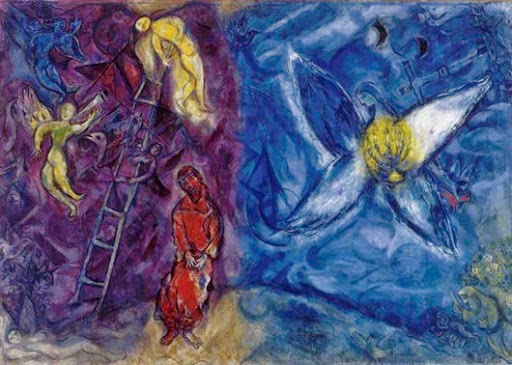
Chagall jacobs dream

A very good friend of mine (CA) lent me a great book about Judaism, entitled “What is a Jew?” and aimed at providing an introduction to a broad variety of aspects of what it means to be Jewish. The book is structured in the form of questions and answers and its tone exudes warmth and a desire to share rather than to impose or indoctrinate. Even before I started reading the book, I was looking forward to learning more about Judaism, both because of a desire to have a better understanding of the religion of several friends of mine, and because of the heightened insistence on a rediscovery of Judaism made by the Catholic Church since Vatican II.

John Paul II was famously the first pope to visit a synagogue, during which visit he spoke with clarity and warmth about the relationship between Christianity and Judaism:

“The Jewish religion is not ‘extrinsic’ to us, but in a certain way is ‘intrinsic’ to our own religion. […] With Judaism, therefore, we have a relationship which we do not have with any other religion. You are our dearly beloved brothers, and, in a certain way, it could be said that you are our elder brothers.”

Benedict XVI went on to maintain very strong relationships with Judaism, both acknowledging the Church’s past wrongs and expressing its gratitude and debt to the Jewish people:

“Abraham, father of the people of Israel, father of faith, has become the source of blessing, for in him ‘all the families of the earth shall call themselves blessed.’ The task of the Chosen People is therefore to make a gift of their God – the one true God – to every other people. In reality, as Christians we are the inheritors of their faith in the one God. Our gratitude therefore must be extended to our Jewish brothers and sisters who, despite the hardships of their own history, have held on to faith in this God right up to the present and who witness to it…”

Finally, Pope Francis has not only continued along the direction indicated by his predecessors, but has also benefitted from close personal friendships with the Jewish community. An example of this is the book – “On Heaven and Earth” that he co-authored with Rabbi Abraham Skorka, who also accompanied him on his recent visit to Israel and who has been a frequent visitor at the Vatican. Pope Francis has also reiterated, in his apostolic exhortation Evangelii Gaudium, the brotherly relationship that his predecessors have stressed:

“We hold the Jewish people in special regard because their covenant with God has never been revoked, for “the gifts and the call of God are irrevocable” (Rom 11:29). The Church, which shares with Jews an important part of the sacred Scriptures, looks upon the people of the covenant and their faith as one of the sacred roots of her own Christian identity (cf. Rom 11:16-18). As Christians, we cannot consider Judaism as a foreign religion; nor do we include the Jews among those called to turn from idols and to serve the true God (cf. 1 Thes 1:9). With them, we believe in the one God who acts in history, and with them we accept his revealed word. Dialogue and friendship with the children of Israel are part of the life of Jesus’ disciples. […] While it is true that certain Christian beliefs are unacceptable to Judaism, and that the Church cannot refrain from proclaiming Jesus as Lord and Messiah, there exists as well a rich complementarity which allows us to read the texts of the Hebrew Scriptures together and to help one another to mine the riches of God’s word. We can also share many ethical convictions and a common concern for justice and the development of peoples.” (§247-9)

Against this background I was particularly pleased to see the relationship between Christianity and Judaism described by Rabbi Morris Kertzer in “What is a Jew?” as follows:

“[The] German dramatist, Gotthold Ephraim Lessing, caught the essence of this common heritage [of Judaism and Christianity] in a play called Nathan, the Wise. One of the most memorable scenes depicts a meeting between a friar and the Jew Nathan. Moved by the beauty of Nathan’s character, the friar exclaims, “Nathan! Nathan! You are a Christian!” His friend replies, “We are of one mind, for that which makes me, in your eyes, a Christian, makes you, in my eyes, a Jew!”” (pp. 279)

I have to say that this paragraph from the last pages of the book very much rang true for me and expressed with accuracy the feeling I had as I made my way through the whole book. To give you a sense of what triggered such a recognition of what I believe to be very much mine in Rabbi Kertzer’s description of Judaism, I will share a number of excerpts from it next.

To begin with, the mystical tradition in Judaism, and its propensity to expressing itself by means of short stories reminded me immediately of the stories told about the Desert Fathers (and also about Zen kōans and the stories of the Sufi Mullah Nasrudin):

““Rabbi,” one of the disciples complained, “some of the congregants are gossiping in the midst of prayer!” “How wonderful are your people, O God,” The rabbi retorted. “Even in the midst of gossip, they devote a few moments to prayer!”

“Can you tell me, Rabbi, why the wicked are always looking for companions while the righteous are not?” “The answer is simple: The wicked walk in darkness, so are anxious for company. Good people walk in the light of God; they don’t mind walking alone.”” (pp. 21-22)

Next, I was struck by a repeated insistence on orthopraxy, which has a strong tradition in Christianity too:

“Jews are urged to put their religion into action. “Talking is not the main thing; action is,” goes a talmudic maxim, and action includes not just activity within the confines of the Jewish world, but working for the welfare of the larger society in which we live. We call this tikkun olam, meaning the “reparation of world.”” (pp. 30)

And Rabbi Kertzer goes on to recounting the same story about the building of the Tower of Babel that Pope Francis reflects on in his above-mentioned book, and then to presenting a synthesis of principles that resonate very strongly with Christianity too:

“The Rabbis used telling parables to illustrate this point. Why did the Tower of Babel crumble? Because the leaders of the project were more interested in the work than in the workers. When a brick fell to earth, they would pause to bewail its loss; when a worker fell they would urge the others to keep on building. The brick was more important than the human being. So God destroyed the imposing edifice. […]

Basic to Judaism are these fundamental principles, which are also basic to democracy: 1) God recognizes no distinction among us  on the basis of creed, color, gender, or class; all of us are equal in God’s sight. 2) We are all our brother’s and sister’s keepers; we bear responsibility for our neighbors’ failings as well as for their needs. 3) All of us, being made in God’s image, have infinite capacity for doing good; therefore the job of society is to evoke the best that is in each of us. 4) Freedom is to be prized above all things; the very first words of the Ten Commandments depict God as the Great Liberator: “I am the Eternal your God who brought you out of the land of Egypt.”” (pp. 31)

A couple of questions later, Kertzer then sets out an understanding of Scripture that could have come from the Vatican II dogmatic constitution Dei Verbum:

“[M]ost Jews look upon the accounts of miracles as inspiring literature, rather than as actual historical events. That is to say, we do not necessarily accept older interpretations of their significance, since an important lesson for the fifth century may be unimportant in the face of today’s spiritual questions; but we do use these tales as sources of inspiration ourselves, trying to draw religious lessons from the text, even the text of an event that may not be literally true. God did not create the world in precisely six days, just as the biblical text insists, but we can learn lessons for our lives from such stories as the Garden of Eden or the Tower of Babel.” (pp. 45)

On the subject of death and the Kaddish prayer, the book presents a profoundly beautiful reflection by Rabbi Steinberg:

“It is easier for me to let go of life with all its treasures, because these things are not and never have been mine. They belong to the Universe and the God who stands behind it. True, I have been privileged to enjoy them for an hour but they were always a loan to be recalled.

And I let go of them the more easily because I know that as parts of the divine economy they will not be lost. The sunset, the bird’s song, the baby’s smile, the thunder of music, the surge of great poetry, the dreams of the heart, and my own being—all these I can well trust to the God who made them. There is a poignancy and regret about giving them up, but no anxiety. When they slip from my hands they will pass to hands better, stronger, and wiser than mine.

Life is dear; let us then hold it tight while yet we may. But we must hold it loosely also! It is at once infinitely precious and yet a thing lightly to be surrendered. Because of God, we clasp the world, but with relaxed hands; we embrace it, but with open arms.” (pp. 67)

The juxtaposition of an enjoyment of the beauty of the universe and a detachment from it leads to an experiencing of everything in relationship with and gratitude to God:

“Because of its innate trust in both God and God’s world, Judaism affirms the value of life and life’s pleasures. It is therefore a religion that urges us to pay attention to the wonderful universe about us. To help us do so, it provides blessings for all of life’s bounties: seeing a rainbow; experiencing a thunderstorm; observing the first blossoms of springtime; putting on new clothes; even eating our first garden produce, as each crop ripens year after year.” (pp. 85)

That the above relationship with God is not simply an individual matter is shown clearly through the concept of minyan, which also reminded me of Jesus’ promise of his presence where “two or three” are gathered together in his name:

“Personal prayer between the individual and God may take place anywhere, any time, and with no one present but God and the individual worshiper. Public services, however, have traditionally required what is known as a minyan, that is, the presence of at least ten adult worshipers. […] Behind the idea of a minimum number is the notion that Jewish spirituality is in some sense communal. We all received the Torah together on Mount Sinai. We are all part of the people Israel.” (pp. 86)

Kertzer then goes on to presenting a simultaneous openness to diversity and faithfulness to God, that has echoes in the Church’s desire for “unity in diversity”:

“Our experience with diverse cultures has enriched our religion in many ways. Above all, perhaps, has been our hospitality to differences. Every question of Jewish law contains both an austere interpretation and a liberal one, and the Rabbis ruled that “both opinions are the word of the living God.” […] One famous rabbinic aphorism pictures God as saying, in effect, “As long as Jews do My will, they need not believe in Me.” That is an exaggeration, of course. Judaism does teach some beliefs, among them the firm conviction that God is real: a real presence in the lives of men and women, children and adults. We can know that reality as surely as we know the beauty of love, the satisfaction of faithfulness, or the buoyancy of hope.” (pp. 108)

In more specific terms, the three pillars of the Jewish faith are presented next, and unity among them is declared:

“We believe, then, in God: a personal God whose ways may be beyond our comprehension, but whose reality makes the difference between a world that has purpose and one that is meaningless.

We believe all human beings are made in God’s image; our role in the universe is thus uniquely important, and despite the failings that spring from our mortality, we are endowed with infinite potential for goodness and greatness.

We believe too that human beings actualize their potential as part of a community. The people Israel is such a community, harking back to Sinai, existing despite all odds from then until now, and still the source of satisfaction for Jews who wish to pursue a life of purpose grounded in the age-old wisdom we call Torah.

And we believe in Torah, therefore, as a continuing source of revelation.

It has been said that you can sum up Jewish belief in these three words, God, Torah, Israel. As the mystics used to say, “God, Torah, and Israel are all one.” If we lose our faith in any one of them, the others quickly perish. […]

In antiquity, it was common for scholars to distill the essence of religion in a simple formula. Thus, Hillel, the great Rabbi and scholar of the first century B.C.E., was asked to sum up Judaism while the questioner stood on one foot! Hillel replied: “Certainly! What is hateful to you, do not do to your neighbor. That is all there is in the Torah. All the rest is mere commentary. I suggest you study the commentary.”” (pp. 109)

The transcendence of God, the universal access to following Him and its being rooted in a putting into practice of His qualities brings the exposition of the Jewish faith to completion:

“Jews believe in the existence of a God who cannot be accurately conceived, described, or pictured. But God is a real presence in the universe at large; and the lives of each of us in particular. We believe also that we most genuinely show God honor when we imitate the qualities that are godly: As God is merciful, so we must be compassionate; as God is just, so we must deal justly with out neighbor; as God is slow to anger, so we must be tolerant in our judgment.” (pp. 110)

“It is the recognition of the reality of God, and the basic moral virtues, such as kindliness, justice, and integrity, that we regard as eternal verities. But we claim no monopoly on these verities, for we recognize that every great religious faith has discovered them. That is what Rabbi Meir meant some eighteen centuries ago, when he said that a non-Jew who follows the Torah is as good as our high priest.” (pp. 113)

Finally, Kertzer also speaks very powerfully about the necessity of remembering the horrors of the Shoah:

“[T]he moral reason [to remember the Shoah] may be the most important one. When the mass murderer Adolf Eichmann was on trial, the Israelis informed the world that the motive behind the judicial proceedings was not vengeance but the moral education of contemporary women and men. The striking thing about Eichmann was precisely that he was so ordinary, a living symbol of what historian Hannah Arendt called “the banality of evil.” Contemplating the events of the Nazi era, we came to see that the sin of omission on the part of the decent peoples of the world was the sin of silence, the refusal to believe that a highly enlightened people like the Germans could permit themselves to be led by a madman into acts of national depravity that culminated in the events of Auschwitz and the other death camps. We had to learn to readjust our vision and take evil seriously once again.” (pp. 161)

Not only is it essential to pursue the doing of good, but so is a taking seriously of evil and a standing up to it, since omission and silence too are grave sins – insights that are of acute relevance today and that were at the time of the Shoah also shared by Christians. The Lutheran theologian Dietrich Bonhoeffer, whose anniversary of being murdered in the Flossenbürg concentration camp in 1945 was yesterday, said:

“Silence in the face of evil is itself evil:
God will not hold us guiltless.
Not to speak is to speak.
Not to act is to act.”
Holy See at Venice Biennale: The Word became flesh

Following its first participation in the Venice Biennale two years ago, the Holy See returns this year with the continuing “desire to re-establish dialogue between art and faith” (Card. Gianfranco Ravasi). The theme this year is: “In the beginning … the Word became flesh,” where the focus is on encounters:1

“[T]he transcendent Word that is “in the beginning”, and, at the same time, reveals the dialogical and communicative nature of the God of Jesus Christ (John 1:1-5), and the Word that becomes “flesh”, body, to bring the presence of God into the essence of humanity, above all where it appears injured and suffering (John 1:14).”

Cardinal Ravasi continues with an exposition of the theme by highlighting the parable of the Good Samaritan:

“The return to immanence is expressed in almost visual terms in the parable of the Good Samaritan, which is taken up in this context as a further thematic suggestion completing the perspective. The pages of the Gospel of Luke offer the image of a God present within a humanity harassed in its human condition. The God made flesh aids the injured man, marked by death and fragility.

The “vertical-transcendent” dimension of the Logos and the “horizontal-immanent” one of the “flesh” are, in this sense, the axes of inquiry. These, including their “intersections”, need to be referred to for an understanding of the individual pieces, of the dialogue that they weave among themselves within the exhibition space.”

Micol Forti, curator of the Holy See pavilion and head of the Vatican Museums’ contemporary art collection, expresses her vision of the theme in particularly vibrant terms:

“There are two poles around which the project for the Pavilion of the Holy See revolves and takes shape: the Logos and the flesh. The Logos establishes a relationship, a harmony, a mediation; the flesh imposes an immanence, a track, a process of in-carnation.

Their inseparable link brings about a dialectic dynamism, irregular, elliptical, abruptly accelerating, precipitously slowing down, to solicit in the artists as in the public, a reflection on a twinning that is at the root of humanity itself.”

Forti then proceeds to introduce this year’s choice of artists – a choice she characterizes as having resulted from risk-taking – two women and one man, all in the early stages of their artistic practices, and all from places that merit the label “peripheral.”

Monika bravo

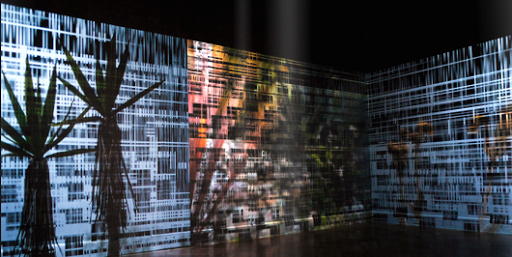
The Colombian multi-disciplinary artist, Monika Bravo, presents “a narrative that is assembled and reassembled on six screens and as many transparent panels, placed on strongly colored walls. In every composition, Nature, Word – written and spoken – and artistic Abstraction present themselves as active elements of a heuristic vision, open to a degree of experimental uncertainty in the development of a new perceptual space and of a sensory fullness, through the gracefulness and poetic “manualness” with which the artist uses technological media.”

Elpida

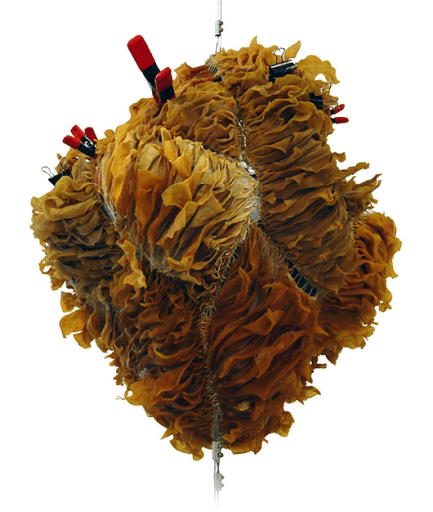
The Macedonian site-specific installation artist, Elpida Hadzi-Vasileva, “blends artisanal abilities, scientific knowledge and a powerful aesthetic vision. She has designed a monumental architectural installation for the Pavilion, whose “fabric,” almost a skin, a mantle, welcomes visitors both in a physical and symbolic dimension at the same time. Made with organic waste materials, in a way that leads from the ready-made to the re-made, the artist creates a cloth that is both an embroidery and a surface, a physical presence and transparency, an instrument of suggestion and surprise.”

Macilau

And finally, the Mozambican photographer Mário Macilau, presents a “series of nine black and white photographs, taken in Maputo, the capital of Mozambique, […] dedicated to the street children who, while still little find themselves facing life as survival. This is not a documentary, but a poetic work that brings the connections between the Now and the Already passed, the Near and the Far, the Visible and the Non-visible. The theme of the origin and the end of each artistic act is carried by the power of photographic composition in confrontation with the agony of the real.”

I believe, this year’s offering of the Holy See pavilion is again an excellent one and both well-balanced, with a representation of video, installation, sculptural and photographic art, and daring, in the choice of artists brought together to represent the Catholic Church at this important event in the art world. It is further confirmation that the Vatican is becoming serious again about engaging with contemporary art and that – to my mind – is essential.


1 Note that the quotes here are from the press kit provided by the Holy See, but that they are a re-translation from the Italian original instead of a use of the official English translation as is.

A marriage and family questionnaire

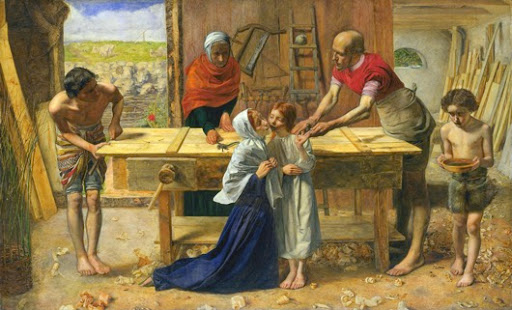
John Everett Millais Christ in the House of His Parents `The Carpenter s Shop Google Art Project s

Ahead of this October’s Synod on the Family, the Bishops of England and Wales have published a questionnaire about marriage and the family, in line with the recommendations issued at the end of last year’s Extraordinary Synod on the same subject. If you reside in England or Wales, I would very much encourage you to complete it, and if you live elsewhere, you might like to find out whether your local bishops’ conference is doing something similar.

Finally, in case you are interested, I would also like to share my own responses to this questionnaire, which I found to be a good opportunity for stopping and reflecting (although not in one go, obviously – I wrote these lines while taking a break from a basketball game with my sons, later while having a couple of minutes to myself before a supper and finally while waiting for a flight – continuity, sadly, is the stuff of fairytales :).

What are your joys and hopes of marriage and family life today?

To me the greatest source of joy with regard both to the family and marriage is the warmth and tenderness that can be experienced there. The family is where all its members can be free to express themselves unreservedly, to share their joys and sorrows, to develop their love for others and to know that their welcome by all in the family is unconditional. It is a place where difficulties can be overcome without judgment and where successes can be shared without envy. Above all though, marriage and the family are an openness to participating in the life of the Trinity: in mutual self-giving, in loving and being loved, that invite Jesus’ presence among those gathered together in His name

What are your struggles and fears of marriage and family life today?

The struggles and challenges that each member of a family faces individually are also a challenge for the family as a whole. Self-centeredness, isolation, indifference, consumerism, a lack of concern for the poor and a tendency to see what distinguishes at the expense of what unites are all prominent dangers. What makes them worse is if they are faced individually and without the benefit of the family or the relationship between spouses. And what makes them even more serious is if a family closes itself, instead of sharing its warmth and tenderness with those around it, if it only looks inside, instead of recognising the presence of God in all around them. These are the greatest dangers and fears I see today. 

How can we better understand marriage as a vocation?

By first understanding and responding to the vocation that follows from baptism and that consists in participation in Christ’s priestly, prophetic and royal nature. Only then can the membership in the mystical body of Christ that the Eucharist gives life to and the access to the Holy Spirit that follows from confirmation be understood and lived. And only on the basis of a conscious experience of these sacraments can an understanding of the sacramentality and vocational nature of marriage be understood and its choice, instead of the choice of other vocations, be discerned and made in alignment with the will of God. Both the putting into practice of the Gospel and a life-long learning of the faith are indispensable here.

  How does your marriage enrich you?

This is a question akin to asking about the benefits derived from oxygen. Getting married is an existential transformation that is followed by a new, joint being where the spouses are one. It is a monologue becoming dialogue, an individual participating in communion and a one that is not alone. It is a complementarity that is not self-sufficient or self-fulfilling but oriented towards God and neighbours instead. 

How does your family life enrich those around you?

This question would better be addressed to those around my family, while for us it is more of an examination of conscience. I hope those around us feel welcomed by us as they are and feel that we understand and don’t judge them. If we keep Jesus’ words and He makes His home with us, I hope we are able to share Him with those whom we meet. 

In what way, through the abiding presence of God, is your family “salt of the earth and light to the world,” and a place of and for handing on our faith?

By placing the Gospel at the heart of our family’s life: as a guiding light and explicit interpretative key for the events in our family and the world at large, as the motivation for our actions, as a mirror in which to identify our failings and as the inspiration for starting again and again with putting it into practice. 

Do you have any other comments?

I would like to express my wholehearted agreement with and support for Pope Francis’ words at the close of last year’s Extraordinary Synod on the Family, where he emphasised the need for the Church to be open to all, not ashamed of the wounds of our fallen brothers and sisters, and be “[t]he Church that has doors wide open to receive the needy, the repentant and not only the righteous or those who think they are perfect!”

Being body in spirit

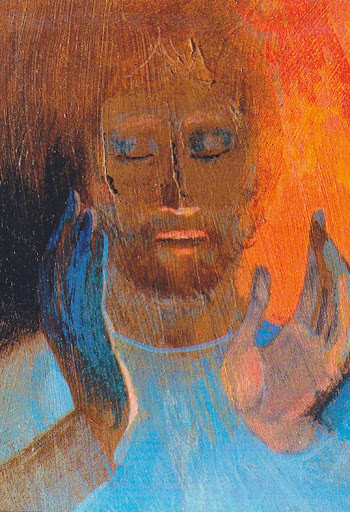
Le christ arcabas

Last Saturday at mass, I heard something along the following lines during the sermon: “We need to look after our souls more than after our bodies, since our souls are eternal and our bodies will be discarded at the end of our lives.” While the intention behind this statement may have been good, and was set in the context of the priest noting that only around 1% of those who attend mass come to confession in his parish, the suggestion of the body being secondary and only temporarily attached to the soul certainly wasn’t in keeping with the Church’s teaching. Since such dualist views are not uncommon and since I have heard them attributed to Catholicism by some friends of mine, I would here like to take a closer look at what the Catholic Church actually teaches about this topic.

Originally I was going to look at the question of how the body and soul are understood in a broader way, with a look at Scripture, a mention of St. Francis of Assisi, a glimpse at the counter-reformation and then examples from Pope Francis’ teaching (e.g., his insistence on the importance of touching the flesh of the poor and suffering), I will instead stay monographic and focus on what St. John Paul II wrote on the subject in his “Man and Woman He Created Them.” As soon as I went back to that book and started re-reading the relevant passages I realized that all of what I wanted to bring into play is there and is expressed crisply and sharply.

To being with, John Paul II’s point of departure is that of humans1 being made in the image of God and therefore being a “primordial sacrament”:

“Man appears in the visible world as the highest expression of the divine gift, because he bears within himself the inner dimension of the gift. And with it he carries into the world his particular likeness to God, with which he transcends and also rules his “visibility” in the world, his bodiliness, his masculinity or femininity, his nakedness. […] Thus, in this dimension, a primordial sacrament is constituted, understood as a sign that efficaciously transmits in the visible world the invisible mystery hidden in God from eternity. And this is the mystery of Truth and Love, the mystery of divine life, in which man really participates. In the history of man, it is original innocence that begins this participation and is also the source of original happiness. The sacrament, as a visible sign, is constituted with man, inasmuch as he is a “body,” through his “visible” masculinity and femininity. The body, in fact, and only the body, is capable of making visible what is invisible: the spiritual and the divine. It has been created to transfer into the visible reality of the world the mystery hidden from eternity in God, and thus to be a sign of it.”

Note how John Paul II does not say “he has a body” but “he is a body” and that the sacramentality of humans consists in their being a “visible sign” of God’s presence in the world. Unlike other sacraments, humans are conscious of their being so and therefore become subjects rather than objects:

“Consciousness of the gift conditions in this case “the sacrament of the body”: in his body as man or woman, man senses himself as a subject of holiness. With this consciousness of the meaning of his own body, man, as male and female, enters into the world as a subject of truth and love.”

The body’s origins (as gift from God and God’s visible sign in the world) and function (as “subject of holiness”) already point to it’s being a lasting and intrinsic part of what it is to be human:

“[W]e draw a first hope already from the mystery of creation: namely, that the fruit of the divine economy of truth and love, which revealed itself “at the beginning,” is not Death, but Life, and not so much the “destruction of the body of man made in the image of God,” but rather the “call to glory” (Romans 8:30).”

And it is Jesus’ resurrection that seals the deal:

“The resurrection, according to Christ’s words reported by the Synoptics, means not only the recovery of bodiliness and the reestablishment of human life in its integrity, through the union of body and soul, but also a wholly new state of human life itself.”

It is often said that all philosophy is a conversation between Plato and Aristotle, and the body-soul question seems to be no different. John Paul II here clearly aligns Christianity and Catholic teaching with Aristotle and later with Thomas Aquinas:

“Reflection about the resurrection led Thomas Aquinas in his metaphysical (and simultaneously theological) anthropology to abandon Plato’s philosophical conception on the relation between the soul and the body and to draw near to Aristotle’s view. In fact, the resurrection attests, at least indirectly, that in the whole of the human composite, the body is not, contrary to Plato, only temporarily linked with the soul (as its earthly “prison,” as Plato maintained), but that together with the soul it constitutes the unity and integrity of the human being. This is precisely what Aristotle taught, in contrast to Plato. When St. Thomas in his anthropology accepted Aristotle’s conception, he did so because he considered the truth about the resurrection. In fact, the truth about the resurrection clearly affirms that man’s “eschatological perfection and happiness cannot be understood as a state of the soul alone, separated (according to Plato, liberated) from the body, but must be understood as the definitively and perfectly “integrated” state of man brought about by such a union of the soul with the body that it definitively qualifies and assures this perfect integrity.”

Siding with Aristotle here is firmly on the basis of the resurrection, which brings about the original harmony that was created by God “in the beginning”:

“In the resurrection, the body will return to perfect unity and harmony with the spirit: man will no longer experience the opposition between what is spiritual and what is bodily in him. [… It is] not only that the spirit will master the body, but, I would say, that it will also fully permeate the body and the powers of the spirit will permeate the “energies of the body.””

John Paul II is quick to insist on the resurrection not having resulted in victory of spirit over body, a subjugation, but in participation and personal fulfillment:

“In fact, in the composite, psychosomatic being that is man, perfection cannot consist in a reciprocal opposition of the spirit and the body, but in a deep harmony between them, in safeguarding the primacy of the spirit. In the “other world,” this primacy will be realized, and it will be manifested in a perfect spontaneity without any opposition on the part of the body. Nevertheless, this should not be understood as a definitive “victory” of the spirit over the body. The resurrection will consist in the perfect participation of all that is bodily in man in all that is spiritual in him. At the same time, it will consist in the perfect realization of what is personal in man.”

This also very much echoes Giuseppe Maria Zanghí’s thought on how our being in God does not annihilate us, is not a victory over us, but instead:

“I can be myself in Him (being an intimate participant of Trinitarian life in the Word), while being really distinct from Him (by virtue of being a creature different from Him). It is His love that wants me, and the love of God does not withdraw into itself, canceling diversity with the other by totally reverting it to Himself, but “makes” the other and guards them in diversity from Himself, not wanting to possess (like He doesn’t possess Himself) in total reabsorption. […] Because the relationship between the two “opposing” extremes (I and the other, I and God) is still thought of as ending in one of the two (and, therefore, in the strongest!); while, if Christian faith is true, the relationship does not end in either of the mediated extremes, but in a third that saves them precisely in their diversity.”

And – as far as the body-soul relationship is concerned, I believe Zanghí’s “third” is precisely John Paul II’s “resurrection.”


1 In my own words I will use the somewhat awkward “humans” to refer to both men and women, while in the quotes from John Paul II’s writings there will be reference to “man.” Note, however, that John Paul II means “human” when his words are rendered as “man” in English, which is explicit from the full text of “Man and Woman He Created Them” and also reflects the fact that in Polish he uses the word “człowiek” which also refers to both men and women and is used in everyday language without the technical connotations that “human” has in English.

Romero: disobey false absolutes

Romero

After a tumultuous process following his martyrdom, Oscar Romero is finally due to be beatified on 23rd May in San Salvador, where he served as archbishop and where he was assassinated by a member of a death squad on 24th March 1980. Instead of writing about his life,1 I would like to share some of his own words with you, from his pastoral letters, homilies and diaries.

Starting from his pastoral letters, there is a strong sense of the social dimension of Christianity, which grows from and is interconnected with individual choices:

“Throughout the centuries the Church has, quite rightly, denounced sin. Certainly she has denounced personal sins, and she has also denounced the sin that perverts relationships between persons, especially at the family level. But she has begun to recall now something that, at the Church’s beginning, was fundamental: social sin – the crystalization, in other words, of individuals’ sins into permanent structures that keep sin in being, and make its force to be felt by the majority of the people.” (2nd pastoral letter, 1977)

In the same pastoral letter, Romero’s response to the “crystalization” of personal sin into “structures of sin” is a call to an authentic, present-day, up-to-date Christianity that understands tradition like Vatican II does – as being alive:

“To remain anchored in a non-evolving traditionalism, whether out of ignorance or selfishness, is to close one’s eyes to what is meant by authentic Christian tradition. For the tradition that Christ entrusted to his Church is not a museum of souvenirs to be protected. It is true that tradition comes out of the past, and that it ought to be loved and faithfully preserved. But it has always a view to the future. It is a tradition that makes the Church new, up to date, effective in every historical epoch. It is a tradition that nourishes the Church’s hope and faith so that she may go on preaching, so that she may invite all men and women to the new heaven and new earth that God has promised (Revelation 21:1; Isaiah 65:17).”

Next, Romero moves on to emphasizing the non-legal, non-rule-based nature of faith and instead presents a model of participation in the person of Christ, as St. Paul did:

“The Church’s foundation is not to be thought of in a legal or juridical sense, as if Christ gathered some persons together, entrusted them with a teaching, gave them a kind of constitution, but then himself remained apart from them. It is not like that. The Church’s origin is something much more profound. Christ founded the Church so that he himself could go on being present in the history of humanity precisely through the group of Christians who make up his Church. The Church is the flesh in which Christ makes present down the ages his own life and his personal mission.”

This is an idea that he returned to in a meditation later that year, which also foreshadows Pope Benedict XVI’s introduction to the 2012-13 Year of Faith:

“How I would like to engrave this great idea
on each one’s heart:
Christianity is not a collection of truths to be believed,
of laws to be obeyed,
of prohibitions.

That makes it very distasteful.
Christianity is a person,
one who loved us so much,
one who calls for our love.
Christianity is Christ.” (November 6, 1977)

Romero continues in his second pastoral letter with making the link between the Church’s authenticity and her being the Body of Christ:

“That is how changes in the Church are to be understood. They are needed if the Church is to be faithful to her divine mission of being the Body of Christ in history. The Church can be Church only so long as she goes on being the Body of Christ. Her mission will be authentic only so long as it is the mission of Jesus in the new situations, the new circumstances, of history. The criterion that will guide the Church will be neither the approval of, nor the fear of, men and women, no matter how powerful or threatening they may be. It is the Church’s duty in history to lend her voice to Christ so that he may speak, her feet so that he may walk today’s world, her hands to build the kingdom, and to enable all its members to make up all that has still to be undergone by Christ (Colossians 1:24).”

And again it is a theme he picks up in a mediation around a year later, which is also an examination of conscience:

“Christ became a man of his people and of his time:
He lived as a Jew,
he worked as a laborer of Nazareth,
and since then he continues to become incarnate in everyone.

If many have distanced themselves from the church,
it is precisely because the church
has somewhat estranged itself from humanity.
But a church that can feel as its own all that is human
and wants to incarnate
the pain,

the hope,

the affliction
of all who suffer and feel joy,
such a church will be Christ loved and awaited,
Christ present.
And that depends on us.” (December 3, 1978)

What does a Church that has not become estranged from humanity and that lends “her feet so that he may walk today’s world” look like? Romero here points to the Matthean questions and updates them to his own time and place:

“There is one rule
by which to judge if God is near us
or is far away –
the rule that God’s word is giving us today:
everyone concerned for the hungry,
the naked,
the poor,
for those who have vanished in police custody,
for the tortured,
for prisoners,
for all flesh that suffers,
has God close at hand.” (February 5, 1978)

Returning to his second pastoral letter, Romero also underlines the non-negotiability of Jesus’ command – even in the face of aggression directed against the Church – to love one another has He has loved us and for that “another” to include our enemies:

“The Church has never incited to hatred or revenge, not even at those saddest of moments when priests have been murdered and faithful Christians have been killed or have disappeared. The Church has continued to preach Jesus’ command love one another (John 15:12). This is a command that the Church cannot renounce, nor has she renounced it, not even in recent months. On the contrary, she has recalled that other command, pray for those who persecute you (Matthew 5:44).”

Such conduct is anything but plain sailing though and is both a thorn in the side of those who seek wealth and power for themselves and a pretext for accusations being leveled against the Church (still from Romero’s second pastoral letter):

“The Church is not dedicated to any particular ideology as such. She must be prepared to speak out against turning any ideology into an absolute. As several of the Latin American hierarchies have said time and again in recent years, worldly interests try to make the Church’s position seem Marxist when it is in fact insisting on fundamental human rights and when it is placing the whole weight of its institutional and prophetic authority at the service of the dispossessed and weak.”

What struck me in the above was also Romero’s denunciation of the absolutization of ideologies, where it is not hard to see examples of this happening also today, and I was glad to see him return to this point and expand on it in his fourth (and final) pastoral letter as the Archbishop of San Salvador. There, his point of departure is an acclamation of transcendence, which he – interestingly – links to critical thinking and which he puts in opposition against the absolutization of human (limited) values:

“As well as offending God, every absolutization disorients, and ultimately destroys, human beings. It is the vocation of human beings to raise themselves to the dignity of the children of God and to participate in God’s divine life. This transcendence of human beings is not an escape from problems here on earth, still less is it an opium that distracts them from their obligations in history. On the contrary, by virtue of this transcendent destiny people have the capacity to always remain critical vis-a-vis the events of history. It gives them a powerful inspiration to reach out to ever higher goals. Social forces should hearken to the saving voice of Christ and of true Christians, cease their questioning, and open themselves to the values of the one and only Absolute. When a human value is turned into an absolute and endowed, whether in theory or in practice, with a divine character, human beings are deprived of their highest calling and inspiration. The spirit of the people is pushed in the direction of a real idolatry, which will only deform and repress it.”

Next, he applies the analysis of absolutization to two contexts, the first of which is wealth:

“The absolutization of wealth holds out to persons the ideal of having more and to that extent reduces interest in being more, whereas the latter should be the ideal for true progress, both for the people as such and for every individual. The absolute desire of having more encourages the selfishness that destroys communal bonds among the children of God. It does so because the idolatry of riches prevents the majority from sharing the goods that the Creator has made for all, and in the all-possessing minority it produces an exaggerated pleasure in these goods.”

Second, he looks at national security with the same optics – a topic of acute relevance also in today’s world:

“By virtue of [the absolutization of national security], the individual is placed at the total service of the state. His or her political participation is suppressed, and this leads to an unequal participation in the results of development. Peoples are put into the hands of military elites, and are subjected to policies that oppress and repress all who oppose them, in the name of what is alleged to be total war. The armed forces are put in charge of social and economic structures under the pretext of the interests of national security. Everyone not at one with the state is declared a national enemy, and the requirements of national security are used to justify assassinations, disappearances, arbitrary imprisonment, acts of terrorism, kidnappings, acts of torture … [all] indicate a complete lack of respect for the dignity of the human person (Puebla #1262).”

It is not hard to see from all of the above why Archbishop Vincenzo Paglia, the postulator of Oscar Romero’s cause for beatification, characterized him by saying: “Romero is truly a martyr of the Church of Vatican II, a Church, as Pope John used to say, who is mother of all, but in particular of the poor.” Everything I have read by him was steeped in the Gospel and in its reading today through the eyes of Vatican II. It is also for this reason that Paglia referred to Romero as the “proto-martyr” of contemporary martyrs.

No account of a martyr’s thought would be complete without including the words pertaining to his own martyrdom, which is a culmination of a life of imitating Christ. Here, Romero was acutely aware of the risk to his own life, which can be readily seen from an interview he gave just days before being shot at long range while celebrating mass:

“You can tell the people that if they succeed in killing me, that I forgive and bless those who do it. Hopefully, they will realize they are wasting their time. A bishop will die, but the church of God, which is the people, will never perish.” 

In spite of the severe threats to his life, even on the day before his death, Romero spoke out against the “structures of sin” that he had been fighting for many years, addressing a group of soldiers:

“Brothers, you came from our own people. You are killing your own brothers. Any human order to kill must be subordinate to the law of God, which says, ‘Thou shalt not kill’. No soldier is obliged to obey an order contrary to the law of God. No one has to obey an immoral law. It is high time you obeyed your consciences rather than sinful orders. The church cannot remain silent before such an abomination … In the name of God, in the name of this suffering people whose cry rises to heaven more loudly each day, I implore you, I beg you, I order you: stop the repression!”


1 For a brief biography of Archbishop Romero, see the one provided by the UN on the website about the “International Day for the Right to the Truth Concerning Gross Human Rights Violations and for the Dignity of Victims,” dedicated to him and held on the anniversary of his martyrdom, the 24th March.

The human and the divine

Patterns of light

Sir Terry Pratchett, who died yesterday and whose books have given me a great deal of joy over the last 20 years, expressed my gut reaction to crowds very well when he said that: “[t]he intelligence of that creature known as a crowd is the square root of the number of people in it.”1 While I don’t have a phobia of crowds, I’d always prefer a walk in a forest over “relaxing” on a packed beach, a stroll around good architecture to queueing at some movie-themed attraction, or a chat with friends in a quiet pub over a party in a sports bar.

These preferences (and prejudices) of mine were again reinforced when I recently spent a weekend at a holiday camp. There was a lot to like about it, no doubt – spending time with my family, a change of environment, clean air, eating out … But it also came with an ample and ready supply of that “creature known as a crowd.” The place was packed to bursting point! My aversion to such an environment was particularly heightened when, at one point, my spouse and younger son left me in a large “leisure pool” and set off to go down some slides.

As I stayed behind in the pool I felt like a sardine who had to be oiled to be squeezed into a tight tin. And I didn’t feel any bonhomie towards my fellow sardines either, I can tell you that for nothing.

Floating there, my mind started wandering and I went back to Cardinal Ravasi’s beautiful piece of thinking on secularity and secularism, and landed on his declaration that Christianity “doesn’t call us to detach ourselves from reality towards mythical or mystical heavens.” The truth of his statement struck me and reminded me of the importance of living neither in the good memories of the past nor in the promises of a potential future, but right here, in the present. As I looked around, it was still the same “creature known as a crowd” that surrounded me, but its individual members now presented an invitation and challenge to me. Can I see them as my brothers and sisters, as the presence of God, or do I let myself be enslaved by my prejudices?

I felt like I was on holy ground (like Pope Francis said to confessors yesterday: “We are ministers of mercy thanks to God’s mercy, and we must never lose this view to the supernatural that makes us truly humble, welcoming and merciful towards every brother and sister who wishes to confess. … Every faithful penitent who approaches the confessional is ‘sacred ground’.”). Ashamed of my self-centeredness, but encouraged by the open arms extended to me in the present moment.

At that point, my mind turned to that extraordinary meditation by Chiara Lubich, the seventh anniversary of whose death it is tomorrow, which she entitled “The great attraction of modern times” and where she wrote:

This is the great attraction of modern times:
to penetrate to the highest contemplation
while mingling with everyone,
one person alongside others.
I would say even more:
to lose oneself in the crowd
in order to fill it with the divine,
like a piece of bread
dipped in wine.
I would say even more:
made sharers in God’s plans for humanity,
to embroider patterns of light on the crowd,
and at the same time to share with our neighbor
shame, hunger, troubles, brief joys.
Because the attraction
of our times, as of all times,
is the highest conceivable expression
of the human and the divine,
Jesus and Mary:
the Word of God, a carpenter’s son;
the Seat of Wisdom, a mother at home.

Thinking about Lubich’s and Ravasi’s words made me realize: Yes, we are not called to a detachment from reality in favor of some heavens in an ephemeral beyond, but to a discovery of those mystical heavens in the reality around us. To a discovery by participation and a facilitation of others’ participation in it with us.


1 Not wanting to nitpick, but I’d adjust Sir Terry’s words along the following lines, to impose a mathematically more severe expression of prejudice against crowds: “The intelligence of that creature known as a crowd is one over the square root of the number of people in it.”

The world: a flowerbed of communion

Klee flowers

Yesterday and today, a fantastic meeting of the Courtyard of the Gentiles – entitled “Renewing the Church in a Secular Age” – is taking place at the Gregorian University in Rome, and it is also being freely live-streamed. Since listening to the opening remarks of the university’s rector, Fr. François-Xavier Dumortier S. J., Fr. George McLean, the President of The Council for Research in Values and Philosophy, and Cardinal Gianfranco Ravasi yesterday, I have been working on a transcript of parts of the first two and pretty much the entirety of the last one, since they struck me as profound and beautiful expressions of the openness and warmth of the Church that I am keen to share with you as soon as possible. I will therefore, in the interest of speed, dispense with my own commentary and reflections, and just offer you the transcript (and coarse translation into English) next:

First, here is the conclusion of Fr. Dumortier’s opening remarks:

“This conference is about the Church in her relationship with the world of today, i.e., with the men and women of today, but also with the societies and cultures of our time. It won’t only be about being at the frontiers that cut through these societies and cultures and our selves too, but about going ahead with confidence and hope in the discovery of God who works mysteriously everywhere and in everyone and who, in some way, calls us to leave behind the certainties we guard too tightly and the places we know too well. This challenge of thinking about our current intellectual and spiritual situation asks for the capacity to go out of the context of our individual specializations, the constraints of our own cultures, from self-referentiality, not so as to confront that which is different and at times far removed, but so as to listen, encounter, understand and learn. It seems to me that such an attitude would indicate a Church that is not afraid of living the newness of the Gospel and that has the audacity of meeting head-on the challenges that permeate cultures today. To recognize when and how human beings are searching for God, which is never a private matter and which is done until the end of self and the end of time. To deepen our current way of humbly bringing the word of God that truly speaks to the hearts and minds of today’s men and women. Desiring to promote a culture of mutual welcome. It is a dialogue that does not despair of anything or anyone. They are challenges that we can now live with the courage and the strength of intelligence, with a generosity of intelligence that broadens the space in which one moves.”

Next, a couple of points made by Fr. McLean, that particularly struck me, where he spoke about a new perspective on secularism, derived from the work of Charles Taylor and Jose Casanova, who

“took on the fallacy that secularity was simply a loss of religion and said: “No!” secularity is a new way of being religious, and he pointed us in the direction that would make that possible. […] There are four things that we need to study: one of them is that of the seekers, that is not that they are against religion or abandoning religion, but they are looking in new ways – can we meet them? Can we find out where they are going? Can we speak to them? This is a new, creative mode of approaching the secular age. And then also the magisterium. How can the magisterium be the guide, the teacher of the new seekers? How can that be done? This is the great challenge for the Church. […] Perhaps there are many different ways in the world today in which people are seeking the divine and responding in their own way. Can we bring those together? Can this be the life of the Church? A creative pastoral responsibility.”

And finally, the main course, Cardinal Gianfranco Ravasi’s superb exposition of two interpretations of the concept “seculum” and the need for dialogue flowing from them:

“I would like to place this word at the center: “seculum”, also because it is directly in the title of this meeting. Seculum, as we know well, generates two meanings and I will build a brief reflection around them that will be more theologically-pastoral in character. The first meaning is a positive meaning: secolo generates secularity, which is a Christian category. Let’s not forget, for example, that “secolo” in New Testament Greek is “aeon”, and “aeon” also has a dimension of eternity. This also holds for the Hebrew “olam” (עוֹלָם) which simultaneously indicates temporality but also a dimension of globality.

[… I’ll start with] secularity as a theological category. I will express the theological form of this category in this case only in an impressionist way, in a simplified way. I’ll express it by means of three components of Christian faith.

The first component is creation. It suffices to listed to these verses from the Book of Wisdom – a book, among other things, of dialogue between the Hebrew and Greek cultures – “[T]he creatures of the world are wholesome; There is not a destructive drug among them.” (Wisdom 1:14). Note: “the creatures of the world.” Second: “For you love all things that are and loathe nothing that you have made.” (Wisdom 11:24).The Lord – lover of life. To the Creator nothing is profane. And this already makes us understand how we must look to totality, we must have an optimistic perspective.

The second component: Jesus is a lay person. He is not a priest. The letter to the Hebrews says so: “It is clear that our Lord arose from Judah, and in regard to that tribe Moses said nothing about priests.” (Hebrews 7:14) But the author of the letter to the Hebrews wasn’t content just with this: “If then he [Jesus] were on earth, he would not be a priest.” (Hebrews 8:4). This aspect, that our founder is a lay person, is truly very significant. Even with all the clarifications that theologians then make.

The third element: Christianity presents a model of the relationship between faith and politics, faith and society, that is extremely significant. because it says no to sacralism, it says no to hierocracy , to integralism and, naturally, it also says no to statolatry, to the negation of any religious component in society.

What is being asserted? An assertion that Christ formulates and on which exegesis has been based for centuries, above all in terms of incarnation. The assertion is precise, and as I often say – it is a tweet that in Greek has only 50 characters, including spaces: “Then repay to Caesar what belongs to Caesar and to God what belongs to God.” (Luke 20:25) There is the recognition that there is a strong autonomy of the image of God that is man, of religion on the one hand, and on the other hand a real autonomy, naturally, of society and the state. Christian religion cannot accept the extraordinary phrase […] “The Temple is my country and my nation, and there is nothing outside it.” (spoken by Joad, the Jewish high priest in Jean Racine’s Athalie). Christianity, instead, recognizes secularity.

I’d now like to conclude with two considerations about secularity. First, secularity is a “locus theologicus”, delicate but real. And it has, fortunately, been considered in various ways during the 20th century. I’d now like to give three examples by just quoting some indicative phrases from these authors whose works I have read.

First, and all know this one and expect me to say his name: Bonhoeffer. Bonhoeffer with his theory of the “mündige Welt” – the adult world, the grown-up world, which, like a young person who becomes emancipated, does not break the links with the family, but has their own autonomy. And the challenge for faith is precisely this: to abandon the theophanic, ex machina God who embraces all reality, in favor of a kenotic God. The God of the cross, who does have his presence, but – you will see – a presence as seed. Not as power.

The second person, whom many will think of as representing fruitfulness, is Gogarten. Gogarten, in his work of 1953, Despair and hope for our time, wrote: “Secularity is the necessary and legitimate consequence of Christian faith.” And here we come to the second topic I would like to address: secularism or secularization. Secularism is a degeneration of secularity because it takes leave of God, radicalizing its own autonomy and canceling the co-presence of the divine. [Gogarten] then continues: “The autonomy of man does not detach itself from God but neither is it sacramentally overpowered.” It is not detached, but it is not crushed either. “The Church must live,” he continues, “in sincere solidarity with the world, without wanting to sacralize it.”

And the third one, obviously, is Rahner. Rahner […], referring to Gaudium et Spes, in his Theological Investigations wrote these words about secularization in 1966 […]: “The Church must and wants to codetermine also the way of the secular world, without, however, wanting to determine it in an integral and doctrinal way.” […] 


Let’s now turn to the second aspect of the word “seculum,” which I’d define as secularism. What symbol could we use to represent secularism? Well, all know it, it is a symbol that has become popular in everyday language […]: disenchantment. The disenchantment of the world. “Entzauberung der Welt.” This phrase, by the way, is not – as all say – by Max Weber, but by Hölderlin. Hölderlin used it in a different sense though, and it is a term that also became popular through a 1985 work of Marcel Gauchet.

So, what are the characteristics of secularism? […] First of all, an emancipation from sacral bonds and subjection, the emancipation from sacral authorities, symbols and institutions. The emancipation from the jurisdiction of the scared. Second, […] the ontological, epistemological, deontological  autonomy from theology. In practice, there is a desire to relegate theology to a sort of protected oasis, but one that is independent of the horizon of knowledge. Also since there is only one subject – humanity, heaven is empty of gods. Another component, which is a consequence of this one, is one I often call the monodicity of knowledge, i.e., knowledge with a single tone, which in the end is the rational/scientific one. As a consequence, what comes to the fore is the scene of the world rather than the foundations of reality. The possibility of transcendence and its own language for approaching it are excluded.

Fortunately, we know that this attitude is now in crisis. We know that our knowledge, that of all – including the simplest person – is polymorphous. When a person, even a scientist, falls in love, they use another channel of knowledge. Esthetics, art … The last component, that I would like to mention, among many examples of secularism, is the phenomenon of the metropolis, of urbanization. This is a component that I take from the work “The secular city” by Harvey Cox from 1975 […] “Urbanization means a structure of life together, in which diversity and the disintegration of traditions dominate.  A kind of impersonality dominates. A certain degree of tolerance and of anonymity that replace traditional moral sanctions and codified knowledge.” You see, even a man from the countryside who arrives in a city, who has his traditions, his morality, when he enters this gray place, loses his identity. […] 


What I think though is that in contemporary secularism there are two pastoral challenges. Two challenges that are also cultural and that are the result of two phenomena, among many other possible ones, in the complex society and culture of today.

The first phenomenon. I’ll label it with a term that I need to explain, because it has been used by some authors already, is: apatheism. Apatheism is the union of apathy and atheism. It is what we often call indifferentism. This is a phenomenon with which, for example, the Courtyard of the Gentiles – this dialogue between believers and non-believers that I am trying to develop – is trying to confront with great difficulty. Because we are in front of a wall of fog. Apathy. A beautiful definition here comes from none other than Diderot in his “Letter on the blind for the use of those who see”, addressed to his atheist friend, Voltaire: “It is very important not to mistake hemlock for parsley, but believing in God or not isn’t.” This is a bit the style of apatheism, which is really problematic and ever more dominant. It doesn’t answer head-on, like Nietzschean atheism, it doesn’t fight faith like atheist regimes do. It ignores God as a stranger. Like a reviewer of Prof. Taylor’s book, Costa, wrote: “If God walked into a square in a contemporary city, he wouldn’t surprise anyone. At most a guard would ask him for his papers.” He’d be asked for his papers because his identity is unknown. God mustn’t interfere in human affairs. He is a stranger. He is not the basis of existential choices. Even transcendence can be recognized but he must remain in the limbo of his transcendence. The times have finished where, de Sade in his “Justine (or The Misfortunes of Virtue)” writes, as an emphatic atheist: “When atheism needs martyrs, it should say so – my blood is ready.” This now would be ridiculous. Atheists today are apatheists. The last ones who are aggressive are a kind of endangered species. Those who feel strongly about atheism. And this relegates religion to insignificance. To uselessness, to irrelevance in history. […]

This situation of apatheism, pastorally, calls out to Christians. I asks Christians why they have not been able to communicate their difference in the face of this indifference. If anything, they have reduced themselves to the minimum, […] they are no longer able to provide answers to key questions and thereby to stimulate questions. Indifferent societies do not love questions. The question, in our languages is represented as something that claws [Ravasi draws a question mark in the air]. Oscar Wilde rightly said that everyone is able to give answers, but it takes genius to ask true questions. A question requires depth and requires tension too. Herein lies the importance of provoking with ultimate truths. Evil. Suffering. The meaning of life. Things that don’t enter into … Also the authenticity of the truth. And we, Christians, have probably lost warmth as far as our lives, our lifestyles go. Let’s recognize it. Very often our communities deserve the condemnation that the Apocalypse launches against the church of Laodicea: “So, because you are lukewarm, neither hot nor cold, I will spit you out of my mouth.” (Revelation 3:16). There are communities lacking any testimony, incoherent. They are no longer the leaven and the yeast of the Gospel.

The second phenomenon that could stimulate us is what I would call polytheism. Which in a nicer way we could express as religious pluralism. We know that already Max Weber in his day spoke about the polytheism of ethical values. Now, however, we have confirmation of this unquestionable phenomenon of a continuous intersection of religions and civilizations. And this phenomenon of a polytheism of more divinities, or more religions leads to three possible reactions as I can see. First, there is fundamentalism. Fear of the other god, of the other culture. Therefore there is aggressive apologetics, self-referential. Islamic fundamentalism is an example of this. It is the choice of pulling out the sword straight-away against the other. Second, there is a reaction that is more alive in Europe. Which is generic syncretism and then apatheism. Inoffensive syncretism. Without identity. The famous poet George Eliot said: “If we lose Christianity, we, Europeans, will no longer be able to understand even Voltaire and Nietzsche. But there is an even worse risk. We will lose our countenance. We will no longer have a face.” Forgetfulness. A loss of memory. Religious memory and also cultural memory, which means that, when faced with fundamentalism, we are in no position to react since we have no identity anymore. Certainly, fundamentalism has an exasperated identity, which is negative too.

So, what is the third way? The third way, evidently, and even though it is demanding, modest and to be carried out with a bowed head, and I have to say that the Church and Pope Francis are going it, is the way of dialogue. Dialogue with all its risks and troubles, inter-religious and intercultural dialogue. What ought this dialogue be like? We could talk about lot about it, but let us just look more closely at the word dialogue.

In its Greek form, and not everyone knows this, it has two meanings. The preposition ‘dia’ has two values – not one. Usually it is said that ‘dia’ is the crossing of two different ‘logoi.’ In reality, ‘dia’ also means a descending into depth. Ideologies have died, but as ideologies died, thought has died with them. We must return to a deepening of our faith, to the foundations, and ask of others that their argumentation be substantial epistemologically and in terms of content. I think that dialogue also means many other things, such as a making oneself close to the other, putting oneself in a position of listening to the other. And this is another very demanding practice. It reminds me of the expression used by John Paul II in his Novo Millennio Ineunte with regard to the Church, which I think ought to become the ideal for humanity too, which share a common basis. He says that we must “make the Church the home and the school of communion.” Here the call is for a humanity that in its diversity manages to share a home which is that of this modest planet. This small flowerbed as Dante Alighieri called it.

In the rabbinical tradition there is a beautiful image, a beautiful aphorism that says: “When men coin money, they do so with a single die, as a result of which all coins are the same. God, too makes men with a single die, yet all men are different.” Dialogue is an arduous, lengthy, maybe eschatological, process of building a shared home. 

To conclude, I would like to pass the word to the Bible, which is to give us a push and the capacity to decipher our own history. The Judaeo-Christian religion is a historical religion. It doesn’t call us to detach ourselves from reality towards mythical or mystical heavens. It is an incarnate religiosity, starting with Christ, who is a great sign. Because of this I would like to remember that stereotype, which has unfortunately become a stereotype, used since conciliar times […]: “the signs of the times.” Signs are important, the signs of power, and I’d say the power of signs is important. And I’ll give the word about this to two fundamental biblical characters, two biblical witnesses: We’ll start with the prophets, where I’ll choose Jeremiah 8:7 “Even the stork in the sky knows its seasons; Turtledove, swift, and thrush observe the time of their return, But my people do not know the order of the LORD.” And now, in the same style, the voice of Christ, who speaks to us from Matthew 16:2-3, using the symbol of meteorological forecasting “In the evening you say, ‘Tomorrow will be fair, for the sky is red’; and, in the morning, ‘Today will be stormy, for the sky is red and threatening.’ You know how to judge the appearance of the sky, but you cannot judge the signs of the times.” 


Asymmetry

Polyhedron2

In Manila, Pope Francis returned to a concept that he first introduced in Evangelii Gaudium – that of the polyhedron being the ideal of social interaction instead of the, seemingly more perfect, sphere. There, speaking about “ideological colonization,” he said:

“[W]hen conditions are imposed by […] colonizing empires they seek to make peoples forget their own identity and make them (all) equal. This is the globalization of the sphere – all the points are equidistant from the center. But the true globalization […] is not the sphere. It is important to globalize […] not like the sphere, but like the polyhedron. Namely that every people, every part, conserves its own identity without being ideologically colonized.”

To make more sense of the sphere-polyhedron distinction, let’s go back to Evangelii Gaudium, where it is presented in the context of strategies for contributing to the common good and peace in society. There, Francis gives preference to time over space (§222-225), unity over conflict (§226-230), realities over ideas (§231-233) and finally the whole over the part. However, he is quick to argue that the part is not negated or subsumed in the whole, but that they mutually enrich each other (§235):

“The whole is greater than the part, but it is also greater than the sum of its parts. There is no need, then, to be overly obsessed with limited and particular questions. We constantly have to broaden our horizons and see the greater good which will benefit us all. But this has to be done without evasion or uprooting. We need to sink our roots deeper into the fertile soil and history of our native place, which is a gift of God. We can work on a small scale, in our own neighborhood, but with a larger perspective. Nor do people who wholeheartedly enter into the life of a community need to lose their individualism or hide their identity; instead, they receive new impulses to personal growth. The global need not stifle, nor the particular prove barren.”

And it is in the context of how the whole and its parts can be thought of without the former stifling the latter that the concept of the polyhedron comes into play (§236):

“Here our model is not the sphere, which is no greater than its parts, where every point is equidistant from the centre, and there are no differences between them. Instead, it is the polyhedron, which reflects the convergence of all its parts, each of which preserves its distinctiveness. Pastoral and political activity alike seek to gather in this polyhedron the best of each. There is a place for the poor and their culture, their aspirations and their potential. Even people who can be considered dubious on account of their errors have something to offer which must not be overlooked. It is the convergence of peoples who, within the universal order, maintain their own individuality; it is the sum total of persons within a society which pursues the common good, which truly has a place for everyone.”

Reading the above, I believe, that the image of a polyhedron also points to another fundamental feature, implicit in the distinction between sphere and polyhedron, which is that of asymmetry.

Purely on geometric grounds, an obvious distinction between a sphere and any polyhedron is that the former abounds in symmetry: an infinity of rotation symmetries around the sphere’s center, an infinity of reflection symmetries with respect to any plane containing the sphere’s center and a central point symmetry, also with respect to its center, not to mention a host of other symmetry groups. On the other hand, a polyhedron, in general, has no guaranteed symmetry whatsoever, where each of its vertices may relate to all the others in a unique way and where even subsets of the polyhedron’s vertices may form geometries distinct from those of other vertex subsets. As a result, the polyhedron formed by a set of vertices, edges and faces is both a unique whole and one whose nature depends on where each one of its components is located, potentially without any symmetry at all. In fact, the absence of symmetry can also be though of as an expression of the non-redundancy of the polyhedron’s parts, since any, even partial symmetries or repetitions would allow for a representation of the polyhedron that no longer requires a reliance on all of its parts. The sphere here represents an extreme, where the infinite continuum of points that form its surface can be reduced just to the coordinates of its center and its radius. Incidentally this line of thinking also resonates with Pope Francis’ early insistence on the importance of peripheries, expressed by him saying that “We understand reality better not from the center, but from the peripheries.” To understand a polyhedron requires traversing its vertices, edges and faces that form its perimeter, while a sphere can be “understood” from its center and radius, since its surface can be inferred from them, without ever being traversed.

Asymmetry not only means that each member is necessary for the identity of the resulting whole, but it is also a principle that is deeply embedded in Jesus’ life and teaching. His incarnation itself is vastly asymmetrical, since it is the infinite, unbounded God making Himself spatiotemporally finite, as is His death on the cross, where his one life is given “so that everyone who believes in him might not perish but might have eternal life.” (John 3:16). The all becomes one to save the many.

Jesus’ teaching too is full of asymmetry, starting with the following, emphatic passage:

“But to you who hear I say, love your enemies, do good to those who hate you, bless those who curse you, pray for those who mistreat you. To the person who strikes you on one cheek, offer the other one as well, and from the person who takes your cloak, do not withhold even your tunic. Give to everyone who asks of you, and from the one who takes what is yours do not demand it back.” (Luke 6:27-30)

In St. Matthew’s account of the same speech, we then hear Jesus adding: “If anyone wants to go to law with you over your tunic, hand him your cloak as well. Should anyone press you into service for one mile, go with him for two miles.” (Matthew 5:40-41).

Love-hate, bless-curse, pray-mistreat, strike-offer, take-give, tunic-tunic+cloak.

And the madness doesn’t stop there! The asymmetrical rewards offered in the parable of the workers in the vineyard have those who have worked a full day complain to the owner: “These last ones worked only one hour, and you have made them equal to us, who bore the day’s burden and the heat.” (Matthew 20:12). The pittance offered by a poor widow is valued above the large sums contributed by the rich (cf. Mark 12:41-44) and asymmetry is also at the heart of Jesus’ exhortation to “be shrewd as serpents and simple as doves” (Matthew 10:16).

Not only are action and reaction, action and reward asymmetrical, but asymmetry is at the very heart of God’s own inner life and at the core of love as such. The gratuity of love and the very concept of a gift hinge on asymmetry. I give without expecting anything in return, for if I did, my gift would not be a gift at all, but – at least implicitly – an exchange, a transaction, a symmetrical process. In the Trinity the Father gives all of Himself to the Son, without holding back or without requiring prior guarantees of equal recompense. The Son too gives Himself to the Father unreservedly and totally, making Himself nothing to Himself and all as gift to the Father. The Holy Spirit makes Himself empty unconditionally to allow for the love of the Father and the Son to find space in Him. Each Person of the Trinity is ultimately asymmetrical: a gift of self outside oneself, for the other; nothing and everything. It is only on this asymmetry that Father, Son and Holy Spirit are one – a one that is dynamic (instead of being static), varied (instead of being monotonous) and communion (instead of being regimented).

A consequence of the asymmetry of love is also a difference in what to expect of oneself versus others. For my actions to be gratuitous and an expression of love, their end must remain their being love, gift and a benefit for the other. If they get reciprocated, my neighbor and I share in the life of the Trinity and we become one without either of us being annihilated.

I believe it is for these same reasons that St. John Paul II used to say: “Be strict to yourself and lenient with everyone else.” and that I choose to constrain what I say and do, out of love for my neighbors, without wanting to impose those same constraints on them. For by imposing them, I would preclude them from freely choosing to self-apply them out of love for me.

Jesus the blasphemer

After the Charlie Hebdo attack, I was struck by a tweet from the Protestant theologian and Yale professor, Miroslav Volf:

“Jesus was crucified for “blasphemy.” Blasphemers should not be crucified, or killed, or punished in any way.”

This assertion of Jesus having been a blasphemer stopped me in my tracks, as I have never thought of him in that way. Good Shepherd, Son of God, Paschal Lamb, and Word Made Flesh would ring a bell, but not Blasphemer. Then, I started thinking about all the offense Jesus has caused during his lifetime: fraternizing with tax collectors and prostitutes (cf. Luke 5:27-32), healing the sick on the Sabbath (cf. Mark 3:1-6), having his disciples eat corn without washing their hands (cf. Mark 7:2), making ludicrous claims about rebuilding the temple in Jerusalem in three days (cf. John 2:19), and even his death on a cross was perceived as a scandal (cf. 1 Corinthians 1:23) … And how did his listeners react? Exactly as Pope Francis suggested recently – with threats and violence, to the point of dragging Jesus to the edge of a cliff and wanting to throw him to his death (cf. Luke 4:29), or to making him fear for his life to the point of deciding to hide from the people he scandalized and who were about to stone him (cf. John 8:59).

Suddenly adding blasphemy to the list doesn’t seem like such a stretch, and in fact the Gospel accounts of Jesus’ trial clearly state that this was the charge brought against him.

When questioned by the Sanhedrin during the night at the start of Good Friday, the high priest commanded Jesus: “I order you to tell us under oath before the living God whether you are the Messiah, the Son of God.” (Matthew 26:63), to which Jesus responded: “You have said so. But I tell you: From now on you will see ‘the Son of Man seated at the right hand of the Power’ and ‘coming on the clouds of heaven.’” (Matthew 26:64). Jesus’ words then triggered the following scene:

““Then the high priest tore his robes and said, “He has blasphemed! What further need have we of witnesses? You have now heard the blasphemy; what is your opinion?” They said in reply, “He deserves to die!” (Matthew 26:65-66)

The determination of Jesus’ blasphemer status is then presented to Pilate by his accusers as the grounds for having the secular powers of the Roman Empire put him to death: “We have a law, and according to that law he ought to die, because he made himself the Son of God.” (John 19:7)

The above may seem pretty cut-and-dried, but, like all legal arguments, it too is just that – arguable. Here the New American Bible has the following, interesting note on Jesus’ blasphemy, as a commentary on the passage about his hearing before the Sanhedrin:

Blasphemed: the punishment for blasphemy was death by stoning (see Leviticus 24:10–16). According to the Mishnah, to be guilty of blasphemy one had to pronounce “the Name itself,” i.e., Yahweh […]. Those who judge the gospel accounts of Jesus’ trial by the later Mishnah standards point out that Jesus uses the surrogate “the Power,” and hence no Jewish court would have regarded him as guilty of blasphemy; others hold that the Mishnah’s narrow understanding of blasphemy was a later development.”

The spirit of what Jesus said certainly qualified as blasphemy, while the letter may have been arguable. Nonetheless, this guy, who was going around Galilee and Judea, telling everyone he was the Son of God, was guilty – a blasphemer! – and had to be killed. It’s the law. The Bible say so …

Now, you may ask yourself, where am I going wit all of this? And that brings us to Charlie Hebdo and other brutal murders of those who speak out against oppressors of free speech, whether they be religious or atheist regimes (and, sadly, there are plenty of examples of both, both in the present and the past). In the case of Charlie Hebdo too we have a bunch of blasphemers, depicting what the law decries as insulting and blasphemous, and law-abiding believers doing their bit for the law’s just punishment being meted out.

Is what the Charlie Hebdo murderers have done consistent with how the vast majority of Muslims understand Islam? Is what Charlie Hebdo have been publishing detestable, crude and inciting of hatred?

Regardless of how those questions are answered (and I’d say “no” and “in some cases, yes”), the first order of business has to be a defense of the freedom of speech – and not just the freedom of “good” speech. Is this an argument for all speech being equal? Absolutely not! And neither is it an expression of support for what publications like Charlie Hebdo have been doing. Instead it is an insistence on the absolute value of free speech. And once that is given, arguments against expressions like Charlie Hebdo can be made (and must be made). Arguments to convince their listeners and readers of such offensive expressions being contrary to the common good, risking an angry (albeit wrong!) response, and not being the most efficacious ways of fighting against oppression, corruption or bigotry. But these must be arguments made on the foundation of free speech where its limiting to “good” free speech becomes a choice of the individual and not the imposed dictate of a legislative regime that is enforced at all cost, including the administration of death.

Making freedom of speech about “good” speech turns it into its opposite, as is clear both from fictional (although chillingly prophetic) accounts like George Orwell’s 1984 and the enforced superficial innocuousness of public speech in 20th century communist regimes, where everything was wonderful, according to plan, fraternal and equal. Unless you made fun of it that is … in which case you’d qualify for a “Golden Bars” award (bars that were not golden, but embedded in prison walls instead). And the distortions of political correctness that grip many countries today are a scarily similar phenomenon. Only two days ago did I hear the following here in the US, in response to showing a historical photo of a Native American during a presentation to illustrate that a certain process was native to its context: “Um … You should be careful about saying “native.” It is a very sensitive term here. Saying Red Indian or chief or similar can be offensive. Some sports teams here have already changed their names not to offend.” My colleague then proceeded to tiptoe around such a sensitive topic and ended up using the term “native” as a non-offensive way of referring to this whole faux pas of mine – the exact term that initially triggered the friendly advice.

Freedom of speech is clearly a complex question and it is easy to come up with examples of things that shouldn’t be said (e.g., racist slurs), that shouldn’t be made fun of (e.g., genocide), that should not be promoted (e.g., violence or exploitation). And I would unquestionably agree with that and support very specific, narrow constraints on freedom of speech. However, the easy solution of criminalizing whole categories of verbal expression brings with it great dangers in that those same legal instruments may be abused for very different ends. The extremes here are totalitarian regimes that criminalize any criticism of themselves and that consider any such criticism an offense against the common good that their leaders embody. In our democratic societies too there are dangers, where governments have been prone to overstep their remits and where legislation to prevent terrorism has enabled infringements of privacy and the gagging or undermining of critical voices. A society that cannot handle hearing ideas it disagrees with will eventually descend into fear and caution, rendering speech lukewarm. Speech that becomes barely worthy of being spat out.

I am therefore wholeheartedly with Volf: “Blasphemers should not be crucified, or killed, or punished in any way.” Instead, they should be challenged and engaged with in the same free speech context they employ and, who knows, maybe such engagement (instead of a silencing by law or bullets) could let all discover each other’s brothers and sisters on the other side of the argument.

Pope Francis the Violent

While there have been popes who have earned the epithet “the Great,” it looks like Francis is risking a very different one: “the Violent.” Even though he tends to come across all goody-goody, “who am I to judge”-y, during the course of the last couple of weeks he has spoken both of punching someone and of kicking them “where the sun never shines.”

Fortunately, paragons of pacifism, like the British Prime Minister David Cameron, have come out to condemn such brutality and thuggishness, insisting that no one has the right to “wreak vengeance.” Thank goodness for that! Where would we be without pillars of the international community like David Cameron? Rogues like Pope Francis would be left unchecked and free to perpetrate their injurious misdeeds without impunity!

With that out of the way, let’s turn to what the pope actually said, and look at whether it merited the prime-ministerial admonition that followed. On the flight from Sri Lanka to the Philippines, during his recent visit to Asia, Pope Francis said the following, in response to a question about the limits of freedom of expression (asked days after the Charlie Hebdo attack):

“Each one not only has the freedom, the right but also the obligation to say what one thinks to help the common good. The obligation! […] We have the obligation to speak openly, to have this freedom, but without giving offense, because, it is true, one mustn’t react violently, but if Dr. Gasbarri,1 a great friend, insults my mum to my face, he gets a punch. It’s normal! It’s normal. You mustn’t provoke, you mustn’t insult other people’s faith, you mustn’t make fun of faith. […]

Many people who speak badly about religions, make fun of them, we could say treat other people’s religions like toys, these people provoke, and what can occur is the same as what would happen to Dr. Gasbarri if he said something against my mum. There is a limit. Every religion has dignity; every religion that respects human life, the human person. And I cannot make fun of it. This is a limit. I have used this example of a limit to say that in freedom of expression there are limits, like that with regard to my mum.”2

Before jumping straight in, let’s also look at what he said when, a couple of days later, he was asked about his answer during the flight back from Manila to Rome:

“In theory we can say that a violent reaction in the face of an offense or a provocation, in theory yes, it is not a good thing, one shouldn’t do it. In theory we can say what the Gospel says, that we should turn the other cheek. In theory we can say that we have freedom of expression, and that’s important. In theory we all agree.

But we are human and there’s prudence which is a virtue of human coexistence. I cannot constantly insult, provoke a person continuously because I risk making them angry, and I risk receiving an unjust reaction, one that is not just. But that’s human. For this reason I say that freedom of expression must take account of the human reality and for this reason one must be prudent.

It’s a way of saying that one must be polite, prudent. Prudence is the virtue that regulates our relations. I can go up to here, I can go up to there, and there, beyond that no. What I wanted to say is that in theory we all agree: there is freedom of expression, a violent aggression is not good, it’s always bad. We all agree, but in practice let us stop a little because we are human and we risk to provoke others. For this reason freedom must be accompanied by prudence. That’s what I wanted to say.”

Oh … So, Pope Francis wasn’t calling for physical violence in response to offense or provocation, and neither was he inciting his 1.2 billion followers to “wreak vengeance,” as the Right Honourable David Cameron, MP, suggested. In fact, even just a closer reading of the original reference to punching Dr. Gasbarri contains clues to what Francis unpacked during the second interview: he said “[if he] insults my mum to my face, he gets a punch,” not “if he insults my mum, then I am obliged to punch him” or “it is my right to punch him” or “the right thing to do is for me to punch him, and punch him I will!,” or “I go away and plan revenge against him in cold blood and with deadly force.” Strictly speaking, Francis points out that Gasbarri insulting his mum runs the risk of triggering a reflex in the heat of the moment. And this is precisely what Francis then elaborates on in the second interview: let us not reason about freedom of expression in a conceptual vacuum, divorced from a realism about human psychology. Insults and offense risk triggering “an unjust reaction,” and in spite of being unjust, one should take the likelihood of such injustice into account.

It could sound like Francis is advocating a ban on any form of criticism directed at religion and is just maneuvering to preempt having the Catholic Church criticized. Such a reading, however, is unsubstantiated. Already in the first answer, Francis emphasizes other religions rather than his own, where what he says could be restated as follows: “Don’t insult other people’s religions, because they might take it the way I might take having my mum insulted. This could make me punch the offender, even though I wouldn’t be proud of myself afterwards and such behavior would not be what the Gospel teaches. But, I too am only human and can get angry when provoked.” Far from calling for violence, Francis is clear about it being wrong, but, at the same time, he reminds his audience of it being prudent to take its possibility into account when one offends another.

That Francis is not thinking here gagging criticisms of the Catholic Church should also be clear from what he has been saying pretty much since his election as pope, where he himself has been razor-sharp in pointing out the flaws of the Church with bluntness and linguistic zest. Here the most recent and brutal example were his “Christmas Greetings” to the Roman Curia last December, where he listed 15 “diseases” whose symptoms he has observed in their conduct, including “mental and spiritual petrification,” “spiritual Alzheimer’s disease,” “rivalry and vainglory,” “gossiping, grumbling and back-biting,” and “self-exhibition.” “Christmas Greetings” indeed!

Finally, let’s also look at the other instance of Francis referring to being violent himself. During the same interview from Manila to Rome, a journalist asked Francis about corruption in the Church, where his answer included the following:

“I remember once, in the year 1994, when I had been scarcely named bishop of the Flores quarter of Buenos Aires, two employees or functionaries of a ministry came to me to tell me, “You have so much need here with so many poor in the villas miserias (shanty towns).” “Oh yes,” I said, and they told me “We can help you. We have, if you want, a subsidy of 400,000 pesos.” At that time, the exchange rate with the dollar was one to one. $400,000. “You can do that?” “Yes, yes.” I listened because, when the offer is so big, even the saint is challenged. And they went on: “To do this, we make the deposit and then you give us half for ourselves.” In that moment I thought about what I would do: either I insult them and give them a kick where the sun never shines or I play the fool. I played the fool and said, in truth, we at the vicariate don’t have an account; you have to make the deposit at the archdiocese’s office (chancery) with the receipt. And that was it. “Oh, we didn’t know.” And they left. But later I thought, if these two landed without even asking for a runway — it’s a bad thought — it’s because someone else said yes. But it’s a bad thought, no?”

Again, the thought of violence (to “kick where the sun never shines”) is triggered by offense (being offered a bribe), but again Francis only points to the impulse to such a response and spells out his having chosen another path.

Looking over all that Francis has said, both in the context of freedom of expression and when recounting his brush with corruption, I see someone who has his eyes wide open, someone who understands both what the right thing is to do, what should happen ideally, in theory, and the risks and dangers that come into play because of human weakness and sinfulness – both conditions he openly self-applies. His talking about limits to freedom of expression here does neither equal a call for legally curbing it, nor does it mean that those limits are absolute. Instead, they are tempered by prudence and may even involve getting “bruised, hurting and dirty” (Evangelii Gaudium §49) when it comes to speaking freely for the common good.


1 Dr. Gasbarri is the papal trip organizer, who was standing beside him during the interview (see the photo at the top of this post for Francis being mid-punch against his obviously distressed victim :).
2 Note that this quote departs from the America magazine English translation in an effort to provide as close a rendering of Pope Francis’ Italian words. This comes at the expense of some awkwardness of expression, but with – I believe – a closer sense of the simplicity and nuances of his words especially regarding the scenario of his punching Dr. Gasbarri.