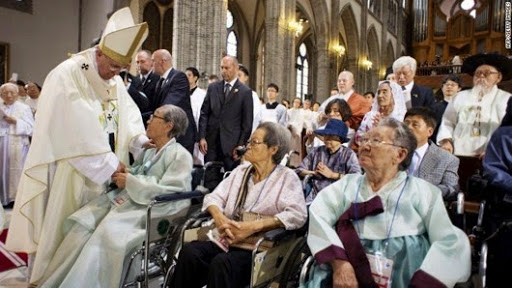
Francis in Korea: Come to my house, enter my heart

140818151053 pope comfort women s036314271 story tablet

Three weeks ago Pope Francis made a five-day visit to South Korea where he again spoke with great clarity about a number of topics and where he gave witness to the Good News of the Gospel by actions at least as much as by words. Instead of providing a comprehensive account of the trip, which can be found in many other places, I would just like to bring together my favorite passages from the around 15 talks he gave there.

Upon his arrival, Francis presented his approach to diplomacy:

“The quest for peace also represents a challenge for each of us, and in a particular way for those of you dedicated to the pursuit of the common good of the human family through the patient work of diplomacy. It is the perennial challenge of breaking down the walls of distrust and hatred by promoting a culture of reconciliation and solidarity. For diplomacy, as the art of the possible, is based on the firm and persevering conviction that peace can be won through quiet listening and dialogue, rather than by mutual recriminations, fruitless criticisms and displays of force.”

Followed by a reflection on how peace, justice and development are interrelated:

“Peace is not simply the absence of war, but “the work of justice” (cf. Is 32:17). And justice, as a virtue, calls for the discipline of forbearance; it demands that we not forget past injustices but overcome them through forgiveness, tolerance and cooperation. It demands the willingness to discern and attain mutually beneficial goals, building foundations of mutual respect, understanding and reconciliation. May all of us dedicate these days to peace, to praying for it and deepening our resolve to achieve it.”

And finally, he underlined the universal need of being heard:

“How important it is that the voice of every member of society be heard, and that a spirit of open communication, dialogue and cooperation be fostered. It is likewise important that special concern be shown for the poor, the vulnerable and those who have no voice, not only by meeting their immediate needs but also by assisting them in their human and cultural advancement.”

Later that same day, when addressing the Korean bishops, Francis warned them against becoming an affluent, middle class Church where the poor do not feel at home and that becomes mediocre:

“There is a danger, a temptation which arises in times of prosperity: it is the danger that the Christian community becomes just another “part of society”, losing its mystical dimension, losing its ability to celebrate the Mystery and instead becoming a spiritual organization, Christian and with Christian values, but lacking the leaven of prophecy. When this happens, the poor no longer have their proper role in the Church. This is a temptation from which particular Churches, Christian communities, have suffered greatly over the centuries; in some cases they become so middle class that the poor even feel ashamed to be a part of them. It is the temptation of spiritual “prosperity”, pastoral prosperity. No longer is it a poor Church for the poor but rather a rich Church for the rich, or a middle class Church for the well-to-do. Nor is this anything new: the temptation was there from the beginning. Paul had to rebuke the Corinthians in his First Letter (11:17), while the Apostle James was even more severe and explicit (2:1-7): he had to rebuke these affluent communities, affluent Churches for affluent people. They were not excluding the poor, but the way they were living made the poor reluctant to enter, they did not feel at home. This is the temptation of prosperity. I am not admonishing you because I know that you are doing good work. As a brother, however, who has the duty to confirm his brethren in the faith, I am telling you: be careful, because yours is a Church which is prospering, a great missionary Church, a great Church. The devil must not be allowed to sow these weeds, this temptation to remove the poor from very prophetic structure of the Church and to make you become an affluent Church for the affluent, a Church of the well-to do – perhaps not to the point of developing a “theology of prosperity” – but a Church of mediocrity.”

The next day, on 15th August, Francis had his first meeting with youth gathered from all over Asia, where he first recalled the need for the Church to “be a seed of unity for the whole human family,” and then proceeded to reflect on an experience shared before his address that was about the challenges of discerning one’s vocation:

“What Marina said really struck me: about the conflict she felt in her life. What to do in this situation? Take up the path of consecrated life, religious life, or study to be better able to help others.

This is only an apparent conflict, because when the Lord calls, he always does so for the good of others, whether it is through the religious life, the consecrated life, or as a lay person, as the father or mother of a family. The goal is the same: to worship God and to do good to others. What should Marina do, and the many others of you who are asking the same question? I once asked it myself: What path should I choose? But you do not have to choose any path! The Lord must choose it! Jesus has chosen it! You have to listen to him and ask: Lord, what should I do?

This is the prayer that a young person should make: “Lord what do you want from me?” With prayer and the advice of some good friends – laity, priests, religious sisters, bishops, popes (even the Pope can offer some good advice!) – you can find the path that the Lord wants for you.”

He then went on to underline the fundamental simplicity of love:

“The path of love is simple: love God and love your neighbor, your brother or sister, the one at your side, who needs love and so many other things. “But Father, how do I know that I love God?” Only if you love your neighbor, if you do not hate your neighbor and do not harbor hatred in your heart, do you love God. This is the sure proof.”

Later that day Francis paid a surprise visit to the Jesuit HQ in Korea, where he said the following to his brothers:

“There are no wounds that can’t be consoled by the love of God. This is how we must live: seeking Jesus Christ so that we may carry this love to consoling wounds, healing wounds. […] God always consoles, always waits, always forgets, always forgives. There are many wounds in the Church. Wounds that are often provoked by ourselves, practicing Catholics and ministers of the Church.

Don’t tell off the people of God anymore! Console the people of God! Often our clerical attitudes lead to clericalism that harms the Church so much. Being a priest does not result in the status of public officials, but of shepherd. Please, be shepherds and not public officials. And when you are in the confessional, remember that God never tires of forgiving. Be merciful!”

Two days later, Francis met bishops from all over Asia to whom he spoke about the simultaneous need for a clear sense of one’s own identity and of openness and receptivity to others, as the basis for dialogue:

“But in undertaking the path of dialogue with individuals and cultures, what should be our point of departure and our fundamental point of reference, which guides us to our destination? Surely it is our own identity, our identity as Christians. We cannot engage in real dialogue unless we are conscious of our own identity. We can’t dialogue, we can’t start dialoguing from nothing, from zero, from a foggy sense of who we are. Nor can there be authentic dialogue unless we are capable of opening our minds and hearts, in empathy and sincere receptivity, to those with whom we speak. In other words, an attentiveness in which the Holy Spirit is our guide. […] And if our communication is not to be a monologue, there has to be openness of heart and mind to accepting individuals and cultures. Fearlessly, for fear is the enemy of this kind of openness.”

And he proceeded to warn against becoming bogged down in formalism, superficiality and easy answers:

“Without a grounding in Christ, the truths by which we live our lives can gradually recede, the practice of the virtues can become formalistic, and dialogue can be reduced to a form of negotiation or an agreement to disagree. An agreement to disagree… so as not to make waves… This sort of superficiality does us great harm. […] Then […] there is [… another] temptation: that of the apparent security to be found in hiding behind easy answers, ready formulas, rules and regulations. Jesus clashed with people who would hide behind laws, regulations and easy answers… He called them hypocrites. Faith by nature is not self-absorbed; it “goes out”. It seeks understanding; it gives rise to testimony; it generates mission. In this sense, faith enables us to be both fearless and unassuming in our witness of hope and love. Saint Peter tells us that we should be ever ready to respond to all who ask the reason for the hope within us (cf. 1 Pet 3:15). Our identity as Christians is ultimately seen in our quiet efforts to worship God alone, to love one another, to serve one another, and to show by our example not only what we believe, but also what we hope for, and the One in whom we put our trust (cf. 2 Tim 1:12).”

Next, Francis insisted on the need for acceptance of others (“Come to my house, enter my heart.”) which has a profound basis in Jesus’ incarnation and in us all being children of the one Father. Empathy and a welcoming of others are core to Christianity and fear for one’s own identity is wholly unwarranted:

“[T]ogether with a clear sense of our own Christian identity, authentic dialogue also demands a capacity for empathy. For dialogue to take place, there has to be this empathy. We are challenged to listen not only to the words which others speak, but to the unspoken communication of their experiences, their hopes and aspirations, their struggles and their deepest concerns. Such empathy must be the fruit of our spiritual insight and personal experience, which lead us to see others as brothers and sisters, and to “hear”, in and beyond their words and actions, what their hearts wish to communicate. In this sense, dialogue demands of us a truly contemplative spirit of openness and receptivity to the other. I cannot engage in dialogue if I am closed to others. Openness? Even more: acceptance! Come to my house, enter my heart. My heart welcomes you. It wants to hear you. This capacity for empathy enables a true human dialogue in which words, ideas and questions arise from an experience of fraternity and shared humanity. If we want to get to the theological basis of this, we have to go to the Father: he created us all; all of us are children of one Father. This capacity for empathy leads to a genuine encounter – we have to progress toward this culture of encounter – in which heart speaks to heart. We are enriched by the wisdom of the other and become open to travelling together the path to greater understanding, friendship and solidarity. “But, brother Pope, this is what we are doing, but perhaps we are converting no one or very few people…” But you are doing it anyway: with your identity, you are hearing the other. What was the first commandment of God our Father to our father Abraham? “Walk in my presence and be blameless”. And so, with my identity and my empathy, my openness, I walk with the other. I don’t try to make him come over to me, I don’t proselytize. Pope Benedict told us clearly: “The Church does not grow by proselytizing, but by attracting”. In the meantime, let us walk in the Father’s presence, let us be blameless; let us practice this first commandment. That is where encounter, dialogue, will take place. With identity, with openness. It is a path to greater knowledge, friendship and solidarity. As Saint John Paul II rightly recognized, our commitment to dialogue is grounded in the very logic of the incarnation: in Jesus, God himself became one of us, shared in our life and spoke to us in our own language (cf. Ecclesia in Asia, 29).”

And finally, Francis places the importance of a shared journey above the others’ conversion and distances the Church from ideas of conquest:

“I am not referring to political dialogue alone, but to fraternal dialogue… “But these Christians don’t come as conquerors, they don’t come to take away our identity: they bring us their own, but they want to walk with us”. And the Lord will grant his grace: sometimes he will move hearts and someone will ask for baptism, sometimes not. But always let us walk together. This is the heart of dialogue.

The next day, during a meeting with religious leaders, Francis returns to the importance of shared journeying:

“Life is a journey, a long journey, but a journey which we cannot make by ourselves. We need to walk together with our brothers and sisters in the presence of God. So I thank you for this gesture of walking together in the presence of God: that is what God asked of Abraham. We are brothers and sisters. Let us acknowledge one another as brothers and sisters, and walk together.”

And finally, during the flight back to Rome, Francis again answers questions put to him there and then by the journalists on board, where three stood out for me in particular. First, in response to being asked about whether he isn’t concerned that his gesture of wearing a yellow ribbon (a sign of solidarity with the victims of the Sewol ferry disaster) might be misunderstood politically, Francis answers:

“Whenever you find yourself facing human suffering, you have to do what your heart tells you to. Then people will say: “He did it for this or that political reason”; let them say what they want. But when you think of these men and woman, these fathers and mothers who have lost their children, their brothers and sisters, of the immense pain of such a disaster, I don’t know, my heart.. I am a priest and I feel the need to draw near! That’s how I feel; that is the first thing. I know that the comfort that any word of mine might give is no cure, it doesn’t bring the dead back to life, but human closeness at these times gives us strength, there is solidarity… […] I would like to add something. I took this (holding up a ribbon). After I carried it for half a day – I took it for solidarity with them – somebody came up to me and said: It’s better to take that off… You should be neutral …” “But listen, where human suffering is involved, you can’t be neutral”. That was my answer; that’s how I feel.”

Second, in response to a question about military intervention in Iraq and also addressing the topic of torture, Francis says:

“Thank you for your very clear question. In these cases, where there is an unjust aggression, I can only say that it is licit to stop the unjust aggressor. I emphasize the word: “stop”. I’m not saying drop bombs, make war, but stop the aggressor. The means used to stop him would have to be evaluated. Stopping an unjust aggressor is licit. But we also need to remember! How many times, with this excuse of stopping an unjust aggressor, the powers have taken over peoples and carried on an actual war of conquest! One nation alone cannot determine how to stop an unjust aggressor. After the Second World War, there was the idea of the United Nations: that is where discussion was to take place, to say: Is this an unjust aggressor? It would seem so. How do we stop him?” This alone, nothing else. Second, minorities. Thanks for using that word. Because people say to me: “the Christians, the poor Christians…” And it is true, they are suffering, and martyrs, yes, there are many martyrs. But there are also men and women, religious minorities, not all Christians, and all are equal before God. To stop an unjust aggressor is a right of humanity, but it is also a right of the aggressor to be stopped in order not to do evil. […]

Today, torture is an almost, I would say, ordinary means used in intelligence work, in trials… And torture is a sin against humanity, it is a crime against humanity. And to Catholics, I say: to torture a person is a mortal sin; it is a grave sin, but even more, it is a sin against humanity.”

And third, in a question about his upcoming encyclical on ecology, Francis spoke again about the relationship between science and faith, being more specific about how he sees the value of science in the context of this document of Catholic teaching:

“[T]here are also scientific hypotheses [to be taken into account], some of them quite solid, others not. In this kind of encyclical, which has to be magisterial, one can only build on solid data, on things that are reliable. If the Pope says that the earth is the centre of the universe, and not the sun, he errs, since he is affirming something that ought to be supported by science, and this will not do. That’s where we are at now. We have to study the document, number by number, and I believe it will become smaller. But to get to the heart of the matter and to what can be safely stated. You can say in a footnote: “On this or that question, there are the following hypotheses…”, as a way of offering information, but you cannot do that in the body of encyclical, which is doctrinal and has to be sound.”

Probably the best movie about Jesus

Il vangelo

Franco Zefirelli’s “Jesus of Nazareth”? No. (Phew!)

Mel Gibson’s “The Passion of the Christ”? No, not that one either. (Phew, again!)

No, “probably the best movie about Jesus” is Pier Paolo Pasolini’s “The Gospel According to St. Matthew.”

“Says who?,” you ask.

Well, none other than the Vatican’s own newspaper, l’Osservatore Romano, which in a review on the 50th anniversary of the movie’s premiere had the following to say (in the words of Emilio Ranzato):

“Whether it be a movie about a crisis in progress or about its overcoming, The Gospel according to Matthew remains a masterpiece, and probably the best movie about Jesus ever made. It is certainly the one in which his words ring out most fluidly, in the most elevated and the most powerful way. Hewn out of bare rock, like the best moments of Pasolinian cinema.”

But, what makes this movie the pinnacle of depicting Jesus’ life? The l’Osservatore Romano review elaborates:

“The director follows the Gospel pages to the letter and doesn’t shy away even from talking about miracles, which he presents with an inspiration worthy of a believer. In this way, on the one hand confirming the validity and power of the Christian word, but, on the other hand, giving it a more down-to-earth context in which to spread, the director clearly intends to give a thrust both towards the marxist and ecclesial worlds. At the same time, however, and maybe unexpectedly, he finds peace in a place that is equidistant from these two poles. Surely there have been few other times in the history of cinema where a representation that plays on sacred strings, or even only mythical and epic ones, has been built on such a sincere realism.”

So, what drove this marxist (and atheist and gay) director to making a movie about Jesus? He explains this himself – during the year before the movie’s release – in a letter to Lucio Caruso of the Pro Civitate Christiana of Assisi (a Christian volunteer organization):

“The first time I visited all of you in Assisi, I found the Gospels at my bedside: your diabolical calculation!

That day, in your place, I read them from beginning to end, like a novel.

And in the exaltation of reading – as you know, it’s the most exalting thing one can read! – there came to me among other things, the idea of making a film… as the days and later the weeks went by, the idea kept getting more overwhelming and exclusive. It threw in the shade all the other ideas for work I had in my head, it weakened and devitalised them.

And it alone remained, alive and thriving within me… my idea is this: to follow the Gospel according to Saint Matthew, point by point, without making a script or adaptation of it. To translate it faithfully into images, following its story exactly without any omissions or additions.

The dialogue too should be strictly that of Saint Matthew, without even a single explanatory or connecting sentence, because no image or inserted word could ever attain the poetic heights of the text… to put it very simply and frankly, I don’t believe that Christ is the son of God, because I am not a believer – at least not consciously. But I believe that Christ is divine. I believe that is, that in him humanity is so kind and ideal as to exceed the common terms of humanity. For this reason I say “poetry” – an irrational instrument to express this irrational feeling of mine for Christ.”

His answer to the question of why he, a non-believer, had made a film which dealt with religious themes, at a press conference in 1966, is also illuminating:

“If you know that I am an unbeliever, then you know me better than I do myself. I may be an unbeliever, but I am an unbeliever who has a nostalgia for a belief.”

But, how does one who is not a Christian create a piece of art that is recognized by Christians as their own, and not only that, but a masterpiece? Here Pasolini’s answer is very telling:

“[T]he rule that dominated the making of the film was the rule of analogy. That is, I found settings that were not reconstructions but that were analogous to ancient Palestine. The characters, too—I didn’t reconstruct characters but tried to find individuals who were analogous. I was obliged to scour southern Italy, because I realized that the pre-industrial agricultural world, the still feudal area of southern Italy, was the historical setting analogous to ancient Palestine. One by one I found the settings that I needed for The Gospel. I took these Italian settings and used them to represent the originals. I took the city of Matera, and without changing it in any way, I used it to represent the ancient city of Jerusalem. Or the little caverns of the village between Lucania and Puglia are used exactly as they were, without any modifications, to represent Bethlehem. And I did the same thing for the characters. The chorus of background characters I chose from the faces of the peasants of Lucania and Puglia and Calabria. […]

In reality, my method consists simply of being sincere, honest, penetrating, precise in choosing men who psychological essence is real and genuine. Once I’ve chosen them, then my work is immensely simplified. I don’t have to do with them what I have to do with professional actors: tell them what they have to do and what they haven’t to do and the sort of people they are supposed to represent and so forth. I simply tell them to say these words in a certain frame of mind and that’s all. And they say them.”

Whether intentionally or not, this way of analogy is precisely Jesus’ own method. The employment of parables, and his teaching in its entirety rely fundamentally on analogy. Here is God – the infinite, omnipotent, omniscient, wholly transcendent and other – speaking to his creatures, who are addled with limitations, and the only possible way is that of analogy, since the listeners have no direct access to the ultimate realities that the speaker is trying to convey. At the heart of this method is in fact the very life of the Trinity, where each Person empties itself so as to receive the other and fully gives itself to the other that is ready to receive them. This self-othering1 nature of God is the basis of analogy, which Pasolini applied masterfully and I would like to argue that his work resonates with Christians not only because of the subject matter, but because of the method that begot it. And I have to say that I am a great fan of it too!

To conclude, I’d just like to share a fragment of the dialogue between the Franciscan Fr. Ugolino Vagnuzzi and Pier Paolo Pasolini that took place in June ’68 and that Fr. Vagnuzzi published a couple of days ago. It starts with Pasolini’s words:

““I saw Christ with two “eyes,” one being mine – of a rational man, modern and a lay person; the other being the look of a simple person with great faith. These two visions complement each other, I’ll explain: I saw him as the Son of God, mystically, religiously, but at the same time I saw him as a revolutionary.”

I asked him [writes Fr. Ugolino] whether before or after that Christ was so successful in the cinema, he had said something to him.

“Religious convictions or non-belief are like blocks of quartz. The reasons that make these blocks dissolve is always mysterious, so I can say neither yes nor no to you.”

I was deeply moved when he then turned to me with these words:

“You see, dear Brother, you and I are one on one and the other on the other bank of a river. A bridge unites us where we can meet. Both of us must travel some distance. I am certain that you will not say no to taking these steps, which are precious to me.””


1 A term coined by my überbestie CS.

Who are children of God?

45460002 aboud mustafa jamie areen avery2

Catholics? Christians? “Good” people?

No.

In total disagreement with the author of yesterday’s “Thoughts on today’s Mass,” distributed in my parish, who said that “we are not naturally children of God: we become so by baptism, when God adopts us as his own. Otherwise to call God our Father would be a bold presumption,” I would like to show that the Catholic Church teaches that every single human being is a child of God. Using the idea of being God’s child as the basis of separation, the basis of an “us,” as opposed to a ”them,” is perverse and absolutely not what the Catholic Church teaches, in spite of the official-looking material handed out in some of its parishes.

To begin with, Jesus – the Son of God – himself recognizes familial status universally, when he says that “whoever does the will of my heavenly Father is my brother, and sister, and mother” (Matthew 12:50) and St. Paul too picks up on the key being adherence to God’s will: “For those who are led by the Spirit of God are children of God” (Romans 8:14).

That such adherence to the will of God is open to everyone – whether they believe in God or not – and that it is at the heart of what the Catholic Church believes, is very clear from Nostra Aetate, the declaration issued during the Second Vatican Council by Pope Paul VI, which says in its closing paragraph:

“We cannot truly call on God, the Father of all, if we refuse to treat in a brotherly way any man, created as he is in the image of God. Man’s relation to God the Father and his relation to men his brothers are so linked together that Scripture says: “He who does not love does not know God” (1 John 4:8).

No foundation therefore remains for any theory or practice that leads to discrimination between man and man or people and people, so far as their human dignity and the rights flowing from it are concerned.

The Church reproves, as foreign to the mind of Christ, any discrimination against men or harassment of them because of their race, color, condition of life, or religion. On the contrary, following in the footsteps of the holy Apostles Peter and Paul, this sacred synod ardently implores the Christian faithful to “maintain good fellowship among the nations” (1 Peter 2:12), and, if possible, to live for their part in peace with all men, so that they may truly be sons of the Father who is in heaven.”

And this is also reflected in what the Catechism teaches about the opening words of the Our Father, the prayer Jesus taught:

“God’s love has no bounds, neither should our prayer. Praying “our” Father opens to us the dimensions of his love revealed in Christ: praying with and for all who do not yet know him, so that Christ may “gather into one the children of God.” God’s care for all men and for the whole of creation has inspired all the great practitioners of prayer; it should extend our prayer to the full breadth of love whenever we dare to say “our” (§2793)

Note in particular the thought-provoking idea in the above of Catholics praying with those who don’t know Jesus. Even in a fundamentally religious act the desire of Catholics is to be united with those who don’t share their beliefs!

And if the above weren’t enough to categorically declare that Catholics consider every human being to be a child of God and therefore also their brother or sister, let’s see what the last three popes had to say on the subject:

  1. “We must never forget that every person, from the moment of conception to the last breath, is a unique child of God and has a right to life.” Pope Saint John Paul II (Address at the Ceremony of the Anointing Of The Sick, Southwark’s Cathedral, London, 28 May 1982)
  2. “God is the origin of the existence of every creature, and the Father in a unique way of every human being: he has a unique, personal relationship with him or her.” Pope Benedict XVI (Sunday Angelus address, 8 January 2012)
  3. “Since many of you are not members of the Catholic Church, and others are not believers, I cordially give this blessing silently, to each of you, respecting the conscience of each, but in the knowledge that each of you is a child of God. May God bless you!” Pope Francis (Audience to Representatives of the Communications Media, 16th March 2013 – the day after his election!)
  4. “Every human being is a child of God! He or she bears the image of Christ! We ourselves need to see, and then to enable others to see, that migrants and refugees do not only represent a problem to be solved, but are brothers and sisters to be welcomed, respected and loved.” Pope Francis (Message for the World Day of Migrants and Refugees, 5 August 2013)

I rest my case.

Francis: Happiness, in ten simple steps

Francis happiness

Yesterday, Pope Francis’ interview with the Argentine Vivir (a Sunday magazine of the Clarin daily) included 10 tips for how to be happy. Their language is simple, and I believe their applicability is very broad and likely to resonate with believers and non-believers alike. While I think that they are essentially an application of his Evangelii Gaudium to the broad readership of a magazine, the way they are posed largely avoids religious terminology,1 even though they have deep roots in Jesus’ life and teaching.

Even though the 77 minute interview from which they are taken is not available yet, these 10 pieces of advice are contained in the four minute extract that Clarin have already published on their website in Spanish:2

  1. Live and let live. “Here the Romans have a saying that we can follow like a thread: “Go ahead and let others go ahead too.” Live and let live, that is the first step towards peace and joy.”
  2. Giving oneself to others. “If one stays still, they run the risk of being selfish. And still water is the first to spoil.”
  3. Moving like a peaceful oasis. “In Don Segundo Sombra there is a beautiful image of someone who reflects on their own life. He says that as a youth he was a rocky stream that moved everything in its path; as an adult he was a river that moved ahead and that in old age he felt in motion, but slowly like a peaceful oasis [“remansado” in the original]. I would use the image of the poet and writer Ricardo Güiraldes, this last adjective “remansado.” The capacity to move with kindness and humility, the peaceful oasis of life. Old people have this wisdom, they are the memory of a nation. And a nation that does not look after its old people has no future.
  4. Playing with kids. “Consumerism has lead us to an anxiety about losing a healthy culture of leisure, reading, enjoying art. These days I rarely hear confessions, but in Buenos Aires I used to do that a lot and when a young mum came to me, I asked her: “How many children do you have? Do you play with them?” And it was a question she did not expect, but I said to her that playing with kids is key, it is a healthy culture. It is difficult, parents go to work early and at times return when the kids are already sleeping, it is difficult, but it has to be done.”
  5. Spending Sundays with the family. “The other day, in Campobasso, I went to a meeting between the worlds of academia and the world of labor, and both were demanding Sundays without work. Sunday is for the family.”
  6. Helping young people find employment. “We have to be creative with their age group. If there is a lack of opportunity, they will fall prey to drugs. And the suicide index among young people without employment is very high. The other day I read, but I don’t trust it because it is not scientific data, that there are 75 million unemployed young people below the age of 25.3 It is not enough to feed them: we have to make up one-year courses for them to learn plumbing, becoming an electrician or a builder. Bringing bread home is what gives you dignity.”
  7. Looking after nature. “We have to look after creation and we are not doing it. It is one of the greatest challenges we have.”
  8. Quickly forgetting about the negative. “The need to speak ill of another indicates low self-esteem, in other words: I feel so low that instead of rising, I lower the other. Quickly forgetting what is negative is healthy.”
  9. Respecting those who think differently. “We may trouble others by our testimony, so that we may both progress in our communication, but the worst that can happen is religious proselytism, which paralyzes: “I dialogue with you to convince you.” No! Each one dialogues from their own identity. The Church grows by attraction, not by proselytism.”
  10. Actively seeking peace. “We are living in times of many wars. In Africa, wars look like tribal wars, but they are something else. War destroys. And the call for peace has to be shouted. Peace at times gives the impression of stillness, but it is never stillness, it is always an active peace.”

I particularly like Francis’ words on respect – both in general (delighting in the progress of others like in one’s own) and in dialogue (worry/unsettle – yes, set out to convince – no), on playing with kids, on a forgetfulness of the negative and on challenges (lack of peace, youth unemployment, selfishness combatted by self-giving) have to be faced actively (but an activity that is kind and humble). To suggest that the above is un-Christian (or even a-Christian) is being blinded by packaging and a subscription to dualism instead of the realization that God’s love extends to all, regardless of their beliefs.


1 Unsurprisingly, but sadly, he has already been criticized for the non-religious terms in which he has expressed his advice, e.g., here.
2 The following, crude translation is mine and follows the interview’s transcript here.
3 In fact the International Labor Organization (a UN agency) places worldwide youth unemployment at 73 million, which supports Francis’ figure. In terms of individual countries, according to government statistics there were “817,000 young people aged 16-24 […] unemployed in March to May 2014” in the UK. And in Argentina the figure is around the 2.5 million mark according to the Peace Child International NGO, while in the US there were 3.5 million unemployed 16-24 year olds in 2013, according to the ILO. Fact-check: done!

Where nothing articulate can be said

Lama sabachthani

The idea of God crying out in forsakenness, nailed to a cross like a criminal, is both deeply disturbing (hence the frequent denial of its “reality”) and a window onto Jesus’ new commandment: “I give you a new commandment: love one another. As I have loved you, so you also should love one another.” (John 13:34). It is an event that has not only occupied theologians and mystics, but has also attracted non-believers and has been written about on this blog several times. Today, I’d like to look at how Hans Urs von Balthasar, St. John Paul II, Gianfranco Ravasi and Chiara Lubich understood it and what consequences they drew from it.

Von Balthasar, like Pope Francis in Evangelii Gaudium (“Jesus’ sacrifice on the cross is nothing else than the culmination of the way he lived his entire life.” §269), argues for a deep continuity between Jesus’ life and teaching and his abandonment on the cross:

“The inarticulate cry of the cross of Jesus is no denial of his articulate proclamation to his disciples and to the people… instead it is the final end of all those articulations… which he utters with the greatest force where nothing articulate can be said any longer.” (The Whole in the Fragment)

To von Balthasar, Jesus’ forsakenness is not failure, but culmination, and this perspective can also be seen in St. John Paul II’s thought where he presents it as necessary for God’s “full solidarity” with humanity:

“[O]n Jesus’ lips the “why” addressed to God was also [… an expression of] pained bewilderment at that suffering which had no merely human explanation, but which was a mystery of which the Father alone possessed the key. Therefore, […] the question contained a theological significance in regard to the sacrifice whereby Christ, in full solidarity with sinful humanity, had to experience in himself abandonment by God.”

During that same General Audience in 1988, John Paul II also presents a synthesis of positions that argue for and against the “reality” of Jesus’ abandonment on the cross:

“If Jesus felt abandoned by the Father, he knew however that that was not really so. He himself said, “I and the Father are one” (Jn 10:30). Speaking of his future passion he said, “I am not alone, for the Father is with me” (Jn 16:32). Jesus had the clear vision of God and the certainty of his union with the Father dominant in his mind. But in the sphere bordering on the senses, and therefore more subject to the impressions, emotions and influences of the internal and external experiences of pain, Jesus’ human soul was reduced to a wasteland. He no longer felt the presence of the Father, but he underwent the tragic experience of the most complete desolation.

Here one can sketch a summary of Jesus’ psychological situation in relationship to God. The external events seemed to manifest the absence of the Father who permitted the crucifixion of his Son, though having at his disposal “legions of angels” (cf. Mt 26:53), without intervening to prevent his condemnation to death and execution. In Gethsemane Simon Peter had drawn a sword in Jesus’ defense, but was immediately blocked by Jesus himself (cf. Jn 18:10 f.). In the praetorium Pilate had repeatedly tried wily maneuvers to save him (cf. Jn 18:31, 38 f.; 19:4-6, 12-15); but the Father was silent. That silence of God weighed on the dying Jesus as the heaviest pain of all […].

In the sphere of feelings and affection this sense of the absence and abandonment by God was the most acute pain for the soul of Jesus who drew his strength and joy from union with the Father. This pain rendered all the other sufferings more intense. That lack of interior consolation was Jesus’ greatest agony.”

While the above may at first look like a variant of the naive arguments for the unreality of Jesus’ abandonment by the Father, which revolve around the claim that Jesus knew he wasn’t “really” abandoned, John Paul II’s position is more nuanced. He both affirms Jesus’ knowledge of the Father’s presence and the fullness of Jesus experiencing the Father’s absence. Unlike the naive positions that present knowledge as a mitigating factor, John Paul II does not hesitate to describe Jesus’ soul as a “wasteland” and his experience as being one of “most complete desolation.” It is essentially a third-person, “objective” view that recognizes the continuing presence of the Father while Jesus fully experiences his absence on the cross. In many ways this is akin to a Christian, who sees their atheist friends’ sincerity, recognizing that their friends live in the absence of an experience of God, while they themselves see both their own and their friends’ lives unfolding in His presence. This is not to deny the “reality” of the atheist experience (qua experience) while at the same time situating it within one’s own understanding of reality. I believe such a parallel also underlines John Paul II’s claim that Jesus’ abandonment on the cross was necessary for the sake of “full solidarity” with all of humanity – both with those who believe in God and who do not.

John Paul II’s analysis does seem to me to be the key also to understanding why many theologians wrestle with with the contradiction of Jesus’ forsakenness on the cross. Even Cardinal Ravasi, who in one context affirms the reality of Jesus’ forsakenness (even calling it “salvific atheism”), in another context speaks both about His being our “brother also in the tragedy of the absence of God” and at the same time about it not being possible to “classify that cry as a sign of despair and almost of disbelief.”

Beyond considerations about the reality of Jesus’ forsakenness and its central role in God’s closeness to humanity, what is its practical impact though? What difference does it mean to me, as a Christian, that Jesus experienced such complete desolation? Here the insights of the Servant of God Chiara Lubich are key, since she recognized in Jesus’ forsakenness the key to uniting herself both to God and to every neighbor she encountered, to the point of declaring Jesus Forsaken to be her spouse.

In a talk from 1971,1 Lubich shares her insight into Jesus’ forsakenness being the pinnacle of his self-giving:

“He had given everything.

First, a life lived beside Mary in hardship and obedience.

Then, three years of mission, revealing the Truth, giving witness to the Father, promising the Holy Spirit, and working all kinds of miracles of love.

Finally, three hours on the cross, from which he gave forgiveness to his executioners, opened paradise to the thief, gave his mother to us, and ultimately gave his body and blood, after having given them mystically in the Eucharist.

He had nothing left but his divinity.

His union with the Father, that sweet and ineffable union with the One who had made him so powerful on earth as the Son of God and so regal on the cross, that feeling of God’s presence had to disappear into the depths of his soul and no longer make itself felt, separating him somehow from the One with whom he had said to be one: “The Father and I are one” (Jn 10:30). In him love was annihilated, the light extinguished, wisdom silenced.”

Left in a state of complete self-noughting, “where nothing articulate can be said,” what choice did he have left?

“To formulate a question was the only way Jesus could then possibly express himself; that loud cry is the Word which is no longer word, which therefore, cannot be understood and explained as word. It is the indescribable reality which is so beyond what words that are uttered in the created world can express. It is the sub-word; that which is chosen by the Powers of Heaven to bear the Eternal ultra- word.”

What was the point of such complete annihilation though? Here Lubich presents a deeply logical argument:

“So he made himself nothing to make us share in the All; a worm2 of the earth, to make us children of God.

We were cut off from the Father. It was necessary that the Son, in whom all of us were represented, should experience separation from the Father. He had to experience being forsaken by God so that we might never be forsaken again.

He had taught that no one has greater love than one who lays down his life for his friends. He who was Life laid down his whole self. This was the culminating point, love’s most beautiful expression. He loved in God’s way! With a love as big as God!”

Most importantly though, Jesus Forsaken was not of academic interest to Lubich, who – with her companions and a growing number of sympathizers and followers – sought to put the Gospel into practice in everything she did, but a person with whom she developed a close relationship:

“He drew us to himself; we discovered him everywhere: in every physical moral or spiritual pain. They were shadows of his great suffering. […] Then we saw him in every neighbor who was suffering. […] Every personal suffering also appeared to us as a countenance of Jesus forsaken to be loved and wanted in order to be with him and like him, so that through the death of ourselves […], he might give life to us and to many others.”

In fact, Lubich understood that such a relationship with Jesus Forsaken, a becoming another Jesus Forsaken, is the way to profound relationships of unity:

“In his testament Jesus had said: “With me in them and you in me, may they be so perfected in unity” (Jn 17:23). If Jesus was in me, if Jesus was in the other, and if Jesus was in all, at that moment we were perfected in unity. […] Jesus forsaken is the model for those who must build unity with others. I cannot enter into another spirit if I am rich of my own. To love others I must constantly make myself so poor in spirit that I possess nothing but love. Love is empty of itself. Jesus forsaken is the perfect model of one who is poor in spirit. He is so poor that he has not even God, so to speak. He does not feel God’s presence.”

And finally, picking up on a theme so close to Pope Francis’ heart, Lubich points to the simultaneous closeness to humanity and God that Jesus’ forsakenness brings about, where He becomes the void that bridges the finite with the infinite:

“In his forsakenness Jesus seems to be nothing but a man, and so never had he been as close to us human beings as in that moment and never, therefore, had he loved so much. At the same time, never had he been so close to the Father; it is out of love for him that he dies in that way.”


1 Which was also my source for the quotes from von Balthasar’s “The Whole in the Fragment” above.
2 “But I am a worm, not a man, scorned by men, despised by the people.” (Psalms 22:7)

The Gospel for families “as they are”

Modern family

The Catholic Church is in the process of preparing for two synods of its bishops – one this autumn and the other the following year – during which questions to do with the family will be reviewed. As a basis for the discussions, the Vatican has issued an initial preparatory document last November, whose most novel feature was an extensive questionnaire addressed to the bishops conferences of the world, but open to completion by anyone. The questionnaire spanned topics like whether Church teaching about the family was known, whether marriage preparation and care for families were effective, how difficult marital situations were dealt with, how same-sex unions were approached, how procreation was understood, plus an open question about any other family-related challenges.A questionnaire of this scale and openness is unprecedented, and three days ago, a summary of its results was published in the form of the “instrumentum laboris” (i.e., working instrument) that will be used during this year’s synod. The document, which weighs in at 25K words is very much worth reading in its entirety, since it – in my opinion – presents a very interesting, world-wide and above all utterly frank look at the life of the family at the beginning of the 21st century and the Church’s relationship with it. Rather than an analysis or commentary, I would first just like to share with you the passages that found most important and that effectively are my favorite 10% of the text (each passage is prefixed with the number of the paragraph it was taken from; note that – with one exception for the sake of the extracts’ logic – the following is in the same order as in the original text):

Part I: Communicating the Gospel of the Family in Today’s World

(2) [T]he divine measure of conjugal love, to which spouses are called by grace, has its source in “the beauty of the saving love of God made manifest in Jesus Christ who died and rose from the dead” (EG, 36), the very heart of the Gospel.

(4) The “true love between husband and wife” (GS, 49) implies a mutual gift of self and includes and integrates the sexual and affective aspects, according to the divine plan (cf. GS, 48-49). […] Christ the Lord “comes into the lives of married Christians through the Sacrament of Matrimony,” and remains with them. In the Incarnation, he assumes human love, purifies it and brings it to fulfillment. Through his Spirit, he enables the bride and groom to live their love and makes that love permeate every part of their lives of faith, hope and charity. In this way, the bride and groom are, so to speak, consecrated and, through his grace, they build up the Body of Christ and are a domestic Church (cf. LG, 11), so that the Church, in order to fully understand her mystery, looks to the Christian family, which manifests her in a real way.

(6) “marriage based on an exclusive and definitive love becomes the icon of the relationship between God and his people and vice versa. God’s way of loving becomes the measure of human love” (DCE, 11).

(35) “Marriage is the icon of God’s love for us. Indeed, God is communion too: the three Persons of the Father, the Son and the Holy Spirit live eternally in perfect unity. And this is precisely the mystery of Matrimony: God makes of the two spouses one single life” (General Audience, 2 April 2014).

(36) A recurring subject in almost all the responses is the importance of the Holy Family of Nazareth as the model and example for the Christian family. The mystery of the Word of God’s becoming incarnate within a family reveals how it is the privileged place for God’s revelation to humanity. In fact, the family is acknowledged to be the ordinary and everyday place to encounter Christ. The Christian people look to the Holy Family of Nazareth as a model in relationships and love, as a point of reference for every family and as a comfort in time of trial.

(39) The role of parents as primary educators in the faith is considered vital and essential. Emphasis is often placed on their witness of fidelity, particularly on the beauty of their individuality and at times, simply on the importance of their distinctive roles as father and mother. At other times, the responses stress the positive character of the spouses’ freedom, equality and reciprocity. Still other responses, especially from Europe, stress the equal importance of both parents in the upbringing of their children and domestic responsibilities.

(43) The family is essential in the maturation of those cognitive and affective processes which are crucial to personal development. In addition to being a vital environment in personal formation, the family is also the place to experience the awareness of being not only a Child of God but also called to a vocation of love.

(7) Faith is no refuge for the fainthearted, but something which enhances our lives. It makes us aware of a magnificent calling, the vocation of love. (LF, 53)

(11) The People of God’s knowledge of conciliar and post-conciliar documents on the Magisterium of the family seems to be rather wanting.

(13) Church teaching is more widely accepted, when the faithful are engaged in a real journey of faith and are not just casually curious in what might be the Church’s thinking in the matter of sexual morality.

(14) Ultimately, the responses and observations call for the need of establishing real, practical formation programmes through which the truths of the faith on the family might be presented, primarily to appreciate their profound human and existential value.

(15) the reason for much resistance to the Church’s teaching on moral issues related to the family is a want of an authentic Christian experience, namely, an encounter with Christ on a personal and communal level, for which no doctrinal presentation, no matter how accurate, can substitute. In this regard, some responses point to the insufficiency of pastoral activity which is concerned only with dispensing the sacraments without a truly engaging Christian experience.

(18) [V]arious episcopal conferences recall the importance of developing the insights of Pope St. John Paul II in his “theology of the body” series, in which he proposes a fruitful approach to the topics of family through existential and anthropological concerns and an openness to the new demands emerging in our time.

(24) Furthermore, much attention is given in the responses to the fact that what becomes established in civil law — based on an increasingly dominant legal positivism — might mistakenly become in people’s mind accepted as morally right. What is “natural” tends to be determined by the individual and society only, who have become the sole judges in ethical choices. The relativization of the concept of “nature” is also reflected in the concept of stability and the “duration” of the relationship of marriage unions. Today, love is considered “forever” only to the point that a relationship lasts.

(29) [T]his tendency accentuates the absolute right to personal freedom without any compromise: people are “formed” on the basis of their individual desires only. What is increasingly judged to be “natural” is more of a reference-to-self only, when it comes to their desires and aspirations.

(30) [M]ore emphasis [is to] be placed on the role of the Word of God as a privileged instrument in the conception of married life and the family, and […] greater reference to the Bible, its language and narratives [is recommended …] Moreover, this proposal insists on using language which is accessible to all, such as the language of symbols utilized during the liturgy. The recommendation was also made to engage young people directly in these matters.

(31) [T]he family is experiencing very difficult times, requiring the Church’s compassion and understanding in offering guidance to families “as they are” and, from this point of departure, proclaim the Gospel of the Family in response to their specific needs.

Part II: The Pastoral Program for the Family in Light of New Challenges

62. [I]n cases where the faith of family members is either weak or non-existent, both the parish and the Church in general are not seen as supportive. […] Often, when the lay faithful sense the great distance between the ideal of family living and the impossibility of achieving that goal, the couple’s crisis in marriage and the family gradually becomes a crisis in faith. Therefore, the question arises on how to act pastorally in these situations, namely, how to make sure that the Church, in her variety of pastoral activities, can demonstrate that she has the ability of caring for couples in difficulty and families.

64. [O]ne of the many critical issues facing the family is a difficulty in relationships and communication. Whether it be tensions and conflicts in a marriage due to a lack of mutual trust and intimacy or the domination of one marriage partner over the other or the inter-generational conflict between parents and children, all hinder the building of family relationships and can even make them entirely impossible. The dramatic aspect of these situations is that they lead to the gradual disappearance of the possibility of dialogue as well as the time and opportunity to work on relationships. For want of sharing and communication, each one is forced to face difficulties in isolation without an experience of being loved and, in turn, loving others. […] People who do not witness, live and accept love on a daily basis find it particularly difficult to discover the person of Christ as the Son of God and the love of God the Father.

66. The responses unanimously make reference to psychological, physical and sexual violence and abuse in families which has a particularly damaging effect on women and children, a phenomenon which, unfortunately, is neither occasional nor isolated, particularly in certain parts of the world. [… T]he responses also mention the appalling phenomenon of the killing of women, often caused by deep emotional trouble in relationships. Arising from a false culture based on possessions, this is particularly disturbing and calls for action by everyone in society and by the Church in her ministry to the family. Sexual promiscuity and incest in the family are explicitly cited in certain parts of the world (Africa, Asia and Oceania), as well as pedophilia and child abuse. The responses also refer to authoritarianism by parents, expressed in the lack of care and attention given to their children, a situation often leading to their children’s abandonment, and, on the parents’s part, a want of a sense of responsible parenthood which causes them to refuse to not only care for their children but also educate them, thereby leaving them totally to their own devices.

70. Increasing job insecurity, together with the growth of unemployment and the consequent need to travel greater distances to work, have taken their toll on family life, resulting in, among other things, a weakening of family relationships and the gradual isolation of persons, causing even greater anxiety.

71. In dialoguing with the State and the related public entities, the Church is called to offer real support for decent jobs, just wages and a fiscal policy favouring the family as well as programmes of assistance to families and children. In this regard, laws protecting the family in relation to work are frequently wanting, particularly those affecting working mothers.

75. Responses from almost every part of the world frequently refer to the sexual scandals within the Church (pedophilia, in particular) and, in general, to a negative experience with the clergy and other persons. Sex scandals significantly weaken the Church’s moral credibility, above all in North America and northern Europe. In addition, a conspicuously lavish lifestyle by some of the clergy shows an inconsistency between their teaching and their conduct. Some lay faithful live and practice their faith in a “showy manner,” failing to display the truth and humility required by the Gospel spirit. The responses lament that persons who are separated, divorced or single parents sometimes feel unwelcome in some parish communities, that some clergy are uncompromising and insensitive in their behavior; and, generally speaking, that the Church, in many ways, is perceived as exclusive, and not sufficiently present and supportive. In this sense, an open and positive pastoral approach is needed, one which can restore confidence in the institution through a credible witness by all her members.

80. “The Church is called to be the house of the Father, with doors always wide open, […] where there is a place for everyone, with all their problems” (GE, 47). […] The mercy of God does not provide a temporary cover-up of personal misdeeds, but rather radically opens lives to reconciliation which brings new trust and serenity through true inward renewal. The pastoral care of families, far from limiting itself to a legal point of view, has a mission to recall the great vocation of love to which each person is called and to help a person live up to the dignity of that calling.

89. Generally speaking, the responses from various places in the world devote attention to divorced and remarried persons or those, at least, who have formed a different union. Those living in such canonically irregular situations display various attitudes ranging from their being entirely unaware of their irregular situation to their consciously enduring the difficulties created by their irregular situation.

90. A rather great number of people give no thought to their irregular situation.

91. Before treating the suffering associated with those who are unable to receive the sacraments due to their irregular union, the responses refer to a more basic suffering which the Church must take in hand, namely, the suffering of a breakdown in marriage and the difficulty of regularizing the situation.

92. Some Church members who are cognizant that they are in an irregular situation clearly suffer from the fact that they are unable to receive the sacraments. Many feel frustrated and marginalized. Some wonder why other sins can be forgiven and not theirs. Others cannot see how religious and priests can receive a dispensation from their vows and priestly obligations so they can marry, while divorced and remarried persons are unable to receive Holy Communion.

103. Pastoral charity impels the Church to assist people who have suffered the breakdown of their marriage and are living with their situation relying on the grace of Christ. A more painful wound results when these people remarry and enter a state of life which does not allow them to receive Holy Communion. Clearly, in these cases, the Church must not assume an attitude of a judge who condemns (cf. Pope Francis, Homily, 28 February 2014), but that of a mother who always receives her children and nurses their wounds so they may heal (cf. GE, 139-141). With great mercy, the Church is called to find forms of “accompaniment” which can support her children on the path of reconciliation. With patience and understanding, she must explain to these people that their not being able to celebrate the sacraments does not mean that they are excluded from the Christian life and a relationship with God.

109. Generally speaking, pastoral care, preparation and planning of formation sessions prior to marriage are having a limited and uneven success everywhere. In almost every case, everything depends, for good or for ill, on the initiatives of each priest.

110. On unions of persons of the same sex, the responses of the bishops’ conferences refer to Church teaching. “There are absolutely no grounds for considering homosexual unions to be in any way similar or even remotely analogous to God’s plan for marriage and family. […] Nonetheless, according to the teaching of the Church, men and women with homosexual tendencies ‘must be accepted with respect, compassion and sensitivity. Every sign of unjust discrimination in their regard should be avoided’” (CDF, Considerations regarding Proposals to Give Legal Recognition to Unions between Homosexual Persons, 4).

113. Every bishops’ conference voiced opposition to “redefining” marriage between a man and a woman through the introduction of legislation permitting a union between two people of the same sex. The episcopal conferences amply demonstrate that they are trying to find a balance between the Church’s teaching on the family and a respectful, non-judgmental attitude towards people living in such unions. On the whole, the extreme reactions to these unions, whether compromising or uncompromising, do not seem to have facilitated the development of an effective pastoral programme which is consistent with the Magisterium and compassionate towards the persons concerned.

115. Episcopal conferences supply a variety of information on unions between persons of the same sex. In countries where legislation exists on civil unions, many of the faithful express themselves in favour of a respectful and non-judgmental attitude towards these people and a ministry which seeks to accept them. This does not mean, however, that the faithful give equal status to heterosexual marriage and civil unions between persons of the same sex.

Part III: An Openness to Life and Parental Responsibility in Upbringing

122. The Church is called to proclaim the fruitfulness of love in light of that faith which “helps us grasp in all its depth and richness the begetting of children, as a sign of the love of the Creator who entrusts us with the mystery of a new person” (LF, 52).

131. The responses recommend that the synod can be of assistance in rediscovering the deep anthropological meaning of the moral character of conjugal life, which beyond every type of moralism, appears as a true desire to live the beauty demanded by the Christian love between a man and a woman and given value by considering the greatest act of love which comes from laying down one’s life for a friend (cf. Jn 15:13).

132. “Parents are called, as Saint Augustine once said, not only to bring children into the world but also to bring them to God, so that through baptism they can be reborn as children of God and receive the gift of faith” (LF, 43).

137. In general, families participating in ecclesial movements are the most active in seeking to transmit the faith to newer generations.

138. [F]amilies with children who may be particularly affected by the so-called “irregular” situation of their parents deserve greater pastoral attention in Christian education. In this regard, words and expressions need to be used which create a sense of belonging and not exclusion, ones that can better convey the warmth, love and the support of the Church, so as not to generate, especially in the children and young people involved, the idea of rejection or discrimination against their parents, fully aware that “irregular” is a word applied to situations, not persons.

146. When parents, usually after an absence from the Church for some time, request from the ecclesial community the sacramental preparation of their children, the most recommended approach in all the responses is to readily accept them without making any distinctions. Receiving them with a basic attitude of respect, a friendly disposition and a willingness to listen to their human and spiritual needs creates a proper and beneficial atmosphere for communicating the Gospel message.

159. After examining the responses and observations and gathering from them not only the hopes and joys but also the griefs and anxieties, this work concludes by returning to the sources of faith, hope and charity, namely, the Blessed Trinity which is the mystery of absolute love, revealed in Christ and made accessible by the Holy Spirit. The love of God shines in a particular way in the Holy Family of Nazareth, the sure point of reference and comfort for every family. The Holy Family, the beacon of true love, is to be contemplated in every family situation so as to draw light, strength and consolation.

I have to say that this document makes me very optimistic and it does so for three reasons: first, the complete frankness of the assessment of today’s reality that doesn’t shirk either from pointing out failings of the Church or from recognizing a disconnect with regard to some aspect of her teaching (the entire document being evidence for this), second, the insistence on the importance of mercy and accompanying: “With great mercy, the Church is called to find forms of “accompaniment” which can support her children on the path of reconciliation.” (§103), and, third, that what is at stake here is not some rejigging of rules, but the very heart of men and women being called to love: “The pastoral care of families, far from limiting itself to a legal point of view, has a mission to recall the great vocation of love to which each person is called and to help a person live up to the dignity of that calling.” (§80). A consequence of these three features is, in my opinion, a chance for the upcoming Synod to bring the joy of the Gospel to families “as they are.”

Freedom, with and without God

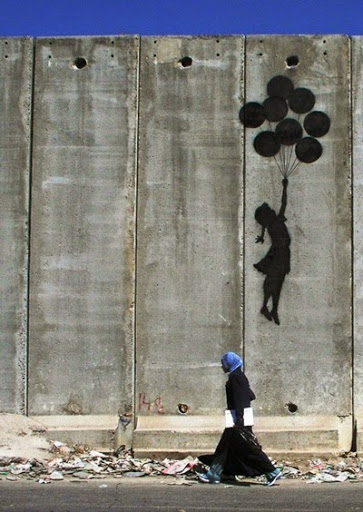
Banksy westbank wall balloon girl1

[Warning: very long read :)]

A video that has been burning a hole in my pocket since last November is the recording of the opening evening of the Berlin Courtyard of the Gentiles, that I already wrote about in a previous post.1 While I focused on Cardinal Ravasi’s talk on beauty and art there, today I’d like to cover the opening session’s discussion of morality, which was conducted under the title “Freedom, with and without God” and where Dostoevsky’s controversial dictum: “If God does not exist, everything is permitted” provided the initial impetus.

To open the evening’s dialogue, Cardinal Gianfranco Ravasi starts with a quote from Albert Camus’ The Plague, which says: “Can one be a saint without God? That’s the problem, in fact the only problem, I’m up against today.” and then proceeds to set the scene by being critical of the obstacles to open and fruitful dialogue between those who hold religious beliefs and those who do not:2

“These days a kind of fog engulfs both true religion and rigorous atheism. This is more of a sociological than an ideological phenomenon. It is an indifference, a superficiality, a banality, a sarcastic derision. In this atmosphere of indifference, mythos rules over logos, the pamphlet replaces the analytical essay, a fundamentalist approach is stronger than a critical weighing of alternative positions, jeering conflict is valued over a calm exchange of ideas, faith gives way to a spiritual collage. Syncretism uses a spiritual menu from which to compose an a la carte offering from which everyone can pick and choose what happens to suit him or her. These pathologies both of unbelief and of religion can benefit from a response in the form of the following dialogue.”

Ravasi then acknowledges the differences of the two positions and proposes that they nonetheless share a common element:

“In fact, the two logoi, the two argumentative positions that will be presented next, have an intrinsic difference, an objective difference. The secular non-believer takes the individual as their point of reference – the subject who seeks their own, personal and social, ethical orientation. The religious person, on the other hand, is convinced that truth, nature and moral order precede and exceed us. To use a famous image from Plato’s Phaedros, these realities are like a plane that stretches out in front of the chariot of the human soul, which proceeds through it towards discovering its objective foundations. A first point of agreement between these obviously differing perspectives – one which is predominantly subjective and the other objective – could be the thoughts of St. Augustine, who claimed that in each one of us there is an innate, original knowledge of good and evil, which enables the capacity for moral judgment. […] A reference to conscience is not a optional call to situational subjectivism, but a return to this radical anthropological structure, which is our conscience. At the same time we have to constantly bear in mind the limitedness of the human subject inherent in its being a creature.”

The opening remarks are then followed by two talks, one by a non-believer and the other by a believer. The first speaker was Prof. Herbert Schnädelbach, an agnostic philosopher whose work has included social philosophy and theories of rationality, epistemology, free will and values. Here Schnädelbach kicks off with an anecdote:

“A friend of mine, who is also a philosopher, said: “This sentence should be place on a list of the most stupid sentences ever – and fairly high up. Even in the absence of the existence of God, I am not allowed to break a red light, to withhold the payment of my taxes or to hit my wife, if that were even physically possible for me. And it is irrational to think that all of this were permitted without God.””

And proceeds to argue that the Dostoevsky quote is meant to teach us a fear of atheism and of atheists, and a fear of what supposedly follows: senselessness and anarchy. Dostoevsky’s quote implies that all rules and norms cease to have power in the absence of God. However:

“we live in a whole network of rules that we adhere to because we consider following them to be rational (e.g., the highway code), or because we want to avoid penalties imposed if they are broken (e.g., paying taxes). I can’t imagine though that Dostoevsky would not have know this. […] Dostoevsky claims that reason is an insufficient basis for our normative culture, that its normative power is too weak, that a more resilient basis is needed to hold up their edifice and that this foundation can only be God.”

This leads Schnädelbach to asking whether “God is even a suitable foundation for norms and who this God is?” and to drawing a parallel with Plato’s dialogue about the nature of piety in his Euthyphro: ““Is the pious loved by the gods because it is pious? Or is it pious because it is loved by the gods?” (10a). By analogy, Schnädelbach asks “is what is good and right for humans, good and right because God commanded it, or did God command it because it is good and right for humans?” and argues that there are two possible answers, using the Ten Commandments of the Old Testament as context:

  1. In the first case, God is sovereign and can freely choose what is good and right and no one can hold him to account. This is a voluntaristic image of God, which is closely related both to fundamentalism and to normative nihilism. They are two faces of the same coin. They rely on the same model of thinking of the all or nothing: either there is an ultimate justification or there is no justification, which is why systematic philosophers, at least since Descartes and until Hegel, have always looked for an absolute first justification for knowledge and claimed that the alternative is skepticism.
  2. In the second case, if God commands what is good and right, he is not an unaccountable tyrant, who could, at will, one day, make law what is evil and unjust. He commands what every person can see to be good and right with their own, healthy reason. This makes commandments 4-10 merely God teaching the People of Israel what they themselves could have discovered with their own reason, and the same would hold true for all of humanity too. This God, who commands what is rational because it is rational, and for no other reason, is the God of the Johannine Logos.”

Schnädelbach then proceeds to argue that only one of the above scenarios is problematic:

“If one assumes a sovereign God who commands without it being possible to ask them for reasons, i.e., where norms are divorced from reason, and if one then denies their existence, then truly everything is permitted. Then our normative culture would have its foundations removed. This danger does not exist, however, if the God who commands what is right and just, because it is right and just for humans, does not exist, since there is still the chance that people will discover it with their own reason and will make it hold even without God’s teaching.”

And, finally, the argument is brought to its logical conclusion, which, along the above lines or reasoning leads to a redundancy of God:

“Why should the practical reason of people and their free consent to what they discover to be normative in the process of rational discourse not be sufficient? Admittedly, this does presuppose the mutual recognition of discourse participants as free and equal partners, and their uninhibited participation in processes where public will is built and set. My final questions is: what could an transcendent God add at this point?”

I have to say that I find Schnädelbach’s reasoning very clear and compelling. There is a basis for morality derived from reason and consensus that is well-founded without the need for God. As a Christian I see this is as being extremely positive, and consistent with my belief in a loving God, who does not make a pursuit of what is good contingent on a person believing in His existence. There’d be more to say regarding the idea of a God who “can freely choose what is good and right,” but I’ll leave that for another time :).

Returning to the Berlin event, the second speaker of the evening was Prof. Hans Joas, a Catholic sociologist, who has worked in areas like social philosophy and the history of values. Joas first appeals for specificity, arguing that there isn’t a single religious or even Christian position, like there isn’t a homogeneous secular or atheist position and that “the level of discussion on this topic rises as the level of abstraction is lowered.” He then proceeds to present his view of the role played by morality in atheism:

“In the 20th century the vast majority of thinkers and writers who have self-identified as atheists did so for strong moral reasons. Often their arguments against faith were moral arguments: a focus on the afterlife would limit one in working for the good here on earth, one would do good only in the hope of a reward in the afterlife, or, a focus on the afterlife inhibits living this life to the full. Religions lead to unnecessary feelings of guilt, risk leading to hypocrisy in interpersonal relationships, or to a denial of one’s corporeality. For those who thought or think in this way, the absence of God is even a heightening of morality. This has to be taken seriously and I have high esteem for philosophers or writers who thought in this way, such as Ludwig Feuerbach or George Eliot. These are people who understood an exceptionally great deal about faith and who were exceptionally serious about going beyond what religion and Christianity had to offer.

For us Christians, it is necessary to look at the history of these views as a history of our failures. These weren’t lunatics, but people who understood certain things very precisely, and it was a failure of Christians to present their faith to them. An example is also the strong secularization of the workers’ movement in 19th century Germany, instead of its alignment with the Church. When asked, some of its members said that they didn’t go to church because they didn’t have the right clothes … This is an actual quote from a survey of Protestant pastors about dwindling numbers at the time. What shocked me here is that the pastor in question didn’t think, “What can I change about the Sunday service, so that people don’t stay away for a stupid thing like clothes.”

The atheism that had such strong moral motives in the beginning, has in some instances also degenerated, as in the case of the German Democratic Republic (GDR), where its leading philosopher claimed that the supreme moral point of reference was the wellbeing of the GDR. And today, there is often a tiredness on the side of non-militant atheism and a rigidity on the militant side. The first challenge, in my opinion, is to reopen a dialogue between believers and non-believers and a mutual awareness.”

Joas then moves on to distancing himself from the Dostoevskian quote and from belief in God being a prerequisite for morality, and instead argues for a developmental and experiential basis, from which God can then be sought:

“I don’t agree with the statement “Values need God.” Many findings in the context of developmental psychology and cultural anthropology point to another source, which has nothing whatsoever to do with religion, and which consists in experiences of reciprocity. Already games played by children point to fundamental rules that underlie human coexistence. Reflecting on them points to the value of justice, to the value of fairness in interpersonal relationships. At the same time, such relationships are under threat of falling apart if one of the participants chooses not to adhere to the rules, e.g., when these are to their disadvantage.

It is therefore useful to think about what it could be that would make humans adhere to moral rules, other than rational appeal, and what could make them adhere to them even when these are to their short-term detriment. What motivates the start of moral reasoning, what makes one start thinking about moral questions, what makes one adhere to shared moral rules? This still doesn’t bring us to God though. I believe we arrive at strong values, at intense convictions of there being such a thing as the good. This can be rooted in positive experiences, such as an encounter with someone who lives in an exemplary way, or in negative experiences, such as wanting to make sure that something doesn’t ever happen again the way that it happened before. For example, on German soil, National Socialism was an obvious, direct experience of evil itself, without the need for rational underpinnings. Then, a long journey can begin that can lead to an understanding how God relates to these values and rules.”

The position of Joas is very clear here: morality played a strong role in early atheism and is in no way in need of divine justification. Even the simple experiences of children lead to a recognition of the good of justice and fairness. My takeaway here is the importance of the emphasis of our common ground, which is what Joas chose to do here – an emphasis of the role of experience and the innate ability to identify good and evil, with only a hint of how God relates to morality for a Christian.

In the discussion that followed, Joas returned to the role of reason in morality, and emphasized the psychological perspective:

“Many things appear as obviously good or evil to us; reasons for why that is are needed when we encounter others who don’t share these evidential experiences with us and challenge us to explain why we value certain things. If we are honest with ourselves, we can see that whether something is good or evil is a matter that does not require rational justification to ourselves – it is obvious to us, and even in the face of counterarguments from others, instead of changing our minds about what appeared good to us from the start, we will look for reasons to support our original intuition. Note that this is a psychological, not a philosophical argument.”

The final contribution to the discussion was Schnädelbach’s sharing his personal experience of what it is like to be a – as he self-labeled himself – “pious atheist”:

“I have great respect for personal piety and for religious experiences, but personally I have to say that I can’t connect these to the God of the Bible – neither the Old nor the New Testament. At times, when something very good happens, I feel the desire to thank someone. But whom? And when something bad happens, I feel – like Job – the urge to argue with someone. But there is no one. I think though that this is the point that makes me who I am – a pious atheist.”

And to conclude the evening, Cardinal Ravasi was invited to share his thoughts, which he prefixed with saying that he is resisting the temptation to join the conversation between Schnädelbach and Joas or even to summarize it. Instead, he decided to present his understanding of the verb “to know”:

“In Hebrew the verb is yada, which has the same meaning as the New Testament Greek word genoskein, which reflects very well the polymorphism of anthropological knowledge, of human knowledge. Knowledge, according to this view, which is a symbolical view that is important also in the current dialectic or counter-positioning of faith and science, arrives along four ways. There is first the intellective, rational way. Added to it is the volitive way; decision, the willed intensity of knowing. The third line then is that of affectivity, of feeling. And the last, the fourth way, is that of action – knowing, which, e.g., in the Bible also means a completion of the sexual act. In other words, an encounter between two people in the fullness also of corporeality.

At this point, knowledge arrives in diverse ways, and each of these ways may lead to different stages. However, all of the stages are necessary. Hence the knowledge of the horizon of God, of transcendence, is a knowledge that has to pass through all of this, this whole itinerary. Therefore, the scientific way is certainly also relevant, as is a well-elaborated theology. But what is also indispensable is a knowledge of the esthetic kind, also of the spiritual kind, of a mystical kind. And this is why individual concepts and individual disciplines reveal themselves to be insufficient if they don’t travel along all the four ways.

This is also true of human experience itself, in general; To know a reality fully, it is not enough to only have knowledge of the phenomenon, knowledge of the context, knowledge of the “documentation.” A knowledge of love is also necessary, a knowledge that is substantially narrative. This knowledge that is also historical is the one that predisposes us to the ultimate foundations, to extreme questions.”

Since this post is massively long as is, I’ll refrain from attempting to present my own understanding of this topic, and will defer to do so at a later time. In any case, my intention with this post was just to share with you the above conversation among Cardinal Ravasi and Profs. Joas and Schnädelbach, which was such a joy to follow and whose availability only in German has been bugging me over this last half year.


1 It may come as a surprise to long-time readers of this blog, but I am actually following up on a strand from a previous post that I said I’d follow up on :).
2 All quotes from the event here are my crude translations from the evening’s recording in German.

Theology: necessary, but only for experts

Experts

Last Sunday was Trinity Sunday – the day when the Church focuses on the one God having revealed himself to be a communion of three persons, whose self-giving love for one another means that they are both three and one – distinct persons, yet of one substance. As St. John Paul II put it in Familiaris Consortio (§11): “God is love and in Himself He lives a mystery of personal loving communion.”

John Paul II then goes on to discussing the relevance of an understanding of the Trinity for humanity, when he says that

“God created man in His own image and likeness: calling him to existence through love, He called him at the same time for love. […] Creating the human race in His own image and continually keeping it in being, God inscribed in the humanity of man and woman the vocation, and thus the capacity and responsibility, of love and communion. Love is therefore the fundamental and innate vocation of every human being.”

Maybe naively, but I therefore expected to read some edifying insight into this trinitarian nature of God when picking up an official leaflet distributed with my parish’s newsletter last Sunday. Instead, I started reading a piece that kicks off as follows:

“The liturgy of Trinity Sunday is full of abstract words that many of us find difficult – unity, trinity, person, substance. They can seem to belong more to a mathematical text-book than to a prayer. This is the technical language of theology, necessary but only for experts.”

At this point I stopped reading, since, whatever followed, could be neither edifying nor enriching, and I preferred to spend the rest of the time I had before mass in a positive way instead of by trying to calm myself down in the face of more drivel.

I am not sure what maths books the author of the above patronizing had read, but I can only think of one of those four terms coming up there. More seriously wrong is the idea though that our understanding of the nature of God is in some way an academic exercise, that it is something that just has to be put up with and that it is best left to experts. The rest of us, for whom this must all be terribly confusing, should just get on with our lives and not let ourselves be troubled by abstract concepts. In fact, we should shelve all this hoity-toity talk about persons and substances under the soothing blanket of “mystery,” as the author of the above insult to every rational human being suggests later in the same piece.

Absolutely no way, Bruce! This would be – to use a soccer analogy – like telling players that they didn’t need to know anything about the Laws of the Game, that they should just run around kicking the ball however they liked (since those complicated rules would just give them headaches) and that the referees would tell them what’s going on and, at some point, who won.

Luckily the author in question here is comfortably outranked by another, whose words I will chose to use against him and to adhere to myself. Yes, you guessed it – I am talking again about St. John Paul II, who said:

“[T]he Trinity is beyond the capacities of our understanding and can only be known through revelation. Nevertheless, this mystery which infinitely transcends us is also the reality closest to us, because it is the very source of our being. For in God we “live and move and have our being” (Acts 17:28), and what St Augustine says of God must be applied to all three divine persons: he is “intimior intimo meo” (Confessions, 3, 6, 11). In the depths of our being, where not even our gaze can penetrate, the Father, Son and Holy Spirit, one God in three persons, are present through grace. Far from being a dry intellectual truth, the mystery of the Trinity is the life that dwells in us and sustains us. […]

He is love in his inner life, where the Trinitarian dynamism is the very expression of the eternal love with which the Father begets the Son and both give themselves to each other in the Holy Spirit. He is love in his relationship to the world, since the free decision to make it out of nothing is the fruit of this infinite love which radiates into the sphere of creation.”

Yes, the Trinity is a mystery, but saying so is not a conversation stopper or an excuse, and neither is it code for saying that we cannot think or reason about what it means. Christianity has at its heart the gift of revelation, where God became man and dwelt among us, precisely so that we could also have some understanding of who He is. While being wholly other, and justifiably approached also by apophatic means, He is at the same time “more inward to us than our inmost self and higher than our highest self” (“intimior intimo meo et superior summo meo”), as St. Augustine says. Being made in His image means that by understanding Him we understand ourselves, and vice versa, and this surely is worth struggling for and putting up with (seemingly) abstract and technical language for.

Let’s not let others tell us that thinking about the Trinity is for experts only, that it is too technical and abstract for us to trouble our pretty little heads with. Let’s receive the gift of revelation and the glimpses of His innermost life that God shared with us, since these are treasures beyond the wildest imagination and keys to unlocking joy in our lives. And even if you, my dear reader, are not a Christian, see what it is that we mean by speaking about God as Trinity, since it tells you what we mean by love.

Gifts of the Holy Spirit

Mnemosyne

Pope Francis uses virtually every opportunity he gets to speak about the Holy Spirit, with whom he calls Christians to have a personal relationship:

“We believe in God who is Father, who is Son, who is Holy Spirit. We believe in Persons, and when we talk to God we talk to Persons: or I speak with the Father, or I speak with the Son, or I speak with the Holy Spirit. And this is the faith. [… Not, a]n ‘all over the place – god,’ a ‘god-spray’ so to speak, who is a little bit everywhere but who no-one really knows anything about.”

But, who is this third person of the Trinity? The most concise characterization that Francis provides here is that the Holy Spirit is “God active in us,” the one who, as Jesus said, “will guide [us] to all truth” (John 16:13), and he expands on this by saying that the Holy Spirit is:

“the soul, the life blood of the Church and of every individual Christian: He is the Love of God who makes of our hearts his dwelling place and enters into communion with us. The Holy Spirit abides with us always, he is always within us, in our hearts.”

Because of his being active in the present, the Holy Spirit “is always somewhat ‘the unknown’ of the faith,” and consequently the reactions to his promptings can at times be less than positive, to the point of annoyance:

“Even among us, we see manifestations of this resistance to the Holy Spirit. Actually, to say it clearly, the Holy Spirit annoys us. Because he moves us, he makes us journey, he pushes the Church to go forward. And we are like Peter at the Transfiguration: ‘Oh, how wonderful it is for us to be here, all together!’ But let it not inconvenience us. We would like the Holy Spirit to doze off. We want to subdue the Holy Spirit. And that just will not work. For he is God and he is that wind that comes and goes, and you do not know from where. He is the strength of God; it is he who gives us consolation and strengthen to continue forward. But to go forward! And this is bothersome. Convenience is nicer. You all could say: ‘But Father, that happened in those times. Now we are all content with the Holy Spirit’. No, that is not true! This is still today’s temptation.”

If the Church is guided by the promptings of the Holy Spirit, she too will exude courage, candor and freedom, as Francis said during the Regina Caeli address this Pentecost, adding:

“Take note: if the Church is alive, she must always surprise. It is incumbent upon the living Church to astound. A Church which is unable to astound is a Church that is weak, sick, dying, and that needs admission to the intensive care unit as soon as possible!”

But how can I tell whether I am listening to the Holy Spirit and allowing myself to be guided by him? Here a great check-list are his gifts, which Pope Francis spoke about in a series of Wednesday general audiences that concluded only last week.

The seven gifts of the Holy Spirit, as laid out in the Catechism (§1831) and as discussed by Francis, are: wisdom, understanding, counsel, fortitude, knowledge, piety and fear of the Lord, which “complete and perfect the virtues of those who receive them.” However, when Pope Francis met with a stadium-full of members of the Charismatic Renewal movement, and when he asked them which was the first gift of the Holy Spirit (an obvious trick question, that was met with embarrassed awkwardness :), he said: “It is the gift of himself, the one who is love and who makes us fall in love with Jesus.”

Instead of attempting a synthesis of the seven already synthetic general audience talks, I would just like to pick out my favorite passages from each one next:

  1. Wisdom “is the grace of being able to see everything with the eyes of God. It is simply this: it is to see the world, to see situations, circumstances, problems, everything through God’s eyes. [… T]his comes from intimacy with God, from the intimate relationship we have with God, from the relationship children have with their Father. [… T]he Holy Spirit thus makes the Christian “wise”. Not in the sense that he has an answer for everything, that he knows everything, but in the sense that he “knows” about God, he knows how God acts, he knows when something is of God and when it is not of God.”
  2. Understanding “is a grace which [… gives] the ability to go beyond the outward appearance of reality and to probe the depths of the thoughts of God and his plan of salvation. […] This of course does not mean that a Christian can comprehend all things and have full knowledge of the designs of God: all of this waits to be revealed in all its clarity once we stand in the sight of God and are truly one with Him. However, as the very word [“l’intelletto” in Italian] suggests, understanding allows us to “intus legere”, or “to read inwardly”: this gift enables us to understand things as God understands them, with the mind of God. […] Jesus himself told his disciples: I will send you the Holy Spirit and he will enable you to understand all that I have taught you [cf. John 16:13]. To understand the teachings of Jesus, to understand his Word, to understand the Gospel, to understand the Word of God.”
  3. Counsel “is the gift through which the Holy Spirit enables our conscience to make a concrete choice in communion with God, according to the logic of Jesus and his Gospel. […] In intimacy with God and in listening to his Word, little by little we put aside our own way of thinking, which is most often dictated by our closures, by our prejudice and by our ambitions, and we learn instead to ask the Lord: what is your desire? What is your will? What pleases you? In this way a deep, almost connatural harmony in the Spirit grows and develops within us and we experience how true the words of Jesus are that are reported in the Gospel of Matthew: “do not be anxious how you are to speak or what you are to say; for what you are to say will be given to you in that hour; for it is not you who speak but the spirit of your Father speaking through you” (10:19-20). It is the Spirit who counsels us, but we have to make room for the Spirit, so that he may counsel us. And to give space is to pray, to pray that he come and help us always.”
  4. Fortitude. “[T]hrough the gift of fortitude, the Holy Spirit liberates the soil of our heart, he frees it from sluggishness, from uncertainty and from all the fears that can hinder it, so that Lord’s Word may be put into practice authentically and with joy. The gift of fortitude is a true help, it gives us strength, and it also frees us from so many obstacles. […] The Apostle Paul said something that will benefit us to hear: “I can do all things in him who strengthens me” (Philippians 4:13). When we face daily life, when difficulties arise, let us remember this: “I can do all things in him who strengthens me”. The Lord always strengthens us, he never lets strength lack. The Lord does not try us beyond our possibilities. He is always with us.”
  5. Knowledge “is a special gift, which leads us to grasp, through creation, the greatness and love of God and his profound relationship with every creature. When our eyes are illumined by the Spirit, they open to contemplate God, in the beauty of nature and in the grandeur of the cosmos, and they lead us to discover how everything speaks to us about Him and His love. All of this arouses in us great wonder and a profound sense of gratitude! [… I]f God sees creation as good, as a beautiful thing, then we too must take this attitude and see that creation is a good and beautiful thing. […] Creation is ours so that we can receive good things from it; not exploit it, to protect it. God forgives always, we men forgive sometimes, but creation never forgives and if you don’t care for it, it will destroy you.”
  6. Piety “indicates our belonging to God and our profound relationship with Him, a bond that gives meaning to our life and keeps us sound, in communion with Him, even during the most difficult and tormenting moments. […] It is a relationship lived with the heart: it is our friendship with God, granted to us by Jesus, a friendship that changes our life and fills us with passion, with joy. Thus, the gift of piety stirs in us above all gratitude and praise. [… S]ome think that to be pious is to close one’s eyes, to pose like a picture and pretend to be a saint. In Piedmont we say: to play the “mugna quacia” [literally: the pious or serene nun]. This is not the gift of piety. The gift of piety means to be truly capable of rejoicing with those who rejoice, of weeping with those who weep, of being close to those who are lonely or in anguish, of correcting those in error, of consoling the afflicted, of welcoming and helping those in need. The gift of piety is closely tied to gentleness. The gift of piety which the Holy Spirit gives us makes us gentle, makes us calm, patient, at peace with God, at the service of others with gentleness.”
  7. Fear of the Lord reminds us “of how small we are before God and of his love and that our good lies in humble, respectful and trusting self-abandonment into his hands. This is fear of the Lord: abandonment in the goodness of our Father who loves us so much. […] It does not mean being afraid of God: we know well that God is Father, that he loves us and wants our salvation, and he always forgives, always; thus, there is no reason to be scared of him! […] It is precisely in experiencing our own limitations and our poverty, however, that the Holy Spirit comforts us and lets us perceive that the only important thing is to allow ourselves to be led by Jesus into the Father’s arms. […] When we are pervaded by fear of the Lord, then we are led to follow the Lord with humility, docility and obedience. This, however, is not an attitude of resignation, passivity or regret, but one of the wonder and joy of being a child who knows he is served and loved by the Father. Fear of the Lord, therefore, does not make of us Christians who are shy and submissive, but stirs in us courage and strength! It is a gift that makes of us Christians who are convinced, enthusiastic, who aren’t submissive to the Lord out of fear but because we are moved and conquered by his love! To be conquered by the love of God! This is a beautiful thing. To allow ourselves to be conquered by this love of a father, who loves us so, loves us with all his heart.”

What struck me first as I read Francis’ words is how the gifts of the Holy Spirit are extraordinary (knowledge of whether something is of God, an understanding with the mind of God, communion with God, freedom from uncertainty, contemplation of God, friendship with God, being led by Jesus) and how no sane person could claim to have the means of achieving them. Were I to say that I can “think with the mind of God,” I would be a good candidate for being committed to a mental asylum. That is precisely not what Francis is saying though. He is at pains to differentiate the gifts of the Holy Spirit from self-delusional claims of omniscience, “full knowledge of the designs of God,” or self-originating sanctity. The key idea here is that these extraordinary realities are gifts as opposed to achievements – and they are gifts whose effects come about “little by little,” as we make ourselves receptive of them, by putting aside our ways of thinking, our ambitions and prejudices. The relationship with the Holy Spirit is one of contradictions, of extremes: on the one hand it calls for child-like trust and self-effacing humility, on the other hand it brings passion, freedom and joy.

Men and women: towards unity in diversity

Chagall adam and eve

[Warning: Long read.]

My personal experience of having many good friends among both men and women is leading me to believe that differences between the two genders are real, but that their nature is very complex and that any attempt to characterize one versus the other ends up in traits that span some of both genders’ populations. No matter what profile is devised with the intention to characterize what a man’s trademark traits are, there will be women I know who excel at some of them, and, equally, I can think of men who excel at traits that would be attributed to the archetypal woman.

Claims that women are more intuitive while men are more rational have always struck me as simplistic and reductive in terms of their predictive capacity in the face of meeting a new person of either gender, and – more importantly, I have found them to be unhelpful, or even obstructive, when it comes to building relationships. Yet, the view of resolving the question about the differences between men and women by means of two list of ‘typical’ traits is very popular, as can also be seen from best-sellers like “Men are from Mars, Women are from Venus” (the first book I read that compelled me to write a review on Amazon :).

To counter this trend, I would like to sketch out my understanding of how men and women compare, and do so from two perspectives: the first one being science (both neuroscience and psychology) and the second one religion (specifically Christianity, and even more specifically Catholic exegesis, the Theology of the Body of St. John Paul II and the intellectual visions of the Servant of God, Chiara Lubich).

From the perspective of science, there is a growing body of work on quantifying both the neurological/physiological and psychological differences between men and women, where certain physical as well as behavioral differences have been measured repeatedly and for which evidence is mounting.

On the neurological and physiological side, there is strong evidence (obtained by a team from Oxford and Cambridge, who pooled together 126 studies, involving 43 000 subjects) to show that the brains of men are between 8% and 13% larger in volume than those of women. There is also evidence for there being significant differences between the relative volumes and densities of different regions in the brain between men and women. A recent example here is the work of Nopoulos et al. from the University of Iowa, who used functional Magnetic Resonance Imaging (fMRI) to study the ventral prefrontal cortex (VPC), a region involved in social cognition and interpersonal judgment. The findings, based on 30 men and 30 women, showed a relatively larger volume of this region in women, by 10%. In other words, relative to the total volume of a brain, the VPC region is 10% larger in women. Finally, there are not only volumetric differences between the brains of men and women, but also morphological ones. Here the most well-known, recent study is by Ingalhalikar et al., where the brains of 949 subjects (428 male and 521 female) were studied in terms of the nature of neural connections (connectome maps) between and within brain hemispheres (using diffusion tensor imaging). The results showed a systematic difference where male brains displayed a greater degree of intra-hemispherical synaptic connections (see top of following figure), while female brains had more prevalent inter-hemispherical links (see bottom of following figure). Interestingly, the authors of this study refer to the differences between the connectome maps of males and females as being a “complementarity” that makes them particularly suitable for collaboration …

Penn medicine

While there is strong evidence for systematic physiological differences between male and female brains, the question of what their consequences are remains far less clearly understood. E.g., taking the question of intelligence, there are studies whose results support all three of the possible outcomes: that there is no statistically significant difference, that men are more intelligent, or that women are more intelligent on average (e.g., see pp. 72 of the following paper). Even in the cases where a difference is shown, it tends to be small: 2-4 points in terms of the well known IQ test, and whether it is men or women who come out ahead depends on the specific test used. E.g., in a study involving 6780 subjects from Brazil, women came out ahead by 2 IQ points using Cambraia’s Attention Test, while men did better in Raven’s Standard Progressive Matrices test – by 1.8 IQ points. Similarly the behavioral consequences, from the perspective of differences between the sexes, of the VPC differences measured by Nopoulos et al., present a complex picture. There, no significant differences were found between men and women in terms of performing the Interpersonal Perception Task, which tests a subject’s ability to understand different types of social interaction. However, when the subjects were asked to complete a Personal Attributes Questionnaire (answering questions that lead to the subject’s self-perception in terms of two scales: “instrumentality” and “expressivity”, which are commonly taken to stand for masculinity and femininity and are used as a measure of gender identity), the resulting scores displayed strong correlation with the Interpersonal Perception Task outcomes.

The point of the above examples taken from recent findings in neuroscience and psychology, from studies that explore the differences between men and women, is to illustrate the complexity of the results obtained to date. On the one hand there is strong evidence for biological differences between male and female subjects, while on the other hand the specific nature of the differences and their impact on psychological traits or inclinations is complex and does not neatly divide along lines of a subject’s sex. While nature differs on average, an individual’s characteristics make them different from their sex’s average, with nurture and society further contributing to there being a continuum of states instead of a binary categorization of abilities, preferences, or traits. In my opinion, the psychology of personality, as opposed to that of gender, is a better means for understanding how one individual may differ from another in terms of their preferences and inclinations, which in turn can facilitate building mutually-fulfilling relationships.1

Turning to how the differences between men and women are understood in the context of Christianity, I would like to highlight three perspectives, as already mentioned at the beginning of this post.

First, there is St. John Paul II’s Theology of the Body, as set out in his “Men and Women He Created Them,” which I have already written about at length here. The only insight I’d like to point to here is John Paul II’s insistence on men and women being created “in the image of God” intrinsically referring to the communion of Persons in the Trinity. He makes this clear by saying that “man2 became the image of God not only through his own humanity, but also through the communion of persons, which man and woman form from the very beginning.” And it is in this context that the differences between men and women have a specific purpose, which is that these “two reciprocally completing ways of “being a body” [… are] complementary dimensions of self-knowledge and self-determination.” This in turn leads John Paul II to saying that a person’s “sex expresses an ever-new surpassing of the limit of man’s solitude [… and] always implies that in a certain way one takes upon oneself the solitude of the body of the second “I” as one’s own.” Men and women are different and complementary, but in profound, existential ways rather than as reducible to a trivial set of typical features or traits.

Second, the New Testament is rich in portraying different roles played by men versus women in the context of Jesus’ mission on Earth. Here Damiano Marzotto’s “Pietro e Maddalena” (mentioned by Pope Francis as being on his reading list), does a superb job of analyzing what these roles are in the Gospels, as a first step towards understanding how women could play the prominent role that they need to have in the Church, which they lack today. Marzotto summarizes his findings by first pointing out a greater propensity in women for welcoming Jesus’ teaching and making themselves available for a deepening and contemplation of his message (with men then acting on what the women understood). Mary’s keeping the events surrounding Jesus’ birth and “reflecting on them in her heart” (Luke 2:19) illustrates this very clearly. This places women in a position of welcoming novelty, of taking risks and of stepping out of line – traits not commonly associated with women in first century Palestine. The women of the Gospel, while having some common features, very much break the mold of societal stereotypes – another argument against characterizing men and women by sets of static, opposed features. The second aspect that Marzotto identifies in the women of the Gospel is an ability to anticipate Jesus’ actions and to provoke him or the apostles to action. Mary’s intervention at the wedding in Cana (John 2:1-12), or Mary Magdalene going to the apostles after meeting the risen Christ (John 20:1-3) are good examples here. Finally, Marzotto also argues that women have been responsible for a broadening of Jesus’ mission, for a greater universality of who it is addressed to. Here the woman suffering from hemorrhage (Mark 5:25-34), the Samaritan woman (John 4:4-42), the Canaanite woman (Matthew 15:21-28), or the widow of Nain (Luke 7:11-17) are great examples.

Third, the Servant of God, Chiara Lubich, in her intellectual visions (like those of Sts. Teresa of Ávila and Ignatius) during the summer of 1949 (referred to as the Paradise ’49), prefigures St. John Paul II’s interpreting the relationship between men and women from the perspective of the Trinity. As Giuseppe Maria Zanghí puts it, “this means that a meeting between the two “differences” requires, in each one of the two, a fullness of being: their synthesis is possible […] because, already before the two meet, each one of them is complete in themselves. Every form of weakness, every temptation of “subjection”, is overcome. […] True unity between man and woman can be achieved if each of the two realities is fulfilled in itself.” During her visions in 1949, Lubich recounts the following insight:

“The perfect man has the woman in him: he contains in his strength all of feminine sweetness, in his directness all of a woman’s suppleness. His character is unitarian, closed and severe like unity. But, if he is perfect (unitarian), he contains in himself the Trinity, who is a woman that is all open, caressing, loving. So the woman too, if she is perfect, encloses her open character in self-restraint that is reminiscent of the Madonna. She is man. Trinity in Unity.” (Paradise ’49, 1319-1320)3

The relationship between men and women, as understood also by Lubich in her mystical vision, is one of unity in distinction and distinction in unity, which is love. To reduce it only to distinction, and to a simplistic binary one at that, is to deny the Trinitarian image in which both men and women were made, and it is also to distort the complex and deeply beautiful picture that science is in the process of understanding as we speak.

[UPDATE on 17 November 2014:] Today Pope Francis opened a symposium on precisely the subject of how men and women relate, entitled “The Complementarity of Man and Woman in Marriage,” during which he had the following to say about the nature of differences between the sexes:

“Christians find [the] deepest meaning [of complementarity] in the first Letter to the Corinthians where Saint Paul tells us that the Spirit has endowed each of us with different gifts so that-just as the human body’s members work together for the good of the whole-everyone’s gifts can work together for the benefit of each. (cf. 1 Cor. 12). To reflect upon “complementarity” is nothing less than to ponder the dynamic harmonies at the heart of all Creation. […]

When we speak of complementarity between man and woman in this context, let us not confuse that term with the simplistic idea that all the roles and relations of the two sexes are fixed in a single, static pattern. Complementarity will take many forms as each man and woman brings his or her distinctive contributions to their marriage and to the formation of their children — his or her personal richness, personal charisma.”


1 But, we’ll have to leave that for another time …
2 “Man” here meaning the human person (as is clear from the context of the original text).
3 Apologies for the crude translation, the Italian original can be found in Zanghí’s “Leggendo un carisma” on pp. 149-150.