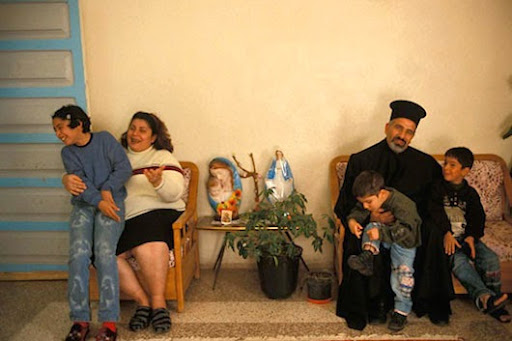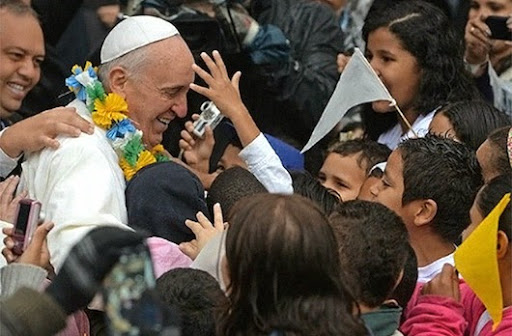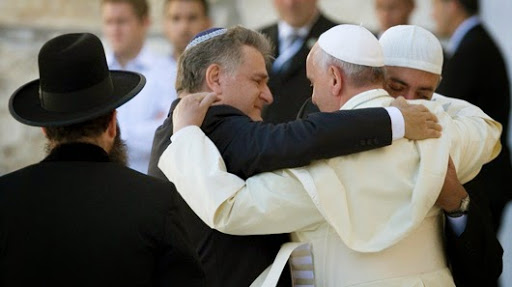
Francis in Jerusalem: brothers in mercy

Francis rabi imam

[Long read.]

Last weekend saw Pope Francis’ visit to the Holy Land, during which he delivered 15 scheduled speeches and made several spontaneous stops that have been in the headlines all over the world. Here I don’t mean to re-tell his whirlwind visit, since that has already been done very well elsewhere, but just to pick out some of my favorite moments from the homilies and addresses he delivered during that 3-day period (in chronological order).

First, there was his homily during a mass in Amman on 24th May (note the focus on diversity in unity, which is one of the key themes of the whole trip):

“The mission of the Holy Spirit, in fact, is to beget harmony – he is himself harmony – and to create peace in different situations and between different people. Diversity of ideas and persons should not trigger rejection or prove an obstacle, for variety always enriches. So today, with fervent hearts, we invoke the Holy Spirit and ask him to prepare the path to peace and unity.”

Second, he addressed refugees and disabled young people in Bethany (note the use of humility as a means of closeness to Jesus and his damning words addressed to the arms trade):

“Coming here to the Jordan to be baptized by John, Jesus showed his humility and his participation in our human condition. He stooped down to us and by his love he restored our dignity and brought us salvation. Jesus’ humility never fails to move us, the fact that he bends down to wounded humanity in order to heal us: he bends down to heal all our wounds! […]

[A]s we observe this tragic conflict, seeing these wounds, seeing so many people who have left their homeland, forced to do so, I ask myself: who is selling arms to these people to make war? Behold the root of evil! Hatred and financial greed in the manufacturing and sale of arms. This should make us think about who is responsible for this situation, for providing arms to those in conflict and thereby sustaining such conflict. Let us think about this and with sincere hearts let us call upon these poor criminals to change their ways.”

The next day (25th May), Pope Francis then addressed President Mahmoud Abbas and the Palestinian authorities, where he concluded his speech as follows (note the reference to God’s almightiness, which is very prominent in Islam, the reference to brotherhood, and the Arabic greeting at the end):

“Mr President, dear brothers and sisters gathered here in Bethlehem: may Almighty God bless you, protect you and grant you the wisdom and strength needed to continue courageously along the path to peace, so that swords will be turned into ploughshares and this land will once more flourish in prosperity and concord. Salaam!”

Later the same day, Francis then delivered a homily in Manger Square, Bethlehem, from which I’d like to quote more extensively, since it provides a great insight about the importance he gives children:

“The Child Jesus, born in Bethlehem, is the sign given by God to those who awaited salvation, and he remains forever the sign of God’s tenderness and presence in our world. The angel announces to the shepherds: “This will be a sign for you: you will find a child…”. […]

The Child of Bethlehem is frail, like all newborn children. He cannot speak and yet he is the Word made flesh who came to transform the hearts and lives of all men and women. This Child, like every other child, is vulnerable; he needs to be accepted and protected. Today too, children need to be welcomed and defended, from the moment of their conception.

Sadly, in this world, with all its highly developed technology, great numbers of children continue to live in inhuman situations, on the fringes of society, in the peripheries of great cities and in the countryside. All too many children continue to be exploited, maltreated, enslaved, prey to violence and illicit trafficking. Still too many children live in exile, as refugees, at times lost at sea, particularly in the waters of the Mediterranean. Today, in acknowledging this, we feel shame before God, before God who became a child.

And we have to ask ourselves: Who are we, as we stand before the Child Jesus? Who are we, standing as we stand before today’s children? Are we like Mary and Joseph, who welcomed Jesus and care for him with the love of a father and a mother? Or are we like Herod, who wanted to elim- inate him? Are we like the shepherds, who went in haste to kneel before him in worship and offer him their humble gifts? Or are we indifferent? Are we perhaps people who use fine and pious words, yet exploit pictures of poor children in order to make money? Are we ready to be there for children, to “waste time” with them? Are we ready to listen to them, to care for them, to pray for them and with them? Or do we ignore them because we are too caught up in our own affairs?”

In the same location, Francis then issued an invitation to prayer for peace (which was very quickly accepted by both parties – within a matter of hours):

“In this, the birthplace of the Prince of Peace, I wish to invite you, President Mahmoud Abbas, together with President Shimon Peres, to join me in heartfelt prayer to God for the gift of peace. I offer my home in the Vatican as a place for this encounter of prayer.

All of us want peace. Many people build it day by day through small gestures and acts; many of them are suffering, yet patiently persevere in their efforts to be peacemakers. All of us – especial- ly those placed at the service of their respective peoples – have the duty to become instruments and artisans of peace, especially by our prayers.”
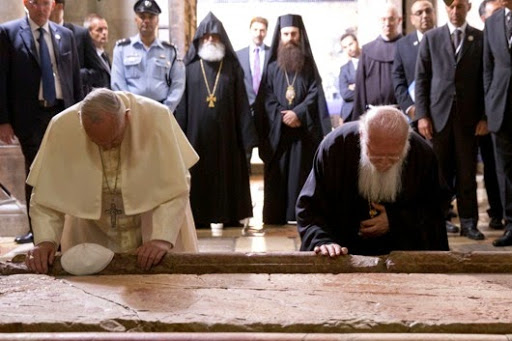
Francis bartholomew slab

From the perspective of ecumenism, the most important speech was then the one Pope Francis delivered at the Holy Sepulchre in Jerusalem, in the presence of Patriarch Bartholomew (note its supporting pillars being mercy, forgiveness, joy and unity, and the fractal nature of ecumenism – from the visible union among Christian churches to the ecumenism of everyday acts of closeness):

“Let us receive the special grace of this moment. We pause in reverent silence before this empty tomb in order to rediscover the grandeur of our Christian vocation: we are men and women of resurrection, and not of death. From this place we learn how to live our lives, the trials of our Churches and of the whole world, in the light of Easter morning. Every injury, every one of our pains and sorrows, has been borne on the shoulders of the Good Shepherd who offered himself in sacrifice and thereby opened the way to eternal life. His open wounds are like the cleft through which the torrent of his mercy is poured out upon the world. Let us not allow ourselves to be robbed of the basis of our hope, which is this: Christòs anesti! Let us not deprive the world of the joyful message of the resurrection! And let us not be deaf to the powerful summons to unity which rings out from this very place, in the words of the One who, risen from the dead, calls all of us “my brothers” (cf. Mt 28:10; Jn 20:17). […]

We know that much distance still needs to be travelled before we attain that fullness of communion which can also be expressed by sharing the same Eucharistic table, something we ardently desire; yet our disagreements must not frighten us and paralyze our progress. We need to believe that, just as the stone before the tomb was cast aside, so too every obstacle to our full communion will also be removed. This will be a grace of resurrection, of which we can have a foretaste even today. Every time we ask forgiveness of one another for our sins against other Christians and every time we find the courage to grant and receive such forgiveness, we experience the resurrection! Every time we put behind us our longstanding prejudices and find the courage to build new fraternal relationships, we confess that Christ is truly risen! Every time we reflect on the future of the Church in the light of her vocation to unity, the dawn of Easter breaks forth!”

On the final day (26th May), Pope Francis addressed the Gran Mufti of Jerusalem, where he concluded with a call to brotherhood:

“Dear brothers, dear friends, from this holy place I make a heartfelt plea to all people and to all communities who look to Abraham: may we respect and love one another as brothers and sisters! May we learn to understand the sufferings of others! May no one abuse the name of God through violence! May we work together for justice and peace! Salaam!”

Then, Francis changed his plans and instead of having lunch at the Notre Dame of Jerusalem Center, he turned up at a Franciscan friary instead, insisting that nothing be changed in either the refectory customs or the day’s menu.
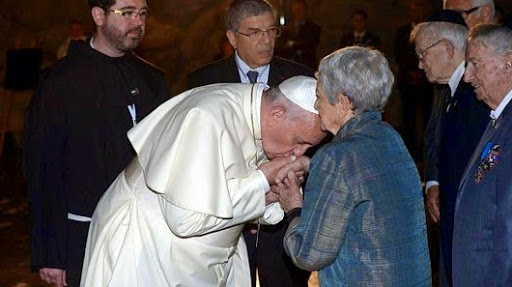
Francis holocaust survivor hand

For me the most important moment of the trip was Francis’ visit to the Yad Vashem Memorial, from where I’d like to quote almost his entire address, without commentary:

““Adam, where are you?” (cf. Gen 3:9). Where are you, o man? What have you come to? In this place, this memorial of the Shoah, we hear God’s question echo once more: “Adam, where are you?” This question is charged with all the sorrow of a Father who has lost his child. The Father knew the risk of freedom; he knew that his children could be lost… yet perhaps not even the Father could imagine so great a fall, so profound an abyss! Here, before the boundless tragedy of the Holocaust, That cry – “Where are you?” – echoes like a faint voice in an unfathomable abyss…

Adam, who are you? I no longer recognize you. Who are you, o man? What have you become? Of what horror have you been capable? What made you fall to such depths?

Certainly it is not the dust of the earth from which you were made. The dust of the earth is some- thing good, the work of my hands. Certainly it is not the breath of life which I breathed into you. That breath comes from me, and it is something good (cf. Gen 2:7).

No, this abyss is not merely the work of your own hands, your own heart… Who corrupted you? Who disfigured you? Who led you to presume that you are the master of good and evil? Who convinced you that you were god? Not only did you torture and kill your brothers and sisters, but you sacrificed them to yourself, because you made yourself a god.

Today, in this place, we hear once more the voice of God: “Adam, where are you?”

From the ground there rises up a soft cry: “Have mercy on us, O Lord!” To you, O Lord our God, be- longs righteousness; but to us confusion of face and shame (cf. Bar 1:15).

A great evil has befallen us, such as never happened under the heavens (cf. Bar 2:2). Now, Lord, hear our prayer, hear our plea, save us in your mercy. Save us from this horror.”

Finally, Francis also celebrated mass at the Upper Room, where he spoke about what its meaning is for us (note the emphasis on friendship, service and family – both the importance of families in the Church, and the Church being a family):

“The Upper Room speaks to us of service, of Jesus giving the disciples an example by washing their feet. Washing one another’s feet signifies welcoming, accepting, loving and serving one another. It means serving the poor, the sick and the outcast, those whom I find difficult, those who annoy me. […]

The Upper Room also reminds us of friendship. “No longer do I call you servants – Jesus said to the Twelve – but I have called you friends” (Jn 15:15). The Lord makes us his friends, he reveals God’s will to us and he gives us his very self. This is the most beautiful part of being a Christian and, especially, of being a priest: becoming a friend of the Lord Jesus, and discovering in our hearts that he is our friend. […]

[T]he Upper Room reminds us of the birth of the new family, the Church, our holy Mother the hierarchical Church established by the risen Jesus; a family that has a Mother, the Virgin Mary. Christian families belong to this great family, and in it they find the light and strength to press on and be renewed, amid the challenges and difficulties of life. All God’s children, of every people and language, are invited and called to be part of this great family, as brothers and sisters and sons and daughters of the one Father in heaven.”

Differing currents of thought: fact or fiction?

Polyhedron

[Warning: Long read.]

One of my favorite passages in Evangelii Gaudium – Pope Francis’ apostolic exhortation, and de facto blueprint for the future of the Church – regards diversity of theological thought, where he says:

“Within the Church countless issues are being studied and reflected upon with great freedom. Differing currents of thought in philosophy, theology and pastoral practice, if open to being reconciled by the Spirit in respect and love, can enable the Church to grow, since all of them help to express more clearly the immense riches of God’s word.” (§40)

With the above model in mind, let me take you through the latest moves in a “cognitive reconciliation” process that has been underway for many years now and that I have commented on before: the dispute between the Congregation for the Doctrine of the Faith (CDF) and the Leadership Conference of Women Religious (LCWR). As you can see from the previous post, my take on the situation was in agreement with the CDF, especially after reading the LCWR’s “Systems Thinking Handbook” (where only the last of these three terms seemed to apply). In fact, I came away thinking that the CDF were being quite soft on the LCWR, whose Handbook could clearly be seen not to be Catholic, even by a non-theologian. As such, I felt that the CDF were doing their job both with precision and with prudence, which is no mean feat.

Last week then saw the next round of talks between the two parties, which Cardinal Müller kicked off with talk that reiterated the previous assessment’s validity and that lamented the limited cooperation of the LCWR over the last months. There, Müller, whose fan I have been for a long time, focused on criticizing the LCWR’s “focalizing of attention […] around the concept of Conscious Evolution,” as expounded by Barbara Marx Hubbard, even leading to “some religious Institutes modify[ing] their directional statements to incorporate concepts and undeveloped terms from Conscious Evolution.” Müller then spoke very directly about what the CDF (which he heads) thought of Conscious Evolution:

“Again, I apologize if this seems blunt, but what I must say is too important to dress up in flowery language. The fundamental theses of Conscious Evolution are opposed to Christian Revelation and, when taken unreflectively, lead almost necessarily to fundamental errors regarding the omnipotence of God, the Incarnation of Christ, the reality of Original Sin, the necessity of salvation and the definitive nature of the salvific action of Christ in the Paschal Mystery.”

And, again I have to say that I am 100% with Müller and that the above statement is an expression of tact and restraint that I personally would find hard to maintain. Marx Hubbard’s “Conscious Evolution” is muddled, buzzword-addled gibberish that at best aspires to pseudo-philosophy. It has nothing whatsoever to do with Christianity and in no sane context would it even be considered a “current of thought in philosophy, theology [or] pastoral practice.” To borrow another Marx’s linguistic device, I’d say that Conscious Evolution is to thought what military justice is to justice. It’s as if the LCWR took a shampoo ad (with its micro-ceramides and nanosphere complexes) as the starting point for a new theory of cosmogeny. If, after reviewing the Conscious Evolution website, you arrive at a different conclusion, please, proceed to ordering the official “EvolvePac” – the “Evolutionary Tool-Kit to-go” (and it is unlikely that I’ll ever see you here again).

So far, so good. “But,” you might ask, “what does this have to do with Evangelii Gaudium?” And you’d be right to question my train of though here, since the above is just an instance of a speck of dust being flicked off the Church’s shoulder. There is no question of a diversity of thought having to be “reconciled by the Spirit.”

Let’s therefore turn to another part of Cardinal Müller’s talk, where he criticizes the LWCR for their non-compliance with the CDF’s order that “speakers and presenters at major programs [are to] be subject to approval by the [the CDF’s] Delegate,” Archbishop Peter Sartain. Müller then proceeds to reiterate why this provision has been put into place, and to give an example:

“This provision has been portrayed as heavy-handed interference in the day-to-day activities of the Conference. For its part, the Holy See would not understand this as a “sanction,” but rather as a point of dialogue and discernment. […]

An example may help at this point. It saddens me to learn that you have decided to give the Outstanding Leadership Award during this year’s Assembly to a theologian criticized by the Bishops of the United States because of the gravity of the doctrinal errors in that theologian’s writings. This is a decision that will be seen as a rather open provocation against the Holy See and the Doctrinal Assessment. Not only that, but it further alienates the LCWR from the Bishops as well.”

What piqued my interest here is that the theologian in question is not named and furthermore that no comment is made by Müller on what it is about their writings that’s amiss (cf. the very clear and direct criticism and naming of Marx Hubbard). Also, a careful reading of his words shows that the objection here is firstly to the process having ignored a provision put in place by the CDF (who does have legal authority over the LCWR) and secondly to the lack of unity with the local Church in the USA.

I was curious though to understand what doctrinal errors the US bishops have found and who the theologian was, so, I dug a bit deeper.

It turns out that the theologian is Dr. Elizabeth Johnson – a Distinguished Professor of Theology at the Jesuit Fordham University in New York City and that the bone of contention with the USCCB is her book “Quest for the Living God.” Having read the USCCB’s assessment of her book made me even more curious, since it sounded to me like its central point was the incompleteness of Johnson’s book (i.e., a focusing only on some aspects, like the economy of the Trinity and not its immanence, or an overemphasis of others, like that of apophasis to the point of denying analogy in the context of our capacity to know anything about God) and that “the book is directed primarily to an audience of non-specialist readers and is being used as a textbook for study of the doctrine of God.”

The next step was obvious – to get a copy of Johnson’s book and see for myself. Here I have to say that I can very clearly identify the basis of the USCCB’s criticism – looking at the cited passages and reading around them provides a picture that is fairly represented in the USCCB’s assessment and, unlike Johnson in her response to the assessment, I don’t believe there has been any misunderstanding.

However, I’d like to argue that Johnson’s case is categorically different from the new-age self-help of the LCWR Handbook or the pseudo-philosophy of Marx Hubbard’s “Conscious Evolution.” Johnson is no charlatan – far from it! Reading her book gives a clear sense both of a sharp and erudite mind and of a person intent on seeking to encounter and understand God (a point also underlined by the USCCB being at pains to emphasize that theirs is “no judgment of the personal intention of the author”). Her writing is full of statements like “theology today […] seeks understanding of God at once contemporaneous with culture and resistant to its wrongs,” or that “[i]nsight develops […] from heart to head to hands,” and that:

“Signifying the Creator, Savior, and Lover of all the world, the whole cosmos as well as all human beings, the phrase “the living God” elicits a sense of ineffable divine mystery on the move in history, calling forth our own efforts in partnership while nourishing a loving relationship at the center of our being: “my heart and my flesh sing for joy to the living God” (Psalm 84:2).”

I have to say that the above could well have come from Pope Francis, Cardinal Ravasi or even Cardinal Müller. Hers is very much Christian and (part of) Catholic thought and clearly a candidate for the kind of process proposed in Evangelii Gaudium. While I agree with the USCCB’s assessment that her writing is misleading (by being incomplete and aimed at a broad audience), I do also think that it is rich in insight and that the response should have been to initiate dialogue, which, sadly has not taken place – also to Prof. Johnson’s disappointment. I believe that it would be well possible for Johnson to extend what she has written in a way that would not change her position, while making its relationship with the Church’s teaching explicit rather than ambiguous to a theologically untrained reader.

To conclude, let me just refer to Cardinal Kasper, who has been asked about this case during his visit to the US this week and who has been quoted as saying: “Sometimes the CDF views things a bit narrowly. Aquinas was condemned by his bishop. So Johnson is in good company.” I believe it is the CDF’s job to view things narrowly, but also that it is the whole Church’s job to be broad and to facilitate exactly the kind of “differing currents of thought” that Pope Francis speaks about in Evangelii Gaudium.

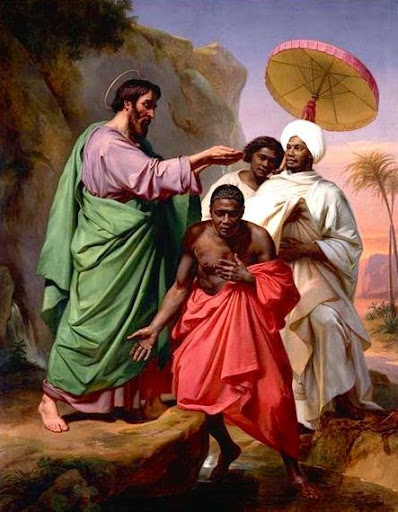
The Ethiopian eunuch: a case study in mercy

Ethiopian eunuch

Today’s first reading, from the Acts of the Apostles (8:26-40), tells the story of St. Philip’s journey from Jerusalem to Gaza, during which he meets the chief treasurer of the Queen of Ethiopia, who is a eunuch (i.e., man castrated to become a more trustworthy and disinterested servant). The eunuch is reading from the book of Isaiah and, upon being asked by Philip whether he understands what he reads, Philip is invited to join the eunuch in his chariot to explain it to him. The passage in question was:

“Like a sheep he was led to the slaughter,
and as a lamb before its shearer is silent,
so he opened not his mouth.

In (his) humiliation justice was denied him.
Who will tell of his posterity?
For his life is taken from the earth.”
(cf Isaiah 53:7-8)

Philip told the eunuch that the passage was about Jesus and proceeded to tell him more. When they came to some water, the eunuch said: “Look, there is water. What is to prevent my being baptized?” (Acts 8:36). And Philip baptized him.

You might think: “so what?,” but the above is actually quite an important passage given what is going on in the Church today, since, I believe, it gives an example of what being welcoming of everyone and focused on mercy mean. The eunuch in question here wasn’t just some guy who wanted to be baptized and whom Philip baptized as a matter of fact, to boost statistics.

The Hebrew Bible is very clear that “the law forbids the community of the Lord to accept anyone who has undergone destruction or removal of their sexual organs” (cf. Deuteronomy 23:2), as is certainly the case with eunuchs. Since St. Philip – like Jesus – was a Jew, and Jesus’ followers at that time were part of the Jewish community, these restrictions would have been know to him and there would have been an obligation to honor and adhere to them. Nonetheless, it must have been Jesus’ imperative to “Go, therefore, and make disciples of all nations, baptizing them in the name of the Father, and of the Son, and of the holy Spirit” (Matthew 28:19) that lead Philip to baptize – and thereby welcome into the community of Jesus’ followers – not only a non-Jew, but a member of a different race and of a sexual minority, explicitly outlawed by the Old Testament. None of these obstacles mattered to him, since “[t]he Spirit said to Philip, “Go and join up with that chariot.”” (Acts 8:29).

Pope Francis’ homily from this morning also deals with this first reading, instead of the Gospel as is more customary, and focuses on Philip’s attitude towards the eunuch:

“It’s impossible to evangelize without dialogue. It’s impossible. Because you must begin from where the person is, who is to be evangelized. And how important this is. ‘But, father, so much time is wasted because every person has their own story, comes with this or that, their own ideas …’ And, time is wasted. God wasted more time when he created the world, and He did well to do so! Dialogue. Waste time with that person because that person is whom God wants you to evangelize, what’s most important is that you give them the news about Jesus. But the way they are, not the way they ought to be: the way they are now.

Let’s think about these three moments of evangelization: the docility to evangelize; to do what God is asking, secondly, dialogue with people – but in dialogue, one begins from where they are – and thirdly, trusting in grace: grace is more important than all of bureaucracy. ‘What prevents this?’ Remember this. Often we in the Church are a factory of obstacles, because of which people can’t arrive at grace. May the Lord help us to understand this.”

Here, I believe, it is important to bear in mind what Francis means by “evangelizing,” which is “[t]o give witness with joy and simplicity to what we are and what we believe in.” There is no compulsion here, no obligation, no proselytizing. And that St. Philip had the same attitude is clear also from it being the eunuch’s initiative to become baptized. What struck me here is also the great simplicity and obviousness of his request: “Look, there is water. What is to prevent my being baptized?” Having received Jesus’ Good News from Philip, the eunuch has a new optics, through which the obstacles of old become invisible and it is only God’s welcome that can be seen. For the Church to then turn to this guy and say: “Sorry, mate, but you don’t qualify,” would have been absurd and is not at all what St. Philip did.

This brings me to a superb interview with Cardinal Walter Kasper, given to Commonweal magazine during his visit to the USA this week, where he speaks about mercy as follows:

“[The] ontological understanding of God was so strong that justice became the main attribute of God, not mercy. Thomas Aquinas clearly said that mercy is much more fundamental because God does not answer to the demands of our rules. Mercy is the faithfulness of God to his own being as love. Because God is love. And mercy is the love revealed to us in concrete deeds and words. So mercy becomes not only the central attribute of God, but also the key of Christian existence. Be merciful as God is merciful. We have to imitate God’s mercy. […]

Mercy concerns not only individuals. It also an imperative for the church itself. The church defined itself at the Second Vatican Council as a sacrament of God’s grace. How can the church be sacramental, a sign and instrument of mercy, when she herself doesn’t live out mercy? So many people do not perceive the church as merciful. It’s hard. […]

There are those who believe the church is for the pure. They forget that the church is also a church of sinners. We all are sinners. And I am happy that’s true because if it were not then I would not belong to the church. It’s a matter of humility.”

The key idea to me here is Kasper’s beautifully synthetic: “God does not answer to the demands of our rules. Mercy is the faithfulness of God to his own being as love.” Our own openness to others must be informed by a desire to share with them the joy that we have received from being brothers and sisters of Jesus and we must be weary of placing obstacles between them and God – no matter what they might be.

Francis’ new bishops

That Pope Francis lives a simple life and seeks closeness to people is well known, documented and broadly admired. However, the question of whether his personal conduct has any effect beyond the Pope himself is regularly put on the table, in the context of concerns about whether the Church as a whole is in the process of changing or whether it “only” has an admirable leader. I have to say that this type of question is well founded, since the Catholic Church has 1.2 billion members, over 400 000 priests and around 5000 bishops, and asking whether the behavior of one person, even if it is its leader, can lead to change in that of over a billion is eminently reasonable.

As a result of the above concern, that I shared, I have been keeping an eye on reports about the new bishops who have been appointed since Pope Francis’ election as well as on reports about the conduct of other bishops. Instead of dwelling on surgical interventions, like the removal of the German “bishop of bling,” the Bishop of Limburg Franz-Peter Tebartz-van Elst, I would like to share with you three examples – two of newly-appointed bishops and one of an established bishop’s change of judgment.

Bishop john keenan
Fr. John (wearing a black t-shirt) with a group of students from Glasgow University at the World Youth Day in Brazil last year.

The first instance of a Pope-Francis-like bishop that I noticed was that of John Keenan, the newly-consecrated Bishop of Paisley. His first move was reported by a Scottish daily, The Herald, by saying that he “has shunned the more comfortable address [of the bishop’s residence] to move into a parish house in a housing scheme in an area of multiple deprivation.” Why did Bishop John do that? His answer was: “[T]o be close to the people of our times,” and he went on to describe his choice as follows:

“I’ve just come from living in a university chaplaincy with a dozen students so I’ve been living surrounded with the buzz of life and fun. When I was thinking about becoming a bishop I was keen to take as much of that into my new life, finding people who could form a family with me and support me. Priests in Paisley found me a place in St Laurence’s, Greenock. I am living with the parish priest, Father Gerry McNellis, lots of parishioners come in and out of the house and it has the sound of laughter that makes me feel at home. I celebrate the parish Mass and am getting to know the people and that’s perfect for me.”

The buzz of life and living in a family are the key here, which then lead to change: “When people see a church not just giving to the poor and the excluded but being among them and living with them joyfully, then they will really begin to believe there is a way out of the vicious cycle of living for yourself in your own little bubble.”

Bishop carl kemme
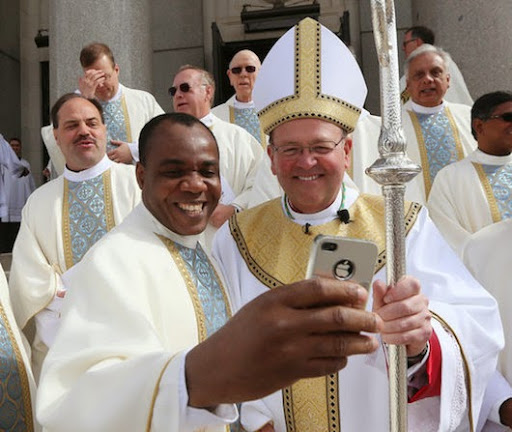
Bp. Carl in a “selfie” after his consecration.

Next, I read about Carl Kemme, the new Bishop of Wichita, who was consecrated last Thursday and whose choice of how to celebrate the event was very much Francis-like. The Wichita Eagle reported it as follows:

“Kemme has decided to have his pre-ordination luncheon with friends and family […] across the street from the cathedral at the Lord’s Diner, which serves dinner each night to the needy. The diner’s staff members will prepare the luncheon. “I’ve asked that the meal be … just a simple meal that we can share in the same place where our brothers and sisters … rely on that for their daily bread,” Kemme said.”

That this is inspired by Francis’ example is something that Bishop Carl is explicit about: “His simplicity, his humility, the fact he’s chosen to live in a simpler place and to ride in a regular car and to prefer not the trappings of the pontificate but the real ministry of it I think signals to the whole world and certainly to the church of a whole new dynamic.” And his reaction to first receiving the news is also telling: “Without a doubt, Pope Francis could have chosen a far more qualified candidate. But in God’s mysterious plan, he has chosen me, which is a humbling and sobering experience. I receive all of this as a sign of how God often chooses the least qualified, the weak and the sinful to accomplish his mission in the world.”

Bishop wilton gregory
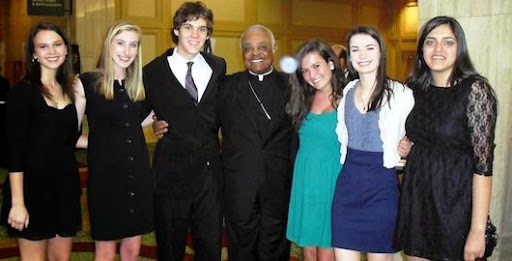
Abp. Wilton with youth from the Society of St. Vincent de Paul.

The final example I’d like to share is of a different kind. It concerns Archbishop Wilton D. Gregory, who has been in office for 10 years and who was consecrated bishop another 11 years before he took on his current post. To resolve space limitations at his Atlanta cathedral, he was planning to move out of his residence, so that other priests could move in, and he was going to have a new archbishop’s residence built with donated money and land. As the New York Times reported, the plan was to build a “$2.2 million, 6,000-square-foot mansion, with plenty of room to host and entertain.” A choice, which in the past would not have been frowned upon since it has to be borne in mind that this was going to be not only the accommodation of the current archbishop, but serve other current and future needs of the Church as well.

However, already during his first meeting with the media since his election, Pope Francis has called for “a church which is poor and for the poor,” and Archbishop Wilton’s plans were out of sync. The key here is that he himself admitted so when he publicly apologized for them, after concerns were raised by lay members of his diocese. In spite of following a selfless decision making process, which he openly shared with his diocese, Abp. Wilton nonetheless took full responsibility, by saying:

“What we didn’t stop to consider, and that oversight rests with me and me alone, was that the world and the church have changed. […] I failed to consider the impact on the families throughout the Archdiocese who, though struggling to pay their mortgages, utilities, tuition and other bills, faithfully respond year after year to my pleas to assist with funding our ministries and services. I failed to consider the difficult position in which I placed my auxiliary bishops, priests, deacons and staff who have to try to respond to inquiries from the faithful about recent media reports when they might not be sure what to believe themselves. I failed to consider the example I was setting for the young sons of the mother who sent the email message with which I began this column.”

And he proceeded to apologize unreservedly and repeatedly: “To all of you, I apologize sincerely and from my heart.” and to put a clear, new process in place, demonstrating again his commitment to listening and his openness to change:

“It is my intention to move deliberately forward and to do a better job of listening than I did before. When I thought this was simply a matter of picking up and moving from one house to a comparable one two miles away, we covered every angle from the fiscal and logistical perspectives, but I overlooked the pastoral implications. I fear that when I should have been consulting, I was really only reporting, and that is my failure. To those who may have hesitated to advise me against this direction perhaps out of deference or other concerns, I am profoundly sorry.

There are structures already in place in the Archdiocese from which I am able to access the collective wisdom of our laity and our clergy. In April I will meet with the Archdiocesan Council of Priests, and in early May our Archdiocesan Pastoral Council (a multi-cultural group of Catholics of all ages, representing parishes of all sizes, who serve as a consultative body to me) will convene. I will ask for the Finance Council of the Archdiocese to schedule an extraordinary meeting. At each of these meetings I will seek their candid guidance on how best to proceed.”

While the examples of Bishops John and Carl are greatly encouraging, I am most impressed by Archbishop Wilton – a bishop of 21 years experience who is ready to take responsibility, apologize for an error of judgment and bring about change in his diocese. His example is one of profound humility and illustrates Pope Francis’ insistence on the need to acknowledge our failings without letting them hold us back from change and constant renewal.

The salvific atheism of Christ

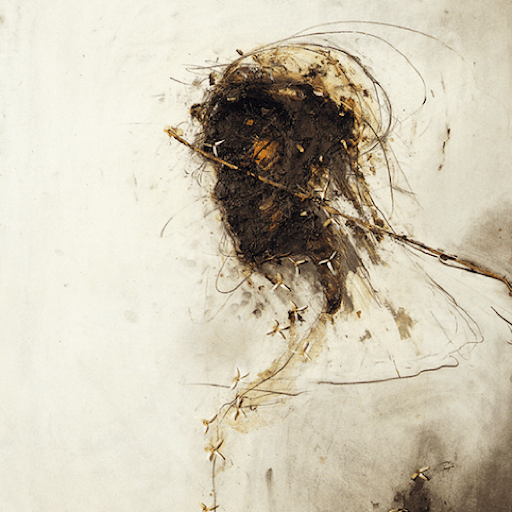
Jf

[Warning: Long read.]

The title of this post is a quote from a conversation between Cardinal Gianfranco Ravasi and the journalist and atheist Eugenio Scalfari. There, Ravasi argued that Jesus’ cry on the cross: “My God, my God, why have you forsaken me?” (Matthew 27:46) can be described as a “salvific atheism.” An atheism that is juxtaposed with the Resurrection, where Jesus remains the Son even when He doesn’t feel the Father and thereby “plants the seed of the infinite in mortality.” Many shy away from attributing atheism to Jesus in this moment, where He laments His being abandoned by God, with a lot of hand-waving and “as if”s or appeals to reason along the lines of “how could Jesus, who is God, have been abandoned by God?!” Such attempts at denying Jesus’ profound experience of the absence of God may have good motives, but they have always struck me as being misguided, since they obscure the extreme nature of this most important moment of Jesus’ life.

That Jesus underwent a trial of this magnitude, where his suffering drove him to a loss of feeling united with the Father – i.e., the very heart of the Trinity, is the most powerful indication of how far God is willing to go towards us, whose faith is limited at the best of times. He is showing us that He is our brother also in darkness and during experiences of the absence of God.

The importance of this nadir in Jesus’ life (and pinnacle of His self-noughting love) was profoundly understood also by Chiara Lubich, the founder of the Focolare Movement who is now on the path of being considered for sainthood, and by the agnostic Swedish film director, Ingmar Bergman.

For Lubich, who with her first companions has spent years focused on putting the Gospel into practice, the realization of the importance of Jesus’ forsakenness on the cross came, when – in 1944 – her spiritual director asked her when Jesus suffered most and declared that he thought it was in his cry of forsakenness on the cross. Looking back to that moment some 56 years later, Lubich described it as follows:

“Right from the start we understood that fullness had another side to it, the tree had its roots. The Gospel covers you in love, but demands everything from you. “If the grain of wheat doesn’t fall to the earth and die – we read in the Gospel of John – it remains just a grain of wheat, but if it dies, it bears much fruit” (Jn 12:24). And the personification of this is Jesus Crucified, whose fruit was the redemption of humankind. […] Through a particular circumstance, we came to know that the greatest suffering of Jesus and, therefore, his greatest act of love, was when on the cross he experienced the abandonment by the Father: “My God, my God, why have you abandoned me?” This touched us to the depths. And our young age, our enthusiasm, but especially the grace of God, urged us to choose only him in his abandonment, as the means to realize our ideal of love.”

Having identified Jesus’ forsakenness as the pinnacle of his love, Lubich and her companions sought to find, love and console Him in the sufferings of all around them and in themselves:

“From that moment on, we seemed to discover his countenance everywhere. He had experienced within himself people’s separation from God and from each other, and he had felt the Father far from him. We saw him not only in all our personal sufferings, which were never lacking, but in those of our neighbor, often alone, abandoned, forgotten, in the separation between generations, between rich and poor, within the very Church at times, and, later, between churches, then between religions and between persons of different convictions.

But these wounds didn’t frighten us. On the contrary, because of our love for him in his abandonment, they attracted us. He had shown us how to face them, how to live them, how to cooperate in overcoming them when, after the abandonment, he placed his spirit in his Father’s hands: “Father, into your hands I commend my spirit” giving to humankind the possibility of being restored to itself and to God, and he showed us the way. And so he manifested himself to be the key to unity, the remedy for every disunity. He was the one who recomposed unity between us each time it cracked. In him we recognized and loved the great and tragic divisions of humankind and of the Church. He became our only Spouse.”

During Lent that same year, Lubich meditated on Jesus’ forsakenness in this way:

“He who is life itself was giving himself completely. It was the culmination of his love, love’s most beautiful expression.

All the painful aspects of life conceal his face: They are nothing other than him.

Yes, because Jesus, crying out in his abandonment, is the image of those who are mute: He no longer knows how to speak.

He is the image of one who is blind – he cannot see; of one who is deaf – he cannot hear.

He is the weary person, moaning.

He is on the brink of desperation.

He is hungry … for union with God.

He is the image of one who has been deceived, betrayed; he seems a failure.

He is fearful, timid, disoriented.

Jesus forsaken is darkness, melancholy, contrast. He is the image of all that is strange, indefinable, that has something monstrous about it. Because he is God crying out for help!

He is the lonely person, the derelict. He seems useless, an outcast, in shock.

Consequently we can recognize him in every suffering brother or sister.”

Finally, Lubich, who has made love of Jesus forsaken her life, describes the following effects of identifying and loving Him in others: “after each encounter in which we have loved Jesus forsaken, we find God in a new way, more face-to-face, with greater openness and fuller unity. Light and joy return; and with the joy, that peace which is the fruit of the spirit.”

To get another, deeply insightful, perspective on this key moment in Jesus’ life, Bergman’s “Winter Light,” that premiered in 1962, has its characters speak about it twice. First, when the pastor of a town, plagued by doubt, breaks down in front of a parishioner who comes to him for help, saying, with obvious anguish and torment throughout:

“If there is no God, would it really make any difference? Life would become understandable. What a relief!

And thus death would be a snuffing out of life. The dissolution of body and soul. Cruelty, loneliness and fear … all these things would be straightforward and transparent.

Suffering is incomprehensible, so it needs no explanation.

There is no creator. No sustainer of life. No design.

My God…

Why have you forsaken me?

I’m free, free at last.”

Before giving thought to the above, let’s look at the second reference to Jesus’ forsakenness, which comes later, when the disabled sacristan (who didn’t hear the pastor’s lament) shares the following reflection with him:

“Wouldn’t you say the focus on [Christ’s] suffering is all wrong? This emphasis on physical pain. It couldn’t have been all that bad. It may sound presumptuous of me – but in my humble way, I’ve suffered as much physical pain as Jesus.

And his torments were rather brief. Lasting some four hours, I gather? I feel that he was tormented far worse on an other level.

Maybe I’ve got it all wrong. But just think of Gethsemane, Vicar. Christ’s disciples fell asleep. They hadn’t understood the meaning of the last supper, or anything. And when the servants of the law appeared, they ran away. And Peter denied him. Christ had known his disciples for three years. They’d lived together day in and day out – but they never grasped what he meant.

They abandoned him, to the last man. And he was left alone. That must have been painful. Realizing that no one understands. To be abandoned when you need someone to rely on – that must be excruciatingly painful. But the worse was yet to come. When Jesus was nailed to the cross – and hung there in torment – he cried out: “God, my God! Why hast thou forsaken me?” He cried out as loud as he could. He thought that his heavenly father had abandoned him. He believed everything he’d ever preached was a lie. The moments before he died, Christ was seized by doubt. Surely that must have been his greatest hardship? God’s silence.”

To my mind, the above are two great attempts at an identification with the forsaken, crucified Jesus. The first, the pastor’s, is an identification from within – a re-experiencing of Jesus’ forsakenness at first hand, that leads the protagonist to a wishing away of it all, to a denial of the problem’s reality and a subsequent, forced declaration of freedom (forced and strained because of how it is portrayed in the movie). The second is an identification from the position of compassion and intuition – the disabled sacristan takes his own physical and psychological sufferings as a basis for inferring the greater magnitude of the latter, and – by extrapolation – intuiting that Jesus’ forsakenness on the cross – the experience of “God’s silence” – must have been most severe.

In many ways it is the pastor’s experience that gives the greatest sense of what it may have been like for Jesus himself, by the anguish and despair that it presents. The sacristan’s monologue, in turn, is – to my mind – already a source of hope in that it demonstrates another’s capacity to intuit my despair and therefore be lead to compassion.

St. John Paul II’s encyclical of suffering

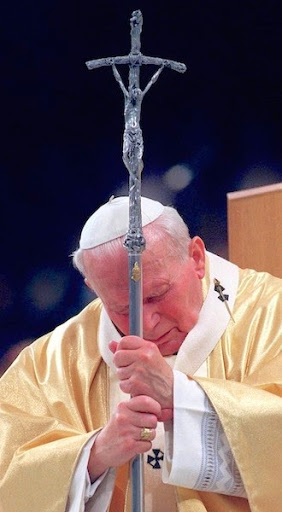
Jp2 cross s

Since writing my previous post of thanksgiving to St. John Paul II, ahead of his and St. John XXII’s canonization last Sunday, I kept coming back to thinking about another aspect of his life that has great importance for me. Beyond his words and actions, his perseverance in suffering, especially during the last 15 years of his pontificate (i.e., since the onset of Parkinson’s), has always been an inspiration and an example for me.

Cardinal Bertone put this aspect of St. John Paul II’s life best, when he said that “suffering was another one of his encyclicals.” And by considering it alongside his writings, the most obvious parallel to draw is with the encyclical Salvifici Doloris, which he wrote about suffering some six years after being elected Pope and where one of the key passages for me is the following (§23):

“Those who share in Christ’s sufferings have before their eyes the Paschal Mystery of the Cross and Resurrection, in which Christ descends, in a first phase, to the ultimate limits of human weakness and impotence: indeed, he dies nailed to the Cross. But if at the same time in this weakness there is accomplished his lifting up, confirmed by the power of the Resurrection, then this means that the weaknesses of all human sufferings are capable of being infused with the same power of God manifested in Christ’s Cross. In such a concept, to suffer means to become particularly susceptible, particularly open to the working of the salvific powers of God, offered to humanity in Christ. In him God has confirmed his desire to act especially through suffering, which is man’s weakness and emptying of self, and he wishes to make his power known precisely in this weakness and emptying of self. This also explains the exhortation in the First Letter of Peter: “Yet if one suffers as a Christian, let him not be ashamed, but under that name let him glorify God.””

The absurdity and scandal of a suffering God – and of suffering man – are not explained away or justified, but become invitations to participate in the suffering of Jesus, which demonstrates the extent of God’s love for man.

About fifteen years after writing the above words, and while visiting the sick in a hospital in Mexico City, St. John Paul II returned the the same theme and elaborated it further:

“Seen in this way, pain, disease and the dark moments of human existence acquire a profound and even hopeful dimension. One is never alone in facing the mystery of suffering: we are with Christ who gives meaning to the whole of life: moments of joy and peace, as well as those of affliction and grief. With Christ everything has meaning, even suffering and death; without him, nothing can be fully understood, not even those legitimate pleasures which God has associated to different moments of human life.”

Thinking about St. John Paul II’s health, one can wonder whether his remaining in office was good for the leadership of the Church, whether it wouldn’t have been better if he had resigned, and one can wonder whether such thoughts even entered the Pope’s head, or whether he had continued in his role out of inertia. The answer to the second part of the question is clear from the revision of his own Last Will that he made in the year 2000 and where he added:

“On May 13, 1981, the day of the attack on the Pope during the general audience in St. Peter’s Square, Divine Providence saved me in a miraculous way from death. The One Who is the Only Lord of life and death Himself prolonged my life, in a certain way He gave it to me again. From that moment it belonged to Him even more. I hope He will help me to recognize up to what point I must continue this service to which I was called on Oct. 16, 1978. I ask him to call me back when He Himself wishes. “In life and in death we belong to the Lord … we are the Lord’s.” (cf. Romans 14,8). I also hope that, as long as I am called to fulfill the Petrine service in the Church, the Mercy of God will give me the necessary strength for this service.”

To answer the first doubt, we need look no further than to the homily given by his successor, Benedict XVI, during the beatification of St. John Paul II, where he said:

“[T]he Lord gradually stripped him of everything, yet he remained ever a “rock”, as Christ desired. His profound humility, grounded in close union with Christ, enabled him to continue to lead the Church and to give to the world a message which became all the more eloquent as his physical strength declined. In this way he lived out in an extraordinary way the vocation of every priest and bishop to become completely one with Jesus, whom he daily receives and offers in the Church.”

Leadership of the Church is not about organizational shrewdness, effective policies or vigor (all of which are good, but secondary) – instead it is about an imitation of its head – Jesus. And as such, there is no doubt in my mind that St. John Paul II remained an exemplary leader until his very last moments on Earth. His public and persistent acceptance of frailty, suffering and weakness were as much evidence of his following in Jesus’ footsteps, as his rallying against the mafia, his effort to establish brotherly relationships with other religions, or his forgiving his would-be assassin. Pope Benedict XVI, addressing the Pontifical Council for pastoral healthcare professionals, explained St. John Paul II’s witness as follows:

“The mystery of suffering seems to blur the face of God, making Him almost a stranger, or even identifying him as being responsible for human suffering, but the eyes of faith are able to look deeply into this mystery. God became incarnate, He came to be close to man, even in the most difficult situations, He did not eliminate suffering, but in the Risen Crucified One, the Son of God suffered unto death, even death on a cross, He reveals that His love goes even deeper into the abyss of man to give him hope. The Crucified is risen, death has been illuminated by the morning of Easter: ‘God so loved the world that he gave his only Son, that whoever believes in him shall not perish but have eternal life’ (Jn 3.16). […] The testimony of the last years of John Paul II’s life teach us this: “An unshakable faith pervaded his physical weakness, making his illness, lived for love of God, the Church and the world, a actual participation in the journey of Christ to Calvary. The following of Christ did not spare Blessed John Paul II to take up his cross every day until the end, to be like his only Master and Lord.””

As I was thinking about what it is about St. John Paul II’s example that attracted me so much, I was visiting the Sagrada Familia in Barcelona, and I went to spend some time in front of Jesus in the Eucharist – if you convince a guard that you realize you are in an actual church, you are granted access to a small, walled-off fragment of the basilica where the tabernacle is situated. In the midst of the roar of a throng of tourists, I looked at the inscription on the tabernacle, which read: “Jo sóc la vida” (“I am the life” – cf. John 14:6) and something went “click” in my mind.1 A following of Jesus means an identification of life with Him and it is this that St. John Paul II did. His was an imitation of Jesus in all aspects of life – the joyous and the sorrowful, and a realization that the way to the joy of the resurrection that is mirrored in the joys of life passes through the sorrow of the crucifixion, which we can participate in, in its sufferings.

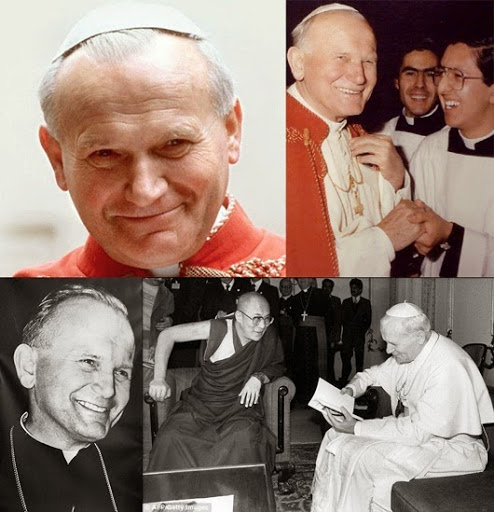
Just to dispel a potential misunderstanding that might arise from having spent 1500 words talking about suffering and that might suggest a preference for or a seeking out of suffering, let me say that this is not what Christianity is about. Instead it is all about joy, but a joy that embraces and subsumes the difficult and painful moments of life – like a profound beauty that also elevates and incorporates ugliness. In the end though it is about joy and beauty, like St. John Paul too emphasized when he insisted that “We are an Easter people” and when Pope Francis criticized “Christians whose lives seem like Lent without Easter” and who look like “sourpusses.” Let me therefore leave you with a couple of photos of St. John Paul II, from which it can be seen that he was anything but a sourpuss 🙂

Jp2 smiles


1 Not that I think the mind is mechanical :).

Subirachs’ Passion Façades

Subirachs

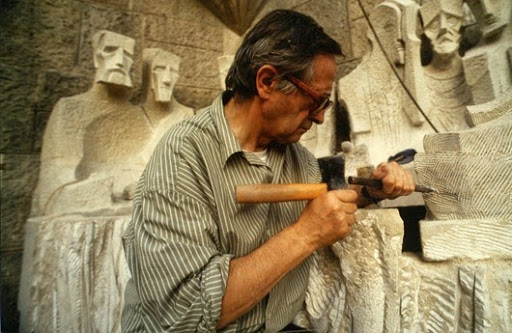
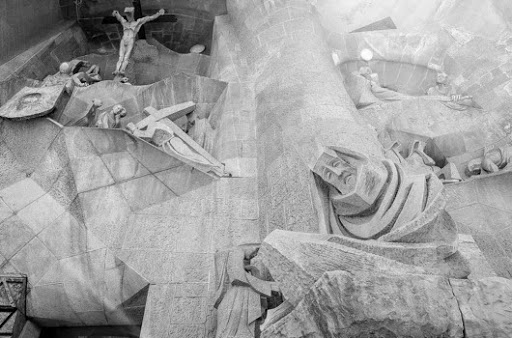
My favorite building in the world is the Basilica of the Sagrada Familia in Barcelona, where its Passion Façade in particular is an exceptional creation and object for contemplation. Its creator, the Catalan sculptor Josep Maria Subirachs,1 who died three weeks ago, was an adherent of the New Figuration movement that brought figurative elements back to sculpture in the 1960s and which Subirachs explains as follows:

“The images of the artists of the new figuration are used in the same way in which abstract artists use form: transformed into signs; because of this, abstract art does not represent but it does signify. Therefore, new figuration too does not represent anything but does signify, which makes me want to call it significative figuration.”

When Subirachs was then asked to create the Sagrada Familia’s Passion Façade, depicting the last two days of Jesus’ life, his two conditions were that he would not imitate Gaudí and follow his own, free creativity instead, and that he would live in the grounds of the church, like Gaudi – whom he admired – lived. While being granted these two requests (and being heavily criticized for his choices subsequently), Subirachs nonetheless was keen to embody Gaudí’s vision, which was the following:

“Some might find this Façade too extravagant; but I would like it to inspire fear, and I would not spare the use of chiaroscuro, of motives of entry and exit, all that results in the most theatrical effect. What’s more, I am prepared to sacrifice the construction of the church itself, to break arches and cut columns, to transmit the bloodiness of the Sacrifice.”

How Subirachs did it though is very different from what Gaudí would have done. For a start, Gaudí considered curves – round, organic shapes – to be “the line of God.” “Instead,” Subirachs says, “my shapes are very geometric, with flat faces and sharp edges, and provide the drama that the scene I am representing needs.” There is also a minimalism in Subirachs’ approach, e.g., where he leaves out the two thieves crucified either side of Jesus and a depiction of Jesus’ entry into Jerusalem on Palm Sunday, which were in Gaudí’s plans, for the sake of a “simple, didactic message.” Such minimalism is at the core of what Subirachs considers to be the essence of sculpture, which is “getting rid of everything that is unnecessary.”

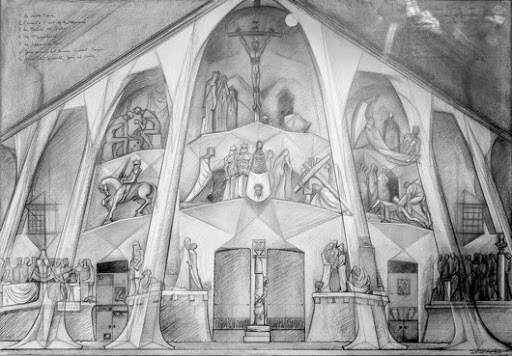
Just to get a sense of how Subirachs approached the depiction of Jesus’ passion, the following shows the plan he drew up before proceeding to create the sculptures:

Passion facade plan

The story, which Subirachs wanted to be “cinematographic,” starts with the last supper at the bottom left and then snakes its way to the top right where the entombment of Jesus is shown. A golden statue depicting the resurrected Jesus is then located between the towers erected above the façade.

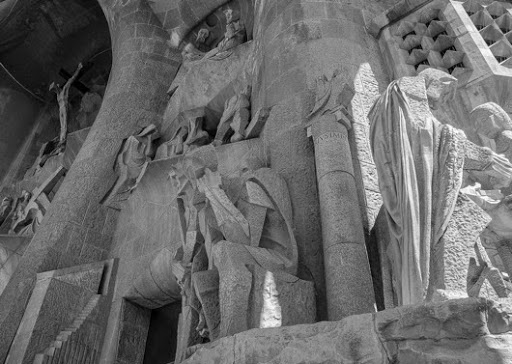
To get a better sense of what the above plan lead to, take a look at the following collection of photos. However, this is just a poor substitute for being there in person. Every time I go to see the Passion Façade, something new stands out for me, and yesterday was no different. What struck me was how the layout of the story, in the boustrophedonic sequence that Subirachs chose, results in three of the characters that betrayed Jesus – Judas, Pilate and Peter – all being depicted in the bottom layer. This, in turn, allows for a viewing of the Passion from their perspectives – with the consequences of their actions (or the source of his sorrows, in Peter’s case) projecting out from them and reinforcing the cause of their grief. In the two following photos you can see the “Passion of Pilate” followed by the “Passion of Peter.”

Passion of pilate

Passion of peter

This also reminded me of Pope Francis’ Palm Sunday homily, where he discarded his prepared text and instead proceeded to reflect on the question of where each one of us fits into Jesus’ Passion, asking: “Where is my heart? Which of these persons am I like?” Subirachs’ Passion Façade is a meditation on the last hours of Jesus life, but (borrowing Benedict XVI’s words about Gaudí) made “not with words but with stones, lines, planes, and points.”


1 If you understand Catalan, there is a great hour-long documentary about Subirachs available here.

Viri probati: priesthood for married men

Johannes30070 036L

It looks like Pope Francis has started testing the waters for the possibility of reintroducing the option of having married priests in the Roman Catholic Church. In an audience with him,1 Erwin Kräutler, the bishop of Xingu in the Brazilian rainforest, raised the challenges of the shortage of priests. Bishop Kräutler told the Pope about only having 27 priests for 800 communities with 700 000 faithful in the Amazonian rainforest, which means that each parishioner only has access to the Eucharist 2-3 times per year.

Francis’ response was that local bishops know the needs of their people best and that they must be courageous and make proposals for new solutions. Bishops mustn’t act alone and should instead first agree in their local bishops’ conferences about proposals for reform, before then bringing them to Rome. This was followed by the topic of the possibility of ordaining married “viri probati” (“proven/tested men”) as priest,2 which lead Pope Francis to sharing the situation in a Mexican diocese, where there is a married, permanent deacon in every parish, but many do not have a priest. These 300 deacons, however, cannot celebrate the mass. How could this continue? It is here that bishops should make proposals.

That, in a nutshell, is Bishop Kräutler’s account of his conversation with Pope Francis, which The Tablet reported on 10th April in an article entitled “Pope says married men could be ordained – if world’s bishops agree.” Not exactly the letter of the original report, but, I’d say, in agreement with its spirit (the audience with Pope Francis points to a broader consultation process than just a yes/no about ordaining proven married men to the priesthood, and by the sounds of it, it was Kräutler who brought up the topic).

During the following days there then came a number of statements by bishops regarding the question of “viri probati,” in general being in favor of it. Among them are three English and Welsh bishops: Thomas McMahon, the previous Bishop of Brentwood, in whose diocese there were 20 former Anglican married priests, who said:

“I would be saying personally that my experience of married priests has been a very good one indeed. I think people in those parishes where they have been placed have taken to them very well indeed. People look to their priest as a man of God, to lead them to God. If he is a real pastor at their service then it is rather secondary as to whether he is married or not.”

Bishop Seamus Cunningham of Hexham and Newcastle also expressed his support and Bishop Tom Burns of Menevia (Cardiff) said that “These married men would bring a wider experience and understanding to priestly ministry.” A couple of days ago, Archbishop Diarmuid Martin of Dublin also expressed his openness to considering the proposal, while emphasizing the importance to act in unity with the whole Church and with the Pope.

There have also been voices of support for this option in the past: Bishop Manfred Scheuer of Innsbruck in Austria declared himself in favor in 2011, while pointing out his skepticism about whether this would be a measure for addressing the shortage of priests though. Cardinal Timothy Dolan of New York, in the book-length interview, stated that he could see the priestly ordination of viri probati happening, but that he too had reservations about it being a solution to current shortage.

And, let’s not forget Pope Benedict XVI himself allowing for the future priestly ordination of married men in in the context of the Personal Ordinariate established by the apostolic constitution Anglicanorum Coetibus (as opposed to only considering it a transitory measure for the initial transferees from the Anglican Communion).

The concept of “viri probati” dates back to the first century, where it is referred to in a letter (§42:4) by Pope St. Clement I, albeit in a different context – that of candidates for being appointed bishops and deacons in general. The idea there was that the men in question had a track record of living a Christian life, before they were considered for ordination. This is already what is in place for married permanent deacons (a practice re-introduced by Vatican II and having resulted in 16 000 married men being ordained and active as deacons today in the US alone), where the minimum requirement (Can. 1031 §2) for a candidate is the age of 35 years (and the consent of his wife! :).

Essentially this new proposal sounds to me like an opening of priestly ordination to those who today are married deacons or who would become married deacons in the future.

Personally I think this is a good idea, but – like Bishop Scheuer and Cardinal Dolan – I don’t believe it would make a dramatic difference to the number of priests. It is not like there are huge numbers of married men vying for the priesthood and I believe vocations among them are going to be scarce. Not only will they need to have had the vocation to receive the sacrament of marriage (as opposed to just have gotten married) but they will then also need to feel the subsequent call to the priesthood. By probability theory alone I would expect this to be a small number. However, for that small number – even if it only ever applied to one – I’d be in favor of admitting them to the priesthood. Why? Mainly because Jesus did so himself – among the apostles, at the very least St. Peter (the first pope! and a viro very much probato) was married (cf. Matthew 8:14) and chances are that some of the other apostles were too. If it was good enough for Jesus, it sure is good enough for me!

What I find by far more encouraging – and a source of joy – is the process that has already taken place and that is being put into practice by Pope Francis: a bishop comes to see him, shares a concern with him and proposes a solution. Francis encourages him, invites him to consult with his brother bishops and asks him to then escalate the proposal to the universal Church’s level, for discernment by himself. Francis also emphasizes the importance of unity and invites the expression of opinion by others. Other bishops step forward and express their views. All of this within the course of days and in the absence of any formal process and without intermediaries and bureaucrats wedged between the Bishop of Rome and his brother Bishops from around the world. This is what collegiality is about, as Vatican II presents in in Lumen Gentium (§22), and it is finally being put into practice. Ad maiorem Dei gloriam!


1 The news was also picked up by the German branch of Vatican Radio some days later.
2 Note, that this is not the same as opening up the possibility of getting married to priest – a practice that has never existed in the Catholic Church. The question on the table is about married men being ordained priests, not vice versa.

Dear Karol, thank you!

Jp2 camping s

That I have remained a Catholic as a teenager is in large part thanks to Pope John Paul II, who was elected when I was 4, whose papacy has lead me into my 30s, and who is now only days away from being declared a saint by the Catholic Church.

At a time when the vast majority of sermons I heard in church were confused, banal and/or plain wrong, and the behavior of certain bishops scandalous (some spouting nationalist idiocy, others visiting casinos and boxing fights),1 John Paul II was an unfailing source of razor-sharp reason, profound compassion, universal openness and a discipleship of Jesus worthy of the apostles. While listening to the drivel that passed as a sermon (or even more offensively as a homily), I had recourse not only to reflecting on the Gospel and the preceding readings, but – and crucially for my Catholicity – also on the brilliant words and actions of my Pope.

Thankfully, there were many others too who gave me great hope in the Church – priests, religious and lay people alike – but it was John Paul II who made any thought of doing a runner unthinkable. That Catholicism made sense even in the 20th century and that it involved the whole person – with an alert and questioning mind and with a body made of flesh and bones – was not only theory, but was lived by it’s head on Earth. The Servant of the Servants of God was a philosophy professor of epic intellect, a brother to the world’s population and an avid skier. The ultimate proof points for my teenage self :). This guy certainly put into practice what he preached and what he preached was as satisfying – both intellectually and emotionally – as anything could be. Being a Catholic wasn’t (and isn’t) some compromise, some ovine brainlessness, some flavorless routine, some wager or safety-net. Instead it was (and is!) an invitation to love, closeness, truth and beauty.

To make the above a bit more specific, let me share some of my favorite thoughts by Pope John Paul II (in the order they come to mind):

  1. “God is one, but not alone.”
    (My favorite explanation of the Trinity and of communion as its – and our – inner life.)
  2. “Faith and reason are like two wings on which the human spirit rises to the contemplation of truth.”
    (The foundation of the need for dialogue between faith and reason and the opening line of one of my favorite encyclicals ever – Fides et Ratio.)
  3. “[W]e all hold conscience and obedience to the voice of conscience to be an essential element in the road towards a better and peaceful world. Could it be otherwise, since all men and women in this world have a common nature, a common origin and a common destiny? If there are many and important differences among us, there is also a common ground, whence to operate together in the solution of this dramatic challenge of our age: true peace or catastrophic war?”
    (His words during the conclusion of the 1986 World Day of Prayer for Peace, where he called together representatives of all Christian denominations and other religions for a first-ever joint prayer.)
  4. “Every genuine artistic intuition goes beyond what the senses perceive and, reaching beneath reality’s surface, strives to interpret its hidden mystery. The intuition itself springs from the depths of the human soul, where the desire to give meaning to one’s own life is joined by the fleeting vision of beauty and of the mysterious unity of things. All artists experience the unbridgeable gap which lies between the work of their hands, however successful it may be, and the dazzling perfection of the beauty glimpsed in the ardour of the creative moment: what they manage to express in their painting, their sculpting, their creating is no more than a glimmer of the splendour which flared for a moment before the eyes of their spirit. […] Even when they explore the darkest depths of the soul or the most unsettling aspects of evil, artists give voice in a way to the universal desire for redemption.”
    (His letter to artists from 1999 has, in my opinion, been the foundation for more recent improvements in the relationship between the Church and contemporary art, as championed by Cardinal Ravasi.)
  5. “[S]ex expresses an ever-new surpassing of the limit of [one’s] solitude [… and] always implies that in a certain way one takes upon oneself the solitude of the body of the second “I” as one’s own.”
    (Just a snippet, but a beautiful example of his analysis of human anthropology, psychology and sexuality in another exceptional piece of thinking – his “Man and Woman He Created Them,” originally delivered as a series of General Audience catecheses(!).)
  6. “[I]n Joseph, the apparent tension between the active and the contemplative life finds an ideal harmony [… W]e can say that Joseph experienced both love of the truth-that pure contemplative love of the divine Truth which radiated from the humanity of Christ-and the demands of love-that equally pure and selfless love required for his vocation to safeguard and develop the humanity of Jesus.”
    (One of my favorite passages from another masterpiece of an encyclical – Redemptoris Custos – where John Paul II emphasizes Jesus’ humanity by reflecting on the instrumental role St. Joseph played in its development.)
  7. “[W]e cannot fail to recognize the infidelities to the Gospel committed by some of our brethren, especially during the second millennium. Let us ask pardon for the divisions which have occurred among Christians, for the violence some have used in the service of the truth and for the distrustful and hostile attitudes sometimes taken towards the followers of other religions. Let us confess, even more, our responsibilities as Christians for the evils of today. […] We humbly ask forgiveness for the part which each of us has had in these evils by our own actions, thus helping to disfigure the face of the Church.”
    (A key passage from his powerful apology for the wrongs committed by the Church over past centuries, made during the Jubilee Year 2000)
  8. “The Jewish religion is not ‘extrinsic’ to us, but in a certain way is ‘intrinsic’ to our own religion. […] With Judaism, therefore, we have a relationship which we do not have with any other religion. You are our dearly beloved brothers, and, in a certain way, it could be said that you are our elder brothers.”
    (A fundamental repositioning of the relationship between Christianity and Judaism, as initiated during Vatican II and then further carried forward by his successors, made during an unprecedented visit to a synagogue in 1986.)

I hope the above at least gives a flavor of why I am such a fan of John Paul II and of how his words have been an inspiration and an encouragement to me. My debt and gratitude to him are immense!


1 I have also met very many holy priests and bishops, both at that time and since, but my teenage years were marked by some of the worst preaching in exegetical, moral, ecclesiological and eschatological terms – to the point where I ended up popping outside during sermons and rejoining the mass once enough time had passed for them to be over. Something I am not proud of, but it had to be done to keep my sanity at the time.

A joy that’s made for sharing

Francis eg

[Guest post: The following is a talk about Pope Francis’ Evangelii Gaudium, given by my bestie, Dr. Ján Morovič, at a retreat. Reproduced here with the author’s permission]

Among papal documents, apostolic exhortations serve the purpose of calling to action, and Pope Francis’ Evangelii Gaudium (The joy of the Gospel) does exactly that – it invites us to share with others the joy we have received from putting the Gospel into practice. It also shows us that sharing is a direct consequence of joy, and that such sharing is preceded by God’s presence in the life of every person.

Evangelii Gaudium is in many ways an extraordinary text. First, because of its directness, e.g., when Pope Francis says that “neither the Pope nor the Church have a monopoly on the interpretation of social realities or the proposal of solutions to contemporary problems” (§184), and when he laments the “unwelcoming atmosphere of some of our parishes and communities, or [… a] bureaucratic way of dealing with problems.” Second, because of its eclectic imagery, e.g., warning us against becoming “sourpusses” (§85) or suggesting that the Church “is not [like a] sphere […], where every point is equidistant from the centre, and [where] there are no differences between them[ … but instead that it is like a] polyhedron, which reflects the convergence of all its parts, each of which preserves its distinctiveness” (§236). And third, because of the broad variety of topics that Pope Francis covers there:

  • He emphasizes the importance of reaching out to those who live at the peripheries – both in economic and spiritual terms, (§20)
  • he desires a Church that “has been out in the streets” instead of one that is entangled in “obsessions and procedures,” (§49)
  • he speaks out against today’s “throw away culture” and the fiction of “trickle down theories of economic growth” leading to justice and inclusion (§54),
  • he warns against the worldliness of “a purely subjective faith” or of a “self-absorbed […] trust in [one’s] own powers” (§94),
  • he calls for “a more incisive female presence in the Church” (§103),
  • he provides practical tips for giving better sermons (§135),
  • he highlights the need for not only embracing the poor but also for learning from them and being evangelized by them (§198),
  • he talks about the principles of “building a people in peace, justice and fraternity,” (§221)
  • he underlines the importance of dialogue with science, other Christians, other religions and those with no religious beliefs, (§257)
  • and he reflects on the role of Mary, as the “Mother of the living Gospel” (§287).

Pope Francis’ thoughts on each of the above subjects are true gems – full of insight, derived from putting the Gospel into practice and presented with razor-sharp clarity, directness and vivid imagery. Each of them – and others besides – could be taken as a starting point for deeper reflection and be further studied, elaborated and put into practice.

While I found Francis’ words on topics like the economy, dialogue, peace and the poor very enriching, and while these stood out for me when I first read Evangelii Gaudium, I would instead like to focus now on three themes that emerged for me when I re-read the exhortation’s 52 000 words a second time. I have since also seen these popping up in his more recent talks and have also found them when reading the sermons from his time as the archbishop of Buenos Aires.

The three themes are:

  • what Christian joy means and how experiencing it compels us to share it,
  • how such sharing is directed absolutely at every single person – without exception, and
  • how the desire to share the joy of the Gospel leads to the realization that God is already present everywhere, and that it is not only a matter of us bringing his gifts to others but that he has given them gifts for us too.

It is an image of a virtuous cycle of light, radiating from the Trinity and infinitely reflected and amplified in all of creation. I believe, these themes are also the roots of the analyses and recommendations that make up the exhortation’s 100 pages and that they can therefore also serve as keys for later reflecting on them.

The joy of feeling loved

Already in it’s first paragraph, Evangelii Gaudium highlights that joy is a consequence of meeting Jesus, who has a “boundless and unfailing love” for us that “fills the hearts and lives of all who encounter” him. The result is a “joy [that] is constantly born anew” (§1) and that leads to a “personal certainty that, when everything is said and done, we are infinitely loved” (§6). This in turn leads Pope Francis to extending an invitation “at this very moment, to a renewed personal encounter with Jesus Christ, or at least an openness to letting him encounter [us]” (§3). Taking up this “most exciting invitation” then leads to the presence of “God with his people in the midst of a celebration overflowing with the joy of salvation” (§4) that Pope Francis let’s the prophet Zephaniah describe for us:

“The Lord, your God is in your midst, a warrior who gives you the victory; he will rejoice over you with gladness, he will renew you in his love; he will exult over you with loud singing, as on a day of festival” (Zephaniah 3:17)

Francis then proceeds to underline the ubiquity of such joy derived from God’s presence among us and of it being right to delight in it:

“This is the joy which we experience daily, amid the little things of life, as a response to the loving invitation of God our Father: “My child, treat yourself well, according to your means… Do not deprive yourself of the day’s enjoyment” (Sirach 14:11, 14). What tender paternal love echoes in these words!” (§4)

Not only is joy a clear theme already for the people of Israel, but it is repeatedly underlined by Jesus too during his time with the apostles:

“The Gospel, radiant with the glory of Christ’s cross, constantly invites us to rejoice. […] His message brings us joy: “I have said these things to you, so that my joy may be in you, and that your joy may be complete” (John 15:11). Our Christian joy drinks of the wellspring of his brimming heart.” (§5)

The joy of the Gospel that Francis speaks about is not a naïve escapism, or only a perk of good times. Instead, it must permeate all of a Christian’s life, like it did that of Jesus:

“I realize of course that joy is not expressed the same way at all times in life, especially at moments of great difficulty. Joy adapts and changes, but it always endures, even as a flicker of light born of our personal certainty that, when everything is said and done, we are infinitely loved. I understand the grief of people who have to endure great suffering, yet slowly but surely we all have to let the joy of faith slowly revive as a quiet yet firm trust, even amid the greatest distress.” (§6)

Francis reminds us that the promise of joy comes from Jesus himself, who said “You will be sorrowful, but your sorrow will turn into joy” (John 16:20) and that a lack of trust in it “is a defeatism which turns us into querulous and disillusioned pessimists, “sourpusses”,” (§85) it makes our “lives seem like Lent without Easter” (§6).

Personally, Francis’ words have been an examination of conscience for me and I have found his positioning of joy as a benchmark of a genuine relationship with Jesus and those around me a great help. It also reminded me of a chat I had with Hans (the responsible for men focolarini) when I was around 20 years old, who told me – in the context of discerning my vocation – “You will know that you have made the right choice, because you will be happy.” These words have stayed with me since and have proven invaluable in trying to understand God’s will at particularly important moments. In this sense, and well aligned with Francis, joy is not only a reward and an effect, but can also be an indicator.

Thinking about what Francis emphasizes about joy, I am struck not only by its clear logic, but also by its close harmony with the Ideal. Already in the first six paragraphs, which have provided all of the above insights, there is reference to life in the present moment, to the presence of Jesus in the midst, to starting again, to joy flowing from suffering and to the primacy of love.

Joy compels us to share itself with everyone

A rich and deep joy, like the one Francis describes, is something that cannot be contained, something that we can’t keep just for ourselves. It is a joy that compels us to share itself with others. As Francis puts it:

“Thanks solely to this encounter […] with God’s love, which blossoms into an enriching friendship, we are liberated from our narrowness and self-absorption. We become fully human when we become more than human, when we let God bring us beyond ourselves in order to attain the fullest truth of our being. Here we find the source and inspiration of all our efforts at evangelization. For if we have received the love which restores meaning to our lives, how can we fail to share that love with others? […] What kind of love would not feel the need to speak of the beloved, to point him out, to make him known?” (§8, 264)

Such a joy-inducing encounter with Jesus cannot be lived alone; it would make us burst if we didn’t share it and pass it on to others.

In the same breath as pointing out the necessity of inviting others to participate in the joy of the Gospel, Francis insists that it is intended for all, without exception. It is not only meant for those whom we like, for fellow Christians, or even for all men and women of good will.

“[I]t is vitally important for the Church today to go forth and preach the Gospel to all: to all places, on all occasions, without hesitation, reluctance or fear. The joy of the Gospel is for all people: no one can be excluded.” (§23)

And he adds later:

“Wherever the need for the light and the life of the Risen Christ is greatest, [the Church] will want to be there.” (§30)

As an example of such great need, Francis provides an analysis of how making everything disposable in contemporary culture leads not only to a marginalization but even to a total exclusion of some people from society:

“We have created a “throw away” culture which is now spreading. It is no longer simply about exploitation and oppression, but something new. Exclusion ultimately has to do with what it means to be a part of the society in which we live; those excluded are no longer society’s underside or its fringes or its disenfranchised – they are no longer even a part of it. The excluded are not the “exploited” but the outcast, the “leftovers”.” (§53)

Francis’ insistence on universality and on the desire of sharing the joy we have received from Jesus is also very much like how Chiara Lubich saw the consequences of unity, as she describes in a letter from 1948:

“The happiness we experience in the unity that you [Jesus] have given us through your death is something we wish to give to all those who pass next to us! We can’t keep it just for ourselves seeing that there are so many who hunger and thirst for this fullness of peace, this infinite joy that we were experiencing!”

But how do we help others develop a relationship with Jesus that then gives them access to His joy? Here, Francis makes several suggestions throughout Evangelii Gaudium. The first is to think about how it was that we grew our own relationship with Jesus and to pass that on to those we meet:

“All of us are called to offer others an explicit witness to the saving love of the Lord, who despite our imperfections offers us his closeness, his word and his strength, and gives meaning to our lives. In your heart you know that it is not the same to live without him; what you have come to realize, what has helped you to live and given you hope, is what you also need to communicate to others. Our falling short of perfection should be no excuse; on the contrary, mission is a constant stimulus not to remain mired in mediocrity but to continue growing.” (§121)

The second piece of advice is to be attentive to unexpected, informal moments that are open to our sharing of Jesus’ joy with others:

“Today, as the Church seeks to experience a profound missionary renewal, there is a kind of preaching which falls to each of us as a daily responsibility. It has to do with bringing the Gospel to the people we meet, whether they be our neighbours or complete strangers. This is the informal preaching which takes place in the middle of a conversation, something along the lines of what a missionary does when visiting a home. Being a disciple means being constantly ready to bring the love of Jesus to others, and this can happen unexpectedly and in any place: on the street, in a city square, during work, on a journey.” (§127)

The third recommendation, or better put, an invitation, is to imitate Jesus’ own method of sharing his Good News, which is that of “closeness.” Let me quote the entire paragraph in which Francis sets this method out, as I consider it to be one of the great jewels in this document:

“Jesus himself is the model of this method of evangelization which brings us to the very heart of his people. How good it is for us to contemplate the closeness which he shows to everyone! If he speaks to someone, he looks into their eyes with deep love and concern: “Jesus, looking upon him, loved him” (Mark 10:21). We see how accessible he is, as he draws near the blind man (cf. Mark 10:46-52) and eats and drinks with sinners (cf. Mark 2:16) without worrying about being thought a glutton and a drunkard himself (cf. Matthew 11:19). We see his sensitivity in allowing a sinful woman to anoint his feet (cf. Luke 7:36-50) and in receiving Nicodemus by night (cf. John 3:1-15). Jesus’ sacrifice on the cross is nothing else than the culmination of the way he lived his entire life. Moved by his example, we want to enter fully into the fabric of society, sharing the lives of all, listening to their concerns, helping them materially and spiritually in their needs, rejoicing with those who rejoice, weeping with those who weep; arm in arm with others, we are committed to building a new world. But we do so not from a sense of obligation, not as a burdensome duty, but as the result of a personal decision which brings us joy and gives meaning to our lives.” (§269)

And finally, Francis also provides a particularly lucid synthesis of the basic principles of how to share the Gospel with others:

“All […] have a right to receive the Gospel. Christians have the duty to proclaim the Gospel without excluding anyone. Instead of seeming to impose new obligations, they should appear as people who wish to share their joy, who point to a horizon of beauty and who invite others to a delicious banquet.” (§15)

And he concludes by paraphrasing Benedict XVI: “It is not by proselytizing that the Church grows, but “by attraction”.”

When I think about my own experience in terms of relationships with others and with God, I clearly recognize the closeness that Francis speaks about and that he identifies as Jesus’ method. Spending a Saturday putting up shelves with one person, driving for hours to pick up some leaflets with another, or sharing a room with someone I have never met before but whose obvious love towards me was the start of a strong friendship, are all specific events, with names and dates, that stick in my mind as moments characterized by closeness. Closeness that attracted me to the other person’s choice of God, that filled me with joy and that built a lasting bond.

Wherever we go, Jesus is already there

Leaving our excursion through Evangelii Gaudium at this point – after having looked at what Francis means by the joy of the Gospel and how he sees it as something that we want to and must share with all – would already be an enriching experience. However, I believe that there is a third strand in Francis’ thought that very much complements the first two and that gives them a new dimension, which is both humbling and empowering. This third dimension is the realization that our efforts to share the joy of the Gospel with others aren’t a matter of us being in possession of Jesus and playing the role of grandees whose generosity provides Him to others. Francis puts it very clearly already in the third paragraph of Evangelii Gaudium:

“The Lord does not disappoint those who take this risk [- the risk of being open to an encounter with Him]; whenever we take a step towards Jesus, we come to realize that he is already there, waiting for us with open arms.” (§3)

When I read these words now, they strike me as having great importance, but I have to admit that they only made me stop when I read them a second time, after hearing the talk Francis gave to missionary families from the Neocatechumenal Way, before their setting off for faraway destinations. There he expands on the idea of God always preceding us:

“[W]herever you may go, it would do you well to think that the Spirit of God always gets there ahead of us. The Lord always precedes us! … Even in the most faraway places, even in the most diverse cultures, God scatters everywhere the seeds of his Word. [… We need to learn] how to recognize the need of the Gospel, which is present everywhere, but also that action that the Holy Spirit has accomplished in the life and in the history of every people.”

These words immediately resonated with the relationships I have with friends from other religions, agnostics and atheist. It seemed to me like Francis put my own experiences in new terms, yet terms that fit them like a glove. Thinking about the close friends I have who are agnostics or atheist, and reflecting on the gifts I have received from them, I can identify features in them that do indicate actions of the Holy Spirit and seeds of the Word.

Armed with this insight from the talk to the Neocatechumenal Way, re-reading Evangelii Gaudium now looked like it was peppered with references to evangelization being a following after Jesus rather than a striking out into the unknown or a bringing of light into total darkness.

In fact, Francis takes this idea even further, by insisting that the gifts God gave others are there also for us to discover and enjoy:

“If we really believe in the abundantly free working of the Holy Spirit, we can learn so much from one another! It is not just about being better informed about others, but rather about reaping what the Spirit has sown in them, which is also meant to be a gift for us.” (§246)

He then proceeds to apply this insight also to the followers of non-Christian and non-Abrahamic religions by saying that:

“God’s working in them tends to produce signs and rites, sacred expressions which in turn bring others to a communitarian experience of journeying towards God. While these lack the meaning and efficacy of the sacraments instituted by Christ, they can be channels which the Holy Spirit raises up in order to liberate non-Christians from […] immanentism or from purely individual religious experiences. The same Spirit everywhere brings forth various forms of practical wisdom which help people to bear suffering and to live in greater peace and harmony. As Christians, we can also benefit from these treasures built up over many centuries, which can help us better to live our own beliefs.” (§254)

In other words, the Holy Spirit guides the followers of other religions too on our collective journey towards God and helps them along the way with gifts that are treasures for us too and that also enrich our own beliefs and lives.

Finally, and more surprisingly, Francis looks for the footsteps of the Holy Spirit not only in other religions, where he follows the clear example of Vatican II, but also in secularized urban environments, where he encourages us to develop a new optics:

“We need to look at our cities with a contemplative gaze, a gaze of faith which sees God dwelling in their homes, in their streets and squares. God’s presence accompanies the sincere efforts of individuals and groups to find encouragement and meaning in their lives. He dwells among them, fostering solidarity, fraternity, and the desire for goodness, truth and justice. This presence must not be contrived but found, uncovered.” (§71)

Reading the above passage made me think, e.g., of Grayson Perry’s Reith Lectures from last year, where he spoke about art and where he noted the challenges of an artist’s pursuit of their calling in a world whose default method is “detached irony.” His response was to declare that “perhaps the most shocking tactic that’s left to artists these days is sincerity.” To my mind this is very much aligned with Francis’ words.

I also see the above passage as a concrete plan for how I can better relate to my colleagues and acquaintances in whose lives I see a great deal of good, often sought under challenging family and personal circumstances, but very clearly lived both for individual good and for the good of all. Instead of only feeling a desire to share Jesus’ love with them, I can also be more attentive to recognizing God’s presence in their lives – an aspect that I was already aware of but that Francis’ words have brought out with greater clarity.

In summary, Francis places repeated emphasis on God’s preceding us wherever we go to spread the joy of the Good News. Be it far away lands with cultures very different from our own, or the cities we live in and from whose culture religion is largely absent. In all of these cases the Holy Spirit is at work though, for the good of those, whose lives he enters without their even being aware of it, but also for our own benefit. God’s presence among all who sincerely seek meaning, harmony, peace, beauty and goodness awaits us with open arms and is ready to reciprocate our sharing of the joy of the Gospel.