Many or all?

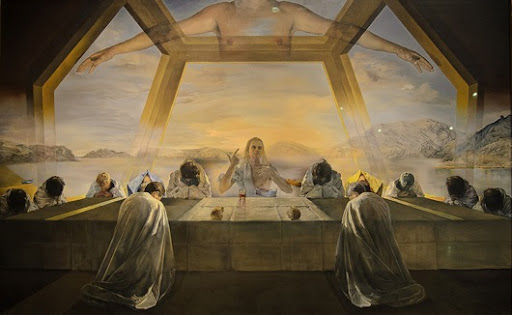
Dali

How do you preserve the message Jesus proclaimed two thousand years ago, when businesses and institutions struggle to get their members to know even just about the strategy and vision of the moment? I think this is quite a thorny challenge, as it can take you down at least two undesirable paths: On the one hand, you can become caught up in splitting hairs and lose sight of what Jesus wanted to communicate, while holding on to his specific words with zeal (the example of those who can recite Scripture but wouldn’t think twice when walking past a homeless person comes to mind). On the other hand, there is the ‘chillax, man!’ kind of approach, which would argue that it doesn’t matter what Jesus said exactly as we know that he just wanted us to be ‘nice’ to each other. While the latter is far less objectionable to me, it does run the risk of missing out on the richness of Jesus’ words, which we have been unpacking for two millennia (e.g., think of St. Francis’ re-discovery of poverty, St. Therese of Lisieux’s realization of the depth of everyday life, etc.).

It is in this context that the question of a single of Jesus’ word’s translations has been plaguing linguists and theologians during the last half century, leading to votes in various national Bishops’ conferences and now even to an intervention by the Pope himself. The word in question is the Latin ‘multis’ and the controversy revolves around whether it ought to be rendered as ‘many’ or ‘all.’

Coming to this question cold, you could be forgiven for saying: “Well, I googled it, and it clearly says ‘many.’ End of story.” As it happens, the Pope has arrived at the same conclusion, but what is noteworthy to me is how he did it (and, no, he didn’t just google it!) and how he then proceeded. To get the full story, see Benedict XVI’s letter to the German Bishops’ Conference, and if you’d just like my summary, read on. The text in question are Jesus’ words at the last supper, where he blesses and offers the wine to his disciples, saying:

hic est enim calix Sanguinis mei novi et aeterni testamenti, qui pro vobis et pro multis effundetur in remissionem peccatorum

which, up until very recently was translated as:

this is the cup of my blood, the blood of the new and everlasting covenant. It will be shed for you and for all so that sins may be forgiven

and, which is now translated as follows (after a very recent revision of the English translation, that was also influenced by Pope Benedict’s choice):

this is the chalice of my blood, the blood of the new and eternal covenant, which will be poured out for you and for many for the forgiveness of sins

As you can see, this is a pretty important word, since it, at first sight, sets the scope for the effects of Jesus’ sacrifice. Did Jesus offer his life for all (as the Church has been, and still is, teaching: “For as in Adam all die, so also in Christ shall all be made alive” – Catechism of the Catholic Church, §655) or only for some? Suggesting the latter would be outrageous, would fly in the face of everything that Christianity can be most certain of and would be entirely incongruent with the rest of Jesus’ teaching. The potential doubt that this change of translation could introduce in the minds of church goers is precisely what made both the German and Italian bishops rebel and vote massively in favor of not changing the respective translations.

This brings us to Pope Benedict’s letter, where he first proceeds to sum up the history of the argument, then to underline the validity of concerns like the above and to re-affirm the universal scope of Jesus’ sacrifice and salvation. Only after having prepared the ground does he proceed first to deliver a master class on the distinction between translation and interpretation (while acknowledging the difficult balance between the two and agreeing that the ‘for all‘ was “a well-founded interpretation then as now”) and on how the two need to go hand in hand:

“The word must be presented as it is, with its own shape, however strange it may appear to us; the interpretation must be measured by the criterion of faithfulness to the word itself, while at the same time rendering it accessible to today’s listeners.”

Benedict does not leave things at this though and at stating that “the words ‘pro multis’ should be translated as they stand”. Instead he proceeds to outline how local bishops need to prepare their congregations for the change in wording and flips the situation from a source of disagreement to an opportunity to spread the Gospel. He does this by underlining the three reasons that Jesus may have had for using the word ‘many’ instead of ‘all’:

  1. “Firstly, for us who are invited to sit at his table [i.e., participate in the Eucharist], it means surprise, joy and thankfulness that he has called me, that I can be with him and come to know him.”
  2. “Secondly, this brings with it a certain responsibility. How the Lord in his own way reaches the others – “all” – ultimately remains his mystery. But without doubt it is a responsibility to be directly called to his table, so that I hear the words “for you” – he suffered for me. The many bear responsibility for all. The community of the many must be the lamp on the lamp-stand, a city on the hilltop, yeast for all.”
  3. “Finally, [i]n today’s society we often feel that we are not “many”, but rather few – a small remnant becoming smaller all the time. But no – we are “many”: “After this I looked, and behold, a great multitude which no man could number, from every nation, from all tribes and peoples and tongues,”, as we read in the Revelation of Saint John (7:9). We are many and we stand for all. So the words “many” and “all” go together and are intertwined with responsibility and promise.”

Having read Pope Benedict’s letter leaves me with admiration for his method, with gratitude for the nuances of the ‘many’/‘all’ difference that he laid bare and also with an appreciation of the subtlety of his approach. After all this is ‘just’ a letter to the German bishops – not one of the formal ‘weapons’ that he has in his arsenal, such as apostolic letters, apostolic exhortations, apostolic constitutions or ‘ex cathedra,’ infallible proclamations. What we get instead is a point made with such power of reason that it does not require legal support.

The Principle of Charity

Cholmondeley I first came across the “principle of charity” thanks to one of the lecturers on the MA in Philosophy that I attended (but sadly not completed) at Sheffield. In the first lecture of the Aristotle module, where we were going to cover Book 9 of the Metaphysics, Dr. Stephen Makin* put something like the following idea to his students:

Aristotle wrote the Metaphysics in the 4th century BC, using the language of the day and firmly set in the cultural, scientific and political context of the time. If we approach this text without an attempt at looking for something positive, valuable or meaningful, we will very quickly come to dismiss it, as it is very easy to find it dated, set it superseded modes of thinking or irrelevant. This would be a great shame though, as it would keep Aristotle’s insights hidden from us. Instead, let’s adopt the principle of charity and look for the most favorable interpretation of Aristotle’s words – the interpretation that would give his statements the greatest value, the most sense.

As you can imagine, I was super enthusiastic about this attitude, since it struck me both as very sensible and like exactly the kind of angle that the Gospels would take, had they addressed the topic of hermeneutics. While looking into the background of this principle, I came across the following example of its application in the context of religion that I found particularly positive:

“The next [human representation of the ideal of divine love] is what is known as Vatsalya, loving God not as our Father but as our Child. This may look peculiar, but it is a discipline to enable us to detach all ideas of power from the concept of God. … [T]he Christian and the Hindu can realize [this idea of God as Child] easily, because they have the baby Jesus and the baby Krishna.”

Swami Vivekanda (1863–1902)

Not only does Vivekanda shed light on an aspect of Christian revelation from a new angle, but he uses it to draw parallels with Hinduism, thereby making both religions’ insights accessible to each other’s followers. In this context it is particularly rewarding to see how this same point is emphasized in a recent homily of Pope Benedict XVI:

“God’s sign is simplicity. God’s sign is the baby. God’s sign is that he makes himself small for us. This is how he reigns. He does not come with power and outward splendor. He comes as a baby – defenseless and in need of our help. He does not want to overwhelm us with his strength. He takes away our fear of his greatness.”

Just to avoid the ever-lurking accusation of syncretism when considering inter-religious questions, I don’t read Vivekanda as equating Jesus with Krishna or proposing their co–existence or merging, but instead as pointing to principles expressed with similarity in both traditions.

If only the principle of charity were more broadly applied both in secular and religious discourse …


I can’t mention Dr. Makin without sharing the following anecdote: One morning Dr. Makin arrives late to give his lecture and with indignation exclaims: “I have been asked to do some administrative work! Can you imagine a professional administrator being asked to write a book about Aristotle?!” I often feel the same (but still have to do it :).

5L2F

Multiplication of loaves and fishes c osseman

After Sunday’s Gospel reading at mass, I was struck by a seemingly throw-away point made during the homily, where the priest said that Jesus asked his disciples to go and buy some food for the people who assembled to listen to him and were in danger of running hungry:

When Jesus raised his eyes and saw that a large crowd was coming to him, he said to Philip, “Where can we buy enough food for them to eat?” He said this to test him, because he himself knew what he was going to do. Philip answered him, “Two hundred days?’ wages worth of food would not be enough for each of them to have a little.'” One of his disciples, Andrew, the brother of Simon Peter, said to him, “There is a boy here who has five barley loaves and two fish; but what good are these for so many?” Jesus said, “Have the people recline.” Now there was a great deal of grass in that place. So the men reclined, about five thousand in number. Then Jesus took the loaves, gave thanks, and distributed them to those who were reclining, and also as much of the fish as they wanted. When they had had their fill, he said to his disciples, “Gather the fragments left over, so that nothing will be wasted.” So they collected them, and filled twelve wicker baskets with fragments from the five barley loaves that had been more than they could eat.

John 6:5-13

The suggestion that Jesus wanted them to use regular means for feeding the masses made me listen up and reflect on the nature of miracles. The conclusion I am coming to is that the miracles Jesus performed were mostly accidental – not premeditated, planned (maybe with the exception of Lazarus’ raising from the dead where Jesus’ actions took place sometime after he was informed of his friend’s death). In this case, Jesus is spreading the good news of his Father’s love for all and it becomes apparent that the crowd following his words is going to get hungry and disperse to seek food in the nearest towns. Instead of following his disciples’ suggestion to call it a day and send his listeners on their separate ways, Jesus instead challenges their faith and asks them to provide for the crowd. Essentially he’s saying to them: nip down to the shops and fetch some dinner.

In spite of the effect that Jesus has already had on his disciples, Philip comes out with a bit of accountancy, ballparking the order at 200 days’ wages (a touch over £9700 in the UK today, which would give a budget per person/family of just under £2 – not exactly a lavish affair) and attempting to bring Jesus’ desire not to interrupt his mission stumbling down on logistical grounds. What comes next is a really great, but super-hesitant, move by Andrew, who says “There is a boy here who has five barley loaves and two fish; but what good are these for so many?” In other words, I hear Andrew as sticking his neck out and positioning himself next to Jesus by taking a leap of faith and bringing up the slightest of possibilities that could address the present challenge. To my mind the miracle is as much a reward for Andrew as it is a lesson for Philip and for the crowd assembled at Jesus’ feet.

Personally I read it as a call to trust in God and not to self–impose constraints where God’s providence is ready to provide against the odds. I have often experienced generosity by others or the discovery of solutions that only came to light because I placed my trust in God’s providence. Shortly before my older son was to be born, the house we were renting was put on the market and we were given a month’s notice to move. When we were informed about it, I was filled with panic and started rushing around, looking at vacancies but failing to find anything whatsoever as it was two weeks before Christmas and most places were shutting down for the holidays. One evening, and I remember this distinctly, I realized that I was leaving God out of this process (and doing so during Advent of all times!) and decided to skip the frantic search and instead spend the evening in prayer. This certainly calmed me down and when I woke in the morning. the thought came to me to look in the neighboring city instead of the one were we were living at the time. That same day I found us a new house to rent and the following months have shown how good the change of location was for us in ways we could not have anticipated.

Now, was that a miracle? No, in the sense that I don’t believe God intervened in the regular running of the universe. But, it did bring about a conversion in me that lead to greater closeness to God and a more attentive listening to his whispers.

This brings me to the final thought I have about Sunday’s Gospel: how much of what John describes (and incidentally the other three Evangelists too) was a miracle in the sense that the laws of nature were locally and temporarily altered? My impression is that not all. Let me explain … I believe that many people in the crowd that day had some food with them and that, when the gathering was dispersed, they may well have moved to a nice spot, laid it out and had a picnic. Others, who had no food would have had to trek to the nearest village and buy some, yet others would have had to go hungry as they may not have had the means to buy more food for themselves. Instead, what Jesus did by arranging the crowd into smaller groups (making the people assembled to hear him less of an anonymous mass), taking the five loaves of bread and two fish, blessing them and beginning to hand them out, was to create better conditions for sharing. I can imagine that someone who saw what Jesus did and had some food on them would add it to the food passed on to the next person, which in turn would lead to a positive, pyramidal-scheme-like avalanche and result in the many basketfuls collected at the end. Am I saying that I don’t believe a miracle (in the laws-of-nature-bending sense) took place? Certainly not – I do not see why Jesus should not have performed miracles, being God who created the universe out of nothing, but I do believe that his miraculous actions also triggered responses in their witnesses that lead to an amplification. Could Jesus have made food appear for 5000 families – sure! But, isn’t the humble (five loaf of bread + two fish) gesture much more loving, as it allows for human participation, rather than a sudden, imposing appearance of rows of fully-laden tables would have been?

I’m with Müller: the Eucharist

Arcabas5

The Vatican’s Congregation of the Doctrine of the Faith has a new head – Gerhard Müller, the former archbishop of Regensburg in Germany and he is being severely criticized by various ‘traditionalist’ groups. The accusation is heresy (a pretty tricky label to pin on the Church’s Chief Doctrinal Officer), principally on three counts: denying the real presence of Jesus in the Eucharist, denying the virgin birth and falsely proclaiming Church unity where it isn’t there. From everything I have read by Archbishop Müller, I have a very positive impression, also for his saying the following:

“Faith is characterized by the greatest openness. It is a personal relationship with God, which has within it all the treasures of wisdom. Because of this our finite reason is always in movement toward the infinite God. We can always learn something anew and understand with ever greater profundity the richness of Revelation. We will never be able to exhaust it.”

To me this sounds exactly like the right attitude and what I have read by his accusers just seems to reveal their insecurity and their sense of feeling threatened by his freedom and lightness of approach. So, what I will try to share in the coming days is my understanding of the three counts on which he is being charged with heresy and I’ll start with the most important one by far – the Eucharist.

Before giving some thought to what Müller said, I would like to come clean about the fact that I treasure and love the Eucharist and also that I believe in Jesus’ real presence there – in it being Jesus! (More on what ’real’ and ‘being’ means later, plus I hope my agnostic and atheist friends are not put off by my coming out like this and that they will bear with me for a couple of paragraphs 🙂

If you take Jesus seriously (and I do), you can’t not take to heart when he says: “Take it; this is my body.” (Mark, 14:22) as he passes bread round to his disciples and next “This is my blood of the covenant, which will be shed for many.” (Mark, 14:24) when he does the same with wine. This is a very strange thing to say and definitely one that would have grabbed your attention had you been sat there with the apostles! What it means to me, and what it has meant to many over the last two thousand years, is that Jesus has left his followers a great gift – a way for them to have a relationship with him like that of the apostles. When I receive the Eucharist, or even when I walk past a church anywhere in the world, I thank him for his presence there and I both derive strength from it and take it as an opportunity to reaffirm my commitment to following him with all my strengths and weaknesses.

OK, lets turn to Müller now and see what he actually said, that earned him such ferocious criticism:1

“In reality, body and blood of Christ do not mean the material components of Jesus the human during his lifetime or of his risen bodily existence. Here, body and blood refer much more to the presence of Christ in the sign of bread and wine.”

The way I read it is as follows: bread and wine don’t materially turn into the bodily parts of Jesus (i.e., there isn’t a restructuring of matter from predominantly carbohydrates to predominantly proteins) during transubstantiation. Instead, bread and wine acquire Jesus’ real presence while phenomenologically remaining only its signs. In other words, I see bread and wine while I believe that the priest’s acting on Jesus’ behalf when repeating his words from the Last Supper brings about Jesus’ presence. My affirmation of the Eucharist really being Jesus is an act of faith and is in no way compromised by stating that the bread and wine have not altered in a way accessible to the senses.

So, while the above attempt at unpacking Müller’s statement merely transposes it into my words and exposes that I fully agree with him, let’s take a look at whether it sounds like what the Church teaches:

“[B]y the consecration of the bread and wine there takes place a change of the whole substance of the bread into the substance of the body of Christ our Lord and of the whole substance of the wine into the substance of his blood.” (Catechism of the Catholic Church, §1376)

In essence, Müller changes nothing in how St. Thomas Aquinas puts that the true presence of Jesus in the Eucharist “cannot be detected by sense, nor understanding, but by faith alone” (Summa Theologica, III, 75, 1), but for the sticklers there remains the question of what the Catechism means by ‘substance.‘ Here we have to refer back to Aristotle, whose theory of being it employs and where a distinction is made between a thing-in-itself (the substance) and its properties (which can be accidental or essential). Loosely put (for to do anything else would take us way off track), the substance of something is that which is inaccessible about it to the senses, while its properties are what is. This distinction between the sense-accessible and sense-inaccessible is echoed throughout the history of ontology and there are certainly other, more recent ways of thinking and talking about it than Aristotle’s ones. In Müller’s defense, it is plenty to realize though that his ’presence’ refers to ‘substance‘ while his labeling bread and wine as ‘signs’ refers to their ‘properties.’

Finally, it is worth remembering though that the above sophistication of thought is merely an attempt at being formal and structured about something that is ‘technically’ unknown and that fully relies on faith.


1 Note that the quote is my own translation, as opposed to the following, Googlified one, bandied around on English websites: “In reality, the body and blood of Christ do not mean the material components of the human person of Jesus during his lifetime or in his transfigured corporality. Here, body and blood mean the presence of Christ in the signs of the medium of bread and wine.” For the German speakers among you, here is what he said directly: „In Wirklichkeit bedeuten Leib und Blut Christi nicht die materiellen Bestandteile des Menschen Jesus während seiner Lebenszeit oder in der verklärten Leiblichkeit. Leib und Blut bedeuten hier vielmehr Gegenwart Christi im Zeichen des Mediums von Brot und Wein.“ quoted from „Die Messe.: Quelle christlichen Lebens“, Augsburg, S. 139f.

James, the firestarter

The apostle James, whose feast it is today, is a super popular saint and is widely believed to have been a bit of a hot-head among Jesus’ disciples (likely also leading to his early martyrdom). On one occasion, when some Samaritans didn’t welcome Jesus with open arms, he asked: “Lord, do you want us to call down fire from heaven to consume them?” (Luke, 9:54). Needless to say, he and his brother John, who was in on the plot to bring in aerial support, got swiftly told off by Jesus and they moved on to the next town.

Muddy road

Muddy road
And now for something not all that different: my favorite Zen kōan:

Tanzan and Ekido were once traveling together down a muddy road. A heavy rain was still falling. Coming around a bend, they met a lovely girl in a silk kimono and sash, unable to cross the intersection. “Come on, girl” said Tanzan at once. Lifting her in his arms, he carried her over the mud.

Ekido did not speak again until that night when they reached a lodging temple. Then he no longer could restrain himself. “We monks don’t go near females,” he told Tanzan, “especially not young and lovely ones. It is dangerous. Why did you do that?” “I left the girl there,” said Tanzan. “Are you still carrying her?”

Mujū

For more great kōans see this collection.

Sunrise skirmish

Two men who wanted to see the sunrise would be foolish to argue about the place where it will appear and their means of looking at it, then to let their argument degenerate into a quarrel, from that to come to blows and in the heat of the conflict to gouge out each other’s eyes. There would no longer be any question then of contemplating the dawn …

Let us who wish to contemplate God purify our hearts by faith and heal them by means of peace; for the effort we make to love one another is already a gift from him to whom we raise our eyes.

Augustine of Hippo (354-430)
(quoted in Roots of Christian Mysticism)

The God of Explanations

God of explanations

Not to be confused either with the God of Small Things or the God of Rain, the God of Explanations1 is fast running out of business. At the dawn of civilization he was busy with lifting the sun across the sky, with making fire, with curing the possessed; by the middle of the 20th century he only had to flip the switch of creation and now we can even notionalize a self–creating Universe and affirm that the God of Explanations is “not necessary,” “surplus to requirement.” And I totally agree! [but apologize for the sarcasm :)]

Leaving to one side the awkward question of where the laws that govern such a self-creating existence come from and that a “[complete unified] theory [that explains our universe] itself would determine the outcome of our search for it!” (Stephen Hawking, A Brief History Of Time“), I would like to argue that applying criteria of “necessity” and “explanatory goodness” to God is a category mistake. It is akin to a child saying that their mother is not necessary for explaining breast milk – true, but not very much to the point …

An atheist has no need for God in their world view – a huge amount of what is going on can be explained by science and some cannot, but is firmly believed to be scientifically explainable. This is a self-consistent view, which rightly looks at God as an unnecessary bolt-on. Someone like me, who believes in the existence of a loving, personal God, can take the same science though and can also split phenomena into explainable and as yet unexplained and, just like my atheist friends, hope for a future increase of the former and decrease of the latter. Neither do I have to equate the unexplained with God’s actions and view the former as having been wrestled off God by science (à la the “God of gaps” argument). On the contrary! I see science as telling me how it is that God’s creation works and I marvel at the beauty of the Standard Model, evolution, neuroscience and cognitive psychology, to mention a few. I also derive pleasure from looking at the history of science, with its drive towards greater understanding peppered with herculean paradigm shifts and all the good that its advances have have done and “to [which] humanity owes so much of its current development” (Fides et Ratio, 106).

Instead of coming to a conclusion that science and belief in God end up being irreconcilable (like Christof Koch does in his interesting “confessions”), I would like to say that a greater understanding of science and a science that has greater and greater predictive and explanatory powers leads to a fuller and greatly enriched understanding of God.

Finally, it is worth realizing that this view is nothing new, as already St. Paul says that “[e]ver since the creation of the world, [God’s] invisible attributes of eternal power and divinity have been able to be understood and perceived in what he has made.” (Romans 1:20) and in the 1960s the Second Vatican Council affirmed that “if methodical investigation within every branch of learning is carried out in a genuinely scientific manner and in accord with moral norms, it never truly conflicts with faith, for earthly matters and the concerns of faith derive from the same God” (Gaudium et Spes, 36).


1 I would like to thank my bestie, Margaret, for coining this phrase and for reminding me that “all holy people reject that kind of a God.” 🙂