Synod14: We aren’t the bosses of God’s mercy

Francis kids

Since the close of yesterday’s sessions of the Extraordinary Synod on the Family, several interviews with or full texts of interventions by some Synod Fathers have been published.

The first of these I’d like to share is by Cardinal Godfried Danneels, the archbishop emeritus of Brussels, who’s contribution to the Synod was a plea for greater care for the divorced and remarried:

“God is just and merciful. He can’t contradict himself. He can separate good and evil in a great straddle. We, we have difficulty because we are only poor ballet dancers for a moment in the whole of history. […]

In the first place we are invited to greatly respect our brothers and sisters, the divorced and remarried. Mercy starts where we have unconditional respect for all who want to live within the Church but can’t marry again for the Church and receive Communion. […]

It is so important to speak with them, to let them speak about the beauty of marriage and the Christian family. Beauty is so powerful! This is obviously not esthetic beauty, but beauty who is the sister of truth and goodness. According to Aristotle “beauty is truth in all its glory”. Pulchrum est splendor veri.

Among our contemporaries there is much scepticism about the truth; even goodness can discourage, but beauty disarms. Beauty heals. Archimedes said about our world today, “Give me a place to stand and I will lift the world.”

The divorced and remarried are not the only suffering children, but there are far more than we think. My appeal – in all simplicity – is: to love God’s children. Their pain and suffering is often great. They don’t immediately ask for the regulations of the Church to change. Their cry is rather one to the shepherds with their hearts in the right place, why carry the wounded lamb on their shoulders. Beauty disarms. We hold the cards: there is indeed nothing more beautiful than Christian marriage and a deeply faithful family. But we must communicate the truth to divorced and remarried people – delicately – with the words of Saint Francis in mind, which he spoke to the superiors of his small communities, “never let anyone leave you in sadness”.”

Archbishop Denis Hart, the President of the Australian Bishop’s Conference, commented on the need for a new language – a “language of love” – and underlined the Church’s concern for all who suffer:

“[The] Catechism of the Catholic Church [speaks] about people being ‘disordered’, things being ‘intrinsically evil’. You say that to a parent who has a gay son or daughter and they just cannot understand that this child whom they love and who they have nurtured – might have chosen a thing that they don’t approve of – but is to be totally rejected because of that. And I think we have to be faithful to our doctrine and our teaching and practice have to go hand in hand, but we can do so with mercy and love and help people to realize that whatever may be the challenges that our in their life, they are respected and loved by the Church. […]

There are people who are separated and divorced, there are people who are same-sex attracted, there are people who are really struggling in their marriage, and wondering how they will go. The bishops have been emphasizing that we are pastors. When our people suffer we feel for them, when our people are bereaved we cry with them, when our people are burdened with sickness we struggle with them, when people are uncertain about where they can go or are suffering terrible material poverty the Church has to be there with them. I think this is the genius of Pope Francis. The great thing that concerns us in this is Synod is our love for our people and our ability to walk with them.”

There are, however, also voices at the Synod, like that of Cardinal Raymond Burke – the current Cardinal Prefect of the Supreme Tribunal of the Apostolic Signatura (whom Pope Francis removed from the Congregation for Bishops last year), who are opposed to a renewal of pastoral practice, e.g., saying that “[i]f homosexual relations are intrinsically disordered, which indeed they are — reason teaches us that and also our faith — then, what would it mean to grandchildren to have present at a family gathering a family member who is living [in] a disordered relationship with another person?”

There is also an important presence of members of other churches, religions and those who hold no religious beliefs at the Synod, who make important contributions. For example, the Anglican Rev. Paul Buttler, provided the following great synthesis of what the Synod is about:

“I think we actually need to reimagine family life again and help people grasp how important steadfastness, faithfulness to one another really is and offer much more support in times of difficulty. We have to be honest – the difficulties happen.”

Last night I also discovered a great blog by the Archbishop Droucher, president of the Canadian Conference of Catholic Bishops, where he recounts his experiences of the Synod, including a summary of his own intervention:

“What I especially wanted to say was that we should not only focus on what is negative in the world which is ours. True, there are many broken families, abandoned children, deeply wounded individuals. It is true that sexuality is often lived more as a leisure activity than as a true loving language of deep self-giving to another. It is also true that less and less couples are choosing marriage today. However, there are also positive realities in our world today. I named the commitment to equality between men and women in marriage, the refusal of all violence to children and women, the growing role of fathers in the affective life of their children, the place given to communication, mutual respect and healthy relationships. All of this is good and should be recognized and celebrated by Church leaders, creating openings for dialogue with society where the Church can proclaim its humanizing teaching on family, marriage and sexuality.”

I also liked Archbishop Droucher’s immediacy in his blog, where the follows his intervention’s summary by saying “And thus did I finish my four minutes of great nervousness (my hands were shaking) and adrenaline rush.” 🙂

Yesterday afternoon’s (8th) session was then focused on Christian education, where the French couple, Olivier and Xristilla Roussy, shared in their opening testimony that:

“Our mission as parents is above all to awaken our children to holiness. Like all of us, they too face the many temptations of the world and, with humility, we try to make them grow in freedom and generosity, to teach them the senses of discernment, decision making and perseverance. We help them develop their life project under the gaze of God. In spite of the difficult pace of modern life, we seek to be attentive to each one of them and give them plenty of time, both all together and individually.”

The notes provided about the following discussion started with:

“an invitation to the faithful to deepen their knowledge of Paul VI’s encyclical, Humanae Vitae, thus better understanding the meaning of the use of natural methods of fertility control and the non-acceptance of contraception. Union and procreation, it was said, are not separate from the conjugal act.”

The importance of appropriate marriage preparation was revisited, and – I believe, importantly – linked to the preparation for religious life:

“as its celebration seems to be increasingly reduced to the social and legal status, rather than a religious and spiritual bond. The preparatory course, it was noted, is often perceived by couples as an imposition, a task to complete without conviction, and as a result it is too brief. Since marriage is a vocation for life, preparation for it should be long and detailed, as in the case of preparation for religious life.”

The other side of the marriage preparation coin – that of the adequate preparation of priests to lead it – was addressed next:

“The Assembly went on to insist on the importance of good preparation for priests in relation to the pastoral care of marriage and the family, and remarked that homilies can be used as a special and effective moment for proclaiming the Gospel of the family to the faithful. It was commented that there is a need for formation and information, as the spiritual holiness of the priest, his creativity and his direct relationship with families are particularly appreciated by the faithful.”

This morning then saw experiences shared by couples and lay experts, who are not voting participants but “listeners” instead. Here the notes point to themes that were very much the same as during the preceding days, with an added emphasis on the need for closer collaboration between the laity and the Church’s hierarchy, also in the context of the laity’s involvement in public and secular life. The challenge of caring for the growing number of people living in solitude (irrespective of their association with the Church) was also highlighted during the following press conference. Importantly, Fr. Lombardi, also mentioned Pope Pius X’s “revolutionary” changes to the reception of the Eucharist by children as opposed to only adults as was previous practice. It was emphasized that this is a different context to the questions facing the divorced and remarried, but that there is precedent to substantial changes. The difficult effects of divorce on children were also lamented, of “ping-pong children” who are oscillating between their parents (and their new partners) and lack stability.

Fr. Manuel Dorantes, reporting on the Spanish speaking Synod Fathers’ contributions (with aplomb, I might add), quoted one of them as saying:

“Above all we must kneel before the Holy Spirit and remember that we aren’t the bosses of God’s mercy. We must remember that the mission that Jesus entrusted to his apostles, and by extension to us as their successors, is to evangelize and to heal. And this means, spreading the Good News.”

Calls for a greater involvement of lay persons, and women in particular, in ecclesiastical tribunals were also reported. Fr. Dorantes then quoted another of the Synod Fathers calling for a greater focus on children: “Brothers, I am the son of divorced parents and I, as their son, experienced the stigma of divorce directed at my parents and directed at me.”

This afternoon the Synod is hearing from “fraternal delegates” – i.e., representatives of other churches and religions, about which there will be a press conference tomorrow and on Monday, Cardinal Erdő will present the report reflecting the week’s contributions.
Synod14: A paternal home for everyone

Francis cap kid

Yesterday afternoon, the third day of the Extraordinary Synod on the Family saw contributions about difficult pastoral situations. Cardinal Raymundo Damasceno Assis, who chaired this, 6th session of the Synod, said that these are situations there is a “need to be accompanied by the Church, since the people involved in them live experiences of deep wounds to their own humanity, to their relationship with others and with God.” Here, the Church is called to learn the art of accompanying, as Pope Francis says in Evangelii Gaudium (§169) that “this accompaniment must be steady and reassuring, reflecting our closeness and our compassionate gaze which also heals, liberates and encourages growth in the Christian life.”

Cardinal Assis then proceeded to listing the various “difficult pastoral situations” that are mentioned in the Instrumentum Laboris, including cohabitation, civil unions, separation, divorce and same-sex union, and goes on to insisting that:

“Far from locking ourselves into a legalist perspective, we would like to immerse ourselves into the depths of these difficult situations, to welcome all those who are involved in them and so that the Church may be the paternal home where there is room for everyone, with their strenuous lives.”

The notes on the following discussion, shared by the Vatican’s press office, then show a reiteration of Cardinal Assis’ words, saying that:

“the Church is not a customs [checkpoint], but rather the house of the Father, and must therefore offer patient accompaniment to all people, including those who find themselves in difficult pastoral situations. The true Catholic Church encompasses healthy families and families in crisis, and therefore in her daily effort of sanctification must not show indifference in relation to weakness, as patience implies actively helping the weakest.”

Applying the above to the divorced and remarried, the Synod Fathers called for an approach rooted in mercy:

“It was strongly emphasised that an attitude of respect must be adopted in relation to divorced and remarried persons, as they often live in situations of unease or social injustice, suffer in silence and in many cases seek a gradual path to fuller participation in ecclesial life. Pastoral care must not therefore be repressive, but full of mercy.”

A discussion of the need to streamline processes of declaring the nullity of a marriage and of polygamy followed, after which the Synod Fathers shared experiences and “best practices” of care for divorced and remarried people in the form of “listening groups”:

“It was remarked that it is important to carefully avoid moral judgement or speaking of a “permanent state of sin”, seeking instead to enable understanding that not being admitted to the sacrament of the Eucharist does not entirely eliminate the possibility of grace in Christ and is due rather to the objective situation of remaining bound by a previous and indissoluble sacramental bond. In this respect, the importance of spiritual communion was emphasised repeatedly. It was also commented that there are evident limits to these proposals and that certainly there are no “easy” solutions to the problem.”

This model of “listening groups” and, more generally, of listening, was also emphasised with regard to homosexual people.

Like all the sessions of the Synod, this morning’s, 7th one also started with a testimony by a married couple. Arturo and Hermelinda As Zamberline from Brazil also spoke about the importance of a Christian understanding of sexuality and its role as an expression of love between husband and wife:

“The sexual act is rightful, loved and blessed by God, and the pleasure derived from it contributes to the joy of living and the healthy development of personality. It is the expression of love, which in the beginning may be passion, but which should gradually become more human. Couples who make love are expressing with their bodies what is in their hearts. To reach harmony, it is necessary to develop one’s desire and even a wholesome eroticism. It is necessary to stay passionate and attentive to each other.

How sexuality is lived is very important so that humans become ever more human. Father Caffarel [Founder of the Teams of Our Lady, whose members the Zamberlines are] proposes a fascinating journey: from sexuality to love. The couple is where the three functions of sexuality are expressed: its relational function, its pleasurable function and its reproductive function. The couple grows by combining these three dimensions in a balanced way.

Sexuality is lived in relation with others and with God. It’s called become a language of love, communion and life.”

The notes on the following discussions then start by reporting a re-affirmation of the doctrine on marriage, emphasising:

“the indissoluble nature of marriage, without compromise, based on the fact that the sacramental bond is an objective reality, the work of Christ in the Church. Such a value must be defended and cared for through adequate pre-matrimonial catechesis, so that engaged couples are fully aware of the sacramental character of the bond and its vocational nature.”

This was immediately followed by reiterating that “Pastoral care must not be exclusive, of an “all or nothing” type but must instead be merciful, as the mystery of the Church is a mystery of consolation.” A re-statement of the position with regard to same-sex unions then followed: “while emphasising the impossibility of recognising same sex marriage, the need for a respectful and non-discriminatory approach with regard to homosexuals was in any case underlined.”

The first part of the mooring session concluded with a return to the importance of language:

“so that the Church may involve believers, non-believers and all persons of good will to identify models of family life that promote the full development of the human person and societal wellbeing. It was suggested that the family should be spoken of using a “grammar of simplicity” that reaches the heart of the faithful.”

The theme of the second part of the morning session was openness to life, where:

“responsible parenthood was considered, emphasising that the gift of life (and the virtue of chastity) are basic values in Christian marriage, and underlining the seriousness of the crime of abortion. At the same time, mention was made of the numerous crises experienced by many families, for instance in certain Asian contexts, such as infanticide, violence towards women and human trafficking. The need to highlight the concept of justice among the fundamental virtues of the family was underlined.”

During the press conference at lunchtime, Archbishop Paul-André Durocher of of Gatineau, Quebec, made the following, very illuminating observation:

“In the Church there is a method of thinking and of reasoning that tends to start from principles and lead to conclusions […] the deductive method. And what’s happening within this Synod is we are seeing a more inductive way of reflecting. Starting from the true situations of people and trying to figure out what’s going on there. In a sense, finding that the lived experience of people is also a theological source, a place of theological reflection. Maybe a funny way of saying this is that we are learning to use the Harvard “case study” method in reflecting theologically on the lives of people. And we are only starting to learn how to do this as Church leaders. This is going to take time to learn and together to come to find, as we reflect on this, what is the way God is showing. In this sense, many voices are saying there is no kind of line that we will apply to all conditions because each person is a human person. Jesus did not meet general cases; Jesus met individuals. And he addressed individuals. And, so, for us it is to reflect on how do we do this as a Church, within the Church.”

Synod14: A light that is among us and walks with us

Lumen fidei

Today sees the third day of the Extraordinary Synod on the Family, as well as the publication of various interviews with the Synod Fathers over the course of the last 24 hours, who are left free to speak to the media outside the discussions held within the Synod. I believe that this is a great innovation and one that gives a strong sense of transparency to the process.

Here I would like to pick out some words of Fr. Adolfo Nicolas, the superior general of the Jesuits, who said that “there can be more Christian love in a couple who lives in irregular circumstances than one married in church,” echoing Benedict XVI saying that “agnostics, who are constantly exercised by the question of God, those who long for a pure heart but suffer on account of our[, the Church’s,] sin, are closer to the Kingdom of God than believers whose life of faith is “routine” and who regard the Church merely as an institution, without letting their hearts be touched by faith.” Fr. Nicolas is also reported as saying: “A divorced person has suffered, but we withdraw medicine from him or her who needs it most. No, this cannot be!”

The Archbishop of Dublin, Diarmuid Martin’s intervention in the Synod has also been reported in more detail, where he is quoted as saying:

“[M]any men and women, without making explicit reference to the teaching of the Church, actually live out the value of marital fidelity day-by-day, at times heroically. They would hardly recognise their own experience in the way we present the ideals of married life. Indeed many in genuine humility would probably feel that they are living a life which is distant from the ideal of marriage as presented by Church teaching.”

Martin then proceeded to make a plea for an “incarnated” teaching, close to the reality of people’s lives:

“To many the language of the Church appears to be a disincarnated language of telling people what to do, a “one way dialogue”. I am in no way saying that the Church is not called to teach. I am not saying that experience on its own determines teaching or the authentic interpretation of teaching. What I am saying is that the lived experience and struggle of spouses can help find more effective ways of expression of the fundamental elements of Church teaching. Jesus himself accompanied his preaching the good news with a process of healing the wounded and welcoming those on the margins. His teaching was never disincarnated and unmoved by the concrete human situation in which people could come to be embraced by the Good News. Jesus’ care for the sick and the troubled and those weighed down by burdens is the key which helps to understand how he truly is the Son of God.”

Finally, in a brief interview with Cardinal Nichols there is, I believe, an example of what such new language (and more!) might look like, when he says:

“The family is a place of prayer, the family is a place of shared faith, the family is a place where failure is accepted and worked through, because we want to live by the compassion and the forgiveness that the Lord offers.

I don’t doubt that most young people aspire to having their own family, having their own family within the stable relationship between husband and wife, having that family with a sense of permanence and a permanent, faithful commitment. Nobody wants a wife or a husband who is unfaithful. And so what we have to get across to people is that casual relationships before marriage is actually being casual with somebody’s future husband or wife. And its that sense of the real value that’s written in us, its in the hearts of people, that they aspire to, that has consequences for how we behave today as well.”

Turning to today’s proceedings, the program started with an address by Archbishop Philip Tartaglia of Glasgow, where he first gave an account of happy family life:

“[W]hen husband and wife are happy together and are blessed with children, then love expands from two to three and four and five. In a family, there is every opportunity to be patient and kind and excusing and trusting. There is every opportunity to renew faithfulness to one another by laughing together, crying together, supporting one another, saying sorry to one another, giving one another the benefit of the doubt, embracing one another, being happy for each other, just knowing the right word at the right time. And when those things happen, we are privileged to behold the beauty and simplicity and strength of married love and of family love, a love which truly through the grace of Christ endures all things.”

It is against this backdrop that Tartaglia then declares the need for the Church to help those for whom the above picture does not hold:

“But when families fracture, love is the first casualty. The love which was the glue between spouses turns to hate very quickly. Intimate communion of life is replaced with a terrible logic of division. Children’s peace of heart is shattered and they find themselves both loving and hating their parents at the same time.

Into this sadness, the Church has to find a way to speak St Paul’s words of love, which compassionately excuse and forgive, but which also heal and renew and lift up again; where forgiveness is not accommodation or indifference but genuine and sometimes hard-won reconciliation, engendering new trust, new hope, new endurance, and new faithfulness, a new page in the story of love of husband and wife and their children.”

The press conference that took place again at 1 pm, saw a reading out of notes from yesterday afternoon’s and this morning’s session, followed by additional comments made by Fr. Rosica on the basis of English and French contributions during the sessions, including the observation that “[w]e must appeal to the Bible over language of natural law, when we root ourselves in scripture it has a positive effect,” commenting that while natural law is like a fixed spotlight, the Bible speaks about a soft light that is among us and walks with us (i.e., Jesus).1 On a related point, Fr. Dorantes, representing Spanish speakers, used another image about light, saying that the Synod Fathers argued that the Church needs to move from being like a lighthouse that is fixed in place, to being like a torch that men and women can carry with them to shed light on their lives.

The Nigerian Archbishop Ignatius Kaigama, who was also present at the press conference, spoke about the Nigerian bishop’s opposition to the criminalisation of homosexuality:

“We would defend any person with a homosexual orientation who is being harassed, imprisoned or punished….so when the media takes our story they should balance it….we try to share our point of view (but) we don’t punish them. The government may want to punish them but we don’t, in fact we will work to tell the government to stop punishing those who have different orientations.”

The notes from yesterday afternoon’s session were then published, where a link was made between faith and the family, where “the crisis of faith and the crisis of the family was underlined: it was said that the first generates the second. This is because faith is seen mostly as a set of doctrinal mores, whereas it is primarily a free act by which one entrusts oneself to God.” The impact of working conditions on family life and a focus on issues particularly relevant in Africa followed (including “polygamy, levirate marriage, sects, war, poverty, the painful crisis of migration, international pressure for birth control, and so on”).

The notes from this morning’s session then speak about challenges faced in the Middle East and North Africa, where there are “difficult political, economic and religious situations, with serious repercussions on families.” Here the response to a variety of challenges was always along the lines that “Such couples […] must not be neglected and the Church must continue to take care of them” and that “the need to follow the path of mercy in difficult situations was underlined.” The discussion then turned to challenges arising from unstable employment and unemployment:

“The distress caused by the lack of a secure job creates difficulties within families, along with the poverty that often prevents families from having a home. Furthermore, a lack of money often leads to it becoming “deified” and to families being sacrificed on the altar of profit. It is necessary to re-emphasise that money must serve rather than govern.”

And finally, “[t]here was further reflection on the need for greater preparation for marriage, also with special attention to emotional and sexual education, encouraging a true mystical and familiar approach to sexuality.”


1 Note that this relates very well also to Pope Francis’ catechesis on the gifts of the Holy Spirit, where he said: “God forgives always, we men forgive sometimes, but creation never forgives.”

Synod14: Truly love families in difficulty

Francis at synod

Continuing with my coverage of the Extraordinary Synod on the Family (see the other posts here), today I’d like to pick out some passages from the Vatican’s official notes on the discussions of yesterday afternoon’s 2nd session of the Synod, where important points were made, first on the need to engage with the world as it is today, also adapting our language in response to it – and, I’d argue, also our understanding, since a simple rephrasing is not going to be sufficient, or even possible, since true dialogue alters all parties involved in it:

“[T]here has emerged the need to adapt the language of the Church, so that doctrine on the family, life and sexuality is understood correctly: it is necessary to enter into dialogue with the world, looking to the example offered by the Vatican Council, or rather with a critical but sincere openness. If the Church does not listen to the world, the world will not listen to the Church. And dialogue may be based on important themes, such as the equal dignity of men and women and the rejection of violence.”

The importance of sharing lived experiences of putting the Gospel into practice, instead of dry and dead theory, was emphasised next:

“The Gospel must not be explained, but rather shown – it was said in the Assembly – and above all, the lay faithful must be involved in the proclamation of the Good News, demonstrating the missionary charism. Evangelisation must not be a depersonalised theory, but must instead ensure that families themselves give concrete witness to the beauty and truth of the Gospel. […] The Church, instead, must be “magnetic”; it must work by attraction, with an attitude of friendship towards the world.”

Next, a point from the opening document was underlined, by returning to the importance of recognising the good there is in every situation, and making reference to the law of gradualness that Cardinal Kasper spoke about in his now-famous speech during the last consistory, that St. John Paul II also put forward in his Familiaris Consortio, and whose basic idea is to recognise the need to gradually approach a desired end state, as if following stepping stones from wherever a person or family is in the present:

“[E]ven imperfect situations must be considered with respect: for instance, de facto unions in which couples live together with fidelity and love present elements of sanctification and truth. It is therefore essential to look first and foremost at the positive elements, so that the Synod may infuse with courage and hope even imperfect forms of family, so that their value may be recognised, according to the principle of graduality. It is necessary to truly love families in difficulty.”

Worth noting is also the variant on the above that Fr. Rosica reported during the press conference, where he quoted a Synod Father as saying: “There are different expressions of what is family today and we have to be sensitive to that.”

Finally, the notes also addressed the need to present the good of sexuality: “[T]he essential value of sexuality within marriage was also considered: sexuality outside marriage is discussed so critically that married sexuality can appear almost as a concession to imperfection.”

The discussions from this morning’s session are then summed up in a separate note, where the fist point raised was a call for emphasising the positive and the vocational nature of marriage:

“The suggestion was to look not only towards remedies for failure of the conjugal union, but also to focus on the conditions that render it valid and fruitful. It is necessary to transmit a vision of marriage that does not regard it as a destination, but rather as a path to a higher end, a road towards the growth of the person and of the couple, a source of strength and energy. The decision to marry is a true vocation and as such requires fidelity and coherence in order to become a true locus for the growth and the protection of the human being.”

Next, the need for extensive preparation and accompaniment was stated, also with the consequences of failure bluntly put on the table:

“[M]arried couples must be accompanied throughout their path in life, by means of intense and vigorous family pastoral care. The path of preparation for the marriage sacrament, must therefore be long, personalised and also severe, without the fear of eventually leading to a reduction in the number of weddings celebrated in Church. Otherwise, there is the risk of filling the Tribunals with marriage cases.”

The importance of appropriate language and of dialogue surfaced again this morning:

“[T]he debate focused on the need to renew the language of the proclamation of the Gospel and the transmission of doctrine: the Church must be more open to dialogue, and must listen more frequently (and not only in exceptional cases) to the experiences of married couples, because their struggles and their failures cannot be ignored; on the other hand, they can be the basis of a real and true theology.”

To flesh out some of the above points, the press conference that followed at 1 pm Roman time included specific examples of what such a renewal of language needs to address. Fr. Rosica, the English language Vatican spokesperson, noted that terms like “Living in sin,” “intrinsically disordered,” and “contraceptive mentality” were singled out by the Synod Fathers as examples of “harsh language” where there was a need for change that would demonstrate the Church’s openness and love. Cardinal Nichols, who was also present at the press conference, characterized the atmosphere at the Synod as one where bishops are “speaking as priests, members of families, and not as academics,” adding that “It’s very lovely.” 🙂 On the same note, the Jesuit Fr. Antonio Spadaro – also a participant of the Synod – noted that “the attempts to paint a picture of fighting among cardinals melt like snow in the sun. At the Synod what is lived is an experience of Church …”

Synod14: Speak clearly, don’t be afraid to offend me

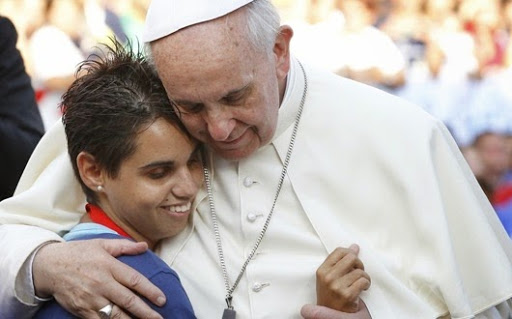
Francis hug

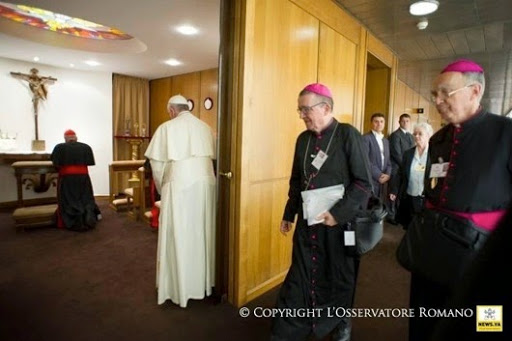
Today saw the first two sessions (“congregations” in Vatican-speak) of the two-week-long extraordinary bishops’ Synod on the family, and I would just like to pick out a couple what I saw as their highlights. First, however, it is worth going back to yesterday’s opening mass of the Synod, when Pope Francis had some warnings for his brother bishops, that clearly set the tone that he expects from the next two weeks’ work:

“The temptation to greed is ever present. […] Greed for money and power. And to satisfy this greed, evil pastors lay intolerable burdens on the shoulders of others, which they themselves do not lift a finger to move (cf. Mt 23:4)

We too, in the Synod of Bishops, are called to work for the Lord’s vineyard. Synod Assemblies are not meant to discuss beautiful and clever ideas, or to see who is more intelligent… They are meant to better nurture and tend the Lord’s vineyard, to help realize his dream, his loving plan for his people. In this case the Lord is asking us to care for the family, which has been from the beginning an integral part of his loving plan for humanity.

We are all sinners and can also be tempted to “take over” the vineyard, because of that greed which is always present in us human beings. God’s dream always clashes with the hypocrisy of some of his servants. We can “thwart” God’s dream if we fail to let ourselves be guided by the Holy Spirit. The Spirit gives us that wisdom which surpasses knowledge, and enables us to work generously with authentic freedom and humble creativity.”

This morning, more along good cop lines, his brief opening remarks then presented the method he would like participants to follow, which builds on clarity, openness, boldness (parrhesia) and tranquility:

“A basic general condition is this: to speak clearly. No one must say: “This can’t be said; he will think of me this way or that …” It is necessary to say everything that is felt with parrhesia. After the last Consistory (February 2014), in which there was talk of the family, a Cardinal wrote to me saying: too bad that some Cardinals didn’t have the courage to say some things out of respect for the Pope, thinking, perhaps, that the Pope thought something different. This is not good; this is not synodality, because it is necessary to say everything that in the Lord one feels should be said, with human respect, without fear. And, at the same time, one must listen with humility and receive with an open heart what the brothers say. Synodality will be exercised with these two attitudes.

Therefore, I ask you, please, for these attitudes of brothers in the Lord: to speak with parrhesia and to listen with humility.

And do so with much tranquillity and peace, because the Synod always unfolds cum Petro et sub Petro, and the Pope’s presence is the guarantee for all and protection of the faith.”

The first session then saw Cardinal Erdő present a 7.5K-word opening document – the “relatio ante disceptationem” – that is effectively the first follow-up to the “Instrumentum Laboris” in which the results of the preceding worldwide questionnaire were summarised. Erdő’s report is based on the written contributions made by the Synod Fathers ahead of the Synod’s opening and, together with the discussions that will last all this week and then in smaller groups next week, it will contribute to the final document that will be submitted to Pope Francis at the conclusion of this process.

As you’d expect, Erdő’s report broadly follows the structure of the Instrumentum Laboris, kicking off with an assessment of the challenges faced today on an individual level:

Many people today have difficulty in thinking in a logical manner and reading lengthy documents. We live in an audio-visual culture, a culture of feelings, emotional experiences and symbols. […]

Many look upon their lives not as a life-long endeavour but a series of moments in which great value is placed on feeling good and enjoying good health. From this vantage point, any firm commitment seems insurmountable and the future appears threatening, because it may happen that in the future we will feel worse. Even social relationships may appear as limitations and obstacles. Respect and “seeking the good” of another person can even call for sacrifice. Isolation is oftentimes linked, therefore, with this cult of a momentary well-being.

How this general disposition (which would not have come as a surprise to Aristippus or Epicurus some 2400 years ago) impacts the position and perception of marriage is addressed next, where there is a balance between challenges and the persistent beauty of the Church’s central teaching:

Avoiding marriage is seen as not only a sign of individualism but also a symptom of the crisis of a society already burdened by formalisms, obligations and bureaucracy. […]

The obligations arising from marriage must not be forgotten, but seen as the demands of the gift which the gift itself makes possible. […]

[The Church’s] teaching [on the family] enjoys a broad consensus among practicing Catholics. This is the case, particularly with regard to the indissolubility of marriage and its sacramental nature among those who are baptized. The teaching on the indissolubility of marriage as such is not questioned. Indeed, it is unchallenged and for the most part observed also in the pastoral practice of the Church with persons who have failed in their marriage and seek a new beginning.

Homosexuality, gender-based discrimination and gender theory get covered next, with a refreshing degree of frankness:

[T]here is a broad consensus that people with a homosexual orientation should not be discriminated against, as reiterated in The Catechism of the Catholic Church (2357-2359). Secondly, it is quite clear that the majority of the baptized — and all episcopal conferences — do not expect that these relationships be equated with marriage between a man and a woman, nor is there a consensus among a vast majority of Catholics on the ideology of gender theories. […]

[M]any want to see a change in the traditional roles in society which are culturally conditioned and in discrimination against women, which continues to be present, without denying, in the process, the differences by nature between the sexes and their reciprocity and complementarity.

The focus is then broadened to a societal level and an acute analysis of the external pressures incident on the family is presented:

We are not dealing with only problems involving individual behaviour but the structures of sin hostile to the family, in a world of inequality and social injustice, of consumerism, on the one hand, and poverty, on the other. Rapid cultural change in every sphere is distorting families, which are the basic unit of society, and putting into question the traditional family culture and oftentimes destroying it. On the other hand, the family is fast becoming the last welcoming human reality in a world determined almost exclusively by finance and technology. A new culture of the family can be the starting point for a renewed human civilization. […]

The widespread difficulty in creating a serene atmosphere of communication in some families is due to multiple factors: business and economic worries; differing views on the upbringing of children from various models of parenting; a reduction in time for dialogue and relaxation. In addition, there are disruptive factors like separation and divorce, with the consequences of a blended family, and, conversely, single parenting, where a relationship with the other parent is confused or limited, if not totally absent. Finally, this lack of communication can result from a widespread selfish mentality that closes in upon itself, with the disturbing consequence of the practice of abortion. The same selfishness can lead to the false idea of parents that children are objects or their property, who can be produced by them as they desire.

Then comes one of my favourite part, where the need for accompanying, for inclusion and for the proclamation of God’s fatherhood and the Church’s motherhood follows:

[T]hought needs to be given on how best to accompany people who find themselves in these situations [of marriage difficulty], so they do not feel excluded from the life of the Church. Finally, forms and suitable language needs to be devised to proclaim that all are and remain God’s children and are loved by God the Father and the Church as Mother. […]

Indeed, God never tires of forgiving the sinner who repents and he does not tire of giving him this possibility again and again. This mercy is not a justification to sin but rather the sinner’s justification, to the extent that he converts and aims to sin no more.

Mercy then gets the central place is requires, with a beautifully succinct paragraph:

Mercy, the central theme of the God’s revelation, is highly important as a hermeneutic for the Church’s actions (cf. Evangelii gaudium, 193 ff.). Certainly, she does not do away with truth nor relativize it, but seeks to interpret it correctly in the hierarchy of truths (cf. Unitatis redintegratio, 11; Evangelii gaudium, 36-37). Nor does she do away with the demands of justice. Consequently, mercy does not take away the commitments which arise from the demands of the marriage bond. They will continue to exist even when human love is weakened or has ceased. This means that, in the case of a (consummated) sacramental marriage, after a divorce, a second marriage recognized by the Church is impossible, while the first spouse is still alive.

Another highlight then is the following section, where the good that is there in civil marriages and even in some forms of cohabitation is called out. This is very much in the spirit of Evangelii Gaudium, where Pope Francis calls for a discernment of what there is of God in every context:

[A] new dimension of pastoral care of the family today reveals itself through considering the reality of civil marriages and, despite the differences, even cohabitation. Consequently, when these relationships are obviously stable in a publicly recognized legal bond, they are characterized by deep affection, display a parental responsibility towards their offspring and an ability to withstand trials and they can be seen as a seed to be nurtured on the path towards celebrating the Sacrament of Marriage. […] The Church cannot fail to take advantage of an opportunity, even in situations which, at first sight, are far from satisfying the criteria of the Gospel, and to draw close to people in order to bring them to a conscious, true and right decision about their relationship.

After an extensive coverage of how the challenges facing those who got divorced and civilly remarried, the report says something that I find tremendously positive and a great example of how we, Catholics, can also look to other Christian churches for inspiration:

The Instrumentum laboris relates that some responses suggest further examining the practice of some of the Orthodox Churches, which allows the possibility of a second or third marriage, marked by a penitential character (cf. 95). Examining this matter is necessary to avoid any questionable interpretations and conclusions which are not sufficiently well-founded. In this regard, studying the history of the discipline of the Churches in the East and West is important. Possible contributions might also come from considering the disciplinary, liturgical and doctrinal traditions of the Eastern Churches.

Finally, Cardinal Erdő’s report concludes with a crescendo:

If we look at the origins of Christianity, we see how it has managed — despite rejection and cultural diversity — to be accepted and welcomed for the depth and intrinsic force of its message. Indeed, Christian revelation has manifested the dignity of the person, not to mention love, sexuality and the family.

The challenge for this synod is to try to bring back to today’s world, which in some way resembles that of the early days of the Church, the attractiveness of the Christian message about marriage and the family, highlighting the joy which they give, but, at the same time, respond, in a true and charitable way (cf. Eph 4:15), to the many problems which have a special impact on the family today and emphasizing that true moral freedom does not consists in doing what one feels or living only by one’s feelings but is realized only in acquiring the true good.

In a real way, we are called upon, above all, to put ourselves alongside our sisters and our brothers in the spirit of the Good Samaritan (cf. Lk 10: 25-37): being attentive to their lives and being especially close to those who have been “wounded” by life and expect a word of hope, which we know only Christ can give us (cf. Jn 6:68).

Chiara Lubich’s Universe

All in one

In anticipation of Pope Francis’ upcoming encyclical on ecology, I have been reading up on various Christian perspectives on the universe, since it is the context to which Francis’ thought will be applied. Speaking about ecology – the “interrelationship of organisms and their environments” – presupposes at least an implicit concept of what those environments and organisms are, and what I will attempt over a series of blog posts will be to sketch out how various Christian thinkers, and the official teaching of the Catholic Church, conceive of it.

Instead of following a chronological or hierarchical order, I will first look at the view that is closest to my own heart – the mystical experience of Chiara Lubich. In 1949, after several years of living to put the Gospel into practice during World War II and its aftermath, Lubich and her companions went to spend a summer in the Dolomites. There, Lubich experienced a series of intellectual visions during which she saw the Trinity reveal Itself to her and provide her with insights that she then proceeded to share with her companions and gradually with all she came in contact with. Here I don’t mean to dwell on the nature of these experiences, but instead pick out a couple of passages from them that show how creation (i.e., the Universe) was experienced by her in the context of the Trinity.

In fact, the first passage relates to the days before the first mystical experience took place, where Lubich recounts her sensation of God’s presence permeating nature (speaking in 1961):

“I remember that during those days, nature seemed to me to be enveloped totally by the sun; it already was physically, but it seemed to me that an even stronger sun enveloped it, saturated it, so that the whole of nature appeared to me as being “in love.” I saw things, rivers, plants, meadows, grass as linked to one another by a bond of love in which each one had a meaning of love with regard to the others.”

On another occasion, she speaks about the same experience as follows:

“I felt that I could perceive, perhaps because of a special grace from God, the presence of God beneath things. Therefore, if the pine trees were gilded by the sun, if the brooks flowed into the glimmering falls, if the daisies, other flowers and the sky were all decked in summer array, stronger than all this was the vision of a sun beneath all creation. In a certain sense, I saw, I believe, God who supports, who upholds things. … The vision of God beneath things, which gave unity to creation, was stronger than the things themselves; the unity of the whole was stronger than the distinction among them.”

What emerges clearly from this event is an intuition of God’s sustaining presence in nature, of His being a unifying and all-pervasive presence and of nature being ordered according to the internal life of the Trinity, which is that of being a self-noughting, self-othering gift – i.e., love. While one way of thinking about the above is a spiritual one, the same experience can also be read from a conceptually paradigmatic perspective that suggests a relational, dynamically-interconnected nature of the universe. And while this is not science, and does not pretend to be science, it is a perspective on the same universe that science is working to understand.

Later, in the midst of a sequence of mystical visions, Lubich experiences creation (the universe) as seen from the perspective of paradise:

“When God created, He created all things from nothing because He created them from Himself: from nothing signifies that they did not pre-exist because He alone pre-existed (but this way of speaking is inexact as in God there is no before and after). He drew them out from Himself because in creating them He died (of love), He died in love, He loved and therefore He created.

As the Word, who is the Idea of the Father, is God, analogously the ideas of things, that “ab aeterno” are in the word, are not abstract, but they are real: word within the Word.

The Father projects them — as with divergent rays — “outside Himself,” that is, in a different and new, created dimension, in which he gives to them “the Order that is Life and Love and Truth.” Therefore, in them there is the stamp of the Uncreated, of the Trinity.”

The pre-mystical intuition of God being beneath all things is brought into focus and spelled out with greater specificity by making three points here: First, that the nothing that is the Universe’s origin is a nothing that results from God’s self-emptying (dying), motivated by love (a total giving of self (God), to the point of becoming nothing, out of love for an other (the Universe)). Second, that the “ideas of things” have a reality in themselves, instead of being mere abstractions. Third, that the way that God relates to the Universe is akin to the relationship between the sun and its rays (the rays being projected outwards, while remaining all sun) and that these “rays” (the Universe) are ordered (have “laws”, regularity – cf. earlier blog post on Genesis 1).

Dr. Callan Slipper, a theologian and close collaborator of Lubich, expands on the above passage as follows:

“Created things in themselves are not and remain nothing, but they have being insofar as it is given to them by participation. This means that creation, even though it is created and distinct from God and always dependent upon God, is, in its being, God. It is an externalized “God,” a “God” transferred outside Godself, a “God” that has become other. Certainly things are always nothing in themselves, but insofar as they are, they are constantly created by God. Their being is “God,” a “God,” so to speak, who is created and so having all the characteristics proper to creatures (finitude, temporality, incapacity, ignorance, and the possibility of suffering).”

What emerges is a picture where the Universe is anything but a remnant of a long forgotten game of snooker where God may have made the first shot and then withdrawn to the point of appearing dead. It is instead an image where God is the singer and the universe his song (cf. Zephaniah 3:17) – nothing in and of itself, yet made real and beautiful by the actions of its performer. On another occasion, Lubich speaks more specifically about how the universe relates to God-Trinity:

“In fact, in Creation all is Trinity: Trinity the things in themselves, because their Being is Love, is Father; the Law in them is Light, is Son, Word; the Life in them is Love, is Holy Spirit. The All given by participation to the Nothing.”

The point here is that the dependence on God is not just some wishy-washy generalisation, but that the Universe is seen as specifically intertwined with the Persons of the Trinity in ways that simultaneously reflect the specificity of each Person (Being, Law, Life) and their being one (Love). Slipper puts this particularly forcefully: “the “vestigia trinitatis” — the “traces of the Trinity” — that can be seen impressed upon things are neither arbitrary nor metaphorical, but are the presence of God” (emphasis mine).

Later, Lubich offers another powerful insight about how creation (the Universe) relates to God:

“When I see a lake of water projected by the sun upon the walls and see the play of the water upon the walls shudder according to the quivering of the real water, I think of creation.

The Father is the real sun. The Word is the real water. The lake reflected is the created. The created is nothingness clothed in the Word: it is the Word reflected. Of “being” in the created therefore there is only God. Except that, while the lake on the walls is false, in creation the Word is present and alive: “I am . . . the Life.”

In the created there is unity between God and nothingness. In the Uncreated between God and God.”

While this is fundamentally analogous to the image of the sun and its rays, the image of the reflection of a lake adds nuance by investing the created (the Universe) with reality. Not a reality independent of God (as has already been established), but a reality of finite, temporal, variety nonetheless. In fact, Lubich returns to this point when recounting a vision of the Eschaton – the end of time:

“I think, for example, of a bird. In paradise there will be the Idea of the bird and there will be all the various ideas. It is likely that there will be therefore also this bird ‘clarified.’ […] And they [i.e., all created things] are Trinity among themselves, since the one is Son and Father of the other, and they all come together, loving one another in the One from whence they came.”

Slipper again explains the above with great clarity, by emphasising that “In bringing about this return to the model, each thing will not be lost in a unity without qualifications, a kind of totalizing void, but, returning to the model Idea, the various ideas come back together in all their variety.”

Finally, and bringing this thread to its point of contact with the question of ecology, Lubich also speaks about the consequences of the above relationship between God and the Universe:

“[T]he fact that God was beneath things meant that they weren’t as we see them; they were all linked to one another by love; all, so to speak, in love with one another. So if the brook flowed into the lake it was out of love. If the pine tree stood high next to another pine tree, it was out of love. […]

I have been created as a gift for the person next to me, and the person next to me has been created by God as a gift for me. … On earth all stands in a relationship of love with all: each thing with each thing. We have to be Love, however, to discover the golden thread among all things that exist.”

Love of and care for the entire Universe are, in Lubich’s vision, a direct consequence of all creation being Trinity by participation, of all relating to all as the Persons of the Trinity relate to each other. I am ontologically bound not only to my neighbours, but the Universe in its totality, all of us jointly having resulted from God’s total gift of self. Such an understanding of creation takes John Donne’s famous “any man’s death diminishes me, because I am involved in mankind, and therefore never send to know for whom the bell tolls; it tolls for thee” and projects it out beyond humanity to the entire Universe.

Just to avoid a potential misunderstanding, it is worth addressing the question of what the nature of the above insights is and how they relate to other forms of rational enquiry, such as philosophy and science. Here, the thoughts of another of Lubich’s collaborators – the nuclear engineer, philosopher and theologian, Prof. Sergio Rondinara – provide a framework by arguing for a unity of knowledge applied to a single reality, albeit approached by different means:

“[Philosophy, science and theology] are forms of autonomous and legitimate interpretation because of the different methods each employs. They are also formally distinct based on the different purposes each has assigned to the same act of cognition. [… They] are not comparable one with the other, since what is affirmed by one cannot be said by the other. For this reason they are mutually complementary, and […] can best express their approach to truth and their truthful contents in a dialogical context.

This […] aims to prevent the isolation of single fields of knowledge. Through appropriate philosophical mediation an indirect interaction among different fields of knowledge can be realized. It is a context in which proper interdisciplinary dialogue presumes that the quest for truth demands openness and acceptance of the position of others, requires each party to know and accept the differences and the specific contributions of the other, seeks what is common, and recognizes the interdependence of the parties. For [Lubich], dialogue between the natural sciences, philosophy, and the knowledge of the faith — that is, theology — is a way toward knowledge of the only reality and the only truth that can help the consciousness reach a unity of knowledge.”

Like a tax collector

Publicanus

Tom and Jack are standing at the back of the crowd that had gathered to listen to their beloved master. At these events you just never know when some old lady would faint and need of a drop of water, or even the healing hands of Luke. Having a medic with them was a real blessing – and such good planning! In any case, keeping to the peripheries afforded an easy view of anything that needed attention and cut out the jostling that would otherwise be inevitable even for the simplest of things. To be honest, however, having Tom wasn’t always an asset, with his quick temper and occasional outbursts of proselytism. He was a solid guy though and his total commitment beyond question.

“Can you hear him?” an old man whisper-shouted at Tom. “Barely. Try to squeeze closer to the center, if you can. Let the man through, people – at his age you’d appreciate the kindness too!”

“If your brother does something wrong, have it out with him alone, between your two selves. If he listens to you, you have won back your brother.”1

“Classic Jesus!” whispers Jack to Tom. “I love this guy …”

“If he does not listen, take one or two others along with you: the evidence of two or three witnesses is required to sustain any charge. But if he refuses to listen to these, report it to the community.”2

“And, see how he advocates due process and checks and balances. This is exactly what we need!” Jack continues to Tom.

“And if he refuses to listen to the community, treat him like a pagan or a tax collector.”3

“That’s it!” exclaims Tom. “See, justice will catch up with transgressors.” he adds, turning to Jack.

“Sure.” admits Jack flatly, with a mischievous smile only just detectable on his lips, and thinks to himself: “Teaching moment coming up.”

“Listen, Tom, can you remind me, how are we to treat ‘pagans and tax collectors’ again?” “Like scum! Why? Because they are scum! Just look at them. Pagans give offense to God and all who worship Him, and tax collectors … Don’t get me started on tax collectors! They are what’s wrong with this country! Sowing misery wherever they go, adding to the Empire’s extortion and getting fat and lazy, heads deep in the trough. They give pigs a bad name!”

“Interesting …” Jack pretends to ponder Tom’s words and, with the most innocent expression he can muster, turns to him with the killer question: “Remind me, Tom, how is it that our Master treats these “offenders” and “pigs,” as you put it?” “What do you mean?!” Tom snaps back, blood visibly rushing to his head.

“Let me tell you a story,” Jack says calmly, while enjoying himself just a tad too much. “Remember that fella, Zac?4 A tax collector par excellence! Fat little chap. Cheating and thieving left, right and center. And what does Jesus do? Homes in on the wretch, looking past all the good people lining his path, calls him down from a tree he climbed up – the grotesque fool, and – to freak the respectable citizenry out even more – invites himself to his place for dinner! Jesus may as well have hugged him … That’s what “treating someone like a tax collector” looks like!” finishes Jack with a flourish.

“Well said kiddo,” adds Jesus who suddenly appears next to our lads, so deep in conversation they were oblivious to everyone else having left, “but there’s no need to be smug about it. Tom is a hothead, yet he is just as much my favorite as you are!”


1Matthew 18:15.
2Matthew 18:16-17a.
3Matthew 18:17b.
4 Cf. Luke 19:1-10.

Francis in Korea: Come to my house, enter my heart

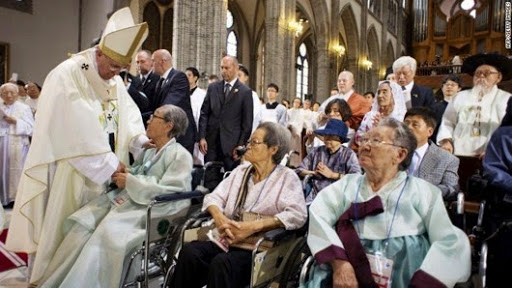
140818151053 pope comfort women s036314271 story tablet

Three weeks ago Pope Francis made a five-day visit to South Korea where he again spoke with great clarity about a number of topics and where he gave witness to the Good News of the Gospel by actions at least as much as by words. Instead of providing a comprehensive account of the trip, which can be found in many other places, I would just like to bring together my favorite passages from the around 15 talks he gave there.

Upon his arrival, Francis presented his approach to diplomacy:

“The quest for peace also represents a challenge for each of us, and in a particular way for those of you dedicated to the pursuit of the common good of the human family through the patient work of diplomacy. It is the perennial challenge of breaking down the walls of distrust and hatred by promoting a culture of reconciliation and solidarity. For diplomacy, as the art of the possible, is based on the firm and persevering conviction that peace can be won through quiet listening and dialogue, rather than by mutual recriminations, fruitless criticisms and displays of force.”

Followed by a reflection on how peace, justice and development are interrelated:

“Peace is not simply the absence of war, but “the work of justice” (cf. Is 32:17). And justice, as a virtue, calls for the discipline of forbearance; it demands that we not forget past injustices but overcome them through forgiveness, tolerance and cooperation. It demands the willingness to discern and attain mutually beneficial goals, building foundations of mutual respect, understanding and reconciliation. May all of us dedicate these days to peace, to praying for it and deepening our resolve to achieve it.”

And finally, he underlined the universal need of being heard:

“How important it is that the voice of every member of society be heard, and that a spirit of open communication, dialogue and cooperation be fostered. It is likewise important that special concern be shown for the poor, the vulnerable and those who have no voice, not only by meeting their immediate needs but also by assisting them in their human and cultural advancement.”

Later that same day, when addressing the Korean bishops, Francis warned them against becoming an affluent, middle class Church where the poor do not feel at home and that becomes mediocre:

“There is a danger, a temptation which arises in times of prosperity: it is the danger that the Christian community becomes just another “part of society”, losing its mystical dimension, losing its ability to celebrate the Mystery and instead becoming a spiritual organization, Christian and with Christian values, but lacking the leaven of prophecy. When this happens, the poor no longer have their proper role in the Church. This is a temptation from which particular Churches, Christian communities, have suffered greatly over the centuries; in some cases they become so middle class that the poor even feel ashamed to be a part of them. It is the temptation of spiritual “prosperity”, pastoral prosperity. No longer is it a poor Church for the poor but rather a rich Church for the rich, or a middle class Church for the well-to-do. Nor is this anything new: the temptation was there from the beginning. Paul had to rebuke the Corinthians in his First Letter (11:17), while the Apostle James was even more severe and explicit (2:1-7): he had to rebuke these affluent communities, affluent Churches for affluent people. They were not excluding the poor, but the way they were living made the poor reluctant to enter, they did not feel at home. This is the temptation of prosperity. I am not admonishing you because I know that you are doing good work. As a brother, however, who has the duty to confirm his brethren in the faith, I am telling you: be careful, because yours is a Church which is prospering, a great missionary Church, a great Church. The devil must not be allowed to sow these weeds, this temptation to remove the poor from very prophetic structure of the Church and to make you become an affluent Church for the affluent, a Church of the well-to do – perhaps not to the point of developing a “theology of prosperity” – but a Church of mediocrity.”

The next day, on 15th August, Francis had his first meeting with youth gathered from all over Asia, where he first recalled the need for the Church to “be a seed of unity for the whole human family,” and then proceeded to reflect on an experience shared before his address that was about the challenges of discerning one’s vocation:

“What Marina said really struck me: about the conflict she felt in her life. What to do in this situation? Take up the path of consecrated life, religious life, or study to be better able to help others.

This is only an apparent conflict, because when the Lord calls, he always does so for the good of others, whether it is through the religious life, the consecrated life, or as a lay person, as the father or mother of a family. The goal is the same: to worship God and to do good to others. What should Marina do, and the many others of you who are asking the same question? I once asked it myself: What path should I choose? But you do not have to choose any path! The Lord must choose it! Jesus has chosen it! You have to listen to him and ask: Lord, what should I do?

This is the prayer that a young person should make: “Lord what do you want from me?” With prayer and the advice of some good friends – laity, priests, religious sisters, bishops, popes (even the Pope can offer some good advice!) – you can find the path that the Lord wants for you.”

He then went on to underline the fundamental simplicity of love:

“The path of love is simple: love God and love your neighbor, your brother or sister, the one at your side, who needs love and so many other things. “But Father, how do I know that I love God?” Only if you love your neighbor, if you do not hate your neighbor and do not harbor hatred in your heart, do you love God. This is the sure proof.”

Later that day Francis paid a surprise visit to the Jesuit HQ in Korea, where he said the following to his brothers:

“There are no wounds that can’t be consoled by the love of God. This is how we must live: seeking Jesus Christ so that we may carry this love to consoling wounds, healing wounds. […] God always consoles, always waits, always forgets, always forgives. There are many wounds in the Church. Wounds that are often provoked by ourselves, practicing Catholics and ministers of the Church.

Don’t tell off the people of God anymore! Console the people of God! Often our clerical attitudes lead to clericalism that harms the Church so much. Being a priest does not result in the status of public officials, but of shepherd. Please, be shepherds and not public officials. And when you are in the confessional, remember that God never tires of forgiving. Be merciful!”

Two days later, Francis met bishops from all over Asia to whom he spoke about the simultaneous need for a clear sense of one’s own identity and of openness and receptivity to others, as the basis for dialogue:

“But in undertaking the path of dialogue with individuals and cultures, what should be our point of departure and our fundamental point of reference, which guides us to our destination? Surely it is our own identity, our identity as Christians. We cannot engage in real dialogue unless we are conscious of our own identity. We can’t dialogue, we can’t start dialoguing from nothing, from zero, from a foggy sense of who we are. Nor can there be authentic dialogue unless we are capable of opening our minds and hearts, in empathy and sincere receptivity, to those with whom we speak. In other words, an attentiveness in which the Holy Spirit is our guide. […] And if our communication is not to be a monologue, there has to be openness of heart and mind to accepting individuals and cultures. Fearlessly, for fear is the enemy of this kind of openness.”

And he proceeded to warn against becoming bogged down in formalism, superficiality and easy answers:

“Without a grounding in Christ, the truths by which we live our lives can gradually recede, the practice of the virtues can become formalistic, and dialogue can be reduced to a form of negotiation or an agreement to disagree. An agreement to disagree… so as not to make waves… This sort of superficiality does us great harm. […] Then […] there is [… another] temptation: that of the apparent security to be found in hiding behind easy answers, ready formulas, rules and regulations. Jesus clashed with people who would hide behind laws, regulations and easy answers… He called them hypocrites. Faith by nature is not self-absorbed; it “goes out”. It seeks understanding; it gives rise to testimony; it generates mission. In this sense, faith enables us to be both fearless and unassuming in our witness of hope and love. Saint Peter tells us that we should be ever ready to respond to all who ask the reason for the hope within us (cf. 1 Pet 3:15). Our identity as Christians is ultimately seen in our quiet efforts to worship God alone, to love one another, to serve one another, and to show by our example not only what we believe, but also what we hope for, and the One in whom we put our trust (cf. 2 Tim 1:12).”

Next, Francis insisted on the need for acceptance of others (“Come to my house, enter my heart.”) which has a profound basis in Jesus’ incarnation and in us all being children of the one Father. Empathy and a welcoming of others are core to Christianity and fear for one’s own identity is wholly unwarranted:

“[T]ogether with a clear sense of our own Christian identity, authentic dialogue also demands a capacity for empathy. For dialogue to take place, there has to be this empathy. We are challenged to listen not only to the words which others speak, but to the unspoken communication of their experiences, their hopes and aspirations, their struggles and their deepest concerns. Such empathy must be the fruit of our spiritual insight and personal experience, which lead us to see others as brothers and sisters, and to “hear”, in and beyond their words and actions, what their hearts wish to communicate. In this sense, dialogue demands of us a truly contemplative spirit of openness and receptivity to the other. I cannot engage in dialogue if I am closed to others. Openness? Even more: acceptance! Come to my house, enter my heart. My heart welcomes you. It wants to hear you. This capacity for empathy enables a true human dialogue in which words, ideas and questions arise from an experience of fraternity and shared humanity. If we want to get to the theological basis of this, we have to go to the Father: he created us all; all of us are children of one Father. This capacity for empathy leads to a genuine encounter – we have to progress toward this culture of encounter – in which heart speaks to heart. We are enriched by the wisdom of the other and become open to travelling together the path to greater understanding, friendship and solidarity. “But, brother Pope, this is what we are doing, but perhaps we are converting no one or very few people…” But you are doing it anyway: with your identity, you are hearing the other. What was the first commandment of God our Father to our father Abraham? “Walk in my presence and be blameless”. And so, with my identity and my empathy, my openness, I walk with the other. I don’t try to make him come over to me, I don’t proselytize. Pope Benedict told us clearly: “The Church does not grow by proselytizing, but by attracting”. In the meantime, let us walk in the Father’s presence, let us be blameless; let us practice this first commandment. That is where encounter, dialogue, will take place. With identity, with openness. It is a path to greater knowledge, friendship and solidarity. As Saint John Paul II rightly recognized, our commitment to dialogue is grounded in the very logic of the incarnation: in Jesus, God himself became one of us, shared in our life and spoke to us in our own language (cf. Ecclesia in Asia, 29).”

And finally, Francis places the importance of a shared journey above the others’ conversion and distances the Church from ideas of conquest:

“I am not referring to political dialogue alone, but to fraternal dialogue… “But these Christians don’t come as conquerors, they don’t come to take away our identity: they bring us their own, but they want to walk with us”. And the Lord will grant his grace: sometimes he will move hearts and someone will ask for baptism, sometimes not. But always let us walk together. This is the heart of dialogue.

The next day, during a meeting with religious leaders, Francis returns to the importance of shared journeying:

“Life is a journey, a long journey, but a journey which we cannot make by ourselves. We need to walk together with our brothers and sisters in the presence of God. So I thank you for this gesture of walking together in the presence of God: that is what God asked of Abraham. We are brothers and sisters. Let us acknowledge one another as brothers and sisters, and walk together.”

And finally, during the flight back to Rome, Francis again answers questions put to him there and then by the journalists on board, where three stood out for me in particular. First, in response to being asked about whether he isn’t concerned that his gesture of wearing a yellow ribbon (a sign of solidarity with the victims of the Sewol ferry disaster) might be misunderstood politically, Francis answers:

“Whenever you find yourself facing human suffering, you have to do what your heart tells you to. Then people will say: “He did it for this or that political reason”; let them say what they want. But when you think of these men and woman, these fathers and mothers who have lost their children, their brothers and sisters, of the immense pain of such a disaster, I don’t know, my heart.. I am a priest and I feel the need to draw near! That’s how I feel; that is the first thing. I know that the comfort that any word of mine might give is no cure, it doesn’t bring the dead back to life, but human closeness at these times gives us strength, there is solidarity… […] I would like to add something. I took this (holding up a ribbon). After I carried it for half a day – I took it for solidarity with them – somebody came up to me and said: It’s better to take that off… You should be neutral …” “But listen, where human suffering is involved, you can’t be neutral”. That was my answer; that’s how I feel.”

Second, in response to a question about military intervention in Iraq and also addressing the topic of torture, Francis says:

“Thank you for your very clear question. In these cases, where there is an unjust aggression, I can only say that it is licit to stop the unjust aggressor. I emphasize the word: “stop”. I’m not saying drop bombs, make war, but stop the aggressor. The means used to stop him would have to be evaluated. Stopping an unjust aggressor is licit. But we also need to remember! How many times, with this excuse of stopping an unjust aggressor, the powers have taken over peoples and carried on an actual war of conquest! One nation alone cannot determine how to stop an unjust aggressor. After the Second World War, there was the idea of the United Nations: that is where discussion was to take place, to say: Is this an unjust aggressor? It would seem so. How do we stop him?” This alone, nothing else. Second, minorities. Thanks for using that word. Because people say to me: “the Christians, the poor Christians…” And it is true, they are suffering, and martyrs, yes, there are many martyrs. But there are also men and women, religious minorities, not all Christians, and all are equal before God. To stop an unjust aggressor is a right of humanity, but it is also a right of the aggressor to be stopped in order not to do evil. […]

Today, torture is an almost, I would say, ordinary means used in intelligence work, in trials… And torture is a sin against humanity, it is a crime against humanity. And to Catholics, I say: to torture a person is a mortal sin; it is a grave sin, but even more, it is a sin against humanity.”

And third, in a question about his upcoming encyclical on ecology, Francis spoke again about the relationship between science and faith, being more specific about how he sees the value of science in the context of this document of Catholic teaching:

“[T]here are also scientific hypotheses [to be taken into account], some of them quite solid, others not. In this kind of encyclical, which has to be magisterial, one can only build on solid data, on things that are reliable. If the Pope says that the earth is the centre of the universe, and not the sun, he errs, since he is affirming something that ought to be supported by science, and this will not do. That’s where we are at now. We have to study the document, number by number, and I believe it will become smaller. But to get to the heart of the matter and to what can be safely stated. You can say in a footnote: “On this or that question, there are the following hypotheses…”, as a way of offering information, but you cannot do that in the body of encyclical, which is doctrinal and has to be sound.”

Probably the best movie about Jesus

Il vangelo

Franco Zefirelli’s “Jesus of Nazareth”? No. (Phew!)

Mel Gibson’s “The Passion of the Christ”? No, not that one either. (Phew, again!)

No, “probably the best movie about Jesus” is Pier Paolo Pasolini’s “The Gospel According to St. Matthew.”

“Says who?,” you ask.

Well, none other than the Vatican’s own newspaper, l’Osservatore Romano, which in a review on the 50th anniversary of the movie’s premiere had the following to say (in the words of Emilio Ranzato):

“Whether it be a movie about a crisis in progress or about its overcoming, The Gospel according to Matthew remains a masterpiece, and probably the best movie about Jesus ever made. It is certainly the one in which his words ring out most fluidly, in the most elevated and the most powerful way. Hewn out of bare rock, like the best moments of Pasolinian cinema.”

But, what makes this movie the pinnacle of depicting Jesus’ life? The l’Osservatore Romano review elaborates:

“The director follows the Gospel pages to the letter and doesn’t shy away even from talking about miracles, which he presents with an inspiration worthy of a believer. In this way, on the one hand confirming the validity and power of the Christian word, but, on the other hand, giving it a more down-to-earth context in which to spread, the director clearly intends to give a thrust both towards the marxist and ecclesial worlds. At the same time, however, and maybe unexpectedly, he finds peace in a place that is equidistant from these two poles. Surely there have been few other times in the history of cinema where a representation that plays on sacred strings, or even only mythical and epic ones, has been built on such a sincere realism.”

So, what drove this marxist (and atheist and gay) director to making a movie about Jesus? He explains this himself – during the year before the movie’s release – in a letter to Lucio Caruso of the Pro Civitate Christiana of Assisi (a Christian volunteer organization):

“The first time I visited all of you in Assisi, I found the Gospels at my bedside: your diabolical calculation!

That day, in your place, I read them from beginning to end, like a novel.

And in the exaltation of reading – as you know, it’s the most exalting thing one can read! – there came to me among other things, the idea of making a film… as the days and later the weeks went by, the idea kept getting more overwhelming and exclusive. It threw in the shade all the other ideas for work I had in my head, it weakened and devitalised them.

And it alone remained, alive and thriving within me… my idea is this: to follow the Gospel according to Saint Matthew, point by point, without making a script or adaptation of it. To translate it faithfully into images, following its story exactly without any omissions or additions.

The dialogue too should be strictly that of Saint Matthew, without even a single explanatory or connecting sentence, because no image or inserted word could ever attain the poetic heights of the text… to put it very simply and frankly, I don’t believe that Christ is the son of God, because I am not a believer – at least not consciously. But I believe that Christ is divine. I believe that is, that in him humanity is so kind and ideal as to exceed the common terms of humanity. For this reason I say “poetry” – an irrational instrument to express this irrational feeling of mine for Christ.”

His answer to the question of why he, a non-believer, had made a film which dealt with religious themes, at a press conference in 1966, is also illuminating:

“If you know that I am an unbeliever, then you know me better than I do myself. I may be an unbeliever, but I am an unbeliever who has a nostalgia for a belief.”

But, how does one who is not a Christian create a piece of art that is recognized by Christians as their own, and not only that, but a masterpiece? Here Pasolini’s answer is very telling:

“[T]he rule that dominated the making of the film was the rule of analogy. That is, I found settings that were not reconstructions but that were analogous to ancient Palestine. The characters, too—I didn’t reconstruct characters but tried to find individuals who were analogous. I was obliged to scour southern Italy, because I realized that the pre-industrial agricultural world, the still feudal area of southern Italy, was the historical setting analogous to ancient Palestine. One by one I found the settings that I needed for The Gospel. I took these Italian settings and used them to represent the originals. I took the city of Matera, and without changing it in any way, I used it to represent the ancient city of Jerusalem. Or the little caverns of the village between Lucania and Puglia are used exactly as they were, without any modifications, to represent Bethlehem. And I did the same thing for the characters. The chorus of background characters I chose from the faces of the peasants of Lucania and Puglia and Calabria. […]

In reality, my method consists simply of being sincere, honest, penetrating, precise in choosing men who psychological essence is real and genuine. Once I’ve chosen them, then my work is immensely simplified. I don’t have to do with them what I have to do with professional actors: tell them what they have to do and what they haven’t to do and the sort of people they are supposed to represent and so forth. I simply tell them to say these words in a certain frame of mind and that’s all. And they say them.”

Whether intentionally or not, this way of analogy is precisely Jesus’ own method. The employment of parables, and his teaching in its entirety rely fundamentally on analogy. Here is God – the infinite, omnipotent, omniscient, wholly transcendent and other – speaking to his creatures, who are addled with limitations, and the only possible way is that of analogy, since the listeners have no direct access to the ultimate realities that the speaker is trying to convey. At the heart of this method is in fact the very life of the Trinity, where each Person empties itself so as to receive the other and fully gives itself to the other that is ready to receive them. This self-othering1 nature of God is the basis of analogy, which Pasolini applied masterfully and I would like to argue that his work resonates with Christians not only because of the subject matter, but because of the method that begot it. And I have to say that I am a great fan of it too!

To conclude, I’d just like to share a fragment of the dialogue between the Franciscan Fr. Ugolino Vagnuzzi and Pier Paolo Pasolini that took place in June ’68 and that Fr. Vagnuzzi published a couple of days ago. It starts with Pasolini’s words:

““I saw Christ with two “eyes,” one being mine – of a rational man, modern and a lay person; the other being the look of a simple person with great faith. These two visions complement each other, I’ll explain: I saw him as the Son of God, mystically, religiously, but at the same time I saw him as a revolutionary.”

I asked him [writes Fr. Ugolino] whether before or after that Christ was so successful in the cinema, he had said something to him.

“Religious convictions or non-belief are like blocks of quartz. The reasons that make these blocks dissolve is always mysterious, so I can say neither yes nor no to you.”

I was deeply moved when he then turned to me with these words:

“You see, dear Brother, you and I are one on one and the other on the other bank of a river. A bridge unites us where we can meet. Both of us must travel some distance. I am certain that you will not say no to taking these steps, which are precious to me.””


1 A term coined by my überbestie CS.

Who are children of God?

45460002 aboud mustafa jamie areen avery2

Catholics? Christians? “Good” people?

No.

In total disagreement with the author of yesterday’s “Thoughts on today’s Mass,” distributed in my parish, who said that “we are not naturally children of God: we become so by baptism, when God adopts us as his own. Otherwise to call God our Father would be a bold presumption,” I would like to show that the Catholic Church teaches that every single human being is a child of God. Using the idea of being God’s child as the basis of separation, the basis of an “us,” as opposed to a ”them,” is perverse and absolutely not what the Catholic Church teaches, in spite of the official-looking material handed out in some of its parishes.

To begin with, Jesus – the Son of God – himself recognizes familial status universally, when he says that “whoever does the will of my heavenly Father is my brother, and sister, and mother” (Matthew 12:50) and St. Paul too picks up on the key being adherence to God’s will: “For those who are led by the Spirit of God are children of God” (Romans 8:14).

That such adherence to the will of God is open to everyone – whether they believe in God or not – and that it is at the heart of what the Catholic Church believes, is very clear from Nostra Aetate, the declaration issued during the Second Vatican Council by Pope Paul VI, which says in its closing paragraph:

“We cannot truly call on God, the Father of all, if we refuse to treat in a brotherly way any man, created as he is in the image of God. Man’s relation to God the Father and his relation to men his brothers are so linked together that Scripture says: “He who does not love does not know God” (1 John 4:8).

No foundation therefore remains for any theory or practice that leads to discrimination between man and man or people and people, so far as their human dignity and the rights flowing from it are concerned.

The Church reproves, as foreign to the mind of Christ, any discrimination against men or harassment of them because of their race, color, condition of life, or religion. On the contrary, following in the footsteps of the holy Apostles Peter and Paul, this sacred synod ardently implores the Christian faithful to “maintain good fellowship among the nations” (1 Peter 2:12), and, if possible, to live for their part in peace with all men, so that they may truly be sons of the Father who is in heaven.”

And this is also reflected in what the Catechism teaches about the opening words of the Our Father, the prayer Jesus taught:

“God’s love has no bounds, neither should our prayer. Praying “our” Father opens to us the dimensions of his love revealed in Christ: praying with and for all who do not yet know him, so that Christ may “gather into one the children of God.” God’s care for all men and for the whole of creation has inspired all the great practitioners of prayer; it should extend our prayer to the full breadth of love whenever we dare to say “our” (§2793)

Note in particular the thought-provoking idea in the above of Catholics praying with those who don’t know Jesus. Even in a fundamentally religious act the desire of Catholics is to be united with those who don’t share their beliefs!

And if the above weren’t enough to categorically declare that Catholics consider every human being to be a child of God and therefore also their brother or sister, let’s see what the last three popes had to say on the subject:

  1. “We must never forget that every person, from the moment of conception to the last breath, is a unique child of God and has a right to life.” Pope Saint John Paul II (Address at the Ceremony of the Anointing Of The Sick, Southwark’s Cathedral, London, 28 May 1982)
  2. “God is the origin of the existence of every creature, and the Father in a unique way of every human being: he has a unique, personal relationship with him or her.” Pope Benedict XVI (Sunday Angelus address, 8 January 2012)
  3. “Since many of you are not members of the Catholic Church, and others are not believers, I cordially give this blessing silently, to each of you, respecting the conscience of each, but in the knowledge that each of you is a child of God. May God bless you!” Pope Francis (Audience to Representatives of the Communications Media, 16th March 2013 – the day after his election!)
  4. “Every human being is a child of God! He or she bears the image of Christ! We ourselves need to see, and then to enable others to see, that migrants and refugees do not only represent a problem to be solved, but are brothers and sisters to be welcomed, respected and loved.” Pope Francis (Message for the World Day of Migrants and Refugees, 5 August 2013)

I rest my case.