The Spirit of God always gets there first

Aiweiwei unilever banner 0

Today Pope Francis gave a stunning speech to around 8000 members, families of the Neocatechumenal Way (a million-strong Catholic movement focused on the Christian formation of adults), ahead of their departure for missions across the world. Before he gave them his blessing, he addressed them with words of advice, all of which I highly recommend. Instead of reflecting on his speech in full, I’d like to focus only on a single point he makes, which stopped me in my tracks as I read it, by its beauty, humility and post hoc obviousness :). Here is what Pope Francis presented as his second of (yes, you guessed it) three points1 of advice:

“[W]herever you may go, it would do you well to think that the Spirit of God always gets there ahead of us. The Lord always precedes us! … Even in the most faraway places, even in the most diverse cultures, God scatters everywhere the seeds of his Word. From here, flows the necessity to give special attention to the cultural context in which you […] will go to work: it consists of an environment often very different from the one from which you come. Many of you will have to work hard to learn the local language, sometimes it will be difficult, and this effort is appreciated. Even more important will be your commitment to “learn” the culture you will encounter, knowing how to recognize the need of the Gospel, which is present everywhere, but also that action that the Holy Spirit has accomplished in the life and in the history of every people.”

To make the most of the above, let’s also put Pope Francis’ closing remarks during the same address on the table:

“I encourage you to bring everywhere, even in the most de-Christianized environments, especially in the existential peripheries, the Gospel of Jesus Christ. Evangelize with love, bring to everyone the love of God. Tell everyone you will meet on the streets of your mission that God loves man as he is, even with his limits, with his mistakes, with his sins. For this, he sent his Son, so that he could take our sins upon himself. Be messengers and witnesses of the infinite goodness and the inexhaustible mercy of the Father.”

What emerges here is a very powerful picture, to my mind, where Francis first points out a consequence of Christian faith that is often overlooked especially when thinking about non-Christian contexts, which is that God is already there even before the first Christian arrives to announce the Good News. A Christian sent to “the most de-Christianized environments” is not the one bringing God to a place from which He is absent! Instead, they need to realize not only that God is already there (to suggest anything else would be heresy), but also that God’s presence brings fruits. A Christian needs to recognize that God is present in a non-Christian culture, that “God scatters everywhere the seeds of his Word.”2 Their reverence for God’s Word then obligates them to recognize also the “action that the Holy Spirit has accomplished in the life and in the history of every people.” The Christian does not arrive as the exclusive bearer of God to a place from where He is lacking, but instead as a fellow recipient of God’s Word. What a different perspective this is from the caricature of proselytism!

The second moment in Pope Francis’ advice that struck me is guidance on the kerygma to be used by the missionaries, where the emphasizes that “God loves man as he is, even with his limits, with his mistakes, with his sins.” God’s love is not conditional, or requiring merit. It is not a “do X, Y and Z and you will become worthy.” Instead, the missionaries are to announce to the people they’ll find at the peripheries of de-Christianized environments that God loves them as they are.

Wow! The mindset Pope Francis offers here is a breath of fresh air.3

As I thought about the above, I realized that I’d be making a mistake though if I thought about Francis’ words as advice that these Neocatechumenal types needed to hear. His words are addressed to me too. I too am often in “de-Christianized environments,” with their own “culture” and I too need to recognize that in those environments too God is natively at work, that I too can look for traces of His presence and His action also in these non-Christian contexts. This does not absolve me from sharing my Christian faith, but it further underlines the fact that I am sharing it with equals – with brothers and sisters.


1 The first point emphasizes the importance of these missionaries being united with the local Churches in the places they are being sent to – a very important point! – and the third – also super important! – is his insisting on the need for missionaries being merciful towards each other and leaving everyone free to change their minds about following the Neocatechumenal Way. Both of these, which in fact mirror some of the criticisms leveled at the Neocatechumenal Way, would be worth reflecting on and I may well return to them in the future.
2 A clear reference to the Ad Gentes Vatican II decree, which makes the same point: “In order that they may be able to bear more fruitful witness to Christ, let [Christians] be joined to those men by esteem and love; let them acknowledge themselves to be members of the group of men among whom they live; let them share in cultural and social life by the various. undertakings and enterprises of human living; let them be familiar with their national and religious traditions; let them gladly and reverently lay bare the seeds of the Word which lie hidden among their fellows.” This, in turn is at least a 2nd century AD idea by Justin Martyr
3 And, no, I don’t mean to suggest this in contrast to what his predecessors have done. It is more a matter of emphasis and directness of language rather than a change in guidance or dogma. See also footnote 2 …

Apophthegmata Patrum: jokes of the Fathers

The temptation of St Anthony

Even though that is not what’s typically highlighted, I love the humor of the Desert Fathers and Mothers – 5th century Christian hermits and mystics from Egypt. The stories told about them, which tend to be of the form “Abba/Amma X said …,” are filled with a deep concern for what matters and a wave-of-the-hand disdain for what does not. To me they are perfect examples of what it means to follow the example of Jesus, without getting bogged down into circumstantial, politically-correct, socially-dictated or procedurally-prescribed baggage. In many ways they are the Christian equivalent of Zen Buddhist kōans, which I enjoy just as much.

What I’d like to do today is just to share some of my favorite Desert Father/Mother sayings, which come from a couple of collections (here, here and here) extracted from their standard source, the Apophthegmata Patrum:

  1. Abba Abraham told of a man of Scetis who was a scribe and did not eat bread. A brother came to beg him to copy a book. The old man whose spirit was engaged in contemplation, wrote, omitting some phrases and with no punctuation. The brother, taking the book and wishing to punctuate it, noticed that words were missing. So he said to the old man, ‘Abba, there are some phrases missing.’ The old man said to him, ‘Go, and practise first that which is written, then come back and I will write the rest.’
  2. Abba Doulas, the disciple of Abba Bessarion said, ‘One day when we were walking beside the sea I was thirsty and I said to Abba Bessarion, “Father, I am very thirsty.” He said a prayer and said to me, “Drink some of the sea water.” The water proved sweet when I drank some. I even poured some into a leather bottle for fear of being thirsty later on. Seeing this, the old man asked me why I was taking some. I said to him, “Forgive me, it is for fear of being thirsty later on.” Then the old man said, “God is here, God is everywhere.”’
  3. It was said of Abba John the Persian that when some evildoers came to him, he took a basin and wanted to wash their feet. But they were filled with confusion, and began to do penance.
  4. One day Abba Isaac went to a monastery. He saw a brother committing a sin and he condemned him. When he returned to the desert, an angel of the Lord came and stood in front of the door of his cell, and said, “I will not let you enter.” But he persisted saying, “What is the matter?” And the angel replied, “God has sent me to ask you where you want to throw the guilty brother whom you have condemned.” Immediately he repented and said, “I have sinned, forgive me.” Then the angel said, “Get up, God has forgiven you. But from now on, be careful not to judge someone before God has done so.”
  5. A brother came to see Abba Poemen and said to him, “Abba, I have many thoughts and they put me in danger.” The old man led him outside and said to him, “Expand your chest and do not breathe in.” He said, “I cannot do that.” Then the old man said to him, “If you cannot do that, no more can you prevent thoughts from arising, but you can resist them.”
  6. Abba Macarius while he was in Egypt discovered a man who owned a beast of burden engaged in plundering Macarius’ goods. So he came up to the thief as if he was a stranger and he helped him to load the animal. He saw him off in great peace of soul, saying, ‘We have brought nothing into this world, and we cannot take anything out of the world.’(1 Tim. 6.7)
  7. A brother at Scetis committed a fault. A council was called to which Abba Moses was invited, but he refused to go to it. Then the priest sent someone to say to him, ‘Come, for everyone is waiting for you.’ So he got up and went. He took a leaking jug, filled it with water and carried it with him. The others came out to meet him and said to him, ‘What is this, Father?’ The old man said to them, ‘My sins ran out behind me, and I do not see them, and today I am coming to judge the errors of another.’ When they heard that they said no more to the brother but forgave him.
  8. Abba Theophilus, the archbishop, came to Scetis one day. The brethren who were assembled said to Abba Pambo, ‘Say something to the Archbishop, so that he may be edified.’ The old man said to them, ‘If he is not edified by my silence, he will not be edified by my speech.’

Book review: I am so much in God’s hands

Jp2

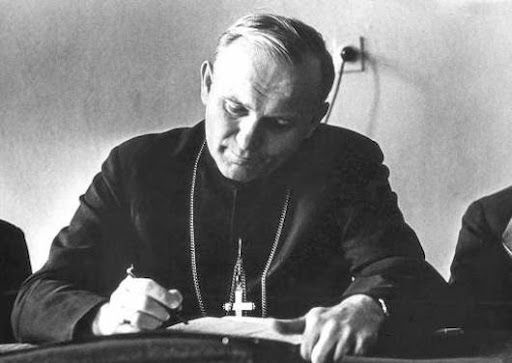
A first (and hopefully last) in a series of book reviews of books I haven’t and will not read, today’s post looks at the upcoming publication of Blessed Pope John Paul II’s personal notes from 1962-2003. A book I would love to read, but won’t.

Imagine that some hitherto unpublished text by your favorite author, thinker or personality has come to light – e.g., some of Aristotle’s works thought lost with the burning of the library at Alexandria, a previously unknown treatise by Voltaire, a new novel by Hesse or the memoirs of Marilyn Monroe (whatever your personal preference). You’d be queueing up to pre-order it as soon as possible (as I did with Camus’ “The First Man,” first published in 1994 – 34 years after his death) and be keen to get hold of any extracts or quotes from it as soon as they were released or even leaked.

So why don’t I feel the same about the upcoming publications of John Paul II’s “I am so much in God’s hands” – 640 pages of new material by probably my favorite thinker of the 20th century, if not of all time (based on having read almost all of his extensive corpus of writings)? Wouldn’t I take great pleasure in reading new words penned by him? Wouldn’t they be edifying, thought provoking and intellectually satisfying? Wouldn’t they further boost my admiration for him? I am certain they would do all that and possibly more.

Yet, I won’t ever read that book.

The reason for this is simple, and follows from my respect and love for its author, who in his Last Will and Testament had the following to say:

“I leave no property behind me of which it is necessary to dispose. Regarding those items of daily use of which I made use, I ask that they be distributed as may appear opportune. My personal notes are to be burned. I ask that Don Stanisław oversees this and thank him for the collaboration and help so prolonged over the years and so comprehensive. All other thanks, instead, I leave in my heart before God Himself, because it is difficult to express them.”

The book about to be published (initially in Polish) contains the “personal notes” that John Paul II ordered to be burned in his will. They are his personal writings, written in the knowledge of their being private and not destined for publication and commercial distribution. Like the diary of a friend, I would not dream of reading it without their express permission.

So, how is it possible that these personal notes will be published? What happened to “Don Stanislaw,” entrusted in John Paul II’s will with executing the burning of his personal notes? Has he been obstructed from carrying out the Pope’s last wishes?

No. To add insult to injury, it is “Don Stanisław” (a. k. a., the now-Cardinal Stanisław Dziwisz) who is behind the book’s publication.

How, you ask, is that possible?! Well, Cardinal Dziwisz gives the following explanation:

“I didn’t burn John Paul II’s notes, because they are the key to interpreting his spirituality, his innermost self: his relationships with God, others, and himself. They somehow reveal another side of the person, whom we knew as Bishop in Kraków and in Rome, Peter of our times, a Pastor of the universal Church. They even show his life much earlier, in the years when he was ordained a bishop and was taking over the bishopric in Kraków. They allow us to look at the intimate personal relation of faith with God, the Creator, Giver of life, the Master and Teacher. They also show sources of his spirituality – his inner strength and a definite will to serve Christ till the last breath of his life.”

OK, I see that the text is rich and precious (and I didn’t ask for an ad for the book), but that wasn’t the question. Let’s try again:

“However, I was not courageous enough to burn these sheets of paper and notebooks with his personal notes, which he had left, because they include important information about his life. I saw them on the desk of the Holy Father, but I had never read them.”

Now, that makes more sense – not complying with the Pope’s orders was a failing – the absence of courage. And admitting that he had never read them while John Paul II was alive should have given him a hint about what was to happen with them after the Pope’s death.

I don’t mean to suggest any malicious motives on the part of Cardinal Dziwisz, but, Don Stanisław, how could you?!

Gender

South Sudan Rain Clouds UN Photo

An easy way of making a Catholic gasp and recoil in horror these days is to utter the word “gender,”1 which in many cases is heard as being synonymous with “heretic.” Saying: “I work for gender equity,” is tantamount to admitting to drug dealing, human trafficking, or worse. What are “gender equity,” or the more widely used term “gender equality,” though? Here one of the best descriptions of it’s consequences – in my opinion – is the following:

“And what shall we say of the obstacles which in so many parts of the world still keep women from being fully integrated into social, political and economic life? […] As far as personal rights are concerned, there is an urgent need to achieve real equality in every area: equal pay for equal work, protection for working mothers, fairness in career advancements, equality of spouses with regard to family rights and the recognition of everything that is part of the rights and duties of citizens in a democratic State.”

Oh, but this doesn’t sound despicable!? If anything, it seems like exactly what every Catholic ought to be (and very often is) striving for! So, where does the opposition to anything to do with “gender” come from?

Let’s take a couple of steps back and look at the concept in isolation. In terms of etymology, “gender” derives from the Latin “genus,” which in turn means “kind” or “type” and which has since antiquity (at least since as early as Protagoras in the 5th century BC) been employed in the context of grammar, resulting in a categorization of nouns into masculine, feminine and neuter. While the application of such categories to human identity, behavior and social roles has traces in the Middle Ages, it is only since the middle of the 20th century that the term is consistently used to refer to a person’s identity or social role, distinguishing between male and female (and more recently a growing list of other types too).

In other words, “gender” refers to whether one considers oneself male or female and/or whether one is considered male or female by society, with all the implications that such (self)categorization entails. It “refers to the economic, social and cultural attributes and opportunities associated with being male or female,” as the United Nations put it.

So far, “gender” sounds like a fairly uncontroversial concept: men and women see themselves as male or female, where their being male or female also has consequences socially, economically and culturally. The term allows for distinguishing between biological sex and it psychological and social consequences and allows for highlighting inequality for which society rather than physiology is accountable for.

To a Christian, who professes that every human being is made in the “Image of God,” inequality needs to be fundamentally abhorrent and equal dignity, opportunity, recognition, rights and respect be seen as an inherent good. If you are a Catholic and feel a bit squeamish about any use of the term “gender,” get over it. And next time someone tells you they work for “gender equality,” congratulate them and support them. Period. Women today are at a disadvantage around the world – in many cases shockingly and criminally so, purely by virtue of being women. Gender equity – the striving for fair treatment of men and women – is an intrinsic moral good that is every Christian’s duty and a direct consequence of Jesus’ commandment to “love your neighbor as yourself” (Matthew 22:39).

So, is the kerfuffle around the term “gender” all just some big mixup or exaggeration?

No.

There is another use of the concept of “gender,” where it becomes an ideology and where, I believe, it is distorted in ways that can lead to at least psychological harm. This ideology – “gender theory” – proceeds along the following lines: “Since gender is a social construct, and since I have self-determination, gender is not an intrinsic attribute of my self. Instead, it is something I “do” and I am free to choose arbitrarily. As a woman I am neither intrinsically female nor male. I become female or am made to behave according to female constraints that society imposes on me.” It is in this vein that Simone de Beauvoir says “one is not born a woman, one becomes so” (The Second Sex) or that Judith Butler declares that “[r]ather than ‘woman’ being something one is, it is something one does” (Gender Trouble). And it is this ideology that Benedict XVI decries and sums up by saying:

“People dispute the idea that they have a nature, given by their bodily identity, that serves as a defining element of the human being. […] Man calls his nature into question. From now on he is merely spirit and will. […] From now on there is only the abstract human being, who chooses for himself what his nature is to be.”

I believe that, in both of the above examples of gender theory statements, the motives for opposition to gender roles, as imposed by society and resulting in injustice, were positive. They were a revolt both against the misogynistic contortions of Freudian psychoanalysis, that posits female inferiority, and against social injustice perpetrated on women. The difficulty, to my mind, arrises neither from the well-justified analysis of social inequality, nor from the reactions against dubious models of female psychology. Instead, it lies with the conclusions drawn from them.2 The observation of unjust gender roles and models leads to their dissociation from sex, instead of to an attack on their injustice and a subsequent project for their rectification.

Instead of denying the link between the biological and the social, as tends to be the case with “gender theory” ideologies, I believe the answer lies in reforming unjust and inequality-fueling gender roles. Here, there are good examples of campaigns that foster awareness and work towards the changing of negative stereotypes, today imposing pressure both in peer groups and from the media. E.g., the UK-based “GREAT Initiative” has a “Great Men Value Women,” campaign where they work with teenage boys to challenge male stereotypes that foster gender inequality (e.g., being tough, even aggressive and not showing their feelings). Then there are: the “Men in Childcare” initiative, which promotes the involvement of men in childcare and related professions, one of the UN’s “Millennium Goals” focusing on gender equality, or the World Food Programme’s providing training sessions for fathers about maternal and child health and nutrition, just to name a few. These, to my mind, are pushing in the right direction. In contrast, the consequences of the sex-gender decoupling of “gender theory” range from the innocuous, albeit arguably exaggerated, protests against the ““pinkification” of girls’ toys” to the dramatically more worrying example of the raising of a boy as “gender neutral.”

Oh, and by the way, the opening quote of this post is from Blessed Pope John Paul II’s “Letter to women” (§4)…


1 Many thanks to my überbesties YYM and PM for their nihil obstats.
2 In many ways this reminds me of Marxism3 (and apologies in advance for the great simplification of critiquing it in a single sentence here), which correctly diagnosed the serious problem of social inequality, but which applied to it a non-remedy: class war. The problem still persists to this day, but it requires an actual solution, mindful of human dignity, instead.
3 No, not of Martin Parr this time either.

The Church is not only for good people

Dsm02 wordle

Due to the brief break in masses at Pope Francis’ residence – the Domus Sanctæ Marthæ – over the Christmas holidays, the set of 43 sermons he delivered there since the beginning of September until the end of 2013 can be considered their second season.1 In this post, I will again look at his sermons’ textual features, compare them against the first season and share with you some of my favorite moments from Francis’ homilies during this period, that haven’t already been referred to in the blog posts I wrote over the same period, which are frequently inspired by them or at least make reference to them.

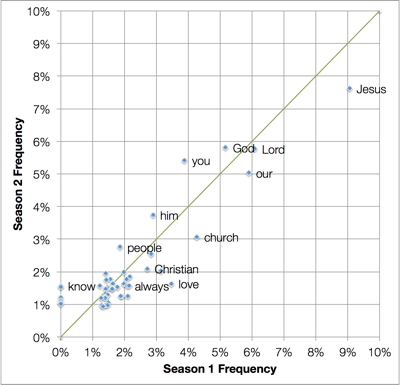
In terms of the latest season’s language, it very much remained like that of the the first, with a heavy focus on Jesus – by far the most frequently used word throughout. The remaining nine of the top ten most frequently-used words were: God, Lord, you, our, him, Church, people, life and Christian (in that order) which means that eight of the top words from the first season remained unchanged, with only “love” and “what” dropping our of the top ten, being replaced by “Christian” and “people.” The specific shifts of these words are also worth noting from the following figure:

S02vs01

While even a relatively small dataset like the above fifty pairs of word frequencies is big enough to have lots read into it, it’d still venture to make the following observations: first, that “Lord” no longer outweighs “God,” second that the gap between the frequency of “our” versus “you” has dropped significantly and third that “Church” and “people” are on almost equal footing instead of the former being said almost twice as often as the latter in the previous season. I don’t mean to build an elaborate analysis on the above features, but they strike me as indicators of an even greater closeness between Francis and his audience.

Worth noting is also the further reduced Gunning-Fog readability Index (from an already very low 6.6 to 6.3), which indicates an increased ease of the text and that this is achieved at the same time as an almost doubling of the text’s lexical density (from 15.2 to 25.3). All of this points to Francis’ words being very accessible, while at the same time holding substance.

Both as an example of his style and as a way to pick out some of my favorite moments from these last three months, the following five are passages from Francis’ homilies that particularly spoke to me:

  1. “Those who live judging their neighbor, speaking ill of their neighbor, are hypocrites, because they lack the strength and the courage to look to their own shortcomings. The Lord does not waste many words on this concept. Further on he says that he who has hatred in his heart for his brother is a murderer. In his first letter, John the Apostle also says it clearly: anyone who has hatred for his brother is a murderer, he walks in darkness, he who judges his brother walks in darkness. And so, every time we judge our brothers in our hearts – or worse still when we speak ill of them with others, we are Christian murderers: A Christian murderer…. It’s not me saying this, it’s the Lord. And there is no place for nuances. If you speak ill of your brother, you kill your brother. […] Gossip always has a criminal side to it. There is no such thing as innocent gossip. […] Some may say that there are persons who deserve being gossiped about. But it is not so: Go and pray for him! Go and do penance for her! And then, if it is necessary, speak to that person who may be able to seek remedy for the problem. But don’t tell everyone! Paul had been a sinner, and he says of himself: I was once a blasphemer, a persecutor, a violent man. But I have been mercifully treated. Perhaps none of us are blasphemers – perhaps … But if we ever gossip we are certainly persecutors and violent. We ask for grace so that we and the entire Church may convert from the crime of gossip to love, to humility, to meekness, to docility, to the generosity of love towards our neighbor.” (13th September)
  2. “You can’t govern without loving the people and without humility! And every man, every woman who has to take up the service of government, must ask themselves two questions: ‘Do I love my people in order to serve them better? Am I humble and do I listen to everybody, to diverse opinions in order to choose the best path.’ If you don’t ask those questions, your governance will not be good. The man or woman who governs – who loves his people is a humble man or woman.” (16th September)
  3. “The Church is not the Church only for good people. Do we want to describe who belongs to the Church, to this feast? The sinners. All of us sinners are invited. At this point there is a community that has diverse gifts: one has the gift of prophecy, another of ministry, who teaching … We all have qualities and strengths. But each of us brings to the feast a common gift. Each of us is called to participate fully in the feast. Christian existence cannot be understood without this participation. ‘I go to the feast, but I don’t go beyond the antechamber, because I want to be only with the three or four people that I am familiar with …’ You can’t do this in the Church! You either participate fully or you remain outside. You can’t pick and choose: the Church is for everyone, beginning with those I’ve already mentioned, the most marginalized. It is everyone’s Church!” (5th November)
  4. “When we look at a father or a mother who speaks to their little child, we see that they become little and speak with a voice of a child and with the manners of children. Someone looking in from the outside think, ‘This is ridiculous!’ They become smaller, right there, no? Because the love of a father and a mother needs to be close. I say this word: to lower themselves to the world of the child … If the father and mother spoke to them normally, the child would still understand; but they want to take up the manner of speaking of the child. They come close, they become children. And so it is with the Lord. The Greek theologians explained this attitude of God with a somewhat difficult word: “syncatabasis” or “the humble and accommodating disposition of God who lowers Himself to make Himself one of us.”” (12th December)
  5. “There is a third coming of the Lord: that of every day. The Lord visits His Church every day! He visits each of us, and so our souls as well experience something similar: our soul resembles the Church, our soul resembles Mary. The Desert Fathers say that Mary, the Church and our souls are feminine, and that what is said about one can be said analogously of the others. Our soul is also in waiting, this waiting for the coming of the Lord – an open soul that calls out, ‘Come, Lord.’” (23rd December)

1 For a review of the “first season,” see here.

Patriarchal plan perplexity

1231

The other day I came across a series of blog posts by Phillip Cary, professor of philosophy at Eastern University, Yale Divinity alumnus and author of multiple books, three of which were even published by OUP. Given his credentials, my expectations were high and – after reading the posts – my subsequent disappointment, by their obvious lack of insight, commensurably deep.

The posts are an exegesis of the first chapters of Genesis regarding the relationship between man and woman, with the penultimate one focusing on Genesis 3:16 – the words God addresses to the woman after she and the man eat from the forbidden “tree of knowledge of good and evil”: “To the woman he said: I will intensify your toil in childbearing; in pain you shall bring forth children. Yet your urge shall be for your husband, and he shall rule over you.” Cary is “puzzled” here by the juxtaposition of the woman’s desire for her husband and his ruling over her and sets out to interpret the meaning of these words of Scripture from the perspective of being God’s plan for how man and woman are to relate:

“My assumption has been that God’s word in Genesis 3 aims at a justice that sets things right. So how does patriarchy, the rule of a man over his wife, set things right? […]

[T]he key point about this patriarchal framework [… is]: because the property of the patriarch consists fundamentally of living things, the increase of wealth and the blessing of procreation are nearly the same thing in Genesis. […]

[T]he man who rules over his wife has a deep economic interest in seeing that she lives well, is healthy and flourishes together with her children, being fruitful and multiplying.”

[And from the following post: T]hat is the framework within which I think we can begin to make sense of patriarchy, where procreation, wealth and the father’s rule of the household coincide. And that in turn is the initial framework we need to see the meaning of God’s word to the woman about her desire for her husband and his ruling over her.”

What I understand from the above is that Cary is saying the following: making the man rule over the woman, in response to their joint disobedience, is a way to re-introduce the value of life in a world where death has entered as a result of the Fall. Life is an economic good and by making procreation a contributor to its proliferation, the husband – who is in charge of the household – benefits and consequently treats his wife well, like he would any other profit-generating asset.

Charming.

Before we get sucked into a diatribe against such a view, let’s take a breath and rewind to Genesis 2:24,1 where man and woman are described before the Fall and where their relationship is one of profound unity: “a man leaves his father and mother and clings to his wife, and the two of them become one body.” In the “one body” there is no master versus slave, no ruler versus subject – there is only one union between man and woman. This is God’s plan for humanity, and, I believe, Cary’s basic mistake is in taking the punishment delivered to man and woman after their disobedience and mistaking it for how man and woman are meant to relate to each other, to the point of arguing for the economic benefits of a relationship that is instituted as punishment. This is like taking the punishing of a child by making them sit still and extolling the virtues of motionlessness in terms of its low carbon footprint.

In fact, Cary’s approach is also at odds with the interpretation Blessed Pope John Paul II makes of Genesis 3:16 in his Man and Woman He Created Them:2

“[T]he words of Genesis 3:16 signify above all a breach, a fundamental loss of the primeval community-communion of persons. This communion had been intended to make man and woman mutually happy through the search of a simple and pure union in humanity, through a reciprocal offering of themselves, that is, through the experience of the gift of the person expressed with soul and body.”

He even goes on to characterize the state instituted in Genesis 3:16 as being a “deformation” of the “original beatifying conjugal union of persons” before the Fall. And if any more evidence were needed for taking this verse not as God’s plan for humanity but as a description of what happens when that plan is corrupted, we only need to look as far as the second reading from the feast of the Holy Family nine days ago, where St. Paul has the following to say: “Wives, be subordinate to your husbands [… h]usbands, love your wives” (Colossians 3:18-19). The advice here is not for husbands to rule, but to love, which, incidentally, also means to self-empty, to subordinate oneself – the exact same thing also asked of wives. The result is a mutual subordination of husband and wife to each other, or – as John Paul II put it – “a reciprocal offering of themselves […] with soul and body.”


1 Just to avoid misunderstandings, speaking about the events described in Genesis does not presuppose considering them to be historical events. The opening chapters of Genesis are a myth, which does not mean to suggest that they are false, but instead that they speak about deep anthropological, psychological and ontological features in a more archaic form – by way of analogy instead of by description of events in this Universe.
2 For more on this book by John Paul II, see here.

Jesus wept


Christianity is not stoicism. Sure, following Jesus’ example does mean first, accepting what is happening to me and recognizing that, whatever it is – whether pleasant or unpleasant, is willed or allowed by God and second, recognizing that it is a context in which loving my neighbors and God through them are open to me. However, the story does not end there, or rather, if it does, then it may well take on a form of the perennial Gnostic heresy that Christianity has resisted since as early as the first century AD and that Pope Francis still battles against today (e.g., see Evangelii Gaudium §94).

The central idea of Gnosticism is a dualism where matter and spirit are opposed, the former being evil and the latter good. A consequence of this belief is also a denial of Jesus’ incarnation, since God, who is good cannot at the same time be matter, which is bad. The Jesus of the Gnostics is pure spirit – a ghost of some sorts, instead of both fully God and fully man. Jesus’ affections and sufferings become mere simulacra and his compassion and sacrifice a mere caricature.

That is not Christianity.

Jesus’ and the Old Testament’s teaching is fundamentally panentheist (cf. St. Paul’s “In him we live and move and have our being” (Acts 17:28)) and, with some qualifications deriving principally from the difference in the cardinality of God and the Universe, monist. Jesus is both God and Man, both a delimited, finite human – made of flesh, nerves and bones – and the infinite, transcendent God who brought the Universe into being and maintains it in existence. Today’s feast of the Theotokos – of Mary being the mother of God and not only of Jesus the man – has profound consequences in terms of God’s humility and love for men and women, instead of being just another piece of makeup as the Gnostic system would have it.

That Jesus was fully human and not only some form of a transcendent God’s apparent presence is also underlined by his incomplete knowledge (cf. “But of that day or hour, no one knows, neither the angels in heaven, nor the Son, but only the Father.” (Mark 13:32)) and by his responding to events not only by will by also by emotion, to the point of shedding tears.

Jesus cried when faced with the death of his friend, Lazarus:

“When Mary came to where Jesus was and saw him, she fell at his feet and said to him, “Lord, if you had been here, my brother would not have died.” When Jesus saw her weeping and the Jews who had come with her weeping, he became perturbed and deeply troubled, and said, “Where have you laid him?” They said to him, “Sir, come and see.” And Jesus wept. So the Jews said, “See how he loved him.”” (John 11:32-36)

when he was at the point of entering Jerusalem to face his capture and crucifixion (foreseeing the subsequent destruction of the city by the Romans and perhaps the longer-term persecution of his people – the people of Israel, including the unspeakable genocide of the Shoah):

“As he drew near, he saw the city and wept over it, saying, “If this day you only knew what makes for peace—but now it is hidden from your eyes. For the days are coming upon you when your enemies will raise a palisade against you; they will encircle you and hem you in on all sides. They will smash you to the ground and your children within you, and they will not leave one stone upon another within you because you did not recognize the time of your visitation.”” (Luke 19:41-44)

and surely also when praying to the Father in the garden on the Mount of Olives before his capture on Maundy Thursday:

“After withdrawing about a stone’s throw from them and kneeling, he prayed, saying, “Father, if you are willing, take this cup away from me; still, not my will but yours be done.” And to strengthen him an angel from heaven appeared to him. He was in such agony and he prayed so fervently that his sweat became like drops of blood falling on the ground.” (Luke 22:41-44)

Why did Jesus cry though? Was it weakness, a deplorable lack of trust in God the Father or for show?

No. Instead, it was for the reasons for which Pope Francis is asking anyone who wants to listen to cry too, when faced with injustice and suffering: “The mystery of the Cross […] can only be understood, a little bit, by kneeling, in prayer, but also through tears: they are the tears that bring us close to this mystery. […] Without weeping, heartfelt weeping, we can never understand [the] mystery [of the cross]. It is the cry of the penitent, the cry of the brother and the sister who are looking upon so much human misery and looking on Jesus, kneeling and weeping and never alone, never alone!” On another occasion, Pope Francis takes the importance of tears one step further, by likening them to lenses through which we recognize Jesus:

“At the empty tomb, Mary Magdalene’s hopes are dashed, but rather than feel like she had failed again, she simply cries. Sometimes in our lives tears are the lenses we need to see Jesus. Let us ask the Lord to give us the grace of tears – it’s a beautiful grace – and ask for the grace to be able to say with our lives, ‘I have seen the Lord,’ not because he appeared to me, but because I saw him with my heart.”

Tears, when faced with suffering either of another or even of oneself, are not signs of weakness, but expressions of sincere, heartfelt love and, I believe, Jesus may well add to the list of questions that will be asked at the Last Judgement (about feeding the hungry, clothing the naked, etc.): “When you saw your brother in pain or your sister in anguish, did you cry?”

Read the Bible; don’t think for yourself

I know this isn’t a new argument, but I am getting a bit tired of it being dusted off and paraded around by intelligent people who should know better. I am talking about the accusation leveled at religion in general and at Christianity in particular that it is an escape from rationality and a subscription to herd mentality.

The latest example of this canard (to use a term favored by militant atheists) comes from the list of “8 books every intelligent person should read” by Neil deGrasse Tyson. The list is excellent, in my opinion, with great works like Nicolo Machiavelli’s The Prince, Sun Tsu’s Art of War and Charles Darwin’s On the Origin of Species, among others. Each book is also accompanied by a statement of what its “actual influence on human behavior” has been – in Tyson’s opinion. For example, Adam Smith’s The Wealth of Nations is accompanied by “to learn that capitalism is an economy of greed, a force of nature unto itself.”

When it comes to the Bible, which is first on the list, Tyson characterizes its impact on humanity as “to learn that it’s easier to be told by others what to think and believe than it is to think for yourself.” From the comments it is clear that this characterization is highly contested, and Tyson comes back with its justification as follows: “The one-line comment after each book is not a review but a statement about how the book’s content influenced the behavior of people who shaped the western world. So, for example, it does no good to say what the Bible “really” meant, if its actual influence on human behavior is something else.”

This – and pardon my language – is bullspit … I have great respect for Tyson as I believe his work on the popularization of science and his efforts for increased funding for science in the US are both extremely positive, but when it comes to his views on religion, statements like the latest one are a let-down. And my point here is not that controversial statements should not be made, or that there should be any form of negativity directed at him, but that I consider his one-line comment to be highly biased, uninformed and lacking in a factual basis.

Just to illustrate why I have an issue with it, let me do two things: first, give a handful of examples of what the Bible actually says (rather than “really” means) about independent thought and second, provide one or two examples of some of the “behavior of people,” actually influenced by the Bible, whose actions were anything but “being told by others what to think instead of thinking for oneself.”

So, what does the Bible say about independent thought?

  1. “The naive believe everything, but the shrewd watch their steps.” (Proverbs 14:15)
  2. “Desire without knowledge is not good; and whoever acts hastily, blunders.” (Proverbs 19:2)
  3. “Behold, I am sending you like sheep in the midst of wolves; so be shrewd as serpents and simple as doves.” (Matthew 10:16)
  4. Brothers, stop being childish in your thinking. In respect to evil be like infants, but in your thinking be mature.” (1 Corinthians 14:20)
  5. “Test everything; retain what is good.” (1 Thessalonians 5:21)
  6. “Beloved, do not trust every spirit but test the spirits to see whether they belong to God, because many false prophets have gone out into the world.” (1 John 4:1)

And how about the Bible’s “actual influence on human behavior”?

  1. Abolition of slavery. From the 13th century “Sachsenspiegel” German code of law that condemns slavery as a violation of God’s likeness to man, via Pope Eugene IV’s Sicut Dudum (banning enslavement on pain of excommunication in the 15th century) and William Wilberforce‘s campaign for the abolition of slavery in 19th century Britain, to Pope Francis’ outcry against human trafficking, the Bible has influenced humans to rebel against the status quo of exploitation.
  2. Scientific advances. The list of scientists who have taken their adherence to the Bible – either as Christians or Jews – to be anything but a ban on free thinking, have been responsible for some of the greatest breakthroughs in science: William of Ockham (the English Franciscan friar who posited his “razor” – a staple even of contemporary scientific thought), Nicolaus Copernicus (author of the heliocentric model of the universe and Catholic priest), Marin Mersenne (father of acoustics, discoverer of Mersenne primes and Minim friar), Gregor Mendel (Augustinian Abbot and “father of modern genetics”), Georges Lemaître (Catholic priest who postulated the Big Bang theory) and Donald Knuth (author of The Art of Computer Programming, the TeX typesetting system and a practicing Lutheran) – to name just a random few.
  3. Conscience above authority. The number of Bible-adherents who have chosen to follow their own consciences and understanding, even in the face of persecution by their fellow Bible-adherents is long and a highly frequent feature in the lives of who later are recognized as saints, as has been discussed at length in a previous post.

To come along, given both what the Bible “actually” says and what those who have taken it as their guiding light have “actually” enacted, and say that it’s influence on human behavior has been “that it’s easier to be told by others what to think and believe than it is to think for yourself,” is simply divorced from facts. And, it does no good to say that these people were “really” influenced by something else, if they all actually took the Bible to be the basis of their beliefs and the source of their actions – as interpreted by their reason and conscience.

Cognition by mutual reflection

Escher mobius

A paper I have been meaning to read since it was published in October is Dr. Callan Slipper’s “Towards a New Kind of Cognition,” in which he reviews a number of cognitive modes, characterizing not only an individual’s development, but also the evolution of the human species and of cultures and then introducing a new, social mode that has roots in the mystical experiences of Chiara Lubich.

As far as setting the scene and providing context, Slipper’s approach bears resemblance to Dr. Yuval Harari’s “A Brief History of Humanity,” both in that it goes back to the cognitive modes of hominids and that it considers both biological and cultural factors. Even Harari’s favorite device of “fiction” (quotes mine) is mirrored in Slipper’s references to myth as a cultural contributor to cognition.

Instead of attempting a summary of the already concentrated review of classical modes of cognition, where Slipper discusses Jean Piaget’s somatic, symbolic and theoretic modes of knowledge that can be observed in a child’s development and then proceeds to show how these are mirrored also in the evolution of the Hominidae family and the basis of rational enquiry into the present day, I’d instead recommend reading the excellent, full paper itself. Instead, what I’d like to do is focus on the new cognitive mode that Slipper’s paper culminates in.

To understand the novelty and otherness of the new cognitive mode, it is worth considering the following observations Slipper makes about the state at which the evolution of cognition has arrived in the present day, as an evolution of “mythic culture”:

Mythic culture employs symbolic representations in the context of narratives (mythos is Greek for story), and these give human subjects powerful instruments to interpret and interact with the environment. Mythic cognition is not static and it did progress, using its narrative and symbolic methodology, to be self-critical. […] The culture that emerged, which we are heir to today, can be called […] the culture of the logos. The logos is a form of knowing that attempts to achieve objectivity, that is, to see things without projections from the hopes, fears, fantasies, or preconditioning of the subject. It develops conceptual reasoning that produces theories, and so it corresponds to the acquisition of theoretical knowledge. But the logos-word can also be a word of command and so have ethical and existential implications. Furthermore, as the light of understanding it can also mean conscience or a profound spiritual intuition, which attempts to see things as they truly are. […] In Greece, for example, this was undertaken by theoretical discourse in the development of philosophy; the ethical-existential dimension was developed in the light of Transcendence by the Hebrew prophets; a transcendent spiritual intuition (bodhi) was at the root of the new conceptual thinking that arose with Buddhism.

The scene therefore is a cognitive culture that aims at objectivity and an abstraction of the individual’s bias from the cognitive process. It is against this cognitive background that Chiara Lubich’s experience and thought are set. It has as its central themes a focus on two of Jesus’ utterances: “where two or three are gathered together in my name, there am I in the midst of them.” (Matthew 18:20) and “My God, my God, why have you forsaken me?” (Matthew 27:46). The first here makes the subject of cognition a community and the second is the key for that community to transcend itself, by imitating Jesus’ self-emptying (kenosis) at the moment of his greatest suffering. It is this mutual loosing oneself out of love for another that is Lubich’s central insight – the fruit first of years of putting the Gospel into practice and then of a mystical, intellectual vision that started in 1949.1With the above, 10K mile view, let’s look at the consequences that Slipper spells out for cognition:

“The individual remains but it is now in a relationship of profound mutual involvement with other individuals, a form of recollection both within self and within the other person insofar as empathy, sensitivity, and attentive listening and communication (the apotheosis of the logos-word) will allow. […] In relation to the other person, everything can be reframed or rethought; even hard-won theories cannot be defended by the ego that generated them. Gesture, symbol, theory are all offered, not imposed, within the context of a deep meeting. In this way it is the very social nature of this process that offers the participants an intensified reflexivity, an extra possibility of using critical reasoning to challenge their presuppositions. Ideas are seen as instruments of a mutual reflection, engaged in together, so that out of the meeting of persons emerges a new act of cognition, one based on but not bound by any of the previous mental models. It thus has creative potential and is capable of thinking thoughts not had before in an act of cognition that is not closed and which, at least in principle, can be developed in further encounters.”

I have to say that I recognize the features of what Slipper speaks about here from personal experience. The attitude that “everything can be reframed or rethought,” that “gesture, symbol, theory are all offered, not imposed” and that “ideas are seen as instruments of a mutual reflection” is precisely what, I believe, allows for the “deep meeting” and “recollection both within self and within the other,” which has the potential for a “new act of cognition” to emerge. When all, who are engaged in jointly trying to understand something, bring this attitude of detachment (that mirrors Jesus’ self-emptying) to the table, the result is a transcendence of each individual (that mirrors Jesus’ promise of being present among his followers).

Slipper puts this very clearly and succinctly as follows:

Meeting together in a shared transcendent experience, the human subjects both feel themselves united with Jesus and find that they are seeing things (nature, humanity, indeed all creation), as it were, from Jesus.

To conclude, I would like to emphasize one aspect of the above, that to me personally is of great importance: this social, transcendent mode of cognition is open to all and is not contingent on Christian beliefs, even though I (like Dr. Slipper) experience, pose and believe it to be their consequence. And this is not some hypothetical speculation, but again an observation from my personal experience. I have experienced the above “deep meeting” with Christians, agnostics and atheists alike, since self-emptying, being open to the other and a going out of oneself to meet the other are all open to everyone. Whether the person I am thinking with believes this to be a participation in Jesus’ vision or not, is not a prerequisite to it. Wherever there is mutual love and detachment from one’s own ideas, it is possible for thought to become a social, self-transcendent experience and lead to insights, already interiorized by virtue of the process itself, that would otherwise be unlikely or impossible. In some sense it is a turning on its head of Jean-Paul Sartre’s being-for-others where the other objectifies me and, by taking something away from me, becomes my “hell.”


For the text of her notes on how that mystical experience started, see here and for a commentary here.

Jesus hidden in these wounds

Noli

During these last days I have been in a daze. Ever since the news on Tuesday morning, that my little sister needed to have some ominous tests done, I felt like someone who is permanently in a state of freshly having been slapped. I can’t quite get away from worrying about my little sister, no matter what I do, and I keep thinking about whether enough time has passed before I can call her or someone else in my family again to see whether there are “news.” Clearly, this is not about news, but about needing to stay close, even at a distance.

Later that same day – last Tuesday – I then read the interview with Pope Francis, and one passage in particular stuck in my mind:

“A teacher of life for me has been Dostoevskij, and a question of his, both explicit and implicit, has always gone around in my heart: “Why do children suffer?” There is no explanation. […] In front of a suffering child, the only prayer that comes to me is the prayer why. Why, Lord? He doesn’t explain anything to me. But I feel that he is looking at me. So I can say: You know the why, I don’t it and You don’t tell me, but You are looking at me and I trust You, Lord, I trust your gaze.”

In many ways my little sister, who is 12 years younger than me, is still like a child to me – even though she is an adult and, as a medical doctor, knows incomparably more about what is going on with her than I ever could. Maybe that is why Pope Francis’ words had such a particular resonance for me. Looking at my little sister, I just keep asking “Why?”

Since his words seemed to fit my situation so intimately, I set out to look at what else he has said about the subject of suffering and illness and I found a couple of other, deeply insightful words by him.

First, how Jesus is particularly present in those who are sick and that this is connatural with his presence in the Eucharist. Those who are sick are essentially tabernacles:

“On the altar we adore the Flesh of Jesus; in the people we find the wounds of Jesus. Jesus hidden in the Eucharist and Jesus hidden in these wounds. […] The Christian adores Jesus, the Christian seeks Jesus, the Christian knows how to recognize the wounds of Jesus. […] Jesus is present among [those who are sick], it is the Flesh of Jesus: the wounds of Jesus are present in [those who are sick].”

This is not meant as an explaining away of illness, but simply as in identification of our suffering with that of Jesus and with Jesus himself. That this is not a matter of explanation, but instead of vicinity and of believing to be looked upon with love, is also clear from Francis’ (and Benedict XVI’s) words in Lumen Fidei:

“To those who suffer, God does not provide arguments which explain everything; rather, his response is that of an accompanying presence, a history of goodness which touches every story of suffering and opens up a ray of light. In Christ, God himself wishes to share this path with us and to offer us his gaze so that we might see the light within it. Christ is the one who, having endured suffering, is “the pioneer and perfecter of our faith” (Hebrews 12:2).”

Finally, in one of his morning homilies, Francis also spoke about three features of how I have felt during these last days: lamenting my little sister’s illness, feeling restless and praying viscerally:

“To lament before God is not a sin. A priest I know once said to a woman who lamented to God about her misfortune: ‘But, madam, that is a form of prayer. Go ahead with it.’ The Lord hears, He listens to our complaints. Think of the greats, of Job, when in chapter three (he says): ‘Cursed be the day I came into the world,’ and Jeremiah, in the twentieth chapter: ‘Cursed be the day’ – they complain even cursing, not the Lord, but the situation, right? It is only human.

Pray for [those who are sick]. They must come into my heart, they must be a cause of restlessness for me: my brother is suffering, my sister suffers. Here is the mystery of the communion of saints: pray to the Lord, ‘But, Lord, look at that person: he cries, he is suffering. Pray, let me say, with the flesh: that our flesh pray. Not with ideas. Praying with the heart.”

Dear Jesus, please, take this cross away from my little sister; help us always feel your loving gaze.