Faith in science

Hanson3

A couple of days ago I saw Prof. Steven Pinker tweet about an article (“No Faith in Science”) by Prof. Jerry Coyne, who argues that science does not involve faith. I was curious to see whether Coyne would come up with a convincing argument or whether the piece was going to be a rather ill-informed rant against religion (as has been the case previously).

My summary of Coyne’s argument – and do read it in full if you are that way inclined – is the following:

  1. Religious faith is “intense, usually confident, belief that is not based on evidence sufficient to command assent from every reasonable person” (Walter Kaufmann), “involves pretending to know things you don’t” and is “wish-thinking.” The term “faith” used in the context of science is “confidence derived from scientific tests and repeated, documented experience.” In other words faith when applied to religion is delusional pretense while when applied to science it is rational confidence. “The conflation of faith as “unevidenced belief” with faith as “justified confidence” is simply a word trick used to buttress religion. In fact, you’ll never hear a scientist saying, “I have faith in evolution” or “I have faith in electrons.””
  2. Confidence in a scientist’s statements “is based on the doubt and criticism inherent in science (but not religion): the understanding that their expertise has been continuously vetted by other [scientists]. In contrast, a priest’s claims about God are no more demonstrable than anyone else’s. We know no more now about the divine than we did 1,000 years ago.” Science is advancing while religion is arbitrary and static.
  3. Science is built on evidence while religion can’t be: “There is strong evidence for the Higgs boson, whose existence was confirmed last year by two independent teams using a giant accelerator and rigorous statistical analysis. But there isn’t, and never will be, any evidence for [religious claims].”
  4. “The orderliness of nature—the set of so-called natural laws—is not an assumption but an observation.”
  5. In summary – and in Richard Dawkinswords – Coyne argues that “There’s all the difference in the world between a belief that one is prepared to defend by quoting evidence and logic and a belief that is supported by nothing more than tradition, authority, or revelation.”

Since I completely disagree with the above, let me try to be explicit about my reasons, which will be made from my perspective as a Catholic (and scientist), but many features of which also apply to believers of other religions (and practitioners of other rational pursuits):

  1. Let’s first look at the Kaufmann definition: religious faith as “usually confident” and insufficient to “command assent from every reasonable person.” Here I’d first like to point to the pervasive presence of doubt in Christianity – starting right with the apostles themselves (Thomas being the obvious choice, but the rest of them were an equally incredulous lot too, much to Jesus’ frustration 🙂 and explicit in the Catechism of the Catholic Church, which in its opening paragraphs says: “Since our knowledge of God is limited, our language about him is equally so. […] We must therefore continually purify our language of everything in it that is limited, image-bound or imperfect, if we are not to confuse our image of God — “the inexpressible, the incomprehensible, the invisible, the ungraspable” — with our human representations” (§40-42). Far from being over-confident, this opening caveat sounds eminently transparent and humble to me. Turning to the second feature of the Kaufmann definition, I struggle to think of many things that “command assent from every reasonable person” – least of all new scientific theories or even observations of phenomena that appear contradictory of the accepted science of the day. One could argue that such an attitude – of cautious assent – is good and is a feature of being critical. That is all well, but then it becomes problematic to use it as a test of reasonableness of faith. Finally, let’s look at the claim that scientists don’t make statements like “I have faith in evolution.” That may well be, but slight variants like “I believe evolution to be true,” or “I consider evolution to be a likely mechanism accounting for the variety of changing life-forms on Earth” are much easier to come by. Is Coyne arguing that the specific grammar and vocabulary of “I have faith in …” has some special features that its alternative formulations don’t?
  2. Next, there is the juxtaposition of “unevidenced belief” with “justified confidence.” Here I’d like to argue that beliefs, assumptions, working hypotheses, views, etc. of both scientific and religious nature can easily fall into these two categories. As a scientist, my adherence to theories whose consistency with observation I have not tested can be as much based on authority and tradition (I read them in text books and other scientists also hold them to be true), as those of a religious person with regard to the teachings of their faith. Conversely, many of my beliefs are very much backed up by evidence: that the merciful will be shown mercy (Matthew 5:7), that walking an extra mile (Matthew 5:41) or welcoming strangers (Matthew 25:35) are sources of joy, or that the pinnacle of love is self-sacrifice (John 15:13). I believe these not because someone has tricked me or made me believe them, but because I have experienced their truth. This is not to say that religious faith and the beliefs that form part of science are the same – they are not – but just to argue that the line is not between the two but among different beliefs in both.
  3. The claim that “we know no more now about the divine than we did 1,000 years ago” may well be true for a “we” that includes Coyne, but certainly not for a “we” that includes me or a vast number of Christians. Christianity is in constant flux and if a Catholic from 500 years ago time-travelled to the present day, they would be stunned by many of the features of present-day Christianity. The Church’s teachings change constantly based on the experiences of her members trying to put Jesus’ words into practice. For a simple, but very specific, example, see a previous post, and for a greater variety, just take a look at a number of statements made by Pope Francis over the last months – causing a stir with regard to atheists, homosexuals, the poor, etc. – even the cross he uses is a source of controversy, which couldn’t exist if Catholics were just a bunch of nodding sheep. To look at all that and say that there is no change in religion is plain irrational.
  4. Arguing from “giant accelerator[s] and rigorous statistical analysis” is just scarily naïve. Statistics is all about compliance with assumptions (about populations, sampling, distributions, …) and the scale of a device has no bearing on its capacity to access the truth. The scary thing to me here is the underlying naïveté by virtue of which observation is considered to be about the “given” (data) instead of realizing that it is all about the “taken.” There is no observation without theory (language itself being theory laden) – what you are looking for, how you measure, are a consequence of what your expectations are and the result can either be consistency or inconsistency (where in the latter case the theory can be revised or the content of observation questioned). This is not meant as a criticism – the process leads to progress and great understanding, but just as an emphasizing of observation and measurement not starting from scratch or being an independent entity with respect to theory.
  5. Finally, let’s look at the claim that the “orderliness of nature is not an assumption but an observation.” Beyond the implicit challenges of observation, I’d ask about what observation or observations result in the belief in orderliness, repeatability, the uniformity of the laws of nature? For this universally-quantified claim to be attributable to a finite set of observation, requires an assumption or even a belief in finite observations lending credence to the nature of other observations of greater cardinality and holding under conditions for which no observations were made (e.g., in the past) or for which no observations can be made (e.g. the future). Again, this is not a criticism of science – making the assumption of orderliness and repeatability is a useful and rational thing to do (it is inherent to rationality itself), but it is not a consequence of observation. Instead, it is a precursor. Without such a belief or assumption, observation would be pointless.

Ultimately it is up to you to decide for yourself whether my arguments above – the arguments of a Catholic – are “intense, usually confident, belief[s] that [are] not based on evidence,” “supported by nothing more than tradition, authority, or revelation,” or whether they make recourse to “evidence and logic” and can therefore co-exist happily with scientific convictions.

Grayson Perry: the stealth spirituality of art

4 our mother by grayson perry1

Before I say anything else, I have to come clean and declare that I am a huge fan of Grayson Perry both as an artist and as a thinker (and I don’t mean to suggest that those are separate facets of Perry, but only to emphasize the prominence of reflection in his work). I have first encountered his pottery when he won the Turner Prize in 2003, then I immensely enjoyed his three-part Channel 4 series “All In The Best Possible Taste” – where I was not only impressed by the tapestries he created as the product of his analysis of the tastes of different classes in British society, but very much also by his ability to relate with such immediacy to all he met in the process – and finally I have delighted in his Reith lectures both due to their tremendously entertaining form (the whip-cracking sounds of the second lecture, his pronunciation of Duchamp [DushomP] and his jovial laughter being highlights) and their partly ironic/satirical and partly sincere, profound, spiritual content.

If you have any interest in art whatsoever, I highly recommend the lectures, which can be found at the BBC 4 website both in audio an transcribed textual form. There, Perry will take you through his thoughts on what art is versus is not, what makes good art, what the position of art and artist is in contemporary society and what it is like to become and be an artist. If you are looking for formulaic answers or even definitions, you’ll be disappointed, but if you are willing to be lead through the warren of insights into and critiques of the “art world” that Perry masterfully moulds together, you will come away greatly enriched.

Instead of attempting a synthesis or even just a walk-through of my favorite bits, let me only focus on a single aspect of Perry’s Reith lectures: the tension between the irony of the art world and the sincerity that is the source of art. Both are effected by artists, yet they stand in opposition to each other.

In Lecture 3, Perry first presents the pitfalls of irony (whose application copiously peppers all four of his lectures):

“[D]etached irony has become the kind of default mode of our time in the art world. And you know I think it can be problematic. [… Tracey Thorn describes the problem of irony as follows:] “It is difficult for people in the arts to be entirely sincere about things without looking like they have not thought about it properly.” The problem with irony is that it assumes the position of being the end result, from having looked at it from both sides and have a very sophisticated take on everything. So the danger of eschewing irony is that you look as though you’ve not thought hard enough about it and that you’re being a bit simplistic. […] Me, I have to sort of protect myself against this because when I’m out in the evening and I’m with my mates and I’m being terribly cynical and ironic; but when I want to look at art, I want to have a sincere one to one experience with it because I am a serious artist. I’ve dedicated my life to it. So I go to exhibitions in the morning on my own when I can go, hmn, and you know maybe have a little bit of a moment. (LAUGHTER) I have to protect my tender parts from that wicked irony. And perhaps the most shocking tactic that’s left to artists these days is sincerity.”

By considering irony to be a sign of reflection and careful though, it becomes an expected feature of an artist’s response to art. Yet, at the same time, irony is an inhibitor of sincerity and to the forming of genuine connections with art or with others. The artist is expected to be externally ironic while internally sincere and the danger of the former taking over and stifling the latter is a concern for Perry.

Towards the end of Lecture 4 and then in response to a question from the audience, Perry elaborates further:

I have a list of banned words: passionate, spiritual, profound. I mean these are all words I could describe – this tender part of me, the tender part that many artists have, you know what keeps them going – but I have an acute allergy to cliches […] and I have to protect that part of me from becoming a cliché. [… Jennifer Yane expressed it by saying:] “Art is spirituality in drag.” [… It’s] the idea that it’s a kind of performance of spirituality, it’s a dressing up, and it’s kind of like a way to accessing spirituality perhaps by stealth almost – you know being tricked into all the colour and loveliness of the art. You know we look at it and suddenly we’re having a spiritual moment, you know. But, like I say, I’m not allowed to talk … […] But the metaphor that […] best describes what it’s like for me being an artist is a refuge, a place inside my head where I can go on my own and process the world and its complexities. It’s a kind of inner shed in which I can lose myself.

There are a couple of points that I really like about what Perry says here. First, that it is the “tender,” inner part of his self that drives his art, which very much reminds me (no, not of Martin Parr) of Kandinsky, who characterizes art as the consequence of an inner necessity. Second, that Perry is protective of this innermost tenderness and sincerity, since he considers their expression to be of importance – to be serious. Third, the at first jarring expression of art being “spirituality in drag”1 actually makes great sense, as explained by Perry: aesthetics and the superficial, at-first-sight are the means by which the profound, innermost, spiritual are smuggled past irony, much like Odysseus’ strapping sheep furs on his back let him escape the cyclops Polyphemus’ abattoir. In many ways, Perry himself comes across as a personification of this definition of art, with a form that has an element of wink-wink, nudge-nudge and hyperbole, but with a substance that is tender, spiritual and profound.


1 Grayson Perry being a transvestite (in a tradition whose roots reach back at least to Ancient Greek theatre, where all characters of the period’s seminal tragedies and comedies were played by male actors, via the pepperpots of Monty Python fame) adds to the poignancy of this definition.

A week in the Early Church

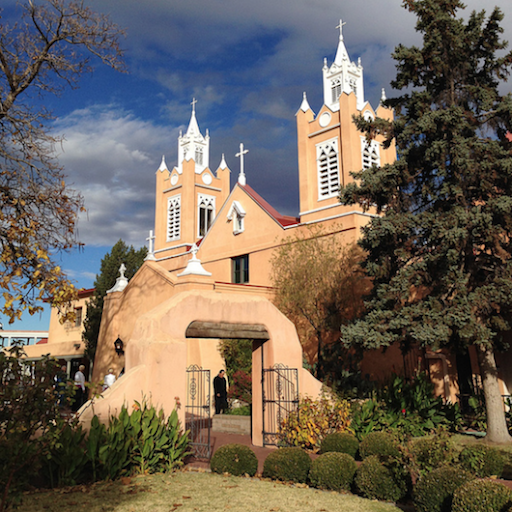
San felipe

A return to Her earliest times has been a recurring theme throughout the history of the Church, who periodically realizes that deviations have crept into Her life and in whom a desire wells up to regain Her initial purity, authenticity and simplicity. This does not have to mean a traditionalism or a denial of the Holy Spirit’s action in the present, and can instead be a push forward and the legitimate wish to embody Tertullian’s epithet of Christians: “See how they love one another,” which echoes Jesus’ own words: “This is how all will know that you are my disciples, if you have love for one another.” (John 13:35).

While I have always thought of the above as a parallel to what Kuhn refers to as paradigm shifts in the development of science, this last week has shown me that the Early Church is alive and well today too. The week spent with my überbestie PM, attending masses at the church of San Felipe de Neri in Old Town Albuquerque has been an experience of participating in the life of a Church, who is family and community and among whom Jesus walks today. I am careful not to call it a journey back in time, since this community was very much tuned into the present, and I’d say it was more like a journey into the future by the Early Church of the apostles and their followers instead.

What made the profound nature of this community come to the fore was a tragic event early last week, when one of the parishioners arrived before mass in great distress. From what I could gather it may have been her husband’s death or the loss of another loved one that made her suffer. What happened next moved me very deeply: One by one almost all the other parishioners approached her, embraced her, kissed and hugged her and exchanged a couple of words of consolation with her. Among the first was the wife of a married deacon, whom I saw read the Gospel the previous Sunday, who not only went to console the grieving parishioner, but who then proceeded to pass by several others – stroking their backs, greeting them, smiling at them. The deacon too approached her and made sure that the parish priest knew about the death and prayed for the deceased during the Eucharistic prayer.

The next day saw a similar scene, of the whole parish gathering around Her suffering member, enveloping her with warmth and love.

I felt a tremendous sense of intimacy among the parishioners, the kind of which I have never seen in a parish. Yet, there was no sense of exclusivity and I felt like a part of the family instead of the stranger who I objectively was.

To avoid giving the sense that the above is a rose-tinted, lyrical view of last week’s events, let me be clear: I did not think this parish was perfect. There was plenty to be critical of: some of the sermons, some of the readers’ theatrics, some of the off-key singing (including my own :), the esthetics of the church building and more besides.

None of that mattered though as this was as close to experiencing the Mystical Body of Christ as I ever have in a parish context. Being filled with an acute sense of the sacred is the dominant memory I’ll take away with me, as is the determination to strive towards building relationships like the ones I saw last week in Albuquerque in my own parish.

Death and resurrection

FrancisFerula3 zpsc3324b49

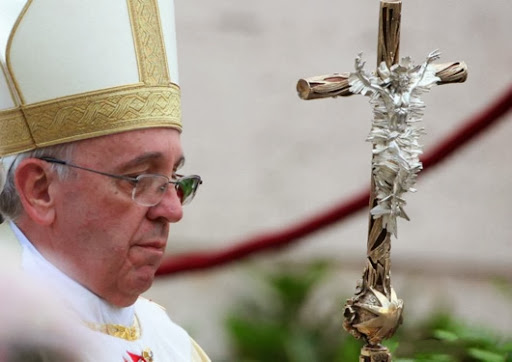
Imagine what the most offensive, sacrilegious and vile depiction of Jesus could be. Now look at the staff (a “ferula”) that Pope Francis holds in the above photo. Is that what you expected? I hope not, but if you googled “pope francis new ferula,” all you’d find is outrage, offence and adjectives like “misconceived,” “bizarre,” “ugly,” “offensive,” “nasty” and “profane.” Not only would these be outliers further down the search results, but it would be literally all you’d find – and I spent a couple of days trying to find anything positive at all about this new liturgical object used by Pope Francis.

So, why is it that this staff causes so much offense? If you abstract away the, sadly, harsh language of the reactions published so far, by sources who self-apply the “traditionalist” label, the root of the outrage is the depiction of the risen Christ instead of the crucified one. In most cases this is presented as being self-evidently an aberration, and one of the sources points to an encyclical by Pope Pius XII and quotes the following fragment:

““…one would be straying from the straight path … were he to order the crucifix so designed that the divine Redeemer’s body shows no trace of His cruel sufferings” (Pius XII, Encyclical Mediator Dei, par. 62).”

When I saw this, I immediately thought: “Great! Finally something specific and something that is likely to be usable against the new staff’s detractors.” As with most fanatics, their quoting of scriptures or other texts tends to be very selective and even just the immediate neighborhood of their snippets is likely to be their undoing. The same scenario applies here, if you look at the expanded quote below, still just staying within paragraph 62 and the opening sentence of paragraph 63 of Pius XII’s Mediator Dei:

“Assuredly it is a wise and most laudable thing to return in spirit and affection to the sources of the sacred liturgy. For research in this field of study, by tracing it back to its origins, contributes valuable assistance towards a more thorough and careful investigation of the significance of feast-days, and of the meaning of the texts and sacred ceremonies employed on their occasion. But it is neither wise nor laudable to reduce everything to antiquity by every possible device. Thus, to cite some instances, one would be straying from the straight path were he to wish the altar restored to its primitive tableform; were he to want black excluded as a color for the liturgical vestments; were he to forbid the use of sacred images and statues in Churches; were he to order the crucifix so designed that the divine Redeemer’s body shows no trace of His cruel sufferings […] Clearly no sincere Catholic can refuse to accept the formulation of Christian doctrine more recently elaborated and proclaimed as dogmas by the Church, under the inspiration and guidance of the Holy Spirit with abundant fruit for souls, because it pleases him to hark back to the old formulas.”

Before looking at the point about crucifixes that vexes Francis’ detractors, let’s just look at Pius XII’s categorical denunciation of traditionalism! The Holy Spirit is constantly active in the Church and more recent elaborations of teaching supersede older ones. By his own words, Pius XII is setting the scope of his own teaching to expire upon being superseded by that of his successors, so even if his words had been in conflict with Francis’ staff, Francis actions would take precedent and would do so by Pius XII’s own teaching.

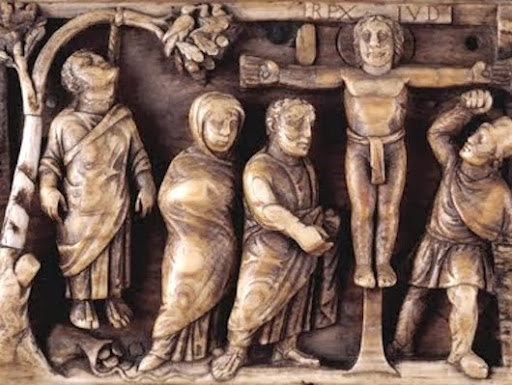
Now, let’s think about what Pius XII actually said about crucifixes, where he objects to them being “so designed that the divine Redeemer’s body shows no trace of His cruel sufferings.” Is he saying that the risen Christ mustn’t be depicted? Not at all. Only that the corpus shall show the traces of crucifixion torture, which early crucifixes did not show. Up until the early 5th century, only crosses and not crucifixes (i.e., crosses with a corpus) were used – and even those only sparsely. The next period then saw depictions of Jesus’ body on crosses, but in the form of unrealistic representations, like the following one, which is among the earliest ones:

Crucifixion earliest narrative rep ivory casket 420 30 rome brit museum

Here Jesus is upright, looking ahead, showing strength. What is Pius XII saying though? That our 5th century brothers and sisters were “straying from the straight path”? Certainly not! Only that if we imitated them in the misguided belief of the past having been a truer, purer, more genuine Christianity, we would be the ones straying and denying the Holy Spirit.

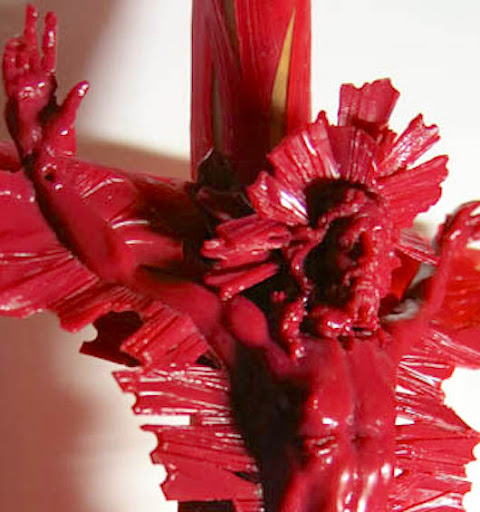
So, my reading of Pius XII is that we are to be open to the Holy Spirit now and that he underlined the importance of depicting the signs of the crucifixion horrors in crucifixes. Let’s now take a closer look at Francis’ new staff – the “crux gloriosa” and examine more closely the choices made by its author, the Roman sculptor Maurizio Lauri:

Papa francesco croce cimasa cera 3

From the above wax cast of the staff, it can clearly be seen that Jesus’ body bears the “trace[s] of His cruel sufferings” – his wrists are pierced,1 his side shows a swollen stab wound, his hands look mangled. This is not the Christus victor depiction of the first nine centuries, but instead a form that incorporates the “Christus mortuus” features whose importance Pius XII insisted upon too.

I believe the crucifix on Pope Francis’ new ferula displays a great degree of continuity with the last two millennia of depicting Jesus’ passion (incidentally, in a particular way with the San Damiano cross through which St. Francis heard Jesus speak to him). While clearly showing that Jesus’ execution on the cross was barbaric and crushing, it also depicts the inexorable link between this suffering, which Jesus underwent out of love, and the resurrection that followed it and that engenders mercy, hope and joy. Rather than in any way negating the monumental scale of Jesus’ suffering, the Lauri ferula projects it towards the resurrection that followed His excruciating death. It seems to me like Lauri was giving form to St. Paul saying: “we do see Jesus crowned with glory and honor because he suffered death” (Hebrews 2:9).

Finally, I have also been struck by the provenance of the materials used for making the Lauri ferula. The staff and crucifix atop it are made of mahogany, bronze and silver, where the metals were mined by Goldlake – an Italian company operating in Honduras and working to explicitly ethical standards, in partnership with local churches in both countries. During the presentation of the ferula to Franics, the CEO of Goldlake – Giuseppe Colaiacovo, explained: “Your holiness […] we would like to present you with this object, made from the materials of the earth, which therefore are poor materials, but which then become transformed by the artistic spirit.” Not only do I see a tremendously orthodox and historically grounded theology behind the form of the ferula, but its material provenance itself bears a positive message in itself.


1 A fact worthy of note by itself, since it is in agreement with recent research that shows how Jesus was nailed to the cross not by his palms, as is typical in depictions of the crucifixion, but by his wrists.

Divorced from reality

Simulacrum

[Warning: long read, again :)]1

Starting this post is turning out to be more difficult than I anticipated, so, please, forgive my meta-cop-out for its opening line. I have now deleted four alternative openings – all failed attempts at arriving at the question that has been occupying me during the last several weeks. In fact, as framing the question (which tends to be halfway to answering it anyway) is the problem, I’ll tell you about its history for me instead.

One of my very best friends, SH, has once asked me (during the course of about a year’s worth of the most fantastic, enlightening – at least for me – and profound conversations) whether he, an agnostic, ought to want to believe in God. My immediate intuition at the time – and a view I still hold – was: “No.” I felt that it would be insincere to make oneself want to believe (if such a thing were even possible) and I was instead convinced that my friend was already living a life that was following Jesus’ example and if he were to become a believer it would not be as a result of setting out to do so. Put in other terms, I was not worried about my fiend and in fact considered him to be an example to me in orthopraxy (even with his lack of orthodoxy). This is the first marker in the landscape I would like to sketch out for you – an agnostic who lives by the Gospel.

Next, I’d like to bring in another strand that leads to my central question today. For a long time now I have felt a keen sense that the Church (i.e., me included!) must be open to all, welcoming of all, transmitting what Pope Francis refers to as the “warming of hearts” that Jesus’ presence effects. As a consequence, I have been very pleased by the Church’s openness towards atheists and agnostics (e.g., see Franics’ letter to Scalfari), by Her fresh attempts at engaging with homosexual persons (e.g. in Francis’ interview with Jesuit magazines) and by Her apparent concern for all who today are at Her periphery, including divorced and re-married persons (e.g., see Francis’ impromptu interview during the flight back from the Rio World Youth Day). All of this is a great source of joy to me and its opposites, which sadly still exist in the Church, pain me.

The third strand that leads to what I would like to talk about today is the perennial tension in the Church between safeguarding Jesus’ original, explicit teaching and listening to the Holy Spirit’s ever-new guidance in every present moment. Being a Christian is not about taking a piece of 2000-year-old text and solitarily reading it as a self-help book. Instead, it is membership in a body that has Jesus as its head and a vast throng of individuals – both alive today and already past their earthly pilgrimage – as its members. Starting from the apostles themselves, who saw, touched and lived with Jesus, through their followers and their followers’ followers down to the present day, this body – animated by the Holy Spirit – is the Church through whom Jesus walks the Earth today. What Jesus’ message is in 2013, is to be found here – in the Church. This means both that it is alive and dynamic and that it is – simultaneously – the same, one message that Jesus shared with his followers 2000 years ago: love your neighbors as yourself and God above all else (cf. Mark 12:30-31), give your life for your friends (John 15:13), feed the hungry, quench their thirst, clothe the naked, welcome strangers, visit prisoners (cf. Mathew 25:35-36), be peacemakers, merciful, meek (cf. Matthew 5:3-12), be shrewd as serpents and innocent as doves (Matthew 10:16).

The fourth strand is another tension that is part of the very fabric of the Church: Her perfection set against the flaws and failings of Her members. Here it is neither my weakness that makes aiming high futile, nor the holiness of Jesus that makes Him inaccessible. Instead I can choose to allow God’s love into my life without deluding myself into taking credit for its effects or thinking of myself as superior in any way. Dr. Sylvie Barnay put this beautifully in the opening chapter of the book “La grande meretrice” (co-authored with 6 other female historians and looking at the history of the criticisms typically leveled at the Church):2

“The Church remains […] on a journey towards sanctity, a sinner by nature, with the potential for being made perfect by grace. She is therefore neither the Church of the pure, nor a prostitute Church. She is the human Church who hopes to become divine.”

The fifth strand then is a specific confluence of the above four and gets at the specific topic that triggered this post: the challenge of how a person who got married, divorced and then (civilly) re-married participates in the life of the Church. They are not free to receive the Eucharist in the Catholic Church, since they are in a state inconsistent with the indissolubility of marriage that Jesus himself taught explicitly and categorically. As such they don’t live according to, or share with the Church in terms of, an important aspect of what it means to follow Jesus. As a consequence they cannot participate in the sacrament that is both the expression of and means to the unity of the Church. This is a very painful situation for remarried divorcees who desire union with the Church in its most profound gift – the Eucharist – as it is for the whole Church, and Pope Francis has dedicated the first synod of bishops of his pontificate to it and the topic of the pastoral care of families in general.

Francis’ attention to the suffering of remarried divorcees has already lead to a lot of discussion and even to the misinterpretation of a German diocese’s contribution to this discussion as an actual permission for remarried divorcees to receive the Eucharist (immediately followed by the Vatican calling for patience ahead of the coming synod). A couple of days later, Archbishop Müller (head of the Congregation for the Doctrine of the Faith) published an extensive treatise on the subject in L’Osservatore Romano. The gist of the argument is a categorical “no” to the idea of remarried divorcees receiving the Eucharist, and not only that, but a systematic closing-down of a number of potential counter-arguments and loop-holes. Müller essentially says: marriage is indissoluble as Jesus himself told us so directly and unambiguously. As such, those who act as if the sacrament of marriage were dissoluble are objectively at odds with the Church and can not participate in the sacrament that “effects and signifies” Her unity.

At first I was quite puzzled by Müller’s piece (while simultaneously being hugely impressed by the beauty of the argument’s exposition and the clarity of his thinking!) – not because I disagreed with it, on the contrary, everything he says is (as befits his job) highly orthodox and I am in full agreement with him, but because it – prima facie – flies in the face of Francis’ consistent message on this subject.

As is often the case with at-first-sight appearances, there is typically more beneath the surface. As I read Müller’s arguments, I started realizing what he is doing – he is crystalizing what the sacrament of marriage is, exposing its rock-solid foundations and being categorical about its value and centrality to Jesus’ teaching. Between the lines I hear him insisting: “The sacrament of marriage is indissoluble. Don’t look for answers to warming the hearts of remarried divorcees here. Look elsewhere!” To come up with an innovative solution, which the next synod will be devoted to and on which I believe both him and Francis are already at work, it is first essential to ensure that we don’t throw out the baby with the bath water, that we don’t dilute Jesus’ teaching and the immeasurable treasures it contains.

In fact, reading Müller more closely also shows that he is very much concerned for remarried divorcees and for all at the Church’s periphery:

“Clearly, the care of remarried divorcees must not be reduced to the question of receiving the Eucharist. It involves a much more wide-ranging pastoral approach, which seeks to do justice to to the different situations. It is important to realize that there are other ways, apart from sacramental communion, of being in fellowship with God. One can draw close to God by turning to him in faith, hope and charity, in repentance and prayer. God can grant his closeness and his salvation to people on different paths, even if they find themselves in a contradictory life situation.”

Far from just slamming a door shut, Müller calls for a broader view of the situation, which is also in line with another of Pope Francis’ hints on the subject. In his interview on the flight from Rio he quoted his predecessor in Buenos Aires, Cardinal Quarracino, as saying: “I consider half of today’s marriages to be invalid because people get married without realising it means forever. They do it out of social convenience, etc …” In other words, the sacrament of marriage is indissoluble, but not all that looks like sacramental marriage is – or indeed ever was – sacramental marriage. In light of this angle, Müller’s demarcation of marriage and reinforcement of its absolute indissolubility make great sense, as part to a new approach to determining whether in a given instance marriage was ever entered into or not.

I have to say I feel greatly encouraged by all of the above developments and by other statements that Pope Francis has made recently, underlining the sacramental, vocational nature and profound value of marriage. In fact, speaking to a group of young people in Assisi about a month ago, he was very explicit: “[Marriage] is a true and authentic vocation, as are the priesthood and the religious life.” I wholeheartedly agree, but I also think that this statement points to an elephant in the room: if marriage is a vocation like the priesthood and religious life, how come there is such a vast gap between how one prepares for it versus the other vocations. Entering a religious order involves years spent in preparation, passing through various forms of novitiate, being followed by a spiritual director, with the outcome not being a guaranteed admission to the order. Preparation for the priesthood is equally lengthy, with years of study, practical and spiritual preparation and discernment being exercised both by the candidate and the Church’s hierarchy. Marriage instead can be had within a matter of weeks (months at most – if we include the challenges of booking the reception venue :|) and after attending a variable number of “preparation” sessions with a total duration in single digit hours. Yet, once the sacrament is enacted, it is binding for life! No surprise that great suffering can come from such a lopsided and inadequate process.

I clearly don’t mean to say that no couple properly prepares for the sacrament of marriage, since I know many who have, but only that if it does, it is so independently of the marriage preparation provided by the Church. Maybe it would be better for fewer marriages to be entered into and for these to be the result of a couple’s response to a call from God to follow Him as a family, instead of the easy access + heavy penalties model in place today. While writing this, I hear alarm bells in my head though, reminding me that it is imperative for the Church to be open and welcoming to all and the challenge remains of how to achieve such openness while following the path Jesus has shown us.


1 Many thanks to my überbestie, PM, for the great chats we have had about this and related topics.
2 The crude translation from Italian here is all mine, as the book is, sadly, not available in English.

Caricature Christianity

Catholic05

[Warning: long read :)]0

As I have said previously, I am a great fan of Dr. Yuval Noah Harari’s MOOC “A Brief History of Humankind,” which I have found not only entertaining and informative, but also thought-provoking and which I would wholeheartedly recommend to anyone. Dr. Harari’s style is engaging and masterful, the examples he uses are vivid (e.g., “The human race is no more than a herd of sheep that ended up with tanks and atomic bombs because of an evolutionary accident.”), his presenting alternative theories throughout the course is greatly illuminating and enriching and his use of the concept of “fiction” is a powerful didactic device that draws attention to the mental/material categories in a novel and forceful way.

Had I been writing this post before the course’s tenth lecture, it would have been 99% panegyric (with the 1% criticism reserved for the presentation of the sex/gender distinction not as fiction, given how that term is used throughout the course). Without taking away from the excellence of the first 9 lectures, I do have serious misgivings about the tenth, entitled “The Law of Religion,” where I consider Dr. Harari’s presentation of Christianity to be a caricature instead of an attempt at synthesis and summary. What makes this the more disappointing is that he is clearly a highly intelligent and learned person, very capable of speaking about religion in an informative and balanced way, as he demonstrated with the excellent exposition of Buddhism in Segment 3 of the lecture.

Even though I was not going to write about my experience of Lecture 10, I have changed my mind after being encouraged to do so by my überbestie JMGR – so you can consider this to be both a “work made for hire” and an attempt to present my grounds for calling it a caricature in more than the 140 characters of a tweet. Before delving into the details, I’d also like to say that the following will be my attempt to present what I, as a Christian, believe and that its justification by reference to established Christian doctrine will be omitted (each of the following points meriting long blog posts individually). The format I’ll use is to go through a number of claims that Dr. Harari makes about Christianity, each immediately followed by my own account. Here I will not be exhaustive (and hopefully not exhausting either), e.g., glossing over the treatment of Christian persecution by the Roman Empire, and try to focus on the most substantial claims.1

First, Dr. Harari claims that Christians believe “that you could make deals with the supreme power of the universe in order to recover from illness, to win the lottery, or to gain victory in war.” This, to my mind is a caricature of prayer, which is presented as a bargaining process: I’ll say these prayers, do some penance, go to mass, etc. and in exchange god will grant me a wish. This is nothing like what my relationship with God, or prayer are for me. I believe God loves me and has a plan for me that starts in every present moment. Prayer is the maintaining of a relationship with God, both by listening and being disposed to discerning his plan and by speaking and sharing my joys, worries and needs with him. Such sharing is not the demanding of an overriding of the Laws of Nature, but instead a silent conversation, an opening up, a turning towards. It also brings with it what Dr. Harari presented so well about Buddhism – an acceptance of both joys and sorrows, of successes and defeats, all of which are received in the context of the above prayer, which – together with a seeking of God in all around me – is the basis of my being Christian.

Second, Dr. Harari presents Christianity as incapable of coexisting with other religions:

“A religion that recognizes the legitimacy of other faiths implies either that its god is not the supreme power of the universe, or that it received from the one and only god only part of the universal truth. […] Monotheists could not live with these ideas. Monotheists usually believed that they are in possession of the entire message of the one and only god. They were compelled to discredit all other religions. If our religion is true, no other religion can also simultaneously be true.”

This, to my mind, is fundamentally a caricature of the concept of God itself and of epistemology too. It first assumes that God is wholly knowable, then that Christians believe they fully know such a fully knowable God and finally that they know that they have such full knowledge. I dispute all three assumptions. Not only is knowledge fundamentally incomplete, indirect and limited even when it comes to my self, let alone to another or a world around me, or to a God whom I believe to be both more immanent and transcendent than anything else. Every single person, their experiences, insights and beliefs are of interest to me and an opportunity to look for the traces of God’s presence. At the same time it does not mean that I believe Christianity to be incomplete, on the contrary, or that I, conversely, have to believe it to have exclusive access to the Truth and to God.

Third, Dr. Harari presents Chirstian saints as being connatural with the gods of polytheism:

“Homo sapiens tend to divide the world into we and them and sapiens want to be in contact with powerful entities that will help us against them. So the idea that there is only one supreme power in the world that cares about everybody equally this was very difficult even for Christians […] to fully adopt and understand. Consequently Christianity […] created an entire new pantheon of saints and people simply began to worship [… them] just as previously they worshipped all kinds of different gods. […] So when England and France […] go to war […] it is believed that Saint Martin helps the French and Saint George helps the English – just like the old gods.”

The irony here that it is precisely the saints who are a strong argument in support of the belief that God “cares about everybody equally.” To me the saints are my fellow Christians, who have lived lives that mirror Jesus’ own life to a particularly high degree and who are therefore examples for me to follow. Not only does the vast variety of backgrounds from which they come (social, ethnic, educational and cultural) support the claim for the universality of God’s call, but their own care and love for their neighbors does too. Since I believe that these saints are now alive in the immediate presence of God, having a relationship with them through prayer is logically consistent with the relationship I have with God himself.

Fourth, Dr. Harari presents the “problem of evil” as follows:

“The problem of evil […] asks why is there evil in the world, why is there so much suffering in the world, why do so many bad things happen even to good people. […] For monotheists the problem of evil is extremely difficult. Monotheists have to perform all kinds of amazing intellectual acrobatic tricks to explain how an all-knowing, all-powerful and perfectly good god allows so much suffering in the world. […] One answer that monotheists try to give is: “This is god’s way of allowing for human free will. If there was no evil in the world, humans could not choose between good and evil and hence there would be no free will.” This is one of these intellectual tricks that monotheists use to answer the problem of evil.”

Again, this strikes me as a caricature: there is a glaring problem with Christianity, so Christians come up with shaky stories to fool themselves. My objection here is not that the “problem of evil” is a challenge, but that presenting it as something that Christians deal with via self-delusion is a caricature. There is no satisfactory explanation for the “problem of evil” – all that I, as a Christian have are some intuitions. Of these, the argument from freedom is a strong one and I fail to see how it can be categorized as a “trick.” It still does not explain why there is evil and suffering in the world though, but only how freedom and the necessity of real choice are linked. Why could God not have done it in a different way is a valid question though! Another, strong intuition to me as a Christian is Jesus’ own life, where the acceptance of suffering – a suffering by a supremely innocent person who was scared of it – plays a pivotal role. All I can say about suffering is that it is linked to the freedom that lets me establish genuine relationships with my fellow humans and with God, that Jesus having endured it also points to its importance, but I can certainly not claim to be in a position to explain or justify it.

Fifth, to sum up his position with regard to Christianity, Dr. Harari has the following to say:

“Monotheism is a kind of mishmash, a kind of bringing together all kinds of monotheist, dualist, polytheist and animist legacies, constantly influencing and changing each other, all coexisting with each other under one big divine umbrella. The average Christian believes in the monotheistic god, but also believes in the dualist devil, in the polytheist saints, and in the animist ghosts and demons.”

Eh … no … I believe in no ghosts or demons, the saints are my brothers and sisters – not gods, and the devil is no equivalent “opposing power” to God (as would follow from Dr. Harari’s dualist definition) but simply the personification of a turning away from God while possessing full knowledge of His being God.

And breathe … 🙂

Needless to say, I am happy to provide references for how what I have said about my own beliefs above is official Catholic teaching and how it is consonant with the beliefs of Christians also from past centuries. At the same time I am not claiming that no Christian has ever held some or all of the beliefs that Dr. Harari, to my mind mistakenly, presents as being universally and fundamentally Christian – certainly they have: in the same way in which some have used microwaves to mistreat cats, without thereby rendering microwaves primarily instruments of cat torture …


0 Many thanks to my überbestie PM for his nihil obstat. 🙂
1 I am skipping the part about heaven and hell only because its exposition is factually holey (not holy :)), where to Dr. Harari’s statement: “There is no trace of [heaven and hell] in the Old Testament” I only have three words to say: Daniel 12:2 … Seriously though, there would be things to say about his claim that such beliefs are dualistic, but their refutal would take us too far off-track and I’ll leave them for another time.

Athena and/or Jesus?

Athena

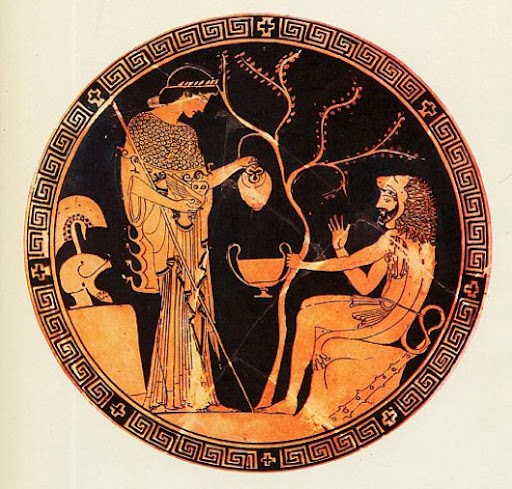
The other day I watched a greatly edifying and enjoyable video of Eugenio Scalfari and Cardinal Gianfranco Ravasi having a chat about a variety of topics in the context of the Courtyard of the Gentiles initiative launched by Pope Benedict XVI – a forum for dialogue between catholics and non-believers. What struck me in particular was a train of thought triggered by Scalfari commenting on Ravasi quoting him as having said that he was “in love” with Jesus. To this Scalfari responds:1

“Maybe it is an exaggerated phrase, but it is true. I have been following the life and preaching of Jesus ever since I was a kid, since I abandoned the faith. I grew up in a Catholic family […] but then I met Athena, together with Italo Calvino, with whom I shared a desk for three years at school …”

This follows the pattern I have seen so many times among my friends: I grew up a Catholic (or member of another church), but then I realized that belief in God was not reasonable and I became an atheist or agnostic. Scalfari tells the same story: upon encountering Athena (the Greek goddess of wisdom) his religious beliefs crumbled. Faced with a choice between faith and reason, he opted for the latter and while he still admires Jesus, he does so without any accompanying – irrational or at least arational – religious beliefs.

I particularly liked the posing of the above process with rationality personified by Athena, as it gave it a symmetry that less poetic accounts lack, and I was looking forward to Ravasi’s response, as this was a statement that he was sure to react to:

“[You tell the story of how you] made the choice of Athena, in a certain sense abandoning the choice of Christ in that moment at least. I think though that this choice, these two choices are not necessary and divisive, that they would split a person. Because I am firmly convinced, I personally, that, even though I have made the choice of Christ, I have not renounced my choice of Athena. Athena, reason, has always interested me.”

Ravasi then – very compellingly – proceeds to expand on Pope Francis’s speaking about the Truth in relational terms in his letter to Scalfari, and then shares the following, personal reflection:

“I, for myself, can’t say that I have the Truth, that I have God. I, every day, have to return – and in some moments it is likely that I drift into a territory where the heavens seem devoid of divinity … [pause] Precisely because there is this dimension of the subject [pointing at himself], that is limited and that walks in a reality that exceeds me. This is why I believe that the element of seeking, searching is fundamental.”

I believe Ravasi is absolutely spot-on here – faith is not an alternative to reason, but a position that requires reason for the sake of remaining authentic. Ravasi presents his relationship with God as a dynamic, persistent search for the infinite, transcendent-immanent by a limited and finite self contained by it. This is no rejection of reason, blind adherence to tradition or irrational ignorance of evidence that are often the objections leveled at faith, but a sincere, dynamic relationship with God, as experienced through the limited, fallible, imperfect consciousness of a human person.

Having focused on Ravasi – whose fan I admit I am, I would also like to express my admiration for Scalfari, who comes across as a highly intelligent, sincere and compassionate person and whose atheism I don’t in any way find issue with. If anything, the fact that shines through their conversation is that both are open and honest about their own understanding of reality and that both value the other’s thoughts and find inspiration in them.

To conclude, I’d like to share my motivation for this post, which was my überbestie, PM’s saying that he didn’t get why I keep talking about faith and reason as being opposed, when in fact they are not. This certainly made me stop, since I completely agree with him, and I in fact proceeded to read up on more formal treatments of rationality, reason and faith, with the desire to get to some low-level mixup that would explain the mistaken perception of this fictitious opposition. I very quickly realized though (how could I not have seen that straight-away?!) that such efforts lead me down the well-trodden, lengthy and criss-crossing paths of epistemology and ontology, for whose considerations the terms “reason” and “rational” were a lax shorthand. Not wanting to attempt a synthesis of a vast field of investigation here, I’d just like to argue again that faith and reason are not opposed – they are both means for making sense of our conscious experiences in ways which I (and the Catholic Church) believe to be complementary and fundamentally incapable of contradicting each other in their perfect instantiations.

Seeing the sincere experiences of Scalfari and many of my friends, who arrive at a different conclusion – i.e., of faith being opposed to reason – instead leads me to an examination of conscience. Why is it that the Church and I fail to present the inherent compatibility of faith and reason compellingly enough? Has too much baggage accumulated over the centuries? Have ulterior motives obscured the profound purity and rationality of Christian faith, motivated by insecurity and lack of trust in God’s love? Maybe the answer lies in personal dialogue though, instead of an attempt to address the question via some new systematic exposition. And Pope Francis’ clear, blunt and razor-sharp directness will help too, of that I am sure …


1 This is around 21:50 in the video (in Italian) and Ravasi’s reaction around 43:00.

The tyranny of absolutism

Stalin

Walking home this evening I felt like Douglas Hofstadter may have felt when coming up with the central idea of his spectacular Gödel, Escher, Bach book. Unlike his realization about a “golden braid” linking the thoughts of Kurt Gödel, M. C. Escher and Johann Sebastian Bach, which all shed light on infinity, I felt like I saw a way to connect the seemingly opposed words of Popes Benedict XVI and Francis with regard to relativism.

Benedict XVI famously attacked relativism in his sermon during the opening mass of the conclave that elected him, saying:

“To have a clear faith, according to the creed of the Church, is often labeled as fundamentalism. While relativism, that is, allowing oneself to be carried about with every wind of “doctrine,” seems to be the only attitude that is fashionable. A dictatorship of relativism is being constituted that recognizes nothing as absolute and which only leaves the “I” and its whims as the ultimate measure.”

The message here is very clear – the arbiter of truth and falsehood as well as good and evil has become the individual, with no intrinsic meaning left for these concepts beyond what each person chooses to invest them with for themselves. It is not only a relativity of meaning but also a solitude – I have my truth and you yours and that is the end of the story. In his book-length interview with Benedict XVI (“Light Of The World”), Peter Seewald, gets Benedict to elaborate on the above idea, when he says:

“It is obvious that the concept of truth has become suspect. Of course it is correct that it has been much abused. Intolerance and cruelty have occurred in the name of truth. To that extent people are afraid when someone says, “This is the truth”, or even “I have the truth.” We never have it; at best it has us. No one will dispute that one must be careful and cautious in claiming the truth. But simply to dismiss it as unattainable is really destructive.

A large proportion of contemporary philosophies, in fact, consist of saying that man is not capable of truth. But viewed in that way, man would not be capable of ethical values, either. Then he would have no standards. Then he would only have to consider how he arranged things reasonably for himself, and then at any rate the opinion of the majority would be the only criterion that counted. History, however, has sufficiently demonstrated how destructive majorities can be, for instance, in systems such as Nazism and Marxism, all of which also stood against truth in particular.

[…] That is why we must have the courage to dare to say: Yes, man must seek the truth; he is capable of truth. It goes without saying that truth requires criteria for verification and falsification. It must always be accompanied by tolerance, also. But then truth also points out to us those constant values which have made mankind great. That is why the humility to recognize the truth and to accept it as a standard has to be relearned and practiced again.”

Essentially, Benedict says that just because we cannot possess the truth, it does not mean that “the” truth does not exist. Our access to it is imperfect and tolerance and caution are called for, but denying its existence (just because of our epistemological constraints) is a dangerous path to follow. The picture from the above is very clear – relativism (making one’s “I” the ultimate arbiter of truth) is a tyranny and a reliance of one’s self is dangerous.

Fast-forward to this morning’s interview1 with Pope Francis talking to Eugenio Scalfari and take a look at what he has to say on the subject:

“Scalfari: Your Holiness, is there is a single vision of the Good? And who determines it?

Francis: Each of us has their own vision of Good and also of Evil. We have to encourage him to proceed towards that which he thinks is Good.

Scalfari: Your Holiness, you have already written it in the letter you addressed to me. Conscience is autonomous, you said, and everyone must obey their own conscience. I think that’s one of the most courageous passages spoken by a Pope.

Francis: And I repeat it here. Each one has their own idea of Good and of Evil and must choose to follow Good and fight Evil as they understand them. This would suffice to make the world a better place.”

“Each one has their own idea of Good and Evil […] as they understand them.” But, this sounds precisely like the relativism (the “I” being arbiter of truth) that Benedict denounced and declared a destructive danger. Are Francis and Benedict disagreeing here? Is Francis changing Church teaching?

I don’t think so. Instead, I believe, that their apparent opposition flows from the different perspectives from which they speak about truth and good and evil. Benedict describes what you’d see from God’s perspective: truth is absolute and denying its existence and substituting one’s whims for it, just because humans can’t access it, is a mistake. Francis, instead looks at the picture from the perspective of the individual: trust your conscience’s discernment between good and evil and choose good. Each human has a conscience by means of which they can discern (to varying degrees of faithfulness – “At present we see indistinctly, as in a mirror” as St. Paul says in 1 Corinthians 13:12) a reflection of the absolute truth. It is the same landscape, but Benedict looks down from the mountaintop while Francis looks up from the valley.

Applying this to myself, I can simultaneously believe in absolute truth and goodness, while being aware of my own inability to grasp them fully (or even with a known level of (in)accuracy). This epistemic constraint in no way undoes the meaningfulness of pursuing goodness and truth and instead makes tolerance and dialogue necessary. It also means that – as Francis said in the same interview – “Proselytism is pompous foolishness that has no sense. We must get to know each other and listen to each other and grow our understanding of the world around us.” I believe we are all accessing fragments of the one Truth,2 which makes me want to know what you have understood as much as deepening my understanding of my own faith.


1 The English translation sadly has some serious issues at the time of this post’s writing (the tile itself being seriously mistranslated), as a result of which I started from it but made adjustments based on reading the Italian original.
2 This is consonant with Francis saying, still in this same interview that “I believe in God. Not a Catholic God, there is no Catholic God, there is God.”

Just war?

Ploughshares

[Warning: long read :)]

Jesus was a pacifist. To deny this in the face of his own words – “But I say to you, whoever is angry with his brother will be liable to judgment.” (Matthew 5:22), “But I say to you, love your enemies, and pray for those who persecute you.” (Matthew 5:44), “But I say to you, offer no resistance to one who is evil. When someone strikes you on (your) right cheek, turn the other one to him as well.” (Matthew 5:39) and “Put your sword back into its sheath, for all who take the sword will perish by the sword.” (Matthew 26:52) – would be sheer dishonesty.

How about the Church though, has it stuck to Jesus’ pacifist position? Let’s see what it says in the Catechism:

“(§2304) Respect for and development of human life require peace. Peace is not merely the absence of war, and it is not limited to maintaining a balance of powers between adversaries. Peace cannot be attained on earth without safeguarding the goods of persons, free communication among men, respect for the dignity of persons and peoples, and the assiduous practice of fraternity.

(§2307) The fifth commandment forbids the intentional destruction of human life. Because of the evils and injustices that accompany all war, the Church insistently urges everyone to prayer and to action so that the divine Goodness may free us from the ancient bondage of war.

(§2308) All citizens and all governments are obliged to work for the avoidance of war. However, “as long as the danger of war persists and there is no international authority with the necessary competence and power, governments cannot be denied the right of lawful self-defense, once all peace efforts have failed.” (Gaudium et Spes, 79 § 4)

(§2309) The strict conditions for legitimate defense by military force require rigorous consideration. The gravity of such a decision makes it subject to rigorous conditions of moral legitimacy. At one and the same time:

  • the damage inflicted by the aggressor on the nation or community of nations must be lasting, grave, and certain;
  • all other means of putting an end to it must have been shown to be impractical or ineffective;
  • there must be serious prospects of success;
  • the use of arms must not produce evils and disorders graver than the evil to be eliminated.

The power of modern means of destruction weighs very heavily in evaluating this condition. These are the traditional elements enumerated in what is called the “just war” doctrine. The evaluation of these conditions for moral legitimacy belongs to the prudential judgment of those who have responsibility for the common good.

(§2314) “Every act of war directed to the indiscriminate destruction of whole cities or vast areas with their inhabitants is a crime against God and man, which merits firm and unequivocal condemnation.” (Gaudium et Spes, 80 § 3)”

While the above does talk about circumstances under which war is justified, it is a last resort, acceptable under the simultaneous satisfaction of specific conditions listed above, and has self-defense as its purpose, with indiscriminate destruction and the devastating effects of modern means of warfare ringing alarm bells. During the progress of such self-defense (the only possible trigger for just military action), the Catechism further emphasizes that “The Church and human reason both assert the permanent validity of the moral law during armed conflict. “The mere fact that war has regrettably broken out does not mean that everything becomes licit between the warring parties.” (Gaudium et Spes, 79 § 4)” and proceeds to warn against the abuses so endemic in war and against the accumulation of arms. Finally, the Catechism draws attention to the root causes, of which war can be a symptom, and calls for their treatment:

“(§2317) Injustice, excessive economic or social inequalities, envy, distrust, and pride raging among men and nations constantly threaten peace and cause wars. Everything done to overcome these disorders contributes to building up peace and avoiding war.”

And Pope Francis, where does he stand? There can be no doubt here that he, like Jesus, is an absolute pacifist:

“War is madness. It is the suicide of humanity. It is an act of faith in money, which for the powerful of the earth is more important than the human being. For behind a war there are always sins. [… War] is the suicide of humanity, because it kills the heart, it kills precisely that which is the message of the Lord: it kills love! Because war comes from hatred, from envy, from desire for power, and – we’ve seen it many times – it comes from that hunger for more power.” (Homily at Domus Sanctae Marthae, 2 June 2013).

“We have perfected our weapons, our conscience has fallen asleep, and we have sharpened our ideas to justify ourselves. As if it were normal, we continue to sow destruction, pain, death! Violence and war lead only to death, they speak of death! Violence and war are the language of death! […]

My Christian faith urges me to look to the Cross. How I wish that all men and women of good will would look to the Cross if only for a moment! There, we can see God’s reply: violence is not answered with violence, death is not answered with the language of death. In the silence of the Cross, the uproar of weapons ceases and the language of reconciliation, forgiveness, dialogue, and peace is spoken. […]

violence and war are never the way to peace! Let everyone be moved to look into the depths of his or her conscience and listen to that word which says: Leave behind the self-interest that hardens your heart, overcome the indifference that makes your heart insensitive towards others, conquer your deadly reasoning, and open yourself to dialogue and reconciliation. Look upon your brother’s sorrow and do not add to it, stay your hand, rebuild the harmony that has been shattered; and all this achieved not by conflict but by encounter! […]

Let the words of Pope Paul VI resound again: “No more one against the other, no more, never! … war never again, never again war!” (Address to the United Nations, 1965).” (Prayer Vigil for Peace, 7 September 2013)

And Francis is not alone is his radical stance against war, Blessed Pope John Paul II said that “War should belong to the tragic past, to history: it should find no place on humanity’s agenda for the future” and that “Humanity should question itself, once more, about the absurd and always unfair phenomenon of war, on whose stage of death and pain only remain standing the negotiating table that could and should have prevented it.” Benedict XVI too was clear about war being a failure: “War, with its aftermath of bereavement and destruction, has always been deemed a disaster in opposition to the plan of God, who created all things for existence and particularly wants to make the human race one family.”

So, you may ask, what is the point of writing about the attitude of Jesus, the Church and recent popes with regard to war, when it is so obviously pacifist and admitting of military self-defense only under almost theoretical, extreme conditions and applying to specific parts of an armed conflict? Sadly there are other, vocal proponents of a very different take on this topic, who – to my mind unbelievably – present their positions as Catholic and who tend to trace them to statements like the following one by George Weigel, who feels supported by Sts. Augustine and Thomas Aquinas:

“Thus those scholars, activists, and religious leaders who claim that the just war tradition “begins” with a “presumption against war” or a “presumption against violence” are quite simply mistaken. It does not begin there, and it never did begin there. To suggest otherwise is not merely a matter of misreading intellectual history (although it is surely that). To suggest that the just war tradition begins with a “presumption against violence” inverts the structure of moral analysis in ways that inevitably lead to dubious moral judgments and distorted perceptions of political reality.”

With Jesus and the Church’s position having been stated with such force and clarity over the last decades, I won’t even go to the trouble of addressing positions like Weigel’s point-by-point and would just like to note that they are akin to reading St. Paul and arguing in favor of slavery today. Positions that may be textually consistent with the source they claim justifies them, but that both miss the original author’s intentions (just think about what slavery would be like if “master” and “slave” followed St. Paul’s advice1) and the fact that the Church is the living Mystical Body of Jesus that has considerably matured over the last 2000 years.


1 “Slaves, be obedient to your human masters with fear and trembling, in sincerity of heart, as to Christ, not only when being watched, as currying favor, but as slaves of Christ, doing the will of God from the heart, willingly serving the Lord and not human beings, knowing that each will be requited from the Lord for whatever good he does, whether he is slave or free. Masters, act in the same way toward them, and stop bullying, knowing that both they and you have a Master in heaven and that with him there is no partiality.” (Ephesians 6:5-9) A classic “infiltrate and destroy from within” tactic if ever I saw one.

Bátyóka

20101220 Voskereweni Vladimir

In Hungarian there are separate words for older versus younger brother or sister and only a word for sibling and the – from a Hungarian perspective – generic “brother” and “sister” are rarely used. There are also words for up to the eleventh ancestors and tenth descendants and such granularity is something I haven’t seen in other languages. A further quirk of Hungarian is the application of “aunt” and “uncle” to senior acquaintances who are not blood-relations and the use of “my son” with reference to any person for whom one cares – I was always struck by the tenderness with which my grandad lovingly addressed my grandmother in this way. And finally, there is the generous use of diminutive suffixes, sometimes of multiple levels, expressing affection – e.g., “apa” – father, “apuka” – daddy, “apucika” – little daddy. All of these features of granularity and attribution of universality to intra-familiar relationships in the Hungarian language, I believe, underline their importance already by virtue of how one speaks about them. Universal brotherhood and specificity of relating to an individual person are hardwired and latent even before one opens one’s mouth or formulates a thought.

As a result of the above, a single word – “bátyóka” (“little older brother”) – suffices to express great love and affection, and my uncle, who completed his earthly pilgrimage yesterday evening, was universally known not only as “bátyóka” but as “Bátyóka.” Being the older brother who is considered with great love and warmth has become his name and all of us in our large, extended family only ever referred to him as such.

Bátyóka has lived a heroic life during tumultuous periods of the 20th century and has been the beloved elder brother not only to his biological family, but also to the countless people he served, guided and protected as a priest during decades of absurd oppression by a criminal Communist regime. His parishes always seemed to me, as a child, like oases and even at a young age it was crystal-clear to me that the way his parishioners related to him was by a bond of love rather than obedience or respect.

Meeting Bátyóka, you’d never have guessed that he had a doctorate in theology from Rome, as it would be his kindness and genuine interest for you as an individual that would strike you immediately. If the conversation turned to topics of faith or reason, his sharp intellect and vast knowledge would almost surprise you, as it wouldn’t have been him to steer the conversation in their direction.

Others could tell you much more about Bátyóka’s life, but all you’d learn from it are the details of the following fact: he was a follower of Jesus par excellence. This I knew from a very early age and continued experiencing on every occasion of meeting him since.

As I write this, on the day after Bátyóka completed his earthly life, I have tears in my eyes. They are not tears for Bátyóka though, who is now united even more closely with Jesus, the love of his life, and more than ever alive and closer to me as a member of Jesus’ Mystical Body, but for me, as I will miss seeing him, laughing at his incessant stream of jokes, being struck by the wisdom he so liberally shared with all and having him around as my “little older brother.”