Conscience, dissent and the ex-excommunicated saints

Image pierre teilhard de chardin pere teilhard jesuite scientifique jesuit scientist point omega noosphere le phenomene humain the human phenomenon parapluie galactique galactic umbrell1

… walk into a bar. I wish I could turn that into a joke, but it happens to be deadly serious. Anyone even remotely following the life of the Church must be acutely aware of the multitude of dissenting groups both in and outside it. The spectrum ranges from the Austrian priests via the US nuns all the way to the Society of St. Pius X (who were largely responsible for the attacks on Archbishop Müller’s words on the Eucharist and Mary’s virginity that I discussed before). While it would be interesting to engage in their arguments, here I would instead like to look at the bigger picture: conscience.

What the Church teaches about conscience is, to my mind, key not only to seeking God’s will but applicable to all – believers and non-believers alike – as a basis for an honest and conscious life. Let’s start with how the Catechism introduces the topic (and forgive me for keeping this brief – it is a section that I am very fond of and would love to expand on in the future):

“Deep within his conscience man discovers a law which he has not laid upon himself but which he must obey. Its voice, ever calling him to love and to do what is good and to avoid evil, sounds in his heart at the right moment…. For man has in his heart a law inscribed by God…. His conscience is man’s most secret core and his sanctuary. There he is alone with God whose voice echoes in his depths.” (Catechism of the Catholic Church, §1776)

I read this as saying that we have in us a sense of right and wrong that is not self–imposed and that Christians believe to come from God. While agnostics/atheists would hold other views on its origin, the key here is that I don’t choose what I myself consider right or wrong.

Next, the Catechism exhorts us to self–examination and reflection – very much in the tradition of philosophers ever since Socrates:

It is important for every person to be sufficiently present to himself in order to hear and follow the voice of his conscience. This requirement of interiority is all the more necessary as life often distracts us from any reflection, self-examination or introspection (CCC, §1779)

Finally, after providing numerous ways to inform one’s conscience, listing a couple of rules (never do evil so that good may result from it, the golden rule, respecting one’s neighbor) and elaborating on the fact that one’s conscience can be erroneous, the Catechism categorically states:

A human being must always obey the certain judgment of his conscience. If he were deliberately to act against it, he would condemn himself. (CCC, §1790)

In other words, if, after having scrutinized and examined your own conscience you get to a conclusion you are certain of, the Church teaches you to follow it no matter what. The conclusion you arrive at may be erroneous in the Church’s eyes and you may be admonished, gagged and even punished for your views, but under no circumstances are you to act against what your conscience, with the help of your reason (CCC, §1786), arrives at as being certain.

Seen from the perspective of an individual this is quite tricky, when their conscience leads them into conflict with the Church’s teaching. Imagine you arrive at a judgment that you are certain of but that is contrary to what the Church says. Are you to disregard your own conscience and fall into line, or are you to dissent? The Catechism warns against the former, but you may incur penalties for the latter, which would give you every right to say: ‘Hey, but you told me to follow my conscience! What gives?!’ This is how many who today are voicing their opinions must feel and I can see how that would be very frustrating.

If we look at this picture from the perspective of the whole Church and over its history, another aspect emerges though, which is that dissent, which may at first be punished, can end up being rewarded later. Often the changes that take place in the Church’s teachings are prefigured in its saints, who – being faithful to their consciences and committed to listening to God’s voice – often have to pay a heavy price for sticking their necks out when most others in the Church have not yet caught on to a new impulse from the Holy Spirit. In fact, suspicion on the part of Church authorities is a pretty constant feature of the lives of the saints (e.g., St. Ignatius of Loyola being questioned by the Inquisition three times, St. John of the Cross being imprisoned by his fellow Carmelites and many others), which brings me to the most severe form of punishment at the Church’s disposal: excommunication.

Excommunication is the severest penalty the Church can impose and results in the excommunicated member being deprived from participating in the life of the Church. It ought to be used as a ‘medicinal’ penalty, meant to correct rather than punish or make satisfaction for the wrong done. Those who have over the centuries proclaimed heresies or lead to schisms in the Church have been excommunicated, but the list also includes a number of saints – in other words, people whom the Church holds up as examples of how to follow the teachings of Jesus and his Church. These saints, who at some point of their lives were excommunicated (and whose excommunications were later either declared invalid or lifted) include St. Joan of Arc (for insubordination to a bishop – declared invalid), St. Mary MacKillop (for reporting a paedofile priest and insisting he be removed – declared invalid), St. Hippolytus (the first antipope, excommunicated, but later reconciled with the pope’s successor who lifted the excommunication – incidentally all three: the two popes and Hippolytus are saints), whose feast day is tomorrow, and finally St. Athanasius, now revered as the ‘Father of Orthodoxy’ (excommunicated by a pope influenced by the Arian heresy but exonerated by his successor).

Maybe the picture emerging here is one of it being just fine to ignore Church teaching and to just go with whatever comes into one’s head. This is not where I am going at all. There is a clear tension between faithfulness to Church teaching and fidelity to one’s own conscience, where – for an individual – the latter wins in the end. However, let us not side-step the elephant in the room: certainty! If you look back at the Catechism’s teaching, it says that ‘a human being must always obey the certain judgment of his conscience’ [emphasis mine] – not just a hunch or even an conclusion that is gathering support or one that has good statistical chances, but certainty! And, in the process of reflecting and analyzing one’s judgment, Catholics are called to take Church teaching and a host of other factors into account. Only after having undergone a rigorous and well informed process and only if this process has lead them to interior certainty are they commanded to follow their own conscience over Church teaching. This is pretty strong stuff and certainly sorts out the wheat from the chaff. In fact, if you look at the vast majority of saints who have come under suspicion in the Church’s eyes, the way they responded to them – with humility, but with determination – was in many cases a contributor to those suspicions having been dissolved.

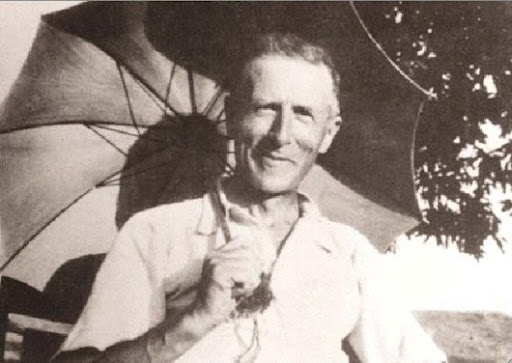
To conclude, let me just point to an example that to me shines most brightly – that of Fr. Pierre Teilhard de Chardin, the French Jesuit, philosopher, paleontologist and geologist, who was one of the most radical and creative thinkers of recent centuries. His ideas (on which more at a later date) are to this day viewed with suspicion by the Church and carry a warning about being ‘offensive to Catholic doctrine’ (although Pope Benedict XVI recently referred to them favorably). The most impressive thing to me about Teilhard de Chardin though is his humility and obedience. When asked by the Church to cease his writings and teachings, he and the Jesuit order complied. This, to my mind was a tremendously selfless act and one that also demonstrated Teilhard de Chardin’s priorities: obedience and poverty before fame and glory. I believe his insights will one day be exonerated and become part of Catholic patrimony.
St. Clare’s treasure

Clare

Tomorrow is the feast day of St. Clare of Assisi – one of my all-time favorite saints. There is a lot to learn from looking at her life, but the thing that stands out to me is what she said on the night when she left the riches of her family and followed St. Francis’ example. While this event is glossed over in most of her biographies with something like: “On that very night she ran away to go follow Francis. When she got there he cut her hair and dressed her in a black tunic and a thick black veil.”

What an account like that makes me wonder about straight-away is what was said by Francis and Clare on such a sacred occasion. It seems highly unlikely that an event like this would have taken place without something precious also being put into words. As it happens, we do get a first glimpse in the account shared by Prof. Corrêa de Oliveira, the prominent Brazilian politician and intellectual, who describes it as follows: “Francis asked her what she wanted, and she answered: ‘I want the God of the Manger and of Calvary. I desire no other treasure or inheritance.’”

This lets us intuit what was on Clare’s mind, but it is only in the following words of Chiara Lubich, the Italian leader and founder of the Focolare Movement, that the full depth of Clare’s frame of mind emerges, when she says:

“I remember when my first companions and I made the choice of God as the Ideal of our lives, while ideals came crashing down all around us [during the Second World War], and I was very impressed by this saint, whose life I knew. Aged eighteen, she encountered St. Francis, and his teachings about poverty, and became captivated by them. So, she too wanted to follow this new way indicated by the Holy Spirit.

I remember the strong impression made on me by her answer to St. Francis’s question: ‘My little daughter, what do you desire?’ And she responded: ‘God.’ How marvelous! It is not like she said: ‘To follow you, Francis; poverty; to give myself to God.’ No. ‘My little daughter, what do you desire?’ ‘God.’

[…] It is the answer that we too have given at the beginning, when all ideals collapsed around us and we felt inside that one Ideal did not collapse: God. It was not the result of human reasoning, it was an inspiration, an impulse from the Holy Spirit, a thrust inside us.

We have chosen God.

But, it was not as a result of my reasoning, or that of my first companions.

God.”

Not only does Chiara Lubich elaborate on how to read Clare’s answer in its radicalness and totality, but she highlights parallels with her own experience, over 700 years later, during the Second World War. The wholeheartedness of both Clare’s and Chiara’s yeses to God is in fact a universal feature of the call many feel, to give their lives to God. It comes with a demand for everything: no holds barred.


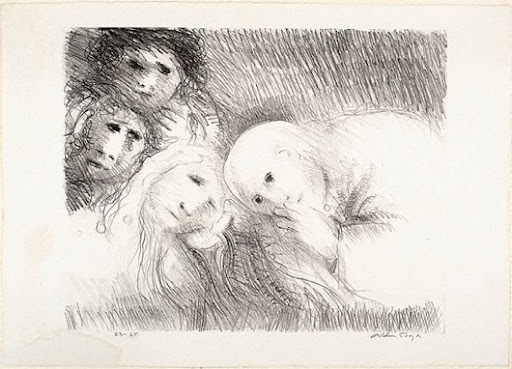
I’d just like to draw your attention to the fantastic series of lithographs by Arthur Boyd on the life of St. Francis, from which I took the above image. Also, many thanks to NP and PM for helping me with translating the quote by Chiara Lubich from Italian (all errors are mine though :).

Edith to Mary

Seint Edith Stein

Today is the 70th anniversary of the martyrdom of St. Edith Stein, one of the great saints of the 20th century and one of the patrons of Europe. Born a Jew, turned atheist, converted to Christianity, became a nun, was a great philosopher (student of Husserl, father of phenomenology) and champion of women’s rights, she finally gave her life for her faith, choosing to remain at Auschwitz with her fellow Jewish prisoners rather than using her baptism as a get out card. She is a towering example of a true disciple of Jesus.

The following is a poem she wrote to Mary on Good Friday 1938:

Today I stood with you beneath the cross
And felt more clearly than I ever did
That you became our Mother only there.

But those whom you have chosen for companions
To stand with you around the eternal throne,

They must stand with you beneath the Cross,
And with the lifeblood of their bitter pains,
Must purchase heavenly glory for those souls
Whom God’s own Son entrusted to their care.

Gang up on the green!

Temple gardens

The last week has seen a discouraging pair of shots being fired between the religious and atheists camps in the form of an article in the Catholic Herald by Fr. Alexander Lucie-Smith and a response to it by the biologist Prof. Jerry A. Coyne.1

I will leave it to you to read the two articles for yourself and won’t attempt to challenge the many individual shots fired by the two sides, as tempting as that is. The problem of evil, Nietzsche’s philosophy, nihilism, alternative theories of meaning, the nature of empirical observation, inference, theoretical parsimony and (lack of) evidence for God are all used as bullets, but without any attention paid to attempting a meeting of minds and certainly without any effort made to apply the principle of charity by either side.

Instead of going into the pair of arguments point–by–point, I would just like to throw the following into the mix (one each as criticisms of the two protagonists):

  1. Prof. Coyne, isn’t it the case that a given set of empirical data can be the basis of multiple, alternative inferences? Stating that the character of our universe being the opposite of what would be expected given a loving and powerful god is an “inference from evidence” is all well and good, but I’d argue that so would be the inference that our universe is exactly what would be expected given a loving and powerful god. What is inferred from evidence does not derive from it in a causal way (seeing a dropping apple does not cause a specific theory of gravity to be posited by an observer) and neither does a given (set of) evidence only lend itself to the definition of a single, specific theory to be inferred from it. Just looking at the playing filed of contemporary physics (or probably any other field of rational enquiry) ought to be enough to settle this point. Please, don’t take this as me saying that scientific theories are feelings or that they are arbitrary. That is not what I believe at all. I have a deep admiration for science, derive great satisfaction from participating in its advancement (admittedly in a minuscule way as far as my contribution goes) and fully subscribe to its enormous value. While I wholeheartedly agree with Prof. Dawkins and you that we can all be moral without a belief in god, I would also like to suggest that the religious views you attack are caricatures, assuming no intelligence on the part of those who hold them – not a great basis for dialogue.
  2. Fr. Lucie–Smith, isn’t it the case that the feeling of indifference, the unanswered call for justice and the lack of clarity of purpose that you attribute to atheists is precisely what Jesus felt in his abandonment on the cross (“My God, my God, why have you forsaken me?” Mathew 27:45)? And isn’t it then more fitting to engage in a dialogue with atheists that seeks to tease out the common ground between what is accessible to us without the benefit of a faith, which we, Catholics, believe to be a gift (“Faith is an entirely free gift that God makes to man.” Catechism of the Catholic Church, §162)? Please, don’t take this the wrong way, but what did you seek to achieve with your article, beyond ridiculing a ridiculous interpretation of another’s words?

So, potentially having made two fresh enemies, let me suggest that we are looking at the wrong battle lines altogether! The fight ought not to be between atheists and religious but between the rational atheists and religious on the one hand and those who act without employing reason or who abuse reason for selfish and immoral ends on the other – and those come in both flavors. Let me just give two examples that shocked and saddened me recently: first the ‘Christian’ idiot who killed seven at a Sikh gurdwara in Milwaukee and second the ‘atheist’ Chinese state whose officials have performed a forced abortion on a 7–month–old foetus. And these are just two outrageous and reprehensible events picked almost at random from the last two weeks.

For us, who do clearly have differences that I don’t mean to belittle, but who subscribe to both rationality and morality, to squabble with each other is both an offense to reason and to God and I wish that we would learn from the inhabitants of Sir Terry Pratchett’s Discworld, where “[b]lack and white lived in perfect harmony and ganged up on green.”


1 Thanks to Luke Coppen for his excellent daily ‘Catholic must-reads’ and Twitter feed, where I first read about these articles.

I’m with Müller: Mary’s virginity

01 arcabas La Annonce faite à Marie

Somewhat reluctantly,1 I’ll now turn to the second of the three most prevalent criticisms that ‘traditionalist’ groups have leveled against Archbishop Gerhard Müller, the new prefect of the Congregation of the Doctrine of the Faith. For the context and my take on the first criticism that relates to the Eucharist, see a previous post.

First let us review the Catholic teaching that Mary was a virgin and look at what the Catechism says:

“The gospel accounts understand the virginal conception of Jesus as a divine work that surpasses all human understanding and possibility: “That which is conceived in her is of the Holy Spirit,” said the angel to Joseph about Mary his fiancée. The Church sees here the fulfillment of the divine promise given through the prophet Isaiah: “Behold, a virgin shall conceive and bear a son.”” (Catechism of the Catholic Church, §497)

This certainly sets the tone very clearly: the Church (and I) believes that Jesus was conceived by action of the Holy Spirit while Mary was a virgin and that this is an event that is beyond human understanding – beyond what’s considered possible (i.e., I read this as being inconsistent with the regular laws of nature). Let’s look more closely at what is said though about the nature of Mary’s virginity:

“[T]he Church confess[es] Mary’s real and perpetual virginity even in the act of giving birth to the Son of God made man. In fact, Christ’s birth “did not diminish his mother’s virginal integrity but sanctified it.”” (CCC, §499)

Finally, let’s see how the Catechism concludes the part dedicated to Mary’s virginity:

“Mary is a virgin because her virginity is the sign of her faith “unadulterated by any doubt,” and of her undivided gift of herself to God’s will. It is her faith that enables her to become the mother of the Savior: “Mary is more blessed because she embraces faith in Christ than because she conceives the flesh of Christ.”” (CCC, § 506)

So, to sum up, I believe the Church teaches that Mary was a virgin before during and after Jesus’s birth, that this was an event clearly outside the regular running of nature and that, while her virginity was very much real, its value is not in the physiological facts that sustained it but in it being a sign of her faith.

With the above in mind, let’s turn to Müller’s words2 (note that the changes indicated below are mine, based on the German original and versus the English wording found in a multitude of blog posts):

”[The perpetual virginity of Mary] is not so much about specific physiological proprieties peculiarities in the natural process of birth (such as the birth canal not having been opened, the hymen not being broken wounded, or the absence of birth pangs), but with about the healing and saving influence of the grace of the Savior on human nature, that had been wounded by Original Sin. […] The article of faith it is not so much about physiologically and empirically verifiable somatic details.” (Katholische Dogmatik für Studium und Praxis, p. 498)

The first thing to notice is that, if anything, the English translation used (critically) everywhere is more vague than the way I read Müller in the original German. I understand him as saying that Mary’s virginity is not about physiology and about what did or did not happen to her reproductive organs, but about grace, salvation and the person of Jesus. I see it as a reaction to the tomes upon tomes of pseudo–scientific accounts of how Jesus’ birth may have taken place vis a vis Mary’s perpetual virginity. This is about as useful as mediaeval ‘scientists’ writing treatises about lions without ever having seen one. If anything this is even worse, as there is no way for these ‘scientists’ to ever verify their claims.

Müller is not a scientist and he makes it clear that the Church’s beliefs about Mary’s virginity are not situated in a scientific context. As the Catechism (quoted above) also states, Mary’s perpetual virginity “surpasses all human understanding and possibility” and its analysis in terms of physiological categories is an exercise in futility.

Before concluding this little excursion, let me highlight one of the things that Müller said in a part that the quote bandied about by his critics left out: “To a mother, giving birth is not limited only to being a biological process.” This, to anyone who has children, is such an obvious thing to say that it seems hardly worth saying. Yet, in the context of the analyses and criticisms of Müller’s words on Mary’s virginity, it stands out like a beacon of sense in a sea of confusion and misguided breast-beating.3 What was it that went through Mary’s head when Jesus was born? Certainly not thoughts about her own hymen or birth canal, but an immense outpouring of love for her son and an awareness of the extraordinary consequences of her “Yes” to the message brought to her by the angel Gabriel now becoming even more of a gift to the world.


1 I feel great affection for Jesus’ mum, who is not only an example in following her son, in putting others before herself, in listening and adhering to God’s call, in consoling the suffering and in stepping to the fore when most needed, but also someone with whom I feel I have a personal relationship. Having to discuss their anatomy isn’t exactly what seems most attractive to me, but I do think it is worthwhile given the spurious accusations that I’ll address here.

2 As in previous posts, here too I’ll try to be careful about seeing exactly what someone has said before jumping to attack or defend it. So, the original German of Müller’s statement is: »Es geht nicht um abweichende physiologische Besonderheiten in dem natürlichen Vorgang der Geburt (wie etwas die Nichteröffnung der Geburtswege, die Nichtverletzung des Hymen und der nicht eingetretenen Geburtsschmerzen), sondern um den heilenden und erlösenden Einfluß der Gnade des Erlösers auf die menschliche Natur, die durch die Ursünde “verletzt” worden war. … Der Inhalt der Glaubensaussage bezieht sich also nicht auf physiologisch und empirisch verifizierbare somatische Details« (S. 498). And, for completeness sake, here is the original wording of the missing part referred to later in the post: »Die Geburt beschränkt sich für die Mutter nicht lediglich auf einen biologischen Vorgang.«

3 Not wanting to taint the main body of this post with reference to it, I can still not overlook some of the utter nonsense that some commentators have dragged up in the context of this topic. Let me just give one example, which goes as follows: “On this note, to deny that the Virgin Mary was not preserved from childbirthing [sic] pains is an attack on the Immaculate Conception of the same Virgin Mary.” Immaculate Conception?! They may as well bring the instructions on how Noah was to construct the ark into play! [Apologies for the outburst – for those of you not versed in Catholic theology, let me just state what the Immaculate Conception is about: “Through the centuries the Church has become ever more aware that Mary, “full of grace” through God, was redeemed from the moment of her conception. That is what the dogma of the Immaculate Conception confesses.” (CCC, §491, emphasis mine) Sheesh!]

The Occam–Einstein Incongruence

Razor

No, this is not an episode of The Big Bang Theory you missed, but instead the seeming tension between two of science’s best-loved heroes: William of Occam (who, incidentally, was a Franciscan friar and is revered in the Anglican Church as a saint) and Albert Einstein.

Let’s set the ground first by seeing what these two guys say about simplicity versus complexity, that is often applied also to scientific theories. Occam is almost exclusively known for his razor, which goes as follows:

“Plurality must never be posited without necessity” (which he also expressed by saying that “[i]t is futile to do with more things that which can be done with fewer.”)

while Einstein has, among many other things, warned that:

“Everything should be kept as simple as possible, but no simpler.”
and that
“For every problem there is a solution which is simple, obvious, and wrong.”

At first sight it may seem like Occam is arguing for simplicity, while Eistein is warning against its excessive application, but a closer reading suggests to me that Einstein is simply being cautious of simplicity in the absolute. Just looking at some theory and judging it to be complex does not automatically make it a candidate for being cut to size with Occam’s razor. Instead, it is its simplicity relative to the simplicity of the entities and events that it refers to that needs to be considered. Neither is it the case that two theories can be compared solely on the grounds of simplicity, with the conclusion that Occam would side with the simpler one. It is only when the competing theories have the same level of descriptive/predictive performance that the razor comes into play.

Bringing Occam and Einstein together, we can say that problems of varying degrees of simplicity require solutions of commensurate complexity – if a solution’s simplicity exceeds that of the problem’s, it is likely not to be a solution, while if it falls short of it, there is room for simplification and the added baggage is unnecessary.

Instead of being a battle axe, Occam’s razor looks more like a surgical implement, requiring careful deliberation both before and during application. As for our protagonists, they are more likely to star in an episode entitled ‘The Occam-Einstein Equivalency’ :).

Does science require beliefs?

Rembrandt anatomy

I am not talking about a belief in God, or anything whatsoever to do with religion. All I am asking is whether the practice of science requires the holding of beliefs or not. If you ask most scientists, engineers or even random members of the public, you are likely to get a negative answer (for a vigorously atheist answer see here). Science, after all, is about knowledge and repeatable process. The scientific method delivers predictive, explanatory models of the universe, that are derived from, and agree with, hard facts – measured data. We know there is gravity from repeatable experiments and we have models that let us make predictions about how it acts. Therefore, we have no need for beliefs to explain that an object lifted off the ground drops when let go.

That does sounds pretty convincing. Given a law of nature we can explain how the entities and events it refers to interact and we can make predictions about how they will behave under some new, future conditions. This requires no beliefs.

Or does it? If you were to ask Max Planck (yes, the Nobel prize winning author of quantum theory and the guy after whom the Planck constant is named), he’d promptly admonish you as follows:

“We have no right to assume that any physical laws exist, or if they have existed up until now, that they will continue to exist in a similar manner in the future.”

No amount of past data is grounds for expecting the same, previously observed relationships to hold into the future (whether under past or new conditions), for which – by definition – we have no data. Making predictions fundamentally relies on the belief that the laws of Nature are constant and will persist as observed and deduced previously. Now, you might argue that this is a reasonable belief to hold, and I’d agree with you, but you’d be hard pressed not to concede that it is a belief rather than a (scientific) fact. Almost as an aside, there is some evidence though that puts a question mark over the belief that the laws of nature are constant (e.g., see this article in the journal Nature or reports like the one in ABC Science).

The above is just a specific application of the more general problem of induction, whereby we “[p]resuppos[e] that a sequence of events in the future will occur as it always has in the past.” A great, more recent thought experiment to illustrate the problem has been proposed by Goodman in the form of the purpose-built predicate “grue.” “Something is grue if and only if it has been observed to be green before a certain time or blue after that time.” Therefore all emeralds that have ever been observed are not only green, but also grue and we have no basis for assuming that after some future time T we will find green but not grue emeralds. Coming back with saying that emeralds have always been green is beside the point …

As you may have noticed, the above reasoning deliberately took shortcuts and did not explore other instances of belief in science, which may well be rectified in future blog posts (we just can’t tell yet).

Finally, it is worth noting that the ideas presented above are in no way an attack on science! Science, on the basis of its underlying beliefs and assumptions, sheds light on how the world around us may work, allows us to make predictions (which for some phenomena have so far always come true), lets us harness the potential of materials around us for the benefit of humanity and dramatically demonstrates the advances that human intelligence is capable of. This makes science greatly valuable and something to be proud of, but let us not delude ourselves into thinking that it is devoid of belief.

Many or all?

Dali

How do you preserve the message Jesus proclaimed two thousand years ago, when businesses and institutions struggle to get their members to know even just about the strategy and vision of the moment? I think this is quite a thorny challenge, as it can take you down at least two undesirable paths: On the one hand, you can become caught up in splitting hairs and lose sight of what Jesus wanted to communicate, while holding on to his specific words with zeal (the example of those who can recite Scripture but wouldn’t think twice when walking past a homeless person comes to mind). On the other hand, there is the ‘chillax, man!’ kind of approach, which would argue that it doesn’t matter what Jesus said exactly as we know that he just wanted us to be ‘nice’ to each other. While the latter is far less objectionable to me, it does run the risk of missing out on the richness of Jesus’ words, which we have been unpacking for two millennia (e.g., think of St. Francis’ re-discovery of poverty, St. Therese of Lisieux’s realization of the depth of everyday life, etc.).

It is in this context that the question of a single of Jesus’ word’s translations has been plaguing linguists and theologians during the last half century, leading to votes in various national Bishops’ conferences and now even to an intervention by the Pope himself. The word in question is the Latin ‘multis’ and the controversy revolves around whether it ought to be rendered as ‘many’ or ‘all.’

Coming to this question cold, you could be forgiven for saying: “Well, I googled it, and it clearly says ‘many.’ End of story.” As it happens, the Pope has arrived at the same conclusion, but what is noteworthy to me is how he did it (and, no, he didn’t just google it!) and how he then proceeded. To get the full story, see Benedict XVI’s letter to the German Bishops’ Conference, and if you’d just like my summary, read on. The text in question are Jesus’ words at the last supper, where he blesses and offers the wine to his disciples, saying:

hic est enim calix Sanguinis mei novi et aeterni testamenti, qui pro vobis et pro multis effundetur in remissionem peccatorum

which, up until very recently was translated as:

this is the cup of my blood, the blood of the new and everlasting covenant. It will be shed for you and for all so that sins may be forgiven

and, which is now translated as follows (after a very recent revision of the English translation, that was also influenced by Pope Benedict’s choice):

this is the chalice of my blood, the blood of the new and eternal covenant, which will be poured out for you and for many for the forgiveness of sins

As you can see, this is a pretty important word, since it, at first sight, sets the scope for the effects of Jesus’ sacrifice. Did Jesus offer his life for all (as the Church has been, and still is, teaching: “For as in Adam all die, so also in Christ shall all be made alive” – Catechism of the Catholic Church, §655) or only for some? Suggesting the latter would be outrageous, would fly in the face of everything that Christianity can be most certain of and would be entirely incongruent with the rest of Jesus’ teaching. The potential doubt that this change of translation could introduce in the minds of church goers is precisely what made both the German and Italian bishops rebel and vote massively in favor of not changing the respective translations.

This brings us to Pope Benedict’s letter, where he first proceeds to sum up the history of the argument, then to underline the validity of concerns like the above and to re-affirm the universal scope of Jesus’ sacrifice and salvation. Only after having prepared the ground does he proceed first to deliver a master class on the distinction between translation and interpretation (while acknowledging the difficult balance between the two and agreeing that the ‘for all‘ was “a well-founded interpretation then as now”) and on how the two need to go hand in hand:

“The word must be presented as it is, with its own shape, however strange it may appear to us; the interpretation must be measured by the criterion of faithfulness to the word itself, while at the same time rendering it accessible to today’s listeners.”

Benedict does not leave things at this though and at stating that “the words ‘pro multis’ should be translated as they stand”. Instead he proceeds to outline how local bishops need to prepare their congregations for the change in wording and flips the situation from a source of disagreement to an opportunity to spread the Gospel. He does this by underlining the three reasons that Jesus may have had for using the word ‘many’ instead of ‘all’:

  1. “Firstly, for us who are invited to sit at his table [i.e., participate in the Eucharist], it means surprise, joy and thankfulness that he has called me, that I can be with him and come to know him.”
  2. “Secondly, this brings with it a certain responsibility. How the Lord in his own way reaches the others – “all” – ultimately remains his mystery. But without doubt it is a responsibility to be directly called to his table, so that I hear the words “for you” – he suffered for me. The many bear responsibility for all. The community of the many must be the lamp on the lamp-stand, a city on the hilltop, yeast for all.”
  3. “Finally, [i]n today’s society we often feel that we are not “many”, but rather few – a small remnant becoming smaller all the time. But no – we are “many”: “After this I looked, and behold, a great multitude which no man could number, from every nation, from all tribes and peoples and tongues,”, as we read in the Revelation of Saint John (7:9). We are many and we stand for all. So the words “many” and “all” go together and are intertwined with responsibility and promise.”

Having read Pope Benedict’s letter leaves me with admiration for his method, with gratitude for the nuances of the ‘many’/‘all’ difference that he laid bare and also with an appreciation of the subtlety of his approach. After all this is ‘just’ a letter to the German bishops – not one of the formal ‘weapons’ that he has in his arsenal, such as apostolic letters, apostolic exhortations, apostolic constitutions or ‘ex cathedra,’ infallible proclamations. What we get instead is a point made with such power of reason that it does not require legal support.

The Principle of Charity

Cholmondeley I first came across the “principle of charity” thanks to one of the lecturers on the MA in Philosophy that I attended (but sadly not completed) at Sheffield. In the first lecture of the Aristotle module, where we were going to cover Book 9 of the Metaphysics, Dr. Stephen Makin* put something like the following idea to his students:

Aristotle wrote the Metaphysics in the 4th century BC, using the language of the day and firmly set in the cultural, scientific and political context of the time. If we approach this text without an attempt at looking for something positive, valuable or meaningful, we will very quickly come to dismiss it, as it is very easy to find it dated, set it superseded modes of thinking or irrelevant. This would be a great shame though, as it would keep Aristotle’s insights hidden from us. Instead, let’s adopt the principle of charity and look for the most favorable interpretation of Aristotle’s words – the interpretation that would give his statements the greatest value, the most sense.

As you can imagine, I was super enthusiastic about this attitude, since it struck me both as very sensible and like exactly the kind of angle that the Gospels would take, had they addressed the topic of hermeneutics. While looking into the background of this principle, I came across the following example of its application in the context of religion that I found particularly positive:

“The next [human representation of the ideal of divine love] is what is known as Vatsalya, loving God not as our Father but as our Child. This may look peculiar, but it is a discipline to enable us to detach all ideas of power from the concept of God. … [T]he Christian and the Hindu can realize [this idea of God as Child] easily, because they have the baby Jesus and the baby Krishna.”

Swami Vivekanda (1863–1902)

Not only does Vivekanda shed light on an aspect of Christian revelation from a new angle, but he uses it to draw parallels with Hinduism, thereby making both religions’ insights accessible to each other’s followers. In this context it is particularly rewarding to see how this same point is emphasized in a recent homily of Pope Benedict XVI:

“God’s sign is simplicity. God’s sign is the baby. God’s sign is that he makes himself small for us. This is how he reigns. He does not come with power and outward splendor. He comes as a baby – defenseless and in need of our help. He does not want to overwhelm us with his strength. He takes away our fear of his greatness.”

Just to avoid the ever-lurking accusation of syncretism when considering inter-religious questions, I don’t read Vivekanda as equating Jesus with Krishna or proposing their co–existence or merging, but instead as pointing to principles expressed with similarity in both traditions.

If only the principle of charity were more broadly applied both in secular and religious discourse …


I can’t mention Dr. Makin without sharing the following anecdote: One morning Dr. Makin arrives late to give his lecture and with indignation exclaims: “I have been asked to do some administrative work! Can you imagine a professional administrator being asked to write a book about Aristotle?!” I often feel the same (but still have to do it :).

5L2F

Multiplication of loaves and fishes c osseman

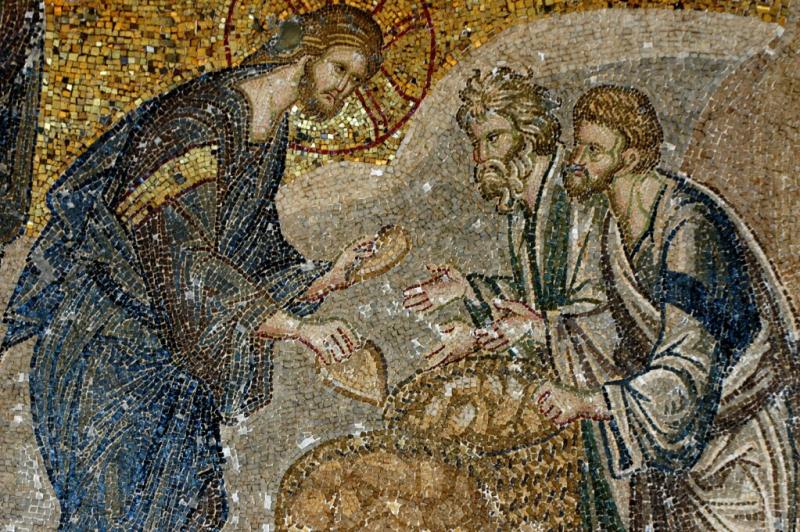
After Sunday’s Gospel reading at mass, I was struck by a seemingly throw-away point made during the homily, where the priest said that Jesus asked his disciples to go and buy some food for the people who assembled to listen to him and were in danger of running hungry:

When Jesus raised his eyes and saw that a large crowd was coming to him, he said to Philip, “Where can we buy enough food for them to eat?” He said this to test him, because he himself knew what he was going to do. Philip answered him, “Two hundred days?’ wages worth of food would not be enough for each of them to have a little.'” One of his disciples, Andrew, the brother of Simon Peter, said to him, “There is a boy here who has five barley loaves and two fish; but what good are these for so many?” Jesus said, “Have the people recline.” Now there was a great deal of grass in that place. So the men reclined, about five thousand in number. Then Jesus took the loaves, gave thanks, and distributed them to those who were reclining, and also as much of the fish as they wanted. When they had had their fill, he said to his disciples, “Gather the fragments left over, so that nothing will be wasted.” So they collected them, and filled twelve wicker baskets with fragments from the five barley loaves that had been more than they could eat.

John 6:5-13

The suggestion that Jesus wanted them to use regular means for feeding the masses made me listen up and reflect on the nature of miracles. The conclusion I am coming to is that the miracles Jesus performed were mostly accidental – not premeditated, planned (maybe with the exception of Lazarus’ raising from the dead where Jesus’ actions took place sometime after he was informed of his friend’s death). In this case, Jesus is spreading the good news of his Father’s love for all and it becomes apparent that the crowd following his words is going to get hungry and disperse to seek food in the nearest towns. Instead of following his disciples’ suggestion to call it a day and send his listeners on their separate ways, Jesus instead challenges their faith and asks them to provide for the crowd. Essentially he’s saying to them: nip down to the shops and fetch some dinner.

In spite of the effect that Jesus has already had on his disciples, Philip comes out with a bit of accountancy, ballparking the order at 200 days’ wages (a touch over £9700 in the UK today, which would give a budget per person/family of just under £2 – not exactly a lavish affair) and attempting to bring Jesus’ desire not to interrupt his mission stumbling down on logistical grounds. What comes next is a really great, but super-hesitant, move by Andrew, who says “There is a boy here who has five barley loaves and two fish; but what good are these for so many?” In other words, I hear Andrew as sticking his neck out and positioning himself next to Jesus by taking a leap of faith and bringing up the slightest of possibilities that could address the present challenge. To my mind the miracle is as much a reward for Andrew as it is a lesson for Philip and for the crowd assembled at Jesus’ feet.

Personally I read it as a call to trust in God and not to self–impose constraints where God’s providence is ready to provide against the odds. I have often experienced generosity by others or the discovery of solutions that only came to light because I placed my trust in God’s providence. Shortly before my older son was to be born, the house we were renting was put on the market and we were given a month’s notice to move. When we were informed about it, I was filled with panic and started rushing around, looking at vacancies but failing to find anything whatsoever as it was two weeks before Christmas and most places were shutting down for the holidays. One evening, and I remember this distinctly, I realized that I was leaving God out of this process (and doing so during Advent of all times!) and decided to skip the frantic search and instead spend the evening in prayer. This certainly calmed me down and when I woke in the morning. the thought came to me to look in the neighboring city instead of the one were we were living at the time. That same day I found us a new house to rent and the following months have shown how good the change of location was for us in ways we could not have anticipated.

Now, was that a miracle? No, in the sense that I don’t believe God intervened in the regular running of the universe. But, it did bring about a conversion in me that lead to greater closeness to God and a more attentive listening to his whispers.

This brings me to the final thought I have about Sunday’s Gospel: how much of what John describes (and incidentally the other three Evangelists too) was a miracle in the sense that the laws of nature were locally and temporarily altered? My impression is that not all. Let me explain … I believe that many people in the crowd that day had some food with them and that, when the gathering was dispersed, they may well have moved to a nice spot, laid it out and had a picnic. Others, who had no food would have had to trek to the nearest village and buy some, yet others would have had to go hungry as they may not have had the means to buy more food for themselves. Instead, what Jesus did by arranging the crowd into smaller groups (making the people assembled to hear him less of an anonymous mass), taking the five loaves of bread and two fish, blessing them and beginning to hand them out, was to create better conditions for sharing. I can imagine that someone who saw what Jesus did and had some food on them would add it to the food passed on to the next person, which in turn would lead to a positive, pyramidal-scheme-like avalanche and result in the many basketfuls collected at the end. Am I saying that I don’t believe a miracle (in the laws-of-nature-bending sense) took place? Certainly not – I do not see why Jesus should not have performed miracles, being God who created the universe out of nothing, but I do believe that his miraculous actions also triggered responses in their witnesses that lead to an amplification. Could Jesus have made food appear for 5000 families – sure! But, isn’t the humble (five loaf of bread + two fish) gesture much more loving, as it allows for human participation, rather than a sudden, imposing appearance of rows of fully-laden tables would have been?