Faithfulness and caring

Woelki

When I read an interview (in German – English here1) with the youngest Cardinal of the Catholic Church – Rainer Maria Woelki, the following question and answer struck me in particular:

ZEIT: You were quoted as saying the following during the Catholic Congress, which resulted in a lot of anger being directed at you: “I can imagine that people who take responsibility for one another and who live in a permanent, homosexual relationship, can be seen similarly to those who live in a heterosexual partnership.” Do you stand by this statement?

Woelki: The Catechism says the following about those who have homosexual tendencies: “Every sign of unjust discrimination in their regard should be avoided.” [Catechism of the Catholic Church, §2358] If I take this seriously, I cannot look at homosexual relationships and only see their being “contrary to the natural law,” as the Catechism states [§2357]. I also try to acknowledge that they take responsibility for each other on a permanent basis, have promised each other faithfulness and want to look after each other, even though I cannot endorse their life choices. The life choice, that we as Catholic Church represent, is sacramental marriage between a man and a woman, that is open to the transmission of life. This is how I have said it also at the Catholic Congress immediately before the statement you have quoted.

[translation and references in square brackets mine]

What I like a lot about this quote is the obvious desire by Cardinal Woelki to see the good that is there even under circumstances that the Church does not endorse, without being unfaithful to its teaching. This strikes me like exactly the thing Jesus would do today.


1 The translation does seem quite skewed to me, so, proceed with caution if you are thinking of reading it. You can get a sense of this even just from the one question I re-translated above and from the article’s title, which bears little resemblance to the Cardinal’s words.

Freedom

He who created human beings in order to make them share in his own fullness so disposed their nature that it contains the principle of all that is good, and each of these dispositions draws them to desire the corresponding divine attribute. So God could not have deprived them of the best and most precious of his attributes: self-determination, freedom …

Gregory of Nyssa (330-395) quoted in Roots of Christian Mysticism

Solitary amongst a crowd

Syncletica

Amma Syncletica said,
“Many live in the mountains
and behave as if they were living amidst the uproar of the city,
and they are lost.
It is possible
while living amongst a crowd
to be inwardly solitary,
and while living alone
to be inwardly beset by the crowd.”

Sayings of the Desert Fathers (quoted in Roots of Christian Mysticism)

How to keep parishioners awake

112arcabas jpg

One of my favorite books of all time is the superb Roots of Christian Mysticism, from which I would like to share a couple of quotes with you over the coming weeks. The book as a whole is a joy to read and the quotes you will find here are among my absolute favorites – they are a list I compiled for one of my best friends, who is also the most sincere agnostic I have ever met. So, here comes the first one:

Some elders came to see Abba Poemen to ask him,
“If we see some brothers dozing in the congregation,
do you want us to reprove them so that they stay awake?”
He said to them, “For my part, when I see a brother dozing,
I lay his head on my lap and let him rest.”

Sayings of the Desert Fathers

🙂

Does Dawkins need God to be good?

Dawkins

While I have to admit that I am not a fan of Richard Dawkins‘ rhetoric, I found myself immediately agreeing with what he meant by the title of one of his most recent articles: “You don’t need God to be good … or generous.” Leaving aside the 95% of the article where he attacks religion in his trademark ad hominem, populist manner (“as a matter of fact it probably is not the case”[emphasis mine]), it turns out that his argument simply is that non-believers too are capable of “selfless generosity.” Both this and his claim, which I would translate as “you don’t need to believe in God to be good,” are statements that I wholeheartedly agree with and which are in line with the teachings of the Catholic Church. Here the Catechism (§33) affirms that we are all

“open to truth and beauty, [have a] sense of moral goodness, [have] freedom and the voice[s] of [our] conscience[s], with [our] longings for the infinite and for happiness.”

None of this is predicated on a belief in God. What I believe though is that it does come from God, who is the source of all goodness, generosity and love. This is where Prof. Dawkins and I would disagree.

Jesus loved Judas

Judaskiss3

During these last weeks I have been thinking about a passage that struck me during this year’s Good Friday way of the cross that was lead by Pope Benedict XVI and for which the meditations were prepared by Danilo and Anna Maria Zanzucchi (the first married couple ever to provide the thoughts to reflect on during this key moment of the Easter triduum):

It seems we can hear you say:
“I have been condemned to death;
so many people who seemed to love and understand me
have listened to lies
and accused me.
They did not understand my words.
They handed me over to judgement and condemnation.
To death by crucifixion, the most ignominious death.”

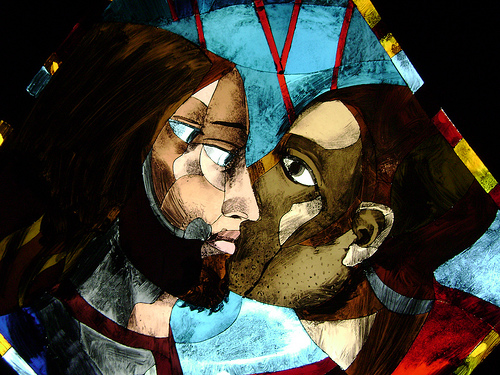
What caught my attention here was the insight that Jesus loved Judas as much as all the other apostles and that Judas’ betrayal must have hurt him a lot. The picture of Judas in the Gospels is understandably negative and his mentions tend to be accompanied by warnings of his future betrayal. This, to me, has until last Easter obscured the fact that Jesus would not have viewed Judas in such a light. He would have been fond of him and would have looked upon him as he did upon John, Peter, James or the other apostles. His betrayal would have been a searing pain for Jesus rather than the consummation of the inevitable that I previously got from a superficial reading of Scripture. What this underlines to me is that Jesus experienced not only the abandonment by society that Golgotha presents, but a very personal, individual betrayal by a loved one too.

What do I believe?

Trying to answer this question is hopelessly ambitious and as unlikely to be precise or comprehensive as trying to exhaustively describe someone. Nonetheless, I’d like to take a first stab at it and probably return to it as the Year of Faith kicks off and progresses. The following then would be a couple of the highlights:

  1. I believe in doing to others what I would have them do to me. (Mathew 7:12)
  2. I believe there is a God who is Love (1 John 4:8).
  3. I believe God so loved the world that he gave his only Son to us (John 3:16).
  4. The beliefs of the Nicene Creed are mine.
  5. I believe the truth will set us free (John 8:32).
  6. I believe that beauty stands equal alongside goodness and truth and that they all are how God shows himself to us.
  7. I believe there is goodness and truth to be found in all religions (Catechism of the Catholic Church, § 843) and that they all “reflect a ray of that truth which enlightens all men” (Nostra Aetate 2).
  8. I believe that agnostics and atheists are my brothers and sisters.
  9. I believe in defending the right of others to say things I disapprove of. (Voltaire)
  10. I believe there are motives worth dying for but none worth killing for. (See: “The way we came to know love was that he laid down his life for us; so we ought to lay down our lives for our brothers.” (1 John 3:16))
  11. I believe in being strict to myself and lenient to others. (John Paul II)
  12. I believe that “faith and reason are like two wings on which the human spirit rises to the contemplation of truth” (Fides et Ratio) and that the scientific method not only holds utility but also opens our eyes to God’s creation.

Twelve being a good number to stop at, I’d say that’s it for now :).

Where to start?

Over the last months I have been reflecting on what it is that my faith consists of and I have to say that the definition put forward for the Year of Faith fits like a glove – it is all about my relationship with a person: Jesus. To leave it at that though could make it sound like a lot of very different things to different people and may well also be the basis for the typical first reactions I get whenever religion comes up in conversation with colleagues or friends and I admit to being ‘religious’ (a term so loaded with connotations alien to me, but nonetheless one I don’t want to deny):

  1. Really? I would never have had you down as being religious!
  2. Do you believe in magic then?
  3. [my favorite and one that I actually took as a compliment] Anyone over the age of thirty who is religious is either an idiot or very smart. 🙂

This is typically followed by a stream of ‘So, do you believe in X?’ questions, where X includes the virgin birth, immaculate conception, papal infallibility and a list of other (often also fictitious) articles of faith. The next phase then is an (often thankfully only temporary) imposition of a sense of self-censorship on my friends (‘Sorry, did that offend you?’) as religious people do so easily take offense :). The fact that I am a scientist further complicates my admission of religiosity as the former has an image of rationality while the latter conjures up connotations of superstition. I am therefore either a schizophrenic or there is something else going on …