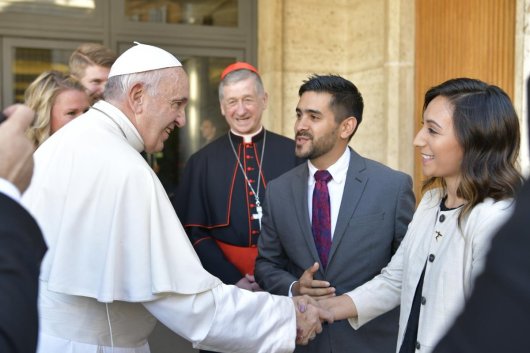
Amazon Synod: Jesus is the center

Amazon2

725 words, 4 min read

Following on from the first piece about the Amazon Synod, I would here like to only cover three contributions to the Synod from the last week and skip entirely the reports of the “circoli minori” that were published a week ago and that give a first sense of the inputs to the Synod’s final document that is being drafted now and that will be voted on tomorrow. I’ll just mention some of the key themes that came up frequently in these intermediate working reports: a focus on caring for our common home – Mother Earth – where the Church plays an integral role, a denunciation of violence in the Amazon, the diversity of the Church and the need for inculturation (an Amazonian Rite was mentioned several time), a call for the need for regular, frequent, stable access to the Eucharist and the related call for ordaining married men (viri probati) to the priesthood, the call for a greater, more prominent, more “official” role of women in the Church, including a call for reinstating the diaconate for women.

Let me turn to the three moments from the last week or so that particularly stood out to me. The first was an interview with the newly-appointed Cardinal Jean Claude Hollerich of Luxembourg, who started with putting things into perspective:

“If our planet is destroyed, we can shout as much as we want about married priests or women priests, but there will be no priests needed anymore. So it’s the most important problem and it’s a problem with the greatest urgency.”

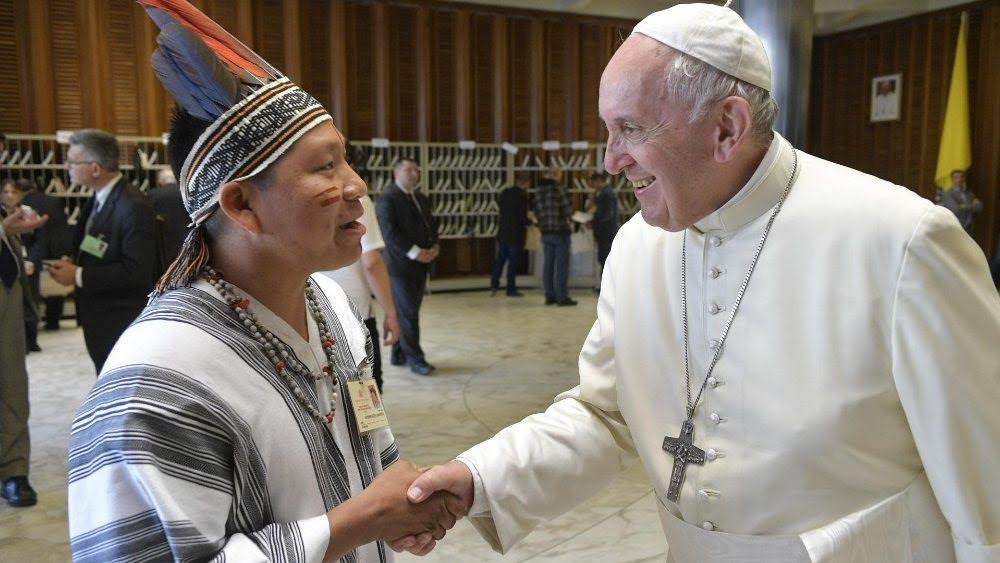
Another, equally important attempt at going back to basics was an impassioned plea by one of the lay participants of the synod, Delio Siticonatzi Camaiteri, of the Asháninka indigenous people of Perù, who was quite direct with the journalists – and through them with the broader population – at the Vatican press briefing yesterday, who said:

“I see you looking quite uneasy from here, not understanding what the Amazon really needs. We have our view of the universe, our way of looking at the world that surrounds us and it is nature that brings us closer to God. Seeing God’s face in our culture in our experience brings us closer [to him], because we, as indigenous people, live in harmony with all beings that are there. For you, I see that the idea of us as indigenous people does not make sense. You look worried to me, you look doubtful in the face of this reality that we seek as indigenous people. Don’t harden your heart, soften your heart – this is what Jesus invites us to do. May we live together. We believe in one God. In the end we will all be united. And this is what we, as indigenous people, desire. We have our rites. Yes, we do have our rites. But this rite must include its centre, which is Jesus Christ! There is nothing else to talk about here. The center that unites us now in this Synod is Jesus Christ. Defending life itself, natural life – there is nothing else besides.”

And, finally, there were Pope Francis’ own words at Wednesday’s General Audience, which, while addressed to the whole Church, I can’t help hear as being particularly meant for the Synod members, ahead of their vote on the Synod’s final document tomorrow:

“The nature of the Church emerges from the Book of the Acts, which is not a fortress but a tent capable of enlarging its space (Cf. Isaiah 54:2) and giving access to all. The Church is either “going forth” or it’s not Church, it is either a path that is always widening its space so that all can enter, or it’s not Church,’ — “a  Church with open doors” (Apostolic Exhortation Evangelii Gaudium, 46), always with the doors open.  When I see a church here, in this city, or when I see it in the other diocese from which I come, with the doors closed, this is a bad sign. The churches must always have the doors open because this is the symbol of what a church is: always open. The Church is “called to be always the open House of the Father. [. . . ] So that, if someone wants to follow a motion of the Spirit and approaches, seeking God, he/she won’t meet with the coldness of a closed door” (Ibid., 47).”

Amazon Synod: bring the Good News to the ends of the earth

Amazon1

2810 words, 14 min read

Last Sunday saw the opening of the Synod for the Amazon, which Pope Francis announced two years ago and whose aim is “to find new ways for the evangelization of that portion of the People of God, especially the indigenous, often forgotten and without a perspective of a good future, also for the cause of the crisis of the Amazonian forest, lung of fundamental importance for our planet”. During the two years leading up to ip, 80 000 people living in the Amazon basin (which has an indigenous population of 20 million) were consulted and raised issues ranging from care for the environment, via social justice to constraints on access to the sacraments and pastoral care. The Synod will last 3 weeks and will result in a final document addressed to Pope Francis, who will take it as a basis for a future encyclical or exhortation (like he has done in the case of synods on the family and on youth in the past).

Over the course of the Synod, I will try to periodically share here a selection of news and reflections about its progress, as a way to be engaged with this important event in the life of the Church. I will not try to be exhaustive (you can follow media outlets like news.va and americamagazine.org for that) but focus on what gives me greatest joy or sorrow instead.

As with previous Synods, here too Pope Francis’ opening homily, delivered during mass celebrated at St. Peter’s last Sunday, is key to understanding what is at stake. Off the bat, he frames the Synod as an exercise in receiving, being and sharing a gift:

“We [bishops] received a gift so that we might become a gift. Gifts are not bought, traded or sold; they are received and given away. If we hold on to them, if we make ourselves the centre and not the gift we have received, we become bureaucrats, not shepherds. We turn the gift into a job and its gratuitousness vanishes. We end up serving ourselves and using the Church. […] The gift we have received is a fire, a burning love for God and for our brothers and sisters. A fire does not burn by itself; it has to be fed or else it dies; it turns into ashes. If everything continues as it was, if we spend our days content that “this is the way things have always been done”, then the gift vanishes, smothered by the ashes of fear and concern for defending the status quo. […] Jesus did not come to bring a gentle evening breeze, but to light a fire on the earth.”

Francis then proposes prudence as the attitude with which to approach these gifts, a prudence that is active and a vehicle for the newness of the Holy Spirit:

“The fire that rekindles the gift is the Holy Spirit, the giver of gifts. […] Not a spirit of timidity, but of prudence. Someone may think that prudence is a virtue of the “customs house”, that checks everything to ensure that there is no mistake. No, prudence is a Christian virtue; it is a virtue of life, and indeed the virtue of governance. And God has given us this spirit of prudence. Paul places prudence in opposition to timidity. What is this prudence of the Spirit? As the Catechism teaches, prudence “is not to be confused with timidity or fear”; rather, it is “the virtue that disposes practical reason to discern our true good in every circumstance and to choose the right means of achieving it” (No. 1806). […] Rekindling our gift in the fire of the Spirit is the opposite of letting things take their course without doing anything. Fidelity to the newness of the Spirit is a grace that we must ask for in prayer. May the Spirit, who makes all things new, give us his own daring prudence; may he inspire our Synod to renew the paths of the Church in Amazonia, so that the fire of mission will continue to burn.”

Finally, he contrasts the fire of the Gospel that is God’s gift with the destructive fire of human greed and self-interest:

“When peoples and cultures are devoured without love and without respect, it is not God’s fire but that of the world. Yet how many times has God’s gift been imposed, not offered; how many times has there been colonization rather than evangelization! May God preserve us from the greed of new forms of colonialism. The fire set by interests that destroy, like the fire that recently devastated Amazonia, is not the fire of the Gospel. The fire of God is warmth that attracts and gathers into unity. It is fed by sharing, not by profits. The fire that destroys, on the other hand, blazes up when people want to promote only their own ideas, form their own group, wipe out differences in the attempt to make everyone and everything uniform.”

Echoing St. Irenaeus1, the same mindset was also summed up by the newly appointed cardinal (and newly ordained bishop) Michael Czerny SJ saying that:

“[O]ur vocation is to help men and women to live their human lives and to live them to the full…. This is the big mission. This is what it means to preach the Gospel and to bring the Good News to the ends of the earth.”

On the next day, Monday 7th October, Cardinal Cláudio Hummes, the Relator General of the Synod, then set the scene for the upcoming process of synodal discernment by summarising the work of the preceding two years, including a start overview of the harsh challenges facing the region:

“Numerous consultations held throughout the Amazon show that the communities consider that life in the Amazon is especially threatened by: (a) criminalization and assassination of leaders and defenders of the territory; (b) appropriation and privatization of natural goods such as water itself; (c) both legal logging concessions and illegal logging; (d) predatory hunting and fishing, mainly in rivers; (e) mega-projects: hydroelectric and forest concessions, logging for monoculture production, construction of roads and railways, or mining and oil projects; (f) pollution caused by the entire extractive industry that causes problems and diseases, especially among children and young people; (g) drug trafficking; (h) the resulting social problems associated with these threats such as alcoholism, violence against women, sex work, human trafficking, loss of original culture and identity (language, spiritual practices and customs), and all conditions of poverty to which the peoples of the Amazon are condemned (IL,15).”

Cardinal Hummes then panned out to show the big picture in which these challenges play out, which is that of God’s relationship with his creation:

“Integral ecology teaches us that everything is connected, human beings and nature. All living beings on the planet are children of the earth. The human body is made of the “dust of the ground”, into which God “breathed” the spirit of life as the Bible says (cf. Gen 2,7). Consequently, all damage done to the earth damages human beings and all the other living creatures on the earth. This proves that one cannot address ecology, economy, culture and other issues separately. In Laudato Si’ it is stated that they must be considered as one; an environmental, economic, social and cultural ecology (cf. LS, cap. IV).

The Son of God too became a man and his human body comes from the earth. In this body, Jesus died for us on the Cross to overcome evil and death, he rose again among the dead and now sits to the right of God the Father in eternal and immortal glory. The Apostle Paul writes, “For in him all the fullness was pleased to dwell, and through him to reconcile all things for him (…) whether those on earth or those in heaven.”(Col. 1,19-20). In Laudato si’ we read that, “This leads us to direct our gaze to the end of time, when the Son will deliver all things to the Father, so that “God may be everything to everyone” (1 Cor.15:28). Thus, “the creatures of this world no longer appear to us under merely natural guise because the risen One is mysteriously holding them to himself and directing them towards fullness as their end” (LS, 100). It is thus that God has definitively connected Himself to His entire creation. This mystery is accomplished in the sacrament of the Eucharist.”

He also touched on the very infrequent access to the sacraments that the Catholics of the Amazon suffer from and shared both a call for the ordination to the priesthood to be opened to married men and for greater recognition of the spiritual service and leadership of women in the region:

“There is a lack of appointed priests and this means pastoral care consisting of occasional instead of adequate daily pastoral care. The Church lives on the Eucharist and the Eucharist is the foundation of the Church (St. John Paul II). Participation in the celebration of the Eucharist, at least on Sundays, is essential for the full and progressive development of Christian communities and a true experience of the Word of God in people’s lives. It will be necessary to define new paths for the future. During the consultation stages, indigenous communities, faced with the urgent need experienced by most of the Catholic communities in Amazonia, requested that the path be opened for the ordination of married men resident in their communities, albeit confirming the great importance of the charisma of celibacy in the Church. At the same time, faced with a great number of women who nowadays lead communities in Amazonia, there is a request that this service be acknowledged and there be an attempt to consolidate it with a suitable ministry for them.”

During that same first general congregation of the Synod, Pope Francis spoke2 again and also warned against ideologies, prejudices and contempt:

“Ideologies are a dangerous weapon; we always tend to latch onto an ideology for interpreting a people. Ideologies are reductive, and they lead us to exaggeration in our pretence to understand intellectually, but without accepting, understanding without admiring, understanding without taking on and then reality is received in categories, the most common are the categories of “isms.” Then when we have to approach the reality of a native people we speak of “indigenisms”, and when we want to provide them with a launch pad towards a bette life, we don’t ask them, we speak of developmentalism. These “isms” re-formulate life from an illustrious and enlightened laboratory. There are catchphrases that take root and condition the approach to native people. In our country, the catchphrase: “civilization and barbarism” served to divide, to annihilate and it reached its culmination toward the end of the 80s, [in the 19th century] annihilating the majority of the native people, because they were “savage” and “civilization” came from another side. [This] still continues in my homeland, with offensive words, and then there is talk of a second class civilization, of those that come from barbarism, which today are the “bolitas” [meaning “marbles” and used as a racial slur for Bolivian immigrants in Argentina], the “paraguas” [meaning “umbrellas”, referring to Paraguayans], the “little black heads,” always removing ourselves from the reality of a people, qualifying it and putting distances in place. That’s the experience in my country — and then, contempt. Yesterday I was very sad to hear, here, a mocking comment about that pious man who brought the gifts [during mass on Sunday] with feathers on his head, tell me: what difference is there between wearing feathers on the head and the biretta [a three-cornered hat] that some officials of our Dicasteries wear? Then we run the risk of proposing simply pragmatic measures, when, on the contrary, we are asked to contemplate the people, to have a capacity for admiration, which then lead to paradigmatic thinking. If someone has come with pragmatic intentions, let him pray the “I confess,” let him convert and open his heart to a paradigmatic perspective that is born of the reality of the people.

From the second day onwards, there then followed testimonies of Synod participants during the daily Vatican press briefings, which were rich both in sharing the Amazon peoples’ profound sufferings and joys and in transmitting the warm and positive atmosphere of the synod. On that second day, one experience that particularly struck me was that of Sister Alba Teresa Cediel Castillo, of the Missionary Sisters of Mary Immaculate and of St. Catherine of Siena, who lives in Colombia among the indigenous communities and whose words display both a profound love for the people she serves and a clear absurdity of current practice:

“We are present everywhere and we do what a woman can do by virtue of her Baptism: we accompany the indigenous people, and when priests cannot be present, we perform baptisms. If someone wants to get married, we are present and we witnesses to the love of the couple. We have often had to listen to confessions, but we have not given absolution. In the depth of our hearts, though, we have said that with the humility with which this man or woman approached us because of illness, or because they were close to death – we believe God the Father intervenes there”.

On Thursday, 10th October, Bishop Medardo de Jesús Henao Del Río, Apostolic Vicar of Mitú, and Titular Bishop of Casae Medianae, in Colombia spoke at the press briefing, starting with examples of the horrors that his people endure, summarized by Vatican News as follows:

“He described the situation there as particularly difficult. The drug trade, he said, is exploiting indigenous people in the area. While there is a school and a paramedic station, there is widespread malnutrition and many live abandoned. The Bishop told the story of a woman who was experiencing a difficult pregnancy. She had nowhere to go and had to perform a C-section on herself. Her husband managed to get her to the hospital where the gynecologist was shocked this could have happened. In this case, the woman and her child survived. In other cases, men have had to help their wives deliver babies using knives, and women sometimes die as a result.”

He also gave examples of multi-national companies exploiting the region by mining and logging that forces the indigenous people off their land. Finally, Bishop Del Rio also spoke very beautifully of what inculturation looks like in how he ordains deacons:3

“I have recently ordained an indigenous deacon. I have ordained him – and many may be scandalized by this – I have ordained him in two rites: the Roman rite and the indigenous rite. Many may say: what did I do, did I ordain a wizard? No. If we enter the indigenous cosmogonic context, I followed the rite of ordaining a deacon until the point where I deliver the Gospel to him. The the indigenous leaders then placed a crown on his head, which is the sign of a man who acquires wisdom within a community and who will care for the community. […] It is a sign of distinction. Then they receive him and pass him all around the church – him with the Word of God which is the ultimate wisdom. They dance all around the church, the community applauds him. Then follows the embrace of peace with which the rite of ordination concludes. Once the ceremony and Eucharist conclude, this community welcomes him, asks him for his blessing, they tell him: “You will help us … When will you come and bless me at my work …” So, this is not a mixing, but an assimilation of certain values that are there in the indigenous communities that go together with Christian values. We can neither consider all that is indigenous to be holy, nor to be of the devil. It is necessary to study all their myths, what their rites mean, so that rites are such that they accept them and that they are in communion with service. The other thing is that the deacon is at the service of the community. Recently the pope told us that they are not there to serve in a liturgy beside a bishop or a priest but to be at the service of the community. It is a ministry that has strong consonance with indigenous tradition.”


1 “For the glory of God is the living man, and the life of man is the vision of God.” (Against Heresies, Book 4, Chapter 34, Section 7)
2 The original Spanish text of Pope Francis’ address can be found here and I took the liberty of adjusting the zenith.org translation in some places with the desire to render the original text more faithfully in English.
3 Please, note, that this is my translated transcript of Bishop Del Rio’s words, spoken at the press briefing, and that all mistakes here are mine.

Cardinal Burke’s confusion

Burke purple

2094 words, 11 min read

In what is fast becoming a series1, this post will pick up on just one of the 40 “truths” presented by Cardinal Raymond Leo Burke in his “Declaration of the truths relating to some of the most common errors in the life of the Church of our time” – a document he claims is being published in a “spirit of fraternal charity” and one that I wholeheartedly recommend not to read.

Just like with a punnet of strawberries, there are obvious places to look at here too, when trying to decide whether or not to buy it. An easy way to start is to review “truth” #28 on capital punishment, which reads as follows:

“In accordance with Holy Scripture and the constant tradition of the ordinary and universal Magisterium, the Church did not err in teaching that the civil power may lawfully exercise capital punishment on malefactors where this is truly necessary to preserve the existence or just order of societies (see Gen 9:6; John 19:11; Rom 13:1-7; Innocent III, Professio fidei Waldensibus praescripta; Roman Catechism of the Council of Trent, p. III, 5, n. 4; Pius XII, Address to Catholic jurists on December 5, 1954).”

This is a direct challenge to the recent change to the Catechism of the Catholic Church, effected by Pope Francis (who has “supreme, full, immediate, and universal ordinary power in the Church” (cf. Cann. 331-334)), which now states the following regarding the death penalty:

“Recourse to the death penalty on the part of legitimate authority, following a fair trial, was long considered an appropriate response to the gravity of certain crimes and an acceptable, albeit extreme, means of safeguarding the common good.

Today, however, there is an increasing awareness that the dignity of the person is not lost even after the commission of very serious crimes. In addition, a new understanding has emerged of the significance of penal sanctions imposed by the state. Lastly, more effective systems of detention have been developed, which ensure the due protection of citizens but, at the same time, do not definitively deprive the guilty of the possibility of redemption.

Consequently, the church teaches, in the light of the Gospel, that “the death penalty is inadmissible because it is an attack on the inviolability and dignity of the person”, and she works with determination for its abolition worldwide.”

Against this background, let us look at three aspects of Burke’s claim: first whether the Church erred, second, whether its tradition (on the basis of the references in this “truth”) has been constant and – most seriously – whether the lawfulness of capital punishment is in accordance with Holy Scripture.

First, the Catholic Church today does teach that the death penalty is always inadmissible as is set out by its supreme legislator (Pope Francis) and promulgated in its Catechism. Applying the Church’s past teaching to today – as Cardinal Burke does – is therefore an act of erring and in direct conflict with the Church’s Magisterium.2

Second, let’s take a closer look at the references to the “constant tradition of the ordinary and universal Magisterium” provided by Burke. The first of these is a passage from the 1566 Catechism of the Council of Trent, which reads as follows:

Execution Of Criminals

Another kind of lawful slaying belongs to the civil authorities, to whom is entrusted power of life and death, by the legal and judicious exercise of which they punish the guilty and protect the innocent. The just use of this power, far from involving the crime of murder, is an act of paramount obedience to this Commandment which prohibits murder. The end of the Commandment- is the preservation and security of human life. Now the punishments inflicted by the civil authority, which is the legitimate avenger of crime, naturally tend to this end, since they give security to life by repressing outrage and violence. Hence these words of David: In the morning I put to death all the wicked of the land, that I might cut off all the workers of iniquity from the city of the Lord.”

This is pretty clear: to preserve and secure human life, civil authority has the right to put criminals to death as a protective and punitive measure.

Let’s now look at the second of the two references for the constancy of tradition, a talk Pope Pius XII addressed to Italian lawyers in 1954, and at the only paragraph in that text that talks about the death penalty:

“The human judge, on the other hand, since he does not possess the omnipresence and omniscience of God, has the duty of forming for himself, before issuing the judicial sentence, a moral certainty, that is, one which excludes every reasonable and serious doubt about the external fact and the internal guilt. But he does not have immediate insight into the interior dispositions of the accused at the very moment of the crime; rather, in most cases the judge is not in a position to reconstruct them with absolute clarity from the arguments offered as proof, nor, often enough, from the very confession of the delinquent. But this difficulty should not be exaggerated, as though it were ordinarily impossible for a human judge to attain sufficient certainty, and therefore a solid foundation for a sentence. According to the cases, the judge will not fail to consult renowned specialists on the capacity and responsibility of the presumed criminal, and to take into consideration the findings of the modern sciences of psychology, psychiatry and characterology. If, despite all these precautions, there still remains a grave and serious doubt, no conscientious judge will proceed to pronounce a sentence of condemnation, all the more so when there is question of an irrevocable punishment, such as the death penalty.”

Hm … this is somewhat different from the first reference. Yes, the death penalty is not deemed inadmissible. However, it is presented as a case where the general challenges of ascertaining guilt and culpability, that are essential limitations of human judges as compared with God, the ultimate Judge, impose a heightened degree of caution and a heightened burden of proof on the jurist. Incidentally the whole text is set in the context of reforms being considered to the penal code and speaks about the relationship between crime and punishment, which it examines from psychological, juridical, moral and religious angles. Far from being a simple affirmation of the rights of the state, as set out by the Tridentine Catechism, Pius XII’s reflection is a careful, cautious one, calling for checks and balances commensurate with the irrevocability of capital punishment.

Moving beyond the two references provided to substantiate “constancy of tradition”, it is worth noting that the first mention of the death penalty in any conciliar document of the western Church comes on 6th July 1415, during the 16th session of the Council of Constance (none of the 15 councils that pre-date it, starting with the Council of Nicea in 325 AD, even mention the topic):

“Doctors who state that anybody subjected to ecclesiastical censure, if he refuses to be corrected, should be handed over to the judgment of the secular authority, are undoubtedly following in this the chief priests, the scribes and the pharisees who handed over to the secular authority Christ himself, since he was unwilling to obey them in all things, saying, It is not lawful for us to put any man to death; these gave him to the civil judge, so that such men are even greater murderers than Pilate.”

Again, this does not sound very “constant” (pun intended) with the Tridentine text. Church authorities handing transgressors over to secular authority are “greater murderers than Pilate”? But, isn’t the state perfectly within its rights to mete out the death penalty, as the Tridentine text suggests?

Let’s also bracket Burke’s references from the other end, with the wording of the Catechism as approved by St. John Paul II, where its §2267 sets out the Church’s position in 1992 (now replaced by Francis’ text quoted above):

“Assuming that the guilty party’s identity and responsibility have been fully determined, the traditional teaching of the Church does not exclude recourse to the death penalty, if this is the only possible way of effectively defending human lives against the unjust aggressor.

If, however, non-lethal means are sufficient to defend and protect people’s safety from the aggressor, authority will limit itself to such means, as these are more in keeping with the concrete conditions of the common good and more in conformity to the dignity of the human person.

Today, in fact, as a consequence of the possibilities which the state has for effectively preventing crime, by rendering one who has committed an offense incapable of doing harm – without definitely taking away from him the possibility of redeeming himself – the cases in which the execution of the offender is an absolute necessity “are very rare, if not practically nonexistent.””

Note again the tone of how the topic is dealt with, which is in continuity with Pius XII’s approach and takes it further still. Unlike the Tridentine text, capital punishment is a last resort and one whose likelihood of being legitimate is close to nil, if not nil.

Third, let’s turn to Burke’s claim that capital punishment is in accordance with Holy Scripture, and in particular with the two New Testament references. The first points to John 19:11, which goes: “Jesus answered [him], “You would have no power over me if it had not been given to you from above. For this reason the one who handed me over to you has the greater sin.”” Here the “him” is Pilate and reading the passage as condoning capital punishment is a rather lazy application of how this passage has been interpreted during the history of the Church (although not an uncommon one). While St. Augustine takes the reference to “from above” here as being “from God”, as in “all power comes from God”, to go from there to taking all application of power to be good is some stretch and one that both St. Augustine himself and later St. Thomas Aquinas refutes very clearly in his commentary on John’s Gospel:

“So, first Christ teaches Pilate about the source of his power; secondly, about the greatness of his sin.

In regard to the first he says, You would have no power over me unless it had been given you from above. He is saying in effect: If you seem to have some power, you do not have this from yourself, but it has been given to you from above, from God, from whom all power comes: “By me kings reign” (Prv 8:15). He says no power, that is, no matter how little, because Pilate did have a limited power under a greater one, the power of Caesar: “For I am a man under authority” (Mt 8:9).

Therefore, he concludes, he who delivered me to you, that is, Judas or the chief priests, has the greater sin. He says greater, to indicate that both those who delivered him up to Pilate and Pilate himself were guilty of sin.” (§2394-2396)

Far from suggesting that Pilate’s application of the death penalty to Jesus is a “good thing”, St. Thomas recognises it as a sin – as sin committed while exercising God-given power. Just by giving you a knife (that can be used for a lot of good), I am not condoning let alone approving everything you do with it.

The second reference, to Romans 13:1-7 again seems to be taken by Burke to follow the same pattern of equating the divine source of power with the goodness of its application. And it is St. Thomas Aquinas who succinctly debunks this misinterpretation of Scripture too:

“The order of authority derives from God, as the Apostle says [in Romans 13:1-7]. For this reason, the duty of obedience is, for the Christian, a consequence of this derivation of authority from God, and ceases when that ceases. But, as we have already said, authority may fail to derive from God for two reasons: either because of the way in which authority has been obtained, or in consequence of the use which is made of it.”

I’ll leave the analysis of the other 39 “truths” to the reader who chooses to ignore my advice …


1 For the previous one, on Cardinal Müller, see here.
2 I know that I am side-stepping the literal claim of “truth” #28 which is about whether the Church did or did not err in the past. This is a different question from whether its past teaching is true today.

Cardinal Müller’s confusion

2017 09 20 Cdl

685 words, 4 min read

It is interesting to see the approach that Cardinal Gerhard Ludwig Müller has taken to responding to an ostensible call from “many bishops, priests, religious and lay people of the Catholic Church” to “make a public testimony about the truth of revelation”, which he constructs by referencing 33 of the Catechism’s 2865 paragraphs.

Sadly, those 33 paragraphs do not include the one that would have sufficed: §85, which goes like this and two thirds of which come from one of Vatican II’s four dogmatic constitutions – Dei Verbum:

““The task of giving an authentic interpretation of the Word of God, whether in its written form or in the form of Tradition, has been entrusted to the living teaching office of the Church alone. Its authority in this matter is exercised in the name of Jesus Christ.” (Dei Verbum, §10) This means that the task of interpretation has been entrusted to the bishops in communion with the successor of Peter, the Bishop of Rome.”

Also curious is the total lack of mention of the pope, the “successor of Peter, the Bishop of Rome” in Cardinal Müller’s attempt to dispel confusion and shed light on the “many bishops, priests, religious and lay people of the Catholic Church” who are currently at a loss with regard to the “truth of revelation”, especially since he is rather central (to put it mildly) to the “shepherds’ very own task” that Cardinal Müller self-attributes in his statement. Yet again the answer is in the Catechism that Cardinal Müller presents – quoting St. John Paul II’s Fidei Depositum – as the “safe standard for the doctrine of the faith” in the opening paragraph of his declaration. There, at §883, and quoting from another of Vatican II’s dogmatic constitutions, we read:

““The college or body of bishops has no authority unless united with the Roman Pontiff, Peter’s successor, as its head.” As such, this college has “supreme and full authority over the universal Church; but this power cannot be exercised without the agreement of the Roman Pontiff.” (Lumen Gentium, §22)”

Besides such paradigmatic confusion, Cardinal Müller also seems to be exercising some, shall we say, poetic license. Just to give an example, he presents “[f]or he who dies in mortal sin without repentance will be forever separated from God” as the summary of §1033, which reads:

“We cannot be united with God unless we freely choose to love him. But we cannot love God if we sin gravely against him, against our neighbor or against ourselves: “He who does not love remains in death. Anyone who hates his brother is a murderer, and you know that no murderer has eternal life abiding in him.” (1 Jn 3:14-15) Our Lord warns us that we shall be separated from him if we fail to meet the serious needs of the poor and the little ones who are his brethren. (Cf. Mt 25:31-46.) To die in mortal sin without repenting and accepting God’s merciful love means remaining separated from him for ever by our own free choice. This state of definitive self-exclusion from communion with God and the blessed is called “hell.””

I’m afraid the Catechism (and the magisterium of at least the last three popes) is a shade more nuanced. Instead of Cardinal Müller’s “[f]or he who dies in mortal sin without repentance will be forever separated from God” we have “[t]o die in mortal sin without repenting and accepting God’s merciful love means remaining separated from him for ever by our own free choice” (emphasis mine). Not the same and a bit confusing, if you ask me … or even better, if you ask the Pope, or read and put into practice the Gospel, or read the whole Catechism, instead of Reader’s Digest versions of 33 of its 2865 paragraphs.

Finally, the entire missive ends on another confusion, which is its author’s title, given as “Prefect of the Congregation for the Doctrine of the Faith 2012-2017” and which instead ought to be “Prefect emeritus of the Congregation for the Doctrine of the Faith”, with all the implications of authority that this difference entails.

Synod18: on the road to self-giving holiness

Francis synod18

5635 words, 28 min read

Saturday saw the conclusion of a month-long synod of the Catholic Church on the topic of “young people, faith and vocational discernment” and the publication of its final document that presents an array of statements on a vast variety of topics including the environment, the economy, marginalisation and exclusion, discrimination and abuse, education, accompaniment, freedom, conscience, men and women, sex, homosexuality, conscience, faith, Jesus and holiness. It is the result of 268 Synod fathers (mostly cardinals and bishops), a handful of young people from around the world, a select group of experts and a small number of “fraternal delegates” from other Churches (including Rev. Martina Kopecká, a female priest from the Czechoslovak Hussite Church) having undergone a shared journey (synod) with and under (cum et sub) Pope Francis. What I would like to offer you below is a quick translation of a selection of passages from the final document that, to my mind, speak to some of the synod’s key themes (each paragraph showing how many voted for and against it in square brackets), preceded by Pope Francis’ summary of the synod from yesterday’s Angelus.

I believe that a key here is to look for the forest when viewing the trees – the forest being that the Church welcomes all, reaffirms God’s love for all and strives to accompany all towards their own fulfilment, which she proposes is to be found in relationships with others and with God. The Church shows herself as being on a journey and as working for the good of her members and of all humanity. She shows herself as a loving mother even while her children fail, and some even fail in unspeakably evil and scandalous ways. Yet she persists and calls all to be saints in their many and varied walks of life.


The words of Pope Francis before today’s Angelus prayer, summarising the experience of Synod2018:

“[The Synod] was a time of consolation and of hope. It was, first of all, a moment of listening: to listen, in fact, requires time, attention, an open mind, and heart. However, every day this commitment was transformed into consolation, especially because we had in our midst the lively and stimulating presence of young people, with their stories and their contributions. Through the testimonies of the Synodal Fathers, the multi-form reality of the new generations entered the Synod, so to speak, from everywhere: from every Continent and from many different human and social situations.

With this fundamental attitude of listening, we sought to read the reality, to gather the signs of these our times. Communal discernment, made in the light of the Word of God and of the Holy Spirit. This is one of the most beautiful gifts that the Lord gives to the Catholic Church, namely, that of bringing together the voices and faces of the most varied realities and thus being able to attempt an interpretation that takes into account the richness and complexity of the phenomena, always in the light of the Gospel. So, in these days, we were faced with having to know how to walk together through so many challenges, such as the digital world, the phenomenon of migrations, the meaning of the body and sexuality, the tragedy of wars and violence. The fruits of this work are now “fermenting,” as the juice of the grapes does in the casks after the harvest. The Synod of Young People was a good harvest, and it promises good wine. However, I would like to say that the first fruit of this Synodal Assembly should be in fact in the example of a method that one tried to follow, from the preparatory phase; a Synodal style that doesn’t have, as its main objective, the drawing up of a document, which is also precious and useful. More important than the document, however, it’s important to spread a way of being and of working together, young people and elderly, in listening and in discernment, to arrive at pastoral choices that respond to the reality.

Therefore, we invoke the intercession of the Virgin Mary. To Her, who is Mother of the Church, we confide our gratitude to God for the gift of this Synodal Assembly. And may She help us now to take forward, without fear, what we experienced, in the ordinary life of communities. May the Holy Spirit, with His wise imagination, make the fruits of our work grow, to continue to walk together with the young people of the whole world.”

The following then are excerpts from the final document of the Synod of Bishops addressed to Pope Francis on 27th October 2018:1

“We have recognized, in the episode of the disciples of Emmaus (see Lk 24: 13-35), a paradigmatic text for understanding the ecclesial mission with regard to younger generations. This episode expresses well what we have experienced at the Synod and what we would like every one of our particular Churches to live in relation to young people. Jesus walks with the two disciples who have not understood the meaning of recent events and are moving away from Jerusalem and from the community. To stay in their company, to travel the road with them, he listens to their version of the facts to help them recognize what they are living. Then, with affection and energy, he announces the Word to them, leading them to interpret the events they have lived in the light of the Scriptures. He accepts their invitation to stay with them at nightfall: he enters their night. While listening, their heart warms and their mind is illuminated, with the breaking of the bread their eyes open. They themselves choose to resume the journey in the opposite direction without delay, to return to the community, sharing the experience of the encounter with the Risen One. [235-2]” (§4)

“Listening is an encounter of freedom, which requires humility, patience, willingness to understand, a commitment to elaborate answers in a new way. Listening transforms the heart of those who live it, above all when one places oneself in an interior attitude of harmony and docility to the Spirit. It is therefore not just a collection of information, nor a strategy to achieve a goal, but it is the form in which God himself relates to his people. In fact, God sees the misery of his people and listens to their lamentations, allows himself to be touched in his innermost being and descends to free them (see Exodus 3:7-8). The Church then, through listening, enters the movement of God who, in the Son, comes to meet every human being. [238-2]” (§6)

“We cannot forget the difference between men and women with their particular gifts, the specific sensibilities and experiences of the world. This difference can be an area in which forms of domination, exclusion and discrimination arise from which all societies and the Church itself need to free themselves. The Bible presents man and woman as equal partners before God (see Gn 5:2): all domination and discrimination based on sex offends human dignity. It also presents the difference between the sexes as a mystery as constitutive of human being as it is irreducible to stereotypes. The relationship between man and woman is then understood in terms of a vocation to live together in reciprocity and in dialogue, in communion and in fruitfulness (see Gn 1:27-29; 2:21-25) in all areas of human experience: the life of couples, work, education and more. God has entrusted the earth to their covenant. [221-18]” (§13)

“The digital environment characterizes the contemporary world. Large sections of humanity are immersed in it in an ordinary and continuous manner. It is no longer just about “using” means of communication, but to live in a widely digitalized culture that has a very profound impact on the notion of time and space, on the perception of oneself, of others and of the world, on the way of communicating, learning, informing, entering into a relationship with others. An approach to reality that tends to favor the image over listening and reading influences the way of learning and the development of critical thinking. It is now clear that “the digital environment is not a parallel or purely virtual world, but it is part of the daily reality of many people, especially the younger ones” (BENEDICT XVI, Message for the XLVII World Day of Social Communications). [235-3]

The Web and social networks are a place where young people spend a lot of time and meet easily, even if not all of them have equal access, particularly in some regions of the world. However, they constitute an extraordinary opportunity for dialogue, encounter and exchange between people, as well as access to information and knowledge. Moreover, the digital one is a context of socio-political participation and active citizenship, and it can facilitate the circulation of independent information capable of effectively protecting the most vulnerable people by revealing violations of their rights. In many countries, the web and social networks are now an indispensable place to reach and involve young people, even in pastoral initiatives and activities. [231-3]” (§21-22)

“The different kinds of abuse perpetrated by some bishops, priests, religious and laity provoke in those who are victims, among them many young people, sufferings that can last a lifetime and for which no repentance can be a remedy. This phenomenon is widespread in society, it also affects the Church and represents a serious obstacle to its mission. The Synod reaffirms its firm commitment to the adoption of rigorous preventive measures that impede its repetition, starting from the selection and training of those who will be entrusted with responsibilities and educational tasks. [208-30]

There are different types of abuse: power, economic, conscience, sexual. It is evident that this is a matter of of eradicating those forms of the exercise of authority onto which they are grafted and of countering the lack of accountability and transparency with which many cases have been handled. The desire for domination, the lack of dialogue and transparency, various forms of double lives, the spiritual emptiness, as well as psychological fragility are the terrain on which corruption flourishes. Clericalism, in particular, “arises from an elitist and excluding view of vocation, which interprets a ministry that has been received as a power to be exercised rather than as a free and generous service to offer; and this leads us to believe that we belong to a group that has all the answers and no longer needs to listen and learn anything, or that pretends to listen.” (Francis, Address to the General Congregation of the XV General Assembly of the Synod of Bishops, 3 October 2018). [204-31]” (§29-30)

“[C]hristian families and ecclesial communities try to help young people discover sexuality as a great gift that is inhabited by Mystery, so that they may live relationships according to the logic of the Gospel. However, they are not always able to translate this desire into an adequate affective and sexual education, which is not limited to sporadic and occasional events. Where such education has been really proposed and accepted as a choice, positive results are noted that help young people to grasp the relationship between their adherence to faith in Jesus Christ and the way of living affectivity and interpersonal relationships. These results invite and encourage greater investment of ecclesial energy in this field. [214-25]

The Church has a rich tradition on which to build and from which to propose its own teaching on this subject: for example, the Catechism of the Catholic Church, the theology of the body developed by St. John Paul II, Benedict XVI’s Encyclical Deus caritas est, Francis’ Apostolic Exhortation Amoris laetitia. But young people, even those who know and live this teaching, express the desire to receive a clear, human and empathetic word from the Church. In fact, sexual morality often causes misunderstanding and estrangement from the Church, as it is perceived as a space of judgment and condemnation. Faced with social changes and ways of experiencing affectivity and the multiplicity of ethical perspectives, young people are sensitive to the value of authenticity and dedication, but are often disoriented. They express more particularly an explicit desire for facing issues related to the difference between male and female identities, to the reciprocity between men and women, to homosexuality. [195-43]” (§38-39)

“Many […] recognize [Jesus] as the Savior and the Son of God and often feel close to him through Mary, his mother and commit themselves to a journey of faith. Others do not have a personal relationship with him, but regard him as a good man and an ethical reference. Others still meet him through a strong experience of the Spirit. For others he is a figure of the past without any existential relevance or very distant from human experience. If for many young people God, religion and the Church appear empty words, they are sensitive to the figure of Jesus, when presented in an attractive and effective way. In many ways even today’s young people tell us: “We want to see Jesus” (Jn 12.21), thus manifesting that healthy restlessness that characterizes the heart of every human being: “The restlessness of a spiritual search, the restlessness of meeting with God, the restlessness of love “(Francis, Mass for the beginning of the General Chapter of the Order of St. Augustine, 28 August 2013). [238-1]” (§50)

“There emerges also a demand among young people for a greater recognition and valuing of women in society and in the Church. Many women play an irreplaceable role in Christian communities, but in many places it is difficult to give them space in the decision-making processes, even when these do not require specific ministerial responsibilities. The absence of the female voice and gaze impoverishes the Church’s debate and the path, removing a precious contribution from discernment. The Synod recommends making everyone more aware of the urgency of an unavoidable change, also starting from an anthropological and theological reflection on the reciprocity between men and women. [209-30]” (§55)

“Freedom is an essential condition for every authentic choice in life. However, it risks being misunderstood, also because it is not always adequately presented. The Church itself ends up appearing to many young people as an institution that imposes rules, prohibitions and obligations. Christ, on the other hand, “freed us for freedom” (Gal 5:1), making us pass from the regime of the Law to that of the Spirit. In the light of the Gospel, it is appropriate today to recognize with greater clarity that freedom is constitutively relational and show that passions and emotions are relevant insofar as they direct towards an authentic encounter with others. Such a perspective clearly attests that true freedom is understandable and only possible in relation to the truth (see Jn 8:31-32) and above all to charity (see 1Cor 13:1-13, Gal 5:13): freedom is being oneself in the heart of another. [226-4]

Through lived fraternity and solidarity, especially with the least ones, young people discover that authentic freedom arises from feeling welcomed and grows in making space for another. They have a similar experience when they are committed to cultivating moderation or respect for the environment. The experience of mutual recognition and shared commitment leads them to discover that their hearts are inhabited by a silent appeal to the love that comes from God. It thus becomes easier to recognize the transcendent dimension that freedom originally bears in itself and which, in contact with the most intense experiences of life – birth and death, friendship and love, guilt and forgiveness – is most clearly awakened. It is precisely these experiences that help to recognize that the nature of freedom is radically responsive. [239-1]

More than 50 years ago, St. Paul VI introduced the expression “dialogue of salvation” and interpreted the mission of the Son in the world as the expression of a “formidable question of love”. He added, however, that we are “free to correspond with it or reject it” (see Ecclesiam suam, No. 77). From this perspective, the act of personal faith appears as free and liberating: it will be the starting point for a gradual internalising of the contents of the faith. Faith therefore does not constitute an element that is added almost from the outside to freedom, but fulfils the yearning of conscience for truth, goodness and beauty, finding them fully in Jesus. The testimony of many young martyrs of the past and the present, that resounded strongly to the Synod, is the most convincing proof that faith sets free against the powers of the world, its injustices and even in the face of death. [235-0]

Human freedom is marked by the wounds of personal sin and concupiscence. But when, thanks to forgiveness and mercy, a person becomes aware of the obstacles that imprison them, they grow in maturity and can engage more clearly in the definitive choices of life. From an educational perspective, it is important to help young people not to be discouraged by mistakes and failures, though they may be humiliating, because they are an integral part of the journey towards a more mature freedom, aware of its own greatness and weakness. But evil does not have the last word: “For God so loved the world that he gave his only Son” (Jn 3:16). He loved us to the end and thus redeemed our freedom. Dying for us on the cross he poured out the Spirit, and “where there is the Spirit of the Lord there is freedom” (2 Cor 3:17): a new, Paschal freedom, which is accomplished in the daily gift of self. [238-0]” (§73-76)

“Discernment calls attention to what happens in the heart of every man and woman. In biblical texts the term “heart” is used to indicate the central point of the interiority of the person, where listening to the Word that God constantly addressed to them becomes a criterion for evaluating life and choices (see Ps 139). The Bible considers the personal dimension, but at the same time emphasizes the community dimension. Even the “new heart” promised by the prophets is not an individual gift, but concerns all of Israel, in whose tradition and salvific history the believer is inserted (see Ez 36:26-27). The Gospels continue along the same lines: Jesus insists on the importance of interiority and places the center of moral life in the heart (see Mt 15:18-20). [223-20]

The apostle Paul enriches what the biblical tradition has elaborated regarding the heart by relating it to the term “conscience”, which he takes from the culture of his time. It is in our conscience that we gather the fruit of the encounter and of communion with Christ: a saving transformation and the reception of a new freedom. The Christian tradition insists on conscience as a privileged place of special intimacy with God and of encounter with Him, in which His voice becomes present: “Conscience is the most secret nucleus and man’s sanctuary, where he is alone. with God, whose voice resounds in intimacy” (Gaudium et spes, n.16). This conscience does not coincide with immediate and superficial feelings, nor with a “self-awareness”: it attests to a transcendent presence, which each one finds in their own interiority, but which they does not possess. [219-23]

Forming one’s conscience is a path for one’s whole life, where one learns to nourish the same feelings as Jesus Christ by assuming the criteria of his choices and the intentions of his actions (see Phil 2:5). In order to reach the deepest dimension of conscience, according to a Christian vision, it is important to care for one’s interior, which includes times of silence, prayerful contemplation and listening to the Word, the support of sacramental practice and the teaching of the Church. Furthermore, a habitual practice of the good, verified in the examination of conscience, is necessary: ​​an exercise that is not only a matter of identifying sins, but also of recognizing the work of God in one’s daily experience, in the events of history and of the cultures in which one is inserted, in the witness of many other men and women who have come before us or accompany us with their wisdom. All this helps to grow in the virtue of prudence, articulating a global direction of existence with concrete choices, in the serene awareness of one’s own gifts and limits. The young Solomon asked for this gift more than anything else (see 1 Kings 3:9). [205-36]

The conscience of every believer in their most personal dimension is always in relation with the ecclesial conscience. It is only through the mediation of the Church and her tradition of faith that we can access the authentic face of God revealed in Jesus Christ. Spiritual discernment thus presents itself as the sincere work of conscience, in its commitment to know the possible good on which to decide responsibly in the correct exercise of practical reason, within and by the light of a personal relationship with the Lord Jesus. [205-34]” (§106-109)

“In this Synod we have experienced that co-responsibility lived with young Christians is a source of profound joy also for bishops. We recognize in this experience a fruit of the Spirit that continually renews the Church and calls it to practice synodality as a way of being and acting, promoting the participation of all the baptized and people of good will, each according to their age, state of life and vocation. In this Synod, we have experienced that the collegiality that unites the bishops cum Petro et sub Petro in care for the People of God is called to articulate and enrich itself through the practice of synodality at all levels. [206-34]

[…]

This lived experience made the Synod participants aware of the importance of a synodal form of the Church for the proclamation and transmission of the faith. The participation of young people has helped to “awaken” synodality, which is a “constitutive dimension of the Church. […] As St. John Chrysostom says, “the Church and Synod are synonymous” – because the Church is nothing other than the “walking together” of the Flock of God on the paths of history meeting Christ the Lord” (Francis, Speech for the Commemoration of the 50th anniversary of the establishment of the Synod of Bishops, 17 October 2015). Synodality characterizes both the life and the mission of the Church, who is the People of God formed by young and old, men and women of every culture and reach, and the Body of Christ, in which we are members of each other, starting from those who are marginalized and downtrodden. During the exchanges and through the testimonies, the Synod brought out some fundamental features of a synodal style, towards which we are called to convert. [191-51!]

It is in relationships – with Christ, with others, in the community – that faith is transmitted. Also in view of her mission, the Church is called to assume a relational face that focuses on listening, welcoming, dialogue, common discernment in a process that transforms the lives of those who participate in it. “A Synodal Church is a Church of listening, in the awareness that listening “is more than feeling”. It is a mutual listening in which everyone has something to learn. Faithful people, Episcopal College, Bishop of Rome: one listening to others; and all listening to the Holy Spirit, the “Spirit of truth” (Jn 14:17), to know what he “says to the Churches” (Revelation 2:7)” (Francis, Speech for the Commemoration of the 50th anniversary of the institution of the Synod of Bishops, 17 October 2015). In this way the Church presents herself as the “tent of meeting” in which the Ark of the Covenant is preserved (see Ex 25): a dynamic and moving Church, which accompanies while walking, strengthened by many charisms and ministries. Thus God makes himself present in this world. [199-43]

[…]

The experience of “walking together” as a People of God helps us to better understand the meaning of authority in terms of service. Pastors are required to increase collaboration in witness and mission, and accompany processes of community discernment to interpret the signs of the times in the light of faith and under the guidance of the Spirit, with the contribution of all the members of the community, starting from those who find themselves at the margins. Ecclesial leaders with these capacities need specific training in synodality. From this point of view, it seems promising to structure common training courses among young lay people, young religious and seminarians, in particular as regards issues such as the exercise of authority or team work. [208-33]” (§119, 121-122, 124)

“Many migrants are young. The universal spread of the Church offers her the great opportunity to make the communities from which they depart and those in which they arrive dialogue, contributing to overcoming fears and mistrust, and reinforcing the links that migrations are likely to break. “Welcoming, protecting, promoting and integrating”, the four verbs with which Pope Francis summarizes the lines of action in favor of migrants, are synodal verbs. Implementing them requires the action of the Church at all levels and involves all members of Christian communities. For their part, migrants, opportunely accompanied, will be able to offer spiritual, pastoral and missionary resources to the communities that receive them. Of particular importance is the cultural and political commitment, to be continued also through appropriate structures, to fight against the spread of xenophobia, racism and the turning away of migrants. The resources of the Catholic Church are a vital element in the fight against the trafficking of human beings, as is clear in the work of many religious women. The role of the Santa Marta Group, which unites religious and law enforcement officials, is crucial and is a good practice by which to be inspired. Do not forget the commitment to guarantee the right to remain in your country for people who do not want to migrate but are forced to do so and support for the Christian communities that migration threatens to empty. [228-12]

A Church that seeks to live a synodal style can not but reflect on the condition and role of women within it, and consequently also in society. Young men and women ask for it with great force. The reflections developed need to be implemented through a work of courageous cultural conversion and change in daily pastoral practice. An area of particular importance in this regard is that of the presence of women in the ecclesial bodies at all levels, also in functions of responsibility, and of female participation in ecclesial decision-making processes while respecting the role of ordained ministry. It is a duty owed to justice, which finds inspiration both in the way in which Jesus related to men and women of his time, and in the importance of the role of some female figures in the Bible, in the history of salvation and in the life of the Church. [201-38]

In the current cultural context, the Church struggles to convey the beauty of the Christian vision of corporeity and sexuality, as emerges from the Holy Scriptures, Tradition and the Magisterium of recent Popes. Therefore, a search for more adequate methods is urgently needed, which translates concretely into the elaboration of renewed training approaches. It is necessary to propose to young people an anthropology of affectivity and sexuality capable of giving the right value to chastity, showing pedagogically the most authentic meaning for the growth of the person, in all the states of life. It is a matter of focusing on empathetic listening, accompaniment and discernment, along the line indicated by the recent Magisterium. For this reason it is necessary to take care of the formation of pastoral workers that are credible, starting from a maturing of their own affective and sexual dimension. [214-26]

There are questions concerning the body, affectivity and sexuality that need a more in-depth anthropological, theological and pastoral elaboration, to be carried out in the most appropriate modalities and levels, from local to universal. Among these emerge in particular those related to the difference and harmony between male and female identities and sexual inclinations. In this regard, the Synod reaffirms that God loves every person and so does the Church, renewing its commitment against any discrimination and violence on a sexual basis. Equally it reaffirms the determining anthropological relevance of the difference and reciprocity between man and woman and considers it reductive to define the identity of people starting only from their “sexual orientation” (CONGREGATION FOR THE DOCTRINE OF THE FAITH, Letter to the Catholic Church Bishops on pastoral care of homosexual persons, October 1, 1986, No. 16). In many Christian communities there are already paths to accompanying homosexual persons in the faith: the Synod recommends encouraging these paths. There people are helped to read their own story; to adhere freely and responsibly to their baptismal call; to recognize the desire to belong and contribute to the life of the community; to discern the best ways for making it happen. In this way we help every young person, no one excluded, to increasingly integrate the sexual dimension into their personality, growing in the quality of relationships and walking towards the gift of self. [178-65!]

The Church is committed to promoting social, economic and political life in the name of justice, solidarity and peace, just as young people strongly demand. This requires the courage to be the voice of those who have no voice among world leaders, denouncing corruption, wars, the arms trade, drug trafficking and exploitation of natural resources and inviting those who are responsible for their conversion. From an integral perspective, this can not be separated from the commitment to the inclusion of the most fragile, building paths that allow them not only to find their own needs, but also to contribute to the construction of society. [230-7]

Aware that “work is a fundamental dimension of man’s existence on earth” (St. John Paul II, Laborem exercens, n.4) and that its lack is humiliating for many young people, the Synod recommends that local Churches favor and accompany the integration of young people in this world, including through the support of youth entrepreneurship initiatives. Experiences in this sense are widespread in many local Churches and must be supported and strengthened. [236-1]

The promotion of justice also challenges the management of Church property. Young people feel at home in a Church where economics and finance are lived in transparency and consistency. Courageous choices from the perspective of sustainability, as indicated by the encyclical Laudato si’, are necessary, since the lack of respect for the environment generates new poverty, of which the young are the first victims. Systems also change, showing that a different way of living the economic and financial dimension is possible. Young people encourage the Church to be prophetic in this field, with words but above all through choices that show that an economy that is friendly to the person and to the environment is possible. Together with them we can do it. [233-6]” (§147-153)

“All vocational diversity are gathered in the one and universal call to holiness, which in the end can only be the fulfillment of the appeal to the joy of love that resounds in the heart of every young person. Effectively it is only by starting from the one vocation to holiness that different forms of life can be articulated, knowing that God “wants us to be saints and does not expect us to be content with a mediocre, watered down, inconsistent existence” (Francis, Gaudete et exsultate, No. 1). Holiness finds its inexhaustible source in the Father, who through his Spirit sends us Jesus, “the holy one of God” (Mk 1:24) come among us to make us saints through friendship with Him, which brings joy and peace in our life. Recovering the living contact with the joyful existence of Jesus throughout the ordinary pastoral care of the Church is the fundamental condition for every renewal. [234-2]

We must be saints to be able to invite young people to become them. Young people have clamored for an authentic, luminous, transparent, joyful Church: only a Church of the saints can live up to these requests! Many of them have left it because they have not found sanctity, but mediocrity, presumption, division and corruption. Unfortunately, the world is outraged by the abuses of some people of the Church rather than revived by the holiness of its members: this is why the Church as a whole must make a decisive, immediate and radical change of perspective! Young people need saints who form other saints, thus showing that “holiness is the most beautiful face of the Church” (Francis, Gaudete et exsultate, n.9). There is a language that all men and women of all times, places and cultures can understand, because it is immediate and luminous: it is the language of sanctity. [216-8]

It has been clear from the beginning of the Synodal journey that young people are an integral part of the Church. So is therefore also their holiness, which in recent decades has produced a multifaceted flowering in all parts of the world: contemplating and meditating during the Synod the courage of so many young people who have renounced their lives to remain faithful to the Gospel has been moving for us; listening to the testimonies of the young people present at the Synod who in the middle of persecutions have chosen to share the passion of the Lord Jesus has been regenerating. Through the holiness of the young the Church can renew her spiritual ardor and her apostolic vigor. The balm of holiness generated by the good life of many young people can heal the wounds of the Church and the world, bringing us back to that fullness of love to which we have always been called: the young saints urge us to return to our first love (cf. Ap 2,4). [239-2]” (§165-167)


1 Apologies in advance for mistakes in the translation here – they are all mine.
To judge or not to judge?

Cristo e lAdultera

2281 words, 12 min read

This, like so much of putting Jesus’ teachings into practice, is at the same time utterly simple and rather complex. Are we to judge whether an act is right or wrong so that we may choose good over evil, or are we to abstain from judgement lest we, who are weak, imperfect and flawed, be judged ourselves? The immediate response to both – on the face of it – opposed questions is an obvious yes, which points to the need for a qualifier that in some cases points to non-judgment and in others to judgment.

How is that to be arrived at though? Again, simplicity and complexity meet: I just have to listen to my conscience (in the intimacy of which it is the Holy Spirit who speaks), but I must also involve intelligence, given to me by God to participate in the universe in a free and informed way.

As tends to be the case, what is to be sought here is not a decision tree of if-then casuistry, but an imitation of Christ. And where better to start understanding that than in the Gospels.

There, Luke 6 offers a first glimpse of both horns of the dichotomy. In verses 24-26 that follow Jesus’ setting out of the beatitudes, he reels off a series of warnings, which contain clear, negative judgments of wealth, satedness, jolliness, and good reputation:

“But woe to you who are rich, for you have received your consolation. But woe to you who are filled now, for you will be hungry. Woe to you who laugh now, for you will grieve and weep. Woe to you when all speak well of you, for their ancestors treated the false prophets in this way.” (Luke 6:24-26)

A few verses later (37-42, and also in Matthew 7:1-5) we get Jesus’ famous denunciation of judgment, condemnation and the holding of grudges, followed by a call to forgiveness and mercy that he promises will be reciprocated:

“Stop judging and you will not be judged. Stop condemning and you will not be condemned. Forgive and you will be forgiven. Give and gifts will be given to you; a good measure, packed together, shaken down, and overflowing, will be poured into your lap. For the measure with which you measure will in return be measured out to you.” And he told them a parable, “Can a blind person guide a blind person? Will not both fall into a pit? No disciple is superior to the teacher; but when fully trained, every disciple will be like his teacher. Why do you notice the splinter in your brother’s eye, but do not perceive the wooden beam in your own? How can you say to your brother, ‘Brother, let me remove that splinter in your eye,’ when you do not even notice the wooden beam in your own eye? You hypocrite! Remove the wooden beam from your eye first; then you will see clearly to remove the splinter in your brother’s eye.” (Luke 6:37-42)

In John 7 we then find Jesus encouraging his listeners in the temple to “Stop judging by appearances, but judge justly.” (7:24) when they condemn him for having worked a miracle on the Sabbath even though the Scriptures recount Moses performing a circumcision on the same day.

In the next chapter, John then recounts the episode of the adulteress who was about to be stoned to death and whose accusers had a change of heart when he challenged them by asking him who is without sin to throw the first stone. When the mob dispersed, Jesus said to the woman:

““Woman, where are they? Has no one condemned you?” She replied, “No one, sir.” Then Jesus said, “Neither do I condemn you. Go, [and] from now on do not sin any more.”” (8:10-11).

Notice how this verse and a half contains both judgment (adultery is sin) and not judging (the woman). In fact, later in the same chapter we have Jesus saying: “You judge by appearances, but I do not judge anyone. And even if I should judge, my judgment is valid, because I am not alone, but it is I and the Father who sent me.” (8:15-16) when some Pharisees tell him that his statements about himself are not trustworthy. Again Jesus declares himself as not judging any person, even though he could.

In Matthew 18:6 we hear Jesus quite dramatically judging what appears to be a person, when he says the following (which is also found at Mark 9:42 and Luke 17:2):

“Whoever causes one of these little ones who believe in me to sin, it would be better for him to have a great millstone hung around his neck and to be drowned in the depths of the sea.”

Notice also how this pattern echoes in Jesus words about Judas at the Last Supper:

“He who has dipped his hand into the dish with me is the one who will betray me. The Son of Man indeed goes, as it is written of him, but woe to that man by whom the Son of Man is betrayed. It would be better for that man if he had never been born.” (Matthew 26:23-24)

Next, we come to two epic judgment episodes in Jesus’ public life, both recorded by Matthew. The first is a vehement tirade against scribes and Pharisees, where you can imagine the veins on Jesus’ neck bulging as he spat it out:

“Then Jesus spoke to the crowds and to his disciples, saying, “The scribes and the Pharisees have taken their seat on the chair of Moses. Therefore, do and observe all things whatsoever they tell you, but do not follow their example. For they preach but they do not practice. They tie up heavy burdens [hard to carry] and lay them on people’s shoulders, but they will not lift a finger to move them. All their works are performed to be seen. They widen their phylacteries and lengthen their tassels. They love places of honor at banquets, seats of honor in synagogues, greetings in marketplaces, and the salutation ‘Rabbi.’ As for you, do not be called ‘Rabbi.’ You have but one teacher, and you are all brothers. Call no one on earth your father; you have but one Father in heaven. Do not be called ‘Master’; you have but one master, the Messiah. The greatest among you must be your servant. Whoever exalts himself will be humbled; but whoever humbles himself will be exalted. “Woe to you, scribes and Pharisees, you hypocrites. You lock the kingdom of heaven[h] before human beings. You do not enter yourselves, nor do you allow entrance to those trying to enter.

“Woe to you, scribes and Pharisees, you hypocrites. You traverse sea and land to make one convert, and when that happens you make him a child of Gehenna twice as much as yourselves.

“Woe to you, blind guides, who say, ‘If one swears by the temple, it means nothing, but if one swears by the gold of the temple, one is obligated.’ Blind fools, which is greater, the gold, or the temple that made the gold sacred? And you say, ‘If one swears by the altar, it means nothing, but if one swears by the gift on the altar, one is obligated.’ You blind ones, which is greater, the gift, or the altar that makes the gift sacred? One who swears by the altar swears by it and all that is upon it; one who swears by the temple swears by it and by him who dwells in it; one who swears by heaven swears by the throne of God and by him who is seated on it.

“Woe to you, scribes and Pharisees, you hypocrites. You pay tithes of mint and dill and cummin, and have neglected the weightier things of the law: judgment and mercy and fidelity. [But] these you should have done, without neglecting the others. Blind guides, who strain out the gnat and swallow the camel! “Woe to you, scribes and Pharisees, you hypocrites. You cleanse the outside of cup and dish, but inside they are full of plunder and self-indulgence. Blind Pharisee, cleanse first the inside of the cup, so that the outside also may be clean.

“Woe to you, scribes and Pharisees, you hypocrites. You are like whitewashed tombs, which appear beautiful on the outside, but inside are full of dead men’s bones and every kind of filth. Even so, on the outside you appear righteous, but inside you are filled with hypocrisy and evildoing. “Woe to you, scribes and Pharisees, you hypocrites. You build the tombs of the prophets and adorn the memorials of the righteous, and you say, ‘If we had lived in the days of our ancestors, we would not have joined them in shedding the prophets’ blood.’ Thus you bear witness against yourselves that you are the children of those who murdered the prophets; now fill up what your ancestors measured out! You serpents, you brood of vipers, how can you flee from the judgment of Gehenna?” (23:1-33)

And just in case anyone felt like “Phew, good job I’m not a scribe or Pharisee!”, we hear Jesus pass universal Judgment in one of the Gospels’ most famous and fundamental passages in Matthew 25:

“When the Son of Man comes in his glory, and all the angels with him, he will sit upon his glorious throne, and all the nations will be assembled before him. And he will separate them one from another, as a shepherd separates the sheep from the goats. He will place the sheep on his right and the goats on his left. Then the king will say to those on his right, ‘Come, you who are blessed by my Father. Inherit the kingdom prepared for you from the foundation of the world. For I was hungry and you gave me food, I was thirsty and you gave me drink, a stranger and you welcomed me, naked and you clothed me, ill and you cared for me, in prison and you visited me.’ Then the righteous will answer him and say, ‘Lord, when did we see you hungry and feed you, or thirsty and give you drink? When did we see you a stranger and welcome you, or naked and clothe you? When did we see you ill or in prison, and visit you?’ And the king will say to them in reply, ‘Amen, I say to you, whatever you did for one of these least brothers of mine, you did for me.’ Then he will say to those on his left, ‘Depart from me, you accursed, into the eternal fire prepared for the devil and his angels. For I was hungry and you gave me no food, I was thirsty and you gave me no drink, a stranger and you gave me no welcome, naked and you gave me no clothing, ill and in prison, and you did not care for me.’ Then they will answer and say, ‘Lord, when did we see you hungry or thirsty or a stranger or naked or ill or in prison, and not minister to your needs?’ He will answer them, ‘Amen, I say to you, what you did not do for one of these least ones, you did not do for me.’ And these will go off to eternal punishment, but the righteous to eternal life.” (31-46)

Yes, this is both beautiful in that God identifies himself with the hungry, thirsty, naked, strangers and prisoners and takes any good deed performed for them as performed directly for Him, but it is also a total and absolute condemnation of the opposite, of the absence of such good deeds, withheld from those in need and on the periphery.

Thinking about all of the above Gospel passages, my impression is that Jesus’ harshness comes when he speaks about behaviours and attitudes, where he judges with severity and points to Hell as the wages of hypocrisy, hatred and selfishness. Even when he speaks about Judas and that it would have been better had he not been born, he puts it in general terms – i.e., he speaks about “that man” who will betray him. Or, when he talks about leading others to sin being worse than having a millstone around ones neck, not to mention his tirade about the systematic perversions of the Pharisees. In all of these cases, it seems to me, Jesus’ objective is to warn against dangers to one’s ability to be part of a community and to participate in the life of God Himself. Betrayal, leading others to fall, hypocrisy all separate their perpetrators from others and introduce rifts in personal relationships. As such they lead to eternal death and Jesus pulls out all the stops to warn against them.

When facing individuals, rather than patterns of behaviour, Jesus tells us that he choses not to judge, while also being clear that he – but not we – would be in a position to do so. Why? I believe this is because of who he is, who God is – a God of Mercy. It is because of this that he invites us not to judge – and I think he means not to judge others, lest we be judged. What I don’t see Jesus either asking us or doing himself is to abstain from judging what Blessed Óscar Romero called “structures of sin”. Here, I believe, we, like Jesus, must denounce the evil being done in the world, whether it be various forms of economic exploitation and exclusion, war, violence or abominations like the sexual abuse of children and other vulnerable persons that has been perpetrated even by representatives of the Church.

God is a family

Border father son

588 words, 3 min read

Last Sunday our new parish priest started his homily with reflecting on Jesus’ startling rebuke of St. Peter: “Get behind me, Satan! You are thinking not as God thinks, but as human beings do.” (Mark 8:33). This, our parish priest argued, was akin to him going up to the parents of a disabled child, taking them to one side and saying: “Look, why don’t you put your kid into a home so you can live a calmer, more relaxed life?” The parents would look at him like at an alien and would be as horrified as Jesus was when Peter suggested to him to get out of his impending suffering and death. Peter’s saying “Heaven preserve you, Lord, this must not happen to you.” (Matthew 16:22) was like parents hearing someone telling them to get rid of their child for a quiet life. Our parish priest then went on to develop an edifying line of thought about “thinking as God does” but I saw a different path leading on from such an insightful opening.

What struck me was the wisdom of the simile. Jesus related to the will of his Father in as inalienable and unquestionable a way as a parent relates to their child. Suggesting alternatives to it or a turning away from it then elicits as visceral a reaction as would result from being faced with separation from one’s own kids. Jesus therefore reaches for the most savage label he has at his disposal – Satan. He, who enjoyed direct access to the Father’s will and chose to turn away from it with full knowledge of the consequences. He, about whom Jesus said: “I watched Satan fall like lightning from heaven.” (Luke 10:18). St. Peter must have been well freaked out, as must have Jesus. “How can he say that to me when I just wanted the best for him”; “How can he still not get it?! Hasn’t anything I said to him sunk in?” they may have thought …

Then it seemed to me that this simile points to another angle: that the preference parents have for their children mirrors an essential aspect of the nature of God, whose inner life is that of a family. As St. John Paul II said, “our God in his deepest mystery is not a solitude, but a family, since he has in himself fatherhood, sonship and the essence of the family, which is love.” The Father favors the Son, the Son favors the Father and their preference for each other is the Holy Spirit, who thereby doesn’t remain “unfavored” since he is integral to the preferential relationship of the other two Persons. Thinking about my relationship with my family, I at times wonder about how my manifest preference for them sits with my relationship with everyone else, whom I am called to love equally. What struck me on Sunday is that the solution here is not to diminish my preference for my own family but to realize that every single person I meet is loved by God as his own child. Being a child of God myself, this places everyone else into my immediate family. Having a spouse and children (and parents and siblings) also serves the purpose of making me experience more deeply how it is that the Persons of the Trinity favor and love one another and each one of us. Yet again I return to Patriarch Athenagoras’ dictum: “God loves us all equally, but secretly each one of us is his favorite.”

I’m with Pope Francis: silence as imitation of Christ when facing discord, hatred, division

517 best black white images on pinterest black and white black n black white

2068 words, 11 min read

The Viganò claims have been investigated and commented on extensively,1 as has Pope Francis’ response of silence to them. Instead of adding a voice to the already rich and plentiful landscape, I would here like to look at Pope Francis’ response to Viganò in terms of the potential that it has to serve as an example to me personally.

First, let’s take a look at what Francis said, when asked about Viganò’s allegations aboard his return flight from Ireland around ten days ago, which were published that same day, on the morning of the second day of his two-day visit there:

“I read the statement this morning.  I read it and sincerely I must tell you, and all those who are interested: read it yourselves carefully and make your own judgment.  I will not say a single word on this.  I believe the memo speaks for itself, and you are capable enough as journalists to draw your own conclusions.  This is an act of trust: when some time has passed and you have drawn conclusions, perhaps I will speak.  But I ask that you use your professional maturity in doing this: it will do you good, really. That is enough for now.”

Having read the 11-page “statement” earlier that day, I immediately got Pope Francis’ refusal to engage with that vague, handwaving rant, which plainly was a coordinated attack by his ideological opponents.2 If he had responded to it as if it were a serious claim, he would have given it a level of credence that it did not merit and he would have made himself part of an irrational argument (the likes of which are hard won, given the ingenuity of those who tend to weave them – see also Viganò’s repeated “yes, buts” after the initial statement, as it gave way to scrutiny3). What is also noteworthy here is Pope Francis’ invitation to the journalistic community to be the one who weighs up Viganò’s claims – a smart move that demonstrates openness, which is crucial in this context, where it has been the Church’s internal coverups that have fuelled unspeakable suffering and damage. The invitation was accepted broadly and now, just over a week later, there seems to be little doubt that Viganò’s central claims of Pope Francis being involved in a coverup are false.4

On Monday this week (i.e., a week after the story broke), Pope Francis then gave a homily at the Santa Marta, the Vatican guest house where he stays, that provided a glimpse into the basis on which he chose to respond to Viganò’s statement with silence. He reflected on the Gospel of the day from Luke (4:16-30), where Jesus’s return to Nazareth and preaching in its synagogue is met with opposition when he comments on a passage from the prophet Isaiah and where he identifies himself with the promises it made. There, Jesus’ response to his critics is one of silence:

“When Jesus arrived at the synagogue, he aroused curiosity. Everyone wanted to see the person they had heard was working miracles in other places. Instead of satisfying their curiosity, the Son of the Heavenly Father uses only the Word of God, an attitude that he adopts also when he wants to defeat the Devil. And it is precisely this approach of humility that leaves space for the first “word-bridge”, a word that sows the seeds of doubt, that brings about a change of atmosphere from peace to war, from amazement to fury.

They weren’t people, but a pack of wild dogs instead that drove him out of the city. They did not reason, they shouted. Jesus was silent. They took him to the brow of a mountain to throw him off it.

This passage of the Gospel ends like this: ‘But he passed through the midst of them and went away’. The dignity of Jesus: with his silence he defeats the wild pack and walks away. Because the hour had not yet arrived. The same then happens on Good Friday: the people who on Palm Sunday had cheered for Jesus and had called to him ‘Blessed are You, Son of David’, then said ’crucify him’: they had changed. The devil had sown a lie into their heart, and Jesus was silent.

This teaches us that when there is such a way of acting, of not seeing the truth, what remains is silence.

It is silence that wins, but through the Cross. The silence of Jesus. How many times do arguments about politics, sport, money flare up in families and those families end up destroyed in these discussions where we see that the devil, who wants to destroy, is there …

Silence. Say your piece and then keep quiet. Because the truth is gentle, the truth is quiet, the truth is not noisy. It is not easy, what Jesus did; but there is the dignity of the Christian who is anchored in the power of God. With people who do not have good will, with people who seek only scandal, who seek only division, who seek only destruction, even in families: silence. And prayer.

May the Lord give us the grace to discern when we must speak and when we must stay silent. This applies to every part of life: to work, at home, in society … in all of life. Thus we will be closer imitators of Jesus.”

Unsurprisingly, it turns out that keeping quiet in the face of unjustified accusations was not just some clever tactic, but part of Francis’ desire to imitate Jesus – i.e., to live as a Christian. But, let’s be quite specific here about what he did and what constitutes an imitation of Christ – silence in the face if unjust accusations, of arguments “[w]ith people who do not have good will, with people who seek only scandal, who seek only division, who seek only destruction.” What Francis is not saying, and what his opponents have attributed to him, is to keep quiet in the face of harm, injustice, abuse or to cover up such sins and crimes. Instead, his, and Jesus’ advice and example are about how to respond to attempts at sowing discord, hatred, opposition.

As some commentators have already pointed out, Francis’ attitude has deeper roots still, going back to a period in his life during the late 1980s when he was “exiled” from his role among the Jesuits, following false allegations that he was complicit in the Argentine dictatorship’s crimes. Writing in 1990, in an article entitled “Silence and Word”, Francis roots his response to the situation he was living in the example given my Mary, Jesus’ mother and his first and greatest disciple:

“The Gospels present Our Lady as keeping silence, meditating all things in her heart. The strongest thing about her is her silence. We contemplate the image of Mary, the Undoer of knots. Her hands are undoing a ‘mess’, a tangle that would just be made worse by anyone who’d try to fix it. What does she undo? Why does she undo it? Irenaeus of Lyons explains: “the knot of Eve’s disobedience was undone by the obedience of Mary; what the virgin Eve tied by unbelief, the Virgin Mary untied by faith”. A mess set into the thread of the life of men and of peoples, due to these two things: disobedience and incredulity. That is what Mary undoes … and she does it with the hands of obedience and faith. The mess is rigged up by us … it does not come from outside. In one way or another we all contribute to its entangling. I do not care so much about knots. I worry that we want to undo them ourselves by our own strength or ability. Sometimes, when a hive of knots becomes evident, it is already well entangled. Those who intend to undo the knots by themselves cannot, and entangle themselves even more. In addition to the knots there begins a confusion born of one’s own sufficiency: the Tower of Babel is repeated, and in the heart of each distinct language, war already nests, and -behind the war- the murderous cainism of the brother. And if we project the situation ahead and let it grow by itself, we are left with one more step: the sufficiency of the Giants who set themselves up as ‘supermen’ with their own project instead of God’s: it sets the “type” of all human pretensions of taking on the role of doers and sovereigns, and all their aspirations to turn themselves into supermen; and then, finally, the flood. All this is born of the virgin Eve, of her disobedience and her unbelief; and all this is what Mary undoes with her faith and obedience. No one is alien to this ‘mess’, “all sinned in Adam.” It is the moment in which one wants to consolidate one’s own project instead of God’s project. It is a matter of insolent curiosity, of indiscreet audacity, characteristic of all sin.”

Silence here is an expression of faith, of trust in God, a self-emptying, self-abandoning into God’s hands. Mary here is in a position to undo messes and entanglements, not because of any particular powers of her own, but of her supreme strength, which is her letting God act in her life. By turning to her, I invite God into my life and make space for him to act in me and through me, instead of placing myself at the centre and (wrongly) considering my own abilities and capacities as sufficient. Silence here is a “making space” for God. It is a taking away of oxygen from war, from selfishness and from delusion.

Later on in the same text, Francis speaks about the effects of such silence, drawing on the same Gospel passage as in his homily last Monday:

“It is an example to see how he acts in the Synagogue of Nazareth, when a great scandal is provoked and they want to throw Jesus down. Jesus forces [the devil] to ‘show himself’, ‘he lets him come’. In times of darkness and much tribulation, when the ‘messes’ and the ‘knots’ cannot be unraveled and things cannot be clarified, then we must remain silent: the meekness of silence will make us appear even weaker, and it will be the same devil who, emboldened, will manifest himself in the light, who will show his real intentions, no longer disguised as an angel of light but openly. Resist him in silence, “hold your ground” but with the attitude of Jesus himself.”

Finally, Francis returns to Mary as her to whom to rush in times of trial, suspicion, in-fighting …

“In the silence of a situation that is a cross we are only asked to protect the wheat, and not to go about tearing up little weeds. On the roof of the Domestic Chapel of the Residence of the Company in Córdoba there is an image. There the Novice Brothers are under the mantle of Mary, protected; and below is written: “Monstra te esse matrem”. In times of spiritual turbulence, when God wants to fight Him, our place is under the mantle of the Holy Mother of God. This was understood already by ancient Russian spirituality when it advised, in such circumstances, to protect oneself under the Pokrov Presviatoi Bogoroditsy (the mantle of the Blessed Mother of God). Cry out to the Mother; tell Jesus what the woman of the Gospel said: “Blessed is the womb that carried you and the breasts at which you nursed”, and Mary will be present, because “[o]ne could say that the words of that unknown woman in a way brought Mary out of her hiddenness”.”


1 As of today (7th September 2018), I think one of the clearest accounts of their veracity is Greg Daly’s at The Irish Catholic.
2 It should be needless to say the following, but given the delicacy and gravity of the matter, I will say it anyway: I am here talking solely about Viganò’s statement and not about the extraordinarily grave and serious matter of sexual abuse about which it makes allegations. The former is the noise of a fly while the latter merits all attention, serious engagement, rectification and prevention. And just like a fly in a burning house, the former is to be ignored while the latter is urgently and fully to be to attended to.
3 E.g., see here and here.
4 See, e.g., the Guardian.

Pope Francis’ letter on child sex abuse

Erik ravelo intocables

1732 words, 9 min read

I wasn’t planning to write anything about the subject of child sex abuse, whether perpetrated by priests or others, since it is such a shocking and incomprehensible atrocity to my mind. Even in this post I will not reflect on the subject itself (out of a sense of self-preservation and an insurmountable repulsion), but only on Pope Francis’ letter from last week that he wrote “to the People of God” after the report of the Pennsylvania Grand Jury was published about over 1000 cases of child sex abuse perpetrated by over 300 predator Catholic priests and covered up by numerous bishops.

Pope Francis’ letter was published three days after the Grand Jury report and I read it immediately and in a hurry. My immediate sense was one of mixed feelings. In isolation it made sense, but given how long this scandal has been publicly known, it left me feeling like it fell short of what was needed today. It also lacked any mention of bishops or any specifics about what will be done to bring about justice and healing.

Over the following days I then read a host of very negative reactions to the letter, which, from memory didn’t match with my impression from a brief reading of the text. In addition to what were issues for me, many commentators also criticised Pope Francis’ call to prayer and repentance for the whole Church, arguing that it does not apply to the victims of child sex abuse. This is obviously a view I share, but it didn’t seem to me like that was what Pope Francis was saying.

So, against the above background, I’d here like to take a careful look at some passages from the letter, addressed to “the People of God” – i.e., first to the Church and then to all of humanity.

Francis starts by again recognising the criminal harm done to the victims of sexual abuse, abuse of power and abuse of conscience and is clear about the enormity of the evil that has happened and the importance of preventing it in the future:

“Looking back to the past, no effort to beg pardon and to seek to repair the harm done will ever be sufficient. Looking ahead to the future, no effort must be spared to create a culture able to prevent such situations from happening, but also to prevent the possibility of their being covered up and perpetuated.”

He then takes full ownership for this failure on behalf of the Church:

“With shame and repentance, we acknowledge as an ecclesial community that we were not where we should have been, that we did not act in a timely manner, realizing the magnitude and the gravity of the damage done to so many lives. We showed no care for the little ones; we abandoned them.”

Next, Francis calls for solidarity, since “to acknowledge the truth of what has happened, in itself this is not enough”:

“If, in the past, the response was one of omission, today we want solidarity, in the deepest and most challenging sense, to become our way of forging present and future history. […] A solidarity that summons us to fight all forms of corruption, especially spiritual corruption. […] Saint Paul’s exhortation to suffer with those who suffer is the best antidote against all our attempts to repeat the words of Cain: “Am I my brother’s keeper?” (Gen 4:9).”

Pope Francis then points to “effort and work being carried out in various parts of the world to come up with the necessary means to ensure the safety and protection of the integrity of children and of vulnerable adults, as well as implementing zero tolerance and ways of making all those who perpetrate or cover up these crimes accountable.” Here, I believe, it would have been good to be more specific both about the fact that “those who perpetrate and cover up these crimes” include bishops and to give at least some examples of what the “work and effort” is that is being carried out. As it stands, this passage sounds very generic and not very convincing.

To complement the specific efforts already in place to address past instances of child sex abuse and prevent future ones, Francis moves on to issuing a call for “every one of the baptized [to] feel involved in the ecclesial and social change that we so greatly need.” He calls for the conversion of the whole Church (a call that Jesus perennially addresses to Her) so that we may “see things as the Lord does”.

“To see things as the Lord does, to be where the Lord wants us to be, to experience a conversion of heart in his presence. To do so, prayer and penance will help. I invite the entire holy faithful People of God to a penitential exercise of prayer and fasting, following the Lord’s command. This can awaken our conscience and arouse our solidarity and commitment to a culture of care that says “never again” to every form of abuse.”

A key passage follows next, where Francis insists on the need for the whole Church to dealing with abuse, instead of leaving it to “specialists” and he argues that it is precisely a model of the Church where she is identified with clerics instead of the whole “People of God” that is the root of the present crisis:

“It is impossible to think of a conversion of our activity as a Church that does not include the active participation of all the members of God’s People. Indeed, whenever we have tried to replace, or silence, or ignore, or reduce the People of God to small elites, we end up creating communities, projects, theological approaches, spiritualities and structures without roots, without memory, without faces, without bodies and ultimately, without lives. This is clearly seen in a peculiar way of understanding the Church’s authority, one common in many communities where sexual abuse and the abuse of power and conscience have occurred. Such is the case with clericalism, an approach that “not only nullifies the character of Christians, but also tends to diminish and undervalue the baptismal grace that the Holy Spirit has placed in the heart of our people”. Clericalism, whether fostered by priests themselves or by lay persons, leads to an excision in the ecclesial body that supports and helps to perpetuate many of the evils that we are condemning today. To say “no” to abuse is to say an emphatic “no” to all forms of clericalism.”

This I buy unreservedly – the Church are all who are baptised and considering the clergy to be in some way above the laity (by either group) distorts both and leads to perversions of teaching and action. Francis sums this up by saying that

“the only way that we have to respond to this evil that has darkened so many lives is to experience it as a task regarding all of us as the People of God. […] Without the active participation of all the Church’s members, everything being done to uproot the culture of abuse in our communities will not be successful in generating the necessary dynamics for sound and realistic change.”

Next, the question of who is called to repentance is clarified and, I believe, dismisses the interpretation of critics who consider it to be directed also at the victims of abuse [emphasis in the following is mine]:

“The penitential dimension of fasting and prayer will help us as God’s People to come before the Lord and our wounded brothers and sisters as sinners imploring forgiveness and the grace of shame and conversion. In this way, we will come up with actions that can generate resources attuned to the Gospel. For “whenever we make the effort to return to the source and to recover the original freshness of the Gospel, new avenues arise, new paths of creativity open up, with different forms of expression, more eloquent signs and words with new meaning for today’s world” (Evangelii Gaudium, 11).”

This clearly reads in a way where fasting and prayer are asked of those members of the Church who have not been abused and certainly not of those who have. This also doesn’t read to me as an abdication of responsibility by the hierarchy (who certainly have greater responsibility for the failures that have lead to this unthinkable scandal), but as a recognition of the importance of the Church to be actively a body composed of all of its members. Then fasting and prayer – the invitation to which I gladly accept myself – may lead to a discernment of what to do differently so that an end may be put to abuse.

Francis summarises this very clearly towards the end of the letter:

“Let us beg forgiveness for our own sins and the sins of others. An awareness of sin helps us to acknowledge the errors, the crimes and the wounds caused in the past and allows us, in the present, to be more open and committed along a journey of renewed conversion.

Likewise, penance and prayer will help us to open our eyes and our hearts to other people’s sufferings and to overcome the thirst for power and possessions that are so often the root of those evils. May fasting and prayer open our ears to the hushed pain felt by children, young people and the disabled. A fasting that can make us hunger and thirst for justice and impel us to walk in the truth, supporting all the judicial measures that may be necessary. A fasting that shakes us up and leads us to be committed in truth and charity with all men and women of good will, and with society in general, to combatting all forms of the abuse of power, sexual abuse and the abuse of conscience.”

Having several times re-read Pope Francis letter carefully, I do see its call to fasting and prayer as addressed to me, a member of the People of God, to be what I and the whole Church need to hear from him and act upon now. At the same time, I wish he would have spoken more specifically and concretely about what will happen to address the crimes that were perpetrated by priests and bishops, either by pointing to processes in motion or by indicating new ones that would go towards “making all those who perpetrate or cover up these crimes accountable”.

What is a mystic today


862 words, 4 min read

The following is a rough translation of Xavier Melloni‘s “Qué es un místico hoy“, recommended to me by PM and AC. I hope it – a true mystic’s manifesto – will bring as much joy to English-speaking readers as it did to its original audience and to me:


Today, as in all times, a mystic is someone who is as necessary as they are useless for their own generation. They are useless because they produce nothing and what they offer can be neither bought nor sold. It has no price in the market. It escapes those who want to take it and confuses those who want to understand it. Therefore they have to be set aside, since they place themselves in front of the immediacy of what has to be achieved and produced. The mystic says: what truly is, already exists. One just has to learn to perceive it. They also irritate  institutions, because they relativize them and remind them that the sky they have painted inside their vaults is not the authentic, open sky.

But, at the same time, their presence is indispensable because they indicates a mode of existence that all beings and institutions crave. They were born to foster the sacred flame that burns in everyone and everything. The fire of the mystic is different from that of the prophet. The prophet points to and shouts about what is missing, while the mystic indicates what is already. The prophet speaks of the not yet, while the mystic speaks of the already. Both things are necessary.

Paraphrasing Raimon Panikkar, “the mystic is not the one who has hope for the future but for the Invisible”.

The mystic is not naive, but innocent. Naivety is an immaturity that makes people blind and clumsy, because it prevents them from confronting the dark elements of reality and of themselves, while the innocent sees everything, perceives everything and, without backing away, surrenders.

Another thing that is proper to the mystic is their ability to reconcile paradoxes. On the one hand, they are someone exquisitely close to people and their situations, but they also remain unreachable, withdrawn to a strange distance. Being fully present, they are also absent. They find themselves in another place, and when they are in another place, their presence is perceived. Their speech is quiet and with their silence, they speak. Words are sacred to him – or her; that’s why they do not squander them. And because of that, they also know how to listen, and understand what others do not understand. They speak, look, understand from a different place; at times so different, it seems madness. But their madness is nothing more than the shock that their anticipation of Reality produces in us.

They love every object, every plant, every petal, and is fascinated by them, but, at the same time, they can do without it. They are all tenderness, but also vigor, as Leonardo Boff says about Francis of Assisi. They are fragile and strong at the same time. They cannot stand the pain of the little ones. They see from them and for them, and their prayer is always for them.

They are concrete, rooted in their time and place, capable of speaking simply and giving examples that the smallest ones understand, and at the same time, they are universal, because they perceive what concerns the common human condition. They see the part in the all and the all in the part. We could say that they have a fractal instinct, which is just as scientists today understand that the framework of reality is constituted.

Theirs is a sovereign freedom but, at the same time, they are at the service of all, because they perceive the unrepeatability of each person and each thing, and this makes them walk on hallowed ground. They welcome each being as an epiphany and, shaken, submit themselves freely because they know that their self does not belong to them, but is only a receptacle and a witness to other existences.

They love their tradition, the one that has nourished and guided them, but they do not make an absolute of it. They know that “to be original is to return to the origins” (Gaudí), not to repeat them but to recreate them. And the origin of every tradition is beyond itself, before it emerged. They know the way of the Source, “although by night”. Their faith is transconfessional, because they know that Presence runs through existence and that is what all traditions celebrate. Their rejoice with them, for their diversity and their wealth.

Like a compass, with one foot they are rooted in their own center, and with the other one they wander the circles of otherness. This center is not only that of the tradition to which they belong, but a deeper Center that, by de-centering them, re-centers them.

They are all empty. Their existence is a passage through which others transit to discover themselves. Like an icon, their mere presence helps those around them to discover the depth that inhabits themselves. They only stay silent and see. And their joy, like their nostalgia, are immense.