Filioque: division or wonderful variety?

3879 words, 20 min read

Naïvely, I thought that a key point of theological difference between the Orthodox and Catholic Churches concerned the nature of the Holy Spirit, with the Orthodox view being that he proceeds from the Father alone (a la a triangle pointing up, with the Father on top), and the Catholic one consisting in a procession from both Father and Son (a la a triangle point down, with the Holy Spirit at the bottom), where the Latin term “filioque” (meaning “and the Son”, as in referring to the Holy Spirit as him “qui ex Patre Filioque procedit”, “who proceeds from the Father and the Son.”) embodies this Western position. Given such superficial understanding, I wondered what room for dialogue there might be between the two traditions, but I never ventured deeper into this question, until – by sheer coincidence – I came across one of St. John Paul II’s General Audiences from 1998, where he mentions the topic in passing in the following terms, in the context of talking about the Holy Spirit as the source of communion also among all Christians:

“[I]t comforts us to recall that precisely on the doctrine of the Holy Spirit significant steps have been made towards unity among the various Churches, especially among the Catholic Church and the Orthodox Churches. In particular, on the specific problem of the Filioque concerning the relationship between the Holy Spirit and the Word who proceed from the Father, it is possible to maintain that the difference between the Latin and Eastern traditions does not affect the identity of the faith “in the reality of the same mystery confessed” but its expression, constituting a “legitimate complementarity” which does not jeopardize but indeed can enrich communion in the one faith (cf. Catechism of the Catholic Church, 248; Apostolic Letter Orientale lumen, 2 May 1995, n. 5; Note of the Pontifical Council for Promoting Christian Unity, 29 June 1995: The Greek and Latin Traditions Regarding the Procession of the Holy Spirit, L’Osservatore Romano English edition, 20 September 1995, p. 3).”

Looking at the Catechism, the complementarity of such “expressions of faith” can indeed be found there at §248:

“At the outset the Eastern tradition expresses the Father’s character as first origin of the Spirit. By confessing the Spirit as he “who proceeds from the Father”, it affirms that he comes from the Father through the Son. The Western tradition expresses first the consubstantial communion between Father and Son, by saying that the Spirit proceeds from the Father and the Son (filioque). It says this, “legitimately and with good reason”, for the eternal order of the divine persons in their consubstantial communion implies that the Father, as “the principle without principle”, is the first origin of the Spirit, but also that as Father of the only Son, he is, with the Son, the single principle from which the Holy Spirit proceeds. This legitimate complementarity, provided it does not become rigid, does not affect the identity of faith in the reality of the same mystery confessed.”

Essentially, the Catechism argues that the two views: whether the Spirit is thought of as proceeding from the Father through the Son (Eastern) or from the Father and the Son, who are consubstantial, but where the Father is the first principle (Western), are complementary.

Turning to the next reference from John Paul II’s 1998 General Audience – his Apostolic Letter Orientale Lumen – yields the following gem in reference to the development of both Eastern and Western traditions, which further underlines the argument for complementarity:

“We can only thank God with deep emotion for the wonderful variety with which he has allowed such a rich and composite mosaic of different tesserae to be formed.”

Next, and before arriving at the note from the Pontifical Council for Promoting Christian Unity that John Paul II refers to, it is worth listening to the words he addressed to Bartholomew I of Constantinople on the Feast of Sts. Peter and Paul June 29, 1995:

“[I]t is necessary to clear up a misunderstanding which still casts its shadow on relations between Catholics and Orthodox. To this end a Joint Commission was established. Its task is to explain, in the light of our common faith, the legitimate meaning and importance of different traditional expressions concerning the eternal origin of the Holy Spirit in the Trinity, expressions that are part of our mutual doctrinal and liturgical heritages. On the Catholic side, there is a firm desire to clarify the traditional doctrine of the Filioque, present in the liturgical version of the Latin Credo, in order to highlight its full harmony with what the Ecumenical Council confesses in its creed: the Father as the source of the whole Trinity, the one origin of both the Son and the Holy Spirit.”

Joh Paul II here sets the scene for the joint Orthodox-Catholic study of this subject by affirming a key point that is central to Orthodox Pneumatology, which is that of the Father as the sole origin of the Holy Spirit. This is in deed a point at which that Joint Commission has arrived already in 1982, in its first report, where it says:

“Without wishing to resolve yet the difficulties which have arisen between the East and the West concerning the relationship between the Son and the Spirit, we can already say together that this Spirit, which proceeds from the Father (Jn 15:26) as the sole source in the Trinity and which has become the Spirit of our sonship (Rom 8:15) since he is also the Spirit of the Son (Gal 4:6), is communicated to us particularly in the eucharist by this Son upon whom he reposes in time and in eternity (Jn 1:32).”

Arriving at the 1995 Note of the Pontifical Council for Promoting Christian Unity (entitled “Greek and Latin Traditions on Holy Spirit”​), there is a clear desire to show how Catholic teaching respects the key points of the Orthodox one, how inadequate human thought is when facing the nature of God and that the introduction of the contested “filioque” term in the Latin liturgy followed both a delayed arrival of the creed of Nicaea-Constantinople and questionable Greek to Latin translation:

“The doctrine of the Filioque must be understood and presented by the Catholic Church in such a way that it cannot appear to contradict the Monarchy of the Father nor the fact that he is the sole origin (ἄρχω, αἰτία) of the ἐκπορευόσις of the Spirit. The Filioque is, in fact, situated in a theological and linguistic context different from that of the affirmation of the sole monarchy of the Father, the one origin of the Son and of the Spirit. Against Arianism, which was still virulent in the West, its purpose was to stress the fact that the Holy Spirit is of the same divine nature as the Son, without calling in question the one monarchy of the Father. 

We are presenting here the authentic doctrinal meaning of the Filioque on the basis of the Trinitarian faith of the Symbol professed by the second Ecumenical Council at Constantinople. We are giving this authoritative interpretation, while being aware of how inadequate human language is to express the ineffable mystery of the Holy Trinity, one God, a mystery which is beyond our words and our thoughts. 

The Catholic Church interprets the Filioque with reference to the conciliar and ecumenical, normative and irrevocable value of the confession of faith in the eternal origin of the Holy Spirit, as defined in 381 by the Ecumenical Council of Constantinople in its Symbol. This Symbol only became known and received by Rome on the occasion of the Ecumenical Council of Chalcedon in 451. In the meantime, on the basis of the earlier Latin theological tradition, Fathers of the Church of the West like St Hilary, St Ambrose, St Augustine and St Leo the Great, had confessed that the Holy Spirit proceeds (procedit) eternally from the Father and the Son. 

Since the Latin Bible (the Vulgate and earlier Latin translations) had translated Jn 15:26 (παρὰ τοῦ πατρὸς ἐκπορεύεται) by “qui a Patre procedit”, the Latins translated the ἐκ τοῦ Πατρὸς ἐκπορευόμενον of the Symbol of Nicaea-Constantinople by “ex Patre procedentem” (Mansi VII, 112 B). In this way, a false equivalence was involuntarily created with regard to the eternal origin of the Spirit between the Oriental theology of the ἐκπορευόσις and the Latin theology of the processio. 

The Greek ἐκπορευόσις signifies only the relationship of origin to the Father alone as the principle without principle of the Trinity. The Latin processio, on the contrary, is a more common term, signifying the communication of the consubstantial divinity from the Father to the Son and from the Father, through and with the Son, to the Holy Spirit. In confessing the Holy Spirit “ex Patre procedentem”, the Latins, therefore, could only suppose an implicit Filioque which would later be made explicit in their liturgical version of the Symbol.”

This effectively sounds to me like the Catholic side saying: we never intended to change the  Niceno-Constantinopolitan Creed – we agree with the Father being the origin of the whole Trinity and we are just making it explicit that the Holy Spirit, whose origin is the Father, then proceeds from the Father through the Son. With attempts to clear up the mistranslation already in the 7th century and with a clear desire from both sides to explain how each other’s positions were close to each other, one could wonder why this has even been such a prominent cause of division during the history of the Church.

Here, an excellent 2003 study by the North American Orthodox-Catholic Theological Consultation, entitled “The Filioque: a Church-Dividing Issue? An Agreed Statement” sheds some light by tracing the history of the controversy and showing the prominent role of ecclesial, religious and secular power struggles in the process, including Charlemagne, the rise of Islam and power moves by popes, patriarchs and princes (“II. Historical Considerations” of the document is a fascinating read).

The North American statement also provides insight into the background to the renewed dialogue between Catholic and Orthodox Churches, which is in line with the Pontifical Council’s note, but which provides a much appreciated personal and practical perspective, both very much in sync with Pope Francis’ emphasis now on journeying together:

“When Patriarch Dimitrios I visited Rome on December 7, 1987, and again during the visit of Patriarch Bartholomew I to Rome in June 1995, both patriarchs attended a Eucharist celebrated by Pope John Paul II in St. Peter’s Basilica. On both occasions the Pope and Patriarch proclaimed the Creed in Greek (i.e., without the Filioque). Pope John Paul II and Romanian Patriarch Teoctist did the same in Romanian at a papal Mass in Rome on October 13, 2002. The document Dominus Iesus: On the Unicity and Salvific Universality of Jesus Christ and the Church, issued by the Congregation for the Doctrine of the Faith on August 6, 2000, begins its theological considerations on the Church’s central teaching with the text of the creed of 381, again without the addition of the Filioque. While no interpretation of these uses of the Creed was offered, these developments suggest a new awareness on the Catholic side of the unique character of the original Greek text of the Creed as the most authentic formulation of the faith that unifies Eastern and Western Christianity.”

The Statement also revisits the recognition of human limitations when contemplating the Trinity, which has been clear from as far back as Pseudo-Dionysius the Areopagite in the 5th Century:

“Concerning the divine Mystery itself, we can say very little, and our speculations always risk claiming a degree of clarity and certainty that is more than their due. As Pseudo-Dionysius reminds us, “No unity or trinity or number or oneness or fruitfulness, or any other thing that either is a creature or can be known to any creature, is able to express the Mystery, beyond all mind and reason, of that transcendent Godhead which in a super-essential way surpasses all things” (On the Divine Names 13.3). That we do, as Christians, profess our God, who is radically and indivisibly one, to be the Father and the Son and the Holy Spirit – three “persons” who can never be confused with or reduced to one another, and who are all fully and literally God, singly and in the harmonious whole of their relationships with each other – is simply a summation of what we have learned from God’s self-revelation in human history, a revelation that has reached its climax in our being able, in the power of the Holy Spirit, to confess Jesus as the Eternal Father’s Word and Son.”

The Joint Orthodox-Catholic statement then proceeds to spell out the great degree of agreement that they have found to be already the case:

“We are convinced from our own study that the Eastern and Western theological traditions have been in substantial agreement, since the patristic period, on a number of fundamental affirmations about the Holy Trinity that bear on the Filioque debate:
both traditions clearly affirm that the Holy Spirit is a distinct hypostasis or person within the divine Mystery, equal in status to the Father and the Son, and is not simply a creature or a way of talking about God’s action in creatures;

  • although the Creed of 381 does not state it explicitly, both traditions confess the Holy Spirit to be God, of the same divine substance (homoousios) as Father and Son;
  • both traditions also clearly affirm that the Father is the primordial source (arch‘) and ultimate cause (aitia) of the divine being, and thus of all God’s operations: the “spring” from which both Son and Spirit flow, the “root” of their being and fruitfulness, the “sun” from which their existence and their activity radiates;
  • both traditions affirm that the three hypostases or persons in God are constituted in their hypostatic existence and distinguished from one another solely by their relationships of origin, and not by any other characteristics or activities;
  • accordingly, both traditions affirm that all the operations of God – the activities by which God summons created reality into being, and forms that reality, for its well-being, into a unified and ordered cosmos centered on the human creature, who is made in God’s image – are the common work of Father, Son and Holy Spirit, even though each of them plays a distinctive role within those operations that is determined by their relationships to one another.

Nevertheless, the Eastern and Western traditions of reflection on the Mystery of God have clearly developed categories and conceptions that differ in substantial ways from one another. These differences cannot simply be explained away, or be made to seem equivalent by facile argument.”

Beyond such broad alignment, there are subtle differences though between how the two traditions speak about the Holy Spirit, in particular between the implication or not of an origin in the words used for speaking about procession in Greek versus Latin:

“The Filioque controversy is first of all a controversy over words. As a number of recent authors have pointed out, part of the theological disagreement between our communions seems to be rooted in subtle but significant differences in the way key terms have been used to refer to the Spirit’s divine origin. The original text of the Creed of 381, in speaking of the Holy Spirit, characterizes him in terms of John 15.26, as the one “who proceeds (ekporeuetai) from the Father”: probably influenced by the usage of Gregory the Theologian (Or. 31.8), the Council chose to restrict itself to the Johannine language, slightly altering the Gospel text (changing to pneuma…ho para tou Patros ekporeuetai to: to pneuma to hagion… to ek tou Patros ekporeuomenon) in order to emphasize that the “coming forth” of the Spirit begins “within” the Father’s own eternal hypostatic role as source of the divine Being, and so is best spoken of as a kind of “movement out of (ek)” him. The underlying connotation of ekporeuesthai (“proceed,” “issue forth”) and its related noun, ekporeusis (“procession”), seems to have been that of a “passage outwards” from within some point of origin. Since the time of the Cappadocian Fathers, at least, Greek theology almost always restricts the theological use of this term to the coming-forth of the Spirit from the Father, giving it the status of a technical term for the relationship of those two divine persons. In contrast, other Greek words, such as proienai, “go forward,” are frequently used by the Eastern Fathers to refer to the Spirit’s saving “mission” in history from the Father and the risen Lord.

The Latin word procedere, on the other hand, with its related noun processio, suggests simply “movement forwards,” without the added implication of the starting-point of that movement; thus it is used to translate a number of other Greek theological terms, including proienai, and is explicitly taken by Thomas Aquinas to be a general term denoting “origin of any kind” (Summa Theologiae I, q. 36, a.2), including – in a Trinitarian context – the Son’s generation as well as the breathing-forth of the Spirit and his mission in time. As a result, both the primordial origin of the Spirit in the eternal Father and his “coming forth” from the risen Lord tend to be designated, in Latin, by the same word, procedere, while Greek theology normally uses two different terms. Although the difference between the Greek and the Latin traditions of understanding the eternal origin of the Spirit is more than simply a verbal one, much of the original concern in the Greek Church over the insertion of the word Filioque into the Latin translation of the Creed of 381 may well have been due – as Maximus the Confessor explained (Letter to Marinus: PG 91.133-136) – to a misunderstanding on both sides of the different ranges of meaning implied in the Greek and Latin terms for “procession”.”

The Joint Statement then presents an summary of the theology behind the subtly different Greek and Latin concepts, with a focus on the Son’s role in the life of the Holy Spirit and again a conclusion of many similarities between Eastern and Western positions:

“[T]he theological issue behind this dispute is whether the Son is to be thought of as playing any role in the origin of the Spirit, as a hypostasis or divine “person,” from the Father, who is the sole ultimate source of the divine Mystery. The Greek tradition, as we have seen, has generally relied on John 15.26 and the formulation of the Creed of 381 to assert that all we know of the Spirit’s hypostatic origin is that he “proceeds from the Father,” in a way distinct from, but parallel to, the Son’s “generation” from the Father (e.g., John of Damascus, On the Orthodox Faith 1.8). However, this same tradition acknowledges that the “mission” of the Spirit in the world also involves the Son, who receives the Spirit into his own humanity at his baptism, breathes the Spirit forth onto the Twelve on the evening of the resurrection, and sends the Spirit in power into the world, through the charismatic preaching of the Apostles, at Pentecost. On the other hand, the Latin tradition since Tertullian has tended to assume that since the order in which the Church normally names the persons in the Trinity places the Spirit after the Son, he is to be thought of as coming forth “from” the Father “through” the Son. Augustine, who in several passages himself insists that the Holy Spirit “proceeds from the Father,” because as God he is not inferior to the Son (De Fide et Symbolo 9.19; Enchiridion 9.3), develops, in other texts, his classic understanding that the Spirit also “proceeds” from the Son because he is, in the course of sacred history, the Spirit and the “gift” of both Father and Son (e.g., On the Trinity 4.20.29; Tractate on Gospel of John 99.6-7), the gift that begins in their own eternal exchange of love (On the Trinity 15.17.29). In Augustine’s view, this involvement of the Son in the Spirit’s procession is not understood to contradict the Father’s role as the single ultimate source of both Son and Spirit, but is itself given by the Father in generating the Son: “the Holy Spirit, in turn, has this from the Father himself, that he should also proceed from the Son, just as he proceeds from the Father” (Tractate on Gospel of John 99.8).”

Finally the Statement is careful not to present an unrealistically rosy picture, acknowledging differences that remain in spite of similarities – with the West considering procession from Father and Son (with the Father as origin) necessary for distinguishing the Son from the Holy Spirit, while the East focuses on the Holy Spirit proceeding from the Father alone and the Son manifesting and sending the Holy Spirit in creation:

“The Greek and Latin theological traditions clearly remain in some tension with each other on the fundamental issue of the Spirit’s eternal origin as a distinct divine person. By the Middle Ages, as a result of the influence of Anselm and Thomas Aquinas, Western theology almost universally conceives of the identity of each divine person as defined by its “relations of opposition” – in other words, its mutually defining relations of origin – to the other two, and concludes that the Holy Spirit would not be hypostatically distinguishable from the Son if the Spirit “proceeded” from the Father alone. In the Latin understanding of processio as a general term for “origin,” after all, it can also be said that the Son “proceeds from the Father” by being generated from him. Eastern theology, drawing on the language of John 15.26 and the Creed of 381, continues to understand the language of “procession” (ekporeusis) as denoting a unique, exclusive, and distinctive causal relationship between the Spirit and the Father, and generally confines the Son’s role to the “manifestation” and “mission” of the Spirit in the divine activities of creation and redemption. These differences, though subtle, are substantial, and the very weight of theological tradition behind both of them makes them all the more difficult to reconcile theologically with each other.”

Personally, I am left feeling much more optimistic about the Catholic and Orthodox Churches approaching each the with openness and the desire to look for the good in each other and with St. John Paul II’s words on my mind: “We can only thank God with deep emotion for the wonderful variety with which he has allowed such a rich and composite mosaic of different tesserae to be formed.”
Žižek’s Holy Spirit: equality, love, community, freedom

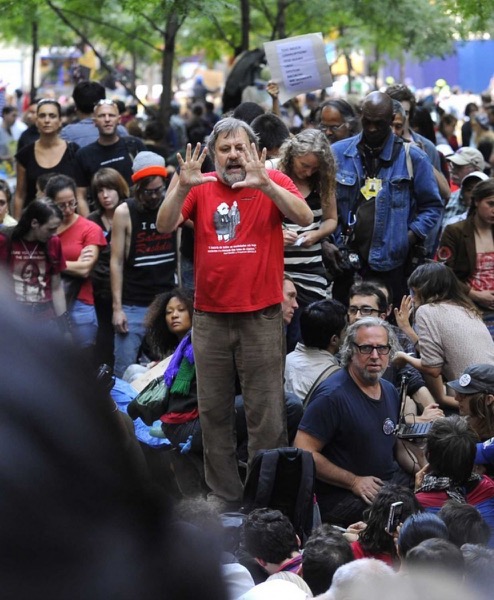
Zizek occupy wall street

2002 words, 10 min read

The Post-Marxist philosopher Slavoj Žižek is perhaps a surprising source of insights about the Holy Spirit, but I believe that his perspective is highly relevant for atheists and Christians alike. My first encounter with his thought on the subject was in a transcript of him addressing Occupy Wall Street protesters at Zuccotti Park in 2011:

“What is Christianity? It’s the Holy Spirit. What is the Holy Spirit? It’s an egalitarian community of believers who are linked by love for each other, and who only have their own freedom and responsibility to do it. In this sense, the Holy Spirit is here now. And down there on Wall Street, there are pagans who are worshipping blasphemous idols.”

Instead of being a throw-away comment of the moment, Žižek’s view of the Holy Spirit is the result of careful reflection from a number of viewpoints.

In a 2007 lecture – entitled “Meditation on Michelangelo’s Christ on the Cross” – he elaborated on how it is that the Holy Spirit is the source of the Christian community and pointed to the radicality of life that such a basis implies:

“The Holy Spirit is the love between believers; it is the spirit of the community of believers, according to the famous words of Christ: “For where two or three have gathered together in my name, I am there in their midst.” (Matthew 18:20) I think this passage should be taken literally. So what does this mean? Even today, the message is very radical. The temptation to be resisted is the temptation of meaning itself. […] I claim that Christ died on the cross precisely to reject […] attempts at finding a higher purpose or meaning. Rather the message is: “Your standards matter to me. I throw myself into creation, and abandon my place up there.” The conclusions are radical. The ultimate meaning of Christianity for me is a very precise one. It is not: “We should trust God. The big guy’s with me, so nothing really bad can happen.” That is too easy. The message is not: “We trust God.” The message is rather: “God trusts us.” The gesture of Christ says, “I leave it over to you.” Usually we read religion as the way to guarantee meaning: We are concerned with the small details of everyday life and never know what will come of it all, or how things will turn out; we can only make wagers, and we do this maybe to ensure that God will arrange things in our favor. But the meaning of the death of Christ for me is the opposite: God made the wager on us. It is really a crazy wager, where God is saying: “I leave it to you. Holy Ghost, community of believers, you have to do it!””

In the same piece Žižek also demonstrates that his thoughts on the Holy Spirit are not merely an analysis from outwith or a thinking about an other, but that they are pertinent to his own context and community:

“[The] link between Christian community and the progressive movement is crucial. And here I’m not playing a cheap game of identifying radical political movements as a kind of religious community; what I’m referring to is the idea of a radical community of believers. The ideal is neither that of blind liberal individuals collaborating with each other, nor the old organic conservative community. It is a community along the lines of the original Christian community: A community of outcasts. We need this today, this idea of an egalitarian community of believers that is neither the traditional heretical community nor the liberal multiplicity. This is why I and many other leftist philosophers, such as Alain Badiou and others, are so interested in rereading, rehabilitating, and reappropriating the legacy of Paul. It is not just a matter of private religious convictions. I claim that if we lose this key moment—the moment of realizing the Holy Spirit as a community of believers—we will live in a very sad society, where the only choice will be between vulgar egoist liberalism or the fundamentalism that counterattacks it. This is why I—precisely as a radical leftist—think that Christianity is far too precious a thing to leave to conservative fundamentalists. We should fight for it. Our message should not be, “You can have it,” but “No, it’s ours. You are kidnapping it.””

Žižek’s thoughts on the Holy Spirit have deeper roots still, which go to the very heart of the Christian mystery of the Trinity and the incarnation. In a 2004 paper entitled “Death’s Merciless Love”, he reflects on how the transcendent-immanent, divine-human gap is resolved by Jesus’ death on the cross, which finds its fulfilment in and unity with the Holy Spirit:

“[I]n order for humanity to be restored to God, [Christ as the mediator between God and humanity] must sacrifice himself. In other words, as long as Christ is here, there can be no Holy Ghost, which IS the figure of the reunification of God and humanity. Christ as the mediator between God and humanity is, to put it in today’s deconstructionist terms, the condition of possibility AND the condition of impossibility between the two: as mediator, he is at the same time the obstacle which prevents the full mediation of the opposed poles. Or, to put it in the Hegelian terms of the Christian syllogism: there are two “premises” (Christ is God’s Son, fully divine, and Christ is man’s son, fully human), and to unite the opposed poles, to arrive at the “conclusion” (humanity is fully united with God in the Holy Spirit), the mediator must erase himself out of the picture. Christ’s death is not part of the eternal cycle of the divine incarnation and death, in which God repeatedly appears and then withdraws into himself, in his Beyond. As Hegel put it, what dies on the Cross is NOT the human incarnation of the transcendent God, but the God of Beyond Himself. Through Christ’s sacrifice, God Himself is no longer beyond, but passes into the Holy Spirit (of the religious community). In other words, if Christ were to be the mediator between two separated entities (God and humanity), his death would mean that there is no longer a mediation, that the two entities are apart again. So, obviously, God must be the mediator in a stronger sense: it’s not that, in the Holy Spirit, there is no longer the need for Christ, because the two poles are directly united; for this mediation to be possible, the nature of both poles must be radically changed, i.e. in one and the same movement, they both must undergo a transubstantiation. Christ is, on the one hand, the vanishing mediator/medium through whose death God-Father himself “passes into” the Holy Spirit, and, on the other hand, the vanishing mediator/medium through whose death human community itself “passes into” the new spiritual stage.

These two operations are not separated, they are the two aspects of one and the same movement: the very movement through which God loses the character of a transcendent Beyond and passes into the Holy Spirit (the spirit of the community of believers) EQUALS the movement through which the “fallen” human community is elevated into the Holy Spirit. In other words, it is not that, in the Holy Ghost, men and God communicate directly, without Christ’s mediation; it is rather that they directly coincide – God is NOTHING BUT the Holy Spirit of the community of believers. Christ has to die not in order to enable direct communication between God and humanity, but because there is no longer any transcendent God with whom to communicate.”

In a 2009 book entitled “The Monstrosity of Christ. Paradox or Dialectic?” and co-authored with the Anglican theologian John Milbank, Žižek challengingly draws the identification of the community of believers with the Holy Spirit and of the Holy Spirit with the crucified and risen Christ to its ultimate conclusion, which is a life at the end of history, a life of “ethical extravagance” and “permanent revolution”:

“There is, however, a third position between these two extremes, that of the Holy Spirit, of the apocalyptic community of believers, of the self-organization dialectical clarity versus the misty conceit of paradox of believers who drew from Christ’s nonreturn after his death the correct conclusion: they were awaiting the wrong thing, Christ already had returned as the Holy Spirit of their community. The very meaning of Christ’s death is that the work to be done is theirs, that Christ put his trust in them. Once we accept this, Eagleton’s reading of Jesus’ “ethical extravagance” also becomes problematic:

“What one might call Jesus’s ethical extravagance—giving over and above the measure, turning the other cheek, rejoicing in being persecuted, loving one’s enemies, refusing to judge, non-resistance to evil, laying oneself open to the violence of others—is . . . motivated by a sense that history is now at an end. Recklessness, improvidence and an over-the-top lifestyle are signs that God’s sovereignty is at hand.There is no time for political organization or instrumental rationality, and they are unnecessary in any case.”

But is this “extravagance” really constrained to the end-of-time atmosphere in which all we can do is wait and get ready for the Second Coming? Is it not that, in an apocalyptic time—the time of the end of time, as Agamben put it—we have both aspects, “ethical extravagance” as well as political organization? The specificity of the Holy Spirit, the apocalyptic emancipatory collective, is that it is precisely an organization which practices these “ethical extravagances,” i.e., which lives its life in an apocalyptic “state of emergency” in which all ordinary legal (and moral) commitments are suspended, practiced in the mode of “as if not.” The problem with the Church is that it betrayed original Christianity not by its organization, but by the type of this organization: the apocalyptic community of believers which lives in the emergency state of a “permanent revolution” is changed into an ideological apparatus legitimizing the normal run of things. In other words, with the Church, we are not active enough: the pressure of the Second Coming is eased, all we have to do is to lead our daily lives following the prescribed ethico-religious rules, and Salvation will come by itself.“

In summary, Žižek’s Holy Spirit – like all of Žižek’s Trinity – invites to a life of radical commitment in the present, to a life lived with and for others and therefore in God, a life steeped in freedom:

“So what I claim is that something absolutely unheard of happens with Christianity which is that Christ, the death of Christ, means something very radical. It means, in all other religions we trust God, we believe in God. The death of Christ [instead] means, God trusted us. It means, “I give you your freedom, it’s up to you.” The Holy Ghost for me is — and I take it literally when it says in the Bible “Whenever the two of you are there, I will be there, I am there.” — it means the gift of freedom. It means, God doesn’t want to play that “up there a guarantee,” it means God entrusts the fate of creation, his own fate, into us. It means what happens here is part of, as it were, the history of God. And […] à propos iconoclasm […]: the prohibition to make images of God in Judaism does not mean this gnostic way “oh it’s too mysterious, we cannot paint it.” It means the exact opposite! It means God is alive not in your stupid deep meditations of up there, but how you act and react with others. And that’s why you shouldn’t make images because it’s not an image to be made up there. And I think, if anything, even more this holds for Christianity. That’s for me what the Holy Ghost is. God is no longer the substantial master up there, God is — to put it in this way — the spirit of our community, the gift of freedom.”

The dialect of faith

Language

1471 words, 7 min read

At the beginning of this year, pope Francis baptised 34 babies in the Sistine Chapel and afterwards addressed their parents with the following opening line: “There is just one thing I want to tell you, something that is up to you: the transmission of the Faith can only be done in “dialect”, in the “language” of the family, the “dialect” or “language” used by the father and mother, the grandfather and grandmother.”

I immediately liked the way Francis framed the question of how faith is transmitted – a topic that has been, and in many cases still is, fraught with difficulty and plagued by pathological perversions like proselytism – and thought that his likening it first to language and then to dialect was a stroke of genius. Also, I couldn’t help but hear “language” in my own “dialect”, which, naturally, speaks with a Viennese accent and thinks in the categories of the later Wittgenstein. I couldn’t help but think about his concept of the language-game (“Sprachspiel”), its setting in an infantile context and its complete rootedness in participativeness, self-othering and community, all of which fit Francis’ intentions like a glove.

More recently I have been thinking about what this dialect of faith is like that has been passed to me in the games my family played when I was a kid, which is what I’d like to reflect on in this post.

For a start, a bit of context: I grew up in a communist country, in a family that was deeply involved in the life of the underground Catholic Church. This gave its dialect a distinctly edgy and adventurous twang. My mum and dad took great risks for the sake of the language game of faith, which made progress the more rewarding and the stakes scarily high. As is the case with most kids though, my siblings and I were, thankfully, not fully aware of the dangers at the time. Our parents took us to events organised by a then very young movement in the Church, whose activities – like any other non-commumist-party-organized group activities at the time – were wholly illegal. This lead to the need for elaborate ruses, like pretending that it was someone’s birthday (and everyone knowing whose birthday it is supposed to be in case the police arrived) when the actual purpose of a gathering was to read the Gospel, share experiences of putting it into practice and encourage each other in doing so even under the extreme circumstances at the time.

Not only did we participate in such events, but my dad deliberately built our house to allow for large meetings to take place there. Our living room has always seemed excessively large to me, until I discovered that my dad built it (no, not “had it built”, “built it”) with a floor especially reinforced to hold the groups of 60+ people who often met there. Looking back, this was made even more reckless and dangerous given who our neighbour was – a veteran and hero of the communist resistance army from WWII and a zealous party member, who could have denounced us to the secret police in a heartbeat.

Miraculously, my dad at one point got a job in a neighbouring, non-communist country – an event reserved for the very few and only for the party faithful. My dad getting the job with all he was doing in secret and with his brother being a priest was baffling and lead to even greater risks. My mum and dad immediately saw this as an opportunity for serving the underground community they were part of by connecting it to its members on the other side of the Iron Curtain. They regularly smuggled books and audio recordings across the border for which they would have been sent to prison. One of my most vivid memories from that period is crossing the border, which was quite an elaborate game! You’d first get stopped some miles from the border itself at a barrier with armed soldiers, who would check your papers, telephone the border post and after what seemed like half an eternity, raise the barrier and let you enter the barren no man’s land behind the barbed wire fence – a stretch of land dotted with guard towers. At the border, papers would be checked again, questions would be asked, the underside of the car would be inspected with mirrors and dogs would put their olfactory senses to official use. Our parents always told us to not answer any questions whatsoever – just to say we don’t know and say that they, our parents, would answer. We, kids, found this rather odd and asked: “What if they ask my name?”. Sometimes the game at the border involved having the car practically disassembled – seats being unbolted and removed, knives being stuck into any food we were carrying to make sure they didn’t contain the seeds of the communist regime’s destruction.

At the same time those “seeds”, sought so diligently by the communist regime were there, for everyone to be seen in plain sight: my dad’s constant kindness and politeness when dealing with the border guards. Over the years he’d learn their names, strike up conversations and do precisely what the game of our Christian faith was all about: to love all like Jesus loved us. This, in fact is the first and most persistent rule of the dialect that was spoken in our home.

What sticks most vividly in my mind here are the first minutes of pretty much any car journey we took from home. No matter where we were going, whom we were going to visit or what errand needed to be run, by the time we go to the bottom of the hill my mum and dad’s house is on, my dad would – following the implicit rules of our game – ask: “Why are we going to [visit X / do Y / or travel to Z]?” And we, who played the game well too, would answer – sometimes enthusiastically, at other times out of a sense of obligation – “To love whomever we meet there!” It didn’t matter what were about to do, this “handshake” was a tuning of our instruments, a directing of our minds and wills towards the good of those we were going to encounter.

Now, for the game to be effective the “rules” had to be practiced and their application had to be demonstrated. And there was no shortage here! My dad would give his hat and gloves to a man guarding a car park in the middle of winter (and winter where I come from is winter indeed, with temperatures down to -20°C), would let a homeless man stay in our basement, providing him with clothes and food too; my mum would visit sick friends or acquaintances in hospital, cooking the most delicious meals for them and care for them at times when others could or would not visit them. My parents would be the ones there at the ends of their lives. Our house was always a cross-roads of people staying for shorter or longer periods, coming for advice and support (including a student whose priestly vocation was sustained by my dad during his military service and who is now a bishop), not to mention the hundreds of people over the years for whom my dad helped find work, a service so central to what it is to be human, as Pope Francis frequently emphasises.

Like all good games, the one we were taught was not a walk in the park or even just a challenge that took hard work but where the rewards were sure to follow. There was plenty of misunderstanding, clashes of personalities and even downright slander and ill will. A painful example here has been the expulsion of my dad from the heart of very community for which he risked his and his family’s freedom during the communist regime and to which he gave so much over many decades. Yet, this was also an opportunity for him to show us, his kids, how the game of the Gospel is played, with what dialect it is spoken in our family. In spite of the injustice done to him, he never turned on those responsible for it and has instead been both on the look-out for continuing to participate, albeit at the periphery, and supportive of us – his children – to continue being involved in it.

Thinking about my childhood, but also my adult life, I can see clearly how it is the Gospel that my mum and dad have made the language, the dialect of their family. The Gospel, where God’s self-noughting, self-othering love draws humanity into itself and where humanity, like a child, giddy with enthusiasm at times, nursing its wounds at others, learns and re-learns to take wobbly steps towards its family, the Trinity.

What I lack that God might give me through the other

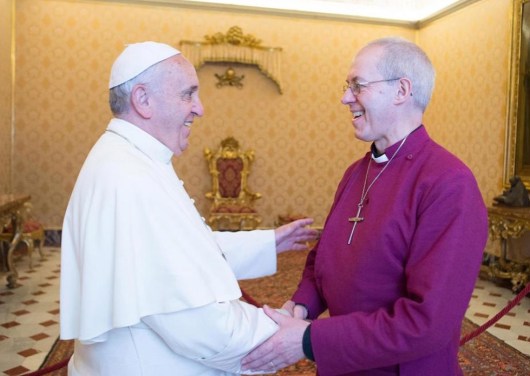
Welby francis

3344 words, 17 min read

A new fruit of the ecumenical dialogue between the Anglican Communion and the Catholic Church was published on 2nd July, entitled “ARCIC III – Walking Together on the Way. Learning to Be the Church—Local, Regional, Universal”. It is a 34K word report on the work of ARCIC, the Anglican–Roman Catholic International Commission, which was first set up in 1969 and which has looked into a number of topics over the decades of its existence. The latest one is on what it means to be Church at local, regional (trans-local) and world-wide levels and, crucially, how the two communities can learn from each other – the central idea of “receptive ecumenism”. Others have already reported well on this important document (e.g., see here or here), and what I would like to do instead is to offer a selection of passages that will, in under 3.5K words, give a flavor of the full 34K word document, whose reading in its entirety I wholeheartedly recommend:


“The document published here is the work of the Anglican–Roman Catholic International Commission. It is a joint statement of the Commission. The authorities who appointed the Commission have allowed the statement to be published so that it may be widely discussed. It is not an authoritative declaration by the Roman Catholic Church or by the Anglican Communion, which will evaluate the document in order to take a position on it in due time.” (Preamble)

“ARCIC III believes that the time is ripe to pursue the task of ecumenical engagement as one that includes explicit ecclesial self-critique. It is not enough to recognize that there is something of gift and grace in the other. We must explore what God has given to our partners which, as Pope Francis has said, ‘is also meant to be a gift for us’ (Evangelii Gaudium §246). This is particularly so when such ‘treasure[s] to be shared’ (Anglicanorum Coetibus, §III) address difficulties in one’s own tradition.” (§17)

“This method, commonly called receptive ecumenism, is an approach which is strongly influenced by Pope John Paul II’s request of church leaders and theologians from other traditions to help reimagine the practice of papacy (Ut Unum Sint §§95–96). It is deeply resonant with the respective teachings of Pope Francis (Evangelii Gaudium §246, cited above) and Archbishop Justin Welby. Preaching at Westminster Abbey in 2016 when celebrating fifty years of the Anglican Centre in Rome, the Archbishop said: ‘The habits of the centuries render us comfortable with disunity … I pray that ARCIC disrupts our disunity … it must develop its especial genius of a spirit of receptive ecumenism: of asking not what we might give the other, but what we lack that God might give us through the other.’” (§18)

“Archbishop Justin Welby and Pope Francis have both used the image of ‘walking together’ on the path to full communion to describe our ecumenical relations. We are indeed fellow pilgrims journeying at the summons of God’s Word, through the difficult terrain of a rapidly changing world. We encounter very similar difficulties along the way, and we struggle to discern what faithful obedience demands. Walking together means that, as travelling companions, we tend each other’s wounds, and that we love one another in our woundedness. This journey that we undertake, which is a walking together into increasing degrees of communion despite difference, bears powerful and urgent witness to the world as to what it means to live difference well for mutual flourishing.” (§21)

“Acts 15 has been understood as a model of how the early Church made decisions and guided the community in Christian living that tried to maintain the unity of the existing communion while at the same time recognizing the growing diversity of the rapidly expanding Church. In the local church of Antioch, as depicted in the Lucan narrative, Greeks were being converted to the Gospel, with the approval of the church at Jerusalem (Acts 11.19ff). Problems arose as to whether these Gentile converts needed to be circumcised and to keep the Law of Moses in order to be baptized as followers of Jesus (Acts 15.1–2). Unable to resolve this question on its own, the church of Antioch sent a delegation (Paul and Barnabas) to consult the church in Jerusalem, implicitly, therefore, recognizing the authority of that church. Luke presents us with an encounter of respectful mutual listening: the leaders of the church in Jerusalem listened to the experiences of representatives of the local church of Antioch, and then the latter listened to the arguments developed by the leaders of the Jerusalem church. The decision taken was under the guidance of the Holy Spirit (15.28), in accord with the Scripture (15.16–18), and involved the whole Church (15.4, 5, 12, 22). The narrative is a programmatic guide to preserving the koinonia [communion] in a context of dispute. The practice of a local church (Antioch) must be examined and approved by the church that is regarded as the primary guardian of the apostolic tradition (Jerusalem), and this church, in turn, must attend to the pastoral and mission struggles of each particular community. The aim is to achieve, in the power of the Spirit, the unanimity that bears witness to the mind of Christ (Life in Christ: Morals, Communion and the Church §§23–26).” (§35)

“The following main sections (IV–VI) focus on the relationship between the local and the trans- local dimensions of ecclesial life. They explore structures within our respective traditions and reflect on what each might fruitfully learn from the other. Anglicans and Catholics have some differing understandings, practices, and structures, as well as differences of vocabulary (see ‘Usage of Terms’). The aim here is not to eradicate these differences. The point rather is to ask how each might be a resource for the other so that what is experienced as grace and benefit in one might help address what is less developed in the other.” (§46)

“Anglicans and Catholics also recognize that the faithful People of God, thanks to their baptism, share an instinct for the faith (sensus fidei fidelium), the spiritual gift of discernment of the truth (see The Gift of Authority (Authority in the Church III) §§29–30; also Sensus Fidei in the Life of the Church). The sense of faith grows through a life of strong charity and regular religious practice, each of which promotes communion between the faithful and God, who is love. One who loves Love and welcomes Love has a symbiotic relationship with God and, thereby, a sense of who God is, what God expects of us, and the kind of happiness Christ promises. Therefore, the sense of the faith means that the authentic transmission of the faith is not only the preserve of the magisterium and theologians, but also of saintly parents and holy men, women and children who know God ‘from within’ and have a sense of what conforms to God’s designs for human beatitude. The further implication, then, is that the Church’s indefectibility, as well as the experience of disagreement in the Church, demands structures which will facilitate the fullest possible sharing of the experience of Christ and of the gifts of the Spirit among all the baptized. Through prayer, debate, discussion, and study, the Church at every level seeks consensus with the assistance of the Spirit, even if variously formulated. This process of discernment of the mind of Christ can take time. It is this task of discovering which ‘calls for continuing discernment, constant repentance and renewing of the mind (Romans 12)’ (Life in Christ: Morals, Communion and the Church §29).” (§54)

Worldwide communion for Catholics is determined by communion with the Bishop of Rome.
For the Catholic Church, it is possible for one local church to be in communion with another local church only when the bishop of each is in communion with the Bishop of Rome (see LG §23 and CN §13). One local Catholic church cannot be in full communion with another local church whose bishop is not in communion with the Bishop of Rome.

Worldwide communion for Anglicans with the Archbishop of Canterbury
Anglicans hold an understanding of a global communion centred on the See of Canterbury. The consequences for Anglicans of communion with the Archbishop of Canterbury differ from the consequences for Catholics of communion with the Bishop of Rome. Currently within the Anglican Communion there exist provincial churches which are in communion with the Archbishop of Canterbury but refuse to be in communion with other provincial churches that are also in communion with the Archbishop of Canterbury (see Lambeth Conference 1998, Resolution IV.11). There are also provincial churches in communion with the Archbishop of Canterbury which claim communion with other churches that are not in communion with the Archbishop of Canterbury. For Anglicans all of these situations are anomalous, and some are deeply painful. Other anomalies, of a more positive kind, are found, for example, in the full communion relationships shared between Lutherans and Anglicans in both the USA and Canada. Lambeth 1998 stated that ‘… some anomalies may be bearable when there is an agreed goal of visible unity, but … there should always be an impetus towards their resolution and, thus, towards the removal of the principal anomaly of disunity’ (Resolution IV.1.3).” (§63-64)

“Today’s sober appreciation of the long-term nature of the ecumenical calling (see §§5–6 and 10) has coincided with the recognition within each of our traditions of our respective difficulties and the need for processes of reform and renewal. We suggest that the current twofold task, as we seek to walk the way towards full communion, is (i) to look humbly at what is not working effectively within one’s own tradition, and (ii) to ask whether this might be helped by receptive learning from the understanding, structures, practices, and judgements of the other. The opportunity is to teach by showing what it means to learn and to bear witness by showing what it means to receive in our need—recognizing that at times the members of one tradition may judge that the practices and structures of the other will not, in a given instance, be helpful.” (§78)

Local level example:

“Anglican receptive learning about participation in the greater whole 
Anglicans are faced with the question of commitment to the unity of the Church, both for the local diocesan church and for the wider Communion. A catholic instinct for unity and participation in a greater whole is a deeply embedded value. Where Anglicans find themselves in situations of fragmentation, they may ask what ecclesial learning can be explored in relation to Roman Catholic universal identity.

Roman Catholic receptive learning about the need for open conversation The quality of Roman Catholic conversation at parochial and diocesan levels could be enriched by learning from Anglican experience of open and sometimes painful debate while the Church is in process of coming to a common mind (Theology Today: Perspectives, Principles, and Criteria §52).” (§101)

Worldwide level example:

“In appreciation of the Roman Catholic commitment to episcopal collegiality in discernment, Anglican bishops could learn from the recent synods of Catholic bishops. Given that it is not feasible to hold the Lambeth Conference at a greater frequency than once a decade, the model of smaller, more frequent synods of bishops for the exploration of particular issues with intensive consultation and dialogue could provide additional opportunities for episcopal discernment. The opportunity for deeper theological and pastoral deliberation, with local input and subsequent gatherings for follow-up, would be welcome.

The manner in which Pope Francis listened to and articulated debate within the Roman Catholic Church, as reflected in the two recent Synods on the Family in Amoris Lætitia, has been carefully observed by Anglicans. His encouragement of subsidiarity in the determination of divisive pastoral issues could well be such an area of receptive learning (Amoris Lætitia §3).


In light of the difficulties experienced hitherto with the Synod of Bishops, two reforms born of receptive learning from Anglican practice are possible which would render the quality of universal collegiality practised there more effective.

First, Pope Francis’s commendation of frank conversation at the Synod raises the question as to whether the quality of synodal conversation and exchange might be enhanced by learning from the Anglican experience of indaba at and since Lambeth 2008. This might model a healthy revitalizing of Roman Catholic conversation which would be of relevance to every level of Roman Catholic life. Second, in line with existing canonical provision and again recognizing the need to preserve the executive function of the Bishop of Rome as head of the college of bishops, Anglican models could be drawn upon in order to move the Synod from being a purely consultative body54 to being a deliberative body, which is foreseen in the Code of Canon Law (see c. 343).” (§146)

Instruments of communion and their imperfection
The term ‘instruments of communion’ emerged in Anglican usage. The Commission found that it could also be applied to Roman Catholic structures and procedures. The Commission recognizes that Anglicans and Catholics share a common heritage. Only in the sixteenth century did the structures and procedures of our two traditions break apart, and in many ways they remain similar. These instruments are seen as prompted by the Holy Spirit and as tokens of divine providence. However, they have developed in the course of history and have been influenced in their form as they have sought to meet the challenge of changing circumstances. As such, even when regarded as essential they are also open to reform. The Commission asks how well the respective structures and procedures we have inherited serve as instruments of communion for the mission of the Church today. The Commission also asks what each tradition can learn from the inheritance of the other, and how far each tradition needs to undergo conversion, renewal, and reform. This requires humility and repentance.” (§152)

Common affirmations concerning the Church local, trans-local, and universal
There are significant aspects which both of our traditions affirm, albeit with characteristically differing emphases. Each affirms a fullness of ecclesial reality at the level of the diocese gathered around its bishop, together with a relative autonomy of church at this level. Each also affirms the need for the local churches to be interrelated at the various trans-local levels of province, nation, region, and worldwide communion. The trans-local organization of the churches is a clear sign that the Church wants to reach out to the human reality in the diversity of cultures, nations, and even continents. The trans-local structuring of churches has a theological and ecclesiological meaning; it is not simply a sociological necessity: it is an expression of the catholicity of the Church. Catholics and Anglicans agree that the People of God, that is, all the baptized as a whole, are endowed with the unfailing instinct for the faith. Therefore, in discerning matters of faith and morals, Catholics and Anglicans must give attention to what the Spirit may be saying in the other tradition before arriving at a definitive conclusion for their own particular tradition.” (§153)

“In Ut Unum Sint §34 Pope John Paul II speaks of the essential role of examination of conscience in ecumenical dialogue: our ecumenical dialogue needs to be a ‘dialogue of consciences’. Recognizing that many sins have contributed to our historical divisions, he states that ‘Christian unity is possible, provided that we are humbly conscious of having sinned against unity and are convinced of our need for conversion.’ He continues, ‘not only personal sins must be forgiven and left behind, but also social sins, which is to say the sinful “structures” themselves which have contributed and can still contribute to the reinforcing of division.’ In his address at Vespers on the occasion of the fiftieth anniversary of the Anglican Centre in Rome, Archbishop Justin Welby, commenting on a daily prayer used at Lambeth Palace, notes:


It is a prayer that recognises the past and present, our sin—and yet comes back to God, who calls us to be one, because to be one is the only way to lead a life worthy of the calling to which we have been called. The difficulty which the prayer faces full on is that the habits of the centuries render us comfortable with disunity—even more so when there is the apparatus of dialogue. Dialogue can be an opiate, dulling the pain of separation; or it can be a stimulant, confronting us with the need for repentance and change.58

For Anglicans and Catholics their respective confessional identities—cherishing the role of the local and regional church (Anglican) and placing high priority on the need for ecclesial unity and coherence (Roman Catholic)—are valued as gifts of grace and providence. Nevertheless these identities themselves are not unaffected by sin, as can be seen when the concern for autonomy becomes one of outright independence and when the concern for ecclesial unity and coherence becomes excessive centralized power. Hence there is the need for ecclesial repentance and for reform of our instruments of communion in this respect. The proposals for mutual receptive learning summarized in the paragraphs below are the first step in taking up the vision of a Church fully reconciled.” (§154)

Roman Catholic receptive learning from Anglicans
The discernment of proper teaching, sound governance, and appropriate pastoral care requires a healthy and open conversation in the Church. In the judgement of the Commission, the Roman Catholic Church can learn from the culture of open and frank debate that exists at all levels of the Anglican Communion, evidenced by the indaba process, for example. The Anglican practice of granting a deliberative role to synods and of investing authority in regional instruments of communion indicates that the Synod of Bishops could be granted a deliberative role and further suggests the need for the Roman Catholic Church to articulate more clearly the authority of episcopal conferences. Mindful of the participation in the threefold office of Christ of both laity and the ordained, the Catholic Church can fruitfully learn from the inclusion of laity in decision-making structures at every level of Anglican life.” (§157)

Anglican receptive learning from the Roman Catholic Church
Receptive learning for Anglicans from Roman Catholic ecclesial life begins with an appreciation for the depth of commitment to the unity of the universal Church. In the judgement of the Commission, a renewed commitment to this ethos of unity would be strengthened through commitments such as: the use of at least one common, modern eucharistic prayer across the Communion; the provision of an approved common catechism; formal reception of the Principles of Canon Law Common to the Churches of the Anglican Communion; further exploration of the role of the See of Canterbury and its cathedral as the seat of the Archbishop as a focus of unity; and the practice of pilgrimage visits by bishops to meet with the Archbishop of Canterbury for prayer and consultation. Receptive learning from Roman Catholic expressions of episcopal leadership would include reflection on: diverse communities in full communion with one another in the same region; models of episcopal consultation and deliberation as seen in episcopal conferences and the Synod of Bishops as recently developed; the normative presence of a voice from outside the province, representing the wider Church in the deliberations and life of a regional church; and clarity of recognized processes for discernment, communication, and reception of authoritative teachings and decisions.” (§158)


I have to say that reading this document has been a great source of joy and hope for me. Above all, it struck me as more than good intentions, as an actual fruit of what Archbishop Welby and Pope Francis have been talking about: of fellow pilgrims journeying together, facing the same challenges along the way and learning from each other, helping each other ahead, recognizing in principle and in practice that they are travelling together. Seeing these two “pilgrims” working together, seeing what is good in the other’s style of pilgrimage and being open and humble about their own limitations in progressing along the way strikes me as the bud from which tangible, visible unity may grow.

Jesus, with feeling

Paulklee144 v vierspaltig

1424 words, 7 min read

While the focus in the Gospels is mostly on what Jesus said and did, the Evangelists in some cases also report how they thought he felt, which is what I would like to look at in this post.1 Reading the Gospels with this aspect of Jesus in mind underlines the sense that it is his words and actions that were of greatest concerns to their authors, with little thought given most of the time to what Jesus’ emotional life might have been at any given moment. This makes the few explicit reference to his feelings the more interesting since they seem to point to instances where Jesus’ feelings were either not obvious (he may have done or said a certain thing in different states), a key to understanding his subsequent actions or of particularly high importance.

For a start, and unsurprisingly, Jesus felt love towards others, alongside loving them by what he said and did. Mark tells us about this being Jesus response to a man who observed the commandments since his youth:

“Jesus, looking at him, loved him and said to him, “You are lacking in one thing. Go, sell what you have, and give to [the] poor and you will have treasure in heaven; then come, follow me.”” (Mark 10:21)

And he also felt love towards his friends:

“Now Jesus loved Martha and her sister and Lazarus.” (John 11:5)

Jesus also felt hunger, as all three synoptic Gospels report. Matthew and Luke speak about Jesus’ understandable hunger after 40 days of fasting in the desert:

“He fasted for forty days and forty nights, after which he was hungry.” (Matthew 4:2)

“Filled with the holy Spirit, Jesus returned from the Jordan and was led by the Spirit into the desert for forty days, to be tempted by the devil. He ate nothing during those days, and when they were over he was hungry.” (Luke 4:1-2)

Mark instead tells us about Jesus’ hunger as a way to set the scene for the episode where he curses a fig tree for bearing no fruit out of season:

“The next day as they were leaving Bethany he was hungry.” (Mark 11:12)

Beyond the strongly biological, the Evangelists also report Jesus feeling amazed and astonished, in all cases in the face of faith or the lack thereof. Matthew and Luke tell us about Jesus’ response to the unexpected faith of the Roman Centurion, whose daughter is ill and who takes it as a given that Jesus has the power to heal here even at a distance:

“When Jesus heard this he was astonished and said to those following him, ‘In truth I tell you, in no one in Israel have I found faith as great as this.” (Matthew 8:10)

“When Jesus heard this he was amazed at him and, turning, said to the crowd following him, “I tell you, not even in Israel have I found such faith.”” (Luke 7:9)

Mark, instead reports the complement – Jesus’ amazement at the lack of faith in his own home town of Nazareth:

“He was amazed at their lack of faith.” (Mark 6:6)

Jesus also takes such surprise and responds to it with greater displeasure by being stern and strict when he wants to emphasise that his instructions are to be adhered to without fail. Mark reports this attitude when Jesus admonishes unclean spirits not to reveal his true nature:

“He warned them sternly not to make him known.” (Mark 3:12)

Matthew first mentions this when describing how Jesus spoke to two blind men whom he cured:

“And their sight returned. Then Jesus sternly warned them, ‘Take care that no one learns about this.’” (Matthew 9:30)

and then when describing Jesus’ reaction to Peter declaring who he thought Jesus was:

“Then he strictly ordered his disciples to tell no one that he was the Messiah.” (Matthew 16:20)

Sternness becomes indignation, as far as Mark is concerned, when he describes Jesus discovering that his disciples wouldn’t let kids come to him:

“When Jesus saw this he became indignant and said to them, “Let the children come to me; do not prevent them, for the kingdom of God belongs to such as these.”” (Mark 10:14)

And Jesus even feels anger and grief when the good he does – of curing a man’s hand – is disapproved of:

“Looking around at them with anger and grieved at their hardness of heart, he said to the man, “Stretch out your hand.” He stretched it out and his hand was restored.” (Mark 3:5)

Jesus then feels perturbed and troubled upon receiving news of his friend Lazarus’ death:

“When Jesus saw her weeping and the Jews who had come with her weeping, he became perturbed and deeply troubled, and said, “Where have you laid him?” They said to him, “Sir, come and see.” And Jesus wept. […] So Jesus, perturbed again, came to the tomb. It was a cave, and a stone lay across it.” (John 11:33-35,38)

The same feelings return to Jesus on the night before his crucifixion. First, already during the last supper, after washing the disciples’ feet and telling them that one of them will betray him:

“When he had said this, Jesus was deeply troubled and testified, “Amen, amen, I say to you, one of you will betray me.”” (John 13:21)

Then, on the way to the Garden of Gethsemane, when feelings of sorrow accompany his distress and being troubled:

“He took along Peter and the two sons of Zebedee, and began to feel sorrow and distress.” (Matthew 26:37)

“He took with him Peter, James, and John, and began to be troubled and distressed. Then he said to them, “My soul is sorrowful even to death. Remain here and keep watch.”” (Mark 14:33-34)

Finally, the time in the Garden culminates in feeling agony:

“He was in such agony and he prayed so fervently that his sweat became like drops of blood falling on the ground.” (Luke 22:44)

However, the feeling most often reported by the Evangelists is one of compassion – of feeling pity and feeling sorry for the condition others are in. Jesus felt this for the public at large as he was teaching in towns and villages:

“And when he saw the crowds he felt sorry for them because they were harassed and dejected, like sheep without a shepherd.” (Matthew 9:36)

And he felt this in particular who followed him even to deserted places with a disregard for their own needs:

“When he disembarked and saw the vast crowd, his heart was moved with pity for them, and he cured their sick.” (Matthew 14:14)

“When he disembarked and saw the vast crowd, his heart was moved with pity for them, for they were like sheep without a shepherd; and he began to teach them many things.” (Mark 6:34)

“My heart is moved with pity for the crowd, because they have been with me now for three days and have nothing to eat.” (Mark 8:2)

Feelings of pity were also elicited in Jesus by individuals at the periphery of society, like a leper and two blind men, whose healing was triggered by his feelings:

“Moved with pity, Jesus touched their eyes. Immediately they received their sight, and followed him.” (Matthew 20:34)

“Moved with pity, he stretched out his hand, touched him, and said to him, “I do will it. Be made clean.”” (Mark 1:41)

Finally, pity was a also how Jesus felt when seeing a widow from Nain mourn her dead son:

“When the Lord saw her, he was moved with pity for her and said to her, “Do not weep.”” (Luke 7:13)

What strikes me most about having read the Gospels through the lens of Jesus’ emotions is that they point to his having engaged with the world fully and richly, responding to it with great closeness at certain times and with forceful rejection and condemnation at others. His feelings in some cases grew out of his own self (bodily and psychologically) while in others they came about as reactions to events unfolding around him. Instead of an aloof, otherworldly apparition come to deliver a message, Jesus clearly had preferences, needs and dislikes, making himself one with us and therefore showing the way to a life of fulfilment through compassion and self-giving.


1 Two principles guided my choices: first, to look for instances where it is the Evangelists who directly describe Jesus’ feelings (i.e., I left out verses where his actions are described and where these could be used to infer his feelings), and second to try and be exhaustive.

Gaudete et Exsultate: God’s face reflected in so many other faces

Faces

6590 words, 33 min read

At Roman noon today, Pope Francis published his latest apostolic exhortation, entitled Gaudete et Exsultate (“Rejoice and be glad”) in which he sets out “to repropose the call to holiness in a practical way for our own time, with all its risks, challenges and opportunities. For the Lord has chosen each one of us “to be holy and blameless before him in love” (Eph 1:4).” (§2). This 126K word document will take some time to receive and internalize well and I would, for now, just like to share with you my favorite passages from it. The holiness Pope Francis presents here is one that has its eyes wide open to the world and to God present in it. It is a holiness that asks for everything and that gives more in return. A holiness that requires sacrifice to the smallest details and that offers fulfilment and endless joy in a community where God dwells among his people.


I like to contemplate the holiness present in the patience of God’s people: in those parents who raise their children with immense love, in those men and women who work hard to support their families, in the sick, in elderly religious who never lose their smile. In their daily perseverance I see the holiness of the Church militant. Very often it is a holiness found in our next-door neighbours, those who, living in our midst, reflect God’s presence. We might call them “the middle class of holiness”. (§7)

Holiness is the most attractive face of the Church. But even outside the Catholic Church and in very different contexts, the Holy Spirit raises up “signs of his presence which help Christ’s followers” (Novo Millennio Ineunte). Saint John Paul II reminded us that “the witness to Christ borne even to the shedding of blood has become a common inheritance of Catholics, Orthodox, Anglicans and Protestants”. In the moving ecumenical commemoration held in the Colosseum during the Great Jubilee of the Year 2000, he stated that the martyrs are “a heritage which speaks more powerfully than all the causes of division”. (§9)

We should not grow discouraged before examples of holiness that appear unattainable. There are some testimonies that may prove helpful and inspiring, but that we are not meant to copy, for that could even lead us astray from the one specific path that the Lord has in mind for us. The important thing is that each believer discern his or her own path, that they bring out the very best of themselves, the most personal gifts that God has placed in their hearts (cf. 1 Cor 12:7), rather than hopelessly trying to imitate something not meant for them. We are all called to be witnesses, but there are many actual ways of bearing witness. (§11)

To be holy does not require being a bishop, a priest or a religious. We are frequently tempted to think that holiness is only for those who can withdraw from ordinary affairs to spend much time in prayer. That is not the case. We are all called to be holy by living our lives with love and by bearing witness in everything we do, wherever we find ourselves. Are you called to the consecrated life? Be holy by living out your commitment with joy. Are you married? Be holy by loving and caring for your husband or wife, as Christ does for the Church. Do you work for a living? Be holy by labouring with integrity and skill in the service of your brothers and sisters. Are you a parent or grandparent? Be holy by patiently teaching the little ones how to follow Jesus. Are you in a position of authority? Be holy by working for the common good and renouncing personal gain. (§14)

When you feel the temptation to dwell on your own weakness, raise your eyes to Christ crucified and say: “Lord, I am a poor sinner, but you can work the miracle of making me a little bit better”. In the Church, holy yet made up of sinners, you will find everything you need to grow towards holiness. The Lord has bestowed on the Church the gifts of scripture, the sacraments, holy places, living communities, the witness of the saints and a multifaceted beauty that proceeds from God’s love, “like a bride bedecked with jewels” (Is 61:10). (§15)

This holiness to which the Lord calls you will grow through small gestures. Here is an example: a woman goes shopping, she meets a neighbour and they begin to speak, and the gossip starts. But she says in her heart: “No, I will not speak badly of anyone”. This is a step forward in holiness. Later, at home, one of her children wants to talk to her about his hopes and dreams, and even though she is tired, she sits down and listens with patience and love. That is another sacrifice that brings holiness. Later she experiences some anxiety, but recalling the love of the Virgin Mary, she takes her rosary and prays with faith. Yet another path of holiness. Later still, she goes out onto the street, encounters a poor person and stops to say a kind word to him. One more step. (§16)

At times, life presents great challenges. Through them, the Lord calls us anew to a conversion that can make his grace more evident in our lives, “in order that we may share his holiness” (Heb 12:10). At other times, we need only find a more perfect way of doing what we are already doing: “There are inspirations that tend solely to perfect in an extraordinary way the ordinary things we do in life”. When Cardinal François-Xavier Nguyên van Thuân was imprisoned, he refused to waste time waiting for the day he would be set free. Instead, he chose “to live the present moment, filling it to the brim with love”. He decided: “I will seize the occasions that present themselves every day; I will accomplish ordinary actions in an extraordinary way”. (§17)

At its core, holiness is experiencing, in union with Christ, the mysteries of his life. It consists in uniting ourselves to the Lord’s death and resurrection in a unique and personal way, constantly dying and rising anew with him. But it can also entail reproducing in our own lives various aspects of Jesus’ earthly life: his hidden life, his life in community, his closeness to the outcast, his poverty and other ways in which he showed his self-sacrificing love. The contemplation of these mysteries, as Saint Ignatius of Loyola pointed out, leads us to incarnate them in our choices and attitudes. (§20)

The Father’s plan is Christ, and ourselves in him. In the end, it is Christ who loves in us, for “holiness is nothing other than charity lived to the full”. As a result, “the measure of our holiness stems from the stature that Christ achieves in us, to the extent that, by the power of the Holy Spirit, we model our whole life on his”. Every saint is a message which the Holy Spirit takes from the riches of Jesus Christ and gives to his people. (§21)

It is not healthy to love silence while fleeing interaction with others, to want peace and quiet while avoiding activity, to seek prayer while disdaining service. Everything can be accepted and integrated into our life in this world, and become a part of our path to holiness. We are called to be contemplatives even in the midst of action, and to grow in holiness by responsibly and generously carrying out our proper mission. (§26)

Needless to say, anything done out of anxiety, pride or the need to impress others will not lead to holiness. We are challenged to show our commitment in such a way that everything we do has evangelical meaning and identifies us all the more with Jesus Christ. We often speak, for example, of the spirituality of the catechist, the spirituality of the diocesan priesthood, the spirituality of work. For the same reason, in Evangelii Gaudium I concluded by speaking of a spirituality of mission, in Laudato Si’ of an ecological spirituality, and in Amoris Laetitia of a spirituality of family life. (§28)

This does not mean ignoring the need for moments of quiet, solitude and silence before God. Quite the contrary. The presence of constantly new gadgets, the excitement of travel and an endless array of consumer goods at times leave no room for God’s voice to be heard. We are overwhelmed by words, by superficial pleasures and by an increasing din, filled not by joy but rather by the discontent of those whose lives have lost meaning. How can we fail to realize the need to stop this rat race and to recover the personal space needed to carry on a heartfelt dialogue with God? Finding that space may prove painful but it is always fruitful. (§29)

We need a spirit of holiness capable of filling both our solitude and our service, our personal life and our evangelizing efforts, so that every moment can be an expression of self-sacrificing love in the Lord’s eyes. In this way, every minute of our lives can be a step along the path to growth in holiness. (§31)

Do not be afraid of holiness. It will take away none of your energy, vitality or joy. On the contrary, you will become what the Father had in mind when he created you, and you will be faithful to your deepest self. To depend on God sets us free from every form of enslavement and leads us to recognize our great dignity. We see this in Saint Josephine Bakhita: “Abducted and sold into slavery at the tender age of seven, she suffered much at the hands of cruel masters. But she came to understand the profound truth that God, and not man, is the true Master of every human being, of every human life. This experience became a source of great wisdom for this humble daughter of Africa”. (§32)

When somebody has an answer for every question, it is a sign that they are not on the right road. They may well be false prophets, who use religion for their own purposes, to promote their own psychological or intellectual theories. God infinitely transcends us; he is full of surprises. We are not the ones to determine when and how we will encounter him; the exact times and places of that encounter are not up to us. Someone who wants everything to be clear and sure presumes to control God’s transcendence. (§42)

It is not easy to grasp the truth that we have received from the Lord. And it is even more difficult to express it. So we cannot claim that our way of understanding this truth authorizes us to exercise a strict supervision over others’ lives. Here I would note that in the Church there legitimately coexist different ways of interpreting many aspects of doctrine and Christian life; in their variety, they “help to express more clearly the immense riches of God’s word”. It is true that “for those who long for a monolithic body of doctrine guarded by all and leaving no room for nuance, this might appear as undesirable and leading to confusion”. (§43)

Only on the basis of God’s gift, freely accepted and humbly received, can we cooperate by our own efforts in our progressive transformation. We must first belong to God, offering ourselves to him who was there first, and entrusting to him our abilities, our efforts, our struggle against evil and our creativity, so that his free gift may grow and develop within us: “I appeal to you, therefore, brethren, by the mercies of God, to present your bodies as a living sacrifice, holy and acceptable to God” (Rom 12:1). For that matter, the Church has always taught that charity alone makes growth in the life of grace possible, for “if I do not have love, I am nothing” (1 Cor 13:2). (§56)

Still, some Christians insist on taking another path, that of justification by their own efforts, the worship of the human will and their own abilities. The result is a self-centred and elitist complacency, bereft of true love. This finds expression in a variety of apparently unconnected ways of thinking and acting: an obsession with the law, an absorption with social and political advantages, a punctilious concern for the Church’s liturgy, doctrine and prestige, a vanity about the ability to manage practical matters, and an excessive concern with programmes of self-help and personal fulfilment. Some Christians spend their time and energy on these things, rather than letting themselves be led by the Spirit in the way of love, rather than being passionate about communicating the beauty and the joy of the Gospel and seeking out the lost among the immense crowds that thirst for Christ. (§57)

[A]mid the thicket of precepts and prescriptions, Jesus clears a way to seeing two faces, that of the Father and that of our brother. He does not give us two more formulas or two more commands. He gives us two faces, or better yet, one alone: the face of God reflected in so many other faces. For in every one of our brothers and sisters, especially the least, the most vulnerable, the defenceless and those in need, God’s very image is found. Indeed, with the scraps of this frail humanity, the Lord will shape his final work of art. For “what endures, what has value in life, what riches do not disappear? Surely these two: the Lord and our neighbour. These two riches do not disappear!” (§61)

The Beatitudes are like a Christian’s identity card. So if anyone asks: “What must one do to be a good Christian?”, the answer is clear. We have to do, each in our own way, what Jesus told us in the Sermon on the Mount. In the Beatitudes, we find a portrait of the Master, which we are called to reflect in our daily lives. (§63)

The word “happy” or “blessed” thus becomes a synonym for “holy”. It expresses the fact that those faithful to God and his word, by their self-giving, gain true happiness. (§64)

“Blessed are the poor in spirit, for theirs is the kingdom of heaven”

Wealth ensures nothing. Indeed, once we think we are rich, we can become so self-satisfied that we leave no room for God’s word, for the love of our brothers and sisters, or for the enjoyment of the most important things in life. In this way, we miss out on the greatest treasure of all. That is why Jesus calls blessed those who are poor in spirit, those who have a poor heart, for there the Lord can enter with his perennial newness. (§68)

This spiritual poverty is closely linked to what Saint Ignatius of Loyola calls “holy indifference”, which brings us to a radiant interior freedom: “We need to train ourselves to be indifferent in our attitude to all created things, in all that is permitted to our free will and not forbidden; so that on our part, we do not set our hearts on good health rather than bad, riches rather than poverty, honour rather than dishonour, a long life rather than a short one, and so in all the rest”. (§69)

“Blessed are the meek, for they will inherit the earth”

These are strong words in a world that from the beginning has been a place of conflict, disputes and enmity on all sides, where we constantly pigeonhole others on the basis of their ideas, their customs and even their way of speaking or dressing. Ultimately, it is the reign of pride and vanity, where each person thinks he or she has the right to dominate others. Nonetheless, impossible as it may seem, Jesus proposes a different way of doing things: the way of meekness. This is what we see him doing with his disciples. It is what we contemplate on his entrance to Jerusalem: “Behold, your king is coming to you, humble, and mounted on a donkey” (Mt 21:5; Zech 9:9). (§71)

Someone might object: “If I am that meek, they will think that I am an idiot, a fool or a weakling”. At times they may, but so be it. It is always better to be meek, for then our deepest desires will be fulfilled. The meek “shall inherit the earth”, for they will see God’s promises accomplished in their lives. In every situation, the meek put their hope in the Lord, and those who hope for him shall possess the land… and enjoy the fullness of peace (cf. Ps 37:9.11). For his part, the Lord trusts in them: “This is the one to whom I will look, to the humble and contrite in spirit, who trembles at my word” (Is 66:2). (§74)

“Blessed are those who mourn, for they will be comforted”

The world tells us exactly the opposite: entertainment, pleasure, diversion and escape make for the good life. The worldly person ignores problems of sickness or sorrow in the family or all around him; he averts his gaze. The world has no desire to mourn; it would rather disregard painful situations, cover them up or hide them. Much energy is expended on fleeing from situations of suffering in the belief that reality can be concealed. But the cross can never be absent. (§75)

A person who sees things as they truly are and sympathizes with pain and sorrow is capable of touching life’s depths and finding authentic happiness. He or she is consoled, not by the world but by Jesus. Such persons are unafraid to share in the suffering of others; they do not flee from painful situations. They discover the meaning of life by coming to the aid of those who suffer, understanding their anguish and bringing relief. They sense that the other is flesh of our flesh, and are not afraid to draw near, even to touch their wounds. They feel compassion for others in such a way that all distance vanishes. In this way they can embrace Saint Paul’s exhortation: “Weep with those who weep” (Rom 12:15). (§76)

“Blessed are those who hunger and thirst for righteousness, for they will be filled”

Hunger and thirst are intense experiences, since they involve basic needs and our instinct for survival. There are those who desire justice and yearn for righteousness with similar intensity. Jesus says that they will be satisfied, for sooner or later justice will come. We can cooperate to make that possible, even if we may not always see the fruit of our efforts. (§77)

True justice comes about in people’s lives when they themselves are just in their decisions; it is expressed in their pursuit of justice for the poor and the weak. While it is true that the word “justice” can be a synonym for faithfulness to God’s will in every aspect of our life, if we give the word too general a meaning, we forget that it is shown especially in justice towards those who are most vulnerable: “Seek justice, correct oppression; defend the fatherless, plead for the widow” (Is 1:17). (§79)

“Blessed are the merciful, for they will receive mercy”

Jesus does not say, “Blessed are those who plot revenge”. He calls “blessed” those who forgive and do so “seventy times seven” (Mt 18:22). We need to think of ourselves as an army of the forgiven. All of us have been looked upon with divine compassion. If we approach the Lord with sincerity and listen carefully, there may well be times when we hear his reproach: “Should not you have had mercy on your fellow servant, as I had mercy on you?” (Mt 18:33). (§82)

“Blessed are the pure in heart, for they will see God”

A heart that loves God and neighbour (cf. Mt 22:36-40), genuinely and not merely in words, is a pure heart; it can see God. In his hymn to charity, Saint Paul says that “now we see in a mirror, dimly” (1 Cor 13:12), but to the extent that truth and love prevail, we will then be able to see “face to face”. Jesus promises that those who are pure in heart “will see God”. (§86)

“Blessed are the peacemakers, for they will be called children of God”

It is not easy to “make” this evangelical peace, which excludes no one but embraces even those who are a bit odd, troublesome or difficult, demanding, different, beaten down by life or simply uninterested. It is hard work; it calls for great openness of mind and heart, since it is not about creating “a consensus on paper or a transient peace for a contented minority”, or a project “by a few for the few”. Nor can it attempt to ignore or disregard conflict; instead, it must “face conflict head on, resolve it and make it a link in the chain of a new process”. We need to be artisans of peace, for building peace is a craft that demands serenity, creativity, sensitivity and skill. (§89)

“Blessed are those who are persecuted for righteousness’ sake, for theirs is the kingdom of heaven”

Jesus himself warns us that the path he proposes goes against the flow, even making us challenge society by the way we live and, as a result, becoming a nuisance. He reminds us how many people have been, and still are, persecuted simply because they struggle for justice, because they take seriously their commitment to God and to others. Unless we wish to sink into an obscure mediocrity, let us not long for an easy life, for “whoever would save his life will lose it” (Mt 16:25). (§90)

Here we are speaking about inevitable persecution, not the kind of persecution we might bring upon ourselves by our mistreatment of others. The saints are not odd and aloof, unbearable because of their vanity, negativity and bitterness. The Apostles of Christ were not like that. The Book of Acts states repeatedly that they enjoyed favour “with all the people” (2:47; cf. 4:21.33; 5:13), even as some authorities harassed and persecuted them (cf. 4:1-3, 5:17-18). (§93)

In the twenty-fifth chapter of Matthew’s Gospel (vv. 31-46), Jesus expands on the Beatitude that calls the merciful blessed. If we seek the holiness pleasing to God’s eyes, this text offers us one clear criterion on which we will be judged. “I was hungry and you gave me food, I was thirsty and you gave me drink, I was a stranger and you welcomed me, I was naked and you clothed me, I was sick and you took care of me, I was in prison and you visited me” (vv. 35-36). (§95)

Given these uncompromising demands of Jesus, it is my duty to ask Christians to acknowledge and accept them in a spirit of genuine openness, sine glossa. In other words, without any “ifs or buts” that could lessen their force. Our Lord made it very clear that holiness cannot be understood or lived apart from these demands, for mercy is “the beating heart of the Gospel”. (§97)

If I encounter a person sleeping outdoors on a cold night, I can view him or her as an annoyance, an idler, an obstacle in my path, a troubling sight, a problem for politicians to sort out, or even a piece of refuse cluttering a public space. Or I can respond with faith and charity, and see in this person a human being with a dignity identical to my own, a creature infinitely loved by the Father, an image of God, a brother or sister redeemed by Jesus Christ. That is what it is to be a Christian! Can holiness somehow be understood apart from this lively recognition of the dignity of each human being? (§98)

[An] ideological error is found in those who find suspect the social engagement of others, seeing it as superficial, worldly, secular, materialist, communist or populist. Or they relativize it, as if there are other more important matters, or the only thing that counts is one particular ethical issue or cause that they themselves defend. Our defence of the innocent unborn, for example, needs to be clear, firm and passionate, for at stake is the dignity of a human life, which is always sacred and demands love for each person, regardless of his or her stage of development. Equally sacred, however, are the lives of the poor, those already born, the destitute, the abandoned and the underprivileged, the vulnerable infirm and elderly exposed to covert euthanasia, the victims of human trafficking, new forms of slavery, and every form of rejection. We cannot uphold an ideal of holiness that would ignore injustice in a world where some revel, spend with abandon and live only for the latest consumer goods, even as others look on from afar, living their entire lives in abject poverty. (§101)

We often hear it said that, with respect to relativism and the flaws of our present world, the situation of migrants, for example, is a lesser issue. Some Catholics consider it a secondary issue compared to the “grave” bioethical questions. That a politician looking for votes might say such a thing is understandable, but not a Christian, for whom the only proper attitude is to stand in the shoes of those brothers and sisters of ours who risk their lives to offer a future to their children. Can we not realize that this is exactly what Jesus demands of us, when he tells us that in welcoming the stranger we welcome him (cf. Mt 25:35)? (§102)

The saints do not waste energy complaining about the failings of others; they can hold their tongue before the faults of their brothers and sisters, and avoid the verbal violence that demeans and mistreats others. Saints hesitate to treat others harshly; they consider others better than themselves (cf. Phil 2:3). (§116)

It is not good when we look down on others like heartless judges, lording it over them and always trying to teach them lessons. That is itself a subtle form of violence. Saint John of the Cross proposed a different path: “Always prefer to be taught by all, rather than to desire teaching even the least of all”. And he added advice on how to keep the devil at bay: “Rejoice in the good of others as if it were your own, and desire that they be given precedence over you in all things; this you should do wholeheartedly. You will thereby overcome evil with good, banish the devil, and possess a happy heart. Try to practise this all the more with those who least attract you. Realize that if you do not train yourself in this way, you will not attain real charity or make any progress in it”. (§117)

If you are unable to suffer and offer up a few humiliations, you are not humble and you are not on the path to holiness. The holiness that God bestows on his Church comes through the humiliation of his Son. He is the way. Humiliation makes you resemble Jesus; it is an unavoidable aspect of the imitation of Christ. For “Christ suffered for you, leaving you an example, so that you might follow in his steps” (1 Pet 2:21). In turn, he reveals the humility of the Father, who condescends to journey with his people, enduring their infidelities and complaints (cf. Ex 34:6-9; Wis 11:23-12:2; Lk 6:36). (§118)

Here I am not speaking only about stark situations of martyrdom, but about the daily humiliations of those who keep silent to save their families, who prefer to praise others rather than boast about themselves, or who choose the less welcome tasks, at times even choosing to bear an injustice so as to offer it to the Lord. “If when you do right and suffer for it, you have God’s approval” (1 Pet 2:20). This does not mean walking around with eyes lowered, not saying a word and fleeing the company of others. At times, precisely because someone is free of selfishness, he or she can dare to disagree gently, to demand justice or to defend the weak before the powerful, even if it may harm his or her reputation. (§119)

Far from being timid, morose, acerbic or melancholy, or putting on a dreary face, the saints are joyful and full of good humour. Though completely realistic, they radiate a positive and hopeful spirit. The Christian life is “joy in the Holy Spirit” (Rom 14:17), for “the necessary result of the love of charity is joy; since every lover rejoices at being united to the beloved… the effect of charity is joy”. Having received the beautiful gift of God’s word, we embrace it “in much affliction, with joy inspired by the Holy Spirit” (1 Thess 1:6). If we allow the Lord to draw us out of our shell and change our lives, then we can do as Saint Paul tells us: “Rejoice in the Lord always; I say it again, rejoice!” (Phil 4:4). (§122)

Holiness is also parrhesía: it is boldness, an impulse to evangelize and to leave a mark in this world. To allow us to do this, Jesus himself comes and tells us once more, serenely yet firmly: “Do not be afraid” (Mk 6:50). “I am with you always, to the end of the world” (Mt 28:20). These words enable us to go forth and serve with the same courage that the Holy Spirit stirred up in the Apostles, impelling them to proclaim Jesus Christ. Boldness, enthusiasm, the freedom to speak out, apostolic fervour, all these are included in the word parrhesía. The Bible also uses this word to describe the freedom of a life open to God and to others (cf. Acts 4:29, 9:28, 28:31; 2 Cor 3:12; Eph 3:12; Heb 3:6, 10:19). (§129)

Look at Jesus. His deep compassion reached out to others. It did not make him hesitant, timid or self-conscious, as often happens with us. Quite the opposite. His compassion made him go out actively to preach and to send others on a mission of healing and liberation. Let us acknowledge our weakness, but allow Jesus to lay hold of it and send us too on mission. We are weak, yet we hold a treasure that can enlarge us and make those who receive it better and happier. Boldness and apostolic courage are an essential part of mission. (§131)

God is eternal newness. He impels us constantly to set out anew, to pass beyond what is familiar, to the fringes and beyond. He takes us to where humanity is most wounded, where men and women, beneath the appearance of a shallow conformity, continue to seek an answer to the question of life’s meaning. God is not afraid! He is fearless! He is always greater than our plans and schemes. Unafraid of the fringes, he himself became a fringe (cf. Phil 2:6-8; Jn 1:14). So if we dare to go to the fringes, we will find him there; indeed, he is already there. Jesus is already there, in the hearts of our brothers and sisters, in their wounded flesh, in their troubles and in their profound desolation. He is already there. (§135)

Let us not forget that Jesus asked his disciples to pay attention to details. The little detail that wine was running out at a party. The little detail that one sheep was missing. The little detail of noticing the widow who offered her two small coins. The little detail of having spare oil for the lamps, should the bridegroom delay. The little detail of asking the disciples how many loaves of bread they had. The little detail of having a fire burning and a fish cooking as he waited for the disciples at daybreak. (§144)

A community that cherishes the little details of love, whose members care for one another and create an open and evangelizing environment, is a place where the risen Lord is present, sanctifying it in accordance with the Father’s plan. There are times when, by a gift of the Lord’s love, we are granted, amid these little details, consoling experiences of God. (§145)

Finally, though it may seem obvious, we should remember that holiness consists in a habitual openness to the transcendent, expressed in prayer and adoration. The saints are distinguished by a spirit of prayer and a need for communion with God. They find an exclusive concern with this world to be narrow and stifling, and, amid their own concerns and commitments, they long for God, losing themselves in praise and contemplation of the Lord. I do not believe in holiness without prayer, even though that prayer need not be lengthy or involve intense emotions. (§147)

So let me ask you: Are there moments when you place yourself quietly in the Lord’s presence, when you calmly spend time with him, when you bask in his gaze? Do you let his fire inflame your heart? Unless you let him warm you more and more with his love and tenderness, you will not catch fire. How will you then be able to set the hearts of others on fire by your words and witness? If, gazing on the face of Christ, you feel unable to let yourself be healed and transformed, then enter into the Lord’s heart, into his wounds, for that is the abode of divine mercy. (§151)

I ask that we never regard prayerful silence as a form of escape and rejection of the world around us. (§152)

Meeting Jesus in the Scriptures leads us to the Eucharist, where the written word attains its greatest efficacy, for there the living Word is truly present. In the Eucharist, the one true God receives the greatest worship the world can give him, for it is Christ himself who is offered. When we receive him in Holy Communion, we renew our covenant with him and allow him to carry out ever more fully his work of transforming our lives. (§157)

We are not dealing merely with a battle against the world and a worldly mentality that would deceive us and leave us dull and mediocre, lacking in enthusiasm and joy. Nor can this battle be reduced to the struggle against our human weaknesses and proclivities (be they laziness, lust, envy, jealousy or any others). It is also a constant struggle against the devil, the prince of evil. Jesus himself celebrates our victories. He rejoiced when his disciples made progress in preaching the Gospel and overcoming the opposition of the evil one: “I saw Satan fall like lightning from heaven” (Lk 10:18). (§159)

[W]e should not think of the devil as a myth, a representation, a symbol, a figure of speech or an idea. This mistake would lead us to let down our guard, to grow careless and end up more vulnerable. The devil does not need to possess us. He poisons us with the venom of hatred, desolation, envy and vice. When we let down our guard, he takes advantage of it to destroy our lives, our families and our communities. “Like a roaring lion, he prowls around, looking for someone to devour” (1 Pet 5:8). (§161)

God’s word invites us clearly to “stand against the wiles of the devil” (Eph 6:11) and to “quench all the flaming darts of the evil one” (Eph 6:16). These expressions are not melodramatic, precisely because our path towards holiness is a constant battle. Those who do not realize this will be prey to failure or mediocrity. For this spiritual combat, we can count on the powerful weapons that the Lord has given us: faith-filled prayer, meditation on the word of God, the celebration of Mass, Eucharistic adoration, sacramental Reconciliation, works of charity, community life, missionary outreach. If we become careless, the false promises of evil will easily seduce us. (§162)

Discernment is necessary not only at extraordinary times, when we need to resolve grave problems and make crucial decisions. It is a means of spiritual combat for helping us to follow the Lord more faithfully. We need it at all times, to help us recognize God’s timetable, lest we fail to heed the promptings of his grace and disregard his invitation to grow. Often discernment is exercised in small and apparently irrelevant things, since greatness of spirit is manifested in simple everyday realities. It involves striving untrammelled for all that is great, better and more beautiful, while at the same time being concerned for the little things, for each day’s responsibilities and commitments. For this reason, I ask all Christians not to omit, in dialogue with the Lord, a sincere daily “examination of conscience”. Discernment also enables us to recognize the concrete means that the Lord provides in his mysterious and loving plan, to make us move beyond mere good intentions. (§169)

Only if we are prepared to listen, do we have the freedom to set aside our own partial or insufficient ideas, our usual habits and ways of seeing things. In this way, we become truly open to accepting a call that can shatter our security, but lead us to a better life. It is not enough that everything be calm and peaceful. God may be offering us something more, but in our comfortable inadvertence, we do not recognize it. (§172)

Naturally, this attitude of listening entails obedience to the Gospel as the ultimate standard, but also to the Magisterium that guards it, as we seek to find in the treasury of the Church whatever is most fruitful for the “today” of salvation. It is not a matter of applying rules or repeating what was done in the past, since the same solutions are not valid in all circumstances and what was useful in one context may not prove so in another. The discernment of spirits liberates us from rigidity, which has no place before the perennial “today” of the risen Lord. The Spirit alone can penetrate what is obscure and hidden in every situation, and grasp its every nuance, so that the newness of the Gospel can emerge in another light. (§173)

An essential condition for progress in discernment is a growing understanding of God’s patience and his timetable, which are never our own. God does not pour down fire upon those who are unfaithful (cf. Lk 9:54), or allow the zealous to uproot the tares growing among the wheat (cf. Mt 13:29). Generosity too is demanded, for “it is more blessed to give than to receive” (Acts 20:35). Discernment is not about discovering what more we can get out of this life, but about recognizing how we can better accomplish the mission entrusted to us at our baptism. This entails a readiness to make sacrifices, even to sacrificing everything. For happiness is a paradox. We experience it most when we accept the mysterious logic that is not of this world: “This is our logic”, says Saint Bonaventure, pointing to the cross. Once we enter into this dynamic, we will not let our consciences be numbed and we will open ourselves generously to discernment. (§174)

God asks everything of us, yet he also gives everything to us. He does not want to enter our lives to cripple or diminish them, but to bring them to fulfilment. Discernment, then, is not a solipsistic self-analysis or a form of egotistical introspection, but an authentic process of leaving ourselves behind in order to approach the mystery of God, who helps us to carry out the mission to which he has called us, for the good of our brothers and sisters. (§175)

Mary

3047 words, 15 min read

[The following is based on two talks given to groups of young adults in Barcelona and London in December ’17 and January ’18 respectively.]


Today I would like to share something with you about who Mary is for me and I will try to do that in three ways: say something about who she is, tell you about my relationship with her and reflect on what this relationship has taught me about what love is and who God is.

Who is Mary?

Instead of painting a comprehensive picture, I would like to focus on three moments in Mary’s life that I believe tell us a lot about who she is: the annunciation, the ~30 years she spent living with Jesus before his public ministry and her suffering at the foot of the cross. What I hope to do here is to highlight that Mary is more than an object of piety, that she is more than meekness and compliance and that she is an example for all Christians and people of good will, whether they be women or men.

But, let’s start at the beginning, which in terms of the Gospels is Luke’s account of the annunciation, where we are drawn into an event of courage, non-conformity and selflessness and where the very nature of the universe changes categorically. Mary, a young woman is presented with a startling request: to become the mother of God. She is unmarried and pregnancy would make her a social outcast, she would be rejected by her fiancee and would bring dishonour on her family, not to mention that she can’t even get her head around how this could possibly happen since she is a virgin. Yet, she takes a leap of faith and gives her consent. And everything changes. God, the uncreated, eternal, infinite, all powerful, while retaining all of these attributes, also becomes a clump of cells in Mary’s womb. Incarnate in the created, not only finite, but infinitesimal, not only weak but highly vulnerable. Mary’s self-giving, in spite of her doubts, reservations and incomprehension is immediately rewarded in a way that makes a hundredfold look positively mean.

In a recent homily on the feast of the Annunciation last year, Pope Francis drew parallels between Mary’s response to the Annunciation and our own reality today, when he said:

“Like in the past, God continues to look for allies, continues to look for men and women capable of believing, capable of remembering, of feeling part of his people so as to cooperate with the creativity of the Spirit. God continues to pass through our neighbourhoods and our streets, he goes everywhere in search of hearts capable of listening to his invitation and of making him become flesh here and now. Paraphrasing St. Ambrose […] we can say: God continues to look for hearts like that of Mary, willing to believe even under the most extraordinary conditions.”


The second moment to reflect on is what the Gospels are silent about. The long years during which Mary, her husband Josep and their son Jesus lived together as a family. After the initial, extraordinary, cosmic drama of Jesus’ incarnation there followed decades of what I hesitate to call “ordinary” life. It couldn’t have been! Just imagine it – Mary, the mother of God, Joseph, a just man whom God chose to teach and raise his only son, and Jesus, God made man, all living in a small town in Palestine. Working, doing household chores, getting together with friends, being good, religiously-observant first-century Jews, being frustrated and angered by social and political issues, having to budget their resources with prudence, having worries and fears, hopes and dreams. Yet those who met them, who got to know them, must have felt that there was something special here. This family drew them in, they felt welcome there, they felt the warmth of how Joseph looked at Mary, how Mary took everyone as a member of her family from the first moment and how their son, Jesus flourished as a child, grew up to be a kind and friendly youth and developed into a wise, just and loving man.

This is a period in the life of Mary that Chiara Lubich also spoke about and where she saw the Holy Family as a real model for us to imitate:

“[It must have been a] family, whose members starting with a supernatural vision, seeing Jesus in others, end with the most down-to-earth and simple expressions typical of family life. A family whose members do not have a heart of stone but a heart of flesh, like Jesus, like Mary, like Joseph. Are there among you some who are suffering because of spiritual trials? They must be understood as much as and more than a mother would. Bring them the light with a word or by example. Do not let them feel the absence of the family warmth, on the contrary, let them feel it all the more. Are there among you some who are suffering physically? Let them be treated as favourites. It is necessary to suffer with them. Try to understand them right to the depth of their pain. Are there some who are dying? Imagine yourself in their place and do for them whatever you would have done for you up to the moment of your last breath. Is one of you rejoicing over some success or for any other reason? Rejoice with him or her so that the joy is not spoilt and the soul closed in on itself, but the happiness is shared by all. Is one of you going away? Do not let him or her leave without a heart filled with a single legacy: the sense of the family, so as to take it with them wherever they go. Never put any kind of activity, either spiritual or apostolic, before the spirit of the family.”

Finally, let us consider a third picture, which is that of Mary standing at the foot of the cross. There, above her hangs the mangled, broken, twisted and damaged body of her son, her own flesh and blood. She looks at him and sees the baby she gave birth to, the little boy who learned to walk, read, do geometry, the man who never stopped being her child and who brought heaven into the midst of the world, who announced the good news of God’s love for all, who cured the sick, who revived the dead and who was then betrayed and condemned to death by his peers. Such suffering may be unimaginable to us, but it is shared today by mothers, fathers, brothers, sisters and friends of those killed in natural disasters, by illnesses, in wars and out of hatred. Yet, for Mary even this unbearable burden was only part of the story. She also saw her son cry out to his Father: “My God, my God, why have you forsaken me?” His physical and psychological torment culminated in a complete loss of that which made him who he is – his being one with the Father. Mary looked at her son lose his faith. She saw God without God. The God who changed the universe in her at the annunciation was now gone, leaving her son a mere husk of a man. What would I have done in her place? I, like the apostles, would have run and run far – seeing Jesus on the cross would have been unbearable beyond words. Yet, Mary stayed. She didn’t care about the cost to herself, what it would look like, what the consequences would be. She chose to be there with and for her son while utterly helpless in the face of his suffering. She had to stay, because it was in this moment that her son loved us most – giving everything, holding back nothing, showing us that he is there in all our suffering. And Mary’s response of silent unity with her son spoke volumes. It took courage, it ignored social disapproval and it was utterly self-less and self-giving.

Yet the question remains: why did they – Jesus in his forsakenness and Mary in her desolation – have to suffer so much? Here Chiara Lubich again proposes a key:

“How beautiful is Mary desolate in this turning of herself towards humanity to gather up the fruit of her son’s death – truly co-redeemer in this working together for the redemption of all. I see her with him running towards humanity which has become their god out of love for God! Both ready to leave everything for us. We too, like them, must leave God for human beings, must leave unity for the Jesus forsakens scattered throughout the world. Must make of unity our launch pad towards humanity. Must come, must live for sinners and not for the righteous – like him, like her.”

What is my relationship with Mary like?

When I say that I have a close relationship with Mary, I don’t mean to suggest something esoteric, elitist or extraordinary (although the extraordinary is to be found everywhere!). What I mean is that she is someone whose presence I seek and find in my relationship with others. It is not dissimilar to me finding a shared friend in my relationship with another friend, or finding my parents in my relationship with my siblings, or my wife in my relationship with my sons. Analogously, I find Mary in all my relationships, since she is the one through whom Jesus, in whom all relationships subsist, came to us.

When I meet someone new, I see her since she is the mother of all and recognising her reminds me that this person who is new to me is at the same time my sibling, to be cared for, to be welcomed, to be treated with lightness and warmth. When I find myself mindlessly in the midst of a routine, I glimpse her and the routine recedes into the background of a conversation with her – after all, a routine shared is a routine halved :). When I am troubled, when it is unclear to me what I should do, when what happens doesn’t make sense, I find her beside me, consoling me and leading me to her son. When I see exclusion, discrimination, injustice, I recognise her among the excluded, calling me to herself, giving me courage to join her. And when I see suffering, I see her son and her by his side, with space for me to stand beside her. Useless, impotent, but present and ready to look for the little that I may be able to do.

Let me give you an example to illustrate what I am talking about here. During the last months there have been many challenging moments at work, where I saw that my colleagues were struggling with the pressures they were under. One Monday morning, when I arrived at work, I saw a young colleague looking physically unwell, as pale as a sheet, another colleague injecting panic into every conversation and a general sense of defeat and disillusionment among all who worked on a project that my brother Peter and I are leading. The previous week some technical challenges emerged and the general feeling was that they could end up making our project completely collapse, after ten years of hard work and before it brought anything to the company. This was unquestionably a moment of crisis and I knew that the expectation was for me to lead, to drive, to persuade and ultimately to win! I certainly wanted our project to succeed, no doubt, but the question that kept going around in my head was: “What would Mary do here?” I saw my colleagues like lost children at that moment, who first of all needed to be loved. And who better to learn from than their mother! Mary would surely comfort them, tell them they were special and give them a hug. I couldn’t do that literally, but I set out to go around, talking to them one by one and making sure they felt my closeness, that they felt understood and that they knew that we were in this difficult situation together. It was a day spent alongside Mary and therefore a day spent recognising Jesus in all.

What does Mary tell us about what love is and who God is?

Finally, we can also look at the above and ask what it tells us about what love is and who God is. Here there are two aspects that I would like to focus on, both of which are expressed with particular clarity in a mystical vision of Paradise that Chiara Lubich had in 1949. At that point she and her friends had spent five years of putting the Gospel into practice in their daily lives and when they went on holiday to the Dolomites, Chiara started receiving intellectual visions. Speaking about one of them some years later, she described Mary in the following way:

“On that day I understood Mary, perhaps through an intellectual vision, as I had never seen her before. And now twelve years have passed since that day, but I still have the clear impression of the unexpected “greatness” that this discovery of the Mother of God in the Bosom of the Father made on me.
As the blue of the sky contains sun and moon and stars, so Mary appeared to me, made by God so great as to contain God Himself in the Word.
I had never had such a notion of Mary, but there her divine greatness (divine by participation in the divinity of God) was impressed upon my soul in such a way that I do not know how to say it again.”


God, who is Love, makes Mary, his creature, greater than himself to the point where she contains him. Yet, this extreme humility in turn adds to God’s greatness because it shows the measure of his love for Mary. The result is a virtuous cycle of love where my making myself small so that the other may flourish fulfils me too and makes me grow, which in turn adds to the greatness of the other person whom I love and so on. Asking here who is greater then becomes a misunderstanding, since the “greatness” that follows from love has no limit once the first step of making oneself “small” out of love is taken.

A second vision that Chiara Lubich received shows an image that sheds light on the relationships among the persons of the Trinity, Mary and all of humanity. Here I’d like to read you just one passage from it:

“The tree of humanity was […] created in the image of God.
When, in the fullness of time, it blossomed, unity was made between heaven and earth, and the Holy Spirit espoused Mary.
Therefore, there is one flower: Mary. And there is one fruit: Jesus. And Mary, though alone, is nevertheless the synthesis of the entire creation in the culminating moment of its beauty when it presents itself as spouse to its Creator.
Jesus, instead, is creation and the uncreated made one: the Marriage consummated. And he contains Mary within himself just as the fruit contains the flower. Once the flower has served its purpose, it falls and the fruit matures. Even so, if there had never been a flower, then neither would the fruit have ripened.
Just as Mary is daughter of her Son, similarly, the flower is child of the fruit which is its child.”

To get a clearer reading of this mystical and poetic text, let’s listen to what reflections it inspired in Fr. Pasquale Foresi, one of Chiara Lubich’s closest collaborators, who in 2006 wrote the following:

“God is the Father who gives himself wholly in the Son, who in turn wholly gives himself back to Him. And their mutual love – the relationship that unites them among themselves – is the Holy Spirit. Being like God then means living this same Trinitarian dynamic with Him. […]
Also to us, then, created “in the likeness” of God, must be given the possibility of giving God to God, that is, of returning to him as creatures truly capable of being like him.
This possibility took shape fully on earth, at a given moment in history, in Mary.
She is the creature who was made capable of generating in the flesh the Word, the second Person of the Trinity.
We must understand this prerogative of Mary in all its extraordinary depth, which makes it unique among all creatures.
Mary, being Mother of Jesus, is the Mother of the only human-divine Person of the Word, to whom she gives human nature, which in him unites in most profound and most perfect union – “without division” and “without confusion”, as the Council of Chalcedon affirms – with the divine one.
Mary is therefore, in the true sense, Mother of God. God has been able to bring about so much in her because of her free consent to the divine plan prepared from all eternity: “May it be done to me according to your word” (Lk 1:38).
At the same time, Mary, because conceived of by God as the one who in herself sums up the whole creation, has opened to creation itself the possibility of generating God.
This is how with her and in her the freedom of the human person reaches its truth and its fullness.”

What stands out to me here is the level of intimacy and unity between God and us, his creation, which has its pinnacle in Mary, the person whom God singled out in his relationship with humanity and who is at the same time one of us and one with God. Through God’s relationship with Mary we see the relationship we are all called to and in which we all already share through Mary. And again it also speaks about what love is, regardless of whether you believe in God or not. The relationship we are presented with between God and Mary is one where the lover surrenders to the beloved, risks their own plans by placing them at the mercy of the beloved, but ultimately arrives at a relationship of such unity with an other, who is so dramatically different from their self, that they both become each other’s source and fulfilment.

Capacity for otherness

Moma conner untitledfrommandalaseries ct2538 06 x2016

1390 words, 7 min read

A couple of weeks ago I had an article recommended to me that I then read and greatly appreciated. Since the original is in Spanish, I would here like to offer a quick translation of the text to English, since I believe that it has a high degree of relevance and value beyond its original context. The article is entitled “A space yet to be discovered” and was written by the Catalan Jesuit, Xavier Melloni, in response to the current, tense political situation in Catalonia. Here Melloni offers his perspective on what it takes to truly dialogue with another person, which is something that is needed everywhere and at all times.


In view of the events of recent months in Catalonia, the assessments and interpretations we have made have grown out of our own positions. At first it can not be otherwise, because we do not see reality as it is, but as we are. There is no objective reality and subjective perception, instead at the moment of perceiving reality we are already configuring and co-creating it with our categories. Starting from this assessment, is essential to avoid falling into moral judgments about the opinions of others, because opinion is preceded by perception, at the same time as perception being conditioned by opinion, because every cognitive act is both affective and perceptive. Now, if we want to go beyond the increasingly polarized, tense and entrenched situation in which we find ourselves, we have to find a place that transcends us and makes us all grow. This place is not behind us, as if nothing had happened, but within each one of us and in front of us, in a space still to be discovered and created. A space that will only appear and will only be reached when we are capable of mutual recognition, which also involves the ability to recognize one’s own excesses or mistakes.

So much is the vehemence of our positions that we do not have nor leave space for the other. We are facing an important and delicate issue that corresponds to the third and fourth needs according to the scale of Abraham Maslow: the sense of belonging and the need for recognition, issues that revolve around identity. Leaving space for the other does not mean confusing ourselves with them or submitting to their point of view, instead it implies considering them seriously and tenaciously as part of the reality that we both (three, four, hundreds, thousands, millions of citizens) are parts of. We are all parts of everything and we are parts of an All. We must come to accept that the other’s point of view is as necessary and valid as our own and welcome it, just as we expect the other to do so with regard to ourselves. For this to be possible, the first step is to avoid judgment, to not dismiss the other. I can only maintain my own position with nobility if I consider that the position of the other is also noble and that they, as I do, look for their sense of belonging and for their need for recognition. Every time I think or say that the other is stupid or lies, we are annihilating them and committing mental or verbal violence against them, even if they do not hear us. We have to arrive at a vote of confidence in the other having some reasons in terms of which they perceive-interpret events in a way that is different and even opposed to mine, but that this does not mean that they lie, just as I hope that they do not consider me an idiot or a liar either, because I perceive-interpret things in a way opposite to theirs.

If we are able to have such openness and such respect, many things will follow, since an affective and cognitive space will appear where the other is present also. This nobility and generosity towards the other, this vote of firm and sustained confidence is put to the test when the other then does not give me space, when I do not feel that they recognize me. It is then easy to give in and respond with the same dismissal and judgment that I receive.

The principles of non-violence are very demanding and their fruits tend to be long-term. Only rarely are they immediate. But this is the test that a confrontation must go through if it wants to be noble. If the confrontation is noble, it will ennoble those who participate in it and they will turn it into fertile dialogue. If it is vile, confrontation will degrade them. It is difficult, very difficult, to persist in the non-dismissal of the other when their opinion, attitude or action are opposed to our own. But it is here that the extent to which we have integrated the values of the Gospel into our lives, which are the same as those of non-violence, manifests itself. Jesus says in the Sermon on the Mount: ““You have heard that it was said to your ancestors, ‘You shall not kill; and whoever kills will be liable to judgment.’ But I say to you, whoever is angry with his brother will be liable to judgment, and whoever says to his brother, ‘Raqa,’ will be answerable to the Sanhedrin, and whoever says, ‘You fool,’ will be liable to fiery Gehenna.” (Mt 5:21-22).

What Jesus means is that when we insult someone, we are killing them. We kill them because we do not recognize them, because we eliminate them by condemning them to the categories we have assigned them. The other cannot be recognized in the image I have made of him. Then I cannot expect them to recognize me either. An abyss has been created between the two. We are both condemned by the other. This is the fire by which we are consumed. What is the way out of this hell? “You have heard that it was said, ‘An eye for an eye and a tooth for a tooth.’ But I say to you, offer no resistance to one who is evil. When someone strikes you on your right cheek, turn the other one to him as well. If anyone wants to go to law with you over your tunic, hand him your cloak as well. Should anyone press you into service for one mile, go with him for two miles.” (Mt 5:38-41).

The bar is very high, as high are the flames of the fire that devours us and as tall are the walls that we must transcend to find the place where we still are not.

This is not naiveté or “do-goodery”, instead they are the conditions for the possibility of a new way of existing and co-existing that can be born in each moment if we apply ourselves to it. The challenge is to convert every act, every word and every thought into a spiritual exercise. I understand by “spiritual” the open and available space that exists between me and the other, beyond and deeper than our understandable, but visceral and totally insufficient, reactions. Political and civic life are urgently in need of this demanding exercise of the containment and transcendence of our positions that are still too primary and emotional. The emotions are intense, but ephemeral. What remains are acts and we still have time to reorient them towards the creation of a common space.

Space widens when we look, speak and act from a broader perspective that includes the other. Conversely, when we absolutize our point of view, we constrain our inner space and also the common space and we tear each other apart because there is no space for everyone. We cannot wait to open this space until the other is willing to do so. It begins to appear when one takes the first step and acts with courage and generosity, giving a vote of confidence to the other, as many times as necessary. “As many as seven times?” “Not seven times but seventy-seven times.” (Mt 18:21-22).

Each one of those times brings me closer to the other, who, feeling recognized, sooner or later will also recognize me and we will discover a space that is fruitful for all. Is not this the opportunity we have to grow together in greater capacity for otherness?

Realities > ideas

803 words, 4 min read

During the last weeks I have been thinking a lot about one of the lemmas that Pope Francis presents in Evangelii Gaudium, namely that realities are greater than ideas (§231-233). There he argues that “[t]here […] exists a constant tension between ideas and realities. Realities simply are, whereas ideas are worked out. There has to be continuous dialogue between the two, lest ideas become detached from realities. […] This calls for rejecting the various means of masking reality: angelic forms of purity, dictatorships of relativism, empty rhetoric, objectives more ideal than real, brands of ahistorical fundamentalism, ethical systems bereft of kindness, intellectual discourse bereft of wisdom.” This, however, is not a one-way street of adjusting ideas to match reality, but also a call to putting our ideas and convictions into practice: “Not to put the word into practice, not to make it reality, is to build on sand, to remain in the realm of pure ideas and to end up in a lifeless and unfruitful self-centredness and gnosticism.” Leaving ideas and realities disconnected either results in our being deluded and/or disconnected from the world.

The above words of Pope Francis came to my mind recently in the context of hearing about how a friend of mine had made a mistake at work and how their attempt at presenting the situation in a way that didn’t correspond with the facts lead to a lot of tension, hurt and ultimately evil. What occurred to me then was another of Pope Francis’ recurring expressions, that the Devil is the “Father of Lies” (John 8:44). If lies then are a mismatch between reality and ideas, and the Devil personifies a turning away from God, who is good, then calling him the Father of Lies both points to that turning away being from the truth too (which also has its pinnacle and fulfilment in God) and it elevates lying to a privileged position among sins. Not necessarily from a perspective of gravity, but as the principle behind all evil.

Ultimately, it now seems to me, all evil has its roots in lies, in ideas being disconnected from reality and there being no correspondence between the two. If I hate, exploit, discriminate against or even murder another person, I have to have believed or at least implicitly assumed that they are different from me, that they are inferior to me, that their life matters less, that they are not beloved children of God. It is lies like these, mismatches between ideas and realities like these, that are the basis of and pre-requisite for evil.

Now, looking at the above, it might at first seem like an impossible situation: a mismatch between ideas and realities leads to evil, we only have direct access to ideas (challenge: try to give an example of something that is not an idea) and their mismatch with realities (that we do not have direct cognitive access to) is unknowable and seemingly inevitable. What a cruel setup!

Well, I don’t believe that this is what is actually going on. Instead of the above prison of ideas – inescapable and unsurpassable – I believe, with psychologists everywhere, that we experience reality not only in terms of ideas, but also in a variety of other conscious and unconscious ways. As a result, we may be saved from erroneous – and therefore potentially evil-oriented – ideas by our unconscious experiences. At some point we may be overcome by a feeling that our ideas just don’t add up and we may be prompted to re-examine and potentially change them, in spite of the epistemological gulf that persists between our minds and whatever gives rise to our experiences.

How can such a safety mechanism be triggered? Not primarily by being exposed to ideas (sadly, including these very ones), but by participating in realities and allowing these to interact with my conscious and unconscious processes. Having a low opinion of certain attitudes, choices or world views, the best thing to do alongside engaging with them rationally is to get to know those who have, have made or hold them. Like that, I can relate not only to their ideas, but also to their realities in a richer and fuller way and any lies I believe in may be challenged and overcome, much like the example given by the Marxist thinker Terry Eagleton, who suggests that meeting fulfilled childless women can lead one to abandon the untruthful conviction that they are all embittered.

This is both the way to stress and refine my own ideas and the mechanism by which I can have an effect on the ideas of others – not only by sharing my own ideas with them but by putting them into practice myself so that the other may experience them more fully than ideas alone would allow them to.

Viaticum

Emmaus Helge Boe

1746 words, 9 min read

Back in 2015, Pope Francis visited a Lutheran church in Rome and answered three questions from the congregation: one, from a 9-year-old boy, on what he liked about being Pope, another, from the community’s treasurer who was involved in a project for refugees, on how to avoid resignation and people turning to erecting walls, and the final one, which I’d like to take a look at here, on intercommunion. In particular, I would like to present Pope Francis’ answer more fully and, as always arguably, more closely than the Vatican’s official English translation.

As a result, the following account of his words will be a combination of the official English translation, which I will seek to follow as much as possible, and of my, coarse translation of his words when it departs from a more verbatim translation of the original Italian. Details about my departures from the official translation will be provided in the endnotes, not to interfere with a reading of his response to this important question.

Before proceeding, I’d like to thank the Vatican for its prompt and broad translation of the pope’s words into English – having access to them in this way is not something I take for granted and my alternative translation exercise here is not meant to be an attack or even a criticism, merely a different translation, possibly done with different objectives to the official one. E.g., I will favour closer, more verbatim English choices wherever these are available, even at the cost of a result that may sound odd or flow less well than other alternatives. The matter at hand is highly delicate and important and I believe that as close a rendering of the pope’s words as possible is preferable here, also because these were off-the-cuff remarks rather than a prepared text.

So, let’s begin at the beginning, with the question put to Pope Francis about intercommunion:1

“My name is Anke de Bernardinis and, like many members of our community, I am married to an Italian, who is a Roman Catholic Christian. We have been living together happily for many years, sharing joys and sufferings. And therefore it hurts is very much that we are divided in our faith and that we cannot partake together in the Lord’s Supper. What can we do to, at last, reach communion on this point?”

The pope then responds (all changes are highlighted in bold type, bold text without an endnote indicates a word missing from the official translation but present in the Italian original):

“Thank you, Ma’am. Regarding the question on sharing the Lord’s Supper, it is not easy for me to answer you, especially in front of a theologian like Cardinal Kasper! I’m afraid! I think the Lord told us2 when he gave us this command: “Do this in memory of me”. And when we share in the Lord’s Supper, we remember and imitate,3 we do the same thing that the Lord Jesus did. And the there will be the Lord’s Supper, there will be the final banquet in the New Jerusalem,4 but this will be the last one. Instead on the journey, I ask myself5 — and I don’t know how to answer, but I am making your question my own — I ask myself: “Is sharing the Lord’s Supper the end of a journey or is it the viaticum for walking together? I leave the question to the theologians, to those who understand. It is true that in a certain sense sharing is saying that there are no differences between us, that we have the same doctrine — I underline the word, a difficult word to understand — but I ask myself: but don’t we have the same Baptism? And if we have the same Baptism, we have to walk together. You are a witness to a journey that is also profound6 because it is a conjugal journey, a journey properly of the family7, of human love and of shared faith. We have the same Baptism. When you feel you are a sinner — I too feel I am quite a sinner — when your husband feels he is a sinner, you go before the Lord and ask forgiveness; your husband does the same and goes to the priest and asks for8 absolution. They are remedies for9 keeping Baptism alive. When you pray together, that Baptism grows, it becomes strong; when you teach your children who Jesus is, why Jesus came, what Jesus did, you do the same, whether in Lutheran language or in Catholic language10, but it is the same. The question: and the Supper? There are questions to which only if one is honest with oneself and with the few theological “lights” that I have, one must respond the same, you see. “This is my Body, this is my Blood”, said the Lord, “do this in memory of me”, and this is a viaticum that helps us to walk11. I had a great friendship with an Episcopalian bishop, 48 years old, married with two children, and he had this concern: a Catholic wife, Catholic children, and he a bishop. He accompanied his wife and children to Mass on Sundays and then went to worship with his community. It was a step of participating in the Lord’s Supper. Then he passed on, the Lord called him, a just man. I respond to your question only with a question: how can I do [things] with my husband12, so that the Lord’s Supper may accompany me on my way13? It is a problem to which each person must respond. A pastor friend of mine said to me: “We believe that the Lord is present there. He is present. You believe that the Lord is present. So what is the difference?” — “Well, there are explanations, interpretations…”. Life is greater than explanations and interpretations. Always refer to Baptism: “One faith, one baptism, one Lord”, as Paul tells us, and from there draw the consequences14. I would never dare give permission to do this because it is not my competence15. One Baptism, one Lord, one faith. Speak with the Lord and go forward. I do not dare say more.”

From the perspective of translation it could be argued that 14/15 of my changes don’t do much to the resulting meaning, and I would agree with that. My objective there was only to make subtle changes of nuance and not to suggest that what an English reader would understand from the original translation would be different in essence from what an Italian reader would get from reading the official, Italian transcript.

However, I made one rather substantial and important change: the translation of the Italian “competenza” as “competence” instead of as “authority” as in the official English version. Since the English language contains the word “competence”, which not only has the same origin, but also the same meaning and polysemic scope as the Italian “competenza” (i.e., it is not a so-called “false friend”), choosing a synonym for it that narrows meaning and changes polysemy is, to my mind, an unnecessary change to Francis’ words. Further, to map “competenza” to “authority” is particularly serious in the case of the pope, who enjoys “supreme, full, immediate, and universal ordinary power in the Church” (cf. Cann. 331-334).

Rendering “competenza” as authority leaves Francis’ words sounding like giving permission for intercommunion is something he cannot do. This is certainly a possible interpretation of “competenza”. Another is that he meant that this decision is not for him to make, that he does have the power to make it, but that the most “competent” party is the person who faces this situation directly. I believe that if Francis had wanted to get the former interpretation across, he could have used another Italian word that was equally open to him: “autorità”. But he didn’t.

Instead he did the following, which, to my mind, is more consistent with my translation: he presents the choice of two interpretations of the Eucharist – as sign of having arrived at the end of a journey (the Eschaton, the New Jerusalem), or as a viaticum (provisions for a journey – that which gives the sustenance needed for journeying). Having presented the two alternatives, Francis then comes down on the side of the latter. He links his choice to Jesus’ words from the Last Supper and, importantly, he also does so on the basis that we, Christians are all journeying together on the one journey, which our shared baptism opens to us and to which it introduces us. Francis further underlines this oneness of journey – the journey that needs a viaticum – by repeating St. Paul’s kerygmatic “One faith, one baptism, one Lord” not once but twice in the course of his answer. Now, why doesn’t he just use his authority to permit what his interlocutor asks? I believe it is because the answer depends on where one is on this journey, on whether one is on this one, shared journey or not.

“One faith, one baptism, one Lord.”


1 For a start, the question is not translated in the official English version, which only provides the following account: “Then Anke de Bernardinis, the wife of a Roman Catholic, expressed sorrow at “not being able to partake together in the Lord’s Supper” and asked: “What more can we do to reach communion on this point?”.”
2 Italian: “ci ha detto”; English: “gave us [the answer]”.
3 Italian: “la Cena del Signore, ricordiamo e imitiamo,”; English: “, remember and emulate the Lord’s Supper,”.
4 Italian: “E la Cena del Signore ci sarà, il banchetto finale nella Nuova Gerusalemme ci sarà”; English: “And the Lord’s Supper will be, the final banquet will there be in the New Jerusalem”
5 Italian: “mi domando”; English: “I wonder”
6 Italian: “un cammino anche profondo”; English: “an even profound journey”
7 Italian: “un cammino proprio di famiglia”; English: “truly a family journey”
8 Italian: “chiede”; English: “requests”
9 Italian: “rimedi per”; English: “ways of”
10 Italian: “in lingua luterana che in lingua cattolica”; English: “in Lutheran or Catholic terms”
11 Italian: “che ci aiuta a camminare”; English: “which helps us to journey”
12 Italian: “come posso fare con mio marito”; English: “how can I participate with my husband”
13 Italian: “strada”; English: “path”
14 Italian: “e di là prendete le conseguenze”; English: “and take the outcome from there”
15 Italian: “non è mia competenza”; English: “I do not have the authority”