The family: union with God

8417364534 92a9f089c2 z

On Saturday, Pope Francis met with members of the Schönstatt Apostolic Movement in the Vatican and answered some of their questions. Since I haven’t found the full text in English anywhere, and since the topic of most of the questions was the family, I was keen to hear Francis’ words this soon after the conclusion of the Synod.

Instead of an extensive analysis, I would just like to share the following translated transcript of the introduction to his first answer, which I read as a beautiful “relatio synodi” put in Francis’ own words:

“The Christian family, the family, marriage, have never been attacked as much as now. Attacked directly or attacked as a matter of fact. Maybe I am mistaken, and the historians of the Church could tell us, but the family is being beaten, is being bastardized, as if it were just a loose association, as if you could call anything a family. And then, how many wounded families there are, how many broken down marriages, how much relativism there is, as far as the understanding of the sacrament of marriage. From the sociological point of view, from the point of view of human values, and from the point of the Catholic sacrament, the Christian sacrament, there is a crisis of the family. It gets beaten up from all sides. It ends up being very wounded.

So, we have no choice but to do something. So, what can we do. Yes, we can give nice talks, declare some nice principles, this we do have to do for sure to have clear ideas. Look, these things you are proposing, they are not marriage. It is an association, but it is not marriage. Sometimes it is necessary to say things very clearly. And they must be said. But the pastoral help that is needed is body to body. Accompanying. And this means loosing time. The greatest teacher of how to lose time is Jesus. He lost time by accompanying, to help consciences mature, to heal wounds, to teach. Accompanying means to share a journey.

Evidently the sacrament of marriage has been devalued. And, unconsciously, there has been a move from the sacrament to the ritual. A reduction of sacrament to ritual. This leads to thinking about the sacrament as a social matter. Yes, with religious elements, for sure, but the strong point being the social. […] The social aspect obscures that which is most important about marriage, which is union with God.”

And this, in turn, made me think of St. John Paul II’s profound words on the same subject:

“[T]he primordial model of the family is to be sought in God himself, in the Trinitarian mystery of life. […] The family itself is the great mystery of God.” (Letter to Families, 1994, §6, §19)

Very much is at stake here. Not only the family, but our relationship with God too. The God of mercy and vicinity, who invites us to share in the life of his being family.

Synod14: Truly love families in difficulty

Francis at synod

Continuing with my coverage of the Extraordinary Synod on the Family (see the other posts here), today I’d like to pick out some passages from the Vatican’s official notes on the discussions of yesterday afternoon’s 2nd session of the Synod, where important points were made, first on the need to engage with the world as it is today, also adapting our language in response to it – and, I’d argue, also our understanding, since a simple rephrasing is not going to be sufficient, or even possible, since true dialogue alters all parties involved in it:

“[T]here has emerged the need to adapt the language of the Church, so that doctrine on the family, life and sexuality is understood correctly: it is necessary to enter into dialogue with the world, looking to the example offered by the Vatican Council, or rather with a critical but sincere openness. If the Church does not listen to the world, the world will not listen to the Church. And dialogue may be based on important themes, such as the equal dignity of men and women and the rejection of violence.”

The importance of sharing lived experiences of putting the Gospel into practice, instead of dry and dead theory, was emphasised next:

“The Gospel must not be explained, but rather shown – it was said in the Assembly – and above all, the lay faithful must be involved in the proclamation of the Good News, demonstrating the missionary charism. Evangelisation must not be a depersonalised theory, but must instead ensure that families themselves give concrete witness to the beauty and truth of the Gospel. […] The Church, instead, must be “magnetic”; it must work by attraction, with an attitude of friendship towards the world.”

Next, a point from the opening document was underlined, by returning to the importance of recognising the good there is in every situation, and making reference to the law of gradualness that Cardinal Kasper spoke about in his now-famous speech during the last consistory, that St. John Paul II also put forward in his Familiaris Consortio, and whose basic idea is to recognise the need to gradually approach a desired end state, as if following stepping stones from wherever a person or family is in the present:

“[E]ven imperfect situations must be considered with respect: for instance, de facto unions in which couples live together with fidelity and love present elements of sanctification and truth. It is therefore essential to look first and foremost at the positive elements, so that the Synod may infuse with courage and hope even imperfect forms of family, so that their value may be recognised, according to the principle of graduality. It is necessary to truly love families in difficulty.”

Worth noting is also the variant on the above that Fr. Rosica reported during the press conference, where he quoted a Synod Father as saying: “There are different expressions of what is family today and we have to be sensitive to that.”

Finally, the notes also addressed the need to present the good of sexuality: “[T]he essential value of sexuality within marriage was also considered: sexuality outside marriage is discussed so critically that married sexuality can appear almost as a concession to imperfection.”

The discussions from this morning’s session are then summed up in a separate note, where the fist point raised was a call for emphasising the positive and the vocational nature of marriage:

“The suggestion was to look not only towards remedies for failure of the conjugal union, but also to focus on the conditions that render it valid and fruitful. It is necessary to transmit a vision of marriage that does not regard it as a destination, but rather as a path to a higher end, a road towards the growth of the person and of the couple, a source of strength and energy. The decision to marry is a true vocation and as such requires fidelity and coherence in order to become a true locus for the growth and the protection of the human being.”

Next, the need for extensive preparation and accompaniment was stated, also with the consequences of failure bluntly put on the table:

“[M]arried couples must be accompanied throughout their path in life, by means of intense and vigorous family pastoral care. The path of preparation for the marriage sacrament, must therefore be long, personalised and also severe, without the fear of eventually leading to a reduction in the number of weddings celebrated in Church. Otherwise, there is the risk of filling the Tribunals with marriage cases.”

The importance of appropriate language and of dialogue surfaced again this morning:

“[T]he debate focused on the need to renew the language of the proclamation of the Gospel and the transmission of doctrine: the Church must be more open to dialogue, and must listen more frequently (and not only in exceptional cases) to the experiences of married couples, because their struggles and their failures cannot be ignored; on the other hand, they can be the basis of a real and true theology.”

To flesh out some of the above points, the press conference that followed at 1 pm Roman time included specific examples of what such a renewal of language needs to address. Fr. Rosica, the English language Vatican spokesperson, noted that terms like “Living in sin,” “intrinsically disordered,” and “contraceptive mentality” were singled out by the Synod Fathers as examples of “harsh language” where there was a need for change that would demonstrate the Church’s openness and love. Cardinal Nichols, who was also present at the press conference, characterized the atmosphere at the Synod as one where bishops are “speaking as priests, members of families, and not as academics,” adding that “It’s very lovely.” 🙂 On the same note, the Jesuit Fr. Antonio Spadaro – also a participant of the Synod – noted that “the attempts to paint a picture of fighting among cardinals melt like snow in the sun. At the Synod what is lived is an experience of Church …”

Synod14: Speak clearly, don’t be afraid to offend me

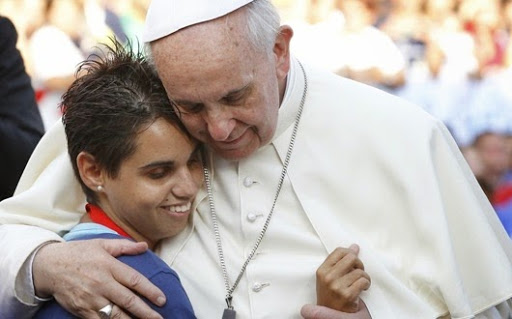
Francis hug

Today saw the first two sessions (“congregations” in Vatican-speak) of the two-week-long extraordinary bishops’ Synod on the family, and I would just like to pick out a couple what I saw as their highlights. First, however, it is worth going back to yesterday’s opening mass of the Synod, when Pope Francis had some warnings for his brother bishops, that clearly set the tone that he expects from the next two weeks’ work:

“The temptation to greed is ever present. […] Greed for money and power. And to satisfy this greed, evil pastors lay intolerable burdens on the shoulders of others, which they themselves do not lift a finger to move (cf. Mt 23:4)

We too, in the Synod of Bishops, are called to work for the Lord’s vineyard. Synod Assemblies are not meant to discuss beautiful and clever ideas, or to see who is more intelligent… They are meant to better nurture and tend the Lord’s vineyard, to help realize his dream, his loving plan for his people. In this case the Lord is asking us to care for the family, which has been from the beginning an integral part of his loving plan for humanity.

We are all sinners and can also be tempted to “take over” the vineyard, because of that greed which is always present in us human beings. God’s dream always clashes with the hypocrisy of some of his servants. We can “thwart” God’s dream if we fail to let ourselves be guided by the Holy Spirit. The Spirit gives us that wisdom which surpasses knowledge, and enables us to work generously with authentic freedom and humble creativity.”

This morning, more along good cop lines, his brief opening remarks then presented the method he would like participants to follow, which builds on clarity, openness, boldness (parrhesia) and tranquility:

“A basic general condition is this: to speak clearly. No one must say: “This can’t be said; he will think of me this way or that …” It is necessary to say everything that is felt with parrhesia. After the last Consistory (February 2014), in which there was talk of the family, a Cardinal wrote to me saying: too bad that some Cardinals didn’t have the courage to say some things out of respect for the Pope, thinking, perhaps, that the Pope thought something different. This is not good; this is not synodality, because it is necessary to say everything that in the Lord one feels should be said, with human respect, without fear. And, at the same time, one must listen with humility and receive with an open heart what the brothers say. Synodality will be exercised with these two attitudes.

Therefore, I ask you, please, for these attitudes of brothers in the Lord: to speak with parrhesia and to listen with humility.

And do so with much tranquillity and peace, because the Synod always unfolds cum Petro et sub Petro, and the Pope’s presence is the guarantee for all and protection of the faith.”

The first session then saw Cardinal Erdő present a 7.5K-word opening document – the “relatio ante disceptationem” – that is effectively the first follow-up to the “Instrumentum Laboris” in which the results of the preceding worldwide questionnaire were summarised. Erdő’s report is based on the written contributions made by the Synod Fathers ahead of the Synod’s opening and, together with the discussions that will last all this week and then in smaller groups next week, it will contribute to the final document that will be submitted to Pope Francis at the conclusion of this process.

As you’d expect, Erdő’s report broadly follows the structure of the Instrumentum Laboris, kicking off with an assessment of the challenges faced today on an individual level:

Many people today have difficulty in thinking in a logical manner and reading lengthy documents. We live in an audio-visual culture, a culture of feelings, emotional experiences and symbols. […]

Many look upon their lives not as a life-long endeavour but a series of moments in which great value is placed on feeling good and enjoying good health. From this vantage point, any firm commitment seems insurmountable and the future appears threatening, because it may happen that in the future we will feel worse. Even social relationships may appear as limitations and obstacles. Respect and “seeking the good” of another person can even call for sacrifice. Isolation is oftentimes linked, therefore, with this cult of a momentary well-being.

How this general disposition (which would not have come as a surprise to Aristippus or Epicurus some 2400 years ago) impacts the position and perception of marriage is addressed next, where there is a balance between challenges and the persistent beauty of the Church’s central teaching:

Avoiding marriage is seen as not only a sign of individualism but also a symptom of the crisis of a society already burdened by formalisms, obligations and bureaucracy. […]

The obligations arising from marriage must not be forgotten, but seen as the demands of the gift which the gift itself makes possible. […]

[The Church’s] teaching [on the family] enjoys a broad consensus among practicing Catholics. This is the case, particularly with regard to the indissolubility of marriage and its sacramental nature among those who are baptized. The teaching on the indissolubility of marriage as such is not questioned. Indeed, it is unchallenged and for the most part observed also in the pastoral practice of the Church with persons who have failed in their marriage and seek a new beginning.

Homosexuality, gender-based discrimination and gender theory get covered next, with a refreshing degree of frankness:

[T]here is a broad consensus that people with a homosexual orientation should not be discriminated against, as reiterated in The Catechism of the Catholic Church (2357-2359). Secondly, it is quite clear that the majority of the baptized — and all episcopal conferences — do not expect that these relationships be equated with marriage between a man and a woman, nor is there a consensus among a vast majority of Catholics on the ideology of gender theories. […]

[M]any want to see a change in the traditional roles in society which are culturally conditioned and in discrimination against women, which continues to be present, without denying, in the process, the differences by nature between the sexes and their reciprocity and complementarity.

The focus is then broadened to a societal level and an acute analysis of the external pressures incident on the family is presented:

We are not dealing with only problems involving individual behaviour but the structures of sin hostile to the family, in a world of inequality and social injustice, of consumerism, on the one hand, and poverty, on the other. Rapid cultural change in every sphere is distorting families, which are the basic unit of society, and putting into question the traditional family culture and oftentimes destroying it. On the other hand, the family is fast becoming the last welcoming human reality in a world determined almost exclusively by finance and technology. A new culture of the family can be the starting point for a renewed human civilization. […]

The widespread difficulty in creating a serene atmosphere of communication in some families is due to multiple factors: business and economic worries; differing views on the upbringing of children from various models of parenting; a reduction in time for dialogue and relaxation. In addition, there are disruptive factors like separation and divorce, with the consequences of a blended family, and, conversely, single parenting, where a relationship with the other parent is confused or limited, if not totally absent. Finally, this lack of communication can result from a widespread selfish mentality that closes in upon itself, with the disturbing consequence of the practice of abortion. The same selfishness can lead to the false idea of parents that children are objects or their property, who can be produced by them as they desire.

Then comes one of my favourite part, where the need for accompanying, for inclusion and for the proclamation of God’s fatherhood and the Church’s motherhood follows:

[T]hought needs to be given on how best to accompany people who find themselves in these situations [of marriage difficulty], so they do not feel excluded from the life of the Church. Finally, forms and suitable language needs to be devised to proclaim that all are and remain God’s children and are loved by God the Father and the Church as Mother. […]

Indeed, God never tires of forgiving the sinner who repents and he does not tire of giving him this possibility again and again. This mercy is not a justification to sin but rather the sinner’s justification, to the extent that he converts and aims to sin no more.

Mercy then gets the central place is requires, with a beautifully succinct paragraph:

Mercy, the central theme of the God’s revelation, is highly important as a hermeneutic for the Church’s actions (cf. Evangelii gaudium, 193 ff.). Certainly, she does not do away with truth nor relativize it, but seeks to interpret it correctly in the hierarchy of truths (cf. Unitatis redintegratio, 11; Evangelii gaudium, 36-37). Nor does she do away with the demands of justice. Consequently, mercy does not take away the commitments which arise from the demands of the marriage bond. They will continue to exist even when human love is weakened or has ceased. This means that, in the case of a (consummated) sacramental marriage, after a divorce, a second marriage recognized by the Church is impossible, while the first spouse is still alive.

Another highlight then is the following section, where the good that is there in civil marriages and even in some forms of cohabitation is called out. This is very much in the spirit of Evangelii Gaudium, where Pope Francis calls for a discernment of what there is of God in every context:

[A] new dimension of pastoral care of the family today reveals itself through considering the reality of civil marriages and, despite the differences, even cohabitation. Consequently, when these relationships are obviously stable in a publicly recognized legal bond, they are characterized by deep affection, display a parental responsibility towards their offspring and an ability to withstand trials and they can be seen as a seed to be nurtured on the path towards celebrating the Sacrament of Marriage. […] The Church cannot fail to take advantage of an opportunity, even in situations which, at first sight, are far from satisfying the criteria of the Gospel, and to draw close to people in order to bring them to a conscious, true and right decision about their relationship.

After an extensive coverage of how the challenges facing those who got divorced and civilly remarried, the report says something that I find tremendously positive and a great example of how we, Catholics, can also look to other Christian churches for inspiration:

The Instrumentum laboris relates that some responses suggest further examining the practice of some of the Orthodox Churches, which allows the possibility of a second or third marriage, marked by a penitential character (cf. 95). Examining this matter is necessary to avoid any questionable interpretations and conclusions which are not sufficiently well-founded. In this regard, studying the history of the discipline of the Churches in the East and West is important. Possible contributions might also come from considering the disciplinary, liturgical and doctrinal traditions of the Eastern Churches.

Finally, Cardinal Erdő’s report concludes with a crescendo:

If we look at the origins of Christianity, we see how it has managed — despite rejection and cultural diversity — to be accepted and welcomed for the depth and intrinsic force of its message. Indeed, Christian revelation has manifested the dignity of the person, not to mention love, sexuality and the family.

The challenge for this synod is to try to bring back to today’s world, which in some way resembles that of the early days of the Church, the attractiveness of the Christian message about marriage and the family, highlighting the joy which they give, but, at the same time, respond, in a true and charitable way (cf. Eph 4:15), to the many problems which have a special impact on the family today and emphasizing that true moral freedom does not consists in doing what one feels or living only by one’s feelings but is realized only in acquiring the true good.

In a real way, we are called upon, above all, to put ourselves alongside our sisters and our brothers in the spirit of the Good Samaritan (cf. Lk 10: 25-37): being attentive to their lives and being especially close to those who have been “wounded” by life and expect a word of hope, which we know only Christ can give us (cf. Jn 6:68).

The Gospel for families “as they are”

Modern family

The Catholic Church is in the process of preparing for two synods of its bishops – one this autumn and the other the following year – during which questions to do with the family will be reviewed. As a basis for the discussions, the Vatican has issued an initial preparatory document last November, whose most novel feature was an extensive questionnaire addressed to the bishops conferences of the world, but open to completion by anyone. The questionnaire spanned topics like whether Church teaching about the family was known, whether marriage preparation and care for families were effective, how difficult marital situations were dealt with, how same-sex unions were approached, how procreation was understood, plus an open question about any other family-related challenges.A questionnaire of this scale and openness is unprecedented, and three days ago, a summary of its results was published in the form of the “instrumentum laboris” (i.e., working instrument) that will be used during this year’s synod. The document, which weighs in at 25K words is very much worth reading in its entirety, since it – in my opinion – presents a very interesting, world-wide and above all utterly frank look at the life of the family at the beginning of the 21st century and the Church’s relationship with it. Rather than an analysis or commentary, I would first just like to share with you the passages that found most important and that effectively are my favorite 10% of the text (each passage is prefixed with the number of the paragraph it was taken from; note that – with one exception for the sake of the extracts’ logic – the following is in the same order as in the original text):

Part I: Communicating the Gospel of the Family in Today’s World

(2) [T]he divine measure of conjugal love, to which spouses are called by grace, has its source in “the beauty of the saving love of God made manifest in Jesus Christ who died and rose from the dead” (EG, 36), the very heart of the Gospel.

(4) The “true love between husband and wife” (GS, 49) implies a mutual gift of self and includes and integrates the sexual and affective aspects, according to the divine plan (cf. GS, 48-49). […] Christ the Lord “comes into the lives of married Christians through the Sacrament of Matrimony,” and remains with them. In the Incarnation, he assumes human love, purifies it and brings it to fulfillment. Through his Spirit, he enables the bride and groom to live their love and makes that love permeate every part of their lives of faith, hope and charity. In this way, the bride and groom are, so to speak, consecrated and, through his grace, they build up the Body of Christ and are a domestic Church (cf. LG, 11), so that the Church, in order to fully understand her mystery, looks to the Christian family, which manifests her in a real way.

(6) “marriage based on an exclusive and definitive love becomes the icon of the relationship between God and his people and vice versa. God’s way of loving becomes the measure of human love” (DCE, 11).

(35) “Marriage is the icon of God’s love for us. Indeed, God is communion too: the three Persons of the Father, the Son and the Holy Spirit live eternally in perfect unity. And this is precisely the mystery of Matrimony: God makes of the two spouses one single life” (General Audience, 2 April 2014).

(36) A recurring subject in almost all the responses is the importance of the Holy Family of Nazareth as the model and example for the Christian family. The mystery of the Word of God’s becoming incarnate within a family reveals how it is the privileged place for God’s revelation to humanity. In fact, the family is acknowledged to be the ordinary and everyday place to encounter Christ. The Christian people look to the Holy Family of Nazareth as a model in relationships and love, as a point of reference for every family and as a comfort in time of trial.

(39) The role of parents as primary educators in the faith is considered vital and essential. Emphasis is often placed on their witness of fidelity, particularly on the beauty of their individuality and at times, simply on the importance of their distinctive roles as father and mother. At other times, the responses stress the positive character of the spouses’ freedom, equality and reciprocity. Still other responses, especially from Europe, stress the equal importance of both parents in the upbringing of their children and domestic responsibilities.

(43) The family is essential in the maturation of those cognitive and affective processes which are crucial to personal development. In addition to being a vital environment in personal formation, the family is also the place to experience the awareness of being not only a Child of God but also called to a vocation of love.

(7) Faith is no refuge for the fainthearted, but something which enhances our lives. It makes us aware of a magnificent calling, the vocation of love. (LF, 53)

(11) The People of God’s knowledge of conciliar and post-conciliar documents on the Magisterium of the family seems to be rather wanting.

(13) Church teaching is more widely accepted, when the faithful are engaged in a real journey of faith and are not just casually curious in what might be the Church’s thinking in the matter of sexual morality.

(14) Ultimately, the responses and observations call for the need of establishing real, practical formation programmes through which the truths of the faith on the family might be presented, primarily to appreciate their profound human and existential value.

(15) the reason for much resistance to the Church’s teaching on moral issues related to the family is a want of an authentic Christian experience, namely, an encounter with Christ on a personal and communal level, for which no doctrinal presentation, no matter how accurate, can substitute. In this regard, some responses point to the insufficiency of pastoral activity which is concerned only with dispensing the sacraments without a truly engaging Christian experience.

(18) [V]arious episcopal conferences recall the importance of developing the insights of Pope St. John Paul II in his “theology of the body” series, in which he proposes a fruitful approach to the topics of family through existential and anthropological concerns and an openness to the new demands emerging in our time.

(24) Furthermore, much attention is given in the responses to the fact that what becomes established in civil law — based on an increasingly dominant legal positivism — might mistakenly become in people’s mind accepted as morally right. What is “natural” tends to be determined by the individual and society only, who have become the sole judges in ethical choices. The relativization of the concept of “nature” is also reflected in the concept of stability and the “duration” of the relationship of marriage unions. Today, love is considered “forever” only to the point that a relationship lasts.

(29) [T]his tendency accentuates the absolute right to personal freedom without any compromise: people are “formed” on the basis of their individual desires only. What is increasingly judged to be “natural” is more of a reference-to-self only, when it comes to their desires and aspirations.

(30) [M]ore emphasis [is to] be placed on the role of the Word of God as a privileged instrument in the conception of married life and the family, and […] greater reference to the Bible, its language and narratives [is recommended …] Moreover, this proposal insists on using language which is accessible to all, such as the language of symbols utilized during the liturgy. The recommendation was also made to engage young people directly in these matters.

(31) [T]he family is experiencing very difficult times, requiring the Church’s compassion and understanding in offering guidance to families “as they are” and, from this point of departure, proclaim the Gospel of the Family in response to their specific needs.

Part II: The Pastoral Program for the Family in Light of New Challenges

62. [I]n cases where the faith of family members is either weak or non-existent, both the parish and the Church in general are not seen as supportive. […] Often, when the lay faithful sense the great distance between the ideal of family living and the impossibility of achieving that goal, the couple’s crisis in marriage and the family gradually becomes a crisis in faith. Therefore, the question arises on how to act pastorally in these situations, namely, how to make sure that the Church, in her variety of pastoral activities, can demonstrate that she has the ability of caring for couples in difficulty and families.

64. [O]ne of the many critical issues facing the family is a difficulty in relationships and communication. Whether it be tensions and conflicts in a marriage due to a lack of mutual trust and intimacy or the domination of one marriage partner over the other or the inter-generational conflict between parents and children, all hinder the building of family relationships and can even make them entirely impossible. The dramatic aspect of these situations is that they lead to the gradual disappearance of the possibility of dialogue as well as the time and opportunity to work on relationships. For want of sharing and communication, each one is forced to face difficulties in isolation without an experience of being loved and, in turn, loving others. […] People who do not witness, live and accept love on a daily basis find it particularly difficult to discover the person of Christ as the Son of God and the love of God the Father.

66. The responses unanimously make reference to psychological, physical and sexual violence and abuse in families which has a particularly damaging effect on women and children, a phenomenon which, unfortunately, is neither occasional nor isolated, particularly in certain parts of the world. [… T]he responses also mention the appalling phenomenon of the killing of women, often caused by deep emotional trouble in relationships. Arising from a false culture based on possessions, this is particularly disturbing and calls for action by everyone in society and by the Church in her ministry to the family. Sexual promiscuity and incest in the family are explicitly cited in certain parts of the world (Africa, Asia and Oceania), as well as pedophilia and child abuse. The responses also refer to authoritarianism by parents, expressed in the lack of care and attention given to their children, a situation often leading to their children’s abandonment, and, on the parents’s part, a want of a sense of responsible parenthood which causes them to refuse to not only care for their children but also educate them, thereby leaving them totally to their own devices.

70. Increasing job insecurity, together with the growth of unemployment and the consequent need to travel greater distances to work, have taken their toll on family life, resulting in, among other things, a weakening of family relationships and the gradual isolation of persons, causing even greater anxiety.

71. In dialoguing with the State and the related public entities, the Church is called to offer real support for decent jobs, just wages and a fiscal policy favouring the family as well as programmes of assistance to families and children. In this regard, laws protecting the family in relation to work are frequently wanting, particularly those affecting working mothers.

75. Responses from almost every part of the world frequently refer to the sexual scandals within the Church (pedophilia, in particular) and, in general, to a negative experience with the clergy and other persons. Sex scandals significantly weaken the Church’s moral credibility, above all in North America and northern Europe. In addition, a conspicuously lavish lifestyle by some of the clergy shows an inconsistency between their teaching and their conduct. Some lay faithful live and practice their faith in a “showy manner,” failing to display the truth and humility required by the Gospel spirit. The responses lament that persons who are separated, divorced or single parents sometimes feel unwelcome in some parish communities, that some clergy are uncompromising and insensitive in their behavior; and, generally speaking, that the Church, in many ways, is perceived as exclusive, and not sufficiently present and supportive. In this sense, an open and positive pastoral approach is needed, one which can restore confidence in the institution through a credible witness by all her members.

80. “The Church is called to be the house of the Father, with doors always wide open, […] where there is a place for everyone, with all their problems” (GE, 47). […] The mercy of God does not provide a temporary cover-up of personal misdeeds, but rather radically opens lives to reconciliation which brings new trust and serenity through true inward renewal. The pastoral care of families, far from limiting itself to a legal point of view, has a mission to recall the great vocation of love to which each person is called and to help a person live up to the dignity of that calling.

89. Generally speaking, the responses from various places in the world devote attention to divorced and remarried persons or those, at least, who have formed a different union. Those living in such canonically irregular situations display various attitudes ranging from their being entirely unaware of their irregular situation to their consciously enduring the difficulties created by their irregular situation.

90. A rather great number of people give no thought to their irregular situation.

91. Before treating the suffering associated with those who are unable to receive the sacraments due to their irregular union, the responses refer to a more basic suffering which the Church must take in hand, namely, the suffering of a breakdown in marriage and the difficulty of regularizing the situation.

92. Some Church members who are cognizant that they are in an irregular situation clearly suffer from the fact that they are unable to receive the sacraments. Many feel frustrated and marginalized. Some wonder why other sins can be forgiven and not theirs. Others cannot see how religious and priests can receive a dispensation from their vows and priestly obligations so they can marry, while divorced and remarried persons are unable to receive Holy Communion.

103. Pastoral charity impels the Church to assist people who have suffered the breakdown of their marriage and are living with their situation relying on the grace of Christ. A more painful wound results when these people remarry and enter a state of life which does not allow them to receive Holy Communion. Clearly, in these cases, the Church must not assume an attitude of a judge who condemns (cf. Pope Francis, Homily, 28 February 2014), but that of a mother who always receives her children and nurses their wounds so they may heal (cf. GE, 139-141). With great mercy, the Church is called to find forms of “accompaniment” which can support her children on the path of reconciliation. With patience and understanding, she must explain to these people that their not being able to celebrate the sacraments does not mean that they are excluded from the Christian life and a relationship with God.

109. Generally speaking, pastoral care, preparation and planning of formation sessions prior to marriage are having a limited and uneven success everywhere. In almost every case, everything depends, for good or for ill, on the initiatives of each priest.

110. On unions of persons of the same sex, the responses of the bishops’ conferences refer to Church teaching. “There are absolutely no grounds for considering homosexual unions to be in any way similar or even remotely analogous to God’s plan for marriage and family. […] Nonetheless, according to the teaching of the Church, men and women with homosexual tendencies ‘must be accepted with respect, compassion and sensitivity. Every sign of unjust discrimination in their regard should be avoided’” (CDF, Considerations regarding Proposals to Give Legal Recognition to Unions between Homosexual Persons, 4).

113. Every bishops’ conference voiced opposition to “redefining” marriage between a man and a woman through the introduction of legislation permitting a union between two people of the same sex. The episcopal conferences amply demonstrate that they are trying to find a balance between the Church’s teaching on the family and a respectful, non-judgmental attitude towards people living in such unions. On the whole, the extreme reactions to these unions, whether compromising or uncompromising, do not seem to have facilitated the development of an effective pastoral programme which is consistent with the Magisterium and compassionate towards the persons concerned.

115. Episcopal conferences supply a variety of information on unions between persons of the same sex. In countries where legislation exists on civil unions, many of the faithful express themselves in favour of a respectful and non-judgmental attitude towards these people and a ministry which seeks to accept them. This does not mean, however, that the faithful give equal status to heterosexual marriage and civil unions between persons of the same sex.

Part III: An Openness to Life and Parental Responsibility in Upbringing

122. The Church is called to proclaim the fruitfulness of love in light of that faith which “helps us grasp in all its depth and richness the begetting of children, as a sign of the love of the Creator who entrusts us with the mystery of a new person” (LF, 52).

131. The responses recommend that the synod can be of assistance in rediscovering the deep anthropological meaning of the moral character of conjugal life, which beyond every type of moralism, appears as a true desire to live the beauty demanded by the Christian love between a man and a woman and given value by considering the greatest act of love which comes from laying down one’s life for a friend (cf. Jn 15:13).

132. “Parents are called, as Saint Augustine once said, not only to bring children into the world but also to bring them to God, so that through baptism they can be reborn as children of God and receive the gift of faith” (LF, 43).

137. In general, families participating in ecclesial movements are the most active in seeking to transmit the faith to newer generations.

138. [F]amilies with children who may be particularly affected by the so-called “irregular” situation of their parents deserve greater pastoral attention in Christian education. In this regard, words and expressions need to be used which create a sense of belonging and not exclusion, ones that can better convey the warmth, love and the support of the Church, so as not to generate, especially in the children and young people involved, the idea of rejection or discrimination against their parents, fully aware that “irregular” is a word applied to situations, not persons.

146. When parents, usually after an absence from the Church for some time, request from the ecclesial community the sacramental preparation of their children, the most recommended approach in all the responses is to readily accept them without making any distinctions. Receiving them with a basic attitude of respect, a friendly disposition and a willingness to listen to their human and spiritual needs creates a proper and beneficial atmosphere for communicating the Gospel message.

159. After examining the responses and observations and gathering from them not only the hopes and joys but also the griefs and anxieties, this work concludes by returning to the sources of faith, hope and charity, namely, the Blessed Trinity which is the mystery of absolute love, revealed in Christ and made accessible by the Holy Spirit. The love of God shines in a particular way in the Holy Family of Nazareth, the sure point of reference and comfort for every family. The Holy Family, the beacon of true love, is to be contemplated in every family situation so as to draw light, strength and consolation.

I have to say that this document makes me very optimistic and it does so for three reasons: first, the complete frankness of the assessment of today’s reality that doesn’t shirk either from pointing out failings of the Church or from recognizing a disconnect with regard to some aspect of her teaching (the entire document being evidence for this), second, the insistence on the importance of mercy and accompanying: “With great mercy, the Church is called to find forms of “accompaniment” which can support her children on the path of reconciliation.” (§103), and, third, that what is at stake here is not some rejigging of rules, but the very heart of men and women being called to love: “The pastoral care of families, far from limiting itself to a legal point of view, has a mission to recall the great vocation of love to which each person is called and to help a person live up to the dignity of that calling.” (§80). A consequence of these three features is, in my opinion, a chance for the upcoming Synod to bring the joy of the Gospel to families “as they are.”

Priests as welcomers and accompaniers

Emmaus

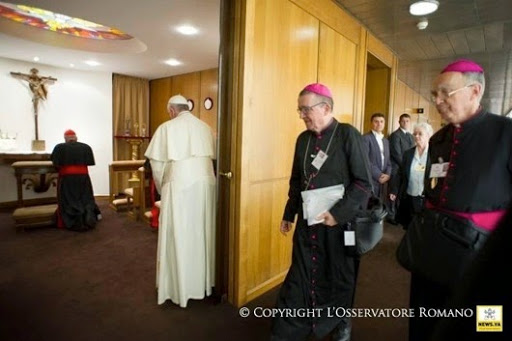
This morning Pope Francis met with Rome’s priests at the basilica of St. John Lateran and, following some brief, opening remarks, spent two hours in a Q&A with them. The meeting was private and away from the lenses and microphones of journalist, but details of Pope Francis’ words have been emerging during the course of the day.

To begin with, the priests invited to the meeting were sent a letter that Francis wrote in 2008, while still a cardinal and archbishop of Buenos Aires, in which he reflects on the implications of the Aparecida document on the priesthood. There, Francis starts out by defining the “identity of the priest in relation to a community, with two characteristics. First, as “gift,” as opposed to “delegate” or “representative.” Second, in terms of faithfulness to the call of the Master, instead of “management.”” Francis then emphasizes that identity means belonging: “The priest belongs to the People of God, from which he has been drawn, to which he has been sent, and a part of which he is.” This communitarian aspect is further emphasized in the Aparecida document, which in its §156 affirms that “a constitutive dimension of the Christian event is belonging to a concrete communion in which we can be part of an ongoing experience of discipleship and communion with the successors of the apostles and with the successor of Peter.”

Further along in this preparatory document for today’s meeting, Francis emphasizes the joint importance of truth and mercy, which in the Aparecida document (§199) is presented thus: “to care for the flock entrusted to them and to seek out who have strayed furthest [… that they may be] servant-of-life-priests: who are alert to the needs of the poorest, committed to the defense of the rights of the weakest, and promoters of the culture of solidarity. The need is also for priests full of mercy.” Finally, Francis proposes to priests to be “enamored disciples,” since, “logically the missionary dimension is born from the interior experience of a love of Jesus Christ.” His letter to the Argentinian priests is a beautiful document in its entirety, and the above is meant to serve only as context for the very telegraphic details that have emerged so far from today’s private meeting with the priests of Rome.

The most extensive source of information so far has been an article in today’s Roma Sette, a website of the Diocese of Rome, where the following snippets are shared:

  1. Francis kicked off the Q&A by stating that “he considered himself above all to be a priest, and now as Pope he was afraid of feeling otherwise. “I would be afraid of feeling a bit more important; I am afraid of that, because the devil is cunning … and makes you think you have power, that you can do this and that … But thanks to God, I haven’t yet lost that fear, and if once you see that I have lost it, please, tell me, and if you can’t tell me privately, say it publicly, but say it: ‘Look, convert!’ It’s clear, isn’t it?”.” Wow! This is pretty strong stuff and it paints such a vivid picture – one that reminds me of St. Peter in the Early Church, as its head, but one that listens (cf. Galatians 2:11-14 where Paul says: “And when Cephas came to Antioch, I opposed him to his face because he clearly was wrong.” – i.e., the “Incident at Antioch”).
  2. A focus again on the “existential peripheries” that Francis has spoken about before. Here, he adds that such peripheries also refer to “weak and poor thought.” Francis also added that “reality is better understood from the periphery and not from the centre, which, instead, runs the risk of degenerating.”
  3. Francis acknowledges the “serious problems of the Church,” but without being pessimistic. “The Church does not crumble. The Church has never been as well as today, it is a beautiful moment for the Church, it is enough to read its history. There are saints recognized even by non-Catholics – let’s think of Blessed Teresa – but there is also the everyday holiness of ordinary mothers and women, of men who work every day for their families, and this brings us hope. Holiness is greater than scandals.” As an example of everyday holiness, he gives the example of a woman he spoke to over the phone the previous day (!), who is a “cleaner at Buenos Aires airport and who supports her drug-addicted, unemployed son: “This is holiness.””
  4. He also speaks about the fatigue that priests feel, remembering the expression John Paul II used in his “Redemptoris Mater,” where he speaks about Mary’s “particular heaviness of heart” (§17). Francis says that “when a priest is in touch with his people, he gets tired. Faced with this tiredness, there is only Jesus’ answer: be with the poor, announce the Gospel and go ahead.” Here Francis also differentiates between different kinds of tiredness: “When a priest is in contact with his people, he works, but he sleeps well. When a priest is not in contact with his people, he works, but he works badly and sleeps badly. … When a priest is in contact with his people, who have many real needs, need for God, then this requires serious effort – but they are the needs of God, no?, that seriously make you tired, and there is no need for sleeping pills.”
  5. Beyond fatigue, priests can also experience what St. John of the Cross called the “Dark Night of the Soul”: “there is a final effort, which is necessary at the moment that there should be triumph. … This happens when a priest questions himself about his existence, he looks within himself at the path he has followed, at the sacrifices he has made, the children he has not had and asks if perhaps he made a mistake, if his life was a failure [… John the Baptist,] in the darkness of his confinement experienced the darkness of his soul, and sent his disciples to ask Jesus if it was He Who awaited him.”
  6. Francis then proposes the following solution both to fatigue and existential darkness: “So, what can a priest do when he lives the experience of John the Baptist? Pray, to the point of falling asleep before the Tabernacle, but stay there.” Also important are “closeness with other priests and closeness of the bishop.” Francis then goes on to underline this last point: “Us bishops have to be close to priests, we have to love our neighbors, and our closest neighbors are the priests. The closest neighbors of the bishop are the priests. [applause] The opposite is true too, eh? [laughter, applause]: the closest neighbor of the priests must be the bishop: the closest neighbor. The bishop says: my closest neighbors are my priests. This exchange is beautiful, no? I believe this to be the most important moment of closeness, between bishop and priests: this moment without words, because there are no words for this fatigue.” Another great piece of advice by Pope Francis, which very much reminds me of the key moment in Herman Hesse’s Siddhartha, where the eponymous protagonist communicates wordlessly with the ferryman Vasudeva in a moment of profound union.
  7. Another remedy against fatigue and darkness is the memory “of one’s vocation, entering seminary, one’s priestly ordination: memory is the life-blood of the Church.” Francis invites all priests to remember their initial falling in love with Jesus, the moment when they first felt Jesus’ gaze on them. “For me this is the key point: that a priest has the capacity to return in memory to his first love. … A Church that loses her memory is an electronic Church, without life.”
  8. Francis also insisted that priest extend a “heartfelt welcome” so that “the faithful feel at home.” Referring in particular to couples who live together outside marriage, Francis emphasized the need for welcome – a welcome in truth. “Always speak the truth, knowing that the truth is not exhausted by a dogmatic definition, but that it inserts itself in the love and the fullness of God.” The priest therefore has to “accompany.” We just have to think of the disciples of Emmaus and how “the Lord has accompanied them and warmed their hearts.”
  9. Here Francis emphasizes the importance of creativity instead of novelty: “[do not] confuse creativity with making something new. Creativity is finding the path to proclaim the Gospel and … this is not easy. It is not simply a question of changing things. It is something different, it comes from the spirit and passes through prayer and dialogue with people, with the faithful. […] The Code of Canon Law give us many, many possibilities, so much freedom to look for these things. … We must find those moments to welcome and receive the faithful, when they enter the parish church for one reason or another.”
  10. Francis also addressed the topic of remarried divorcees: “The problem cannot be reduced merely to a matter of who can receive communion or not, because to pose the question in these terms does not enable an understanding of the real problem. … It is a serious problem regarding the Church’s reponsibility towards families living in this situation. … The Church must now do something to solve the problem of marriage annulment.”
  11. He also warned against economic interests by saying: “There must be a cordial welcome so that those who go to Church feel at home. They feel comfortable and do not feel as if they are being exploited. … When people feel there are economic interests at work, they stay away”.
  12. Finally, Francis advised the priests of his diocese to beware of both severe and lax priests. “Instead, the merciful priest proclaims that ‘God’s truth is this, so to speak, dogmatic or moral truth’, but always accompanied by God’s love and patience. Do not panic – the good God awaits us. … We must always keep in mind the word ‘accompany’ – let us be travelling companions. Conversion always takes place on the street, not in the laboratory”. This, to my mind is a fundamental point – the distinction among lax, strict and merciful – a point I didn’t get before. It made me realize that mercy involves adherence to the truth (which laxity lacks) while loving (which strictness misses).

As a married person, I am grateful to Pope Francis for these profound directions, addressed to the priests of Rome, and I feel that a lot of what he says applies equally to me and is a challenge that I too want to accept and respond to.

UPDATE (18 September 2013): Yesterday several Vatican sources (e.g., VIS, L’Osservatore Romano and Radio Vaticana) have published further details of Pope Francis’ words from the meeting with Roman clergy, which have now been added to the above post.