Amoris Lætitia: has anything changed?

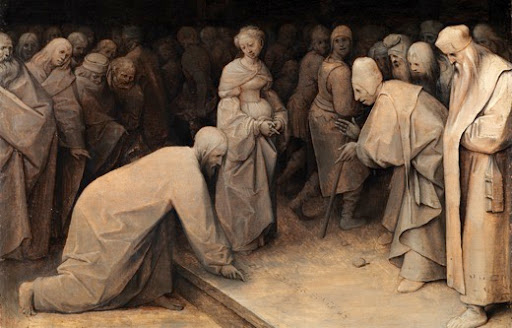
Brueghel jesus writing

1965 words, 10 min read

On the flight back from visiting refugees on the island of Lesbos (and bringing three Muslim families back with him to the Vatican!), Pope Francis was asked point blank: “[W]ith respect to the discipline that regulates access to the sacraments for the divorced and remarried, […] are there new, concrete possibilities that didn’t exist before the publication of the exhortation or not?” In other words, has anything actually changed, or is it “just” a rehashing of the previous status quo, albeit in nicer words.

To this, Francis responded with a clear: “I can say yes, many,” and then recommended a reading of Cardinal Christoph Schönborn’s presentation of Amoris Lætitia during the press conference on 8th April, when the exhortation was published. Pope Francis then added that Schönborn “is a great theologian. He was the secretary for the Congregation of the Doctrine of the Faith, and he knows the doctrine of the faith well. In that presentation, your question will find an answer.”

Before we take a look at what the cardinal said, let’s look at Pope Francis’ next answer from the same in-flight press conference, just to put the question about the divorced and re-married into context:

“One of the recent popes, speaking of the Council, said that there were two councils: the Second Vatican Council in the Basilica of St. Peter, and the other, the council of the media. When I convoked the first synod, the great concern of the majority of the media was communion for the divorced and remarried, and, since I am not a saint, this annoyed me a bit, and then made me sad. Because, thinking of those media who said, this, this and that, don’t they realize that that is not the important problem? Don’t they realize that instead the family throughout the world is in crisis? And the family is the basis of society. Do you not realize that young people don’t want to marry? Don’t you realize that the lack of jobs and employment opportunities mean that dad and mum take on two jobs, and children grow up alone and don’t learn to grow in dialogue with dad and mum? These are the big problems!”

Let’s turn to Cardinal Schönborn’s presentation of Amoris Lætitia (AL) now, to get a sense of what its impact on the divorced and re-married is.

First, Schönborn sets out the foundation of AL, which is universal inclusion:

“No-one must feel condemned, no-one is scorned. In this climate of welcome, the discourse on the Christian vision of marriage and the family becomes an invitation, an encouragement, to the joy of love in which we can believe and which excludes no-one, truly and sincerely no-one.”

Second, he highlights two modes of engagement that AL revolves around and emphasizes that they are directed towards all:

“In Evangelii Gaudium Pope Francis said that we must take of our shoes before the sacred ground of others (EG 36). This fundamental attitude runs throughout the Exhortation. And it is also provides the most profound reason for the other two key words, to discern and to accompany. These words apply not only to the so-called “irregular situation” (Pope Francis underlines this “so-called”) but rather for all people, for every marriage and for every family. Indeed, we are all journeying and we are all in need of “discernment” and “accompaniment”.”

Schönborn then acknowledges a potential misunderstanding of inclusion as “relativism,” “permissiveness,” “laxity” or “anything goes,” and juxtaposes it against an opposite, contrary danger of an “obsession with controlling and dominating everything.” As a means of navigating between these opposed dangers,

“Pope Francis often returns to the issue of trust in the conscience of the faithful: “We have been called to form consciences, not to replace them” (AL 37). The great question, obviously, is this: how do we form consciences? How do we arrive at what is the key concept of all this great document, the key to correctly understanding Pope Francis’ intentions: “personal discernment”, especially in difficult and complex situations? “Discernment” is a central concept in Ignatian exercises. Indeed, these must help to discern the will of God in the concrete situations of life. It is discernment that grants a person a mature character, and the Christian path should be of help in reaching this personal maturity: not forming automatons, externally conditioned and remote-controlled, but people who have matured in their friendship with Christ. Only when this personal “discernment” is mature is it also possible to arrive at “pastoral discernment”; which is important especially in “those situations that fall short of what the Lord demands of us” (AL 6).”

We now arrive at the point in AL (Chapter 8), where “the question of how the Church treats these wounds, of how she treats the failure of love” is addressed. The basis here is again a declaration of the desire to integrate, reinstate:

“With regard to those who are divorced and civilly remarried, [Pope Francis] states: “I am in agreement with the many Synod Fathers who observed that … the logic of integration is the key to their pastoral care. … Such persons need to feel not as excommunicated members of the Church, but instead as living members, able to live and grow in the Church and experience her as a mother who welcomes them always…” (AL 299).”

Schönborn then acknowledges the elephant in the room: “But what does this mean in practice? Many rightly ask this question,” and responds by saying that “The definitive answers are found in Amoris Lætitia, paragraph 300.” So, let’s take a look at it next in full:

“If we consider the immense variety of concrete situations such as those I have mentioned, it is understandable that neither the Synod nor this Exhortation could be expected to provide a new set of general rules, canonical in nature and applicable to all cases. What is possible is simply a renewed encouragement to undertake a responsible personal and pastoral discernment of particular cases, one which would recognize that, since “the degree of responsibility is not equal in all cases”, the consequences or effects of a rule need not necessarily always be the same. Priests have the duty to “accompany [the divorced and remarried] in helping them to understand their situation according to the teaching of the Church and the guidelines of the bishop. Useful in this process is an examination of conscience through moments of reflection and repentance. The divorced and remarried should ask themselves: how did they act towards their children when the conjugal union entered into crisis; whether or not they made attempts at reconciliation; what has become of the abandoned party; what consequences the new relationship has on the rest of the family and the community of the faithful; and what example is being set for young people who are preparing for marriage. A sincere reflection can strengthen trust in the mercy of God which is not denied anyone”. What we are speaking of is a process of accompaniment and discernment which “guides the faithful to an awareness of their situation before God. Conversation with the priest, in the internal forum, contributes to the formation of a correct judgment on what hinders the possibility of a fuller participation in the life of the Church and on what steps can foster it and make it grow. Given that gradualness is not in the law itself (cf. Familiaris Consortio, 34), this discernment can never prescind from the Gospel demands of truth and charity, as proposed by the Church. For this discernment to happen, the following conditions must necessarily be present: humility, discretion and love for the Church and her teaching, in a sincere search for God’s will and a desire to make a more perfect response to it”. These attitudes are essential for avoiding the grave danger of misunderstandings, such as the notion that any priest can quickly grant “exceptions”, or that some people can obtain sacramental privileges in exchange for favours. When a responsible and tactful person, who does not presume to put his or her own desires ahead of the common good of the Church, meets with a pastor capable of acknowledging the seriousness of the matter before him, there can be no risk that a specific discernment may lead people to think that the Church maintains a double standard.” (AL, §300)

Here, Schönborn singles out that those who expected a “new set of general rules” will be “disappointed” and that it is pastoral discernment instead that AL puts forward. This is covered in paragraphs 300-312 and contains the process and examination of conscience proposed in last year’s Synod by the German-language working group (§85 of the 2015 Relatio Finalis which is quoted above in AL §300).

The next big question then is about what Pope Francis says “in relation to access to the sacraments for people who live in “irregular” situations.” And the answer here is in the context presented in §300, where the formulaic is shunned in favor of personal and pastoral discernment:

““Discernment must help to find possible ways of responding to God and growing in the midst of limits. By thinking that everything is black and white, we sometimes close off the way of grace and of growth, and discourage paths of sanctification which give glory to God” (AL 205). [Pope Francis] also reminds us of an important phrase from Evangelii Gaudium, 44: “A small step, in the midst of great human limitations, can be more pleasing to God than a life which appears outwardly in order but moves through the day without confronting great difficulties” (AL 304). In the sense of this “via caritatis” (AL 306), the Pope affirms, in a humble and simple manner, in a note (351) that the help of the sacraments may also be given “in certain cases”. But for this purpose he does not offer us case studies or recipes, but instead simply reminds us of two of his famous phrases: “I want to remind priests that the confessional should not be a torture chamber but rather an encounter with the Lord’s mercy” (EG 44), and the Eucharist “is not a prize for the perfect but a powerful medicine and nourishment for the weak” (EG 47).”

Finally, Schönborn acknowledges the challenges of the above and sums up AL as follows:

“Pope Francis acknowledges this concern [of the “discernment of situations” not being regulated more precisely]: “I understand those who prefer a more rigorous pastoral care which leaves no room for confusion” (AL 308). However, he challenges this, remarking that “We put so many conditions on mercy that we empty it of its concrete meaning and real significance. That is the worst way of watering down the Gospel” (AL 311). Pope Francis trusts in the “joy of love”. Love is able to find the way. It is the compass that shows us the road. It is both the goal and the path itself, because God is love and love is from God. Nothing is more demanding than love. It cannot be obtained cheaply. Therefore, no-one should be afraid that Pope Francis invites us, with Amoris Lætitia, to take too easy a path. The road is not an easy one, but it is full of joy!”

Cardinal Christoph Schönborn’s presentation of Amoris Lætitia is very clear and the answer both to the question of whether anything has changed for the divorced and civilly remarried and to the question of whether anything has changed about their access to the Eucharist is a clear “Yes!”. However, it is a yes that is not in the form of a new decision tree, à la those used in call centers to deal with customer queries, but an invitation to a relationship of accompanying and discernment in which God’s will is sought and where God’s love and mercy flow.
The only thing that’s changed is everything

Francis behind cross

2610 words, 13 min read

Yesterday, at the closing mass of the Synod on the Family, Pope Francis concluded his homily with the following words:

“There is a […] temptation, that of falling into a “scheduled faith”. We are able to walk with the People of God, but we already have our schedule for the journey, where everything is listed: we know where to go and how long it will take; everyone must respect our rhythm and every problem is a bother. We run the risk of becoming the “many” of the Gospel who lose patience and rebuke Bartimaeus. Just a short time before, they scolded the children (cf. Mark 10:13), and now the blind beggar: whoever bothers us or is not of our stature is excluded. Jesus, on the other hand, wants to include, above all those kept on the fringes who are crying out to him. They, like Bartimaeus, have faith, because awareness of the need for salvation is the best way of encountering Jesus. In the end, Bartimaeus follows Jesus on his path (cf. v. 52). He did not only regain his sight, but he joined the community of those who walk with Jesus. Dear Synod Fathers, we have walked together.”

To my mind, these few lines sum up the Synod perfectly, by presenting two poles: one, characterized by rules, clarity and predictability and the other by an path that twists and turns, that is full of surprises, but where we are walking not only among Jesus’ friends, but side-by-side with Jesus himself.

Detractors of the Synod have already declared it a failure, a preservation of the status quo, a “no change” of doctrine, a failure for not opening up access to the Eucharist for the divorced and remarried and a giving-in to African pressures on gays. They, however, are precisely the group for whom Pope Francis had harsh words in the speech he delivered after the Synod Fathers voted on the final report (the Relatio Finalis) paragraph-by-paragraph:

“[The Synod] was about bearing witness to everyone that, for the Church, the Gospel continues to be a vital source of eternal newness, against all those who would “indoctrinate” it in dead stones to be hurled at others. It was also about laying bare closed hearts that frequently hide even behind the Church’s teachings or good intentions, in order to sit in the chair of Moses, sometimes with superiority and superficiality, and judge difficult cases and wounded families.”

Instead of being a failure, I believe, that the Synod was a dramatic first step along the path that Pope Francis presented the week before, on the occasion of the 50th anniversary of the institution of the Synod of Bishops. In that landmark speech, Francis shared his vision of a synodal Church, a Church that is on a journey with Christ in the present moment:

“A synodal Church is a Church of listening, knowing that listening “is more than hearing”. It is a mutual listening in which everyone has something to learn. Faithful people, the College of Bishops, Bishop of Rome: each one listening to the others; and all listening to the Holy Spirit, the “Spirit of truth” (Jn 14:17), to know what he “says to the Churches” (Rev 2:7).”

In such a synodal Church, authority too changes, and becomes rooted in the cross, as Pope Francis explains:

“Let us never forget it! For the disciples of Jesus, yesterday, today and always, the only authority is the authority of service, the only power is the power of the cross, in the words of the Master: “You know that the rulers of the Gentiles lord it over them, and the great ones make their authority over them felt. But it shall not be so among you. Rather, whoever wishes to be great among you shall be your servant; whoever wishes to be first among you shall be your slave.”(Mt 20: 25-27). It shall not be so among you: in this expression we reach the heart of the mystery of the Church – “it shall not be so among you” – and receive the necessary light to understand hierarchical service.”

Pope Francis is also very clear, in the homily he delivered on the morning of the Synod’s last day, about a consequence of being a journeying, synodal Church also being constant change. However, since the journeying party includes Jesus, it is not a thrashing about or a bending with the wind. Instead it is a tight adherence to the person of Christ, while being immersed in the ever-changing now. A freedom with rather than a freedom from or a freedom to:

“The times change and we Christians must change continuously. We must change while being firm in our faith in Jesus Christ, firm in the truth of the Gospel, but our attitude must move continuously according to the signs of the times. We are free. We are free by the gift of freedom that Jesus Christ gave us. But it is our task to look at what happens inside us, to discern our feelings, our thoughts; and what happens outside us and to discern the signs of the times. With silence, with reflection and with prayer.”

All of the above is, to my mind a beautiful spelling out of what Pope Benedict XVI meant when he said, at the beginning of the 2012-13 Year of Faith, that faith “is no theory, but an encounter with a Person who lives within the Church.”

With the above perspective, of a community walking with Jesus, where service is the basis of authority and where life is full of surprises because we aren’t following a set of instructions, but developing a relationship with Jesus instead, let us look at what the Synod on the Family was all about.

First, the Synod was a resounding endorsement of the family, as Cardinal Schönborn put very clearly:

“I think that the principal message of this Synod is the theme of the Synod: that the Catholic Church around the world, with one billion and 200 million Catholics, have discussed the topic of marriage and the family for two years, with all its positives aspects and difficulties … This alone is a remarkable fact for our time, because the core of the message is this: a great yes to the family. The success of this Synod for me is a great yes to the family; that the family is not over, not an old model, but that it is a fundamental model of human society.”

Second, that this endorsement wasn’t just a pre-cooked message to be rubber-stamped, but that it was, instead, the result of an intense process of discernment, discussion and at times even outright verbal warfare both inside the Synod and by interests outside it. Just as examples, a letter from some cardinals to the pope got leaked and resulted in all sorts of recriminations, some cardinals accused others of being opposed to Jesus, and false news about the pope’s health was released two days before the final vote. The inappropriate nature of some of the behavior inside the Synod lead the German language working group to open their final report with the following words:

“We have observed the public statements of individual Synod Fathers regarding the people, content and course of the Synod with great dismay and sadness. This contradicts the spirit of walking together, the spirit of the Synod and its elementary rules. The images and comparisons used are not only coarse and wrong, but hurtful. We distance ourselves from them categorically.”

Third, that there was a great diversity among the Synod Fathers. One of the English language working group’s reports stated that “[o]n many […] points there was consensus, on others there was wide if not universal agreement, and on a few there was significant disagreement.” Pope Francis too saw this very clearly, when he said in his closing speech:

“[W]e have also seen that what seems normal for a bishop on one continent, is considered strange and almost scandalous for a bishop from another; what is considered a violation of a right in one society is an evident and inviolable rule in another; what for some is freedom of conscience is for others simply confusion. Cultures are in fact quite diverse, and each general principle needs to be inculturated, if it is to be respected and applied.”

To my mind this is a very positive picture, which sends a clear message that it is possible to talk about even divisive and sensitive topics openly in the Church.

Fourth, that there was a tremendous desire for unity in the Synod, in the face of the variety of disparate views represented in it. Two things evidence this very clearly. First, that all of the final report’s 94 points were accepted with a 2/3rds majority. In fact, the vast majority (something around 80% of the points) were accepted with near unanimity, and even the handful of more controversial points received support from over 2/3rds of the Synod Fathers. Second, that the German language working group, which included the strongest proponents of both positions in favor of least change (Cardinal Gerhard Ludwig Müller) and of most change (Cardinal Walter Kasper), arrived at unanimous support for all of its reports. Cardinal Reinhard Marx, who was also in that group, gave a very intimate account of how that came about in one of the official press conferences:

“You have to argue. You can’t say I have an opinion. You must be very clear in your knowledge, to quote St. Thomas and the others. When you listen for a few minutes to Cardinal Müller, Cardinal Kasper and Cardinal Schönborn discussing about St. Thomas that is very interesting and when they say St. Thomas said this or that then he really did. So, you have to be together and say: that is the meaning of St. Thomas. […] We had the will to make a text together. It was clear when we wouldn’t find unanimity but we tried to come together and also in the different points, for example regarding the divorced and remarried, we tried to make a text that everyone could accept as a proposal to the Holy Father. [Before the first set of reports we felt that other groups were looking to us to see whether we would find unanimity, given who we are in this group] and Cardinal Schönborn said: “The others are looking at us, so make an effort to come together.””

Fifth, the Synod presented the family as a subject, an agent, rather than an as an object, as something that needs to be managed. One of the Italian working groups put this particularly clearly:

“Given […] that evangelization is the duty of the whole Christian people, […] families, under the grace of the sacrament of marriage, need to become ever more subjects of pastoral care, expression of a mission that becomes visible through a concrete life, not something that is only theoretical but an experience of faith rooted in people’s real problems. Priests should therefore be trained to recognize families as subjects, valuing the skills and experiences of all: lay, religious and ordained.”

Sixth, that the sheer variety and breadth of family circumstances and factors affecting them requires closeness, tenderness and discernment to be the basis of sharing God’s love with all. No set of rules, laws, principles can be a substitute for personal relationships, and Pope Francis is very clear about this too:

“[T]he true defenders of doctrine are not those who uphold its letter, but its spirit; not ideas but people; not formulae but the gratuitousness of God’s love and forgiveness. This is in no way to detract from the importance of formulae, laws and divine commandments, but rather to exalt the greatness of the true God, who does not treat us according to our merits or even according to our works but solely according to the boundless generosity of his Mercy (cf. Rom 3:21-30; Ps 129; Lk 11:37-54). It does have to do with overcoming the recurring temptations of the elder brother (cf. Lk 15:25-32) and the jealous labourers (cf. Mt 20:1-16). Indeed, it means upholding all the more the laws and commandments which were made for man and not vice versa (cf. Mk 2:27).”

An example of this personal discernment-based approach is also the proposal in the final report regarding the divorced and re-married, which says (in §85-86):

“It is […] the task of pastors to accompany interested [divorced and civilly remarried] persons on the way of discernment in keeping with the teaching of the Church and the guidance of bishops. In this process it will be useful to make an examination of conscience through times of reflection and penitence. The divorced and remarried should ask themselves how they behaved toward their children when the conjugal union entered into crisis; if there were attempts at reconciliation; how is the situation with the abandoned partner; what consequences the new relationship has on the rest of the family and the community of the faithful; what example it offers to young people who must prepare for marriage. A sincere reflection can strengthen the trust in the mercy of God which is never denied to anyone. […] Therefore, while upholding a general norm, it is necessary to recognize that the responsibility regarding certain actions or decisions is not the same in all cases. Pastoral discernment, while taking account of the rightly formed conscience of persons, must take responsibility for these situations. Even the consequences of the acts carried out are not necessarily the same in all cases. The process of accompaniment and discernment directs these faithful to an awareness of their situation before God. Conversation with the priest, in the internal forum, contributes to the formation of a correct judgment on what hinders the possibility of a fuller participation in the life of the Church and the steps that can foster it and make it grow.”

Seventh, that mercy is the root of divine love [“Misericordia est radix amoris divini”] as already St. Thomas Aquinas taught and as Pope Francis again underlined as the Synod closed and as the opening of the Jubilee of Mercy approaches:

“The Church’s first duty is not to hand down condemnations or anathemas, but to proclaim God’s mercy, to call to conversion, and to lead all men and women to salvation in the Lord (cf. Jn 12:44-50). […] In effect, for the Church to conclude the Synod means to return to our true “journeying together” in bringing to every part of the world, to every diocese, to every community and every situation, the light of the Gospel, the embrace of the Church and the support of God’s mercy!”

One of the Synod Fathers, Fr. Antonio Spadaro SJ, the director of the Jesuit journal La Civiltà Cattolica, summed this up beautifully in a tweet today:

“After #Synod15 the #Jubilee switches from the binary logic of a door, open/closed, to that of a face, which vitally changes before another face.”


Just in case you are left feeling short-changed about the content of the final report, the scarcity of references to it in the above post are a consequence of two facts: first, that it has no magisterial value (i.e., it is not the Church speaking to its faithful or the world through it – instead, it is a collection of ideas that serve as input for Pope Francis), and, second, that it was the shared journey of the Synod Fathers that matters rather than that document – in keeping with Pope Francis’ call for being a synodal Church instead of one that feels herself best expressed in laws, rules or documents.