
From individual to person

Community1

I am feeling quite “meta” today and have no less than four reasons for it: first, what I am about to discuss is fundamentally meta, second, the act of writing about it to you is an instance of it, third, it ties several of the strands that I started in previous posts together, and, fourth, it has come to me in a way that illustrates the topic itself (thanks to my bestie, Margaret, of ‘the God of Explanations’ fame). If that is not enough to pique your interest, let me add that it is centered around a talk given by one of my favorite contemporary thinkers – Dr. Rowan Williams, the Archbishop of Canterbury.

The subject of the talk is an exploration of what it means to be human and revolves around the distinction between an individual and a person. In customary magisterial fashion, Archbishop Williams ties together the thinking of St. Augustine, Orthodox and Catholic theologians (Vladimir Lossky and Robert Spaemann), a Russian and a French philosopher (Mikhail Bakhtin and René Descartes), a French thinker (Alexis de Tocqueville), a psychotherapist (Patricia Gosling) and an LSE sociologist (Richard Sennett). The argument begins by claiming that the relevant polarity is not between individualism and communitarianism but between the concepts of an individual and a person.

Here an individual is simply an example of a certain thing: e.g., Bob is an example of a human being, just like Fido is an example of a dog. Seen from this “atomic” perspective (where, incidentally, “individuum” is merely the latinized version of the Greek “atomos”), the individual is the center of their own world – its solid core. Even when they engage in relationships with others, they always have “the liberty of hurrying back home,” and the best relationship they can have with the world, that is separate from them and beyond them, is control. The consequences of such a view of what it is to be human are alienation, non-cooperation and unease with limits. This view is summed up clearly by de Tocqueville saying that “[e]ach person, withdrawn into himself, behaves as though he is a stranger in the destiny of all the others.” It is also the psychological and anthropological parallel of the epistemic approach pioneered by Descartes (and driven to its limit in the “brain-in-a-vat” scenario), that I also adapted in an earlier post and that, in art, is mirrored by Antony Gormley’s approach to sculpture.

The other concept of a human being is that of a person, where there is “something about us as a whole that is not defined just by listing the facts that happen to be true about us” and where a person is a “subject [that is] irreducible to its nature” (Lossky). Williams argues though that while “we know what we mean by personal/impersonal and persons in relation, […] we struggle to pin down what we mean that we cannot be reduced just to our nature.” He then goes on to postulating that “what makes me a person and distinct from another person is not a bundle of facts, but relations to others. I stand in the middle of a network of relations.” This leads to the definition of a person as the “point at which relationships intersect.”

Williams then moves on to the question of how one is to determine whether another is a human person and, following from the previous analysis, concludes that this cannot be done on the basis of a checklist for whether a given set of pre-requisites are present. Instead, we need to “form a relation, converse, to determine whether another is a person” and that language helps us to decide. He is quick here to move from a narrow concept of language as verbal only to a broad one that includes gestures and the “flicker of an eyelid.” This means that “[p]ersonal dignity or worth is ascribed to human individuals because, in a relationship, each of us has a presence or meaning in someone else’s existence. We live in another’s life. Living in the life of another is an implication of the profound mysteriousness about personal reality. Otherwise you end up with the model where somebody decides who is going to count as human.” Such a test of human personhood based on relateability very much reminded me of Turing’s test of machine intelligence, where the basis again is not a predetermined set of criteria, but the ability for a machine to converse with (relate to) a human person and for that person to recognize the machine as a person. Williams’ point about “each of us [having] a presence or meaning in someone else’s existence” also brought back echoes of Martini’s “the other is within us.”

How does the individual (which is by far the position with the strongest epistemic justification) see themselves as a person though? Here Williams quotes the following passage from Spaemann:

“Each organism naturally develops a system that interacts with its environment. Each creature stands at the center of its own world. The world only discloses itself as that which can do something for us; something becomes meaningful in light of the interest we take in it. To see the other as other, to see myself as his “thou” over against him, to see myself as constituting an environment for other centers of being, thus stepping out of the center of my world, is an eccentric position. […] As human beings in relationship, we sense that our environment is created by a relation with other persons; we create an environment for them and in that exchange, that mutuality, we discover what person means.”

How do you “step out” and assume an “eccentric position” tough? Here, Williams admits that such “stepping beyond one’s own individuality requires acts of faith. Living as a person is a matter of faith.” And I completely agree with him – strictly from a position of introspective enquiry, from Gormley’s “darkness of the body,” there is no fact-based way out. There is a need for a Kierkegaardianleap of faith,” but I would like to argue that it does not require a belief in God and in fact is akin to Eco’s communist acquaintance’s belief in the “continuity of life” discussed in an earlier post.

Finally, let’s also look at what Williams says about the aspect of personhood that is revealed as a consequence of belief in God:1

“Before personal relations, we are in relation with God. I am in relation to a non-worldly, non-historical attention which is God. My neighbor is always somebody who is in a relation with God, before they are in a relation with me. There is a very serious limit for me to make of my neighbor what I choose. They don’t belong to me and their relation to me is not what is true of them or even the most most important thing that is true of them. Human dignity – the unconditional requirement that we attend with reverence to one another – rests firmly on that conviction that the other is already related to something that isn’t me.”

In summary, a very clear picture emerges here, where I can think of myself as an individual – a world unto myself – or as the intersection of relations with others that allows me to go beyond myself and recognize in others that they are part of my world and I part of theirs. As a Christian this eccentricity also reveals to me that the relations I have with others build on the relations He has with them already and allow me to relate to Him not only in the intimacy of my self but also through my neighbors.


1 As an argument, this is essentially a variant of Bishop Berkeley’s response to the following challenge to his philosophy, where being is predicated on perceiving:

There was a young man who said God,
must find it exceedingly odd
when he finds that the tree
continues to be
when noone’s about in the Quad.

To which Berkeley responded with another limerick:

Dear Sir, your astonishment’s odd
I’m always about in the Quad
And that’s why the tree
continues to be
Since observed by, yours faithfully, God

:)))
Orthodoxy and/or orthopraxy

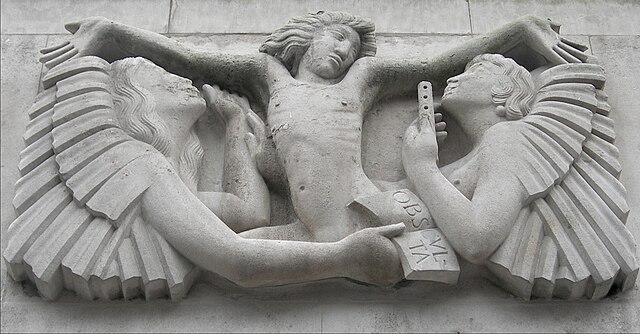
640px Ariel between Wisdom and Gaiety

What is the relationship between correct belief (orthodoxy) and correct action (orthopraxy) and how much does one matter versus the other? Is it more important what you think or what you do? While this is not a new question, I believe it is still a key one today.

Starting with Jesus, we can see him emphasizing both orthopraxy (also as a means of inferring orthodoxy when heterodoxy may be suspected):

“By their fruits you will know them. Do people pick grapes from thornbushes, or figs from thistles?” (Matthew 7:16) and

“Not everyone who says to me, ‘Lord, Lord,’ will enter the kingdom of heaven, but only the one who does the will of my Father in heaven.” (Matthew 7:21)

and validating orthodoxy in spite of it’s proponents’ heteropraxy:

“The scribes and the Pharisees have taken their seat on the chair of Moses. Therefore, do and observe all things whatsoever they tell you, but do not follow their example. For they preach but they do not practice. They tie up heavy burdens [hard to carry] and lay them on people’s shoulders, but they will not lift a finger to move them. All their works are performed to be seen.” (Matthew 23:2-5)

Looking at Jesus’s teaching, there is a clear preference for orthopraxy (whose absence is an obstacle and which will also be the basis for the questions asked at the last judgement about feeding the hungry, quenching their thirst, welcoming strangers, clothing the naked, caring for the sick, visiting prisoners, … (Matthew 25:31-46)) but orthodoxy is valued in its own right as a (non-exclusive) means for engendering orthopraxy (and, by Christians, as a gift from God). In a way it can be seen as being assumed to be present at least implicitly, partially, unconsciously in those behaving orthopractically.

Let me just pick out two examples of where this principle of orthopraxy being taken to assume (implicit) orthodoxy has been employed by Jesus’ followers – a very recent one and a rather ancient one:

  1. Saint Pope Gregory the Great (6-7 century AD) was so taken by the justice that the emperor Trajan (1-2 century AD) has shown towards a widow, who violently lost her only son, and by his virtue that he prayed for the salvation of his soul and it’s promotion from purgatory to heaven. In other words, Gregory was motivated by Trajan’s orthopraxy to petition for his receiving the rewards he thought were only due to the orthodox.
  2. Archbishop Müller, when questioned about his friendship with Gustavo Gutiérrez, the father of Liberation Theology, responded: “The theology of Gustavo Gutiérrez, independently of how you look at it, is orthodox because it is orthopractic. It teaches us the correct way of acting in a Christian fashion since it comes from true faith.” This is not to say that all of Liberation Theology is exonerated by virtue of the virtue of its followers (the Vatican’s criticisms of Marxist influences in some of its strands are upheld by Müller), but that the virtue of its followers is a fruit of their orthodoxy.

All of this links rather nicely with Martini’s idea of (non)believers and is another argument for appreciating the orthopraxy of all while also valuing beliefs that can lead to it. I also believe it is a key to reading some Protestant–Catholic differences, to relating the lives of saints and Church doctrine and to appreciating great works of art created by artists who have committed heinous crimes (a.k.a., my roadmap for a couple of future posts :).

Martini & Eco: ethics for (non)believers

Martini eco

The passing of one of the princes of the Church is always a call for me to find out a bit about them, if I didn’t know of them already, and Cardinal Martini, whose dies natalis was yesterday, is no exception. I’ll leave it to you to find out about him for yourself (and there is certainly interesting material widely available across the internet) and will instead spend a couple of paragraphs talking about a topic very close to my own heart: the relationship between believers and nonbelievers, which is also the subject of a great book (or rather pamphlet as it is only 60-odd pages in length) containing the correspondence of Carlo Maria Martini and one of my favorite writers and an agnostic, Umberto Eco. The book is entitled “Belief Or Nonbelief” and I highly recommend it to you in full.

The two points I would like to pick out here (and I may return to others covered there in the future) are what constitutes (non)believers and whether one can think of a common basis for ethics that can be shared by all.

In the introduction, by Harvey Cox, Martini is quoted as saying the following about (non)believers:

When I think about “believers” and “nonbelievers,” I don’t have two different groups of people in mind. In all of us there is something of the believer and something of the nonbeliever, and this is true of this bishop as well.

As soon as I read this, I knew that I was going to enjoy the whole book – and I was not disappointed. After tackling topics like hope, human life and the role of men and women, the pair – who deliver a masterclass is dialogue (neither trying to trip up or ridicule the other, striving to deepen their understanding of each other’s positions) – turn to the question of whether there is common ground in terms of the ethical basis of believers and nonbelievers.

The question is posed by Martini, who asks: “what guides a secular person[, who does not recognize a personal God or appeal to an Absolute, to] profess moral principles, principles so firmly held that the person would give his life for them?” Martini acknowledges that all have ethical foundations and that even believers would often not seek recourse to God when making decisions under ordinary circumstances. What interests Martini is what happens in extremis – when one’s life is at stake – and he also pays homage to nonbelievers who have sacrificed their lives for their moral convictions or performed acts of great altruism. He is particularly keen to drill down to the foundations, which kick into action when things are pushed to their limits and wants to sweep away the consequences of “custom, convention, usage, functional or pragmatic behavior, even social necessity” and get to life and death choices which these can’t underpin.

To answer his question on behalf of believers, Martini points to inter-religious efforts that have looked into it and that point to it being “transcendental Mystery” that forms the basis for moral action. For Christians this is the Trinity, which provides us with “God the Father, Creator of All, and our brother Jesus Christ,” who give us an impulse to closeness and solidarity with others and who express that “the other is within us.”1 Quoting Hans Küng, Martini also points out that this basis makes ethical values “binding unconditionally (and not simply when it’s convenient) and hence universally (to all classes, ranks, and races).”

Eco’s2 response kicks off with an admission of his, now lost, Catholic roots and the realization that their past presence cannot be factored out. Given such caveats, he states that there can be a sense of the scared and of “communion with something greater even in the absence of faith in a personal and provident deity,” but he rightly comes back on track by reiterating the focus on that which is “binding, compelling, and unrenounceable” in secular ethics.

Eco cleverly and appropriately widens the scope of the question to universals and not just their application to ethics and proceeds with a magisterial introduction to “universal semantics3 – i.e., that “notions common to all cultures exist” (citing examples of referring to our position in space – up, down, left, right, …). After postulating the universality of perception, memory, desire, fear, pleasure, pain, … Eco steps back and draws our attention to there being not only universals applicable to the “solitary Adam,” but that sex, dialogue, parental love or the loss of a loved one provide social ones too. Poignantly Eco exposes the underlying implications of the semantic basis so far – that of focusing on ‘us,’ and on restricting the “other” or Martini’s “the other is within us” to those from our own tribal group, ethnicity or circle. Those outwith are inhuman and may therefore be treated barbarically even while members of one’s own group are afforded respect. Eco places the growth of who is considered a member of one’s circle at a millennial scale and cites even Jesus’s coming as having been conditioned by when humanity was ready for his teaching of the Golden Rule.

To get to the basis of what can drive a nonbeliever to give their life for a moral principle, Eco cites the example of a “communist” whom he asked how he, an atheist, can make sense of “something as otherwise meaningless as his own death.” “By asking before I die for a public funeral, so that, though I am no longer, I have left an example to others.” Eco argues that it is this “continuity of life,” a sense of duty to those who come after us, “because in some way what one believes or what one finds beautiful can be believed or seen as beautiful by those who come after.”

In essence my take on this exchange is that Martini threw a bit of a curved ball, knowing that Eco’s answer can but elaborate the consequences of his own beliefs about the roots of morality since he also believes that God is present in all – whether they believe in him or not. Eco did hold his own though by turning the situation around and highlighting the value of the Christian story, whether it is true or not. What they have done together is present a case for the Golden Rule both from divine revelation and from semantic analysis. I only see winners in this exchange: Martini’s “the other is within us” and Eco’s “continuity of life” form a pair of insights that, I believe, enrich all (non)believers :).


1 See my take on the epistemological parallel of this concept here.
2Please, note that, unlike Cardinal Martini for Catholics, Eco is not an official representative of nonbelievers and his answer therefore cannot be taken even as being intended as an answer on behalf of all nonbelievers. I, therefore, also don’t take it as such and don’t presume that, if you are a nonbeliever, it represents you. If you do happen to be a nonbeliever reading this and either agree or disagree with Eco’s take, I’d very much appreciate hearing from you in the comments. Thanks! 🙂
3 Semantics being the “study of meaning.”

Somewhat off-topic is another gem from the book – a reference of Eco’s to Kant’s take on atheism: how can one not believe in God, maintain that it is impossible to prove his existence, yet also firmly believe in the nonexistence of God, claiming that it can be proved 🙂

I would, finally, also like to dedicate this post to my bestie, SH – the most sincere agnostic I have ever met and a man who to this day teaches me humility by consistently beating me at scrabble, typically by a factor of two …

I say polygon, you say polyhedron


When you look at the above image, what do you see? Two triangles and five quadrangles, a cube or something else? Now, let’s turn to the following thought experiment:

You are strapped into a chair, your head held firmly in place, and you see a bright, diffuse screen in front of you, showing a series of black lines. You notice that the screen can go from an only-just visible black point at its periphery, via lines cutting across it or forming triangles with its edges, to closed squares or even constellations of polygons moving and morphing across it. You also notice that there are several knobs and levers at your disposal and that you can influence the shapes seen on the screen. Your task is to work out how the patterns you see are formed.

All you have access to in this case is a sequence of experiences of a two-dimensional, bounded world, yet through painstaking experiments you come to the realization that what you are seeing is consistent with there being a wireframe cube behind the screen. All the patters, the changes from one pattern to another and the lengths of edges could be the result of a wireframe cube casting a shadow. Once you arrive at your conclusion you are released from your restraints and are free to exit the room. As you do so, another person exits the room next to you. A quick chat reveals you had the same experience, but it turns out that they are convinced that it was just a computer screen rather that the silhouette of a mesh cube. You enter each other’s rooms and realize that they look identical! You believe their room shows a 3D cube’s shadow; they believe your room contains a 2D computer-driven display. You both look for a way to access what is behind the respective screens and after a while you find the rooms backing onto your two ones. Your screen and theirs were indeed driven differently: one was a display driven by a computer and the other a piece of translucent plexiglass having a backlit cube cast shadows on it. Which was which remains a secret guarded by the two of you.

Now, my question to you: who was the more rational participant in this experiment? The person postulating a 3D entity on the basis of strictly 2D evidence or the person whose theories remained firmly 2D, in line with the nature of their evidence?

I would like to argue that they were both equally rational and that the distinction between them was not along rational-irrational lines and to underline the fact that they were both deriving their world views from the same evidence.

What was the point of this whole exercise though? It was to propose that empirical evidence alone is not sufficient to constrain explanation to a solely empirical domain (even just the use of mathematics in science, with its universal quantifier is beyond the empirical) and that the exact same experiences can be held up as a basis for alternative theories.

The last exegetical point I’d like to make though is that the two protagonists of the thought experiment can learn a lot from each other. The person hypothesizing the 3D cube can lend the other means for simplification while the strictly 2D person can share a more refined understanding of 2D relationships, which also enrich the cube’s understanding.

Why is it that I am concerned by the evidence-theory relationship and try to dig into its nature? It is because this is a key stumbling block in the rapprochement between atheist scientists and the rational religious. The former don’t get how the latter can transcend evidence while the latter are threatened by the former’s insights into empirical evidence. The many-to-many nature of the evidence-theory relationship also underlies inter-religious dialogue. Since the transcendent is infinite, hyper-dimensional and vastly exceeding the fragmentary insights we can have of it, also in terms of aspects we don’t even know about!, it is understandable that different interpretations of its actions have been formed in different cultures and by different people. It would be short-sighted to stop at an incompatibility between the monotheism of some religions, the personal Trinitarian insight of Christianity, the polytheism of Hinduism and the apparent atheism of Buddhism (in the strict sense of atheism as opposed to its current use as anti-theism) and arrive at the erroneous conclusion that these religions talk about different things rather than differently about aspects of the same (please, don’t mis-read this as me saying that everything that all religions claim is true, that all religions are equally true or that religions can be freely intertwined and recombined. End of caveat :).

If there is a God, who is infinite, transcendent and vastly more complex than us, wouldn’t his actions as experienced in our limited realm lead precisely to the variety of religions as well as agnosticism and atheism that we see today?


Just a quick hat-tip to Flatland, to the Chinese Room thought experiment and to the story of the blind men and an elephant (and surely to many others :).

Who is a Christian?

What is

“Christ is the first-born of God, his Logos, in whom all people share. That is what we have learned and what we bear witness to … All who have lived in accordance with the Logos are Christians, even if they have been reckoned atheists, as amongst the Greeks Socrates, Heraclitus and the like.”

Justin (died 165) (quoted in Roots of Christian Mysticism)

Just to preempt a misinterpretation of the above, I don’t believe the idea is akin to the dubious posthumous baptisms practiced by some groups – instead it is an acknowledgement of the universality of Jesus’ message and a recognition by Justin (Christians) of its practicing and adherence to by others. It is not an imposed labeling of ‘good’ atheists as Christians against their will but an affirmation that being Jesus’ follower is about following his words (feeding the hungry, quenching their thirst, welcoming strangers, clothing the naked, caring for the sick, visiting prisoners, … (Matthew 25:31-46)). In many ways St. Justin’s statement is echoed in Pope Benedict’s point made during the homily at Freiburg airport last October:

“[A]gnostics, who are constantly exercised by the question of God, those who long for a pure heart but suffer on account of our[, the Church’s,] sin, are closer to the Kingdom of God than believers whose life of faith is “routine” and who regard the Church merely as an institution, without letting their hearts be touched by faith.”

Pope Benedict XVI