3344 words, 17 min read
A new fruit of the ecumenical dialogue between the Anglican Communion and the Catholic Church was published on 2nd July, entitled “ARCIC III – Walking Together on the Way. Learning to Be the Church—Local, Regional, Universal”. It is a 34K word report on the work of ARCIC, the Anglican–Roman Catholic International Commission, which was first set up in 1969 and which has looked into a number of topics over the decades of its existence. The latest one is on what it means to be Church at local, regional (trans-local) and world-wide levels and, crucially, how the two communities can learn from each other – the central idea of “receptive ecumenism”. Others have already reported well on this important document (e.g., see here or here), and what I would like to do instead is to offer a selection of passages that will, in under 3.5K words, give a flavor of the full 34K word document, whose reading in its entirety I wholeheartedly recommend:
“The document published here is the work of the Anglican–Roman Catholic International Commission. It is a joint statement of the Commission. The authorities who appointed the Commission have allowed the statement to be published so that it may be widely discussed. It is not an authoritative declaration by the Roman Catholic Church or by the Anglican Communion, which will evaluate the document in order to take a position on it in due time.” (Preamble)
“ARCIC III believes that the time is ripe to pursue the task of ecumenical engagement as one that includes explicit ecclesial self-critique. It is not enough to recognize that there is something of gift and grace in the other. We must explore what God has given to our partners which, as Pope Francis has said, ‘is also meant to be a gift for us’ (Evangelii Gaudium §246). This is particularly so when such ‘treasure[s] to be shared’ (Anglicanorum Coetibus, §III) address difficulties in one’s own tradition.” (§17)
“This method, commonly called receptive ecumenism, is an approach which is strongly influenced by Pope John Paul II’s request of church leaders and theologians from other traditions to help reimagine the practice of papacy (Ut Unum Sint §§95–96). It is deeply resonant with the respective teachings of Pope Francis (Evangelii Gaudium §246, cited above) and Archbishop Justin Welby. Preaching at Westminster Abbey in 2016 when celebrating fifty years of the Anglican Centre in Rome, the Archbishop said: ‘The habits of the centuries render us comfortable with disunity … I pray that ARCIC disrupts our disunity … it must develop its especial genius of a spirit of receptive ecumenism: of asking not what we might give the other, but what we lack that God might give us through the other.’” (§18)
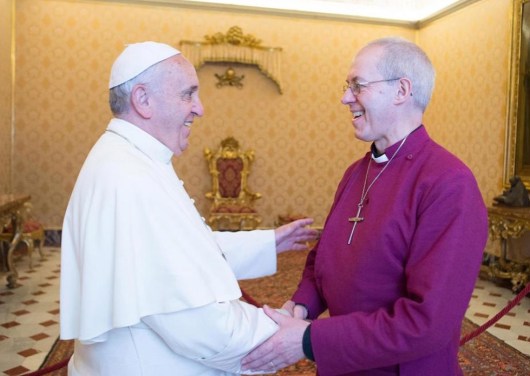
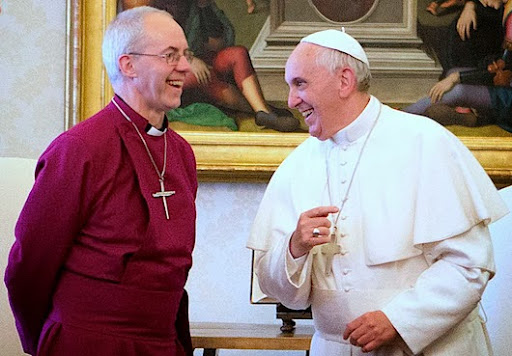
“Archbishop Justin Welby and Pope Francis have both used the image of ‘walking together’ on the path to full communion to describe our ecumenical relations. We are indeed fellow pilgrims journeying at the summons of God’s Word, through the difficult terrain of a rapidly changing world. We encounter very similar difficulties along the way, and we struggle to discern what faithful obedience demands. Walking together means that, as travelling companions, we tend each other’s wounds, and that we love one another in our woundedness. This journey that we undertake, which is a walking together into increasing degrees of communion despite difference, bears powerful and urgent witness to the world as to what it means to live difference well for mutual flourishing.” (§21)
“Acts 15 has been understood as a model of how the early Church made decisions and guided the community in Christian living that tried to maintain the unity of the existing communion while at the same time recognizing the growing diversity of the rapidly expanding Church. In the local church of Antioch, as depicted in the Lucan narrative, Greeks were being converted to the Gospel, with the approval of the church at Jerusalem (Acts 11.19ff). Problems arose as to whether these Gentile converts needed to be circumcised and to keep the Law of Moses in order to be baptized as followers of Jesus (Acts 15.1–2). Unable to resolve this question on its own, the church of Antioch sent a delegation (Paul and Barnabas) to consult the church in Jerusalem, implicitly, therefore, recognizing the authority of that church. Luke presents us with an encounter of respectful mutual listening: the leaders of the church in Jerusalem listened to the experiences of representatives of the local church of Antioch, and then the latter listened to the arguments developed by the leaders of the Jerusalem church. The decision taken was under the guidance of the Holy Spirit (15.28), in accord with the Scripture (15.16–18), and involved the whole Church (15.4, 5, 12, 22). The narrative is a programmatic guide to preserving the koinonia [communion] in a context of dispute. The practice of a local church (Antioch) must be examined and approved by the church that is regarded as the primary guardian of the apostolic tradition (Jerusalem), and this church, in turn, must attend to the pastoral and mission struggles of each particular community. The aim is to achieve, in the power of the Spirit, the unanimity that bears witness to the mind of Christ (Life in Christ: Morals, Communion and the Church §§23–26).” (§35)
“The following main sections (IV–VI) focus on the relationship between the local and the trans- local dimensions of ecclesial life. They explore structures within our respective traditions and reflect on what each might fruitfully learn from the other. Anglicans and Catholics have some differing understandings, practices, and structures, as well as differences of vocabulary (see ‘Usage of Terms’). The aim here is not to eradicate these differences. The point rather is to ask how each might be a resource for the other so that what is experienced as grace and benefit in one might help address what is less developed in the other.” (§46)
“Anglicans and Catholics also recognize that the faithful People of God, thanks to their baptism, share an instinct for the faith (sensus fidei fidelium), the spiritual gift of discernment of the truth (see The Gift of Authority (Authority in the Church III) §§29–30; also Sensus Fidei in the Life of the Church). The sense of faith grows through a life of strong charity and regular religious practice, each of which promotes communion between the faithful and God, who is love. One who loves Love and welcomes Love has a symbiotic relationship with God and, thereby, a sense of who God is, what God expects of us, and the kind of happiness Christ promises. Therefore, the sense of the faith means that the authentic transmission of the faith is not only the preserve of the magisterium and theologians, but also of saintly parents and holy men, women and children who know God ‘from within’ and have a sense of what conforms to God’s designs for human beatitude. The further implication, then, is that the Church’s indefectibility, as well as the experience of disagreement in the Church, demands structures which will facilitate the fullest possible sharing of the experience of Christ and of the gifts of the Spirit among all the baptized. Through prayer, debate, discussion, and study, the Church at every level seeks consensus with the assistance of the Spirit, even if variously formulated. This process of discernment of the mind of Christ can take time. It is this task of discovering which ‘calls for continuing discernment, constant repentance and renewing of the mind (Romans 12)’ (Life in Christ: Morals, Communion and the Church §29).” (§54)
“Worldwide communion for Catholics is determined by communion with the Bishop of Rome.
For the Catholic Church, it is possible for one local church to be in communion with another local church only when the bishop of each is in communion with the Bishop of Rome (see LG §23 and CN §13). One local Catholic church cannot be in full communion with another local church whose bishop is not in communion with the Bishop of Rome.
Worldwide communion for Anglicans with the Archbishop of Canterbury
Anglicans hold an understanding of a global communion centred on the See of Canterbury. The consequences for Anglicans of communion with the Archbishop of Canterbury differ from the consequences for Catholics of communion with the Bishop of Rome. Currently within the Anglican Communion there exist provincial churches which are in communion with the Archbishop of Canterbury but refuse to be in communion with other provincial churches that are also in communion with the Archbishop of Canterbury (see Lambeth Conference 1998, Resolution IV.11). There are also provincial churches in communion with the Archbishop of Canterbury which claim communion with other churches that are not in communion with the Archbishop of Canterbury. For Anglicans all of these situations are anomalous, and some are deeply painful. Other anomalies, of a more positive kind, are found, for example, in the full communion relationships shared between Lutherans and Anglicans in both the USA and Canada. Lambeth 1998 stated that ‘… some anomalies may be bearable when there is an agreed goal of visible unity, but … there should always be an impetus towards their resolution and, thus, towards the removal of the principal anomaly of disunity’ (Resolution IV.1.3).” (§63-64)
“Today’s sober appreciation of the long-term nature of the ecumenical calling (see §§5–6 and 10) has coincided with the recognition within each of our traditions of our respective difficulties and the need for processes of reform and renewal. We suggest that the current twofold task, as we seek to walk the way towards full communion, is (i) to look humbly at what is not working effectively within one’s own tradition, and (ii) to ask whether this might be helped by receptive learning from the understanding, structures, practices, and judgements of the other. The opportunity is to teach by showing what it means to learn and to bear witness by showing what it means to receive in our need—recognizing that at times the members of one tradition may judge that the practices and structures of the other will not, in a given instance, be helpful.” (§78)
Local level example:
“Anglican receptive learning about participation in the greater whole Anglicans are faced with the question of commitment to the unity of the Church, both for the local diocesan church and for the wider Communion. A catholic instinct for unity and participation in a greater whole is a deeply embedded value. Where Anglicans find themselves in situations of fragmentation, they may ask what ecclesial learning can be explored in relation to Roman Catholic universal identity.
Roman Catholic receptive learning about the need for open conversation The quality of Roman Catholic conversation at parochial and diocesan levels could be enriched by learning from Anglican experience of open and sometimes painful debate while the Church is in process of coming to a common mind (Theology Today: Perspectives, Principles, and Criteria §52).” (§101)
Worldwide level example:
“In appreciation of the Roman Catholic commitment to episcopal collegiality in discernment, Anglican bishops could learn from the recent synods of Catholic bishops. Given that it is not feasible to hold the Lambeth Conference at a greater frequency than once a decade, the model of smaller, more frequent synods of bishops for the exploration of particular issues with intensive consultation and dialogue could provide additional opportunities for episcopal discernment. The opportunity for deeper theological and pastoral deliberation, with local input and subsequent gatherings for follow-up, would be welcome.
The manner in which Pope Francis listened to and articulated debate within the Roman Catholic Church, as reflected in the two recent Synods on the Family in Amoris Lætitia, has been carefully observed by Anglicans. His encouragement of subsidiarity in the determination of divisive pastoral issues could well be such an area of receptive learning (Amoris Lætitia §3).
In light of the difficulties experienced hitherto with the Synod of Bishops, two reforms born of receptive learning from Anglican practice are possible which would render the quality of universal collegiality practised there more effective.
First, Pope Francis’s commendation of frank conversation at the Synod raises the question as to whether the quality of synodal conversation and exchange might be enhanced by learning from the Anglican experience of indaba at and since Lambeth 2008. This might model a healthy revitalizing of Roman Catholic conversation which would be of relevance to every level of Roman Catholic life. Second, in line with existing canonical provision and again recognizing the need to preserve the executive function of the Bishop of Rome as head of the college of bishops, Anglican models could be drawn upon in order to move the Synod from being a purely consultative body54 to being a deliberative body, which is foreseen in the Code of Canon Law (see c. 343).” (§146)
“Instruments of communion and their imperfection
The term ‘instruments of communion’ emerged in Anglican usage. The Commission found that it could also be applied to Roman Catholic structures and procedures. The Commission recognizes that Anglicans and Catholics share a common heritage. Only in the sixteenth century did the structures and procedures of our two traditions break apart, and in many ways they remain similar. These instruments are seen as prompted by the Holy Spirit and as tokens of divine providence. However, they have developed in the course of history and have been influenced in their form as they have sought to meet the challenge of changing circumstances. As such, even when regarded as essential they are also open to reform. The Commission asks how well the respective structures and procedures we have inherited serve as instruments of communion for the mission of the Church today. The Commission also asks what each tradition can learn from the inheritance of the other, and how far each tradition needs to undergo conversion, renewal, and reform. This requires humility and repentance.” (§152)
“Common affirmations concerning the Church local, trans-local, and universal
There are significant aspects which both of our traditions affirm, albeit with characteristically differing emphases. Each affirms a fullness of ecclesial reality at the level of the diocese gathered around its bishop, together with a relative autonomy of church at this level. Each also affirms the need for the local churches to be interrelated at the various trans-local levels of province, nation, region, and worldwide communion. The trans-local organization of the churches is a clear sign that the Church wants to reach out to the human reality in the diversity of cultures, nations, and even continents. The trans-local structuring of churches has a theological and ecclesiological meaning; it is not simply a sociological necessity: it is an expression of the catholicity of the Church. Catholics and Anglicans agree that the People of God, that is, all the baptized as a whole, are endowed with the unfailing instinct for the faith. Therefore, in discerning matters of faith and morals, Catholics and Anglicans must give attention to what the Spirit may be saying in the other tradition before arriving at a definitive conclusion for their own particular tradition.” (§153)
“In Ut Unum Sint §34 Pope John Paul II speaks of the essential role of examination of conscience in ecumenical dialogue: our ecumenical dialogue needs to be a ‘dialogue of consciences’. Recognizing that many sins have contributed to our historical divisions, he states that ‘Christian unity is possible, provided that we are humbly conscious of having sinned against unity and are convinced of our need for conversion.’ He continues, ‘not only personal sins must be forgiven and left behind, but also social sins, which is to say the sinful “structures” themselves which have contributed and can still contribute to the reinforcing of division.’ In his address at Vespers on the occasion of the fiftieth anniversary of the Anglican Centre in Rome, Archbishop Justin Welby, commenting on a daily prayer used at Lambeth Palace, notes:
It is a prayer that recognises the past and present, our sin—and yet comes back to God, who calls us to be one, because to be one is the only way to lead a life worthy of the calling to which we have been called. The difficulty which the prayer faces full on is that the habits of the centuries render us comfortable with disunity—even more so when there is the apparatus of dialogue. Dialogue can be an opiate, dulling the pain of separation; or it can be a stimulant, confronting us with the need for repentance and change.58
For Anglicans and Catholics their respective confessional identities—cherishing the role of the local and regional church (Anglican) and placing high priority on the need for ecclesial unity and coherence (Roman Catholic)—are valued as gifts of grace and providence. Nevertheless these identities themselves are not unaffected by sin, as can be seen when the concern for autonomy becomes one of outright independence and when the concern for ecclesial unity and coherence becomes excessive centralized power. Hence there is the need for ecclesial repentance and for reform of our instruments of communion in this respect. The proposals for mutual receptive learning summarized in the paragraphs below are the first step in taking up the vision of a Church fully reconciled.” (§154)
“Roman Catholic receptive learning from Anglicans
The discernment of proper teaching, sound governance, and appropriate pastoral care requires a healthy and open conversation in the Church. In the judgement of the Commission, the Roman Catholic Church can learn from the culture of open and frank debate that exists at all levels of the Anglican Communion, evidenced by the indaba process, for example. The Anglican practice of granting a deliberative role to synods and of investing authority in regional instruments of communion indicates that the Synod of Bishops could be granted a deliberative role and further suggests the need for the Roman Catholic Church to articulate more clearly the authority of episcopal conferences. Mindful of the participation in the threefold office of Christ of both laity and the ordained, the Catholic Church can fruitfully learn from the inclusion of laity in decision-making structures at every level of Anglican life.” (§157)
“Anglican receptive learning from the Roman Catholic Church
Receptive learning for Anglicans from Roman Catholic ecclesial life begins with an appreciation for the depth of commitment to the unity of the universal Church. In the judgement of the Commission, a renewed commitment to this ethos of unity would be strengthened through commitments such as: the use of at least one common, modern eucharistic prayer across the Communion; the provision of an approved common catechism; formal reception of the Principles of Canon Law Common to the Churches of the Anglican Communion; further exploration of the role of the See of Canterbury and its cathedral as the seat of the Archbishop as a focus of unity; and the practice of pilgrimage visits by bishops to meet with the Archbishop of Canterbury for prayer and consultation. Receptive learning from Roman Catholic expressions of episcopal leadership would include reflection on: diverse communities in full communion with one another in the same region; models of episcopal consultation and deliberation as seen in episcopal conferences and the Synod of Bishops as recently developed; the normative presence of a voice from outside the province, representing the wider Church in the deliberations and life of a regional church; and clarity of recognized processes for discernment, communication, and reception of authoritative teachings and decisions.” (§158)
I have to say that reading this document has been a great source of joy and hope for me. Above all, it struck me as more than good intentions, as an actual fruit of what Archbishop Welby and Pope Francis have been talking about: of fellow pilgrims journeying together, facing the same challenges along the way and learning from each other, helping each other ahead, recognizing in principle and in practice that they are travelling together. Seeing these two “pilgrims” working together, seeing what is good in the other’s style of pilgrimage and being open and humble about their own limitations in progressing along the way strikes me as the bud from which tangible, visible unity may grow.
 eyebeleave