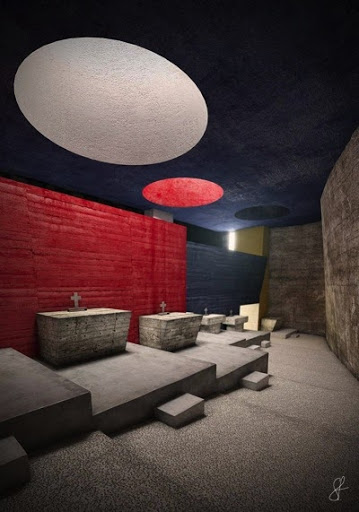
Grayson Perry: the stealth spirituality of art

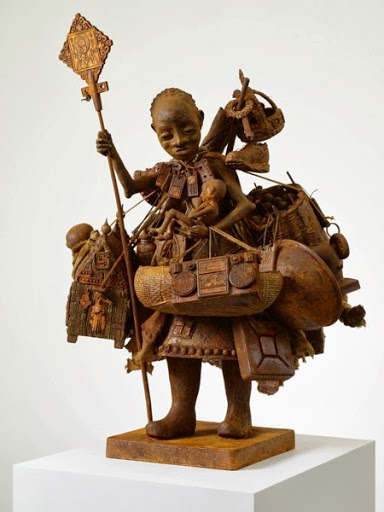
4 our mother by grayson perry1

Before I say anything else, I have to come clean and declare that I am a huge fan of Grayson Perry both as an artist and as a thinker (and I don’t mean to suggest that those are separate facets of Perry, but only to emphasize the prominence of reflection in his work). I have first encountered his pottery when he won the Turner Prize in 2003, then I immensely enjoyed his three-part Channel 4 series “All In The Best Possible Taste” – where I was not only impressed by the tapestries he created as the product of his analysis of the tastes of different classes in British society, but very much also by his ability to relate with such immediacy to all he met in the process – and finally I have delighted in his Reith lectures both due to their tremendously entertaining form (the whip-cracking sounds of the second lecture, his pronunciation of Duchamp [DushomP] and his jovial laughter being highlights) and their partly ironic/satirical and partly sincere, profound, spiritual content.

If you have any interest in art whatsoever, I highly recommend the lectures, which can be found at the BBC 4 website both in audio an transcribed textual form. There, Perry will take you through his thoughts on what art is versus is not, what makes good art, what the position of art and artist is in contemporary society and what it is like to become and be an artist. If you are looking for formulaic answers or even definitions, you’ll be disappointed, but if you are willing to be lead through the warren of insights into and critiques of the “art world” that Perry masterfully moulds together, you will come away greatly enriched.

Instead of attempting a synthesis or even just a walk-through of my favorite bits, let me only focus on a single aspect of Perry’s Reith lectures: the tension between the irony of the art world and the sincerity that is the source of art. Both are effected by artists, yet they stand in opposition to each other.

In Lecture 3, Perry first presents the pitfalls of irony (whose application copiously peppers all four of his lectures):

“[D]etached irony has become the kind of default mode of our time in the art world. And you know I think it can be problematic. [… Tracey Thorn describes the problem of irony as follows:] “It is difficult for people in the arts to be entirely sincere about things without looking like they have not thought about it properly.” The problem with irony is that it assumes the position of being the end result, from having looked at it from both sides and have a very sophisticated take on everything. So the danger of eschewing irony is that you look as though you’ve not thought hard enough about it and that you’re being a bit simplistic. […] Me, I have to sort of protect myself against this because when I’m out in the evening and I’m with my mates and I’m being terribly cynical and ironic; but when I want to look at art, I want to have a sincere one to one experience with it because I am a serious artist. I’ve dedicated my life to it. So I go to exhibitions in the morning on my own when I can go, hmn, and you know maybe have a little bit of a moment. (LAUGHTER) I have to protect my tender parts from that wicked irony. And perhaps the most shocking tactic that’s left to artists these days is sincerity.”

By considering irony to be a sign of reflection and careful though, it becomes an expected feature of an artist’s response to art. Yet, at the same time, irony is an inhibitor of sincerity and to the forming of genuine connections with art or with others. The artist is expected to be externally ironic while internally sincere and the danger of the former taking over and stifling the latter is a concern for Perry.

Towards the end of Lecture 4 and then in response to a question from the audience, Perry elaborates further:

I have a list of banned words: passionate, spiritual, profound. I mean these are all words I could describe – this tender part of me, the tender part that many artists have, you know what keeps them going – but I have an acute allergy to cliches […] and I have to protect that part of me from becoming a cliché. [… Jennifer Yane expressed it by saying:] “Art is spirituality in drag.” [… It’s] the idea that it’s a kind of performance of spirituality, it’s a dressing up, and it’s kind of like a way to accessing spirituality perhaps by stealth almost – you know being tricked into all the colour and loveliness of the art. You know we look at it and suddenly we’re having a spiritual moment, you know. But, like I say, I’m not allowed to talk … […] But the metaphor that […] best describes what it’s like for me being an artist is a refuge, a place inside my head where I can go on my own and process the world and its complexities. It’s a kind of inner shed in which I can lose myself.

There are a couple of points that I really like about what Perry says here. First, that it is the “tender,” inner part of his self that drives his art, which very much reminds me (no, not of Martin Parr) of Kandinsky, who characterizes art as the consequence of an inner necessity. Second, that Perry is protective of this innermost tenderness and sincerity, since he considers their expression to be of importance – to be serious. Third, the at first jarring expression of art being “spirituality in drag”1 actually makes great sense, as explained by Perry: aesthetics and the superficial, at-first-sight are the means by which the profound, innermost, spiritual are smuggled past irony, much like Odysseus’ strapping sheep furs on his back let him escape the cyclops Polyphemus’ abattoir. In many ways, Perry himself comes across as a personification of this definition of art, with a form that has an element of wink-wink, nudge-nudge and hyperbole, but with a substance that is tender, spiritual and profound.


1 Grayson Perry being a transvestite (in a tradition whose roots reach back at least to Ancient Greek theatre, where all characters of the period’s seminal tragedies and comedies were played by male actors, via the pepperpots of Monty Python fame) adds to the poignancy of this definition.
Death and resurrection

FrancisFerula3 zpsc3324b49

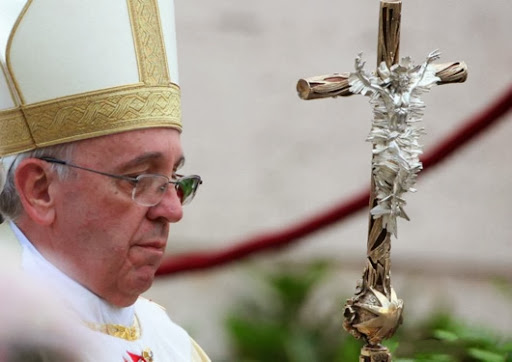
Imagine what the most offensive, sacrilegious and vile depiction of Jesus could be. Now look at the staff (a “ferula”) that Pope Francis holds in the above photo. Is that what you expected? I hope not, but if you googled “pope francis new ferula,” all you’d find is outrage, offence and adjectives like “misconceived,” “bizarre,” “ugly,” “offensive,” “nasty” and “profane.” Not only would these be outliers further down the search results, but it would be literally all you’d find – and I spent a couple of days trying to find anything positive at all about this new liturgical object used by Pope Francis.

So, why is it that this staff causes so much offense? If you abstract away the, sadly, harsh language of the reactions published so far, by sources who self-apply the “traditionalist” label, the root of the outrage is the depiction of the risen Christ instead of the crucified one. In most cases this is presented as being self-evidently an aberration, and one of the sources points to an encyclical by Pope Pius XII and quotes the following fragment:

““…one would be straying from the straight path … were he to order the crucifix so designed that the divine Redeemer’s body shows no trace of His cruel sufferings” (Pius XII, Encyclical Mediator Dei, par. 62).”

When I saw this, I immediately thought: “Great! Finally something specific and something that is likely to be usable against the new staff’s detractors.” As with most fanatics, their quoting of scriptures or other texts tends to be very selective and even just the immediate neighborhood of their snippets is likely to be their undoing. The same scenario applies here, if you look at the expanded quote below, still just staying within paragraph 62 and the opening sentence of paragraph 63 of Pius XII’s Mediator Dei:

“Assuredly it is a wise and most laudable thing to return in spirit and affection to the sources of the sacred liturgy. For research in this field of study, by tracing it back to its origins, contributes valuable assistance towards a more thorough and careful investigation of the significance of feast-days, and of the meaning of the texts and sacred ceremonies employed on their occasion. But it is neither wise nor laudable to reduce everything to antiquity by every possible device. Thus, to cite some instances, one would be straying from the straight path were he to wish the altar restored to its primitive tableform; were he to want black excluded as a color for the liturgical vestments; were he to forbid the use of sacred images and statues in Churches; were he to order the crucifix so designed that the divine Redeemer’s body shows no trace of His cruel sufferings […] Clearly no sincere Catholic can refuse to accept the formulation of Christian doctrine more recently elaborated and proclaimed as dogmas by the Church, under the inspiration and guidance of the Holy Spirit with abundant fruit for souls, because it pleases him to hark back to the old formulas.”

Before looking at the point about crucifixes that vexes Francis’ detractors, let’s just look at Pius XII’s categorical denunciation of traditionalism! The Holy Spirit is constantly active in the Church and more recent elaborations of teaching supersede older ones. By his own words, Pius XII is setting the scope of his own teaching to expire upon being superseded by that of his successors, so even if his words had been in conflict with Francis’ staff, Francis actions would take precedent and would do so by Pius XII’s own teaching.

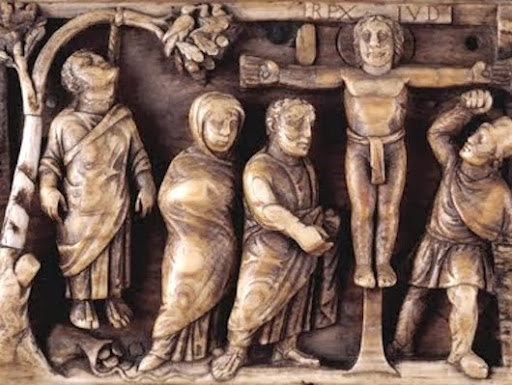
Now, let’s think about what Pius XII actually said about crucifixes, where he objects to them being “so designed that the divine Redeemer’s body shows no trace of His cruel sufferings.” Is he saying that the risen Christ mustn’t be depicted? Not at all. Only that the corpus shall show the traces of crucifixion torture, which early crucifixes did not show. Up until the early 5th century, only crosses and not crucifixes (i.e., crosses with a corpus) were used – and even those only sparsely. The next period then saw depictions of Jesus’ body on crosses, but in the form of unrealistic representations, like the following one, which is among the earliest ones:

Crucifixion earliest narrative rep ivory casket 420 30 rome brit museum

Here Jesus is upright, looking ahead, showing strength. What is Pius XII saying though? That our 5th century brothers and sisters were “straying from the straight path”? Certainly not! Only that if we imitated them in the misguided belief of the past having been a truer, purer, more genuine Christianity, we would be the ones straying and denying the Holy Spirit.

So, my reading of Pius XII is that we are to be open to the Holy Spirit now and that he underlined the importance of depicting the signs of the crucifixion horrors in crucifixes. Let’s now take a closer look at Francis’ new staff – the “crux gloriosa” and examine more closely the choices made by its author, the Roman sculptor Maurizio Lauri:

Papa francesco croce cimasa cera 3

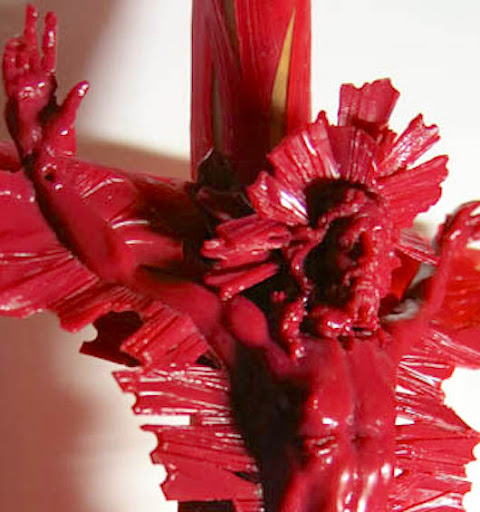
From the above wax cast of the staff, it can clearly be seen that Jesus’ body bears the “trace[s] of His cruel sufferings” – his wrists are pierced,1 his side shows a swollen stab wound, his hands look mangled. This is not the Christus victor depiction of the first nine centuries, but instead a form that incorporates the “Christus mortuus” features whose importance Pius XII insisted upon too.

I believe the crucifix on Pope Francis’ new ferula displays a great degree of continuity with the last two millennia of depicting Jesus’ passion (incidentally, in a particular way with the San Damiano cross through which St. Francis heard Jesus speak to him). While clearly showing that Jesus’ execution on the cross was barbaric and crushing, it also depicts the inexorable link between this suffering, which Jesus underwent out of love, and the resurrection that followed it and that engenders mercy, hope and joy. Rather than in any way negating the monumental scale of Jesus’ suffering, the Lauri ferula projects it towards the resurrection that followed His excruciating death. It seems to me like Lauri was giving form to St. Paul saying: “we do see Jesus crowned with glory and honor because he suffered death” (Hebrews 2:9).

Finally, I have also been struck by the provenance of the materials used for making the Lauri ferula. The staff and crucifix atop it are made of mahogany, bronze and silver, where the metals were mined by Goldlake – an Italian company operating in Honduras and working to explicitly ethical standards, in partnership with local churches in both countries. During the presentation of the ferula to Franics, the CEO of Goldlake – Giuseppe Colaiacovo, explained: “Your holiness […] we would like to present you with this object, made from the materials of the earth, which therefore are poor materials, but which then become transformed by the artistic spirit.” Not only do I see a tremendously orthodox and historically grounded theology behind the form of the ferula, but its material provenance itself bears a positive message in itself.


1 A fact worthy of note by itself, since it is in agreement with recent research that shows how Jesus was nailed to the cross not by his palms, as is typical in depictions of the crucifixion, but by his wrists.

Oscar Wilde: Socialism, Jesus, Art

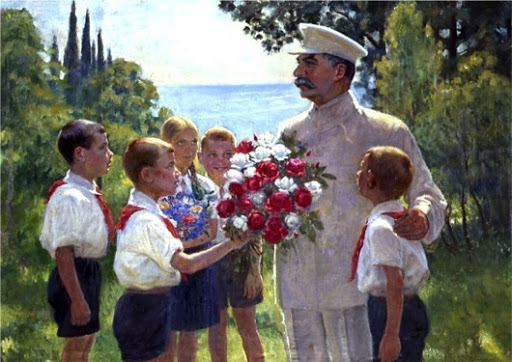
Roses for stalin

Even before reading his work, I was a fan of Oscar Wilde on the basis of his witticisms, with my favorite being the following (from The Picture of Dorian Gray): “It is only shallow people who do not judge by appearances.” While it could be dismissed as just a throwaway flourish, I have always felt a sense of depth behind it and proceeded to read his writings with great joy.
The other day I then came across a reference to his essay, “The Soul of Man under Socialism,” in the context of theories of art and I was immediately keen to read it. Even though the essay’s focus is socialism – a topic of limited interest to me, since I have experienced a failed attempt of implementing it first hand – I would like to acknowledge Wilde’s prophetic anticipation of the flaws of its authoritarian flavor, as practiced in the Soviet bloc, when he says: “If the Socialism is Authoritarian; if there are Governments armed with economic power as they are now with political power; if, in a word, we are to have Industrial Tyrannies, then the last state of man will be worse than the first.” +1!

What I found more interesting than the call to anarchic socialism, were Wilde’s thoughts on Jesus, whom he introduces thus:

“‘Know thyself’ was written over the portal of the antique world. Over the portal of the new world, ‘Be thyself’ shall be written. And the message of Christ to man was simply ‘Be thyself.’ That is the secret of Christ.”

This is a great synthesis of the Gospel and it seems to me that it derives from what is already there in Genesis, which says that “God created mankind in his image” (1:27). Being created in God’s image and being myself put me on a path towards God, closeness to whom is my fulfillment, and I see why Wilde presents it as Jesus’ “secret” and then proceeds to elaborate on what this “Be thyself” implies:

“What Jesus meant, was this. He said to man, ‘You have a wonderful personality. Develop it. Be yourself. Don’t imagine that your perfection lies in accumulating or possessing external things. Your affection is inside of you. If only you could realise that, you would not want to be rich. Ordinary riches can be stolen from a man. Real riches cannot. In the treasury-house of your soul, there are infinitely precious things, that may not be taken from you.’”

This very closely tracks Jesus’ saying: “Do not store up for yourselves treasures on earth, where moth and decay destroy, and thieves break in and steal. But store up treasures in heaven, where neither moth nor decay destroys, nor thieves break in and steal. For where your treasure is, there also will your heart be.” (Matthew 6:19-21). Such an attitude has direct consequences, which Wild puts in a particularly clear and again Gospel-mirroring way:

“If a man takes their cloak, they are to give him their coat, just to show that material things are of no importance. If people abuse them, they are not to answer back. What does it signify? The things people say of a man do not alter a man. He is what he is. Public opinion is of no value whatsoever. Even if people employ actual violence, they are not to be violent in turn. That would be to fall to the same low level. After all, even in prison, a man can be quite free. His soul can be free. His personality can be untroubled. He can be at peace. And, above all things, they are not to interfere with other people or judge them in any way.”

Reading the above, in particular the point about freedom in prison (which Wilde too knew about from first hand experience), made me think of all those who have been and to this day are imprisoned not for criminal reasons but as a form of persecution for their beliefs and convictions, whether political, personal or religious. The Vietnamese Cardinal François-Xavier Nguyễn Văn Thuận then sprung to mind, who insisted that the focus needs to be maintained on living in every present moment even as he was in solitary confinement while imprisoned by the Communist regime:

“While in prison, everyone waits for freedom, every day, every minute. We must live each day, each minute of our life as though it is the last.”

His was not only a tolerance of the desolate conditions he had to endure but a being himself as a follower of Jesus:

“I am happy here, in this cell, where white mushrooms are growing on my sleeping mat, because You are here with me, because You want me to live here with You. I have spoken much in my lifetime: now I speak no more. It’s Your turn to speak to me, Jesus; I am listening to You.”

Returning to Wilde’s essay, there is a clear sense of him having understood something profound about Jesus’ message, while at the same time I have to say that I am far from agreeing with his views on the family (where he claims that Jesus advocated its abolition) or on the poor (although he certainly makes important observations there also, especially as far as dignity is concerned). Only after these topics does Wilde turn to art, which was the initial motive for my reading his essay, and kicks off by warning against the exercise of control over art:

“[W]henever a community or a powerful section of a community, or a government of any kind, attempts to dictate to the artist what he is to do, Art either entirely vanishes, or becomes stereotyped, or degenerates into a low and ignoble form of craft. A work of art is the unique result of a unique temperament. Its beauty comes from the fact that the author is what he is. It has nothing to do with the fact that other people want what they want. Indeed, the moment that an artist takes notice of what other people want, and tries to supply the demand, he ceases to be an artist, and becomes a dull or an amusing craftsman, an honest or a dishonest tradesman. He has no further claim to be considered as an artist.”

The key idea here is very much consonant with Kandinsky’s concept of the inner necessity and the dire consequences that Wild foretells in the case of dictatorship bearing on art are very much what I believe can be seen in that repugnant “art” called Socialist Realism or the soulless classicism of the Third Reich.

Wilde then makes a great point about the absurdity of public expectation and tastes attempting to influence art, by drawing parallels with science and philosophy:

“Art should never try to be popular. The public should try to make itself artistic. There is a very wide difference. If a man of science were told that the results of his experiments, and the conclusions that he arrived at, should be of such a character that they would not upset the received popular notions on the subject, or disturb popular prejudice, or hurt the sensibilities of people who knew nothing about science; if a philosopher were told that he had a perfect right to speculate in the highest spheres of thought, provided that he arrived at the same conclusions as were held by those who had never thought in any sphere at all–well, nowadays the man of science and the philosopher would be considerably amused.”

Finally, Wilde underlines again the absurdity of measuring art against past criteria and precedents:

“[A]n educated person’s ideas of Art are drawn naturally from what Art has been, whereas the new work of art is beautiful by being what Art has never been; and to measure it by the standard of the past is to measure it by a standard on the rejection of which its real perfection depends.”

The above very much reminds me of Le Corbusier exclaiming: “Every day, every hour, the Earth sees splendors surging up which are truths and present-day beauty,” and I have to say that I feel great affinity with what the last three artists – Le Corbusier, Kandinsky and Wilde – whose thoughts on art I have read recently are saying. True art springs from the innermost being of an artist – necessarily in the now – and cares only about its own honesty and purity. Yet, it is not detached from the world, since – in Wilde’s words – it rises up from “the perfection of the soul that is within him,” a perfection rooted in God and thereby connected to the souls of all.

Kandinsky: innermost necessity of the soul

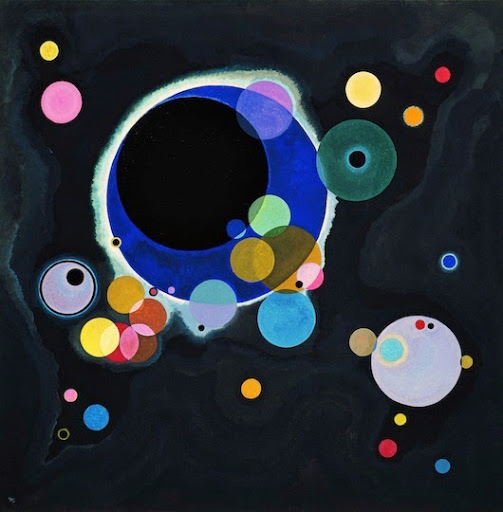
Kandinsky several circles website hd 5 13

[Warning: long read :)] Wassily Kandinsky, the father of abstract painting, is among those artists whom I have greatest affinity to, not for some specific reason, but simply because of the persistent bond that I feel between his work and myself. Looking at a piece like “Composition VIII” or at “St George I,” a reproduction of which we have in our living room, is always an experience that is hard to describe and that I prefer to leave unverbalized.

A couple of days ago I then came across a video from 1926 of him painting, which was a completely unexpected treat (thanks, @openculture!) and which lead me to his book “Point and line to plane,” where he gives the following, stunning definition of the point:

“The geometric point is an invisible thing. Therefore, it must be defined as an incorporeal thing. Considered in terms of substance, it equals zero. Hidden in this zero, however, are various attributes which are “human” in nature. We think of this zero — the geometric point — in relation to the greatest possible brevity, i.e., to the highest degree of restraint which, nevertheless, speaks. Thus we look upon the geometric point as the ultimate and most singular union of silence and speech. […] In the flow of speech, the point symbolizes interruption, non-existence The (negative element), and at the same time it forms a bridge from one existence to another (positive element). In writing, this constitutes its inner significance.”

This is clearly neither a mathematical definition, nor a scientific one (invisible=incorporeal?), but a phenomenological, even spiritual one. It is more like what a close friend would say in a eulogy, and that is how I felt when reading this book: to Kandinsky the point, line and plane were not some hypothetical concepts, but intimate friends and collaborators. His writing about them at times sounds like a person’s memoirs, rather than detached rationalizations of a theorist. Needless to say, I was hooked, and then delighted when I came to reading the foreword to the book (which I don’t tend to do as a rule) and discovering that “Point and line to plane” was the sequel to “On the spiritual in art.” This fact alone pointed me to another interpretative key for the above passage about the point, and its parallels with the person of Jesus and indeed with the Trinity jumped out at me. The process of non-existence, while simultaneously bridging between existences is precisely the dynamic between the persons of the Trinity (each emptying themselves – becoming nothing1 – out of love for the other).

If you have any interest in art, I can’t recommend “On the spiritual in art” too highly – not only is it an insight into one of the greatest painters of all time, but, to my mind, it is of the order of Plato’s Republic in terms of foundation myths.

Kandinsky starts out by emphasizing the necessity to act in the present moment (much like Le Corbusier insisted too), instead of attempting to imitate the past, which he depicts in harsh terms:

“[E]very cultural period creates art of its own, which can never be repeated again. An effort to revive art-principles of the past, at best, can only result in works of art resembling a still-born child. […] The sculptor’s attempts to employ Greek principles can only achieve a similarity in form, while the work itself remains for all time without a soul.”

Within the space of a couple of pages from the beginning, Kandinsky then proceeds to present his view of the hierarchy of spiritual life, which he equates with that of artistic life, since “[the] grammar of painting [… are] the rules of the inner necessity […] of the soul.”:

“A large acute triangle divided into unequal segments, the narrowest one pointing upwards, is a schematically correct representation of spiritual life. The lower the segment the larger, wider, higher, and more embracing will be the other parts of the triangle. The entire triangle moves slowly, almost invisible, forward and upward and where the apex was “today,” the second segment is going to be “tomorrow,” that is to say, that which today can be understood only by the apex, and which to the rest of the triangle seems an incomprehensible gibberish, tomorrow forms the true and sensitive life of the second segment.

At the apex of the top segment, sometimes one man stands entirely alone. His joyous vision corresponds to a vast inner sorrow, and even those, who are closest to him, do not comprehend him. […] Artists are to be found in every segment of this imaginary triangle. Each one of these artists, who can see beyond the limits of his present stage, in this segment of spiritual evolution is a prophet to those surrounding him and helps to move forward the ever obstinate carload of humanity. However, one of those not possessed by such vision, or misusing it for base purposes and reasons, when he closes the triangle may be easily understood by his fellow men and even acclaimed. The larger the segment (that is, the lower it lies in the triangle), the greater is the number of people to comprehend the words of the artist. In spite of it and correspondingly every group consciously or unconsciously hungers for spiritual food.”

While the above is unquestionably elitist, there are several details to note, which, I believe, hint at a dichotomy with the universally-accessible. First, the interconnectedness of the entire universe of spiritual ascent and the impact of its protagonists on all (“where the apex was “today,” the second segment is going to be “tomorrow.””). Second, the positive view of everyone’s potential to comprehend advances in art, albeit with a delay (“[T]hat which today […] to the rest of the triangle seems an incomprehensible gibberish, tomorrow forms the true and sensitive life of the second segment.”). Third, the desire of all for genuine spiritual food, in spite of some contenting themselves with fakes. Added to the above pull towards democratization of the elite striving for spiritual/artistic progress is also his declaration that “[a]nyone, who absorbs the innermost hidden treasures of art, is an enviable partner in building the spiritual pyramid, which is meant to reach into heaven.”

This tension is further carried forward, when Kandinsky argues that there is only a single criterion for what makes eternal art – its “inner necessity” from the perspective of its author:

“The artist should be blind to the importance of “recognition” or “non-recognition” and deaf to the teachings and demands of the time. His eye should be directed to his inner life and his ear should harken to the words of the inner necessity. Then, he will resort with equal ease to every means and achieve his end. […] All means are sacred when called upon by innermost necessity.”

““[O]uter necessity” […] can never lead beyond the limits of the conventional, that is, traditional “beauty” only. The “inner necessity” does not know such limits and, for this reason, often creates results which are conventionally termed “ugly.” “Ugly” is, therefore, only a conventional term which continues to lead a sham life long after the inner necessity […] has been superseded. At that time, everything was considered ugly if it was not connected with the inner necessity of the time, and anything so connected was termed beautiful. Everything, which appeals to the inner necessity is already beautiful by its virtue, and will be recognized sooner or later.”

“As no “dissonant notes” exist in music, nor in painting “inharmony,” in these two art expressions every sound, whether harmony or discord, is beautiful (appropriate), if it results from inner need. The inner value of each and every movement will soon be felt, as the inner beauty replaces the sensuous aspect. Thus, “ugly” movements suddenly appear beautiful, from which an undreamed power and vital force will burst forth instantly.”

Rooting perfection in “inner necessity” also changes the criteria by which art is judged and the means that are justified for its pursuit:

“A “perfect drawing” is the one where nothing can be changed without destroying the essential inner life, quite irrespective of whether this drawing contradicts our conception of anatomy, botany, or other sciences.”

“Likewise, colours should be used not because they are true to nature but only because the colour harmony is required by the paintings individually. The artist is not only justified in using any form necessary for his purposes, but it is his very duty to do so. Neither anatomical correctness nor any basic overthrow of scientific statements are necessary, only the artist’s unlimited freedom in the selection of his means.”

“This unlimited freedom must be based on inner necessity (which is called honesty). This is not only the principle of art but of life. This principle is the great sword of the superman with which he fights the Philistines.”

More than anything, the above reminds me of St. Augustine’s most famous dictum: “Love and then what you will, do,” which we could put into Kandinsky’s mouth as “Be honest and then what you will, paint,” without incurring any contradiction with his own words.

I have to say that reading “On the spiritual in art” has made me feel even closer to Kandinsky and has armed me with new means, with which I can revisit his paintings (and those of others!) in an attempt to connect with the innermost necessity that lead to their creation.


1 This self-emptying – kenosis – is explicitly indicated in St. Paul’s letter to the Philippians (2:5-9) and beautifully explained also by Hans Urs von Balthasar: “The Father, in uttering and surrendering himself without reserve, does not lose himself. He does not extinguish himself by self-giving, just as he does not keep back anything of himself either. For in this self surrender he is the whole divine essence. Here we see both God’s infinite power and his powerlessness; he cannot be God in any other way but in this “kenosis” within the Godhead itself.” (Theo-Drama: Theological Dramatic Theory: The Action Vol 4).

Le Corbusier: the sacred cubic centimeter

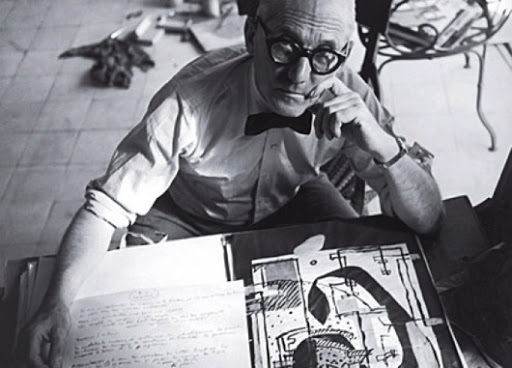
Le corbusier

Having come across yet another profoundly misguided piece on church architecture, and not feeling like rehashing previous posts on the subject,1 I instead set out to learn more about Le Corbusier, whose name the aforementioned piece took in vain.

Le Corbusier defined architecture as “giving living form to dead material” and elaborated on its dual nature of construction and art as follows:

“You employ stone, wood and concrete, and with these materials you build houses and palaces. That is construction. Ingenuity is at work. But suddenly you touch my heart, you do me good, I am happy and I say: “This is beautiful.” That is Architecture. Art enters in.”

Even before turning to church architecture, there is a great sense of focus not only on beauty but also on the sacred in Le Corbusier’s thought:

“One preoccupation has concerned me compulsively; to introduce into the home a sense of the sacred; to make the home the temple of the family. From that moment on, everything changed. A cubic centimetre of housing was worth gold, represented possible happiness. With such an idea of dimension and purpose, today you can build a temple to meet family needs beside the very cathedrals.” (Mise Au Point)2

How does one infuse matter with life, introduce the sacred into every cubic centimeter of a home? Again, Le Corbusier’s thoughts are illuminating:

“I am not faultless or simple, I am filled with turmoil and undercurrents. When pondering and working out a project (town planning, architecture or painting), always a long process, I bring into focus, I realise, I come to the point. I have made an immense effort without a word spoken; over the drawing boards of my office […] I do not speak; my private office (used for patient research) […] is opened to no one. There I am alone. Never in my life have I “explained” a painting. The painting will go out and will be loved or hated, understood or not. Do you think that bothers me! (How could it bother me?)” (The Chapel at Ronchamp, 1957)

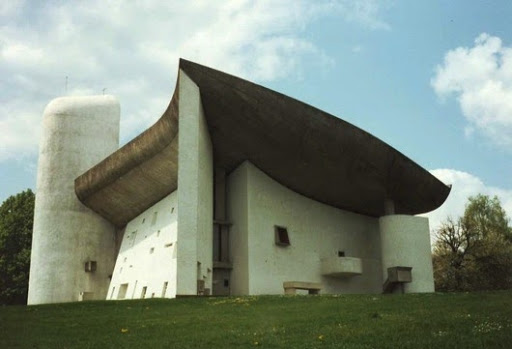
Ronchamp chapelle le Corbusier
This attitude of infusing matter with purpose, with intention, and doing so in a subtle, hinting rather than overpowering way comes to the fore again when Le Corbusier inaugurates one of his greatest masterpieces – the Chapel of Our Lady of the Height in Ronchamp:

This is “a project difficult, meticulous, primitive, made strong by the resources brought into play, but sensitive and informed by all-embracing mathematics which is the creator of that space which cannot be described in words. A few scattered symbols, a few written words telling the praises of the Virgin. The cross – the true cross of suffering – is raised up in this space; the drama of Christianity has taken possession of the place from this time onwards. […] I give you this chapel of dear, faithful concrete, shaped perhaps with temerity but certainly with courage in the hope that it will seek out in you (as in those who will climb the hill) an echo of what we have drawn into it.” (Le Corbusier’s dedication speech at the chapel’s inauguration, June 25 1955)

To my mind all of the above exudes a profound love of beauty and of the sacred, and a desire to offer it to others in a way that is inviting instead of imposing. Yet, in the course of reading about Le Corbusier, I kept coming across two criticisms leveled against his work. First, that it is inferior to renaissance and antique architecture and that this inferiority stems from ignorance. It is an argument that baffled me from the start, and that I see directly countered when reading about Le Corbusier’s reaction to the Acropolis:

“In 1910 I spent six weeks at the Parthenon. At the age of 23 my consciousness had determined its future direction. “Laborious hours in the revealing light of the Acropolis. Perilous hours which brought a distressing doubt about the (real) strength of our strength, the (real) art of our art. Those who, practising the art of architecture, find themselves at a point in their career,their brain empty, and heart broken with doubt in face of the task of giving living form to dead material, will realise the despondency of soliloquies amongst the ruins. Very often I left the Acropolis, my shoulders bowed with heavy foreboding, not daring to face the fact that one day I would have to practise. The Parthenon is a drama …”” (The Chapel at Ronchamp, 1957)

The second criticism is even more ad hominem and one that I find deeply repugnant. It is an objection to Le Corbusier’s lack of faith and adherence to Catholicism, put forward as a disqualifying obstacle regarding his involvement in church architecture. Such an attitude is exemplified by the following criticism directed at the Dominican3 Fr. Marie-Alain Couturier, O.P., who commissioned Le Corbusier’s work on the Monastery of Sainte-Marie-de-La-Tourette:

“By mistaking the “spirit of the age,” or Zeitgeist, for the Holy Spirit, Couturier assisted in the production of structures by famous modernist architects at the expense of the essential features of Catholic artistic work. […] Couturier placed his trust in artists, believing that all true art revealed something of the sacred. Since true art could only be revealed by true artists, he therefore sought the services of the masters of his time, Catholic or not, to reach the sacred through the production of a supposedly “true” art.”

I couldn’t disagree more! Like Fr. Couturier, and, incidentally, Pope Paul VI,4 I too firmly believe that “all true art reveal[s] something of the sacred.”

La tourette

In response to these criticisms, it is worth noting two aspects to Le Corbusier, the first of which is his directness and honesty about his beliefs:

“I am not a churchgoer myself, but one thing I do know is that every man has the religious consciousness of belonging to a greater mankind, to a greater or lesser degree, but in the end he is part of it. Into my work I bring so much effusion and intense inner life that it becomes something almost religious. […] People were at first surprised to see me participating in a sacred art. I am not a pagan. Ronchamp is a response to a desire that one occasionally has to extend beyond oneself, and to seek contact with the unknown.”

To leave a reflection on Le Corbusier’s compatibility with Christianity there would be unfair though and could leave a sense of vagueness and hand-waving. Instead, let me conclude by sharing with you the following passage from his book, “When Cathedrals Were White”:

“But those of us who live intensely in the present moment of modem times,[…] have extended our sympathy to all the world and to all times. We have rediscovered life and the axis of all human marvels and agonies. We are far from the theatrical stage which tries to place events of qualitative interest above and outside of human labors. We plunge into daily realities, are face to face with consciousness itself. […] Life bursts forth everywhere, outside the studios where art is “made,” outside of the small circles where it is talked about, outside of the writings in which the spirit of quality is isolated, localized, and disintegrated. […] Every day, every hour, the Earth sees splendors surging up which are truths and present-day beauty. Ephemeral perhaps! Tomorrow, new truths and new beauties bloom. The day after tomorrow, etc. … Thus life is replenished, full. Life is beautiful! We do not have-do we?-any intention or claim to fix the destiny of the eternal things of the future? Everything, at every hour, is only the work of the present moment. The present moment is creative, creating with an unheard-of intensity.”

If that is not Christian thought (albeit thought by a non-Christian), then I don’t know what is, and to support my claim I only need to look as far as Jesus’ own words:

“Therefore I tell you, do not worry about your life, what you will eat [or drink], or about your body, what you will wear. […] Look at the birds in the sky; they do not sow or reap, they gather nothing into barns, yet your heavenly Father feeds them. Are not you more important than they? Can any of you by worrying add a single moment to your life-span? Why are you anxious about clothes? Learn from the way the wild flowers grow. They do not work or spin. But I tell you that not even Solomon in all his splendor was clothed like one of them. If God so clothes the grass of the field, which grows today and is thrown into the oven tomorrow, will he not much more provide for you, O you of little faith? So do not worry and say, ‘What are we to eat?’ or ‘What are we to drink?’ or ‘What are we to wear?’ […] But seek first the kingdom (of God) and his righteousness, and all these things will be given you besides. Do not worry about tomorrow; tomorrow will take care of itself.” (Matthew 6:25-34)


1 The only point I’ll allow myself to make on account of refuting the ludicrous idea that church architecture has had a golden age in some past centuries is to quote from a great post on the Idle Speculations blog, which presents the killer argument that “[i]n Roman times, the early Roman basilicas were of course based on the public buildings of ancient Rome.” The tradition of church architecture is to be contemporary and not a saccharine pastiche of past forms, like the examples touted as successful by blogs like the one that triggered the present post.
2 A great source on Le Corbusier has for me been the excellent “Le Corbusier in Detail” by Flora Samuel, where this quote too can be found.
3 I am becoming quite a fan of the Dominicans, given also their links with Camus, mentioned here before.
4 “[T]he Church of the council declares to you through our voice: if you are friends of genuine art, you are our friends.” (Council Closing Messages December 8, 1965 By Pope Paul To Council Fathers)

Art as incarnation today

That God is greater than any attempt to describe or represent Him is universally acknowledged in religion. Yet, this basic insight leads to different implications for visual art. In some cases (Islam, Judaism) it results in a prohibition of any representation of God and even of other living beings. E.g., the second of the Ten Commandments prescribes that “You shall not make for yourself an idol or a likeness of anything in the heavens above or on the earth below or in the waters beneath the earth” (Exodus 20:4), adding in the following verse that “you shall not bow down before them or serve them.”

In fact, in Christianity too the use of “holy images” was prohibited by Emperor Leo III in 726 AD. Strong opposition followed immediately though and its source was deeply theological. St. John Damascene put his counterargument, which eventually prevailed, as follows:

“Of old, God the incorporeal and uncircumscribed was never depicted. Now, however, when God is seen clothed in flesh, and conversing with men, (cf. Baruch 3:38) I make an image of the God whom I see. I do not worship matter, I worship the God of matter, who became matter for my sake, and deigned to inhabit matter, who worked out my salvation through matter. I will not cease from honouring that matter which works my salvation.” (Apologia Against Those Who Decry Holy Images)

In other words, the root cause of the visual arts and material objects in general having the potential to contribute to one’s spiritual growth and salvation is the incarnation itself – “God […] clothed in flesh.” Just like Jesus, God “who became matter for my sake” instead of appearing as pure spirit, who took advantage of matter to spread His message and be present in the world, we too can use matter even for the most spiritual of activities, following His example.

The key though is a heeding of the second commandment’s admonition that we “shall not bow down before […] or serve” matter, which St. John Damascene too insisted on: “I do not worship matter, I worship the God of matter.” The difference between the Ten Commandments’ warning and St. John’s position is not about whether the worshiping of matter is wrong or not (they – and I – all agree that it is). It is about a much more subtle point, and one that again derives from Jesus’ direct teaching. It is about looking beyond matter and about the capacity that matter has for pointing beyond itself. Remember Jesus himself saying: “Whoever has seen me has seen the Father.” (John 14:9) and note the significance of His reference to visual sensory perception. He didn’t say “whoever has understood my words,” or “whoever has felt their spirit united with mine,” but “whoever has seen me.” He takes sensory experience and makes it project beyond itself.

Make no mistake though, this topic is not only of historical interest but of currency even today, as also demonstrated by a recent pair of articles:

The first was Rev. Giles Fraser‘s energetic defense of the theological basis of protests like those seen in front of St. Paul’s in London some time ago and now in Gezi Park. There he underlines that “God is not some thing that can be wielded out and beaten into the shape of a national polity or political programme. Such a god is an idol.” Such “idolization” is “the deathly move whereby something living is turned into something dead, into a thing.” What Fraser is concerned about is precisely what St. John objected to and called the “worship of matter,” which is a mistaking of the signifier for the signified, rendering the signified inaccessible. Fraser looks at the question very broadly – from a perspective where art and political protest fall in the same category – and I couldn’t agree more with his conclusions.

The second article by Fr. Alexander Lucie-Smith sets itself up in opposition against Rev. Fraser, by stating that “great Catholic art does precisely the opposite of what [Rev. Fraser] fears. It makes clear to the viewer (or, better, participant) that God is always greater than the sum of our thoughts about Him. God is not made into a thing, rather, great art cracks open the things we create and lets in a shaft of divine light.” While I do agree with Fr. Lucie-Smith’s positioning of art, I don’t believe his reading of Rev. Fraser’s position to be comprehensive in that an analogous reading of St. John Damascene’s treatise would make even him come across as an iconoclast.

While Fr. Lucie-Smith has a lot to say about art that is close to my heart, including that it can “communicate something about the transcendent nature of God, without words,” I have another gripe with his article, which is that the most recent of the five examples of good, towards-God-pointing art he picks, is from the 16th century. It is as if human creativity and striving for closeness with God concluded or at least peaked in a distant past, which we have to keep looking back to and imitating. Not wanting to re-visit this topic again, let me point you to its previous coverage here, and instead pick five examples of contemporary art that I consider to be in this category:

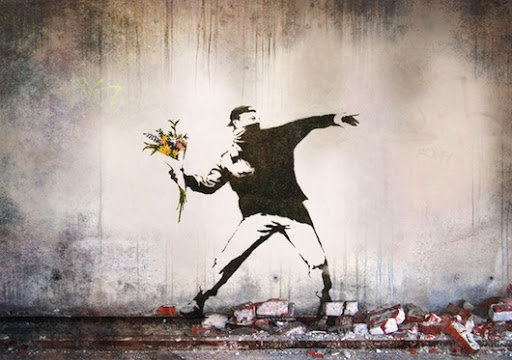
Banksy s

Banksy (2003) “Love is in the air”

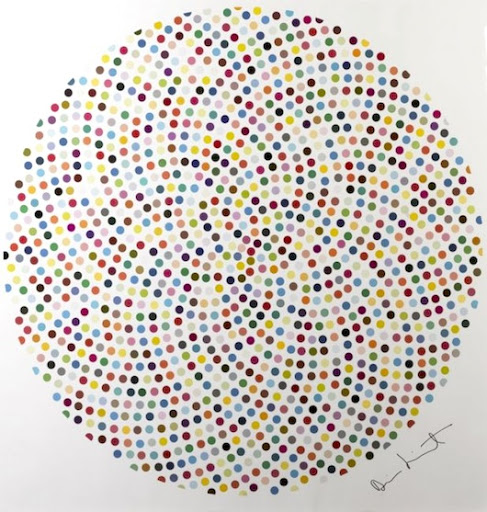
Damien Hirst  Valium s

Damien Hirst (2000) “Valium”

0565 feelingmaterial vi 2003 001 l

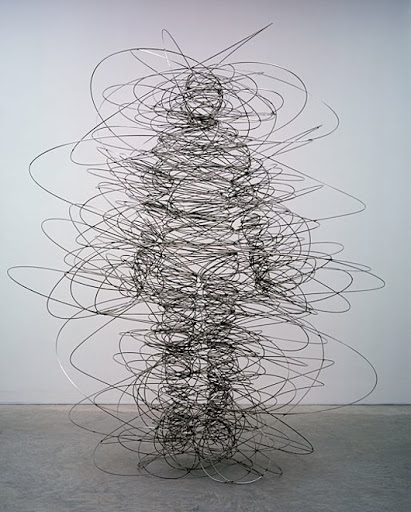
Antony Gormley (2003-2008) “Feeling material”

Kusama s

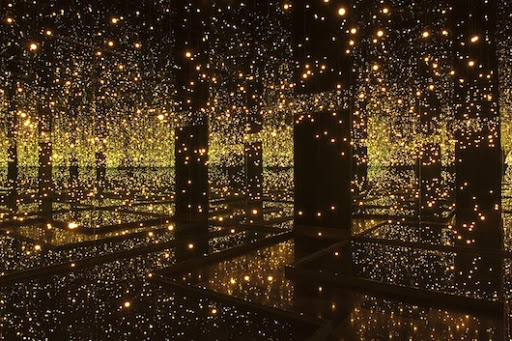
Yayoi Kusama (2013) “Fireflies on the water”

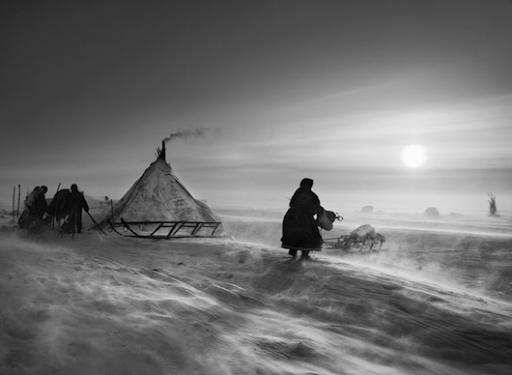
SalgadoSebastião Salgado (2011) “They stand, and they withstand”

Art’s dialogue: Vatican @ Venice Biennale

“It’s Sandro, about the Biennale.” was the first thought that entered my mind when I heard about the Vatican’s latest plans to engage with contemporary art, followed by an “Phew!” as soon as I read the details. While the Church has been a patron of the arts during many centuries, it would be fair to say that it’s ties with contemporary art have slipped of late. While still proclaiming the importance of art as such, the picture it portrayed was one of art having expired after the Renaissance.

It was therefore great to see the announcement yesterday by Cardinal Ravasi that the Holy See is going to present a pavilion at this year’s Venice Biennale and to hear about the artists commissioned for it: Studio Azzurro (a Milanese group of video and performance artists), Josef Koudelka (a highly respected Czech photographer, represented by Magnum Photos) and Lawrence Carroll (Australian-born, American painter whose work is in the permanent collections of galleries like the MOCA). Before taking a closer look at these artists, it is worth noting the theme of the pavilion: “In the Beginning.”1 The focus here is on the first 11 chapters of Genesis as an inspiration for the exploration of man’s origins (“Creation”), the introduction of evil into history (“Un-creation”) and the hope that enters the world via the New Man (“Re-creation”). In Ravasi’s words:

“Creation concentrates on the first part of the biblical narrative, when the creative act is introduced through the Word and the breath of the Holy Spirit, generating a temporal and spatial dimension, and all forms of life including human beings.

Un[-]creation, on the other hand, invites us to focus on the choice of going against God’s original plan through forms of ethical and material destruction, such as original sin and the first murder (Cain and Abel), inviting us to reflect on the “inhumanity of man.” The ensuing violence and disharmony trigger a new start for humanity, which begins with the punitive/purifying event of the Flood.

In this biblical story, the concept of the voyage, and the themes of seeking and hope, represented by the figure of Noah and his family and then by Abraham and his progeny, eventually lead to the designation of a New Man and a renewed creation, where a profound internal change gives new meaning and vitality to existence.”

By the sounds of it, this is a very broad brief, which Ravasi underlines by saying that “each of these aspects was only a starting point for the selected artists. A vital, rich, and elaborate dialogue has been established with them and is a sign of a renewed, modern patronage.” And the aim of such patronage? “[I]nstituting and promoting occasions of dialogue within an ever broader and diversified context,” which sounds exactly like the mission statement of Ravasi’s Pontifical Council for Culture and a natural extension to the dialogue already in progress with intellectuals of all faiths an none, promoted via the Courtyard of the Gentiles initiative.

So, who are the three artists chosen for the first Vatican presence at a Venice Biennale?

Studio azzurro

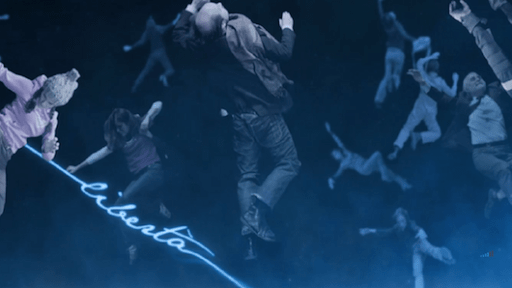
Of the three, the only one I didn’t know of is Studio Azzurro, who have been given the first of the three themes: “Creation” and who place “light, sound, and sensory stimuli at the center of their artistic investigation,” in the words of the art historian and director of the Vatican Museums Prof. Antonio Paolucci. He adds that “[t]heir work triggers a dialogue, awash with echoes and reverberations, between the vegetable and animal kingdoms and the human dimension, which leads, via memory, to other personal narrations.” In broad strokes this sounds like their “Fare gli Italiani” installation in Turin two years ago (a video of which can be seen here) or their earlier “Meditazioni Mediterraneo.” From the perspective of the artists themselves, their interests lie in the “values of memory, places and communities” and their use in “strongly participatory” ways.

Koudelka slovacchia 1963

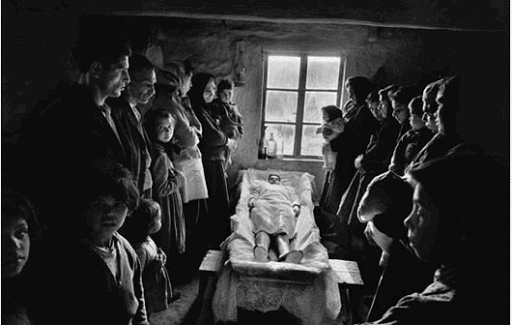
“Un-creation” is entrusted to the photographer Josef Koudelka, whose work is described by Paolucci as follows: “themes such as the destruction brought about by war, the material and conceptual consumption of history through time, and the two opposing poles of nature and industry are made to emerge. The photographer’s images expose an abandoned, wounded world, and at the same time are able to transform fragments of reality into works of art bordering on abstraction.” In many ways this sounds like the “redeeming ugliness” also explored by Michel Pochet, mentioned in an earlier post. To my mind this part of the theme is of great importance as it underlines the being “in the world but not of the world” (cf. John 15:19) of Christianity and a readiness to engage with all of reality. This is an attitude that is at the heart of Koudelka’s approach, who says that “I would like to see everything, look at everything, I want to be the view itself.” His portfolios covering the 1968 invasion of Prague by the Soviet army, the lives of gypsies in Eastern Europe in the ’70s (from which the above photo is taken) and the Welsh landscape in the late ’90s are all great examples of his desire to “be part of everything that is around [him].”

Lawrence carroll

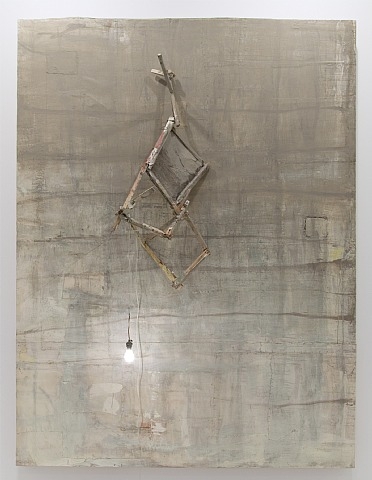
Finally, “Re-creation” will be taken up in the work of the painter Lawrence Carroll, who uses “salvaged materials and the processes of transfiguration, which [he] presents both realistically and symbolically together. His is an elaboration that, meditating on the experiences of Arte Povera, actualizes a continuous and cyclical action of recovery and erosion, of suspension and decline, and of pause and reactivation through the reintroduction of objects into a temporal circuit, forcing fragility and monumentality to coexist” (Paolucci). Carroll himself says that his work “is about the idea that ideas and things have the possibility of having another life” carried from generation to generation of artists. In many ways his work is not only about the transformative, transcendent aspects of art but also its interconnectedness both with past and present ideas, forms and objects.

I believe Cardinal Ravasi has achieved something very impressive here. First, he has chosen a theme with universal appeal and accessible to believers and non-believers alike. Second, he has chosen a set of three artists who are very different from each other, who are respected in and representative of the contemporary art world (insofar as that is possible) and who have a great sense personal freedom (both Koudelka and Carroll have been emphasizing their commitment to their own independence over the year, e.g., with Koudelka saying: “I refuse assignments, even for projects that I have decided to do anyhow […] the idea that no one can buy me is important for me”). Third, he has steered clear of art “destined for the liturgy and sacred spaces” – this is not about interior decoration or illustration but about “rebuild[ing] relations between art and faith.” While not overtly religious, the works commissioned by the Vatican nonetheless speak to themes that are core to Christianity, since – as Cardinal Ravasi puts it – “they should raise questions in people’s minds about their origins and the origins of the world, about sin and destruction, about suffering, but also about hope for a new creation and new way of living.”


1 A theme dear to this blog, where it was covered in the context of the Johannine prologue, the perspective of the roots of science in Genesis and of John Paul II’s Theology of the Body among others.

Look at Mary, see Jesus

8717839098 b716ba634d

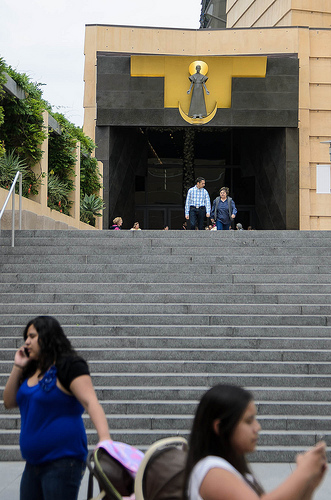
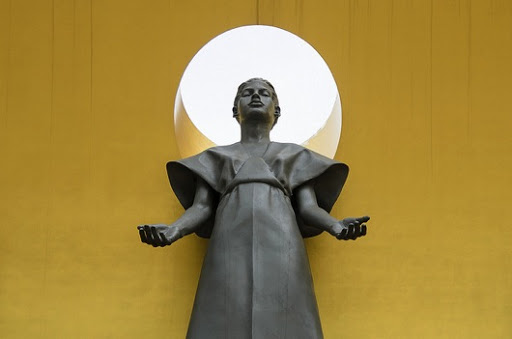
Last week I visited the Cathedral of Our Lady of the Angels in Los Angeles1 and it struck me that the statue above its entrance showed something akin to an optical illusion. Already when seen from afar, the statue above the main doors of the cathedral presented a somewhat ambiguous figure – the short hair, bare arms and forward facing palms were more consonant with an adolescent Jesus, prefiguring his later crucifixion wounds, while the context (i.e., it being the Cathedral of Our Lady and “the medium [being] the message” as McLuhan put it), the moon at the figure’s feet and the placement of the belt on the robe pointed to Mary, albeit posed in a highly unusual way.

In fact, if you look at the typical silhouettes of a statue of Mary (left – where her cloak dominates the outline), the LA statue (center) and a statue of Jesus (right – where head and hands are clearly distinct from the torso) you’ll see where my ambiguity came from:

Silhouette

Even up close this ambiguity does not resolve itself:

8716719089 f0a29367d0 z

The muscular arms as well as the scale of the hands are consistent with a young man, while the dress becomes more clearly female and the face is sufficiently androgynous to allow both for a male and a female reading. In the end I am left with a feeling akin to viewing the rabbit-duck in that I can both resolve the ambiguity in Mary’s and in Jesus’ favor.

What the sculptor Robert Graham has achieved here – at least through my eyes, is to put in bronze the key to Mary being the model Christian. Saint Louis Marie de Montfort put it as follows: “We never give more honor to Jesus than when we honor his Mother, and we honor her simply and solely to honor him all the more perfectly. We go to her only as a way leading to the goal we seek – Jesus, her Son.” And Pope Benedict XVI simply expressed it by saying that we look to Christ by “going towards Mary who shows us Jesus.” Instead of seeking fame and glory for herself, her whole life was one of self-effacing humility, a constant pointing beyond herself – to Jesus – to the point of becoming transparent.


1 For more about the cathedral’s architecture see here.

Tarkovsky: glimpse with sightless eyes

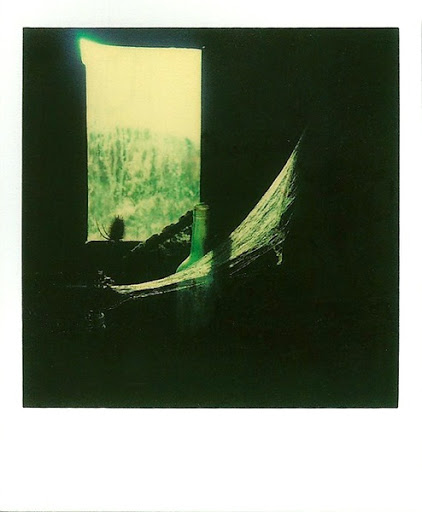
Tarkovsky76 s

Today I have received a wonderful Christmas present from my bestie PM: the book “Instant Light Tarkovsky Polaroids” that contains a series of Polariods taken by the Russian film director Andrei Tarkovsky. If you haven’t seen any of his work, I highly recommend it – his movies are beautifully shot, profound, thought-provoking and reveal a desire to use cinema as a means of exploring fundamental aspects of human nature: “Juxtaposing a person with an environment that is boundless, collating him with a countless number of people passing by close to him and far away, relating a person to the whole world, that is the meaning of cinema.” Fortunately, his movies can now be seen for free on-line, with openculture.com having an up-to-date listing here.
What struck me about the book is first of all the personal character of its photos. They are how I’d imagine Tarkovsky’s Instagram feed to be, rather than a polished fine art collection. While exhibiting the atmospheric, observant nature of his movies, they instead show his dog, son and wife or scenes from places he visited during travels in Russia and Italy. In addition to the photos, there are also a couple of poems, prayers and reflections by Tarkovsky here and I believe these to be the true gems of the book. Let me share a couple of my favorites with you.

First, Tarkovsky gives thought to the nature of artistic expression (italics show original emphasis):

“The image is not a certain meaning
expressed by the director,
but the entire world
reflected as in a drop of water.”

This view very much rings true for me. Whenever I am asked to “explain” my own paintings I feel like I am just one of the multitude of possible viewers, all of whom can confront the work as a world in itself and extract feelings, insights, questions, etc. from it. To my mind, as to Tarkovsky’s, a piece of art is not a message, but an alternate representation of the world. This concept of the image as world, is taken further along a religious line in the following:

“An image
is an impression
of the Truth,
which God
has allowed us
to glimpse
with our
sightless eyes.”

Again there is the world/Truth impressed in an image here, but it is now confronted with our inherent inability to even glimpse it with our “sightless eyes.” I believe this expresses beautifully that basic inability to absolutely interpret artistic work, which is an impression (i.e., not the thing in and of itself) or a reflection (again, only a twisted representation) of a reality that lies beyond it. Tarkovsky here attributes any success in attaining meaning or Truth to God’s benevolence and takes his religious viewpoint further still in the following passage:

“Whatever it expresses –
even destruction and ruin –
the artistic image
is by definition an embodiment of hope,
it is inspired by faith.
Artistic creation
is by definition a denial of death.
Therefore it is optimistic,
even if in an ultimate sense the artist is tragic.
And so there can never be
optimistic artists and pessimistic artists.
There can only be talent and mediocrity.”

To my mind this very much resonates with both what the painter Michel Pochet said about the redemptive power of ugliness and what Benedict XVI said about the liberating, uplifting effect of art even when it is shocking. The role of faith that Tarkovsky sees here, comes out even more clearly in the next quote, where he emphasizes love as the key to faith and their subsequent resolution of the limitations set out above:

“We are crucified on one plane,
while the world is many-dimensional.
We are aware of that
and are tormented by our inability
to know the truth.
But there is no need to know it!
We need to love.
And to believe.
Faith is knowledge with the help of love.”

Finally, Tarkovsky also reflects on man being created in the “image of God” according to the Genesis account – a point that is also central to John Paul II’s Theology of the Body (covered first here and then here):

“In my opinion, when we talk about God
making man in His own image and likeness,
we should understand that the likeness
has to do with His essence, and this is creation.
From this comes the possibility
of evaluating a work and what it represents.
In short, the meaning of art
is the search of God in man.”

This, I believe, is a beautiful synthesis of the above quotes. Man is created in God’s image and is by himself incapable of going beyond the surface of even his own creations. It is only through love and faith that he can seek to be granted access to meaning, Truth and God in himself, in art and in the world.

In search of joy

Joy

As I haven’t managed to write a post here for over a week, I would just like to take the opportunity now to tie together a couple of the strands of the last seven days, which happen to have a shared theme of joy.

First, there is a talk by Pope Benedict XVI that I have been wanting to read for a while and that I finally got to last night. It is the first sermon he gave after the start of the Year of Faith, where he sets out to – what else – talk about the nature of faith. Amongst other things (and I encourage you to read the original in full), he says that “[f]aith is a gift of God, but it is also a deeply human and free act” and he asks himself how we can get “that openness of heart and mind […] to believe in the God.” The answer Benedict puts forward comes from Dei Verbum (§5): “To make this act of faith, the grace of God and the interior help of the Holy Spirit must precede and assist, moving the heart and turning it to God, opening the eyes of the mind and giving “joy and ease to everyone in assenting to the truth and believing it” (Second Council of Orange, Canon 7, 529 AD).” And this makes him conclude: “To believe is to trust freely and joyfully in God’s providential plan” and saying “yes” to God “transforms life, opens the way towards fullness of meaning, thus making it new, full of joy and of reliable hope.”

Second, this joy and freedom of choice (also supported by the ultimate emphasis placed on the freedom of conscience in the Catechism (§1790)) then lead to lives like those of the saints, whom Benedict considers to be “the greatest apologetic for our faith,” alongside art. The accessibility and attractiveness of the joy that another person has, was then one of the topics that I spoke about with my bestie JMGR – a (in my opinion accurately) self-proclaimed “born-again agnostic” :). While our beliefs and views cannot be transferred to another and can remain the subject of doubt and suspicion, the joy and goodness of another’s life is accessible to us regardless of what we think about their beliefs. We can recognize the goodness of the fruit and as a result be more receptive to listening to the tree. A related theme that came up during our chat was also the role of uncertainty in the context of building personal relationships. Acknowledging the fundamental limitations of knowledge (which make it impossible to go beyond one’s self epistemologically) can lead not to indifference or nihilism (which is exhausting) but instead to openness and a greater readiness to hear out those who hold other beliefs.

Third, preceding these explicit instances of thinking about joy as the primary focus, was my reflecting on the activities of aggressive atheists like Richard Dawkins and realizing that I should be grateful for them! On this blog alone, I have confronted their claims repeatedly (about goodness, rationality, science, cosmology) and have always come away from the process enriched both because I read up on the relevant science or philosophy and because I have discovered that the views held by the Church (through the Catechism, the teaching of the Popes or the insights of the Saints) are eminently rational, warmheartedly open and very much my own. There is also no denying the fact that the Church’s teaching has become what it is today also in response to attacks from militant atheists, which have meant that it had to think more carefully about how faith and reason relate and to clean itself from some aberrations that have crept in over the centuries.

Fourth, a very good friend of mine – MK – has been a constant source of joy to me over the last months, during which he has been battling with a serious, life-threatening disease. Throughout this time he has been sharing his experiences on Facebook and on a blog, where he chronicles his battling with the disease, while firmly keeping his sight set on God and on loving his neighbors. His blog is such a source of light for me that I could pick a paragraph at random and share it with you here. In fact, I am just going to share the beginning of what he wrote today:

“I am a child of God not by merit but by a gift of love from Him. Not only that, everybody else is a child of God and if God is our father, we are brothers and sisters, equal! Sounds obvious, but from my, our behaviour, we don’t treat each other as equal. How many times do I put me before loving God in my neighbour. I have all the experience in this and that, I know best, because I have done it before, I have a talent from God! More and more I discover that all these things are given into my hand to make his love visible! When I and my talents, inspirations and gifts from God get in the way of taking time to love my neighbour, it is always me. Where there is me there God can’t be! Here is the challenge: To love the way Jesus loved when he was on the cross, giving everything, becoming nothing out of love!”

True joy is rich, rewarding and all-encompassing. It is not a matter of only the good, easy times, but an insight and gift that transforms challenge, difficulty and suffering. My bestie Margaret once wrote the following to another bestie of ours – DF – and me: “Hope all is very very well (I mean, of course all manner of things are always well because we are loved immensely, so maybe I should wish that you are in the state where you are able to see that it is).” That too is joy and I couldn’t put it any better myself.