Atheists: adversaries, or brothers?

Trio

It is no secret that I have a great deal of respect for my atheist and agnostic friends and I feel like I have learned a lot from them about matters that are of profound value to me as a Christian. With Cardinal Ravasi I can also say that I too have absolutely no interest in converting them (or anyone else for that matter). At the same time I am aware of this attitude not having been the mainstream position of the Church for a long time (although there have always been those who have shared it – many of whom were saints) and that atheism is seen by some (many?) in the Church as a problem even today.

It is against this background that I was pleased to hear voices consonant with mine while reading two great books: On Heaven and Earth (by Cardinal Bergoglio – now Pope Francis – and Rabbi – and biophysicist! – Abraham Skorka, mentioned here before) and Colloqui (by Fr. Pasquale Foresi – one of the co-founders of the Focolare Movement).

Here Francis has the following to say:1

“When I meet atheist persons, I share with them human questions […] which are such rich material for sharing and working on together that they can easily lead to mutual and complementary enrichment. As a believer I know these riches are a gift from God[, but] instead of proselytizing, I respect atheists and I present myself the way I am. I have nothing to hide and I would not say that their life is condemned, because I am convinced that I have no right to judge their honesty. […] We have to be coherent with the message we receive from the Bible: all men and women are made in the image of God, whether they are believers or not.”

Later in the book, this attitude is also reinforced by Rabbi Skorka, saying that “we are all joined by the links of brotherhood.” While the position is, to my mind, positive – we are all brothers and sisters irrespective of our beliefs and there are great riches to be shared with each other in openness, a point worth elaborating on are the positions that Pope Francis rejects here – i.e., proselytism and condemnation.

Why these are novelties in the Catholic Church is addressed in Fr. Foresi’s book, which I happened to read at the same time :). There he points to the great changes that have been confirmed by the Second Vatican Council, a key point of which was an increased emphasis on and respect for following one’s conscience.2 Among others, this shift also legitimized pacifist positions held by prominent Christians during the last century’s World Wars. E.g., see the Catholic, Italian MP Igino Giordani – now in the process of being considered for sainthood, who championed a bill to allow for conscientious objectors to abstain from military service – incidentally in collaboration with atheist Communists (a great rarity during the first half of the 20th century).

It was on the back of this rediscovery of the importance of conscience that the honesty of atheist beliefs was contemplated and while the Church certainly has a position different from atheism, it stated clearly in the Gaudium et Spes constitution of the Second Vatican Council that,

“motivated by love for all men, [the Church] believes [that the] questions [raised by atheism] ought to be examined seriously and more profoundly. [… T]he Church sincerely professes that all men, believers and unbelievers alike, ought to work for the rightful betterment of this world in which all alike live; such an ideal cannot be realized, however, apart from sincere and prudent dialogue. Hence the Church protests against the distinction which some state authorities make between believers and unbelievers, with prejudice to the fundamental rights of the human person.” (Gaudium et Spes, 21)

Fr. Foresi explains that prior to Vatican II it was generally thought that “one couldn’t be an atheist in good faith, and that it was “impossible” for them to be saved.” This has all changed though, so that now there are not only individuals in the Church, who are keen to build relationships with their atheist friends, but it is the Church’s official teaching that the dignity of believers and non-believers alike be protected and valued.

And there is more. In his book, Fr. Foresi recounts how the Focolare Movement, founded by Chiara Lubich, has gone a step further and has done so with the Church’s formal approval. The Focolare Movement is an organization that promotes unity and universal brotherhood among all and even though it started in the Catholic Church during the Second World War, it also has members from other Christian churches and communities and from other religions. And it also counts agnostics or atheists among its members. While links with non-Catholics and atheists were at first informal, as the Focolare Movement was gaining official recognition by the Catholic Church, it also asked for its non-Catholic members to be officially recognized as such – a request eventually granted by the Vatican.

Why am I saying all this? Do I care so much about being “official”? No, not for its own sake, but I believe that it is an indication of how seriously these questions are taken by the Church and how it is not only its declared intention to be open to atheists but also something it approves formally.


1 Since I have the original book in Spanish, the English text is my rough translation.
2 For a more detailed discussion of this topic see a previous post.

Sign of contradiction

Contradictions

Imagine1 sitting on the terrace of a seaside hotel, coolly sipping afternoon drinks, and spotting a yacht heading straight towards you. On beaching the yacht, its sole passenger and captain – armed to the teeth and attempting to communicate with the holiday-makers by signs – persists in the conviction that she has reached a dangerous land, hitherto unknown to civilization, while actually having landed at another of her own homeland’s tourist destinations. You’d certainly feel for her and try to gently steer her in the right direction, but you couldn’t just play along with her delusion.

The above is exactly how I felt (minus the afternoon drink) when I saw a tweet two days ago pointing to “Project Reason” having triumphantly unmasked the shocking contradictions that addle the Bible, with the hope that it would finally bring those religious fanatics to their senses.

🙂

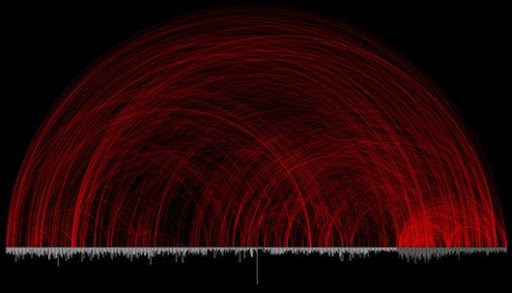
Having scoured the Bible end to end and connected verses that contradict each other, Project Reason have built – and rather beautifully visualized (see above) – a large database of intra-biblical contradictions. I am both grateful to them for this work and certain of the good that reading the Bible has done them (as it does anyone who reads it). What they haven’t done though is in any way question the Bible’s value or present someone who approaches scripture along Dei Verbum lines (i.e., “written under the inspiration of the Holy Spirit, they have God as their author,” but since they were written by men “[we] must investigate what meaning the sacred writer intended to express and actually expressed in particular circumstances by using contemporary literary forms in accordance with the situation of his own time and culture.”) with any challenge whatsoever.

Project Reason: “Aha! The Bible contains contradictions!”
Me: “Yeah, I know and am profoundly grateful for them!”
Project Reason: “?!” (plus an outsized bead of sweat, emblematic of certain Japanese cartoons, that appears during particularly awkward or embarrassing moments)

Let me try to explain why it is that I consider biblical contradictions a strength and source of comfort rather than a challenge or obstacle. The difficulty I have here is not how to do that, but which of the many parallel reasons to start with.

First, there is the angle that has nothing whatsoever to do with religion and that comes from the impossibility of simultaneously being complete and consistent, proven for formal systems by Kurt Gödel and discussed at some length in a previous post here. A system of axioms (rules) can either be consistent or complete, but not both – if it is consistent it has to be incomplete, while if it is complete it has to be inconsistent. Christians believe that revelation is complete in the person of Jesus, which makes inconsistency in his and the Church’s teachings be no surprise to those of us who have a fondness for formal systems and mathematics. That may sound weird, but it sure as Kurt is not unreasonable or irrational.

Second, Christianity (and Judaism too) is about the relationship with a person – God – not about following rules2 (as much as militant atheists would like to believe so). If anything, the contradictions in Scripture underline the necessity of seeking to personally relate to God, to listen to one’s conscience and to seek to live in every individual and unique moment in a way that is a participation in the life of God. In C. S. Lewis’ words: “Doctrines are not God: they are only a kind of map. But that map is based on the experience of people who really were in touch with God.” To which my bestie ML adds: “We should not mistake a map for the territory it describes. We do not turn to the page picturing the ocean in an atlas and expect our shoes to get wet.”

Third, there is the basic fact that different contexts require different words and actions to move them towards the same goal. When a child is very young (and I am thinking ~2 years) wouldn’t you exaggerate the dangers of them sticking anything into a power socket, while when they are older you can explain to them with greater precision what it is that would be dangerous and what wouldn’t (and introduce the whole topic of electricity, conductivity, etc.)? My favorite example of this type of “contradiction” is the “not with us = against us” versus “not against us = with us” case that Project Reason also picked up on. Here we have Jesus say “Whoever is not with me is against me” (Matthew 12:30) at one point and “For whoever is not against us is for us” (Mark 9:40) at another. A contradiction. Right? No, not really – in the first, Matthean case Jesus is referring to his driving out “demons” and this meaning that him and the demons are in opposition, while in the second, Marcan case Jesus is talking about someone who was driving out demons in his name and who his disciples were jealous of. Instead of being a contradiction, this example is actually fully consistent – Jesus is against demons and those who are also against demons are with him …

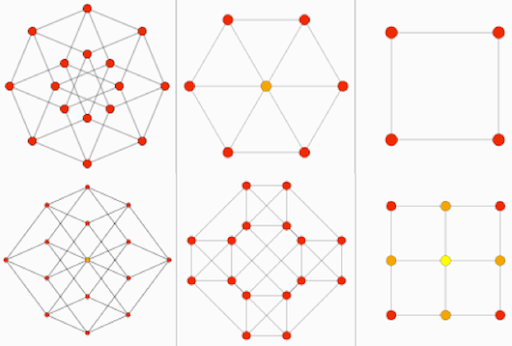
Fourth, if you believe that the Scriptures were “written under the inspiration of the Holy Spirit, [and] have God as their author” (Dei Verbum), then this immediately points to a necessary and vast mismatch in dimensionality between the source (God) and its representation/projection (human words and concepts during the first century AD). Like projections of even just a four-dimensional hypercube into 2D, which give rise to a myriad seemingly unrelated and “contradictory” shapes when considered only in 2D (e.g., how many vertices does this shape have? 4, 7, 16?):3

Tesseract

So too the projections of God’s words into human language necessarily result in apparent inconsistency and contradiction when considered only on the level of human language as opposed to seen as the reductions and conflations they are.

Fifth, to avoid giving the impression of all of the above just being post hoc attempts to explain a feature that the original authors of Scripture did not intend or were not aware of, it is worth noting that contradiction has been a strand in Christian theology that has its origins in the Gospels and that can be traced throughout the last two thousand years (with a recent peak in John Paul II’s thought). This can be seen from Simeon saying to Mary that Jesus “is destined for the fall and rise of many in Israel, and to be a sign that will be contradicted” (Luke 2:34) to St. Paul teaching that “For since in the wisdom of God the world did not come to know God through wisdom, it was the will of God through the foolishness of the proclamation [of the cross] to save those who have faith.” (1 Corinthians 1:21).

¡Viva la contradicción!


1 Thanks to G. K. Chesterton for this great image, borrowed from the opening paragraph of Orthodoxy.
2 But, wait! Didn’t your first point assume that Scripture was a formal system and you are now saying that it is not about rules. Aha! A contradiction! – Yes, I know … so? (see the third point).
3 For more detail see a previous post here.

Pope Francis: Beauty, Goodness, Truth

Pope francis at back

As you many not have the time to follow all of Pope Francis’ talks during these first days of his pontificate, I have compiled the following links to them and my favorite quotes from each one of them – consider it a taster menu if you like:

  1. Patriarch Bartholomew I’s address to Pope Francis on behalf of the religious leaders meeting him after his installation mass on Tuesday:

    “This world is the domain where we realize [the] spiritual way of life, where we achieve our integration into the body of Christ, and where we are brought through Him into eternal life. [… W]e travel this way of truth, acquiring the heavenly through the earthly.”

  2. Pope Francis’ address to the religious leaders then affirmed his commitment both to ecumenism and inter-religious dialogue and he also took advantage of the occasion to emphasize again the importance of aligning ourselves also with those who hold no religious beliefs:

    “[W]e feel the closeness also of those men and women who, while not belonging to any religious tradition, feel, however the need to search for the truth, the goodness and the beauty of God, and who are our precious allies in efforts to defend the dignity of man, in the building of a peaceful coexistence between peoples and in the careful protection of creation.”

    If you are an agnostic or atheist, please, don’t read the above as the Pope imposing a search for God on you. I believe it only refers to a “search for […] truth, […] goodness and […] beauty” since in the Pope’s (and my!) eyes, these all point to God whether you are looking for him through them or not.

  3. During this morning’s mass with Vatican gardeners and cleaners, Pope Francis shared the following insight during his short, impromptu homily (with reference to today’s Gospel reading (John 10:31-42), where Jesus is facing an angry mob that is on the verge of stoning him).

    “When we have a heart of stone it happens that we pick up real stones and stone Jesus Christ in the person of our brothers and sisters, especially the weakest of them.”

  4. Later this morning, Pope Francis then met with the diplomatic corps, again returning to the topics of fraternity, poverty and peace that have been a constant throughout these first days of his being in office and he again underlined the importance of cordial relationships with all – whether they hold religious beliefs of not – and placed this also at the heart of our relationship with God:

    “It is not possible to build bridges between people while forgetting God. But the converse is also true: it is not possible to establish true links with God, while ignoring other people. […] And it is also important to intensify outreach to non-believers, so that the differences which divide and hurt us may never prevail, but rather the desire to build true links of friendship between all peoples, despite their diversity.”

Have a good weekend! 🙂

Science and religion: a set-theoretic view

Universe

The question of how science and religion relate is a staple of this blog, yet in spite of numerous posts1 on this topic already, I feel the need to revisit it again (and probably not for the last time either). What I would like to give some thought to here, are different beliefs (or at least assumptions) about how God and the universe relate2 and the consequences they have on how science and religion are viewed.

For a change, let me start with what I believe myself and then proceed to contrast it with alternatives. To my mind, God infinitely exceeds the universe and is present everywhere and always – as St. Augustine puts it, God is “more inward to me than my most inward part; and higher than my highest.” (Confessions 3, 6). He has both created and sustains the universe, but does so in a way that is intelligible (and therefore also repeatable – the expectation of different outcomes when doing the same thing being one of the definitions of insanity, as Albert Einstein puts it). My position is therefore panentheistic (as opposed to pantheistic – God being equal to the universe – or deist, believing in a distant, separate God) and one that is fundamentally rational as opposed to fideist (a point also emphatically underlined by Benedict XVI during a general audience in November ’12). Here the universe, created “in and by” God,3 is both other than God and very much part of God and the top left quadrant of the diagram above is an attempt to depict it in terms of sets: the universe is represented by a circle, situated in an infinitely extending plane – God.

In this worldview, science is profoundly good not only because of the improvements to life that it can yield, but also because it tells me about how the universe that God created operates. It tells me about God in a way that is like learning about a mime artist by viewing their performance – the information is not immediate, but nonetheless leads to insights about the actor. Another source of understanding God comes to me from theology, which seeks to understand what God has revealed about himself through his relationship with the people of Israel, through his Son, Jesus and through his presence among his followers since then and into the present. These two sources of information about God are in perfect complementarity and equally fill me with wonder and admiration.

Yet science and religion (theology) are not the same – the former has methods finely tuned to bringing the laws of the universe to light and spans the sensible (empirical), while the latter has a span that exceeds that of science, by addressing the extra-empirical aspects of the universe (the whys and ought(’nt)s) as well as events and entities exclusive to its scope. This is not to place one above the other, but simply to put them in relationship as far as their scopes are concerned (bottom left quadrant of the above diagram).

In summary, my understanding of science and religion is that they jointly yield an understanding both of the world I live in and its source and purpose that I believe in. As John Paul II said, “Science can purify religion from error and superstition; religion can purify science from idolatry and false absolutes. Each can draw the other into a wider world, a world in which both can flourish.”

As for alternative views, a positioning of the world as separate from God and outside God, as shown on the right side of the above diagram, is also widespread among religious believers. Here God’s involvement in creation is only an initial impulse and setup, followed by a subsequent separation and distance. The scope of what science and religion have to talk about has no overlap.

My impression here is that this separation also extends into other spheres, beyond just the relationship between God and the universe. At times I come across (repulsive) statements that, e.g., imply that ethical behavior is “owned” by those who hold religious beliefs or that the same applies to truth or beauty.4 In my set theory of the God-universe relationship, all that is good, true and beautiful in the universe, and is accessible without faith, is mine and I just feel like I am being given more or being helped more to live it from my additional, extra-empirical sources.

I have a feeling that this (right) picture also applies to atheist believers, with the circle representing God removed. Here all that is believed to exist is the universe, which is being understood by scientific means and religion is a separate activity that has no corresponding object.

Finally, I suspect that those atheists, who don’t acknowledge that their position is a belief, operate on a worldview like mine (i.e., on the left above), but with the labels swapped. Claims about God are treated like claims about an entity enclosed in the universe and therefore fully subject to the methods of science. Religion too is an activity that can be fully reduced to scientific scrutiny just like any other human activity. If this is correct, then I can understand why atheists who fall in this category find religious belief as lacking in credibility, to the point of being hostile to it.

If any of you, my readers, identify with one of the positions other than mine, I would very much appreciate it if you let me know if I misunderstood something about it. And even if you agree with me, I’d be keen to hear from you :).


1 With previous looks at the science of creation from nothing, a mystical view of creation, the role of belief in science (also here), the dialogue between Chief Rabi Sacks and Prof. Dawkins, the ambiguous relationship between theory and evidence, the constraints of empiricism, the “God of gaps” caricature, atheism as a creed, the evidential equivalence of atheism and religious belief, Martini and Eco’s dialogue on ethics and a call for recognizing rationality in (some of) religion and science alike – to mention just a few :).
2 Many thanks to NP and AG with whom I have spoken about some aspects of this picture by email and over on Facebook over the last weeks. Their insights triggered a lot of interesting and valuable discussion.
3 “The universe, created in and by the eternal Word, the “image of the invisible God,” is destined for and addressed to man, himself created in the “image of God” and called to a personal relationship with God. Our human understanding, which shares in the light of the divine intellect, can understand what God tells us by means of his creation.” (Catechism of the Catholic Church, §299)
4 My friend, SC, told me of a particularly saddening and vile case of her parish priest telling her (at the age of 7) that she wasn’t even human, because she didn’t believe in God. This has nothing to do with Christianity as I understand it, as I hear it taught by the current and previous popes or presented in the Catechism. Instead, it is its perversion.

Rational and evidential equivalence

RothkoMural4

I don’t usually chase popularity, but what I saw after my previous post was published gave me cause for reflection. Of the 94 posts on this blog, “An atheist creed” has certainly had the best first 24 hours, with more than 100 views during that period alone. It was also my most popular post by far, reaching 10 “+1s” within a couple of hours. On Twitter and Google+ too it was received well, which suggested that I had picked a good topic. Not only that, but on Google+ it also lead to a conversation that made me append an update to the original post.

And then three of the original +1s were revoked, still leaving a respectable seven but clearly signaling disagreement with the update’s content. After a day of trying to work out what might have lead to someone changing their mind (and if you are one of the three who did, I’d love to hear from you), I have decided to expand on what I said, with the hope of being more explicit than the update’s 100 or so words allowed.

While the initial post attempted a summary of Dawkins’ “The God Delusion” and arrived at the conclusion that his position is one of unacknowledged belief, for the explicit variant of which he chides those who hold religious ones. At the end of the post I then admitted that, while I respect agnostic positions and hold a Christian one, I fail to see the honesty of atheism. After an enriching exchange on Google+ I then returned to the post and added an update in which I quote one of my atheist friends as saying that their atheism is a belief in there being nothing else out there beyond what we experience. Since this was the first time I have encountered atheism as a creed (my post’s title originally having been intended as a dig at Dawkins), I was surprised and felt like I needed to take a fresh look at it.

I suspect, although I am not sure (and, please, do correct me if I am wrong), that the following may have been the root of the discontent with the post’s update: “the nature of [religious or atheist] belief and [their] relation to evidence and rationality are, to my mind, equivalent.” While the original post was decidedly negative about atheism, the update may have looked like I have softened my stance and like I may even have devalued my own Christian beliefs. Let me therefore be more explicit about these two possible interpretations.

First, everything I have said in the post before the update still stands as is. The atheism presented by Dawkins, and many other militant, aggressive atheists like him, is to my mind rationally feeble and delusional. It claims to be a purely rational, evidence-derived position, while it cannot possibly be. This lack of honesty about the nature of such atheism is fundamentally harmful to those who hold it, since it endows them with an illusory sense of superiority that dramatically (and demonstrably) inhibits their capacity for dialogue.

Why do I claim that their position cannot be evidence derived? For a more detailed answer see this previous post, but in a nutshell it is this: All empirical evidence that I can ever have is in the form of my own experiences and not directly of entities beyond myself. I experience images, sounds, sensations of texture, pressure, temperature, etc. but in all of this I am only conscious of aspects of myself. When I have the experience of seeing an apple, my evidence is not of some external entity – the “apple” as separate from events in my stream of consciousness – but of an image formed in my consciousness. No amount of reference to others, method, measurement or anything else can possibly result in anything other than events that I can with certainty place anywhere other than my own consciousness. This is the nature of experience that has been well understood by philosophers for some centuries now (very clearly by Hume and Locke and to different extents also by many others in preceding centuries).

The only exclusively empirical position is to restrict oneself to making statements only about oneself. Anything else requires belief. A belief in a physical world that causes the experiences we have access to, or even a belief that there is nothing beyond oneself (or some of the more esoteric beliefs typically posited for the sake of exploring the nature of knowledge, like the idea that we are all brains in vats, being fed signals that give rise to the experience we have). A belief that the physical world is all there is or that there is something or someone else beyond it. Beliefs about what it is that lies beyond the physical world. All of these beliefs have the same relationship to empirical evidence – i.e., none! Empirical evidence can contribute to greater or lesser confidence being attributed to one theory or another that explains it, but its scope is only that of the empirical. Evidence cannot point one way or another when it comes to what is beyond it – whether it be nothing or something.

It is with this in mind that I said, and repeat, that an atheist creed has the same empirical and rational status as a religious creed (including my Christian one). The position that is rationally inferior is an atheism that considers itself to be derived from evidence and devoid of the necessity of forming beliefs beyond its scope.

Finally, let me also emphasize that this position is fully compatible with how Christianity understands its own beliefs – as a gift from God (Catechism of the Catholic Church, §153-154):

“Believing is possible only by grace and the interior helps of the Holy Spirit. But it is no less true that believing is an authentically human act. Trusting in God and cleaving to the truths he has revealed are contrary neither to human freedom nor to human reason. Even in human relations it is not contrary to our dignity to believe what other persons tell us […] or to trust their promises […] to share a communion of life with one another.”

My belief in God is empirically and rationally equivalent to another’s belief that there is nothing beyond the physical world and I look forward to learning from my atheist friends what it is like to hold the beliefs they do. Open, honest and charitable dialogue can only be enriching to all who partake in it and I am pleased that I can now count some atheists among those who appreciate it as much as I do.

An atheist creed

Ancient evidence by california artist nancy eckels abstract contemporary modern art painting 3ab3ad12d3d6cababf2ad2ad61347a7f

I have finally read Richard Dawkins’ “The God Delusion” and I highly recommend it: if, like me, you consider “faith and reason [to be the] wings on which the human spirit rises to the contemplation of truth” then this book will give you an (albeit laboriously gleaned) insight into Dawkins’ views and the insults directed there at you will be good practice for charity and compassion. If, on the other hand, you are among those religious fanatics whom Dawkins most vehemently attacks, then you are unlikely to be reading this anyway and anything I say will have about as much effect as Dawkins’ words themselves. The category of reader for whom Dawkins’ book is probably of least value are those who are genuinely seeking to understand the questions he addresses, as they will find far more chaff here than wheat.

While I have heard Richard Dawkins speak on several occasions and have also read various articles of his, I have always come away with a feeling of not knowing what his position is as opposed to what he attacks (the latter having always come across crystal-clear). “The God Delusion” has certainly helped me here and I will try to share my understanding of it next. If you are thinking of reading the book yourself (and I do encourage you to) – just a word of advice: gloss over his attacks on religion and focus instead on those sparse passages where he exposes his own views.

I believe Dawkins’ philosophy is most succinctly expressed by the following needle of a quote from his book:

“An atheist […] is somebody who believes there is nothing beyond the natural, physical world [… and i]f there is something that appears to lie beyond the natural world as it is now imperfectly understood, we hope eventually to understand it and embrace it within the natural.”

In other words: a belief in nothing existing beyond the physical and a hope for an understanding that vindicates such a belief. As an ontological position this is vanilla-flavor materialism and not worthy of further comment. What is more interesting though is not the ontology of this view, but its being posited in terms of “belief” and “hope.” Dawkins (implicitly) acknowledges that atheism is a position that (like all other ontological positions, including religious ones) cannot be held on purely epistemological grounds. Whether there is or isn’t something beyond the physical, sensible is by definition of what counts as evidence beyond its scope (since no sensory, empirical data will ever derive from it). Holding beliefs about nonexistence is more complicated still, thanks to the challenges of evidencing absence,1 which Cowper puts beautifully by saying that “absence of proof is not proof of absence.”2 The presence of hope is also noteworthy since it suggests that this ontological position is not held dispassionately, but that Dawkins cares about its truth value. While not being a religious position by any means, it nonetheless exhibits two of the three key aspects of Christianity: faith and hope, with love also being of clear importance to Dawkins. This is in no way a “gotcha,” but simply a realization that Dawkins’ atheist beliefs share features with my Christian ones and I don’t begrudge him this.

While Dawkins’ hope for and belief in only the physical existing are not derived from evidence (there being no evidence for the absence of non-physical existence), he happily challenges those who hold religious beliefs for making assertions “for which they neither have, nor could have, any evidence.” In fact, he goes even further by mounting an argument for a particular entity not existing in this non-physical void: God.3 Here Dawkins’ argument against God’s existence is the following:

“The argument from improbability states that complex things could not have come about by chance.”

“However statistically improbable the entity you seek to explain by invoking a designer, the designer himself has got to be at least as improbable.”

It is ironic to see what Dawkins does here. He takes a weak cosmological argument for the existence of God (that many have torn to shreds) and “leverages” it for his own ends, while inheriting (even amplifying) its weaknesses. In essence this argument – a favorite among Creationists – is that the world is so complex that it couldn’t have come about by chance or from simpler entities and that a designer or creator had to be its source. Dawkins then comes along and thinks he is trumping them by adding that the presumed creator must be more complex still and therefore even less likely. Far be it from me to defend the original cosmological argument, but it is disappointing to see Dawkins attempt its use as an argument for the almost-non-existence of God. The irony is greater still since it is Dawkins’ own scientific work that has contributed to illuminating how it is that greater complexity comes about from simpler origins …

My final takeaway is a deflated “oh …” in the face of the naïveté of Dawkins’ position. First, for his schoolboy materialist creed and, second, for his clumsy attempt at offering an argument for the statistical non-existence of God. Is this the best that atheism has to offer intellectually? Before writing this piece I have tried to think about whether I could offer a better atheist position, but I have to admit that I have failed. Atheism just does not make any sense since it is at its core an oxymoron: the belief in an entity’s non-existence. Agnosticism is another matter altogether. It is a position I don’t hold, but one that I have great respect for and that I have seen stated convincingly and with a great sense of honesty.

UPDATE (19 December 2012): I have just read the following, illuminating comment on this post on Google+:

“I could very elegantly be an agnostic, which is the rational stance, and save myself some problems. But I actually have this belief inside, my gut bets that there is NOTHING else out there. So I have to be honest about that.”

This is the kind of atheist position I was trying to (but failing to) intuit before writing the post. It is an atheism that to me sounds ultimately honest and is very much like my own Christianity: it holds a belief about what there is beyond the empirical. There is a clear difference in what that belief contains, but the nature of the belief and its relation to evidence and rationality are, to my mind, equivalent. I now feel that I need to look at atheism in a new way and I hope to learn more about it.

UPDATE (9 January 2013): This post is fast becoming one of the most popular on this blog and it has certainly triggered a lot of discussion both on- and off-line. For coverage of some of its aftermath see the following post.


1 For a very well presented analysis of this point, and with reference to Dawkins, see Brian Garvey’s paper.
2 This dictum is not without challenge and I hope to return to it in a future post.
3 Dawkins goes to great lengths to be clear that he doesn’t mean an “Einsteinian God” or a God of the laws of physics, but a personal God like that of the Abrahamic religions. From my perspective this only amounts to a display of a profound misunderstanding of how Christianity sees God (displayed with particular virtuosity when discussing the Trinity).

Lumen Gentium: On the People of God

Fish family

[Just a quick apology before you proceed – this post has turned out to be rather longer than I hoped for, but there was just so much of interest in this chapter of Lumen Gentium that I couldn’t be any more succinct. You may prefer to read it in parts rather than all in one go …]

To have any chance of reading the full set of 16 Vatican II documents during this Year of Faith, I need to press on and take a look at the second chapter of Lumen Gentium, the council’s dogmatic constitution on the Church. In the first chapter, we got a view of who the Church is, as seen from God’s perspective – i.e., what the ultimate end of the Church is, while here, in chapter two, the focus is more on a view from the trenches: the People of God.

If you are reading this as an agnostic or a non-Catholic, let me first point you to the caveat in my post on Dei Verbum (paragraph 2), and re-iterate how this particular document does not use the most accessible language (e.g., with sentences like “Fortified by so many and such powerful means of salvation, all the faithful, whatever their condition or state, are called by the Lord, each in his own way, to that perfect holiness whereby the Father Himself is perfect.”). While I would feel quite at ease recommending a direct reading of Dei Verbum to anyone interested in how the Church understands Scripture, I’d hesitate when it comes to Lumen Gentium. Nonetheless, if you consider Lumen Gentium to be like a patent is to a scientific paper and take the time to peel away its particular form, the substance it carries is well worth the effort.

The starting point of Chapter 2 is Jesus’ New Testament, which forms a new people (the People of God) by means not of genetics (as was the case in the Old Testament, where the Israelites are already called the “Church of God”) but of the Spirit. All who believe in Jesus, become members of His people through baptism and the actions of the Holy Spirit. “The state of this people is that of the dignity and freedom of the sons of God, in whose hearts the Holy Spirit dwells as in His temple. Its law is the new commandment to love as Christ loved us.” A clearer distinction is made here between those who are members of the People of God and those who are not than in the first chapter. The Church is presented as the salt or yeast from which the whole world can benefit: “although it does not actually include all men, and at times may look like a small flock, [the Church] is nonetheless a lasting and sure seed of unity, hope and salvation for the whole human race.” Looking back at chapter one and at Dei Verbum, this should not be taken as an indication of superiority, but simply as an attempt at specificity. Clearly not all of humanity believes that Jesus is God, who came to show us the way to Himself, and Lumen Gentium here strives to spell out what it is that those who hold this belief are like and how they live as a community. This positioning of the Church is particularly clear from the following: “Established by Christ as a communion of life, charity and truth, [the Church] is also used by Him as an instrument for the redemption of all.”

The role of the People of God is to “bear witness to Christ and give an answer to those who seek an account of that hope of eternal life which is in them.” This is done by all members of the Church by participating in the priesthood of Jesus, who is its head. Those consecrated to the “ministerial priesthood” “teach and rule the priestly people; acting in the person of Christ, making present the Eucharistic sacrifice, and offering it to God in the name of all the people.” The laity too participate in Jesus’ (“royal”) priesthood, which they exercise “in receiving the sacraments, in prayer and thanksgiving, in the witness of a holy life, and by self-denial and active charity.” The whole church therefore is a “priestly community.”

It is a community that operates through the “sacraments and the exercise of the virtues,” where members are “[i]ncorporated in the Church through baptism” (incorporated since the Church is the Body of Christ, as chapter one sets out). This membership is further perfected by confirmation, when “the Holy Spirit endows them with special strength so that they are more strictly obliged to spread and defend the faith, both by word and by deed.” The Eucharist, which is “the fount and apex of the whole Christian life” strengthens them and “manifest[s] in a concrete way [the] unity of the people of God.” Through the sacrament of Penance, they “obtain pardon from […] God for the offence committed against Him and are […] reconciled with the Church.” Through the anointing of the sick, the People of God “associat[e] themselves freely with the passion and death of Christ.” Those who are consecrated by “Holy Orders[,] are appointed to feed the Church in Christ’s name with the word and the grace of God,” while those who receive the sacrament of Matrimony, “partake of the mystery of that unity and fruitful love which exists between Christ and His Church, help each other to attain to holiness in their married life and in the rearing and education of their children.” “From the wedlock of Christians there comes the family, in which new citizens of human society are born, who by the grace of the Holy Spirit received in baptism are made children of God, thus perpetuating the people of God through the centuries. The family is, so to speak, the domestic church.” What is crystal clear from the above is that the sacraments (shown in bold) are the “means of salvation,” helping the members of the Church to “bear witness to Christ.”

So far, so good, but what comes next in §12 is to me the most interesting part of Chapter 2 (as the preceding paragraphs were edifying, but had a sense of the taxonomical about them):

“The entire body of the faithful […] cannot err in matters of belief. They manifest this special property by means of the whole peoples’ supernatural discernment in matters of faith when “from the Bishops down to the last of the lay faithful” they show universal agreement in matters of faith and morals. That discernment in matters of faith is aroused and sustained by the Spirit of truth. It is exercised under the guidance of the sacred teaching authority, in faithful and respectful obedience to which the people of God accepts that which is not just the word of men but truly the word of God. Through it, the people of God adheres unwaveringly to the faith given once and for all to the saints, penetrates it more deeply with right thinking, and applies it more fully in its life.”

This is strong stuff, both as it states that the entire body of the faithful “cannot err” when it comes to faith and morals and as it calls for careful thought being applied to these beliefs and for their ever more perfect putting into practice. To my mind the key takeaway here is that infallibility here is attributed to the “entire body of the faithful” – i.e., the Mystical Body of Christ that has Jesus as its head. If truly all the faithful hold a certain belief then I can well subscribe to that belief having to be taken seriously and having to be attributed to the Holy Spirit. What this view does is to place the whole of the Church in a position of tremendous importance and responsibility, far from the usual caricature where the hierarchy is seen as dictating to a flock that follows it blindly and unthinkingly. The flip side of such status is the responsibility we carry for disagreements and disunity within the Church, which prevents us from accessing the unerring insights that the Holy Spirit has prepared for us when we are united.1

Two aspects of the above strike me as relevant: first, that this is not a new idea, but instead a centuries-old idea that has had new light shed on it and second, that it again points to the continuing action of the Holy Spirit. In terms of the first aspect, the basic idea can be seen already in the Latin proverb: “Vox populi, vox Dei” (“The voice of the people is the voice of God”) which has been quoted as a proverb already in the 8th century AD. The second aspect then is particlarly clearly illuminated by what Pope Benedict XVI in fact said just today:

“This gift, the sensus fidei, constitutes in the believer a kind of supernatural instinct that has a connatural life with the same object of faith. It is a criterion for discerning whether or not a truth belongs to the deposit of the living apostolic tradition. It also has a propositional value because the Holy Spirit does not cease to speak to the Churches and lead them to the whole truth.”

To underline the profound vocation of every single member of the People of God, Lumen Gentium points to the Holy Spirit’s gifts being bestowed on anyone whom He chooses: “[T]he Holy Spirit sanctifies and leads the people of God and enriches it with virtues, “allotting his gifts to everyone according as He wills.” He distributes special graces among the faithful of every rank. By these gifts He makes them fit and ready to undertake the various tasks and offices which contribute toward the renewal and building up of the Church.” This acknowledges very clearly that it is not the hierarchy of the church alone who have a role of leadership in the Church, but that the Holy Spirit can choose anyone to contribute to its renewal, “but judgment as to their genuinity and proper use belongs to those who are appointed leaders in the Church, to whose special competence it belongs, not indeed to extinguish the Spirit, but to test all things and hold fast to that which is good.” A very careful balance is presented here between the hierarchical and the “charismatic” aspect of the Church, which underlines again the fact that the Church are all the People of God.

Paragraph 13 then focuses on there being only one People of God, “which takes its citizens from every race, making them citizens of a kingdom which is of a heavenly rather than of an earthly nature.” This “takes nothing away from the temporal welfare of any people. On the contrary it fosters and takes to itself, insofar as they are good, the ability, riches and customs in which the genius of each people expresses itself.” All the diversity in the Church then has as its goal the fulfillment of St. Peter’s words: “According to the gift that each has received, administer it to one another as good stewards of the manifold grace of God” (1 Peter 4:10).

In paragraph 14 we turn to the role of the Church in the context of salvation and we start with a warning: “Whosoever, […] knowing that the Catholic Church was made necessary by Christ, would refuse to enter or to remain in it, could not be saved.” Membership in the Church requires acceptance of “her entire system and all the means of salvation given to her, and [being] united with her as part of her visible bodily structure and through her with Christ, who rules her through the Supreme Pontiff and the bishops.” Even membership (for those who know that it is necessary for salvation) is not sufficient though: “He is not saved, however, who, though part of the body of the Church, does not persevere in charity. He remains indeed in the bosom of the Church, but, as it were, only in a “bodily” manner and not “in his heart.”” And it gets even worse! Those who “fail […] to respond to [the grace of Christ] in thought, word and deed, not only shall they not be saved but they will be the more severely judged.” Reading Chapter two very much gives you a sense of growing wonder as you proceed towards the end of §13, only to be followed by a cold shower and stark warnings!

So, what does §15 hold? First, it starts by acknowledging that there are Christians outside the Catholic Church:

“They lovingly believe in God the Father Almighty and in Christ, the Son of God and Saviour. They are consecrated by baptism, in which they are united with Christ. They also recognize and accept other sacraments within their own Churches or ecclesiastical communities. Many of them rejoice in the episcopate, celebrate the Holy Eucharist and cultivate devotion toward the Virgin Mother of God. They also share with us in prayer and other spiritual benefits. Likewise we can say that in some real way they are joined with us in the Holy Spirit, for to them too He gives His gifts and graces whereby He is operative among them with His sanctifying power.”

The key to me here is not only the extensive list of similarities that the Catholic Church sees in other “churches and ecclesiastical communities” but also the warmth of the language used (“lovingly believe,” “consecrated by baptism,” “rejoice in the episcopate,” “cultivate devotion,” “joined with us in the Holy Spirit”). There is a real yearning and well-wishing here and a desire to “pray, hope and work” towards being “peacefully united.”

Paragraph 16 then talks about where the Catholic Church sees non-Christians in this picture and there is again a sense of openness, warmth and yearning here. First come the Jews, “from whom Christ was born according to the flesh”: “this people remains most dear to God, for God does not repent of the gifts He makes nor of the calls He issues.” Next, come the Muslims “who, professing to hold the faith of Abraham, along with us adore the one and merciful God, who on the last day will judge mankind.” Then there are all others who seek God: “Nor is God far distant from [them], for it is He who gives to all men life and breath and all things, and as Saviour wills that all men be saved.” Finally, all those of good will are in the picture too: “Divine Providence [does not] deny the helps necessary for salvation to those who, without blame on their part, have not yet arrived at an explicit knowledge of God and with His grace strive to live a good life.” The message is very clear: all are called to salvation and each has to take advantage of all the means they are offered for reaching it, according to their conscience and understanding.

Finally, Chapter 2 closes with a reminder of Jesus’ words: “Go, therefore, make disciples of all nations, baptizing them in the name of the Father and of the Son and of the Holy Spirit, teaching them to observe all things whatsoever I have commanded you. And behold I am with you all days even to the consummation of the world” (Mathew 28:19). All members of the Church have an “obligation of spreading the faith” so that “whatever good is in the minds and hearts of men, whatever good lies latent in the religious practices and cultures of diverse peoples, is not only saved from destruction but is also cleansed, raised up and perfected unto the glory of God.” All this is done so that “the entire world may become the People of God,” which instead of being an attempt to conquer or colonize is one of striving for unity in diversity.


1 I would just like to tip my hat to my bestie PM, who has essentially arrived at this point without having read Lumen Gentium!

In search of joy

Joy

As I haven’t managed to write a post here for over a week, I would just like to take the opportunity now to tie together a couple of the strands of the last seven days, which happen to have a shared theme of joy.

First, there is a talk by Pope Benedict XVI that I have been wanting to read for a while and that I finally got to last night. It is the first sermon he gave after the start of the Year of Faith, where he sets out to – what else – talk about the nature of faith. Amongst other things (and I encourage you to read the original in full), he says that “[f]aith is a gift of God, but it is also a deeply human and free act” and he asks himself how we can get “that openness of heart and mind […] to believe in the God.” The answer Benedict puts forward comes from Dei Verbum (§5): “To make this act of faith, the grace of God and the interior help of the Holy Spirit must precede and assist, moving the heart and turning it to God, opening the eyes of the mind and giving “joy and ease to everyone in assenting to the truth and believing it” (Second Council of Orange, Canon 7, 529 AD).” And this makes him conclude: “To believe is to trust freely and joyfully in God’s providential plan” and saying “yes” to God “transforms life, opens the way towards fullness of meaning, thus making it new, full of joy and of reliable hope.”

Second, this joy and freedom of choice (also supported by the ultimate emphasis placed on the freedom of conscience in the Catechism (§1790)) then lead to lives like those of the saints, whom Benedict considers to be “the greatest apologetic for our faith,” alongside art. The accessibility and attractiveness of the joy that another person has, was then one of the topics that I spoke about with my bestie JMGR – a (in my opinion accurately) self-proclaimed “born-again agnostic” :). While our beliefs and views cannot be transferred to another and can remain the subject of doubt and suspicion, the joy and goodness of another’s life is accessible to us regardless of what we think about their beliefs. We can recognize the goodness of the fruit and as a result be more receptive to listening to the tree. A related theme that came up during our chat was also the role of uncertainty in the context of building personal relationships. Acknowledging the fundamental limitations of knowledge (which make it impossible to go beyond one’s self epistemologically) can lead not to indifference or nihilism (which is exhausting) but instead to openness and a greater readiness to hear out those who hold other beliefs.

Third, preceding these explicit instances of thinking about joy as the primary focus, was my reflecting on the activities of aggressive atheists like Richard Dawkins and realizing that I should be grateful for them! On this blog alone, I have confronted their claims repeatedly (about goodness, rationality, science, cosmology) and have always come away from the process enriched both because I read up on the relevant science or philosophy and because I have discovered that the views held by the Church (through the Catechism, the teaching of the Popes or the insights of the Saints) are eminently rational, warmheartedly open and very much my own. There is also no denying the fact that the Church’s teaching has become what it is today also in response to attacks from militant atheists, which have meant that it had to think more carefully about how faith and reason relate and to clean itself from some aberrations that have crept in over the centuries.

Fourth, a very good friend of mine – MK – has been a constant source of joy to me over the last months, during which he has been battling with a serious, life-threatening disease. Throughout this time he has been sharing his experiences on Facebook and on a blog, where he chronicles his battling with the disease, while firmly keeping his sight set on God and on loving his neighbors. His blog is such a source of light for me that I could pick a paragraph at random and share it with you here. In fact, I am just going to share the beginning of what he wrote today:

“I am a child of God not by merit but by a gift of love from Him. Not only that, everybody else is a child of God and if God is our father, we are brothers and sisters, equal! Sounds obvious, but from my, our behaviour, we don’t treat each other as equal. How many times do I put me before loving God in my neighbour. I have all the experience in this and that, I know best, because I have done it before, I have a talent from God! More and more I discover that all these things are given into my hand to make his love visible! When I and my talents, inspirations and gifts from God get in the way of taking time to love my neighbour, it is always me. Where there is me there God can’t be! Here is the challenge: To love the way Jesus loved when he was on the cross, giving everything, becoming nothing out of love!”

True joy is rich, rewarding and all-encompassing. It is not a matter of only the good, easy times, but an insight and gift that transforms challenge, difficulty and suffering. My bestie Margaret once wrote the following to another bestie of ours – DF – and me: “Hope all is very very well (I mean, of course all manner of things are always well because we are loved immensely, so maybe I should wish that you are in the state where you are able to see that it is).” That too is joy and I couldn’t put it any better myself.

A universe from nothing

Dark energy
In 2009 Richard Dawkins introduced a talk by Lawrence Krauss by eulogizing about his work as follows: “[T]he study of origins, origins of all kinds, right across the board from the origin of the Universe to the origin of Life, to the origin of everything that you can think of [ – w]hat an amazingly exciting initiative.” Krauss himself – whose talk is entitled “A Universe From Nothing” – then goes on to extoll the virtues of wonder by saying that “scientists love mysteries. They love not knowing. That’s a key part of science. The excitement of learning about the Universe.” What a great way to start a talk: origins and wonder!

The only thing left for me to do to enjoy the rest of Krauss’ lecture about cosmology is to filter out the recurring jabs at “sterile” religion, “where the excitement is apparently knowing everything although clearly knowing nothing” and many more throughout the talk. In fact, Krauss’ and Dawkins’ view of religion reminds me very much of the view that young-earth creationists have of science – both equally ignorant of the other. Leaving those aside (engaging with them would be fruitless), this is what I understood as being Krauss’ argument for the Universe having come into being from nothing:

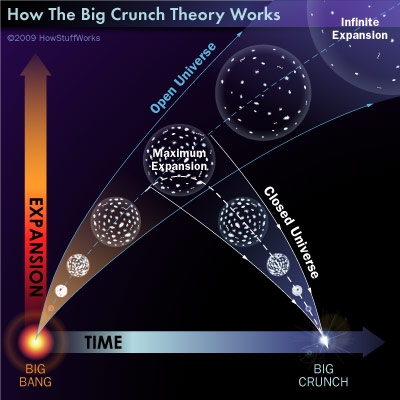
After establishing that the universe is expanding (with reference to Edwin Hubble’s discovery of it in the 1920s, who observed that all other galaxies were moving away from us and were doing so faster, the further away they were1), Krauss presents three alternatives for how that expansion may be occurring: “[A] closed Universe would expand and stop and then recollapse in a Big Crunch, the reverse of the Big Bang. An open Universe would expand forever and a flat Universe will expand and slow down and never quite stop.” The following illustration shows the open and closed cases – the flat one being similar to the open one, but having a limit (bound) to its (still infinite) expansion as opposed to being unbounded.

Big crunch open and flat universe

In the process of determining which of the three cases of expansion our Universe is undergoing, the challenge of measuring the mass of galaxies (to infer from them the curvature of their light-bending effects and therefore the curvature of the universe) and the whole universe arises and attempts to do so show that “most of the mass in [a] system of clusters of galaxies is not where the galaxies are. It’s between the galaxies. It is where nothing is shining.” This in turn leads to the realization that “dark matter is a new type of elementary particle,” which further complicates the quest for measuring the mass and energy of the universe.

The consequences of the universe being flat (i.e., expanding infinitely but asymptotically towards a limit) are then spelled out:

“It turns out that in a flat Universe, the total energy of the Universe is precisely zero. Because gravity can have a negative energy. So the negative energy of gravity balances out the positive energy of matter. What’s so beautiful about a Universe with total energy zero? Well, only such a Universe can begin from nothing. And that is remarkable, because the laws of physics2 allow Universes to begin from nothing! You don’t need a deity.3 You have nothing. Zero total energy and quantum fluctuations can produce a Universe.”

This nothing is further illustrated by results obtained recently about the mass of protons, where:

“it turns out most of the mass of the proton comes not from the quarks within a proton, but from the empty space between the quarks. These fields popping in and out of existence produce about 90% of the mass of a proton, and since protons and neutrons are the dominant stuff in your body, the empty space is responsible for 90% of your mass. So this empty space is vital to science and these calculations are vital to understanding not just protons, but electrons and atoms and produce the best comparisons.”

In other words, the nothing from which a universe can come into being is a “boiling bubbling brew of virtual particles that are popping in and out of existence” “because of the laws of quantum mechanics and special relativity.” This nothing is an “empty space” that is empty insofar as matter and gravity cancel out each other’s energy and insofar as quantum mechanics deals in fields that may or may not yield particles.

As far as this being what I understood, I actually find it quite beautiful – and Krauss would agree by saying that “the only mathematically beautiful Universe” is a flat one, like ours. There is a symmetry between positive and negative energy, light and dark matter, there is infinite expansion that is at the same time bounded, there is a constant dynamic of being potentially versus actually and there is a tremendous amount of beautiful science that has lead to this view of the universe. We have Lemaître’s and Hubble’s insights into the universe’s expansion, we have the astonishing work on measuring the universe’s curvature by means of looking at it’s background radiation, we have ways of measuring the mass of distant galaxies and their distances from us and so much more. From this point of view, I do recommend Krauss’ talk wholeheartedly.

Sadly, there is another side to it, which is its being peppered with jabs at religion and a profound ignorance of what many religious people believe. The underlying view of religious faith that informs the criticisms leveled against it here, and in many other atheist forums, seems to have people like Young-Earth creationists, Pentecostal snake-handlers and members of groups like the Westboro Baptist Church as their model. This is akin to me taking someone like Dr. Josef Mengele as the archetype of a scientist and projecting prejudices from him to all scientists. I have about as much in common with the lunacy of the above mentioned “religious” groups as with the barbarity of the above mentioned “scientist.”

Let me be a bit more specific though about why the religion-related claims of Krauss don’t stick, as it can otherwise seem like this is just a lot of hand-waving. First, let’s look at the cosmology (and cosmogeny) presented by Krauss, which postulates a coming-into-being of the universe from nothing. If anything, this scientific insight is fully consistent with the Christian account of creation, where God creates the world from nothing – hence the emblematic Latin phrase: “ex nihilo.” The Christian view of how the world came into being is not one of a God having inhabited space-time and then decided to turn parts of himself into planets, vegetation, animals, humans. Instead, the Catechism here affirms that “God gave a beginning to all that exists outside of himself” (§290), where (in some sense) there was nothing before: “All things came to be through him, and without him nothing came to be” (John 1:3). The Nicene Creed even speaks about God as the creator of “all things visible and invisible,” which can comfortably be applied to dark matter or the negative energy of gravity.

In fact, the Catechism (§296) is insistent on there having been nothing before the Universe started:

“We believe that God needs no pre-existent thing or any help in order to create, nor is creation any sort of necessary emanation from the divine substance. God creates freely “out of nothing”: “If God had drawn the world from pre-existent matter, what would be so extraordinary in that? A human artisan makes from a given material whatever he wants, while God shows his power by starting from nothing to make all he wants.” (St. Theophilus of Antioch, Ad Autolycum II)”

So, if anything, the model of a flat universe and of the nothingness that is at its origin is in perfect accord with what the Church has come to believe through revelation and the guidance of the Holy Spirit over the centuries (and as early as in the 2nd century in the writings of St. Theophilus!). There simply is no conflict here – listening to the science Krauss talks about just makes me delight in how much better we understand how it was that the universe came into being from nothing. I can therefore happily conclude, again with the Catechism (§283):

“The question about the origins of the world and of man has been the object of many scientific studies which have splendidly enriched our knowledge of the age and dimensions of the cosmos, the development of life-forms and the appearance of man. These discoveries invite us to even greater admiration for the greatness of the Creator, prompting us to give him thanks for all his works and for the understanding and wisdom he gives to scholars and researchers.”

Catholics (and adherents of many other Christian denominations and other religions) are in no way at odds with the advances of science, since – in addition to the benefits that it enables for the good of all, it sheds light on how the universe works and how it has worked since its beginning. Those who believe in God having created the universe (from nothing!), being the source of its laws and continuously sustaining its being can enjoy the advances of science as much as those who don’t hold those beliefs, and I wish that neither side would try to ridicule the other or force them to change their views!


1 Incidentally, it was Georges Lemaître – the Belgian priest and physicist, who made this realization based on Hubble’s data a couple of years before Hubble did.
2 It always baffles me how many atheists hail the latest developments of science as proofs of the non-existence of God, while quite happily relying on pre-existing “laws of physics.”
3 I. e., a “god of gaps” deity …

The beyond inside

Living success 3d drinking tea

For a while now, I have been coming across rather negative takes on the Dalai Lama’s “Beyond Religion” book from last year. So, when I saw it at an airport bookshop today, I bought it and started reading it on my way home across the Atlantic. Before I tell you more about it, I have to admit to having a deep-seated fondness for and admiration of the present Dalai Lama, stemming from having read quite a bit of his writings, having seen interviews with him (and that gem of a chat between him and Archbishop Desmond Tutu, mentioned here some time ago) and also from counting the movie Kundun among my all-time favorites. With this “baggage” in mind, you’ll understand that I was rather skeptical about the book’s reviews and dubious about their being representative of its author’s thoughts.

The criticisms tend to focus on quotes like: “in today’s secular world, religion alone is no longer adequate as a basis for ethics” and “when negative attitudes towards religion […] are motivated by a concern for justice, they must be respected.” Several commentators are then quite content to take these, become indignant and launch into extensive rants in defense of religion. I find that rather misguided and not only a misrepresentation of the Dalai Lama’s thought, but also woefully naïve.

Even just a reading of the introduction to the book makes one thing crystal clear – the Dalai Lama is not turning away from religion or finding it lacking in any way: “religion has helped millions of people in the past, helps millions of people today, and will continue to help millions in the future” and “it may seem [… that] I am advocating the exclusion of religion from ethical systems, or even from all areas of public life [… – t]his is not at all what I have in mind.”

So, what is he getting at?

“[My statements] may seem strange coming from someone who from a very early age has lived as a monk in robes. Yet I see no contradiction here. My faith enjoins me to strive for the welfare and benefit of all sentient beings, and reaching out beyond my own tradition, to those of other religions and to those of none, is entirely in keeping with this.”

All I can say to that is: Amen! Instead of renouncing religion or in any way devaluing it, the Dalai Lama is saying: let’s look for what we have in common and for the good that is deep-rooted in our human nature and nourish it. In fact, he puts the relationship between the ethics that is not contingent on religious beliefs and the ethics that is thus:

“Ethics and inner values without religious content are like water, something we need every day for health and survival. Ethics and inner values based in a religious context are more like tea. The tea we drink is mostly composed of water, but it also contains some other ingredients – tea leaves, spices, perhaps some sugar or, at least in Tibet, salt – and this makes it more nutritious and sustaining and something we want every day.”

This, to my mind, is a beautiful way of putting it, which makes me even sadder to see that the first part of the above quote gets bandied about as further evidence for the Dalai Lama considering religion to be of little value. Instead, I believe, that his metaphor is spot on and emphasizes the riches of faith, while also highlighting the universal access to a great deal of what is good about it. Note, that he is not saying – ethics without religion is water and the extra ingredients that can turn it into tea are religion. He is saying, religion is tea (i.e., water and other ingredients together) – it is a richer, more complex entity than what is accessible otherwise rather than an optional, minimal add-on. In this sense, the striving to bring ethics beyond religion is one of doing so for an ethics that is very much inside religion – like water is in tea.

From my Christian perspective I can rephrase what the Dalai Lama is saying as God, whom I believe to be the source of all goodness and happiness, making a great deal of himself accessible even to those who don’t believe in him (He is love, so why wouldn’t He?). This is a source of joy to me and – like the Dalai Lama – something I am grateful for and want to build on in my relationships with all. I am also grateful for what God makes accessible to me through His gift of faith, but it would be foolish of me to be jealous of His generosity and I would be blind if I saw His love only among those who hold the same beliefs as I do. The Dalai Lama’s attempts to tease out what he sees as being universal (i.e., non-belief-contingent) aspects of ethics are to me greatly positive and directed towards making God’s presence evermore widely and clearly felt on earth.

Re-reading the above, a possible misunderstanding of it comes to my mind: “Are you saying that the ethics of religious people is superior? That those of no religious faith are in some way second class ethical?” Not at all! I believe that we are all fully capable of acting selflessly, for the good of our neighbors, those in need and even our enemies – having faith is not a prerequisite for this (and this is essentially the Dalai Lama’s point). So, does faith make any difference? Absolutely! I believe that my faith helps me greatly in trying to live in the above way. Instead of a feeling of superiority it engenders a sense of responsibility in me though, and brings to mind Jesus’ parable of the talents (Matthew 25:14-30): from those to whom more was given, more will be expected.