God is a family

Border father son

588 words, 3 min read

Last Sunday our new parish priest started his homily with reflecting on Jesus’ startling rebuke of St. Peter: “Get behind me, Satan! You are thinking not as God thinks, but as human beings do.” (Mark 8:33). This, our parish priest argued, was akin to him going up to the parents of a disabled child, taking them to one side and saying: “Look, why don’t you put your kid into a home so you can live a calmer, more relaxed life?” The parents would look at him like at an alien and would be as horrified as Jesus was when Peter suggested to him to get out of his impending suffering and death. Peter’s saying “Heaven preserve you, Lord, this must not happen to you.” (Matthew 16:22) was like parents hearing someone telling them to get rid of their child for a quiet life. Our parish priest then went on to develop an edifying line of thought about “thinking as God does” but I saw a different path leading on from such an insightful opening.

What struck me was the wisdom of the simile. Jesus related to the will of his Father in as inalienable and unquestionable a way as a parent relates to their child. Suggesting alternatives to it or a turning away from it then elicits as visceral a reaction as would result from being faced with separation from one’s own kids. Jesus therefore reaches for the most savage label he has at his disposal – Satan. He, who enjoyed direct access to the Father’s will and chose to turn away from it with full knowledge of the consequences. He, about whom Jesus said: “I watched Satan fall like lightning from heaven.” (Luke 10:18). St. Peter must have been well freaked out, as must have Jesus. “How can he say that to me when I just wanted the best for him”; “How can he still not get it?! Hasn’t anything I said to him sunk in?” they may have thought …

Then it seemed to me that this simile points to another angle: that the preference parents have for their children mirrors an essential aspect of the nature of God, whose inner life is that of a family. As St. John Paul II said, “our God in his deepest mystery is not a solitude, but a family, since he has in himself fatherhood, sonship and the essence of the family, which is love.” The Father favors the Son, the Son favors the Father and their preference for each other is the Holy Spirit, who thereby doesn’t remain “unfavored” since he is integral to the preferential relationship of the other two Persons. Thinking about my relationship with my family, I at times wonder about how my manifest preference for them sits with my relationship with everyone else, whom I am called to love equally. What struck me on Sunday is that the solution here is not to diminish my preference for my own family but to realize that every single person I meet is loved by God as his own child. Being a child of God myself, this places everyone else into my immediate family. Having a spouse and children (and parents and siblings) also serves the purpose of making me experience more deeply how it is that the Persons of the Trinity favor and love one another and each one of us. Yet again I return to Patriarch Athenagoras’ dictum: “God loves us all equally, but secretly each one of us is his favorite.”

Enfleshment

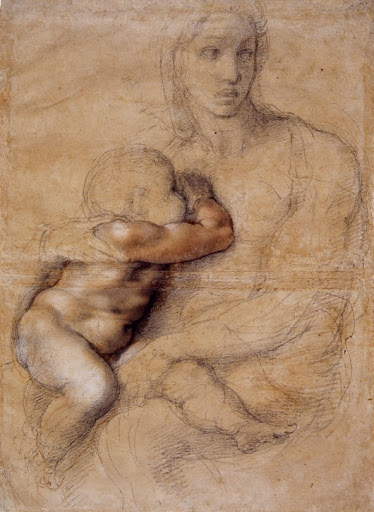
Michelangelo drawing

1221 words, 6 min read

Are there some places or objects that are more sacred than others? Is there anything special about the spot where Jesus was entombed after Joseph of Arimathea obtained his dead body from Pontius Pilate? How about the relics of saints, do they deserve special reverence? Or the cell where St. Theresa of Ávila spent her life, the patch of soil where St. Francis is buried or the spots where Dietrich Bonhoeffer was hanged or St. Thomas More beheaded? Are they any different from your local supermarket?

Before a hasty “yes” to the above, let’s approach the question from the other end too. Isn’t all of creation, the entire Universe made holy because it has been created and is being sustained by God, because it has being only insofar as God makes it participate in His own? Isn’t God present everywhere and always? Isn’t it the case that wherever I may go, God is already there, awaiting me and waiting for me to discover him and relate to him there? Isn’t each person equally loved by God and therefore given equal dignity and worth? Shouldn’t we see His presence everywhere, always, in everything and everyone? Doesn’t that result in universal equality and equivalence?

As with very many questions of this kind, I believe the answer is a resounding “both” and the template in this case could be Patriarch Athenagoras’ saying: “God loves everyone equally, but secretly each one of us is his favorite.” It is both a confirmation of universal equality and of individual exceptionality and I believe that both are needed in equal measure. Focusing only on the former, universal aspect brings with it a danger of declaring a love of humanity while not particularly liking any one person, a danger of emphasizing the general principle while loosing sight of the instances in ought to be applied to. The risk here is an idealism that lacks flesh. A focus on the latter, instead risks an idolization of some while looking down upon others, a schizophrenia of reverence for people and objects that ostensibly possess special qualities while walking past the poor, the “ordinary”, the “everyday” whose dignity is equipollent. The risk here is a materialism – even when it may appear as sacred – that lacks soul.

What does a “both” attitude look like though, in the face of these seemingly polar opposites. Here, I believe the answer is the incarnation – and if you are not a Christian, please, bear with me, because I believe that the pattern of thought that it represents (and embodies!) is more broadly relevant.

Let’s see first how Pope Benedict XVI explains what “incarnation” means:

“Incarnation derives from the Latin incarnatio. St Ignatius of Antioch — at the end of the first century — and, especially, St Irenaeus used this term in reflecting on the Prologue to the Gospel according to St John, in particular in the sentence “the Word became flesh” (Jn 1:14). Here the word “flesh”, according to the Hebrew usage, indicates man in his whole self, the whole man, but in particular in the dimension of his transience and his temporality, his poverty and his contingency. This was in order to tell us that the salvation brought by God, who became man in Jesus of Nazareth, affects man in his material reality and in whatever situation he may be. God assumed the human condition to heal it from all that separates it from him, to enable us to call him, in his Only-Begotten Son, by the name of “Abba, Father”, and truly to be children of God. […]

The Logos, who is with God, is the Logos who is God, the Creator of the world (cf. Jn 1:1) through whom all things were created (cf. 1:3) and who has accompanied men and women through history with his light (cf. 1:4-5; 1:9), became one among many and made his dwelling among us, becoming one of us (cf. 2:14).

The Second Vatican Ecumenical Council said: “The Son of God… worked with human hands, he thought with a human mind. He acted with a human will, and with a human heart he loved. Born of the Virgin Mary, he has truly been made one of us, like to us in all things except sin” (Constitution Gaudium et Spes, n. 22). Thus it is important to recover our wonder at the mystery, to let ourselves be enveloped by the grandeur of this event: God, the true God, Creator of all, walked our roads as a man, entering human time to communicate his own life to us (cf. 1 Jn 1:1- 4). And he did not do so with the splendour of a sovereign who dominates the world with his power, but with the humility of a child.”

At the heart of Christianity there is a co-existence, a simultaneity between the eternal and the transient, the splendid and the humble, the self-sufficient and the contingent, which invests the latter with the former. It elevates material reality to a status that is inseparable from the uncreated, the eternal, since the uncreated made Himself created, while retaining His uncreatedness.

Elevating the material through the incarnation also elevates the specific to the status of the general. Material being brings with it Leibniz’s principle of identity, whereby no two entities can be the same since they will always differ at least in temporal and or spatial location. Since no two material entities can be the same, their distinction and specificity is intrinsic to material being, whose elevation through God’s incarnation also raises the specific, delimited to the level of the general and infinite.

Because God became flesh, flesh becomes not only a signifier of His presence, a token, but His actual presence. The value that materialist atheism attributes to matter is therefore in no way undermined or diminished by the Christian’s belief in its being in relationship with God, its being a manifestation of His presence. Both can, and the Christian ought, lest they deny the reality of the incarnation, value the physical, without caveats.

Pope Francis, in fact, makes Christian love conditional on being connected to Jesus’ flesh, which the flesh of the poor, the suffering and the needy makes present today, and he has harsh words for those who de-flesh the Church:

“A love which does not acknowledge that Jesus came in the flesh is not the love with which God commands us: it is a worldly love, it is a philosophical love, it is an abstract love, it is a somewhat failed love, it is soft love. No! The criterion for Christian love is the Incarnation of the Word. […]

[W]hoever wishes to love not as Christ loves his spouse, the Church, with his own flesh and giving life, loves ideologically: they do not love with the all their body and with all their soul. And this way of theorizing, of being ideological, as well as the proposals of religiosity which removes the flesh of Christ, which removes the flesh of the Church, going beyond and ruining the community, ruining the Church.”

Instead of distancing Christians from atheist materialists, the incarnation makes every Christian be as much of a materialist as their atheist brothers and sisters. It makes them be both materialists and theists, fully materialist so as to be fully theist.

The identity of discernibles

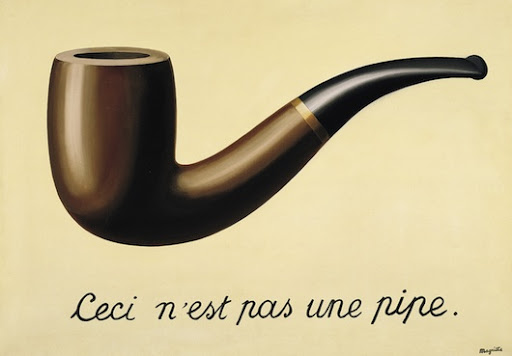
margritti-this-is-not-a-pipe_s.jpg

If two men or two women want to make a life-long commitment of love and support to one another, for better, for worse, for richer, for poorer, in sickness and in health, why shouldn’t that be called marriage? Why do many religious people have an issue with this and why don’t they just recognize and appreciate the love and commitment such couples have for one another? Doesn’t a lack of support for same-sex marriages show an elitism, judgment and discrimination that are foreign to Jesus’ message? As heterosexual couples can marry, why should that right be denied to homosexual ones? And why is it that same-sex marriage should be a threat to the very idea of marriage?

Questions like the above have, I believe, a great deal of profound Christian appeal: love, commitment, not judging, equality and taking the beam out of one’s own eye before proceeding to the splinter in another’s are all deeply Christian principles and when Christians are criticized for their seeming lack, they better take them seriously. Actually, when I say they, I mean me, so let me make this train of thought more personal. What do I think? Where do I stand?

First, let me be super clear about one thing: I believe God has a plan for every single human being and loves each one of us immensely. The late Patriarch Athenagoras saying that “God loves everyone equally, but secretly each one of us is his favorite,” Martin Luther saying “It is not because we are beautiful that God loves us, but because God loves us that we are beautiful,” John Paul II adding that “The person who does not decide to love forever will find it very difficult to really love for even one day,” and Benedict XVI tweeting yesterday that “Everything is a gift from God: it is only by recognizing this crucial dependence on the Creator that we will find freedom and peace,” sum it up for me. Everyone is loved by God, who sees beauty in them, and my love for all mustn’t be selective, jealous or fretting either. So, I believe God loves homosexual men and women and I too need to do the same to call myself a follower of Jesus.

I am therefore vehemently opposed to any lack of love shown towards homosexual persons and am strongly against homophobia, bullying, marginalization or any other respect and care that is not extended to them. Violence against homosexual men or women horrifies me, with cases where it is the state that fuels it (as in Uganda and countries where there are criminal penalties for homosexuality) being particularly abhorrent to me. This is a position that I hold beyond doubt and one in which I feel fully in line with the position and teaching of the Church.

The Catechism states clearly that homosexual persons “must be accepted with respect, compassion, and sensitivity. Every sign of unjust discrimination in their regard should be avoided. These persons are called to fulfill God’s will in their lives.” (Catechism of the Catholic Church, §2358). Several bishops have emphasized that there is good in relationships among homosexual men or women, such as Bishop Woelki of Berlin saying “I also try to acknowledge that they take responsibility for each other on a permanent basis, have promised each other faithfulness and want to look after each other,” the Bishops of England and Wales stating that “We also recognise that many same sex couples raise children in loving and caring homes,” or the late Cardinal Basil Hume affirming that “Homosexual people […] can, and often do, give a fine example of friendship and the art of chaste loving.” As recently as last Monday, there is also the determination by Archbishop Vincenzo Paglia, head of the Pontifical Council for the Family, for the Church to “do more to protect gays and lesbians from discrimination in countries where homosexuality is illegal. […] In the world there are 20 or 25 countries where homosexuality is a crime, […] I would like the church to fight against all this.”1

So, am I in favor of same sex marriage then? Actually, no … My reason for this is that marriage is a lifelong commitment of one woman and one man to each other. This commitment results in the birth of a family, which, at least in principle, is open to the procreation of children. As this is what the concept of marriage means, it is not applicable to same sex couples. But isn’t this discriminatory and doesn’t it fly in the face of everything I have said above? I honestly don’t think so, and I am fully in agreement with the Bishops of England and Wales, who say:

“We disagree that the signal that is sent currently, by restricting marriage to opposite sex couples, is one of disparagement of same sex relationships. The basic argument that is advanced in favour of same sex marriage is one of equality and fairness. But we suggest that this intuitively appealing argument is fundamentally flawed. Those who argue for same sex marriage do so on the basis that it is unjust to treat same sex and heterosexual relationships differently in allowing only heterosexual couples access to marriage. Our principal argument against this is that it is not unequal or unfair to treat those in different circumstances differently. Indeed, to treat them the same would itself be unjust.”

This to me is the crux of the argument: the outcome of even the commitment expressed by marriage vows results in two different states depending on whether it is done by two people of different sexes or the same sex. While there are similarities (i.e., the value and sincerity of the commitment and the love that it springs from and subsequently supports), there are categorical differences too (i.e., the possibility of bringing children into the world and the complementarity of the male and female sexes). Ignoring such differences is the beginning of a loss of clarity of thought and consequently of judgment and action. It is akin to suddenly deciding that we will call an ear an eye – they are both organs and result in sensory perception and surely the ear is just as good as the eye. It is certainly possible to do this, but it will result in confusion (were all the pre-ear=eye statements about eyes meant to apply to the new eye or only to eye-eyes and not ear-eyes?).

The motivation for extending marriage to same sex couples may in many cases be good and be underpinned by principles that I fully subscribe to, but the result is a delusion and a divorce from reality.

Nonetheless, I believe that many homosexual men and women do not feel welcomed by the Church, which to me is similar to the lack of unity among Christians – both pain me, but for both I place myself firmly inside the Church and try to understand what it is that I can do towards overcoming them. With Christian unity too we could decide from one day to the next that we will declare ourselves to be united, that we’ll just change the definition of a couple of terms so that they span previously exclusive concepts. But what would we achieve with that? Not only nothing, but it would be a step back, as it would hinder a true understanding of underlying reality and efforts to arrive at a loving solution that has its eyes wide open.2


1 Even though it is not the topic of this post and addressing it even just briefly would make it way too long, I can’t not mention the Church’s classification of homosexual relationships as “objectively disordered.” This, I have to say, is an unfortunate choice of words. Cardinal Hume felt the same and provided the following reflection:

“The word ”disordered” is a harsh one in our English language. It immediately suggests a sinful situation, or at least implies a demeaning of the person or even a sickness. It should not be so interpreted. First, the word is a term belonging to the vocabulary of traditional Catholic moral theology and philosophy. It is used to describe an inclination which is a departure from what is generally regarded to be the norm. The norm consists of an inclination towards a sexual relationship with a person of the opposite sex and not between persons of the same sex. Being a homosexual person is, then, neither morally good nor morally bad.”

This is an argument I do agree with: the sexual relationship between a man and a woman is constituent of what it means to be human, while such relationships between persons of the same sex are a departure from the inherent purpose of sexuality (without meaning to restrict it to its procreative function). I do believe this to be a fact, but that does not mean that homosexual men and women should not be welcomed by the Church in more effective and constructive ways than is the case today. What these ought to be is not clear to me, but I am convinced of their necessity.
2 Thanks to my überbesties KM, PM and MR for reviewing a draft of this post and for their great feedback!