Harmony in diversity

Turkey popejpeg 01dca c0 327 5242 3382 s561x327

10380974 837984076265611 4582951503244712748 n

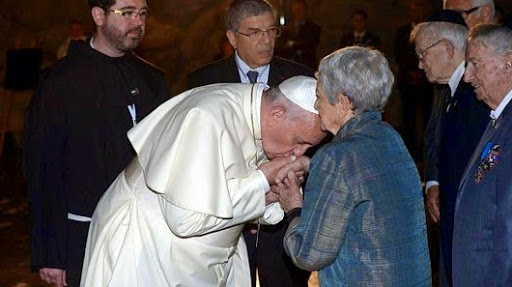
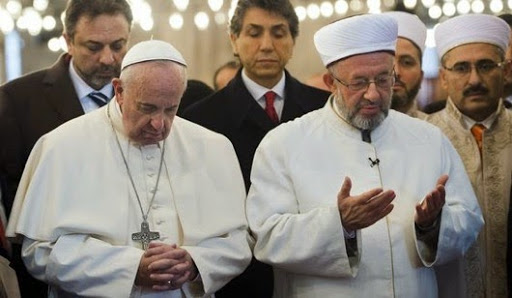
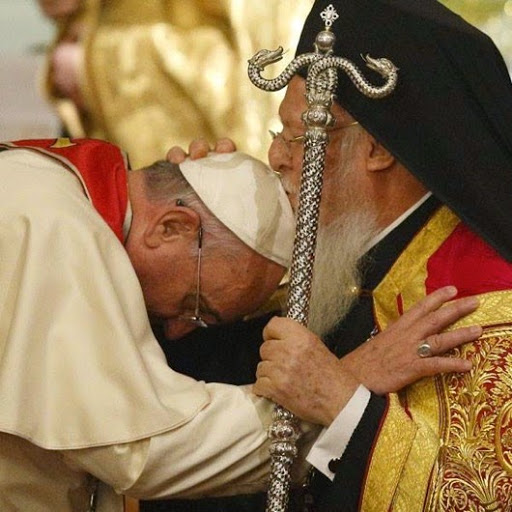
Last weekend Pope Francis visited Turkey, a country where 99.8% of the population is Muslim and where there are only about 35,000 Roman Catholics – truly a peripheral choice, fitting perfectly into Francis’ focus throughout his pontificate. What I would like to do in this post is just to pick out a couple of my favorites from among the things the pope said and share with you three photos – the two at the top, of Francis praying with Istanbul’s Grand Mufti Rahmi Yaran in the Blue Mosque and the one in the middle of Francis – and with him the entire Roman Church – being blessed (and kissed on the head) by Ecumenical Patriarch Bartholomew I.

In his first address in Turkey, to civil authorities, Francis emphasized the centrality of human dignity and brotherhood:

“Today what is needed is a dialogue which can deepen the understanding and appreciation of the many things which we hold in common. Such a dialogue will allow us to reflect sensibly and serenely on our differences, and to learn from them.

There is a need to move forward patiently in the task of building a lasting peace, one founded on respect for the fundamental rights and duties rooted in the dignity of each person. In this way, we can overcome prejudices and unwarranted fears, leaving room for respect, encounter, and the release of more positive energies for the good of all.

To this end, it is essential that all citizens – Muslim, Jewish and Christian – both in the provision and practice of the law, enjoy the same rights and respect the same duties. They will then find it easier to see each other as brothers and sisters who are travelling the same path, seeking always to reject misunderstandings while promoting cooperation and concord. Freedom of religion and freedom of expression, when truly guaranteed to each person, will help friendship to flourish and thus become an eloquent sign of peace.”

Later during the first day, Francis addressed the president of the Diyanet, the Department For Religious Affairs, denouncing religious extremism and fundamentalism:

“Particular concern arises from the fact that, owing mainly to an extremist and fundamentalist group, entire communities, especially – though not exclusively – Christians and Yazidis, have suffered and continue to suffer barbaric violence simply because of their ethnic and religious identity. They have been forcibly evicted from their homes, having to leave behind everything to save their lives and preserve their faith. This violence has also brought damage to sacred buildings, monuments, religious symbols and cultural patrimony, as if trying to erase every trace, every memory of the other.

As religious leaders, we are obliged to denounce all violations against human dignity and human rights. Human life, a gift of God the Creator, possesses a sacred character. As such, any violence which seeks religious justification warrants the strongest condemnation because the Omnipotent is the God of life and peace. The world expects those who claim to adore God to be men and women of peace who are capable of living as brothers and sisters, regardless of ethnic, religious, cultural or ideological differences.”

The next day, during his homily at the Catholic Cathedral of the Holy Spirit in Istanbul, Francis focused first on the fundamental role of the Holy Spirit in our lives and then on the nature of diversity in unity:

“When we pray, it is because the Holy Spirit inspires prayer in our heart. When we break the cycle of our self-centredness, and move beyond ourselves and go out to encounter others, to listen to them and help them, it is the Spirit of God who impels us to do so. When we find within a hitherto unknown ability to forgive, to love someone who doesn’t love us in return, it is the Spirit who has taken hold of us. When we move beyond mere self-serving words and turn to our brothers and sisters with that tenderness which warms the heart, we have indeed been touched by the Holy Spirit.

It is true that the Holy Spirit brings forth different charisms in the Church, which at first glance, may seem to create disorder. Under his guidance, however, they constitute an immense richness, because the Holy Spirit is the Spirit of unity, which is not the same thing as uniformity. Only the Holy Spirit is able to kindle diversity, multiplicity and, at the same time, bring about unity. When we try to create diversity, but are closed within our own particular and exclusive ways of seeing things, we create division. When we try to create unity through our own human designs, we end up with uniformity and homogenization. If we let ourselves be led by the Spirit, however, richness, variety and diversity will never create conflict, because the Spirit spurs us to experience variety in the communion of the Church. […] Saint Basil the Great’s lovely expression comes to mind: “Ipse harmonia est”, He himself is harmony.

The temptation is always within us to resist the Holy Spirit, because he takes us out of our comfort zone and unsettles us; he makes us get up and drives the Church forward. It is always easier and more comfortable to settle in our sedentary and unchanging ways. In truth, the Church shows her fidelity to the Holy Spirit in as much as she does not try to control or tame him. And the Church shows herself also when she rejects the temptation to look only inwards. We Christians become true missionary disciples, able to challenge consciences, when we throw off our defensiveness and allow ourselves to be led by the Spirit. He is freshness, imagination and newness.”

On the Saturday evening then came a particularly moving moment of “mystical tenderness” (as Fr. Antonio Spadaro, SJ put it), shown in the following photo and following these words by Pope Francis, addressed to the Patriarch Bartholomew:

“Andrew and Peter heard [the promise of joy]; they received this gift. They were blood brothers, yet their encounter with Christ transformed them into brothers in faith and charity. In this joyful evening, at this prayer vigil, I want to emphasize this; they became brothers in hope – and hope does not disappoint us! What a grace, Your Holiness, to be brothers in the hope of the Risen Lord! What a grace, and what a responsibility, to walk together in this hope, sustained by the intercession of the holy Apostles and brothers, Andrew and Peter! And to know that this shared hope does non deceive us because it is founded, not upon us or our poor efforts, but rather upon God’s faithfulness.

With this joyful hope, filled with gratitude and eager expectation, I extend to Your Holiness and to all present, and to the Church of Constantinople, my warm and fraternal best wishes on the Feast of your holy Patron. And I ask a favour of you: to bless me and the Church of Rome.”
IMG 4226

The final day of Francis’ trip – Sunday 30th November, the feast day of St. Andrew, patron saint of the Orthodox Church – started with an address during the Orthodox Divine Liturgy at the Patriarchal Church of St. George in Istanbul, where his focus was on the relationship between the Catholic and Orthodox Churches and where he first underlined deeply personal nature of the Christian life:

“Meeting each other, seeing each other face to face, exchanging the embrace of peace, and praying for each other, are all essential aspects of our journey towards the restoration of full communion. All of this precedes and always accompanies that other essential aspect of this journey, namely, theological dialogue. An authentic dialogue is, in every case, an encounter between persons with a name, a face, a past, and not merely a meeting of ideas.

This is especially true for us Christians, because for us the truth is the person of Jesus Christ. The example of Saint Andrew, who with another disciple accepted the invitation of the Divine Master, “Come and see”, and “stayed with him that day” (Jn 1:39), shows us plainly that the Christian life is a personal experience, a transforming encounter with the One who loves us and who wants to save us. In addition, the Christian message is spread thanks to men and women who are in love with Christ, and cannot help but pass on the joy of being loved and saved. Here again, the example of the apostle Andrew is instructive. After following Jesus to his home and spending time with him, Andrew “first found his brother Simon, and said to him, ‘We have found the Messiah’ (which means Christ). He brought him to Jesus” (Jn 1:40-42). It is clear, therefore, that not even dialogue among Christians can prescind from this logic of personal encounter.”

Next, Francis reiterated the Vatican II Unitatis Redintegratio position that the Catholic Church recognizes that the Orthodox Churches “possess true sacraments, above all – by apostolic succession – the priesthood and the Eucharist, whereby they are still joined to us in closest intimacy” and that “it is of the greatest importance to preserve and support the rich patrimony of the Eastern Churches.” He then set out his vision for the road towards full communion:

“I believe that it is important to reaffirm respect for this principle as an essential condition, accepted by both, for the restoration of full communion, which does not signify the submission of one to the other, or assimilation. Rather, it means welcoming all the gifts that God has given to each, thus demonstrating to the entire world the great mystery of salvation accomplished by Christ the Lord through the Holy Spirit. I want to assure each one of you here that, to reach the desired goal of full unity, the Catholic Church does not intend to impose any conditions except that of the shared profession of faith.”

And finally, he called for joint action already, as a consequence of being Jesus’ disciples, in three areas: the poor, the victims of conflicts and young people.

Next followed a common declaration by Pope Francis and Patriarch Bartholomew, of their desire “to intensify our efforts to promote the full unity of all Christians, and above all between Catholics and Orthodox. […] asking our faithful to join us in praying “that all may be one, that the world may believe” (Jn 17:21).” And finally, Pope Francis went to meet with young refugees from Turkey, Syria and Iraq who were being looked after by Salesians in Istanbul, where he said:

“Dear young people, do not be discouraged. It is easy to say this, but please make an effort not to be discouraged. With the help of God, continue to hope in a better future, despite the difficulties and obstacles which you are currently facing. […] Remember always that God does not forget any of his children, and that those who are the smallest and who suffer the most are closest to the Father’s heart.”

As has been customary on Pope Francis’ trips, there was a press conference this time too during the return flight, where journalists could ask him questions directly. Here I’d just pick out his answer to a question about what praying in the Blue Mosque meant for him:

“I went there, to Turkey, as a pilgrim, not as a tourist. And I went there primarily for the feast [of St. Andrew] that we celebrated today: I came precisely to share it with Patriarch Bartholomew, with a religious motive. But then, when I went to the mosque, I could not say, “No, now I’m a tourist.” No, it was all religious. And I saw that wonderful place! The mufti explained things well to me, with such gentleness, and also using the Qur’an, which speaks of Mary and John the Baptist, he explained everything to me … That’s when I felt the need to pray. And I said: “Shall we pray a bit?” – “Yes, yes,” he said. And I prayed for Turkey, for peace, for the mufti … for all … for myself, since I need it … I prayed, really … And I prayed for peace, above all. I said, “Lord, let’s put an end to these wars …” So, it was a moment of sincere prayer.”
Francis in Jerusalem: brothers in mercy

Francis rabi imam

[Long read.]

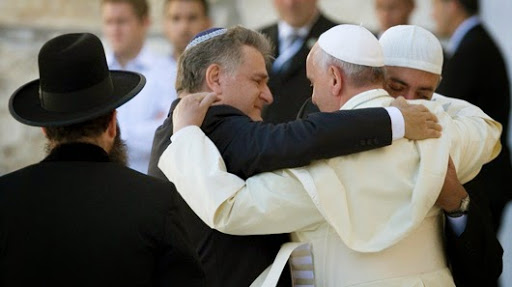
Last weekend saw Pope Francis’ visit to the Holy Land, during which he delivered 15 scheduled speeches and made several spontaneous stops that have been in the headlines all over the world. Here I don’t mean to re-tell his whirlwind visit, since that has already been done very well elsewhere, but just to pick out some of my favorite moments from the homilies and addresses he delivered during that 3-day period (in chronological order).

First, there was his homily during a mass in Amman on 24th May (note the focus on diversity in unity, which is one of the key themes of the whole trip):

“The mission of the Holy Spirit, in fact, is to beget harmony – he is himself harmony – and to create peace in different situations and between different people. Diversity of ideas and persons should not trigger rejection or prove an obstacle, for variety always enriches. So today, with fervent hearts, we invoke the Holy Spirit and ask him to prepare the path to peace and unity.”

Second, he addressed refugees and disabled young people in Bethany (note the use of humility as a means of closeness to Jesus and his damning words addressed to the arms trade):

“Coming here to the Jordan to be baptized by John, Jesus showed his humility and his participation in our human condition. He stooped down to us and by his love he restored our dignity and brought us salvation. Jesus’ humility never fails to move us, the fact that he bends down to wounded humanity in order to heal us: he bends down to heal all our wounds! […]

[A]s we observe this tragic conflict, seeing these wounds, seeing so many people who have left their homeland, forced to do so, I ask myself: who is selling arms to these people to make war? Behold the root of evil! Hatred and financial greed in the manufacturing and sale of arms. This should make us think about who is responsible for this situation, for providing arms to those in conflict and thereby sustaining such conflict. Let us think about this and with sincere hearts let us call upon these poor criminals to change their ways.”

The next day (25th May), Pope Francis then addressed President Mahmoud Abbas and the Palestinian authorities, where he concluded his speech as follows (note the reference to God’s almightiness, which is very prominent in Islam, the reference to brotherhood, and the Arabic greeting at the end):

“Mr President, dear brothers and sisters gathered here in Bethlehem: may Almighty God bless you, protect you and grant you the wisdom and strength needed to continue courageously along the path to peace, so that swords will be turned into ploughshares and this land will once more flourish in prosperity and concord. Salaam!”

Later the same day, Francis then delivered a homily in Manger Square, Bethlehem, from which I’d like to quote more extensively, since it provides a great insight about the importance he gives children:

“The Child Jesus, born in Bethlehem, is the sign given by God to those who awaited salvation, and he remains forever the sign of God’s tenderness and presence in our world. The angel announces to the shepherds: “This will be a sign for you: you will find a child…”. […]

The Child of Bethlehem is frail, like all newborn children. He cannot speak and yet he is the Word made flesh who came to transform the hearts and lives of all men and women. This Child, like every other child, is vulnerable; he needs to be accepted and protected. Today too, children need to be welcomed and defended, from the moment of their conception.

Sadly, in this world, with all its highly developed technology, great numbers of children continue to live in inhuman situations, on the fringes of society, in the peripheries of great cities and in the countryside. All too many children continue to be exploited, maltreated, enslaved, prey to violence and illicit trafficking. Still too many children live in exile, as refugees, at times lost at sea, particularly in the waters of the Mediterranean. Today, in acknowledging this, we feel shame before God, before God who became a child.

And we have to ask ourselves: Who are we, as we stand before the Child Jesus? Who are we, standing as we stand before today’s children? Are we like Mary and Joseph, who welcomed Jesus and care for him with the love of a father and a mother? Or are we like Herod, who wanted to elim- inate him? Are we like the shepherds, who went in haste to kneel before him in worship and offer him their humble gifts? Or are we indifferent? Are we perhaps people who use fine and pious words, yet exploit pictures of poor children in order to make money? Are we ready to be there for children, to “waste time” with them? Are we ready to listen to them, to care for them, to pray for them and with them? Or do we ignore them because we are too caught up in our own affairs?”

In the same location, Francis then issued an invitation to prayer for peace (which was very quickly accepted by both parties – within a matter of hours):

“In this, the birthplace of the Prince of Peace, I wish to invite you, President Mahmoud Abbas, together with President Shimon Peres, to join me in heartfelt prayer to God for the gift of peace. I offer my home in the Vatican as a place for this encounter of prayer.

All of us want peace. Many people build it day by day through small gestures and acts; many of them are suffering, yet patiently persevere in their efforts to be peacemakers. All of us – especial- ly those placed at the service of their respective peoples – have the duty to become instruments and artisans of peace, especially by our prayers.”

Francis bartholomew slab

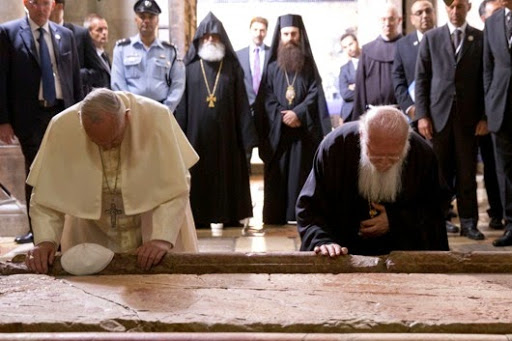
From the perspective of ecumenism, the most important speech was then the one Pope Francis delivered at the Holy Sepulchre in Jerusalem, in the presence of Patriarch Bartholomew (note its supporting pillars being mercy, forgiveness, joy and unity, and the fractal nature of ecumenism – from the visible union among Christian churches to the ecumenism of everyday acts of closeness):

“Let us receive the special grace of this moment. We pause in reverent silence before this empty tomb in order to rediscover the grandeur of our Christian vocation: we are men and women of resurrection, and not of death. From this place we learn how to live our lives, the trials of our Churches and of the whole world, in the light of Easter morning. Every injury, every one of our pains and sorrows, has been borne on the shoulders of the Good Shepherd who offered himself in sacrifice and thereby opened the way to eternal life. His open wounds are like the cleft through which the torrent of his mercy is poured out upon the world. Let us not allow ourselves to be robbed of the basis of our hope, which is this: Christòs anesti! Let us not deprive the world of the joyful message of the resurrection! And let us not be deaf to the powerful summons to unity which rings out from this very place, in the words of the One who, risen from the dead, calls all of us “my brothers” (cf. Mt 28:10; Jn 20:17). […]

We know that much distance still needs to be travelled before we attain that fullness of communion which can also be expressed by sharing the same Eucharistic table, something we ardently desire; yet our disagreements must not frighten us and paralyze our progress. We need to believe that, just as the stone before the tomb was cast aside, so too every obstacle to our full communion will also be removed. This will be a grace of resurrection, of which we can have a foretaste even today. Every time we ask forgiveness of one another for our sins against other Christians and every time we find the courage to grant and receive such forgiveness, we experience the resurrection! Every time we put behind us our longstanding prejudices and find the courage to build new fraternal relationships, we confess that Christ is truly risen! Every time we reflect on the future of the Church in the light of her vocation to unity, the dawn of Easter breaks forth!”

On the final day (26th May), Pope Francis addressed the Gran Mufti of Jerusalem, where he concluded with a call to brotherhood:

“Dear brothers, dear friends, from this holy place I make a heartfelt plea to all people and to all communities who look to Abraham: may we respect and love one another as brothers and sisters! May we learn to understand the sufferings of others! May no one abuse the name of God through violence! May we work together for justice and peace! Salaam!”

Then, Francis changed his plans and instead of having lunch at the Notre Dame of Jerusalem Center, he turned up at a Franciscan friary instead, insisting that nothing be changed in either the refectory customs or the day’s menu.

Francis holocaust survivor hand

For me the most important moment of the trip was Francis’ visit to the Yad Vashem Memorial, from where I’d like to quote almost his entire address, without commentary:

““Adam, where are you?” (cf. Gen 3:9). Where are you, o man? What have you come to? In this place, this memorial of the Shoah, we hear God’s question echo once more: “Adam, where are you?” This question is charged with all the sorrow of a Father who has lost his child. The Father knew the risk of freedom; he knew that his children could be lost… yet perhaps not even the Father could imagine so great a fall, so profound an abyss! Here, before the boundless tragedy of the Holocaust, That cry – “Where are you?” – echoes like a faint voice in an unfathomable abyss…

Adam, who are you? I no longer recognize you. Who are you, o man? What have you become? Of what horror have you been capable? What made you fall to such depths?

Certainly it is not the dust of the earth from which you were made. The dust of the earth is some- thing good, the work of my hands. Certainly it is not the breath of life which I breathed into you. That breath comes from me, and it is something good (cf. Gen 2:7).

No, this abyss is not merely the work of your own hands, your own heart… Who corrupted you? Who disfigured you? Who led you to presume that you are the master of good and evil? Who convinced you that you were god? Not only did you torture and kill your brothers and sisters, but you sacrificed them to yourself, because you made yourself a god.

Today, in this place, we hear once more the voice of God: “Adam, where are you?”

From the ground there rises up a soft cry: “Have mercy on us, O Lord!” To you, O Lord our God, be- longs righteousness; but to us confusion of face and shame (cf. Bar 1:15).

A great evil has befallen us, such as never happened under the heavens (cf. Bar 2:2). Now, Lord, hear our prayer, hear our plea, save us in your mercy. Save us from this horror.”

Finally, Francis also celebrated mass at the Upper Room, where he spoke about what its meaning is for us (note the emphasis on friendship, service and family – both the importance of families in the Church, and the Church being a family):

“The Upper Room speaks to us of service, of Jesus giving the disciples an example by washing their feet. Washing one another’s feet signifies welcoming, accepting, loving and serving one another. It means serving the poor, the sick and the outcast, those whom I find difficult, those who annoy me. […]

The Upper Room also reminds us of friendship. “No longer do I call you servants – Jesus said to the Twelve – but I have called you friends” (Jn 15:15). The Lord makes us his friends, he reveals God’s will to us and he gives us his very self. This is the most beautiful part of being a Christian and, especially, of being a priest: becoming a friend of the Lord Jesus, and discovering in our hearts that he is our friend. […]

[T]he Upper Room reminds us of the birth of the new family, the Church, our holy Mother the hierarchical Church established by the risen Jesus; a family that has a Mother, the Virgin Mary. Christian families belong to this great family, and in it they find the light and strength to press on and be renewed, amid the challenges and difficulties of life. All God’s children, of every people and language, are invited and called to be part of this great family, as brothers and sisters and sons and daughters of the one Father in heaven.”

Eternity today

Arcabas canaa l

Today the Church has launched its Year of Faith, whose announcement motivated me three months ago to start writing this blog. While the Year of Faith was its explicit impetus, my deeper reasons were both a desire to be clearer to myself about what it was that my faith meant to me and implied for me and a desire to make explicit my deep-seated conviction that imitating Jesus was not contrary to reason or to my scientific profession and that it ought to be more accessible to my friends with other religious beliefs or none. By this I don’t mean in any way an attempt to convince them of anything, but simply by making my faith explicit and by revealing its consequences and connections to the broader philosophical, cultural, artistic and scientific contexts, show that it makes sense and that it allows me to seek the goals and values that they themselves share. I was also keen to look for the underlying similarities among all who employ reason honestly and who seek the common good and to show that at this level are all close to one another. Whether this is something that has emerged from the last 68 posts is something you’ll have to judge for yourself. All I can say is that it has been a positive experience for me, especially in the cases where a post has lead to or was triggered by dialogue.

With that preamble out of the way, let me share with you my take on today’s opening of the Year of Faith by pulling together some of the points made by Pope Benedict XVI in his sermon during the opening mass, Archbishop Rowan Williamsaddress to the Bishops’ Synod yesterday and Patriarch Bartholomew I’s greeting this morning. This fact alone, of having the heads of the Roman Catholic, Anglican and Eastern Orthodox communities come together at the opening of this Year of Faith is great cause for enthusiasm to me, as it points to their shared belief in Jesus being present “where two or three are gathered together in [his] name” (Matthew 18:20) and in their shared commitment to “witness together to the Gospel message of salvation and healing for the least of our brethren: the poor, the oppressed, the forgotten in God’s world.” (Bartholomew I).

To my mind, Archbishop Williams’ talk yesterday did a great job of setting the scene by reflecting on what it is that attracts people to authentic, lived Christianity:

“[It is] the possibility, quite simply, of living more humanly – living with less frantic acquisitiveness, living with space for stillness, living in the expectation of learning, and most of all, living with an awareness that there is a solid and durable joy to be discovered in the disciplines of self-forgetfulness that is quite different from the gratification of this or that impulse of the moment.”

He argues, as do I, that the behavior to which authentic Christians are lead by their desire to imitate Jesus has universal value and is not something alien or parallel to what all others seek too. Williams follows the above with a warning though: “The man who seeks sincerity, instead of seeking truth in self-forgetfulness, is like the man who seeks to be detached instead of laying himself open in love.” (Henri de Lubac, Paradoxes of Faith, pp. 114) – striving to share with the world what it means to follow Jesus cannot be sought for its own sake as that defeats its own purpose. Such self-consciousness about one’s faith and its perception by others, by definition, cannot be overcome by being even more self-conscious about it:

“We have to return to St Paul and ask, ‘Where are we looking?’ Do we look anxiously to the problems of our day, the varieties of unfaithfulness or of threat to faith and morals, the weakness of the institution? Or are we seeking to look to Jesus, to the unveiled face of God’s image in the light of which we see the image further reflected in ourselves and our neighbours?”

In many ways it is like how Douglas Adams describes flying in the Hitchhiker’s Guide: a throwing of oneself to the ground and accidentally missing, by having been distracted at the critical moment. Sharing my faith is like throwing myself into following Jesus and being distracted by my friends. 🙂

What does it mean though to follow Jesus? How can you even try to imitate a carpenter, healer, prophet, teacher, … from two thousand years ago? Here Pope Benedict argues that we face a fundamental tension when striving to

“mak[e] the truth and beauty of the faith shine out in our time, without sacrificing it to the demands of the present or leaving it tied to the past: the eternal presence of God resounds in the faith, transcending time, yet it can only be welcomed by us in our own unrepeatable today.”

Applying Jesus’ message to the conditions we are in today is essential, but so is remaining faithful to it and this is the challenge that both the Second Vatican Council, which opened 50 years ago today, and this new Year of Faith strive to address. To Pope Benedict, the key though is the person of Jesus, through whom “God’s face is revealed to us.” “[T]he closer [we] get to him, the closer [we] get to the hearts of [our] brothers and sisters” (Chiara Lubich, Essential Writings, p.37; quoted by Archbishop Williams).