Contemporary art and its enemies

To paraphrase Karl Popper, let me start by saying that it is “impossible to make art in such a way that it cannot be misunderstood.” Over the course of this last week I have come across no less than three articles in which Christian authors denounce the evils of contemporary art.
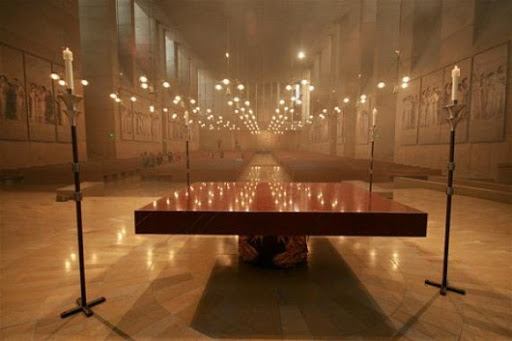
Cathedral our lady angels 4961 large slideshow

First, there is our old friend Nikos Salingaros – of Oakland Cathedral review fame, who has a go at the Cathedral of Our Lady of the Angels this time. His argument is again the same: “We have here a celebration of asymmetry, which might be understandable if there were a sound reason for it coming either from design necessities, or from religion.1 But there is none. The building’s asymmetry serves an essentially negative purpose: to deny coherence and harmony.2” And there is the usual litany of nonsensical gems like: “geometrical fundamentalism,” “naked concrete walls [being] ultimately unpleasant,” lacking “connective ornament,” and claiming that religion “has a natural affinity with traditional architectural expressions of coherence” before taking Antoni Gaudí’s3 name in vain. There is only one thing to say in response to this: bullspit! Instead of trying to debunk this junk head on, I think that I have a sense of the root cause of his confused misreading of this piece of architecture: an expectation of the literal. God is perfect harmony, so churches need to be perfectly symmetrical; the Church values continuity, so a church needs to look old; the soul needs to ascend to God, so there need to be vertical lines in the church’s geometry (and the list of naïveté goes on and on). What I believe this approach entirely misses are two key aspects of beauty: mystery and surprise! Why is it that an object evokes emotions, triggers reflection, prompts insight and delivers aesthetic joy and pleasure? Sure, there are plenty of theories, but periodically an artist comes along and creates a piece that breaks them, yet that is unmistakably appreciated as art. Surprise too is a key element of art, in my opinion, and the kind of literal expectations that Salingaros relies on would entirely eradicate it.

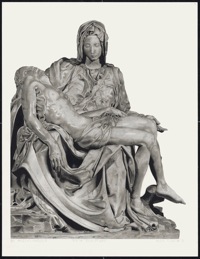
Second, I have made the virtual acquaintance of another budding art critic: Jimmy Akin, who takes it upon himself to have a go at the Vatican’s touring art exhibit: “The Vatican Splendors: A Journey Through Faith and Art,” exclaiming that the works “from the mid-2oth [sic] century onward were terrible.”4 Akin is much more to the point than Salingaros and doesn’t even feel the need to back up his claims – the art of the last 60+ years is just “terrible.” But what he lacks in specificity, he certainly makes up for in initiative, with the “brilliant” idea to do something about “all the lousy Catholic art” by “supporting Catholic art education so that we can get better Catholic artists.” So far so good – I am filled with anticipation of the centre of excellence he’ll propose to support and the examples of their great Catholic art, done right [no, not really]. Instead, Akin unveils the following “stupendously amazing” piece by a 12th grader:
Pieta drawing

And, just to underline the horrors of the “lousy” art we have had to put up with, he pulls out Pericle Fazzini’s “The Resurrection” situated in the Vatican’s Paul VI’s hall:

Paul vi resurrection

I am stunned by this guy’s barefacedness. How can he put a school-kid’s (admittedly skillfully executed) drawing of Michelangelo’s Pieta beside Fazzini’s masterpiece (a 66×23 foot bronze created it in 1977 and showing Jesus rising from the crater of a nuclear bomb) and say: more of the former and less of the latter, please! The mind boggles!

Third, I have come across a far more cogent, yet – to my mind – still misguided, piece by Francis Phillips. Here the composer James MacMillan is first quoted as saying that “[a]rt can be a window on to the mind of God. Through this window we can encounter beauty and divine truth” and I am thinking that I have finally come across a good piece on the subject, following the arid head banging of Salingaros and Akin. Sadly, Phillips decides to take us down a frustrating route too, by turning a promising piece into a crusade against the National Gallery in London showing Richard Hamilton’s “The Passage of the Angel to the Virgin.” The piece is a giclée photomontage that bases itself on Fra Angelico’s Annunciation, but with two female nudes where Fra Angelico has the angel Gabriel and the Virgin Mary. Phillips proceeds to label it as “scandalous,” as “shocking to Catholics, who have a particular reverence for the Virgin Mary,” as skewed for “[p]ortraying the Angel Gabriel as a young woman [since] the traditional Christian understanding of angels [is] as sexless spiritual beings”5 and as “desecrating.” Personally, I have a profound love for Mary and a deep gratitude to her for being the model of the perfect Christian, but I have to say that I disagree with all of the above. Since some of you may side with Phillips in your reaction to this piece, I will not reproduce it here, but only provide this (NSFW) link for those of you who choose to follow it. I have to say that I am not a fan of this piece by any means, but my reaction is one of curiosity about why Hamilton made the choices he made in it. Instead of a feeling of indignation, my response is more one of boredom and I would just walk past it and enjoy the rest of the National Gallery’s exquisite collection, instead of mounting a (failed) attempt to have it taken down, as Phillips did.

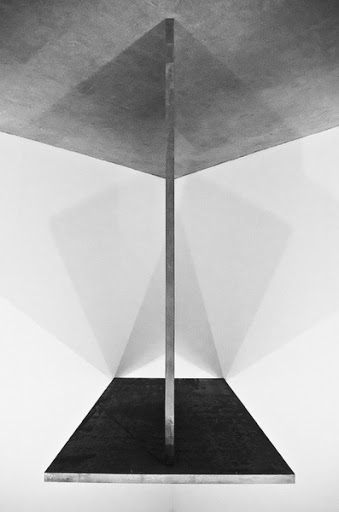
A point that seems to emerge to me from these last two articles is one of a decorative and exegetical role for art. A looking for pieces that would be good interior decoration for a church or that would illustrate a passage from Scripture or the Catechism. While some great art can certainly do that, it will do so in a way that transcends the simple, literal and functional. Other, equally great art would be entirely out of place as decoration though, yet would have the capacity to “be a window on to the mind of God.” I am certainly not thinking of Hamilton’s piece here, but more of something along the lines of Richard Serra’s work, such as his “Trip Hammer”:
Serra

Relegating “the mind of God” to decoration just seems like something that not even a heathen would do …

UPDATE (12/11/2012): My bestie JM went to visit the Cathedral of our Lady of the Angels, with my über-besties MR and RR, and had the following to say:

I went to visit the Cathedral last weekend, in anticipation of coming down either on the side of its supporters or detractors. Instead, while I am undeniably an outright fan of it as a place of worship, I have to say that it is so ugly on the outside that only its mother could love it. You would be forgiven for mistaking it for a car park or a storage facility, if it wasn’t for the separate bell tower carrying a cross and the rather beautiful statue of Mary above its main entrance.

The interior is another story and is an unreserved and total success. The space is vast without being overpowering; it is light and welcoming and beautifully laid out not only in the main nave but also with its numerous chapel-like spaces that face out and away from the building’s main volume. They, like the whole church, are bathed in natural light and house content as diverse as a shrine to Our Lady of Guadalupe, a Día de los muertos arrangement, a temporary exhibit by a local painter, artifacts from Pope John Paul II’s visit to LA and the confessionals. Outside too, the space is at the service of the community, with a great playground and a cafe/grill on the other side of a large square adjacent to the Cathedral.

In many ways this church is like one of those great Northern European cathedrals turned inside out. Instead of an ornate exterior and a plainer interior, here money has been spent on the interior space that church goers enjoy (including a great set of tapestries showing the communion of saints – and not only of canonized ones) while leaving the exterior plain and purely functional. Would I have preferred a more pleasing external architecture? No doubt! But, I believe the diocese spent their money where it matters to its members and visitors. This is a church that embraces those who come to it, instead of advertising itself to all. Not that the latter has little value, but I see why they would have favored the former. For some photos of my visit, see this Flickr set.


1 I wasn’t going to engage with this nonsense, but – come on! – to claim that there is no “religious” reason for asymmetry! How about the following (vastly incomplete) examples: good – evil, infinite – finite, uncreated – created, selfless – selfish. And the list could go on and on.
2 How about: to show movement, ascent, growth, a pull towards God?
3 To invoke Gaudí in an argument for traditional, symmetrical, literal architecture is just beyond nuts!
4 The hubris here would easily make Achilles’ dragging Hector’s lifeless body behind his chariot in front of the gates of Troy an act of level-headed diplomacy.
5 Not noticing the irony of this objection. Would the sexless angel better be portrayed as a man? Why?

Bishops’ synod conclusions: faith open to reason and science

The Bishops’ synod on the New Evangelisation (i. e., a renewed sharing of the Good News with those who have drifted away from the Church) concluded on Friday and resulted in 58 “propositions” that were presented to the pope and that will form the basis of a future encyclical. If you are not into the whole synod thing, here are (telegraphically) at least the points that stood out for me:

  1. Not a proposition, but nonetheless worth noting, is the fact that the propositions were written in English rather than the usual Latin (although the authoritative final version will still use it) and that “with the kind permission of the Holy Father, Pope Benedict XVI, the provisional, unofficial English version, prepared under the auspices of the General Secretariat of the Synod of Bishops [which is normally kept confidential], is published in the Bulletin of the Holy See Press Office.”
  2. Prop. 8: “The world is God’s creation and manifests his love.” This presents a very positive view of the world, unlike attitudes in the past where “the world” was presented more like a necessary evil, in conflict with God.
  3. Prop. 12: The “hermeneutic of reform in continuity,” championed by Pope Benedict XVII is taken as the underlying method, as described here: “There is the “hermeneutic of reform”, of renewal in the continuity of the one subject-Church which the Lord has given to us. She is a subject which increases in time and develops, yet always remaining the same, the one subject of the journeying People of God. […] However, wherever this interpretation guided the implementation of the Council, new life developed and new fruit ripened” (Benedict XVI, Address to the Roman Curia, 22 December 2005)” I believe this shows very clearly an acknowledgement of the need to keep updating the Church and also the tension of this process with the need to stay faithful to Jesus’ teaching.
  4. Prop. 13: “believers must strive to show to the world the splendor of a humanity grounded in the mystery of Christ” Again there is recognition of the value of the natural (humanity) and a claim of its fulfilment in the divine (Jesus).
  5. Prop. 17: “It is necessary not only to show that faith does not oppose reason, but also to highlight a number of truths and realities which pertain to a correct anthropology, that is enlightened by natural reason. Among them, is the value of the Natural Law, and the consequences it has for the whole human society. The notions of “Natural Law” and “human nature” are capable of rational demonstrations, both at the academic and popular levels.” This was followed with a call to develop a “theology of credibility,” that expresses Church teaching in terms consistent with current scientific understanding.
  6. Prop. 20: “Christ, the “Good Shepherd” (cf. Jn 10:11) is the Truth in person, the beautiful revelation in sign, pouring himself out without measure. It is important to give testimony […], not only of his goodness and truth, but also of the fullness of his beauty. […] Beauty attracts us to love, through which God reveals to us his face in which we believe.”
  7. Prop. 54 (in full): “The dialogue between science and faith is a vital field in the New Evangelization. On the one hand, this dialogue requires the openness of reason to the mystery which transcends it and an awareness of the fundamental limits of scientific knowledge. On the other hand, it also requires a faith that is open to reason and to the results of scientific research.”
  8. Prop. 55: “believers and non-believers can dialogue about fundamental themes: the great values of ethics, art and science, and the search for the transcendent. This dialogue is directed in particular to “those to whom religion is something foreign, to whom God is unknown and who nevertheless do not want to be left merely Godless, but rather to draw near to him, albeit as the Unknown” (Benedict XVI, Address to the Members of the Roman Curia, 21 December 2009).”

I was pleased to see so much emphasis on reason, science and credibility and will try to do the little I can to contribute towards them myself.

A man the color of a sapphire

Meister des Hildegardis Codex 003

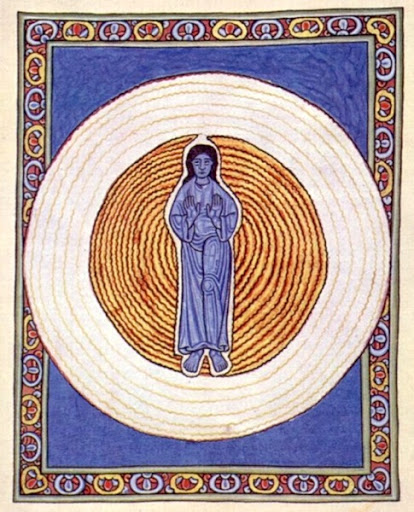
Tomorrow is the feast day of St. Hildegard of Bingen, a great 12th century German mystic who was a Benedictine Abbess, poet and composer and all round intellectual (having contributed not only to theology but also to medicine and science as well). Even though she has been venerated as a saint for centuries, she has only been formally canonized last May by Pope Benedict XVI, who also spoke about her in several of his sermons. There he emphasized her as a role model for spiritual leadership, since “she inspired holy emulation in the practice of good to such an extent that, as time was to tell, both the mother and her daughters competed in mutual esteem and in serving each other.”

Also with regard to her mystic visions he praised here humility, which at first made her doubt them and only when they received approval first from St. Bernard of Clairvaux and later from Pope Eugene III did she share them with her followers and the public. “The person endowed with supernatural gifts never boasts of them, never flaunts them and, above all, shows complete obedience to the ecclesial authority.” As far as she herself was concerned, this is how she described her visions:

“The vision fascinates my whole being: I do not see with the eyes of the body but it appears to me in the spirit of the mysteries…. I recognize the deep meaning of what is expounded on in the Psalter, in the Gospels and in other books, which have been shown to me in the vision. This vision burns like a flame in my breast and in my soul and teaches me to understand the text profoundly” (Epistolarium pars prima I-XC: CCCM 91).

From among her extensive visions that touched on virtually all aspects of Christianity, I would just like to pick out her vision of the Trinity, which struck me as particularly beautiful:

“Then I saw a bright light, and in this light the figure of a man the color of sapphire, which was all blazing with a gentle glowing fire. And that bright light bathed the whole of the glowing fire, and the glowing fire bathed the bright light; and the bright light and the glowing fire poured over the whole human figure, so that the three were one light in one power of potential.” (Scivias 2.2, quoted in Anne Hunt’s The Trinity: Insights from the Mystics, pp. 38).

In fact, the image at the top of the post is a representation of this vision from an early illuminated printed version. St. Hildegard explains this vision as follows:

“You see a bright light, which without any flaw of illusion, deficiency or deception designates the Father; and in this light the figure of a man the color of a sapphire, which without any flaw of obstinacy, envy or iniquity designates the Son, Who was begotten of the Father in Divinity before time began, and then within time was incarnate in the world in Humanity; which is all blazing with a gentle glowing fire, which fire without any flaw of aridity, mortality or darkness designates the Holy Spirit, by Whom the Only-Begotten of God was conceived in the flesh and born of the Virgin within time and poured the true light into the world.” (Scivias, 2.2.2, quoted in ibid).

What I find very attractive about St. Hildegard is the visual and allegorical nature of her mystical experiences (which she is careful to describe as spiritual rather than ocular) and their subtle beauty that is particularly clear in the above example.

Beauty, ugliness and art

Michel pochet

“Ugliness will redeemed us” was certainly among the most provocative and profound insights shared at a conference of Christian academics and artists that I attended some 12 years ago in Rome. This statement, by the French painter Michel Pochet, was made very much in earnest and at a moment of reflection on a sacred text that spoke about Jesus’ suffering on the cross and his cry of abandonment before his death (“My God, my God, why have you forsaken me?” Mathew 27:45). It certainly was not a frivolous, Oscar Wilde-esque quip, yet the reaction to it was one of disbelief, shock and immediate, widespread opposition. A very prominent Italian sculptress asked to be given the floor and launched into what was effectively a plea for reason to return: “How can you say that ugliness will redeem us? God is beauty and it will be by beauty that salvation will be delivered!” Personally, I was very much attracted to Pochet’s words and equally disappointed by the immediate opposition they received. Thankfully, the conference chair swiftly rebuked Pochet’s critic, with something along the following lines: He said that the sculptress’ words were not in the spirit of charity, reminded her that we must believe in the good intentions of others and that if their views differ from ours, we must try to understand why they are different. In the end what she said was true but so was that which she criticized, in its own context. The most impressive thing to my mind was not only Pochet’s insight, but also that this group of distinguished academics and artists was both capable of open disagreement and of accepting a rebuke that in many contexts would have lead to offense.

But, let us return to Pochet’s insight, which has immediately attracted me, for which I could see good reason, but which I never had the opportunity to know more about, until I read the transcript of a talk (in Italian) that he gave at an event in 2006. There he talks about his experience of returning to painting after many years and being in post-war Croatia with some friends. Materials were scarce and when his friends realized that he was painting again, they were looking for supplies for him. One day he was given a piece of canvas that was badly marked, torn, discolored and generally not in a fit state to be used as the basis for a painting. Since it was offered to him out of love by his friends, he could not refuse it. Examining the canvas, the thought came to him to paint a portrait of Jesus in his abandonment on the cross, since there he too suffered from the damage that this canvas presented.

Upon completing the painting (shown at the top of this post), Pochet realized that what he did was not so much a portrait of the abandoned Jesus but of the risen one, bearing the marks of his crucifixion and suffering. Looking at his own work, Pochet understood that this dual portrait of the suffering and risen Jesus provides an insight into what beauty is. He realized that Jesus, being God, is also perfect beauty and that his person is substitutable with that of Beauty in the Gospel:1

“[Beauty] seems dead, buried under the rock of ugliness. But on the third day the tomb is empty. Someone tells us that she is risen and that she waits for us. She walks with us, talks to us. My heart burns in my chest. It is getting late. We ask her to stay for supper, but our eyes open in the moment she disappears. Risen Beauty does not appear again: she disappears, hides in the anonymity of whomever, in the banal, the everyday. […]

Beauty is at the lake’s shore, unrecognizable. A pure eye intuits her and opens our eyes. We dive into the water and Beauty nurtures our mind and our senses, with bread baked on a hot stone. Beauty climbs a mountain with us, is lifted up high before our eyes and a cloud removes her out of sight.

And while we are staring at the heavens as she leaves: “Why are you looking at the sky? This Beauty, which has been among you and has been taken up to heaven, will return one day in the same way in which you have seen her leave.” And we, along the ways of the world, remember her words of farewell: I am with you all the days, until the end of the present age. […]

[T]he death of Beauty, “ugliness” – if we want to call it that, [is] assumed by God, divinized, in the risen Jesus.”

This fits perfectly with the intuition I had when first hearing him speak about ugliness, although the profound insight that Jesus’ life can be applied to Beauty, to gain a deeper understanding of it, is an impressive bonus! Beauty, understood through the optics of Jesus, is not superficial, ‘kitsch’ or only concerned with aesthetics, but one that goes to the heart of what it is to be human. It embraces the ugliness of suffering and uses it to arrive at love and joy.

What Pope Benedict XVI has to say on the subject is very much related. E.g., when talking about Michelangelo‘s “The Last Judgement” fresco in the Sistine Chapel, he says that it “issues a strong prophetic cry against evil, against every form of injustice” and goes on the exult beauty as follows:

“[T]he experience of beauty, beauty that is authentic, not merely transient or artificial, is by no means a supplementary or secondary factor in our search for meaning and happiness; the experience of beauty does not remove us from reality, on the contrary, it leads to a direct encounter with the daily reality of our lives, liberating it from darkness, transfiguring it, making it radiant and beautiful.

Indeed, an essential function of genuine beauty, as emphasized by Plato, is that it gives man a healthy “shock”, it draws him out of himself, wrenches him away from resignation and from being content with the humdrum — it even makes him suffer, piercing him like a dart, but in so doing it “reawakens” him, opening afresh the eyes of his heart and mind, giving him wings, carrying him aloft.”

He then quotes Simone Weil, saying: “In all that awakens within us the pure and authentic sentiment of beauty, there, truly, is the presence of God. There is a kind of incarnation of God in the world, of which beauty is the sign. Beauty is the experimental proof that incarnation is possible. For this reason all art of the first order is, by its nature, religious.”

I hope that you won’t see this as an attempted land-grab for all art in the name of religion. Instead, I believe, it is an acknowledgement of art expressing a fundamental attribute of God, which believers can seek regardless of whether the artist intended it, agrees with it or believes in it. With the profound understanding of beauty (including a “risen” ugliness) that both Pope Benedict XVI and Michel Pochet talk about, we can further seek to recognize the presence of beauty also in art (and life!) that at first sight appears ugly.


1 Apologies for this unpolished translation – it is mine and was done in a hurry :$