Synod14: A reality check

Francis synod

If you are a regular on this blog, you’ll know that I have been following the Extraordinary Synod on the Family very closely. I have seen all the press conferences, read all the documents, watched all the interviews, waded through the, sadly mostly morass, of tweets tagged with #synod14, and have written blog posts daily. At the end of the Synod’s two weeks, I felt a great sense of joy and I delighted at the whole process, which, to my mind, was an example of a shared journey, of transparency, and of a group of bishops and lay people striving for the good of the family, with a tremendous sense of seriousness and honesty.

When I then read the first reports on Saturday evening, and then during the course of today in the general press, about what this Synod has arrived at, I have to admit that I came away from them with disappointment. I shouldn’t have been that naive, since this seems to be the norm in how anything moderately nuanced gets reported. From the perspective of the media, the result has been some variant of the following Guardian headline: “Catholic bishops veto gay-friendly statements leaving Pope Francis the loser.”

What I have seen over the last two weeks couldn’t be further from a loss for Pope Francis, first of all because that is a meaningless way of looking at the situation. And even if one were to apply the loss/victory categories to the Synod, the opposite would be my conclusion. Let me therefore lay out what I believe just happened, in as blunt terms as I can, and, please, bear with me while I take a couple of steps back to do this picture justice.

In the beginning was the Word …

No, let me not go back that far just yet (although that verse from the Johannine prologue is highly relevant to one of the keys to the Synod that I will return to in a later post) and instead start with a thought from Pope Benedict XVI’s resignation letter, where he assesses the current situation in the world as follows:

“[T]oday’s world [is] subject to so many rapid changes and shaken by questions of deep relevance for the life of faith”

Questions of deep relevance need to be addressed and Benedict does not have the strength to do it. So, he does what a true servant of servants must, and vacates the See of Peter. A conclave is called and cardinals present their visions for the Church. One Jorge Bergoglio presents the following program:

“Holy Week challenges us to step outside ourselves so as to attend to the needs of others: those who long for a sympathetic ear, those in need of comfort or help. We should not simply remain in our own secure world, that of the ninety-nine sheep who never strayed from the fold, but we should go out, with Christ, in search of the one lost sheep, however far it may have wandered.”

He gets elected Pope Francis and, the next day, in his first address to the cardinals since his election he declares:

“[A]ll together, pastors and faithful, we will make an effort to respond faithfully to the eternal mission: to bring Jesus Christ to humanity, and to lead humanity to an encounter with Jesus Christ: the Way, the Truth and the Life, truly present in the Church and, at the same time, in every person.”

Then follow months of Francis putting his mission to welcome and accompany not only every single person who comes his way, but to go out of his way to reach out to those who may feel far from the Church. His correspondence with the atheist Eugenio Scalfari, his iPhone video to Evangelical Christians in the US and his resounding “Who am I to judge them?” with regard to gays are just a couple of examples off the top of my head.

Eight months after his election and to drive home the message that being a Church that is open and welcoming of all is a must, Francis pens the magnificent apostolic exhortation Evangelii Gaudium – a magisterial document of the Catholic Church, where he declares in the section entitled “A mother with an open heart” that:

“Everyone can share in some way in the life of the Church; everyone can be part of the community, nor should the doors of the sacraments be closed for simply any reason. This is especially true of the sacrament which is itself “the door”: baptism. The Eucharist, although it is the fullness of sacramental life, is not a prize for the perfect but a powerful medicine and nourishment for the weak.[51] These convictions have pastoral consequences that we are called to consider with prudence and boldness. Frequently, we act as arbiters of grace rather than its facilitators. But the Church is not a tollhouse; it is the house of the Father, where there is a place for everyone, with all their problems.” (§47)

A whole year later, and a year where an outreach to the peripheries, an openness to all, regardless of how “proper” or well-ordered their lives are, have been Francis’ daily mission, he has the following to say on the eve of the Synod – just in case someone hasn’t been listening during the preceding year and a half:

“The temptation to greed is ever present. We encounter it also in the great prophecy of Ezekiel on the shepherds (cf. ch. 34), which Saint Augustine commented upon in one his celebrated sermons which we have just reread in the Liturgy of the Hours. Greed for money and power. And to satisfy this greed, evil pastors lay intolerable burdens on the shoulders of others, which they themselves do not lift a finger to move (cf. Mt 23:4)

We too, in the Synod of Bishops, are called to work for the Lord’s vineyard. […] We are all sinners and can also be tempted to “take over” the vineyard, because of that greed which is always present in us human beings. God’s dream always clashes with the hypocrisy of some of his servants. We can “thwart” God’s dream if we fail to let ourselves be guided by the Holy Spirit. The Spirit gives us that wisdom which surpasses knowledge, and enables us to work generously with authentic freedom and humble creativity.

My Synod brothers, to do a good job of nurturing and tending the vineyard, our hearts and our minds must be kept in Jesus Christ by “the peace of God which passes all understanding” (Phil 4:7). In this way our thoughts and plans will correspond to God’s dream: to form a holy people who are his own and produce the fruits of the kingdom of God (cf. Mt 21:43).”

Note two things about what Francis says here: First, God’s dream is a holy people who are his own and who are looked after by his servants, servants who are not to overburden them. Second, he quotes Scripture and a saint to them [remember this for contrast with how he speaks to the Synod Fathers after the Synod].

A week of the Synod later, during which Francis attends almost every single session (skipping one due to the General Audience on the Wednesday), but during which he does not intervene, the interim report of the Synod is published – written by Archbishop Bruno Forte, whom Francis directly appointed to the job of doing so. What does the interim report (the “relatio post disceptationem”) say? Well, amongst other things:

“[I]t is the task of the Church to recognize those seeds of the Word that have spread beyond its visible and sacramental boundaries. Following the expansive gaze of Christ, whose light illuminates every man (cf. Jn 1,9; cf. Gaudium et Spes, 22), the Church turns respectfully to those who participate in her life in an incomplete and imperfect way, appreciating the positive values they contain rather than their limitations and shortcomings. […]

In this respect, a new dimension of today’s family pastoral consists of accepting the reality of civil marriage and also cohabitation, taking into account the due differences. Indeed, when a union reaches a notable level of stability through a public bond, is characterized by deep affection, responsibility with regard to offspring, and capacity to withstand tests, it may be seen as a germ to be accompanied in development towards the sacrament of marriage. […]

Homosexuals have gifts and qualities to offer to the Christian community: are we capable of welcoming these people, guaranteeing to them a fraternal space in our communities? Often they wish to encounter a Church that offers them a welcoming home. Are our communities capable of providing that, accepting and valuing their sexual orientation, without compromising Catholic doctrine on the family and matrimony?”

The Pope listened to everyone speaking their mind and then had “his man” pen the key takeaways – recognize a participation in the life of the Gospel no matter under what circumstances it happens, be welcoming, look for ways for everyone, who wants to, to find their place in the Church.

A week later, during which significant resistance is shown by some cardinals to the interim report, a final report is produced that tones down the interim reports’ language, but that still speaks about all the topics mentioned in the interim report. The final report is voted on paragraph by paragraph, but instead of only those paragraphs that have reached the 2/3 majority needed for them to be official proposals from the Synod to the Pope, all paragraphs are published on the Pope’s orders, including the data on how many votes each paragraph received. The purpose of this final document of the Extraordinary Synod on the Family is that it sets the agenda for the work of this, next year that leads to the Ordinary Synod on the Family in October 2015. Keeping all topics from the interim report in the final report means that they will get discussed both over the course of this year and at the next Synod.

Is that the end of the story? Not at all! What Pope Francis does next is to completely upstage the final report of the Synod, by delivering an amazing closing speech. Why does he do that? Because this Synod is not about its final document – it is the kick-off for a year of discernment and work towards the next Synod, after which proposals are going to be made to the Pope.

So, what did Pope Francis say at the end of this year’s Synod? First, he thanked all for their great effort and then he moved straight to telling them the temptations he saw them struggle with: “the temptation of hostile rigidity,” “the temptation of destructive do-goodery,” “the temptation to turn stone into bread and also to turn bread into stone,” “the temptation to come down from the cross” and “the temptation to neglect the “deposit of faith” and the temptation to ignore reality.” Ouch!

Then he proceeds to spell out, yet again!, what he is looking for:

“And this is the Church, the Lord’s vineyard, the fertile Mother and caring [female] Teacher, who is not afraid to roll up her sleeves to pour oil and wine on the wounds of men (cf. Lk 10: 25-37); who does not look at humanity from a glass castle to judge or categorize people. This Church is the One, Holy, Catholic, Apostolic and composed of sinners, in need of His mercy. This is the Church, the true bride of Christ, seeking to be faithful to her spouse and to his doctrine. It is the Church who is not afraid of eating and drinking with prostitutes and tax collectors (Luke 15). The Church that has doors wide open to receive the needy, the repentant and not only the righteous or those who think they are perfect! The Church that is not ashamed of the fallen brother and does not pretend not to see him, what’s more, she feels involved and almost obliged to raise him and encourage him to continue his journey, and she accompanies him to the final encounter with her ​​Spouse, in the heavenly Jerusalem.”

But he doesn’t leave it there and in true Steve Jobs fashion pulls a “one more thing”:

“We will speak a little bit about the Pope, now, in relation to the Bishops [laughing]. So, the duty of the Pope is that of guaranteeing the unity of the Church; it is that of reminding the faithful of their duty to faithfully follow the Gospel of Christ; it is that of reminding the pastors that their first duty is to nourish the flock – to nourish the flock – that the Lord has entrusted to them, and to seek to welcome – with fatherly care and mercy, and without false fears – the lost sheep. I made a mistake here. I said welcome: [rather] to go out and find them.”

Francis pulls a great in-joke here, since the word “welcome” as applied to homosexuals was one of the most contested points in the interim report. Note the serrated edge that the above (“I made a mistake here. I said welcome”) gets in light of what Francis says at the end of his speech. First, however, he reads to them from one of Benedict XVI’s General Audiences:

“His duty is to remind everyone that authority in the Church is a service, as Pope Benedict XVI clearly explained, with words I cite verbatim: “The Church is called and commits herself to exercise this kind of authority which is service and exercises it not in her own name, but in the name of Jesus Christ… through the Pastors of the Church, in fact: it is he who guides, protects and corrects them, because he loves them deeply. But the Lord Jesus, the supreme Shepherd of our souls, has willed that the Apostolic College, today the Bishops, in communion with the Successor of Peter… to participate in his mission of taking care of God’s People, of educating them in the faith and of guiding, inspiring and sustaining the Christian community, or, as the Council puts it, ‘to see to it… that each member of the faithful shall be led in the Holy Spirit to the full development of his own vocation in accordance with Gospel preaching, and to sincere and active charity’ and to exercise that liberty with which Christ has set us free (cf. Presbyterorum Ordinis, 6)… and it is through us,” Pope Benedict continues, “that the Lord reaches souls, instructs, guards and guides them. St Augustine, in his Commentary on the Gospel of St John, says: ‘let it therefore be a commitment of love to feed the flock of the Lord’ (cf. 123, 5); this is the supreme rule of conduct for the ministers of God, an unconditional love, like that of the Good Shepherd, full of joy, given to all, attentive to those close to us and solicitous for those who are distant (cf. St Augustine, Discourse 340, 1; Discourse 46, 15), gentle towards the weakest, the little ones, the simple, the sinners, to manifest the infinite mercy of God with the reassuring words of hope (cf. ibid., Epistle, 95, 1).”

In other words, Francis is saying: what I have set out before you at the beginning of the Synod is pretty much what Benedict asked of you four years ago and what I have been telling you day in, day out, for the last year and a half.

And, just to sharpen the point a touch – and make it more directly understandable for those who have been misusing the law as a veto against accepting change – Francis concludes by quoting canon law to them (a. k. a. reading them the riot act!):

“So, the Church is Christ’s – she is His bride – and all the bishops, in communion with the Successor of Peter, have the task and the duty of guarding her and serving her, not as masters but as servants. The Pope, in this context, is not the supreme lord but rather the supreme servant – the “servant of the servants of God”; the guarantor of the obedience and the conformity of the Church to the will of God, to the Gospel of Christ, and to the Tradition of the Church, putting aside every personal whim, despite being – by the will of Christ Himself – the “supreme Pastor and Teacher of all the faithful” (Can. 749) and despite enjoying “supreme, full, immediate, and universal ordinary power in the Church” (cf. Cann. 331-334).”

Boom! Oh, you think my saying “welcoming” was a “mistake”? Think again.

“Catholic bishops veto gay-friendly statements leaving Pope Francis the loser.” Not even close.
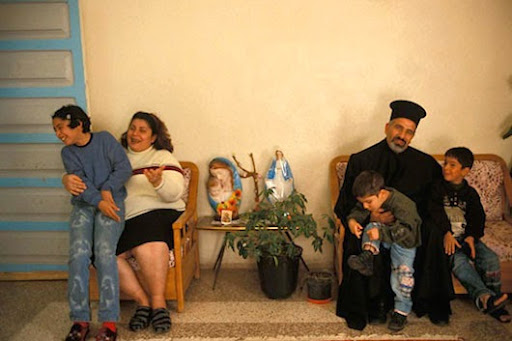
Who are children of God?

45460002 aboud mustafa jamie areen avery2

Catholics? Christians? “Good” people?

No.

In total disagreement with the author of yesterday’s “Thoughts on today’s Mass,” distributed in my parish, who said that “we are not naturally children of God: we become so by baptism, when God adopts us as his own. Otherwise to call God our Father would be a bold presumption,” I would like to show that the Catholic Church teaches that every single human being is a child of God. Using the idea of being God’s child as the basis of separation, the basis of an “us,” as opposed to a ”them,” is perverse and absolutely not what the Catholic Church teaches, in spite of the official-looking material handed out in some of its parishes.

To begin with, Jesus – the Son of God – himself recognizes familial status universally, when he says that “whoever does the will of my heavenly Father is my brother, and sister, and mother” (Matthew 12:50) and St. Paul too picks up on the key being adherence to God’s will: “For those who are led by the Spirit of God are children of God” (Romans 8:14).

That such adherence to the will of God is open to everyone – whether they believe in God or not – and that it is at the heart of what the Catholic Church believes, is very clear from Nostra Aetate, the declaration issued during the Second Vatican Council by Pope Paul VI, which says in its closing paragraph:

“We cannot truly call on God, the Father of all, if we refuse to treat in a brotherly way any man, created as he is in the image of God. Man’s relation to God the Father and his relation to men his brothers are so linked together that Scripture says: “He who does not love does not know God” (1 John 4:8).

No foundation therefore remains for any theory or practice that leads to discrimination between man and man or people and people, so far as their human dignity and the rights flowing from it are concerned.

The Church reproves, as foreign to the mind of Christ, any discrimination against men or harassment of them because of their race, color, condition of life, or religion. On the contrary, following in the footsteps of the holy Apostles Peter and Paul, this sacred synod ardently implores the Christian faithful to “maintain good fellowship among the nations” (1 Peter 2:12), and, if possible, to live for their part in peace with all men, so that they may truly be sons of the Father who is in heaven.”

And this is also reflected in what the Catechism teaches about the opening words of the Our Father, the prayer Jesus taught:

“God’s love has no bounds, neither should our prayer. Praying “our” Father opens to us the dimensions of his love revealed in Christ: praying with and for all who do not yet know him, so that Christ may “gather into one the children of God.” God’s care for all men and for the whole of creation has inspired all the great practitioners of prayer; it should extend our prayer to the full breadth of love whenever we dare to say “our” (§2793)

Note in particular the thought-provoking idea in the above of Catholics praying with those who don’t know Jesus. Even in a fundamentally religious act the desire of Catholics is to be united with those who don’t share their beliefs!

And if the above weren’t enough to categorically declare that Catholics consider every human being to be a child of God and therefore also their brother or sister, let’s see what the last three popes had to say on the subject:

  1. “We must never forget that every person, from the moment of conception to the last breath, is a unique child of God and has a right to life.” Pope Saint John Paul II (Address at the Ceremony of the Anointing Of The Sick, Southwark’s Cathedral, London, 28 May 1982)
  2. “God is the origin of the existence of every creature, and the Father in a unique way of every human being: he has a unique, personal relationship with him or her.” Pope Benedict XVI (Sunday Angelus address, 8 January 2012)
  3. “Since many of you are not members of the Catholic Church, and others are not believers, I cordially give this blessing silently, to each of you, respecting the conscience of each, but in the knowledge that each of you is a child of God. May God bless you!” Pope Francis (Audience to Representatives of the Communications Media, 16th March 2013 – the day after his election!)
  4. “Every human being is a child of God! He or she bears the image of Christ! We ourselves need to see, and then to enable others to see, that migrants and refugees do not only represent a problem to be solved, but are brothers and sisters to be welcomed, respected and loved.” Pope Francis (Message for the World Day of Migrants and Refugees, 5 August 2013)

I rest my case.

St. John Paul II’s encyclical of suffering

Jp2 cross s

Since writing my previous post of thanksgiving to St. John Paul II, ahead of his and St. John XXII’s canonization last Sunday, I kept coming back to thinking about another aspect of his life that has great importance for me. Beyond his words and actions, his perseverance in suffering, especially during the last 15 years of his pontificate (i.e., since the onset of Parkinson’s), has always been an inspiration and an example for me.

Cardinal Bertone put this aspect of St. John Paul II’s life best, when he said that “suffering was another one of his encyclicals.” And by considering it alongside his writings, the most obvious parallel to draw is with the encyclical Salvifici Doloris, which he wrote about suffering some six years after being elected Pope and where one of the key passages for me is the following (§23):

“Those who share in Christ’s sufferings have before their eyes the Paschal Mystery of the Cross and Resurrection, in which Christ descends, in a first phase, to the ultimate limits of human weakness and impotence: indeed, he dies nailed to the Cross. But if at the same time in this weakness there is accomplished his lifting up, confirmed by the power of the Resurrection, then this means that the weaknesses of all human sufferings are capable of being infused with the same power of God manifested in Christ’s Cross. In such a concept, to suffer means to become particularly susceptible, particularly open to the working of the salvific powers of God, offered to humanity in Christ. In him God has confirmed his desire to act especially through suffering, which is man’s weakness and emptying of self, and he wishes to make his power known precisely in this weakness and emptying of self. This also explains the exhortation in the First Letter of Peter: “Yet if one suffers as a Christian, let him not be ashamed, but under that name let him glorify God.””

The absurdity and scandal of a suffering God – and of suffering man – are not explained away or justified, but become invitations to participate in the suffering of Jesus, which demonstrates the extent of God’s love for man.

About fifteen years after writing the above words, and while visiting the sick in a hospital in Mexico City, St. John Paul II returned the the same theme and elaborated it further:

“Seen in this way, pain, disease and the dark moments of human existence acquire a profound and even hopeful dimension. One is never alone in facing the mystery of suffering: we are with Christ who gives meaning to the whole of life: moments of joy and peace, as well as those of affliction and grief. With Christ everything has meaning, even suffering and death; without him, nothing can be fully understood, not even those legitimate pleasures which God has associated to different moments of human life.”

Thinking about St. John Paul II’s health, one can wonder whether his remaining in office was good for the leadership of the Church, whether it wouldn’t have been better if he had resigned, and one can wonder whether such thoughts even entered the Pope’s head, or whether he had continued in his role out of inertia. The answer to the second part of the question is clear from the revision of his own Last Will that he made in the year 2000 and where he added:

“On May 13, 1981, the day of the attack on the Pope during the general audience in St. Peter’s Square, Divine Providence saved me in a miraculous way from death. The One Who is the Only Lord of life and death Himself prolonged my life, in a certain way He gave it to me again. From that moment it belonged to Him even more. I hope He will help me to recognize up to what point I must continue this service to which I was called on Oct. 16, 1978. I ask him to call me back when He Himself wishes. “In life and in death we belong to the Lord … we are the Lord’s.” (cf. Romans 14,8). I also hope that, as long as I am called to fulfill the Petrine service in the Church, the Mercy of God will give me the necessary strength for this service.”

To answer the first doubt, we need look no further than to the homily given by his successor, Benedict XVI, during the beatification of St. John Paul II, where he said:

“[T]he Lord gradually stripped him of everything, yet he remained ever a “rock”, as Christ desired. His profound humility, grounded in close union with Christ, enabled him to continue to lead the Church and to give to the world a message which became all the more eloquent as his physical strength declined. In this way he lived out in an extraordinary way the vocation of every priest and bishop to become completely one with Jesus, whom he daily receives and offers in the Church.”

Leadership of the Church is not about organizational shrewdness, effective policies or vigor (all of which are good, but secondary) – instead it is about an imitation of its head – Jesus. And as such, there is no doubt in my mind that St. John Paul II remained an exemplary leader until his very last moments on Earth. His public and persistent acceptance of frailty, suffering and weakness were as much evidence of his following in Jesus’ footsteps, as his rallying against the mafia, his effort to establish brotherly relationships with other religions, or his forgiving his would-be assassin. Pope Benedict XVI, addressing the Pontifical Council for pastoral healthcare professionals, explained St. John Paul II’s witness as follows:

“The mystery of suffering seems to blur the face of God, making Him almost a stranger, or even identifying him as being responsible for human suffering, but the eyes of faith are able to look deeply into this mystery. God became incarnate, He came to be close to man, even in the most difficult situations, He did not eliminate suffering, but in the Risen Crucified One, the Son of God suffered unto death, even death on a cross, He reveals that His love goes even deeper into the abyss of man to give him hope. The Crucified is risen, death has been illuminated by the morning of Easter: ‘God so loved the world that he gave his only Son, that whoever believes in him shall not perish but have eternal life’ (Jn 3.16). […] The testimony of the last years of John Paul II’s life teach us this: “An unshakable faith pervaded his physical weakness, making his illness, lived for love of God, the Church and the world, a actual participation in the journey of Christ to Calvary. The following of Christ did not spare Blessed John Paul II to take up his cross every day until the end, to be like his only Master and Lord.””

As I was thinking about what it is about St. John Paul II’s example that attracted me so much, I was visiting the Sagrada Familia in Barcelona, and I went to spend some time in front of Jesus in the Eucharist – if you convince a guard that you realize you are in an actual church, you are granted access to a small, walled-off fragment of the basilica where the tabernacle is situated. In the midst of the roar of a throng of tourists, I looked at the inscription on the tabernacle, which read: “Jo sóc la vida” (“I am the life” – cf. John 14:6) and something went “click” in my mind.1 A following of Jesus means an identification of life with Him and it is this that St. John Paul II did. His was an imitation of Jesus in all aspects of life – the joyous and the sorrowful, and a realization that the way to the joy of the resurrection that is mirrored in the joys of life passes through the sorrow of the crucifixion, which we can participate in, in its sufferings.

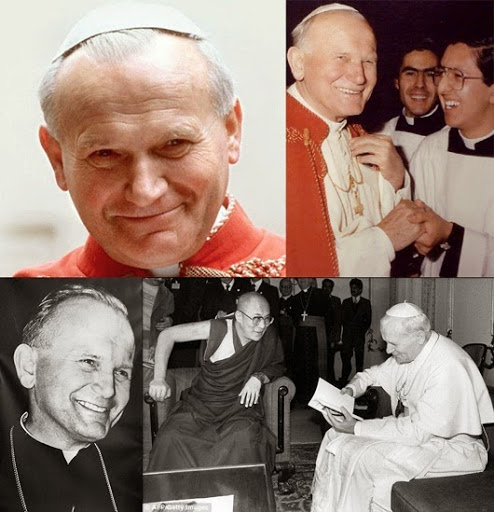
Just to dispel a potential misunderstanding that might arise from having spent 1500 words talking about suffering and that might suggest a preference for or a seeking out of suffering, let me say that this is not what Christianity is about. Instead it is all about joy, but a joy that embraces and subsumes the difficult and painful moments of life – like a profound beauty that also elevates and incorporates ugliness. In the end though it is about joy and beauty, like St. John Paul too emphasized when he insisted that “We are an Easter people” and when Pope Francis criticized “Christians whose lives seem like Lent without Easter” and who look like “sourpusses.” Let me therefore leave you with a couple of photos of St. John Paul II, from which it can be seen that he was anything but a sourpuss 🙂

Jp2 smiles


1 Not that I think the mind is mechanical :).

Subirachs’ Passion Façades

Subirachs

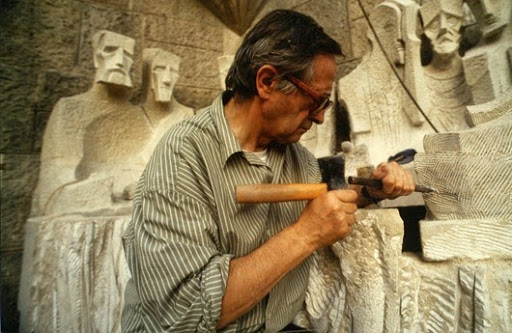
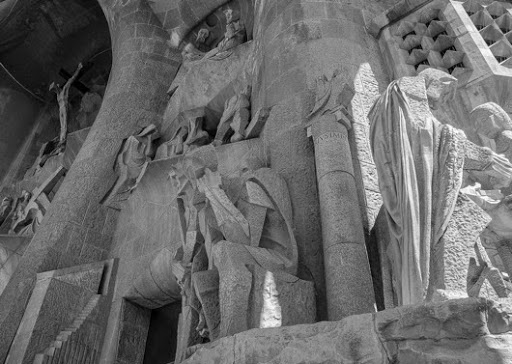
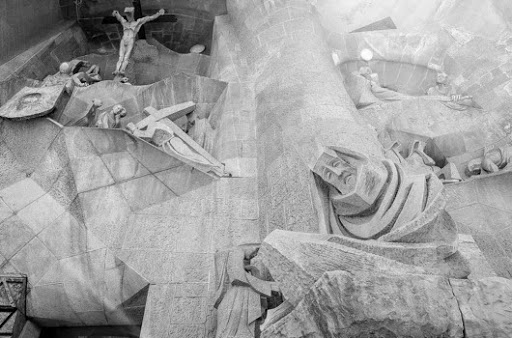
My favorite building in the world is the Basilica of the Sagrada Familia in Barcelona, where its Passion Façade in particular is an exceptional creation and object for contemplation. Its creator, the Catalan sculptor Josep Maria Subirachs,1 who died three weeks ago, was an adherent of the New Figuration movement that brought figurative elements back to sculpture in the 1960s and which Subirachs explains as follows:

“The images of the artists of the new figuration are used in the same way in which abstract artists use form: transformed into signs; because of this, abstract art does not represent but it does signify. Therefore, new figuration too does not represent anything but does signify, which makes me want to call it significative figuration.”

When Subirachs was then asked to create the Sagrada Familia’s Passion Façade, depicting the last two days of Jesus’ life, his two conditions were that he would not imitate Gaudí and follow his own, free creativity instead, and that he would live in the grounds of the church, like Gaudi – whom he admired – lived. While being granted these two requests (and being heavily criticized for his choices subsequently), Subirachs nonetheless was keen to embody Gaudí’s vision, which was the following:

“Some might find this Façade too extravagant; but I would like it to inspire fear, and I would not spare the use of chiaroscuro, of motives of entry and exit, all that results in the most theatrical effect. What’s more, I am prepared to sacrifice the construction of the church itself, to break arches and cut columns, to transmit the bloodiness of the Sacrifice.”

How Subirachs did it though is very different from what Gaudí would have done. For a start, Gaudí considered curves – round, organic shapes – to be “the line of God.” “Instead,” Subirachs says, “my shapes are very geometric, with flat faces and sharp edges, and provide the drama that the scene I am representing needs.” There is also a minimalism in Subirachs’ approach, e.g., where he leaves out the two thieves crucified either side of Jesus and a depiction of Jesus’ entry into Jerusalem on Palm Sunday, which were in Gaudí’s plans, for the sake of a “simple, didactic message.” Such minimalism is at the core of what Subirachs considers to be the essence of sculpture, which is “getting rid of everything that is unnecessary.”

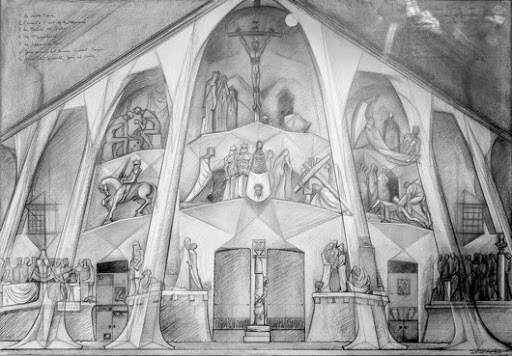
Just to get a sense of how Subirachs approached the depiction of Jesus’ passion, the following shows the plan he drew up before proceeding to create the sculptures:

Passion facade plan

The story, which Subirachs wanted to be “cinematographic,” starts with the last supper at the bottom left and then snakes its way to the top right where the entombment of Jesus is shown. A golden statue depicting the resurrected Jesus is then located between the towers erected above the façade.

To get a better sense of what the above plan lead to, take a look at the following collection of photos. However, this is just a poor substitute for being there in person. Every time I go to see the Passion Façade, something new stands out for me, and yesterday was no different. What struck me was how the layout of the story, in the boustrophedonic sequence that Subirachs chose, results in three of the characters that betrayed Jesus – Judas, Pilate and Peter – all being depicted in the bottom layer. This, in turn, allows for a viewing of the Passion from their perspectives – with the consequences of their actions (or the source of his sorrows, in Peter’s case) projecting out from them and reinforcing the cause of their grief. In the two following photos you can see the “Passion of Pilate” followed by the “Passion of Peter.”

Passion of pilate

Passion of peter

This also reminded me of Pope Francis’ Palm Sunday homily, where he discarded his prepared text and instead proceeded to reflect on the question of where each one of us fits into Jesus’ Passion, asking: “Where is my heart? Which of these persons am I like?” Subirachs’ Passion Façade is a meditation on the last hours of Jesus life, but (borrowing Benedict XVI’s words about Gaudí) made “not with words but with stones, lines, planes, and points.”


1 If you understand Catalan, there is a great hour-long documentary about Subirachs available here.

Viri probati: priesthood for married men

Johannes30070 036L

It looks like Pope Francis has started testing the waters for the possibility of reintroducing the option of having married priests in the Roman Catholic Church. In an audience with him,1 Erwin Kräutler, the bishop of Xingu in the Brazilian rainforest, raised the challenges of the shortage of priests. Bishop Kräutler told the Pope about only having 27 priests for 800 communities with 700 000 faithful in the Amazonian rainforest, which means that each parishioner only has access to the Eucharist 2-3 times per year.

Francis’ response was that local bishops know the needs of their people best and that they must be courageous and make proposals for new solutions. Bishops mustn’t act alone and should instead first agree in their local bishops’ conferences about proposals for reform, before then bringing them to Rome. This was followed by the topic of the possibility of ordaining married “viri probati” (“proven/tested men”) as priest,2 which lead Pope Francis to sharing the situation in a Mexican diocese, where there is a married, permanent deacon in every parish, but many do not have a priest. These 300 deacons, however, cannot celebrate the mass. How could this continue? It is here that bishops should make proposals.

That, in a nutshell, is Bishop Kräutler’s account of his conversation with Pope Francis, which The Tablet reported on 10th April in an article entitled “Pope says married men could be ordained – if world’s bishops agree.” Not exactly the letter of the original report, but, I’d say, in agreement with its spirit (the audience with Pope Francis points to a broader consultation process than just a yes/no about ordaining proven married men to the priesthood, and by the sounds of it, it was Kräutler who brought up the topic).

During the following days there then came a number of statements by bishops regarding the question of “viri probati,” in general being in favor of it. Among them are three English and Welsh bishops: Thomas McMahon, the previous Bishop of Brentwood, in whose diocese there were 20 former Anglican married priests, who said:

“I would be saying personally that my experience of married priests has been a very good one indeed. I think people in those parishes where they have been placed have taken to them very well indeed. People look to their priest as a man of God, to lead them to God. If he is a real pastor at their service then it is rather secondary as to whether he is married or not.”

Bishop Seamus Cunningham of Hexham and Newcastle also expressed his support and Bishop Tom Burns of Menevia (Cardiff) said that “These married men would bring a wider experience and understanding to priestly ministry.” A couple of days ago, Archbishop Diarmuid Martin of Dublin also expressed his openness to considering the proposal, while emphasizing the importance to act in unity with the whole Church and with the Pope.

There have also been voices of support for this option in the past: Bishop Manfred Scheuer of Innsbruck in Austria declared himself in favor in 2011, while pointing out his skepticism about whether this would be a measure for addressing the shortage of priests though. Cardinal Timothy Dolan of New York, in the book-length interview, stated that he could see the priestly ordination of viri probati happening, but that he too had reservations about it being a solution to current shortage.

And, let’s not forget Pope Benedict XVI himself allowing for the future priestly ordination of married men in in the context of the Personal Ordinariate established by the apostolic constitution Anglicanorum Coetibus (as opposed to only considering it a transitory measure for the initial transferees from the Anglican Communion).

The concept of “viri probati” dates back to the first century, where it is referred to in a letter (§42:4) by Pope St. Clement I, albeit in a different context – that of candidates for being appointed bishops and deacons in general. The idea there was that the men in question had a track record of living a Christian life, before they were considered for ordination. This is already what is in place for married permanent deacons (a practice re-introduced by Vatican II and having resulted in 16 000 married men being ordained and active as deacons today in the US alone), where the minimum requirement (Can. 1031 §2) for a candidate is the age of 35 years (and the consent of his wife! :).

Essentially this new proposal sounds to me like an opening of priestly ordination to those who today are married deacons or who would become married deacons in the future.

Personally I think this is a good idea, but – like Bishop Scheuer and Cardinal Dolan – I don’t believe it would make a dramatic difference to the number of priests. It is not like there are huge numbers of married men vying for the priesthood and I believe vocations among them are going to be scarce. Not only will they need to have had the vocation to receive the sacrament of marriage (as opposed to just have gotten married) but they will then also need to feel the subsequent call to the priesthood. By probability theory alone I would expect this to be a small number. However, for that small number – even if it only ever applied to one – I’d be in favor of admitting them to the priesthood. Why? Mainly because Jesus did so himself – among the apostles, at the very least St. Peter (the first pope! and a viro very much probato) was married (cf. Matthew 8:14) and chances are that some of the other apostles were too. If it was good enough for Jesus, it sure is good enough for me!

What I find by far more encouraging – and a source of joy – is the process that has already taken place and that is being put into practice by Pope Francis: a bishop comes to see him, shares a concern with him and proposes a solution. Francis encourages him, invites him to consult with his brother bishops and asks him to then escalate the proposal to the universal Church’s level, for discernment by himself. Francis also emphasizes the importance of unity and invites the expression of opinion by others. Other bishops step forward and express their views. All of this within the course of days and in the absence of any formal process and without intermediaries and bureaucrats wedged between the Bishop of Rome and his brother Bishops from around the world. This is what collegiality is about, as Vatican II presents in in Lumen Gentium (§22), and it is finally being put into practice. Ad maiorem Dei gloriam!


1 The news was also picked up by the German branch of Vatican Radio some days later.
2 Note, that this is not the same as opening up the possibility of getting married to priest – a practice that has never existed in the Catholic Church. The question on the table is about married men being ordained priests, not vice versa.

Humanist transcendence in religious art

Algebraicszoom s

A couple of weeks ago I read an excellent article in the Guardian, by the philosopher and Distinguished Supporter of the British Humanist Association, Kenan Malik. While it is an article that clearly positions religion as deprecated, inferior and outmoded (sentiments I certainly don’t share), it nonetheless makes some very positive moves.

Malik starts out by recognizing a piece of Christian writing as “wonderful, luminous,” able to “discover the poetic even in the most mundane,” and proceeds to argue that the awe that inspires religious artists and the spiritual force that drives them to create are “a celebration of our ability to find the poetic and the transcendent,” which is “something very human.” It is this attitude of recognizing value in the work of another, whose beliefs the author of the article does not share and even opposes, that made me like Malik’s approach from the start.

Having established an openness towards religious art, Malik asks whether “non-believers can truly comprehend the meaning of religiously inspired art.” The answer he provides not only addresses this interesting question, but serves as a basis for even broader dialogue between religion and atheism:

“[W]e can think about the sacred in art [… n]ot so much as an expression of the divine but, paradoxically perhaps, more an exploration of what it means to be human; what it is to be human not in the here and now, not in our immediacy, nor merely in our physicality, but in a more transcendental sense. It is a sense that is often difficult to capture in a purely propositional form, but one that we seek to grasp through art or music or poetry. Transcendence does not, however, necessarily have to be understood in a religious fashion, solely in relation to some concept of the divine. It is rather a recognition that our humanness is invested not simply in our existence as individuals or as physical beings but also in our collective existence as social beings and in our ability, as social beings, to rise above our individual physical selves and to see ourselves as part of a larger project […].”

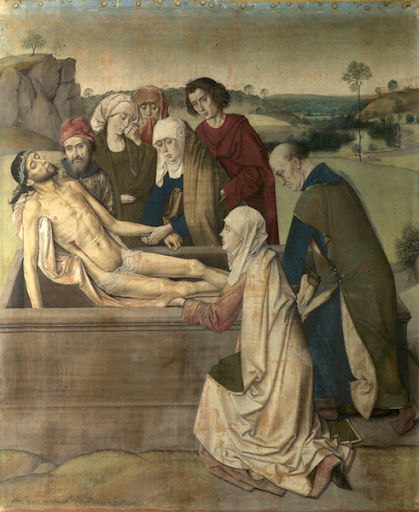
Malik then proceeds to sketch out a brief history of transcendence in philosophy and art, noting its roots in religious belief and proceeding to present attempts made to transplant it into humanist soil in the 15th century, e.g., by Dante Alighieri in his Divine Comedy and by Dirk Bouts, whose “The Entombment” (shown next) Malik analyzes to great effect, arguing that it is an example of a “changing conception of the sacred” that reveals a “humanising impulse.”

Bouts the entombment s

Malik is quick though to point out a “growing suspicion of the very idea of transcendence” in the post-Enlightenment period when “the very rootedness of the idea of transcendence in religious belief made it an uncomfortable concept.” These were accompanied by a gradual ebbing away of the “optimism about human capacities that had originally suffused the humanist impulse,” leading – through the horrors of 20th century history – to a “darkening perceptions of humans.” At the same time, that century also witnessed a “revolution in the way that artists were able to conceive of the human.” Here Malik points to “Olivier Messiaen’s Quartet for the End of Time to Mark Rothko’s paintings, from Barbara Hepworth’s figures to Pablo Neruda’s odes” as “astonishing works of art,” but proceeds to declare that “[i]t makes little sense to call such works of art “sacred”.”

What is curious though is that Malik next quotes Mark Rothko as saying: “The people who weep before my pictures are having the same religious experience as I had when I painted them,” but decides to consider Rhothko’s being religious merely a being “religious”:

“What Rothko calls “religious experience” is not what would traditionally be seen as such. It is rather an attempt to grasp the meaning of our humanness not in its immediacy, nor merely in its physicality, but, to borrow a religious term, in a more apophatic sense.”

If anything, saying that something is apophatic is to align it with the most traditional and deep-seated of religious intuitions about God’s otherness, put particularly starkly by Blessed Duns Scotus: “We do not know what God is. God Himself does not know what He is because He is not anything. Literally God is not, because He transcends being.” or by St. Cyril of Alexandria: “For we explain not what God is but candidly confess that we have not exact knowledge concerning Him. For in what concerns God to confess our ignorance is the best knowledge.” To Christians, God is – to borrow Malik’s words from a different context – “difficult to capture in a purely propositional form.” And this is not just the opinion of fringe elements or of eccentrics from a distant past – it is clearly stated in the Catholic Church’s current Catechism: “God transcends all creatures. We must therefore continually purify our language of everything in it that is limited, image-bound or imperfect, if we are not to confuse our image of God — “the inexpressible, the incomprehensible, the invisible, the ungraspable” — with our human representations. Our human words always fall short of the mystery of God.” (§42). If that’s not apophatic, then I don’t know what is …

The above is not an attempt at an “aha!” or a “gotcha” though – instead it is meant just to suggest that what Malik sees as an areligious or a meta-religious transcendence – a “break[ing of] the shackles of the sacred while maintaining the sense of the transcendent”, in fact has the hallmarks of what I would wholeheartedly label as religious.

What I’d like to take away from Malik’s thought is a very positive point though, which is that the transcendence understood very differently by Malik and myself nonetheless seems like the one transcendence to me that we both appreciate and relate to. In spite of Malik’s efforts to distance contemporary expressions of transcendence in art from any and all religious associations, that exact same art is to me deeply religious and connects to the scared when I view, hear or read it.

Ultimately Malik’s moves can also be seen as a mirror to Pope Benedict XVI’s quoting Simone Weil saying that “all art of the first order is, by its nature, religious.” I have to say I like this picture: atheists claiming religious art is not really religious but humanist, and religious people claiming that secular art is religious after all. To my mind these are both profound compliments and a source of joy :).

An ecumenism of brotherhood

Francis abp welby

[Warning: long read.]

Already St. Paul was faced with factions and divisions among the earliest followers of Jesus – to the point of frustration, in the face of groups declaring their allegiance to one or other leader: “[I]t has been reported to me about you, my brothers, by Chloe’s people, that there are rivalries among you. I mean that each of you is saying, “I belong to Paul,” or “I belong to Apollos,” or “I belong to Cephas,” or “I belong to Christ.” Is Christ divided? Was Paul crucified for you? Or were you baptized in the name of Paul?” (1 Corinthians 1:11-13). In other words: “Pull yourselves together!”

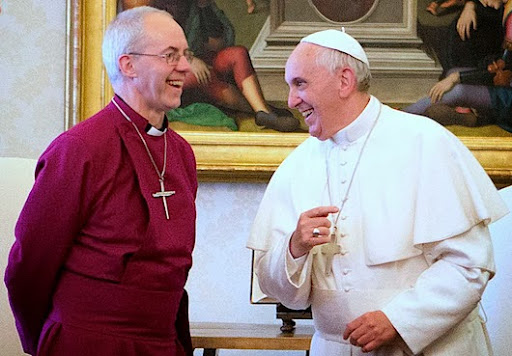
That there are divisions among Christians is a scandal and one that both mocks Jesus’ own call for his followers to be united and for us to love each other like ourselves. It is no wonder then that ecumenism – the desire to see all Christians reunited after centuries of divisions – is one of the most prominent themes of Pope Francis’ preaching and actions. To get a sense of how he is approaching this challenge (or “opportunity,” as it would be put using a politically-correct vocabulary), it is worth taking a look at what he has said on the subject so far. The following is, therefore, my attempt to pull all of Francis’ remarks on ecumenism together in one place (in chronological order):

  1. When addressing the Archbishop of Canterbury in June ’13, Francis focuses on ecumenism as a shared journey, undertaken with Jesus in our midst:

    “The unity we so earnestly long for is a gift that comes from above and it is rooted in our communion of love with the Father, the Son and the Holy Spirit. As Christ himself promised, “where two or three are gathered in my name, there am I in the midst of them” (Mt 18:20). Let us travel the path towards unity, fraternally united in charity and with Jesus Christ as our constant point of reference.”

  2. Later that month, addressing the Ecumenical Patriarch of Constantinople, Francis draws attention to ecumenism not being about a lowest common denominator, but instead about an exchange of riches and a seeking of truth:1

    “It comforts me, knowing that Catholics and Orthodox share the same conception of dialogue that doesn’t seek a theological minimalism on which to reach a compromise, but that rather is based on the deepening of the truth that Christ has given to his Church and that we, moved by the Holy Spirit, never cease to understand better. This is why we shouldn’t be afraid of encounter and true dialogue. It doesn’t distance us from the truth but rather, through an exchange of gifts, leads us, under the guidance of the Spirit of truth, to the whole truth.”

  3. In his address to Baselios Marthoma Paulose II, Catholicos of the Malankara Orthodox Syrian Church in September ’13, Francis calls for a culture of encounter instead of clashes, emphasizing both the need of individual effort and the work of the Holy Spirit:

    “I believe that on the ecumenical path it is important to look with trust to the steps that have been completed, overcoming prejudices and closed attitudes which are part of a kind of “culture of clashes” and source of division, and giving way to a “culture of encounter”, which educates us for mutual understanding and for working towards unity. Alone however, this is impossible; our witnesses and poverty slow the progress. For this reason, it is important to intensify our prayer, because only the Holy Spirit with his grace, his light and his warmth can melt our coldness and guide our steps towards an ever greater brotherhood.”

  4. In “the” interview to Jesuit magazines later that month, Francis emphasized the mutual enrichment that is a consequence of ecumenism: “In ecumenical relations it is important not only to know each other better, but also to recognize what the Spirit has sown in the other as a gift for us.”
  5. During a general audience at the end of September ’13, Francis emphasized two points with regard to ecumenism: first that there is an abundance of riches that Christians already share:

    “There is one body, that of Christ which we receive in the Eucharist; one Spirit, the Holy Spirit that animates and constantly recreates the Church; one hope, eternal life; one faith, one Baptism, one God, Father of us all (cf. vv. 4-6). The richness of what unites us!”

    second, that the work for communion among all Christians starts with each one of us – in the family, parishes, … rather than being something removed from the lives of individuals:

    “Each one should ask himself today: do I make unity grow in the family, in the parish, in the community or am I a motive of division, of hardship? Do I have the humility to heal with patience, with sacrifice, the wounds to communion?”

    and, finally, a reminder that Christian unity is not principally a matter of political negotiation, but a gift received from God:

    “[W]ho is the motor of this unity of the Church? It is the Holy Spirit. Our unity is not primarily the fruit of our consensus, of our effort to be in agreement, but it comes from Him who makes unity in diversity, which is harmony.”

  6. When addressing the president of the Lutheran World Federation in October ’13, Francis positions unity among Christians as a consequence of each individual, community and church drawing closer to Jesus and as being in proportion to the sincerity with which it is asked for: “In the measure in which we draw closer to our Lord Jesus Christ in humility of spirit, we are certain to draw closer to one another. And, in the measure in which we ask the Lord for the gift of unity, we are sure that he will take us by the hand and be our guide.” In other words, both as a consequence of fidelity and as a gift.
  7. A week later, in a letter to the World Council of Churches, Francis effectively calls for action as one Christian community, even in the face of our existing differences:

    “In fidelity to the Gospel, and in response to the urgent needs of the present time, we are called to reach out to those who find themselves in the existential peripheries of our societies and to show particular solidarity with the most vulnerable of our brothers and sisters: the poor, the disabled, the unborn and the sick, migrants and refugees, the elderly and the young who lack employment.”

  8. In an interview for the La Stampa Italian daily in December ’13, Francis further sharpened his insistence on what Christians all have in common:

    “Today there is an ecumenism of blood. In some countries they kill Christians for wearing a cross or having a Bible and before they kill them they do not ask them whether they are Anglican, Lutheran, Catholic or Orthodox. Their blood is mixed. To those who kill we are Christians. We are united in blood, even though we have not yet managed to take necessary steps towards unity between us and perhaps the time has not yet come. Unity is a gift that we need to ask for. I knew a parish priest in Hamburg who was dealing with the beatification cause of a Catholic priest guillotined by the Nazis for teaching children the catechism. After him, in the list of condemned individuals, was a Lutheran pastor who was killed for the same reason. Their blood was mixed. The parish priest told me he had gone to the bishop and said to him: “I will continue to deal with the cause, but both of their causes, not just the Catholic priest’s.” This is what ecumenism of blood is.”

  9. At the end of the Week of Prayer for Christian Unity at the end of January ’14, Francis highlighted that Christian unity won’t be something that suddenly happens at the end of a process, but that it is instead a journey that we share already now:

    “We have all been damaged by these divisions. None of us wishes to become a cause of scandal. And so we are all journeying together, fraternally, on the road towards unity, bringing about unity even as we walk. […] Unity will not come about as a miracle at the very end. Rather, unity comes about in journeying; the Holy Spirit does this on the journey. If we do not walk together, if we do not pray for one another, if we do not collaborate in the many ways that we can in this world for the People of God, then unity will not come about! But it will happen on this journey, in each step we take. And it is not we who are doing this, but rather the Holy Spirit, who sees our goodwill.”

  10. On 18th February Pope Francis then addressed the attendees of a Evangelical Christians, via a video recorded by his friend – the Anglican Bishop Tony Palmer on his iPhone. Not only was the form of the message refreshingly friendly and informal, but its content too is significant in the completely fraternal level at which Francis places himself and the gathering he addresses. The very direct identification of past disagreements as sins on both side, the acknowledgement of God’s action among the gathering he addresses and his emphasis on the need for encounter and the recognition of each other as brothers further underline where he is coming from:2

    Dear brothers and sisters, excuse me because I speak in Italian, but I am not speaking English. But, I will speak no Italian, no English, but heartfully. It is a simpler and more authentic language and this language of the heart has a special style and and a special grammar. A simple grammar. Two rules: Love God above all else, and love the other because they are your brother and sister. With these two things we go ahead. I am here with my brother, with my brother bishop, Tony Palmer. We have been friends for years. […] It is a pleasure to greet you. A joyful and wishful greeting. Joyful, because it fills me with joy to know that you are together to give praise to Jesus Christ, the only Lord. And to pray to the Father and receive the Spirit. This gives joy, because it can be seen that the Lord works all over the world.

    And wishful because … Well, what happens with us is what also happens in some neighborhoods where there are some families who love each other and other families who don’t. Families who come together and families who separate and we are a bit – I’ll use the word – a bit separated. Separated because sins have separated us, our sins. The misunderstandings throughout history. It has been a long road of communitarian sin. But who is to blame? We all are to blame. We are all sinners. Only one is just – the Lord.

    I am wishful for this separation to end and for communion to come. I am wishful for that embrace that Holy Scripture speaks about when Joseph’s brothers, starving, went to Egypt so that they could buy food to eat. They went to buy, they had money, but they couldn’t eat the money! And there they found something more than food, they found their brother. All of us have “currency.” The currency of culture, the currency of our history, and lots of cultural riches and religious ones, of diverse traditions. But we have to come together as brothers. And we must cry together like Joseph did. This crying will unite us – the crying of love. I am talking to you as your brother. And I speak to you like this, simply. With joy and wishfulness. Let us make our wishfulness grow, because this will push us to find each other, to embrace each other and to praise Jesus Christ as the only Lord of history. […] I ask you to bless me and I bless you – from brother to brother.”

  11. That emphasis on Jesus being the center of Christian life is then taken further in Francis’ Angelus message3 last Sunday, where he insisted that :

    “Saint Paul explains that […] the community does not belong to the apostles, but it is them – the apostles – who belong to the community; but the community, in its entirety, belongs to Christ!

    From this belonging derives the fact that in Christian communities – dioceses, parishes, associations, movements – differences mustn’t contradict the fact that we all, through Baptism, have the same dignity: we are all all, in Jesus Christ, sons and daughters of God. And this is our dignity: in Jesus Christ we are sons and daughters of God! Those who have received a ministry of leadership, of preaching, of administering the Sacraments, mustn’t consider themselves to in possession of special powers, masters, but place themselves at the service of the community, helping it along the journey of holiness with joy. […]

    May the Lord give us the grace to work for the unity of the Church, of building this unity, because unity is more important than conflicts! The unity of the Church is of Christ, conflicts are problems that are not always of Christ. […]

    Pray for us [the new Cardinals, made the previous day, and the pope], that we may be good servants: good servants, not good masters! All together, bishops, priests, consecrated persons and faithful laity, we have to give witness of a Church faithful to Christ, animated by the desire to serve brothers and sisters and ready to reach out with prophetic courage towards the spiritual expectations and needs of men and women of our times.”

All of this is a lot to take in, but for me there are a couple of key points that Francis has made. First, that neither those who persecute or denigrate Christians, nor God, make distinctions between the different denominations. Second, that there are degrees of unity and that we can make it grow by working together for the good of all – including those who are not Christians, thereby contributing also to universal brotherhood (as stated also in Evangelii Gaudium §245). Third, that no one owns the Christian “brand” but Jesus himself. We are all on a level playing field, all having made mistakes, but all being recipients of God’s gifts and in a position to help, accompany and support each other. Fourth, that ecumenism is not akin to mergers and acquisitions or to a peace treaty – it is not about compromise or a lowest common denominator. The name of the game is truth, and differences, instead, are riches that will be brought together by the actions of the Holy Spirit. Fifth, ecumenism is both God’s work and ours and is part of our broader obligation – in response to Jesus’ own testament4 – to work towards unity in all contexts, which also reminds me of a great piece of advice by St. Ignatius of Loyola: “Pray as though everything depended on God. Work as though everything depended on you.”


1 Echoing one of Pope Benedict XVI’s most daring statements on the subject: “[T]he search for knowledge and understanding always has to involve drawing closer to the truth. Both sides in this piece-by-piece approach to truth are therefore on the path that leads forward and towards greater commonality, brought about by the oneness of the truth. As far as preserving identity is concerned, it would be too little for the Christian, so to speak, to assert his identity in a such a way that he effectively blocks the path to truth. Then his Christianity would appear as something arbitrary, merely propositional. He would seem not to reckon with the possibility that religion has to do with truth. On the contrary, I would say that the Christian can afford to be supremely confident, yes, fundamentally certain that he can venture freely into the open sea of the truth, without having to fear for his Christian identity.”
2 The following is my translation of the original Italian – except for the first few sentences (transcribed in italics), which Francis speaks in (broken) English – another great gesture :).
3 Since the English version of the full text is not available yet, the following is my own, crude rendition. 4 “I pray not only for them, but also for those who will believe in me through their word, so that they may all be one, as you, Father, are in me and I in you, that they also may be in us, that the world may believe that you sent me.” (John 17:20-22)

Gender

South Sudan Rain Clouds UN Photo

An easy way of making a Catholic gasp and recoil in horror these days is to utter the word “gender,”1 which in many cases is heard as being synonymous with “heretic.” Saying: “I work for gender equity,” is tantamount to admitting to drug dealing, human trafficking, or worse. What are “gender equity,” or the more widely used term “gender equality,” though? Here one of the best descriptions of it’s consequences – in my opinion – is the following:

“And what shall we say of the obstacles which in so many parts of the world still keep women from being fully integrated into social, political and economic life? […] As far as personal rights are concerned, there is an urgent need to achieve real equality in every area: equal pay for equal work, protection for working mothers, fairness in career advancements, equality of spouses with regard to family rights and the recognition of everything that is part of the rights and duties of citizens in a democratic State.”

Oh, but this doesn’t sound despicable!? If anything, it seems like exactly what every Catholic ought to be (and very often is) striving for! So, where does the opposition to anything to do with “gender” come from?

Let’s take a couple of steps back and look at the concept in isolation. In terms of etymology, “gender” derives from the Latin “genus,” which in turn means “kind” or “type” and which has since antiquity (at least since as early as Protagoras in the 5th century BC) been employed in the context of grammar, resulting in a categorization of nouns into masculine, feminine and neuter. While the application of such categories to human identity, behavior and social roles has traces in the Middle Ages, it is only since the middle of the 20th century that the term is consistently used to refer to a person’s identity or social role, distinguishing between male and female (and more recently a growing list of other types too).

In other words, “gender” refers to whether one considers oneself male or female and/or whether one is considered male or female by society, with all the implications that such (self)categorization entails. It “refers to the economic, social and cultural attributes and opportunities associated with being male or female,” as the United Nations put it.

So far, “gender” sounds like a fairly uncontroversial concept: men and women see themselves as male or female, where their being male or female also has consequences socially, economically and culturally. The term allows for distinguishing between biological sex and it psychological and social consequences and allows for highlighting inequality for which society rather than physiology is accountable for.

To a Christian, who professes that every human being is made in the “Image of God,” inequality needs to be fundamentally abhorrent and equal dignity, opportunity, recognition, rights and respect be seen as an inherent good. If you are a Catholic and feel a bit squeamish about any use of the term “gender,” get over it. And next time someone tells you they work for “gender equality,” congratulate them and support them. Period. Women today are at a disadvantage around the world – in many cases shockingly and criminally so, purely by virtue of being women. Gender equity – the striving for fair treatment of men and women – is an intrinsic moral good that is every Christian’s duty and a direct consequence of Jesus’ commandment to “love your neighbor as yourself” (Matthew 22:39).

So, is the kerfuffle around the term “gender” all just some big mixup or exaggeration?

No.

There is another use of the concept of “gender,” where it becomes an ideology and where, I believe, it is distorted in ways that can lead to at least psychological harm. This ideology – “gender theory” – proceeds along the following lines: “Since gender is a social construct, and since I have self-determination, gender is not an intrinsic attribute of my self. Instead, it is something I “do” and I am free to choose arbitrarily. As a woman I am neither intrinsically female nor male. I become female or am made to behave according to female constraints that society imposes on me.” It is in this vein that Simone de Beauvoir says “one is not born a woman, one becomes so” (The Second Sex) or that Judith Butler declares that “[r]ather than ‘woman’ being something one is, it is something one does” (Gender Trouble). And it is this ideology that Benedict XVI decries and sums up by saying:

“People dispute the idea that they have a nature, given by their bodily identity, that serves as a defining element of the human being. […] Man calls his nature into question. From now on he is merely spirit and will. […] From now on there is only the abstract human being, who chooses for himself what his nature is to be.”

I believe that, in both of the above examples of gender theory statements, the motives for opposition to gender roles, as imposed by society and resulting in injustice, were positive. They were a revolt both against the misogynistic contortions of Freudian psychoanalysis, that posits female inferiority, and against social injustice perpetrated on women. The difficulty, to my mind, arrises neither from the well-justified analysis of social inequality, nor from the reactions against dubious models of female psychology. Instead, it lies with the conclusions drawn from them.2 The observation of unjust gender roles and models leads to their dissociation from sex, instead of to an attack on their injustice and a subsequent project for their rectification.

Instead of denying the link between the biological and the social, as tends to be the case with “gender theory” ideologies, I believe the answer lies in reforming unjust and inequality-fueling gender roles. Here, there are good examples of campaigns that foster awareness and work towards the changing of negative stereotypes, today imposing pressure both in peer groups and from the media. E.g., the UK-based “GREAT Initiative” has a “Great Men Value Women,” campaign where they work with teenage boys to challenge male stereotypes that foster gender inequality (e.g., being tough, even aggressive and not showing their feelings). Then there are: the “Men in Childcare” initiative, which promotes the involvement of men in childcare and related professions, one of the UN’s “Millennium Goals” focusing on gender equality, or the World Food Programme’s providing training sessions for fathers about maternal and child health and nutrition, just to name a few. These, to my mind, are pushing in the right direction. In contrast, the consequences of the sex-gender decoupling of “gender theory” range from the innocuous, albeit arguably exaggerated, protests against the ““pinkification” of girls’ toys” to the dramatically more worrying example of the raising of a boy as “gender neutral.”

Oh, and by the way, the opening quote of this post is from Blessed Pope John Paul II’s “Letter to women” (§4)…


1 Many thanks to my überbesties YYM and PM for their nihil obstats.
2 In many ways this reminds me of Marxism3 (and apologies in advance for the great simplification of critiquing it in a single sentence here), which correctly diagnosed the serious problem of social inequality, but which applied to it a non-remedy: class war. The problem still persists to this day, but it requires an actual solution, mindful of human dignity, instead.
3 No, not of Martin Parr this time either.

Beauty wounds

Give or take

The latest in a series of “Courtyard of the Gentiles” events took place in Berlin this week and I have to say that I have been very impressed with the little of it that I have managed to follow via its livestreaming. The discussion between Profs. Joas and Schnädelbach (masterfully moderated by Prof. Markschies) was a particular gem, to which I definitely hope to return at a later date (with a highlight being Joas’s call for a confederacy of the “ethically universalist”1 – very much along a previous post here). If you understand German, I very much recommend the recordings of the event, as they represent a, to my mind, exemplary instance of dialogue between Christians and non-believers.

In this post, however, I’d like to share some of my favorite parts of Cardinal Gianfranco Ravasi’s opening address of the “Religion on stage” session that took place at the Deutsches Theater Berlin and where he spoke about beauty, a topic that is very close to my own heart. The text of his talk is available both in German and Italian on-line and the following excerpts will be my own, crude translations from both versions combined.

Ravasi opens by pointing to Judeo-Christian religions representing God Himself by analogy to the aesthetic and to drama,2 which can be seen in the Old Testament in the book of Wisdom: “For from the greatness and the beauty of created things their original author, by analogy, is seen.” (13:5) and already in Genesis, where “God saw that it was good.” (1:10) when looking at what he has created. Here Ravasi makes an important observation about the Genesis text, where the Hebrew adjective tôb, which is rendered as “good,” has not only ethical and utilitarian, but also aesthetic meaning. This would allow for the phrase to be put also as “God saw that it was beautiful.” His final Old Testament reference with regard to this idea is my favorite and points to the book of Proverbs, where God’s creative Wisdom is represented as a girl who “was his delight day by day, playing before him all the while, Playing over the whole of his earth, having my delight with human beings.” (8:30-31). I like this image very much since it ties together creativity, wisdom, play and joy and since already as an image – beyond its metaphorical content – it is beautiful.

The above leads Ravasi to the realization that faith and art are sisters by nature, since – in the words of Paul Klee about art – “they don’t represent the visible, but the invisible that is in the visible.”3 Another dichotomy that is at play both in life and in art (specifically the theater) is that of suffering and joy – of drama and comedy, which Fyodor Dostoyevsky explains by saying: “tragedy and satire [comedy] are sisters, who walk hand in hand and who together are called truth.” To this, Ravasi adds that “authentic art seeks to express also the dark side of this truth,” which he then expands on by first quoting Rainer Maria Rilke: “The beautiful is nothing but the beginning of the terrifying” and then Virginia Woolf: “The beauty of the world has two edges, one of laughter, one of anguish, cutting the heart asunder.” Finally, this line of reasoning is pushed even further through the words of the then-Cardinal Ratzinger from 1992: “beauty wounds, but precisely by doing so, it awakens man to his highest calling.”

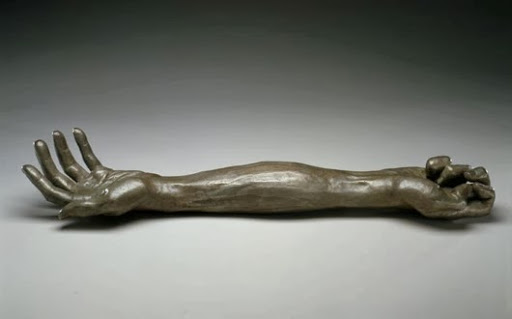
This emphasis on the integrity and comprehensiveness of art with respect to the full spectrum of human emotion is an important move away from the backward-looking, formulaic, stylized or solely artisanal nature of sacral “art” that Ravasi bemoans (and he is equally critical of contemporary attempts that result in “sacral garages where God is parked and the faithful are lined up”). Such failures lead to the divorce between art and faith that has been the case since the last century and that Ravasi has clearly spoken about already during the announcement of the Vatican pavilion a this year’s Venice Biennale. In contrast to its pathologies, Ravasi points to the importance of the cuts that authentic art can inflict and emphasizes that they can be “slits that open onto the infinite and eternal, the absolute, the mystery and the divine,” regardless of the faith of the artist, e.g., as with Lucio Fontana’s – a contemporary of Marcel Duchamp – “Tagli” or “Concetto spaziale” pieces, and – in my opinion – in a less literal way in the work of Louise Bourgeois (e.g., see her “Give or Take”).

Ravasi notes that the separation between art and faith has also, naturally, lead to a shelving of the themes, symbols and narratives of the Bible, which, e.g., Chagall held in very high regard: “For centuries painters dipped their brushes into this colorful alphabet, that of the Holy Scriptures.” Next, Ravasi makes the – to me – most interesting move by a virtuoso application of the principle of charity: “Even certain desecrating and blasphemous expressions4 that have recently elicited strong responses ultimately show not only the strong impact that religious symbols and themes maintain even in a secularized society, but perhaps they also manifest a nostalgia for the signs and images that have been such an extraordinary source of art and culture for two millennia.”

To sum up, I’d like to take advantage of Prof. Dr. Hans Joas’ words from his remarks of the opening session of the Berlin Courtyard of the Gentiles, where he called for “curiosity with regard to the other and humility with regard to oneself,” as a basis for authentic dialogue. I believe Cardinal Ravasi has taken great steps towards a new relationship between the Catholic Church and contemporary art, both in the practical move of participating in the Venice Biennale earlier this year, and in his clear attempts to recognize value and goodness even in art that at first sight is opposed to faith and in being explicit about the breadth of expression that authentic art requires.


1 As opposed to an “ethical particularism” that distinguishes between religious and secular ethics.
2 E.g., for a recent example, see also Hans Urs von Balthasar’s five-volume work “Theo-Drama: Theological Dramatic Theory.”
3 This seems to be related to the following, more extensive quote: “Art does not reproduce the visible; rather, it makes visible…. My aim is always to get hold of the magic of reality and to transfer this reality into painting – to make the invisible visible through reality. It may sound paradoxical, but it is, in fact, reality which forms the mystery of our existence.”
4 Characterized as “desecrating and blasphemous,” the most obvious example that springs to mind is Andres Serrano’s photograph [view at your own discretion].

The tyranny of absolutism

Stalin

Walking home this evening I felt like Douglas Hofstadter may have felt when coming up with the central idea of his spectacular Gödel, Escher, Bach book. Unlike his realization about a “golden braid” linking the thoughts of Kurt Gödel, M. C. Escher and Johann Sebastian Bach, which all shed light on infinity, I felt like I saw a way to connect the seemingly opposed words of Popes Benedict XVI and Francis with regard to relativism.

Benedict XVI famously attacked relativism in his sermon during the opening mass of the conclave that elected him, saying:

“To have a clear faith, according to the creed of the Church, is often labeled as fundamentalism. While relativism, that is, allowing oneself to be carried about with every wind of “doctrine,” seems to be the only attitude that is fashionable. A dictatorship of relativism is being constituted that recognizes nothing as absolute and which only leaves the “I” and its whims as the ultimate measure.”

The message here is very clear – the arbiter of truth and falsehood as well as good and evil has become the individual, with no intrinsic meaning left for these concepts beyond what each person chooses to invest them with for themselves. It is not only a relativity of meaning but also a solitude – I have my truth and you yours and that is the end of the story. In his book-length interview with Benedict XVI (“Light Of The World”), Peter Seewald, gets Benedict to elaborate on the above idea, when he says:

“It is obvious that the concept of truth has become suspect. Of course it is correct that it has been much abused. Intolerance and cruelty have occurred in the name of truth. To that extent people are afraid when someone says, “This is the truth”, or even “I have the truth.” We never have it; at best it has us. No one will dispute that one must be careful and cautious in claiming the truth. But simply to dismiss it as unattainable is really destructive.

A large proportion of contemporary philosophies, in fact, consist of saying that man is not capable of truth. But viewed in that way, man would not be capable of ethical values, either. Then he would have no standards. Then he would only have to consider how he arranged things reasonably for himself, and then at any rate the opinion of the majority would be the only criterion that counted. History, however, has sufficiently demonstrated how destructive majorities can be, for instance, in systems such as Nazism and Marxism, all of which also stood against truth in particular.

[…] That is why we must have the courage to dare to say: Yes, man must seek the truth; he is capable of truth. It goes without saying that truth requires criteria for verification and falsification. It must always be accompanied by tolerance, also. But then truth also points out to us those constant values which have made mankind great. That is why the humility to recognize the truth and to accept it as a standard has to be relearned and practiced again.”

Essentially, Benedict says that just because we cannot possess the truth, it does not mean that “the” truth does not exist. Our access to it is imperfect and tolerance and caution are called for, but denying its existence (just because of our epistemological constraints) is a dangerous path to follow. The picture from the above is very clear – relativism (making one’s “I” the ultimate arbiter of truth) is a tyranny and a reliance of one’s self is dangerous.

Fast-forward to this morning’s interview1 with Pope Francis talking to Eugenio Scalfari and take a look at what he has to say on the subject:

“Scalfari: Your Holiness, is there is a single vision of the Good? And who determines it?

Francis: Each of us has their own vision of Good and also of Evil. We have to encourage him to proceed towards that which he thinks is Good.

Scalfari: Your Holiness, you have already written it in the letter you addressed to me. Conscience is autonomous, you said, and everyone must obey their own conscience. I think that’s one of the most courageous passages spoken by a Pope.

Francis: And I repeat it here. Each one has their own idea of Good and of Evil and must choose to follow Good and fight Evil as they understand them. This would suffice to make the world a better place.”

“Each one has their own idea of Good and Evil […] as they understand them.” But, this sounds precisely like the relativism (the “I” being arbiter of truth) that Benedict denounced and declared a destructive danger. Are Francis and Benedict disagreeing here? Is Francis changing Church teaching?

I don’t think so. Instead, I believe, that their apparent opposition flows from the different perspectives from which they speak about truth and good and evil. Benedict describes what you’d see from God’s perspective: truth is absolute and denying its existence and substituting one’s whims for it, just because humans can’t access it, is a mistake. Francis, instead looks at the picture from the perspective of the individual: trust your conscience’s discernment between good and evil and choose good. Each human has a conscience by means of which they can discern (to varying degrees of faithfulness – “At present we see indistinctly, as in a mirror” as St. Paul says in 1 Corinthians 13:12) a reflection of the absolute truth. It is the same landscape, but Benedict looks down from the mountaintop while Francis looks up from the valley.

Applying this to myself, I can simultaneously believe in absolute truth and goodness, while being aware of my own inability to grasp them fully (or even with a known level of (in)accuracy). This epistemic constraint in no way undoes the meaningfulness of pursuing goodness and truth and instead makes tolerance and dialogue necessary. It also means that – as Francis said in the same interview – “Proselytism is pompous foolishness that has no sense. We must get to know each other and listen to each other and grow our understanding of the world around us.” I believe we are all accessing fragments of the one Truth,2 which makes me want to know what you have understood as much as deepening my understanding of my own faith.


1 The English translation sadly has some serious issues at the time of this post’s writing (the tile itself being seriously mistranslated), as a result of which I started from it but made adjustments based on reading the Italian original.
2 This is consonant with Francis saying, still in this same interview that “I believe in God. Not a Catholic God, there is no Catholic God, there is God.”