Just war?

Ploughshares

[Warning: long read :)]

Jesus was a pacifist. To deny this in the face of his own words – “But I say to you, whoever is angry with his brother will be liable to judgment.” (Matthew 5:22), “But I say to you, love your enemies, and pray for those who persecute you.” (Matthew 5:44), “But I say to you, offer no resistance to one who is evil. When someone strikes you on (your) right cheek, turn the other one to him as well.” (Matthew 5:39) and “Put your sword back into its sheath, for all who take the sword will perish by the sword.” (Matthew 26:52) – would be sheer dishonesty.

How about the Church though, has it stuck to Jesus’ pacifist position? Let’s see what it says in the Catechism:

“(§2304) Respect for and development of human life require peace. Peace is not merely the absence of war, and it is not limited to maintaining a balance of powers between adversaries. Peace cannot be attained on earth without safeguarding the goods of persons, free communication among men, respect for the dignity of persons and peoples, and the assiduous practice of fraternity.

(§2307) The fifth commandment forbids the intentional destruction of human life. Because of the evils and injustices that accompany all war, the Church insistently urges everyone to prayer and to action so that the divine Goodness may free us from the ancient bondage of war.

(§2308) All citizens and all governments are obliged to work for the avoidance of war. However, “as long as the danger of war persists and there is no international authority with the necessary competence and power, governments cannot be denied the right of lawful self-defense, once all peace efforts have failed.” (Gaudium et Spes, 79 § 4)

(§2309) The strict conditions for legitimate defense by military force require rigorous consideration. The gravity of such a decision makes it subject to rigorous conditions of moral legitimacy. At one and the same time:

  • the damage inflicted by the aggressor on the nation or community of nations must be lasting, grave, and certain;
  • all other means of putting an end to it must have been shown to be impractical or ineffective;
  • there must be serious prospects of success;
  • the use of arms must not produce evils and disorders graver than the evil to be eliminated.

The power of modern means of destruction weighs very heavily in evaluating this condition. These are the traditional elements enumerated in what is called the “just war” doctrine. The evaluation of these conditions for moral legitimacy belongs to the prudential judgment of those who have responsibility for the common good.

(§2314) “Every act of war directed to the indiscriminate destruction of whole cities or vast areas with their inhabitants is a crime against God and man, which merits firm and unequivocal condemnation.” (Gaudium et Spes, 80 § 3)”

While the above does talk about circumstances under which war is justified, it is a last resort, acceptable under the simultaneous satisfaction of specific conditions listed above, and has self-defense as its purpose, with indiscriminate destruction and the devastating effects of modern means of warfare ringing alarm bells. During the progress of such self-defense (the only possible trigger for just military action), the Catechism further emphasizes that “The Church and human reason both assert the permanent validity of the moral law during armed conflict. “The mere fact that war has regrettably broken out does not mean that everything becomes licit between the warring parties.” (Gaudium et Spes, 79 § 4)” and proceeds to warn against the abuses so endemic in war and against the accumulation of arms. Finally, the Catechism draws attention to the root causes, of which war can be a symptom, and calls for their treatment:

“(§2317) Injustice, excessive economic or social inequalities, envy, distrust, and pride raging among men and nations constantly threaten peace and cause wars. Everything done to overcome these disorders contributes to building up peace and avoiding war.”

And Pope Francis, where does he stand? There can be no doubt here that he, like Jesus, is an absolute pacifist:

“War is madness. It is the suicide of humanity. It is an act of faith in money, which for the powerful of the earth is more important than the human being. For behind a war there are always sins. [… War] is the suicide of humanity, because it kills the heart, it kills precisely that which is the message of the Lord: it kills love! Because war comes from hatred, from envy, from desire for power, and – we’ve seen it many times – it comes from that hunger for more power.” (Homily at Domus Sanctae Marthae, 2 June 2013).

“We have perfected our weapons, our conscience has fallen asleep, and we have sharpened our ideas to justify ourselves. As if it were normal, we continue to sow destruction, pain, death! Violence and war lead only to death, they speak of death! Violence and war are the language of death! […]

My Christian faith urges me to look to the Cross. How I wish that all men and women of good will would look to the Cross if only for a moment! There, we can see God’s reply: violence is not answered with violence, death is not answered with the language of death. In the silence of the Cross, the uproar of weapons ceases and the language of reconciliation, forgiveness, dialogue, and peace is spoken. […]

violence and war are never the way to peace! Let everyone be moved to look into the depths of his or her conscience and listen to that word which says: Leave behind the self-interest that hardens your heart, overcome the indifference that makes your heart insensitive towards others, conquer your deadly reasoning, and open yourself to dialogue and reconciliation. Look upon your brother’s sorrow and do not add to it, stay your hand, rebuild the harmony that has been shattered; and all this achieved not by conflict but by encounter! […]

Let the words of Pope Paul VI resound again: “No more one against the other, no more, never! … war never again, never again war!” (Address to the United Nations, 1965).” (Prayer Vigil for Peace, 7 September 2013)

And Francis is not alone is his radical stance against war, Blessed Pope John Paul II said that “War should belong to the tragic past, to history: it should find no place on humanity’s agenda for the future” and that “Humanity should question itself, once more, about the absurd and always unfair phenomenon of war, on whose stage of death and pain only remain standing the negotiating table that could and should have prevented it.” Benedict XVI too was clear about war being a failure: “War, with its aftermath of bereavement and destruction, has always been deemed a disaster in opposition to the plan of God, who created all things for existence and particularly wants to make the human race one family.”

So, you may ask, what is the point of writing about the attitude of Jesus, the Church and recent popes with regard to war, when it is so obviously pacifist and admitting of military self-defense only under almost theoretical, extreme conditions and applying to specific parts of an armed conflict? Sadly there are other, vocal proponents of a very different take on this topic, who – to my mind unbelievably – present their positions as Catholic and who tend to trace them to statements like the following one by George Weigel, who feels supported by Sts. Augustine and Thomas Aquinas:

“Thus those scholars, activists, and religious leaders who claim that the just war tradition “begins” with a “presumption against war” or a “presumption against violence” are quite simply mistaken. It does not begin there, and it never did begin there. To suggest otherwise is not merely a matter of misreading intellectual history (although it is surely that). To suggest that the just war tradition begins with a “presumption against violence” inverts the structure of moral analysis in ways that inevitably lead to dubious moral judgments and distorted perceptions of political reality.”

With Jesus and the Church’s position having been stated with such force and clarity over the last decades, I won’t even go to the trouble of addressing positions like Weigel’s point-by-point and would just like to note that they are akin to reading St. Paul and arguing in favor of slavery today. Positions that may be textually consistent with the source they claim justifies them, but that both miss the original author’s intentions (just think about what slavery would be like if “master” and “slave” followed St. Paul’s advice1) and the fact that the Church is the living Mystical Body of Jesus that has considerably matured over the last 2000 years.


1 “Slaves, be obedient to your human masters with fear and trembling, in sincerity of heart, as to Christ, not only when being watched, as currying favor, but as slaves of Christ, doing the will of God from the heart, willingly serving the Lord and not human beings, knowing that each will be requited from the Lord for whatever good he does, whether he is slave or free. Masters, act in the same way toward them, and stop bullying, knowing that both they and you have a Master in heaven and that with him there is no partiality.” (Ephesians 6:5-9) A classic “infiltrate and destroy from within” tactic if ever I saw one.

Benedict XVI – Odifreddi: searching for Truth, with gloves off

Boxing gloves

[Warning: long read :)]1

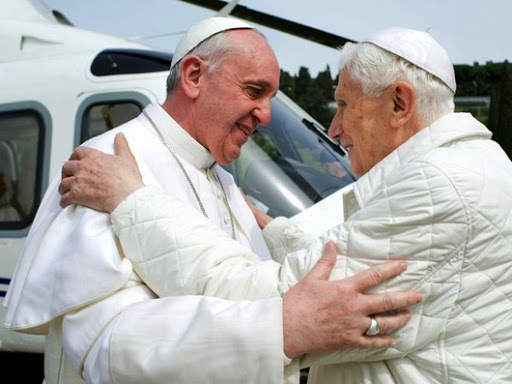
If you are even remotely interested in the dialogue between faith and reason, between religion and science, the last fortnight has to be among the most electrifying periods in the history of mankind. Not only did it kick-off with the beautifully sincere and profound move by Pope Francis in his letter to the atheist journalist Eugenio Scalfari, but it saw the publication of “the” interview that Pope Francis gave to Jesuit media and in which he spoke about science in terms that, to my mind, take the Church’s appreciation of science further than ever before. And if that wasn’t enough, today saw the publication of extracts from an 11-page letter that Pope Emeritus Benedict XVI wrote to the Italian atheist mathematician Prof. Piergiorgio Odifreddi, in response to his book “Caro Papa ti scrivo: Un matematico ateo a confronto con il papa teologo” (“Dear Pope, I write to you: An atheist mathematician confronting the theologian pope”).

Looking at the two letters (or, more precisely, the extracts from Benedict’s versus the full text of Francis’), Francis’ and Scalfari’s style is like a polite, yet illuminating, exchange between two gentlemen over a cup of tea, while Benedict’s and Odifreddi’s exchange is like a bare-knuckle fist-fight between a pair of prize-winning boxers who in the end sincerely shake hands and respect each other, but without giving an inch during the fight itself.

To begin with, let’s take a quick look at Odifreddi’s opening move – his 204-page book, addressed to Benedict as “between colleagues” – from a maths to a theology professor. Early on, Odifreddi identifies a point in common with Benedict’s thought, by pointing to the following passage from Benedict’s Regensburg address:

“the experience […] of the fact that despite our specializations which at times make it difficult to communicate with each other, we made up a whole, working in everything on the basis of a single rationality with its various aspects and sharing responsibility for the right use of reason”

While Odifreddi identifies this – the adherence to reason – as a common point of departure, he quickly objects to Benedict’s excessive use of it (“your almost obsessive use of the word “reason,” repeated around forty times, akin to a musical motif or continuous base”) and to the “scandalous” words from Benedict’s sermon before the conclave that elected him:

“[H]aving a clear faith based on the Creed of the Church is often labeled as fundamentalism. Whereas relativism, that is, letting oneself be “tossed here and there, carried about by every wind of doctrine”, seems the only attitude that can cope with modern times. We are building a dictatorship of relativism that does not recognize anything as definitive and whose ultimate goal consists solely of one’s own ego and desires.”

While being critical of Benedict’s words, Odifreddi argues that “both religion and science are perceived as antidemocratic and absolutist” as a result of their focus on “ultimate truths” and then proceeds to arguing against a series of passages from Benedict’s “Introduction To Christianity” and his Jesus of Nazareth trilogy.

Since it is the full, fine detail that is key to understanding the nature of what is going on between Odifreddi and Benedict, let me just pick out a single point of contention (from among many important and interesting ones that I hope to return to soon!),2 which Benedict objected to most forcefully and which the following passage from Odifreddi’s book sums up nicely:

“There is little to say about the historical Jesus, literally, because there are virtually no traces of him in the official history of the period. In total, there are only few tens of lines about him in the works of Pliny, Tacitus, Suetonius and Flavius Josephus. Some are of uncertain interpretation, like the “Chrestus” of Suetonius. Others are of dubious authenticity, like the interpolation of Flavius Josephus. […] If, therefore, Jesus truly existed, he must have been irrelevant to his contemporaries, beyond the narrow circle of his relatives, friends and followers.”

Odifreddi further accuses Benedict of side-stepping questions of fact by saying to him: “you seem uninterested in (or seem interested in not) discussing the historicity of the Gospels and the facts that they report” and attributes to him an opposition to historical-critical methods of Biblical interpretation, by quoting Benedict as saying that they “can effectively become an instrument of the Antichrist.”

Benedict’s response here is as sharp as the jab he received:

“What you say about the figure of Jesus is not worthy of your scientific status. If you put the question as if nothing were, ultimately, known about Jesus, as a historical figure, as if nothing were ascertainable, then I can only firmly invite you to become more competent from a point of view of history. To this end I particularly recommend to you the four volumes that Martin Hengel (exegete at the Protestant Faculty of Theology of Tübingen) has published with Maria Maria Schwemer: it is an excellent example of historical precision and of vast breadth of historical information. […] Further I have to forcefully reject your affirmation (pp. 126) according to which I have presented historical-critical exegesis as an instrument of the Antichrist. Discussing the account of Jesus’ temptations, I have only recalled Soloviev’s thesis, according to whom historical-critical exegesis may also be used by the Antichrist – which is an unquestionable fact. At the same time, however, I have always – and in particular in the foreword to the first volume of my book on Jesus of Nazareth – made it evidently clear that historical-critical exegesis is necessary for a faith that does not propose myths using historical images, but demands true historicity and therefore has to present historical reality in its affirmations also in a scientific way. Because of this, it is not correct either that you say that I have been interested only in meta-history: on the contrary, all my efforts have had as their objective to show that the Jesus described in the Gospels is also the real, historical Jesus; that it is a matter of history that really took place.”

Uff … I have to be honest and admit that I was at first a bit uneasy about the tone of both Odifreddi and Benedict, neither of whom are pulling punches and both of whom are blunt to say the least. Looking more closely though, and reflecting on my professional experience as a scientist, I recognize that this is the tone and strength of academic argument and doing anything less would be dishonest on the part of both the professor and the ex-professor. This is a very different context from the Francis-Scalfari one and it demands the unforgiving rigor, precision and detail of the quotes shown above. Treating Benedict like any other academic shows Odifreddi’s respect for him (which he is explicit about when saying “Having read his Introduction to Christianity, […] I realized that the faith and doctrine of Benedict XVI, unlike that of others, were sufficiently solid and fierce that they could very well face and sustain frontal attack.”) Benedict is equally complimentary about Odifreddi, when he tells him that he “considers very positively the fact that you […] have sought such an open dialogue with the faith of the Catholic Church and that, in spite of all the differences, in the central themes, there is no lack of convergence at all.”

What this, academic, dialogue is truly about is put best – and to my mind beautifully lucidly – by Odifreddi, who says that:

“[The aim], obviously, was not to try and “convert the Pope,” but instead to honestly present to him the perplexity, and at times incredulity, of a mathematician with regard to faith. Analogously, the letter from Benedict XVI does not try to “convert the atheist,” but to direct at him his own, honest, symmetrical perplexity, and at time incredulity, of a very special believer with regard to atheism. The result is a dialogue between faith and reason, which, as Benedict XVI notes, has allowed both of us to confront each other frankly, and at times also bluntly, in the spirit of the Courtyard of the Gentiles that he himself has initiated in 2009. […] Divided in almost everything, but joined by at least one objective: the search for Truth, with a capital “T”.”

Wow! I have to say I am very impressed with Odifreddi (having come to this clearly as Benedict XVI fan) and I look forward to seeing his next steps in this full-contact dialogue. In many ways, I believe, that the most important thing to take away from this first encounter is the seriousness and complete transparency, with which both parties approached the challenge of dialogue – a dialogue that is not a watering-down or a “playing nice” but a striving for Truth, regardless of how vast the abyss may appear between its opposing cliffs. It would be a mistake to get stuck on whether I happen to agree with one side or the other, as it would miss the masterclass in serious dialogue that we have just witnessed. In many ways, I read Odifreddi’s closing thoughts as a transposition – from an intra-Christian to a Christian-atheist setting – of Francis’ call to an ecumenism that starts now, while there are clear differences between the parties, when he says in “the” interview: “We must walk united with our differences: there is no other way to become one. This is the way of Jesus.”


1 Apologies, again, for the rough translation from Italian – once “official” translations are available, I’ll point you to them.
2 I can’t not mention the following zinger from Benedict, which points to the widespread use of “science fiction” in science, in response to Odifreddi’s claiming that it was religion that practiced the genre. Benedict here says, referring to Heisenberg and Schrödinger’s theories, and adding Dawkins’ “selfish gene” to the list, that “I’d call them “science fiction” too, in the good sense: they are visions and anticipations, to arrive at true knowledge, but they are, indeed, only imagination with which we try to get closer to reality.” 🙂 I agree and I’ll definitely pick this line up in a future post.

Science grows Church’s understanding

350px God the Geometer0

As was immediately clear from a first reading, “the” interview given by Pope Francis last Thursday to Jesuit magazines is a text rich both in spiritual and intellectual treasures and will be a prominent trigger of reflection for a long time to come.

Today I’d like to take a closer look at a passage from it that has immediately caught my eye, but that received little attention so far. It addresses the relationship between science and religion in a, to my mind, very positive way:

“[H]uman self-understanding changes with time and so also human consciousness deepens. Let us think of when slavery was accepted or the death penalty was allowed without any problem. So we grow in the understanding of the truth. Exegetes and theologians help the church to mature in her own judgment. Even the other sciences and their development help the church in its growth in understanding. There are ecclesiastical rules and precepts that were once effective, but now they have lost value or meaning. The view of the church’s teaching as a monolith to defend without nuance or different understandings is wrong.”

While the opposition between science and religion certainly does not apply to the Catholic Church – with Blessed Pope John Paul II’s landmark encyclical Fides et Ratio being a categorical statement of the mutual benefits of faith and reason and with Pope Benedict XVI having spoken of the necessity of dialogue between science and faith 1 – Francis’ positioning of science as “helping the church in its growth in understanding” is a significant move. Like with many of Francis’ statements, it could be argued that they contain nothing new (Fides et Ratio already saying that “science can purify religion from error and superstition”) or that they are only new in style – and in some sense that is true, since he is firmly rooted in the Church, but it would, I believe, also miss an important nuance.

While I have always read Fides et Ratio as positioning faith and reason as separate, but mutually “strengthening” entities,2 here I see Francis presenting theology and science as two activities whose results both help the Church, the former leading to mature judgment while the latter resulting in increased understanding. This is a picture that does not place theology in a privileged, internal position with regard to the Church, and science as an external, while admittedly positive, activity, but positions both as engines of progress that deepen our humanity.3

While the above is clearly my reading and attempted unpacking of Francis’ condensed thought, I believe it is compatible with another of the important points he makes in “the” interview, namely that the Church is the “faithful people of God,”4 and that “‘thinking with the church’ [does not mean] only thinking with the hierarchy of the church,” that it “does not concern theologians only.” Seen in this way, “[t]he church is the totality of God’s people” and is therefore formed as much by theology as by science. Science becomes an internal concern of the Church – the People of God – and its advances and insights form her teaching from within.5 In many ways this also reminds me of Francis’ address to Brazil’s “leaders of society” during his visit in July, where he emphasizes that Christianity “combines transcendence and incarnation” and “faith and reason unite, the religious dimension and the various aspects of human culture – art, science, labour, literature…”

The above sketch, which I don’t believe I am bolting on to Francis’ thought, strikes me as a natural evolution of the solid foundations that John Paul II laid down, and I am curious to see whether it will find support in his future teaching.


0 I don’t mean to distract, but note the fractal in this 13th century illuminated illustration!
1 “In the great human enterprise of striving to unlock the mysteries of man and the universe, I am convinced of the urgent need for continued dialogue and cooperation between the worlds of science and of faith in the building of a culture of respect for man, for human dignity and freedom, for the future of our human family and for the long-term sustainable development of our planet. Without this necessary interplay, the great questions of humanity leave the domain of reason and truth, and are abandoned to the irrational, to myth, or to indifference, with great damage to humanity itself, to world peace and to our ultimate destiny.” (Pope Benedict XVI, Address To The Pontifical Academy Of Sciences, 8 November 2012)
2 As Lumen Fidei puts it in §32.
3 Echoing the affirmation in Fides et Ratio that “Men and women have at their disposal an array of resources for generating greater knowledge of truth so that their lives may be ever more human.”
4 The definition presented in Lumen Gentium, as Francis points out.
5 This is not a conflation of the two – theology and science – but a recognition of their equal import for the Church’s progress.

Pope Francis’ letter to non-believers

Pope 2509845b

That Pope Francis cares deeply for non-believers1 is nothing new, with his previous declaration that Jesus has redeemed atheists too having lead both to very positive responses and to a great media muddle. In today’s issue of the Italian newspaper La Repubblica, Francis continues in this dialogue with non-believers by responding to questions sent to him by the atheist journalist Eugenio Scalfari regarding Francis’ encyclical Lumen Fidei, and I would like to share my favorite parts of his letter with you here.2

Francis starts out by arguing that dialogue between the followers of Jesus and non-believers is “necessary and valuable” today for two reasons: First, the paradox that “Christian faith, whose novelty and impact on human life have since the beginning been expressed through the symbol of light, has become branded as the darkness of superstition that is opposed to the light of reason,” resulting in an absence of communication between Christian and Enlightenment-based contemporary culture. Second, for those who seek “to follow Jesus in the light of faith, […] this dialogue is not a secondary accessory[, but …] an intimate and indispensable expression of faith instead.” This, Francis argues, is expressed by §34 of Lumen Fidei, from which he proceeds to quote:

“Clearly, then, faith is not intransigent, but grows in respectful coexistence with others. One who believes may not be presumptuous; on the contrary, truth leads to humility, since believers know that, rather than ourselves possessing truth, it is truth which embraces and possesses us. Far from making us inflexible, the security of faith sets us on a journey; it enables witness and dialogue with all.”

After a beautiful exposition of how Francis himself came to believe in God and how the Christian faith has Jesus’ incarnation and resurrection at its heart, through which all of humanity is shown God’s love and connectedness to each other – to every single human being,3 he proceeds to answering the three questions Scalfari put to him.

The first of Scalfari’s questions regards whether “the God of Christians forgives those who don’t believe and don’t seek faith.” Here Francis’s response, which I particularly like, is the following:

“Given that – and this is the fundamental point – the mercy of God has no limits if one turns to Him with a sincere and contrite heart, the question for those who don’t believe in God is about obeying one’s own conscience. Sin, also for those who don’t have faith, occurs when one goes against conscience. Listening and obeying to it means, in fact, taking decisions in the face of what becomes understood as good or as bad. And it is on the basis of this decision that the goodness or evil of our actions plays out.”

Wow! While this is in some sense nothing more than what the Catechism has been saying explicitly since Vatican II, having it presented in the above universal way is great. I have often argued in exactly these terms and have faced quizzical looks from other Catholics, who wouldn’t quite believe it. It also confirms me in the answer I have given to several of my best, atheist or agnostic friends when they have asked me whether they should want to believe in God, which was “no,” with the caveat of seeking to be honest in front of their consciences.

Scalfari’s second question asks whether “thinking that there is no absolute and therefore no absolute truth either, but only a series of relative and subjective truths, is a mistake or a sin.” Great question! 🙂 To this Francis responds by saying:

“To begin with, I wouldn’t talk, not even to those who believe, about “absolute” truth, in the sense that the absolute is that which is disconnected, which is devoid of any relation. Now, the truth, according to Christian faith, is the love of God for us in Jesus Christ. Therefore, the truth is a relationship! It is also true that each one of us takes it, the truth, and expresses it by departing from oneself: from one’s history and culture, the circumstances in which one lives, etc. This does not mean though that the truth is variable and subjective. Instead, it means that it gives itself to us always and only as a journey and a life. Didn’t maybe Jesus say the same: “I am the way and the truth and the life.”?4 In other words, truth, being ultimately all one with love, requires humility and openness when sought, accepted and expressed. Therefore, it is necessary to understand each other’s terminology better, and, maybe, to avoid the constraints of an opposition that is … absolute, deepen the framing of the question. I believe that this is absolutely necessary today, so that a serene and constructive dialogue can take place.”

Another fantastic answer! Anyone who has tried to pigeonhole Francis as a populist, as opposed to the thinker that Benedict XVI undoubtedly is, can proceed to eat their own words …

The third, and final of Scalfari’s questions asks whether “the disappearance of humans from Earth would also mean a disappearance of thought that is capable of thinking God.” Here, Francis’ answer, which I won’t translate in full, revolves around arguing that, in his experience and those of many others, God is not an idea, but a “reality with a capital ‘R’.” Instead of going into more detail here, I’d instead like to translate Francis’ closing thoughts, before which he expresses his hope that his reflections would be “received as a tentative and provisional response, but one that is sincere and faithful to the invitation of walking along a stretch of road together.”:

“The Church, believe me, in spite of all the slowness, the unfaithfulness, the mistakes and sins that it may have committed and may yet commit in those who compose it, has no other meaning and end than that of living and giving testimony to Jesus: Him who has been sent by the Father “to bring glad tidings to the poor, to proclaim liberty to captives and recovery of sight to the blind, to let the oppressed go free, and to proclaim a year acceptable to the Lord” (Luke 4:18-19).”

I have to say I am delighted by these words of Pope Francis – both the emphasis on conscience that I have held dear for a long time and the insights about truth as relationship and love – and I would be keen to hear from my atheist, agnostic, humanist (and even Christian 🙂 friends what they made of them.

UPDATE (12 Sept. 2013): This morning Vatican Radio broadcast a short interview with Cardinal Gianfranco Ravasi on the topic of Pope Francis’ letter discussed above (which is now available in an official English translation here). Ravasi, who leads the Pontifical Council for Culture and in its context the “Courtyard of the Gentiles” initiative, whose aim is dialogue with non-believers, naturally welcomed Francis’ letter with great positivity, including it among the initiatives foundational documents. He then also proceeds to elaborate on the, to my mind key, point Francis made about the truth being a relationship:

“Already Plato affirmed [that the truth is a relationship] when he said that the chariot of the soul runs along the plane of truth, which means that the truth is not a cold reality like a precious stone that you can put in your pocket. Instead, it is an immense plane, a horizon – or, to use another image by a writer from the last century5 – we can say that the truth is a sea that one enters and navigates. So, in this light, I believe that the concept of truth not as absolute, but personal, interpersonal, will be very fruitful for dialogue, without losing the dimension of objectivity, of identity in itself, typical of the truth.”


1 Picking what term to use to refer to those who do not believe in God is tricky and I am going with the term Francis is using himself, not necessarily because I believe it is the most appropriate one, but because my aim here is to share his message with you today. I am mindful though of Prof. Cox’s point about the undesirability of negative labels, but since the positive alternatives (e.g., humanist) may not be self-applied by all whom the Pope intends to address here, I am sticking with his terminology. If you belong to his target audience (and to some extent everyone does – including me, a Catholic) and have a suggestion for what term to use, please, let me know.
2 Since I haven’t found an English translation of this article yet, the following quotes are my own crude translations, for which I apologize in advance.
3 I’d like to return to this great synthesis of Christianity in a future post and, if you understand Italian, I’d wholeheartedly recommend reading the full letter to you straight-away.
4 John 14:6.
5 Ravasi refers to this quote in an earlier talk, where he attributes it to Musil’s The Man Without Qualities, although I couldn’t find it there.

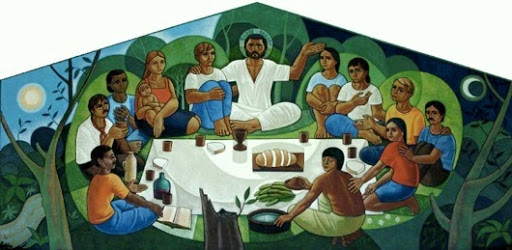
Liberation Theology rehabilitated

Santa cena teologia liberacion

Pope Francis is about to meet with the founder of Liberation Theology, Fr. Gustavo Gutiérrez, thanks to the current head of the Congregation for the Doctrine of the Faith (CDF) – Archbishop Gerhard Ludwig Müller, which – on the face of it – is a 180° turn versus its past condemnations by the Vatican. Taken superficially, it is a meeting between Francis and a proponent of a theology that has been categorically denounced both by Blessed Pope John Paul II and his successor, Pope Benedict XVI.

A closer look reveals quite a different picture though:

  1. Fr. Gutiérrez, unlike other teachers of Liberation Theology (e.g., Leonardo Boff), has never been censured by the Vatican.
  2. John Paul II and Benedict XVI never condemned Liberation Theology as such, but only those variants of it that placed Marxist analysis at their cores and thereby de-Christified it. In fact, Benedict XVI (then then-Cardinal Ratzinger) is quite clear about the distinction in the “instruction” he published in 1984 as the head of the CDF:

    “The aspiration for ‘liberation’, as the term itself suggests, repeats a theme which is fundamental to the Old and New Testaments. In itself, the expression “theology of liberation” is a thoroughly valid term: it designates a theological reflection centered on the biblical theme of liberation and freedom, and on the urgency of its practical realization. […] The warning against the serious deviations of some “theologies of liberation” must not be taken as some kind of approval, even indirect, of those who keep the poor in misery, who profit from that misery, who notice it while doing nothing about it, or who remain indifferent to it. The Church, guided by the Gospel of mercy and by the love for mankind, hears the cry for justice and intends to respond to it with all her might.”

  3. Instead of this being a change brought in by Francis, the re-visiting of the position taken with respect to Liberation Theology escalated when Benedict XVI appointed Müller as the head of the CDF in 2011 – Müller, who was known to be a personal friend of Gutiérrez, whom he considered as his mentor and whose summer lectures he has been attending annually since 1998 in Peru.
  4. While the new attitude is a change version previous positions, it is not a change as far as Marxist-based flavors of Liberation Theology go. Instead, it is a sign of support for those strands of Liberation Theology that have presented social justice and a focus on the poor on a wholly Christian basis. Fr. Juan Carlos Scannone, one of Pope Francis’ former professors puts it as follows: “In the Argentinean Liberation Theology, social Marxist analysis is not used, but rather a historical-cultural analysis, not based on class warfare as a determining principle for the interpretation of society and history.”

To get a sense of why Müller, who is clearly the catalyst behind the rehabilitation of some strands of Liberation Theology, took an interest in it, it is worth taking a look at the speech1 he gave at the Pontifical Catholic University of Peru in 2008, when it awarded him an honorary doctorate.

There, Müller starts by admitting that he had read expositions of Liberation Theology as well as their criticisms by the CDF, before meeting Gutiérrez, but that his engagement with them was purely theoretical. His initial attitude was one of skepticism and concern about both a danger of leading to violence and a naïveté with regard to the application of Marxist principles. Attending a seminar lead by Gutiérrez then turned him “from academic reflection on a new theological concept to experience with the men and women for whom this theology had been developed.” From the start, Gutiérrez emphasized that Liberation Theology was about theology and not politics, with the aim “to understand the world, history and society and transform them in light of the God’s own supernatural revelation as savior and liberator of man.” The “point of departure” is very clearly put by Müller as follows:

“How one can speak of God in the face of human suffering, of the poor who don’t have sustenance for their children, or the right to medical assistance, or access to education, who are excluded from social and cultural life, marginalized and considered a burden and a threat to the lifestyle of the wealthy few.

These poor are not an anonymous mass. Each one of them has a face. How can I as a Christian, priest or layman, whether through evangelization or scientific theological work, talk about God and His Son who became man and died for us on the cross and bear witness to Him, if I don’t want to build another theological system in addition to the existing one, except by saying to the specific poor person face to face: God loves you and your inalienable dignity is rooted in God. How does one make Biblical considerations real in individual and collective life, when human rights originate in the creation of man in the image and likeness of God.”

Müller then moves on to what I believe is the core of his message, when he speaks about not only attending courses about Liberation Theology in various Latin American countries, but also their being accompanied by:

“long weeks of pastoral work in the Andean region, especially in Lares in the Archdiocese of Cuzco. There the faces acquired names and became personal friends, this experience of universal Communion in the love of God and neighbor, which must be the essence of the Catholic Church. Finally it was a deep joy for me when in 2003, in Lares, in the Archdiocese of Cuzco, being already a bishop, I could administer the sacrament of Confirmation to young people whose parents I had already known for a long time and whom I myself had baptized.

Hence I have not been speaking of liberation theology in an abstract and theoretical way, much less ideologically to flatter progressive church groups. Similarly I have no fear that this may be interpreted as a lack of orthodoxy. Gustavo Gutiérrez’s theology, regardless of which angle you look at it from, is orthodox because it is orthopractic and teaches us proper Christian action because it comes from true faith.”

Müller’s assessment of Liberation Theology comes not only from a reading of and reflection on its teachings, but from him personally having put it into practice and experienced its fruits. It is these fruits that reinforce the truth of its principles, whose flowing from “true faith” can be inferred from them. It is a “see, judge, act” process, which Müller says “has been decisive in my own theological development” and which follows Jesus’ own words as regards orthopraxy:

“Beware of false prophets, who come to you in sheep’s clothing, but underneath are ravenous wolves. By their fruits you will know them. Do people pick grapes from thornbushes, or figs from thistles? Just so, every good tree bears good fruit, and a rotten tree bears bad fruit. A good tree cannot bear bad fruit, nor can a rotten tree bear good fruit. Every tree that does not bear good fruit will be cut down and thrown into the fire. So by their fruits you will know them.” (Matthew 7:15-20).

UPDATE (13 September 2013): The Catholic New Service has just tweeted that the Vatican has confirmed that a meeting between Pope Francis and Fr. Gutiérrez took place two days ago.


1 The original, Spanish version can be found here. Note that the English text used above includes my adjustments based on this original (e.g., at one point “imperdible” is translated as “amazing” in the English referred to above, while I render it as “inalienable”).

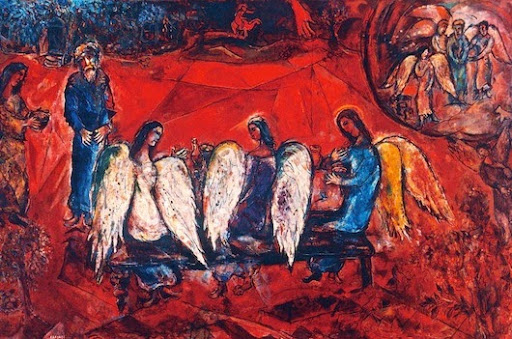
The Trinity – the mystery of love

Chagall abraham angels

Imagine coming across a popular science article containing the following:

“Science says light is “strange.” According to Albert Einstein, light is somehow also a stream of particles but not a stream of particles.”

You’d hardly think that you were reading the work of an award-winning journalist and would instead be checking whether the piece was a satire on the lack of science literacy.

Sadly, the same doesn’t seem to apply when it comes to the coverage of religion, since the above is a transposition of the following excerpt from an article published on the CNN Belief Blog yesterday:

“Christianity says the Trinity is a “mystery” of faith. According to Christian tradition, God begets a son who is somehow also Him but not Him.”

Not only is the source an established news broadcaster, but the author himself – Jeffrey Weiss – is described as “an award-winning religion reporter,” and – ironically – there is no suggestion of parody in the piece.

Instead of having a go at the article piece by piece, let me try to say what I understand by saying that God is both three and one. It is always easier just to mock than to put one’s neck on the line by being constructive, so I’ll take a risk and open myself to criticism next.

First, let me say that the Trinity is a mystery. What I don’t mean by that though is that it cannot be thought or spoken about, that it is irrational or that stating that it is a mystery is a conversation stopper. The universe too is full of mystery and while science is making tremendous progress in understanding it better and better, there are still many phenomena that we cannot fully explain (e.g., how does anesthesia work, what happened during the Planck epoch, what causes a reversal in the Earth’s magnetic field’s polarity, etc.). You could say that these phenomena are mysteries. What would be understood by that is that something about them eludes our explanatory capacity and, most likely, that we are trying to get a better understanding of them.

It is in this sense that the Trinity is a mystery, and the fact that our imperfect grasp of it fuels the desire of Christians to deepen their understanding, rather than being an obstacle to it, can be seen easily if one samples not only the output of theological work but also the insights of mystics and saints.

Before proceeding to share examples of Christian thought about the Trinity, let me put my own cards on the table (which, naturally, have their source in the experiences and thoughts of others :). I believe that the Christian teaching about God being both three and one is all about expressing core aspects of what love is, since God is Love. Love necessarily requires more than one party and is a dynamic relationship. Furthermore, it is a relationship in which change is fueled by loss and gain, by nothingness and being. When I take my son to the playground, instead of reading that next book or sleeping, I am losing my selfish plans (and in some sense annihilating that part of my self that was invested in them) and instead giving part of my self (that part which instead of pursuing my own plans will now chase him around a playground) to him. In some sense, as a result of my love for my son, part of me becomes part of him. However, when love is reciprocated, the element of loss, which is real, becomes compensated for, and – in this example – the laughter of my son, his joy, his wellbeing return to me as gifts from him and close the cycle started by my giving up on reading at the beginning of this story. Finally, the exchange of self that – motivated by love – took place here, is real in the sense that what was lost by one and gained by another are real and substantially change them. In some sense the exchange itself – the relationship – is as real as the persons between which it took place.

With an exposition of love in the above terms, the Trinity can be seen as its reductio ad absurdum, where the Father gives all of himself to the Son (thereby losing himself completely) and the Son reciprocates the gift by giving himself fully to the Father in return. The Holy Spirit then is the relationship of the Father and the Son personified, and by simultaneously not being and being, the three persons of the Trinity are the one God who is.

Such a conception of the Trinity makes all relationships of love be modeled on the innermost life of God, and while it is complex and abstract, it is no more so than theories of contemporary physics.1 St. Gregory of Nazianzus (in the 4th century AD!) refers to the Trinity as “the infinite co-naturality of three infinites” (a phrase any thinker could be proud of) and Blessed Pope John Paul II explains the motive for such trinity: “God is one, but not alone.” That relationships are the key to the Trinity is also apparent already in St. Augustine, who equates love with the Trinity by saying: “If you see love, you see the Trinity. Since you see someone who loves, someone who is loved, and the love uniting them.” Augustine then proceeds to underline how completely the persons of the Trinity are “co-natural,” by saying that the Father “is not called Father with reference to himself but only in relation to the Son; seen by himself he is simply God.” (De Trinitate VII, 1, 2), which the then-Cardinal Joseph Ratzinger explains as:

“‘Father’ is purely a concept of relationship. Only in being-for the other is he Father; in his own being-in-himself he is simply God. Person is the pure relation of being related, nothing else. Relationship is not something extra added to the person, as it is with us; it only exists at all as relatedness.” (Introduction to Christianity)

In summary, and in Chiara Lubich’s words, the Trinity is revealed to us “as unconditional, reciprocal self-giving, as mutual loving, self-emptying out of love, as total and eternal communion.” It is a mystery, but one that speaks volumes about what Christianity means both by love and by God and what relationships it strives towards already in the here and now.


1 And I am not saying that theology is physics, but merely drawing a comparison between the level of intuitiveness and simplicity of their concepts.

Lumen Fidei: Love and truth are inseparable

Pope 001 4 3 rx513 c680x510

Pope Benedict XVI’s long-awaited encyclical on faith (completing the trilogy of encyclicals with those on love and hope) and Pope Francis’ equally eagerly awaited first encyclical are out – and they are one and the same – the encyclical entitled “Lumen Fidei” – “The Light of Faith.” As Francis puts it, “It’s an encyclical written with four hands, so to speak, because Pope Benedict began writing it and he gave it to me. It’s a strong document. I will say in it that I received it and most of the work was done by him and I completed it.”

I couldn’t agree more – it is a very strong document indeed, and one rich in insights that merit reflection and repeated analysis. It is a document that is beautifully written, in rich yet purposeful language, with razor-sharp logic and with a tremendous openness to the world as it is today. The references alone are worth highlighting, as they range from theological classics like the works of St. Augustine and St. Thomas Aquinas, through ancient non-Christian texts like the writings of Celsus, up to more recent and also critical voices like Nietzsche, Wittgenstein or T. S. Eliot. This is not a piece of propaganda, but a carefully thought out presentation of what faith means to a Christian, from a Catholic perspective, and how it relates not only to matters internal to the Church but to secular thought as well. As such, if you are not a Christian and curious about what we mean when way talk about faith, I would recommend a reading of Lumen Fidei (a recommendation I don’t make lightly).1

Since Lumen Fidei is a hefty document, and one where “padding” is minimal, I won’t even attempt an overview of the topics it touches upon and will instead just highlight the section where Benedict and Francis talk about how faith, truth, knowledge and love are related.

This train of thought starts already in the introductory chapter:

“Faith […] appear[s] to some as an illusory light, preventing mankind from boldly setting out in quest of knowledge. The young Nietzsche encouraged his sister Elisabeth to take risks, to tread “new paths… with all the uncertainty of one who must find his own way”, adding that “this is where humanity’s paths part: if you want peace of soul and happiness, then believe, but if you want to be a follower of truth, then seek”. Belief would be incompatible with seeking. From this starting point Nietzsche was to develop his critique of Christianity for diminishing the full meaning of human existence and stripping life of novelty and adventure. Faith would thus be the illusion of light, an illusion which blocks the path of a liberated humanity to its future.”

Faith is here portrayed as an illusion that at best can be an anxiolytic, but that is opposed to a seeking of truth and to free human fulfillment. This is certainly a view I have come across in person and I was pleased to see it be the position with which Lumen Fidei sets out to contrast it’s understanding, where it first declares what it understands by faith, before then considering its consequences:

“Christian faith is […] faith in a perfect love, in its decisive power, in its ability to transform the world and to unfold its history. “We know and believe the love that God has for us” (1 John 4:16). In the love of God revealed in Jesus, faith perceives the foundation on which all reality and its final destiny rest. […] Our culture has lost its sense of God’s tangible presence and activity in our world. We think that God is to be found in the beyond, on another level of reality, far removed from our everyday relationships. But if this were the case, if God could not act in the world, his love would not be truly powerful, truly real, and thus not even true, a love capable of delivering the bliss that it promises. It would make no difference at all whether we believed in him or not. Christians, on the contrary, profess their faith in God’s tangible and powerful love which really does act in history and determines its final destiny: a love that can be encountered, a love fully revealed in Christ’s passion, death and resurrection.”

To my mind the above does two important things: first, it underlines that faith is all about love and second, that this love is real here and now – that it is an incarnate, material, tangible love and not some ethereal, abstract, wholly otherness. Lumen Fidei goes on to underlining these important features of faith:

“Far from divorcing us from reality, our faith in the Son of God made man in Jesus of Nazareth enables us to grasp reality’s deepest meaning and to see how much God loves this world and is constantly guiding it towards himself. This leads us, as Christians, to live our lives in this world with ever greater commitment and intensity.”

Having established the focus of faith on love and on its incarnation in the world, Lumen Fidei, proceeds to linking it to truth:

“Faith without truth does not save, it does not provide a sure footing. It remains a beautiful story, the projection of our deep yearning for happiness, something capable of satisfying us to the extent that we are willing to deceive ourselves. Either that, or it is reduced to a lofty sentiment which brings consolation and cheer, yet remains prey to the vagaries of our spirit and the changing seasons, incapable of sustaining a steady journey through life. […] Only to the extent that love is grounded in truth can it endure over time, can it transcend the passing moment and be sufficiently solid to sustain a shared journey. If love is not tied to truth, it falls prey to fickle emotions and cannot stand the test of time. True love, on the other hand, unifies all the elements of our person and becomes a new light pointing the way to a great and fulfilled life. Without truth, love is incapable of establishing a firm bond; it cannot liberate our isolated ego or redeem it from the fleeting moment in order to create life and bear fruit.”

This, to me, is both a beautiful and a particularly lucid way of putting faith’s dependence on truth, knowledge and honesty. Looking back to the quote from Nietzsche’s letter to his sister, the above agrees with him on the deficiency of the kind of faith Nietzsche criticizes as being divorced from the truth and points to a (Hegelian dialectic) resolution of the initial, seeming opposition.

Lumen Fidei then goes further and emphasizes that it is not only “love [that] needs truth, [but that] truth also needs love.”:

“Love and truth are inseparable. Without love, truth becomes cold, impersonal and oppressive for people’s day-to-day lives. The truth we seek, the truth that gives meaning to our journey through life, enlightens us whenever we are touched by love. One who loves realizes that love is an experience of truth, that it opens our eyes to see reality in a new way, in union with the beloved. […] It is a relational way of viewing the world, which then becomes a form of shared knowledge, vision through the eyes of another and a shared vision of all that exists. [… F]aith-knowledge does not direct our gaze to a purely inward truth. The truth which faith discloses to us is a truth centred on an encounter with Christ, on the contemplation of his life and on the awareness of his presence. Saint Thomas Aquinas speaks of the Apostles’ oculata fides — a faith which sees! — in the presence of the body of the Risen Lord. With their own eyes they saw the risen Jesus and they believed.”

Since they derive from love, faith and truth are neither a private matter, nor are they oppressive, imposing or colonizing:

“But if truth is a truth of love, if it is a truth disclosed in personal encounter with the Other and with others, then it can be set free from its enclosure in individuals and become part of the common good. As a truth of love, it is not one that can be imposed by force; it is not a truth that stifles the individual. […] Clearly, then, faith is not intransigent, but grows in respectful coexistence with others. One who believes may not be presumptuous; on the contrary, truth leads to humility, since believers know that, rather than ourselves possessing truth, it is truth which embraces and possesses us. Far from making us inflexible, the security of faith sets us on a journey; it enables witness and dialogue with all.”

The above is a great manifesto not only for a Christian’s understanding of their own faith but of its inherent pointing outward towards others, with an openness and a welcoming disposition aimed at profound dialogue.2Unsurprisingly, the above faith sees science as a great good and sees itself as being a source of wonder that is also the motivational root cause of scientific endeavor, as readily agreed to by atheist and religious scientists alike:

“Nor is the light of faith, joined to the truth of love, extraneous to the material world, for love is always lived out in body and spirit; the light of faith is an incarnate light radiating from the luminous life of Jesus. It also illumines the material world, trusts its inherent order and knows that it calls us to an ever widening path of harmony and understanding. The gaze of science thus benefits from faith: faith encourages the scientist to remain constantly open to reality in all its inexhaustible richness. Faith awakens the critical sense by preventing research from being satisfied with its own formulae and helps it to realize that nature is always greater. By stimulating wonder before the profound mystery of creation, faith broadens the horizons of reason to shed greater light on the world which discloses itself to scientific investigation.”

I have barely scratched the surface of Lumen Fidei here, but what I have found has been a joy to read, reflect on and try to share with you here. Thank you, Benedict and Francis, for such a beautiful piece of thinking!


1 Plus, if you are interested, take a look at the second paragraph here for a suggestion of how to read both this blog and the Lumen Fidei encyclical.
2 I can’t not mention again one of Benedict XVI’s most astonishingly beautiful insights that is echoed here: “As far as preserving identity is concerned, it would be too little for the Christian, so to speak, to assert his identity in a such a way that he effectively blocks the path to truth. Then his Christianity would appear as something arbitrary, merely propositional. He would seem not to reckon with the possibility that religion has to do with truth. On the contrary, I would say that the Christian can afford to be supremely confident, yes, fundamentally certain that he can venture freely into the open sea of the truth, without having to fear for his Christian identity.” (Christmas Greetings to the Roman Curia, 2012)

Me atheist, you Vatican spokesman

Chinese whispers

The journalistic farce that followed Pope Francis’ now-famous “atheists” homily is best viewed through Monty Python lenses, where it is in many ways like the final scene of the Life of Brian.1 There, a centurion comes to rescue Brian from the cross, but when he asks “Where is Brian of Nazareth?!” everyone volunteers, even to the point of one of the other crucifixion victims saying “I’m Brian, and so’s my wife!”

Let’s backtrack though and see what happened step by step. First, there was Francis’ homily itself:

“The Lord has redeemed all of us, all of us, with the Blood of Christ: all of us, not just Catholics. Everyone! ‘Father, the atheists?’ Even the atheists. Everyone! And this Blood makes us children of God of the first class! We are created children in the likeness of God and the Blood of Christ has redeemed us all! And we all have a duty to do good. And this commandment for everyone to do good, I think, is a beautiful path towards peace. If we, each doing our own part, if we do good to others, if we meet there, doing good, and we go slowly, gently, little by little, we will make that culture of encounter: we need that so much. We must meet one another doing good. ‘But I don’t believe, Father, I am an atheist!’ But do good: we will meet one another there.”

When I first read this, a couple of hours after Francis delivered it during his 7 am Domus Sanctae Marthae mass on 22nd May, I felt great joy and gratitude for having a Pope who is open and welcoming to all – just like Jesus was. I thought no more about it, since it seemed to me to be just a re-iteration – albeit a very welcome and clear one – of what the Church has been teaching consistently since Vatican II.2 In essence, Francis was saying that we hope to see atheists in heaven as much as we hope to be there ourselves. This is not to impose beliefs on those who believe neither in God nor in the existence of heaven, but to assure them that we, Catholics (and many other Christians too), believe in a God who loves all and welcomes all, regardless of their beliefs.

When I then looked at Twitter later in the day, I saw it ablaze with two types of reactions: very positive ones both from Christians and atheists, welcoming the invitation to dialogue and the appreciation of the good done by atheists (e.g., see the Huffington Post article from the same day and note the Pope’s homily being the second most shared piece on Reddit) and very critical ones – mainly from “traditional” Catholics (e.g., see a particularly forceful and conceited criticism here).

The day ended well for this story though, with a spot-on rebuke of Francis’ critics from a 1964 homily of the then-Fr. Joseph Ratzinger, shared in a blog post by Anna Williams:

“It seems as if we want to be rewarded, not just with our own salvation, but most especially with other people’s damnation—just like the workers hired in the first hour. That is very human, but the Lord’s parable [of the workers in the vineyard (Matthew 20:1-6)] is particularly meant to make us quite aware of how profoundly un-Christian it is at the same time.”

So far, so good: another great homily by Pope Francis, mostly positive and some negative reactions and a great put-down of the critics to round out the day.

The next morning, the weather turned though and a farce of epic proportion began brewing with the news of a Vatican spokesperson having issued a correction of Pope Francis’ words. As far as I can tell, the source of this red herring was a post on cnn.com, which stated that “On Thursday, the Vatican issued an “explanatory note on the meaning to ‘salvation.’” The Rev. Thomas Rosica, a Vatican spokesman, said that people who [are] aware of the Catholic church “cannot be saved” if they “refuse to enter her or remain in her.”” This was quickly picked up by media outlets around the world, with headlines like: “Vatican Clarifies Pope’s ‘Atheist’ Remarks,” “Vatican corrects Pope: Atheists are still going to hell,” and “Not so fast: Vatican says Pope Francis got it wrong, atheists do go to hell.”

It was immediately clear to me that something didn’t add up here: first, Fr. Thomas Rosica isn’t “a Vatican spokesman” (Fr. Federico Lombardi being “the” Vatican spokesperson, who has been in office for many years),3 second, “people who are aware of the Catholic Church and are not in her cannot be saved” is not at all what the Catechism says4 and third, any member of the Catholic Church (never mind a priest or Vatican member of staff) who felt it to be their job to issue an “explanatory note” about the Pope’s words off their own back and unprompted by the Pope better check themselves, before they wreck themselves.

In any case, I was curious to see this alleged “explanatory note,” so I (foolishly!) headed over to the Vatican website, where – naturally – there was no trace of it. Instead, I tracked it down on zenith.org here and I found – as I should have anticipated – that it was actually not a bad commentary on Francis’ words (and, no, it did not contain the offensive quote on “being aware of the Catholic Church” attributed to it on cnn.com). So, the facts of the matter are that the Vatican never issued any communication to “correct” Francis’ words and Fr. Rosica actually did a good job of commenting on the Pope’s words in my opinion (if you take care to read the whole text rather than pick phrases out of context – or even misquote them).

Like in so many cases before (did anyone say “Jesus’ wife”?), this incident was a display of journalistic ineptitude, carelessness and superficiality.

To conclude though I’d rather leave you on a positive note – a quote from Pope John Paul II’s address to the United Nations from 1995, which Fr. Rosica quoted in his explanatory note:

“Because of the radiant humanity of Christ, nothing genuinely human fails to touch the hearts of Christians. Faith in Christ does not impel us to intolerance. On the contrary, it obliges us to engage others in a respectful dialogue. Love of Christ does not distract us from interest in others, but rather invites us to responsibility for them, to the exclusion of no one and indeed, if anything, with a special concern for the weakest and the suffering. Thus, as we approach the two thousandth anniversary of the birth of Christ, the Church asks only to be able to propose respectfully this message of salvation, and to be able to promote, in charity and service, the solidarity of the entire human family.”

[UPDATE] I actually started writing this post several days ago and I was beginning to wonder whether it still made sense to publish it, since the events it speaks about took place two weeks ago. Surely the storm in a teacup would have died down since then and Francis’ words would be seen for what they were. Last night and then this morning I saw two articles that changed my mind though: first, one by the otherwise very cogent Fr. Alexander Lucie-Smith, who concluded his latest blog post with the following: “Heresy, and atheism, produce nothing beautiful. They can’t. They are stony barren fields.” and second, a post by the atheist Herb Silverman, whose take on the matter is that “Perhaps Pope Francis forgot to run this concession by the papal censors, because the following day the Vatican announced a do-over. The Rev. Thomas Rosica, a Vatican spokesman, said that those who are aware of the Catholic Church “cannot be saved” if they “refuse to enter her or remain in her.” […] So Rev. Rosica is simply reiterating the traditional Catholic position that atheists can go to hell.” Sadly, this post still has currency, but I hope that you have found it to be of some interest.


1 And those of you who are well versed in all matters Python, will also have spotted the direct reference to the “nurse” sketch, which is closely related to the present matter too.
2 For previous coverage of how the Church relates to atheists, see the following posts.
3 Though he did translate for Lombardi during the last conclave, so the mixup could be excused – if the source were not supposed to be engaged in journalism.
4 What the Catechism actually says is this: “Hence they could not be saved who, knowing that the Catholic Church was founded as necessary by God through Christ, would refuse either to enter it or to remain in it.” (§846)
Knowing and necessary – two very strong words, on a very different end of the scale to being aware that the Catholic Church exists! In effect it means that if you act against your own certain conviction that being in the Catholic Church is necessary for salvation, you are choosing to reject it and it is your freedom that is being respected instead of you being excluded.

Look at Mary, see Jesus

8717839098 b716ba634d

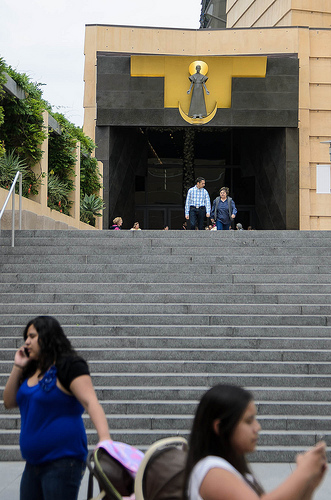
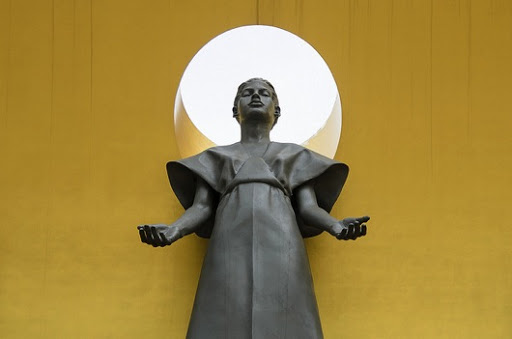
Last week I visited the Cathedral of Our Lady of the Angels in Los Angeles1 and it struck me that the statue above its entrance showed something akin to an optical illusion. Already when seen from afar, the statue above the main doors of the cathedral presented a somewhat ambiguous figure – the short hair, bare arms and forward facing palms were more consonant with an adolescent Jesus, prefiguring his later crucifixion wounds, while the context (i.e., it being the Cathedral of Our Lady and “the medium [being] the message” as McLuhan put it), the moon at the figure’s feet and the placement of the belt on the robe pointed to Mary, albeit posed in a highly unusual way.

In fact, if you look at the typical silhouettes of a statue of Mary (left – where her cloak dominates the outline), the LA statue (center) and a statue of Jesus (right – where head and hands are clearly distinct from the torso) you’ll see where my ambiguity came from:

Silhouette

Even up close this ambiguity does not resolve itself:

8716719089 f0a29367d0 z

The muscular arms as well as the scale of the hands are consistent with a young man, while the dress becomes more clearly female and the face is sufficiently androgynous to allow both for a male and a female reading. In the end I am left with a feeling akin to viewing the rabbit-duck in that I can both resolve the ambiguity in Mary’s and in Jesus’ favor.

What the sculptor Robert Graham has achieved here – at least through my eyes, is to put in bronze the key to Mary being the model Christian. Saint Louis Marie de Montfort put it as follows: “We never give more honor to Jesus than when we honor his Mother, and we honor her simply and solely to honor him all the more perfectly. We go to her only as a way leading to the goal we seek – Jesus, her Son.” And Pope Benedict XVI simply expressed it by saying that we look to Christ by “going towards Mary who shows us Jesus.” Instead of seeking fame and glory for herself, her whole life was one of self-effacing humility, a constant pointing beyond herself – to Jesus – to the point of becoming transparent.


1 For more about the cathedral’s architecture see here.

Skin and heart, not antiques or novelties

Past present future 3 john kennard

Where does Pope Francis stand on the perennial question of reform versus continuity, progress versus tradition? His sermon during yesterday morning’s Chrism mass made it very clear – like Benedict XVI, who referred to it as “reform in continuity,” Francis too rejects a focus on tradition alone (calling it “antiques”) as well as on progress alone (“novelties”) and instead calls us to “put [our] own skin and [our] own heart on the line” and to live in the midst of our communities, sharing the life of our neighbors. Another way of reading the popes’ position is to cast it in terms of past, present and future, with a firm focus on living in the present moment instead of a nostalgia for a past Golden Age or a putting off of life until a bright future dawns.

While it contains a clear position on where Francis’ priorities lie, yesterday morning’s sermon – which I recommend highly in full – will, in my opinion, go down as the founding moment of a renewal of the priesthood, with the following being its key moments:

“[T]he anointing that [priests] receive is meant in turn to anoint God’s faithful people, whose servants they are; they are anointed for the poor, for prisoners, for the oppressed.[…]

A good priest can be recognized by the way his people are anointed. This is a clear test. When our people are anointed with the oil of gladness, it is obvious: for example, when they leave Mass looking as if they have heard good news. Our people like to hear the Gospel preached with “unction”, they like it when the Gospel we preach touches their daily lives, when it runs down like the oil of Aaron to the edges of reality, when it brings light to moments of extreme darkness, to the “outskirts” where people of faith are most exposed to the onslaught of those who want to tear down their faith. […]

We need to “go out”, then, in order to experience our own anointing, its power and its redemptive efficacy: to the “outskirts” where there is suffering, bloodshed, blindness that longs for sight, and prisoners in thrall to many evil masters. It is not in soul-searching or constant introspection that we encounter the Lord[…]

Those who do not go out of themselves, instead of being mediators, gradually become intermediaries, managers. We know the difference: the intermediary, the manager, “has already received his reward”, and since he doesn’t put his own skin and his own heart on the line, he never hears a warm, heartfelt word of thanks. This is precisely the reason why some priests grow dissatisfied, become sad priests, lose heart and become in some sense collectors of antiques or novelties – instead of being shepherds living with “the smell of the sheep”, shepherds in the midst of their flock, fishers of men. […]

It is not a bad thing that reality itself forces us to “put out into the deep”, where what we are by grace is clearly seen as pure grace, out into the deep of the contemporary world, where the only thing that counts is “unction” – not function – and the nets which overflow with fish are those cast solely in the name of the One in whom we have put our trust: Jesus.”

Wow! What a wake up call! And before you think: “Yeah! Them priests better get their act together,” let me just remind you (as I remind myself) that we all share in Jesus’ royal priesthood! When I heard Pope Francis say these words, I felt that he was addressing me. Do I share in the life of those around me? Do I live in their midst or am I withdrawn into introspection? These are undoubtedly great challenges, but ones that, I believe, will help all of us Christians to be more faithful followers of Jesus.

As is his trademark, Pope Francis proceeded to put his model of the priesthood into practice straight-away, by celebrating the Maundy Thursday mass in a juvenile detention center. Not only that, but he chose – against present liturgical law!1 – to wash the feet not of 12 men (which in the case of the popes’ Maundy Thursday masses have been priests), but of a group of youths, among whom were women as well as men and Muslims as well as Christians. This a shepherd in the midst of his flock, a fisherman putting “out into the deep”!

Not only his actions, but his words too, during the sermon of the same Maundy Thursday mass, illustrate his closeness and adaptation to the specific people he is with. The message he shares is universal, accessible to all and obviously comes from his heart:

“Help one another. This is what Jesus teaches us. This is what I do. And I do it with my heart. I do this with my heart because it is my duty, as a priest and bishop I must be at your service. But it is a duty that comes from my heart and a duty I love. I love doing it because this is what the Lord has taught me. But you too must help us and help each other, always. And thus in helping each other we will do good for each other.

Now we will perform the ceremony of the Washing of the Feet and we must each one of us think, Am I really willing to help others? Just think of that. Think that this sign is Christ’s caress, because Jesus came just for this, to serve us, to help us.”

This universality and at the same time specificity of his approach also shines through in his inviting ten parish priests from around Rome for lunch earlier that same day. One of the guests – the parish priest of the San Giacomo church in central Rome – reports:

“At first there was a bit of awkwardness – he is the pope after all – but he put everyone at ease. […] He didn’t want us to kiss his hand – instead he kissed each one of us. We asked him whether we could tell our parishioners that we had lunch with him and Francis told us to greet and bless them in his name. […] He also had a word of advice for each one of us. Since my parish is an inner city one, he invited me to keep my church open, as he already said during Wednesday’s general audience: “how sad to see closed churches!”. He told me that if the door is open, when someone passes by, they may enter and if they they also find a priest who is ready to hear their confession, it becomes an occasion for meeting Jesus and the Church.”


1 Although, personally and individually being the Catholic Church’s supreme and ultimate legislator, this is a moot point.