Beauty, ugliness and art

Michel pochet

“Ugliness will redeemed us” was certainly among the most provocative and profound insights shared at a conference of Christian academics and artists that I attended some 12 years ago in Rome. This statement, by the French painter Michel Pochet, was made very much in earnest and at a moment of reflection on a sacred text that spoke about Jesus’ suffering on the cross and his cry of abandonment before his death (“My God, my God, why have you forsaken me?” Mathew 27:45). It certainly was not a frivolous, Oscar Wilde-esque quip, yet the reaction to it was one of disbelief, shock and immediate, widespread opposition. A very prominent Italian sculptress asked to be given the floor and launched into what was effectively a plea for reason to return: “How can you say that ugliness will redeem us? God is beauty and it will be by beauty that salvation will be delivered!” Personally, I was very much attracted to Pochet’s words and equally disappointed by the immediate opposition they received. Thankfully, the conference chair swiftly rebuked Pochet’s critic, with something along the following lines: He said that the sculptress’ words were not in the spirit of charity, reminded her that we must believe in the good intentions of others and that if their views differ from ours, we must try to understand why they are different. In the end what she said was true but so was that which she criticized, in its own context. The most impressive thing to my mind was not only Pochet’s insight, but also that this group of distinguished academics and artists was both capable of open disagreement and of accepting a rebuke that in many contexts would have lead to offense.

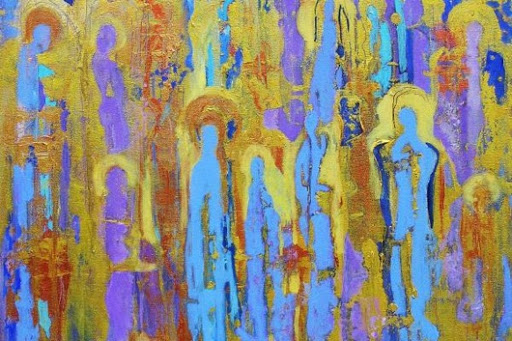
But, let us return to Pochet’s insight, which has immediately attracted me, for which I could see good reason, but which I never had the opportunity to know more about, until I read the transcript of a talk (in Italian) that he gave at an event in 2006. There he talks about his experience of returning to painting after many years and being in post-war Croatia with some friends. Materials were scarce and when his friends realized that he was painting again, they were looking for supplies for him. One day he was given a piece of canvas that was badly marked, torn, discolored and generally not in a fit state to be used as the basis for a painting. Since it was offered to him out of love by his friends, he could not refuse it. Examining the canvas, the thought came to him to paint a portrait of Jesus in his abandonment on the cross, since there he too suffered from the damage that this canvas presented.

Upon completing the painting (shown at the top of this post), Pochet realized that what he did was not so much a portrait of the abandoned Jesus but of the risen one, bearing the marks of his crucifixion and suffering. Looking at his own work, Pochet understood that this dual portrait of the suffering and risen Jesus provides an insight into what beauty is. He realized that Jesus, being God, is also perfect beauty and that his person is substitutable with that of Beauty in the Gospel:1

“[Beauty] seems dead, buried under the rock of ugliness. But on the third day the tomb is empty. Someone tells us that she is risen and that she waits for us. She walks with us, talks to us. My heart burns in my chest. It is getting late. We ask her to stay for supper, but our eyes open in the moment she disappears. Risen Beauty does not appear again: she disappears, hides in the anonymity of whomever, in the banal, the everyday. […]

Beauty is at the lake’s shore, unrecognizable. A pure eye intuits her and opens our eyes. We dive into the water and Beauty nurtures our mind and our senses, with bread baked on a hot stone. Beauty climbs a mountain with us, is lifted up high before our eyes and a cloud removes her out of sight.

And while we are staring at the heavens as she leaves: “Why are you looking at the sky? This Beauty, which has been among you and has been taken up to heaven, will return one day in the same way in which you have seen her leave.” And we, along the ways of the world, remember her words of farewell: I am with you all the days, until the end of the present age. […]

[T]he death of Beauty, “ugliness” – if we want to call it that, [is] assumed by God, divinized, in the risen Jesus.”

This fits perfectly with the intuition I had when first hearing him speak about ugliness, although the profound insight that Jesus’ life can be applied to Beauty, to gain a deeper understanding of it, is an impressive bonus! Beauty, understood through the optics of Jesus, is not superficial, ‘kitsch’ or only concerned with aesthetics, but one that goes to the heart of what it is to be human. It embraces the ugliness of suffering and uses it to arrive at love and joy.

What Pope Benedict XVI has to say on the subject is very much related. E.g., when talking about Michelangelo‘s “The Last Judgement” fresco in the Sistine Chapel, he says that it “issues a strong prophetic cry against evil, against every form of injustice” and goes on the exult beauty as follows:

“[T]he experience of beauty, beauty that is authentic, not merely transient or artificial, is by no means a supplementary or secondary factor in our search for meaning and happiness; the experience of beauty does not remove us from reality, on the contrary, it leads to a direct encounter with the daily reality of our lives, liberating it from darkness, transfiguring it, making it radiant and beautiful.

Indeed, an essential function of genuine beauty, as emphasized by Plato, is that it gives man a healthy “shock”, it draws him out of himself, wrenches him away from resignation and from being content with the humdrum — it even makes him suffer, piercing him like a dart, but in so doing it “reawakens” him, opening afresh the eyes of his heart and mind, giving him wings, carrying him aloft.”

He then quotes Simone Weil, saying: “In all that awakens within us the pure and authentic sentiment of beauty, there, truly, is the presence of God. There is a kind of incarnation of God in the world, of which beauty is the sign. Beauty is the experimental proof that incarnation is possible. For this reason all art of the first order is, by its nature, religious.”

I hope that you won’t see this as an attempted land-grab for all art in the name of religion. Instead, I believe, it is an acknowledgement of art expressing a fundamental attribute of God, which believers can seek regardless of whether the artist intended it, agrees with it or believes in it. With the profound understanding of beauty (including a “risen” ugliness) that both Pope Benedict XVI and Michel Pochet talk about, we can further seek to recognize the presence of beauty also in art (and life!) that at first sight appears ugly.


1 Apologies for this unpolished translation – it is mine and was done in a hurry :$

Martini: backstabber or faithful son?

Primus inter pares

You’ll know from a previous post here, that I am becoming a great fan of Cardinal Martini, whose funeral was celebrated two days ago and whose exchange of letters with Umberto Eco I enjoyed greatly. Upon hearing of his death, I was keen to learn more about him and I also eagerly read the last interview with him, published in the Corriere della Sera (and available in English translation here).

The interview took place on 8th August and asks Martini to comment on the state of the Church – a question he is very well positioned to answer and that he answers with great honesty. Martini says that the church is tired, culturally out of date, being weighted down by bureaucracy and basically showing the traits of a mature business rather than a dynamic start-up (my words :). The Church lacks the dynamism of John the Baptist and St. Paul, the faith of the Roman centurion (whose servant Jesus healed) and of St. Mary Magdalen and the closeness to the people that the Servant of God, Bishop Óscar Romero and the Jesuit martyrs of El Salvador had. Martini’s answer to this predicament is to involve more people from outside formal Church structures, to recognize our own errors and start a process of conversion, to return to the Word (i.e., to a personal closeness to the Gospel), to renew an adherence to the sacraments and to be open to all, regardless of what family and social circumstances they are in. Finally, he exhorts us to renew our faith, confidence and courage and to let ourselves be conquered by God’s love.

My immediate reaction was that of gratitude for such a greatly distilled analysis of where the Church is today, for the degree of honesty and self-criticism, for the concrete steps forward and for a final call to love.

The second hand, to form applause with Martini’s interview, then is the message that Pope Benedict XVI sent to his funeral. The pope picks a line from Psalm 119: “Your word is a lamp for my feet, a light for my path” to sum up the cardinal’s life, calls him a “generous and faithful pastor of the Church” and states that everything Martini did was “for the greater glory of God.” The pope then goes on to say that:

[h]e did so with a great openness of heart, never refusing to encounter and dialogue with anyone, responding concretely to the Apostle’s invitation to “always be ready to give an explanation to anyone who asks you for a reason for your hope ” (1 Peter 3:15).

Finally, he concludes by saying: “May the Lord, who guided Cardinal Carlo Maria Martini his whole life, receive this tireless servant of the Gospel and of the Church in the Heavenly Jerusalem.” Not only an elegant nod to Martini’s fondness for the earthly Jerusalem, but also an endorsement of his faithfulness to and inspiration from God.

If it were just for these two texts – the last interview with Martini and the pope’s message at his funeral – you could think that the two were uncontroversial parts of giving thanks for the life of a great son of the Church and, I believe you’d be right. A quick look at the press presents a very different picture though. The Independent calls Martini’s interview “a damning critique that has rocked the Catholic Church,” the Daily Mail calls it a “scathing attack,” the Belfast Telegraph says that the “Vatican is rocked by Cardinal Martini’s damning words from beyond the grave” and all news outlets latch on to Martini’s saying that “the Church is two hundred years behind.” Reading these and virtually all other reports (with the notable exception of Fr. Lucie-Smith’s blog), you’d think that Martini’s last interview was some kind of vengeful, underhand jab at the Church. Instead, I see Martini’s words as much more in line with Blessed Pope John Paul II’s emphasis on acknowledging past wrongs as a first step towards a renewal of the Church. E.g., in Incarnationis Mysterium he says that the Church “should kneel before God and implore forgiveness for the past and present sins of her sons and daughters” (Section 11), such humble repentance being in fact a common feature of the attitude of saints.


I’d first like to thank my bestie, PM, for suggesting this as a topic for a post 🙂

I also realize that I may come across as someone who unreservedly agrees with everything the Church and its representatives do. Let me assure you that this is far from the case and may in fact be more a consequence of my desire to focus on what is good and worth sharing rather than on presenting a complete, balanced view of how I see the Church. As an example of something that recently irked me, take a look at the third question in this very recent interview with Cardinal Cormac Murphy-O’Connor:

Q: At a lecture after Archbishop Vincent Nichols’ installation you urged Christians to treat atheists and agnostics with deep esteem. However, later you are quoted as saying that a lack of Faith is the ‘greatest of all evils’. You blamed atheism for war and destruction, and implied it was a greater evil than sin itself. Is this a contradiction, or were you misquoted?
[At this point Cardinal Cormac got up and went to his adjacent study. Perhaps this was an abrupt end to our interview? However, after a few minutes he returned with two books.]
A: Yes, I was misquoted – it was out of context. To get the full meaning of what I said, I would encourage [you] to study the books I have assembled ‘Faith in Britain’ and ‘Faith in Europe’.

No, thanks … If the Cardinal cannot address this, very good question in the interview and his only recourse is to bring back TWO books that the reader is to study and from which they are to distill what the Cardinal thinks, then in all likelihood those books are not going to be any help either. Seeing a response like this (and much of the lengthy interview) just makes me recoil in frustration and shake my head in disappointment …

Saints as teaching

Communion of saints elise ritter

Especially if you are a nonbeliever (and even if you aren’t), you would be forgiven for looking at saints as a rather outmoded, superficially pious and self-congratulatory aspect of Christianity. Their statues can appear as nothing more than window dressing and be part of what Cardinal Martini referred to as off-putting ‘pomp‘. Even a closer look can yield unedifying results and present a view of saints as freaks, focusing either on their horrific deaths (burning, skinning, drawing and quartering, beheading, mauling, hanging, …) or on weird stunts like levitation, bilocation, living atop a pillar, or severe self-mortification. With a view like that, you’d do best to stay well clear of them and the last thing you’d want to do is tell your children about them!

If you have seen this blog before, you’ll know that I profoundly admire many saints and that I strive to learn from them. St. Francis is an example for approaching poverty, St. Therese for valuing simple, everyday life, St. Maximilian Kolbe for what it means to give one’s life for one’s friends, St. Anselm for how logic can point to God, St. Philip Neri for recognizing humor as a gift, Bl. Chiara ‘Luce’ for how cancer can be an encounter with Jesus, St. John of the Cross for how one’s relationship with God can be misunderstood even by one’s closest fellow believers, St. Thomas More for how adherence to Jesus is above any secular power. And I could go on and on 🙂

What is the point of looking up to saints though? Actually, the point is precisely that it is a looking across rather than a looking up, since saints are my fellow followers of Jesus – subject to weakness, limitations, errors, lapses, pride, difficulties of personality and bounded intelligence. They are what makes me think that I too may have a shot at faithfully following Jesus and it is their virtue, selflessness, compassion, determination and love for all that spurn me on.

There is another key aspect to saints that has been forming in my mind since I have started writing this blog, and it is the following: Church teaching is a complex, often technical and hierarchically–governed set of prescriptions and proscriptions. It is far more akin to the law than anything else, and – just like in the case of the law, its correct interpretation and application to ‘real life’ is arbitrated by professionals: theologians and church officials – the barristers/solicitors and judges of theology. This, however, presents a serious challenge for the individual Christian, who is keen to be faithful to Jesus’ teaching, but who faces the complexities of a technical corpus with finely-tuned, carefully-crafted, legalistic language. How am I, an apprentice follower of Jesus, to grapple with encyclicals, exhortations, the church fathers, canon law, the councils, and even the relatively user-friendly catechism, when I lack theological and legal training? How on earth did St. Peter – a fisherman – do it?

The answer lies precisely in what the early Christians realized already: that it requires putting one’s faith in God and acting on the inspiration provided by the Holy Spirit (e.g., see the account of St. Stephen’s trial and execution in the Acts of the Apostles – chapters 6-8, where Stephen is repeatedly referred to as being ‘filled with the holy Spirit’ (e.g., Acts 7:55), but it also requires continuity with how God acts in others and has acted in others in the past (where the more structured aspect of Church teaching, referred to before, comes from) also so that one’s conscience is purified of errors. What all of this leads to is that explicit Church teaching is certainly a guide to following Jesus, but also that the example of others can provide a more accessible means of seeing it put into practice. For example, by imitating St. Therese in seeking God’s will in everyday chores and doing them out of love for Him and my neighbors, I will not only act orthopractically, but also on an orthodox basis. By seeing how a saint has acted, I have a more applied and immediate view of what the Church teaches. In fact, Pope Benedict XVI said something similar yesterday in the context of ecumenism, when he highlighted that while Church unity is not something that we can cause (it will be a gift from God), we can “learn from each other how to follow Christ today.” In other words, orthopraxy is to be imitated regardless of who does it.

Finally, there is another aspects of learning from the actions of saints, which is that it is not only individual Christians who can do so, but the Church as a whole too. I believe that official, formal Church teaching can be seen as a distillation of the orthopraxy (holiness) and therefore orthodoxy of saints. This was evidently so at the very beginning of the Church, where it is Jesus’ actions and beliefs that are Church teaching, but right from the get go it is also the teachings of the apostles that attain orthodox status (e.g., see Peter’s ‘trance’ in which he is told to eat food considered impure and told “What God has made clean, you are not to call profane.” (Acts, 10:15)). The history of the church is then a sequence of growing insight into how best to follow Jesus and the actions and beliefs of saints are a key part of it (just look at the Catechism and notice the number of references to what the saints have said). Since such growth of insight also involves change, the new understanding, acted upon by saints, is often misunderstood and often so for decades or centuries (but luckily saints don’t do what they do for celebrity status). In the end though, the orthopraxy of saints tends to be of such vehemence that doubts about the origin of their beliefs are dispelled.

The wedding garment


Yesterday’s gospel reading was a bit of a puzzler and as I don’t think I ever heard it convincingly explained in a homily or made satisfactory sense of it myself, I started digging a bit into it. The text is from Matthew’s gospel (22:1-14) and presents the parable of the king’s son’s wedding feast where those who are invited refuse and the king’s servants bring in whomever they can find. The parable then ends in one of the guests being expelled for wearing the wrong gear plus there is a bit of killing too. Here is the full text:
Jesus said to the chief priests and the elders of the people, ‘The kingdom of heaven may be compared to a king who gave a feast for his son’s wedding. He sent his servants to call those who had been invited, but they would not come. Next he sent some more servants. “Tell those who have been invited” he said “that I have my banquet all prepared, my oxen and fattened cattle have been slaughtered, everything is ready. Come to the wedding.” But they were not interested: one went off to his farm, another to his business, and the rest seized his servants, maltreated them and killed them. The king was furious. He despatched his troops, destroyed those murderers and burnt their town. Then he said to his servants, “The wedding is ready; but as those who were invited proved to be unworthy, go to the crossroads in the town and invite everyone you can find to the wedding.” So these servants went out on to the roads and collected together everyone they could find, bad and good alike; and the wedding hall was filled with guests. When the king came in to look at the guests he noticed one man who was not wearing a wedding garment, and said to him, “How did you get in here, my friend, without a wedding garment?” And the man was silent. Then the king said to the attendants, “Bind him hand and foot and throw him out into the dark, where there will be weeping and grinding of teeth.” For many are called, but few are chosen.’

So, what does all this mean? I had a quick look at homilies over the last 2000 years and found the following:

  1. St. Cyril of Jerusalem (4th century AD) basically considers this parable self-explanatory 😐
  2. St. John Chrysostom (4th century AD) gives the parable a historical reading whereby those invited are the people of Israel while the random crowd picked from the cross-roads are the Gentiles. He also focuses on the invitation to the latter being due to no merit of their own but wholly down to grace. The most interesting part if the parable to me is the poor guy who gets kicked out after he was invited at random. Here St. John focuses on the fact that he condemns himself – only after the king personally questions him about his improper attire (representing the corrupted state of his life) and he is unable to bring anything to his own defense, is he condemned. St. John also makes a point about this guest having had a clean garment given to him to begin with: “And yet the calling was of grace; wherefore then doth He take a strict account? Because although to be called and to be cleansed was of grace, yet, when called and clothed in clean garments, to continue keeping them so, this is of the diligence of them that are called.” This addresses the prima facie peculiarity of the parable: why punish someone who was invited in at random. The answer seems to be that the second cohort of guests were given appropriate attire (grace) but failed to maintain it.
  3. St. Augustine (4th-5th century AD) offers a rather convoluted explanation of this parable, spending an inordinate amount of time on evidencing that the one expelled guest actually represents a whole category (he is to be commended for his rigor though). As regards the expelled guest, St. Augustine equates the wedding garment with charity and quotes St. Paul to warn against its imperfect variants :““though I distribute all my goods for the use of the poor, and though I give my body to be burned, and have not charity, it profiteth me nothing.” This then is “the wedding garment.””
  4. Martin Luther (14th-15th century AD) reiterates the historical reading of St. John and St. Augustine and, as regards the expelled guest he characterizes them as follows: “These are pious people, much better than the foregoing; for you must consider them the ones who have heard and understood the Gospel, yet they cleaved to certain works and did not creep entirely into Christ; like the foolish virgins, who had no oil, that is, no faith.” That is, Christians, who were given everything, but have squandered it. What is it that God wants instead? Here Martin Luther has the following to say: “Now, what do we bring to him? Nothing but all our heart-aches, all our misfortunes, sins, misery and lamentations.” God wants us to be open with him and give him our all – weaknesses and strengths included.
  5. Finally, Pope Benedict XVI also offers his reading of this parable in a recent sermon: “God is generous to us, He offers us His friendship, His gifts, His joy, but often we do not accept His words, we show more interest in other things, we put our material concerns, our interests first.” As far as the expelled guest, Pope Benedict says: “on entering the hall, the king sees someone who has not wanted to wear the wedding garment, and for this reason he is excluded from the feast.” again echoing St. John’s position that the wedding garment was available to the guest but that it was his choice not to wear/maintain it. Pope Benedict then quotes St. Gregory the Great, who says that “this garment is symbolically interwoven on two pieces of wood, one above and one below: love of God and love of our neighbour.”

This parable has certainly been given a lot of thought since Jesus shared it with his followers and it seems clear that it is squarely directed at those who have heard the call of God to follow him. It is a warning both to those who hear it and ignore it and to those who follow it on the surface, but don’t back it up with faith and charity. In no way is this any criticism of sincere atheists/agnostics. Instead it is a rather harsh warning to those of us who claim to be Jesus’ followers, and, as St. John says “indicates […] the strictness of the life required, and how great the punishment appointed for the careless.” So, instead of a “oh, isn’t this a bit unfair to the poor, random fella” the message is clearly: take your relationship with God seriously – it is no game.

Many or all?

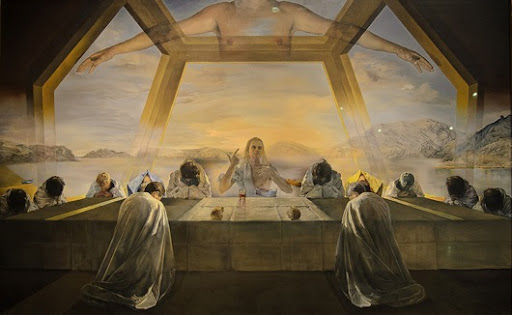
Dali

How do you preserve the message Jesus proclaimed two thousand years ago, when businesses and institutions struggle to get their members to know even just about the strategy and vision of the moment? I think this is quite a thorny challenge, as it can take you down at least two undesirable paths: On the one hand, you can become caught up in splitting hairs and lose sight of what Jesus wanted to communicate, while holding on to his specific words with zeal (the example of those who can recite Scripture but wouldn’t think twice when walking past a homeless person comes to mind). On the other hand, there is the ‘chillax, man!’ kind of approach, which would argue that it doesn’t matter what Jesus said exactly as we know that he just wanted us to be ‘nice’ to each other. While the latter is far less objectionable to me, it does run the risk of missing out on the richness of Jesus’ words, which we have been unpacking for two millennia (e.g., think of St. Francis’ re-discovery of poverty, St. Therese of Lisieux’s realization of the depth of everyday life, etc.).

It is in this context that the question of a single of Jesus’ word’s translations has been plaguing linguists and theologians during the last half century, leading to votes in various national Bishops’ conferences and now even to an intervention by the Pope himself. The word in question is the Latin ‘multis’ and the controversy revolves around whether it ought to be rendered as ‘many’ or ‘all.’

Coming to this question cold, you could be forgiven for saying: “Well, I googled it, and it clearly says ‘many.’ End of story.” As it happens, the Pope has arrived at the same conclusion, but what is noteworthy to me is how he did it (and, no, he didn’t just google it!) and how he then proceeded. To get the full story, see Benedict XVI’s letter to the German Bishops’ Conference, and if you’d just like my summary, read on. The text in question are Jesus’ words at the last supper, where he blesses and offers the wine to his disciples, saying:

hic est enim calix Sanguinis mei novi et aeterni testamenti, qui pro vobis et pro multis effundetur in remissionem peccatorum

which, up until very recently was translated as:

this is the cup of my blood, the blood of the new and everlasting covenant. It will be shed for you and for all so that sins may be forgiven

and, which is now translated as follows (after a very recent revision of the English translation, that was also influenced by Pope Benedict’s choice):

this is the chalice of my blood, the blood of the new and eternal covenant, which will be poured out for you and for many for the forgiveness of sins

As you can see, this is a pretty important word, since it, at first sight, sets the scope for the effects of Jesus’ sacrifice. Did Jesus offer his life for all (as the Church has been, and still is, teaching: “For as in Adam all die, so also in Christ shall all be made alive” – Catechism of the Catholic Church, §655) or only for some? Suggesting the latter would be outrageous, would fly in the face of everything that Christianity can be most certain of and would be entirely incongruent with the rest of Jesus’ teaching. The potential doubt that this change of translation could introduce in the minds of church goers is precisely what made both the German and Italian bishops rebel and vote massively in favor of not changing the respective translations.

This brings us to Pope Benedict’s letter, where he first proceeds to sum up the history of the argument, then to underline the validity of concerns like the above and to re-affirm the universal scope of Jesus’ sacrifice and salvation. Only after having prepared the ground does he proceed first to deliver a master class on the distinction between translation and interpretation (while acknowledging the difficult balance between the two and agreeing that the ‘for all‘ was “a well-founded interpretation then as now”) and on how the two need to go hand in hand:

“The word must be presented as it is, with its own shape, however strange it may appear to us; the interpretation must be measured by the criterion of faithfulness to the word itself, while at the same time rendering it accessible to today’s listeners.”

Benedict does not leave things at this though and at stating that “the words ‘pro multis’ should be translated as they stand”. Instead he proceeds to outline how local bishops need to prepare their congregations for the change in wording and flips the situation from a source of disagreement to an opportunity to spread the Gospel. He does this by underlining the three reasons that Jesus may have had for using the word ‘many’ instead of ‘all’:

  1. “Firstly, for us who are invited to sit at his table [i.e., participate in the Eucharist], it means surprise, joy and thankfulness that he has called me, that I can be with him and come to know him.”
  2. “Secondly, this brings with it a certain responsibility. How the Lord in his own way reaches the others – “all” – ultimately remains his mystery. But without doubt it is a responsibility to be directly called to his table, so that I hear the words “for you” – he suffered for me. The many bear responsibility for all. The community of the many must be the lamp on the lamp-stand, a city on the hilltop, yeast for all.”
  3. “Finally, [i]n today’s society we often feel that we are not “many”, but rather few – a small remnant becoming smaller all the time. But no – we are “many”: “After this I looked, and behold, a great multitude which no man could number, from every nation, from all tribes and peoples and tongues,”, as we read in the Revelation of Saint John (7:9). We are many and we stand for all. So the words “many” and “all” go together and are intertwined with responsibility and promise.”

Having read Pope Benedict’s letter leaves me with admiration for his method, with gratitude for the nuances of the ‘many’/‘all’ difference that he laid bare and also with an appreciation of the subtlety of his approach. After all this is ‘just’ a letter to the German bishops – not one of the formal ‘weapons’ that he has in his arsenal, such as apostolic letters, apostolic exhortations, apostolic constitutions or ‘ex cathedra,’ infallible proclamations. What we get instead is a point made with such power of reason that it does not require legal support.

Jesus loved Judas

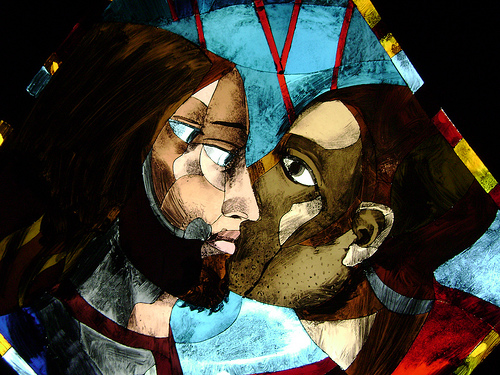
Judaskiss3

During these last weeks I have been thinking about a passage that struck me during this year’s Good Friday way of the cross that was lead by Pope Benedict XVI and for which the meditations were prepared by Danilo and Anna Maria Zanzucchi (the first married couple ever to provide the thoughts to reflect on during this key moment of the Easter triduum):

It seems we can hear you say:
“I have been condemned to death;
so many people who seemed to love and understand me
have listened to lies
and accused me.
They did not understand my words.
They handed me over to judgement and condemnation.
To death by crucifixion, the most ignominious death.”

What caught my attention here was the insight that Jesus loved Judas as much as all the other apostles and that Judas’ betrayal must have hurt him a lot. The picture of Judas in the Gospels is understandably negative and his mentions tend to be accompanied by warnings of his future betrayal. This, to me, has until last Easter obscured the fact that Jesus would not have viewed Judas in such a light. He would have been fond of him and would have looked upon him as he did upon John, Peter, James or the other apostles. His betrayal would have been a searing pain for Jesus rather than the consummation of the inevitable that I previously got from a superficial reading of Scripture. What this underlines to me is that Jesus experienced not only the abandonment by society that Golgotha presents, but a very personal, individual betrayal by a loved one too.