Adversus Scruton

Tracey emin

2191 words, 11 min read

Is the body subject to the mind, or the mind something that the body does? Is it my body that holds me – my true, immaterial self – back, or is it my parasitic mind that inhibits the freedom of my body, my true, physical self? Ought I to favor the purity of ideas over messy matter, or the concreteness of being over the ephemeral nature of the mind?

Such questions are the polar opposites of a concept of the human person as a single being that is at home both in the material world and in a world that – at least apparently – is beyond matter: a world of thought, memory, relationships and values.

In the context of Christianity, the above is an opposition between the dualist heresy that denigrates matter and the body and attributes goodness only to the soul, and the concept of differentiated unity pervading the New Testament and made explicit in St. Paul speaking of the “spiritual body” [soma pneumatikón] (1 Corinthians 15:44). In Karl Barth’s words, “man is an embodied soul, a besouled body” and the Catechism of the Catholic Church presents an ultimately Trinitarian anthropology: “[t]he unity of soul and body is so profound that one has to consider the soul to be the “form” of the body. [… S]pirit and matter, in man, are not two natures united, but rather their union forms a single nature.” (§365).

With that brief preamble in mind, let us turn to a program by the philosopher Roger Scruton where he speaks about beauty, a subject very close to my heart (in the Homerian sense). Instead of being enlightening or thought provoking, Scruton’s position lead me to disappointment and frustration and, eventually (after some hesitation, given the strength of my initial aversion) to the writing of this piece.

There is a lot to be “against” in this hour-long program, but I will focus on only three of its, liberally intermingled, aspects here: superficiality, internal inconsistency and dualism.

Before arguing in favor of his positions’ flaws, I would first like to underline the good that I have seen in Scruton’s thought. For a start, I wholeheartedly share his insistence on the importance of beauty:

“I want to persuade you that beauty matters; that it is not just a subjective thing, but a universal need of human beings. If we ignore this need we find ourselves in a spiritual desert. I want to show you the path out of that desert. It is a path that leads to home.”

Scruton also presents beauty in art as impelling its recipient towards the good – “The beautiful work of art brings consolation in sorrow and affirmation in joy.” – and as a gateway to profound truths: “The most ordinary event can be made into something beautiful by a painter who can see into the heart of things.” And Scruton also aligns himself with Immanuel Kant’s emphasis of selflessness in art:

“Kant argued that the experience of beauty comes when we put our interests to one side; when we look on things not to use them for our own purposes or to explain how they work or to satisfy some need or appetite, but simply to absorb them and to endorse what they are.”

Sadly that is all I can echo from Scruton’s 6300 word defense of beauty, since the rest strikes me as little more than an attempt to justify what is to his taste and belittle what isn’t, instead of being an attempted enquiry into beauty.

The first issue I find with Scruton’s thought is that there is a tremendous superficiality and lack of charity in his approach to post-nineteenth-century art. This is coupled with a blanket attribution of goodness to all that came before it, paired with a universal belittling of all that came since. Virtually at the start of the program, Scruton declares:

“[I]n the 20th century beauty stopped being important. Art increasingly aimed to disturb and to break moral taboos. It was not beauty but originality however achieved and at whatever moral cost that won the prizes. Not only has art made a cult of ugliness. Architecture too has become soul-less and sterile. […] One word is written large on all these ugly things and that word is “Me.” My profits, my desires, my pleasures. […] Our world has turned its back on beauty and because of that we find ourselves surrounded by ugliness and alienation.”

To my mind this is little more than an expression of Scruton’s esthetic response to contemporary art rather than the result of an analysis either of its motives (in which he assumes beauty not to feature) or of its beauty (which, incidentally, Scruton never defines or analyses beyond declaring its presence or absence). If Scruton had taken the trouble to listen to even just the responses of those who were interviewed in his own program (!), he could have seen that beauty is very much still a driving force in contemporary art. Admittedly not a beauty that he might recognize or appreciate, but beauty nonetheless and not the universally base consumerist pursuit of selfish pleasures that he attributes it.

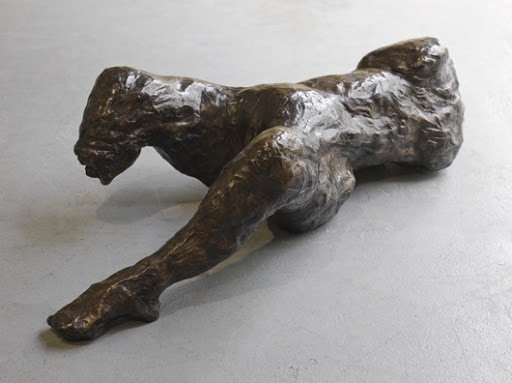
The clearest example in the program is the following passage from Tracey Emin being interviewed by David Frost about her 1998 piece “My Bed”:

Frost: “[T]he Tate says that it is [beautiful]. But what do you want the viewer, the visitor to the gallery to say? Do you want…. You don’t want them to say, ‘I think that’s beautiful.’”
Emin: “No, no one’s actually said that, only me.”
Frost: “You think it’s beautiful?”
Emin: “Yeah…. I do, otherwise I wouldn’t have showed it.”

Far from beauty being absent from artistic expression, Emin here not only points to it as the motive of her work (“otherwise I wouldn’t have showed [sic] it”) but, to my mind, also expresses a sadness about its absence from the minds of those who view her work.

Another piece that Scruton presents as an example for the absence of beauty is Marcel Duchamp’s 1917 “Fountain” which, he argues “was [a] satirical [gesture], designed to mock the world of art and the snobberies that go with it.” In other words, Duchamp’s work is about mockery and is entirely disconnected from beauty. Interestingly, the Tate describes this work in different terms – as “testing the commitment of the new American Society to freedom of expression and its tolerance of new conceptions of art.” And, importantly, the photographer Alfred Stieglitz, writing in a letter from 1917 describes his photograph of Duchamp’s work as “really quite a wonder – Everyone who has seen it thinks it beautiful – And it’s true – it is. It has an oriental look about it – a cross between a Buddha and a Veiled Woman.” Again, news of the death of beauty is greatly exaggerated …

Finally, let’s look at the words of a third of the enemies of beauty as presented by Scruton – the conceptual artist and painter Michael Craig-Martin. During his interview with Scruton, he responds to a question about what the point was of the changes that Duchamp wanted to usher in, by saying:

“I also think it is important to say that the notion of beauty has been extended to include things that would not have been thought of – that’s part of the artist’s function, to make one see something as beautiful that no one thought was beautiful until now.”

The difficulty here is not that Scruton does not like what Emin, Duchamp and Craig-Martin have done – he is free to experience reality as he pleases – but that he equates the lack of his perception of beauty in their work with their own disinterest in beauty and that he attributes motives to them that are base and among which beauty does not figure.

A second flawed strand in Scruton’s arguments is a total lack of self-consistency. E.g., he is quite content to launch into a tirade against today’s “people”:

“Maybe people have lost their faith in beauty because they have lost their belief in ideals. All there is, they are tempted to think, is the world of appetite. There are no values other than utilitarian ones. Something has a value if it has a use and what’s the use of beauty? […] Our consumer society puts usefulness first and beauty is no better than a side-effect.”

And, almost in the same breath put the following question to Craig-Martin, as a challenge to contemporary art: “What is the use of this art? What does it help people to do?” In other words: “Consumer society puts utility before beauty, and what’s the use of contemporary art anyway?!”

Scruton also simultaneously does two things: he bemoans a “cult of ugliness” at the beginning of the program and, half an hour later, states that art has always done that:

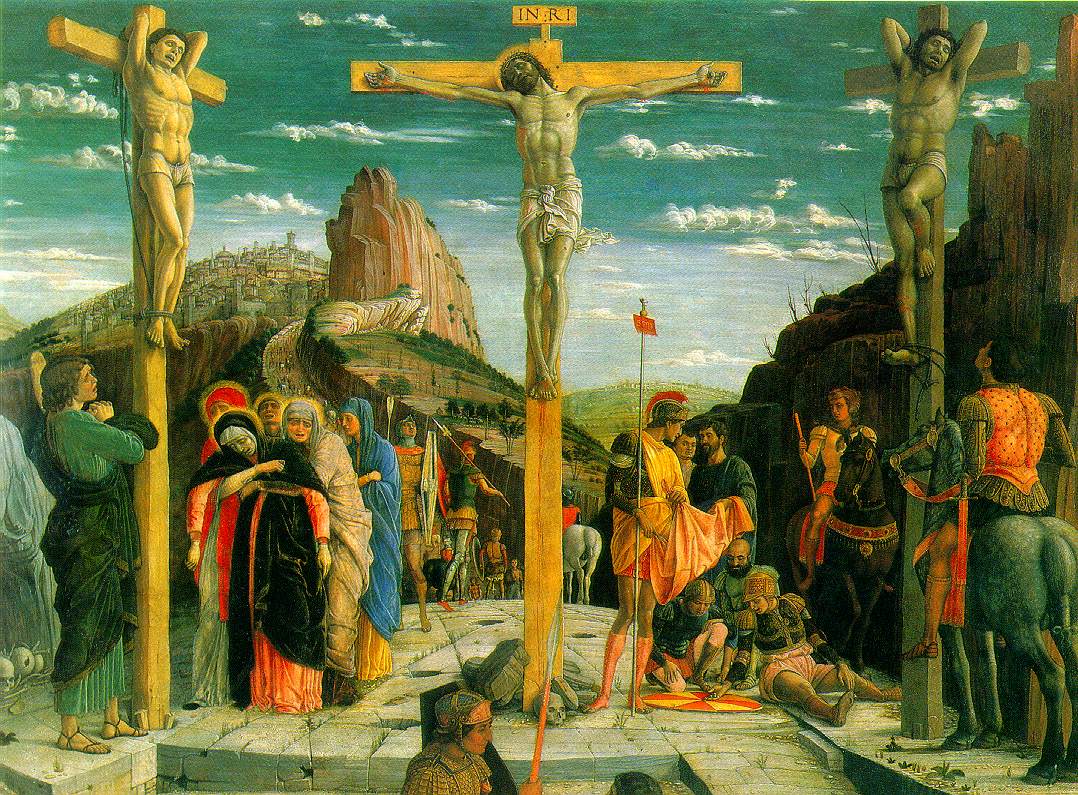
“Of course, this habit of dwelling on the distressing side of human life isn’t new. From the beginning of our civilisation it has been one of the tasks of art to take what is most painful in the human condition and to redeem it in a work of beauty. Art has the ability to redeem life, by finding beauty even in the worst aspect of things. Mantegna’s crucifixion displaying the cruellest and most ugly of deaths achieves a kind of majesty and serenity”

The third flaw I see though is the one that presents the greatest gulf between the beauty that Scruton speaks about and the one that I know: his putting in dualist opposition of the ideal and the particular, of desire and adoration:

“But if human beauty arouses desire how can it have anything to do with the divine? Desire is for the individual, living in this world. It is an urgent passion. Sexual desire presents us with a choice: adoration or appetite? Love or lust? Lust is about taking, but love is about giving.

Lust brings ugliness – the ugliness of human relations in which one person treats another as a disposable instrument. To reach the source of beauty we must overcome lust.

This longing without lust is what we mean today by Platonic love. When we find beauty in a youthful person it is because we glimpse the light of eternity shining in those features from a heavenly source beyond this world. The beautiful human form is an invitation to unite with it spiritually not physically. Our feeling for beauty therefore is a religious and not a sensual emotion.”

Beyond the questionable leaps from desire to sexual desire to lust, Scruton’s thought here too is self-inconsistent: lust leads to ugliness which makes one treat another as an instrument; beauty in youth points to “light of eternity”. To my mind Scruton’s proposal for how to engage with beauty is as objectifying as the sexually-lustful one he decries. In both the case of a source of beauty being turned into an object of one’s pleasure and the case of it being treated as a means for seeking an eternal ideal, that source of beauty is not engaged with for its own sake but is used as a device for satisfying its “consumer”’s ends. And while one can argue about the relative merits of those two ends, their seeking degrades beauty into a mere means.

Scruton’s thought here seems like a polar opposite of the caricature of contemporary art that he battles against, which, however, makes it a caricature too, pitting the beauty of the material and sensory against the beauty of the spiritual and ideal, instead of being open to the union and mutual enrichment of both.

Just to give an example of what an approach of differentiated unity – instead of dualism – looks like when applied to desire, let us consider the way Fr. James Martin, SJ speaks about it:

“[S]adly, desire has a disreputable reputation in many religious circles. When many hear the term, they think of two things: sexual desire or material wants, both of which are often condemned by some religious leaders. The first is one of the greatest gifts from God to humanity; without it the human race would cease to exist! The second is part of our natural desire for a healthy life — desire for food, shelter and clothing. […]

The deep longings of our hearts are our holy desires. Not only desires for physical healing, as Bartimaeus asked for (and as many ask for today) but also the desires for change, for growth, for a fuller life. And our deepest desires, those desires that lead us to become who we are, are God’s desires for us. They are ways that God speaks to you directly, one way that the Creator deals with the creation. They are also the way that God fulfills God’s own dreams for the world, by calling people to certain tasks.”

Such a recognition of good in desire leads to greater appreciation of the entirety of the universe we inhabit rather than to an a priori discarding of either the totality of the material/sensual or spiritual/ideal. In fact it leads to a vision of art like that of Pope Francis who said that “art must discard nothing and no one.”
Antony Gormley: tools for carrying nothing

0401 quantumcloud ix 1999 001

3083 words, 16 min read

Ever since my first encounter with Antony Gormley’s sculptures, I have had a sense of great affinity with his work and later, as I started reading various of his writings and interviews, also with his thought. What attracted me to his sculptures initially is not verbalizable, but reflecting on it leads me to a recognition of shared experience and of shared values. And I am thinking here of existential and ontological values first, although not to the exclusion of moral ones.

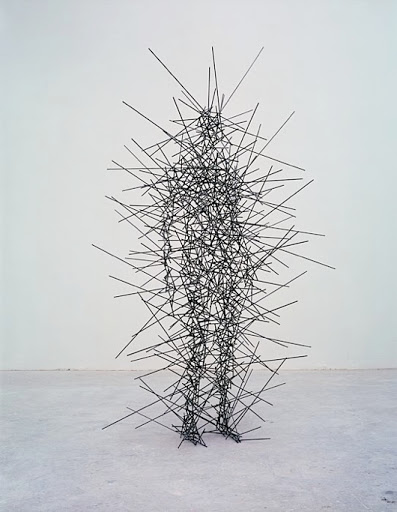
Being in the presence of one of his pieces has always given me a profound sense of incarnation – of a beyond in the here – and of communion, of a blurring of boundaries. The latter is obvious in sculptures since his Domain series (and also in Quantum Could, Hive and other, later ones) but I feel it is also there in his earlier work that, at first sight, may suggest the polar opposite – isolation, separation, individuation. Already the Three Part Lead Bodycase works, which on the face of it are solid, lead boundaries, impermeably encasing individuals, are such strong pointers to that “darkness of the body” that Gormley presents as “objectless”, that they too bring out a sense of a collective, shared place – to which each one of us has access in their own bodies, open to encounter and communion.

Instead of talking more about how I see Gormley’s work, I’d like to share some of his thoughts with you, and encourage you to go an see his sculptures next time you get a chance.

To begin with, Gormley has a concept of art that is extreme (a matter of life and death), paradoxical (useless yet vital), but at the same time profound (potentially life-changing confrontation rather than illustrative decoration):

“Art is the way that life tests and expresses itself, without which we are already dead. [… A]rt […] is useless but vital; it is through art that we communicate what it feels like to be alive.” (Art In The Time Of Global Warming, 2010)

“Art is the means by which we communicate what it feels like to be alive – in the past that was mixed up with other illustrative duties but that was still its central function that has been liberated in the art called modern. Art is not necessarily good for you or about communicating “good things”. […] Making beautiful things for everyday use is a wonderful thing to do – making life flow more easily – but art confronts life, allowing it to stop and perhaps change direction – they are completely different.” (BBC Forum Questions And Answers, 2002)

Gormley’s art is very much also about meaning and has parallels with religion: “[My] work comes from the same source as the need for religion: wanting to face existence and discover meaning. The work attempts by starting with a real body in real time to face space and eternity. The body – or rather the place that the body occupies is seen as the locus on which those forces act.” (Concerning The Religious Dimension In My Art, 1987) While rejecting the Christianity of his childhood, which he recounts as something that he was “indoctrinated” with and where he speaks about how he was told that the Devil is inside him, Gormley looks to art as the means also for preserving what is good in religion, while excluding its past errors:

“I am interested in reviving this idea of presence. Can we have presence without the God? Can we resurrect the monument without bringing the shadow of bad history? The idea of an image that is open enough to be interpreted widely, that has multiple and generative potential for meaning but is strong enough to be a focus. How do we construct such an image? In its being someone’s can it become everyone’s? It has seemed for quite a long time obvious to me that the body can represent at the present time what abstraction did at the beginning of the twentieth century. That is, the ground on which all the seeds of emancipated identity are to grow: the last frontier, the inner realm. (Space has been probed but what do we really know of the body’s darkness.) The body, not as an object of idealisation that should be forced to carry allegorical, symbolic or dramatic readings, but the body as a place. The body not as hero or as sexual object, but the body in some way as the collective subjective – the place where we all live. The place on which the pressures of society are inscribed and out of which expression, language, feeling can come.” (Still Moving, 1996)

In the same interview, Gormley emphasizes communion as a purpose of art – also a deeply Christian teleology:

“Can we use the space of art for communion? A contact not only between ourselves but between ourselves and history? In doing this can we also derive the energy necessary to believe in our part in the construction of the future? Is it possible for art to provide a space that can be regenerative? Is it possible to use the space of art to resist this restlessness, this sense of fragmentation, this sense of alienation from self and from place?”

In fact, Gormely sees art as closely tied to beliefs about the value of life and its future not only in the context of an individual but of society and humanity as a whole:

“It is necessary these days to hold on to the crucial function art has in the continuance and regulation of life. It provides us with images and acts by which we identity ourselves but so often now in an unstable way. Art can be a focus for life by reasserting in times of vicissitude the central belie[fs] of a people. In tribal cultures it is a collective act whether in dance, carving, self-decoration that reasserts the body of the people and it is from this that the individual draws his or her power. Art and the practice of non-utilitarian skills is an act of will for the future and is as critical an aspect of survival as hunting or gathering food. What has happened to this urgency expressed in a collective creativity that projects into the future and ensures the belief necessary for life? It is not that we have lost it, but the repositories of dance, dream and art are dispersed into the hands of individuals who have responsibility not simply to a single family or tribe but as points of consciousness of the whole world.” (The Impossible Self, 1988)

The desire for community and an undoing of alienation and fragmentation through art is also a strong theme in Gormley’s 2010 talk about the specific role of art in the context of Global Warming, which is highly relevant also to the upcoming UN conference on climate change that starts on Monday in Paris and deeply consonant with Pope Francis’ Laudato si’ encyclical:

“Is it possible to re-think art and take it from this finished-object status and make it into a verb, a participatory, open space, a place of transformation and the exchange of ideas and reflection on our state and status? Can we use art as a way of investigating this perilous time? Can we change from our obsession with production values? Instead of the perfection of an Asprey’s catalogue or the gloss of the desirable branded object can we accept that art has to find its own raw and direct way of existing?

[In my studio w]e create here situations and objects that can become catalysts for a form of reflexivity that allows the viewing subject not simply to be a passive consumer of an already tested experience but for the experience of art itself to be testing ground for both the model of art and the model of the human subject. We have in making art a specialisation and its exchange as a matter of high monetary worth lost its central subject – the human being. In the art of the 20th century the Duchampian breakthrough was the examination of human labour and mass production in the ‘found object’. I would like art to re-focus on the lost subject.” (Art In The Time Of Global Warming, 2010)

I particularly like that Gormley self-applies his thinking about the state of the world – to his own most immediate environment: his studio. At the same time his perspective is anything but parochial and extends to a global scale [in same text as above]:

“In facing the challenges of global climate crisis in a culture which encourages us to do more, produce more, be seen more – my initial response is paralysing fear, I want to shrink, to go into a hibernating state with minimum muscular effort and put minimal demand on any kind of fuel.

This position is not helpful but perhaps is a good place to start to rethink one’s place in the world.

[…] We can no longer assume that more is better. We have to change our cultural heroes from generals and captains of industry to meditators and mediators, from Rambo and Terminator to Ghandi and the Dalai Lama.

Our tool systems, no longer stone, having separated us from the rest of the planet and biosphere, are now what will, without this revolution, destroy both. The notion that human life was going to be improved by an empirical march of tool making that would make life stronger, longer and safer is challenged by the fall out effects of this very technology. Technology that was in some senses made to make life better has now become the problem.”

Given the above context, let’s turn to what is at the basis of Gormley’s own work as an artist, a sculptor:

“I’m interested in art’s ability to bear witness, and I start with what I know, the bit of the material world in which my consciousness is embedded: my body. And I try to present that bit of material (to myself as much as to anybody else) in a way in which its trace is registered. So my work always starts with the idea of a body at a particular moment in a particular position, fixed by a negative just like a photographic negative, except that this is a three-dimensional negative and we call it a mould. I still think of a mould as being the most magical and mysterious thing. The mould is a testament, a proof of the existence of an object or a body and, for my sculpture, the particular body that I inhabit. […]

I think of my work as instrumental. My sculptures will be seen as very boring objects if you look at them in terms of Western art history, or a kind of desire to make beautiful objects or a “picture” of reality. But if you look at them as instruments then they can become vessels, empty things that can be used for a type of thinking or a kind of feeling, then they begin to get more interesting.” (Silence And Stillness: Antony Gormley Interviewed By Enrique Juncosa, 2002)

I get a great sense of humility from Gormley’s words: a starting from one’s own body, a witnessing first to oneself, a recognition of one’s work being an empty vessel (immediately making me think of Christ’s kenotic self-emptying).

This impression is further strengthened by seeing how Gormley explains the need for starting from the body, which represents common ground and which he sees as an invitation for others to inhabit his work:

“The issue for me is that it is impossible to make art that can truly be shared without acknowledging the body as a starting point of common experience. So I have to acknowledge the body and at the same time try to find a way of not representing it, or presenting it simply as an object. This is the reason why I’m not interested in the perfect copy, in representation. We probably never did it better than Mantegna or Masaccio, and anyway, photography does it perfectly. […]

[My sculptures] are tools for carrying nothing, nothing else than emptiness, shadow, darkness, carrying the condition of embodiment. They each carry the condition we all know. All you have to do is to shut your eyes when you are awake you are in the place that the bodyforms and the bodycases carry. […]

I completely disagree with the […] proposition that the highest aspiration of art is to have a specific object that is purely itself and refers to nothing. I want people to inhabit my sculpture with their own lives, feelings, thoughts, emotions, whatever. I would like the logical and affective to be in the right balance.” (Interview With Pierre Tillet, 2008)

A final point in this thread is also that Gormley sees art as non-elitist, as a landscape open to all:

“We could say that for most of European art’s progress, it’s been about picturing. Then in Modernism it turns to interpretation and deconstruction. And now, I think, we’re into a completely new phase in which art is about providing a place where the human subject is somehow able to concentrate on his/her own being. […] The subjective experience of space-time, the condition of life, rather than being in some way the assumed background condition for refined perceptions of the object, now becomes a landscape in itself. And I think this is a new paradigm in the evolution of art.” (Interview With Hans Ulrich Obrist, 2008)

While Gormley has been extremely successful in his appreciation by the art world, there is an explicit desire in his thought to not be confined by it and to live “in the wild” instead:

“All art now has to be lost: to be an awkward interloper within life, that is its job. What Heidegger talks about in The Origin of the Work of Art, the idea that the temple is part of its landscape and the landscape part of the temple is an ideal, and we have lost it. This is a classical image of interdependence of site and object. And while I recognise this ideal, I think that sculpture does not have a home. For me, sculpture is a lost subject, an alien body that infects and interrupts the cohesion of place. The museum is just one place amongst many wherein you might find art – but not art at work but in refuge. I’m not against museums because I think they have a very important part to play in the memory of a culture. But before my work has any need to be in the museums it has to have a life, it has to have adventures in the real world. For me, art has to be part of everyday life and every one of my pieces is an attempt to look at a new context and say: how can I deal with this opportunity?” (Interview With Pierre Tillet, 2008)

Gormley then positions the scope of art even beyond inter-personal communication, between artist and viewer:

“I’m not so interested in formal validations of work, where people called artists make something called art that belongs in a gallery. It’s tiny the ecology and economy of the art world. Art is not simply human communication or a way of explaining ourselves to ourselves. I’m interested in art that speaks of our vulnerability in time, in the same way that a figure on Easter Island looks up at the sky somewhere above the horizon and is evidently not a substitute for me speaking to you. It’s not about communication between human beings; it’s about communication between human beings and deep time and deep space. This is the broader horizon that I’m interested in positioning the work against. I want to make an art that has to do with survival, that thinks about where human beings fit in the chain of being, that asks who we are, and where we’re going…well, these big, big questions.” (Silence And Stillness: Antony Gormley Interviewed By Enrique Juncosa, 2002)

On the basis of the above, it should come as no surprise that Gormley is an admirer of Teilhard de Chardin, whose concepts of a continuum between matter and spirit and of an evolution towards collective consciousness bear strong resemblance to his art:

“The Internet, for better or worse, is an objectification of Teilhard de Chardin’s idea of the communion of human mind – the noosphere, which is the third encirclement of the globe, the first being the biosphere and the second the atmosphere. With this possibility of instant communication, created by a non-space that is everywhere, the idea of place becomes very important.” (Still Moving, 1996)

“I love Teilhard de Chardin’s idea of the ‘Noosphere’; the idea that there is a deep connection between the mineral and the mental. This has everything to do with sculpture. But in some way the history of material transformation on the planet is a progress from slower, less complex forms to faster, more complex forms and that, in some way, human consciousness is a kind of atmosphere. He calls it ‘Noosphere’ – the idea of an encirclement of the entire surface of the globe by ‘mind’. I think that mind is collective; a collective subjective and one of the tasks is to make that collectivity more apparent.” (Interview With Marjetica Potrc, 1994)

To conclude, let’s look at how Gormley positions his own work in such a continuous world view, speaking about the Earth in not dissimilar ways to St. Francis’ Canticle of Brother Sun:

“Sculpture is a direct way of allowing mind to dwell in matter. It is a means of becoming aware of the connections between matter, space and time in a way that complements (but is completely different from) the connections that science has demonstrated. I firmly believe that we are part of a chain of being and that sculpture is a way of providing instruments in which our place within it can be tested, made manifest and perhaps transformed.

Where does the world begin? Of course we can make it moment by moment and most intimately in what we call the self – but world and self cannot be separated – they are continuous. Where consciousness ends and the world begins is not so easy to define. We are, after all, borrowing our bodies from the earth and is it not likely that the earth knows more of us than we of it? Nothing is ever lost.” (Present Time, 1996)


I’d also recommend a great BBC documentary about Antony Gormley that has only come out recently.

Being body in spirit

Le christ arcabas

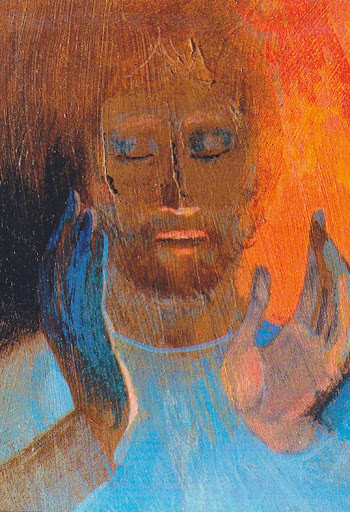
Last Saturday at mass, I heard something along the following lines during the sermon: “We need to look after our souls more than after our bodies, since our souls are eternal and our bodies will be discarded at the end of our lives.” While the intention behind this statement may have been good, and was set in the context of the priest noting that only around 1% of those who attend mass come to confession in his parish, the suggestion of the body being secondary and only temporarily attached to the soul certainly wasn’t in keeping with the Church’s teaching. Since such dualist views are not uncommon and since I have heard them attributed to Catholicism by some friends of mine, I would here like to take a closer look at what the Catholic Church actually teaches about this topic.

Originally I was going to look at the question of how the body and soul are understood in a broader way, with a look at Scripture, a mention of St. Francis of Assisi, a glimpse at the counter-reformation and then examples from Pope Francis’ teaching (e.g., his insistence on the importance of touching the flesh of the poor and suffering), I will instead stay monographic and focus on what St. John Paul II wrote on the subject in his “Man and Woman He Created Them.” As soon as I went back to that book and started re-reading the relevant passages I realized that all of what I wanted to bring into play is there and is expressed crisply and sharply.

To being with, John Paul II’s point of departure is that of humans1 being made in the image of God and therefore being a “primordial sacrament”:

“Man appears in the visible world as the highest expression of the divine gift, because he bears within himself the inner dimension of the gift. And with it he carries into the world his particular likeness to God, with which he transcends and also rules his “visibility” in the world, his bodiliness, his masculinity or femininity, his nakedness. […] Thus, in this dimension, a primordial sacrament is constituted, understood as a sign that efficaciously transmits in the visible world the invisible mystery hidden in God from eternity. And this is the mystery of Truth and Love, the mystery of divine life, in which man really participates. In the history of man, it is original innocence that begins this participation and is also the source of original happiness. The sacrament, as a visible sign, is constituted with man, inasmuch as he is a “body,” through his “visible” masculinity and femininity. The body, in fact, and only the body, is capable of making visible what is invisible: the spiritual and the divine. It has been created to transfer into the visible reality of the world the mystery hidden from eternity in God, and thus to be a sign of it.”

Note how John Paul II does not say “he has a body” but “he is a body” and that the sacramentality of humans consists in their being a “visible sign” of God’s presence in the world. Unlike other sacraments, humans are conscious of their being so and therefore become subjects rather than objects:

“Consciousness of the gift conditions in this case “the sacrament of the body”: in his body as man or woman, man senses himself as a subject of holiness. With this consciousness of the meaning of his own body, man, as male and female, enters into the world as a subject of truth and love.”

The body’s origins (as gift from God and God’s visible sign in the world) and function (as “subject of holiness”) already point to it’s being a lasting and intrinsic part of what it is to be human:

“[W]e draw a first hope already from the mystery of creation: namely, that the fruit of the divine economy of truth and love, which revealed itself “at the beginning,” is not Death, but Life, and not so much the “destruction of the body of man made in the image of God,” but rather the “call to glory” (Romans 8:30).”

And it is Jesus’ resurrection that seals the deal:

“The resurrection, according to Christ’s words reported by the Synoptics, means not only the recovery of bodiliness and the reestablishment of human life in its integrity, through the union of body and soul, but also a wholly new state of human life itself.”

It is often said that all philosophy is a conversation between Plato and Aristotle, and the body-soul question seems to be no different. John Paul II here clearly aligns Christianity and Catholic teaching with Aristotle and later with Thomas Aquinas:

“Reflection about the resurrection led Thomas Aquinas in his metaphysical (and simultaneously theological) anthropology to abandon Plato’s philosophical conception on the relation between the soul and the body and to draw near to Aristotle’s view. In fact, the resurrection attests, at least indirectly, that in the whole of the human composite, the body is not, contrary to Plato, only temporarily linked with the soul (as its earthly “prison,” as Plato maintained), but that together with the soul it constitutes the unity and integrity of the human being. This is precisely what Aristotle taught, in contrast to Plato. When St. Thomas in his anthropology accepted Aristotle’s conception, he did so because he considered the truth about the resurrection. In fact, the truth about the resurrection clearly affirms that man’s “eschatological perfection and happiness cannot be understood as a state of the soul alone, separated (according to Plato, liberated) from the body, but must be understood as the definitively and perfectly “integrated” state of man brought about by such a union of the soul with the body that it definitively qualifies and assures this perfect integrity.”

Siding with Aristotle here is firmly on the basis of the resurrection, which brings about the original harmony that was created by God “in the beginning”:

“In the resurrection, the body will return to perfect unity and harmony with the spirit: man will no longer experience the opposition between what is spiritual and what is bodily in him. [… It is] not only that the spirit will master the body, but, I would say, that it will also fully permeate the body and the powers of the spirit will permeate the “energies of the body.””

John Paul II is quick to insist on the resurrection not having resulted in victory of spirit over body, a subjugation, but in participation and personal fulfillment:

“In fact, in the composite, psychosomatic being that is man, perfection cannot consist in a reciprocal opposition of the spirit and the body, but in a deep harmony between them, in safeguarding the primacy of the spirit. In the “other world,” this primacy will be realized, and it will be manifested in a perfect spontaneity without any opposition on the part of the body. Nevertheless, this should not be understood as a definitive “victory” of the spirit over the body. The resurrection will consist in the perfect participation of all that is bodily in man in all that is spiritual in him. At the same time, it will consist in the perfect realization of what is personal in man.”

This also very much echoes Giuseppe Maria Zanghí’s thought on how our being in God does not annihilate us, is not a victory over us, but instead:

“I can be myself in Him (being an intimate participant of Trinitarian life in the Word), while being really distinct from Him (by virtue of being a creature different from Him). It is His love that wants me, and the love of God does not withdraw into itself, canceling diversity with the other by totally reverting it to Himself, but “makes” the other and guards them in diversity from Himself, not wanting to possess (like He doesn’t possess Himself) in total reabsorption. […] Because the relationship between the two “opposing” extremes (I and the other, I and God) is still thought of as ending in one of the two (and, therefore, in the strongest!); while, if Christian faith is true, the relationship does not end in either of the mediated extremes, but in a third that saves them precisely in their diversity.”

And – as far as the body-soul relationship is concerned, I believe Zanghí’s “third” is precisely John Paul II’s “resurrection.”


1 In my own words I will use the somewhat awkward “humans” to refer to both men and women, while in the quotes from John Paul II’s writings there will be reference to “man.” Note, however, that John Paul II means “human” when his words are rendered as “man” in English, which is explicit from the full text of “Man and Woman He Created Them” and also reflects the fact that in Polish he uses the word “człowiek” which also refers to both men and women and is used in everyday language without the technical connotations that “human” has in English.