In anticipation of Pope Francis’ upcoming encyclical on ecology, I have been reading up on various Christian perspectives on the universe, since it is the context to which Francis’ thought will be applied. Speaking about ecology – the “interrelationship of organisms and their environments” – presupposes at least an implicit concept of what those environments and organisms are, and what I will attempt over a series of blog posts will be to sketch out how various Christian thinkers, and the official teaching of the Catholic Church, conceive of it.
Instead of following a chronological or hierarchical order, I will first look at the view that is closest to my own heart – the mystical experience of Chiara Lubich. In 1949, after several years of living to put the Gospel into practice during World War II and its aftermath, Lubich and her companions went to spend a summer in the Dolomites. There, Lubich experienced a series of intellectual visions during which she saw the Trinity reveal Itself to her and provide her with insights that she then proceeded to share with her companions and gradually with all she came in contact with. Here I don’t mean to dwell on the nature of these experiences, but instead pick out a couple of passages from them that show how creation (i.e., the Universe) was experienced by her in the context of the Trinity.
In fact, the first passage relates to the days before the first mystical experience took place, where Lubich recounts her sensation of God’s presence permeating nature (speaking in 1961):
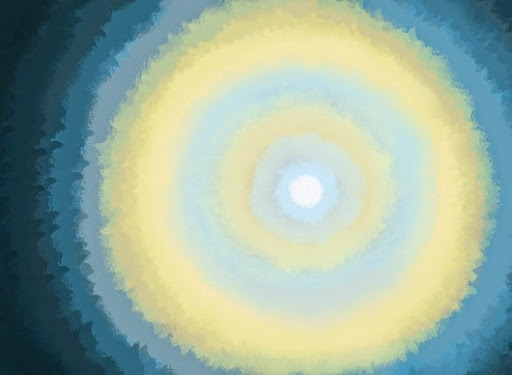
“I remember that during those days, nature seemed to me to be enveloped totally by the sun; it already was physically, but it seemed to me that an even stronger sun enveloped it, saturated it, so that the whole of nature appeared to me as being “in love.” I saw things, rivers, plants, meadows, grass as linked to one another by a bond of love in which each one had a meaning of love with regard to the others.”
On another occasion, she speaks about the same experience as follows:
“I felt that I could perceive, perhaps because of a special grace from God, the presence of God beneath things. Therefore, if the pine trees were gilded by the sun, if the brooks flowed into the glimmering falls, if the daisies, other flowers and the sky were all decked in summer array, stronger than all this was the vision of a sun beneath all creation. In a certain sense, I saw, I believe, God who supports, who upholds things. … The vision of God beneath things, which gave unity to creation, was stronger than the things themselves; the unity of the whole was stronger than the distinction among them.”
What emerges clearly from this event is an intuition of God’s sustaining presence in nature, of His being a unifying and all-pervasive presence and of nature being ordered according to the internal life of the Trinity, which is that of being a self-noughting, self-othering gift – i.e., love. While one way of thinking about the above is a spiritual one, the same experience can also be read from a conceptually paradigmatic perspective that suggests a relational, dynamically-interconnected nature of the universe. And while this is not science, and does not pretend to be science, it is a perspective on the same universe that science is working to understand.
Later, in the midst of a sequence of mystical visions, Lubich experiences creation (the universe) as seen from the perspective of paradise:
“When God created, He created all things from nothing because He created them from Himself: from nothing signifies that they did not pre-exist because He alone pre-existed (but this way of speaking is inexact as in God there is no before and after). He drew them out from Himself because in creating them He died (of love), He died in love, He loved and therefore He created.
As the Word, who is the Idea of the Father, is God, analogously the ideas of things, that “ab aeterno” are in the word, are not abstract, but they are real: word within the Word.
The Father projects them — as with divergent rays — “outside Himself,” that is, in a different and new, created dimension, in which he gives to them “the Order that is Life and Love and Truth.” Therefore, in them there is the stamp of the Uncreated, of the Trinity.”
The pre-mystical intuition of God being beneath all things is brought into focus and spelled out with greater specificity by making three points here: First, that the nothing that is the Universe’s origin is a nothing that results from God’s self-emptying (dying), motivated by love (a total giving of self (God), to the point of becoming nothing, out of love for an other (the Universe)). Second, that the “ideas of things” have a reality in themselves, instead of being mere abstractions. Third, that the way that God relates to the Universe is akin to the relationship between the sun and its rays (the rays being projected outwards, while remaining all sun) and that these “rays” (the Universe) are ordered (have “laws”, regularity – cf. earlier blog post on Genesis 1).
Dr. Callan Slipper, a theologian and close collaborator of Lubich, expands on the above passage as follows:
“Created things in themselves are not and remain nothing, but they have being insofar as it is given to them by participation. This means that creation, even though it is created and distinct from God and always dependent upon God, is, in its being, God. It is an externalized “God,” a “God” transferred outside Godself, a “God” that has become other. Certainly things are always nothing in themselves, but insofar as they are, they are constantly created by God. Their being is “God,” a “God,” so to speak, who is created and so having all the characteristics proper to creatures (finitude, temporality, incapacity, ignorance, and the possibility of suffering).”
What emerges is a picture where the Universe is anything but a remnant of a long forgotten game of snooker where God may have made the first shot and then withdrawn to the point of appearing dead. It is instead an image where God is the singer and the universe his song (cf. Zephaniah 3:17) – nothing in and of itself, yet made real and beautiful by the actions of its performer. On another occasion, Lubich speaks more specifically about how the universe relates to God-Trinity:
“In fact, in Creation all is Trinity: Trinity the things in themselves, because their Being is Love, is Father; the Law in them is Light, is Son, Word; the Life in them is Love, is Holy Spirit. The All given by participation to the Nothing.”
The point here is that the dependence on God is not just some wishy-washy generalisation, but that the Universe is seen as specifically intertwined with the Persons of the Trinity in ways that simultaneously reflect the specificity of each Person (Being, Law, Life) and their being one (Love). Slipper puts this particularly forcefully: “the “vestigia trinitatis” — the “traces of the Trinity” — that can be seen impressed upon things are neither arbitrary nor metaphorical, but are the presence of God” (emphasis mine).
Later, Lubich offers another powerful insight about how creation (the Universe) relates to God:
“When I see a lake of water projected by the sun upon the walls and see the play of the water upon the walls shudder according to the quivering of the real water, I think of creation.
The Father is the real sun. The Word is the real water. The lake reflected is the created. The created is nothingness clothed in the Word: it is the Word reflected. Of “being” in the created therefore there is only God. Except that, while the lake on the walls is false, in creation the Word is present and alive: “I am . . . the Life.”
In the created there is unity between God and nothingness. In the Uncreated between God and God.”
While this is fundamentally analogous to the image of the sun and its rays, the image of the reflection of a lake adds nuance by investing the created (the Universe) with reality. Not a reality independent of God (as has already been established), but a reality of finite, temporal, variety nonetheless. In fact, Lubich returns to this point when recounting a vision of the Eschaton – the end of time:
“I think, for example, of a bird. In paradise there will be the Idea of the bird and there will be all the various ideas. It is likely that there will be therefore also this bird ‘clarified.’ […] And they [i.e., all created things] are Trinity among themselves, since the one is Son and Father of the other, and they all come together, loving one another in the One from whence they came.”
Slipper again explains the above with great clarity, by emphasising that “In bringing about this return to the model, each thing will not be lost in a unity without qualifications, a kind of totalizing void, but, returning to the model Idea, the various ideas come back together in all their variety.”
Finally, and bringing this thread to its point of contact with the question of ecology, Lubich also speaks about the consequences of the above relationship between God and the Universe:
“[T]he fact that God was beneath things meant that they weren’t as we see them; they were all linked to one another by love; all, so to speak, in love with one another. So if the brook flowed into the lake it was out of love. If the pine tree stood high next to another pine tree, it was out of love. […]
I have been created as a gift for the person next to me, and the person next to me has been created by God as a gift for me. … On earth all stands in a relationship of love with all: each thing with each thing. We have to be Love, however, to discover the golden thread among all things that exist.”
Love of and care for the entire Universe are, in Lubich’s vision, a direct consequence of all creation being Trinity by participation, of all relating to all as the Persons of the Trinity relate to each other. I am ontologically bound not only to my neighbours, but the Universe in its totality, all of us jointly having resulted from God’s total gift of self. Such an understanding of creation takes John Donne’s famous “any man’s death diminishes me, because I am involved in mankind, and therefore never send to know for whom the bell tolls; it tolls for thee” and projects it out beyond humanity to the entire Universe.
Just to avoid a potential misunderstanding, it is worth addressing the question of what the nature of the above insights is and how they relate to other forms of rational enquiry, such as philosophy and science. Here, the thoughts of another of Lubich’s collaborators – the nuclear engineer, philosopher and theologian, Prof. Sergio Rondinara – provide a framework by arguing for a unity of knowledge applied to a single reality, albeit approached by different means:
“[Philosophy, science and theology] are forms of autonomous and legitimate interpretation because of the different methods each employs. They are also formally distinct based on the different purposes each has assigned to the same act of cognition. [… They] are not comparable one with the other, since what is affirmed by one cannot be said by the other. For this reason they are mutually complementary, and […] can best express their approach to truth and their truthful contents in a dialogical context.
This […] aims to prevent the isolation of single fields of knowledge. Through appropriate philosophical mediation an indirect interaction among different fields of knowledge can be realized. It is a context in which proper interdisciplinary dialogue presumes that the quest for truth demands openness and acceptance of the position of others, requires each party to know and accept the differences and the specific contributions of the other, seeks what is common, and recognizes the interdependence of the parties. For [Lubich], dialogue between the natural sciences, philosophy, and the knowledge of the faith — that is, theology — is a way toward knowledge of the only reality and the only truth that can help the consciousness reach a unity of knowledge.”
 eyebeleave