Me atheist, you Vatican spokesman

Chinese whispers

The journalistic farce that followed Pope Francis’ now-famous “atheists” homily is best viewed through Monty Python lenses, where it is in many ways like the final scene of the Life of Brian.1 There, a centurion comes to rescue Brian from the cross, but when he asks “Where is Brian of Nazareth?!” everyone volunteers, even to the point of one of the other crucifixion victims saying “I’m Brian, and so’s my wife!”

Let’s backtrack though and see what happened step by step. First, there was Francis’ homily itself:

“The Lord has redeemed all of us, all of us, with the Blood of Christ: all of us, not just Catholics. Everyone! ‘Father, the atheists?’ Even the atheists. Everyone! And this Blood makes us children of God of the first class! We are created children in the likeness of God and the Blood of Christ has redeemed us all! And we all have a duty to do good. And this commandment for everyone to do good, I think, is a beautiful path towards peace. If we, each doing our own part, if we do good to others, if we meet there, doing good, and we go slowly, gently, little by little, we will make that culture of encounter: we need that so much. We must meet one another doing good. ‘But I don’t believe, Father, I am an atheist!’ But do good: we will meet one another there.”

When I first read this, a couple of hours after Francis delivered it during his 7 am Domus Sanctae Marthae mass on 22nd May, I felt great joy and gratitude for having a Pope who is open and welcoming to all – just like Jesus was. I thought no more about it, since it seemed to me to be just a re-iteration – albeit a very welcome and clear one – of what the Church has been teaching consistently since Vatican II.2 In essence, Francis was saying that we hope to see atheists in heaven as much as we hope to be there ourselves. This is not to impose beliefs on those who believe neither in God nor in the existence of heaven, but to assure them that we, Catholics (and many other Christians too), believe in a God who loves all and welcomes all, regardless of their beliefs.

When I then looked at Twitter later in the day, I saw it ablaze with two types of reactions: very positive ones both from Christians and atheists, welcoming the invitation to dialogue and the appreciation of the good done by atheists (e.g., see the Huffington Post article from the same day and note the Pope’s homily being the second most shared piece on Reddit) and very critical ones – mainly from “traditional” Catholics (e.g., see a particularly forceful and conceited criticism here).

The day ended well for this story though, with a spot-on rebuke of Francis’ critics from a 1964 homily of the then-Fr. Joseph Ratzinger, shared in a blog post by Anna Williams:

“It seems as if we want to be rewarded, not just with our own salvation, but most especially with other people’s damnation—just like the workers hired in the first hour. That is very human, but the Lord’s parable [of the workers in the vineyard (Matthew 20:1-6)] is particularly meant to make us quite aware of how profoundly un-Christian it is at the same time.”

So far, so good: another great homily by Pope Francis, mostly positive and some negative reactions and a great put-down of the critics to round out the day.

The next morning, the weather turned though and a farce of epic proportion began brewing with the news of a Vatican spokesperson having issued a correction of Pope Francis’ words. As far as I can tell, the source of this red herring was a post on cnn.com, which stated that “On Thursday, the Vatican issued an “explanatory note on the meaning to ‘salvation.’” The Rev. Thomas Rosica, a Vatican spokesman, said that people who [are] aware of the Catholic church “cannot be saved” if they “refuse to enter her or remain in her.”” This was quickly picked up by media outlets around the world, with headlines like: “Vatican Clarifies Pope’s ‘Atheist’ Remarks,” “Vatican corrects Pope: Atheists are still going to hell,” and “Not so fast: Vatican says Pope Francis got it wrong, atheists do go to hell.”

It was immediately clear to me that something didn’t add up here: first, Fr. Thomas Rosica isn’t “a Vatican spokesman” (Fr. Federico Lombardi being “the” Vatican spokesperson, who has been in office for many years),3 second, “people who are aware of the Catholic Church and are not in her cannot be saved” is not at all what the Catechism says4 and third, any member of the Catholic Church (never mind a priest or Vatican member of staff) who felt it to be their job to issue an “explanatory note” about the Pope’s words off their own back and unprompted by the Pope better check themselves, before they wreck themselves.

In any case, I was curious to see this alleged “explanatory note,” so I (foolishly!) headed over to the Vatican website, where – naturally – there was no trace of it. Instead, I tracked it down on zenith.org here and I found – as I should have anticipated – that it was actually not a bad commentary on Francis’ words (and, no, it did not contain the offensive quote on “being aware of the Catholic Church” attributed to it on cnn.com). So, the facts of the matter are that the Vatican never issued any communication to “correct” Francis’ words and Fr. Rosica actually did a good job of commenting on the Pope’s words in my opinion (if you take care to read the whole text rather than pick phrases out of context – or even misquote them).

Like in so many cases before (did anyone say “Jesus’ wife”?), this incident was a display of journalistic ineptitude, carelessness and superficiality.

To conclude though I’d rather leave you on a positive note – a quote from Pope John Paul II’s address to the United Nations from 1995, which Fr. Rosica quoted in his explanatory note:

“Because of the radiant humanity of Christ, nothing genuinely human fails to touch the hearts of Christians. Faith in Christ does not impel us to intolerance. On the contrary, it obliges us to engage others in a respectful dialogue. Love of Christ does not distract us from interest in others, but rather invites us to responsibility for them, to the exclusion of no one and indeed, if anything, with a special concern for the weakest and the suffering. Thus, as we approach the two thousandth anniversary of the birth of Christ, the Church asks only to be able to propose respectfully this message of salvation, and to be able to promote, in charity and service, the solidarity of the entire human family.”

[UPDATE] I actually started writing this post several days ago and I was beginning to wonder whether it still made sense to publish it, since the events it speaks about took place two weeks ago. Surely the storm in a teacup would have died down since then and Francis’ words would be seen for what they were. Last night and then this morning I saw two articles that changed my mind though: first, one by the otherwise very cogent Fr. Alexander Lucie-Smith, who concluded his latest blog post with the following: “Heresy, and atheism, produce nothing beautiful. They can’t. They are stony barren fields.” and second, a post by the atheist Herb Silverman, whose take on the matter is that “Perhaps Pope Francis forgot to run this concession by the papal censors, because the following day the Vatican announced a do-over. The Rev. Thomas Rosica, a Vatican spokesman, said that those who are aware of the Catholic Church “cannot be saved” if they “refuse to enter her or remain in her.” […] So Rev. Rosica is simply reiterating the traditional Catholic position that atheists can go to hell.” Sadly, this post still has currency, but I hope that you have found it to be of some interest.


1 And those of you who are well versed in all matters Python, will also have spotted the direct reference to the “nurse” sketch, which is closely related to the present matter too.
2 For previous coverage of how the Church relates to atheists, see the following posts.
3 Though he did translate for Lombardi during the last conclave, so the mixup could be excused – if the source were not supposed to be engaged in journalism.
4 What the Catechism actually says is this: “Hence they could not be saved who, knowing that the Catholic Church was founded as necessary by God through Christ, would refuse either to enter it or to remain in it.” (§846)
Knowing and necessary – two very strong words, on a very different end of the scale to being aware that the Catholic Church exists! In effect it means that if you act against your own certain conviction that being in the Catholic Church is necessary for salvation, you are choosing to reject it and it is your freedom that is being respected instead of you being excluded.

The church that can(not) change

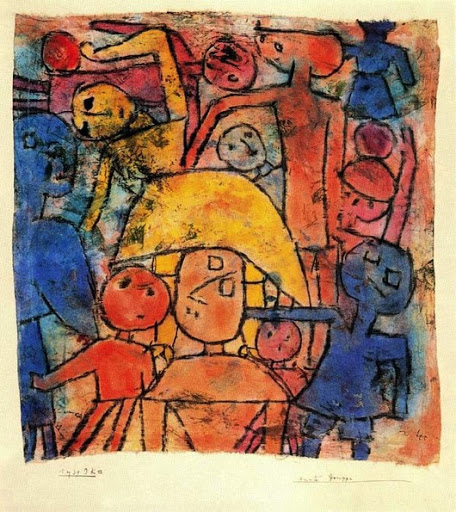
Paul Klee Colourful Group

A criticism frequently leveled at the Church is that it is set in its ways and that – unlike science – new inputs have no impact on its tenets. In a word, the Church comes across as static, in a world whose rate of change increases and that adapts and adjusts itself continuously. The end result is the appearance of mismatch and alienation, and Church representatives saying things like “These are the teachings of the church and they’re unchangeable truths.” does not help.

There is a very serious problem with statements like the above though and I am just saying so from the perspective of the Church itself, rather than as a criticism from outside. The problem is that such statements negate Jesus’ own words: “I have much more to tell you, but you cannot bear it now. But when he comes, the Spirit of truth, he will guide you to all truth.” (John 16:12-13). They deny “inspiration” received from the Holy Spirit and consider the Church’s teaching to be an immutable monolith obtained in one go rather than the gradual understanding of its full revelation in the person of Jesus. In fact Pope Francis himself reminds us that “throughout the history of salvation, whenever God reveals himself, He brings newness — God always brings newness — and demands our complete trust” and then goes on to challenge us:

“Are we open to God’s surprises? Or are we closed and fearful before the newness of the Holy Spirit? Do we have the courage to strike out along the new paths which God’s newness sets before us, or do we resist, barricaded in transient structures which have lost their capacity for openness to what is new?”

This is not to say that everything is open to change, but to be very clear about change being a core feature of Christian faith and consequently of the Church’s teaching too.

“OK,” you say “but does the Church actually change what it teaches?” Instead of answering that with a categorical “yes” and a lot of handwaving, let me present the following, very specific, example that I came across by accident some time ago. It concerns the question of “mixed marriages,” which here refers to marriages between one Catholic and one Christian, but non-Catholic spouse.

Let’s first look at how such marriages were spoken of in 1893, in Pope Leo XIII’s Constanti Hungarorum encyclical:

“[T]o remove the source of many evils, it is of utmost importance that pastors never cease to admonish their flocks to refrain as far as possible from entering into mixed marriages. Let the faithful correctly understand and resolutely remember that it is their duty to regard with horror such marriages, which the Church has always detested. They are to be abhorred for the reason which we emphasized in another letter, “They offer the opportunity for a forbidden sharing and participation in sacred things; they create a danger to the religion of the Catholic partner; they are an impediment to the virtuous education of children and very often cause them to become accustomed to viewing all religions as equal because they have lost the power of discriminating between the true and the false.” (Pope Leo XIII, Arcanum)”

Uff … “source of many evils,” “regard with horror,” “the Church has always detested,” “to be abhorred,” “impediment to the virtuous education of children [… who lose] the power of discriminating between the true and the false.” Sounds nasty!

Scroll ahead 100 years and look at what the 1993 Catechism of the Catholic Church says on the exact same subject (§1633-1637):

“[Mixed marriage] requires particular attention on the part of couples and their pastors. […] Difference of confession between the spouses does not constitute an insurmountable obstacle for marriage, when they succeed in placing in common what they have received from their respective communities, and learn from each other the way in which each lives in fidelity to Christ. But the difficulties of mixed marriages must not be underestimated. They arise from the fact that the separation of Christians has not yet been overcome. The spouses risk experiencing the tragedy of Christian disunity even in the heart of their own home. […] Through ecumenical dialogue Christian communities in many regions have been able to put into effect a common pastoral practice for mixed marriages. Its task is to help such couples live out their particular situation in the light of faith, overcome the tensions between the couple’s obligations to each other and towards their ecclesial communities, and encourage the flowering of what is common to them in faith and respect for what separates them.”

Hmm … “learn from each other the way in which each lives in fidelity to Christ,” “tragedy of Christian disunity […] in the heart of their own home,” “encourage the flowering of what is common to [the couple] in faith and respect for what separates them.” From abhorrently horrific, conscience-distorting evil to a challenging miniature laboratory of ecumenism where “fidelity to Christ” mutually enriches spouses – all in the space of 100 years. Not bad …

The devil

Liardet2

Beyond his great humility, simplicity, personal poverty, warmth and approachability, what struck me about Pope Francis have also been his frequent references to the devil. He mentioned him as early as his first full day in office and keeps bringing him up at least on a weekly, if not a more frequent, basis in his sermons.

Since the devil is not part of what consciously constitutes my spiritual life, I have at first just glossed over his mentions, but I am now growing curious about why it is that Francis so frequently refers to him. It is not that I have an issue with the devil being referred to – it is more that I just haven’t given him much thought. The Christianity I try to practice is about love rather than the avoidance of sin, about following Jesus rather than combatting the devil and about seeking to encounter goodness, truth and beauty rather than learning how to recognize evil. It is not that I don’t care about avoiding evil, but I believe that to be a necessary side-effect of seeking good.

The problem of evil is unquestionably challenging though and its manifestations in the world are a source of horror and sorrow for me, which does make me want to understand why it is that Francis speaks so often about the devil. In fact, I have been reading Steven Pinker’s excellent The Better Angels of Our Nature precisely for the sake of gaining a better understanding of how it is that we, humans, are capable of the shocking atrocities that we keep perpetrating on each other. While Pinker is certainly critical of religion and opposed to the idea of the devil, he makes two points that I think are relevant here: first, that “[we] need to make the case that [our inner demons] exist, because there is a resistance in modern intellectual life to the idea that human nature embraces any motives that incline us toward violence at all,”1 and second that “[violence] is not a single motive, let alone a mounting urge. It is the output of several psychological systems that differ in their environmental triggers, their internal logic, their neurobiological basis, and their social distribution.” In other words, Pinker argues both that there is a tendency to deny the ubiquity of the capacity for violence and that its origins and manifestations are complex.

These two points are in fact a great bridge from contemporary psychology and anthropology to the Church’s teaching about evil and the devil. In its most recent (1975) review of the subject of the devil, the Congregation of the Doctrine of the Faith starts with the same kind of realization as Pinker makes in the context of violence – that “the very existence of the devil is frankly called into question.” On the point of complexity too, it calls for caution and reason: “The many forms of superstition [and] obsessional preoccupation with Satan […] have always been condemned by the Church. […] Reserve and prudence are in fact demanded. [… O]ne must exercise discernment. And one must leave room for research and its findings.” Finally, it also dispells a potential misunderstanding, where the devil could be used as an excuse and a barrier to seeking scientific understanding: “It is clear that [the Church] has never allowed man to rid himself of his responsibility by attributing his faults to the devil. The Church did not hesitate to oppose such escapism when the latter manifested itself, saying with St. John Chrysostom: “It is not the devil but men’s own carelessness which causes all their falls and all the ills of which they complain.””

So, why is it that the Church speaks about the devil? By far the most obvious and compelling answer is that Jesus himself did so – calling him “tempter” (Matthew 4:3), “accuser” (Revelation 12:10), “father of lies” and “murderer” (John 8:44). Who is this devil though, whom Jesus speaks about? Jesus himself describes him as follows: “He was a murderer from the beginning and does not stand in truth, because there is no truth in him.” (John 8:44). Two things are important here: first, that the devil has been present “from the beginning,” which the Catechism explains by saying that ““[t]he devil and the other demons were indeed created naturally good by God, but they became evil by their own doing.” Scripture speaks of a sin of these angels. This “fall” consists in the free choice of these created spirits, who radically and irrevocably rejected God.” (§391-392). This means that the devil is God’s creature, rather than an equivalent but opposed being, which in turn leaves God as having created only what is good and the devil opposing him out of pride and his free choice. The second part of Jesus’ profile of the devil is equally key: the devil has “no truth in him” – his temptations are lies and the sufferings they lead to are a consequence of an opposition to the truth.

Coming back to Pope Francis, let me just pick out a couple of his references to the devil:

  1. In his very first sermon after being elected pope, Francis quotes the French poet Léon Bloy: “Whoever does not pray to God, prays to the devil.” I read this as him pointing to there being no middle ground between truth and falsehood.
  2. During one of his morning masses in the Domus Sanctae Marthae, he points to the seriousness of falsehood: “We are all sinners; all of us. We all commit sins. But calumny is something else. It is of course a sin, too, but it is something more. Calumny aims to destroy the work of God, and calumny comes from a very evil thing: it is born of hatred. And hate is the work of Satan. Calumny destroys the work of God in people, in their souls. Calumny uses lies to get ahead. And let us be in no doubt, eh?: Where there is calumny, there is Satan himself.”
  3. On another occasion he places the impulse to gossip at the feet of the devil: “When we prefer to gossip, gossip about others, criticize others- these are everyday things that happen to everyone, including me – these are the temptations of the evil one who does not want the Spirit to come to us and bring about peace and meekness in the Christian community.”
  4. Finally, he also warns that “the devil, lead[s] us to believe that ghosts, fantasies, are reality,” again underlining how it is the absence of truth that is the root from which evil springs.

As you can see, the above is just my attempt to structure some first notes rather than an exposition of some clear insight. I am at the point of trying to begin to make sense of why it is that Francis keeps bringing up the devil and trying to understand why it is that Jesus, and subsequently the Church, speaks about him. The picture I am getting is one that certainly makes sense in the bigger context of creation and has the following as its core idea: The truth presented to a free recipient can be rejected out of pride, where subsequent lies result in evil and suffering. To have this rejection of the truth be the act of a creature, albeit spiritual, rather than “just” an abstract concept or principle is again consistent with the personal nature of the Trinity and the ultimate superiority of good to evil.


1 This reminded me of the following line from The Usual Suspects (delivered by the character Keyser Söze), which comes from Charles Baudelaire’s Le spleen de Paris: “The finest trick of the devil is to persuade you that he does not exist.”

Neither faith nor reason: ex nihilo butchered

Nequaquam

Another Sunday, another “Faith and Reason” column in the “Our Faith on Sunday” newsletter, another spectacularly confused piece on an otherwise interesting topic, and this time – to add insult to injury – a complete disregard for the fact that it was Easter Sunday!

Instead of reflecting on something to do with the Easter triduum (e.g., the resurrection, Jesus’ descent into hell or his abandonment on the cross, or a myriad other aspects that could have been looked at from the faith-reason perspective), yesterday’s column was the following (with its first, superfluous sentence removed):

“[…] Creation ex nihilo (out of nothing) does not mean that, before matter was brought into existence, that there was absolute nothingness. If there had been absolutely nothing before creation, absolutely nothing could have come into existence. The nihil of ex nihilo refers to the nothing of material existence. Creation ex nihilo means that, before matter was called into being, there was no matter. God and the angels existed ‘before’ the creation of matter.”

Oh, man! Where to start? Before debunking the above hot mess, let me just put a couple of quotes from the Catechism on the table, so that the squirming irrationality of this week’s “Faith and Reason” column is counterbalanced by how the Church actually talks about God and creation:

“In [Jesus] “all things were created, in heaven and on earth… all things were created through him and for him. He is before all things, and in him all things hold together.” (Colossians 1:16-17)” (§291)

“We believe that God needs no pre-existent thing or any help in order to create, nor is creation any sort of necessary emanation from the divine substance. God creates freely “out of nothing”.” (§296)

“The world began when God’s word drew it out of nothingness; all existent beings, all of nature, and all human history are rooted in this primordial event, the very genesis by which the world was constituted and time begun. (cf. St. Augustine, De Genesi contra Manichaeos 1, 2, 4)” (§338)

Note how there is no arguing against the nothingness that preceded creation in the Catechism (neither in the passages quoted above nor anywhere else in its 2865 paragraphs) for it would be futile to do so. Even in the context of poetic (as distinct from philosophical, theological or scientific) language, both Genesis 1 (“In the beginning, when God created the heavens and the earth”) and John 1 (“In the beginning was the Word, and the Word was with God, and the Word was God. He was in the beginning with God. All things came to be through him, and without him nothing came to be.”) steer well clear of attempting to talk about what happened before “the beginning” in which God created the universe (i.e., space-time).

Why is that? Again we find the Church’s position in the Catechism as follows:

“Since our knowledge of God is limited, our language about him is equally so. We can name God only by taking creatures as our starting point, and in accordance with our limited human ways of knowing and thinking.”(§40)

“God transcends all creatures. We must therefore continually purify our language of everything in it that is limited, image-bound or imperfect, if we are not to confuse our image of God — “the inexpressible, the incomprehensible, the invisible, the ungraspable” — with our human representations. Our human words always fall short of the mystery of God. Admittedly, in speaking about God like this, our language is using human modes of expression; nevertheless it really does attain to God himself, though unable to express him in his infinite simplicity. Likewise, we must recall that “between Creator and creature no similitude can be expressed without implying an even greater dissimilitude”; and that “concerning God, we cannot grasp what he is, but only what he is not, and how other beings stand in relation to him.””(§42-43)

To me the key here is: “we can name God only by taking creatures as our starting point,” which you could transpose into Wittgensteinese as “we can only use the rules of games we have played.” In other words – the meanings of our language (using which we can “name” God) derive from our own, direct experiences, which take place firmly within the context of the universe and which therefore have a scope constrained to it. Instead of strictly following Wittgenstein’s “whereof one cannot speak, thereof one must be silent,” Christianity still talks about God and about what has been revealed to it about realities beyond the universe, but does so with great caution and with lots of “in some sense.”

To take the “ex nihilo” of God’s creative act and start qualifying it in the belief that it would otherwise preclude a pre-existence of God is jut confused, since before the “beginning” in which space-time were created, there is no before (which requires time) and to consider creation to be only of matter (and not of time as well – as the column’s author does) not only flies in the face of contemporary physics but also of St. Augustine’s insights, arrived at around 389 AD.

The crowning glory of yesterday’s column though is its assertion that “If there had been absolutely nothing before creation, absolutely nothing could have come into existence,” which is a direct denial of God’s ex nihilo bringing about of the universe (and of contemporary physics pointing to the same) and stands proudly alongside the same column barefacedly denying the incarnation the previous Sunday.

The most charitable interpretation of yesterday’s mental contortions is that they were a misguided attempt at trying to resolve a fictitious contradiction or a mistimed April Fools prank …


1 Previous ones having protested against the denial of the incarnation, the allegedly separate “orders of knowledge” of science and religion, the abuse of “cf.,” the perversion of philosophy and a plagiaristic ignorance of infinity.

Why did God make bad stuff?

Thorns

Since my sons, who are 5 and 10 years old, attend a non-Catholic school, I have been giving them Catechism lessons. The format is that I try to get them to propose topics, encourage them to share what they think themselves and then attempt to round out the picture we arrive at together. When we kicked-off these weekly catechism sessions, the first one was me pretending to be an alien and asking them to explain to me what this whole God, Jesus, Church business is all about – as you can imagine it was hilarious both for me and for them and I believe it gave catechism a place in the entertainment category :).

At the end of the most recent session, I again asked my boys for suggestions for the next topic, to which my older son replied: “Why did God make bad stuff?” I have to say I was really pleased with this question, since it shows that he is thinking carefully about his faith and also that he applies and contrasts it with his life.

What I would like to do next, therefore, is to sketch out the answer that I’ll try to get across in our Q&A-style format and thereby to attempt a response to the question of evil in language accessible to a 10-year-old, with a 5-year-old listening in. The following then are some of the questions/ideas I will try to share with them. As you’ll see, they expect certain responses from the boys that you’ll just have to intuit from my half of the conversation :):1

“What do you like best about your friends?

Great! Can you think of some examples when someone was kind/friendly/nice to you?
And you do the same to others as well, don’t you?

But do you think you can make someone be nice/friendly/kind?

That’s right, you can’t! They have to choose to be nice to you, don’t they? And sometimes even your friends aren’t nice – right? Can you think of some examples?

That’s not good, is it? But, do they stop being your friends?

Exactly, of course they don’t … What do you think you can do when they are not nice? Can you make them be nice?

Is there something else you can do though?

That’s right, you can keep being kind and loving towards them, regardless of what they do. But it’s best when they are kind and loving back to you, isn’t it?

What do you think God would like us to do?

And do you think he can make us be nice?

Sure, he could – but then it wouldn’t really be us who are loving him, would it? We would no longer choose to be kind and we’d be like robots instead. Do you think God wants us to be like robots?

So, it looks like God needs to give us the choice to be either good or bad, so that we can really choose to love him and the people around us … But, let’s think a bit more about the question we started with: “Why did God make bad stuff?” Do you think he really made bad stuff?

That’s right – he didn’t, because he is good and he always loves everyone! Good things are like light and bad things are like darkness – in the end there will be light everywhere. No matter how much darkness there is, it cannot stop the light shining from even just one candle.

So, you can see that when we are unkind to others it is not God who makes them suffer. He only lets it happen because he wants us to choose to be kind instead of forcing us. But, instead of choosing to be kind, we are sometimes mean – that’s pretty sad, isn’t it?

How do you think God feels when we are mean to each other?

Yes, he is sad too, because he loves every one of us very much and when we are mean to others we are also mean to him.

How about another, even more difficult question: Why is it that bad things happen that are not the result of someone being mean? Why do people get sick, why are there earthquakes or tsunamis, or why is it that God doesn’t stop people from being mean when what they do is very bad? What do you think?

It is tricky … And, to be honest I don’t know either! I don’t think anyone really knows. What we do know though is that when Jesus came to show us how God loves us, in the end he suffered a lot for us. As you know, he was killed in a very painful way on the cross. What do you think this tells us?

Yes, it must mean that there is a reason for suffering. We don’t know what it is, but we can trust that God is loving us even when things are difficult and painful. Just imagine that God, who can do anything he wants, chose to show us that he loves us so much that he is prepared even to suffer for us.

And do you remember what happened after Jesus was killed on the cross?

Yes, he came back to life and then went up to heaven. It is the same for us – when bad things happen we can say to Jesus: “I know you are with me now and I am with you on the cross.” You will see that you will feel Jesus close to you and he will then take you with him to heaven.”

I know the above is incomplete and far from a satisfactory treatment of the problem of evil for an adult audience (and probably even for kids). What I tried to do though is to give my sons a sense of how freedom plays a role here, how it is that we don’t have anything like a full answer and also how Jesus’ death and resurrection can help us at least intuit the value of suffering. Any thoughts on the above would be much appreciated – as always!


1 Not that I can hope for anything remotely as masterful as Camus’ The Fall, but at least the half-dialogue format of the following is inspired by it :).

The identity of discernibles

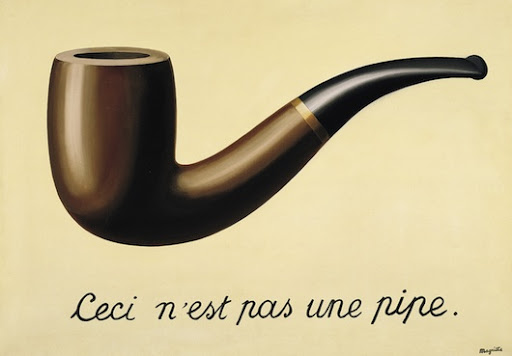
margritti-this-is-not-a-pipe_s.jpg

If two men or two women want to make a life-long commitment of love and support to one another, for better, for worse, for richer, for poorer, in sickness and in health, why shouldn’t that be called marriage? Why do many religious people have an issue with this and why don’t they just recognize and appreciate the love and commitment such couples have for one another? Doesn’t a lack of support for same-sex marriages show an elitism, judgment and discrimination that are foreign to Jesus’ message? As heterosexual couples can marry, why should that right be denied to homosexual ones? And why is it that same-sex marriage should be a threat to the very idea of marriage?

Questions like the above have, I believe, a great deal of profound Christian appeal: love, commitment, not judging, equality and taking the beam out of one’s own eye before proceeding to the splinter in another’s are all deeply Christian principles and when Christians are criticized for their seeming lack, they better take them seriously. Actually, when I say they, I mean me, so let me make this train of thought more personal. What do I think? Where do I stand?

First, let me be super clear about one thing: I believe God has a plan for every single human being and loves each one of us immensely. The late Patriarch Athenagoras saying that “God loves everyone equally, but secretly each one of us is his favorite,” Martin Luther saying “It is not because we are beautiful that God loves us, but because God loves us that we are beautiful,” John Paul II adding that “The person who does not decide to love forever will find it very difficult to really love for even one day,” and Benedict XVI tweeting yesterday that “Everything is a gift from God: it is only by recognizing this crucial dependence on the Creator that we will find freedom and peace,” sum it up for me. Everyone is loved by God, who sees beauty in them, and my love for all mustn’t be selective, jealous or fretting either. So, I believe God loves homosexual men and women and I too need to do the same to call myself a follower of Jesus.

I am therefore vehemently opposed to any lack of love shown towards homosexual persons and am strongly against homophobia, bullying, marginalization or any other respect and care that is not extended to them. Violence against homosexual men or women horrifies me, with cases where it is the state that fuels it (as in Uganda and countries where there are criminal penalties for homosexuality) being particularly abhorrent to me. This is a position that I hold beyond doubt and one in which I feel fully in line with the position and teaching of the Church.

The Catechism states clearly that homosexual persons “must be accepted with respect, compassion, and sensitivity. Every sign of unjust discrimination in their regard should be avoided. These persons are called to fulfill God’s will in their lives.” (Catechism of the Catholic Church, §2358). Several bishops have emphasized that there is good in relationships among homosexual men or women, such as Bishop Woelki of Berlin saying “I also try to acknowledge that they take responsibility for each other on a permanent basis, have promised each other faithfulness and want to look after each other,” the Bishops of England and Wales stating that “We also recognise that many same sex couples raise children in loving and caring homes,” or the late Cardinal Basil Hume affirming that “Homosexual people […] can, and often do, give a fine example of friendship and the art of chaste loving.” As recently as last Monday, there is also the determination by Archbishop Vincenzo Paglia, head of the Pontifical Council for the Family, for the Church to “do more to protect gays and lesbians from discrimination in countries where homosexuality is illegal. […] In the world there are 20 or 25 countries where homosexuality is a crime, […] I would like the church to fight against all this.”1

So, am I in favor of same sex marriage then? Actually, no … My reason for this is that marriage is a lifelong commitment of one woman and one man to each other. This commitment results in the birth of a family, which, at least in principle, is open to the procreation of children. As this is what the concept of marriage means, it is not applicable to same sex couples. But isn’t this discriminatory and doesn’t it fly in the face of everything I have said above? I honestly don’t think so, and I am fully in agreement with the Bishops of England and Wales, who say:

“We disagree that the signal that is sent currently, by restricting marriage to opposite sex couples, is one of disparagement of same sex relationships. The basic argument that is advanced in favour of same sex marriage is one of equality and fairness. But we suggest that this intuitively appealing argument is fundamentally flawed. Those who argue for same sex marriage do so on the basis that it is unjust to treat same sex and heterosexual relationships differently in allowing only heterosexual couples access to marriage. Our principal argument against this is that it is not unequal or unfair to treat those in different circumstances differently. Indeed, to treat them the same would itself be unjust.”

This to me is the crux of the argument: the outcome of even the commitment expressed by marriage vows results in two different states depending on whether it is done by two people of different sexes or the same sex. While there are similarities (i.e., the value and sincerity of the commitment and the love that it springs from and subsequently supports), there are categorical differences too (i.e., the possibility of bringing children into the world and the complementarity of the male and female sexes). Ignoring such differences is the beginning of a loss of clarity of thought and consequently of judgment and action. It is akin to suddenly deciding that we will call an ear an eye – they are both organs and result in sensory perception and surely the ear is just as good as the eye. It is certainly possible to do this, but it will result in confusion (were all the pre-ear=eye statements about eyes meant to apply to the new eye or only to eye-eyes and not ear-eyes?).

The motivation for extending marriage to same sex couples may in many cases be good and be underpinned by principles that I fully subscribe to, but the result is a delusion and a divorce from reality.

Nonetheless, I believe that many homosexual men and women do not feel welcomed by the Church, which to me is similar to the lack of unity among Christians – both pain me, but for both I place myself firmly inside the Church and try to understand what it is that I can do towards overcoming them. With Christian unity too we could decide from one day to the next that we will declare ourselves to be united, that we’ll just change the definition of a couple of terms so that they span previously exclusive concepts. But what would we achieve with that? Not only nothing, but it would be a step back, as it would hinder a true understanding of underlying reality and efforts to arrive at a loving solution that has its eyes wide open.2


1 Even though it is not the topic of this post and addressing it even just briefly would make it way too long, I can’t not mention the Church’s classification of homosexual relationships as “objectively disordered.” This, I have to say, is an unfortunate choice of words. Cardinal Hume felt the same and provided the following reflection:

“The word ”disordered” is a harsh one in our English language. It immediately suggests a sinful situation, or at least implies a demeaning of the person or even a sickness. It should not be so interpreted. First, the word is a term belonging to the vocabulary of traditional Catholic moral theology and philosophy. It is used to describe an inclination which is a departure from what is generally regarded to be the norm. The norm consists of an inclination towards a sexual relationship with a person of the opposite sex and not between persons of the same sex. Being a homosexual person is, then, neither morally good nor morally bad.”

This is an argument I do agree with: the sexual relationship between a man and a woman is constituent of what it means to be human, while such relationships between persons of the same sex are a departure from the inherent purpose of sexuality (without meaning to restrict it to its procreative function). I do believe this to be a fact, but that does not mean that homosexual men and women should not be welcomed by the Church in more effective and constructive ways than is the case today. What these ought to be is not clear to me, but I am convinced of their necessity.
2 Thanks to my überbesties KM, PM and MR for reviewing a draft of this post and for their great feedback!

Science and religion: a set-theoretic view

Universe

The question of how science and religion relate is a staple of this blog, yet in spite of numerous posts1 on this topic already, I feel the need to revisit it again (and probably not for the last time either). What I would like to give some thought to here, are different beliefs (or at least assumptions) about how God and the universe relate2 and the consequences they have on how science and religion are viewed.

For a change, let me start with what I believe myself and then proceed to contrast it with alternatives. To my mind, God infinitely exceeds the universe and is present everywhere and always – as St. Augustine puts it, God is “more inward to me than my most inward part; and higher than my highest.” (Confessions 3, 6). He has both created and sustains the universe, but does so in a way that is intelligible (and therefore also repeatable – the expectation of different outcomes when doing the same thing being one of the definitions of insanity, as Albert Einstein puts it). My position is therefore panentheistic (as opposed to pantheistic – God being equal to the universe – or deist, believing in a distant, separate God) and one that is fundamentally rational as opposed to fideist (a point also emphatically underlined by Benedict XVI during a general audience in November ’12). Here the universe, created “in and by” God,3 is both other than God and very much part of God and the top left quadrant of the diagram above is an attempt to depict it in terms of sets: the universe is represented by a circle, situated in an infinitely extending plane – God.

In this worldview, science is profoundly good not only because of the improvements to life that it can yield, but also because it tells me about how the universe that God created operates. It tells me about God in a way that is like learning about a mime artist by viewing their performance – the information is not immediate, but nonetheless leads to insights about the actor. Another source of understanding God comes to me from theology, which seeks to understand what God has revealed about himself through his relationship with the people of Israel, through his Son, Jesus and through his presence among his followers since then and into the present. These two sources of information about God are in perfect complementarity and equally fill me with wonder and admiration.

Yet science and religion (theology) are not the same – the former has methods finely tuned to bringing the laws of the universe to light and spans the sensible (empirical), while the latter has a span that exceeds that of science, by addressing the extra-empirical aspects of the universe (the whys and ought(’nt)s) as well as events and entities exclusive to its scope. This is not to place one above the other, but simply to put them in relationship as far as their scopes are concerned (bottom left quadrant of the above diagram).

In summary, my understanding of science and religion is that they jointly yield an understanding both of the world I live in and its source and purpose that I believe in. As John Paul II said, “Science can purify religion from error and superstition; religion can purify science from idolatry and false absolutes. Each can draw the other into a wider world, a world in which both can flourish.”

As for alternative views, a positioning of the world as separate from God and outside God, as shown on the right side of the above diagram, is also widespread among religious believers. Here God’s involvement in creation is only an initial impulse and setup, followed by a subsequent separation and distance. The scope of what science and religion have to talk about has no overlap.

My impression here is that this separation also extends into other spheres, beyond just the relationship between God and the universe. At times I come across (repulsive) statements that, e.g., imply that ethical behavior is “owned” by those who hold religious beliefs or that the same applies to truth or beauty.4 In my set theory of the God-universe relationship, all that is good, true and beautiful in the universe, and is accessible without faith, is mine and I just feel like I am being given more or being helped more to live it from my additional, extra-empirical sources.

I have a feeling that this (right) picture also applies to atheist believers, with the circle representing God removed. Here all that is believed to exist is the universe, which is being understood by scientific means and religion is a separate activity that has no corresponding object.

Finally, I suspect that those atheists, who don’t acknowledge that their position is a belief, operate on a worldview like mine (i.e., on the left above), but with the labels swapped. Claims about God are treated like claims about an entity enclosed in the universe and therefore fully subject to the methods of science. Religion too is an activity that can be fully reduced to scientific scrutiny just like any other human activity. If this is correct, then I can understand why atheists who fall in this category find religious belief as lacking in credibility, to the point of being hostile to it.

If any of you, my readers, identify with one of the positions other than mine, I would very much appreciate it if you let me know if I misunderstood something about it. And even if you agree with me, I’d be keen to hear from you :).


1 With previous looks at the science of creation from nothing, a mystical view of creation, the role of belief in science (also here), the dialogue between Chief Rabi Sacks and Prof. Dawkins, the ambiguous relationship between theory and evidence, the constraints of empiricism, the “God of gaps” caricature, atheism as a creed, the evidential equivalence of atheism and religious belief, Martini and Eco’s dialogue on ethics and a call for recognizing rationality in (some of) religion and science alike – to mention just a few :).
2 Many thanks to NP and AG with whom I have spoken about some aspects of this picture by email and over on Facebook over the last weeks. Their insights triggered a lot of interesting and valuable discussion.
3 “The universe, created in and by the eternal Word, the “image of the invisible God,” is destined for and addressed to man, himself created in the “image of God” and called to a personal relationship with God. Our human understanding, which shares in the light of the divine intellect, can understand what God tells us by means of his creation.” (Catechism of the Catholic Church, §299)
4 My friend, SC, told me of a particularly saddening and vile case of her parish priest telling her (at the age of 7) that she wasn’t even human, because she didn’t believe in God. This has nothing to do with Christianity as I understand it, as I hear it taught by the current and previous popes or presented in the Catechism. Instead, it is its perversion.

Rational and evidential equivalence

RothkoMural4

I don’t usually chase popularity, but what I saw after my previous post was published gave me cause for reflection. Of the 94 posts on this blog, “An atheist creed” has certainly had the best first 24 hours, with more than 100 views during that period alone. It was also my most popular post by far, reaching 10 “+1s” within a couple of hours. On Twitter and Google+ too it was received well, which suggested that I had picked a good topic. Not only that, but on Google+ it also lead to a conversation that made me append an update to the original post.

And then three of the original +1s were revoked, still leaving a respectable seven but clearly signaling disagreement with the update’s content. After a day of trying to work out what might have lead to someone changing their mind (and if you are one of the three who did, I’d love to hear from you), I have decided to expand on what I said, with the hope of being more explicit than the update’s 100 or so words allowed.

While the initial post attempted a summary of Dawkins’ “The God Delusion” and arrived at the conclusion that his position is one of unacknowledged belief, for the explicit variant of which he chides those who hold religious ones. At the end of the post I then admitted that, while I respect agnostic positions and hold a Christian one, I fail to see the honesty of atheism. After an enriching exchange on Google+ I then returned to the post and added an update in which I quote one of my atheist friends as saying that their atheism is a belief in there being nothing else out there beyond what we experience. Since this was the first time I have encountered atheism as a creed (my post’s title originally having been intended as a dig at Dawkins), I was surprised and felt like I needed to take a fresh look at it.

I suspect, although I am not sure (and, please, do correct me if I am wrong), that the following may have been the root of the discontent with the post’s update: “the nature of [religious or atheist] belief and [their] relation to evidence and rationality are, to my mind, equivalent.” While the original post was decidedly negative about atheism, the update may have looked like I have softened my stance and like I may even have devalued my own Christian beliefs. Let me therefore be more explicit about these two possible interpretations.

First, everything I have said in the post before the update still stands as is. The atheism presented by Dawkins, and many other militant, aggressive atheists like him, is to my mind rationally feeble and delusional. It claims to be a purely rational, evidence-derived position, while it cannot possibly be. This lack of honesty about the nature of such atheism is fundamentally harmful to those who hold it, since it endows them with an illusory sense of superiority that dramatically (and demonstrably) inhibits their capacity for dialogue.

Why do I claim that their position cannot be evidence derived? For a more detailed answer see this previous post, but in a nutshell it is this: All empirical evidence that I can ever have is in the form of my own experiences and not directly of entities beyond myself. I experience images, sounds, sensations of texture, pressure, temperature, etc. but in all of this I am only conscious of aspects of myself. When I have the experience of seeing an apple, my evidence is not of some external entity – the “apple” as separate from events in my stream of consciousness – but of an image formed in my consciousness. No amount of reference to others, method, measurement or anything else can possibly result in anything other than events that I can with certainty place anywhere other than my own consciousness. This is the nature of experience that has been well understood by philosophers for some centuries now (very clearly by Hume and Locke and to different extents also by many others in preceding centuries).

The only exclusively empirical position is to restrict oneself to making statements only about oneself. Anything else requires belief. A belief in a physical world that causes the experiences we have access to, or even a belief that there is nothing beyond oneself (or some of the more esoteric beliefs typically posited for the sake of exploring the nature of knowledge, like the idea that we are all brains in vats, being fed signals that give rise to the experience we have). A belief that the physical world is all there is or that there is something or someone else beyond it. Beliefs about what it is that lies beyond the physical world. All of these beliefs have the same relationship to empirical evidence – i.e., none! Empirical evidence can contribute to greater or lesser confidence being attributed to one theory or another that explains it, but its scope is only that of the empirical. Evidence cannot point one way or another when it comes to what is beyond it – whether it be nothing or something.

It is with this in mind that I said, and repeat, that an atheist creed has the same empirical and rational status as a religious creed (including my Christian one). The position that is rationally inferior is an atheism that considers itself to be derived from evidence and devoid of the necessity of forming beliefs beyond its scope.

Finally, let me also emphasize that this position is fully compatible with how Christianity understands its own beliefs – as a gift from God (Catechism of the Catholic Church, §153-154):

“Believing is possible only by grace and the interior helps of the Holy Spirit. But it is no less true that believing is an authentically human act. Trusting in God and cleaving to the truths he has revealed are contrary neither to human freedom nor to human reason. Even in human relations it is not contrary to our dignity to believe what other persons tell us […] or to trust their promises […] to share a communion of life with one another.”

My belief in God is empirically and rationally equivalent to another’s belief that there is nothing beyond the physical world and I look forward to learning from my atheist friends what it is like to hold the beliefs they do. Open, honest and charitable dialogue can only be enriching to all who partake in it and I am pleased that I can now count some atheists among those who appreciate it as much as I do.

In search of joy

Joy

As I haven’t managed to write a post here for over a week, I would just like to take the opportunity now to tie together a couple of the strands of the last seven days, which happen to have a shared theme of joy.

First, there is a talk by Pope Benedict XVI that I have been wanting to read for a while and that I finally got to last night. It is the first sermon he gave after the start of the Year of Faith, where he sets out to – what else – talk about the nature of faith. Amongst other things (and I encourage you to read the original in full), he says that “[f]aith is a gift of God, but it is also a deeply human and free act” and he asks himself how we can get “that openness of heart and mind […] to believe in the God.” The answer Benedict puts forward comes from Dei Verbum (§5): “To make this act of faith, the grace of God and the interior help of the Holy Spirit must precede and assist, moving the heart and turning it to God, opening the eyes of the mind and giving “joy and ease to everyone in assenting to the truth and believing it” (Second Council of Orange, Canon 7, 529 AD).” And this makes him conclude: “To believe is to trust freely and joyfully in God’s providential plan” and saying “yes” to God “transforms life, opens the way towards fullness of meaning, thus making it new, full of joy and of reliable hope.”

Second, this joy and freedom of choice (also supported by the ultimate emphasis placed on the freedom of conscience in the Catechism (§1790)) then lead to lives like those of the saints, whom Benedict considers to be “the greatest apologetic for our faith,” alongside art. The accessibility and attractiveness of the joy that another person has, was then one of the topics that I spoke about with my bestie JMGR – a (in my opinion accurately) self-proclaimed “born-again agnostic” :). While our beliefs and views cannot be transferred to another and can remain the subject of doubt and suspicion, the joy and goodness of another’s life is accessible to us regardless of what we think about their beliefs. We can recognize the goodness of the fruit and as a result be more receptive to listening to the tree. A related theme that came up during our chat was also the role of uncertainty in the context of building personal relationships. Acknowledging the fundamental limitations of knowledge (which make it impossible to go beyond one’s self epistemologically) can lead not to indifference or nihilism (which is exhausting) but instead to openness and a greater readiness to hear out those who hold other beliefs.

Third, preceding these explicit instances of thinking about joy as the primary focus, was my reflecting on the activities of aggressive atheists like Richard Dawkins and realizing that I should be grateful for them! On this blog alone, I have confronted their claims repeatedly (about goodness, rationality, science, cosmology) and have always come away from the process enriched both because I read up on the relevant science or philosophy and because I have discovered that the views held by the Church (through the Catechism, the teaching of the Popes or the insights of the Saints) are eminently rational, warmheartedly open and very much my own. There is also no denying the fact that the Church’s teaching has become what it is today also in response to attacks from militant atheists, which have meant that it had to think more carefully about how faith and reason relate and to clean itself from some aberrations that have crept in over the centuries.

Fourth, a very good friend of mine – MK – has been a constant source of joy to me over the last months, during which he has been battling with a serious, life-threatening disease. Throughout this time he has been sharing his experiences on Facebook and on a blog, where he chronicles his battling with the disease, while firmly keeping his sight set on God and on loving his neighbors. His blog is such a source of light for me that I could pick a paragraph at random and share it with you here. In fact, I am just going to share the beginning of what he wrote today:

“I am a child of God not by merit but by a gift of love from Him. Not only that, everybody else is a child of God and if God is our father, we are brothers and sisters, equal! Sounds obvious, but from my, our behaviour, we don’t treat each other as equal. How many times do I put me before loving God in my neighbour. I have all the experience in this and that, I know best, because I have done it before, I have a talent from God! More and more I discover that all these things are given into my hand to make his love visible! When I and my talents, inspirations and gifts from God get in the way of taking time to love my neighbour, it is always me. Where there is me there God can’t be! Here is the challenge: To love the way Jesus loved when he was on the cross, giving everything, becoming nothing out of love!”

True joy is rich, rewarding and all-encompassing. It is not a matter of only the good, easy times, but an insight and gift that transforms challenge, difficulty and suffering. My bestie Margaret once wrote the following to another bestie of ours – DF – and me: “Hope all is very very well (I mean, of course all manner of things are always well because we are loved immensely, so maybe I should wish that you are in the state where you are able to see that it is).” That too is joy and I couldn’t put it any better myself.

A universe from nothing

Dark energy
In 2009 Richard Dawkins introduced a talk by Lawrence Krauss by eulogizing about his work as follows: “[T]he study of origins, origins of all kinds, right across the board from the origin of the Universe to the origin of Life, to the origin of everything that you can think of [ – w]hat an amazingly exciting initiative.” Krauss himself – whose talk is entitled “A Universe From Nothing” – then goes on to extoll the virtues of wonder by saying that “scientists love mysteries. They love not knowing. That’s a key part of science. The excitement of learning about the Universe.” What a great way to start a talk: origins and wonder!

The only thing left for me to do to enjoy the rest of Krauss’ lecture about cosmology is to filter out the recurring jabs at “sterile” religion, “where the excitement is apparently knowing everything although clearly knowing nothing” and many more throughout the talk. In fact, Krauss’ and Dawkins’ view of religion reminds me very much of the view that young-earth creationists have of science – both equally ignorant of the other. Leaving those aside (engaging with them would be fruitless), this is what I understood as being Krauss’ argument for the Universe having come into being from nothing:

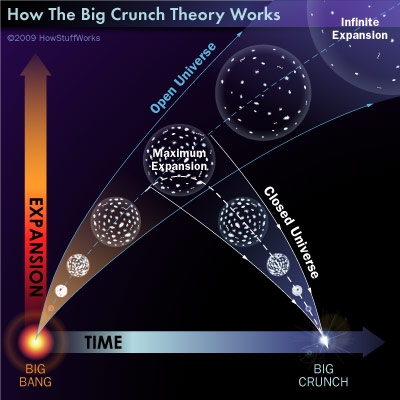
After establishing that the universe is expanding (with reference to Edwin Hubble’s discovery of it in the 1920s, who observed that all other galaxies were moving away from us and were doing so faster, the further away they were1), Krauss presents three alternatives for how that expansion may be occurring: “[A] closed Universe would expand and stop and then recollapse in a Big Crunch, the reverse of the Big Bang. An open Universe would expand forever and a flat Universe will expand and slow down and never quite stop.” The following illustration shows the open and closed cases – the flat one being similar to the open one, but having a limit (bound) to its (still infinite) expansion as opposed to being unbounded.

Big crunch open and flat universe

In the process of determining which of the three cases of expansion our Universe is undergoing, the challenge of measuring the mass of galaxies (to infer from them the curvature of their light-bending effects and therefore the curvature of the universe) and the whole universe arises and attempts to do so show that “most of the mass in [a] system of clusters of galaxies is not where the galaxies are. It’s between the galaxies. It is where nothing is shining.” This in turn leads to the realization that “dark matter is a new type of elementary particle,” which further complicates the quest for measuring the mass and energy of the universe.

The consequences of the universe being flat (i.e., expanding infinitely but asymptotically towards a limit) are then spelled out:

“It turns out that in a flat Universe, the total energy of the Universe is precisely zero. Because gravity can have a negative energy. So the negative energy of gravity balances out the positive energy of matter. What’s so beautiful about a Universe with total energy zero? Well, only such a Universe can begin from nothing. And that is remarkable, because the laws of physics2 allow Universes to begin from nothing! You don’t need a deity.3 You have nothing. Zero total energy and quantum fluctuations can produce a Universe.”

This nothing is further illustrated by results obtained recently about the mass of protons, where:

“it turns out most of the mass of the proton comes not from the quarks within a proton, but from the empty space between the quarks. These fields popping in and out of existence produce about 90% of the mass of a proton, and since protons and neutrons are the dominant stuff in your body, the empty space is responsible for 90% of your mass. So this empty space is vital to science and these calculations are vital to understanding not just protons, but electrons and atoms and produce the best comparisons.”

In other words, the nothing from which a universe can come into being is a “boiling bubbling brew of virtual particles that are popping in and out of existence” “because of the laws of quantum mechanics and special relativity.” This nothing is an “empty space” that is empty insofar as matter and gravity cancel out each other’s energy and insofar as quantum mechanics deals in fields that may or may not yield particles.

As far as this being what I understood, I actually find it quite beautiful – and Krauss would agree by saying that “the only mathematically beautiful Universe” is a flat one, like ours. There is a symmetry between positive and negative energy, light and dark matter, there is infinite expansion that is at the same time bounded, there is a constant dynamic of being potentially versus actually and there is a tremendous amount of beautiful science that has lead to this view of the universe. We have Lemaître’s and Hubble’s insights into the universe’s expansion, we have the astonishing work on measuring the universe’s curvature by means of looking at it’s background radiation, we have ways of measuring the mass of distant galaxies and their distances from us and so much more. From this point of view, I do recommend Krauss’ talk wholeheartedly.

Sadly, there is another side to it, which is its being peppered with jabs at religion and a profound ignorance of what many religious people believe. The underlying view of religious faith that informs the criticisms leveled against it here, and in many other atheist forums, seems to have people like Young-Earth creationists, Pentecostal snake-handlers and members of groups like the Westboro Baptist Church as their model. This is akin to me taking someone like Dr. Josef Mengele as the archetype of a scientist and projecting prejudices from him to all scientists. I have about as much in common with the lunacy of the above mentioned “religious” groups as with the barbarity of the above mentioned “scientist.”

Let me be a bit more specific though about why the religion-related claims of Krauss don’t stick, as it can otherwise seem like this is just a lot of hand-waving. First, let’s look at the cosmology (and cosmogeny) presented by Krauss, which postulates a coming-into-being of the universe from nothing. If anything, this scientific insight is fully consistent with the Christian account of creation, where God creates the world from nothing – hence the emblematic Latin phrase: “ex nihilo.” The Christian view of how the world came into being is not one of a God having inhabited space-time and then decided to turn parts of himself into planets, vegetation, animals, humans. Instead, the Catechism here affirms that “God gave a beginning to all that exists outside of himself” (§290), where (in some sense) there was nothing before: “All things came to be through him, and without him nothing came to be” (John 1:3). The Nicene Creed even speaks about God as the creator of “all things visible and invisible,” which can comfortably be applied to dark matter or the negative energy of gravity.

In fact, the Catechism (§296) is insistent on there having been nothing before the Universe started:

“We believe that God needs no pre-existent thing or any help in order to create, nor is creation any sort of necessary emanation from the divine substance. God creates freely “out of nothing”: “If God had drawn the world from pre-existent matter, what would be so extraordinary in that? A human artisan makes from a given material whatever he wants, while God shows his power by starting from nothing to make all he wants.” (St. Theophilus of Antioch, Ad Autolycum II)”

So, if anything, the model of a flat universe and of the nothingness that is at its origin is in perfect accord with what the Church has come to believe through revelation and the guidance of the Holy Spirit over the centuries (and as early as in the 2nd century in the writings of St. Theophilus!). There simply is no conflict here – listening to the science Krauss talks about just makes me delight in how much better we understand how it was that the universe came into being from nothing. I can therefore happily conclude, again with the Catechism (§283):

“The question about the origins of the world and of man has been the object of many scientific studies which have splendidly enriched our knowledge of the age and dimensions of the cosmos, the development of life-forms and the appearance of man. These discoveries invite us to even greater admiration for the greatness of the Creator, prompting us to give him thanks for all his works and for the understanding and wisdom he gives to scholars and researchers.”

Catholics (and adherents of many other Christian denominations and other religions) are in no way at odds with the advances of science, since – in addition to the benefits that it enables for the good of all, it sheds light on how the universe works and how it has worked since its beginning. Those who believe in God having created the universe (from nothing!), being the source of its laws and continuously sustaining its being can enjoy the advances of science as much as those who don’t hold those beliefs, and I wish that neither side would try to ridicule the other or force them to change their views!


1 Incidentally, it was Georges Lemaître – the Belgian priest and physicist, who made this realization based on Hubble’s data a couple of years before Hubble did.
2 It always baffles me how many atheists hail the latest developments of science as proofs of the non-existence of God, while quite happily relying on pre-existing “laws of physics.”
3 I. e., a “god of gaps” deity …