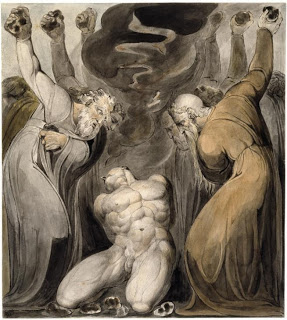
After the Charlie Hebdo attack, I was struck by a tweet from the Protestant theologian and Yale professor, Miroslav Volf:
“Jesus was crucified for “blasphemy.” Blasphemers should not be crucified, or killed, or punished in any way.”
This assertion of Jesus having been a blasphemer stopped me in my tracks, as I have never thought of him in that way. Good Shepherd, Son of God, Paschal Lamb, and Word Made Flesh would ring a bell, but not Blasphemer. Then, I started thinking about all the offense Jesus has caused during his lifetime: fraternizing with tax collectors and prostitutes (cf. Luke 5:27-32), healing the sick on the Sabbath (cf. Mark 3:1-6), having his disciples eat corn without washing their hands (cf. Mark 7:2), making ludicrous claims about rebuilding the temple in Jerusalem in three days (cf. John 2:19), and even his death on a cross was perceived as a scandal (cf. 1 Corinthians 1:23) … And how did his listeners react? Exactly as Pope Francis suggested recently – with threats and violence, to the point of dragging Jesus to the edge of a cliff and wanting to throw him to his death (cf. Luke 4:29), or to making him fear for his life to the point of deciding to hide from the people he scandalized and who were about to stone him (cf. John 8:59).
Suddenly adding blasphemy to the list doesn’t seem like such a stretch, and in fact the Gospel accounts of Jesus’ trial clearly state that this was the charge brought against him.
When questioned by the Sanhedrin during the night at the start of Good Friday, the high priest commanded Jesus: “I order you to tell us under oath before the living God whether you are the Messiah, the Son of God.” (Matthew 26:63), to which Jesus responded: “You have said so. But I tell you: From now on you will see ‘the Son of Man seated at the right hand of the Power’ and ‘coming on the clouds of heaven.’” (Matthew 26:64). Jesus’ words then triggered the following scene:
““Then the high priest tore his robes and said, “He has blasphemed! What further need have we of witnesses? You have now heard the blasphemy; what is your opinion?” They said in reply, “He deserves to die!” (Matthew 26:65-66)
The determination of Jesus’ blasphemer status is then presented to Pilate by his accusers as the grounds for having the secular powers of the Roman Empire put him to death: “We have a law, and according to that law he ought to die, because he made himself the Son of God.” (John 19:7)
The above may seem pretty cut-and-dried, but, like all legal arguments, it too is just that – arguable. Here the New American Bible has the following, interesting note on Jesus’ blasphemy, as a commentary on the passage about his hearing before the Sanhedrin:
“Blasphemed: the punishment for blasphemy was death by stoning (see Leviticus 24:10–16). According to the Mishnah, to be guilty of blasphemy one had to pronounce “the Name itself,” i.e., Yahweh […]. Those who judge the gospel accounts of Jesus’ trial by the later Mishnah standards point out that Jesus uses the surrogate “the Power,” and hence no Jewish court would have regarded him as guilty of blasphemy; others hold that the Mishnah’s narrow understanding of blasphemy was a later development.”
The spirit of what Jesus said certainly qualified as blasphemy, while the letter may have been arguable. Nonetheless, this guy, who was going around Galilee and Judea, telling everyone he was the Son of God, was guilty – a blasphemer! – and had to be killed. It’s the law. The Bible say so …
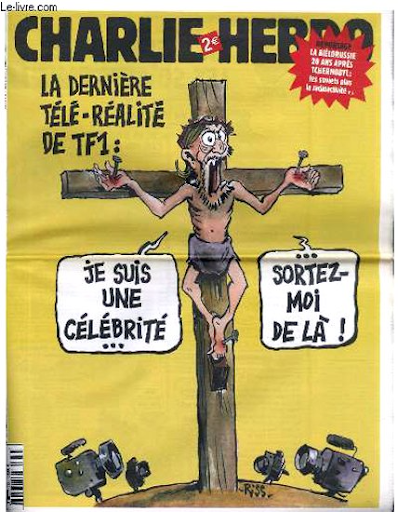
Now, you may ask yourself, where am I going wit all of this? And that brings us to Charlie Hebdo and other brutal murders of those who speak out against oppressors of free speech, whether they be religious or atheist regimes (and, sadly, there are plenty of examples of both, both in the present and the past). In the case of Charlie Hebdo too we have a bunch of blasphemers, depicting what the law decries as insulting and blasphemous, and law-abiding believers doing their bit for the law’s just punishment being meted out.
Is what the Charlie Hebdo murderers have done consistent with how the vast majority of Muslims understand Islam? Is what Charlie Hebdo have been publishing detestable, crude and inciting of hatred?
Regardless of how those questions are answered (and I’d say “no” and “in some cases, yes”), the first order of business has to be a defense of the freedom of speech – and not just the freedom of “good” speech. Is this an argument for all speech being equal? Absolutely not! And neither is it an expression of support for what publications like Charlie Hebdo have been doing. Instead it is an insistence on the absolute value of free speech. And once that is given, arguments against expressions like Charlie Hebdo can be made (and must be made). Arguments to convince their listeners and readers of such offensive expressions being contrary to the common good, risking an angry (albeit wrong!) response, and not being the most efficacious ways of fighting against oppression, corruption or bigotry. But these must be arguments made on the foundation of free speech where its limiting to “good” free speech becomes a choice of the individual and not the imposed dictate of a legislative regime that is enforced at all cost, including the administration of death.
Making freedom of speech about “good” speech turns it into its opposite, as is clear both from fictional (although chillingly prophetic) accounts like George Orwell’s 1984 and the enforced superficial innocuousness of public speech in 20th century communist regimes, where everything was wonderful, according to plan, fraternal and equal. Unless you made fun of it that is … in which case you’d qualify for a “Golden Bars” award (bars that were not golden, but embedded in prison walls instead). And the distortions of political correctness that grip many countries today are a scarily similar phenomenon. Only two days ago did I hear the following here in the US, in response to showing a historical photo of a Native American during a presentation to illustrate that a certain process was native to its context: “Um … You should be careful about saying “native.” It is a very sensitive term here. Saying Red Indian or chief or similar can be offensive. Some sports teams here have already changed their names not to offend.” My colleague then proceeded to tiptoe around such a sensitive topic and ended up using the term “native” as a non-offensive way of referring to this whole faux pas of mine – the exact term that initially triggered the friendly advice.
Freedom of speech is clearly a complex question and it is easy to come up with examples of things that shouldn’t be said (e.g., racist slurs), that shouldn’t be made fun of (e.g., genocide), that should not be promoted (e.g., violence or exploitation). And I would unquestionably agree with that and support very specific, narrow constraints on freedom of speech. However, the easy solution of criminalizing whole categories of verbal expression brings with it great dangers in that those same legal instruments may be abused for very different ends. The extremes here are totalitarian regimes that criminalize any criticism of themselves and that consider any such criticism an offense against the common good that their leaders embody. In our democratic societies too there are dangers, where governments have been prone to overstep their remits and where legislation to prevent terrorism has enabled infringements of privacy and the gagging or undermining of critical voices. A society that cannot handle hearing ideas it disagrees with will eventually descend into fear and caution, rendering speech lukewarm. Speech that becomes barely worthy of being spat out.
I am therefore wholeheartedly with Volf: “Blasphemers should not be crucified, or killed, or punished in any way.” Instead, they should be challenged and engaged with in the same free speech context they employ and, who knows, maybe such engagement (instead of a silencing by law or bullets) could let all discover each other’s brothers and sisters on the other side of the argument.
 eyebeleave