Men and women: towards unity in diversity

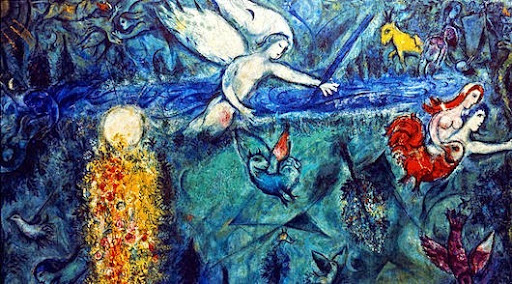
Chagall adam and eve

[Warning: Long read.]

My personal experience of having many good friends among both men and women is leading me to believe that differences between the two genders are real, but that their nature is very complex and that any attempt to characterize one versus the other ends up in traits that span some of both genders’ populations. No matter what profile is devised with the intention to characterize what a man’s trademark traits are, there will be women I know who excel at some of them, and, equally, I can think of men who excel at traits that would be attributed to the archetypal woman.

Claims that women are more intuitive while men are more rational have always struck me as simplistic and reductive in terms of their predictive capacity in the face of meeting a new person of either gender, and – more importantly, I have found them to be unhelpful, or even obstructive, when it comes to building relationships. Yet, the view of resolving the question about the differences between men and women by means of two list of ‘typical’ traits is very popular, as can also be seen from best-sellers like “Men are from Mars, Women are from Venus” (the first book I read that compelled me to write a review on Amazon :).

To counter this trend, I would like to sketch out my understanding of how men and women compare, and do so from two perspectives: the first one being science (both neuroscience and psychology) and the second one religion (specifically Christianity, and even more specifically Catholic exegesis, the Theology of the Body of St. John Paul II and the intellectual visions of the Servant of God, Chiara Lubich).

From the perspective of science, there is a growing body of work on quantifying both the neurological/physiological and psychological differences between men and women, where certain physical as well as behavioral differences have been measured repeatedly and for which evidence is mounting.

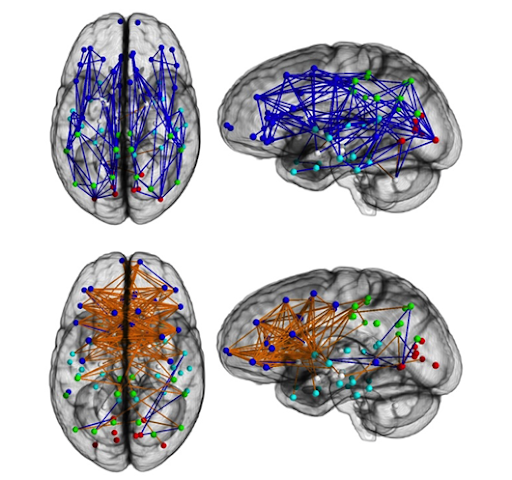
On the neurological and physiological side, there is strong evidence (obtained by a team from Oxford and Cambridge, who pooled together 126 studies, involving 43 000 subjects) to show that the brains of men are between 8% and 13% larger in volume than those of women. There is also evidence for there being significant differences between the relative volumes and densities of different regions in the brain between men and women. A recent example here is the work of Nopoulos et al. from the University of Iowa, who used functional Magnetic Resonance Imaging (fMRI) to study the ventral prefrontal cortex (VPC), a region involved in social cognition and interpersonal judgment. The findings, based on 30 men and 30 women, showed a relatively larger volume of this region in women, by 10%. In other words, relative to the total volume of a brain, the VPC region is 10% larger in women. Finally, there are not only volumetric differences between the brains of men and women, but also morphological ones. Here the most well-known, recent study is by Ingalhalikar et al., where the brains of 949 subjects (428 male and 521 female) were studied in terms of the nature of neural connections (connectome maps) between and within brain hemispheres (using diffusion tensor imaging). The results showed a systematic difference where male brains displayed a greater degree of intra-hemispherical synaptic connections (see top of following figure), while female brains had more prevalent inter-hemispherical links (see bottom of following figure). Interestingly, the authors of this study refer to the differences between the connectome maps of males and females as being a “complementarity” that makes them particularly suitable for collaboration …
Penn medicine

While there is strong evidence for systematic physiological differences between male and female brains, the question of what their consequences are remains far less clearly understood. E.g., taking the question of intelligence, there are studies whose results support all three of the possible outcomes: that there is no statistically significant difference, that men are more intelligent, or that women are more intelligent on average (e.g., see pp. 72 of the following paper). Even in the cases where a difference is shown, it tends to be small: 2-4 points in terms of the well known IQ test, and whether it is men or women who come out ahead depends on the specific test used. E.g., in a study involving 6780 subjects from Brazil, women came out ahead by 2 IQ points using Cambraia’s Attention Test, while men did better in Raven’s Standard Progressive Matrices test – by 1.8 IQ points. Similarly the behavioral consequences, from the perspective of differences between the sexes, of the VPC differences measured by Nopoulos et al., present a complex picture. There, no significant differences were found between men and women in terms of performing the Interpersonal Perception Task, which tests a subject’s ability to understand different types of social interaction. However, when the subjects were asked to complete a Personal Attributes Questionnaire (answering questions that lead to the subject’s self-perception in terms of two scales: “instrumentality” and “expressivity”, which are commonly taken to stand for masculinity and femininity and are used as a measure of gender identity), the resulting scores displayed strong correlation with the Interpersonal Perception Task outcomes.

The point of the above examples taken from recent findings in neuroscience and psychology, from studies that explore the differences between men and women, is to illustrate the complexity of the results obtained to date. On the one hand there is strong evidence for biological differences between male and female subjects, while on the other hand the specific nature of the differences and their impact on psychological traits or inclinations is complex and does not neatly divide along lines of a subject’s sex. While nature differs on average, an individual’s characteristics make them different from their sex’s average, with nurture and society further contributing to there being a continuum of states instead of a binary categorization of abilities, preferences, or traits. In my opinion, the psychology of personality, as opposed to that of gender, is a better means for understanding how one individual may differ from another in terms of their preferences and inclinations, which in turn can facilitate building mutually-fulfilling relationships.1

Turning to how the differences between men and women are understood in the context of Christianity, I would like to highlight three perspectives, as already mentioned at the beginning of this post.

First, there is St. John Paul II’s Theology of the Body, as set out in his “Men and Women He Created Them,” which I have already written about at length here. The only insight I’d like to point to here is John Paul II’s insistence on men and women being created “in the image of God” intrinsically referring to the communion of Persons in the Trinity. He makes this clear by saying that “man2 became the image of God not only through his own humanity, but also through the communion of persons, which man and woman form from the very beginning.” And it is in this context that the differences between men and women have a specific purpose, which is that these “two reciprocally completing ways of “being a body” [… are] complementary dimensions of self-knowledge and self-determination.” This in turn leads John Paul II to saying that a person’s “sex expresses an ever-new surpassing of the limit of man’s solitude [… and] always implies that in a certain way one takes upon oneself the solitude of the body of the second “I” as one’s own.” Men and women are different and complementary, but in profound, existential ways rather than as reducible to a trivial set of typical features or traits.

Second, the New Testament is rich in portraying different roles played by men versus women in the context of Jesus’ mission on Earth. Here Damiano Marzotto’s “Pietro e Maddalena” (mentioned by Pope Francis as being on his reading list), does a superb job of analyzing what these roles are in the Gospels, as a first step towards understanding how women could play the prominent role that they need to have in the Church, which they lack today. Marzotto summarizes his findings by first pointing out a greater propensity in women for welcoming Jesus’ teaching and making themselves available for a deepening and contemplation of his message (with men then acting on what the women understood). Mary’s keeping the events surrounding Jesus’ birth and “reflecting on them in her heart” (Luke 2:19) illustrates this very clearly. This places women in a position of welcoming novelty, of taking risks and of stepping out of line – traits not commonly associated with women in first century Palestine. The women of the Gospel, while having some common features, very much break the mold of societal stereotypes – another argument against characterizing men and women by sets of static, opposed features. The second aspect that Marzotto identifies in the women of the Gospel is an ability to anticipate Jesus’ actions and to provoke him or the apostles to action. Mary’s intervention at the wedding in Cana (John 2:1-12), or Mary Magdalene going to the apostles after meeting the risen Christ (John 20:1-3) are good examples here. Finally, Marzotto also argues that women have been responsible for a broadening of Jesus’ mission, for a greater universality of who it is addressed to. Here the woman suffering from hemorrhage (Mark 5:25-34), the Samaritan woman (John 4:4-42), the Canaanite woman (Matthew 15:21-28), or the widow of Nain (Luke 7:11-17) are great examples.

Third, the Servant of God, Chiara Lubich, in her intellectual visions (like those of Sts. Teresa of Ávila and Ignatius) during the summer of 1949 (referred to as the Paradise ’49), prefigures St. John Paul II’s interpreting the relationship between men and women from the perspective of the Trinity. As Giuseppe Maria Zanghí puts it, “this means that a meeting between the two “differences” requires, in each one of the two, a fullness of being: their synthesis is possible […] because, already before the two meet, each one of them is complete in themselves. Every form of weakness, every temptation of “subjection”, is overcome. […] True unity between man and woman can be achieved if each of the two realities is fulfilled in itself.” During her visions in 1949, Lubich recounts the following insight:

“The perfect man has the woman in him: he contains in his strength all of feminine sweetness, in his directness all of a woman’s suppleness. His character is unitarian, closed and severe like unity. But, if he is perfect (unitarian), he contains in himself the Trinity, who is a woman that is all open, caressing, loving. So the woman too, if she is perfect, encloses her open character in self-restraint that is reminiscent of the Madonna. She is man. Trinity in Unity.” (Paradise ’49, 1319-1320)3

The relationship between men and women, as understood also by Lubich in her mystical vision, is one of unity in distinction and distinction in unity, which is love. To reduce it only to distinction, and to a simplistic binary one at that, is to deny the Trinitarian image in which both men and women were made, and it is also to distort the complex and deeply beautiful picture that science is in the process of understanding as we speak.

[UPDATE on 17 November 2014:] Today Pope Francis opened a symposium on precisely the subject of how men and women relate, entitled “The Complementarity of Man and Woman in Marriage,” during which he had the following to say about the nature of differences between the sexes:

“Christians find [the] deepest meaning [of complementarity] in the first Letter to the Corinthians where Saint Paul tells us that the Spirit has endowed each of us with different gifts so that-just as the human body’s members work together for the good of the whole-everyone’s gifts can work together for the benefit of each. (cf. 1 Cor. 12). To reflect upon “complementarity” is nothing less than to ponder the dynamic harmonies at the heart of all Creation. […]

When we speak of complementarity between man and woman in this context, let us not confuse that term with the simplistic idea that all the roles and relations of the two sexes are fixed in a single, static pattern. Complementarity will take many forms as each man and woman brings his or her distinctive contributions to their marriage and to the formation of their children — his or her personal richness, personal charisma.”


1 But, we’ll have to leave that for another time …
2 “Man” here meaning the human person (as is clear from the context of the original text).
3 Apologies for the crude translation, the Italian original can be found in Zanghí’s “Leggendo un carisma” on pp. 149-150.
The salvific atheism of Christ

Jf

[Warning: Long read.]

The title of this post is a quote from a conversation between Cardinal Gianfranco Ravasi and the journalist and atheist Eugenio Scalfari. There, Ravasi argued that Jesus’ cry on the cross: “My God, my God, why have you forsaken me?” (Matthew 27:46) can be described as a “salvific atheism.” An atheism that is juxtaposed with the Resurrection, where Jesus remains the Son even when He doesn’t feel the Father and thereby “plants the seed of the infinite in mortality.” Many shy away from attributing atheism to Jesus in this moment, where He laments His being abandoned by God, with a lot of hand-waving and “as if”s or appeals to reason along the lines of “how could Jesus, who is God, have been abandoned by God?!” Such attempts at denying Jesus’ profound experience of the absence of God may have good motives, but they have always struck me as being misguided, since they obscure the extreme nature of this most important moment of Jesus’ life.

That Jesus underwent a trial of this magnitude, where his suffering drove him to a loss of feeling united with the Father – i.e., the very heart of the Trinity, is the most powerful indication of how far God is willing to go towards us, whose faith is limited at the best of times. He is showing us that He is our brother also in darkness and during experiences of the absence of God.

The importance of this nadir in Jesus’ life (and pinnacle of His self-noughting love) was profoundly understood also by Chiara Lubich, the founder of the Focolare Movement who is now on the path of being considered for sainthood, and by the agnostic Swedish film director, Ingmar Bergman.

For Lubich, who with her first companions has spent years focused on putting the Gospel into practice, the realization of the importance of Jesus’ forsakenness on the cross came, when – in 1944 – her spiritual director asked her when Jesus suffered most and declared that he thought it was in his cry of forsakenness on the cross. Looking back to that moment some 56 years later, Lubich described it as follows:

“Right from the start we understood that fullness had another side to it, the tree had its roots. The Gospel covers you in love, but demands everything from you. “If the grain of wheat doesn’t fall to the earth and die – we read in the Gospel of John – it remains just a grain of wheat, but if it dies, it bears much fruit” (Jn 12:24). And the personification of this is Jesus Crucified, whose fruit was the redemption of humankind. […] Through a particular circumstance, we came to know that the greatest suffering of Jesus and, therefore, his greatest act of love, was when on the cross he experienced the abandonment by the Father: “My God, my God, why have you abandoned me?” This touched us to the depths. And our young age, our enthusiasm, but especially the grace of God, urged us to choose only him in his abandonment, as the means to realize our ideal of love.”

Having identified Jesus’ forsakenness as the pinnacle of his love, Lubich and her companions sought to find, love and console Him in the sufferings of all around them and in themselves:

“From that moment on, we seemed to discover his countenance everywhere. He had experienced within himself people’s separation from God and from each other, and he had felt the Father far from him. We saw him not only in all our personal sufferings, which were never lacking, but in those of our neighbor, often alone, abandoned, forgotten, in the separation between generations, between rich and poor, within the very Church at times, and, later, between churches, then between religions and between persons of different convictions.

But these wounds didn’t frighten us. On the contrary, because of our love for him in his abandonment, they attracted us. He had shown us how to face them, how to live them, how to cooperate in overcoming them when, after the abandonment, he placed his spirit in his Father’s hands: “Father, into your hands I commend my spirit” giving to humankind the possibility of being restored to itself and to God, and he showed us the way. And so he manifested himself to be the key to unity, the remedy for every disunity. He was the one who recomposed unity between us each time it cracked. In him we recognized and loved the great and tragic divisions of humankind and of the Church. He became our only Spouse.”

During Lent that same year, Lubich meditated on Jesus’ forsakenness in this way:

“He who is life itself was giving himself completely. It was the culmination of his love, love’s most beautiful expression.

All the painful aspects of life conceal his face: They are nothing other than him.

Yes, because Jesus, crying out in his abandonment, is the image of those who are mute: He no longer knows how to speak.

He is the image of one who is blind – he cannot see; of one who is deaf – he cannot hear.

He is the weary person, moaning.

He is on the brink of desperation.

He is hungry … for union with God.

He is the image of one who has been deceived, betrayed; he seems a failure.

He is fearful, timid, disoriented.

Jesus forsaken is darkness, melancholy, contrast. He is the image of all that is strange, indefinable, that has something monstrous about it. Because he is God crying out for help!

He is the lonely person, the derelict. He seems useless, an outcast, in shock.

Consequently we can recognize him in every suffering brother or sister.”

Finally, Lubich, who has made love of Jesus forsaken her life, describes the following effects of identifying and loving Him in others: “after each encounter in which we have loved Jesus forsaken, we find God in a new way, more face-to-face, with greater openness and fuller unity. Light and joy return; and with the joy, that peace which is the fruit of the spirit.”

To get another, deeply insightful, perspective on this key moment in Jesus’ life, Bergman’s “Winter Light,” that premiered in 1962, has its characters speak about it twice. First, when the pastor of a town, plagued by doubt, breaks down in front of a parishioner who comes to him for help, saying, with obvious anguish and torment throughout:

“If there is no God, would it really make any difference? Life would become understandable. What a relief!

And thus death would be a snuffing out of life. The dissolution of body and soul. Cruelty, loneliness and fear … all these things would be straightforward and transparent.

Suffering is incomprehensible, so it needs no explanation.

There is no creator. No sustainer of life. No design.

My God…

Why have you forsaken me?

I’m free, free at last.”

Before giving thought to the above, let’s look at the second reference to Jesus’ forsakenness, which comes later, when the disabled sacristan (who didn’t hear the pastor’s lament) shares the following reflection with him:

“Wouldn’t you say the focus on [Christ’s] suffering is all wrong? This emphasis on physical pain. It couldn’t have been all that bad. It may sound presumptuous of me – but in my humble way, I’ve suffered as much physical pain as Jesus.

And his torments were rather brief. Lasting some four hours, I gather? I feel that he was tormented far worse on an other level.

Maybe I’ve got it all wrong. But just think of Gethsemane, Vicar. Christ’s disciples fell asleep. They hadn’t understood the meaning of the last supper, or anything. And when the servants of the law appeared, they ran away. And Peter denied him. Christ had known his disciples for three years. They’d lived together day in and day out – but they never grasped what he meant.

They abandoned him, to the last man. And he was left alone. That must have been painful. Realizing that no one understands. To be abandoned when you need someone to rely on – that must be excruciatingly painful. But the worse was yet to come. When Jesus was nailed to the cross – and hung there in torment – he cried out: “God, my God! Why hast thou forsaken me?” He cried out as loud as he could. He thought that his heavenly father had abandoned him. He believed everything he’d ever preached was a lie. The moments before he died, Christ was seized by doubt. Surely that must have been his greatest hardship? God’s silence.”

To my mind, the above are two great attempts at an identification with the forsaken, crucified Jesus. The first, the pastor’s, is an identification from within – a re-experiencing of Jesus’ forsakenness at first hand, that leads the protagonist to a wishing away of it all, to a denial of the problem’s reality and a subsequent, forced declaration of freedom (forced and strained because of how it is portrayed in the movie). The second is an identification from the position of compassion and intuition – the disabled sacristan takes his own physical and psychological sufferings as a basis for inferring the greater magnitude of the latter, and – by extrapolation – intuiting that Jesus’ forsakenness on the cross – the experience of “God’s silence” – must have been most severe.

In many ways it is the pastor’s experience that gives the greatest sense of what it may have been like for Jesus himself, by the anguish and despair that it presents. The sacristan’s monologue, in turn, is – to my mind – already a source of hope in that it demonstrates another’s capacity to intuit my despair and therefore be lead to compassion.

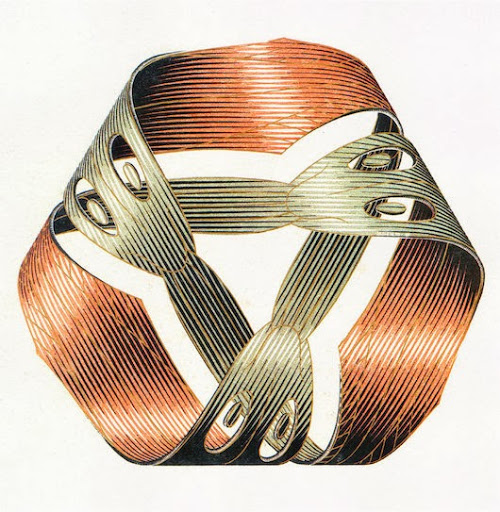
Cognition by mutual reflection

Escher mobius

A paper I have been meaning to read since it was published in October is Dr. Callan Slipper’s “Towards a New Kind of Cognition,” in which he reviews a number of cognitive modes, characterizing not only an individual’s development, but also the evolution of the human species and of cultures and then introducing a new, social mode that has roots in the mystical experiences of Chiara Lubich.

As far as setting the scene and providing context, Slipper’s approach bears resemblance to Dr. Yuval Harari’s “A Brief History of Humanity,” both in that it goes back to the cognitive modes of hominids and that it considers both biological and cultural factors. Even Harari’s favorite device of “fiction” (quotes mine) is mirrored in Slipper’s references to myth as a cultural contributor to cognition.

Instead of attempting a summary of the already concentrated review of classical modes of cognition, where Slipper discusses Jean Piaget’s somatic, symbolic and theoretic modes of knowledge that can be observed in a child’s development and then proceeds to show how these are mirrored also in the evolution of the Hominidae family and the basis of rational enquiry into the present day, I’d instead recommend reading the excellent, full paper itself. Instead, what I’d like to do is focus on the new cognitive mode that Slipper’s paper culminates in.

To understand the novelty and otherness of the new cognitive mode, it is worth considering the following observations Slipper makes about the state at which the evolution of cognition has arrived in the present day, as an evolution of “mythic culture”:

Mythic culture employs symbolic representations in the context of narratives (mythos is Greek for story), and these give human subjects powerful instruments to interpret and interact with the environment. Mythic cognition is not static and it did progress, using its narrative and symbolic methodology, to be self-critical. […] The culture that emerged, which we are heir to today, can be called […] the culture of the logos. The logos is a form of knowing that attempts to achieve objectivity, that is, to see things without projections from the hopes, fears, fantasies, or preconditioning of the subject. It develops conceptual reasoning that produces theories, and so it corresponds to the acquisition of theoretical knowledge. But the logos-word can also be a word of command and so have ethical and existential implications. Furthermore, as the light of understanding it can also mean conscience or a profound spiritual intuition, which attempts to see things as they truly are. […] In Greece, for example, this was undertaken by theoretical discourse in the development of philosophy; the ethical-existential dimension was developed in the light of Transcendence by the Hebrew prophets; a transcendent spiritual intuition (bodhi) was at the root of the new conceptual thinking that arose with Buddhism.

The scene therefore is a cognitive culture that aims at objectivity and an abstraction of the individual’s bias from the cognitive process. It is against this cognitive background that Chiara Lubich’s experience and thought are set. It has as its central themes a focus on two of Jesus’ utterances: “where two or three are gathered together in my name, there am I in the midst of them.” (Matthew 18:20) and “My God, my God, why have you forsaken me?” (Matthew 27:46). The first here makes the subject of cognition a community and the second is the key for that community to transcend itself, by imitating Jesus’ self-emptying (kenosis) at the moment of his greatest suffering. It is this mutual loosing oneself out of love for another that is Lubich’s central insight – the fruit first of years of putting the Gospel into practice and then of a mystical, intellectual vision that started in 1949.1With the above, 10K mile view, let’s look at the consequences that Slipper spells out for cognition:

“The individual remains but it is now in a relationship of profound mutual involvement with other individuals, a form of recollection both within self and within the other person insofar as empathy, sensitivity, and attentive listening and communication (the apotheosis of the logos-word) will allow. […] In relation to the other person, everything can be reframed or rethought; even hard-won theories cannot be defended by the ego that generated them. Gesture, symbol, theory are all offered, not imposed, within the context of a deep meeting. In this way it is the very social nature of this process that offers the participants an intensified reflexivity, an extra possibility of using critical reasoning to challenge their presuppositions. Ideas are seen as instruments of a mutual reflection, engaged in together, so that out of the meeting of persons emerges a new act of cognition, one based on but not bound by any of the previous mental models. It thus has creative potential and is capable of thinking thoughts not had before in an act of cognition that is not closed and which, at least in principle, can be developed in further encounters.”

I have to say that I recognize the features of what Slipper speaks about here from personal experience. The attitude that “everything can be reframed or rethought,” that “gesture, symbol, theory are all offered, not imposed” and that “ideas are seen as instruments of a mutual reflection” is precisely what, I believe, allows for the “deep meeting” and “recollection both within self and within the other,” which has the potential for a “new act of cognition” to emerge. When all, who are engaged in jointly trying to understand something, bring this attitude of detachment (that mirrors Jesus’ self-emptying) to the table, the result is a transcendence of each individual (that mirrors Jesus’ promise of being present among his followers).

Slipper puts this very clearly and succinctly as follows:

Meeting together in a shared transcendent experience, the human subjects both feel themselves united with Jesus and find that they are seeing things (nature, humanity, indeed all creation), as it were, from Jesus.

To conclude, I would like to emphasize one aspect of the above, that to me personally is of great importance: this social, transcendent mode of cognition is open to all and is not contingent on Christian beliefs, even though I (like Dr. Slipper) experience, pose and believe it to be their consequence. And this is not some hypothetical speculation, but again an observation from my personal experience. I have experienced the above “deep meeting” with Christians, agnostics and atheists alike, since self-emptying, being open to the other and a going out of oneself to meet the other are all open to everyone. Whether the person I am thinking with believes this to be a participation in Jesus’ vision or not, is not a prerequisite to it. Wherever there is mutual love and detachment from one’s own ideas, it is possible for thought to become a social, self-transcendent experience and lead to insights, already interiorized by virtue of the process itself, that would otherwise be unlikely or impossible. In some sense it is a turning on its head of Jean-Paul Sartre’s being-for-others where the other objectifies me and, by taking something away from me, becomes my “hell.”


For the text of her notes on how that mystical experience started, see here and for a commentary here.

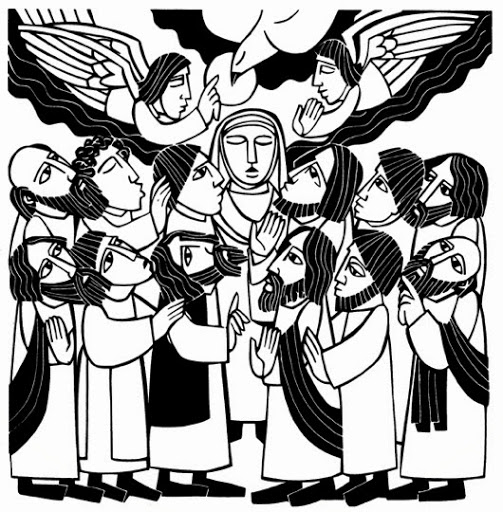
Mary is more important than the apostles

Mary queen of apostles

That the role of women in the Church is lacking, is a failing that Pope Francis has spoken about repeatedly and for which he is seeking a solution. As he stated during the impromptu interview on the flight back from the World Youth Day in Rio last summer, and again during “the” interview given to Jesuit publications, the role of women needs to be revised and they need to be part of the decision making processes in the Church. The points made during those interviews are incorporated and elaborated again in Pope Francis’ apostolic exhortation Evangelii Gaudium – a magisterial document of the Catholic Church, where he sums the situation up as follows in paragraphs 103 and 104:

“The Church acknowledges the indispensable contribution which women make to society through the sensitivity, intuition and other distinctive skill sets which they, more than men, tend to possess. I think, for example, of the special concern which women show to others, which finds a particular, even if not exclusive, expression in motherhood. I readily acknowledge that many women share pastoral responsibilities with priests, helping to guide people, families and groups and offering new contributions to theological reflection. But we need to create still broader opportunities for a more incisive female presence in the Church. Because “the feminine genius is needed in all expressions in the life of society, the presence of women must also be guaranteed in the workplace” and in the various other settings where important decisions are made, both in the Church and in social structures.

Demands that the legitimate rights of women be respected, based on the firm conviction that men and women are equal in dignity, present the Church with profound and challenging questions which cannot be lightly evaded. The reservation of the priesthood to males, as a sign of Christ the Spouse who gives himself in the Eucharist, is not a question open to discussion, but it can prove especially divisive if sacramental power is too closely identified with power in general. It must be remembered that when we speak of sacramental power “we are in the realm of function, not that of dignity or holiness”. The ministerial priesthood is one means employed by Jesus for the service of his people, yet our great dignity derives from baptism, which is accessible to all. The configuration of the priest to Christ the head – namely, as the principal source of grace – does not imply an exaltation which would set him above others. In the Church, functions “do not favour the superiority of some vis-à-vis the others”. Indeed, a woman, Mary, is more important than the bishops. Even when the function of ministerial priesthood is considered “hierarchical”, it must be remembered that “it is totally ordered to the holiness of Christ’s members”. Its key and axis is not power understood as domination, but the power to administer the sacrament of the Eucharist; this is the origin of its authority, which is always a service to God’s people. This presents a great challenge for pastors and theologians, who are in a position to recognize more fully what this entails with regard to the possible role of women in decision-making in different areas of the Church’s life.”

I’d sum the key points up as follows:

  1. Men and women are of equal dignity.
  2. Sacramental power is a function, not a source of prestige, dignity or holiness.
  3. Sacramental power being too closely tied to power in general is a source of division.
  4. Women already share some responsibilities with priests in pastoral, guidance and theological terms.
  5. Women need to be present where important decisions are made in society and in the Church.
  6. How to include women in the Church’s decision-making process and have them hold positions of responsibility and power is a great challenge.

To my mind, Pope Francis’ is a very clear and transparent account of the current status and his desire to change it is obvious from every occasion when he speaks about it.

In an attempt to get a sense of what a solution might look like, an Italian newspaper, Corriere della Sera, went to interview Maria Voce, the president of the 2.5 million member Focolare Movement – the only lay movement in the Catholic Church headed by a woman. The interview kicks off with the most obvious – and good – question about whether Voce is unhappy that she cannot become a priest1:

“Look, I know female Evangelical pastors, who are my friends and exceptional women and who do very well for their churches, but I have never thought that the possibility of becoming a priest would increase the dignity of women. It would just be an additional service. Because, the point is another: as women, what we need, it seems to me, is to see a recognition of equal dignity, of equal opportunity in the Catholic Church. Service and not servitude, as Pope Francis himself says.”

The point here is clear – the priesthood is a service to the Church, while what women need is dignity and opportunity. On a related note, Voce was also asked about the question of female cardinals, to which she responded:

“A female cardinal could be a sign for humanity, but not for me or for other women, I believe. It does not interest me. She would be an exceptional person to be made a cardinal. OK, but then? The great female figures, saints and doctors of the church, have always been valued. But it is the woman as such who doesn’t find her place. What needs to be recognized is the female genius in the everyday.”

Again, this makes great sense – the point is about an all-pervasive presence of women in the church – at all levels of responsibility and service, and not only the appreciation for exceptional individuals, who have already been well dealt with for centuries. But what would this recognition and presence look like? Here Voce has several suggestions:

“Women could lead departments of the Vatican curia […] I don’t understand why, for example, the department on the family necessarily has to be lead by a cardinal. It could very well be a couple of lay persons who live their marriage in a Christian way […] The same could apply to other departments too. It seems normal to me.

I am also thinking of the general Congregations before a conclave. The mother superiors of large orders could participate and maybe also elected representatives of dioceses. […]

[Regarding the council of eight cardinals advising the pope] I don’t envisage a group of only women that would be added. It would be more useful to have a mixed group, with women and other lay persons who together with the cardinals could provide the necessary information and perspectives. I’d be very enthusiastic about that.”

The final topic of the interview was the question of the “theology of women” that Pope Francis referred to as being absent but very much needed. Here, Voce identified Francis’ statement that “Mary is greater than the apostles” as being the Leitmotiv of such a theology. She also suggested that this direction, given by the Pope, points both to complementarity and to women also participating in the Church’s magisterium, it’s teaching and leadership role, in some way:

“Chiara [Lubich]2 thought of Mary as the blue sky that contains the sun, the moon and the stars. In this vision, if the sun is God and the stars are the saints, Mary is the sky that contains them, that contains also God: by God’s own will who has incarnated himself in her womb. The woman in the Church is this, needs to have this function, which can only exist in complementarity with the Petrine charism. It can’t be only Peter guiding the Church, there needs to be Peter with the apostles and sustained and enveloped by the embrace of this woman-mother who is Mary.”

This image of Mary enveloping the apostles is filled with profound beauty to my mind, and is such an intuitive way of putting the need for complementarity between the Petrine, apostolic aspect of the Church and the Marian aspect, which is about reciprocating God’s love for us. In fact, the Catechism of the Catholic Church – drawing on John Paul II’s apostolic letter Mulieris Dignitatem – puts this very clearly:

““[The Church’s] structure is totally ordered to the holiness of Christ’s members. And holiness is measured according to the ‘great mystery’ in which the Bride responds with the gift of love to the gift of the Bridegroom.” Mary goes before us all in the holiness that is the Church’s mystery as “the bride without spot or wrinkle.” This is why the “Marian” dimension of the Church precedes the “Petrine.””

The challenge now is to put it into practice!


1 For more on this subject, see a previous post.
2 For more about Chiara Lubich – the founder of the Focolare Movement, see previous posts and for some background on the image referred to by Voce see this particular one.

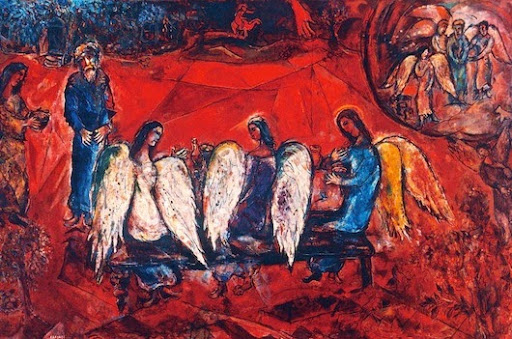
The Trinity – the mystery of love

Chagall abraham angels

Imagine coming across a popular science article containing the following:

“Science says light is “strange.” According to Albert Einstein, light is somehow also a stream of particles but not a stream of particles.”

You’d hardly think that you were reading the work of an award-winning journalist and would instead be checking whether the piece was a satire on the lack of science literacy.

Sadly, the same doesn’t seem to apply when it comes to the coverage of religion, since the above is a transposition of the following excerpt from an article published on the CNN Belief Blog yesterday:

“Christianity says the Trinity is a “mystery” of faith. According to Christian tradition, God begets a son who is somehow also Him but not Him.”

Not only is the source an established news broadcaster, but the author himself – Jeffrey Weiss – is described as “an award-winning religion reporter,” and – ironically – there is no suggestion of parody in the piece.

Instead of having a go at the article piece by piece, let me try to say what I understand by saying that God is both three and one. It is always easier just to mock than to put one’s neck on the line by being constructive, so I’ll take a risk and open myself to criticism next.

First, let me say that the Trinity is a mystery. What I don’t mean by that though is that it cannot be thought or spoken about, that it is irrational or that stating that it is a mystery is a conversation stopper. The universe too is full of mystery and while science is making tremendous progress in understanding it better and better, there are still many phenomena that we cannot fully explain (e.g., how does anesthesia work, what happened during the Planck epoch, what causes a reversal in the Earth’s magnetic field’s polarity, etc.). You could say that these phenomena are mysteries. What would be understood by that is that something about them eludes our explanatory capacity and, most likely, that we are trying to get a better understanding of them.

It is in this sense that the Trinity is a mystery, and the fact that our imperfect grasp of it fuels the desire of Christians to deepen their understanding, rather than being an obstacle to it, can be seen easily if one samples not only the output of theological work but also the insights of mystics and saints.

Before proceeding to share examples of Christian thought about the Trinity, let me put my own cards on the table (which, naturally, have their source in the experiences and thoughts of others :). I believe that the Christian teaching about God being both three and one is all about expressing core aspects of what love is, since God is Love. Love necessarily requires more than one party and is a dynamic relationship. Furthermore, it is a relationship in which change is fueled by loss and gain, by nothingness and being. When I take my son to the playground, instead of reading that next book or sleeping, I am losing my selfish plans (and in some sense annihilating that part of my self that was invested in them) and instead giving part of my self (that part which instead of pursuing my own plans will now chase him around a playground) to him. In some sense, as a result of my love for my son, part of me becomes part of him. However, when love is reciprocated, the element of loss, which is real, becomes compensated for, and – in this example – the laughter of my son, his joy, his wellbeing return to me as gifts from him and close the cycle started by my giving up on reading at the beginning of this story. Finally, the exchange of self that – motivated by love – took place here, is real in the sense that what was lost by one and gained by another are real and substantially change them. In some sense the exchange itself – the relationship – is as real as the persons between which it took place.

With an exposition of love in the above terms, the Trinity can be seen as its reductio ad absurdum, where the Father gives all of himself to the Son (thereby losing himself completely) and the Son reciprocates the gift by giving himself fully to the Father in return. The Holy Spirit then is the relationship of the Father and the Son personified, and by simultaneously not being and being, the three persons of the Trinity are the one God who is.

Such a conception of the Trinity makes all relationships of love be modeled on the innermost life of God, and while it is complex and abstract, it is no more so than theories of contemporary physics.1 St. Gregory of Nazianzus (in the 4th century AD!) refers to the Trinity as “the infinite co-naturality of three infinites” (a phrase any thinker could be proud of) and Blessed Pope John Paul II explains the motive for such trinity: “God is one, but not alone.” That relationships are the key to the Trinity is also apparent already in St. Augustine, who equates love with the Trinity by saying: “If you see love, you see the Trinity. Since you see someone who loves, someone who is loved, and the love uniting them.” Augustine then proceeds to underline how completely the persons of the Trinity are “co-natural,” by saying that the Father “is not called Father with reference to himself but only in relation to the Son; seen by himself he is simply God.” (De Trinitate VII, 1, 2), which the then-Cardinal Joseph Ratzinger explains as:

“‘Father’ is purely a concept of relationship. Only in being-for the other is he Father; in his own being-in-himself he is simply God. Person is the pure relation of being related, nothing else. Relationship is not something extra added to the person, as it is with us; it only exists at all as relatedness.” (Introduction to Christianity)

In summary, and in Chiara Lubich’s words, the Trinity is revealed to us “as unconditional, reciprocal self-giving, as mutual loving, self-emptying out of love, as total and eternal communion.” It is a mystery, but one that speaks volumes about what Christianity means both by love and by God and what relationships it strives towards already in the here and now.


1 And I am not saying that theology is physics, but merely drawing a comparison between the level of intuitiveness and simplicity of their concepts.

Atheists: adversaries, or brothers?

Trio

It is no secret that I have a great deal of respect for my atheist and agnostic friends and I feel like I have learned a lot from them about matters that are of profound value to me as a Christian. With Cardinal Ravasi I can also say that I too have absolutely no interest in converting them (or anyone else for that matter). At the same time I am aware of this attitude not having been the mainstream position of the Church for a long time (although there have always been those who have shared it – many of whom were saints) and that atheism is seen by some (many?) in the Church as a problem even today.

It is against this background that I was pleased to hear voices consonant with mine while reading two great books: On Heaven and Earth (by Cardinal Bergoglio – now Pope Francis – and Rabbi – and biophysicist! – Abraham Skorka, mentioned here before) and Colloqui (by Fr. Pasquale Foresi – one of the co-founders of the Focolare Movement).

Here Francis has the following to say:1

“When I meet atheist persons, I share with them human questions […] which are such rich material for sharing and working on together that they can easily lead to mutual and complementary enrichment. As a believer I know these riches are a gift from God[, but] instead of proselytizing, I respect atheists and I present myself the way I am. I have nothing to hide and I would not say that their life is condemned, because I am convinced that I have no right to judge their honesty. […] We have to be coherent with the message we receive from the Bible: all men and women are made in the image of God, whether they are believers or not.”

Later in the book, this attitude is also reinforced by Rabbi Skorka, saying that “we are all joined by the links of brotherhood.” While the position is, to my mind, positive – we are all brothers and sisters irrespective of our beliefs and there are great riches to be shared with each other in openness, a point worth elaborating on are the positions that Pope Francis rejects here – i.e., proselytism and condemnation.

Why these are novelties in the Catholic Church is addressed in Fr. Foresi’s book, which I happened to read at the same time :). There he points to the great changes that have been confirmed by the Second Vatican Council, a key point of which was an increased emphasis on and respect for following one’s conscience.2 Among others, this shift also legitimized pacifist positions held by prominent Christians during the last century’s World Wars. E.g., see the Catholic, Italian MP Igino Giordani – now in the process of being considered for sainthood, who championed a bill to allow for conscientious objectors to abstain from military service – incidentally in collaboration with atheist Communists (a great rarity during the first half of the 20th century).

It was on the back of this rediscovery of the importance of conscience that the honesty of atheist beliefs was contemplated and while the Church certainly has a position different from atheism, it stated clearly in the Gaudium et Spes constitution of the Second Vatican Council that,

“motivated by love for all men, [the Church] believes [that the] questions [raised by atheism] ought to be examined seriously and more profoundly. [… T]he Church sincerely professes that all men, believers and unbelievers alike, ought to work for the rightful betterment of this world in which all alike live; such an ideal cannot be realized, however, apart from sincere and prudent dialogue. Hence the Church protests against the distinction which some state authorities make between believers and unbelievers, with prejudice to the fundamental rights of the human person.” (Gaudium et Spes, 21)

Fr. Foresi explains that prior to Vatican II it was generally thought that “one couldn’t be an atheist in good faith, and that it was “impossible” for them to be saved.” This has all changed though, so that now there are not only individuals in the Church, who are keen to build relationships with their atheist friends, but it is the Church’s official teaching that the dignity of believers and non-believers alike be protected and valued.

And there is more. In his book, Fr. Foresi recounts how the Focolare Movement, founded by Chiara Lubich, has gone a step further and has done so with the Church’s formal approval. The Focolare Movement is an organization that promotes unity and universal brotherhood among all and even though it started in the Catholic Church during the Second World War, it also has members from other Christian churches and communities and from other religions. And it also counts agnostics or atheists among its members. While links with non-Catholics and atheists were at first informal, as the Focolare Movement was gaining official recognition by the Catholic Church, it also asked for its non-Catholic members to be officially recognized as such – a request eventually granted by the Vatican.

Why am I saying all this? Do I care so much about being “official”? No, not for its own sake, but I believe that it is an indication of how seriously these questions are taken by the Church and how it is not only its declared intention to be open to atheists but also something it approves formally.


1 Since I have the original book in Spanish, the English text is my rough translation.
2 For a more detailed discussion of this topic see a previous post.

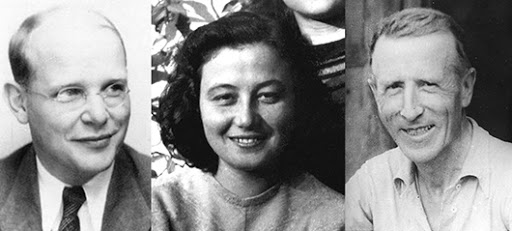
Bonhoeffer, Lubich, Teilhard: A world luminous from within

Bonhoeffer lubich teilhard s

Sixty eight years ago yesterday, in the Flossenbürg concentration camp, the Lutheran pastor and theologian Dietrich Bonhoeffer was martyred. His opposition to Nazi euthanasia and genocide directed against the Jewish people, born of his discipleship of Jesus, earned him the gallows. While I have long been an admirer of Bonhoeffer’s witness and theology, I have only now come across the following passage from his Letters and Papers from Prison, where he points particularly lucidly to the alternative to the God of Gaps caricature still popular today:

“How wrong it is to use God as a stop-gap for the incompleteness of our knowledge. If in fact the frontiers of knowledge are being pushed further and further back (and that is bound to be the case), then God is being pushed back with them, and is therefore continually in retreat. We are to find God in what we know, not in what we don’t know.”

This emphasis on the presence of God in what we know made me think of Chiara Lubich’s mystical experience that started during the summer of 1949.1 There, before the start of the actual “intellectual visions,” she recounts the following:

“[N]ature seemed to me to be enveloped totally by the sun; it already was physically, but it seemed to me that an even stronger sun enveloped it, saturated it, so that the whole of nature appeared to me as being “in love.” I saw things, rivers, plants, meadows, grass as linked to one another by a bond of love in which each one had a meaning of love with regard to the others. […] I had seemed to see the blossom of a horse chestnut tree alive with a higher life that sustained it from beneath so that it seemed to be coming out towards me.” (Paradise ’49)

How is it though that one comes to seeing God “in what we know,” as “sustain[ing everything] from beneath”? Here, in the paragraphs preceding the above quote, Lubich says that “[for about five years w]e had been trying with great intensity to live [… communion] with Jesus in the Eucharist, with our brother or sister, with the Word of God […] constantly in the present moment.” Her answer then is that this experience of God “enveloping” all has for her and her companions followed a putting of the Gospel into practice.

This in turn made me think of Pierre Teilhard de Chardin’s “The Divine Milieu,” where he sets out “a way of teaching how to see” and starts by posing a challenge:

“God is as pervasive and perceptible as the atmosphere in which we are bathed. He encompasses us on all sides, like the world itself. What prevents you, then, from enfolding him in your arms? Only one thing: your inability to see him.”

Reflecting on the above near the end of his life, Teilhard shares the following:

“Throughout my life, by means of my life, the world has little by little caught fire in my sight until, aflame all around me, it has become almost completely luminous from within. … Such has been my experience in contact with the earth — the diaphany of the Divine at the heart of the universe on fire … Christ; his heart; a fire: capable of penetrating everywhere and, gradually, spreading everywhere.”

Again the vision of God illuminating the world “from within” follows a life focused on seeking Him, as Teilhard says in “The Divine Milieu,” both in what we do and what happens to us – both the active and the passive, and therefore in life as a whole:

“It is the whole of human life, down to its most “natural” zones, which, the Church teaches, can be sanctified. […] “So whether you eat or drink, or whatever you do, do everything for the glory of God.” (1 Corinthians 10:31).”


1 For previous mentions of “Paradise ’49” see the following posts here and here.

Lumen Gentium: The Religious

Obedience

In an effort to get at least to the end of the second of the Vatican II documents that I would like to read during this Year of Faith, let me now turn to chapter six of Lumen Gentium, which talks about the religious. After its first two chapters set out who the church is and how it lives, the next pair present its hierarchy and laity and chapter five speaks about a universal call to holiness, this chapter is about, what in contemporary organizations would be called, a horizontal group.1

The logic of presenting the religious after the universal call to holiness in chapter five is very clear in that the religious take a specific commitment to the evangelical counsels of “chastity dedicated to God, poverty and obedience” that are presented to all the Church as means for attaining holiness. The distinguishing feature of the religious is that they “bind themselves to the three aforesaid counsels either by vows, or by other sacred bonds, which are like vows in their purpose.” In this context, the Church’s hierarchy has the role of “interpreting these evangelical counsels, of regulating their practice and finally to build on them stable forms of living.” These “forms of living” include “community life, as well as various religious families,” yet:

“the religious state of life is not an intermediate state between the clerical and lay states. But, rather, the faithful of Christ are called by God from both these states of life so that they might enjoy this particular gift in the life of the Church.”

The purpose of the vows that the religious profess is “to free [themselves] from those obstacles, which might draw [them] away from the fervor of charity and the perfection of divine worship.” As a result, “[t]he evangelical counsels […] lead to charity [and] join their followers to the Church and its mystery in a special way. [… T]he spiritual life of [the religious] should then be devoted to the welfare of the whole Church.” In other words, the vows of chastity, obedience and poverty are aids to living with greater love for the good of the whole Church.

A particularly beautiful insight is shared next: “[the] purpose [of the religious state] is to free its members from earthly cares, [which] more fully manifests to all believers the presence of heavenly goods already possessed here below. […] Christ proposed to His disciples this form of life, which He, as the Son of God, accepted in entering this world to do the will of the Father.” Instead of being directed at the benefit only of the religious, their withdrawal from some aspects of natural life serves the purpose of highlighting a foretaste of heaven that is to be had already here and now. I believe this foretaste is the love that they show the Church and the world, and based on the religious I know, this is certainly something many of them radiate! Just to avoid any misunderstanding, I don’t believe the religious have a monopoly on accessing the “heavenly goods already possessed here below” – we can all do so (and this is not even restricted only to Christians or other people of faith), but it is the religious who give them particular visibility due to their relinquishing certain aspects of everyday life.

As a consequence of their “duty […] to care for the People of God,” the hierarchy “regulate the practice of the evangelical counsels by law,” just like they do the practice of the priesthood and marriage. The impetus are always “rules presented by outstanding men and women” (such as St. Francis, St. Benedict, Bl. Mother Teresa, Chiara Lubich, etc.), which the hierarchy then receives “following with docility the prompting of the Holy Spirit” and, after possible adjustments, approves. The resulting religious orders, communities or movements (called “institutes of perfection”) can then either be under the direct authority of the pope or of a local bishop, to whom they owe obedience. Incorporated in the Church in this way, the religious show Jesus “to believers and non-believers alike[, … portraying Him] in contemplation on the mountain, in His proclamation of the kingdom of God to the multitudes, in His healing of the sick and maimed, in His work of converting sinners to a better life, in His solicitude for youth and His goodness to all men, always obedient to the will of the Father who sent Him.”

To conclude its brief presentation of the religious, Lumen Gentium takes care to be clear about the nature of the renunciation and withdrawal that the evangelical counsels entail:

“Let no one think that religious have become strangers to their fellowmen or useless citizens of this earthly city by their consecration. For even though it sometimes happens that religious do not directly mingle with their contemporaries, yet in a more profound sense these same religious are united with them in the heart of Christ and spiritually cooperate with them.”

Finally, the religious are summed up as “Brothers and Sisters, who in monasteries, or in schools and hospitals, or in the missions, adorn the Bride of Christ by their unswerving and humble faithfulness in their chosen consecration and render generous services of all kinds to mankind.” Again the emphasis is on service to all and on a transmission of Jesus’ love to them, which has been a focus throughout the presentation of the hierarchy and laity in previous chapters too. From personal experience, I am deeply grateful for the gifts I have received thanks to those “Brothers and Sisters” of mine who have bound themselves to the evangelical counsels and who are shining beacons of God’s love.


1 If you have read previous “Lumen Gentium” posts on this blog, you will be familiar with my pointing to a caveat for non-Catholic readers, in paragraph 2 of this post.

The blue of the sky

On New Year’s Day was one of my favourite feasts of the Church calendar: that of Mary, mother of God. While the emphasis on Christmas Day is very much on God becoming man – the infinite also becoming finite, the feast of the Theotokos looks at another central aspect of the Christmas paradox.

Instead of descending to earth on a cloud or by means of some other superficial spectacle, God first sought the consent of a girl and then grew and developed inside her in the same way every human does. He joined humanity from the ground floor rather than waltzing in at the peak of its powers as a fully-grown adult. This also means that he has a mum whom he loved, respected, was concerned for and esteemed just like other children and adults relate to their mothers. He also felt her absolute love, care, commitment and devotion, just like children and adults receive from their mothers.

In an intellectual vision in 1949, Chiara Lubich received the following, particularly striking, insight about Mary’s relationship to God:

“As the blue of the sky contains sun and moon and stars, so Mary appeared to me, made by God so great as to contain God Himself in the Word.”

This image clearly expresses how great a love God has for Mary by making her contain Him as His mother (like the sky contains the sun), which in some sense shows God as being smaller than Mary. Yet, since it is God who made himself small, this self-humbling adds to his magnanimity and greatness and we see a God who is great, but whose greatness includes His making Himself small.

By having Mary be His mother, God leads us to humility by example, which is also what Jesus explicitly called us to: “But many who are first will be last, and the last will be first.” (Matthew 19:30).

Divergent rays

Nasa sun

The Gospel verse “In the beginning was the Word” has been going around in my head, ever since it dawned on me last weekend that it clearly points to something having preceded it. Thinking more about it made me revisit a text (actually, various fragments of it, since it has, as yet, not been published in full) where Chiara Lubich recounts her “intellectual visions” of Paradise that started in 1949. In particular, I wanted to re-read how she described Jesus, the Word:

“I found myself […], as in a vision seen with the eyes of the soul, having come into the Bosom of the Father, who showed me, as it were, the inside of a sun that was all gold or flames of gold, infinite, but not frightening.”

“[F]rom the walls inside the Sun, the Father pronounced the word: Love, and this Word, concentrated in the heart of the Father, was his Son.”

The picture here is very vivid and in many ways like those of St. Hildegard of Bingen’s visions. It transmits a very clear sense of what it may have seemed like to be there “in the beginning.” Reading on, Chiara also shares the following vision of creation:

“When God created, He created all things from nothing because He created them from Himself: from nothing signifies that they did not pre-exist because He alone pre-existed (but this way of speaking is inexact as in God there is no before and after). He drew them out from Himself because in creating them He died (of love), He died in love, He loved and therefore He created.

As the Word, who is the Idea of the Father, is God, analogously the ideas of things, that “ab aeterno” are in the word, are not abstract, but they are real: word within the Word.

The Father projects them — as with divergent rays — “outside Himself,” that is, in a different and new, created dimension, in which he gives to them “the Order that is Life and Love and Truth.” Therefore, in them there is the stamp of the Uncreated, of the Trinity.”

I find the above paragraphs particularly important since they indicate several key ways of thinking about how God and the universe are related:

  1. That God (the Trinity, the Uncreated) can be found in nature since it bears His “stamp,”
  2. that Jesus – the Word – is not only God who made himself present in the world as a human being 2000 years ago, but is the very means by which the Father goes “outside Himself” in His Creation,
  3. that creation is an act of self-noughting love, and
  4. that creation can be thought of as a new dimension of God.

This relationship is clearly not that of a “God of gaps,” cobbled-on caricature, but a tightly-interwoven, integral, first-person communion. Creation is to God as the rays of the sun are to the sun.

In fact, the picture of the sun and its divergent rays (and the use of “picture” is very deliberate, given what follows), is also very much consonant with Wittgenstein’s thoughts on how a system (the world) and its meaning relate:

“The sense of the world must lie outside the world. In the world everything is as it is and happens as it does happen. In it there is no value—and if there were, it would be of no value.

If there is a value which is of value, it must lie outside all happening and being-so. For all happening and being-so is accidental.

What makes it non-accidental cannot lie in the world, for otherwise this would again be accidental.

It must lie outside the world.” (Tractatus Logico-Philosophicus, 6.41)

Where does this leave a Christian in terms of how science and revelation make sense of the world? I believe, James Clerk Maxwell put it very well: “I think Christians whose minds are scientific are bound to study science that their view of the glory of God may be as extensive as their being is capable.” It is with this mindset that Prof. John Lennox commented on the Higgs Boson discovery by saying “God created it, Higgs predicted it and Cern found it.” Instead of a conflict, the advances of science are as much a source of wonder and joy to a Christian as are the visions of those who seek God and to whom he makes himself known in entirely unscientific ways.