Eternity today

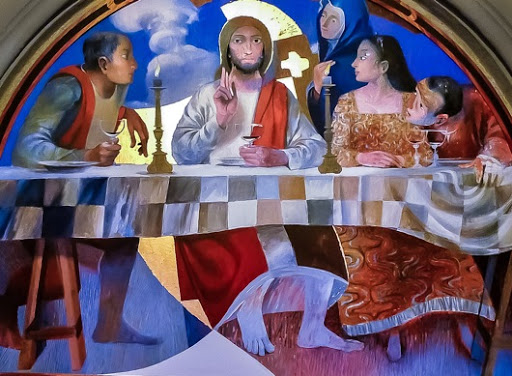
Arcabas canaa l

Today the Church has launched its Year of Faith, whose announcement motivated me three months ago to start writing this blog. While the Year of Faith was its explicit impetus, my deeper reasons were both a desire to be clearer to myself about what it was that my faith meant to me and implied for me and a desire to make explicit my deep-seated conviction that imitating Jesus was not contrary to reason or to my scientific profession and that it ought to be more accessible to my friends with other religious beliefs or none. By this I don’t mean in any way an attempt to convince them of anything, but simply by making my faith explicit and by revealing its consequences and connections to the broader philosophical, cultural, artistic and scientific contexts, show that it makes sense and that it allows me to seek the goals and values that they themselves share. I was also keen to look for the underlying similarities among all who employ reason honestly and who seek the common good and to show that at this level are all close to one another. Whether this is something that has emerged from the last 68 posts is something you’ll have to judge for yourself. All I can say is that it has been a positive experience for me, especially in the cases where a post has lead to or was triggered by dialogue.

With that preamble out of the way, let me share with you my take on today’s opening of the Year of Faith by pulling together some of the points made by Pope Benedict XVI in his sermon during the opening mass, Archbishop Rowan Williamsaddress to the Bishops’ Synod yesterday and Patriarch Bartholomew I’s greeting this morning. This fact alone, of having the heads of the Roman Catholic, Anglican and Eastern Orthodox communities come together at the opening of this Year of Faith is great cause for enthusiasm to me, as it points to their shared belief in Jesus being present “where two or three are gathered together in [his] name” (Matthew 18:20) and in their shared commitment to “witness together to the Gospel message of salvation and healing for the least of our brethren: the poor, the oppressed, the forgotten in God’s world.” (Bartholomew I).

To my mind, Archbishop Williams’ talk yesterday did a great job of setting the scene by reflecting on what it is that attracts people to authentic, lived Christianity:

“[It is] the possibility, quite simply, of living more humanly – living with less frantic acquisitiveness, living with space for stillness, living in the expectation of learning, and most of all, living with an awareness that there is a solid and durable joy to be discovered in the disciplines of self-forgetfulness that is quite different from the gratification of this or that impulse of the moment.”

He argues, as do I, that the behavior to which authentic Christians are lead by their desire to imitate Jesus has universal value and is not something alien or parallel to what all others seek too. Williams follows the above with a warning though: “The man who seeks sincerity, instead of seeking truth in self-forgetfulness, is like the man who seeks to be detached instead of laying himself open in love.” (Henri de Lubac, Paradoxes of Faith, pp. 114) – striving to share with the world what it means to follow Jesus cannot be sought for its own sake as that defeats its own purpose. Such self-consciousness about one’s faith and its perception by others, by definition, cannot be overcome by being even more self-conscious about it:

“We have to return to St Paul and ask, ‘Where are we looking?’ Do we look anxiously to the problems of our day, the varieties of unfaithfulness or of threat to faith and morals, the weakness of the institution? Or are we seeking to look to Jesus, to the unveiled face of God’s image in the light of which we see the image further reflected in ourselves and our neighbours?”

In many ways it is like how Douglas Adams describes flying in the Hitchhiker’s Guide: a throwing of oneself to the ground and accidentally missing, by having been distracted at the critical moment. Sharing my faith is like throwing myself into following Jesus and being distracted by my friends. 🙂

What does it mean though to follow Jesus? How can you even try to imitate a carpenter, healer, prophet, teacher, … from two thousand years ago? Here Pope Benedict argues that we face a fundamental tension when striving to

“mak[e] the truth and beauty of the faith shine out in our time, without sacrificing it to the demands of the present or leaving it tied to the past: the eternal presence of God resounds in the faith, transcending time, yet it can only be welcomed by us in our own unrepeatable today.”

Applying Jesus’ message to the conditions we are in today is essential, but so is remaining faithful to it and this is the challenge that both the Second Vatican Council, which opened 50 years ago today, and this new Year of Faith strive to address. To Pope Benedict, the key though is the person of Jesus, through whom “God’s face is revealed to us.” “[T]he closer [we] get to him, the closer [we] get to the hearts of [our] brothers and sisters” (Chiara Lubich, Essential Writings, p.37; quoted by Archbishop Williams).

Sun and moon and stars


Today is the feast day of the assumption of Mary into heaven. A unique honor reserved for Jesus’ mother who was not only conceived without original sin, lived a life without sin but was also lifted up into heaven at the end of her earthly journey.

To intuit the greatness of Mary and her key role in understanding both her son and the Trinity, the following is a fragment from one of the most recent mystical visions shedding light on her – that of Chiara Lubich in 1949:

“On that day I understood Mary, perhaps through an intellectual vision, as I had never seen her before. And now twelve years have passed since that day, but I still have the clear impression of the unexpected “greatness” that this discovery of the Mother of God in the Bosom of the Father made on me. As the blue of the sky contains sun and moon and stars, so Mary appeared to me, made by God so great as to contain God Himself in the Word.

I had never had such a notion of Mary, but there her divine [by participation] greatness was impressed upon my soul in such a way that I do not know how to say it again.

I can say only that no human reasoning would be able to render the idea.

That vision produced conviction.”

St. Clare’s treasure

Clare

Tomorrow is the feast day of St. Clare of Assisi – one of my all-time favorite saints. There is a lot to learn from looking at her life, but the thing that stands out to me is what she said on the night when she left the riches of her family and followed St. Francis’ example. While this event is glossed over in most of her biographies with something like: “On that very night she ran away to go follow Francis. When she got there he cut her hair and dressed her in a black tunic and a thick black veil.”

What an account like that makes me wonder about straight-away is what was said by Francis and Clare on such a sacred occasion. It seems highly unlikely that an event like this would have taken place without something precious also being put into words. As it happens, we do get a first glimpse in the account shared by Prof. Corrêa de Oliveira, the prominent Brazilian politician and intellectual, who describes it as follows: “Francis asked her what she wanted, and she answered: ‘I want the God of the Manger and of Calvary. I desire no other treasure or inheritance.’”

This lets us intuit what was on Clare’s mind, but it is only in the following words of Chiara Lubich, the Italian leader and founder of the Focolare Movement, that the full depth of Clare’s frame of mind emerges, when she says:

“I remember when my first companions and I made the choice of God as the Ideal of our lives, while ideals came crashing down all around us [during the Second World War], and I was very impressed by this saint, whose life I knew. Aged eighteen, she encountered St. Francis, and his teachings about poverty, and became captivated by them. So, she too wanted to follow this new way indicated by the Holy Spirit.

I remember the strong impression made on me by her answer to St. Francis’s question: ‘My little daughter, what do you desire?’ And she responded: ‘God.’ How marvelous! It is not like she said: ‘To follow you, Francis; poverty; to give myself to God.’ No. ‘My little daughter, what do you desire?’ ‘God.’

[…] It is the answer that we too have given at the beginning, when all ideals collapsed around us and we felt inside that one Ideal did not collapse: God. It was not the result of human reasoning, it was an inspiration, an impulse from the Holy Spirit, a thrust inside us.

We have chosen God.

But, it was not as a result of my reasoning, or that of my first companions.

God.”

Not only does Chiara Lubich elaborate on how to read Clare’s answer in its radicalness and totality, but she highlights parallels with her own experience, over 700 years later, during the Second World War. The wholeheartedness of both Clare’s and Chiara’s yeses to God is in fact a universal feature of the call many feel, to give their lives to God. It comes with a demand for everything: no holds barred.


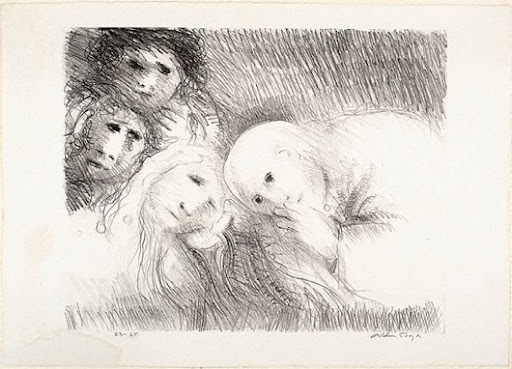
I’d just like to draw your attention to the fantastic series of lithographs by Arthur Boyd on the life of St. Francis, from which I took the above image. Also, many thanks to NP and PM for helping me with translating the quote by Chiara Lubich from Italian (all errors are mine though :).