The riches of poverty

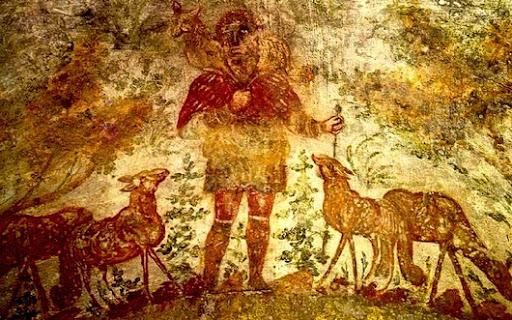
Goodshepherd domitilla

The other day I came across a very interesting article shared by one of my besties – MS – on Facebook. It reproduced the text of a pact signed by 40 bishops in the catacombs of St. Domitilla (the oldest and most extensive of the Roman catacombs) shortly before the Second Vatican Council’s conclusion – “The Pact of the Servant and Poor Church,” also known as “The Pact of the Catacombs.” The core of this group was made up of Brazilian bishops, but it also included several from Europe, Africa, Asia and both North and South America.1 At its heart, this pact was a commitment made by each signatory to live the evangelical counsel of poverty in their position as bishop of their local church and it echoed a point also emphasized in Vatican II’s Lumen Gentium, which says:2

“Jesus, “though He was by nature God … emptied Himself, taking the nature of a slave”, and “being rich, became poor” for our sakes. Thus, the Church, although it needs human resources to carry out its mission, is not set up to seek earthly glory, but to proclaim, even by its own example, humility and self-sacrifice.”

The following then is my abbreviated version of the pact’s preamble and 13 points:

“We, Bishops meeting at Vatican Council II, being aware of the deficiencies of our life of poverty according to the Gospel, encouraged by one another in this initiative in which each one wants to avoid singularity and presumption, in union with all our brothers in the Episcopate; counting, especially, on the grace and strength of our Lord Jesus Christ, on the prayer of the faithful and priests of our respective diocese; putting ourselves in thought and prayer before the Trinity, commit ourselves to the following:

  1. We will seek to live in accordance with the ordinary manner of our people, regarding housing, food, means of transportation, etc.
  2. We renounce wealth and the appearance thereof, especially in clothing (expensive fabrics and garish colors), and insignia of precious metals.
  3. We will possess neither liquid nor fixed assets in our names; and if it is necessary to possess anything, we will place it under the name of our diocese or other social or charitable works.
  4. We will entrust the financial and material administration of our diocese to a commission of competent lay people conscious of their apostolic role, since we should be pastors and apostles rather than administrators.
  5. We refuse to be called by names or titles that signify grandeur and power. We prefer to be called by the Gospel name “Father”.
  6. We will avoid everything that could appear to confer privilege, priority, or even preference to the rich and powerful.
  7. We will also avoid fostering or flattering the vanity of anyone, whoever they might be, when rewarding or requesting donations, or for any other reason. We will invite our faithful to consider their gifts as normal participation in worship, ministry and social action.
  8. We will give our time, thought, heart, means, etc. to the service of working individuals and groups who are economically weak and underdeveloped, without this being at the expense of other people and groups in the diocese.
  9. We will seek to transform the works of charity into social works based on charity and justice that take everyone into account.
  10. We will endeavor to ensure that government and public services decide on and implement laws, structures and social institutions that are necessary for justice, equality and the full and harmonious development of the whole person and all people.
  11. We commit ourselves to share, according to our ability, in the urgent projects of the dioceses in poor nations; together to always give witness to the Gospel at the international level, by asking for the adoption of economic and cultural structures that do not create poor nations in an ever richer world, but that allow the poor majority to emerge from their poverty.
  12. We pledge to share our life with our brothers and sisters in Christ (priests, religious and laity), so that our ministry constitutes a real service. We will seek out partners so that we can be promoters according to the spirit rather than rulers according to the world. We will try to be present, to be welcoming. We will be open to everyone, whatever their religion.
  13. When we return to our diocese we will present these resolutions to our diocesan priests, asking them to help us with their understanding, collaboration and prayers.

God help us to be faithful.”

When I first read this pact, my immediate reaction was of great admiration for its signatories, who resolve in it to start afresh in their role as bishops, returning to what is fundamental in imitating Jesus and applying the resolutions of Vatican II to themselves with great specificity and individuality. I also appreciated their making this choice together and following the model of the Early Church. In essence, I saw – and see – here that going of an extra mile and that self-noughting that is also set out as an example in Lumen Gentium, where the whole Church is warned not to “[l]et [either] the use of the things of this world [or] attachment to riches, which is against the spirit of evangelical poverty, hinder them in their quest for perfect love.”

In the process of looking up some background on this pact, it has become clear to me that the vast majority of texts that refer to it are ones dissenting from the Catholic Church’s teaching and are critical of its conduct. On the one hand this is not difficult to understand – there are numerous bishops who behave in ways incompatible with this pact’s letter and spirit (or who at least seem to do so) and it can be used as a handy ruler by which to find them wanting. I find such a reading incongruous on two counts: First, this pact is one freely entered into by specific bishops who, probably as a result of participating in the Council, received the grace to impose on themselves specific measures that they felt called to follow. Second, it smacks of a basic disregard to the very spirit in which the pact’s signatories acted, whose desire was to “avoid presumption” and be “aware of the deficiencies of [their] life of poverty.” Furthermore, it flies in the face of Jesus’ own reprimand: “You hypocrite, remove the wooden beam from your eye first; then you will see clearly to remove the splinter from your brother’s eye.” (Matthew 7:5). This is in no way to deny or attempt to excuse the unchristian conduct of some bishops, but simply to recognize this document for what it is – the sincere resolution of a group of bishops to renew their commitment to Jesus, instead of waving it around like a weapon.


1 For scans of a reproduction of the original Portuguese text – Bonaventure Kloppenburg’s 1974 The ecclesiology of Vatican II – see here. While the above is based on the source from the first paragraph, I chose to translate some words differently, taking advantage of the original version’s scans (e.g., I translate “berrante” in point 2 as “garish” instead of “brilliant” and – in point 9 – “beneficência” as “charity”).
2 For a very interesting analysis that situates this pact in the context of Benedict XVI’s thought as well as of that of other post-conciliar theologians, see this article.

Science and religion: a set-theoretic view

Universe

The question of how science and religion relate is a staple of this blog, yet in spite of numerous posts1 on this topic already, I feel the need to revisit it again (and probably not for the last time either). What I would like to give some thought to here, are different beliefs (or at least assumptions) about how God and the universe relate2 and the consequences they have on how science and religion are viewed.

For a change, let me start with what I believe myself and then proceed to contrast it with alternatives. To my mind, God infinitely exceeds the universe and is present everywhere and always – as St. Augustine puts it, God is “more inward to me than my most inward part; and higher than my highest.” (Confessions 3, 6). He has both created and sustains the universe, but does so in a way that is intelligible (and therefore also repeatable – the expectation of different outcomes when doing the same thing being one of the definitions of insanity, as Albert Einstein puts it). My position is therefore panentheistic (as opposed to pantheistic – God being equal to the universe – or deist, believing in a distant, separate God) and one that is fundamentally rational as opposed to fideist (a point also emphatically underlined by Benedict XVI during a general audience in November ’12). Here the universe, created “in and by” God,3 is both other than God and very much part of God and the top left quadrant of the diagram above is an attempt to depict it in terms of sets: the universe is represented by a circle, situated in an infinitely extending plane – God.

In this worldview, science is profoundly good not only because of the improvements to life that it can yield, but also because it tells me about how the universe that God created operates. It tells me about God in a way that is like learning about a mime artist by viewing their performance – the information is not immediate, but nonetheless leads to insights about the actor. Another source of understanding God comes to me from theology, which seeks to understand what God has revealed about himself through his relationship with the people of Israel, through his Son, Jesus and through his presence among his followers since then and into the present. These two sources of information about God are in perfect complementarity and equally fill me with wonder and admiration.

Yet science and religion (theology) are not the same – the former has methods finely tuned to bringing the laws of the universe to light and spans the sensible (empirical), while the latter has a span that exceeds that of science, by addressing the extra-empirical aspects of the universe (the whys and ought(’nt)s) as well as events and entities exclusive to its scope. This is not to place one above the other, but simply to put them in relationship as far as their scopes are concerned (bottom left quadrant of the above diagram).

In summary, my understanding of science and religion is that they jointly yield an understanding both of the world I live in and its source and purpose that I believe in. As John Paul II said, “Science can purify religion from error and superstition; religion can purify science from idolatry and false absolutes. Each can draw the other into a wider world, a world in which both can flourish.”

As for alternative views, a positioning of the world as separate from God and outside God, as shown on the right side of the above diagram, is also widespread among religious believers. Here God’s involvement in creation is only an initial impulse and setup, followed by a subsequent separation and distance. The scope of what science and religion have to talk about has no overlap.

My impression here is that this separation also extends into other spheres, beyond just the relationship between God and the universe. At times I come across (repulsive) statements that, e.g., imply that ethical behavior is “owned” by those who hold religious beliefs or that the same applies to truth or beauty.4 In my set theory of the God-universe relationship, all that is good, true and beautiful in the universe, and is accessible without faith, is mine and I just feel like I am being given more or being helped more to live it from my additional, extra-empirical sources.

I have a feeling that this (right) picture also applies to atheist believers, with the circle representing God removed. Here all that is believed to exist is the universe, which is being understood by scientific means and religion is a separate activity that has no corresponding object.

Finally, I suspect that those atheists, who don’t acknowledge that their position is a belief, operate on a worldview like mine (i.e., on the left above), but with the labels swapped. Claims about God are treated like claims about an entity enclosed in the universe and therefore fully subject to the methods of science. Religion too is an activity that can be fully reduced to scientific scrutiny just like any other human activity. If this is correct, then I can understand why atheists who fall in this category find religious belief as lacking in credibility, to the point of being hostile to it.

If any of you, my readers, identify with one of the positions other than mine, I would very much appreciate it if you let me know if I misunderstood something about it. And even if you agree with me, I’d be keen to hear from you :).


1 With previous looks at the science of creation from nothing, a mystical view of creation, the role of belief in science (also here), the dialogue between Chief Rabi Sacks and Prof. Dawkins, the ambiguous relationship between theory and evidence, the constraints of empiricism, the “God of gaps” caricature, atheism as a creed, the evidential equivalence of atheism and religious belief, Martini and Eco’s dialogue on ethics and a call for recognizing rationality in (some of) religion and science alike – to mention just a few :).
2 Many thanks to NP and AG with whom I have spoken about some aspects of this picture by email and over on Facebook over the last weeks. Their insights triggered a lot of interesting and valuable discussion.
3 “The universe, created in and by the eternal Word, the “image of the invisible God,” is destined for and addressed to man, himself created in the “image of God” and called to a personal relationship with God. Our human understanding, which shares in the light of the divine intellect, can understand what God tells us by means of his creation.” (Catechism of the Catholic Church, §299)
4 My friend, SC, told me of a particularly saddening and vile case of her parish priest telling her (at the age of 7) that she wasn’t even human, because she didn’t believe in God. This has nothing to do with Christianity as I understand it, as I hear it taught by the current and previous popes or presented in the Catechism. Instead, it is its perversion.

Rational and evidential equivalence

RothkoMural4

I don’t usually chase popularity, but what I saw after my previous post was published gave me cause for reflection. Of the 94 posts on this blog, “An atheist creed” has certainly had the best first 24 hours, with more than 100 views during that period alone. It was also my most popular post by far, reaching 10 “+1s” within a couple of hours. On Twitter and Google+ too it was received well, which suggested that I had picked a good topic. Not only that, but on Google+ it also lead to a conversation that made me append an update to the original post.

And then three of the original +1s were revoked, still leaving a respectable seven but clearly signaling disagreement with the update’s content. After a day of trying to work out what might have lead to someone changing their mind (and if you are one of the three who did, I’d love to hear from you), I have decided to expand on what I said, with the hope of being more explicit than the update’s 100 or so words allowed.

While the initial post attempted a summary of Dawkins’ “The God Delusion” and arrived at the conclusion that his position is one of unacknowledged belief, for the explicit variant of which he chides those who hold religious ones. At the end of the post I then admitted that, while I respect agnostic positions and hold a Christian one, I fail to see the honesty of atheism. After an enriching exchange on Google+ I then returned to the post and added an update in which I quote one of my atheist friends as saying that their atheism is a belief in there being nothing else out there beyond what we experience. Since this was the first time I have encountered atheism as a creed (my post’s title originally having been intended as a dig at Dawkins), I was surprised and felt like I needed to take a fresh look at it.

I suspect, although I am not sure (and, please, do correct me if I am wrong), that the following may have been the root of the discontent with the post’s update: “the nature of [religious or atheist] belief and [their] relation to evidence and rationality are, to my mind, equivalent.” While the original post was decidedly negative about atheism, the update may have looked like I have softened my stance and like I may even have devalued my own Christian beliefs. Let me therefore be more explicit about these two possible interpretations.

First, everything I have said in the post before the update still stands as is. The atheism presented by Dawkins, and many other militant, aggressive atheists like him, is to my mind rationally feeble and delusional. It claims to be a purely rational, evidence-derived position, while it cannot possibly be. This lack of honesty about the nature of such atheism is fundamentally harmful to those who hold it, since it endows them with an illusory sense of superiority that dramatically (and demonstrably) inhibits their capacity for dialogue.

Why do I claim that their position cannot be evidence derived? For a more detailed answer see this previous post, but in a nutshell it is this: All empirical evidence that I can ever have is in the form of my own experiences and not directly of entities beyond myself. I experience images, sounds, sensations of texture, pressure, temperature, etc. but in all of this I am only conscious of aspects of myself. When I have the experience of seeing an apple, my evidence is not of some external entity – the “apple” as separate from events in my stream of consciousness – but of an image formed in my consciousness. No amount of reference to others, method, measurement or anything else can possibly result in anything other than events that I can with certainty place anywhere other than my own consciousness. This is the nature of experience that has been well understood by philosophers for some centuries now (very clearly by Hume and Locke and to different extents also by many others in preceding centuries).

The only exclusively empirical position is to restrict oneself to making statements only about oneself. Anything else requires belief. A belief in a physical world that causes the experiences we have access to, or even a belief that there is nothing beyond oneself (or some of the more esoteric beliefs typically posited for the sake of exploring the nature of knowledge, like the idea that we are all brains in vats, being fed signals that give rise to the experience we have). A belief that the physical world is all there is or that there is something or someone else beyond it. Beliefs about what it is that lies beyond the physical world. All of these beliefs have the same relationship to empirical evidence – i.e., none! Empirical evidence can contribute to greater or lesser confidence being attributed to one theory or another that explains it, but its scope is only that of the empirical. Evidence cannot point one way or another when it comes to what is beyond it – whether it be nothing or something.

It is with this in mind that I said, and repeat, that an atheist creed has the same empirical and rational status as a religious creed (including my Christian one). The position that is rationally inferior is an atheism that considers itself to be derived from evidence and devoid of the necessity of forming beliefs beyond its scope.

Finally, let me also emphasize that this position is fully compatible with how Christianity understands its own beliefs – as a gift from God (Catechism of the Catholic Church, §153-154):

“Believing is possible only by grace and the interior helps of the Holy Spirit. But it is no less true that believing is an authentically human act. Trusting in God and cleaving to the truths he has revealed are contrary neither to human freedom nor to human reason. Even in human relations it is not contrary to our dignity to believe what other persons tell us […] or to trust their promises […] to share a communion of life with one another.”

My belief in God is empirically and rationally equivalent to another’s belief that there is nothing beyond the physical world and I look forward to learning from my atheist friends what it is like to hold the beliefs they do. Open, honest and charitable dialogue can only be enriching to all who partake in it and I am pleased that I can now count some atheists among those who appreciate it as much as I do.

Lumen Gentium: On the People of God

Fish family

[Just a quick apology before you proceed – this post has turned out to be rather longer than I hoped for, but there was just so much of interest in this chapter of Lumen Gentium that I couldn’t be any more succinct. You may prefer to read it in parts rather than all in one go …]

To have any chance of reading the full set of 16 Vatican II documents during this Year of Faith, I need to press on and take a look at the second chapter of Lumen Gentium, the council’s dogmatic constitution on the Church. In the first chapter, we got a view of who the Church is, as seen from God’s perspective – i.e., what the ultimate end of the Church is, while here, in chapter two, the focus is more on a view from the trenches: the People of God.

If you are reading this as an agnostic or a non-Catholic, let me first point you to the caveat in my post on Dei Verbum (paragraph 2), and re-iterate how this particular document does not use the most accessible language (e.g., with sentences like “Fortified by so many and such powerful means of salvation, all the faithful, whatever their condition or state, are called by the Lord, each in his own way, to that perfect holiness whereby the Father Himself is perfect.”). While I would feel quite at ease recommending a direct reading of Dei Verbum to anyone interested in how the Church understands Scripture, I’d hesitate when it comes to Lumen Gentium. Nonetheless, if you consider Lumen Gentium to be like a patent is to a scientific paper and take the time to peel away its particular form, the substance it carries is well worth the effort.

The starting point of Chapter 2 is Jesus’ New Testament, which forms a new people (the People of God) by means not of genetics (as was the case in the Old Testament, where the Israelites are already called the “Church of God”) but of the Spirit. All who believe in Jesus, become members of His people through baptism and the actions of the Holy Spirit. “The state of this people is that of the dignity and freedom of the sons of God, in whose hearts the Holy Spirit dwells as in His temple. Its law is the new commandment to love as Christ loved us.” A clearer distinction is made here between those who are members of the People of God and those who are not than in the first chapter. The Church is presented as the salt or yeast from which the whole world can benefit: “although it does not actually include all men, and at times may look like a small flock, [the Church] is nonetheless a lasting and sure seed of unity, hope and salvation for the whole human race.” Looking back at chapter one and at Dei Verbum, this should not be taken as an indication of superiority, but simply as an attempt at specificity. Clearly not all of humanity believes that Jesus is God, who came to show us the way to Himself, and Lumen Gentium here strives to spell out what it is that those who hold this belief are like and how they live as a community. This positioning of the Church is particularly clear from the following: “Established by Christ as a communion of life, charity and truth, [the Church] is also used by Him as an instrument for the redemption of all.”

The role of the People of God is to “bear witness to Christ and give an answer to those who seek an account of that hope of eternal life which is in them.” This is done by all members of the Church by participating in the priesthood of Jesus, who is its head. Those consecrated to the “ministerial priesthood” “teach and rule the priestly people; acting in the person of Christ, making present the Eucharistic sacrifice, and offering it to God in the name of all the people.” The laity too participate in Jesus’ (“royal”) priesthood, which they exercise “in receiving the sacraments, in prayer and thanksgiving, in the witness of a holy life, and by self-denial and active charity.” The whole church therefore is a “priestly community.”

It is a community that operates through the “sacraments and the exercise of the virtues,” where members are “[i]ncorporated in the Church through baptism” (incorporated since the Church is the Body of Christ, as chapter one sets out). This membership is further perfected by confirmation, when “the Holy Spirit endows them with special strength so that they are more strictly obliged to spread and defend the faith, both by word and by deed.” The Eucharist, which is “the fount and apex of the whole Christian life” strengthens them and “manifest[s] in a concrete way [the] unity of the people of God.” Through the sacrament of Penance, they “obtain pardon from […] God for the offence committed against Him and are […] reconciled with the Church.” Through the anointing of the sick, the People of God “associat[e] themselves freely with the passion and death of Christ.” Those who are consecrated by “Holy Orders[,] are appointed to feed the Church in Christ’s name with the word and the grace of God,” while those who receive the sacrament of Matrimony, “partake of the mystery of that unity and fruitful love which exists between Christ and His Church, help each other to attain to holiness in their married life and in the rearing and education of their children.” “From the wedlock of Christians there comes the family, in which new citizens of human society are born, who by the grace of the Holy Spirit received in baptism are made children of God, thus perpetuating the people of God through the centuries. The family is, so to speak, the domestic church.” What is crystal clear from the above is that the sacraments (shown in bold) are the “means of salvation,” helping the members of the Church to “bear witness to Christ.”

So far, so good, but what comes next in §12 is to me the most interesting part of Chapter 2 (as the preceding paragraphs were edifying, but had a sense of the taxonomical about them):

“The entire body of the faithful […] cannot err in matters of belief. They manifest this special property by means of the whole peoples’ supernatural discernment in matters of faith when “from the Bishops down to the last of the lay faithful” they show universal agreement in matters of faith and morals. That discernment in matters of faith is aroused and sustained by the Spirit of truth. It is exercised under the guidance of the sacred teaching authority, in faithful and respectful obedience to which the people of God accepts that which is not just the word of men but truly the word of God. Through it, the people of God adheres unwaveringly to the faith given once and for all to the saints, penetrates it more deeply with right thinking, and applies it more fully in its life.”

This is strong stuff, both as it states that the entire body of the faithful “cannot err” when it comes to faith and morals and as it calls for careful thought being applied to these beliefs and for their ever more perfect putting into practice. To my mind the key takeaway here is that infallibility here is attributed to the “entire body of the faithful” – i.e., the Mystical Body of Christ that has Jesus as its head. If truly all the faithful hold a certain belief then I can well subscribe to that belief having to be taken seriously and having to be attributed to the Holy Spirit. What this view does is to place the whole of the Church in a position of tremendous importance and responsibility, far from the usual caricature where the hierarchy is seen as dictating to a flock that follows it blindly and unthinkingly. The flip side of such status is the responsibility we carry for disagreements and disunity within the Church, which prevents us from accessing the unerring insights that the Holy Spirit has prepared for us when we are united.1

Two aspects of the above strike me as relevant: first, that this is not a new idea, but instead a centuries-old idea that has had new light shed on it and second, that it again points to the continuing action of the Holy Spirit. In terms of the first aspect, the basic idea can be seen already in the Latin proverb: “Vox populi, vox Dei” (“The voice of the people is the voice of God”) which has been quoted as a proverb already in the 8th century AD. The second aspect then is particlarly clearly illuminated by what Pope Benedict XVI in fact said just today:

“This gift, the sensus fidei, constitutes in the believer a kind of supernatural instinct that has a connatural life with the same object of faith. It is a criterion for discerning whether or not a truth belongs to the deposit of the living apostolic tradition. It also has a propositional value because the Holy Spirit does not cease to speak to the Churches and lead them to the whole truth.”

To underline the profound vocation of every single member of the People of God, Lumen Gentium points to the Holy Spirit’s gifts being bestowed on anyone whom He chooses: “[T]he Holy Spirit sanctifies and leads the people of God and enriches it with virtues, “allotting his gifts to everyone according as He wills.” He distributes special graces among the faithful of every rank. By these gifts He makes them fit and ready to undertake the various tasks and offices which contribute toward the renewal and building up of the Church.” This acknowledges very clearly that it is not the hierarchy of the church alone who have a role of leadership in the Church, but that the Holy Spirit can choose anyone to contribute to its renewal, “but judgment as to their genuinity and proper use belongs to those who are appointed leaders in the Church, to whose special competence it belongs, not indeed to extinguish the Spirit, but to test all things and hold fast to that which is good.” A very careful balance is presented here between the hierarchical and the “charismatic” aspect of the Church, which underlines again the fact that the Church are all the People of God.

Paragraph 13 then focuses on there being only one People of God, “which takes its citizens from every race, making them citizens of a kingdom which is of a heavenly rather than of an earthly nature.” This “takes nothing away from the temporal welfare of any people. On the contrary it fosters and takes to itself, insofar as they are good, the ability, riches and customs in which the genius of each people expresses itself.” All the diversity in the Church then has as its goal the fulfillment of St. Peter’s words: “According to the gift that each has received, administer it to one another as good stewards of the manifold grace of God” (1 Peter 4:10).

In paragraph 14 we turn to the role of the Church in the context of salvation and we start with a warning: “Whosoever, […] knowing that the Catholic Church was made necessary by Christ, would refuse to enter or to remain in it, could not be saved.” Membership in the Church requires acceptance of “her entire system and all the means of salvation given to her, and [being] united with her as part of her visible bodily structure and through her with Christ, who rules her through the Supreme Pontiff and the bishops.” Even membership (for those who know that it is necessary for salvation) is not sufficient though: “He is not saved, however, who, though part of the body of the Church, does not persevere in charity. He remains indeed in the bosom of the Church, but, as it were, only in a “bodily” manner and not “in his heart.”” And it gets even worse! Those who “fail […] to respond to [the grace of Christ] in thought, word and deed, not only shall they not be saved but they will be the more severely judged.” Reading Chapter two very much gives you a sense of growing wonder as you proceed towards the end of §13, only to be followed by a cold shower and stark warnings!

So, what does §15 hold? First, it starts by acknowledging that there are Christians outside the Catholic Church:

“They lovingly believe in God the Father Almighty and in Christ, the Son of God and Saviour. They are consecrated by baptism, in which they are united with Christ. They also recognize and accept other sacraments within their own Churches or ecclesiastical communities. Many of them rejoice in the episcopate, celebrate the Holy Eucharist and cultivate devotion toward the Virgin Mother of God. They also share with us in prayer and other spiritual benefits. Likewise we can say that in some real way they are joined with us in the Holy Spirit, for to them too He gives His gifts and graces whereby He is operative among them with His sanctifying power.”

The key to me here is not only the extensive list of similarities that the Catholic Church sees in other “churches and ecclesiastical communities” but also the warmth of the language used (“lovingly believe,” “consecrated by baptism,” “rejoice in the episcopate,” “cultivate devotion,” “joined with us in the Holy Spirit”). There is a real yearning and well-wishing here and a desire to “pray, hope and work” towards being “peacefully united.”

Paragraph 16 then talks about where the Catholic Church sees non-Christians in this picture and there is again a sense of openness, warmth and yearning here. First come the Jews, “from whom Christ was born according to the flesh”: “this people remains most dear to God, for God does not repent of the gifts He makes nor of the calls He issues.” Next, come the Muslims “who, professing to hold the faith of Abraham, along with us adore the one and merciful God, who on the last day will judge mankind.” Then there are all others who seek God: “Nor is God far distant from [them], for it is He who gives to all men life and breath and all things, and as Saviour wills that all men be saved.” Finally, all those of good will are in the picture too: “Divine Providence [does not] deny the helps necessary for salvation to those who, without blame on their part, have not yet arrived at an explicit knowledge of God and with His grace strive to live a good life.” The message is very clear: all are called to salvation and each has to take advantage of all the means they are offered for reaching it, according to their conscience and understanding.

Finally, Chapter 2 closes with a reminder of Jesus’ words: “Go, therefore, make disciples of all nations, baptizing them in the name of the Father and of the Son and of the Holy Spirit, teaching them to observe all things whatsoever I have commanded you. And behold I am with you all days even to the consummation of the world” (Mathew 28:19). All members of the Church have an “obligation of spreading the faith” so that “whatever good is in the minds and hearts of men, whatever good lies latent in the religious practices and cultures of diverse peoples, is not only saved from destruction but is also cleansed, raised up and perfected unto the glory of God.” All this is done so that “the entire world may become the People of God,” which instead of being an attempt to conquer or colonize is one of striving for unity in diversity.


1 I would just like to tip my hat to my bestie PM, who has essentially arrived at this point without having read Lumen Gentium!
A universe from nothing

Dark energy
In 2009 Richard Dawkins introduced a talk by Lawrence Krauss by eulogizing about his work as follows: “[T]he study of origins, origins of all kinds, right across the board from the origin of the Universe to the origin of Life, to the origin of everything that you can think of [ – w]hat an amazingly exciting initiative.” Krauss himself – whose talk is entitled “A Universe From Nothing” – then goes on to extoll the virtues of wonder by saying that “scientists love mysteries. They love not knowing. That’s a key part of science. The excitement of learning about the Universe.” What a great way to start a talk: origins and wonder!

The only thing left for me to do to enjoy the rest of Krauss’ lecture about cosmology is to filter out the recurring jabs at “sterile” religion, “where the excitement is apparently knowing everything although clearly knowing nothing” and many more throughout the talk. In fact, Krauss’ and Dawkins’ view of religion reminds me very much of the view that young-earth creationists have of science – both equally ignorant of the other. Leaving those aside (engaging with them would be fruitless), this is what I understood as being Krauss’ argument for the Universe having come into being from nothing:

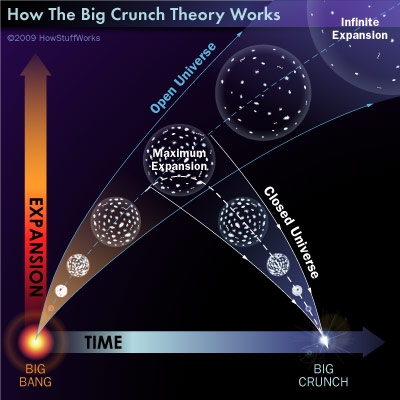
After establishing that the universe is expanding (with reference to Edwin Hubble’s discovery of it in the 1920s, who observed that all other galaxies were moving away from us and were doing so faster, the further away they were1), Krauss presents three alternatives for how that expansion may be occurring: “[A] closed Universe would expand and stop and then recollapse in a Big Crunch, the reverse of the Big Bang. An open Universe would expand forever and a flat Universe will expand and slow down and never quite stop.” The following illustration shows the open and closed cases – the flat one being similar to the open one, but having a limit (bound) to its (still infinite) expansion as opposed to being unbounded.

Big crunch open and flat universe

In the process of determining which of the three cases of expansion our Universe is undergoing, the challenge of measuring the mass of galaxies (to infer from them the curvature of their light-bending effects and therefore the curvature of the universe) and the whole universe arises and attempts to do so show that “most of the mass in [a] system of clusters of galaxies is not where the galaxies are. It’s between the galaxies. It is where nothing is shining.” This in turn leads to the realization that “dark matter is a new type of elementary particle,” which further complicates the quest for measuring the mass and energy of the universe.

The consequences of the universe being flat (i.e., expanding infinitely but asymptotically towards a limit) are then spelled out:

“It turns out that in a flat Universe, the total energy of the Universe is precisely zero. Because gravity can have a negative energy. So the negative energy of gravity balances out the positive energy of matter. What’s so beautiful about a Universe with total energy zero? Well, only such a Universe can begin from nothing. And that is remarkable, because the laws of physics2 allow Universes to begin from nothing! You don’t need a deity.3 You have nothing. Zero total energy and quantum fluctuations can produce a Universe.”

This nothing is further illustrated by results obtained recently about the mass of protons, where:

“it turns out most of the mass of the proton comes not from the quarks within a proton, but from the empty space between the quarks. These fields popping in and out of existence produce about 90% of the mass of a proton, and since protons and neutrons are the dominant stuff in your body, the empty space is responsible for 90% of your mass. So this empty space is vital to science and these calculations are vital to understanding not just protons, but electrons and atoms and produce the best comparisons.”

In other words, the nothing from which a universe can come into being is a “boiling bubbling brew of virtual particles that are popping in and out of existence” “because of the laws of quantum mechanics and special relativity.” This nothing is an “empty space” that is empty insofar as matter and gravity cancel out each other’s energy and insofar as quantum mechanics deals in fields that may or may not yield particles.

As far as this being what I understood, I actually find it quite beautiful – and Krauss would agree by saying that “the only mathematically beautiful Universe” is a flat one, like ours. There is a symmetry between positive and negative energy, light and dark matter, there is infinite expansion that is at the same time bounded, there is a constant dynamic of being potentially versus actually and there is a tremendous amount of beautiful science that has lead to this view of the universe. We have Lemaître’s and Hubble’s insights into the universe’s expansion, we have the astonishing work on measuring the universe’s curvature by means of looking at it’s background radiation, we have ways of measuring the mass of distant galaxies and their distances from us and so much more. From this point of view, I do recommend Krauss’ talk wholeheartedly.

Sadly, there is another side to it, which is its being peppered with jabs at religion and a profound ignorance of what many religious people believe. The underlying view of religious faith that informs the criticisms leveled against it here, and in many other atheist forums, seems to have people like Young-Earth creationists, Pentecostal snake-handlers and members of groups like the Westboro Baptist Church as their model. This is akin to me taking someone like Dr. Josef Mengele as the archetype of a scientist and projecting prejudices from him to all scientists. I have about as much in common with the lunacy of the above mentioned “religious” groups as with the barbarity of the above mentioned “scientist.”

Let me be a bit more specific though about why the religion-related claims of Krauss don’t stick, as it can otherwise seem like this is just a lot of hand-waving. First, let’s look at the cosmology (and cosmogeny) presented by Krauss, which postulates a coming-into-being of the universe from nothing. If anything, this scientific insight is fully consistent with the Christian account of creation, where God creates the world from nothing – hence the emblematic Latin phrase: “ex nihilo.” The Christian view of how the world came into being is not one of a God having inhabited space-time and then decided to turn parts of himself into planets, vegetation, animals, humans. Instead, the Catechism here affirms that “God gave a beginning to all that exists outside of himself” (§290), where (in some sense) there was nothing before: “All things came to be through him, and without him nothing came to be” (John 1:3). The Nicene Creed even speaks about God as the creator of “all things visible and invisible,” which can comfortably be applied to dark matter or the negative energy of gravity.

In fact, the Catechism (§296) is insistent on there having been nothing before the Universe started:

“We believe that God needs no pre-existent thing or any help in order to create, nor is creation any sort of necessary emanation from the divine substance. God creates freely “out of nothing”: “If God had drawn the world from pre-existent matter, what would be so extraordinary in that? A human artisan makes from a given material whatever he wants, while God shows his power by starting from nothing to make all he wants.” (St. Theophilus of Antioch, Ad Autolycum II)”

So, if anything, the model of a flat universe and of the nothingness that is at its origin is in perfect accord with what the Church has come to believe through revelation and the guidance of the Holy Spirit over the centuries (and as early as in the 2nd century in the writings of St. Theophilus!). There simply is no conflict here – listening to the science Krauss talks about just makes me delight in how much better we understand how it was that the universe came into being from nothing. I can therefore happily conclude, again with the Catechism (§283):

“The question about the origins of the world and of man has been the object of many scientific studies which have splendidly enriched our knowledge of the age and dimensions of the cosmos, the development of life-forms and the appearance of man. These discoveries invite us to even greater admiration for the greatness of the Creator, prompting us to give him thanks for all his works and for the understanding and wisdom he gives to scholars and researchers.”

Catholics (and adherents of many other Christian denominations and other religions) are in no way at odds with the advances of science, since – in addition to the benefits that it enables for the good of all, it sheds light on how the universe works and how it has worked since its beginning. Those who believe in God having created the universe (from nothing!), being the source of its laws and continuously sustaining its being can enjoy the advances of science as much as those who don’t hold those beliefs, and I wish that neither side would try to ridicule the other or force them to change their views!


1 Incidentally, it was Georges Lemaître – the Belgian priest and physicist, who made this realization based on Hubble’s data a couple of years before Hubble did.
2 It always baffles me how many atheists hail the latest developments of science as proofs of the non-existence of God, while quite happily relying on pre-existing “laws of physics.”
3 I. e., a “god of gaps” deity …

The beyond inside

Living success 3d drinking tea

For a while now, I have been coming across rather negative takes on the Dalai Lama’s “Beyond Religion” book from last year. So, when I saw it at an airport bookshop today, I bought it and started reading it on my way home across the Atlantic. Before I tell you more about it, I have to admit to having a deep-seated fondness for and admiration of the present Dalai Lama, stemming from having read quite a bit of his writings, having seen interviews with him (and that gem of a chat between him and Archbishop Desmond Tutu, mentioned here some time ago) and also from counting the movie Kundun among my all-time favorites. With this “baggage” in mind, you’ll understand that I was rather skeptical about the book’s reviews and dubious about their being representative of its author’s thoughts.

The criticisms tend to focus on quotes like: “in today’s secular world, religion alone is no longer adequate as a basis for ethics” and “when negative attitudes towards religion […] are motivated by a concern for justice, they must be respected.” Several commentators are then quite content to take these, become indignant and launch into extensive rants in defense of religion. I find that rather misguided and not only a misrepresentation of the Dalai Lama’s thought, but also woefully naïve.

Even just a reading of the introduction to the book makes one thing crystal clear – the Dalai Lama is not turning away from religion or finding it lacking in any way: “religion has helped millions of people in the past, helps millions of people today, and will continue to help millions in the future” and “it may seem [… that] I am advocating the exclusion of religion from ethical systems, or even from all areas of public life [… – t]his is not at all what I have in mind.”

So, what is he getting at?

“[My statements] may seem strange coming from someone who from a very early age has lived as a monk in robes. Yet I see no contradiction here. My faith enjoins me to strive for the welfare and benefit of all sentient beings, and reaching out beyond my own tradition, to those of other religions and to those of none, is entirely in keeping with this.”

All I can say to that is: Amen! Instead of renouncing religion or in any way devaluing it, the Dalai Lama is saying: let’s look for what we have in common and for the good that is deep-rooted in our human nature and nourish it. In fact, he puts the relationship between the ethics that is not contingent on religious beliefs and the ethics that is thus:

“Ethics and inner values without religious content are like water, something we need every day for health and survival. Ethics and inner values based in a religious context are more like tea. The tea we drink is mostly composed of water, but it also contains some other ingredients – tea leaves, spices, perhaps some sugar or, at least in Tibet, salt – and this makes it more nutritious and sustaining and something we want every day.”

This, to my mind, is a beautiful way of putting it, which makes me even sadder to see that the first part of the above quote gets bandied about as further evidence for the Dalai Lama considering religion to be of little value. Instead, I believe, that his metaphor is spot on and emphasizes the riches of faith, while also highlighting the universal access to a great deal of what is good about it. Note, that he is not saying – ethics without religion is water and the extra ingredients that can turn it into tea are religion. He is saying, religion is tea (i.e., water and other ingredients together) – it is a richer, more complex entity than what is accessible otherwise rather than an optional, minimal add-on. In this sense, the striving to bring ethics beyond religion is one of doing so for an ethics that is very much inside religion – like water is in tea.

From my Christian perspective I can rephrase what the Dalai Lama is saying as God, whom I believe to be the source of all goodness and happiness, making a great deal of himself accessible even to those who don’t believe in him (He is love, so why wouldn’t He?). This is a source of joy to me and – like the Dalai Lama – something I am grateful for and want to build on in my relationships with all. I am also grateful for what God makes accessible to me through His gift of faith, but it would be foolish of me to be jealous of His generosity and I would be blind if I saw His love only among those who hold the same beliefs as I do. The Dalai Lama’s attempts to tease out what he sees as being universal (i.e., non-belief-contingent) aspects of ethics are to me greatly positive and directed towards making God’s presence evermore widely and clearly felt on earth.

Re-reading the above, a possible misunderstanding of it comes to my mind: “Are you saying that the ethics of religious people is superior? That those of no religious faith are in some way second class ethical?” Not at all! I believe that we are all fully capable of acting selflessly, for the good of our neighbors, those in need and even our enemies – having faith is not a prerequisite for this (and this is essentially the Dalai Lama’s point). So, does faith make any difference? Absolutely! I believe that my faith helps me greatly in trying to live in the above way. Instead of a feeling of superiority it engenders a sense of responsibility in me though, and brings to mind Jesus’ parable of the talents (Matthew 25:14-30): from those to whom more was given, more will be expected.

What is a holy person like?

Butterfly wikimedia 0085 big

Last Sunday, Archbishop Rowan Williams met a group of young people in New Zealand and spoke to them about what it means to be a holy person. As will be no surprise to you, if you have been following this blog, his words were again a joy to read and I would just like to share my favorite bits with you.

The starting point of the talk is the apparent contrast of the Old Testament concept of holiness, where the emphasis is on being set apart, special, protected and the New Testament view which focuses on ubiquity (St. Paul’s addressing the first Christian communities as saints and holy people) and on the central importance of Jesus’ being involved intimately with human suffering, culminating in his crucifixion. This takes us to the realization that “[b]eing holy is being absolutely involved, not being absolutely separated.”

Instead of a holy person being “weird, […] drained of blood[, …] in a nutshell, not like us,” they go “into the heart of where it’s most difficult for human beings to be human”:

“And so Jesus goes outside the city, he goes to the place where people suffer and are humiliated, he goes to the place where people throw stuff out, including other people. [… The Christian idea of holiness is …] something to do with going where it’s most difficult in the name of the Jesus who went to where it was most difficult. And he wants us to be holy like that.”

As a result “there’s no contrast, no tension […] between holiness and involvement in the world. On the contrary, the most holy, who is Jesus, is most involved, most at the heart of human experience.” Instead of an irritating “saintliness, strictness, devoutness, goodness” that makes people around them feel “worse, guilty, inadequate,” holy people “make you feel better than you.”:

“But the holy person somehow enlarges your world, makes you feel more yourself, opens you up, affirms you. They’re not in competition; they’re not saying, ‘I’ve got something you haven’t’. They’re saying, ‘There’s an enormous amount of room for you in the world we occupy together.'”

This is not about complacency though, but about realizing that “it’s OK, we can start [here]. The world is big enough and God is big enough.” Saints “produce joy around them”; when you are with them “the landscape changes – there [is] a new light on it.” Holiness is not “a sort of extra special kind of goodness[, …] it’s not about competing levels of how good you are[, it’s] about enlarging the world, and it’s about involving in the world.”:

“[H]oly people, however much they may enjoy being themselves, just aren’t obsessively interested in themselves. They actually allow you to see, not them, but the world. They allow you to see not them, but God.[…]

[But], there’s the catch: if you want to be holy, stop thinking about it. If you want to be holy, look at God. If you want to be holy, enjoy God’s world, enter into it as much as you can in love and in service.”

These are just a couple of the bits I liked most from the talk and I’d encourage you to read it in full. What struck me as I was reading it was a very strong sense of knowing people just like that! I have been blessed, and keep being blessed, by knowing a number of holy people (a number that strikes me as being undeservedly large!) and counting them among my friends. Meeting them, or even receiving an email or text message from them, leaves me with precisely what Archbishop Williams says – a conviction that they have made me see the beauty of the world and God. As I know some of you are reading this: thank you!

Lumen Gentium: The mystery of the church

Christ Healing the Sick at Bethesda

In my attempt to read the full set of Vatican II documents during this Year of Faith, and after having greatly enjoyed both reading Dei Verbum and trying to share my takeaways from it here, I have turned to the next one of the four dogmatic constitutions: Lumen Gentium.1

The first thing to note about Lumen Gentium (LG) is its heft – while Dei Verbum (DV) comes in at ~6K words, LG clocks up just short of 35K. To keep my posts from draining your tablet batteries and to make the challenge more manageable for myself, I am going to look at LG chapter by chapter. The second aspect of LG that jumped out at me was its language as compared with DV. While DV strikes me as much more direct, synthetic and to the point, in LG there seems to be a much greater use of epithets, honorifics and circumlocution. This is not by way of criticism, but just as an observation that would probably make me recommend DV more easily than LG to someone who would otherwise not read these kinds of texts.

With the preambles out of the way, let me share with you what the first chapter of Lumen Gentium, entitled “The Mystery of the Church,” meant to me. While the whole of LG is about the Church, its first chapter is essentially the answer the Church gives to the question: “Who are you?” Even if you aren’t a Catholic, you can take the answer to be how the Church thinks of herself, and throughout this chapter you’d see that it does so along two dimensions: God-Church-World and Nature-Mission. The Church presents herself “as a sign and instrument both of a very closely knit union with God and of the unity of the whole human race” – facing not only towards God but also towards humanity, and “desires […] to unfold more fully to the faithful of the Church and to the whole world its own inner nature and universal mission.”

God the Father created the world and planned to “raise men to a participation of the divine life.” The Church, which Jesus “inaugurated,” is the “Kingdom of heaven on earth,” the Kingdom of the divine life. This may at first sound odd, but I believe, it could also have been put as “where God’s law (i.e., love) is adhered to on earth,” with the “where” not being restricted to location but applicable also to persons (i.e., an “in whom” and “among whom”). This ”Kingdom” is “the unity of all believers who form one body in Christ,” where that unity is “expressed and brought about” by the Eucharist:

“[I]n the breaking of the Eucharistic bread, we are taken up into communion with Him and with one another. “Because the bread is one, we though many, are one body, all of us who partake of the one bread”. In this way all of us are made members of His Body, “but severally members one of another”.”

The image of the Church as the “body of Christ” is very prominent in LG – Jesus is the “head of the Body which is the Church [… and all its] members ought to be molded in the likeness of Him, until Christ be formed in them.” This is very clearly not just about “what would Jesus do” but about a “becoming Jesus” and thereby “becoming one another.” This is not some rhetorical flourish, but an emphasis on the profound, existential nature of following Jesus, who “is the image of the invisible God and in [whom] all things came into being.” And neither is it about my, individual seeking of God only, but fundamentally about how I relate to others, how I become a “member of another,” how – as Cardinal Martini put it “the other is within us.” This is further emphasized in the following passage, where the role of the Holy Spirit (who “was sent [… to] continually sanctify the Church”) is presented:

“Giving the body unity through Himself and through His power and inner joining of the members, [the Holy] Spirit produces and urges love among the believers. From all this it follows that if one member endures anything, all the members co-endure it, and if one member is honored, all the members together rejoice.”

If this all sounds too idealized and removed from reality, it is worth bearing in mind that it is about what the Church is (or how it thinks of itself) and not about what it looks like. While saying anything about being (as opposed to empirically observed phenomena) is very difficult (if not impossible, if you are epistemologically honest) in the context of philosophy and science. Christianity, on the other hand, holds beliefs about it, justified by revelation in the person of Jesus and subsequently illuminated by the Holy Spirit.

What about the way that the Church appears? How does that relate to the “body of Christ” presented above? Here LG is very explicit:

“[T]he society structured with hierarchical organs and the Mystical Body of Christ, are not to be considered as two realities, nor are the visible assembly and the spiritual community, nor the earthly Church and the Church enriched with heavenly things; rather they form one complex reality which coalesces from a divine and a human element. For this reason, by no weak analogy, it is compared to the mystery of the incarnate Word. As the assumed nature inseparably united to Him, serves the divine Word as a living organ of salvation, so, in a similar way, does the visible social structure of the Church serve the Spirit of Christ, who vivifies it, in the building up of the body.”

Jesus, the Word of God, is to Jesus the person who walked the earth 2000 years ago as the social structure – the Church, is to the Mystical Body of Christ – the Church. Just like every aspect of how Christianity views anything is ultimately rooted in the Trinity, so too the Church mirrors the incarnation of one of its Persons – Jesus. I believe this is a very powerful way of understanding the Church, that reconciles both the temporal, limited, imperfect with the infinite, perfect that sustains it and gives life to it.

Just to avoid giving the impression that LG is divorced from the phenomenological experience of the Church, with its obvious limitations, that sadly also include some shocking perversions, it is useful to highlight the following passage:

“While Christ, holy, innocent and undefiled knew nothing of sin, but came to expiate only the sins of the people, the Church, embracing in its bosom sinners, at the same time holy and always in need of being purified, always follows the way of penance and renewal. […]

By the power of the risen Lord it is given strength that it might, in patience and in love, overcome its sorrows and its challenges, both within itself and from without, and that it might reveal to the world, faithfully though darkly, the mystery of its Lord until, in the end, it will be manifested in full light.”

Finally, I was also encouraged to see a clear acknowledgement that the Church as an organization does not claim to have a monopoly, by saying that “many elements of sanctification and of truth are found outside of its visible structure” and a clear reminder of the Church’s status in the world:

“Just as Christ carried out the work of redemption in poverty and persecution, so the Church is called to follow the same route that it might communicate the fruits of salvation to men. Christ Jesus, “though He was by nature God … emptied Himself, taking the nature of a slave”, and “being rich, became poor” for our sakes. Thus, the Church, although it needs human resources to carry out its mission, is not set up to seek earthly glory, but to proclaim, even by its own example, humility and self-sacrifice.”

While I have certainly found the first chapter of Lumen Gentium much more challenging than Dei Verbum (and I don’t know how well I managed to get my impressions from it across), it has left me with a vision of the Church that is profound, universal, open and positioned to draw itself and all closer to God-Love.


1 If you haven’t read my post on Dei Verbum (and I am not suggesting you should feel bad about that :), you might like to at least take a quick look at the caveat there in paragraph 2.

She said, he said

Fragments

Have you ever been approached by a Jehova’s witness and had them quote from the Bible to you? I have (several times 🙂 and the thing that first struck me, and I have found almost invariably since, is that they tend to use a small set of passages to further their cause while being blind to the fullness of the Good News. A frequent example is their reference to Revelation for arguing that very few will be saved (and that they can get you a seat): “I heard the number of those who had been marked with the seal, one hundred and forty-four thousand marked from every tribe of the Israelites” (Revelation 7:4). Yet, only a couple of sentences later John says: “After this I had a vision of a great multitude, which no one could count, from every nation, race, people, and tongue. They stood before the throne and before the Lamb, wearing white robes and holding palm branches in their hands.” (Revelation 7:9). And my pointing it out to them in their copy of the Bible tends to be the end of our friendly chat …

“OK,” you may think, “so Jehova’s witnesses are a bit blinkered – but I already knew that!” and you’d be right. There is no surprise there, but where I have been surprised recently was by the controversy surrounding Dr. Tina Beattie, Professor of Catholic Studies at Roehampton University. Prof. Beattie has last week had an invitation revoked to be a Visiting Fellow at the University of San Diego and to deliver a series of talks. Naturally, she objected and she went on to claim that unfounded denunciations of her writings by numerous “Catholic” blogs were to blame. This is not the first time such cancellations happened either, as plans for a lecture by her at Clifton Cathedral in Bristol have also been cancelled recently on grounds of her alleged heterodoxy. Such claims by her and her critics made me curious about what was behind them and the following is what I managed to piece together.

First of all, Prof. Beattie does not deny that she holds some views that are in conflict with the teaching of the Church (e.g., she signed a letter to The Times, saying that Catholics could, “using fully informed consciences, … support the legal extension of civil marriage to same-sex couples.”) Instead, she justifies her position by the following:

“I am an academic theologian who is also a practising Catholic. (This is subtly different from claiming to be a Catholic theologian if that implies somebody with a licence who is authorised to teach by the official magisterium). […]

Any academic theologian working in a university must […] seek to promote an intellectual culture in which reason rather than fideism is the basis for enquiry and research, knowing that in the Catholic tradition reason and revelation go hand in hand. […]

I have also always had absolute respect for the difference between the doctrinal truths of the faith, made knowable through revelation alone, and those truths which are arrived at by reason and which involve philosophical reflection informed by natural law and in engagement with other sources of human knowledge. So, with regard to all the doctrinal teachings that belong within the deposit of faith entrusted to the Church, my theological position is absolutely orthodox.”

Hmm … where to start?! Even before looking at what Prof. Beattie has to say, I see several issues with how she positions herself, although I also see things that I agree with unreservedly! Promoting an “intellectual culture in which reason rather than fideism is the basis for enquiry and research” is certainly one of them. Where Prof. Beattie and I would part ways though is her compartmentalization of herself: as a practicing Catholic on the one had and as a critical academic on the other. Not only do I believe this to be unhealthy, but also impossible! Either one strives to be a practicing Catholic (with all that implies and not only with a cherry–picking of it), or one places themselves outside that community and is honest about it.

Such bipolarity is further underlined by the last part of the above quote, where Prof. Beattie draws a line between faith “knowable through revelation alone” and “truths arrived at by reason [and] human knowledge.” At its basis this is just as contradictory a position as the practicing-academic one. Dei Verbum states very clearly that “God, who spoke of old, uninterruptedly converses with the bride of His beloved Son; [through the] Holy Spirit, through whom the living voice of the Gospel resounds in the Church, and through her, in the world” (§8). To draw a line between God speaking “of old” and his “uninterrupted conversation” with the Church is just as contrary to what the Church teaches as the other topics that she has been picked up on.

I don’t mean to recount in a lot of detail what Prof. Beattie is being criticized for, and if you are easily (or even not all that easily 🙂 offended, please, skip to the last paragraph.

The key bone of contention, as cited by the “Protect the Pope” blog and many others, beyond her support for same-sex marriage and abortion under some circumstances, is the claim that she describes the Mass as “an act of (homo) sexual intercourse” on pp. 80 of her book entitled “God’s Mother, Eve’s Advocate.” This is an accusation that Prof. Beattie vehemently denies and claims is a result of a misunderstanding:
“In the work that is cited and quoted by these bloggers, I was writing an extended critique of the theology of Hans Urs von Balthasar, whose writings I have studied for a number of years. My comments were made in the context of my deep concern over his highly sexualised representation of the Mass. This criticism is shared by a number of others who have written on von Balthasar. The suggestion that I mock the Mass because I criticise another theologian’s interpretation is outrageous.”

I have to say I agree with Prof. Beattie here: the remarks she is being attacked for are ones she herself is critical of and attributes to another. On pp. 196 of the same book she states clearly that “neo-orthodox theology risks reducing the Mass to an orgasmic celebration of homosexual love.” Where my agreement fizzles out though is with her attributing the view she criticizes to von Balthasar. While I haven’t studied his writings “for a number of years,” I am familiar with some of them and have even tracked down the following passage, where von Balthasar talks about the Trinity (which must also inform his views on the mass), in terms that others have taken as him reading their relationships in sexual terms:

“In Trinitarian terms, of course, the Father, who begets him who is without origin, appears primarily as (super-) masculine; the Son, in consenting, appears as (super-) feminine, but in the act (together with the Father) of breathing forth the Spirit, he is (super-) masculine. As for the Spirit, he is (super-) feminine. There is even something (super-) feminine about the Father too, since as we have shown, in the action of begetting and breathing forth he allows himself to be determined by the Persons who thus proceed from him.” (Hans Urs von Balthasar, Theo-drama. V: The last act, pp. 91)

To take the above and interpret it as von Balthasar talking about homosexual relationships among the persons of the Trinity or during the mass is confused though – and, more importantly from the perspective of the argument I am trying to make here, not what von Balthasar meant! Here it suffices to just read on in the same paragraph, where he says:

“The very fact of the Trinity forbids us to project any secular sexuality into the Godhead (as happens in many religions and in the gnostic syzygia). It must be enough for us to regard the ever-new reciprocity of acting and consenting, which in turn is a form of activity and fruitfulness, as the transcendent origin of what we see realized in the world of creation: in the form and actualization of love and its fruitfulness in sexuality.”

Far from sexualizing the Trinity, von Balthasar instead points to the Trinitarian origin of human sexuality, where its self-giving, reciprocal, consenting and fruit-bearing aspects reflect the dynamics of intra-Trinitarian relationships. A very different and wholly orthodox view in my opinion … It may well be that her way of interpreting von Balthasar is again a consequence of Prof. Beattie’s distinction between Scripture and Tradition as it seems like the taking of a text in isolation and a free interpretation of it (free as in fall – not beer :).

In summary, I acknowledge that I only have a very partial view of Prof. Beattie’s thought and even though she recently prepared a “public statement on [her] theological views,” its focus was on what she does not mean rather than on what she does – a useful, but inherently limited exercise. Further, her self-justification seems to rely on a separation between Catholic practice and academic thought and between Scripture and Tradition, neither of which are beneficial or orthodox. While I wholeheartedly support Prof. Beattie’s commitment to a reasoned critique of Church teaching and to the model of “diversity in unity,” her own approach seems to me heterodox not only in content but also in method. Finally, let me express an even more categorical disagreement with blogs like “Protect the Pope,” who snatch a fragmentary quote out of context and present it in a light that is diametrically opposed to its original meaning and, furthermore, that they take this to initiate a witch-hunt! In the end we arrive at a misrepresentation of a misinterpretation, which instead of supporting either party’s position just places both into disrepute. This is not a reasoned diversity manifesting itself (which I would wholeheartedly support and be proud of), but brawlers lashing out at each other in the dark.

Queen of Paradise مريم

Mariam

A couple of days ago I came across the following tweets, written by a Muslim:

“Mary = Maryam/Miryam. “None among women have reached perfection except Mary the Virgin” – P. Muhammad”

“Since the Quran venerates her & the Prophet Muhammad called her […] the Queen of Paradise, I do recourse to her intercession.”

As you can imagine, it stopped me in my tracks and I have been trying to find out more about where these statements fitted within Islamic teaching. While I was vaguely aware of the Qur’an considering Jesus a prophet and also mentioning Mary (and doing so more extensively even than the New Testament), what I learned over the last couple of days goes so far beyond that and I would like to share it with you.

Muslims believe that God sent the angel Gabriel to the prophet Muhammad, who transmitted to him God’s words, verbatim – the Qur’an. There Mary is mentioned from the start and the Annunciation, is recounted as follows in the third chapter (Surat ‘Āli `Imrān):

“[T]he angels said, “O Mary, indeed Allah has chosen you and purified you and chosen you above the women of the worlds. O Mary, be devoutly obedient to your Lord and prostrate and bow with those who bow [in prayer].”” (Qur’an, 3:42-43)

“[T]he angels said, “O Mary, indeed Allah gives you good tidings of a word from Him, whose name will be the Messiah, Jesus, the son of Mary – distinguished in this world and the Hereafter and among those brought near [to Allah].
He will speak to the people in the cradle and in maturity and will be of the righteous.”
She said, “My Lord, how will I have a child when no man has touched me?” [The angel] said, “Such is Allah; He creates what He wills. When He decrees a matter, He only says to it, ‘Be,’ and it is.
And He will teach him writing and wisdom and the Torah and the Gospel.
And [make him] a messenger to the Children of Israel, [who will say], ‘Indeed I have come to you with a sign from your Lord in that I design for you from clay [that which is] like the form of a bird, then I breathe into it and it becomes a bird by permission of Allah. And I cure the blind and the leper, and I give life to the dead – by permission of Allah.”” (Qur’an, 3:45-49)

The Qur’an also talks about Mary’s birth, the years leading up to the Annunciation and her life of prayer under the supervision of the prophet Zechariah in earlier verses:

“[W]hen the wife of ‘Imran [Joachim] said, “My Lord, indeed I have pledged to You what is in my womb, consecrated [for Your service], so accept this from me. Indeed, You are the Hearing, the Knowing.”
But when she delivered her, she said, “My Lord, I have delivered a female.” And Allah was most knowing of what she delivered, “And the male is not like the female. And I have named her Mary, and I seek refuge for her in You and [for] her descendants from Satan, the expelled [from the mercy of Allah].”
So her Lord accepted her with good acceptance and caused her to grow in a good manner and put her in the care of Zechariah. Every time Zechariah entered upon her in the prayer chamber, he found with her provision. He said, “O Mary, from where is this [coming] to you?” She said, “It is from Allah. Indeed, Allah provides for whom He wills without account.””(Qur’an, 3:35-37)

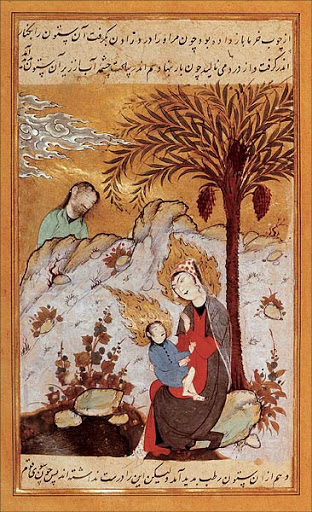
Later on, chapter 19 (Surat Maryam) is dedicated to Mary, which after an account of John the Baptist’s birth proceeds to re-tell the Annunciation (having the angel say to Mary: “I am only the messenger of your Lord to give you [news of] a pure boy.”) and then proceeding to the birth of Jesus:

“So she conceived him, and she withdrew with him to a remote place.
And the pains of childbirth drove her to the trunk of a palm tree. She said, “Oh, I wish I had died before this and was in oblivion, forgotten.”
But he called her from below her, “Do not grieve; your Lord has provided beneath you a stream.
And shake toward you the trunk of the palm tree; it will drop upon you ripe, fresh dates.” (Qur’an, 19:22-25)

“[S]he pointed to him. They said, “How can we speak to one who is in the cradle a child?”
[Jesus] said, “Indeed, I am the servant of Allah. He has given me the Scripture and made me a prophet.
And He has made me blessed wherever I am and has enjoined upon me prayer and zakah as long as I remain alive
And [made me] dutiful to my mother, and He has not made me a wretched tyrant.
And peace is on me the day I was born and the day I will die and the day I am raised alive.”” (Qur’an, 19:29-33)

Mary is mentioned 34 times in the Qur’an (the only woman to be referred to by name) and there is a wealth of ways in which she is revered and taken as an example in Islam. What am I, a Catholic, to make of this though? Primarily, my reaction is one of joy at having discovered a previously unknown community of my Mother’s sons and daughters. There is no doubt in my mind that Muslims who look to Mary as a role model (which I didn’t know existed before) have a lot in common with me and that is unquestionably a delight. Even from the few quotes above (that barely scratch the surface and don’t even touch on exegesis), it is clear though that there are dramatic differences here both in direct contrast (e.g., the account of Jesus’ birth being at odds with its Christian understanding) and in terms of lacking parallel accounts (Mary’s youth not being recounted in the New Testament), not to mention the very different conception of Jesus as compared to the Christian one. While it would be a mistake to look for syncretism (it always is), I believe it would also be a missed opportunity to only focus on differences. The Catechism of the Catholic Church is very clear about there being goodness and truth to be found in all religions (§843) and that they all “reflect a ray of that truth which enlightens all men” (Nostra Aetate 2). I certainly feel enriched from having read the above passages of the Qur’an and will seek to further deepen my understanding.

Allāhu Akbar.