Divergent rays

Nasa sun

The Gospel verse “In the beginning was the Word” has been going around in my head, ever since it dawned on me last weekend that it clearly points to something having preceded it. Thinking more about it made me revisit a text (actually, various fragments of it, since it has, as yet, not been published in full) where Chiara Lubich recounts her “intellectual visions” of Paradise that started in 1949. In particular, I wanted to re-read how she described Jesus, the Word:

“I found myself […], as in a vision seen with the eyes of the soul, having come into the Bosom of the Father, who showed me, as it were, the inside of a sun that was all gold or flames of gold, infinite, but not frightening.”

“[F]rom the walls inside the Sun, the Father pronounced the word: Love, and this Word, concentrated in the heart of the Father, was his Son.”

The picture here is very vivid and in many ways like those of St. Hildegard of Bingen’s visions. It transmits a very clear sense of what it may have seemed like to be there “in the beginning.” Reading on, Chiara also shares the following vision of creation:

“When God created, He created all things from nothing because He created them from Himself: from nothing signifies that they did not pre-exist because He alone pre-existed (but this way of speaking is inexact as in God there is no before and after). He drew them out from Himself because in creating them He died (of love), He died in love, He loved and therefore He created.

As the Word, who is the Idea of the Father, is God, analogously the ideas of things, that “ab aeterno” are in the word, are not abstract, but they are real: word within the Word.

The Father projects them — as with divergent rays — “outside Himself,” that is, in a different and new, created dimension, in which he gives to them “the Order that is Life and Love and Truth.” Therefore, in them there is the stamp of the Uncreated, of the Trinity.”

I find the above paragraphs particularly important since they indicate several key ways of thinking about how God and the universe are related:

  1. That God (the Trinity, the Uncreated) can be found in nature since it bears His “stamp,”
  2. that Jesus – the Word – is not only God who made himself present in the world as a human being 2000 years ago, but is the very means by which the Father goes “outside Himself” in His Creation,
  3. that creation is an act of self-noughting love, and
  4. that creation can be thought of as a new dimension of God.

This relationship is clearly not that of a “God of gaps,” cobbled-on caricature, but a tightly-interwoven, integral, first-person communion. Creation is to God as the rays of the sun are to the sun.

In fact, the picture of the sun and its divergent rays (and the use of “picture” is very deliberate, given what follows), is also very much consonant with Wittgenstein’s thoughts on how a system (the world) and its meaning relate:

“The sense of the world must lie outside the world. In the world everything is as it is and happens as it does happen. In it there is no value—and if there were, it would be of no value.

If there is a value which is of value, it must lie outside all happening and being-so. For all happening and being-so is accidental.

What makes it non-accidental cannot lie in the world, for otherwise this would again be accidental.

It must lie outside the world.” (Tractatus Logico-Philosophicus, 6.41)

Where does this leave a Christian in terms of how science and revelation make sense of the world? I believe, James Clerk Maxwell put it very well: “I think Christians whose minds are scientific are bound to study science that their view of the glory of God may be as extensive as their being is capable.” It is with this mindset that Prof. John Lennox commented on the Higgs Boson discovery by saying “God created it, Higgs predicted it and Cern found it.” Instead of a conflict, the advances of science are as much a source of wonder and joy to a Christian as are the visions of those who seek God and to whom he makes himself known in entirely unscientific ways.

In the beginning

In the beginning

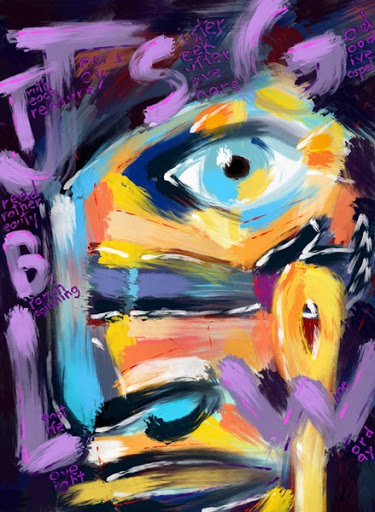
This is my third attempt at starting a post1 that I have been thinking about intensively all weekend (and that follows a train of thought that I have nursed on and off for years). Why write about it now? Because I believe I have finally understood something that has been staring me in the face for years: the opening line of St. John’s Gospel is a joke!

“Whoa!” I hear you say “Hold it right there!” Before you start crying “Blasphemy!” or “Stone him!,” please, do hear me out.2 I don’t mean to say that it is ridiculous, frivolous, trivial or inconsequential. On the contrary! I believe that I can now see a twist of humor in it that furthermore alludes to complexity that would otherwise have taken tomes upon tomes to try and spell out and that would have been well beyond St. John or the Christians of the first many centuries.

Picture this (imaginary, non-canonical!) scene:

God the Father, Jesus and the Holy Spirit are sitting around a table, chatting (you can imagine that this is what they spoke about in the scene Rublev painted, if you like):

Father: OK, guys, let’s get John started with his Gospel.

Jesus: Dad, can we have him spell out how it all started, and not just open with my birth?

HS: Sure(!), but the maths might be a tad beyond him, don’t you think?

Jesus: I didn’t mean to give him the full recipe, HS! This is not about repeatability and independent verification …

HS: So, were you thinking along the lines of the atemporal – yet dynamic, hyper-dimensional, infinite, partaking in the finite, linear, half-axis of time and being delimited in space? Even if we dumb it down to the level of philosophy, it’s still a tall order (although if anyone can do it, I can!).

Father: Look, HS, Jesus does have a point – we could give them a sense of what is going on, without having to bring Ambrose, Thomas or Albert forward. Surely you can think of some little quip to point them in the right direction.

[A “moment”’s silence later.]

HS: It’s a bit cheeky, but how about this – and I’m just riffing here (plus they’ll have to wait for Ludwig and Martin to start unpacking it) …

Jesus: Get on with it! We may have all eternity, but I’d rather get back to giving Sidd some more hints.

HS: All right, all right! How about John opens with this: “In the beginning was the Word!”

The Father and Jesus look at each other, wide-eyed, exclaim: “Genius!” and the triune bursts out laughing.

The insight I had, while walking to mass on Sunday morning and thinking about Dei Verbum, the Johannine prologue and Descartes’ “cogito,” was the following: Saying “In the beginning was the Word” is like starting a recipe with “knead the dough.” A word cannot possibly be the start: it requires a language, other words, syntax, grammar and speakers and listeners who know how to play the games it facilitates. Saying “In the beginning was the Word” is saying “Look, this is as far back as we can take you, but know that there was lots that came before.” It places at the beginning an innocent-looking entity: a word, yet one that vehemently points beyond itself. To meaning, to reference, to relation, to function, to communication, to a meeting of minds. With a simple sentence, John (with some help), gives a masterclass on the inevitability of the preexisting and the core of Trinitarian relationships, where, like a word, each person points beyond themselves.

“Alright,” you say, “but why call it a joke?” I believe the structure of this sentence is precisely that of all one-liners: the first part (“In the beginning”) prepares you for a certain set of expectations and the second surprises you with something that just does not fit (“the Word,” which cannot possibly be in the beginning :). This is exactly what Kant meant with “Laughter is an effect that arises if a tense expectation is transformed into nothing.” Not wanting to kill humor with explanation, let me leave you with another example of the same comedic form: “Every winter when the first snow fell, I’d run to the front door with excitement, start banging on it and shout: “Mum! Dad! Let me in!”” (Milton Jones).

Realizing the above, I started seeing the Johannine pattern elsewhere too. Descartes, starts with “cogito ergo sum,” in an attempt to draw a line and derive a philosophy from that stake in the ground. Yet, it is a line that carries a lot of baggage beyond itself. My own earlier attempt too, which tries to take the “cogito” a step further by starting with “Language” is nothing but an explicit acknowledgement of such a necessary preexistence and in no way escapes or circumvents it. Unsurprisingly, the account of creation in Genesis uses the word/language mechanism for indicating the process of creation, where matter is spoken into being (“Then God said: Let there be light, and there was light” (Genesis 1:3)). More surprisingly, one of the Hindu creation accounts (the Nasadiya Sukta in the Rigveda) also employs a similar, though not identical, mechanism: “The One breathed windlessly and self-sustaining […] that was the primal seed, born of the mind.” Even the creation account of the Sumerians (The debate between Sheep and Grain, written in the 3rd millennium BC), highlights the role of language in the process: “the great gods, did not even know the names Grain or Sheep.”

What is clear to me from the above is the fundamental role of language in the process of something coming from nothing, which in a sense undermines the idea of a true nothing having preceded the something. With this in mind, the Christian identification of Jesus with “the Word,” which I have been wondering about for years, makes perfect sense. The Father makes himself known to us by speaking his Son, who in turn points back to Him: “Whoever has seen me has seen the Father.” (John 14:9) and then: “The words that I speak to you I do not speak on my own. The Father who dwells in me is doing his works. Believe me that I am in the Father and the Father is in me, or else, believe because of the works themselves.” (John 14:10-11, with a nice hat-tip to orthopraxy).

So, let me finish with a one-liner: “In the beginning was the Word.” 🙂


1 In a previous version I would have taken you through Lemaître, the Planck epoch and the opening lines of the Tanakh, before getting to the Johannine prologue.
2 Thanks to my über–bestie, PM, for his Nihil Obstat and Transferitur (the Imprimatur of the digital age) – much appreciated!

Hellfire and brimstone: not in my name

While the current bishop’s synod in Rome is a joy to follow (with gems like Archbishop Williams’ talk or the pope’s opening sermon and contributions from many of the world’s bishops as well as other invited participants), there are the inevitable oddities swirling around its periphery.

Today, for example, I came across a piece about one of the synod’s observers, Dr. Ralph Martin, Director of Graduate Theology and New Evangelization at Sacred Heart Major Seminary in Detroit, who argues that “Evangelization should include fear of hell” and that “[t]he assumption that almost everyone is basically good and destined for heaven is a “silent apostasy” infecting a culture “drifting toward destruction.”” Martin then proceeds to invoke Lumen Gentium (the Vatican II document I am reading now) and say that while it “does allow the possibility “for certain people to be saved without hearing the Gospel under specific conditions,” […] very often people aren’t inculpably ignorant of the Gospel, they’re not seeking God, they’re not living according to the light of their conscience, they’re not responding to God’s grace, and they actually exchange the truth of God for a lie.” In summary, “we can’t presume that everyone’s on the way that’s leading to Heaven.”

I couldn’t disagree more!

  1. While Martin (rightly) points out that people are often “not living according to the light of their conscience” (and who isn’t at some time or another?!), it is some stretch to go from there to suggest that they (we!) are not on the way to heaven.
  2. Lumen Gentium makes absolutely no mention of hell (or any related concept I could think of) whatsoever, so brandishing it as the justification of one’s views is a bit of a leap of (non)faith.
  3. Martin’s approach seems divorced from both Benedict XVI’s and John Paul II’s teaching about hell:

    “[H]ell is the ultimate consequence of sin itself… Rather than a place, hell indicates the state of those who freely and definitively separate themselves from God, the source of all life and joy.” (Blessed Pope John Paul II, general audience, 28 July 1999)

    “Who will [be in hell]? The Church has never made any pronouncement in this regard. This is a mystery, truly inscrutable, which embraces the holiness of God and the conscience of man. The silence of the Church is, therefore, the only appropriate position for Christian faith. Even when Jesus says of Judas, the traitor, “It would be better for that man if he had never been born” (Matthew 26:24), His words do not allude for certain to eternal damnation.” (Blessed Pope John Paul II, Crossing the Threshold of Hope)

    “Perhaps there are not so many who have destroyed themselves so completely, who are irreparable forever, who no longer have any element upon which the love of God can rest, who no longer have the slightest capacity to love within themselves. This would be hell.” (Pope Benedict XVI, question and answer session with the priests of Rome, 11 February 2008)

    With the above concept of hell (a voluntary separation of oneself from God, in the face of God!), it is hard to see who would be there. Benedict XVI only goes so far as to say that there are perhaps “not so many” there, while John Paul II flatly refuses to speculate! Both of their positions are very much aligned though with the view that Martin opposes (“[t]he assumption that almost everyone is basically good and destined for heaven”) and calls a “silent apostasy” … Not the smartest of criticisms to level at a pope and especially not at the current and previous ones.

  4. Threatening others with hell just seems to be contrary both to the Golden Rule and the Good News that Jesus taught, as can be seen also from what some of the early Church Fathers had to say about the subject, including St. Gregory of Nyssa’s belief that “all free creatures will share the grace of salvation” (i.e., apocatastasis) and another exclaiming: “If anyone has to be in hell, let it be me.” Even just from the perspective of charity, I cannot see how I could wish for anything other than for hell to be empty.
  5. Even from a psychological perspective, reinforcement of good behaviour is more effective than threatening to punish bad behaviour (e. g., see Kahneman’s treatment of the subject).
  6. Jesus’ call is a positive one: love your neighbor as yourself, feed the hungry, clothe the naked, visit prisoners, … Following it leads to heaven, while just trying to avoid transgressions that are punishable is not enough.

I don’t mean to deny the reality of hell – just like heaven (communion with God-Love), a foretaste of hell (separation from God-Love) can readily be had in this life already. What I am saying though is that a focus on hell is counterproductive. By keeping my eyes on God in my neighbors, I am leaving myself less time to be absorbed by myself. Hell is kept at bay by my being busy with the pursuit of heaven.

Dei Verbum: a first look

Word made flesh 2

As set out in a previous post, I have embarked on a journey through the 16 Vatican II documents, starting with the dogmatic constitution Dei Verbum here.

Before getting into it, let me start with a few words to those of you – my friends! – who hold no or other beliefs about God than me. Without meaning to tell you what to do, I’d say that probably the best attitude to have when reading this post (and the rest of the series that will follow on Vatican II) is that of Thomas Nagel in his well-known paper entitled: “What is it like to be a bat?1 I don’t mean to get sidetracked here into his superb challenge to how consciousness is to be approached, but would just like to take some pointers from him on how one can consider the words of another, who holds different beliefs (and I am talking purely about understanding, without meaning to reduce relationships to knowledge alone). Nagel has the key insight that the question of what it is to be a bat is not about what it would be like for me to be a bat, but what it is for a bat to be a bat. “Yet if I try to imagine this, I am restricted to the resources of my own mind, and those resources are inadequate to the task. I cannot perform it either by imagining additions to my present experience, or by imagining segments gradually subtracted from it, or by imagining some combination of additions, subtractions, and modifications.” Just to avoid any misunderstanding, I believe these limitations apply in both directions. I too lack the direct experience of not believing in God or of holding other beliefs to my own, and therefore can only get so far with understanding what it is like to be an atheist or agnostic using my own “inadequate resources.” Sticking to Nagel’s example, trying to understand another person with whom I don’t share a key characteristic is like trying to understand from a bat what it is like to have sonar. Even if the bat could speak English, we wouldn’t have a shared vocabulary for it to quite get that across to me. In spite of such limitations, I hope that you will find interest in how Catholics look at the way they believe God has revealed himself to the world, which is precisely the subject of Dei Verbum.

Where else would the discourse start but with a quote from the New Testament, where John says the following:

“We announce to you the eternal life which dwelt with the Father and was made visible to us. What we have seen and heard we announce to you, so that you may have fellowship with us and our common fellowship be with the Father and His Son Jesus Christ” (1 John 1:2-3)

This puts us in a very clear context from the word go: that of continuity with Jesus’s disciples desiring to share what they have “seen and heard,” for the sake of building relationships with others and with God. The purpose of Dei Verbum then is to clarify how the above revelation of God to the world is to be understood. This revelation, where “the invisible God out of the abundance of His love speaks to men as friends and lives among them, so that He may invite and take them into fellowship with Himself.”

Dei Verbum proceeds to present different ways in which God has revealed and continues to reveal himself:

  1. Nature. “God, who through the Word creates all things and keeps them in existence, gives men an enduring witness to Himself in created realities” and “he ceaselessly kept the human race in His care, to give eternal life to those who perseveringly do good in search of salvation.” The message here is clear: God can be found in his creation,2 “known […] by the light of human reason” and all who live for others rather than themselves will find him.
  2. The people of Israel. “Then, at the time He had appointed He called Abraham in order to make of him a great nation. Through the patriarchs, and after them through Moses and the prophets, He taught this people to acknowledge Himself the one living and true God, provident father and just judge.” The books of the Old Testament “give expression to a lively sense of God, contain a store of sublime teachings about God, sound wisdom about human life, and a wonderful treasury of prayers, and in them the mystery of our salvation is present in a hidden way.” Even though these books “also contain some things which are incomplete and temporary, [we] should receive them with reverence.” “God, the inspirer and author of both Testaments, wisely arranged that the New Testament be hidden in the Old and the Old be made manifest in the New.”
  3. Jesus. “He sent His Son, the eternal Word, who enlightens all men, so that He might dwell among men and tell them of the innermost being of God.” God sends his Son, Jesus – the “eternal Word” – and through his life, teaching, death and resurrection, God shows himself directly to us and reveals himself in full intimacy.
  4. The Holy Spirit. For someone to “freely assent to the truth revealed by Him […], the grace of God and the interior help of the Holy Spirit must precede and assist” and “[t]o bring about an ever deeper understanding of revelation the same Holy Spirit constantly brings faith to completion.” While revelation is complete in the person of Jesus, the Holy Spirit (“the Spirit of truth”), whom Jesus sent to his followers after his resurrection, continues to deepen our understanding of it.

How is it then, that God’s revelation is preserved, maintained and spread? Jesus commissioned the Apostles to share with others “what they had received from [His lips], from living with Him, and from what He did, or what they had learned through the prompting of the Holy Spirit.” They were also prompted to “commit the message of salvation to writing” and, “to keep the Gospel forever whole and alive.” “[T]he Apostles left bishops as their successors, “handing over” to them “the authority to teach in their own place.” (St. Irenaeus, Against Heretics III, 3)” Since the words of the Gospel are put into practice by Jesus’ followers, and since the Holy Spirit inspires them, “there is a growth in the understanding of the realities and the words which have been handed down.” This to me is quite a key passage – the account of Jesus’s life and teaching is not a static piece of text, frozen in time, but instead a source of growing understanding and new insights brought about with the help of the Holy Spirit in those who follow Jesus: “[T]hus God, who spoke of old, uninterruptedly converses with the bride of His beloved Son; [through the] Holy Spirit, through whom the living voice of the Gospel resounds in the Church, and through her, in the world.” The upshot of this is a very tight link between Scripture (a record of Jesus’ life and teaching) and Tradition (Jesus’ followers’ growing insight into Scripture from putting it into practice and with the help of the Holy Spirit), interpreted over time by the successors of the Apostles.

How is one to understand the nature of Scripture though? Dei Verbum first reaffirms the Church’s belief in “the books of both the Old and New Testaments in their entirety, with all their parts, [being] sacred and canonical because written under the inspiration of the Holy Spirit, they have God as their author and have been handed on as such to the Church herself.” However, since they were written by men, we “should carefully investigate what meaning the sacred writers really intended, and what God wanted to manifest by means of their words.” Here, a distinction needs to be made between passages that are “historical, prophetic, poetic, or of other forms of discourse.” “[We] must investigate what meaning the sacred writer intended to express and actually expressed in particular circumstances by using contemporary literary forms in accordance with the situation of his own time and culture. [… D]ue attention must be paid to the customary and characteristic styles of feeling, speaking and narrating which prevailed at the time of the sacred writer, and to the patterns men normally employed at that period in their everyday dealings with one another.” This is as far from literalism as you can get – instead it is a teasing out of intention from a text anchored in a specific period of history and in a specific geographical location. No wonder its understanding has the potential to grow and for “new insights [to be] brought about”!

An important warning follows next in Dei Verbum: “serious attention must be given to the content and unity of the whole of Scripture if the meaning of the sacred texts is to be correctly worked out [and t]he living tradition of the whole Church must be taken into account along with the harmony which exists between elements of the faith.” Understanding what was meant by a passage from Scripture mustn’t be done on the basis of picking a couple of phrases out of the whole and trying to make sense of them from scratch. They are part of a textual corpus and there is a rich body of existing insight into them and interpretation of them, to which any new understanding can add. Preserving the message God sent us through his Son and the Holy Spirit – and understanding it in the context I am in – requires a careful and critical interaction with all of Scripture, in which the Church’s judgment plays a key guiding and interpretative role too. Ultimately, the aim is “that we may learn the gentle kindness of God, which words cannot express, and how far He has gone in adapting His language with thoughtful concern for our weak human nature” (St. John Chrysostom, On Genesis).

Within the New Testament, the Gospels have a special “preeminence,” “for they are the principal witness for the life and teaching of the incarnate Word.” Their authors wrote the four Gospels, “selecting some things from the many which had been handed on by word of mouth or in writing, reducing some of them to a synthesis, explaining some things in view of the situation of their churches and preserving the form of proclamation but always in such fashion that they told us the honest truth about Jesus. For their intention in writing was that […] we might know “the truth” concerning those matters about which we have been instructed.” To make these “words of God” “accessible at all times, the Church […] sees to it that suitable and correct translations are made into different languages, especially from the original texts of the sacred books.” Preference is given also to producing translations “with the separated brethren[…, so that] all Christians will be able to use them.”

Finally, all Christians are called to a frequent reading of Scripture and to accompany it with prayer, “so that God and man may talk together; for “we speak to Him when we pray; we hear Him when we read the divine saying.” (St. Ambrose, On the Duties of Ministers I)” In this way “the treasure of revelation, entrusted to the Church, may more and more fill the hearts of men.”

So, these are my 1500 word notes on the 6000 word Vatican II text 🙂 – if you are interested, do read it in full. I certainly got a lot out of it and feel very comfortable with what the Church teaches about Scripture: they are believed to be the true Words of God, but since they were recorded by humans and within the “literary forms” and cultural conventions of a specific place and time, the task of understanding what the authors’ intentions were and what God meant to communicate, is a delicate process. That it is a process is also key, to my mind – it is not like these 2000 year old texts can just be internalized immediately (no text can!). Instead, they require knowledge, discernment, an open mind and the willingness to hear what God has to say to me – here and now.

Lumen Gentium is up next, and since it has 27000 words, I reckon it will occupy me for a while :).


1 Thanks to my bestie, Margaret, for introducing me to this paper a good 10 years ago! If you are interested in consciousness at all, I highly recommend it in full.
2 Note, that this does not imply the lunacy of Creationism – instead, I read this as, with our best knowledge today, God sustaining a universe that he made to follow the (his!) Standard Model.

The agrapha: Jesus’ extra-canonical sayings

Elbuenpastor

Over the course of the last week I have come across a – to me previously unknown – source of Jesus’ sayings: the “agrapha,” and this straight from two places: first, Pope Benedict XVI’s off-the-cuff (!) remarks during the first day of the Bishops’ synod, where he quotes Origen quoting Jesus as saying “Whoever is close to me is close to the fire,” where the fire is God’s presence. Second, an article about the Servant of God Igino Giordani, where he reflects on Tertullian and St. Clement of Alexandria quoting Jesus as saying: “Have you seen your brother? You have seen your God.”

So, what are these “agrapha”? The word comes from the Greek agraphon – “non written” and refers to these sayings (sometimes also called logion/logia) not being found in the canonical Gospels, but instead having been (up to a point) handed down by word of mouth. As of today there are 21 that are generally though to be authentic, based on a specific set of criteria, spelled out in the Catholic Encyclopedia. They come from the rest of the New Testament (unsurprisingly) – i.e., being instances of someone quoting Jesus as opposed to Jesus being recorded as speaking directly as in the Gospels, from apocryphal sources – contemporary or near-contemporary sources to the Gospels that have not been included in the New Testament due to overall questions about their authenticity, from the Church Fathers – early Christian teachers quoting Jesus’ sayings passed down by verbal tradition and from the Oxyrhynchus Papyri – a set of manuscripts discovered in 1897 and 1904 dating from the early half of the 3rd century AD. While the current set numbers 21 such sayings, it is certainly open to extension if new sources are discovered and if their likelihood of authenticity is judged high. Also worth pointing out is the fact that these sayings are not attributed the same status as those of the canonical texts (more on that in the future post on Dei Verbum) and that a less stringent level of scrutiny is applied to them.

Nonetheless, if these sayings are likely to come from Jesus, there is great merit in knowing of them and understanding how they might shed new light on what is recorded about Jesus in the Gospels. Having the Pope himself quote one of them and having such a great Catholic writer as Igino Giordani reflect on them, should add further impetus to looking at them myself.

The following then are my favorites from among the full set found here, skipping ones found in the New Testament outside the Gospels, which are already familiar:

  1. Let your alm sweat in your hands until you know to whom to give it. (Didache, 1.6)
  2. Those who wish to see me and take hold of my kingdom must receive me in tribulation and suffering. (Barnabas, 7.11b)
  3. There shall be schisms and heresies. (St. Justin Martyr, Dialogue with Trypho, 35)
  4. In what things I take you [by surprise], in those things I also will judge.(ibid, 47)
  5. The days will come in which vines will grow, each having ten thousand shoots, and on each shoot ten thousand branches, and on each branch ten thousand twigs, and on each twig ten thousand clusters, and in each cluster ten thousand grapes, and each grape, when pressed, will give twenty-five measures of wine. And, when one of those saints takes hold of a cluster, another cluster will clamor: I am better, take me, bless the Lord through me! Similarly a grain of wheat also will generate ten thousand heads, and each head will have ten thousand grains, and each grain five double pounds of clear and clean flour. And the remaining fruits and seeds and herbiage will follow through in congruence with these, and all the animals using these foods which are taken from the earth will in turn become peaceful and consenting, subject to men with every subjection. (St. Irenaeus, Against Heresies, 5.33.3-4, quoting Jesus talking about what heaven will be like, his source being “Papias […] who was a[n] earwitness of John and companion of Polycarp”)
  6. Have you seen your brother? You have seen your God. (St. Clement of Alexandria, Miscellanies, 1.19)
  7. Ask for the great things, and the little things will be added unto you. (ibid, 1.24)
  8. With reason, then, the scripture, wishing us to become such kind of dialectics, exhorts: But become approved moneychangers, rejecting the [evil] things, and embracing the good. (ibid, 1.28)
  9. Love covers a multitude of sins. (ibid, 4.8)
  10. No man can obtain the heavenly kingdom that has not passed through temptation. (Tertullian, On Baptism, 20)
  11. How can you say: I have kept the law and the prophets? For it is written in the law: You shall love your neighbor as yourself. And behold, many of your brethren, sons of Abraham, are clad in filth, dying of hunger, and your house is full of many good things, and nothing at all goes out of it unto them. (Origen, On Mathew, 15)
  12. On account of the sick I was sick and on account of the hungry I was hungry and on account of the thirsty I was thirsty. (ibid, 13.2)
  13. He that is near me is near the fire. He that is far from me is far from the kingdom. (Origen, On Jeremiah, 20.3)
  14. If your brother sins in word […] and makes satisfaction to you, seven times a day receive him. Simon his disciple said to him: Seven times a day? The Lord responded and said to him: Still I say to you, until seventy times seven. For indeed in the prophets, even after they were anointed by the holy spirit, the speech of sin was found. (St. Jerome, Against Pelagius, 3.2)
  15. And taking them along he entered into the place of purification itself and was walking around in the temple. And there came a certain Pharisee, a high priest, Levi by name, and he joined them and said to the savior: Who allowed you to tread on this place of purification and see these holy vessels, neither having bathed nor the feet of your disciples having been baptized? But after having defiled it, you treaded on this holy place, which is clean, on which no other man unless he has bathed and changed his clothing treads, nor dares to look at these holy vessels. And the savior immediately stood with the disciples and answered him: You therefore, being here in the temple, are you clean? The former says to him: I am clean. For I bathed in the pool of David and by one ladder going down by another I went up, and I garbed myself in garments white and clean, and then went and looked upon these holy vessels. The savior answered to him and said: Woe, blind men who do not see. You bathed in these flowing waters in which dogs and swine are cast night and day, and washed and smeared the outside skin, which even the prostitutes and the flute-girls perfume and bathe and wipe and beautify for the desire of men, but within they are filled with scorpions and all evil. But I and my disciples whom you say have not been baptized have been immersed in waters of eternal life. (Papyrus Oxyrhynchus 840, 7b-45)
  16. Wherever there are two, they are not without God; and wherever there is one alone, I say I am with him. Raise the stone and there thou shalt find me; cleave the wood, and there am I. (Papyrus Oxyrhynchus 1)

What a rich harvest! There is much here to think and talk about, but I wanted to share it with you as soon as I could, hence the “bare” presentation. Enjoy!

St. Teresa of Ávila: children’s book sneak preview

Teresa avila

On today’s feast of St. Teresa of Ávila, I have a special treat for you: a sneak preview of an upcoming, illustrated book about saints for children by my besties PM and JM. What follows is St. Teresa’s story written for children in the 5-10 year age range:

Saint Teresa of Ávila
(Teresa Sánchez de Cepeda y Ahumada)
1515 AD (Ávila, Spain) – 1582 AD (Salamanca, Spain)
Feast day: 15 October

Saint Teresa of Avila, who lived in Spain and was a friend of Saint John of the Cross, wanted to follow Jesus ever since she was a little girl. At the age of seven she decided to give her life to Jesus and when she grew up she became a nun. Do you know what a nun is? Nuns are women who follow Jesus by spending long hours in prayer, by looking after the poor and sick, by teaching or by helping people in whatever way they can. Saint Teresa was a great nun! She reminded her sisters that it is important to be poor, like Jesus taught us, and she was also exceptionally good at praying.

Do you like to pray? How do you pray? What Saint Teresa understood was, that Jesus is our friend and that praying to him is just like talking to a friend. You can ask him for help, you can tell him what makes you happy or sad, you can thank him for all the good he has given you. If you like, try it next time you pray!

Saint Teresa was also very concerned for Jesus and wanted to make his suffering on the cross easier for him. Even though we weren’t there when Jesus died on the cross, we can still be close to him when we are ill, uncomfortable or in pain. Have you ever had a sore tooth, a scratch, a bruise or a bump? In all of these you can be close to Jesus and tell him that you love him.

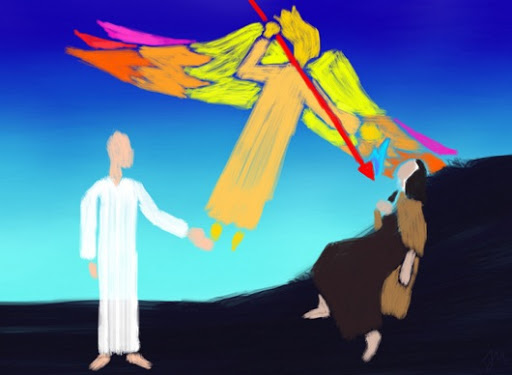
Jesus loved Saint Teresa so much that he even came to visit her – she could feel that he was in front of her even though she couldn’t see him with her eyes. The picture she saw when Jesus visited her, was of an angel who pierced her heart with a burning spear, which is very painful. But then the angel pulled his spear out and she felt great joy! This confirmed to her how important it is to love Jesus when we are in pain and that, if we do so, we will also share with him the joy of rising from the dead.

Quote:
Let nothing disturb you.
Let nothing make you afraid.
All things are passing.
God alone never changes.
Patience gains all things.
If you have God you will want for nothing.
God alone suffices.

If you have any feedback to pass on to PM and JM, please, leave it in the comments.

Havel, Jobs and my conciliar reading list

Redemptorist

The Year of Faith has properly kicked off in our parish today, with a letter from our local bishop being read out during the masses. While nothing new struck me about its content, it’s focus on two “pillars” for deepening an understanding of the Catholic faith – the Catechism and the documents of Vatican II – gave me an idea. Since I know the Catechism fairly well and have read it in full not that long ago, I’ll set myself the challenge of reading the 16 Vatican II documents during the coming year. I’ll proceed in the order shown here, starting with the four conciliar constitutions (being the highest level of Papal decree with legislative power): Dei Verbum (on divine revelation), Lumen Gentium (on the Church), Sacrosanctum Concilium (on the liturgy) and Gaudium et Spes (on the Church in the “modern world”). If you are that way inclined, why don’t you join me in starting with Dei Verbum.

Another pleasant surprise at today’s mass were the Year of Faith diaries ordered by our parish priest from Redemptorist Publications. I am not usually one for diaries, but I was asked by my spouse to buy one and I have to say, I have been impressed both by the layout and aesthetics and the content, from which I would like to share with you two of the quotes provided there for reflection:

“Remembering that I’ll be dead soon is the most important tool I’ve encountered to help me make the big choices in life. Because almost everything – all external expectations, all pride, all fear of embarrassment or failure – these things just fall away in the face of death, leaving only what is truly important.” (Steve Jobs)

“Isn’t it the moment of most profound doubt that gives birth to new certainties? Perhaps hopelessness is the very soil that nourishes human hope; perhaps one could never find sense in life without first experiencing its absurdity.” (Václav Havel)

Kudos to the Redemptorists for such great choices and on to Dei Verbum!

Eternity today

Arcabas canaa l

Today the Church has launched its Year of Faith, whose announcement motivated me three months ago to start writing this blog. While the Year of Faith was its explicit impetus, my deeper reasons were both a desire to be clearer to myself about what it was that my faith meant to me and implied for me and a desire to make explicit my deep-seated conviction that imitating Jesus was not contrary to reason or to my scientific profession and that it ought to be more accessible to my friends with other religious beliefs or none. By this I don’t mean in any way an attempt to convince them of anything, but simply by making my faith explicit and by revealing its consequences and connections to the broader philosophical, cultural, artistic and scientific contexts, show that it makes sense and that it allows me to seek the goals and values that they themselves share. I was also keen to look for the underlying similarities among all who employ reason honestly and who seek the common good and to show that at this level are all close to one another. Whether this is something that has emerged from the last 68 posts is something you’ll have to judge for yourself. All I can say is that it has been a positive experience for me, especially in the cases where a post has lead to or was triggered by dialogue.

With that preamble out of the way, let me share with you my take on today’s opening of the Year of Faith by pulling together some of the points made by Pope Benedict XVI in his sermon during the opening mass, Archbishop Rowan Williamsaddress to the Bishops’ Synod yesterday and Patriarch Bartholomew I’s greeting this morning. This fact alone, of having the heads of the Roman Catholic, Anglican and Eastern Orthodox communities come together at the opening of this Year of Faith is great cause for enthusiasm to me, as it points to their shared belief in Jesus being present “where two or three are gathered together in [his] name” (Matthew 18:20) and in their shared commitment to “witness together to the Gospel message of salvation and healing for the least of our brethren: the poor, the oppressed, the forgotten in God’s world.” (Bartholomew I).

To my mind, Archbishop Williams’ talk yesterday did a great job of setting the scene by reflecting on what it is that attracts people to authentic, lived Christianity:

“[It is] the possibility, quite simply, of living more humanly – living with less frantic acquisitiveness, living with space for stillness, living in the expectation of learning, and most of all, living with an awareness that there is a solid and durable joy to be discovered in the disciplines of self-forgetfulness that is quite different from the gratification of this or that impulse of the moment.”

He argues, as do I, that the behavior to which authentic Christians are lead by their desire to imitate Jesus has universal value and is not something alien or parallel to what all others seek too. Williams follows the above with a warning though: “The man who seeks sincerity, instead of seeking truth in self-forgetfulness, is like the man who seeks to be detached instead of laying himself open in love.” (Henri de Lubac, Paradoxes of Faith, pp. 114) – striving to share with the world what it means to follow Jesus cannot be sought for its own sake as that defeats its own purpose. Such self-consciousness about one’s faith and its perception by others, by definition, cannot be overcome by being even more self-conscious about it:

“We have to return to St Paul and ask, ‘Where are we looking?’ Do we look anxiously to the problems of our day, the varieties of unfaithfulness or of threat to faith and morals, the weakness of the institution? Or are we seeking to look to Jesus, to the unveiled face of God’s image in the light of which we see the image further reflected in ourselves and our neighbours?”

In many ways it is like how Douglas Adams describes flying in the Hitchhiker’s Guide: a throwing of oneself to the ground and accidentally missing, by having been distracted at the critical moment. Sharing my faith is like throwing myself into following Jesus and being distracted by my friends. 🙂

What does it mean though to follow Jesus? How can you even try to imitate a carpenter, healer, prophet, teacher, … from two thousand years ago? Here Pope Benedict argues that we face a fundamental tension when striving to

“mak[e] the truth and beauty of the faith shine out in our time, without sacrificing it to the demands of the present or leaving it tied to the past: the eternal presence of God resounds in the faith, transcending time, yet it can only be welcomed by us in our own unrepeatable today.”

Applying Jesus’ message to the conditions we are in today is essential, but so is remaining faithful to it and this is the challenge that both the Second Vatican Council, which opened 50 years ago today, and this new Year of Faith strive to address. To Pope Benedict, the key though is the person of Jesus, through whom “God’s face is revealed to us.” “[T]he closer [we] get to him, the closer [we] get to the hearts of [our] brothers and sisters” (Chiara Lubich, Essential Writings, p.37; quoted by Archbishop Williams).

From individual to person

Community1

I am feeling quite “meta” today and have no less than four reasons for it: first, what I am about to discuss is fundamentally meta, second, the act of writing about it to you is an instance of it, third, it ties several of the strands that I started in previous posts together, and, fourth, it has come to me in a way that illustrates the topic itself (thanks to my bestie, Margaret, of ‘the God of Explanations’ fame). If that is not enough to pique your interest, let me add that it is centered around a talk given by one of my favorite contemporary thinkers – Dr. Rowan Williams, the Archbishop of Canterbury.

The subject of the talk is an exploration of what it means to be human and revolves around the distinction between an individual and a person. In customary magisterial fashion, Archbishop Williams ties together the thinking of St. Augustine, Orthodox and Catholic theologians (Vladimir Lossky and Robert Spaemann), a Russian and a French philosopher (Mikhail Bakhtin and René Descartes), a French thinker (Alexis de Tocqueville), a psychotherapist (Patricia Gosling) and an LSE sociologist (Richard Sennett). The argument begins by claiming that the relevant polarity is not between individualism and communitarianism but between the concepts of an individual and a person.

Here an individual is simply an example of a certain thing: e.g., Bob is an example of a human being, just like Fido is an example of a dog. Seen from this “atomic” perspective (where, incidentally, “individuum” is merely the latinized version of the Greek “atomos”), the individual is the center of their own world – its solid core. Even when they engage in relationships with others, they always have “the liberty of hurrying back home,” and the best relationship they can have with the world, that is separate from them and beyond them, is control. The consequences of such a view of what it is to be human are alienation, non-cooperation and unease with limits. This view is summed up clearly by de Tocqueville saying that “[e]ach person, withdrawn into himself, behaves as though he is a stranger in the destiny of all the others.” It is also the psychological and anthropological parallel of the epistemic approach pioneered by Descartes (and driven to its limit in the “brain-in-a-vat” scenario), that I also adapted in an earlier post and that, in art, is mirrored by Antony Gormley’s approach to sculpture.

The other concept of a human being is that of a person, where there is “something about us as a whole that is not defined just by listing the facts that happen to be true about us” and where a person is a “subject [that is] irreducible to its nature” (Lossky). Williams argues though that while “we know what we mean by personal/impersonal and persons in relation, […] we struggle to pin down what we mean that we cannot be reduced just to our nature.” He then goes on to postulating that “what makes me a person and distinct from another person is not a bundle of facts, but relations to others. I stand in the middle of a network of relations.” This leads to the definition of a person as the “point at which relationships intersect.”

Williams then moves on to the question of how one is to determine whether another is a human person and, following from the previous analysis, concludes that this cannot be done on the basis of a checklist for whether a given set of pre-requisites are present. Instead, we need to “form a relation, converse, to determine whether another is a person” and that language helps us to decide. He is quick here to move from a narrow concept of language as verbal only to a broad one that includes gestures and the “flicker of an eyelid.” This means that “[p]ersonal dignity or worth is ascribed to human individuals because, in a relationship, each of us has a presence or meaning in someone else’s existence. We live in another’s life. Living in the life of another is an implication of the profound mysteriousness about personal reality. Otherwise you end up with the model where somebody decides who is going to count as human.” Such a test of human personhood based on relateability very much reminded me of Turing’s test of machine intelligence, where the basis again is not a predetermined set of criteria, but the ability for a machine to converse with (relate to) a human person and for that person to recognize the machine as a person. Williams’ point about “each of us [having] a presence or meaning in someone else’s existence” also brought back echoes of Martini’s “the other is within us.”

How does the individual (which is by far the position with the strongest epistemic justification) see themselves as a person though? Here Williams quotes the following passage from Spaemann:

“Each organism naturally develops a system that interacts with its environment. Each creature stands at the center of its own world. The world only discloses itself as that which can do something for us; something becomes meaningful in light of the interest we take in it. To see the other as other, to see myself as his “thou” over against him, to see myself as constituting an environment for other centers of being, thus stepping out of the center of my world, is an eccentric position. […] As human beings in relationship, we sense that our environment is created by a relation with other persons; we create an environment for them and in that exchange, that mutuality, we discover what person means.”

How do you “step out” and assume an “eccentric position” tough? Here, Williams admits that such “stepping beyond one’s own individuality requires acts of faith. Living as a person is a matter of faith.” And I completely agree with him – strictly from a position of introspective enquiry, from Gormley’s “darkness of the body,” there is no fact-based way out. There is a need for a Kierkegaardianleap of faith,” but I would like to argue that it does not require a belief in God and in fact is akin to Eco’s communist acquaintance’s belief in the “continuity of life” discussed in an earlier post.

Finally, let’s also look at what Williams says about the aspect of personhood that is revealed as a consequence of belief in God:1

“Before personal relations, we are in relation with God. I am in relation to a non-worldly, non-historical attention which is God. My neighbor is always somebody who is in a relation with God, before they are in a relation with me. There is a very serious limit for me to make of my neighbor what I choose. They don’t belong to me and their relation to me is not what is true of them or even the most most important thing that is true of them. Human dignity – the unconditional requirement that we attend with reverence to one another – rests firmly on that conviction that the other is already related to something that isn’t me.”

In summary, a very clear picture emerges here, where I can think of myself as an individual – a world unto myself – or as the intersection of relations with others that allows me to go beyond myself and recognize in others that they are part of my world and I part of theirs. As a Christian this eccentricity also reveals to me that the relations I have with others build on the relations He has with them already and allow me to relate to Him not only in the intimacy of my self but also through my neighbors.


1 As an argument, this is essentially a variant of Bishop Berkeley’s response to the following challenge to his philosophy, where being is predicated on perceiving:

There was a young man who said God,
must find it exceedingly odd
when he finds that the tree
continues to be
when noone’s about in the Quad.

To which Berkeley responded with another limerick:

Dear Sir, your astonishment’s odd
I’m always about in the Quad
And that’s why the tree
continues to be
Since observed by, yours faithfully, God

:)))

Other truths

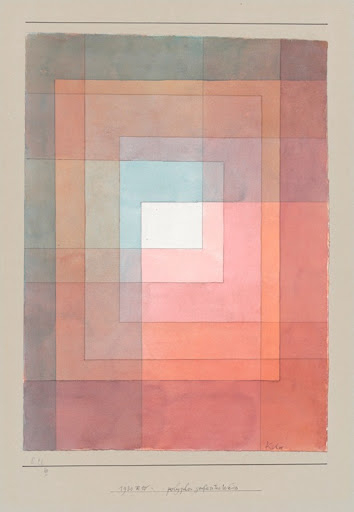
Paul Klee polyphon gefasstes Weiss 1930 Zentrum Paul Klee Bernkl1

Beyond being sheep, Catholics are often also accused of claiming a monopoly on the truth – that it is exclusively them who have it and that everyone else is simply wrong. Sadly there is some basis in this accusation, if you look back over the history of the Church – peaking in shameful crimes like those perpetrated by the Inquisition and for which Blessed Pope John Paul II has unreservedly apologized.

Thankfully the Second Vatican Council has restored a much healthier view of appreciating Truth, wherever it is found, and seeking to learn from and live with those who profess other religions or none. At its root, this newfound openness derives from the event described in last Sunday’s Gospel, where John runs to Jesus to complain: “Teacher, we saw someone driving out demons in your name, and we tried to prevent him because he does not follow us.” It is impressive to see that already at the time of Jesus, his disciples were jealous of Jesus’s actions and teaching and wanted to keep tight control over it. I believe there is a positive motivation for this in that they recognized it as being very valuable and didn’t want it to become distorted by those who did not also have a personal relationship with Jesus.

The response Jesus gives is very clear though: “Do not prevent him. There is no one who performs a mighty deed in my name who can at the same time speak ill of me. For whoever is not against us is for us.” (Mark 9:38-40) Again there is the emphasis on orthopraxy and on the Truth being universal, accessible to all, albeit in different ways and expressed using different language and concepts. The Catechism here states that “the Church considers all goodness and truth found in [other] religions” to come from Him “who enlightens all men.” (CCC, §843).

This challenge is far from dealt with though, and Pope Benedict XVI has spoken about it with great openness and honesty at a meeting with Portuguese artists and scientists during his visit in 2010:

“The Church, in her adherence to the eternal character of truth, is in the process of learning how to live with respect for other “truths” and for the truth of others. Through this respect, open to dialogue, new doors can be opened to the transmission of truth.”

He is very frank about this post–conciliar openness being new, and like with all new things, is the beginning of a process where the Church needs to work out how to behave. In his book, Truth and Tolerance, published in 2003 before he became pope, the then-cardinal Ratzinger lays out the pre-requisites for effective inter-religious dialogue and indeed for a true adherence to one’s own religion:

“Can or must a man simply make the best of the religion that happens to fall to his share, in the form in which it is actually practiced around him? Or must he not, whatever happens, be one who seeks, who strives to purify his conscience and, thus, move toward—at the very least—the purer forms of his own religion? […]

The apostles, and the early Christian congregations as a whole, were only able to see in Jesus their Savior because they were looking for the “hope of Israel”—because they did not simply regard the inherited religious forms of their environment as being sufficient in themselves but were waiting and seeking people with open hearts. […]

[I]t is the dynamic of the conscience and of the silent presence of God in it that is leading religions toward one another and guiding people onto the path to God, not the canonizing of what already exists, so that people are excused from any deeper searching.”

The message here is clear: what is needed is a persistent striving for a conscience that is purified of distractions and impediments (which also requires the practice of charity in its broadest sense) and which will then lead one to God and all people closer to each other.