Civil disobedience

399px Cloak of Conscience Closeup

One of the most common charges against “religious” people in general and Catholics in particular is that they surrender the use of their critical faculties and follow orders from their leaders like sheep. In other words: they are no trouble, they won’t break rank and are all-round model citizens.

Today I’d like to argue that this is as far from the truth as possible, and I will take advantage of the Vatican’s foreign secretary, Archbishop Dominique Mamberti’s address to the United Nations from last Monday, which in many ways tracks Pope Benedict XVI’s speech at the German Bundestag, delivered last year.

He starts by acknowledging the dangers that follow from the “financial crisis, which is worsening some humanitarian and environmental emergencies, does not seem yet to be over, and may even herald new and dangerous conflicts” and that spreading “the rule of law by every means becomes a particularly urgent task for a just, equitable and effective world governance.” Then, he fully aligns himself with the UN’s insistence on: “the unbreakable link between the rule of law and respect for human rights, […] the judicial control of laws and of executive power, […] transparency in acts of governance and the existence of public opinion capable of expressing itself freely.” Mamberti’s key point comes next though:

“The rule of law is also put at risk when it is equated with a legalistic mentality, with a formal and uncritical adherence to laws and rules, in an attitude which can even paradoxically degenerate into a means of abusing human dignity and the rights of individuals, communities and states, as happened during the totalitarian regimes of the 20th century. Furthermore, in the phrase “rule of law”, the concept “law” should be understood as “justice”.”

The first thing to note here is that it calls for critical thinking and, I believe, that, as far as they are rules, this warning also applies to Church teaching. Taking even the ‘rules’ that the Church presents to its members and applying them with a “legalistic mentality, with a formal and uncritical adherence” can lead to their perversion. The Church has very rightly emphasized a focus on deepening one’s relationship with Jesus during the upcoming Year of Faith, rather than talking about making oneself familiar with Church “rules.”

In case you think that this is just my own interpretation of Church teaching, as opposed to the official line, let me point to one of my favorite lines from the Catechism:

A human being must always obey the certain judgment of his conscience. If he were deliberately to act against it, he would condemn himself. (CCC, §1790)

In fact, this brings us back to Mamberti’s talk, where he affirms that justice is “proper and inalienable to the nature of every human being.” Bringing all of this together in fact puts a Catholic into a position of having to critically assess laws and being called both to strict adherence to those that are aligned with their conscience and to resistance against those that don’t. This is neither a position of blind obedience, nor one of disregard for the law, but a more complex, but far more personally and socially rewarding one, where discernment and prudence need to be exercised.

Let’s get back to Mamberti though and see what he has to say about justice:

“Man is not merely self-creating freedom. Man does not create himself. He is intellect and will, but he is also nature, and his will is rightly ordered if he respects his nature, listens to it and accepts himself for who he is, as one who did not create himself. In this way, and in no other, is true human freedom fulfilled, and it is only in this way that we can speak truly of the rule of law.”

The key here, to my mind, is that freedom is not arbitrary. You can’t just decide, with disregard for human nature and your conscience, what behavior to follow and expect that it will allow you to remain free.

Just to avoid giving the impression that this topic is in any way simple, Mamberti rightly recognizes that “[t]he question of how to recognize what is truly right and thus to serve justice when framing laws has never been simple, and today in view of the vast extent of our knowledge and our capacity, it has become still harder.” The more you know the more difficult certainty becomes, which echoes Socrates’ “The more I learn, the more I learn how little I know.” And, finally, he postulates a very clear link between a subversion of the law and the economic crisis that the world is in today:

“It is well known that, at the international level, there are interest groups present who, by means of formally legitimate procedures, are impacting on the policies of states in order to obtain multilateral norms which not only cannot serve the common good but which, under the guise of legitimacy, are in fact an abuse of norms and of international recommendations, as has been seen in the recent financial crisis.”

Even just the last 100 years have been addled with abuses of the law that were fully legal in the sense of not exhibiting procedural violations. It would be a mistake to think though that this is all in the past or that it only applies to regimes notorious for human rights abuses. Even in the “civilized West” there are attacks on the rights of peoples to express their desire for self-determination and on the practice of religious freedom. As St. Augustine said “Without justice – what else is the State but a great band of robbers?”
Serving the Church

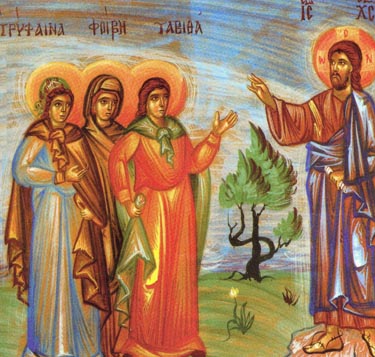
Christ calling Deaconesses to serve the Church

I am starting from scratch after having written a lengthy post on this topic already and realizing – after talking to my besties YYM1 and PM – that I was approaching the topic all wrong. I can still use all the research, but the tone had to change from the playful and partly sarcastic to what I am going to try next.

I feel that my being married, working at a tech company and being a lay person allows me to seek God without limits, to fully participate in the life of the Church and to have the path to sanctity wide open to me. At the same time I realize though that some of my Catholic sisters suffer from feeling the call to the priesthood and being faced with (a now final) barrier to it:

“I declare that the Church has no authority whatsoever to confer priestly ordination on women and that this judgment is to be definitively held by all the Church’s faithful.” (Ordinatio Sacerdotalis, §4)

At first sight (and maybe even after repeated reading) this might sound like an aspect of Church teaching that is simply out of date, that needs to catch up with the times and that can be summed up with the following:

“[T]here is an urgent need to achieve real equality in every area: equal pay for equal work, protection for working mothers, fairness in career advancements, equality of spouses with regard to family rights and the recognition of everything that is part of the rights and duties of citizens in a democratic State.” (Letter to Women, §4)

Now, maybe this will come as a surprise, but the author of both of the above quotes is the same person: Blessed Pope John Paul II, and you may ask yourself how he can at the same time talk about women’s rights and slam the door shut on the question of women priests. I believe the answer lies in the following (and, yes, it too is by John Paul II):

“If Christ […] entrusted only to men the task of being an “icon” of his countenance as “shepherd” and “bridegroom” of the Church through the exercise of the ministerial priesthood, this in no way detracts from the role of women, or for that matter from the role of the other members of the Church who are not ordained to the sacred ministry, since all share equally in the dignity proper to the “common priesthood” based on Baptism.” (Letter to Women, §11)

When I first saw this, a light went on in my mind after I read the words “an “icon” of his countenance.” Priests are Jesus’ proxies and transmit to us his presence in the Church and his being the source of the sacraments. When I attend mass, I experience a man saying the words that bring about the Eucharist, like I would have, had I been at the Last Supper; when I go to confession, I speak to a man, as I would have, had I been among Jesus’ disciples. Jesus having come into the world as a man rather than a woman is not an accident, nor is it a consequence of social conventions. I believe, that God became flesh as a baby boy, to use the male gender in a specific way, just like he sought consent from a girl to become His mother, again because of the specifics of the female gender. To read this as in any way discriminatory against women is incomprehensible to my mind, but I’ll leave that to another post.

Let me now put my last card on the table with regard to the priesthood. God’s call is ultimately the same for all of us: to choose Him as the first priority in our lives and to follow his new commandment of love. Placing something above a love for one’s neighbor and for God is a mistake, even if that something is the priesthood. If love for God and neighbor are missing, the priesthood becomes a millstone (“The road to hell is paved with the skulls of erring priests, with bishops as their signposts.” St. John Chrysostom) and if they are present, then it becomes secondary and one seeks specifics with humility. To come at the argument from a perspective of rights is also a category mistake. No one has the right to be made a priest, whether man or woman, and it is in all cases a gift that is received rather than an entitlement that can be claimed.

For now, let it suffice that my argument is this: the priesthood is only open to men, because Jesus was a man and because he indicated to us from the very beginning that it was through men that he wanted certain aspects of his ministry to be perpetuated. In this way, his ministers’ being male is integral to their being Jesus’ proxies and no matter what social or other developments ensue, the priesthood in the Catholic Church is going to remain restricted to them.

This is not the end of the story though, since we are ultimately all being called to be Jesus’ proxies: to be the means by which He can show His love to all. As a married, lay person I don’t feel in any way limited in the extent to which I can strive to imitate Jesus’ love for humanity, even if I don’t become a priest. But, and there is a but, there is a variety of other ways in which Jesus can be imitated and and in which Catholics can serve the Church (which is fundamentally also what the priesthood is about: service). Two of these, which today are not open to women, are the diaconate and the office of cardinal, and I would like to argue that they may both one day (hopefully soon) be conferred on women.

Bishop Emil Wcela has just published a very interesting article (that I recommend in full), entitled “Why not women?” It starts where the final word on women priests in the Catholic Church ends: by making a case for exploring the possibility of ordaining women as deacons. Wcela presents a compelling case, starting with evidence for deaconesses dating back right to the time of the apostles (giving the example of St. Phoebe, whom St. Paul calls a diakonos in his letter to the Romans (16:1) – although the meaning of the term is disputed) and dotted through the history of the church (including Pope Benedict VIII writing to the bishop of Porto to give him authority to ordain deaconesses). He the proceeds to give the example of deaconesses in other Christian churches, but is also clear about the fact that this is not the case in the Catholic Church at present.

Nonetheless, there has been a desire to explore its possibility since the Second Vatican Council, including a raising of the issue by the US bishops in a pastoral letter from 1992. 2009 then saw an important change to Canon law, which differentiates between the nature of the priestly and episcopal order and that of deacons, stating that bishops and priests “receive the mission and capacity to act in the person of Christ the Head; deacons, however, are empowered to serve the People of God in the ministries of the liturgy, the word and charity.” (Canon 1009 of the Code of Canon Law). This change removes the constraints that previous legislation placed on the diaconate and historical precedent further supports a future change in this area. Bishop Wcela finally notes that women already participate extensively in the Church’s ministry and that ordaining them as deacons would provide greater official recognition, confer the grace of the sacrament on them and give them access to ecclesiastical offices that require ordination. The article ends with a call to raising awareness of this opportunity and I would personally like to add my voice to it.

On a related note, Cardinal Timothy Dolan stated in an interview last March, that the office of cardinal is in principle open to women, since it does not require priestly or episcopal orders. He then proceeded to tell the story of how someone once suggested to Pope John Paul II to make Mother Teresa a cardinal, to which he replied: “I asked her – she doesn’t want to be one.” While the John Paul II – Mother Teresa story may be little more than an anecdote, it nonetheless expresses both the Church’s newfound openness and Mother Teresa’s humility beautifully. What is key here is the acknowledgement by one of the cardinals that his office is in principle not restricted to women.

I hope it is clear what I am getting at: the role of women in the Church is certainly not what it ought to be, but I see clear signs of a desire to change that, including at the highest levels. What it won’t be is an opening of the priesthood to women, but the diaconate and the office of cardinal are both on the horizon (hopefully even in my own lifetime). One point I would like to emphasize though is that the role of women in the Church needs to be all-pervasive and not only constrained to “women’s issues.” When one of the 23 women present at the Second Vatican Council – one of the Council Mothers – was asked what topics were discussed that related to women, she responded “We are now interested in everything.” As Fr. Fabio Ciardi, who was taught by Rosemary Goldie (another Council Mother) during his time at the Lateran University, said: “The temptation is to constrain women in the Church to dealing with topics that are about women, not knowing that all topics are about them and that they have a contribution to make to all of them.”


1 Thanks to YYM also for giving me probably the most acceptable label: “progressive orthodox.” It may sound like an oxymoron, but I shall wear it with pride :).

Mercy, not sacrifice

Jesus Heals 1 op 364x600

Today’s Gospel reading1 is definitely among my favorites, as it makes one thing very clear: Jesus did not come to set up a new club for the “good.” Instead, he and the Church are here for sinners:

While he was at table in his house, many tax collectors and sinners came and sat with Jesus and his disciples. The Pharisees saw this and said to his disciples, “Why does your teacher eat with tax collectors and sinners?” He heard this and said, “Those who are well do not need a physician, but the sick do. Go and learn the meaning of the words, ‘I desire mercy, not sacrifice.’ I did not come to call the righteous but sinners.” (Matthew 9:9-13)

Maybe the word “sinner” sounds uncomfortable, antiquated and out of fashion today, but I believe it can be read more broadly here as failure, outcast, disgraced, rather than only in the moral theology sense (i.e., as someone rejecting God’s call to love (cf. Catechism of the Catholic Church, §397)). I don’t mean set up failure in general and moral errors as an identity, but instead suggest that Jesus referred to the attitude of his “righteous” contemporaries towards those whom they considered failures. In other words, it is Jesus’ peers who equated sin not only with moral failure but also with mental or physical illness (considered to be a punishment for sin – either the patient’s own or that of their ancestors3) and with living at the margins of society.2 The “righteous” of the first century (and of today), considered sinners unworthy of Jesus’ company and would have preferred to have them out of sight. “Eugh, what do you want with those types, Jesus? They are not good, decent folk, pillars of the community, like us! They are not the sort of people who come to church!”

Jesus’ response is a sharp, sarcastic jab: “Go and learn the meaning of the words, ‘I desire mercy, not sacrifice.’ I did not come to call the righteous but sinners.” While I have for a long time though that Jesus refers to those that the Pharisees complain about as sinners, I now believe that a much better fit to this event is to take him as talking about the Pharisees themselves. By reprimanding them that God desires mercy, not sacrifice, he is charging them with having sinned against God’s call to love. The Pharisees are the ones in need of a physician too, but their self-righteousness blinds them to their own lack of openness and charity.

Applying this to myself makes me examine my own attitude to those that strike me as unfit for building relationships with. By sacrificing them to my own false sense of superiority (even if unwittingly at times), I place myself besides the Pharisees rather than in the circle around Jesus, where were are all weak, but where were have Him amongst us. I’ll start again tomorrow!


1 Incidentally, it is the feast of St. Matthew today, who’s call to follow Jesus precedes the passage quoted here.
2 Incredibly this attitude persists in some societies to this day …
3 See, e.g., “If you listen closely to the voice of the LORD, your God, and do what is right in his eyes: if you heed his commandments and keep all his statutes, I will not afflict you with any of the diseases with which I afflicted the Egyptians” (Exodus 15:26) and “For I, the LORD, your God, am a jealous God, inflicting punishment for their ancestors’ wickedness on the children of those who hate me, down to the third and fourth generation” (Exodus 20:5), but don’t ignore the next verse: “but showing love down to the thousandth generation of those who love me and keep my commandments.” which is another way of saying that God’s love is disproportionately greater than any punishment :). Also, see “The son shall not be charged with the guilt of his father, nor shall the father be charged with the guilt of his son. Justice belongs to the just, and wickedness to the wicked.” (Ezekiel 18:20) – just picking a single verse tends to be a great way to come up with nonsense …

Jesus’ wife: clicks, facts and ‘children in a marketplace’

King jesus wife

I wasn’t going to write about this, but then I received a direct (and very welcome) requests by my bestie PM, and with his help realized that there was a much more interesting angle to this story than the obvious (and not all that exciting) one.

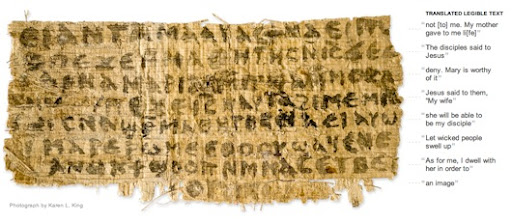
Let’s start with the facts of the matter: a fragment of Coptic script on papyrus that may date from the 4th century AD and that consists of 49.5 words in its English translation (see the top of this post) was presented at the International Congress of Coptic Studies on 18th September. The fragment contains no complete sentences and the sole reason for its overnight fame are the following words it contains:

Jesus said to them, “My wife

Looking at reports in the media, the following picture emerges:

“Even with many questions unsettled, the discovery could reignite the debate over whether Jesus was married, whether Mary Magdalene was his wife and whether he had a female disciple.” (New York Times)
“The discovery that some ancient Christians thought Jesus had a wife could shake up centuries-old Christian traditions” (Washington Post)
“A discovery by a Harvard researcher may shed light on a controversial aspect of the life of Jesus Christ.” (Huffington Post)
“A Harvard Divinity School professor’s interpretation of a scrap of fourth-century Egyptian papyrus that quotes Jesus Christ making reference to a wife could stoke new debates to the role of women in Christianity, theologians say.” (Boston Herald)
“An 4th century papyrus fragment could call centuries of celibacy into question.” (Time)

The message is clear: this is a major discovery that could alter that very foundations of Christianity in one fell swoop. As much fun as it would be to debunk statements like the above, it would be falling for a textbook straw man argument (as some have, while others, like Fr. James Martin, haven’t). Instead, let me defer any comment on the matter, until we see Dr. Karen L. King, the scholar who presented the fragment at the Congress, speak for herself. And what better way to do that than to refer to a draft of her peer-reviewed journal paper, to be published in the Harvard Theological Review (link courtesy of Harvard Magazine):

“This is the only extant ancient text which explicitly portrays Jesus as referring to a wife. It does not, however, provide evidence that the historical Jesus was married, given the late date of the fragment and the probable date of original composition only in the second half of the second century. Nevertheless, if the second century date of composition is correct, the fragment does provide direct evidence that claims about Jesus’s marital status first arose over a century after the death of Jesus in the context of intra-Christian controversies over sexuality, marriage, and discipleship.
[…]
The use of the term “gospel” here regards the probable genre of the work to which this fragment belonged (see below, “Genre”) and makes absolutely no claim to canonical status nor to the historical accuracy of the content as such. This invented reference in no way means to imply that this was the title in antiquity, or that “Jesus’s wife” is the “author” of this work, is a major character in it, or is even a significant topic of discussion—none of that can be known from such a tiny fragment. Rather the title references the fragment’s most distinctive claim (that Jesus was married), and serves therefore as a kind of short-hand reference to the fragment.”

Wait, what?! Unlike the cat-among-pigeons reaction of the media, Dr. King’s words (maybe with a little help from the journal’s reviewers 🙂 sound rational, factual and well representative of what this fragment may be: a text recorded probably in the 4th century AD that may be a copy of a 2nd century one, situated among the ’intra-Christian controversies’ of the day. No “Christianity 2.0”, no “we have had it all wrong for 2000 years” and no “shake up.”

In this (hopefully) more complete picture, Dr. King (who, after all was speaking at the Institutum Patristicum Augustinianum, which is part of the Pontifical Lateran University – i.e., popularly known as the “Pope’s University”!) comes up smelling of roses, while the various media reports happen to fit the topic that I actually wanted to talk about today like a glove! Namely, yesterday’s Gospel reading, in which Jesus vents his frustration with childish attitudes. In Luke 7:31-35 he is reported as saying the following:

“To what shall I compare the people of this generation?
What are they like?
They are like children who sit in the marketplace and call to one another,

‘We played the flute for you, but you did not dance.
We sang a dirge, but you did not weep.’

For John the Baptist came neither eating food nor drinking wine,
and you said, ‘He is possessed by a demon.’
The Son of Man came eating and drinking and you said,
‘Look, he is a glutton and a drunkard,
a friend of tax collectors and sinners.’
But wisdom is vindicated by all her children.”

When I read this, I could picture Jesus’ disbelief in the face of his contemporaries’ conduct (“What are they like?!”), who thought of John the Baptist as a nutter and of Jesus himself as a pig [my own words :] and who jumped at anything to push their own agendas. How little has changed in 2000 years!

Let me not finish on a negative note though as I do see this episode as positive overall. That a new fragment from the early days of Christianity has come to light is great (the more we know the better, since knowledge is power and the truth will set us free [apologies for this fragment–peddling – it just seemed fitting :]) and so is the scholarly integrity of Dr. King and her fellow coptologists, who can shed light on the history of this find and its place within the overall corpus of early Christian writings.


I know the media reports are a straw man, but a very juicy and tempting one, so let me just take one slash at it: Assuming the fragment’s authenticity (which I am in no position to question or believe in) places it into the 4th century. Taking it as a record of events from the first century is like someone discovering the following fragment from this post in the 38th century: “Newton wrote: ‘This quantity I designate by the name of aura” and considering it as a record of Newton’s words from 1687 …

On an entirely separate and unrelated note, let me just share what I found out about the following words that Jesus speaks in Luke’s Gospel: ‘We played the flute for you, but you did not dance. We sang a dirge, but you did not weep.’ This intrigued me straightaway and I first though that it may come from one of the Psalms or another part of the Bible. It seems instead that they were just part of a game that kids played at the time. Two groups would be formed – one playing jolly music and another a wailing funereal tune and they’d compete in who’d gather more followers as they moved through the streets. What a bizarre (but great 🙂 game! Thanks to St. Cyril of Alexandria for the tip!

Without words

Juan macias

The saint, whose feast is celebrated today, stands out from among his sainted brothers and sisters in that he never preached or wrote about his faith. Instead, St. Juan Macías, who was a Dominican lay brother and spent his life performing domestic and administrative tasks as his monastery’s porter, gave witness to his faith by welcoming and feeding the needy who came to his door for help. He lived his life in simplicity and frugality, serving his neighbors more eloquently than if he had been a great orator. Reading about his life made me think of last Sunday’s second reading, which ends as follows:

“So also faith of itself, if it does not have works, is dead. Indeed someone might say, “You have faith and I have works.” Demonstrate your faith to me without works, and I will demonstrate my faith to you from my works.” (James, 2:17-18)

A man the color of a sapphire

Meister des Hildegardis Codex 003

Tomorrow is the feast day of St. Hildegard of Bingen, a great 12th century German mystic who was a Benedictine Abbess, poet and composer and all round intellectual (having contributed not only to theology but also to medicine and science as well). Even though she has been venerated as a saint for centuries, she has only been formally canonized last May by Pope Benedict XVI, who also spoke about her in several of his sermons. There he emphasized her as a role model for spiritual leadership, since “she inspired holy emulation in the practice of good to such an extent that, as time was to tell, both the mother and her daughters competed in mutual esteem and in serving each other.”

Also with regard to her mystic visions he praised here humility, which at first made her doubt them and only when they received approval first from St. Bernard of Clairvaux and later from Pope Eugene III did she share them with her followers and the public. “The person endowed with supernatural gifts never boasts of them, never flaunts them and, above all, shows complete obedience to the ecclesial authority.” As far as she herself was concerned, this is how she described her visions:

“The vision fascinates my whole being: I do not see with the eyes of the body but it appears to me in the spirit of the mysteries…. I recognize the deep meaning of what is expounded on in the Psalter, in the Gospels and in other books, which have been shown to me in the vision. This vision burns like a flame in my breast and in my soul and teaches me to understand the text profoundly” (Epistolarium pars prima I-XC: CCCM 91).

From among her extensive visions that touched on virtually all aspects of Christianity, I would just like to pick out her vision of the Trinity, which struck me as particularly beautiful:

“Then I saw a bright light, and in this light the figure of a man the color of sapphire, which was all blazing with a gentle glowing fire. And that bright light bathed the whole of the glowing fire, and the glowing fire bathed the bright light; and the bright light and the glowing fire poured over the whole human figure, so that the three were one light in one power of potential.” (Scivias 2.2, quoted in Anne Hunt’s The Trinity: Insights from the Mystics, pp. 38).

In fact, the image at the top of the post is a representation of this vision from an early illuminated printed version. St. Hildegard explains this vision as follows:

“You see a bright light, which without any flaw of illusion, deficiency or deception designates the Father; and in this light the figure of a man the color of a sapphire, which without any flaw of obstinacy, envy or iniquity designates the Son, Who was begotten of the Father in Divinity before time began, and then within time was incarnate in the world in Humanity; which is all blazing with a gentle glowing fire, which fire without any flaw of aridity, mortality or darkness designates the Holy Spirit, by Whom the Only-Begotten of God was conceived in the flesh and born of the Virgin within time and poured the true light into the world.” (Scivias, 2.2.2, quoted in ibid).

What I find very attractive about St. Hildegard is the visual and allegorical nature of her mystical experiences (which she is careful to describe as spiritual rather than ocular) and their subtle beauty that is particularly clear in the above example.

Continuity in the present

Perkins frolic graphiteacrylic 4ftx6ft 2010 s

Since the start of this blog, I have noticed another theme emerging, in addition to the one about saints and the related roles of orthopraxy–orthodoxy and dissent. Namely, the question of traditionalist versus liberal Catholicism and more generally the concept of neatly-packaged, pre-cooked labels or categories. Looking at my 56 posts so far, I note a greater propensity for opposing those who self-apply the traditionalist name, which leads me to today’s question: am I a liberal or a traditionalist, on the left or the right of the Catholic spectrum, a dissenter or a wholehearted follower of Catholic teaching?

I find this question quite challenging as I don’t come to an easy answer when I ask myself: “Who would you rather spend an hour with in a stuck lift – someone who calls themselves a traditionalist or a liberal?” Indulge me therefore during the next two paragraphs, while I share with you my thoughts on two imperfect and incomplete stereotypes.

What I value in traditionalists is their dedication to continuity: what the Church has understood throughout its history and as a result of the Holy Spirit’s acting in and among the people of God, is to be treasured and must be built on. The heritage of the Church – including its saints, liturgy, practices and dogmatic teaching – throughout its 2000 year history is a precious gift to us, members of the Church Militant today. After all, the starting point of tradition and its continuity is Jesus himself and the value of preserving it is unquestionable. We can only be Christians if we follow Jesus’ teaching and example, handed down to us by tradition. Just picking up the Gospel today and trying to apply it without the benefit of our predecessors’ insights and lived experiences would greatly impoverish it or even falsify it. Where I part ways with traditionalists though is on the point of whether what tradition teaches is immutable or open to adaptation. My impression here is that traditionalists tend to fall into the trap of considering the past homogeneous (i.e., “this is what the Church has always taught”) and implicitly that it was in a perfect state typically at some date before their birth, e.g., see the Society of Saint Pope Pius X. Incidentally, note that Pope Pius X has introduced numerous changes versus the tradition that has preceded him, such as allowing children to receive the Eucharist instead of them having to wait until adulthood. The result often is a distancing from neighbours whom Jesus called us to love.

Liberals, on the other hand attract me for their desire to bring Jesus to today’s men and women, who live in a culture other than that of the traditionalists. The role and rights of women, the participation of divorcees and homosexuals in the life of the church, the role of the laity, an openness to other Christian denominations, religions and society at large and the broad question of how those who do not live in complete accord with Church teaching (which liberals often see as covering everyone) are to participate in Her life are all of great relevance to me. What does distance me from them though is a seemingly great ease of slipping into dissent – a lack of humility that places their own views above those of the Church and that gives preference to interfacing with contemporary trends and challenges over ensuring that one’s actions and views are those that Jesus would have done or thought today. Then there also seems to be an element of pride and personal importance that doesn’t gel with the beatitudes.

So, what is the right answer, as neither traditionalism nor liberalism look like the way forward in their reductio ad absurdum. I believe that the answer is to develop a personal relationship with Jesus, by seeking and loving Him in the people I meet – regardless of their views, actions or allegiances, by encountering him in the Eucharist, the Gospel and the teachings of the Church and by listening to His voice as made accessible to me via my own, imperfect conscience. Whether the result will look like traditionalism or liberalism or whether it will be foreign to both is irrelevant, and, I believe will also lead to solutions that neither extreme school of thought would arrive at by its own means. What Pope Benedict XVI said about ecumenism – that “the most important thing is that we listen to each other, since as fellow Christians we cannot create unity, which is a gift from God.” – is a template that can be applied more broadly.

I’m with Müller: Ecumenism

Oecumenisme1

After addressing criticisms directed at Archbishop Müller1 in terms of his statements about the Eucharist and about this virginity of Mary, let me now turn to the last of the three topics that most irked ‘traditional Catholics’ when he was named head of the Congregation of the Doctrine of the Faith (the Vatican’s orthodoxy watchdog, enforcer and promoter). Before looking at the evidence, let me start off with putting my cards on the table: I am deeply committed to ecumenism, inter–religious dialogue and dialogue with those of no religious convictions. I believe God made us all and wants to have a personal relationship with us all – then who am I to pick and choose who to try and relate to! What I do value as well though, and here I can intuit some of the feelings of ‘traditionalists,’ is the truth and a jealous preservation of Jesus’ message – a message though that is not dead, fixed, static, but alive and active in the here and now, in our continuing relationship with Him.

Before we proceed, let me just share a word of caution – what follows is fairly technical and, if you are not that way inclined, you may do better to skip this post, or just take a look at the last paragraph. With that caveat out of the way, let’s look at what Archbishop Müller said that angered his critics:2

“[C]hristians, who are not in full communion with regards to the teaching, means of salvation and apostolic–episcopal constitution of the Catholic Church, are also justified by faith and baptism and fully members of the Church of God, as the body of Christ. In this way we are brothers and sisters among ourselves and really belong to the ‘whole Christ, head and body, one Christ’ (see Unitatis Redintegratio, 3))” and
“Baptism is the fundamental sign that sacramentally unites us in Christ and that makes us visible as one Church in front of the world. We, as Catholic and Evangelical Christians, are also already united in this, that we call the visible Church. There are therefore – to be precise – not multiple Churches alongside one another, but we are dealing with divisions and splits within the one people of the House of God: Credo unam ecclesiam … confiteor unum baptisma [I believe in one Church … I confess one Baptism].”

Both were quoted here and come from a speech he gave when Dr. Johannes Friedrich, regional bishop of the Evangelical-Lutheran Church in Bavaria, was presented the ecumenical award of the Catholic Academy of Bavaria. Note though that the above includes an additional sentence in both cases versus the English article and even though it does not change what the critics attack, it will allow me to more clearly present my defense of Archbishop Müller’s views (if his critics are allowed to pick two sentences from a lengthy speech, then surely I am allowed four :).

Before going into what the above means, let me just start by showing how this is very much what the Church teaches, rather than some deviation introduced by Müller. In fact, if we follow up the hint he himself makes at Unitatis Redintegratio – the ‘Decree on Ecumenism’ of the Second Vatican Council, we’ll find the following:

“[A]ll who have been justified by faith in Baptism are members of Christ’s body, and have a right to be called Christian, and so are correctly accepted as brothers by the children of the Catholic Church.” and
“Moreover, some and even very many of the significant elements and endowments which together go to build up and give life to the Church itself, can exist outside the visible boundaries of the Catholic Church: the written word of God; the life of grace; faith, hope and charity, with the other interior gifts of the Holy Spirit, and visible elements too. All of these, which come from Christ and lead back to Christ, belong by right to the one Church of Christ.”

If anything, Archbishop Müller could be more effectively accused of plagiarizing Vatican II documents, but in his line of work that is not a bad thing. On the face of it, it might seem difficult to see why ‘traditionalists’ got so het up about these words of the Archbishop, but – extending the Principle of Charity to their words too, quickly leads to the Dominus Iesus declaration of the Congregation of the Doctrine of the Faith (CDF), written by Cardinal Ratzinger in 2000 when he was its head. This declaration, which at the time caused a lot of hurt to Evangelical and Anglican Christians (and should have been much better handled by the CDF), spoke about what a Church is and who are to be considered Churches versus other entities. The following are a couple of excerpts that would give you a sense of the declaration’s gist (all from section 17):

“[T]here exists a single Church of Christ, which subsists in the Catholic Church, governed by the Successor of Peter and by the Bishops in communion with him.”
“[E]cclesial communities which have not preserved the valid Episcopate and the genuine and integral substance of the Eucharistic mystery, are not Churches in the proper sense; however, those who are baptized in these communities are, by Baptism, incorporated in Christ and thus are in a certain communion, albeit imperfect, with the Church.”
“The Christian faithful are therefore not permitted to imagine that the Church of Christ is nothing more than a collection — divided, yet in some way one — of Churches and ecclesial communities; nor are they free to hold that today the Church of Christ nowhere really exists, and must be considered only as a goal which all Churches and ecclesial communities must strive to reach”

While it does seem from the above that the traditionalists do have a leg to stand on, the declaration is definitely among the more technical and complex Vatican documents I have read and it is in fact Müller himself who offers the following explanation in the same speech – his point being that the term ‘Church’ is used in a very specific, legal sense in Dominus Iesus:3

“The assertion that the Ecclesial Communities that have not upheld valid episcopacy … are not Churches (plural) in a proper sense is not translated theologically correctly by the bold statement that ‘the Evangelical Church is not actually a Church’. That is because the plural designates the Churches as local Churches with a bishop. The question here is not whether the confessional Churches of reformed character are actual Churches — it is rather whether sacramental episcopacy is a constitutive element of a local Church or of a diocese. The difference between an Evangelical local Church and a Catholic diocese is being described – not evaluated. The Catholic Magisterium is far from denying an ecclesial character or an ecclesial existence to ‘the separated Churches and ecclesial Communities of the West’ (Unitatis Redintegratio, 19).”

So, what does all of this boil down to? I believe that it depends on how you view the scandalous divisions among Christians today. I understand that ‘traditionalists’ are protective of Catholic teaching and that there may be different takes on and interpretations of the key Catholic texts regarding ecumenism. I also read Pope Benedict’s declaration as a call to being precise – to not calling the current situation something that it is not (yet). But, I do feel a misplaced us-versus-them attitude in ‘traditionalist’ statements and very much stand by Müller’s ‘us’-only take on things (which nonetheless does not lack precision). An ‘us’ that is painfully and unacceptably divided, but an ‘us’ nonetheless.


1 Note that in the meantime there are others, who have come to his defense too.

2 The English translations, as reproduced in the source I refer to above were actually the following:
“Also the Christians that are not in full community with the Catholic Church regarding teaching, means of salvation and the apostolic episcopacy, are justified by faith and baptism and they are fully incorporated/ integrated into Church of God, being the Body of Christ.” and “Baptism is the fundamental sign that sacramentally unites us in Christ, and which presents us as the one Church in front of the world. Thus, we as Catholic and Evangelical Christians are already united even in what we call the visible Church.” Since the original German (contained in the full text of the speech here) was the following, the English above is my own translation: “Denn auch die Christen, die nicht in voller Gemeinschaft der Lehre, der Heilsmittel und der apostolisch-bischöflichen Verfassung mit der katholischen Kirche stehen, sind durch Glaube und die Taufe gerechtfertigt und in die Kirche Gottes als Leib Christi voll eingegliedert. So sind wir untereinander Brüder und Schwestern und gehören wirklich zum „ganzen Christus, Haupt und Leib, ein Christus“ (vgl. UR 3).” [this includes the additional sentence I refer to above] and “Die Taufe ist das grundlegende Zeichen, das uns sakramental in Christus eint und vor der Welt als die eine Kirche sichtbar macht. Wir sind als katholische und evangelische Christen also auch in dem schon vereint, was wir die sichtbare Kirche nennen. Es gibt daher – genau genommen – nicht mehrere Kirchen nebeneinander, sondern es handelt sich um Trennungen und Spaltungen innerhalb des einen Volkes und Hauses Gottes: Credo unam ecclesiam … confiteor unum baptisma.” [again with an additional sentence included versus the original English source].

3 Note the irony of this also being Müller’s choice of episcopal motto :).

Lord Sacks, Prof. Dawkins, Archbishop Tutu and the Dalai Lama

Introspection 709731

Just a quick one today – a link to two fantastic videos:

  1. Yesterday the BBC broadcast the best program I have ever seen about the science-religion relationship, following Lord Sacks, the Chief Rabbi of the United Hebrew Congregations of the Commonwealth, talking to three non-believing scientists: Baroness Greenfield, Prof. Al-Khalili and Prof. Dawkins. I have to say that I fully agree with Lord Sack’s view, which in fact is pretty much what I got to in an earlier post. The most impressive thing to me was how he and Richard Dawkins arrived at consensus precisely about the need for rational, good-willed people to work together regardless of their religious or areligious views. I am now officially a huge fan of Lord Sacks (see also my post on one of his blog posts on how hatred and liberty cannot coexist).

    If you are in the UK, you can see the program on iPlayer here and I’ll look for a source accessible from outside the UK later.

    To whet your apetite in the meantime, here are just a couple of quotes:

    “Science takes things apart to see how they work. Religion puts things together to see what they mean.” Lord Sacks
    “There’s nothing quite as frightening as someone who knows they are ‘right’.” Michael Faraday (quoted by Baroness Greenfield)
    “For me religion at its best involves asking questions and challenging conventional assumptions.” Lord Sacks
    “The answer to bad religion is good religion, not no religion.” Lord Sacks

  2. A while ago Archbishop Tutu and the Dalai Lama had a chat via the Google+ ‘hangout’ videoconferencing feature. It is somewhat lengthy, but a joy to watch two friends having a great time. One of the gems was:

    Desmond Tutu: “Do you have an army?”
    Dalai Lama: “Yes, at the spiritual level! No weapons, but wisdom!”

Enjoy! 🙂

A golden mouth against corruption

John chrysostom

Q: Which saint had (at least) four skulls?1
A: John Chrysostom – just ask a Russian, a Greek and two Italian churches who all claim to have it. 🙂

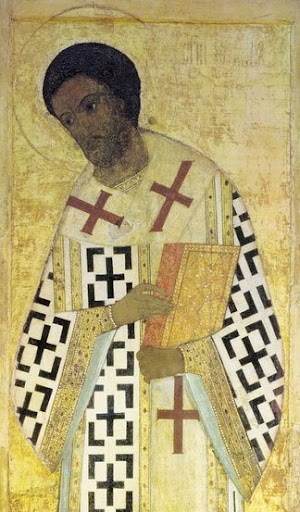
St. John Chrysostom, whose feast day it is tomorrow, is actually one of my favorite saints and I’m sure he won’t hold this joke against me. He is one of those saints – like Saint Pope Gregory the Great, whose thought had a wide-reaching influence on the Church during their lifetime and, even more impressively, still continues to have today (just note the 18 sections of the 1992 Catechism that cite him).

St. John’s epithet, Χρυσόστομος (Chrysostom) means “golden mouthed,” and if you start reading his many homilies and treatises you will soon appreciate his obvious rhetorical gift. The Church is fortunate to have had him on her side and to have had Jesus’ teaching so clearly, elegantly and effectively applied to his day. Take a look at the following quote on poverty and Church property (which applies today just as it did in the 4th century AD) and I hope you will agree with me:

“Do you wish to honour the body of Christ? Do not ignore him when he is naked. Do not pay him homage in the temple clad in silk, only then to neglect him outside where he is cold and ill-clad. He who said: “This is my body” is the same who said: “You saw me hungry and you gave me no food”, and “Whatever you did to the least of my brothers you did also to me”… What good is it if the Eucharistic table is overloaded with golden chalices when your brother is dying of hunger? Start by satisfying his hunger and then with what is left you may adorn the altar as well.”

(Evangelium S. Matthaei, hom 50:3-4; Cited by Blessed Pope John Paul II, Ecclesia de Eucharistia, footnote 34.)


1 Multi-skulled saints cannot be mentioned without telling a joke by an Irish relative of mine:

A rogue relic dealer kept selling skulls, claiming to be St. Oliver Plunkett’s, until one day a customer said to them: “This can’t be St. Oliver’s skull. I am a doctor and can tell you that this is the skull of a child and St. Oliver died in his fifties!” The dealer, thinking on their feet, retorted: “Well, of course it is a child’s skull. It is St. Oliver’s skull when he was a child!” 🙂