Stubbornly unholy brutalist: church architecture today

Churchcocathedral

Cathedral christ light som220109 th 0

Which of the above churches looks more aesthetically appealing to you? The top or the bottom one? If you answered ‘top,’ kindly move along as you will at best find offence in what follows. If, however, your answer was ‘bottom,’ please, come with me on a brief journey of ‘I can’t believe they said that!’

The church at the top happens to be the Co-Cathedral of the Sacred Heart in Houston while the bottom photo shows the Cathedral of Christ the Light in Oakland. Now, why did I pick these two churches for the following rant? The choice was far from random and was in fact motivated by an article published two days ago by an ‘architectural theorist,’ ‘the author of many books.’ At first I hoped to learn something interesting from reading it, but instead it just made me outraged at the pure nonsense of the views it propounded.

In summary, the article’s author argues in favor of the traditional (yet to the author ‘innovative’) Houston [co-]cathedral, which provides “[h]armonious ornamentation achieved through multiple symmetries [that] nourishes our senses and creates in us a healing state.” The style is even likened to Viennese Secession! [Wagner and Olbrich are spinning in their graves …]

Instead, the Oakland cathedral is an exercise in technocratic self indulgence, failing to provide a “traditional church volume” and opening itself to criticisms like the following: “Why are the wooden slats horizontal instead of vertical? Are we not trying to connect vertically to the universe, to transcend the materiality of this building so that our souls can rise upwards?” Aside from the obvious counter arguments of why bricks or stone slabs in churches built in the past are not positioned vertically but instead horizontally, I find the idea that the orientation of wooden slats can inhibit transcendence preposterous and trivial (reminding me of the tin foil hats worn by those afraid of having their minds intercepted). Let us take a look at the interior of the Oakland cathedral to get a first hand feel for its potential to enable a rising up of souls:
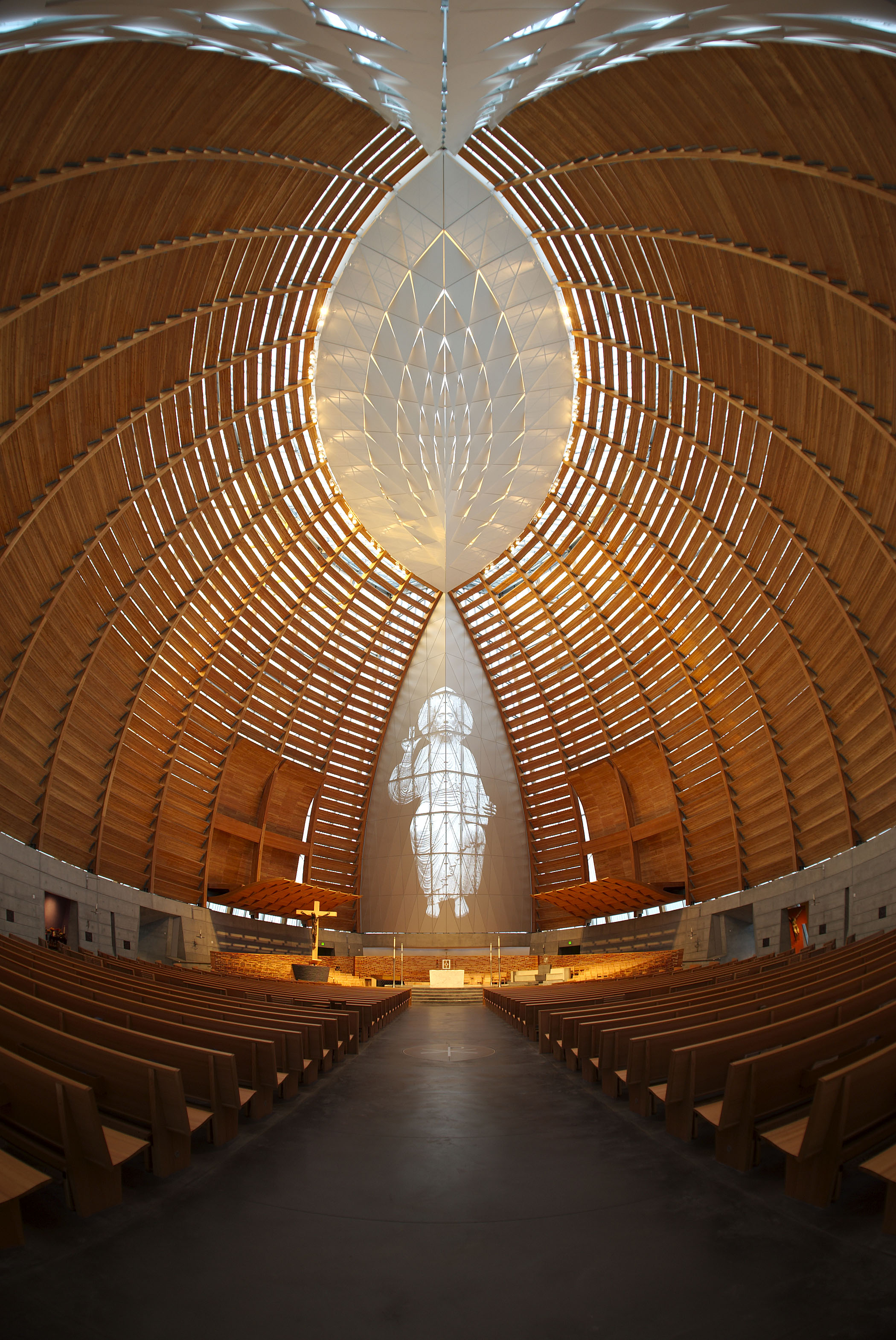
BLAUSTEIN CCL 4688

And for comparison let’s also look inside the Houston Co-cathedral:

Dsc 0001

If you’ve read this far (and are not doing it just to raise your blood pressure), then the above needs no explanation.

Then there are also those “stubborn asymmetries,” “the use of brutalist concrete[, which is] fundamentally unholy [and does not] conveyed a love for the Creator,” and not being “appropriate for housing the timeless truths offered by religion.”

Wow! Not only does the author not like the Oakland cathedral, but considers it unholy and inappropriate! I couldn’t disagree more and am baffled by his credentials.

First, let me get one point out of the way: I am grateful for the existence of both buildings since they provide spaces where the Church (i. e., people) can meet to build a community, celebrate mass and house the Eucharist. That is not what this rant is about.

Second, let me challenge the conclusions of the article on theological grounds. Christianity is an incarnate, living, historic religion where it’s “timeless truths” are timeless in substance but very much temporally incarnate in form! Since the person of Jesus, the Church has been a body with spatio-temporal location, evolving its understanding and putting into practice of the revelation Jesus brought. How can it therefore be claimed that there are some ancient, preferred church architectures rather than a preference for using the best of contemporary architecture?! Weren’t the Hagia Sophia, the Antwerp cathedral and the Sagrada Familia all children of their times? Should church architecture have stopped at the catacombs? I find this kind of thinking as incongruous as that of Catholics who want to cling onto tradition as it was in the early 20th century (but why then?!). Authentic tradition leads up to the now and is the fruit of the Holy Spirit’s continuing life in the Church.

Third, let me argue that the Oakland cathedral is aesthetically vastly superior to the Houston one. Just look at them! The former looks like the result of inspiration meeting taste, while the latter seems to me like a conveyor-belt, Disneyfied knock-off. I guess you either see that or not …


Apologies if this was too harsh, but I couldn’t let a piece like that just go. Not only are there plenty of ‘Catholic’ voices out there that make us seem like fools, but also fools without taste, like the one I tried to respond to here.


Hatred and liberty cannot coexist

Chief Rabbi Lord Sacks pic 3 Copy

I have been following Lord Sacks, the chief rabbi of the Commonwealth, for a while on Twitter and have greatly enjoyed his writings ever since. Today’s post on his website is no exception and is well worth reading in full. Kicking off with a great quote by Martin Luther King:

Darkness cannot drive out darkness: only light can do that. Hate cannot drive out hate: only love can do that. Hate multiplies hate, violence multiplies violence, and toughness multiplies toughness …

he then goes on to discuss one of the instructions Moses gives to his people: “Do not hate an Egyptian, because you were a stranger in his land.” (Deuteronomy 23: 8). Lord Sacks emphasizes how counter-intuitive a law this is, given the exploitation and slavery the Israelites suffered at the hands of the Egyptians, instead of a spell of hospitality that the quote may suggest. His key point though is that hatred makes us slaves of the past and allows for past wrongs to persist in us even after they occurred. This does not mean that injustice ought to be forgotten, but only that its remembrance is to serve the purpose of prevention rather than retaliation. The key paragraph from Lord Sacks’s exegesis to me is the following though:

Hatred and liberty cannot coexist. A free people does not hate its former enemies; if it does, it is not yet ready for freedom. To create a non-persecuting society out of people who have been persecuted, you have to break the chains of the past; rob memory of its sting; sublimate pain into constructive energy and the determination to build a different future.

In many ways this is similar also to what St. Augustine, whose feast it is today, said:

“[He] he shall neither hate the man because of his vice, nor love the vice because of the man, but hate the vice and love the man. For the vice being cursed, all that ought to be loved, and nothing that ought to be hated, will remain.” (The City of God, 14:6)

Here Lord Sacks’ words can be read as saying that a fault’s or wrongdoing’s ‘cure’ needs to be accelerated and that those who have been wronged can take the first step. Maybe hatred is not a feeling I have myself, but there are certainly past events that have hurt or saddened me and I will strive to apply Lord Sacks’s advice to my attitude to them.

I say polygon, you say polyhedron


When you look at the above image, what do you see? Two triangles and five quadrangles, a cube or something else? Now, let’s turn to the following thought experiment:

You are strapped into a chair, your head held firmly in place, and you see a bright, diffuse screen in front of you, showing a series of black lines. You notice that the screen can go from an only-just visible black point at its periphery, via lines cutting across it or forming triangles with its edges, to closed squares or even constellations of polygons moving and morphing across it. You also notice that there are several knobs and levers at your disposal and that you can influence the shapes seen on the screen. Your task is to work out how the patterns you see are formed.

All you have access to in this case is a sequence of experiences of a two-dimensional, bounded world, yet through painstaking experiments you come to the realization that what you are seeing is consistent with there being a wireframe cube behind the screen. All the patters, the changes from one pattern to another and the lengths of edges could be the result of a wireframe cube casting a shadow. Once you arrive at your conclusion you are released from your restraints and are free to exit the room. As you do so, another person exits the room next to you. A quick chat reveals you had the same experience, but it turns out that they are convinced that it was just a computer screen rather that the silhouette of a mesh cube. You enter each other’s rooms and realize that they look identical! You believe their room shows a 3D cube’s shadow; they believe your room contains a 2D computer-driven display. You both look for a way to access what is behind the respective screens and after a while you find the rooms backing onto your two ones. Your screen and theirs were indeed driven differently: one was a display driven by a computer and the other a piece of translucent plexiglass having a backlit cube cast shadows on it. Which was which remains a secret guarded by the two of you.

Now, my question to you: who was the more rational participant in this experiment? The person postulating a 3D entity on the basis of strictly 2D evidence or the person whose theories remained firmly 2D, in line with the nature of their evidence?

I would like to argue that they were both equally rational and that the distinction between them was not along rational-irrational lines and to underline the fact that they were both deriving their world views from the same evidence.

What was the point of this whole exercise though? It was to propose that empirical evidence alone is not sufficient to constrain explanation to a solely empirical domain (even just the use of mathematics in science, with its universal quantifier is beyond the empirical) and that the exact same experiences can be held up as a basis for alternative theories.

The last exegetical point I’d like to make though is that the two protagonists of the thought experiment can learn a lot from each other. The person hypothesizing the 3D cube can lend the other means for simplification while the strictly 2D person can share a more refined understanding of 2D relationships, which also enrich the cube’s understanding.

Why is it that I am concerned by the evidence-theory relationship and try to dig into its nature? It is because this is a key stumbling block in the rapprochement between atheist scientists and the rational religious. The former don’t get how the latter can transcend evidence while the latter are threatened by the former’s insights into empirical evidence. The many-to-many nature of the evidence-theory relationship also underlies inter-religious dialogue. Since the transcendent is infinite, hyper-dimensional and vastly exceeding the fragmentary insights we can have of it, also in terms of aspects we don’t even know about!, it is understandable that different interpretations of its actions have been formed in different cultures and by different people. It would be short-sighted to stop at an incompatibility between the monotheism of some religions, the personal Trinitarian insight of Christianity, the polytheism of Hinduism and the apparent atheism of Buddhism (in the strict sense of atheism as opposed to its current use as anti-theism) and arrive at the erroneous conclusion that these religions talk about different things rather than differently about aspects of the same (please, don’t mis-read this as me saying that everything that all religions claim is true, that all religions are equally true or that religions can be freely intertwined and recombined. End of caveat :).

If there is a God, who is infinite, transcendent and vastly more complex than us, wouldn’t his actions as experienced in our limited realm lead precisely to the variety of religions as well as agnosticism and atheism that we see today?


Just a quick hat-tip to Flatland, to the Chinese Room thought experiment and to the story of the blind men and an elephant (and surely to many others :).

The wedding garment


Yesterday’s gospel reading was a bit of a puzzler and as I don’t think I ever heard it convincingly explained in a homily or made satisfactory sense of it myself, I started digging a bit into it. The text is from Matthew’s gospel (22:1-14) and presents the parable of the king’s son’s wedding feast where those who are invited refuse and the king’s servants bring in whomever they can find. The parable then ends in one of the guests being expelled for wearing the wrong gear plus there is a bit of killing too. Here is the full text:


Jesus said to the chief priests and the elders of the people, ‘The kingdom of heaven may be compared to a king who gave a feast for his son’s wedding. He sent his servants to call those who had been invited, but they would not come. Next he sent some more servants. “Tell those who have been invited” he said “that I have my banquet all prepared, my oxen and fattened cattle have been slaughtered, everything is ready. Come to the wedding.” But they were not interested: one went off to his farm, another to his business, and the rest seized his servants, maltreated them and killed them. The king was furious. He despatched his troops, destroyed those murderers and burnt their town. Then he said to his servants, “The wedding is ready; but as those who were invited proved to be unworthy, go to the crossroads in the town and invite everyone you can find to the wedding.” So these servants went out on to the roads and collected together everyone they could find, bad and good alike; and the wedding hall was filled with guests. When the king came in to look at the guests he noticed one man who was not wearing a wedding garment, and said to him, “How did you get in here, my friend, without a wedding garment?” And the man was silent. Then the king said to the attendants, “Bind him hand and foot and throw him out into the dark, where there will be weeping and grinding of teeth.” For many are called, but few are chosen.’

So, what does all this mean? I had a quick look at homilies over the last 2000 years and found the following:

  1. St. Cyril of Jerusalem (4th century AD) basically considers this parable self-explanatory 😐
  2. St. John Chrysostom (4th century AD) gives the parable a historical reading whereby those invited are the people of Israel while the random crowd picked from the cross-roads are the Gentiles. He also focuses on the invitation to the latter being due to no merit of their own but wholly down to grace. The most interesting part if the parable to me is the poor guy who gets kicked out after he was invited at random. Here St. John focuses on the fact that he condemns himself – only after the king personally questions him about his improper attire (representing the corrupted state of his life) and he is unable to bring anything to his own defense, is he condemned. St. John also makes a point about this guest having had a clean garment given to him to begin with: “And yet the calling was of grace; wherefore then doth He take a strict account? Because although to be called and to be cleansed was of grace, yet, when called and clothed in clean garments, to continue keeping them so, this is of the diligence of them that are called.” This addresses the prima facie peculiarity of the parable: why punish someone who was invited in at random. The answer seems to be that the second cohort of guests were given appropriate attire (grace) but failed to maintain it.
  3. St. Augustine (4th-5th century AD) offers a rather convoluted explanation of this parable, spending an inordinate amount of time on evidencing that the one expelled guest actually represents a whole category (he is to be commended for his rigor though). As regards the expelled guest, St. Augustine equates the wedding garment with charity and quotes St. Paul to warn against its imperfect variants :““though I distribute all my goods for the use of the poor, and though I give my body to be burned, and have not charity, it profiteth me nothing.” This then is “the wedding garment.””
  4. Martin Luther (14th-15th century AD) reiterates the historical reading of St. John and St. Augustine and, as regards the expelled guest he characterizes them as follows: “These are pious people, much better than the foregoing; for you must consider them the ones who have heard and understood the Gospel, yet they cleaved to certain works and did not creep entirely into Christ; like the foolish virgins, who had no oil, that is, no faith.” That is, Christians, who were given everything, but have squandered it. What is it that God wants instead? Here Martin Luther has the following to say: “Now, what do we bring to him? Nothing but all our heart-aches, all our misfortunes, sins, misery and lamentations.” God wants us to be open with him and give him our all – weaknesses and strengths included.
  5. Finally, Pope Benedict XVI also offers his reading of this parable in a recent sermon: “God is generous to us, He offers us His friendship, His gifts, His joy, but often we do not accept His words, we show more interest in other things, we put our material concerns, our interests first.” As far as the expelled guest, Pope Benedict says: “on entering the hall, the king sees someone who has not wanted to wear the wedding garment, and for this reason he is excluded from the feast.” again echoing St. John’s position that the wedding garment was available to the guest but that it was his choice not to wear/maintain it. Pope Benedict then quotes St. Gregory the Great, who says that “this garment is symbolically interwoven on two pieces of wood, one above and one below: love of God and love of our neighbour.”

This parable has certainly been given a lot of thought since Jesus shared it with his followers and it seems clear that it is squarely directed at those who have heard the call of God to follow him. It is a warning both to those who hear it and ignore it and to those who follow it on the surface, but don’t back it up with faith and charity. In no way is this any criticism of sincere atheists/agnostics. Instead it is a rather harsh warning to those of us who claim to be Jesus’ followers, and, as St. John says “indicates […] the strictness of the life required, and how great the punishment appointed for the careless.” So, instead of a “oh, isn’t this a bit unfair to the poor, random fella” the message is clearly: take your relationship with God seriously – it is no game.

Victories of all kinds

Fr. Maximilian

Today is the feast of one of the most heroic saints of modern times: St. Maximilian Kolbe, who gave his life for a fellow inmate at Auschwitz. When a prisoner escaped the camp, 10 inmates were to be executed as a reprisal. One of them was the young father of a family, who pleaded for mercy. In response Fr. Maximilian offered to take his place and the guards acquiesced. After a prolonged starvation during which he supported his fellows on death row and which made his guards’ patience run out, Fr. Maximilian was given a lethal injection, which killed him.

This much is generally known about him and it is indeed worthy of admiration and contemplation. Fr. Maximilian was also a person of great openness and learning, having spent many years in Japan, encountering Buddhism and Shintoism, and a person who stood up to the oppressive Nazi regime, having written articles and transmitted radio broadcasts calling for resistance, which ultimately got him sent to the death camp.

His act of heroism was not a momentary exception, but the fruit of a life dedicated to truth and love.

Here is what he has to say in his own words:

“No one in the world can change Truth. What we can do and and should do is to seek truth and to serve it when we have found it. The real conflict is the inner conflict. Beyond armies of occupation and the hetacombs of extermination camps, there are two irreconcilable enemies in the depth of every soul: good and evil, sin and love. And what use are the victories on the battlefield if we are ourselves are defeated in our innermost personal selves?”

St. Clare’s treasure

Clare

Tomorrow is the feast day of St. Clare of Assisi – one of my all-time favorite saints. There is a lot to learn from looking at her life, but the thing that stands out to me is what she said on the night when she left the riches of her family and followed St. Francis’ example. While this event is glossed over in most of her biographies with something like: “On that very night she ran away to go follow Francis. When she got there he cut her hair and dressed her in a black tunic and a thick black veil.”

What an account like that makes me wonder about straight-away is what was said by Francis and Clare on such a sacred occasion. It seems highly unlikely that an event like this would have taken place without something precious also being put into words. As it happens, we do get a first glimpse in the account shared by Prof. Corrêa de Oliveira, the prominent Brazilian politician and intellectual, who describes it as follows: “Francis asked her what she wanted, and she answered: ‘I want the God of the Manger and of Calvary. I desire no other treasure or inheritance.’”

This lets us intuit what was on Clare’s mind, but it is only in the following words of Chiara Lubich, the Italian leader and founder of the Focolare Movement, that the full depth of Clare’s frame of mind emerges, when she says:

“I remember when my first companions and I made the choice of God as the Ideal of our lives, while ideals came crashing down all around us [during the Second World War], and I was very impressed by this saint, whose life I knew. Aged eighteen, she encountered St. Francis, and his teachings about poverty, and became captivated by them. So, she too wanted to follow this new way indicated by the Holy Spirit.

I remember the strong impression made on me by her answer to St. Francis’s question: ‘My little daughter, what do you desire?’ And she responded: ‘God.’ How marvelous! It is not like she said: ‘To follow you, Francis; poverty; to give myself to God.’ No. ‘My little daughter, what do you desire?’ ‘God.’

[…] It is the answer that we too have given at the beginning, when all ideals collapsed around us and we felt inside that one Ideal did not collapse: God. It was not the result of human reasoning, it was an inspiration, an impulse from the Holy Spirit, a thrust inside us.

We have chosen God.

But, it was not as a result of my reasoning, or that of my first companions.

God.”

Not only does Chiara Lubich elaborate on how to read Clare’s answer in its radicalness and totality, but she highlights parallels with her own experience, over 700 years later, during the Second World War. The wholeheartedness of both Clare’s and Chiara’s yeses to God is in fact a universal feature of the call many feel, to give their lives to God. It comes with a demand for everything: no holds barred.


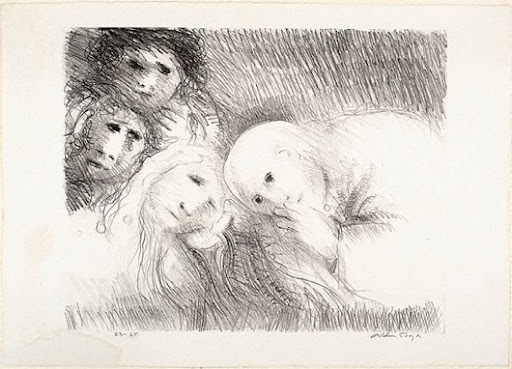
I’d just like to draw your attention to the fantastic series of lithographs by Arthur Boyd on the life of St. Francis, from which I took the above image. Also, many thanks to NP and PM for helping me with translating the quote by Chiara Lubich from Italian (all errors are mine though :).

Gang up on the green!

Temple gardens

The last week has seen a discouraging pair of shots being fired between the religious and atheists camps in the form of an article in the Catholic Herald by Fr. Alexander Lucie-Smith and a response to it by the biologist Prof. Jerry A. Coyne.1

I will leave it to you to read the two articles for yourself and won’t attempt to challenge the many individual shots fired by the two sides, as tempting as that is. The problem of evil, Nietzsche’s philosophy, nihilism, alternative theories of meaning, the nature of empirical observation, inference, theoretical parsimony and (lack of) evidence for God are all used as bullets, but without any attention paid to attempting a meeting of minds and certainly without any effort made to apply the principle of charity by either side.

Instead of going into the pair of arguments point–by–point, I would just like to throw the following into the mix (one each as criticisms of the two protagonists):

  1. Prof. Coyne, isn’t it the case that a given set of empirical data can be the basis of multiple, alternative inferences? Stating that the character of our universe being the opposite of what would be expected given a loving and powerful god is an “inference from evidence” is all well and good, but I’d argue that so would be the inference that our universe is exactly what would be expected given a loving and powerful god. What is inferred from evidence does not derive from it in a causal way (seeing a dropping apple does not cause a specific theory of gravity to be posited by an observer) and neither does a given (set of) evidence only lend itself to the definition of a single, specific theory to be inferred from it. Just looking at the playing filed of contemporary physics (or probably any other field of rational enquiry) ought to be enough to settle this point. Please, don’t take this as me saying that scientific theories are feelings or that they are arbitrary. That is not what I believe at all. I have a deep admiration for science, derive great satisfaction from participating in its advancement (admittedly in a minuscule way as far as my contribution goes) and fully subscribe to its enormous value. While I wholeheartedly agree with Prof. Dawkins and you that we can all be moral without a belief in god, I would also like to suggest that the religious views you attack are caricatures, assuming no intelligence on the part of those who hold them – not a great basis for dialogue.
  2. Fr. Lucie–Smith, isn’t it the case that the feeling of indifference, the unanswered call for justice and the lack of clarity of purpose that you attribute to atheists is precisely what Jesus felt in his abandonment on the cross (“My God, my God, why have you forsaken me?” Mathew 27:45)? And isn’t it then more fitting to engage in a dialogue with atheists that seeks to tease out the common ground between what is accessible to us without the benefit of a faith, which we, Catholics, believe to be a gift (“Faith is an entirely free gift that God makes to man.” Catechism of the Catholic Church, §162)? Please, don’t take this the wrong way, but what did you seek to achieve with your article, beyond ridiculing a ridiculous interpretation of another’s words?

So, potentially having made two fresh enemies, let me suggest that we are looking at the wrong battle lines altogether! The fight ought not to be between atheists and religious but between the rational atheists and religious on the one hand and those who act without employing reason or who abuse reason for selfish and immoral ends on the other – and those come in both flavors. Let me just give two examples that shocked and saddened me recently: first the ‘Christian’ idiot who killed seven at a Sikh gurdwara in Milwaukee and second the ‘atheist’ Chinese state whose officials have performed a forced abortion on a 7–month–old foetus. And these are just two outrageous and reprehensible events picked almost at random from the last two weeks.

For us, who do clearly have differences that I don’t mean to belittle, but who subscribe to both rationality and morality, to squabble with each other is both an offense to reason and to God and I wish that we would learn from the inhabitants of Sir Terry Pratchett’s Discworld, where “[b]lack and white lived in perfect harmony and ganged up on green.”


1 Thanks to Luke Coppen for his excellent daily ‘Catholic must-reads’ and Twitter feed, where I first read about these articles.

I’m with Müller: Mary’s virginity

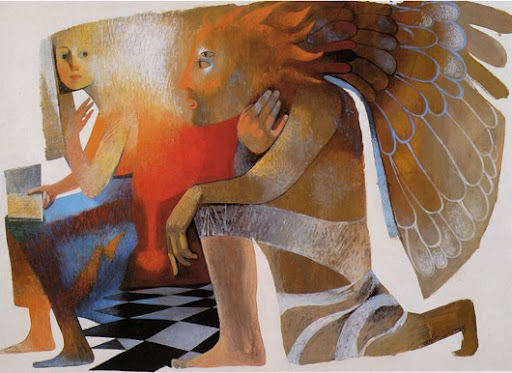
01 arcabas La Annonce faite à Marie

Somewhat reluctantly,1 I’ll now turn to the second of the three most prevalent criticisms that ‘traditionalist’ groups have leveled against Archbishop Gerhard Müller, the new prefect of the Congregation of the Doctrine of the Faith. For the context and my take on the first criticism that relates to the Eucharist, see a previous post.

First let us review the Catholic teaching that Mary was a virgin and look at what the Catechism says:

“The gospel accounts understand the virginal conception of Jesus as a divine work that surpasses all human understanding and possibility: “That which is conceived in her is of the Holy Spirit,” said the angel to Joseph about Mary his fiancée. The Church sees here the fulfillment of the divine promise given through the prophet Isaiah: “Behold, a virgin shall conceive and bear a son.”” (Catechism of the Catholic Church, §497)

This certainly sets the tone very clearly: the Church (and I) believes that Jesus was conceived by action of the Holy Spirit while Mary was a virgin and that this is an event that is beyond human understanding – beyond what’s considered possible (i.e., I read this as being inconsistent with the regular laws of nature). Let’s look more closely at what is said though about the nature of Mary’s virginity:

“[T]he Church confess[es] Mary’s real and perpetual virginity even in the act of giving birth to the Son of God made man. In fact, Christ’s birth “did not diminish his mother’s virginal integrity but sanctified it.”” (CCC, §499)

Finally, let’s see how the Catechism concludes the part dedicated to Mary’s virginity:

“Mary is a virgin because her virginity is the sign of her faith “unadulterated by any doubt,” and of her undivided gift of herself to God’s will. It is her faith that enables her to become the mother of the Savior: “Mary is more blessed because she embraces faith in Christ than because she conceives the flesh of Christ.”” (CCC, § 506)

So, to sum up, I believe the Church teaches that Mary was a virgin before during and after Jesus’s birth, that this was an event clearly outside the regular running of nature and that, while her virginity was very much real, its value is not in the physiological facts that sustained it but in it being a sign of her faith.

With the above in mind, let’s turn to Müller’s words2 (note that the changes indicated below are mine, based on the German original and versus the English wording found in a multitude of blog posts):

”[The perpetual virginity of Mary] is not so much about specific physiological proprieties peculiarities in the natural process of birth (such as the birth canal not having been opened, the hymen not being broken wounded, or the absence of birth pangs), but with about the healing and saving influence of the grace of the Savior on human nature, that had been wounded by Original Sin. […] The article of faith it is not so much about physiologically and empirically verifiable somatic details.” (Katholische Dogmatik für Studium und Praxis, p. 498)

The first thing to notice is that, if anything, the English translation used (critically) everywhere is more vague than the way I read Müller in the original German. I understand him as saying that Mary’s virginity is not about physiology and about what did or did not happen to her reproductive organs, but about grace, salvation and the person of Jesus. I see it as a reaction to the tomes upon tomes of pseudo–scientific accounts of how Jesus’ birth may have taken place vis a vis Mary’s perpetual virginity. This is about as useful as mediaeval ‘scientists’ writing treatises about lions without ever having seen one. If anything this is even worse, as there is no way for these ‘scientists’ to ever verify their claims.

Müller is not a scientist and he makes it clear that the Church’s beliefs about Mary’s virginity are not situated in a scientific context. As the Catechism (quoted above) also states, Mary’s perpetual virginity “surpasses all human understanding and possibility” and its analysis in terms of physiological categories is an exercise in futility.

Before concluding this little excursion, let me highlight one of the things that Müller said in a part that the quote bandied about by his critics left out: “To a mother, giving birth is not limited only to being a biological process.” This, to anyone who has children, is such an obvious thing to say that it seems hardly worth saying. Yet, in the context of the analyses and criticisms of Müller’s words on Mary’s virginity, it stands out like a beacon of sense in a sea of confusion and misguided breast-beating.3 What was it that went through Mary’s head when Jesus was born? Certainly not thoughts about her own hymen or birth canal, but an immense outpouring of love for her son and an awareness of the extraordinary consequences of her “Yes” to the message brought to her by the angel Gabriel now becoming even more of a gift to the world.


1 I feel great affection for Jesus’ mum, who is not only an example in following her son, in putting others before herself, in listening and adhering to God’s call, in consoling the suffering and in stepping to the fore when most needed, but also someone with whom I feel I have a personal relationship. Having to discuss their anatomy isn’t exactly what seems most attractive to me, but I do think it is worthwhile given the spurious accusations that I’ll address here.

2 As in previous posts, here too I’ll try to be careful about seeing exactly what someone has said before jumping to attack or defend it. So, the original German of Müller’s statement is: »Es geht nicht um abweichende physiologische Besonderheiten in dem natürlichen Vorgang der Geburt (wie etwas die Nichteröffnung der Geburtswege, die Nichtverletzung des Hymen und der nicht eingetretenen Geburtsschmerzen), sondern um den heilenden und erlösenden Einfluß der Gnade des Erlösers auf die menschliche Natur, die durch die Ursünde “verletzt” worden war. … Der Inhalt der Glaubensaussage bezieht sich also nicht auf physiologisch und empirisch verifizierbare somatische Details« (S. 498). And, for completeness sake, here is the original wording of the missing part referred to later in the post: »Die Geburt beschränkt sich für die Mutter nicht lediglich auf einen biologischen Vorgang.«

3 Not wanting to taint the main body of this post with reference to it, I can still not overlook some of the utter nonsense that some commentators have dragged up in the context of this topic. Let me just give one example, which goes as follows: “On this note, to deny that the Virgin Mary was not preserved from childbirthing [sic] pains is an attack on the Immaculate Conception of the same Virgin Mary.” Immaculate Conception?! They may as well bring the instructions on how Noah was to construct the ark into play! [Apologies for the outburst – for those of you not versed in Catholic theology, let me just state what the Immaculate Conception is about: “Through the centuries the Church has become ever more aware that Mary, “full of grace” through God, was redeemed from the moment of her conception. That is what the dogma of the Immaculate Conception confesses.” (CCC, §491, emphasis mine) Sheesh!]

The Principle of Charity

Cholmondeley I first came across the “principle of charity” thanks to one of the lecturers on the MA in Philosophy that I attended (but sadly not completed) at Sheffield. In the first lecture of the Aristotle module, where we were going to cover Book 9 of the Metaphysics, Dr. Stephen Makin* put something like the following idea to his students:

Aristotle wrote the Metaphysics in the 4th century BC, using the language of the day and firmly set in the cultural, scientific and political context of the time. If we approach this text without an attempt at looking for something positive, valuable or meaningful, we will very quickly come to dismiss it, as it is very easy to find it dated, set it superseded modes of thinking or irrelevant. This would be a great shame though, as it would keep Aristotle’s insights hidden from us. Instead, let’s adopt the principle of charity and look for the most favorable interpretation of Aristotle’s words – the interpretation that would give his statements the greatest value, the most sense.

As you can imagine, I was super enthusiastic about this attitude, since it struck me both as very sensible and like exactly the kind of angle that the Gospels would take, had they addressed the topic of hermeneutics. While looking into the background of this principle, I came across the following example of its application in the context of religion that I found particularly positive:

“The next [human representation of the ideal of divine love] is what is known as Vatsalya, loving God not as our Father but as our Child. This may look peculiar, but it is a discipline to enable us to detach all ideas of power from the concept of God. … [T]he Christian and the Hindu can realize [this idea of God as Child] easily, because they have the baby Jesus and the baby Krishna.”

Swami Vivekanda (1863–1902)

Not only does Vivekanda shed light on an aspect of Christian revelation from a new angle, but he uses it to draw parallels with Hinduism, thereby making both religions’ insights accessible to each other’s followers. In this context it is particularly rewarding to see how this same point is emphasized in a recent homily of Pope Benedict XVI:

“God’s sign is simplicity. God’s sign is the baby. God’s sign is that he makes himself small for us. This is how he reigns. He does not come with power and outward splendor. He comes as a baby – defenseless and in need of our help. He does not want to overwhelm us with his strength. He takes away our fear of his greatness.”

Just to avoid the ever-lurking accusation of syncretism when considering inter-religious questions, I don’t read Vivekanda as equating Jesus with Krishna or proposing their co–existence or merging, but instead as pointing to principles expressed with similarity in both traditions.

If only the principle of charity were more broadly applied both in secular and religious discourse …


I can’t mention Dr. Makin without sharing the following anecdote: One morning Dr. Makin arrives late to give his lecture and with indignation exclaims: “I have been asked to do some administrative work! Can you imagine a professional administrator being asked to write a book about Aristotle?!” I often feel the same (but still have to do it :).

5L2F

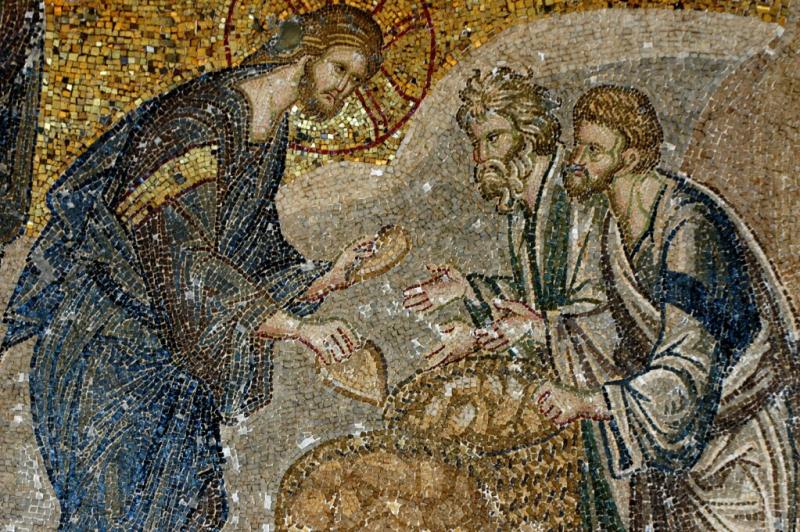
Multiplication of loaves and fishes c osseman

After Sunday’s Gospel reading at mass, I was struck by a seemingly throw-away point made during the homily, where the priest said that Jesus asked his disciples to go and buy some food for the people who assembled to listen to him and were in danger of running hungry:

When Jesus raised his eyes and saw that a large crowd was coming to him, he said to Philip, “Where can we buy enough food for them to eat?” He said this to test him, because he himself knew what he was going to do. Philip answered him, “Two hundred days?’ wages worth of food would not be enough for each of them to have a little.'” One of his disciples, Andrew, the brother of Simon Peter, said to him, “There is a boy here who has five barley loaves and two fish; but what good are these for so many?” Jesus said, “Have the people recline.” Now there was a great deal of grass in that place. So the men reclined, about five thousand in number. Then Jesus took the loaves, gave thanks, and distributed them to those who were reclining, and also as much of the fish as they wanted. When they had had their fill, he said to his disciples, “Gather the fragments left over, so that nothing will be wasted.” So they collected them, and filled twelve wicker baskets with fragments from the five barley loaves that had been more than they could eat.

John 6:5-13

The suggestion that Jesus wanted them to use regular means for feeding the masses made me listen up and reflect on the nature of miracles. The conclusion I am coming to is that the miracles Jesus performed were mostly accidental – not premeditated, planned (maybe with the exception of Lazarus’ raising from the dead where Jesus’ actions took place sometime after he was informed of his friend’s death). In this case, Jesus is spreading the good news of his Father’s love for all and it becomes apparent that the crowd following his words is going to get hungry and disperse to seek food in the nearest towns. Instead of following his disciples’ suggestion to call it a day and send his listeners on their separate ways, Jesus instead challenges their faith and asks them to provide for the crowd. Essentially he’s saying to them: nip down to the shops and fetch some dinner.

In spite of the effect that Jesus has already had on his disciples, Philip comes out with a bit of accountancy, ballparking the order at 200 days’ wages (a touch over £9700 in the UK today, which would give a budget per person/family of just under £2 – not exactly a lavish affair) and attempting to bring Jesus’ desire not to interrupt his mission stumbling down on logistical grounds. What comes next is a really great, but super-hesitant, move by Andrew, who says “There is a boy here who has five barley loaves and two fish; but what good are these for so many?” In other words, I hear Andrew as sticking his neck out and positioning himself next to Jesus by taking a leap of faith and bringing up the slightest of possibilities that could address the present challenge. To my mind the miracle is as much a reward for Andrew as it is a lesson for Philip and for the crowd assembled at Jesus’ feet.

Personally I read it as a call to trust in God and not to self–impose constraints where God’s providence is ready to provide against the odds. I have often experienced generosity by others or the discovery of solutions that only came to light because I placed my trust in God’s providence. Shortly before my older son was to be born, the house we were renting was put on the market and we were given a month’s notice to move. When we were informed about it, I was filled with panic and started rushing around, looking at vacancies but failing to find anything whatsoever as it was two weeks before Christmas and most places were shutting down for the holidays. One evening, and I remember this distinctly, I realized that I was leaving God out of this process (and doing so during Advent of all times!) and decided to skip the frantic search and instead spend the evening in prayer. This certainly calmed me down and when I woke in the morning. the thought came to me to look in the neighboring city instead of the one were we were living at the time. That same day I found us a new house to rent and the following months have shown how good the change of location was for us in ways we could not have anticipated.

Now, was that a miracle? No, in the sense that I don’t believe God intervened in the regular running of the universe. But, it did bring about a conversion in me that lead to greater closeness to God and a more attentive listening to his whispers.

This brings me to the final thought I have about Sunday’s Gospel: how much of what John describes (and incidentally the other three Evangelists too) was a miracle in the sense that the laws of nature were locally and temporarily altered? My impression is that not all. Let me explain … I believe that many people in the crowd that day had some food with them and that, when the gathering was dispersed, they may well have moved to a nice spot, laid it out and had a picnic. Others, who had no food would have had to trek to the nearest village and buy some, yet others would have had to go hungry as they may not have had the means to buy more food for themselves. Instead, what Jesus did by arranging the crowd into smaller groups (making the people assembled to hear him less of an anonymous mass), taking the five loaves of bread and two fish, blessing them and beginning to hand them out, was to create better conditions for sharing. I can imagine that someone who saw what Jesus did and had some food on them would add it to the food passed on to the next person, which in turn would lead to a positive, pyramidal-scheme-like avalanche and result in the many basketfuls collected at the end. Am I saying that I don’t believe a miracle (in the laws-of-nature-bending sense) took place? Certainly not – I do not see why Jesus should not have performed miracles, being God who created the universe out of nothing, but I do believe that his miraculous actions also triggered responses in their witnesses that lead to an amplification. Could Jesus have made food appear for 5000 families – sure! But, isn’t the humble (five loaf of bread + two fish) gesture much more loving, as it allows for human participation, rather than a sudden, imposing appearance of rows of fully-laden tables would have been?