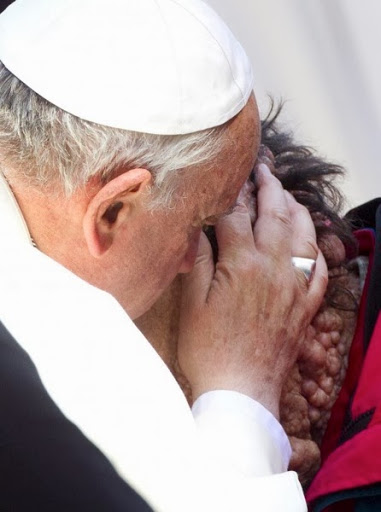
This is what the Gospel looks like

Pope disfigured man

Pope Francis has given another interview – this time to Andrea Tornielli (a contributor to the always up-to-date Vatican Insider blog) at the Italian La Stampa newspaper – and the following are some of my favorite passages:1

“[Christmas] speaks to us of tenderness and hope. When God meets us, he tells us two things. The first one is: have hope. God always opens doors, he never closes them. He is the dad who opens doors for us. Second: don’t be afraid of tenderness. When Christians forget about hope and tenderness, they become a cold Church that doesn’t know where to go and that entangles itself into ideologies, into worldly attachments. Instead, God’s simplicity tells you: go forward, I am a Father who caresses you. I am scared when Christians lose hope and the capacity to embrace and caress.”

Christmas is about hope and warmth, fueled by and in imitation of God and directed towards others.

“What we read in the Gospels is an announcement of joy. The evangelists have described a joy. No consideration is given to the unjust world, to how God could be born into such a world. All this is the fruit of our own contemplations: the poor, the child that has to be born in uncertainty. is born into a precarious situation. Christmas was not a condemnation of social injustice, of poverty; instead, it was an announcement of joy. Everything else are conclusions that we draw. Some are correct, others are less so, and others still are ideologized. Christmas is joy, religious joy, God’s joy, interior, luminous, of peace.”

Christmas is, first and foremost, joy. Let’s not rush to its implications at the expense of overlooking that deep joy that it heralds.

“A teacher of life for me has been Dostoevskij, and a question of his, both explicit and implicit, has always gone around in my heart: “Why do children suffer?” There is no explanation. […] In front of a suffering child, the only prayer that comes to me is the prayer why. Why, Lord? He doesn’t explain anything to me. But I feel that he is looking at me. So I can say: You know the why, I don’t it and You don’t tell me, but You are looking at me and I trust You, Lord, I trust your gaze.”

Suffering can’t – and mustn’t! – be explained away, but it can be lived while trusting in God’s loving gaze.

“The other day at the Wednesday General Audience, there was a young mother with her baby that was only a few months old, behind one of the barriers. As I passed by, the baby cried a lot. The mother was caressing it. I said to her: madam, I think the little one is hungry. She replied: Yes, it’s probably time … I responded: But, give it something to eat, please! She was shy and didn’t want to breastfeed in public, while the Pope was passing. So, I wish to say the same to humanity: give something to eat! That woman had milk to give to her child, in the world we have enough food to feed everyone.”

There is food for everyone – let’s not make our shyness an obstacle for it to get to its rightful recipient.

“Marxist ideology is wrong. But in my life I have met many Marxists who are good people, so I don’t feel offended.”

Don’t conflate ideology with its adherents. Even wrong ideologies have good people following then.

“During these first nine months, I have received visits from many Orthodox brothers, Bartholomew, Hilarion, the theologian Zizioulas, the Copt Tawadros: this last one is a mystic, he’d enter the chapel, remove his shoes and go to pray. I felt like their brother. They have apostolic succession, I received them as brother bishops. It is painful that we are not yet able to celebrate the Eucharist together, but there is friendship. I believe that the way forward is this: friendship, common work, and prayer for unity. We blessed each other, one brother blesses the other, one brother is called Peter and the other Andrew, Mark, Thomas …”

I have no comment to add – only to say how it warms my heart to hear Francis refer to the Orthodox patriarchs as his brothers and liken their relationship to those among the apostles. This is very much in continuation of the tremendous advances made by John Paul II and Benedict XVI, but I am moved by the beauty of the simplicity with which Francis puts the situation.

“I knew a parish priest in Hamburg who was dealing with the beatification cause of a Catholic priest guillotined by the Nazis for teaching children the catechism. After him, in the line of condemned individuals, was a Lutheran pastor who was killed for the same reason. Their blood became mixed. That parish priest told me he had gone to the bishop and said to him: “I will continue to deal with the cause, but for both of them, not just the Catholic priest’s.” This is the ecumenism of blood.”

That we are followers of Jesus, regardless of what Church we belong to is a matter that goes to the bone, into our blood. There we are already one.

“We must try to facilitate people’s faith, rather than control it. Last year in Argentina, I condemned the attitude of some priests who would not baptize the children of unmarried mothers. This is a sick mentality.”

We are not gate-keepers, but each other’s brothers and sisters instead.

“A few months ago, an elderly cardinal said to me: “You have already started the reform of the Curia with your daily masses at St. Martha’s.” This made me think: reform always begins with spiritual and pastoral initiatives rather than with structural changes.”

Structures must be a consequence of life and the best leadership is by example. This point of Pope Francis’ is also in sync with my previous criticisms of his actions being explained away as only “pastoral” and with comments made by Fr. Antonio Spadaro in the New Yorker interview, where he says, when asked about the style-versus-substance debate concerning Pope Francis: “Style is not just the cover of the book. It’s the book itself! Style is the message. The substance is the Gospel. This is what the Gospel looks like.”


1 Please, note that the following quotes are close to the official English translation, but that I have modified them here and there based on the Italian original – not necessarily in the belief of making them “better” – only with the aim of preserving some of the nuances of how Pope Francis expresses himself.

Venture freely into the open sea of the truth

I am glad I kept tabs on Pope Benedict XVI’s sermons, articles and speeches over the Christmas period and that I now had a chance to read them, as there were some true gems to be found there.

Let’s start with his Christmas Vigil homily, where he summed up the trusting fragility of the Christmas paradox particularly vividly and beautifully:

“Again and again it astonishes us that God makes himself a child so that we may love him, so that we may dare to love him, and as a child trustingly lets himself be taken into our arms. It is as if God were saying: I know that my glory frightens you, and that you are trying to assert yourself in the face of my grandeur. So now I am coming to you as a child, so that you can accept me and love me.”

Then, in his article in the Financial Times, he drew out the consequences of God’s becoming man and the love for humanity He thereby demonstrated:

“Christians shouldn’t shun the world; they should engage with it. But their involvement in politics and economics should transcend every form of ideology.

Christians fight poverty out of a recognition of the supreme dignity of every human being, created in God’s image and destined for eternal life. Christians work for more equitable sharing of the earth’s resources out of a belief that, as stewards of God’s creation, we have a duty to care for the weakest and most vulnerable. Christians oppose greed and exploitation out of a conviction that generosity and selfless love, as taught and lived by Jesus of Nazareth, are the way that leads to fullness of life. Christian belief in the transcendent destiny of every human being gives urgency to the task of promoting peace and justice for all.”

However, the engagement of Christians in the world is to be done on Gospel terms and here Benedict introduces a (to me) new reading of Jesus’ famous response to the trap some Pharisees laid him: “Christians render to Caesar only what belongs to Caesar, not what belongs to God.” He goes beyond a splitting of responsibilities and highlights the wrongful demands that secular powers can lay claim to:

“Christians have at times throughout history been unable to comply with demands made by Caesar. From the Emperor cult of ancient Rome to the totalitarian regimes of the last century, Caesar has tried to take the place of God. When Christians refuse to bow down before the false gods proposed today, it is not because of an antiquated world-view. Rather, it is because they are free from the constraints of ideology and inspired by such a noble vision of human destiny that they cannot collude with anything that undermines it.”

Benedict then takes this central idea of freedom in truth and applies it, in a to me surprisingly bold way, to the topic of inter-religious dialogue, which “is a necessary condition for peace in the world and is therefore a duty for Christians as well as other religious communities.” He first presents the current rules of this dialogue as, first, “not aim[ing] at conversion, but at understanding” and, second, that “both parties to the dialogue remain consciously within their identity, which the dialogue does not place in question either for themselves or for the other.” While he underlines the correctness of not aiming at conversion, Benedict sees these rules as “too superficial” and instead proposes the following to the Christian participant:

“[T]he search for knowledge and understanding always has to involve drawing closer to the truth. Both sides in this piece-by-piece approach to truth are therefore on the path that leads forward and towards greater commonality, brought about by the oneness of the truth. As far as preserving identity is concerned, it would be too little for the Christian, so to speak, to assert his identity in a such a way that he effectively blocks the path to truth. Then his Christianity would appear as something arbitrary, merely propositional. He would seem not to reckon with the possibility that religion has to do with truth. On the contrary, I would say that the Christian can afford to be supremely confident, yes, fundamentally certain that he can venture freely into the open sea of the truth, without having to fear for his Christian identity.”

This is decidedly not a cautious edging towards compromise, but instead a realization that Christians “can enter openly and fearlessly into any dialogue.”

The blue of the sky

On New Year’s Day was one of my favourite feasts of the Church calendar: that of Mary, mother of God. While the emphasis on Christmas Day is very much on God becoming man – the infinite also becoming finite, the feast of the Theotokos looks at another central aspect of the Christmas paradox.

Instead of descending to earth on a cloud or by means of some other superficial spectacle, God first sought the consent of a girl and then grew and developed inside her in the same way every human does. He joined humanity from the ground floor rather than waltzing in at the peak of its powers as a fully-grown adult. This also means that he has a mum whom he loved, respected, was concerned for and esteemed just like other children and adults relate to their mothers. He also felt her absolute love, care, commitment and devotion, just like children and adults receive from their mothers.

In an intellectual vision in 1949, Chiara Lubich received the following, particularly striking, insight about Mary’s relationship to God:

“As the blue of the sky contains sun and moon and stars, so Mary appeared to me, made by God so great as to contain God Himself in the Word.”

This image clearly expresses how great a love God has for Mary by making her contain Him as His mother (like the sky contains the sun), which in some sense shows God as being smaller than Mary. Yet, since it is God who made himself small, this self-humbling adds to his magnanimity and greatness and we see a God who is great, but whose greatness includes His making Himself small.

By having Mary be His mother, God leads us to humility by example, which is also what Jesus explicitly called us to: “But many who are first will be last, and the last will be first.” (Matthew 19:30).

A mathematical paradox of Christmas

Rembrandt nativity

An aspect of Christmas that is closest to my heart is that, where A is any set and where H is the set of all humans, it is also about the following:1, 2

!&#8707 A: A &#8836 Q &#8658 Q &#8834 Q &#8743 Q &#8835 Q
H &#8834 Q
&#8707 h: h &#8712 H &#8743 h = Q &#8658 Q &#8712 H &#8743 H &#8712 Q

In other words,3 God (an aspect of whom is represented here by Q), who includes and exceeds everything (which is beautifully put by the Islamic expression Allāhu Akbar – الله أكبر): “God is greater”), has become an individual human person (h) – i. e., a member of one of the myriad sets whose strict superset He is. The resulting recursive, infinite regress of divine in human in divine … is a fundamental aspect of what Christians believe and celebrate at Christmas. Yes, there is a lot more to it and, no, I am not attempting either a reduction or any sort of proof here, but, I believe the mathematical representation of what happened at Christmas just makes the enormity and irregularity of it stand out more starkly than using any other means.

God – the transcendent beyond, has become a man – a finite creature, while retaining His transcendence and immanence simultaneously. This paradox (and it strictly is a paradox since it amounts to a finiteness and infinity that cannot be resolved) is a mind-boggling event regardless of the specific circumstances under which it took place and would in any case have shown God’s love for humanity. His choice of coming into being as a human from the moment of conception (which Christians celebrate on the feast of the Annunciation and when the above paradox actually took place), being born the way all humans are and doing so under the humblest of circumstances just eases our comprehension of this extraordinary event and of the inexhaustible love that God has for us – a love that can also be read from the above set theoretic notation.

Another level of recursive infinity is introduced when Jesus institutes the Eucharist (making his divine-human self present in a transubstantiated, finite quantity of bread and wine), when it is He Himself who is present among any set of two or more humans who follow his words, and when it is He Himself who is also present in each human being. This makes not only God be transcendent-immanent but every single one if us too, by participation in His life. The ontological configuration that the incarnation introduces is truly a source of constant wonder for me and I hope that I managed to share some of that with you here.

Merry Christmas!


1 Thanks to my bestie PM for fixing my initially muddled notation!
2 Yes, I know I am using Cantor’s naïve set theory here and not Zermelo–Fraenkel (ZF or ZFC), but I do so since the latter has been designed to avoid the occurrence of paradox, which in most cases makes good sense, while Cantor’s system is more unconstrained and is precisely what the expression of the Christmas paradox calls for. Also, note that the term “naïve” here merely means non-axiomatic as opposed to implying any derogatory connotations.
3 In case you are not familiar with (this) set theoretic notation, it reads as: “No set A exists such that A is not a strict subset of Q (where a set X is another set Y’s strict subset if and only if all of the members of X are also members of Y and Y has at least one member that is not a member of X), therefore Q is a strict subset and also a strict superset of itself. H is a strict subset of Q. There exists a h that is a member of H and that is identical with Q, therefore Q is a member of H and H is a member of Q.”