Žižek’s Holy Spirit: equality, love, community, freedom

Zizek occupy wall street

2002 words, 10 min read

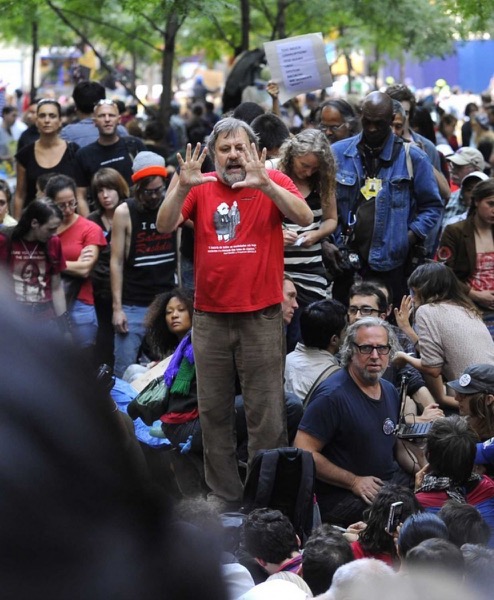
The Post-Marxist philosopher Slavoj Žižek is perhaps a surprising source of insights about the Holy Spirit, but I believe that his perspective is highly relevant for atheists and Christians alike. My first encounter with his thought on the subject was in a transcript of him addressing Occupy Wall Street protesters at Zuccotti Park in 2011:

“What is Christianity? It’s the Holy Spirit. What is the Holy Spirit? It’s an egalitarian community of believers who are linked by love for each other, and who only have their own freedom and responsibility to do it. In this sense, the Holy Spirit is here now. And down there on Wall Street, there are pagans who are worshipping blasphemous idols.”

Instead of being a throw-away comment of the moment, Žižek’s view of the Holy Spirit is the result of careful reflection from a number of viewpoints.

In a 2007 lecture – entitled “Meditation on Michelangelo’s Christ on the Cross” – he elaborated on how it is that the Holy Spirit is the source of the Christian community and pointed to the radicality of life that such a basis implies:

“The Holy Spirit is the love between believers; it is the spirit of the community of believers, according to the famous words of Christ: “For where two or three have gathered together in my name, I am there in their midst.” (Matthew 18:20) I think this passage should be taken literally. So what does this mean? Even today, the message is very radical. The temptation to be resisted is the temptation of meaning itself. […] I claim that Christ died on the cross precisely to reject […] attempts at finding a higher purpose or meaning. Rather the message is: “Your standards matter to me. I throw myself into creation, and abandon my place up there.” The conclusions are radical. The ultimate meaning of Christianity for me is a very precise one. It is not: “We should trust God. The big guy’s with me, so nothing really bad can happen.” That is too easy. The message is not: “We trust God.” The message is rather: “God trusts us.” The gesture of Christ says, “I leave it over to you.” Usually we read religion as the way to guarantee meaning: We are concerned with the small details of everyday life and never know what will come of it all, or how things will turn out; we can only make wagers, and we do this maybe to ensure that God will arrange things in our favor. But the meaning of the death of Christ for me is the opposite: God made the wager on us. It is really a crazy wager, where God is saying: “I leave it to you. Holy Ghost, community of believers, you have to do it!””

In the same piece Žižek also demonstrates that his thoughts on the Holy Spirit are not merely an analysis from outwith or a thinking about an other, but that they are pertinent to his own context and community:

“[The] link between Christian community and the progressive movement is crucial. And here I’m not playing a cheap game of identifying radical political movements as a kind of religious community; what I’m referring to is the idea of a radical community of believers. The ideal is neither that of blind liberal individuals collaborating with each other, nor the old organic conservative community. It is a community along the lines of the original Christian community: A community of outcasts. We need this today, this idea of an egalitarian community of believers that is neither the traditional heretical community nor the liberal multiplicity. This is why I and many other leftist philosophers, such as Alain Badiou and others, are so interested in rereading, rehabilitating, and reappropriating the legacy of Paul. It is not just a matter of private religious convictions. I claim that if we lose this key moment—the moment of realizing the Holy Spirit as a community of believers—we will live in a very sad society, where the only choice will be between vulgar egoist liberalism or the fundamentalism that counterattacks it. This is why I—precisely as a radical leftist—think that Christianity is far too precious a thing to leave to conservative fundamentalists. We should fight for it. Our message should not be, “You can have it,” but “No, it’s ours. You are kidnapping it.””

Žižek’s thoughts on the Holy Spirit have deeper roots still, which go to the very heart of the Christian mystery of the Trinity and the incarnation. In a 2004 paper entitled “Death’s Merciless Love”, he reflects on how the transcendent-immanent, divine-human gap is resolved by Jesus’ death on the cross, which finds its fulfilment in and unity with the Holy Spirit:

“[I]n order for humanity to be restored to God, [Christ as the mediator between God and humanity] must sacrifice himself. In other words, as long as Christ is here, there can be no Holy Ghost, which IS the figure of the reunification of God and humanity. Christ as the mediator between God and humanity is, to put it in today’s deconstructionist terms, the condition of possibility AND the condition of impossibility between the two: as mediator, he is at the same time the obstacle which prevents the full mediation of the opposed poles. Or, to put it in the Hegelian terms of the Christian syllogism: there are two “premises” (Christ is God’s Son, fully divine, and Christ is man’s son, fully human), and to unite the opposed poles, to arrive at the “conclusion” (humanity is fully united with God in the Holy Spirit), the mediator must erase himself out of the picture. Christ’s death is not part of the eternal cycle of the divine incarnation and death, in which God repeatedly appears and then withdraws into himself, in his Beyond. As Hegel put it, what dies on the Cross is NOT the human incarnation of the transcendent God, but the God of Beyond Himself. Through Christ’s sacrifice, God Himself is no longer beyond, but passes into the Holy Spirit (of the religious community). In other words, if Christ were to be the mediator between two separated entities (God and humanity), his death would mean that there is no longer a mediation, that the two entities are apart again. So, obviously, God must be the mediator in a stronger sense: it’s not that, in the Holy Spirit, there is no longer the need for Christ, because the two poles are directly united; for this mediation to be possible, the nature of both poles must be radically changed, i.e. in one and the same movement, they both must undergo a transubstantiation. Christ is, on the one hand, the vanishing mediator/medium through whose death God-Father himself “passes into” the Holy Spirit, and, on the other hand, the vanishing mediator/medium through whose death human community itself “passes into” the new spiritual stage.

These two operations are not separated, they are the two aspects of one and the same movement: the very movement through which God loses the character of a transcendent Beyond and passes into the Holy Spirit (the spirit of the community of believers) EQUALS the movement through which the “fallen” human community is elevated into the Holy Spirit. In other words, it is not that, in the Holy Ghost, men and God communicate directly, without Christ’s mediation; it is rather that they directly coincide – God is NOTHING BUT the Holy Spirit of the community of believers. Christ has to die not in order to enable direct communication between God and humanity, but because there is no longer any transcendent God with whom to communicate.”

In a 2009 book entitled “The Monstrosity of Christ. Paradox or Dialectic?” and co-authored with the Anglican theologian John Milbank, Žižek challengingly draws the identification of the community of believers with the Holy Spirit and of the Holy Spirit with the crucified and risen Christ to its ultimate conclusion, which is a life at the end of history, a life of “ethical extravagance” and “permanent revolution”:

“There is, however, a third position between these two extremes, that of the Holy Spirit, of the apocalyptic community of believers, of the self-organization dialectical clarity versus the misty conceit of paradox of believers who drew from Christ’s nonreturn after his death the correct conclusion: they were awaiting the wrong thing, Christ already had returned as the Holy Spirit of their community. The very meaning of Christ’s death is that the work to be done is theirs, that Christ put his trust in them. Once we accept this, Eagleton’s reading of Jesus’ “ethical extravagance” also becomes problematic:

“What one might call Jesus’s ethical extravagance—giving over and above the measure, turning the other cheek, rejoicing in being persecuted, loving one’s enemies, refusing to judge, non-resistance to evil, laying oneself open to the violence of others—is . . . motivated by a sense that history is now at an end. Recklessness, improvidence and an over-the-top lifestyle are signs that God’s sovereignty is at hand.There is no time for political organization or instrumental rationality, and they are unnecessary in any case.”

But is this “extravagance” really constrained to the end-of-time atmosphere in which all we can do is wait and get ready for the Second Coming? Is it not that, in an apocalyptic time—the time of the end of time, as Agamben put it—we have both aspects, “ethical extravagance” as well as political organization? The specificity of the Holy Spirit, the apocalyptic emancipatory collective, is that it is precisely an organization which practices these “ethical extravagances,” i.e., which lives its life in an apocalyptic “state of emergency” in which all ordinary legal (and moral) commitments are suspended, practiced in the mode of “as if not.” The problem with the Church is that it betrayed original Christianity not by its organization, but by the type of this organization: the apocalyptic community of believers which lives in the emergency state of a “permanent revolution” is changed into an ideological apparatus legitimizing the normal run of things. In other words, with the Church, we are not active enough: the pressure of the Second Coming is eased, all we have to do is to lead our daily lives following the prescribed ethico-religious rules, and Salvation will come by itself.“

In summary, Žižek’s Holy Spirit – like all of Žižek’s Trinity – invites to a life of radical commitment in the present, to a life lived with and for others and therefore in God, a life steeped in freedom:

“So what I claim is that something absolutely unheard of happens with Christianity which is that Christ, the death of Christ, means something very radical. It means, in all other religions we trust God, we believe in God. The death of Christ [instead] means, God trusted us. It means, “I give you your freedom, it’s up to you.” The Holy Ghost for me is — and I take it literally when it says in the Bible “Whenever the two of you are there, I will be there, I am there.” — it means the gift of freedom. It means, God doesn’t want to play that “up there a guarantee,” it means God entrusts the fate of creation, his own fate, into us. It means what happens here is part of, as it were, the history of God. And […] à propos iconoclasm […]: the prohibition to make images of God in Judaism does not mean this gnostic way “oh it’s too mysterious, we cannot paint it.” It means the exact opposite! It means God is alive not in your stupid deep meditations of up there, but how you act and react with others. And that’s why you shouldn’t make images because it’s not an image to be made up there. And I think, if anything, even more this holds for Christianity. That’s for me what the Holy Ghost is. God is no longer the substantial master up there, God is — to put it in this way — the spirit of our community, the gift of freedom.”
I’m with O’Malley: the Mexican border mass

Omalley 1

When an idea or an event that pushes the envelope (in the parlance of our times) arises, the most immediate reaction from some people is to oppose it instinctively, on the grounds of it just not making sense or being the done thing. This is pretty much ubiquitous in science, where new theories initially tend to be ridiculed or at least approached with skepticism, and no less at home in the Church, where new expressions of imitating Jesus often fall on deaf ears or are met with some form of the “crimes against tradition” objection.

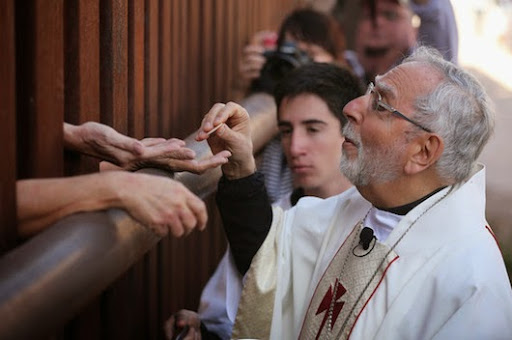
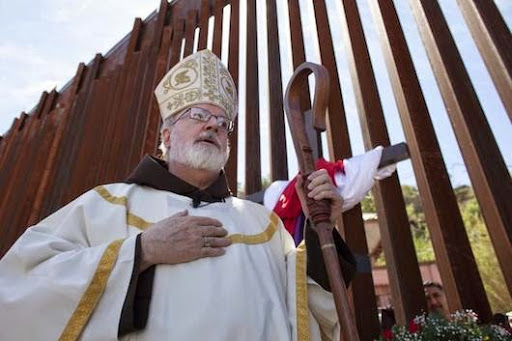
Last week saw an event exactly like that – a mass celebrated at the Mexican-US border, where the concelebrands, Cardinal Sean O’Malley, Bishop Gerald Kicanas, and a dozen other bishops, were on the US side of the 20-foot-tall, metal-fenced border, while the congregation around them, numbering in excess of 500, was partly on US and partly on Mexican soil. The occasion was a two-day visit of the US Conference of Catholic Bishops’ Migration Committee to the border, to experience first hand the conditions under which immigrants risk their lives on their way to the US and to mourn the loss of the many who die in the process. It was also an expression of the many divisions that emigration and deportations bring to families and a clear move to be with those at the peripheries, in imitation also of Pope Francis’ mass at Lampedusa.

During his homily, Cardinal O’Malley, puts the objectives of the event very clearly:

“We come to the desert today because it is the road to Jericho; it is traveled by many trying to reach the metropolis of Jerusalem. We come here today to be a neighbor and to find a neighbor in each of the suffering people who risk their lives and at times lose their lives in the desert. […] We are here to discover our own identity as God’s children so that we can discover who our neighbor is, who is our brother and sister.”

Omalley 2

And he then proceeds to illustrate the scale of the tragedy:

“Last year about 25,000 children, mostly from Central America arrived in the US, unaccompanied by an adult. Tens of thousands of families are separated in the midst of migration patterns. More than 10 million undocumented immigrants are exposed to exploitation and lack access to basic human services, and are living in constant fear. They contribute to our economy by their hard work, often by contributing billions of dollars each year to the social security fund and to Medicare programs that will never benefit them. […] We have presently over 30,000 detainees, most of whom have no criminal connections. The cost of these detentions is about $2 billion a year.”

When I first heard about the event, I was very impressed by it, as an expression of solidarity and closeness to those who suffer and are excluded from society, as Pope Francis put it so clearly in Evangelii Gaudium:

“We have created a “throw away” culture which is now spreading. It is no longer simply about exploitation and oppression, but something new. Exclusion ultimately has to do with what it means to be a part of the society in which we live; those excluded are no longer society’s underside or its fringes or its disenfranchised – they are no longer even a part of it. The excluded are not the “exploited” but the outcast, the “leftovers”.” (§53)

Imagine then my disappointment and disbelief, when I came across a condemnation of the border mass by George Weigel (introduced there as “papal biographer”), whose reaction was:

“It’s not clear to me how holding Mass in these circumstances can be anything other than politicized. […] To turn the Mass into an act of essentially political theater is something I thought we had gotten over in the Church, no matter how noble the cause might be.”

And by the canon lawyer Ed Peters, who made the following assessment of the event:

“Canon 932 § 1 […] states that “The eucharistic celebration is to be carried out in a sacred place unless in a particular case necessity requires otherwise; in such a case the celebration must be done in a decent place”. Obviously, no one suggests that the border is a “sacred place” in the canonical meaning of that term, so the question becomes whether necessity required holy Mass to be celebrated at the border. I think not. The intentions for which this Mass was offered (immigration reform and in memory of those who died crossing the border, both legitimate intentions of course) could have been amply asserted at a Mass celebrated in a sacred place as envisioned by c. 932 […] Thus, the kinds of factors commonly invoked to justify Mass outside of a sacred space do not support this Mass at the border.”

It’s hard to know where to start in the face of such rule-based, status quo thinking – not for want of counterarguments, but for their excess. From among several alternatives, I could go down the Scriptural route, pointing to the instances of Jesus’ own “political theater” (did anyone say Caesar? (cf. Mark 12:17)) or to his take on “necessity” (did you say “withered hand” (cf. Mark 3:4)), but I wont :). Instead I’d like to re-tell a story about one of the Desert Fathers that I came across a while ago, but whose source eludes me now.1

“A poor couple came to Abba Irenaeus to cancel their wedding, since they were unable to find a venue for the reception that they could afford. Upon seeing their sadness, Abba Irenaeus felt moved by compassion and said to them: “Why don’t you hold your wedding celebration in our church?” The couple were overjoyed and accepted the offer. On their wedding day, well into the party, the local bishop happened to walk past, and when he heard music and cheers coming from the church, he stopped and proceeded to investigate. Upon entering the church he saw dancing and food being served to a merry crowd. Filled with indignation he sought out Abba Irenaeus and proceeded to scold him: “How can you desecrate this church by allowing such profanity? And in the presence of the Eucharist!” To which Abba Irenaeus calmly replied: “Wasn’t Jesus himself a wedding guest at Cana? Wouldn’t he have celebrated the wedding of this couple just as much if he were here today in person?””

[UPDATE (11/04/14): Within a couple of hours of publishing this post, my überbestie ML sent me another version of the above wedding story – thank you! This one is told by Anthony de Mello (re-telling Cardinal Martini’s story), is set in Italy, and the two takes on the Eucharist are embodied by the parish priest and his assistant pastor. The whole article that contains it is very much worth reading!]


1 If you do know where the story is from (and its above version is very much just from my imperfect memory), I’d be very grateful if you’d let me know so I could credit it’s source – and you :).

Patriarchal plan perplexity

1231

The other day I came across a series of blog posts by Phillip Cary, professor of philosophy at Eastern University, Yale Divinity alumnus and author of multiple books, three of which were even published by OUP. Given his credentials, my expectations were high and – after reading the posts – my subsequent disappointment, by their obvious lack of insight, commensurably deep.

The posts are an exegesis of the first chapters of Genesis regarding the relationship between man and woman, with the penultimate one focusing on Genesis 3:16 – the words God addresses to the woman after she and the man eat from the forbidden “tree of knowledge of good and evil”: “To the woman he said: I will intensify your toil in childbearing; in pain you shall bring forth children. Yet your urge shall be for your husband, and he shall rule over you.” Cary is “puzzled” here by the juxtaposition of the woman’s desire for her husband and his ruling over her and sets out to interpret the meaning of these words of Scripture from the perspective of being God’s plan for how man and woman are to relate:

“My assumption has been that God’s word in Genesis 3 aims at a justice that sets things right. So how does patriarchy, the rule of a man over his wife, set things right? […]

[T]he key point about this patriarchal framework [… is]: because the property of the patriarch consists fundamentally of living things, the increase of wealth and the blessing of procreation are nearly the same thing in Genesis. […]

[T]he man who rules over his wife has a deep economic interest in seeing that she lives well, is healthy and flourishes together with her children, being fruitful and multiplying.”

[And from the following post: T]hat is the framework within which I think we can begin to make sense of patriarchy, where procreation, wealth and the father’s rule of the household coincide. And that in turn is the initial framework we need to see the meaning of God’s word to the woman about her desire for her husband and his ruling over her.”

What I understand from the above is that Cary is saying the following: making the man rule over the woman, in response to their joint disobedience, is a way to re-introduce the value of life in a world where death has entered as a result of the Fall. Life is an economic good and by making procreation a contributor to its proliferation, the husband – who is in charge of the household – benefits and consequently treats his wife well, like he would any other profit-generating asset.

Charming.

Before we get sucked into a diatribe against such a view, let’s take a breath and rewind to Genesis 2:24,1 where man and woman are described before the Fall and where their relationship is one of profound unity: “a man leaves his father and mother and clings to his wife, and the two of them become one body.” In the “one body” there is no master versus slave, no ruler versus subject – there is only one union between man and woman. This is God’s plan for humanity, and, I believe, Cary’s basic mistake is in taking the punishment delivered to man and woman after their disobedience and mistaking it for how man and woman are meant to relate to each other, to the point of arguing for the economic benefits of a relationship that is instituted as punishment. This is like taking the punishing of a child by making them sit still and extolling the virtues of motionlessness in terms of its low carbon footprint.

In fact, Cary’s approach is also at odds with the interpretation Blessed Pope John Paul II makes of Genesis 3:16 in his Man and Woman He Created Them:2

“[T]he words of Genesis 3:16 signify above all a breach, a fundamental loss of the primeval community-communion of persons. This communion had been intended to make man and woman mutually happy through the search of a simple and pure union in humanity, through a reciprocal offering of themselves, that is, through the experience of the gift of the person expressed with soul and body.”

He even goes on to characterize the state instituted in Genesis 3:16 as being a “deformation” of the “original beatifying conjugal union of persons” before the Fall. And if any more evidence were needed for taking this verse not as God’s plan for humanity but as a description of what happens when that plan is corrupted, we only need to look as far as the second reading from the feast of the Holy Family nine days ago, where St. Paul has the following to say: “Wives, be subordinate to your husbands [… h]usbands, love your wives” (Colossians 3:18-19). The advice here is not for husbands to rule, but to love, which, incidentally, also means to self-empty, to subordinate oneself – the exact same thing also asked of wives. The result is a mutual subordination of husband and wife to each other, or – as John Paul II put it – “a reciprocal offering of themselves […] with soul and body.”


1 Just to avoid misunderstandings, speaking about the events described in Genesis does not presuppose considering them to be historical events. The opening chapters of Genesis are a myth, which does not mean to suggest that they are false, but instead that they speak about deep anthropological, psychological and ontological features in a more archaic form – by way of analogy instead of by description of events in this Universe.
2 For more on this book by John Paul II, see here.

Priests as welcomers and accompaniers

Emmaus

This morning Pope Francis met with Rome’s priests at the basilica of St. John Lateran and, following some brief, opening remarks, spent two hours in a Q&A with them. The meeting was private and away from the lenses and microphones of journalist, but details of Pope Francis’ words have been emerging during the course of the day.

To begin with, the priests invited to the meeting were sent a letter that Francis wrote in 2008, while still a cardinal and archbishop of Buenos Aires, in which he reflects on the implications of the Aparecida document on the priesthood. There, Francis starts out by defining the “identity of the priest in relation to a community, with two characteristics. First, as “gift,” as opposed to “delegate” or “representative.” Second, in terms of faithfulness to the call of the Master, instead of “management.”” Francis then emphasizes that identity means belonging: “The priest belongs to the People of God, from which he has been drawn, to which he has been sent, and a part of which he is.” This communitarian aspect is further emphasized in the Aparecida document, which in its §156 affirms that “a constitutive dimension of the Christian event is belonging to a concrete communion in which we can be part of an ongoing experience of discipleship and communion with the successors of the apostles and with the successor of Peter.”

Further along in this preparatory document for today’s meeting, Francis emphasizes the joint importance of truth and mercy, which in the Aparecida document (§199) is presented thus: “to care for the flock entrusted to them and to seek out who have strayed furthest [… that they may be] servant-of-life-priests: who are alert to the needs of the poorest, committed to the defense of the rights of the weakest, and promoters of the culture of solidarity. The need is also for priests full of mercy.” Finally, Francis proposes to priests to be “enamored disciples,” since, “logically the missionary dimension is born from the interior experience of a love of Jesus Christ.” His letter to the Argentinian priests is a beautiful document in its entirety, and the above is meant to serve only as context for the very telegraphic details that have emerged so far from today’s private meeting with the priests of Rome.

The most extensive source of information so far has been an article in today’s Roma Sette, a website of the Diocese of Rome, where the following snippets are shared:

  1. Francis kicked off the Q&A by stating that “he considered himself above all to be a priest, and now as Pope he was afraid of feeling otherwise. “I would be afraid of feeling a bit more important; I am afraid of that, because the devil is cunning … and makes you think you have power, that you can do this and that … But thanks to God, I haven’t yet lost that fear, and if once you see that I have lost it, please, tell me, and if you can’t tell me privately, say it publicly, but say it: ‘Look, convert!’ It’s clear, isn’t it?”.” Wow! This is pretty strong stuff and it paints such a vivid picture – one that reminds me of St. Peter in the Early Church, as its head, but one that listens (cf. Galatians 2:11-14 where Paul says: “And when Cephas came to Antioch, I opposed him to his face because he clearly was wrong.” – i.e., the “Incident at Antioch”).
  2. A focus again on the “existential peripheries” that Francis has spoken about before. Here, he adds that such peripheries also refer to “weak and poor thought.” Francis also added that “reality is better understood from the periphery and not from the centre, which, instead, runs the risk of degenerating.”
  3. Francis acknowledges the “serious problems of the Church,” but without being pessimistic. “The Church does not crumble. The Church has never been as well as today, it is a beautiful moment for the Church, it is enough to read its history. There are saints recognized even by non-Catholics – let’s think of Blessed Teresa – but there is also the everyday holiness of ordinary mothers and women, of men who work every day for their families, and this brings us hope. Holiness is greater than scandals.” As an example of everyday holiness, he gives the example of a woman he spoke to over the phone the previous day (!), who is a “cleaner at Buenos Aires airport and who supports her drug-addicted, unemployed son: “This is holiness.””
  4. He also speaks about the fatigue that priests feel, remembering the expression John Paul II used in his “Redemptoris Mater,” where he speaks about Mary’s “particular heaviness of heart” (§17). Francis says that “when a priest is in touch with his people, he gets tired. Faced with this tiredness, there is only Jesus’ answer: be with the poor, announce the Gospel and go ahead.” Here Francis also differentiates between different kinds of tiredness: “When a priest is in contact with his people, he works, but he sleeps well. When a priest is not in contact with his people, he works, but he works badly and sleeps badly. … When a priest is in contact with his people, who have many real needs, need for God, then this requires serious effort – but they are the needs of God, no?, that seriously make you tired, and there is no need for sleeping pills.”
  5. Beyond fatigue, priests can also experience what St. John of the Cross called the “Dark Night of the Soul”: “there is a final effort, which is necessary at the moment that there should be triumph. … This happens when a priest questions himself about his existence, he looks within himself at the path he has followed, at the sacrifices he has made, the children he has not had and asks if perhaps he made a mistake, if his life was a failure [… John the Baptist,] in the darkness of his confinement experienced the darkness of his soul, and sent his disciples to ask Jesus if it was He Who awaited him.”
  6. Francis then proposes the following solution both to fatigue and existential darkness: “So, what can a priest do when he lives the experience of John the Baptist? Pray, to the point of falling asleep before the Tabernacle, but stay there.” Also important are “closeness with other priests and closeness of the bishop.” Francis then goes on to underline this last point: “Us bishops have to be close to priests, we have to love our neighbors, and our closest neighbors are the priests. The closest neighbors of the bishop are the priests. [applause] The opposite is true too, eh? [laughter, applause]: the closest neighbor of the priests must be the bishop: the closest neighbor. The bishop says: my closest neighbors are my priests. This exchange is beautiful, no? I believe this to be the most important moment of closeness, between bishop and priests: this moment without words, because there are no words for this fatigue.” Another great piece of advice by Pope Francis, which very much reminds me of the key moment in Herman Hesse’s Siddhartha, where the eponymous protagonist communicates wordlessly with the ferryman Vasudeva in a moment of profound union.
  7. Another remedy against fatigue and darkness is the memory “of one’s vocation, entering seminary, one’s priestly ordination: memory is the life-blood of the Church.” Francis invites all priests to remember their initial falling in love with Jesus, the moment when they first felt Jesus’ gaze on them. “For me this is the key point: that a priest has the capacity to return in memory to his first love. … A Church that loses her memory is an electronic Church, without life.”
  8. Francis also insisted that priest extend a “heartfelt welcome” so that “the faithful feel at home.” Referring in particular to couples who live together outside marriage, Francis emphasized the need for welcome – a welcome in truth. “Always speak the truth, knowing that the truth is not exhausted by a dogmatic definition, but that it inserts itself in the love and the fullness of God.” The priest therefore has to “accompany.” We just have to think of the disciples of Emmaus and how “the Lord has accompanied them and warmed their hearts.”
  9. Here Francis emphasizes the importance of creativity instead of novelty: “[do not] confuse creativity with making something new. Creativity is finding the path to proclaim the Gospel and … this is not easy. It is not simply a question of changing things. It is something different, it comes from the spirit and passes through prayer and dialogue with people, with the faithful. […] The Code of Canon Law give us many, many possibilities, so much freedom to look for these things. … We must find those moments to welcome and receive the faithful, when they enter the parish church for one reason or another.”
  10. Francis also addressed the topic of remarried divorcees: “The problem cannot be reduced merely to a matter of who can receive communion or not, because to pose the question in these terms does not enable an understanding of the real problem. … It is a serious problem regarding the Church’s reponsibility towards families living in this situation. … The Church must now do something to solve the problem of marriage annulment.”
  11. He also warned against economic interests by saying: “There must be a cordial welcome so that those who go to Church feel at home. They feel comfortable and do not feel as if they are being exploited. … When people feel there are economic interests at work, they stay away”.
  12. Finally, Francis advised the priests of his diocese to beware of both severe and lax priests. “Instead, the merciful priest proclaims that ‘God’s truth is this, so to speak, dogmatic or moral truth’, but always accompanied by God’s love and patience. Do not panic – the good God awaits us. … We must always keep in mind the word ‘accompany’ – let us be travelling companions. Conversion always takes place on the street, not in the laboratory”. This, to my mind is a fundamental point – the distinction among lax, strict and merciful – a point I didn’t get before. It made me realize that mercy involves adherence to the truth (which laxity lacks) while loving (which strictness misses).

As a married person, I am grateful to Pope Francis for these profound directions, addressed to the priests of Rome, and I feel that a lot of what he says applies equally to me and is a challenge that I too want to accept and respond to.

UPDATE (18 September 2013): Yesterday several Vatican sources (e.g., VIS, L’Osservatore Romano and Radio Vaticana) have published further details of Pope Francis’ words from the meeting with Roman clergy, which have now been added to the above post.