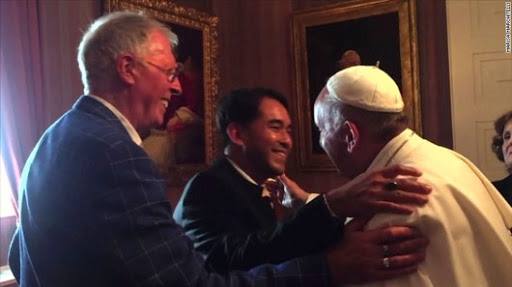
I’m with Fr. Martin: respect, compassion, and sensitivity for LGBTs

151003075258 pope francis meets hugs same sex couple 00000803 exlarge 169

2413 words, 12 min read

Jesus’ last will and testament, which he passed on to the apostles at the Last Supper, contains the following exhortation: “that they may all be one” (John 17:21). Here, Jesus explains in the same verse that “one” means to relate to each other “as you, Father, are in me and I in you.” And since “all” means “all,” it falls to every Christian to strive towards building relationships with everyone like those among the persons of the Trinity – i.e., relationships of loving self-noughting and self-othering. This means that there is no more us versus them, only an all-encompassing us.

Now, this “us” undoubtedly also includes those who are gay, lesbian, bisexual and transgender, and indeed anyone else too, regardless of their sexual orientation. It is therefore essential that we, Christians make everyone, regardless of their sexuality, feel not only welcome but loved and since this has often not been the case, there is a need for a deliberate effort to reach out, which has also been apparent in many things Pope Francis, and many other representatives of the Catholic Church, have said and done recently.

In this context, an important contribution has recently been made by Fr. James Martin SJ, who has for many years ministered to the LGBT community and who has now written an excellent book on how to bring it and the institutional Church closer together. The book is entitled “Building a Bridge: How the Catholic Church and the LGBT Community Can Enter into a Relationship of Respect, Compassion, and Sensitivity” and contains four parts. The first two are built on the metaphor of a bridge between the institutional Church and the LGBT community, where Fr. Martin’s advice for traversing it in both directions is based on what the Catechism of the Catholic Church teaches with regard to LGBT people, which is to treat them with “respect, compassion, and sensitivity” (§2358). The third part comprises a series of scriptural passages that Fr. Martin found helpful in his ministry, each with an introduction and followed by questions suitable for reflection. Finally, the book concludes with a beautiful prayer – “A prayer for when I feel rejected”.

When I first read this book, I found it to be a pure expression of the Gospel desire to share the Good News that Jesus brought to humanity – an invitation to mutual love, to dialogue and to closeness. I also thought that it was highly non-controversial and entirely consistent with the Catholic Church’s teaching and I thought no more about it. During the course of recent days, things have changed though and I have seen a savage and persistent campaign of hate directed at Fr. Martin, who is now being accused of heresy and whose name is being dragged through the mud of social media echo chambers. I am no censor or even theologian, but as a member of the Church’s laity, I have a right and duty to support and defend those who uphold the Gospel, and Fr. Martin certainly does that in spades.

Instead of engaging in a futile rebuttal of his critics, I would just like to share with you some of my favorite passages mostly from the first part of “Building a Bridge,” since it is there that I have most felt spoken to myself.

In the opening pages of the book Fr. Martin sets out the rationale for writing it, which is about breaking down us v. them barriers:

“[T]he work of the Gospel cannot be accomplished if one part of the church is essentially separated from any other part. […] In these times, the church should be a sign of unity. Frankly, in all times. Yet many people see the church as contributing to division, as some Christian leaders and their congregations mark off boundaries of “us” and “them.” But the church works best when it embodies the virtues of respect, compassion, and sensitivity.”

Next, he looks at each of respect, compasion and sensitivity in turn, as they apply to the institutional Church’s relationship with LGBT Catholics and the LGBT community in general. Thinking about respect first, Fr. Martin highlights three consequences of it, the first of which is recognition:

“[R]ecognizing that the LGBT community exists, and extending to it the same recognition that any community desires and deserves because of its presence. […] Jesus recognizes all people, even those who seem invisible in the greater community.”

Throughout the book, Fr. Martin also presents and engages with potential reservations about his proposals. For example, in the case of recognition being misconstrued as blanket approval, he writes:

“Some Catholics have objected to this approach, saying that any outreach implies a tacit agreement with everything that anyone in the LGBT community says or does. This seems an unfair objection, because it is raised with virtually no other group. If a diocese sponsors, for example, an outreach group for Catholic business leaders, it does not mean that the diocese agrees with every value of corporate America.”

The second aspect of respect then is “calling a group what it asks to be called.”:

“[P]eople have a right to name themselves. Using those names is part of respect. And if Pope Francis and several of his cardinals and bishops can use the word gay, as they have done several times during his papacy, so can the rest of the church.”

The third side of respect is to recognise that LGBT Catholics bring many gifts to the Church:

“Respect also means acknowledging that LGBT Catholics bring unique gifts to the church—both as individuals and as a community. […] Many, if not most, LGBT people have endured, from an early age, misunderstanding, prejudice, hatred, persecution, and even violence, and therefore often feel a natural compassion toward the marginalized. Compassion is a gift. They have often been made to feel unwelcome in their parishes and in their church, but they persevere because of their vigorous faith. Perseverance is a gift. They are often forgiving of clergy and other church employees who treat them like damaged goods. Forgiveness is a gift. Compassion, perseverance, and forgiveness are all gifts.”

In summary, Fr. Martin argues that respect translates to participation in God’s love:

“Seeing, naming, and honoring all these gifts are components of respecting our LGBT brothers and sisters and siblings. So also is accepting them as beloved children of God and letting them know that they are beloved children of God. The church has a special call to proclaim God’s love for a people who are often made to feel, whether by their families, neighbors, or religious leaders, as though they were damaged goods, unworthy of ministry, and even subhuman. The church is invited to both proclaim and demonstrate that LGBT people are beloved children of God.”

Turning to compassion, the model is Jesus’ incarnation itself and the need for listening to and living alongside others:

“The word compassion (from the Greek paschō, “to suffer”) means “to experience with, to suffer with.” So what would it mean for the institutional church not only to respect LGBT Catholics, but to be with them, to experience life with them, and even to suffer with them? […]

The first and most essential requirement is listening. It is impossible to experience a person’s life, or to be compassionate, if you do not listen to the person or if you do not ask questions. […]

We need not look far for a model for this. God did this for all of us—in Jesus. The opening lines of the Gospel of John tell us, “The Word became flesh and lived among us” (1: 14). The original Greek is more vivid: “The Word became flesh and pitched its tent among us” (eskēnōsen en hēmin). Isn’t that a beautiful phrase? God entered our world to live among us. This is what Jesus did. He lived alongside us, took our side, even died like us.

We can celebrate and treasure more than simply their gifts. We can celebrate and treasure them. This is a kind of compassion too—to share in the experience of Christian joy that LGBT men and women, young and old, bring to the church.”

Next, sensitivity is presented as a call to closeness, along Pope Francis’ lines of encountering and accompanying and in imitation of Jesus’ reaching out also to those considered on the margins of the People of Israel, in an outside-in motion:

“Merriam-Webster’s Dictionary defines sensitivity as “an awareness or understanding of the feelings of other people.” That’s related to Pope Francis’s call for the church to be a church of “encounter” and “accompaniment.” To begin with, it is nearly impossible to know another person’s feelings at a distance. You cannot understand the feelings of a community if you don’t know the community. You can’t be sensitive to the LGBT community if you only issue documents about them, preach about them, or tweet about them, without knowing them.[…]

In this, as in all things, Jesus is our model. When Jesus encountered people on the margins, he saw not categories but individuals. To be clear, I am not saying that the LGBT community should be, or should feel, marginalized. Rather, I am saying that within the church many of them do find themselves marginalized. They are seen as “other.” But for Jesus there was no “other.” Jesus saw beyond categories; he met people where they were and accompanied them. The Gospel of Matthew, for example, tells the story of Jesus meeting a Roman centurion who asked for healing for his servant (8: 5–13). Although the man was not Jewish, Jesus saw a man in need and responded to his need. […]

The movement for Jesus was always from the outside in. His message was always one of inclusion, communicated through speaking to people, healing them, and offering them what biblical scholars call “table fellowship,” that is, dining with them, a sign of welcome and acceptance in first-century Palestine. In fact, Jesus was often criticized for this practice. But Jesus’s movement was about inclusion. He was creating a sense of “us.” For with Jesus, there is no us and them. There is only us.

In this context, Fr. Martin also addresses the potential objection that Jesus also admonished sinners not to sin, arguing that his approach was one of inclusion first and conversion second (a conversion we are all called to and in need of):

“One common objection here is to say, “No, Jesus always told them, first of all, not to sin!” We cannot meet LGBT people because they are sinning, goes the argument, and when we do meet them, the first thing we must say is, “Stop sinning!” But more often than not, this is not Jesus’s way. In the story of the Roman centurion, Jesus doesn’t shout “Pagan!” or scold him for not being Jewish. Instead, he professes amazement at the man’s faith and then heals his servant. Likewise, in the story of Zacchaeus, after spying the tax collector perched in the tree, he doesn’t point to him and shout, “Sinner!” Instead, Jesus says that he will dine at Zacchaeus’s house, a public sign of openness and welcome, before Zacchaeus has said or done anything. Only after Jesus offers him welcome is Zacchaeus moved to conversion, promising to pay back anyone he might have defrauded. For Jesus it is most often community first—meeting, encountering, including—and conversion second. Here I’m talking about the conversion that all of us need, not simply LGBT people (and, incidently, not “conversion therapy”). Pope Francis echoed this approach in an inflight press conference in 2016, on his return to Rome from the countries of Georgia and Azerbaijan. “People must be accompanied, as Jesus accompanied,” he said. “When a person who has this situation comes before Jesus, Jesus will surely not say: ‘Go away because you’re homosexual.’””

At the conclusion of the first half of the book, Fr. Martin spells out a point that forms the bedrock of his approach, which is that:

“[w]e are all on the bridge together. For that bridge is the church. And, ultimately, on the other side of the bridge for each group is welcome, community, and love.”

And, finally, he draws our attention to the sustaining power of the Holy Sprit, to the need of our, universal brotherhood and sisterhood, and to God’s constant accompanying of humanity:

In difficult times you might ask: “What keeps the bridge standing? What keeps it from collapsing onto the sharp rocks? What keeps us from plunging into the dangerous waters below?” The answer is: the Holy Spirit. The Holy Spirit, which is supporting the church, is supporting you, for you are beloved children of God who, by virtue of your baptism, have as much right to be in the church as the pope, your local bishop, and me. Of course, that bridge has some loose stones, big bumps, and deep potholes, because the people in our church are not perfect. We never have been—just ask St. Peter. And we never will be. We are all imperfect people, struggling to do our best in the light of our individual vocations. We are all pilgrims on the way, loved sinners following the call we first heard at our baptism and that we continue to hear every day of our lives. In short, you are not alone. Millions of your Catholic brothers and sisters accompany you, as do your bishops, as we journey imperfectly together on this bridge. More important, we are accompanied by God, the reconciler of all men and women as well as the architect, the builder, and the foundation of that bridge.

To my mind, Fr. Martin has written a beautiful treatise on dialogue, openness and love that could just as well be applied to any other group of people who are and/or feel marginalised by the Church. The text could easily be transposed to refugees or atheists or to other groups and communities, whom parts of the Church may not be as welcoming towards as they should1 and I highly recommend the book in its entirety.


1 E.g., see Pope Francis’ words from the press conference during his return from Armenia in June 2016: “I think that the Church not only should apologise … to a gay person whom it offended but it must also apologise to the poor as well, to the women who have been exploited, to children who have been exploited by (being forced to) work. It must apologise for having blessed so many weapons.”
Enter darkness, make your closeness felt

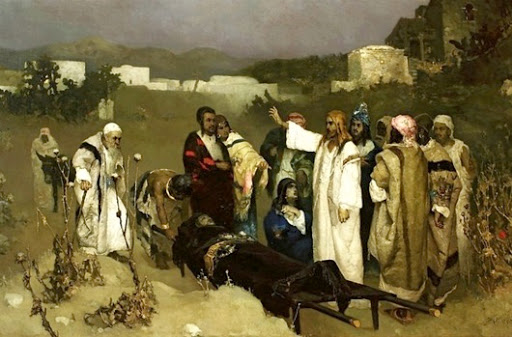
Widow nain

1532 words, 8 min read

A book-length interview with Pope Francis, by the Italian journalist Andrea Tornielli and entitled “The Name of God is Mercy”, has been published today and I would here like to share some of my favorite passages with you (and encourage you to read it in full!).

First, there is Francis’ rooting of mercy in Ezekiel’s account of the foundation of Jerusalem:

“[M]ercy is God’s identity card. God of Mercy, merciful God. For me, this really is the Lord’s identity. I was always impressed by the story of Jerusalem as it is told in chapter 16 of the Book of Ezekiel. The story compares Jerusalem to a little girl whose umbilical cord wasn’t cut, who was left in blood and cast out. God saw her wallowing in blood, he washed the blood from her, he anointed her, he dressed her, and when she grew up he adorned her with silk and jewels. But she, infatuated with her own beauty, became a harlot, taking lovers not for money but paying them herself. God, however, will never forget his covenant and he will place her above her sisters so that Jerusalem will remember and be ashamed (Ezekiel 16:63), when she is forgiven for what she has done.

For me this is one of the most important revelations: you will continue to be the chosen people and all your sins will be forgiven. So mercy is deeply connected to God’s faithfulness. The Lord is faithful because he cannot deny himself. This is explained well by Saint Paul in the Second Letter to Timothy: “If we are faithless, he remains faithful, for he cannot deny himself.” You can deny God, you can sin against him, but God cannot deny himself. He remains faithful.”

Second, Francis exalts the goodness of starting again over that of an (impossible) never failing:

“The most important thing in the life of every man and every woman is not that they should never fall along the way. The important thing is always to get back up, not to stay on the ground licking your wounds. The Lord of mercy always forgives me; he always offers me the possibility of starting over. He loves me for what I am, he wants to raise me up, and he extends his hand to me.”

In fact, earlier in the book, Francis is explicit about the impossibility of not sinning and follows it up with a great quote by St. Francis de Sales:

“We must take this sad reality of ours into account: no one can avoid sin, small or great, for very long. ‘But,’ as Saint Francis de Sales said, ‘if you have a little donkey and along the road it falls onto the cobblestones, what should you do?’ You certainly don’t go there with a stick to beat it, poor little thing; it’s already unfortunate enough. You must take it by the halter and say: ‘Up, let’s take to the road again . . . Now we will get back on the road, and we will pay more attention next time.’”

Third, there is a good number of personal experiences that Pope Francis shares in the book, to give his answers to Tornielli’s questions a fresh sense of concreteness and specificity. Of these one of my favorites is the following:

“Back when I was rector of the Collegio Massimo of Jesuits and a parish priest in Argentina, I remember a mother with young children, whose husband had left her. She did not have a steady job and only managed to find temporary work a couple of months out of the year. When there was no work, she had to prostitute herself to provide her children with food. She was humble, she came to the parish church, and we tried to help her with our charity, Caritas. I remember one day—it was during the Christmas holidays—she came with her children to the College and asked for me. They called me and I went to greet her. She had come to thank me. I thought it was for the package of food from Caritas that we had sent to her. “Did you receive it?” I asked. “Yes, yes, thank you for that, too. But I came here today to thank you because you never stopped calling me Señora.” Experiences like this teach you how important it is to welcome people delicately and not wound their dignity. For her, the fact that the parish priest continued to call her Señora, even though he probably knew how she led her life during the months when she could not work, was as—or perhaps even more—important than the concrete help that we gave her.”

Fourth, in response to being asked to clarify what he meant when he said that famous “who am I to judge” soon after being elected pope, Francis said:

“I am glad that we are talking about “homosexual people” because before all else comes the individual person, in his wholeness and dignity. And people should not be defined only by their sexual tendencies: let us not forget that God loves all his creatures and we are destined to receive his infinite love. I prefer that homosexuals come to confession, that they stay close to the Lord, and that we pray all together.”

Fifth, in the context of being asked about the “scholars of the law” whom Francis frequently lambasts in his homilies, he recalled a great quote from St. Ambrose’s De Abraham:

“When it comes to bestowing grace, Christ is present; when it comes to exercising rigor, only the ministers of the Church are present, but Christ is absent.”

Sixth, Francis addresses the important question put to him by Tornielli of whether there is a risk of “infection” when dealing with those who live in sin:

“We need to enter the darkness, the night in which so many of our brethren live. We need to be able to make contact with them and let them feel our closeness, without letting ourselves be wrapped up in that darkness and influenced by it. Caring for outcasts and sinners does not mean letting the wolves attack the flock. It means trying to reach everyone by sharing the experience of mercy, which we ourselves have experienced, without ever caving in to the temptation of feeling that we are just or perfect. The more conscious we are of our wretchedness and our sins, the more we experience the love and infinite mercy of God among us, and the more capable we are of looking upon the many “wounded” we meet along the way with acceptance and mercy. So we must avoid the attitude of someone who judges and condemns from the lofty heights of his own certainty, looking for the splinter in his brother’s eye while remaining unaware of the beam in his own. Let us always remember that God rejoices more when one sinner returns to the fold than when ninety-nine righteous people have no need of repentance.”

Seventh, there is also a great deal that made me smile in this book, like the following passage that, while clearly communicating a profound truth, does so with humor:

“At times I have surprised myself by thinking that a few very rigid people would do well to slip a little, so that they could remember that they are sinners and thus meet Jesus. I think back to the words of God’s servant John Paul I, who during a Wednesday audience said, “The Lord loves humility so much that sometimes he permits serious sins. Why? In order that those who committed these sins may, after repenting, remain humble. One does not feel inclined to think oneself half a saint, half an angel, when one knows that one has committed serious faults.””

Eighth, Pope Francis speaks beautifully about how compassion relates to mercy, using Jesus himself as the example:

“Let us reflect on the beautiful pages that describe the raising from the dead of the widow’s son. When Jesus arrived in the village of Nain in Galilee, he was moved by the tears of the widow, who was devastated by the loss of her only son. He says to her, “Woman, do not weep.” As Luke writes in the Gospel: “When the Lord saw her, he felt compassion for her” (7:13). God Incarnate let himself be moved by human wretchedness, by our need, by our suffering. The Greek verb that indicates this compassion is σπλαγχνίζομαι [splanchnízomai, ed.], which derives from the word that indicates internal organs or the mother’s womb. It is similar to the love of a father and mother who are profoundly moved by their own son; it is a visceral love. God loves us in this way, with compassion and mercy. Jesus does not look at reality from the outside, without letting himself be moved, as if he were taking a picture. He lets himself get involved. This kind of compassion is needed today to conquer the globalization of indifference. This kind of gaze is needed when we find ourselves in front of a poor person, an outcast, or a sinner. This is the compassion that nourishes the awareness that we, too, are sinners.”

Judaism and Christianity: A common heritage

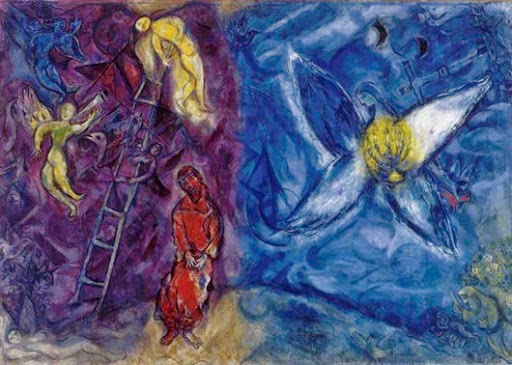
Chagall jacobs dream

A very good friend of mine (CA) lent me a great book about Judaism, entitled “What is a Jew?” and aimed at providing an introduction to a broad variety of aspects of what it means to be Jewish. The book is structured in the form of questions and answers and its tone exudes warmth and a desire to share rather than to impose or indoctrinate. Even before I started reading the book, I was looking forward to learning more about Judaism, both because of a desire to have a better understanding of the religion of several friends of mine, and because of the heightened insistence on a rediscovery of Judaism made by the Catholic Church since Vatican II.

John Paul II was famously the first pope to visit a synagogue, during which visit he spoke with clarity and warmth about the relationship between Christianity and Judaism:

“The Jewish religion is not ‘extrinsic’ to us, but in a certain way is ‘intrinsic’ to our own religion. […] With Judaism, therefore, we have a relationship which we do not have with any other religion. You are our dearly beloved brothers, and, in a certain way, it could be said that you are our elder brothers.”

Benedict XVI went on to maintain very strong relationships with Judaism, both acknowledging the Church’s past wrongs and expressing its gratitude and debt to the Jewish people:

“Abraham, father of the people of Israel, father of faith, has become the source of blessing, for in him ‘all the families of the earth shall call themselves blessed.’ The task of the Chosen People is therefore to make a gift of their God – the one true God – to every other people. In reality, as Christians we are the inheritors of their faith in the one God. Our gratitude therefore must be extended to our Jewish brothers and sisters who, despite the hardships of their own history, have held on to faith in this God right up to the present and who witness to it…”

Finally, Pope Francis has not only continued along the direction indicated by his predecessors, but has also benefitted from close personal friendships with the Jewish community. An example of this is the book – “On Heaven and Earth” that he co-authored with Rabbi Abraham Skorka, who also accompanied him on his recent visit to Israel and who has been a frequent visitor at the Vatican. Pope Francis has also reiterated, in his apostolic exhortation Evangelii Gaudium, the brotherly relationship that his predecessors have stressed:
“We hold the Jewish people in special regard because their covenant with God has never been revoked, for “the gifts and the call of God are irrevocable” (Rom 11:29). The Church, which shares with Jews an important part of the sacred Scriptures, looks upon the people of the covenant and their faith as one of the sacred roots of her own Christian identity (cf. Rom 11:16-18). As Christians, we cannot consider Judaism as a foreign religion; nor do we include the Jews among those called to turn from idols and to serve the true God (cf. 1 Thes 1:9). With them, we believe in the one God who acts in history, and with them we accept his revealed word. Dialogue and friendship with the children of Israel are part of the life of Jesus’ disciples. […] While it is true that certain Christian beliefs are unacceptable to Judaism, and that the Church cannot refrain from proclaiming Jesus as Lord and Messiah, there exists as well a rich complementarity which allows us to read the texts of the Hebrew Scriptures together and to help one another to mine the riches of God’s word. We can also share many ethical convictions and a common concern for justice and the development of peoples.” (§247-9)

Against this background I was particularly pleased to see the relationship between Christianity and Judaism described by Rabbi Morris Kertzer in “What is a Jew?” as follows:

“[The] German dramatist, Gotthold Ephraim Lessing, caught the essence of this common heritage [of Judaism and Christianity] in a play called Nathan, the Wise. One of the most memorable scenes depicts a meeting between a friar and the Jew Nathan. Moved by the beauty of Nathan’s character, the friar exclaims, “Nathan! Nathan! You are a Christian!” His friend replies, “We are of one mind, for that which makes me, in your eyes, a Christian, makes you, in my eyes, a Jew!”” (pp. 279)

I have to say that this paragraph from the last pages of the book very much rang true for me and expressed with accuracy the feeling I had as I made my way through the whole book. To give you a sense of what triggered such a recognition of what I believe to be very much mine in Rabbi Kertzer’s description of Judaism, I will share a number of excerpts from it next.

To begin with, the mystical tradition in Judaism, and its propensity to expressing itself by means of short stories reminded me immediately of the stories told about the Desert Fathers (and also about Zen kōans and the stories of the Sufi Mullah Nasrudin):

““Rabbi,” one of the disciples complained, “some of the congregants are gossiping in the midst of prayer!” “How wonderful are your people, O God,” The rabbi retorted. “Even in the midst of gossip, they devote a few moments to prayer!”

“Can you tell me, Rabbi, why the wicked are always looking for companions while the righteous are not?” “The answer is simple: The wicked walk in darkness, so are anxious for company. Good people walk in the light of God; they don’t mind walking alone.”” (pp. 21-22)

Next, I was struck by a repeated insistence on orthopraxy, which has a strong tradition in Christianity too:

“Jews are urged to put their religion into action. “Talking is not the main thing; action is,” goes a talmudic maxim, and action includes not just activity within the confines of the Jewish world, but working for the welfare of the larger society in which we live. We call this tikkun olam, meaning the “reparation of world.”” (pp. 30)

And Rabbi Kertzer goes on to recounting the same story about the building of the Tower of Babel that Pope Francis reflects on in his above-mentioned book, and then to presenting a synthesis of principles that resonate very strongly with Christianity too:

“The Rabbis used telling parables to illustrate this point. Why did the Tower of Babel crumble? Because the leaders of the project were more interested in the work than in the workers. When a brick fell to earth, they would pause to bewail its loss; when a worker fell they would urge the others to keep on building. The brick was more important than the human being. So God destroyed the imposing edifice. […]

Basic to Judaism are these fundamental principles, which are also basic to democracy: 1) God recognizes no distinction among us  on the basis of creed, color, gender, or class; all of us are equal in God’s sight. 2) We are all our brother’s and sister’s keepers; we bear responsibility for our neighbors’ failings as well as for their needs. 3) All of us, being made in God’s image, have infinite capacity for doing good; therefore the job of society is to evoke the best that is in each of us. 4) Freedom is to be prized above all things; the very first words of the Ten Commandments depict God as the Great Liberator: “I am the Eternal your God who brought you out of the land of Egypt.”” (pp. 31)

A couple of questions later, Kertzer then sets out an understanding of Scripture that could have come from the Vatican II dogmatic constitution Dei Verbum:

“[M]ost Jews look upon the accounts of miracles as inspiring literature, rather than as actual historical events. That is to say, we do not necessarily accept older interpretations of their significance, since an important lesson for the fifth century may be unimportant in the face of today’s spiritual questions; but we do use these tales as sources of inspiration ourselves, trying to draw religious lessons from the text, even the text of an event that may not be literally true. God did not create the world in precisely six days, just as the biblical text insists, but we can learn lessons for our lives from such stories as the Garden of Eden or the Tower of Babel.” (pp. 45)

On the subject of death and the Kaddish prayer, the book presents a profoundly beautiful reflection by Rabbi Steinberg:

“It is easier for me to let go of life with all its treasures, because these things are not and never have been mine. They belong to the Universe and the God who stands behind it. True, I have been privileged to enjoy them for an hour but they were always a loan to be recalled.

And I let go of them the more easily because I know that as parts of the divine economy they will not be lost. The sunset, the bird’s song, the baby’s smile, the thunder of music, the surge of great poetry, the dreams of the heart, and my own being—all these I can well trust to the God who made them. There is a poignancy and regret about giving them up, but no anxiety. When they slip from my hands they will pass to hands better, stronger, and wiser than mine.

Life is dear; let us then hold it tight while yet we may. But we must hold it loosely also! It is at once infinitely precious and yet a thing lightly to be surrendered. Because of God, we clasp the world, but with relaxed hands; we embrace it, but with open arms.” (pp. 67)

The juxtaposition of an enjoyment of the beauty of the universe and a detachment from it leads to an experiencing of everything in relationship with and gratitude to God:

“Because of its innate trust in both God and God’s world, Judaism affirms the value of life and life’s pleasures. It is therefore a religion that urges us to pay attention to the wonderful universe about us. To help us do so, it provides blessings for all of life’s bounties: seeing a rainbow; experiencing a thunderstorm; observing the first blossoms of springtime; putting on new clothes; even eating our first garden produce, as each crop ripens year after year.” (pp. 85)

That the above relationship with God is not simply an individual matter is shown clearly through the concept of minyan, which also reminded me of Jesus’ promise of his presence where “two or three” are gathered together in his name:

“Personal prayer between the individual and God may take place anywhere, any time, and with no one present but God and the individual worshiper. Public services, however, have traditionally required what is known as a minyan, that is, the presence of at least ten adult worshipers. […] Behind the idea of a minimum number is the notion that Jewish spirituality is in some sense communal. We all received the Torah together on Mount Sinai. We are all part of the people Israel.” (pp. 86)

Kertzer then goes on to presenting a simultaneous openness to diversity and faithfulness to God, that has echoes in the Church’s desire for “unity in diversity”:

“Our experience with diverse cultures has enriched our religion in many ways. Above all, perhaps, has been our hospitality to differences. Every question of Jewish law contains both an austere interpretation and a liberal one, and the Rabbis ruled that “both opinions are the word of the living God.” […] One famous rabbinic aphorism pictures God as saying, in effect, “As long as Jews do My will, they need not believe in Me.” That is an exaggeration, of course. Judaism does teach some beliefs, among them the firm conviction that God is real: a real presence in the lives of men and women, children and adults. We can know that reality as surely as we know the beauty of love, the satisfaction of faithfulness, or the buoyancy of hope.” (pp. 108)

In more specific terms, the three pillars of the Jewish faith are presented next, and unity among them is declared:

“We believe, then, in God: a personal God whose ways may be beyond our comprehension, but whose reality makes the difference between a world that has purpose and one that is meaningless.

We believe all human beings are made in God’s image; our role in the universe is thus uniquely important, and despite the failings that spring from our mortality, we are endowed with infinite potential for goodness and greatness.

We believe too that human beings actualize their potential as part of a community. The people Israel is such a community, harking back to Sinai, existing despite all odds from then until now, and still the source of satisfaction for Jews who wish to pursue a life of purpose grounded in the age-old wisdom we call Torah.

And we believe in Torah, therefore, as a continuing source of revelation.

It has been said that you can sum up Jewish belief in these three words, God, Torah, Israel. As the mystics used to say, “God, Torah, and Israel are all one.” If we lose our faith in any one of them, the others quickly perish. […]

In antiquity, it was common for scholars to distill the essence of religion in a simple formula. Thus, Hillel, the great Rabbi and scholar of the first century B.C.E., was asked to sum up Judaism while the questioner stood on one foot! Hillel replied: “Certainly! What is hateful to you, do not do to your neighbor. That is all there is in the Torah. All the rest is mere commentary. I suggest you study the commentary.”” (pp. 109)

The transcendence of God, the universal access to following Him and its being rooted in a putting into practice of His qualities brings the exposition of the Jewish faith to completion:

“Jews believe in the existence of a God who cannot be accurately conceived, described, or pictured. But God is a real presence in the universe at large; and the lives of each of us in particular. We believe also that we most genuinely show God honor when we imitate the qualities that are godly: As God is merciful, so we must be compassionate; as God is just, so we must deal justly with out neighbor; as God is slow to anger, so we must be tolerant in our judgment.” (pp. 110)

“It is the recognition of the reality of God, and the basic moral virtues, such as kindliness, justice, and integrity, that we regard as eternal verities. But we claim no monopoly on these verities, for we recognize that every great religious faith has discovered them. That is what Rabbi Meir meant some eighteen centuries ago, when he said that a non-Jew who follows the Torah is as good as our high priest.” (pp. 113)

Finally, Kertzer also speaks very powerfully about the necessity of remembering the horrors of the Shoah:

“[T]he moral reason [to remember the Shoah] may be the most important one. When the mass murderer Adolf Eichmann was on trial, the Israelis informed the world that the motive behind the judicial proceedings was not vengeance but the moral education of contemporary women and men. The striking thing about Eichmann was precisely that he was so ordinary, a living symbol of what historian Hannah Arendt called “the banality of evil.” Contemplating the events of the Nazi era, we came to see that the sin of omission on the part of the decent peoples of the world was the sin of silence, the refusal to believe that a highly enlightened people like the Germans could permit themselves to be led by a madman into acts of national depravity that culminated in the events of Auschwitz and the other death camps. We had to learn to readjust our vision and take evil seriously once again.” (pp. 161)

Not only is it essential to pursue the doing of good, but so is a taking seriously of evil and a standing up to it, since omission and silence too are grave sins – insights that are of acute relevance today and that were at the time of the Shoah also shared by Christians. The Lutheran theologian Dietrich Bonhoeffer, whose anniversary of being murdered in the Flossenbürg concentration camp in 1945 was yesterday, said:

“Silence in the face of evil is itself evil:
God will not hold us guiltless.
Not to speak is to speak.
Not to act is to act.”

The salvific atheism of Christ

Jf

[Warning: Long read.]

The title of this post is a quote from a conversation between Cardinal Gianfranco Ravasi and the journalist and atheist Eugenio Scalfari. There, Ravasi argued that Jesus’ cry on the cross: “My God, my God, why have you forsaken me?” (Matthew 27:46) can be described as a “salvific atheism.” An atheism that is juxtaposed with the Resurrection, where Jesus remains the Son even when He doesn’t feel the Father and thereby “plants the seed of the infinite in mortality.” Many shy away from attributing atheism to Jesus in this moment, where He laments His being abandoned by God, with a lot of hand-waving and “as if”s or appeals to reason along the lines of “how could Jesus, who is God, have been abandoned by God?!” Such attempts at denying Jesus’ profound experience of the absence of God may have good motives, but they have always struck me as being misguided, since they obscure the extreme nature of this most important moment of Jesus’ life.

That Jesus underwent a trial of this magnitude, where his suffering drove him to a loss of feeling united with the Father – i.e., the very heart of the Trinity, is the most powerful indication of how far God is willing to go towards us, whose faith is limited at the best of times. He is showing us that He is our brother also in darkness and during experiences of the absence of God.

The importance of this nadir in Jesus’ life (and pinnacle of His self-noughting love) was profoundly understood also by Chiara Lubich, the founder of the Focolare Movement who is now on the path of being considered for sainthood, and by the agnostic Swedish film director, Ingmar Bergman.

For Lubich, who with her first companions has spent years focused on putting the Gospel into practice, the realization of the importance of Jesus’ forsakenness on the cross came, when – in 1944 – her spiritual director asked her when Jesus suffered most and declared that he thought it was in his cry of forsakenness on the cross. Looking back to that moment some 56 years later, Lubich described it as follows:

“Right from the start we understood that fullness had another side to it, the tree had its roots. The Gospel covers you in love, but demands everything from you. “If the grain of wheat doesn’t fall to the earth and die – we read in the Gospel of John – it remains just a grain of wheat, but if it dies, it bears much fruit” (Jn 12:24). And the personification of this is Jesus Crucified, whose fruit was the redemption of humankind. […] Through a particular circumstance, we came to know that the greatest suffering of Jesus and, therefore, his greatest act of love, was when on the cross he experienced the abandonment by the Father: “My God, my God, why have you abandoned me?” This touched us to the depths. And our young age, our enthusiasm, but especially the grace of God, urged us to choose only him in his abandonment, as the means to realize our ideal of love.”

Having identified Jesus’ forsakenness as the pinnacle of his love, Lubich and her companions sought to find, love and console Him in the sufferings of all around them and in themselves:

“From that moment on, we seemed to discover his countenance everywhere. He had experienced within himself people’s separation from God and from each other, and he had felt the Father far from him. We saw him not only in all our personal sufferings, which were never lacking, but in those of our neighbor, often alone, abandoned, forgotten, in the separation between generations, between rich and poor, within the very Church at times, and, later, between churches, then between religions and between persons of different convictions.

But these wounds didn’t frighten us. On the contrary, because of our love for him in his abandonment, they attracted us. He had shown us how to face them, how to live them, how to cooperate in overcoming them when, after the abandonment, he placed his spirit in his Father’s hands: “Father, into your hands I commend my spirit” giving to humankind the possibility of being restored to itself and to God, and he showed us the way. And so he manifested himself to be the key to unity, the remedy for every disunity. He was the one who recomposed unity between us each time it cracked. In him we recognized and loved the great and tragic divisions of humankind and of the Church. He became our only Spouse.”

During Lent that same year, Lubich meditated on Jesus’ forsakenness in this way:

“He who is life itself was giving himself completely. It was the culmination of his love, love’s most beautiful expression.

All the painful aspects of life conceal his face: They are nothing other than him.

Yes, because Jesus, crying out in his abandonment, is the image of those who are mute: He no longer knows how to speak.

He is the image of one who is blind – he cannot see; of one who is deaf – he cannot hear.

He is the weary person, moaning.

He is on the brink of desperation.

He is hungry … for union with God.

He is the image of one who has been deceived, betrayed; he seems a failure.

He is fearful, timid, disoriented.

Jesus forsaken is darkness, melancholy, contrast. He is the image of all that is strange, indefinable, that has something monstrous about it. Because he is God crying out for help!

He is the lonely person, the derelict. He seems useless, an outcast, in shock.

Consequently we can recognize him in every suffering brother or sister.”

Finally, Lubich, who has made love of Jesus forsaken her life, describes the following effects of identifying and loving Him in others: “after each encounter in which we have loved Jesus forsaken, we find God in a new way, more face-to-face, with greater openness and fuller unity. Light and joy return; and with the joy, that peace which is the fruit of the spirit.”

To get another, deeply insightful, perspective on this key moment in Jesus’ life, Bergman’s “Winter Light,” that premiered in 1962, has its characters speak about it twice. First, when the pastor of a town, plagued by doubt, breaks down in front of a parishioner who comes to him for help, saying, with obvious anguish and torment throughout:

“If there is no God, would it really make any difference? Life would become understandable. What a relief!

And thus death would be a snuffing out of life. The dissolution of body and soul. Cruelty, loneliness and fear … all these things would be straightforward and transparent.

Suffering is incomprehensible, so it needs no explanation.

There is no creator. No sustainer of life. No design.

My God…

Why have you forsaken me?

I’m free, free at last.”

Before giving thought to the above, let’s look at the second reference to Jesus’ forsakenness, which comes later, when the disabled sacristan (who didn’t hear the pastor’s lament) shares the following reflection with him:

“Wouldn’t you say the focus on [Christ’s] suffering is all wrong? This emphasis on physical pain. It couldn’t have been all that bad. It may sound presumptuous of me – but in my humble way, I’ve suffered as much physical pain as Jesus.

And his torments were rather brief. Lasting some four hours, I gather? I feel that he was tormented far worse on an other level.

Maybe I’ve got it all wrong. But just think of Gethsemane, Vicar. Christ’s disciples fell asleep. They hadn’t understood the meaning of the last supper, or anything. And when the servants of the law appeared, they ran away. And Peter denied him. Christ had known his disciples for three years. They’d lived together day in and day out – but they never grasped what he meant.

They abandoned him, to the last man. And he was left alone. That must have been painful. Realizing that no one understands. To be abandoned when you need someone to rely on – that must be excruciatingly painful. But the worse was yet to come. When Jesus was nailed to the cross – and hung there in torment – he cried out: “God, my God! Why hast thou forsaken me?” He cried out as loud as he could. He thought that his heavenly father had abandoned him. He believed everything he’d ever preached was a lie. The moments before he died, Christ was seized by doubt. Surely that must have been his greatest hardship? God’s silence.”

To my mind, the above are two great attempts at an identification with the forsaken, crucified Jesus. The first, the pastor’s, is an identification from within – a re-experiencing of Jesus’ forsakenness at first hand, that leads the protagonist to a wishing away of it all, to a denial of the problem’s reality and a subsequent, forced declaration of freedom (forced and strained because of how it is portrayed in the movie). The second is an identification from the position of compassion and intuition – the disabled sacristan takes his own physical and psychological sufferings as a basis for inferring the greater magnitude of the latter, and – by extrapolation – intuiting that Jesus’ forsakenness on the cross – the experience of “God’s silence” – must have been most severe.

In many ways it is the pastor’s experience that gives the greatest sense of what it may have been like for Jesus himself, by the anguish and despair that it presents. The sacristan’s monologue, in turn, is – to my mind – already a source of hope in that it demonstrates another’s capacity to intuit my despair and therefore be lead to compassion.