Francis: God’s tenderness for man and woman

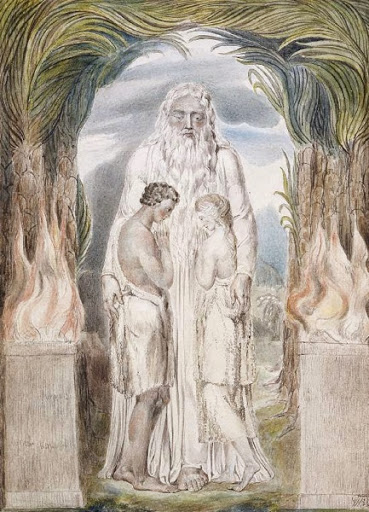
Blake divine presence

Pope Francis has dedicated two of his Wednesday General Audiences to the topic of men and women, their equal dignity, complementarity and the challenges they and their relationships face today. These two catecheses are set within the broader context of the family that he has been speaking about for several weeks now. However, since the question of how the complementarity of men and women is to be understood is close to my heart, I would like to offer a selection of passages from these two talks, which present a particularly clear and useful perspective.

Two weeks ago, Pope Francis started addressing this question by going back to its first treatment in the Bible, to the first creation account in Genesis, and underlining the joint value of man and woman:1

“As we all know, sexual differences are present in so many forms of life, in the long scale of the living. However, only in man and in woman does it bear in itself the image and likeness of God: the biblical text repeats it a good three times in two verses (Genesis 1:26-27): Man and woman are image and likeness of God! This tells us that not only man in himself is the image of God, not only woman in herself is the image of God, but also that man and woman, as a couple, are the image of God. The difference between man and woman is not for opposition, or for subordination, but for communion and creation, always in the image and likeness of God.”

Pope Francis then reflects on gender theory, which he rejects, and to which he offers an alternative, but whose roots he recognizes:

“I wonder […] if the so-called gender theory is not also an expression of a frustration and of a resignation, which aims to cancel the sexual difference because it no longer knows how to address it. Yes, we risk taking a step backward. The removal of the difference, in fact, is the problem, not the solution. To resolve their problems of relation, man and woman must instead talk more to one another, listen more to one another, know one another more, love one another more. They must relate to one another with respect and cooperate with friendship.”

Instead of a denial of differences, the key is respect, communication, friendship and love. However, the present problems are not to be laid equally at the feet of men and women:

“It is without doubt that we must do much more in favor of woman if we want to give back more strength to the reciprocity between men and women. In fact, it is necessary that women not only be more listened to, but that her voice has real weight, a recognized authoritativeness in society and in the Church. The way itself with which Jesus considered women – we read it in the Gospel, it is so! – in a context less favorable than ours, because in those times women were in fact in second place … and Jesus considered them in a way which gives a powerful light, which enlightens a path that leads far, of which we have only followed a small piece. We have not yet understood in depth what things the feminine genius can give us, which woman can give to society and also to us. Perhaps to see things with other eyes that complements the thoughts of men. It is a path to follow with more creativity and more audacity.”

While Pope Francis does not present a solution, he very clearly identifies the problem and sets the challenge of identifying ways that would lead to women having the place in society and the Church that they are due.

In the second catechesis this morning, Pope Francis returns to the question of reciprocity and equal dignity, and he takes the second creation account from Genesis as the starting point:

“[In the second chapter of Genesis] we read that the Lord, after having created heaven and earth, “formed man of dust from the ground, and breathed into his nostrils the breath of life; and man became a living being.” He is the pinnacle of creation. Then God put man in a most beautiful garden so that he would till and keep it. […] When […] God presents woman to him, man rejoices and recognizes that creature, and only that one, which is part of him: “bone of my bones and flesh of my flesh.” Finally, there is a reflection of himself, a reciprocity.”

While the second creation account establishes a closeness between man and woman, where woman is the “flesh of [man’s] flesh,” and which Pope Francis refers to in the same way in which the creed describes how God the Father and Jesus relate (as being consubstantial), he is quick also to emphasize that woman is created directly by God and not in some way by or through man:

“Woman is not a “replica” of man; she comes directly from the creative gesture of God. The image of the “rib” does not express inferiority or subordination but, on the contrary, that man and woman are of the same substance and are complementary. And the fact that – still in the parable – God formed woman while man slept, stresses in fact that she is in no way creature of man, but of God. And it also suggests something else: To find woman, and we can say to find love in woman, to find woman, man must first dream her and then he finds her.”

I particularly like the poetry of Pope Francis speaking about man dreaming woman to then find her and find love in her!

Francis then returns to the challenges facing men and women by reference to suspicion and mistrust and delusions of one’s omnipotence that we are all prone to:

“God’s trust in man and woman, to whom he entrusts the earth, is generous, direct and full. However, it is here where the Evil One introduces in his mind suspicion, incredulity, mistrust and finally disobedience to the commandment that protected them. They fall into that delirium of omnipotence that contaminates everything and destroys harmony. We also feel it within ourselves, so many times, all of us.”

From the general, Francis turns to denouncing injustice and violence committed against women as a result of patriarchal excesses, chauvinism and a turning of women into merchandise and a means:

“Sin generates mistrust and division between man and woman. Their relationship is threatened by thousands of ways of dishonesty and submission, of deceitful seduction and humiliating arrogance, even to the most dramatic and violent degrees. History bears their marks. Let us think, for instance, of the negative excesses of patriarchal cultures. Let us think of the many forms of chauvinism where woman is considered to be second class. Let us think of the instrumentalization and merchandising of the female body in current media culture.”

Next, he makes a pitch for a revival of an alliance between man and woman, whose absence leads to an uprooting of children from their maternal wombs:

“However, let us also think of the recent epidemic of mistrust, skepticism and even hostility that is spreading in our culture – in particular beginning with an understandable mistrust by women – in relation to an alliance between man and woman that would be able to, at the same time, improve the intimacy of communion and to protect the dignity of difference. If we do not find a jolt of sympathy for this alliance, that leads new generations to repairing mistrust and indifference, children will come into the world ever more uprooted from the maternal womb. The social devaluation of the stable and generative alliance of man and woman is certainly a loss for all. We must reassess marriage and the family!”

How so we go about such a reassessment though? Here Francis offers two indications. First, that marriage derives from a self-emptying for the sake of a new, joint journey where the spouses become all for each other (which is precisely the Trinitarian economy):

“And the Bible says a beautiful thing: man finds woman, they find one another, and man must leave something to find her fully. And for this, man will leave his father and his mother to go to her. It is beautiful! This means beginning a journey. Man is all for woman and woman is all for man.”

Second – and this should come as no surprise to anyone who has been following last year’s Synod on the Family or even just the Bull of indiction of the coming Jubilee of Mercy – that God is a tender, loving father to all, regardless of their shortcomings and that we too are called to treat others in exactly that same way. And Francis offers a surprising, beautiful reading of the motives behind Adam and Eve leaving Paradise clothed:2

“To care for this alliance of man and woman – even if they are sinners and wounded, confused and humiliated, mistrustful and uncertain – is therefore, for us believers, a challenging and exciting vocation, under present circumstances. The same account of creation and of sin, at its end, gives us a most beautiful icon: “And the Lord God made for Adam and for his wife garments of skins, and clothed them.” It is an image of tenderness to that sinful couple that leaves us with our mouth open: the tenderness of God for man and for woman. It is an image of paternal care of the human couple. God himself takes care of and protects his masterpiece.”


1 Note, that the English quotes from Pope Francis’ catecheses are mostly verbatim from the Zenith translations, except for a few passages that are adjusted based on the Italian original in an attempt of a more literal rendering.
2 Which turns out to be highly consonant with William Blake’s depiction of that scene, shown at the top of this post.

A marriage and family questionnaire

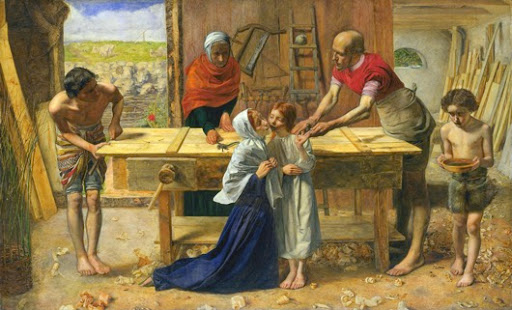
John Everett Millais Christ in the House of His Parents `The Carpenter s Shop Google Art Project s

Ahead of this October’s Synod on the Family, the Bishops of England and Wales have published a questionnaire about marriage and the family, in line with the recommendations issued at the end of last year’s Extraordinary Synod on the same subject. If you reside in England or Wales, I would very much encourage you to complete it, and if you live elsewhere, you might like to find out whether your local bishops’ conference is doing something similar.

Finally, in case you are interested, I would also like to share my own responses to this questionnaire, which I found to be a good opportunity for stopping and reflecting (although not in one go, obviously – I wrote these lines while taking a break from a basketball game with my sons, later while having a couple of minutes to myself before a supper and finally while waiting for a flight – continuity, sadly, is the stuff of fairytales :).

What are your joys and hopes of marriage and family life today?

To me the greatest source of joy with regard both to the family and marriage is the warmth and tenderness that can be experienced there. The family is where all its members can be free to express themselves unreservedly, to share their joys and sorrows, to develop their love for others and to know that their welcome by all in the family is unconditional. It is a place where difficulties can be overcome without judgment and where successes can be shared without envy. Above all though, marriage and the family are an openness to participating in the life of the Trinity: in mutual self-giving, in loving and being loved, that invite Jesus’ presence among those gathered together in His name

What are your struggles and fears of marriage and family life today?

The struggles and challenges that each member of a family faces individually are also a challenge for the family as a whole. Self-centeredness, isolation, indifference, consumerism, a lack of concern for the poor and a tendency to see what distinguishes at the expense of what unites are all prominent dangers. What makes them worse is if they are faced individually and without the benefit of the family or the relationship between spouses. And what makes them even more serious is if a family closes itself, instead of sharing its warmth and tenderness with those around it, if it only looks inside, instead of recognising the presence of God in all around them. These are the greatest dangers and fears I see today. 

How can we better understand marriage as a vocation?

By first understanding and responding to the vocation that follows from baptism and that consists in participation in Christ’s priestly, prophetic and royal nature. Only then can the membership in the mystical body of Christ that the Eucharist gives life to and the access to the Holy Spirit that follows from confirmation be understood and lived. And only on the basis of a conscious experience of these sacraments can an understanding of the sacramentality and vocational nature of marriage be understood and its choice, instead of the choice of other vocations, be discerned and made in alignment with the will of God. Both the putting into practice of the Gospel and a life-long learning of the faith are indispensable here.

  How does your marriage enrich you?

This is a question akin to asking about the benefits derived from oxygen. Getting married is an existential transformation that is followed by a new, joint being where the spouses are one. It is a monologue becoming dialogue, an individual participating in communion and a one that is not alone. It is a complementarity that is not self-sufficient or self-fulfilling but oriented towards God and neighbours instead. 

How does your family life enrich those around you?

This question would better be addressed to those around my family, while for us it is more of an examination of conscience. I hope those around us feel welcomed by us as they are and feel that we understand and don’t judge them. If we keep Jesus’ words and He makes His home with us, I hope we are able to share Him with those whom we meet. 

In what way, through the abiding presence of God, is your family “salt of the earth and light to the world,” and a place of and for handing on our faith?

By placing the Gospel at the heart of our family’s life: as a guiding light and explicit interpretative key for the events in our family and the world at large, as the motivation for our actions, as a mirror in which to identify our failings and as the inspiration for starting again and again with putting it into practice. 

Do you have any other comments?

I would like to express my wholehearted agreement with and support for Pope Francis’ words at the close of last year’s Extraordinary Synod on the Family, where he emphasised the need for the Church to be open to all, not ashamed of the wounds of our fallen brothers and sisters, and be “[t]he Church that has doors wide open to receive the needy, the repentant and not only the righteous or those who think they are perfect!”

In continuous search of the other

Complementarity

Just under a month ago, from 17th to 19th November, the Humanum conference on the “Complementarity of Man and Woman” took place at the Vatican, hosted by the Congregation for the Doctrine of the Faith. There thirty speakers from around the world belonged to various religions, including Hinduism, Buddhism, Islam and Christianity of various kinds, and the talks were wide ranging in the aspects of the family they addressed, reaching far beyond the titular question of complementarity.

In this post I would, however, like to zoom in on things said specifically about complementarity itself (even at the expense of leaving out other, also very interesting content), since that is a topic close to my own heart. The following will therefore be a look at the highlights of what has been said there about how men and women relate, using the hermeneutic of complementarity.1, 2

Right at the start of the symposium, Pope Francis set the scene by rooting complementarity in the words of St. Paul and by panning out to show that it is a profound attribute of God, instead of only a device for thinking about men and women:

“You must admit that “complementarity” does not roll lightly off the tongue! Yet it is a word into which many meanings are compressed. It refers to situations where one of two things adds to, completes, or fulfills a lack in the other. But complementarity is much more than that. Christians find its deepest meaning in the first Letter to the Corinthians where Saint Paul tells us that the Spirit has endowed each of us with different gifts so that-just as the human body’s members work together for the good of the whole-everyone’s gifts can work together for the benefit of each. (cf. 1 Cor. 12). To reflect upon “complementarity” is nothing less than to ponder the dynamic harmonies at the heart of all Creation. This is a big word, harmony. All complementarities were made by our Creator, so the Author of harmony achieves this harmony.”

Having set the scene, Francis then bridges God’s intrinsic harmony and its being the modus operandi of the family, also projecting out its consequences:

“This complementarity is a root of marriage and family. For the family grounded in marriage is the first school where we learn to appreciate our own and others’ gifts, and where we begin to acquire the arts of cooperative living. For most of us, the family provides the principal place where we can aspire to greatness as we strive to realize our full capacity for virtue and charity.”

And finally, Francis warns against an oversimplification and a misunderstanding of complementarity, which, I believe, have plagued thinkers both aligned with the Church and opposed to it:

“When we speak of complementarity between man and woman in this context, let us not confuse that term with the simplistic idea that all the roles and relations of the two sexes are fixed in a single, static pattern. Complementarity will take many forms as each man and woman brings his or her distinctive contributions to their marriage and to the formation of their children — his or her personal richness, personal charisma. Complementarity becomes a great wealth. It is not just a good thing but it is also beautiful.”

The sketch presented by Pope Francis was then fleshed out by Cardinal Gerhard Müller, Prefect of the Congregation for the Doctrine of the Faith, whose analysis departs from the question of (in)completeness:

“One’s own male or female being is not sufficient to oneself. Each one of us feels needy and lacking in completion. [… W]e do not complete ourselves from our own selves, we are not totally self-sufficient. This simple consideration, clear to all, would suffice to demonstrate the inadequacy of the markedly individualistic trait so characteristic to the modern mentality.”

This inbuilt individual self-insufficiency is, Müller argues, positive, since it impels us to go beyond ourselves and since it is in this way that we are in God’s image:

“[I]n the Bible difference is the place of blessing, the exact place where God will make present His action and His image. In this way, we can comprehend that in Scripture, each of the two, Adam and Eve, are measured not only according to their mutual relation but above all from the starting point of their relationship with God. Indeed, in the singularity of each and not only in their union as a couple, we find inscribed the image of the One who has created them. Here, man and woman share the same humanity, the same incarnate condition, and sexual difference does not imply subordination one to the other: “both man and woman are human beings to an equal degree, both are created in God’s image” In this vein, Saint John Paul II said that male and female are as “two incarnations of the same metaphysical solitude before God and the world as two ways of being body and together [hu]man, who complete each other reciprocally.””

Next, Müller argues in a surprising twist that the union between man and woman has an unexpected consequence:

“[I]n the book of Genesis the union of man and woman does not lead to a fulfilment, does not close them within themselves, for it is precisely in uniting with each other that they open themselves to the greater presence of God. One might well say that in the very union of the two, man and woman render themselves needier, which makes increase in them the thirst of the mystery in the measure that their radical reference to the Creator God is revealed more clearly. The union sets off, therefore, a dynamic, a movement, as the Song of Songs recounts, in which the lover and beloved are at the same time in continuous search of the other and of God.”

Müller then arrives at considering the profound nature of complementarity and underlines it being anything but a polar stereotype:

“It is precisely the presence of God within the union between man and woman that helps us consider the meaning of their complementarity. This cannot be understood in a polar fashion, as if male and female were opposed realities who complete each other perfectly: active and passive, exterior and interior, so as to become a closed unity; rather, it is a matter of different ways of situating themselves in the world so that, when they come together, far from closing themselves in, these open the path towards the world and others, a path that leads above all to the encounter with God.”

The reality of children too can be seen from the perspective of incompleteness and of being directed towards God:

“The union of male and female is complementary not in the sense that from it ensues one complete in him or herself, but in the sense that their union demonstrates how both are a mutual help to journey towards the Creator. The way in which this union refers to itself always beyond itself becomes evident in the birth of a child. The union of the two, making themselves “one flesh,” is proven precisely in the one flesh of those generated by that union. Hence, we see confirmed how complementarity also means overabundance, an insurgence of novelty. From the presence of the child comes a light that can help us describe the complementarity of man and woman. The relationship of the parents with the baby, where both open out beyond themselves, is a privileged way to understand the difference between the man and the woman in their role as father and mother. Complementarity is not understood, therefore, when we consider man and woman in an isolated form, but when we consider them in the prospective of the mystery to which their union opens out and, in a concrete way, when we look at male and female in light of the relationship with the child.”

Finally, and only after an ample emphasis on the complexity, richness and God-centeredness of complementarity, does Müller speak about male and female characteristics, while again insisting that “male and female are dimensions that interconnect and exchange”:

“One might add that the female aspect is characterized by a constant presence, which accompanies always the child. Indeed, in German, when a woman is pregnant, we say that she “carries a baby beneath her heart” Contemporary philosophy has spoken of the feminine as a dwelling place, as presence that envelops man from the beginning and accompanies him along the way, as singular sensitivity for the person as gift and for his affirmation.

On the other hand, the male is characterized, in terms of the child, as the presence of someone “in the distance,”in a distance that attracts, and, therefore, helps in walking the journey of life.

Both male and female are necessary to transmit to the child the presence of the Creator,both as love that envelops and confirms the goodness of existence despite all else, and as a call that from afar invites one to grow. In this way, male and female are dimensions that interconnect and exchange, such that the woman enriches man and man the woman, because one participates in the property of the other and may transmit together to the child being in the image of God.”

In many ways, listening to Cardinal Müller reminds me of an, at first perplexing, but upon further reflection profound quote by the Marxist philosopher Slavoj Žižek: “The only way to the universal good is that we all become strangers to ourselves.”

Another speaker at the conference whose words shed light on complementarity is Henry B. Eyring, president of The Church of Jesus Christ of Latter-day Saints. His words have great beauty and can also be seen as a lived experience of the concepts Müller presented:

“Most remarkable to me has been the fulfillment of the hope I felt the day I met my wife. I have become a better person as I have loved and lived with her. We have been complementary beyond anything I could have imagined. Her capacity to nurture others grew in me as we became one. My capacity to plan, direct, and lead in our family grew in her as we became united in marriage. I realize now that we grew together into one—slowly lifting and shaping each other, year by year. As we absorbed strength from each other, it did not diminish our personal gifts. Our differences combined as if they were designed to create a better whole. Rather than dividing us, our differences bound us together.”

Wael Farouq, Visiting Professor of Islamic Studies at the Catholic University of Milano, extends the generative role of the male-female relationship to meaning and likens it to linguistic mechanisms:

“We can say that the complementarity of man and woman is an encounter which generates life and meaning not only in terms of children, but life and meaning which is at the heart of every encounter of man and woman in daily living.

The greatest danger the family faces today is its being emptied of all meaning, being turned into something that can be possessed, bought, and sold. […]

In Arabic, there is no word “to be” or “being” in the absolute. For this reason, one single word has neither meaning or grammatical function, unless it is located in a sentence. You can only understand this verb in relation to the other elements of the sentence. The word in a sentence is like the person in a family: is nothing, unless within a relationship.”

Finally, Lord Jonathan Sacks, the former Chief Rabbi of the United Kingdom, delivered an extraordinary speech, reflecting on a broad range of issues to do with the family. Focusing in just on the concept and role of complementarity, Sacks too emphasizes the importance of the relationship, of conversation:

“[T]ruth, beauty, goodness, and life itself, do not exist in any one person or entity but in the “between,” what Martin Buber called Das Zwischenmenschliche, the interpersonal, the counterpoint of speaking and listening, giving and receiving. Throughout the Hebrew Bible and the rabbinic literature, the vehicle of truth is conversation. In revelation God speaks and asks us to listen. In prayer we speak and ask God to listen. There is never only one voice. In the Bible the prophets argue with God. In the Talmud rabbis argue with one another. In fact I sometimes think the reason God chose the Jewish people was because He loves a good argument.”

Sacks then proceeds to revisit the value and purpose of otherness that Müller also emphasized, by providing a close reading of Genesis 3 where he links it to the desire for immortality and to the recognition of equal personhood:

“If we read [Genesis 3:19-21, the end of the story of Adam and Eve] carefully, we see that until now the first man had given his wife a purely generic name. He called her ishah, woman. […] For him she was a type, not a person. […] What is more he defines her as a derivative of himself: something taken from man. She is not yet for him someone other, a person in her own right. She is merely a kind of reflection of himself.

As long as the man thought he was immortal, he ultimately needed no one else. But now he knew he was mortal. He would one day die and return to dust. There was only one way in which something of him would live on after his death. That would be if he had a child. But he could not have a child on his own. For that he needed his wife. She alone could give birth. She alone could mitigate his mortality. And not because she was like him but precisely because she was unlike him. At that moment she ceased to be, for him, a type, and became a person in her own right. […]”

Finally, Sacks presents the consequences of man recognizing in woman a person in her own right, bound to him by love:

“At that moment, as they were about to leave Eden and face the world as we know it, a place of darkness, Adam gave his wife the first gift of love, a personal name. And at that moment, God responded to them both in love, and made them garments to clothe their nakedness, or as Rabbi Meir put it, “garments of light,” [since] the Hebrew word for “skin” is almost indistinguishable from the Hebrew word for “light.”

And so it has been ever since, that when a man and woman turn to one another in a bond of faithfulness, God robes them in garments of light, and we come as close as we will ever get to God himself, bringing new life into being, turning the prose of biology into the poetry of the human spirit, redeeming the darkness of the world by the radiance of love.”

Looking at the above thoughts in their totality – from Pope Francis’ broad strokes, via their profound elaboration by Cardinal Müller, through the personal witness of President Eyring and the Muslim perspective of Prof. Farouq, and being brought to fruition in the words of Rabbi Sacks – a picture emerges where complementarity is tightly linked to God Himself, more so than to men and women. Instead of having its roots in the differences between the two sexes, complementarity propels one person outside themselves and towards an other, towards a dynamic harmony. Instead of deriving from static differences between two parties, complementarity subsists imperfectly in the interpersonal and is fulfilled in the relationship between our finite selves and the infinite love of God. As such, instead of confining differences to their original owners, complementarity engenders their becoming gifts for the other – a mutual enriching and transfer of all that is good, beautiful and true. And while relationships between men and women are particularly suited for the coming about of complementarity, I believe that complementarity is a principle that acts in all human contact. Each one of us has distinctive contributions to make in our relationships with others, that can engage with what they lack and what they seek on the way to fulfillment, completeness and communion.


1For completeness sake, it is worth noting that, in addition to the speakers, whose thoughts on complementarity are covered here in detail, Sister M. Prudence Allen also spoke about it and did so in terms of four aspects of complementarity: equal dignity, significant difference, synergetic relation and intergenerational fruition.
2 Please, note that the following is not the order in which the talks were given.