Evening came and morning followed: the roots of science in Genesis

Day and Night

The hallmarks of the scientific method include its basis in empirical evidence and its reliance on repeatability for the sake of verifying or falsifying hypotheses accounting for and predicting observations that can be aided by measurement. An aspect of the above that has interested me for a while now has been the nature of repeatability (or reproducibility), which certainly does make good intuitive sense, but where I had questions about whether some other principle couldn’t be used instead to form an equally consistent method of enquiry. Essentially, I was wondering to what extent the scientific method, as anchored in repeatability, allowed for a formalistic reading (like mathematics does – in contrast with conceiving of it as a form of realism).

The breakthrough for me came when my bestie NP wrote a soon to be published article to stimulate dialogue between science and faith and listed the following two of the assumptions of science: namely, that “the universe is intelligible […] and that it has a rational structure.” While both of these may sound self-evident and be taken for granted, having them called out made me think more carefully about intelligibility. What is it that renders an event or entity intelligible and how does a successful understanding demonstrate itself? Especially the latter is a staple of epistemology and the philosophy of science and I don’t mean to review the literature on explanatory power or models of scientific explanation like the deductive-nomological one here. Instead, I’d like to focus on the role of repeatability and to argue that it is necessary not only for science but that it is inextricable from any expression of reason.

The repeatability of events, of the meaning of concepts and of the modes of reasoning is essential to rationality. If such recurrence and persistence of relationships and states did not exist, then each event would be a one-off and it would be impossible to conceive of it using human reason. Language would not exist since words would at most be labels for individual entities and the games it relies on would be impossible too since they require regularity and repetition. Understanding of any kind would also be impossible since reflection and either deductive or inductive modes of analysis would have a sole window of opportunity in which to relate to an event or entity. There would be no laws, rules, regularities or even statistics, since everything that would be, would be a unique, a one-of-a-kind. This necessity of repeatability and its being a constituent of rationality are also expressed in Einstein’s definition of “Insanity: doing the same thing over and over again and expecting different results.”

In science, the insistence on repeatability is then anything but arbitrary and instead becomes an expression of its rationality. It can even be seen as closing the loop that starts with the assumption of the repeatability and regularity of phenomena by requiring of a theory to be repeatably applicable to their recurrences to merit the status of scientific. In other words, the requirement of repeatability in science mirrors the assumption of the repeatability in nature to which it strives to correspond.1

With the above thoughts in mind, and having read and hugely admired John Paul II‘s analysis of Genesis from the perspective of the human person, I proceeded to attempt an imitation from the point of view of science, knowing full well that it could at best be as if seen through a mirror, darkly. Nonetheless, I believe that I have found – to me – surprising traces of the scientific method in the first chapter of the Bible.2 Before making these explicit, I would like to emphasize that I am not looking for a justification of science in the Bible (it is solidly derived from reason alone as sketched out above as well) and neither am I setting out to anachronistically twist the Genesis text to fit contemporary thought (although I am necessarily looking at it from a contemporary perspective). Instead, inspired by John Paul II, I am attempting to look for the roots of what today is the scientific method and I would have been unperturbed even if I had found no traces of it there.

The first thing that struck me when re-reading Genesis 1 over the weekend is its use of the following, exact sentence to conclude the account of each “day” of creation: “Evening came, and morning followed—the [n-th] day.” (verses 5, 8, 13, 19, 23 and 31). Instead of the creation myth3 being a single “poof” event or a random sequence of entities popping into existence (à la Eddie Izzard’s great sketch4), it has a repeating structure as its backbone. Once set up on the first day (“God then separated the light from the darkness. God called the light “day,” and the darkness he called “night.”” 1:4-5), the alternation of day and night repeats itself and becomes subject to predictability and intelligibility.

The second feature of Genesis 1 that is worth noting in this attempt to trace the roots of science in the Torah is the repeated reference to visual observation. As early as verse 4, after the creation of light, we hear that “God saw that the light was good” and as far as the various translations and analyses I have seen, the term translated into English as “saw” does refer to ocular perception as opposed to just understanding in the abstract. Then, in verses 10 (after dry land is separated from water), 12 (after the introduction of vegetation), 18 (after the sky is populated), 21 (after fish and birds are created) and 25 (after animals living on land enter the scene) we are told repeatedly that “God saw that it was good.” From this perspective of visual perception, it is also worth noting that it is employed in a categorically different way once the two first humans are present.

Instead of vision only being a means for God to assess His own work, in His relationship with humans he calls them to use it as a source of evidence for His actions: “God also said: See, I give you every seed-bearing plant on all the earth and every tree that has seed-bearing fruit on it to be your food; and to all the wild animals, all the birds of the air, and all the living creatures that crawl on the earth, I give all the green plants for food.” (Genesis 1:29-30). In fact, the very last verse of Genesis 1 (verse 31), brings both visual observation and the repetitive, predictable nature of the universe together: “God looked at everything he had made, and found it very good. Evening came, and morning followed—the sixth day.”

What the above means to me is that Genesis, and therefore the whole of Judeo-Christian thought, is rooted in an account of creation that, albeit being in the form of a myth, has features that clearly contain two core aspects of the scientific method: repeatability and predictability on the one hand and sensory observation as a means of obtaining evidence on the other. While not a factual account of cosmogeny, Genesis nonetheless hints at how nature is to be approached also from the perspective of understanding it: that regularity can be expected and that the senses are a basis for engaging with it. Instead of being a source of superstition and confusion, the Bible to me is a source of gems that reinforce rather than oppose rationality.


1 I think it unlikely for this train of thought to be novel, so the absence of references is an expression of my ignorance rather than innovation. All I can offer here is the acknowledgement of Aristotle’s already realizing that “there is no science of the individual” (“If they are individual and not universal, real things will be just of the same number as the elements, and the elements will not be knowable.” Metaphysics XIII, 10).
2 I don’t wish to scare you off by setting out to link science directly to the Bible. Let me assure you that my intentions couldn’t be further from those who consider the universe to the 6000 years old or who run lunatic websites like answersingenesis.org (scarily that was the website that the vast majority of Google “science Genesis” searches point to). On the topic of answersingenesis.org, I was particularly struck by their attempt to distinguish between two flavors of science: historical (explaining past events) and operational (applied in the present for utilitarian ends). What the @#$%?!
3 I am using the term myth in the way in which John Paul II employed it: myth “does not refer to fictitious-fabulous content, but simply to an archaic way of expressing a deeper content.” (Man and Woman He Created Them).
4 “So then God created the world, and on the first day he created light and air and fish and jam and soup and potatoes and haircuts and arguments and small things and rabbits and people with noses and jam – more jam, perhaps – and soot and flies and tobogganing and showers and toasters and grandmothers and, uh … Belgium. And the second day he created fire and water and eggnog and radiators and lights and Burma and things that go “urh” and … and Colonel Gaddafi and Arthur Negus. On the third day he probably got lists and said, “I can’t remember what I’ve invented now. I’ve just been ad-libbing so far.”” (Eddie Izzard, Glorious, 1997)

A universe from nothing

Dark energy
In 2009 Richard Dawkins introduced a talk by Lawrence Krauss by eulogizing about his work as follows: “[T]he study of origins, origins of all kinds, right across the board from the origin of the Universe to the origin of Life, to the origin of everything that you can think of [ – w]hat an amazingly exciting initiative.” Krauss himself – whose talk is entitled “A Universe From Nothing” – then goes on to extoll the virtues of wonder by saying that “scientists love mysteries. They love not knowing. That’s a key part of science. The excitement of learning about the Universe.” What a great way to start a talk: origins and wonder!

The only thing left for me to do to enjoy the rest of Krauss’ lecture about cosmology is to filter out the recurring jabs at “sterile” religion, “where the excitement is apparently knowing everything although clearly knowing nothing” and many more throughout the talk. In fact, Krauss’ and Dawkins’ view of religion reminds me very much of the view that young-earth creationists have of science – both equally ignorant of the other. Leaving those aside (engaging with them would be fruitless), this is what I understood as being Krauss’ argument for the Universe having come into being from nothing:

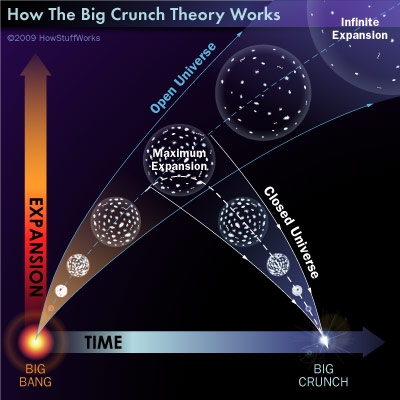
After establishing that the universe is expanding (with reference to Edwin Hubble’s discovery of it in the 1920s, who observed that all other galaxies were moving away from us and were doing so faster, the further away they were1), Krauss presents three alternatives for how that expansion may be occurring: “[A] closed Universe would expand and stop and then recollapse in a Big Crunch, the reverse of the Big Bang. An open Universe would expand forever and a flat Universe will expand and slow down and never quite stop.” The following illustration shows the open and closed cases – the flat one being similar to the open one, but having a limit (bound) to its (still infinite) expansion as opposed to being unbounded.

Big crunch open and flat universe

In the process of determining which of the three cases of expansion our Universe is undergoing, the challenge of measuring the mass of galaxies (to infer from them the curvature of their light-bending effects and therefore the curvature of the universe) and the whole universe arises and attempts to do so show that “most of the mass in [a] system of clusters of galaxies is not where the galaxies are. It’s between the galaxies. It is where nothing is shining.” This in turn leads to the realization that “dark matter is a new type of elementary particle,” which further complicates the quest for measuring the mass and energy of the universe.

The consequences of the universe being flat (i.e., expanding infinitely but asymptotically towards a limit) are then spelled out:

“It turns out that in a flat Universe, the total energy of the Universe is precisely zero. Because gravity can have a negative energy. So the negative energy of gravity balances out the positive energy of matter. What’s so beautiful about a Universe with total energy zero? Well, only such a Universe can begin from nothing. And that is remarkable, because the laws of physics2 allow Universes to begin from nothing! You don’t need a deity.3 You have nothing. Zero total energy and quantum fluctuations can produce a Universe.”

This nothing is further illustrated by results obtained recently about the mass of protons, where:

“it turns out most of the mass of the proton comes not from the quarks within a proton, but from the empty space between the quarks. These fields popping in and out of existence produce about 90% of the mass of a proton, and since protons and neutrons are the dominant stuff in your body, the empty space is responsible for 90% of your mass. So this empty space is vital to science and these calculations are vital to understanding not just protons, but electrons and atoms and produce the best comparisons.”

In other words, the nothing from which a universe can come into being is a “boiling bubbling brew of virtual particles that are popping in and out of existence” “because of the laws of quantum mechanics and special relativity.” This nothing is an “empty space” that is empty insofar as matter and gravity cancel out each other’s energy and insofar as quantum mechanics deals in fields that may or may not yield particles.

As far as this being what I understood, I actually find it quite beautiful – and Krauss would agree by saying that “the only mathematically beautiful Universe” is a flat one, like ours. There is a symmetry between positive and negative energy, light and dark matter, there is infinite expansion that is at the same time bounded, there is a constant dynamic of being potentially versus actually and there is a tremendous amount of beautiful science that has lead to this view of the universe. We have Lemaître’s and Hubble’s insights into the universe’s expansion, we have the astonishing work on measuring the universe’s curvature by means of looking at it’s background radiation, we have ways of measuring the mass of distant galaxies and their distances from us and so much more. From this point of view, I do recommend Krauss’ talk wholeheartedly.

Sadly, there is another side to it, which is its being peppered with jabs at religion and a profound ignorance of what many religious people believe. The underlying view of religious faith that informs the criticisms leveled against it here, and in many other atheist forums, seems to have people like Young-Earth creationists, Pentecostal snake-handlers and members of groups like the Westboro Baptist Church as their model. This is akin to me taking someone like Dr. Josef Mengele as the archetype of a scientist and projecting prejudices from him to all scientists. I have about as much in common with the lunacy of the above mentioned “religious” groups as with the barbarity of the above mentioned “scientist.”

Let me be a bit more specific though about why the religion-related claims of Krauss don’t stick, as it can otherwise seem like this is just a lot of hand-waving. First, let’s look at the cosmology (and cosmogeny) presented by Krauss, which postulates a coming-into-being of the universe from nothing. If anything, this scientific insight is fully consistent with the Christian account of creation, where God creates the world from nothing – hence the emblematic Latin phrase: “ex nihilo.” The Christian view of how the world came into being is not one of a God having inhabited space-time and then decided to turn parts of himself into planets, vegetation, animals, humans. Instead, the Catechism here affirms that “God gave a beginning to all that exists outside of himself” (§290), where (in some sense) there was nothing before: “All things came to be through him, and without him nothing came to be” (John 1:3). The Nicene Creed even speaks about God as the creator of “all things visible and invisible,” which can comfortably be applied to dark matter or the negative energy of gravity.

In fact, the Catechism (§296) is insistent on there having been nothing before the Universe started:

“We believe that God needs no pre-existent thing or any help in order to create, nor is creation any sort of necessary emanation from the divine substance. God creates freely “out of nothing”: “If God had drawn the world from pre-existent matter, what would be so extraordinary in that? A human artisan makes from a given material whatever he wants, while God shows his power by starting from nothing to make all he wants.” (St. Theophilus of Antioch, Ad Autolycum II)”

So, if anything, the model of a flat universe and of the nothingness that is at its origin is in perfect accord with what the Church has come to believe through revelation and the guidance of the Holy Spirit over the centuries (and as early as in the 2nd century in the writings of St. Theophilus!). There simply is no conflict here – listening to the science Krauss talks about just makes me delight in how much better we understand how it was that the universe came into being from nothing. I can therefore happily conclude, again with the Catechism (§283):

“The question about the origins of the world and of man has been the object of many scientific studies which have splendidly enriched our knowledge of the age and dimensions of the cosmos, the development of life-forms and the appearance of man. These discoveries invite us to even greater admiration for the greatness of the Creator, prompting us to give him thanks for all his works and for the understanding and wisdom he gives to scholars and researchers.”

Catholics (and adherents of many other Christian denominations and other religions) are in no way at odds with the advances of science, since – in addition to the benefits that it enables for the good of all, it sheds light on how the universe works and how it has worked since its beginning. Those who believe in God having created the universe (from nothing!), being the source of its laws and continuously sustaining its being can enjoy the advances of science as much as those who don’t hold those beliefs, and I wish that neither side would try to ridicule the other or force them to change their views!


1 Incidentally, it was Georges Lemaître – the Belgian priest and physicist, who made this realization based on Hubble’s data a couple of years before Hubble did.
2 It always baffles me how many atheists hail the latest developments of science as proofs of the non-existence of God, while quite happily relying on pre-existing “laws of physics.”
3 I. e., a “god of gaps” deity …