Ravasi: Borges’ agnostic Christology

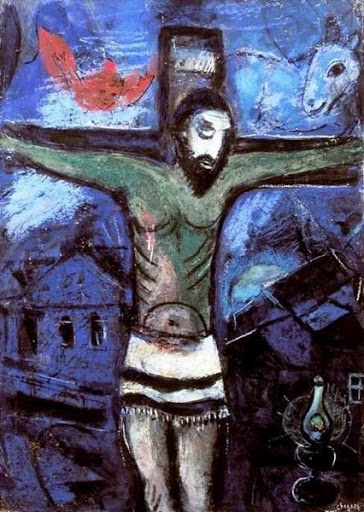
CHRIST EN CROIX  CHAGALL

1691 words, 8 min read

I have just come across a great talk by Cardinal Gianfranco Ravasi on Jorge Luis Borges, given in Cordoba, Argentina last October in the context of the Courtyard of the Gentiles and his receiving an honorary doctorate from the Universidad Católica de Córdoba there. Ravasi gives some beautiful examples from Borges’ poetry that illustrate his approach to Scripture and Christ and where Ravasi underlines the richness of his understanding and the depth of his sincerity, which come from what Pope Francis speaks about as “periphery”. Note that the following is my translated transcript of the talk and that a more extensive version of it can be found here in Spanish.

To Borges, boundaries are always moveable and subtle. There is never an iron curtain between truth and fiction, between waking and dreaming, between reality and imagination, between rationality and feelings, between the essential and consequences, between concrete and abstract, between theology and fantasy literature, between Anglo-Saxon conjecture and Baroque emphasis.

Among his readings, an undisputed primacy was given to the Bible, as he had confessed: “I must remember my grandmother who knew the Bible off by heart, so I could enter literature along the way the Holy Spirit.” His paternal grandmother was in effect English and practicing Anglican and it was her who introduced the little Jorge Luis to the Scriptures and to the exalted English language. During a talk given at Harvard, dedicated to the art of storytelling, Borges, extolling the epic poem as the oldest form of poetry, lead to a triptych of masterpieces for humanity: “The Iliad, The Odyssey and a third ‘poem’ that stands out above the others: the four Gospels … The three stories of Troy, Odysseus and Jesus have been sufficient for humanity … Even though, in the case of the Gospels, there is a difference: I think that the story of Christ can not be told better.”

Let us now leave behind this specific topic of the literary and existential panorama of Borges to focus on a narrower scope that is particularly rich, so much so that here has exercised a small legion of scholars. Here we will deal with the aforementioned passion of the author for the Bible and we will do so through two examples.

The first is the story of Cain and Abel (Genesis 4:1-16) that had a poetic evocation in a short composition “The Unending Rose” entitled, as Borges often liked to do by revisiting Bible passages, “Genesis IV, 8”:

“In the first desert it was.
Two arms cast a great stone.
No cry. Blood.
For the first time death.
Was I Abel or Cain?”

Next to it we must, however, place the broadest reading of this Biblical scene in “In praise of Darkness” where the two brothers meet again after the death of Abel in an atmosphere of the eschatological court, even though the scene is set in the desert and the origins of the world. They sit, light a fire, while the day comes to an end and the stars, as yet unnamed, light up in the sky.

“By the light of the flame, Cain noticed the mark of a stone indented in Abel’s forehead and the bread he had raised to his lips fell before he could eat it and he asked whether his crime had been forgiven.

Abel answered:

“Did you kill me or did I kill you? I already cannot remember, and here we are, together like before.”

“Now, you must have forgiven me,” Cain said, “because to forget is to forgive. I will, too, try to forget.”

Abel replied softly:

“That’s right. While the remorse lasts, so does the guilt.””

Some have seen in this text a relativist moral conception by which an imperceptible transition is performed between good and evil, true and false, virtue and vice. Actually here we instead witness a process of transformation or alteration that we have indicated above and that Borges performs to show the infinite potentialities of an archetypal text. The same text allows continual re-transcriptions and in this case the aim is a paradigmatic celebration of forgiveness that makes the crime vanish completely: revenge is erased by forgetting and through it, the blame of the other becomes dissolved. What certainly remains always active is the fluidity of historical human reality and, therefore, of ethics that, in vain – in the eyes of Borges – also the “inspired” word tries to compress into defined and definitive certainties.

The second example is linked to the figure of Christ as Borges proposes in some of his many texts dedicated to this fundamental figure of Christianity.

“The black beard hangs down heavy over his chest.
His face is not the face from the engravings.
It’s harsh and Jewish. I do not see him
And will keep questing for him till the final
Day of my steps falling upon this earth.”

It was already in the twilight of his existence when Borges writes these verses of “Christ on the Cross”, dating them Kyoto 1984. They are verses of high spiritual tension, that all quote when they want to define Borges’ relationship with Christ, a hoped for encounter, but one that hasn’t occurred fully, bearing in mind that we don’t know his “last steps on earth”. Maria Lucrecia Romera wrote that “Borges confronts the tragic Christ of the Cross … and not the [theological] doctrine of the Resurrection .. His is not the optics of the believer’s faith, but that of the restlessness of the agnostic poet”. However, one needs to add immediately that the general observation made by the French writer Pierre Reverdy in his “En vrac” applies to certain of Borges’ verses: “There are fiercely harsh atheists who are much more interested in God than some frivolous and light believers”. Borges absolutely didn’t have “the fierce harshness” of an atheist, but his was certainly a more intense search than that of many pale and colorless believers. His restlessness was profound, hidden under the bark of a rhythmic dictation and streaked with disinterest, and even irony.

This is the intuition of Borges: the face of Christ is to be sought in the mirrors that reflect human faces. On the other hand, it was Jesus himself who said that everything done “to one of his least brothers”: hungry, thirsty, strangers, naked, sick and imprisoned, is done to him (Matthew 25:31-46). Behind the, often deformed, contours of human faces hides therefore the image of Christ and in this regard, the writer refers to St. Paul for whom “God is all in all” (1 Corinthians 15:28) . It is here, then, that we find Borges’s invitation to follow him in this human quest for Christ in the faces of men:

“We have lost those features,
just as a magic number made up of ordinary figures can be lost;
just as an image in a kaleidoscope is lost for ever. We may come across the features
and not know them. The profile of a Jew on an underground train
may be that of Christ; the hands that give us our
change over a counter may echo those that some soldiers
once nailed to the cross.
Perhaps some feature
of the crucified face lurks in every mirror; perhaps the face
died and was erased so that God could be everyone.”
[Paradise, XXXI: 108]

Now, on the basis of Borgesian Christology, we undoubtedly find the humanity of Jesus of Nazareth who is born, dies, even proclaims himself Son of God, and, therefore, assigns himself a transcendent quality. The writer does not ignore this interweaving of divine and human, of absolute and contingent, of eternal and time, of infinity and the limit and, even while witnessing the side of humanity, does not hesitate to interpret Christ’s consciousness in a poem of extraordinary power, as is that of the original Gospel matrix that generates it.

Here the title is, certainly, more explicit still: “John I, 14” (in “In praise of Darkness”). The verse is cut from the that literary and theological masterpiece that is the anthem-prologue of the Fourth Gospel: “The Lógos (Word) became sarx (flesh) and made his dwelling among us.” A verse that is a counterpoint to the solemn opening words of the hymn: “In the beginning was the Lógos, and the Lógos was with God, and the Lógos was God.” (1:1). Let us consider how John’s Lógos intrigued Goethe so much that in Faust he proposes a range of meanings to express its profound semantics: the Word is, certainly, Wort, word, but also Sinn, meaning, Kraft, power, and Tat, act, in line with the value of the parallel Hebrew word dabar, which means word and act/event. Let us read a few sentences from this surprising “autobiography” of the Word that is eternal (“Is, ​​Was, Is to Come”), but is also “time in succession.”

“I who am the Was, the Is, and the Is to Come
again condescend to the written word
which is time in succession and no more than an emblem. …
I lived under a spell, imprisoned in a body,
in the humbleness of a soul. …
I knew wakefulness, sleep, and dreams,
ignorance, the flesh,
reason’s roundabout labyrinths,
the friendship of men,
the blind devotion of dogs.
I was loved, understood, praised, and hung from a cross.”

***

During the round-table discussion after his talk, Cardinal Ravasi then made a very significant gesture of appreciation towards Borges:

“Borges could be the best patron of the Courtyard of the Gentiles. Because he is not only in the courtyard of the gentiles, and he is not only in the courtyard of the believers. He was, instead, on top of that wall that divided the two spaces. That wall allowed for a good view both from one side and from the other. And Borges is a bit of a believer, in his own way as he said, and also a gentile. And it is because of this that the Courtyard of the Gentiles that takes place here in Córdoba or in Buenos Aires, in his hame, is the best Courtyard of the Gentiles.”

The patron [saint] of the Catholic Church’s dialogue with non-believers is an agnostic!
The world: a flowerbed of communion

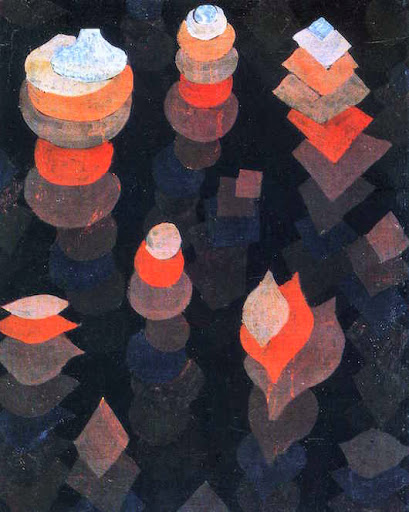
Klee flowers

Yesterday and today, a fantastic meeting of the Courtyard of the Gentiles – entitled “Renewing the Church in a Secular Age” – is taking place at the Gregorian University in Rome, and it is also being freely live-streamed. Since listening to the opening remarks of the university’s rector, Fr. François-Xavier Dumortier S. J., Fr. George McLean, the President of The Council for Research in Values and Philosophy, and Cardinal Gianfranco Ravasi yesterday, I have been working on a transcript of parts of the first two and pretty much the entirety of the last one, since they struck me as profound and beautiful expressions of the openness and warmth of the Church that I am keen to share with you as soon as possible. I will therefore, in the interest of speed, dispense with my own commentary and reflections, and just offer you the transcript (and coarse translation into English) next:

First, here is the conclusion of Fr. Dumortier’s opening remarks:

“This conference is about the Church in her relationship with the world of today, i.e., with the men and women of today, but also with the societies and cultures of our time. It won’t only be about being at the frontiers that cut through these societies and cultures and our selves too, but about going ahead with confidence and hope in the discovery of God who works mysteriously everywhere and in everyone and who, in some way, calls us to leave behind the certainties we guard too tightly and the places we know too well. This challenge of thinking about our current intellectual and spiritual situation asks for the capacity to go out of the context of our individual specializations, the constraints of our own cultures, from self-referentiality, not so as to confront that which is different and at times far removed, but so as to listen, encounter, understand and learn. It seems to me that such an attitude would indicate a Church that is not afraid of living the newness of the Gospel and that has the audacity of meeting head-on the challenges that permeate cultures today. To recognize when and how human beings are searching for God, which is never a private matter and which is done until the end of self and the end of time. To deepen our current way of humbly bringing the word of God that truly speaks to the hearts and minds of today’s men and women. Desiring to promote a culture of mutual welcome. It is a dialogue that does not despair of anything or anyone. They are challenges that we can now live with the courage and the strength of intelligence, with a generosity of intelligence that broadens the space in which one moves.”

Next, a couple of points made by Fr. McLean, that particularly struck me, where he spoke about a new perspective on secularism, derived from the work of Charles Taylor and Jose Casanova, who

“took on the fallacy that secularity was simply a loss of religion and said: “No!” secularity is a new way of being religious, and he pointed us in the direction that would make that possible. […] There are four things that we need to study: one of them is that of the seekers, that is not that they are against religion or abandoning religion, but they are looking in new ways – can we meet them? Can we find out where they are going? Can we speak to them? This is a new, creative mode of approaching the secular age. And then also the magisterium. How can the magisterium be the guide, the teacher of the new seekers? How can that be done? This is the great challenge for the Church. […] Perhaps there are many different ways in the world today in which people are seeking the divine and responding in their own way. Can we bring those together? Can this be the life of the Church? A creative pastoral responsibility.”

And finally, the main course, Cardinal Gianfranco Ravasi’s superb exposition of two interpretations of the concept “seculum” and the need for dialogue flowing from them:

“I would like to place this word at the center: “seculum”, also because it is directly in the title of this meeting. Seculum, as we know well, generates two meanings and I will build a brief reflection around them that will be more theologically-pastoral in character. The first meaning is a positive meaning: secolo generates secularity, which is a Christian category. Let’s not forget, for example, that “secolo” in New Testament Greek is “aeon”, and “aeon” also has a dimension of eternity. This also holds for the Hebrew “olam” (עוֹלָם) which simultaneously indicates temporality but also a dimension of globality.

[… I’ll start with] secularity as a theological category. I will express the theological form of this category in this case only in an impressionist way, in a simplified way. I’ll express it by means of three components of Christian faith.

The first component is creation. It suffices to listed to these verses from the Book of Wisdom – a book, among other things, of dialogue between the Hebrew and Greek cultures – “[T]he creatures of the world are wholesome; There is not a destructive drug among them.” (Wisdom 1:14). Note: “the creatures of the world.” Second: “For you love all things that are and loathe nothing that you have made.” (Wisdom 11:24).The Lord – lover of life. To the Creator nothing is profane. And this already makes us understand how we must look to totality, we must have an optimistic perspective.

The second component: Jesus is a lay person. He is not a priest. The letter to the Hebrews says so: “It is clear that our Lord arose from Judah, and in regard to that tribe Moses said nothing about priests.” (Hebrews 7:14) But the author of the letter to the Hebrews wasn’t content just with this: “If then he [Jesus] were on earth, he would not be a priest.” (Hebrews 8:4). This aspect, that our founder is a lay person, is truly very significant. Even with all the clarifications that theologians then make.

The third element: Christianity presents a model of the relationship between faith and politics, faith and society, that is extremely significant. because it says no to sacralism, it says no to hierocracy , to integralism and, naturally, it also says no to statolatry, to the negation of any religious component in society.

What is being asserted? An assertion that Christ formulates and on which exegesis has been based for centuries, above all in terms of incarnation. The assertion is precise, and as I often say – it is a tweet that in Greek has only 50 characters, including spaces: “Then repay to Caesar what belongs to Caesar and to God what belongs to God.” (Luke 20:25) There is the recognition that there is a strong autonomy of the image of God that is man, of religion on the one hand, and on the other hand a real autonomy, naturally, of society and the state. Christian religion cannot accept the extraordinary phrase […] “The Temple is my country and my nation, and there is nothing outside it.” (spoken by Joad, the Jewish high priest in Jean Racine’s Athalie). Christianity, instead, recognizes secularity.

I’d now like to conclude with two considerations about secularity. First, secularity is a “locus theologicus”, delicate but real. And it has, fortunately, been considered in various ways during the 20th century. I’d now like to give three examples by just quoting some indicative phrases from these authors whose works I have read.

First, and all know this one and expect me to say his name: Bonhoeffer. Bonhoeffer with his theory of the “mündige Welt” – the adult world, the grown-up world, which, like a young person who becomes emancipated, does not break the links with the family, but has their own autonomy. And the challenge for faith is precisely this: to abandon the theophanic, ex machina God who embraces all reality, in favor of a kenotic God. The God of the cross, who does have his presence, but – you will see – a presence as seed. Not as power.

The second person, whom many will think of as representing fruitfulness, is Gogarten. Gogarten, in his work of 1953, Despair and hope for our time, wrote: “Secularity is the necessary and legitimate consequence of Christian faith.” And here we come to the second topic I would like to address: secularism or secularization. Secularism is a degeneration of secularity because it takes leave of God, radicalizing its own autonomy and canceling the co-presence of the divine. [Gogarten] then continues: “The autonomy of man does not detach itself from God but neither is it sacramentally overpowered.” It is not detached, but it is not crushed either. “The Church must live,” he continues, “in sincere solidarity with the world, without wanting to sacralize it.”

And the third one, obviously, is Rahner. Rahner […], referring to Gaudium et Spes, in his Theological Investigations wrote these words about secularization in 1966 […]: “The Church must and wants to codetermine also the way of the secular world, without, however, wanting to determine it in an integral and doctrinal way.” […] 


Let’s now turn to the second aspect of the word “seculum,” which I’d define as secularism. What symbol could we use to represent secularism? Well, all know it, it is a symbol that has become popular in everyday language […]: disenchantment. The disenchantment of the world. “Entzauberung der Welt.” This phrase, by the way, is not – as all say – by Max Weber, but by Hölderlin. Hölderlin used it in a different sense though, and it is a term that also became popular through a 1985 work of Marcel Gauchet.

So, what are the characteristics of secularism? […] First of all, an emancipation from sacral bonds and subjection, the emancipation from sacral authorities, symbols and institutions. The emancipation from the jurisdiction of the scared. Second, […] the ontological, epistemological, deontological  autonomy from theology. In practice, there is a desire to relegate theology to a sort of protected oasis, but one that is independent of the horizon of knowledge. Also since there is only one subject – humanity, heaven is empty of gods. Another component, which is a consequence of this one, is one I often call the monodicity of knowledge, i.e., knowledge with a single tone, which in the end is the rational/scientific one. As a consequence, what comes to the fore is the scene of the world rather than the foundations of reality. The possibility of transcendence and its own language for approaching it are excluded.

Fortunately, we know that this attitude is now in crisis. We know that our knowledge, that of all – including the simplest person – is polymorphous. When a person, even a scientist, falls in love, they use another channel of knowledge. Esthetics, art … The last component, that I would like to mention, among many examples of secularism, is the phenomenon of the metropolis, of urbanization. This is a component that I take from the work “The secular city” by Harvey Cox from 1975 […] “Urbanization means a structure of life together, in which diversity and the disintegration of traditions dominate.  A kind of impersonality dominates. A certain degree of tolerance and of anonymity that replace traditional moral sanctions and codified knowledge.” You see, even a man from the countryside who arrives in a city, who has his traditions, his morality, when he enters this gray place, loses his identity. […] 


What I think though is that in contemporary secularism there are two pastoral challenges. Two challenges that are also cultural and that are the result of two phenomena, among many other possible ones, in the complex society and culture of today.

The first phenomenon. I’ll label it with a term that I need to explain, because it has been used by some authors already, is: apatheism. Apatheism is the union of apathy and atheism. It is what we often call indifferentism. This is a phenomenon with which, for example, the Courtyard of the Gentiles – this dialogue between believers and non-believers that I am trying to develop – is trying to confront with great difficulty. Because we are in front of a wall of fog. Apathy. A beautiful definition here comes from none other than Diderot in his “Letter on the blind for the use of those who see”, addressed to his atheist friend, Voltaire: “It is very important not to mistake hemlock for parsley, but believing in God or not isn’t.” This is a bit the style of apatheism, which is really problematic and ever more dominant. It doesn’t answer head-on, like Nietzschean atheism, it doesn’t fight faith like atheist regimes do. It ignores God as a stranger. Like a reviewer of Prof. Taylor’s book, Costa, wrote: “If God walked into a square in a contemporary city, he wouldn’t surprise anyone. At most a guard would ask him for his papers.” He’d be asked for his papers because his identity is unknown. God mustn’t interfere in human affairs. He is a stranger. He is not the basis of existential choices. Even transcendence can be recognized but he must remain in the limbo of his transcendence. The times have finished where, de Sade in his “Justine (or The Misfortunes of Virtue)” writes, as an emphatic atheist: “When atheism needs martyrs, it should say so – my blood is ready.” This now would be ridiculous. Atheists today are apatheists. The last ones who are aggressive are a kind of endangered species. Those who feel strongly about atheism. And this relegates religion to insignificance. To uselessness, to irrelevance in history. […]

This situation of apatheism, pastorally, calls out to Christians. I asks Christians why they have not been able to communicate their difference in the face of this indifference. If anything, they have reduced themselves to the minimum, […] they are no longer able to provide answers to key questions and thereby to stimulate questions. Indifferent societies do not love questions. The question, in our languages is represented as something that claws [Ravasi draws a question mark in the air]. Oscar Wilde rightly said that everyone is able to give answers, but it takes genius to ask true questions. A question requires depth and requires tension too. Herein lies the importance of provoking with ultimate truths. Evil. Suffering. The meaning of life. Things that don’t enter into … Also the authenticity of the truth. And we, Christians, have probably lost warmth as far as our lives, our lifestyles go. Let’s recognize it. Very often our communities deserve the condemnation that the Apocalypse launches against the church of Laodicea: “So, because you are lukewarm, neither hot nor cold, I will spit you out of my mouth.” (Revelation 3:16). There are communities lacking any testimony, incoherent. They are no longer the leaven and the yeast of the Gospel.

The second phenomenon that could stimulate us is what I would call polytheism. Which in a nicer way we could express as religious pluralism. We know that already Max Weber in his day spoke about the polytheism of ethical values. Now, however, we have confirmation of this unquestionable phenomenon of a continuous intersection of religions and civilizations. And this phenomenon of a polytheism of more divinities, or more religions leads to three possible reactions as I can see. First, there is fundamentalism. Fear of the other god, of the other culture. Therefore there is aggressive apologetics, self-referential. Islamic fundamentalism is an example of this. It is the choice of pulling out the sword straight-away against the other. Second, there is a reaction that is more alive in Europe. Which is generic syncretism and then apatheism. Inoffensive syncretism. Without identity. The famous poet George Eliot said: “If we lose Christianity, we, Europeans, will no longer be able to understand even Voltaire and Nietzsche. But there is an even worse risk. We will lose our countenance. We will no longer have a face.” Forgetfulness. A loss of memory. Religious memory and also cultural memory, which means that, when faced with fundamentalism, we are in no position to react since we have no identity anymore. Certainly, fundamentalism has an exasperated identity, which is negative too.

So, what is the third way? The third way, evidently, and even though it is demanding, modest and to be carried out with a bowed head, and I have to say that the Church and Pope Francis are going it, is the way of dialogue. Dialogue with all its risks and troubles, inter-religious and intercultural dialogue. What ought this dialogue be like? We could talk about lot about it, but let us just look more closely at the word dialogue.

In its Greek form, and not everyone knows this, it has two meanings. The preposition ‘dia’ has two values – not one. Usually it is said that ‘dia’ is the crossing of two different ‘logoi.’ In reality, ‘dia’ also means a descending into depth. Ideologies have died, but as ideologies died, thought has died with them. We must return to a deepening of our faith, to the foundations, and ask of others that their argumentation be substantial epistemologically and in terms of content. I think that dialogue also means many other things, such as a making oneself close to the other, putting oneself in a position of listening to the other. And this is another very demanding practice. It reminds me of the expression used by John Paul II in his Novo Millennio Ineunte with regard to the Church, which I think ought to become the ideal for humanity too, which share a common basis. He says that we must “make the Church the home and the school of communion.” Here the call is for a humanity that in its diversity manages to share a home which is that of this modest planet. This small flowerbed as Dante Alighieri called it.

In the rabbinical tradition there is a beautiful image, a beautiful aphorism that says: “When men coin money, they do so with a single die, as a result of which all coins are the same. God, too makes men with a single die, yet all men are different.” Dialogue is an arduous, lengthy, maybe eschatological, process of building a shared home. 

To conclude, I would like to pass the word to the Bible, which is to give us a push and the capacity to decipher our own history. The Judaeo-Christian religion is a historical religion. It doesn’t call us to detach ourselves from reality towards mythical or mystical heavens. It is an incarnate religiosity, starting with Christ, who is a great sign. Because of this I would like to remember that stereotype, which has unfortunately become a stereotype, used since conciliar times […]: “the signs of the times.” Signs are important, the signs of power, and I’d say the power of signs is important. And I’ll give the word about this to two fundamental biblical characters, two biblical witnesses: We’ll start with the prophets, where I’ll choose Jeremiah 8:7 “Even the stork in the sky knows its seasons; Turtledove, swift, and thrush observe the time of their return, But my people do not know the order of the LORD.” And now, in the same style, the voice of Christ, who speaks to us from Matthew 16:2-3, using the symbol of meteorological forecasting “In the evening you say, ‘Tomorrow will be fair, for the sky is red’; and, in the morning, ‘Today will be stormy, for the sky is red and threatening.’ You know how to judge the appearance of the sky, but you cannot judge the signs of the times.” 


Dialogue, doubt and dangerous religion

Jacob s ladder 1973

The Courtyard of the Gentiles, the Catholic Church’s forum for dialogue with non-believers, met again in September, this time in Bologna. The event included a very interesting conversation between Cardinal Gianfranco Ravasi, president of the Pontifical Council for Culture, and Gino Paoli, the agnostic singer-songwriter and former member of the Italian Parliament for the Communist Party, moderated by the journalist Beppe Severgnini. While the overall theme of the event was that of time, this event focused on questions of faith, doubt, encounter and the dangers of religion. Instead of a commented account, let me just offer you the following, translated transcript (with the usual caveats about my translation’s coarseness) of a conversation I greatly enjoyed and one that I hope will give you as much as it gave me. Here GP will stand for Gino Paoli, GR for Gianfranco Ravasi and BS for Beppe Severgnini (the Italian video is available here in full):

[BS asks GP what he thought when he received the invitation to talk with GR.]

GP: “I thought that the cardinal, being a dogmatic, would like to have dialogue. And, for me, dialogue is the most important thing. I don’t believe in the truth. I believe that my truth is mine, yours is yours and the cardinal’s is his. Through dialogue we may find one truth that contains all three. And I believe this is the intention of Cardinal Ravasi too.” [Ravasi nods.]

[…]

GP: “I believe that religion is not only about those who believe in something. Religiosity exists in all humans. Religiosity, not religion. I believe I too have a religiosity. It can’t be a dogmatic one, because I am an agnostic. I believe that it would take the same degree of wisdom to say that God exists as that God doesn’t exist, because there is no proof of either one or the other claim. I am someone who doesn’t know. And I don’t know with regard to many topics, I don’t even know about myself.”

[BS asks GR whether he thinks love songs, just with their subjects capitalized, could be used in churches – i.e., with the same intentions and sentiments as directed to another person, redirected to God.]

GR: “I would first like to distance myself a bit from a definition that Gino Paoli has assigned to me: dogmatic. Being considered a dogmatic can be good for a theologian, in the sense used by theologians. In its everyday sense, I feel less comfortable with it, because what is characteristic of believing, due to it not being like mathematics where there are theorems that may be self-evident and adherence to which is quasi-mechanical, is its being an experience of intelligence, love and interiority, which – as such – also includes dark moments, moments of silence. For example, if we take the sacred text par excellence and open it on its first pages, we see Abraham ascending Mount Moriah, holding his son’s hand, having received an order from God that is absolutely scandalous, that for him is absurd: he has to kill his son, whom he received from God, whom God promised to him! Further ahead, we find the figure of Job, who even gets to the point of blaspheming. There is an extraordinary phrase by Luther regarding these passages, who says: “Sometimes God appreciates a desperate person’s cursing more than the praises of a well-meaning bourgeois during a Sunday morning service.” […] Then there is another book of the Bible that you may not have read – Ecclesiastes, which presents the figure of a person who is in crisis, a crisis of wisdom, a crisis of meaning, yet it is a book of the Bible, which is the book of believers par excellence. Therefore I’d say that the history of the true believer is an arduous history that does include light but that certainly also includes many moments of shadows and darkness.”

GP: “I have read the Bible, the Qur’an, and other writings, in order to understand, because I don’t believe it would be right to decide whether yes or no if one doesn’t know. I believe that freedom is born of knowledge. You have the freedom to decide, but a you once it knows, not before. You can’t be for God or against God like you can be a supporter of Genoa or Sampdoria – that is not possible. That would be stupid. I have known men of faith, in fact one of the most important people in my life was a priest who was my philosophy professor. I have known many believers and from them I have understood that faith passes through doubt. Only doubt can lead to faith. There is no possibility of certainties. Certainties are not of faith, it is only doubts that lead to faith.”

GR: […] A phrase that I often use as a motto is a quote by the French writer Julien Green that says (specifically in the context of religion): “As long as you are restless, you may be at ease.”

GP: I’d go even further and say: as long as you are restless, you are alive.

GR: I’t true. This is true.

[…]

GP: “When does a value become a defect? A value can also be a defect, depending on where it becomes a defect. For example, the value of tolerance. At what point does it become a defect to accept certain things? The value of honor. When does such a positive positive thing become negative? When does doubt become a brake?

GR: Exactly. The same thing applies to vice and virtue. […] We have at one end of a scale coal and at the other end a diamond. Both have the same basis – carbon – both these extremes. Let’s think, for example, of a vice and let’s take the most sensational vice – even though the gravest one is pride – let’s take lust. Lust has its source in a virtue – the virtue of love and of the eros, which is poetry.

[…]

GR: “Let me get back to your question about songs though. […] There are certainly songs that are explicitly “mystical” (in quotes), for example those of Leonard Cohen and some of Bob Dylan’s […] and this is explicit. In other cases, it is true, there is also an implicitness, since poetry – by nature – is the sister of faith, because she always tries to go beyond the other. She doesn’t remain on the surface.

GP: Poetry, to begin with, is evocative. It lets the imagination of the listener run. In effect it is not what is written, but what is not written, not what is said, but what is not said. Therefore in a certain sense it is mystical. Whatever it may be, poetry is always surreal and, being surreal, and surrealism wasn’t born with that movement, it has always been. It is a given of art, of art in general.

GR: Yes, yes. [… Henry] Miller wrote a small essay – “The wisdom of the heart” – that contains this strange definition by him who wasn’t a believer, who was even quite ferociously against …, his definition is this, he says: “Art and religion are good for nothing, except for showing the meaning of life.”

[…]

GP: “Life is the art of encounter. Why? I could also say that it is the art of choice, which is the same thing. Because it is encounters that enrich you, that maybe wreck you; it is encounters that decide your life. Maybe for Cardinal Ravasi it is the encounter with faith, for another the encounter with a woman, for someone else the encounter with a friend. All depends on the encounters you have. On the one hand this depends on you, on the other hand it depends on fortune. […] I am very happy because I have had good fortune, because I have always met extraordinary people who have given me a lot, who have always given me a lot. I don’t know how much I have given, but the people I have encountered have always given me a huge amount. So, I have been very fortunate. […] I have realized that the riches of a man are his friends. Faith too can be a riches – they are both faces of the same coin. You have one particularly important friend [GP say with a big smile while looking at GR], maybe he is enough in comparison with many others, but I need the many others.

GR: The others are necessary too [GR adds with a laugh]. It is true … I’d like to add something about the dark mirror image of this point. One of the great ills of our time is that of isolation and solitude. […] It is Saturday now and there certainly is a person now in this city in a block of flats who sits by a phone and waits for it to ring. Because if it rings, it means that there is still someone out there who remembers me. For us the ringing of the phone or the front door is a nuisance, but for this person it remains mute and will remain mute tomorrow too, on Sunday, because they have no one to encounter. Maybe they are old, ill, a stranger, someone who has virtually no one. […] This is the true poverty of life.

GP (after speaking about an initiative to help those who are alone): “Every evil, every mistake creates something good in some way. I love a person not because of their virtues, their successes. I love a person because of their fragility, their mistakes, their – and excuse me – cock-ups. I think, deep down, even a sad thing like solitude has its purpose. It has a function with regard to those who are still willing to be generous. I think that one of the most worthy things about a person – according to me – is their human generosity. And this generosity is brought to the fore by evil, by misery, by solitude …

[…]

[BS asks: what can we, in the media and the music industry, which have egoistical, individualist tendencies, do to understand Jesus’ saying “There is more joy in giving than in receiving.” (Acts 20:35)]

GR: Christ’s saying, quoted by St. Paul, is the essence of one of his constant laws, which is paradoxical in economic terms and which is that of loosing for the sake of finding. If one gives something, one deprives oneself of that thing, but if it is given out of love, paradoxically, one becomes enriched. This is also the logic of being in love. When two who are in love start looking at the value of the gifts they give each other, it is a sign that they will break up. So, it is beyond doubt that this law of self-giving, of giving something that gives you joy in the act of giving, is a characteristic both of faith and of the great value of love. […] I would also link this act of giving to face-to-face encounter. [… Then, Card. Ravasi tells the Tibetan story that can be found here.] Giving means overcoming fears and distances, overcoming diversity, and then through this encounter with humanity, with our shared countenance, enables us to give and leads to joy as a result.

GP (addressing GR): […] You have told an extraordinary story. Until you don’t look your enemy in the face, you don’t understand that he is your brother. [… How come we have then seen the followers of different religions over the last centuries stop looking at the faces of their enemies and commit atrocities?]

GR: I’d start with a joke by the philosopher David Hume, who was a skeptic, and who said: “The errors of philosophy are always ridiculous, the errors of religion are always dangerous.” Religion, because it is a reality that completely involves the whole person, and not only reason, but also feelings and passions, when it enters a person, it may become deformed. […] The human person has a fundamental attribute, which is that of freedom. […] Human nature takes this flame [of freedom] in its own hands, this reality that – by its very nature is explosive, explosive also in a good sense – lets just think about the extraordinary things that an authentic believer is capable of – […] and here I include believers who are maybe not explicitly so, who have in them faith in a value. This reality [of religion], suffused in human freedom can also become explosive in the sense that it throws you in the air, or it can lead to deviations from ulterior motives where transcendence is taken as an excuse and becomes an instrument of perversion. This is why I’d say that we need to be extremely careful with living a religion. It is much easier to die for a religion than to live it every day in a continuous, coherent way according to that law we spoke about before. This is why I believe, as a believer and a person who belongs to a religion, that we have to be careful because religion is dangerous, not only grandiose.

GP: I completely agree about religion being dangerous, but I have a slightly different view. I think that religion, as a human movement is very positive and leads to good things. It becomes dangerous when it goes from being such a movement to becoming power. Power over others, over a large number of persons, and this power links to economy, to politics, to many things. To accuse religion alone of disasters is fairly simplistic, because that religion in that moment becomes the instrument of […] someone who through it seeks power and their own interests. […] According to me religion is dangerous to the degree to which it becomes power. I would agree that before that point it is positive, but when linked to power it becomes absolutely dangerous.

GR: Yes, I agree! If you go back to what I said about the dangers of religion earlier, whether it be a king or a modest citizen, if they grab hold of religion and use it as a banner under which to seek their own interests, it is the same, without a doubt. And therefore, I believe, we always have to be careful with religion to avoid its abuse as power, as an instrument. I completely agree with you here.

[…]

GR: About music, I would just like to share something from the world I know best, which is that of the Bible and of Judaism. There, there is a description of how music was born. In the Bible there is a scene, […] a vision of Jacob, one of the great patriarchs of Israel, it is a vision that is presented in chapter 28 of Genesis. It is night and he is escaping from his brother Esau, who wants to kill him, because Jacob tricked him out of some inheritance, and he arrives in this place called Bethel – the house of God. He falls asleep on a rock and at night he has a vision. The vision is this: angels are coming down a stairway, from heaven to earth, and they keep coming down. The angels are like ambassadors of God and they bring a message to Jacob that he will be the father of a people who will inherit this land. This is what the Bible account says. The judaic tradition goes further and has imagined this: after the angels passed on the message to Jacob, they go back to heaven, but they forget one thing, to remove the stairway. This stairway has remained on Earth. And judaic tradition says that it is the musical scale – it is the way to God. The stairs along which to scale up towards the eternal and infinite.

[The event then concluded with a concert by Gino Paoli.]

In my opinion this is another great example of a dialogue, an encounter to use Paoli’s terminology, where profound questions have been illuminated from two perspectives – one whose optics do not include a belief in God and one whose optics do, and where I feel enriched by both. My overwhelming impression here is again one of a tremendous amount of shared value between the two, which – to my mind – is a great source of joy. The picture it reminds me of is that of the relationship between water and tea that the present Dalai Lama used to talk about the two perspectives.

Freedom, with and without God

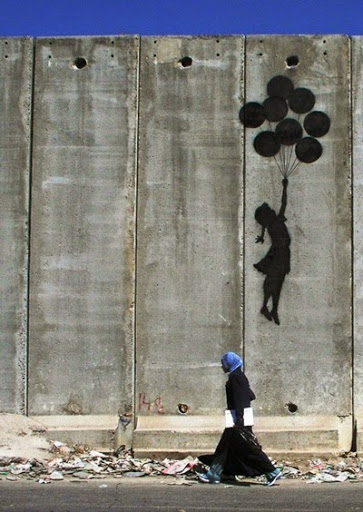
Banksy westbank wall balloon girl1

[Warning: very long read :)]

A video that has been burning a hole in my pocket since last November is the recording of the opening evening of the Berlin Courtyard of the Gentiles, that I already wrote about in a previous post.1 While I focused on Cardinal Ravasi’s talk on beauty and art there, today I’d like to cover the opening session’s discussion of morality, which was conducted under the title “Freedom, with and without God” and where Dostoevsky’s controversial dictum: “If God does not exist, everything is permitted” provided the initial impetus.

To open the evening’s dialogue, Cardinal Gianfranco Ravasi starts with a quote from Albert Camus’ The Plague, which says: “Can one be a saint without God? That’s the problem, in fact the only problem, I’m up against today.” and then proceeds to set the scene by being critical of the obstacles to open and fruitful dialogue between those who hold religious beliefs and those who do not:2

“These days a kind of fog engulfs both true religion and rigorous atheism. This is more of a sociological than an ideological phenomenon. It is an indifference, a superficiality, a banality, a sarcastic derision. In this atmosphere of indifference, mythos rules over logos, the pamphlet replaces the analytical essay, a fundamentalist approach is stronger than a critical weighing of alternative positions, jeering conflict is valued over a calm exchange of ideas, faith gives way to a spiritual collage. Syncretism uses a spiritual menu from which to compose an a la carte offering from which everyone can pick and choose what happens to suit him or her. These pathologies both of unbelief and of religion can benefit from a response in the form of the following dialogue.”

Ravasi then acknowledges the differences of the two positions and proposes that they nonetheless share a common element:

“In fact, the two logoi, the two argumentative positions that will be presented next, have an intrinsic difference, an objective difference. The secular non-believer takes the individual as their point of reference – the subject who seeks their own, personal and social, ethical orientation. The religious person, on the other hand, is convinced that truth, nature and moral order precede and exceed us. To use a famous image from Plato’s Phaedros, these realities are like a plane that stretches out in front of the chariot of the human soul, which proceeds through it towards discovering its objective foundations. A first point of agreement between these obviously differing perspectives – one which is predominantly subjective and the other objective – could be the thoughts of St. Augustine, who claimed that in each one of us there is an innate, original knowledge of good and evil, which enables the capacity for moral judgment. […] A reference to conscience is not a optional call to situational subjectivism, but a return to this radical anthropological structure, which is our conscience. At the same time we have to constantly bear in mind the limitedness of the human subject inherent in its being a creature.”

The opening remarks are then followed by two talks, one by a non-believer and the other by a believer. The first speaker was Prof. Herbert Schnädelbach, an agnostic philosopher whose work has included social philosophy and theories of rationality, epistemology, free will and values. Here Schnädelbach kicks off with an anecdote:

“A friend of mine, who is also a philosopher, said: “This sentence should be place on a list of the most stupid sentences ever – and fairly high up. Even in the absence of the existence of God, I am not allowed to break a red light, to withhold the payment of my taxes or to hit my wife, if that were even physically possible for me. And it is irrational to think that all of this were permitted without God.””

And proceeds to argue that the Dostoevsky quote is meant to teach us a fear of atheism and of atheists, and a fear of what supposedly follows: senselessness and anarchy. Dostoevsky’s quote implies that all rules and norms cease to have power in the absence of God. However:

“we live in a whole network of rules that we adhere to because we consider following them to be rational (e.g., the highway code), or because we want to avoid penalties imposed if they are broken (e.g., paying taxes). I can’t imagine though that Dostoevsky would not have know this. […] Dostoevsky claims that reason is an insufficient basis for our normative culture, that its normative power is too weak, that a more resilient basis is needed to hold up their edifice and that this foundation can only be God.”

This leads Schnädelbach to asking whether “God is even a suitable foundation for norms and who this God is?” and to drawing a parallel with Plato’s dialogue about the nature of piety in his Euthyphro: ““Is the pious loved by the gods because it is pious? Or is it pious because it is loved by the gods?” (10a). By analogy, Schnädelbach asks “is what is good and right for humans, good and right because God commanded it, or did God command it because it is good and right for humans?” and argues that there are two possible answers, using the Ten Commandments of the Old Testament as context:

  1. In the first case, God is sovereign and can freely choose what is good and right and no one can hold him to account. This is a voluntaristic image of God, which is closely related both to fundamentalism and to normative nihilism. They are two faces of the same coin. They rely on the same model of thinking of the all or nothing: either there is an ultimate justification or there is no justification, which is why systematic philosophers, at least since Descartes and until Hegel, have always looked for an absolute first justification for knowledge and claimed that the alternative is skepticism.
  2. In the second case, if God commands what is good and right, he is not an unaccountable tyrant, who could, at will, one day, make law what is evil and unjust. He commands what every person can see to be good and right with their own, healthy reason. This makes commandments 4-10 merely God teaching the People of Israel what they themselves could have discovered with their own reason, and the same would hold true for all of humanity too. This God, who commands what is rational because it is rational, and for no other reason, is the God of the Johannine Logos.”

Schnädelbach then proceeds to argue that only one of the above scenarios is problematic:

“If one assumes a sovereign God who commands without it being possible to ask them for reasons, i.e., where norms are divorced from reason, and if one then denies their existence, then truly everything is permitted. Then our normative culture would have its foundations removed. This danger does not exist, however, if the God who commands what is right and just, because it is right and just for humans, does not exist, since there is still the chance that people will discover it with their own reason and will make it hold even without God’s teaching.”

And, finally, the argument is brought to its logical conclusion, which, along the above lines or reasoning leads to a redundancy of God:

“Why should the practical reason of people and their free consent to what they discover to be normative in the process of rational discourse not be sufficient? Admittedly, this does presuppose the mutual recognition of discourse participants as free and equal partners, and their uninhibited participation in processes where public will is built and set. My final questions is: what could an transcendent God add at this point?”

I have to say that I find Schnädelbach’s reasoning very clear and compelling. There is a basis for morality derived from reason and consensus that is well-founded without the need for God. As a Christian I see this is as being extremely positive, and consistent with my belief in a loving God, who does not make a pursuit of what is good contingent on a person believing in His existence. There’d be more to say regarding the idea of a God who “can freely choose what is good and right,” but I’ll leave that for another time :).

Returning to the Berlin event, the second speaker of the evening was Prof. Hans Joas, a Catholic sociologist, who has worked in areas like social philosophy and the history of values. Joas first appeals for specificity, arguing that there isn’t a single religious or even Christian position, like there isn’t a homogeneous secular or atheist position and that “the level of discussion on this topic rises as the level of abstraction is lowered.” He then proceeds to present his view of the role played by morality in atheism:

“In the 20th century the vast majority of thinkers and writers who have self-identified as atheists did so for strong moral reasons. Often their arguments against faith were moral arguments: a focus on the afterlife would limit one in working for the good here on earth, one would do good only in the hope of a reward in the afterlife, or, a focus on the afterlife inhibits living this life to the full. Religions lead to unnecessary feelings of guilt, risk leading to hypocrisy in interpersonal relationships, or to a denial of one’s corporeality. For those who thought or think in this way, the absence of God is even a heightening of morality. This has to be taken seriously and I have high esteem for philosophers or writers who thought in this way, such as Ludwig Feuerbach or George Eliot. These are people who understood an exceptionally great deal about faith and who were exceptionally serious about going beyond what religion and Christianity had to offer.

For us Christians, it is necessary to look at the history of these views as a history of our failures. These weren’t lunatics, but people who understood certain things very precisely, and it was a failure of Christians to present their faith to them. An example is also the strong secularization of the workers’ movement in 19th century Germany, instead of its alignment with the Church. When asked, some of its members said that they didn’t go to church because they didn’t have the right clothes … This is an actual quote from a survey of Protestant pastors about dwindling numbers at the time. What shocked me here is that the pastor in question didn’t think, “What can I change about the Sunday service, so that people don’t stay away for a stupid thing like clothes.”

The atheism that had such strong moral motives in the beginning, has in some instances also degenerated, as in the case of the German Democratic Republic (GDR), where its leading philosopher claimed that the supreme moral point of reference was the wellbeing of the GDR. And today, there is often a tiredness on the side of non-militant atheism and a rigidity on the militant side. The first challenge, in my opinion, is to reopen a dialogue between believers and non-believers and a mutual awareness.”

Joas then moves on to distancing himself from the Dostoevskian quote and from belief in God being a prerequisite for morality, and instead argues for a developmental and experiential basis, from which God can then be sought:

“I don’t agree with the statement “Values need God.” Many findings in the context of developmental psychology and cultural anthropology point to another source, which has nothing whatsoever to do with religion, and which consists in experiences of reciprocity. Already games played by children point to fundamental rules that underlie human coexistence. Reflecting on them points to the value of justice, to the value of fairness in interpersonal relationships. At the same time, such relationships are under threat of falling apart if one of the participants chooses not to adhere to the rules, e.g., when these are to their disadvantage.

It is therefore useful to think about what it could be that would make humans adhere to moral rules, other than rational appeal, and what could make them adhere to them even when these are to their short-term detriment. What motivates the start of moral reasoning, what makes one start thinking about moral questions, what makes one adhere to shared moral rules? This still doesn’t bring us to God though. I believe we arrive at strong values, at intense convictions of there being such a thing as the good. This can be rooted in positive experiences, such as an encounter with someone who lives in an exemplary way, or in negative experiences, such as wanting to make sure that something doesn’t ever happen again the way that it happened before. For example, on German soil, National Socialism was an obvious, direct experience of evil itself, without the need for rational underpinnings. Then, a long journey can begin that can lead to an understanding how God relates to these values and rules.”

The position of Joas is very clear here: morality played a strong role in early atheism and is in no way in need of divine justification. Even the simple experiences of children lead to a recognition of the good of justice and fairness. My takeaway here is the importance of the emphasis of our common ground, which is what Joas chose to do here – an emphasis of the role of experience and the innate ability to identify good and evil, with only a hint of how God relates to morality for a Christian.

In the discussion that followed, Joas returned to the role of reason in morality, and emphasized the psychological perspective:

“Many things appear as obviously good or evil to us; reasons for why that is are needed when we encounter others who don’t share these evidential experiences with us and challenge us to explain why we value certain things. If we are honest with ourselves, we can see that whether something is good or evil is a matter that does not require rational justification to ourselves – it is obvious to us, and even in the face of counterarguments from others, instead of changing our minds about what appeared good to us from the start, we will look for reasons to support our original intuition. Note that this is a psychological, not a philosophical argument.”

The final contribution to the discussion was Schnädelbach’s sharing his personal experience of what it is like to be a – as he self-labeled himself – “pious atheist”:

“I have great respect for personal piety and for religious experiences, but personally I have to say that I can’t connect these to the God of the Bible – neither the Old nor the New Testament. At times, when something very good happens, I feel the desire to thank someone. But whom? And when something bad happens, I feel – like Job – the urge to argue with someone. But there is no one. I think though that this is the point that makes me who I am – a pious atheist.”

And to conclude the evening, Cardinal Ravasi was invited to share his thoughts, which he prefixed with saying that he is resisting the temptation to join the conversation between Schnädelbach and Joas or even to summarize it. Instead, he decided to present his understanding of the verb “to know”:

“In Hebrew the verb is yada, which has the same meaning as the New Testament Greek word genoskein, which reflects very well the polymorphism of anthropological knowledge, of human knowledge. Knowledge, according to this view, which is a symbolical view that is important also in the current dialectic or counter-positioning of faith and science, arrives along four ways. There is first the intellective, rational way. Added to it is the volitive way; decision, the willed intensity of knowing. The third line then is that of affectivity, of feeling. And the last, the fourth way, is that of action – knowing, which, e.g., in the Bible also means a completion of the sexual act. In other words, an encounter between two people in the fullness also of corporeality.

At this point, knowledge arrives in diverse ways, and each of these ways may lead to different stages. However, all of the stages are necessary. Hence the knowledge of the horizon of God, of transcendence, is a knowledge that has to pass through all of this, this whole itinerary. Therefore, the scientific way is certainly also relevant, as is a well-elaborated theology. But what is also indispensable is a knowledge of the esthetic kind, also of the spiritual kind, of a mystical kind. And this is why individual concepts and individual disciplines reveal themselves to be insufficient if they don’t travel along all the four ways.

This is also true of human experience itself, in general; To know a reality fully, it is not enough to only have knowledge of the phenomenon, knowledge of the context, knowledge of the “documentation.” A knowledge of love is also necessary, a knowledge that is substantially narrative. This knowledge that is also historical is the one that predisposes us to the ultimate foundations, to extreme questions.”

Since this post is massively long as is, I’ll refrain from attempting to present my own understanding of this topic, and will defer to do so at a later time. In any case, my intention with this post was just to share with you the above conversation among Cardinal Ravasi and Profs. Joas and Schnädelbach, which was such a joy to follow and whose availability only in German has been bugging me over this last half year.


1 It may come as a surprise to long-time readers of this blog, but I am actually following up on a strand from a previous post that I said I’d follow up on :).
2 All quotes from the event here are my crude translations from the evening’s recording in German.

The demon of distance

Demon of distance

A couple of weeks ago, Cardinal Gianfranco Ravasi lead another of the “courtyard of the gentiles” events, aimed at providing a space for dialogue between non-believers and Catholics. This time it took place in Budapest and Cardinal Ravasi’s address focused on the fundamental Christian principles, from which its understanding of morality, economy and society derives.

These principles include those of the person (created in the image of God and intrinsically being in relationship with others), of autonomy (of the civil and religious spheres, following Jesus’ words: “Then repay to Caesar what belongs to Caesar and to God what belongs to God.” (Matthew 22:21)), of solidarity and of truth (that precedes and exceeds us and that we inhabit rather than possess1). Each of these four principles is insightfully presented and analyzed by Ravasi and I would recommend anyone to read his talk in full (at the time of writing this post, only available in Italian). Here, however, I would like to focus only on the principle of solidarity, which Ravasi further differentiates into its aspects of justice and love.

The starting point of the principle of solidarity in Christianity, like that of the other three principles too, is the incarnation: “And the Word became flesh” (John 1:14), as a result of which there is a link between faith and history, between religion and political and social life. Cardinal Ravasi also emphasized this point during his brief opening remarks of the entire event, where he pointed out that, while in Eastern religions saints tend to be depicted with closed eyes (indicating an interiority of focus), in Christian art saints are typically shown with their eyes wide open – projecting out into the world around them. What is needed, Ravasi concludes, is both an interiority and a having one’s eyes open to see the great political, economic, social and cultural problems of the world.

In this context, the principle of solidarity in Christianity has its roots already in the Genesis account of creation, where

“the fact of all of us being human is expressed by the noun “Adam,” which in Hebrew is ha-’adam,2 with the article (ha-) that simply means “the human.” is used to refer to humanity. Therefore there is in all of us a shared “adamness.” Solidarity is, therefore, structural to our fundamental anthropological reality. Religion expresses this anthropological unity using two terms that are two moral categories: justice and love. Faith takes solidarity, which is also at the basis of lay philanthropy, but goes beyond it. In fact, staying with John’s Gospel, during the last evening of his earthly life Jesus says a wonderful phrase: “No one has greater love than this, to lay down one’s life for one’s friends.” (John 15:13).”

To illustrate the two aspects of solidarity – justice and love, Ravasi takes advantage not only of Christian tradition, but also makes reference to Eastern thought, in the spirit of inter-religious dialogue.

To present the essence of justice, Ravasi quotes the 4th century saint, Ambrose of Milan:

“The earth was created as a common good for all, for the rich and for the poor. Why, then, O rich, do you usurp an exclusive right to the soil? When you help the poor, you, rich, don’t give them from your own, but you return to them their own. In fact, you alone use the common property, given for the use of all. The earth belongs to all, not only to the rich, therefore when you help the poor you give them back their due, instead of providing them with a gift of your own.” (On Naboth)

Turning to the second aspect of solidarity – love, Ravasi takes advantage of the following Tibetan parable, showing that religious cultures, that are undoubtedly diverse, do at their bases have touch-points and contacts:

“A man, walking through the desert, spots something strange in the distance. Fear starts welling up in him, since, in the absolute solitude of the steppe, such an obscure and mysterious reality – maybe an animal, a dangerous wild beast – can’t but unsettle. Moving ahead, the traveller discovers that he is not approaching a beast, but a person instead. But his fear does not pass. If anything, it grows, thinking that the person could be a robber. Nonetheless, he has no choice but to proceed, until arriving in the presence of the other. At this moment, the traveller lifts his gaze and, to his surprise, exclaims: “It is my brother, whom I haven’t seen for many years!””

Ravasi concludes his reflection on solidarity by noting that “distance generates fears and demons; one has to get close to the other to overcome fears, no matter how understandable they may be. Refusing to get to know the other and to encounter the other is the same as saying no to the love that springs from solidarity and that dissolves terror and generates a true society.”

Personally, I have found Cardinal Ravasi’s reflection highly compelling and enlightening, both due to its deep roots in Scripture and its open and broad perspective that is equally at ease with drawing on the rich sources of Christianity as it is to benefit from the insights of other religions, even in matters as fundamental and core to Christianity as its understanding of love. Specifically, I have also found the Tibetan parable to be a great reminder to attempt closeness with all, instead of remaining at a distance and being put off by distorted, prejudice-filled, blurry perception.


1 Ravasi addressed this concept of the truth several times already, e.g. see also its coverage in a previous post here.
2 For more on the Genesis account and ha-’adam, see John Paul II’s “Man and Woman He Created Them,” discussed here.

Beauty wounds

Give or take

The latest in a series of “Courtyard of the Gentiles” events took place in Berlin this week and I have to say that I have been very impressed with the little of it that I have managed to follow via its livestreaming. The discussion between Profs. Joas and Schnädelbach (masterfully moderated by Prof. Markschies) was a particular gem, to which I definitely hope to return at a later date (with a highlight being Joas’s call for a confederacy of the “ethically universalist”1 – very much along a previous post here). If you understand German, I very much recommend the recordings of the event, as they represent a, to my mind, exemplary instance of dialogue between Christians and non-believers.

In this post, however, I’d like to share some of my favorite parts of Cardinal Gianfranco Ravasi’s opening address of the “Religion on stage” session that took place at the Deutsches Theater Berlin and where he spoke about beauty, a topic that is very close to my own heart. The text of his talk is available both in German and Italian on-line and the following excerpts will be my own, crude translations from both versions combined.

Ravasi opens by pointing to Judeo-Christian religions representing God Himself by analogy to the aesthetic and to drama,2 which can be seen in the Old Testament in the book of Wisdom: “For from the greatness and the beauty of created things their original author, by analogy, is seen.” (13:5) and already in Genesis, where “God saw that it was good.” (1:10) when looking at what he has created. Here Ravasi makes an important observation about the Genesis text, where the Hebrew adjective tôb, which is rendered as “good,” has not only ethical and utilitarian, but also aesthetic meaning. This would allow for the phrase to be put also as “God saw that it was beautiful.” His final Old Testament reference with regard to this idea is my favorite and points to the book of Proverbs, where God’s creative Wisdom is represented as a girl who “was his delight day by day, playing before him all the while, Playing over the whole of his earth, having my delight with human beings.” (8:30-31). I like this image very much since it ties together creativity, wisdom, play and joy and since already as an image – beyond its metaphorical content – it is beautiful.

The above leads Ravasi to the realization that faith and art are sisters by nature, since – in the words of Paul Klee about art – “they don’t represent the visible, but the invisible that is in the visible.”3 Another dichotomy that is at play both in life and in art (specifically the theater) is that of suffering and joy – of drama and comedy, which Fyodor Dostoyevsky explains by saying: “tragedy and satire [comedy] are sisters, who walk hand in hand and who together are called truth.” To this, Ravasi adds that “authentic art seeks to express also the dark side of this truth,” which he then expands on by first quoting Rainer Maria Rilke: “The beautiful is nothing but the beginning of the terrifying” and then Virginia Woolf: “The beauty of the world has two edges, one of laughter, one of anguish, cutting the heart asunder.” Finally, this line of reasoning is pushed even further through the words of the then-Cardinal Ratzinger from 1992: “beauty wounds, but precisely by doing so, it awakens man to his highest calling.”

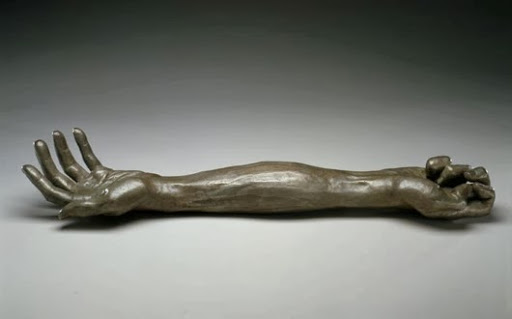
This emphasis on the integrity and comprehensiveness of art with respect to the full spectrum of human emotion is an important move away from the backward-looking, formulaic, stylized or solely artisanal nature of sacral “art” that Ravasi bemoans (and he is equally critical of contemporary attempts that result in “sacral garages where God is parked and the faithful are lined up”). Such failures lead to the divorce between art and faith that has been the case since the last century and that Ravasi has clearly spoken about already during the announcement of the Vatican pavilion a this year’s Venice Biennale. In contrast to its pathologies, Ravasi points to the importance of the cuts that authentic art can inflict and emphasizes that they can be “slits that open onto the infinite and eternal, the absolute, the mystery and the divine,” regardless of the faith of the artist, e.g., as with Lucio Fontana’s – a contemporary of Marcel Duchamp – “Tagli” or “Concetto spaziale” pieces, and – in my opinion – in a less literal way in the work of Louise Bourgeois (e.g., see her “Give or Take”).

Ravasi notes that the separation between art and faith has also, naturally, lead to a shelving of the themes, symbols and narratives of the Bible, which, e.g., Chagall held in very high regard: “For centuries painters dipped their brushes into this colorful alphabet, that of the Holy Scriptures.” Next, Ravasi makes the – to me – most interesting move by a virtuoso application of the principle of charity: “Even certain desecrating and blasphemous expressions4 that have recently elicited strong responses ultimately show not only the strong impact that religious symbols and themes maintain even in a secularized society, but perhaps they also manifest a nostalgia for the signs and images that have been such an extraordinary source of art and culture for two millennia.”

To sum up, I’d like to take advantage of Prof. Dr. Hans Joas’ words from his remarks of the opening session of the Berlin Courtyard of the Gentiles, where he called for “curiosity with regard to the other and humility with regard to oneself,” as a basis for authentic dialogue. I believe Cardinal Ravasi has taken great steps towards a new relationship between the Catholic Church and contemporary art, both in the practical move of participating in the Venice Biennale earlier this year, and in his clear attempts to recognize value and goodness even in art that at first sight is opposed to faith and in being explicit about the breadth of expression that authentic art requires.


1 As opposed to an “ethical particularism” that distinguishes between religious and secular ethics.
2 E.g., for a recent example, see also Hans Urs von Balthasar’s five-volume work “Theo-Drama: Theological Dramatic Theory.”
3 This seems to be related to the following, more extensive quote: “Art does not reproduce the visible; rather, it makes visible…. My aim is always to get hold of the magic of reality and to transfer this reality into painting – to make the invisible visible through reality. It may sound paradoxical, but it is, in fact, reality which forms the mystery of our existence.”
4 Characterized as “desecrating and blasphemous,” the most obvious example that springs to mind is Andres Serrano’s photograph [view at your own discretion].