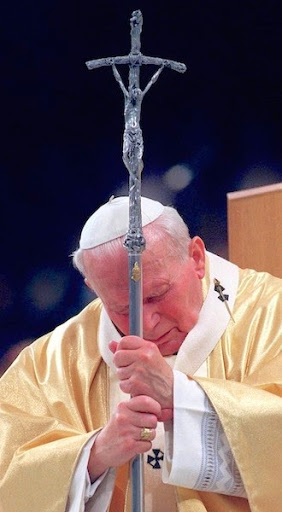
Since writing my previous post of thanksgiving to St. John Paul II, ahead of his and St. John XXII’s canonization last Sunday, I kept coming back to thinking about another aspect of his life that has great importance for me. Beyond his words and actions, his perseverance in suffering, especially during the last 15 years of his pontificate (i.e., since the onset of Parkinson’s), has always been an inspiration and an example for me.
Cardinal Bertone put this aspect of St. John Paul II’s life best, when he said that “suffering was another one of his encyclicals.” And by considering it alongside his writings, the most obvious parallel to draw is with the encyclical Salvifici Doloris, which he wrote about suffering some six years after being elected Pope and where one of the key passages for me is the following (§23):
“Those who share in Christ’s sufferings have before their eyes the Paschal Mystery of the Cross and Resurrection, in which Christ descends, in a first phase, to the ultimate limits of human weakness and impotence: indeed, he dies nailed to the Cross. But if at the same time in this weakness there is accomplished his lifting up, confirmed by the power of the Resurrection, then this means that the weaknesses of all human sufferings are capable of being infused with the same power of God manifested in Christ’s Cross. In such a concept, to suffer means to become particularly susceptible, particularly open to the working of the salvific powers of God, offered to humanity in Christ. In him God has confirmed his desire to act especially through suffering, which is man’s weakness and emptying of self, and he wishes to make his power known precisely in this weakness and emptying of self. This also explains the exhortation in the First Letter of Peter: “Yet if one suffers as a Christian, let him not be ashamed, but under that name let him glorify God.””
The absurdity and scandal of a suffering God – and of suffering man – are not explained away or justified, but become invitations to participate in the suffering of Jesus, which demonstrates the extent of God’s love for man.
About fifteen years after writing the above words, and while visiting the sick in a hospital in Mexico City, St. John Paul II returned the the same theme and elaborated it further:
“Seen in this way, pain, disease and the dark moments of human existence acquire a profound and even hopeful dimension. One is never alone in facing the mystery of suffering: we are with Christ who gives meaning to the whole of life: moments of joy and peace, as well as those of affliction and grief. With Christ everything has meaning, even suffering and death; without him, nothing can be fully understood, not even those legitimate pleasures which God has associated to different moments of human life.”
Thinking about St. John Paul II’s health, one can wonder whether his remaining in office was good for the leadership of the Church, whether it wouldn’t have been better if he had resigned, and one can wonder whether such thoughts even entered the Pope’s head, or whether he had continued in his role out of inertia. The answer to the second part of the question is clear from the revision of his own Last Will that he made in the year 2000 and where he added:
“On May 13, 1981, the day of the attack on the Pope during the general audience in St. Peter’s Square, Divine Providence saved me in a miraculous way from death. The One Who is the Only Lord of life and death Himself prolonged my life, in a certain way He gave it to me again. From that moment it belonged to Him even more. I hope He will help me to recognize up to what point I must continue this service to which I was called on Oct. 16, 1978. I ask him to call me back when He Himself wishes. “In life and in death we belong to the Lord … we are the Lord’s.” (cf. Romans 14,8). I also hope that, as long as I am called to fulfill the Petrine service in the Church, the Mercy of God will give me the necessary strength for this service.”
To answer the first doubt, we need look no further than to the homily given by his successor, Benedict XVI, during the beatification of St. John Paul II, where he said:
“[T]he Lord gradually stripped him of everything, yet he remained ever a “rock”, as Christ desired. His profound humility, grounded in close union with Christ, enabled him to continue to lead the Church and to give to the world a message which became all the more eloquent as his physical strength declined. In this way he lived out in an extraordinary way the vocation of every priest and bishop to become completely one with Jesus, whom he daily receives and offers in the Church.”
Leadership of the Church is not about organizational shrewdness, effective policies or vigor (all of which are good, but secondary) – instead it is about an imitation of its head – Jesus. And as such, there is no doubt in my mind that St. John Paul II remained an exemplary leader until his very last moments on Earth. His public and persistent acceptance of frailty, suffering and weakness were as much evidence of his following in Jesus’ footsteps, as his rallying against the mafia, his effort to establish brotherly relationships with other religions, or his forgiving his would-be assassin. Pope Benedict XVI, addressing the Pontifical Council for pastoral healthcare professionals, explained St. John Paul II’s witness as follows:
“The mystery of suffering seems to blur the face of God, making Him almost a stranger, or even identifying him as being responsible for human suffering, but the eyes of faith are able to look deeply into this mystery. God became incarnate, He came to be close to man, even in the most difficult situations, He did not eliminate suffering, but in the Risen Crucified One, the Son of God suffered unto death, even death on a cross, He reveals that His love goes even deeper into the abyss of man to give him hope. The Crucified is risen, death has been illuminated by the morning of Easter: ‘God so loved the world that he gave his only Son, that whoever believes in him shall not perish but have eternal life’ (Jn 3.16). […] The testimony of the last years of John Paul II’s life teach us this: “An unshakable faith pervaded his physical weakness, making his illness, lived for love of God, the Church and the world, a actual participation in the journey of Christ to Calvary. The following of Christ did not spare Blessed John Paul II to take up his cross every day until the end, to be like his only Master and Lord.””
As I was thinking about what it is about St. John Paul II’s example that attracted me so much, I was visiting the Sagrada Familia in Barcelona, and I went to spend some time in front of Jesus in the Eucharist – if you convince a guard that you realize you are in an actual church, you are granted access to a small, walled-off fragment of the basilica where the tabernacle is situated. In the midst of the roar of a throng of tourists, I looked at the inscription on the tabernacle, which read: “Jo sóc la vida” (“I am the life” – cf. John 14:6) and something went “click” in my mind.1 A following of Jesus means an identification of life with Him and it is this that St. John Paul II did. His was an imitation of Jesus in all aspects of life – the joyous and the sorrowful, and a realization that the way to the joy of the resurrection that is mirrored in the joys of life passes through the sorrow of the crucifixion, which we can participate in, in its sufferings.
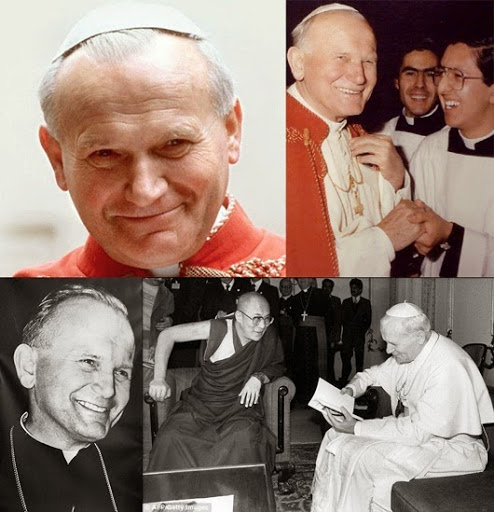
Just to dispel a potential misunderstanding that might arise from having spent 1500 words talking about suffering and that might suggest a preference for or a seeking out of suffering, let me say that this is not what Christianity is about. Instead it is all about joy, but a joy that embraces and subsumes the difficult and painful moments of life – like a profound beauty that also elevates and incorporates ugliness. In the end though it is about joy and beauty, like St. John Paul too emphasized when he insisted that “We are an Easter people” and when Pope Francis criticized “Christians whose lives seem like Lent without Easter” and who look like “sourpusses.” Let me therefore leave you with a couple of photos of St. John Paul II, from which it can be seen that he was anything but a sourpuss 🙂
1 Not that I think the mind is mechanical :).
 eyebeleave