Francis fights fundamentalism

20110311 gor chakhal

A new book by Pope Francis, entitled “Beauty will teach the world,” was published today in Italian and the daily La Repubblica has already released an excerpt. There Francis speaks out against fundamentalism, and while his thoughts are very much along the lines of the understanding of truth that he laid out in the letter to Scalfari, their freshness and forcefulness expand the scope and intensity of the previous sketch. Since I haven’t found an English translation yet, the following is my own, rough attempt.

In the published excerpt, Francis starts with an analysis of fundamentalism, portrayed as a flavor of insecurity and cowardice:

“What is apparent is the fact that during the course of history there has been an explosion, and there continues to be an explosion also today, of fundamentalisms. At their heart, these systems of thought and conduct are absolutely outdated, mummified, and serve as bunkers. Fundamentalism grows from the rigidity of a single thought, inside which a person protects itself from sources of instability (and from crises) in exchange for a certain existential calm. Fundamentalism does not allow for shades of meaning or second thoughts, simply because it is afraid and – specifically – it is afraid of the truth. The person who hides in fundamentalism is someone who is afraid to set out on a journey in search of truth. They already “possess” the truth, they have already acquired it and used it as a defensive means; therefore they experience each discussion as personal aggression.”

Francis then presents an alternative view of the truth – not as defense mechanism and aggression, but as a shared gift, very much reminiscent also of Dr. Slipper’s paper on “cognition by mutual reflection”:

“Our relationship to the truth isn’t static, because the Supreme Truth is infinite and can always be known better; it is always possible to immerse oneself into greater depth in it. The apostle Peter asks of Christians to be ready to “give an explanation”1 of their hope; which means that the truth, on which we base existence, must open itself to dialogue, to the difficulties that others show us or that circumstances present us with. Truth is always “reasonable,” even when I may not be, and the challenge is to remain open to the point of view of the other, without turning our convictions into an immovable whole. Dialogue does not mean relativism, but a “logos” that is shared, reason that offers itself in love, to build together a reality that is more and more liberating every time.”

Dialogue therefore fosters a sharing in truth and freedom, built on mutual openness, and Francis proceeds to project the consequences of such an attitude even further, calling it a “virtuous cycle”:

“In this virtuous cycle, dialogue uncovers the truth and the truth is nourished by dialogue. Careful listening, respectful silence, sincere empathy, an authentic making oneself available to the stranger and the other, are essential virtues that are to be fostered and transmitted in today’s world. God himself calls us to dialogue, he calls and summons us by his Word, the Word that has abandoned every nest and shelter to make itself human.”

Dialogue is presented here not only as something that is a good thing to do, but – for Christians – as a direct call from God and an example set by Him, which in turn opens new dimensions:

“As a result, three, intimately interlinked, dimensions of dialogue appear: one between the person and God – the one that we Christians call prayer, one among human beings themselves, and a third one, of dialogue with oneself. Through these three dimensions the truth grows, consolidates itself and extends over time. […] At this point we have to ask ourselves: what do we mean by the truth? Seeking the truth is different from finding formulae for possessing and manipulating it to one’s own liking.”

An aspect of the above that I particularly like is the order in which Francis presents the dimensions of dialogue: God, others, self … With this framework in place, he proceeds to emphasize the role of humility in the quest for truth:

“The search involves the totality of the person and of being. It is a journey that fundamentally involves humility. With the firm conviction that no one is sufficient for themselves and that it is dehumanizing to use others as means for being sufficient for oneself, the search for the truth embarks on this laborious journey, often artisanal, with a humble heart that refuses to quench its thirst with standing waters.

A fundamentalist “possession” of the truth lacks humility: it tries to impose itself on others by a gesture that, in and of itself, is self-defensive. The search for truth does not quench the roaring thirst. An awareness of “wise ignorance”2 lets us continually restart the journey. A “wise ignorance” that, with life’s experiences, becomes “learned.” We can affirm without fear that the truth isn’t had, is not possessed: it is encountered. For us to desire it, it must cease to be the one that can be possessed. The truth opens itself, uncovers itself to those who – in turn – open themselves to her. The word truth, precisely in its Greek sense of aletheia, suggests that which manifests itself, that which uncovers itself, that which reveals itself by means of a miraculous and gratuitous apparition. The Hebrew sense, instead, of the term emet, unites the meaning of the true with that of the certain, stable, that which does not lie or deceive. The truth, therefore, has a dual connotation: it is a manifestation of the essence of things and persons, that in their opening up of their innermost selves give us the certainty of their authenticity, the reliable proof that invites us to believe in them.”

How does such a concept of certainty mesh with the humility Francis called for earlier on?

“Such certainty is humble, because it simply “lets the other be” it its manifestation, and does not subject it to our needs or demands. This is the first justice that we owe others and ourselves: to accept the truth of what we are, to tell the truth of what we think. Our painful political history has tried many times to gag them. Very often the use of euphemisms has anesthetized us or made us fall asleep before her. But, the time has come to rejoin, to twin ourselves with the truth that needs to be announced prophetically, with justice authentically restored. Justice only springs forth when the circumstances, that we are betrayed and deceived by in our historical destiny, are called by their names. And by doing this, we accomplish one of the principal services of responsibility due to future generations.”

The above seems very clear to me: the need for dialogue and humility that Francis starts out with is motivated by the need for an honest understanding and acceptance of reality, whose denial and distortion otherwise go against the good of all. To conclude the excerpt, Francis pulls back from truth, to reveal her sisters – goodness and beauty:

“The truth is never found by herself. Together with her there are goodness and beauty. Or, better put, the Truth is good and beautiful. An Argentinian thinker used to say: “A truth that is not entirely good always hides some goodness that is not entirely true.” I insist: these three go together and it is neither possible to find nor seek one without the others. It is a reality that is very different from the simple “possession of truth” claimed by fundamentalism: they take formulae in and of themselves as valid, emptied of goodness and beauty, and they try to impose themselves on others with aggression and violence, doing evil and conspiring against life itself.”

As soon as a proper translation becomes available, I’ll point to it here, but I hope that even my broken attempts at rendering Pope Francis’ thoughts in English will give you a sense of his concerns and his positioning of the truth as part of a set with goodness and beauty and as a gift received with others in response to openness, dialogue and a journey shared.


1 “Always be ready to give an explanation to anyone who asks you for a reason for your hope.” (1 Peter 3:15)
2 I guess this is in reference to the Socratic: “I am wiser than this man; for neither of us really knows anything fine and good, but this man thinks he knows something when he does not, whereas I, as I do not know anything, do not think I do either. I seem, then, in just this little thing to be wiser than this man at any rate, that what I do not know I do not think I know either.” (Plato, Apology 21d)

Benedict XVI – Odifreddi: searching for Truth, with gloves off

Boxing gloves

[Warning: long read :)]1

If you are even remotely interested in the dialogue between faith and reason, between religion and science, the last fortnight has to be among the most electrifying periods in the history of mankind. Not only did it kick-off with the beautifully sincere and profound move by Pope Francis in his letter to the atheist journalist Eugenio Scalfari, but it saw the publication of “the” interview that Pope Francis gave to Jesuit media and in which he spoke about science in terms that, to my mind, take the Church’s appreciation of science further than ever before. And if that wasn’t enough, today saw the publication of extracts from an 11-page letter that Pope Emeritus Benedict XVI wrote to the Italian atheist mathematician Prof. Piergiorgio Odifreddi, in response to his book “Caro Papa ti scrivo: Un matematico ateo a confronto con il papa teologo” (“Dear Pope, I write to you: An atheist mathematician confronting the theologian pope”).

Looking at the two letters (or, more precisely, the extracts from Benedict’s versus the full text of Francis’), Francis’ and Scalfari’s style is like a polite, yet illuminating, exchange between two gentlemen over a cup of tea, while Benedict’s and Odifreddi’s exchange is like a bare-knuckle fist-fight between a pair of prize-winning boxers who in the end sincerely shake hands and respect each other, but without giving an inch during the fight itself.

To begin with, let’s take a quick look at Odifreddi’s opening move – his 204-page book, addressed to Benedict as “between colleagues” – from a maths to a theology professor. Early on, Odifreddi identifies a point in common with Benedict’s thought, by pointing to the following passage from Benedict’s Regensburg address:

“the experience […] of the fact that despite our specializations which at times make it difficult to communicate with each other, we made up a whole, working in everything on the basis of a single rationality with its various aspects and sharing responsibility for the right use of reason”

While Odifreddi identifies this – the adherence to reason – as a common point of departure, he quickly objects to Benedict’s excessive use of it (“your almost obsessive use of the word “reason,” repeated around forty times, akin to a musical motif or continuous base”) and to the “scandalous” words from Benedict’s sermon before the conclave that elected him:

“[H]aving a clear faith based on the Creed of the Church is often labeled as fundamentalism. Whereas relativism, that is, letting oneself be “tossed here and there, carried about by every wind of doctrine”, seems the only attitude that can cope with modern times. We are building a dictatorship of relativism that does not recognize anything as definitive and whose ultimate goal consists solely of one’s own ego and desires.”

While being critical of Benedict’s words, Odifreddi argues that “both religion and science are perceived as antidemocratic and absolutist” as a result of their focus on “ultimate truths” and then proceeds to arguing against a series of passages from Benedict’s “Introduction To Christianity” and his Jesus of Nazareth trilogy.

Since it is the full, fine detail that is key to understanding the nature of what is going on between Odifreddi and Benedict, let me just pick out a single point of contention (from among many important and interesting ones that I hope to return to soon!),2 which Benedict objected to most forcefully and which the following passage from Odifreddi’s book sums up nicely:

“There is little to say about the historical Jesus, literally, because there are virtually no traces of him in the official history of the period. In total, there are only few tens of lines about him in the works of Pliny, Tacitus, Suetonius and Flavius Josephus. Some are of uncertain interpretation, like the “Chrestus” of Suetonius. Others are of dubious authenticity, like the interpolation of Flavius Josephus. […] If, therefore, Jesus truly existed, he must have been irrelevant to his contemporaries, beyond the narrow circle of his relatives, friends and followers.”

Odifreddi further accuses Benedict of side-stepping questions of fact by saying to him: “you seem uninterested in (or seem interested in not) discussing the historicity of the Gospels and the facts that they report” and attributes to him an opposition to historical-critical methods of Biblical interpretation, by quoting Benedict as saying that they “can effectively become an instrument of the Antichrist.”

Benedict’s response here is as sharp as the jab he received:

“What you say about the figure of Jesus is not worthy of your scientific status. If you put the question as if nothing were, ultimately, known about Jesus, as a historical figure, as if nothing were ascertainable, then I can only firmly invite you to become more competent from a point of view of history. To this end I particularly recommend to you the four volumes that Martin Hengel (exegete at the Protestant Faculty of Theology of Tübingen) has published with Maria Maria Schwemer: it is an excellent example of historical precision and of vast breadth of historical information. […] Further I have to forcefully reject your affirmation (pp. 126) according to which I have presented historical-critical exegesis as an instrument of the Antichrist. Discussing the account of Jesus’ temptations, I have only recalled Soloviev’s thesis, according to whom historical-critical exegesis may also be used by the Antichrist – which is an unquestionable fact. At the same time, however, I have always – and in particular in the foreword to the first volume of my book on Jesus of Nazareth – made it evidently clear that historical-critical exegesis is necessary for a faith that does not propose myths using historical images, but demands true historicity and therefore has to present historical reality in its affirmations also in a scientific way. Because of this, it is not correct either that you say that I have been interested only in meta-history: on the contrary, all my efforts have had as their objective to show that the Jesus described in the Gospels is also the real, historical Jesus; that it is a matter of history that really took place.”

Uff … I have to be honest and admit that I was at first a bit uneasy about the tone of both Odifreddi and Benedict, neither of whom are pulling punches and both of whom are blunt to say the least. Looking more closely though, and reflecting on my professional experience as a scientist, I recognize that this is the tone and strength of academic argument and doing anything less would be dishonest on the part of both the professor and the ex-professor. This is a very different context from the Francis-Scalfari one and it demands the unforgiving rigor, precision and detail of the quotes shown above. Treating Benedict like any other academic shows Odifreddi’s respect for him (which he is explicit about when saying “Having read his Introduction to Christianity, […] I realized that the faith and doctrine of Benedict XVI, unlike that of others, were sufficiently solid and fierce that they could very well face and sustain frontal attack.”) Benedict is equally complimentary about Odifreddi, when he tells him that he “considers very positively the fact that you […] have sought such an open dialogue with the faith of the Catholic Church and that, in spite of all the differences, in the central themes, there is no lack of convergence at all.”

What this, academic, dialogue is truly about is put best – and to my mind beautifully lucidly – by Odifreddi, who says that:

“[The aim], obviously, was not to try and “convert the Pope,” but instead to honestly present to him the perplexity, and at times incredulity, of a mathematician with regard to faith. Analogously, the letter from Benedict XVI does not try to “convert the atheist,” but to direct at him his own, honest, symmetrical perplexity, and at time incredulity, of a very special believer with regard to atheism. The result is a dialogue between faith and reason, which, as Benedict XVI notes, has allowed both of us to confront each other frankly, and at times also bluntly, in the spirit of the Courtyard of the Gentiles that he himself has initiated in 2009. […] Divided in almost everything, but joined by at least one objective: the search for Truth, with a capital “T”.”

Wow! I have to say I am very impressed with Odifreddi (having come to this clearly as Benedict XVI fan) and I look forward to seeing his next steps in this full-contact dialogue. In many ways, I believe, that the most important thing to take away from this first encounter is the seriousness and complete transparency, with which both parties approached the challenge of dialogue – a dialogue that is not a watering-down or a “playing nice” but a striving for Truth, regardless of how vast the abyss may appear between its opposing cliffs. It would be a mistake to get stuck on whether I happen to agree with one side or the other, as it would miss the masterclass in serious dialogue that we have just witnessed. In many ways, I read Odifreddi’s closing thoughts as a transposition – from an intra-Christian to a Christian-atheist setting – of Francis’ call to an ecumenism that starts now, while there are clear differences between the parties, when he says in “the” interview: “We must walk united with our differences: there is no other way to become one. This is the way of Jesus.”


1 Apologies, again, for the rough translation from Italian – once “official” translations are available, I’ll point you to them.
2 I can’t not mention the following zinger from Benedict, which points to the widespread use of “science fiction” in science, in response to Odifreddi’s claiming that it was religion that practiced the genre. Benedict here says, referring to Heisenberg and Schrödinger’s theories, and adding Dawkins’ “selfish gene” to the list, that “I’d call them “science fiction” too, in the good sense: they are visions and anticipations, to arrive at true knowledge, but they are, indeed, only imagination with which we try to get closer to reality.” 🙂 I agree and I’ll definitely pick this line up in a future post.

Against against understanding

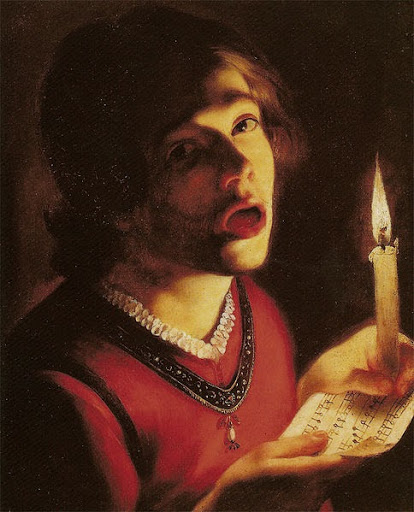
484px Trophime Bigot Singer Candle

You know the caricatures of religious people that Richard Dawkins battles like windmills? Well, I have just read a blog post by one of them. He even self-applied the label “Catholic” and had his missive published in the “National Catholic Register” … Richard, all is forgiven! I’m with you to un-delude this guy – you can even have him as an atheist at the end!

“The world burns because nobody is willing to burn for it.”

“[We are not] to dialogue with over a billion people whose lives are dictated by a false religion and a false ideology, an ideology that threatens to burn the world. [We are not asked] to understand them better.”

“God commissioned [us] to convert the world, not to dialogue with it.”

“There is no antidote to error but truth.”

“We should raise money to send missionaries and pray for their souls when they perish for the effort, and then send more missionaries.”

No, these aren’t the words of Abu Qatada, but those of a “Catholic” blogger.

Let me just be clear about one thing – the above are not the words of a Catholic. Being a Catholic is “not to have a ‘label’ but to live and testify to faith in prayer, in works of charity, in the promotion of justice, in doing good,” as Pope Francis is quoted in another article, ironically on the same website. Calling for “conversion, not dialogue,” a refraining from understanding and raising money to send missionaries to their death are not “works of charity, the promotion of justice, [or] doing good.”

And if that weren’t enough, the author of the above expletives disqualifies himself from the Catholic life by distancing himself from the Church’s teaching: “Well, if we listen to many Church leaders, we hear that we should seek to understand them better. […] And of course, we should seek to dialogue with them. Dialogue, dialogue solves everything. Baloney.” Well, not just any old church leader, but Pope Francis himself, who has been explicit about the Church’s desire to understand and dialogue not only with Muslims, but also with members of other religions, Christian denominations, agnostics and atheists. Everyone!

Does that mean that the Catholic Church and its leaders are not interested in spreading the Good News and in bringing Jesus to all, or as the blog’s author puts it in his closing paragraph:

“For God so loved the world that he gave his one and only Son, that whoever believes in him shall not perish but have eternal life. Do we love the world enough to even tell them about Him?”

Now that’s baloney (in the parlance of our times). Pope Francis is monomaniacally focused on Jesus and on pointing to him at every opportunity. Just look at his daily homilies, where the word Jesus is by far the most frequently used. And you don’t need to look any further back than his last Angelus message, delivered only two days ago to see what he is all about:

“Jesus tells us that there is a door to enter into the family of God. This door is Jesus. Everyone is invited to enter this door, to go through the door of faith, to enter into his life and to allow Jesus into their lives, so that he may transform them, renew them and give them full and lasting joy.”

But it is an invitation, not a conquest, a desire for friendship, not a call to use force. The basis is understanding, compassion, friendship. To look at Jesus and infer from His words that He wants us to make others believe in Him is not having listened to Him at all. Just like Jesus didn’t set out to kidnap the apostles with a cohort of hired muscle, so we too need to invite instead of “burn and perish.”

Let’s be friends (even if we disagree)

Francis japanese

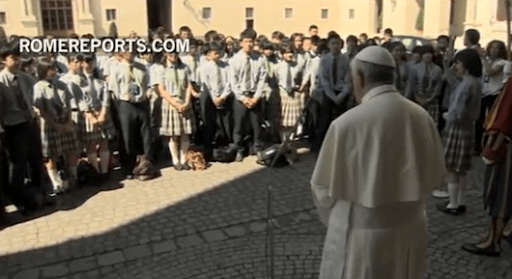
I know I keep talking about Pope Francis, but I can’t help telling you about his meeting with a group of Japanese school kids yesterday, since his words there were an even further crystalized and simplified exposition of the ideas he shared in the message to Muslims last month.

First, it’s worth noting a bit of the back story though. The 200 pupils – both Buddhist and Christian – of the Seibu Gakuen Bunri Junior High School from Tokyo had planned a trip to Rome long before the Vatican announced that Pope Francis wouldn’t be holding general audiences during the month of August. Not wanting to disappoint them, Francis instead met just with their small group yesterday in the courtyard of the Vatican’s Apostolic Palace.

To begin with, Francis praised them for their visiting a foreign country, since:

“to meet other people, other cultures is always good for us, it helps us grow. And, why? Because if we are isolated in ourselves we only have what we have, we cannot grow culturally; instead, if we go in search of other people, other cultures, other ways of thinking, other religious, we come out of ourselves and begin that beautiful adventure that is called “dialogue”.”

Then, he moved on to the core of his short talk, where he proposes meekness as the method of dialogue – a subject he has spoken of at least a dozen timed during his morning homilies:

“And what is the most profound attitude that we should have in order to dialogue and not fight? Meekness, the ability to find people, to find culture, with peace; the ability to make intelligent questions: “Why do you think this way?” “Why does this culture does that?” To listen to others and then talk. First listen, then talk. All of this is meekness.”

His next words though are what really caught my attention since they embody the essence of how dialogue must be an activity among friends and how its purpose is mutual understanding rather than conquest or proselytizing:

“And if you do not think like me – well, you know … I think in a different way, you do not convince me – but we are still friends, I have listened to how you think and you have listened to how I think.”

Having the head of the Catholic Church lay out his view of and expectations from dialogue in this simple way is a big deal. While these ideas are not new by any means, their plain exposition here leaves little room for misinterpretation and is a great contribution to the development of closer relationships not only between believers of different faiths but also none.

Finally, Francis wraps up his address by pointing to the ultimate end of dialogue, which is peace: “This dialogue is what makes peace. You cannot have peace without dialogue. All wars, all struggles, all problems that are not resolved, with which we face, are due to a lack of dialogue. When there is a problem, dialogue: this makes peace.”

Francis: let’s share the joys of Muslims

Francis sultan

A while ago now, Pope Francis wrote a, to my mind, very important message to Muslims at the end of Ramadan (on the feast of Eid al-Fitr), and, I believe, I, as a Christian, need to read it too, as if it were addressed to me personally. Aside from the gesture of Francis himself1 sending the message “as an expression of esteem and friendship for all Muslims,” his choice of theme itself is of great importance, as is the way in which he introduces himself.

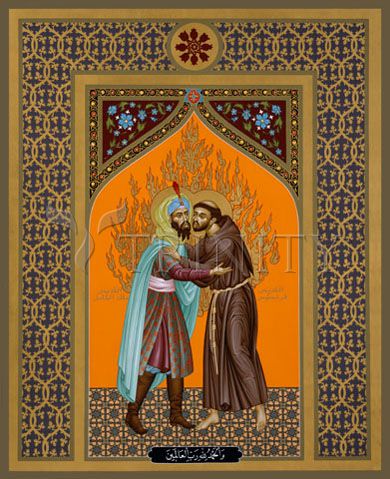
First, he ties himself closely to St. Francis, who had very close links with the Muslim world of his day and who – with Jesus and Mary – is revered also among Muslims and who, after speaking with Sheikh al-Malik al-Kamel (the Sultan of Egypt) told his followers: “[You] are not to engage in arguments or disputes, but to be subject to every human creature for God’s sake.” Then, Francis underlines a number of themes close to the hearts of Muslims: alms giving, a reverence for creation and the family:

“[W]hen the Cardinals elected me as Bishop of Rome and Universal Pastor of the Catholic Church, I chose the name of “Francis”, a very famous saint who loved God and every human being deeply, to the point of being called “universal brother”. He loved, helped and served the needy, the sick and the poor; he also cared greatly for creation. I am aware that family and social dimensions enjoy a particular prominence for Muslims during this period, and it is worth noting that there are certain parallels in each of these areas with Christian faith and practice.”

Next we arrive at the theme chosen for this year’s Ramadan message: “Promoting Mutual Respect through Education,” which Francis lays out as follows:

““Respect” means an attitude of kindness towards people for whom we have consideration and esteem. “Mutual” means that this is not a one-way process, but something shared by both sides. What we are called to respect in each person is first of all his life, his physical integrity, his dignity and the rights deriving from that dignity, his reputation, his property, his ethnic and cultural identity, his ideas and his political choices. We are therefore called to think, speak and write respectfully of the other, not only in his presence, but always and everywhere, avoiding unfair criticism or defamation.”

So far Francis’ message is universal and, I believe, applies to all human relationships and not only those between Christians and Muslims. Kindness, esteem, reciprocity, respect and refraining from gossip are all basics that prepare the ground for the “sincere and lasting friendship” that Francis speaks about later.

Then, Francis’ focus shifts to the aspect of religious belief in this context of human relationships:

“Turning to mutual respect in interreligious relations, especially between Christians and Muslims, we are called to respect the religion of the other, its teachings, its symbols, its values. Particular respect is due to religious leaders and to places of worship. How painful are attacks on one or other of these! It is clear that, when we show respect for the religion of our neighbours or when we offer them our good wishes on the occasion of a religious celebration, we simply seek to share their joy, without making reference to the content of their religious convictions.”

I believe the above is a key move by Francis, in that it explicitly calls for mutual respect of the religious expressions of others while placing the emphasis on the joy and wishing for the good of others that accompany them and that are universally human. No buy-in with regard to the content of religious expression is inferred from being kind and participating in the other’s joy. There is neither proselytizing or attempting to convert the other here nor the suggestion of syncretism.

All of the above is very consistent with what I have heard from Francis so far – we have to realize that we are all brothers and sisters before anything else can happen. In the context of speaking about the poor, his emphasis is always on “touch[ing] the flesh of Christ,” on looking into the eyes of those in need when they are being helped. Just like helping the poor is about building human relationships with them and not only about material assistance, so interreligious dialogue too – and the very essence of the Christian life – is about the exact same thing.

How is this to be achieved though? While the answer here is pretty obvious (education), it is nonetheless worth seeing how Francis puts it:

“Regarding the education of Muslim and Christian youth, we have to bring up our young people to think and speak respectfully of other religions and their followers, and to avoid ridiculing or denigrating their convictions and practices.”

It is impossible to respect and esteem caricatures – if that is how we get used to referring to others (whether they be of a different religion, or none, or of other convictions to our own) we are putting up barriers that prevent us from ever discovering what lives in the hearts and minds of our neighbors.

To conclude, Francis puts his own teaching into practice and concludes his message a follows: “Finally, I send you my prayerful good wishes, that your lives may glorify the Almighty and give joy to those around you. Happy Feast to you all!”

No pomp and circumstance, just sincere simplicity.


1 Instead of having the message sent by the Pontifical Council for Interreligious Dialogue, who normally do so.

Camus on dialogue, revolt, beauty and love

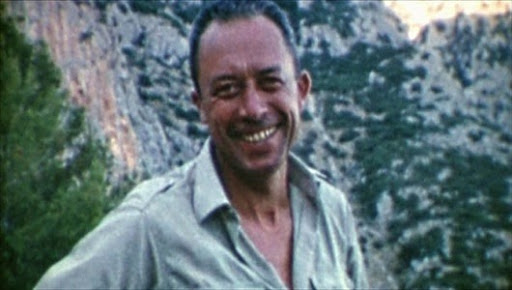
Camus

One of the features of Pope Francis’ first encyclical, Lumen Fidei, that stood out for me most is its constant reference to love, regardless of the specific subject of its reflection. This certainly is not surprising in the context of Christian theology – a theology that is all about God, who is Love – but it’s all-pervasiveness nonetheless made me think. In particular, it made me think about what someone who is not a Christian, who is an atheist or humanist, would say on the subject.

With these questions in mind, I turned to my “read later” reading list and my eyes landed on a piece by Cardinal Gianfranco Ravasi, where he speaks about how Albert Camus‘ thought is a confrontation with the same questions that Christianity grapples with. Questions of meaning, purpose, suffering, revolt, hope and love.

Ravasi there starts with quoting from a talk Camus gave to a group of Dominicans in 1948, where he says to his hosts that “the world of today needs Christians who remain Christians” and where he declares:

“I shall not, as far as I am concerned, try to pass myself off as a Christian in your presence. I share with you the same revulsion from evil. But I do not share your hope, and I continue to struggle against this universe in which children suffer and die.”

This directness and honesty of Camus has always been very attractive to me, which made me look for the full text of his talk to the Dominicans and I found a fairly extensive set of fragments from it here. What struck me there is how I find myself very much agreeing with him, where what he says is in fact a very powerful examination of conscience for Christianity and also for me personally.

From these fragments it is explicit that the Dominicans invited Camus to talk to them about what “unbelievers expect of Christians,” which makes me very impressed with them too, and for which Camus also acknowledged their “intellectual generosity.” He then proceeds to set out the following principles of dialogue:

that “if I allowed myself at the end of this statement to demand of you certain duties, these could only be duties that it is essential to ask of any man today, whether he is or is not a Christian.”

that “I shall never start from the supposition that Christian truth is illusory, but merely from the fact that I could not accept it.”

and that “I shall not try to change anything that I think or anything that you think (insofar as I can judge of it) in order to reach a reconciliation that would be agreeable to all. On the contrary, what I feel like telling you today is that the world needs real dialogue, that falsehood is just as much the opposite of dialogue as is silence, and that the only possible dialogue is the kind between people who remain what they are and speak their mind.”

These are an excellent set of principles: do to others as you would want them to do to you, the principle of charity and respect for the other being who they are, not setting out to change them. In fact, they seem to me to be very much in sync with what Pope Francis said on the same topic: “Dialogue is born of an attitude of respect towards another person, of a conviction that the other has something good to say; it requires that we make space in our heard their point of view, their opinion and their position.”

With these principles as the basis, Camus proceeds to spelling out his expectations:

“What the world expects of Christians is that Christians should speak out, loud and clear, and that they should voice their condemnation in such a way that never a doubt, never the slightest doubt, could rise in the heart of the simplest man. That they should get away from abstraction and confront the blood-stained face history has taken on today. The grouping we need is a grouping of men resolved to speak out clearly and to pay up personally. When a Spanish bishop blesses political executions, he ceases to be a bishop or a Christian; even a man; he is a dog just like the one who, backed by an ideology, orders that execution without doing the dirty work himself. We are still waiting, and I am waiting, for a grouping of all those who refuse to be dogs and are resolved to pay the price that must be paid so that man can be something more than a dog. […]

Perhaps we cannot prevent this world from being a world in which children are tortured. But we can reduce the number of tortured children. And if you don’t help us, who else in the world can help us do this? […]

But it may be […] that Christianity will insist on maintaining a compromise or else on giving its condemnations the obscure form of the encyclical. Possibly it will insist on losing once and for all the virtue of revolt and indignation that belonged to it long ago. In that case Christians will live and Christianity will die. In that case the others will in fact pay for the sacrifice. [… I]f Christians made up their minds to it, millions of voices—millions, I say—throughout the world would be added to the appeal of a handful of isolated individuals who, without any sort of affiliation, today intercede almost everywhere and ceaselessly for children and for men.”

When I read this, it really stopped me in my tracks. This is the kind of dialogue that we, Christians need – someone from the “outside” shaking us, pointing to our errors and doing so not for the sake of some propagandist point-scoring, but out of a genuine concern for our returning to our roots and maintaining our identity. In many ways, what Pope Francis is doing now from the “inside” is similar – the call to poverty, to the “existential peripheries” and to respect for and collaboration with atheists are all examples of it and I am deeply grateful to him and to Camus.

Returning to Ravasi’s discourse, he steers it to another very interesting point of common interest to Christianity and Camus, by quoting from “Helen’s Exile” and then from “The Rebel”:

“Man cannot do without beauty, and this is what our era pretends to want to disregard. It steels itself to attain the absolute and authority; it wants to transfigure the world before having exhausted it, to set it to rights before having understood it. Whatever it may say, our era is deserting this world.”

“Beauty, no doubt, does not make revolutions. But a day will come when revolutions will have need of beauty.”

Here the connection between beauty and the revolt Camus speaks about to the Dominicans is clear – both are set against an exploitation and ignoring of the world. Revolt is directed against suffering while beauty is aimed at appreciating existence.

Ravasi then makes the, to me at first surprising, summary of the above as being “the way of love.” To get a sense of why he may have interpreted it as such, Camus’ own words in “The Rebel” point to the key: “The procedure of beauty, which is to contest reality while endowing it with unity, is also the procedure of rebellion.” Rebellion and beauty bring about unity, which in turn is synonymous with love in Christianity – the Persons of the Trinity being One is their love for each other; Jesus-Love is present among his followers if they are united in his name (cf. Matthew 18:20), etc.

Finally, to underline the importance Camus gives to love, Ravasi quotes the following from his “Notebooks” from 1937:

“If someone told me to write a book on morality, it would have a hundred pages and ninety-nine of them would be blank. On the last page I would write, “I recognize only one duty and that is to love.” And as far as everything else is concerned, I say no.”

St. Augustine would be pleased, as am I 🙂

The infinite nouns of unbelief

Brian cox

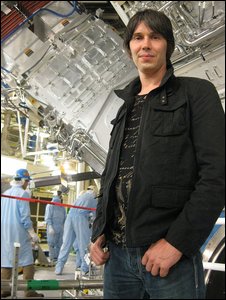
I have been a fan of the physicist Prof. Brian Cox for a while (not least for his TED appearances and the great “Wonders of the Universe” and “Wonders of Life” BBC series) and I now have a new reason: his views on the science-religion relationship:

“As someone who thinks about religion very little – I reject the label atheist because defining me in terms of the things I don’t believe would require an infinite list of nouns – I see no necessary contradiction between religion and science. By which I mean that if I were a deist, I would claim no better example of the skill and ingenuity of The Creator than in the laws of nature that allowed for the magnificent story of the origin and evolution of life on Earth, and their overwhelmingly beautiful expression in our tree of life. I am not a deist, philosopher or theologian, so I will make no further comment on the origin of the laws of nature that permitted life to evolve. I simply don’t know; perhaps someday we will find out.” (Preface, Wonders of Life)

Not only does Prof. Cox put himself into the shoes of those who hold beliefs different from his own – “if I were a deist” – (a key pre-requisite for dialogue), but he even extends the possibility of cognitive consonance to them – “I see no necessary contradiction between religion and science.”

While the above is great, and a real departure from how others, who equally don’t believe in God but have a negative take on the science-religion question, have been approaching this topic, what struck me most about Prof. Cox’s words1 is his saying that “I reject the label atheist because defining me in terms of the things I don’t believe would require an infinite list of nouns.” When I read this, I immediately thought that the same is true of me – “defining me in terms of the things I don’t believe would require an infinite list of nouns” – and that I would not want that either, if I were someone who does not believe in God. Just like I wouldn’t want to be labeled an “amanichean2 (which by virtue of what it denies links me to it), I can see why Prof. Cox is distancing himself from the atheist tag.

What the above attitude also points to is its complement: a focus on what one does believe in, and I think that Prof. Cox and I would have a lot in common, even in the absence of a shared belief in God.3


1 I first saw them in a tweet by @brainpicker and then traced their origin to the “Wonders of Life” book via a blog post.
2 Apologies for the possibly unnecessary neologism …
3 E.g., see a set-theoretic take in an earlier post here.

Art’s dialogue: Vatican @ Venice Biennale

“It’s Sandro, about the Biennale.” was the first thought that entered my mind when I heard about the Vatican’s latest plans to engage with contemporary art, followed by an “Phew!” as soon as I read the details. While the Church has been a patron of the arts during many centuries, it would be fair to say that it’s ties with contemporary art have slipped of late. While still proclaiming the importance of art as such, the picture it portrayed was one of art having expired after the Renaissance.

It was therefore great to see the announcement yesterday by Cardinal Ravasi that the Holy See is going to present a pavilion at this year’s Venice Biennale and to hear about the artists commissioned for it: Studio Azzurro (a Milanese group of video and performance artists), Josef Koudelka (a highly respected Czech photographer, represented by Magnum Photos) and Lawrence Carroll (Australian-born, American painter whose work is in the permanent collections of galleries like the MOCA). Before taking a closer look at these artists, it is worth noting the theme of the pavilion: “In the Beginning.”1 The focus here is on the first 11 chapters of Genesis as an inspiration for the exploration of man’s origins (“Creation”), the introduction of evil into history (“Un-creation”) and the hope that enters the world via the New Man (“Re-creation”). In Ravasi’s words:

“Creation concentrates on the first part of the biblical narrative, when the creative act is introduced through the Word and the breath of the Holy Spirit, generating a temporal and spatial dimension, and all forms of life including human beings.

Un[-]creation, on the other hand, invites us to focus on the choice of going against God’s original plan through forms of ethical and material destruction, such as original sin and the first murder (Cain and Abel), inviting us to reflect on the “inhumanity of man.” The ensuing violence and disharmony trigger a new start for humanity, which begins with the punitive/purifying event of the Flood.

In this biblical story, the concept of the voyage, and the themes of seeking and hope, represented by the figure of Noah and his family and then by Abraham and his progeny, eventually lead to the designation of a New Man and a renewed creation, where a profound internal change gives new meaning and vitality to existence.”

By the sounds of it, this is a very broad brief, which Ravasi underlines by saying that “each of these aspects was only a starting point for the selected artists. A vital, rich, and elaborate dialogue has been established with them and is a sign of a renewed, modern patronage.” And the aim of such patronage? “[I]nstituting and promoting occasions of dialogue within an ever broader and diversified context,” which sounds exactly like the mission statement of Ravasi’s Pontifical Council for Culture and a natural extension to the dialogue already in progress with intellectuals of all faiths an none, promoted via the Courtyard of the Gentiles initiative.

So, who are the three artists chosen for the first Vatican presence at a Venice Biennale?

Studio azzurro

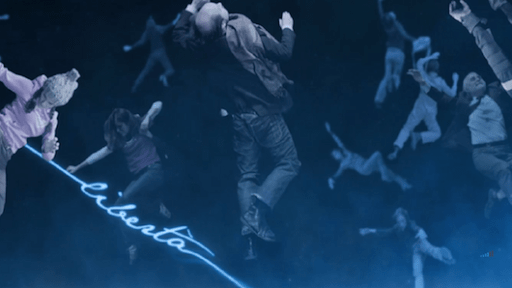
Of the three, the only one I didn’t know of is Studio Azzurro, who have been given the first of the three themes: “Creation” and who place “light, sound, and sensory stimuli at the center of their artistic investigation,” in the words of the art historian and director of the Vatican Museums Prof. Antonio Paolucci. He adds that “[t]heir work triggers a dialogue, awash with echoes and reverberations, between the vegetable and animal kingdoms and the human dimension, which leads, via memory, to other personal narrations.” In broad strokes this sounds like their “Fare gli Italiani” installation in Turin two years ago (a video of which can be seen here) or their earlier “Meditazioni Mediterraneo.” From the perspective of the artists themselves, their interests lie in the “values of memory, places and communities” and their use in “strongly participatory” ways.

Koudelka slovacchia 1963

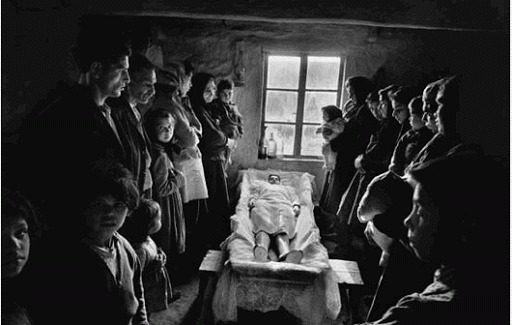
“Un-creation” is entrusted to the photographer Josef Koudelka, whose work is described by Paolucci as follows: “themes such as the destruction brought about by war, the material and conceptual consumption of history through time, and the two opposing poles of nature and industry are made to emerge. The photographer’s images expose an abandoned, wounded world, and at the same time are able to transform fragments of reality into works of art bordering on abstraction.” In many ways this sounds like the “redeeming ugliness” also explored by Michel Pochet, mentioned in an earlier post. To my mind this part of the theme is of great importance as it underlines the being “in the world but not of the world” (cf. John 15:19) of Christianity and a readiness to engage with all of reality. This is an attitude that is at the heart of Koudelka’s approach, who says that “I would like to see everything, look at everything, I want to be the view itself.” His portfolios covering the 1968 invasion of Prague by the Soviet army, the lives of gypsies in Eastern Europe in the ’70s (from which the above photo is taken) and the Welsh landscape in the late ’90s are all great examples of his desire to “be part of everything that is around [him].”

Lawrence carroll

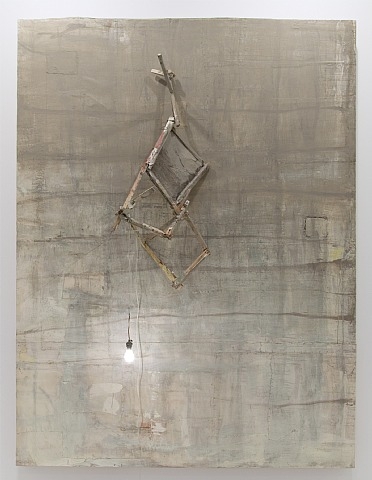
Finally, “Re-creation” will be taken up in the work of the painter Lawrence Carroll, who uses “salvaged materials and the processes of transfiguration, which [he] presents both realistically and symbolically together. His is an elaboration that, meditating on the experiences of Arte Povera, actualizes a continuous and cyclical action of recovery and erosion, of suspension and decline, and of pause and reactivation through the reintroduction of objects into a temporal circuit, forcing fragility and monumentality to coexist” (Paolucci). Carroll himself says that his work “is about the idea that ideas and things have the possibility of having another life” carried from generation to generation of artists. In many ways his work is not only about the transformative, transcendent aspects of art but also its interconnectedness both with past and present ideas, forms and objects.

I believe Cardinal Ravasi has achieved something very impressive here. First, he has chosen a theme with universal appeal and accessible to believers and non-believers alike. Second, he has chosen a set of three artists who are very different from each other, who are respected in and representative of the contemporary art world (insofar as that is possible) and who have a great sense personal freedom (both Koudelka and Carroll have been emphasizing their commitment to their own independence over the year, e.g., with Koudelka saying: “I refuse assignments, even for projects that I have decided to do anyhow […] the idea that no one can buy me is important for me”). Third, he has steered clear of art “destined for the liturgy and sacred spaces” – this is not about interior decoration or illustration but about “rebuild[ing] relations between art and faith.” While not overtly religious, the works commissioned by the Vatican nonetheless speak to themes that are core to Christianity, since – as Cardinal Ravasi puts it – “they should raise questions in people’s minds about their origins and the origins of the world, about sin and destruction, about suffering, but also about hope for a new creation and new way of living.”


1 A theme dear to this blog, where it was covered in the context of the Johannine prologue, the perspective of the roots of science in Genesis and of John Paul II’s Theology of the Body among others.

Other truths

Paul Klee polyphon gefasstes Weiss 1930 Zentrum Paul Klee Bernkl1

Beyond being sheep, Catholics are often also accused of claiming a monopoly on the truth – that it is exclusively them who have it and that everyone else is simply wrong. Sadly there is some basis in this accusation, if you look back over the history of the Church – peaking in shameful crimes like those perpetrated by the Inquisition and for which Blessed Pope John Paul II has unreservedly apologized.

Thankfully the Second Vatican Council has restored a much healthier view of appreciating Truth, wherever it is found, and seeking to learn from and live with those who profess other religions or none. At its root, this newfound openness derives from the event described in last Sunday’s Gospel, where John runs to Jesus to complain: “Teacher, we saw someone driving out demons in your name, and we tried to prevent him because he does not follow us.” It is impressive to see that already at the time of Jesus, his disciples were jealous of Jesus’s actions and teaching and wanted to keep tight control over it. I believe there is a positive motivation for this in that they recognized it as being very valuable and didn’t want it to become distorted by those who did not also have a personal relationship with Jesus.

The response Jesus gives is very clear though: “Do not prevent him. There is no one who performs a mighty deed in my name who can at the same time speak ill of me. For whoever is not against us is for us.” (Mark 9:38-40) Again there is the emphasis on orthopraxy and on the Truth being universal, accessible to all, albeit in different ways and expressed using different language and concepts. The Catechism here states that “the Church considers all goodness and truth found in [other] religions” to come from Him “who enlightens all men.” (CCC, §843).

This challenge is far from dealt with though, and Pope Benedict XVI has spoken about it with great openness and honesty at a meeting with Portuguese artists and scientists during his visit in 2010:

“The Church, in her adherence to the eternal character of truth, is in the process of learning how to live with respect for other “truths” and for the truth of others. Through this respect, open to dialogue, new doors can be opened to the transmission of truth.”

He is very frank about this post–conciliar openness being new, and like with all new things, is the beginning of a process where the Church needs to work out how to behave. In his book, Truth and Tolerance, published in 2003 before he became pope, the then-cardinal Ratzinger lays out the pre-requisites for effective inter-religious dialogue and indeed for a true adherence to one’s own religion:
“Can or must a man simply make the best of the religion that happens to fall to his share, in the form in which it is actually practiced around him? Or must he not, whatever happens, be one who seeks, who strives to purify his conscience and, thus, move toward—at the very least—the purer forms of his own religion? […]

The apostles, and the early Christian congregations as a whole, were only able to see in Jesus their Savior because they were looking for the “hope of Israel”—because they did not simply regard the inherited religious forms of their environment as being sufficient in themselves but were waiting and seeking people with open hearts. […]

[I]t is the dynamic of the conscience and of the silent presence of God in it that is leading religions toward one another and guiding people onto the path to God, not the canonizing of what already exists, so that people are excused from any deeper searching.”

The message here is clear: what is needed is a persistent striving for a conscience that is purified of distractions and impediments (which also requires the practice of charity in its broadest sense) and which will then lead one to God and all people closer to each other.

Lord Sacks, Prof. Dawkins, Archbishop Tutu and the Dalai Lama

Introspection 709731

Just a quick one today – a link to two fantastic videos:

  1. Yesterday the BBC broadcast the best program I have ever seen about the science-religion relationship, following Lord Sacks, the Chief Rabbi of the United Hebrew Congregations of the Commonwealth, talking to three non-believing scientists: Baroness Greenfield, Prof. Al-Khalili and Prof. Dawkins. I have to say that I fully agree with Lord Sack’s view, which in fact is pretty much what I got to in an earlier post. The most impressive thing to me was how he and Richard Dawkins arrived at consensus precisely about the need for rational, good-willed people to work together regardless of their religious or areligious views. I am now officially a huge fan of Lord Sacks (see also my post on one of his blog posts on how hatred and liberty cannot coexist).

    If you are in the UK, you can see the program on iPlayer here and I’ll look for a source accessible from outside the UK later.

    To whet your apetite in the meantime, here are just a couple of quotes:

    “Science takes things apart to see how they work. Religion puts things together to see what they mean.” Lord Sacks
    “There’s nothing quite as frightening as someone who knows they are ‘right’.” Michael Faraday (quoted by Baroness Greenfield)
    “For me religion at its best involves asking questions and challenging conventional assumptions.” Lord Sacks
    “The answer to bad religion is good religion, not no religion.” Lord Sacks

  2. A while ago Archbishop Tutu and the Dalai Lama had a chat via the Google+ ‘hangout’ videoconferencing feature. It is somewhat lengthy, but a joy to watch two friends having a great time. One of the gems was:

    Desmond Tutu: “Do you have an army?”
    Dalai Lama: “Yes, at the spiritual level! No weapons, but wisdom!”

Enjoy! 🙂