Synod15: families more important than institutions

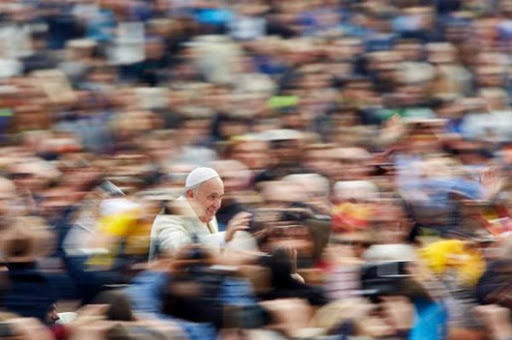
Pope francis blur

Since my last post on the Synod on the Family, which today enters it’s second week, there have been a number of interviews and intervention texts published.

Archbishop Diarmuid Martin of Dublin, in his intervention during one of the General Congregations, spoke about a strong need for change in the language used to speak about marriage and of the need to propose rather than just oppose:

“Our young people make their decisions on marriage and the family within the context of a flawed and antagonistic social culture. It is however not enough to condemn that culture. We have somehow to evangelise that culture. The Synod is called to revitalise the Church’s pastoral concern for marriage and the family and to help believers to see family life as an itinerary of faith. But simply repeating doctrinal formulations alone will not bring the Gospel and the Good News of the Family into an antagonistic society. We have to find a language which helps our young people to appreciate the newness and the challenge of the Gospel.

Where do we find that language? Certainly it cannot be a language which reduces the fullness of the Church’s teaching. We have to find a language which is a bridge to the day-to-day reality of marriage – a human reality, a reality not just of ideals, but of struggle and failure, of tears and joys. Even in within a flawed social culture of the family there are those who seek something more and we have to touch their hearts.

Allow me to give an example. We talk about indissolubility. Most families would not feel that they live indissolubility; they live fidelity and closeness and care in ways we underestimate. As a student, I worked in a centre for prisoners which held a space for women who had to travel long distances before going to visit their spouses in prison. These women were not models of respectable society. They would hardly have been able to pronounce indissolubility. But these women never missed a weekly visit. They understood fidelity, even to a husband who might have betrayed them. And their visit humanised even for a few moment the life of a man whose hope was low.”

In an interview with Vatican Radio, Cardinal Gualtiero Bassetti, archbishop of Perugia, made an important observation about family taking precedence over institutions:

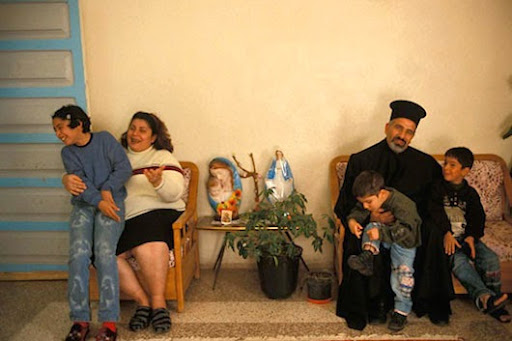
“[In our working group we have] the smallest member of the Synod, Davide, a boy of four months. So, there we have no need for elaborating a definition of the family. The mum every now and again leaves, she goes to breastfeed Davide, because it is clear that the dynamics of the family are more important than those of institutions.”

Cardinal Philippe Nakellentuba Ouédraogo from Burkina Faso then spoke about his expectations for the Synod being a clarification of what living the Gospel means today:

“We expect from this Synod to be precise for Christians and the whole world about what God’s plan is for man, for woman, for marriage and for family life. […] The Gospel doesn’t change. It is our understanding that can change, improve. So, we have our customs, but what is important for us is to know Christ, to love Christ, to be like Christ. That is, living the Gospel.”

Another example of Gospel-based courage comes from the words of Greek-Catholic Hungarian Bishop Fülöp Kocsis:

“We must assess a situation only sociologically, but through the optics of faith: with the strength of this hope there is nothing to fear, because the hope is that we are already saved. We talked, for example, about the attacks on the Church made by the world, but we mustn’t defend ourselves, though, because Jesus Christ has already defeated the devil and conquered death. This starting point, therefore, is very important.”

In his intervention at the Synod, Bishop Mario Grech of Malta spoke out against ideologizing faith and for of putting one’s faith into practice under the specific circumstances of their life, however imperfect they may be: “When theology becomes ideology, the Christian loses their faith and no longer remains a disciple of Jesus. […] The values and virtues that make us conform to the will of God and that are fully established and proven in the future kingdom of God, must be practiced now, to the extent that is possible under the imperfect and sinful circumstances of life in the present time, as the parables of the net and the harvest teach.” Bishop Grech then expressed his support for the type of approach taken in Orthodox Christianity with regard to marriage, where the principle of oikonomia os applied:

“[The logic of oikonomia is] the logic of the approximation of the imperfect towards the ideal situation in a particular case. Every human action is in tension towards the ideal and therefore is an approximation to the ‘ideal’. […] A morally good life does not mean that a person has reached perfection, but rather that the believer is committed and struggles to reach perfection.

The tradition of the Eastern Church states, through the principle of akribeia, that full sacramental marriage is one and must not be dissolved. On the other hand, using the principle of oikonomia, it realizes pastoral mediation in the spirit of indulgence, especially when a person finds themselves in an irreversible situation.”

Pastoral power is not simply in service of the ideal, but for the good of the faithful and can not forget the concrete conditions of life of the believer themselves. A parallel can be drawn between the relationship between akribeia and oikonomia, and the one between justice and pastoral mercy. Two aspects, not opposites, two dimensions of one reality that is developed step by step until it culminates in the fullness of love.”

Fr. Adolfo Nicolas, Superior General of the Jesuits, also made an important point about mercy versus doctrine in an interview with the newspaper Corriere della Sera:

“[In order to make theory and mercy – apparently so antithetical – converge, we must] make room for mercy in the law. For, the law, as we have it in the Church today, is not always also merciful. The law has principles that must be clear. Mercy, on the contrary, is not clear; it always has some ambiguity, because it is impossible to know the depth of the human heart, its weaknesses. Charity cannot be standardized. I have in mind Paul VI, who said to the priests: these are the principles, but please be pastors; accompany people in their reality. Others, on the contrary, have said and say: you have to be pastors, but these are the principles. Apparently, this is the same, but the order is reversed.”

Finally, the moments that stood out from today’s press conference, where the interventions relating already to part 3 of the instrumentum laboris were covered, while the working groups are focusing on part 2, were the following quotes from (unnamed) English-speaking Synod participants:

“For God, no human being is a stranger.”

“Our main task is not, in first place, to tell moral laws and point out sins to people, but it is to show the beauty and value of Christian marriage and the necessity of families through which humanity passes. Sometimes the best thing we can do in such complex, secular situations is to give the testimony of one’s life. A testimony of fidelity and joy.”

Looking back at this post and the several I have already put together about the Synod, the impression may arise that I am being selective about what I share here, that I may omit interventions or interviews that are contrary to my own perspective. This is certainly not my intention and the harmony of what I have shared so far is rooted in the harmony of what I have read coming from the Synod in Rome. Over the weekend, however, I have also come across an interview whose content I do not agree with and that seems dissonant with the rest of what I am reading from the Synod, but I think it is more important to know about it than to pretend that voices like it do not exist. As a result, here are excerpts from an interview with Cardinal John Njue of Nairobi, Kenya, who refers to “the Church’s teaching against homosexuality”:

“It is there in the Bible. It is clear. I think there is not much option. There are facts, such as the fact that God created humanity as Adam and Eve. Whenever someone starts running away from their identity, whatever they do will certainly not be the right thing. If we come to the point of saying that can be changed, there is no logic behind it, with all due respect. Where there is a mistake, a way must be found to help people who have made the mistake to understand that they have done something wrong and need to turn around. It’s not a question of criminalizing or condemning, but we have every right to help the person understand that the way you are living is not how you’re supposed to be.”
Synod14: God does not discriminate

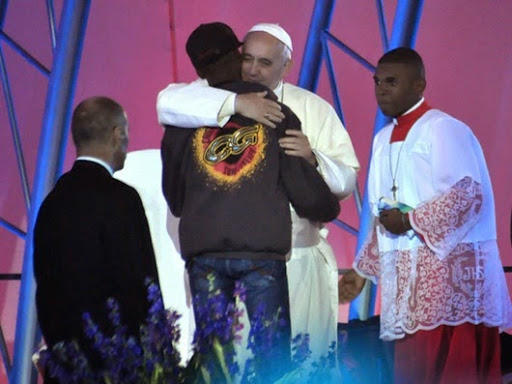
Pope Francis embraces a young man at World Youth Day Rio in 2013

Even though there haven’t been any press conferences or synodal meetings today, more interviews with Synod Fathers have been published over the course of the last day.

Probably the most dramatic have been the words of Archbishop Diarmuid Martin of Dublin, who pointed to significant changes: “[T]his synod cannot simply repeat what was said twenty years ago. It has to find new language, to show that there can be development of doctrine, and that there has been a willingness to listen to what emerged in the questionnaires that went out and what emerged in the synod itself.” He then went on to emphasize the inherent reality of marriage as opposed to its being though of as an imposed teaching:

“There’s a move away from simply an understanding of the church’s teaching on marriage as something that is taught to people – and a greater understanding of the fact that sacramental marriage is an ecclesial reality.

It’s not just a blessing on two spouses. The couple who are married sacramentally develop an ecclesial status for their own lives, but also, as in every other sacrament, for the building of the church.

So in many ways we have to find a way in which the lived experience of this ecclesial reality of marriage … is almost in its own way something that the church learns from rather than simply tries to carry out an external survey of it. That’s certainly one of the changes.”

Finally, Archbishop Martin underlined the need for recognizing the good in people’s lives:

“I meet people in my diocese every, including the poorest people, who live in very difficult situations, and who truly live the values ​​of loyalty, dedication to their children, but they would never be able to express this using the formulations of our theology: but this does not mean they do not live their reality. We need to have a new kind of dialogue with families and a new language.”

The very positive spirit of the Synod can also be felt from comments made by Bishop Oscar Gerardo Fernández Guillén, head of the Bishops’ Conference of Costa Rica who said:

“Even though we face dramatic situations and it could seem like all is lost, that is now how it is. Let us go to the Lord with a humble attitude: He will know how to sustain us and know how to carry us forward.”

The Venezuelan Archbishop Diego R. Padrón Sánchez was equally positive:

“We must announce the joy of living in a family. We are all Church and that is how we must also feel. The Church does not discriminate against anyone, least of all against those who are facing difficulties.”

Cardinal Zenon Grocholewski, prefect of the Congregation for Catholic Education, argued for the need present Christian anthropology in a way shares its beauty:

“I think that the anthropology that we have, and therefore the concept of marriage, is really fantastic, brilliant. If we could explain this to the world of today, it would be a great success. Many do not understand the concept of natural law, but this is fundamentally about understanding what is right and good, according to the light of human reason, for people, for humanity and the long term. It is not, in fact, about ensuring temporary, short-lived pleasure, but about what is good for humanity, for certain progress, for the growth of humanity. We can now see a big gap between scientific and technical progress and, on the other hand, the disgrace regarding the growth of people: there is so much hunger in the world, so many wars, so much hatred, such a lack of respect for people, and we see so much persecution. We have to think of the welfare of humanity. We must not think only of well-being technically, but of that of the human being. I think that this Synod will go in the following direction: how to help people today to live better, to contribute to real progress.”

Cardinal Angelo Scola of Milan, also spoke very clearly about a need for change with regard to homosexual persons: “There is no doubt that we have been slow in assuming a fully respectful view of the dignity and equality of homosexuals.” With regard to communion for the divorced and civilly remarried, Cardinal Scola expressed clear doubts though:

“Personally, on a substantial level, I can not find an answer yet to the possibility that [the divorced and civilly remarried] could have access to sacramental communion without this clashing with the indissolubility of marriage. In short, indissolubility either has an impact on the reality of daily life, or remains a Platonic idea.”

The highlight of today, and the strongest indicator that substantial changes are on the horizon, has been Pope Francis’ magisterial Angelus address, where he insists on God not discriminating against anyone and explaining today’s Gospel reading about the parable of the wedding feast (Matthew 22:1-14) thus:

“Jesus speaks about the answer given to God’s invitation – represented by a king – to attend a wedding banquet. The invitation has three characteristics: gratuity, scale, and universality. Those invited are many, but something surprising happens: none of the selected ones agree to take part in the celebration, saying that they have something else to do; indeed showing some indifference, alienation, even annoyance. God is good to us, freely offering us his friendship, his joy, salvation, but often it is us who do not accept his gifts, we place our material concerns, our interests in the first place and also when the Lord calls us, it often seems to bother us.

Some guests even mistreat and kill the servants who deliver the invitation. But, despite a lack of reception on the part of those who are called, God’s plan is not interrupted. Faced with the refusal of the first guests, he does not lose heart, does not cancel the party, but extends his invitation beyond all reasonable limits and sends his servants into the streets and to the crossroads to gather all those they find. It is ordinary people, the poor, abandoned and destitute, both the good and and bad – yes, even those who are bad are invited – without distinction. And the hall is filled with the “excluded”. The Gospel, rejected by someone, find an unexpected warm welcome in so many other hearts.

The goodness of God has no boundaries and does not discriminate against anyone: this is why the feast of the Lord’s gifts is universal, for all. Everyone is given the opportunity to respond to his invitation, to his call; no one has the right to feel privileged or to an exclusive claim. All this leads us to overcome the habit of positioning ourselves comfortably in the middle, as did the chief priests and the Pharisees. This mustn’t be done; we must open ourselves to the peripheries, recognizing that even those who are on the margins, even one who is despised and rejected by society, is an object of God’s generosity. We are all called to not reducing the Kingdom of God to the confines of a “little church” – our “tiny little church” – but to widen the Church to the scale of the Kingdom of God. There is only one condition: to wear a wedding dress, which is showing love towards God and neighbor.”

Wow!

Synod14: A light that is among us and walks with us

Lumen fidei

Today sees the third day of the Extraordinary Synod on the Family, as well as the publication of various interviews with the Synod Fathers over the course of the last 24 hours, who are left free to speak to the media outside the discussions held within the Synod. I believe that this is a great innovation and one that gives a strong sense of transparency to the process.

Here I would like to pick out some words of Fr. Adolfo Nicolas, the superior general of the Jesuits, who said that “there can be more Christian love in a couple who lives in irregular circumstances than one married in church,” echoing Benedict XVI saying that “agnostics, who are constantly exercised by the question of God, those who long for a pure heart but suffer on account of our[, the Church’s,] sin, are closer to the Kingdom of God than believers whose life of faith is “routine” and who regard the Church merely as an institution, without letting their hearts be touched by faith.” Fr. Nicolas is also reported as saying: “A divorced person has suffered, but we withdraw medicine from him or her who needs it most. No, this cannot be!”

The Archbishop of Dublin, Diarmuid Martin’s intervention in the Synod has also been reported in more detail, where he is quoted as saying:

“[M]any men and women, without making explicit reference to the teaching of the Church, actually live out the value of marital fidelity day-by-day, at times heroically. They would hardly recognise their own experience in the way we present the ideals of married life. Indeed many in genuine humility would probably feel that they are living a life which is distant from the ideal of marriage as presented by Church teaching.”

Martin then proceeded to make a plea for an “incarnated” teaching, close to the reality of people’s lives:

“To many the language of the Church appears to be a disincarnated language of telling people what to do, a “one way dialogue”. I am in no way saying that the Church is not called to teach. I am not saying that experience on its own determines teaching or the authentic interpretation of teaching. What I am saying is that the lived experience and struggle of spouses can help find more effective ways of expression of the fundamental elements of Church teaching. Jesus himself accompanied his preaching the good news with a process of healing the wounded and welcoming those on the margins. His teaching was never disincarnated and unmoved by the concrete human situation in which people could come to be embraced by the Good News. Jesus’ care for the sick and the troubled and those weighed down by burdens is the key which helps to understand how he truly is the Son of God.”

Finally, in a brief interview with Cardinal Nichols there is, I believe, an example of what such new language (and more!) might look like, when he says:

“The family is a place of prayer, the family is a place of shared faith, the family is a place where failure is accepted and worked through, because we want to live by the compassion and the forgiveness that the Lord offers.

I don’t doubt that most young people aspire to having their own family, having their own family within the stable relationship between husband and wife, having that family with a sense of permanence and a permanent, faithful commitment. Nobody wants a wife or a husband who is unfaithful. And so what we have to get across to people is that casual relationships before marriage is actually being casual with somebody’s future husband or wife. And its that sense of the real value that’s written in us, its in the hearts of people, that they aspire to, that has consequences for how we behave today as well.”

Turning to today’s proceedings, the program started with an address by Archbishop Philip Tartaglia of Glasgow, where he first gave an account of happy family life:

“[W]hen husband and wife are happy together and are blessed with children, then love expands from two to three and four and five. In a family, there is every opportunity to be patient and kind and excusing and trusting. There is every opportunity to renew faithfulness to one another by laughing together, crying together, supporting one another, saying sorry to one another, giving one another the benefit of the doubt, embracing one another, being happy for each other, just knowing the right word at the right time. And when those things happen, we are privileged to behold the beauty and simplicity and strength of married love and of family love, a love which truly through the grace of Christ endures all things.”

It is against this backdrop that Tartaglia then declares the need for the Church to help those for whom the above picture does not hold:

“But when families fracture, love is the first casualty. The love which was the glue between spouses turns to hate very quickly. Intimate communion of life is replaced with a terrible logic of division. Children’s peace of heart is shattered and they find themselves both loving and hating their parents at the same time.

Into this sadness, the Church has to find a way to speak St Paul’s words of love, which compassionately excuse and forgive, but which also heal and renew and lift up again; where forgiveness is not accommodation or indifference but genuine and sometimes hard-won reconciliation, engendering new trust, new hope, new endurance, and new faithfulness, a new page in the story of love of husband and wife and their children.”

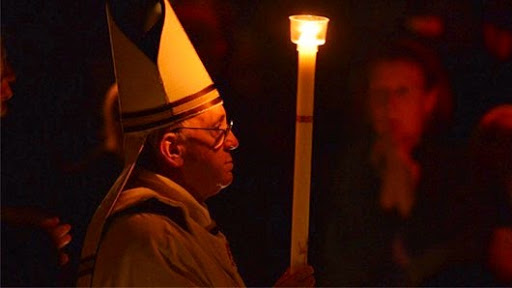
The press conference that took place again at 1 pm, saw a reading out of notes from yesterday afternoon’s and this morning’s session, followed by additional comments made by Fr. Rosica on the basis of English and French contributions during the sessions, including the observation that “[w]e must appeal to the Bible over language of natural law, when we root ourselves in scripture it has a positive effect,” commenting that while natural law is like a fixed spotlight, the Bible speaks about a soft light that is among us and walks with us (i.e., Jesus).1 On a related point, Fr. Dorantes, representing Spanish speakers, used another image about light, saying that the Synod Fathers argued that the Church needs to move from being like a lighthouse that is fixed in place, to being like a torch that men and women can carry with them to shed light on their lives.

The Nigerian Archbishop Ignatius Kaigama, who was also present at the press conference, spoke about the Nigerian bishop’s opposition to the criminalisation of homosexuality:

“We would defend any person with a homosexual orientation who is being harassed, imprisoned or punished….so when the media takes our story they should balance it….we try to share our point of view (but) we don’t punish them. The government may want to punish them but we don’t, in fact we will work to tell the government to stop punishing those who have different orientations.”

The notes from yesterday afternoon’s session were then published, where a link was made between faith and the family, where “the crisis of faith and the crisis of the family was underlined: it was said that the first generates the second. This is because faith is seen mostly as a set of doctrinal mores, whereas it is primarily a free act by which one entrusts oneself to God.” The impact of working conditions on family life and a focus on issues particularly relevant in Africa followed (including “polygamy, levirate marriage, sects, war, poverty, the painful crisis of migration, international pressure for birth control, and so on”).

The notes from this morning’s session then speak about challenges faced in the Middle East and North Africa, where there are “difficult political, economic and religious situations, with serious repercussions on families.” Here the response to a variety of challenges was always along the lines that “Such couples […] must not be neglected and the Church must continue to take care of them” and that “the need to follow the path of mercy in difficult situations was underlined.” The discussion then turned to challenges arising from unstable employment and unemployment:

“The distress caused by the lack of a secure job creates difficulties within families, along with the poverty that often prevents families from having a home. Furthermore, a lack of money often leads to it becoming “deified” and to families being sacrificed on the altar of profit. It is necessary to re-emphasise that money must serve rather than govern.”

And finally, “[t]here was further reflection on the need for greater preparation for marriage, also with special attention to emotional and sexual education, encouraging a true mystical and familiar approach to sexuality.”


1 Note that this relates very well also to Pope Francis’ catechesis on the gifts of the Holy Spirit, where he said: “God forgives always, we men forgive sometimes, but creation never forgives.”

Viri probati: priesthood for married men

Johannes30070 036L

It looks like Pope Francis has started testing the waters for the possibility of reintroducing the option of having married priests in the Roman Catholic Church. In an audience with him,1 Erwin Kräutler, the bishop of Xingu in the Brazilian rainforest, raised the challenges of the shortage of priests. Bishop Kräutler told the Pope about only having 27 priests for 800 communities with 700 000 faithful in the Amazonian rainforest, which means that each parishioner only has access to the Eucharist 2-3 times per year.

Francis’ response was that local bishops know the needs of their people best and that they must be courageous and make proposals for new solutions. Bishops mustn’t act alone and should instead first agree in their local bishops’ conferences about proposals for reform, before then bringing them to Rome. This was followed by the topic of the possibility of ordaining married “viri probati” (“proven/tested men”) as priest,2 which lead Pope Francis to sharing the situation in a Mexican diocese, where there is a married, permanent deacon in every parish, but many do not have a priest. These 300 deacons, however, cannot celebrate the mass. How could this continue? It is here that bishops should make proposals.

That, in a nutshell, is Bishop Kräutler’s account of his conversation with Pope Francis, which The Tablet reported on 10th April in an article entitled “Pope says married men could be ordained – if world’s bishops agree.” Not exactly the letter of the original report, but, I’d say, in agreement with its spirit (the audience with Pope Francis points to a broader consultation process than just a yes/no about ordaining proven married men to the priesthood, and by the sounds of it, it was Kräutler who brought up the topic).

During the following days there then came a number of statements by bishops regarding the question of “viri probati,” in general being in favor of it. Among them are three English and Welsh bishops: Thomas McMahon, the previous Bishop of Brentwood, in whose diocese there were 20 former Anglican married priests, who said:

“I would be saying personally that my experience of married priests has been a very good one indeed. I think people in those parishes where they have been placed have taken to them very well indeed. People look to their priest as a man of God, to lead them to God. If he is a real pastor at their service then it is rather secondary as to whether he is married or not.”

Bishop Seamus Cunningham of Hexham and Newcastle also expressed his support and Bishop Tom Burns of Menevia (Cardiff) said that “These married men would bring a wider experience and understanding to priestly ministry.” A couple of days ago, Archbishop Diarmuid Martin of Dublin also expressed his openness to considering the proposal, while emphasizing the importance to act in unity with the whole Church and with the Pope.

There have also been voices of support for this option in the past: Bishop Manfred Scheuer of Innsbruck in Austria declared himself in favor in 2011, while pointing out his skepticism about whether this would be a measure for addressing the shortage of priests though. Cardinal Timothy Dolan of New York, in the book-length interview, stated that he could see the priestly ordination of viri probati happening, but that he too had reservations about it being a solution to current shortage.

And, let’s not forget Pope Benedict XVI himself allowing for the future priestly ordination of married men in in the context of the Personal Ordinariate established by the apostolic constitution Anglicanorum Coetibus (as opposed to only considering it a transitory measure for the initial transferees from the Anglican Communion).

The concept of “viri probati” dates back to the first century, where it is referred to in a letter (§42:4) by Pope St. Clement I, albeit in a different context – that of candidates for being appointed bishops and deacons in general. The idea there was that the men in question had a track record of living a Christian life, before they were considered for ordination. This is already what is in place for married permanent deacons (a practice re-introduced by Vatican II and having resulted in 16 000 married men being ordained and active as deacons today in the US alone), where the minimum requirement (Can. 1031 §2) for a candidate is the age of 35 years (and the consent of his wife! :).

Essentially this new proposal sounds to me like an opening of priestly ordination to those who today are married deacons or who would become married deacons in the future.

Personally I think this is a good idea, but – like Bishop Scheuer and Cardinal Dolan – I don’t believe it would make a dramatic difference to the number of priests. It is not like there are huge numbers of married men vying for the priesthood and I believe vocations among them are going to be scarce. Not only will they need to have had the vocation to receive the sacrament of marriage (as opposed to just have gotten married) but they will then also need to feel the subsequent call to the priesthood. By probability theory alone I would expect this to be a small number. However, for that small number – even if it only ever applied to one – I’d be in favor of admitting them to the priesthood. Why? Mainly because Jesus did so himself – among the apostles, at the very least St. Peter (the first pope! and a viro very much probato) was married (cf. Matthew 8:14) and chances are that some of the other apostles were too. If it was good enough for Jesus, it sure is good enough for me!

What I find by far more encouraging – and a source of joy – is the process that has already taken place and that is being put into practice by Pope Francis: a bishop comes to see him, shares a concern with him and proposes a solution. Francis encourages him, invites him to consult with his brother bishops and asks him to then escalate the proposal to the universal Church’s level, for discernment by himself. Francis also emphasizes the importance of unity and invites the expression of opinion by others. Other bishops step forward and express their views. All of this within the course of days and in the absence of any formal process and without intermediaries and bureaucrats wedged between the Bishop of Rome and his brother Bishops from around the world. This is what collegiality is about, as Vatican II presents in in Lumen Gentium (§22), and it is finally being put into practice. Ad maiorem Dei gloriam!


1 The news was also picked up by the German branch of Vatican Radio some days later.
2 Note, that this is not the same as opening up the possibility of getting married to priest – a practice that has never existed in the Catholic Church. The question on the table is about married men being ordained priests, not vice versa.