Amoris Lætitia: Communion for the divorced and remarried

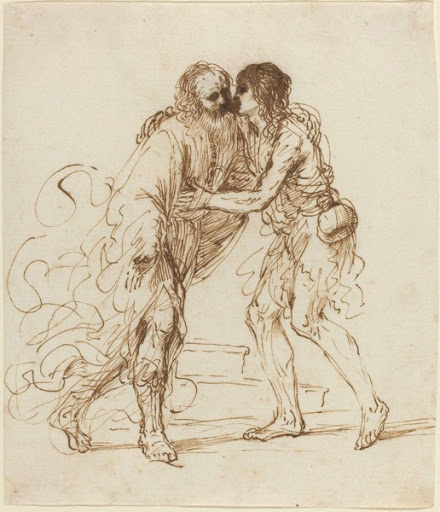
Giovanni francesco barbieri called guercino the return of the prodigal son ca 1640

2314 words, 13 min read

The most hotly debated aspect of Amoris Lætitia, much to Pope Francis’ chagrin, is whether or not it opens access to the Eucharist for at least some divorced and remarried Catholics. Some say that it clearly does not (e.g., Cardinal Gerhard Ludwig Müller, prefect of the Congregation of the Doctrine of the Faith, or Bishop Philip Egan of Portsmouth), others say that is clearly does (e.g., the German Synod Fathers, Card. Marx, Abp. Koch and Bp. Bode, the great German philosopher Robert Spaemann, who by the way doesn’t like that one bit), yet others are reported as saying that it doesn’t, while – if you listen to what they say – they don’t actually do so (e.g., Cardinal Christoph Schönborn of Vienna, whose introduction to Amoris Lætitia Pope Francis singled out as being authoritative). What is clear from the numerous reactions so far is that Pope Francis’ words are being interpreted in contradictory terms not only by some, whose capacity for interpreting them could be questioned and whose conclusions could easily be dismissed, but by competent and expert readers of this 264 page apostolic exhortation.

Instead of engaging with interpretations of Francis’ text, I would here like to take a look directly at what he says in AL that could lead us to a “yes” or “no” conclusion, and instead of presuming to settle the issue, just offer you my own reading.

The obvious starting point is a passage from §305, which is often quoted and which is in the middle of the section entitled “The discernment of “irregular” situations” that spans paragraphs 296-312. Before looking at it, let’s get a sense of the lay of the land first. Right from the get go, in §296, Francis declares that:

“There are two ways of thinking which recur throughout the Church’s history: casting off and reinstating. The Church’s way, from the time of the Council of Jerusalem, has always always been the way of Jesus, the way of mercy and reinstatement… The way of the Church is not to condemn anyone for ever; it is to pour out the balm of God’s mercy on all those who ask for it with a sincere heart… For true charity is always unmerited, unconditional and gratuitous.”

In §297, Francis then reiterates that “No one can be condemned for ever, because that is not the logic of the Gospel!” and speaks with great clarity about the need to preserve the Gospel ideal:

“Naturally, if someone flaunts an objective sin as if it were part of the Christian ideal, or wants to impose something other than what the Church teaches, he or she can in no way presume to teach or preach to others; this is a case of something which separates from the community (cf. Mt 18:17). Such a person needs to listen once more to the Gospel message and its call to conversion.”

What reinstatement and inclusion do not mean is an “anything goes” or a change to what the Church has taught about Christian ideals. At the same time, in §298, Francis calls for nuance instead of a “one size fits all” approach when it comes to the divorced and remarried:

“The divorced who have entered a new union, for example, can find themselves in a variety of situations, which should not be pigeonholed or fit into overly rigid classifications leaving no room for a suitable personal and pastoral discernment. One thing is a second union consolidated over time, with new children, proven fidelity, generous self giving, Christian commitment, a consciousness of its irregularity and of the great difficulty of going back without feeling in conscience that one would fall into new sins. […] Another thing is a new un- ion arising from a recent divorce, with all the suffering and confusion which this entails for children and entire families, or the case of someone who has consistently failed in his obligations to the family.”

Francis echoes Benedict XVI in acknowledging that no “easy recipes” exist here and adds that “the discernment of pastors must always take place “by adequately distinguishing”, with an approach which “carefully discerns situations”.” §300 then sets out a specific, five-stage “examination of conscience” that is to be part of a discernment process involving a pastor and the divorced remarried person. Such a process also has specific pre-conditions: “humility, discretion and love for the Church and her teaching, in a sincere search for God’s will and a desire to make a more perfect response to it.”

§301 presents the consideration of “mitigating factors in pastoral discernment” and Francis declares that it “can no longer simply be said that all those in any “irregular” situation are living in a state of mortal sin and are deprived of sanctifying grace.” (Bearing in mind that “sanctifying grace” is the state that one needs to be in to be eligible for the reception of the Eucharist.) §302 then backs up the legitimacy of the concept of mitigating factors by pointing to passages in the Catechism, which Francis summarizes by saying:

“For this reason, a negative judgment about an objective situation does not imply a judgment about the imputability or culpability of the person involved.”

§303 then calls for a “better incorporation” of “individual conscience […] into the Church’s praxis,” saying that

“conscience can do more than recognize that a given situation does not correspond objectively to the overall demands of the Gospel. It can also recognize with sincerity and honesty what for now is the most generous response which can be given to God, and come to see with a certain moral security that it is what God himself is asking amid the concrete complexity of one’s limits, while yet not fully the objective ideal. In any event, let us recall that this discernment is dynamic; it must remain ever open to new stages of growth and to new decisions which can enable the ideal to be more fully realized.”

Next, we get a section entitled “Rules and discernment,” which opens with the following statement at the beginning of §304:

“It is reductive simply to consider whether or not an individual’s actions correspond to a general law or rule, because that is not enough to discern and ensure full fidelity to God in the concrete life of a human being.”

Next, Francis “earnestly ask[s] that we always recall a teaching of Saint Thomas Aquinas and learn to incorporate it in our pastoral discernment”:

“Although there is necessity in the general principles, the more we descend to matters of detail, the more frequently we encounter defects… In matters of action, truth or practical rectitude is not the same for all, as to matters of detail, but only as to the general principles; and where there is the same rectitude in matters of detail, it is not equally known to all… The principle will be found to fail, according as we descend further into detail”.

What does this mean? Even general rules that set out an absolute good, cannot – in their formulation – provide for all particular situations. Therefore, Francis says in the opening line of §305, “a pastor cannot feel that it is enough simply to apply moral laws to those living in “irregular” situations, as if they were stones to throw at people’s lives,” which brings us to the key passage in §305 where Francis declares that a person “in an objective situation of sin” (such as re-marriage after divorce) can nonetheless be “living in God’s grace” (a pre-requisite for access to the Eucharist1):

“Because of forms of conditioning and mitigating factors, it is possible that in an objective situation of sin – which may not be subjectively culpable, or fully such – a person can be living in God’s grace, can love and can also grow in the life of grace and charity, while receiving the Church’s help to this end.”

To elaborate on what help can be expected from the Church, the above sentence points to the following, much-debated footnote number 351:

“In certain cases, this can include the help of the sacraments. Hence, “I want to remind priests that the confessional must not be a torture chamber, but rather an encounter with the Lord’s mercy” (Apostolic Exhortation Evangelii Gaudium [24 November 2013], 44: AAS 105 [2013], 1038). I would also point out that the Eucharist “is not a prize for the perfect, but a powerful medicine and nourishment for the weak” (ibid., 47: 1039).”

The most obvious interpretation, to my mind, here is that, yes, what Pope Francis is saying is that access to the Eucharist is a possibility in the context of the pastor-lead discernment, where he understands the particular circumstances of a person who approaches him on the back of the pre-conditions spelled out above. It is worth noting here that Cardinal Müller has specifically denied such an interpretation of footnote 351, claiming that “this footnote refers to objective situations of sin in general, not to the specific case of civilly remarried divorcees.” Personally, I find this very hard to see, given that the entire section, in the very middle of which we are here, is all about the divorced and civilly remarried … Furthermore, it is primarily §301 that is the basis of the Eucharist being offered to some divorced and civilly remarried – as “medicine and nourishment”, since it states that those in “irregular” circumstances may nonetheless be in a state of grace. Footnote 351 is then just a spelling out of §301’s consequences.

Before wrapping up my reading of AL from the perspective of whether or not the divorced and civilly remarried have access to the Eucharist (through the above process of pastor-lead discernment), it is also worth noting two aspects of the exhortation that, I believe, indirectly support my interpretation.

First, that Pope Francis never says that the divorced and civilly remarried are excluded from access to the Eucharist, while at the same time making categorical statements about abortion (“So great is the value of a human life, and so inalienable the right to life of an innocent child growing in the mother’s womb, that no alleged right to one’s own body can justify a decision to terminate that life.” (§83)), same-sex marriage (“there are absolutely no grounds for considering homosexual unions to be in any way similar or even remotely analogous to God’s plan for marriage and family” (§251)) and the indissolubility of marriage (“only the exclusive and indissoluble union between a man and a woman has a plenary role to play in society as a stable commitment that bears fruit in new life” (§52)). If Pope Francis would have wanted to maintain pastoral practice as it stands, he could have said that there is no change to it. In fact, even when asked directly after the publication of AL about whether there were “new, concrete possibilities that didn’t exist before” with regard to the “discipline that regulates access to the sacraments for the divorced and remarried”, his response was: “I can say yes, many.”

Second, Pope Francis does explicitly speak about obstacles to receiving the Eucharist in a different context, which consist in “creating scandalous distinctions and divisions among [the Church’s] members” and in “turn[ing] a blind eye to the poor and suffering, or consent[ing] to various forms of division, contempt and inequality”:

“The Eucharist demands that we be members of the one body of the Church. Those who approach the Body and Blood of Christ may not wound that same Body by creating scandalous distinctions and divisions among its members. This is what it means to “discern” the body of the Lord, to acknowledge it with faith and charity both in the sacramental signs and in the community; those who fail to do so eat and drink judgement against themselves. The celebration of the Eucharist thus becomes a constant summons for everyone “to examine himself or herself”, to open the doors of the family to greater fellowship with the underprivileged, and in this way to receive the sacrament of that eucharistic love which makes us one body. We must not forget that “the ‘mysticism’ of the sacrament has a social character”. When those who receive it turn a blind eye to the poor and suffering, or consent to various forms of division, contempt and inequality, the Eucharist is received unworthily. On the other hand, families who are properly disposed and receive the Eucharist regularly, reinforce their desire for fraternity, their social consciousness and their commitment to those in need.” (§186)

Against the background of the above secondary features of Amoris Lætitia, but primarily because of the introduction of greater granularity to how the state of grace is understood of those who are divorced and civilly remarried, as expressed in §301, I have to side with the German Synod Fathers’ and with Robert Spaemann’s reading that Amoris Lætitia does indeed allow for access to the Eucharist for some divorced and civilly remarried Catholics.2, 3

[UPDATE on 13 September 2016] Last Friday, a pair of documents were published that confirm the above reading of Amoris Lætitia directly through the words of Pope Francis, who, responding to a document shared with him by the bishops of the diocese of Buenos Aires, stated that “there is no other interpretation” of Amoris Lætitia’s chapter 8 than that the divorced and civilly remarried may in some cases be admitted to receiving the Eucharist. In addition to the continence scenario that the Buenos Aires document mentions (and that comes from St. John Paul II’s Familiaris Consortio), it also states that such access may also be an option under other circumstances:

“Under other, more complex circumstances, and when it was not possible to obtain a declaration of nullity, the option mentioned above [i.e., continence] may not in fact be feasible. Nonetheless, a path of discernment is still possible. If this arrives, in a specific case, at the conclusion that there are limitations that attenuate responsibility and culpability (cf. 301-302), in particular when a person deems that they would commit further faults that would harm the children of the new union, Amoris Lætitia opens the possibility of access to the sacraments of Reconciliation and the Eucharist (cf. notes 336 and 351). These in turn will dispose the person to continue maturing and growing with the power of grace.”

The document then proceeds to caution against interpreting this as unrestricted access to the sacraments and emphasizes the importance of continuing accompaniment, and examination of conscience.

Having Pope Francis identify this as the only interpretation of Amoris Lætitia now confirms the substantial change that it has introduced to the Church’s pastoral care for the divorced and civilly remarried.


1 The Catechism of the Catholic Church states that “Anyone conscious of a grave sin must receive the sacrament of [Penance and] Reconciliation before coming to communion.” (§1385) and that “[t]he whole power of the sacrament of Penance consists in restoring us to God’s grace and joining us with him in an intimate friendship.” (§1468), with Pope Benedict XVI even bringing these two points together explicitly in in Sacramentum Caritatis §20, emphasizing “the need to be in a state of grace in order to approach sacramental communion worthily”.
2 Beyond what Familiaris Consortio set out in its §84, where the divorced and civilly remarried who abstained from sex were declared to be in a position to receive the Eucharist. I.e., already with St. John Paul II the prohibition was not absolute.
3 Just in case you feel like exclaiming that the Church’s understanding and teaching never changes, take a look here and here (but mainly at the second “here”).
Amoris Lætitia: has anything changed?

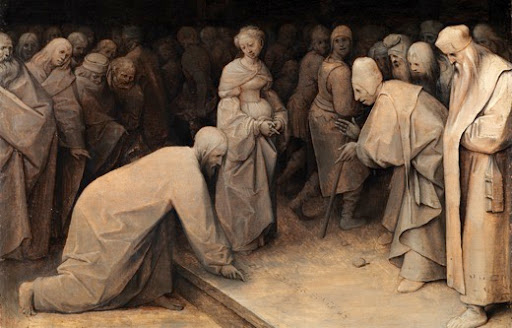
Brueghel jesus writing

1965 words, 10 min read

On the flight back from visiting refugees on the island of Lesbos (and bringing three Muslim families back with him to the Vatican!), Pope Francis was asked point blank: “[W]ith respect to the discipline that regulates access to the sacraments for the divorced and remarried, […] are there new, concrete possibilities that didn’t exist before the publication of the exhortation or not?” In other words, has anything actually changed, or is it “just” a rehashing of the previous status quo, albeit in nicer words.

To this, Francis responded with a clear: “I can say yes, many,” and then recommended a reading of Cardinal Christoph Schönborn’s presentation of Amoris Lætitia during the press conference on 8th April, when the exhortation was published. Pope Francis then added that Schönborn “is a great theologian. He was the secretary for the Congregation of the Doctrine of the Faith, and he knows the doctrine of the faith well. In that presentation, your question will find an answer.”

Before we take a look at what the cardinal said, let’s look at Pope Francis’ next answer from the same in-flight press conference, just to put the question about the divorced and re-married into context:

“One of the recent popes, speaking of the Council, said that there were two councils: the Second Vatican Council in the Basilica of St. Peter, and the other, the council of the media. When I convoked the first synod, the great concern of the majority of the media was communion for the divorced and remarried, and, since I am not a saint, this annoyed me a bit, and then made me sad. Because, thinking of those media who said, this, this and that, don’t they realize that that is not the important problem? Don’t they realize that instead the family throughout the world is in crisis? And the family is the basis of society. Do you not realize that young people don’t want to marry? Don’t you realize that the lack of jobs and employment opportunities mean that dad and mum take on two jobs, and children grow up alone and don’t learn to grow in dialogue with dad and mum? These are the big problems!”

Let’s turn to Cardinal Schönborn’s presentation of Amoris Lætitia (AL) now, to get a sense of what its impact on the divorced and re-married is.

First, Schönborn sets out the foundation of AL, which is universal inclusion:

“No-one must feel condemned, no-one is scorned. In this climate of welcome, the discourse on the Christian vision of marriage and the family becomes an invitation, an encouragement, to the joy of love in which we can believe and which excludes no-one, truly and sincerely no-one.”

Second, he highlights two modes of engagement that AL revolves around and emphasizes that they are directed towards all:

“In Evangelii Gaudium Pope Francis said that we must take of our shoes before the sacred ground of others (EG 36). This fundamental attitude runs throughout the Exhortation. And it is also provides the most profound reason for the other two key words, to discern and to accompany. These words apply not only to the so-called “irregular situation” (Pope Francis underlines this “so-called”) but rather for all people, for every marriage and for every family. Indeed, we are all journeying and we are all in need of “discernment” and “accompaniment”.”

Schönborn then acknowledges a potential misunderstanding of inclusion as “relativism,” “permissiveness,” “laxity” or “anything goes,” and juxtaposes it against an opposite, contrary danger of an “obsession with controlling and dominating everything.” As a means of navigating between these opposed dangers,

“Pope Francis often returns to the issue of trust in the conscience of the faithful: “We have been called to form consciences, not to replace them” (AL 37). The great question, obviously, is this: how do we form consciences? How do we arrive at what is the key concept of all this great document, the key to correctly understanding Pope Francis’ intentions: “personal discernment”, especially in difficult and complex situations? “Discernment” is a central concept in Ignatian exercises. Indeed, these must help to discern the will of God in the concrete situations of life. It is discernment that grants a person a mature character, and the Christian path should be of help in reaching this personal maturity: not forming automatons, externally conditioned and remote-controlled, but people who have matured in their friendship with Christ. Only when this personal “discernment” is mature is it also possible to arrive at “pastoral discernment”; which is important especially in “those situations that fall short of what the Lord demands of us” (AL 6).”

We now arrive at the point in AL (Chapter 8), where “the question of how the Church treats these wounds, of how she treats the failure of love” is addressed. The basis here is again a declaration of the desire to integrate, reinstate:

“With regard to those who are divorced and civilly remarried, [Pope Francis] states: “I am in agreement with the many Synod Fathers who observed that … the logic of integration is the key to their pastoral care. … Such persons need to feel not as excommunicated members of the Church, but instead as living members, able to live and grow in the Church and experience her as a mother who welcomes them always…” (AL 299).”

Schönborn then acknowledges the elephant in the room: “But what does this mean in practice? Many rightly ask this question,” and responds by saying that “The definitive answers are found in Amoris Lætitia, paragraph 300.” So, let’s take a look at it next in full:

“If we consider the immense variety of concrete situations such as those I have mentioned, it is understandable that neither the Synod nor this Exhortation could be expected to provide a new set of general rules, canonical in nature and applicable to all cases. What is possible is simply a renewed encouragement to undertake a responsible personal and pastoral discernment of particular cases, one which would recognize that, since “the degree of responsibility is not equal in all cases”, the consequences or effects of a rule need not necessarily always be the same. Priests have the duty to “accompany [the divorced and remarried] in helping them to understand their situation according to the teaching of the Church and the guidelines of the bishop. Useful in this process is an examination of conscience through moments of reflection and repentance. The divorced and remarried should ask themselves: how did they act towards their children when the conjugal union entered into crisis; whether or not they made attempts at reconciliation; what has become of the abandoned party; what consequences the new relationship has on the rest of the family and the community of the faithful; and what example is being set for young people who are preparing for marriage. A sincere reflection can strengthen trust in the mercy of God which is not denied anyone”. What we are speaking of is a process of accompaniment and discernment which “guides the faithful to an awareness of their situation before God. Conversation with the priest, in the internal forum, contributes to the formation of a correct judgment on what hinders the possibility of a fuller participation in the life of the Church and on what steps can foster it and make it grow. Given that gradualness is not in the law itself (cf. Familiaris Consortio, 34), this discernment can never prescind from the Gospel demands of truth and charity, as proposed by the Church. For this discernment to happen, the following conditions must necessarily be present: humility, discretion and love for the Church and her teaching, in a sincere search for God’s will and a desire to make a more perfect response to it”. These attitudes are essential for avoiding the grave danger of misunderstandings, such as the notion that any priest can quickly grant “exceptions”, or that some people can obtain sacramental privileges in exchange for favours. When a responsible and tactful person, who does not presume to put his or her own desires ahead of the common good of the Church, meets with a pastor capable of acknowledging the seriousness of the matter before him, there can be no risk that a specific discernment may lead people to think that the Church maintains a double standard.” (AL, §300)

Here, Schönborn singles out that those who expected a “new set of general rules” will be “disappointed” and that it is pastoral discernment instead that AL puts forward. This is covered in paragraphs 300-312 and contains the process and examination of conscience proposed in last year’s Synod by the German-language working group (§85 of the 2015 Relatio Finalis which is quoted above in AL §300).

The next big question then is about what Pope Francis says “in relation to access to the sacraments for people who live in “irregular” situations.” And the answer here is in the context presented in §300, where the formulaic is shunned in favor of personal and pastoral discernment:

““Discernment must help to find possible ways of responding to God and growing in the midst of limits. By thinking that everything is black and white, we sometimes close off the way of grace and of growth, and discourage paths of sanctification which give glory to God” (AL 205). [Pope Francis] also reminds us of an important phrase from Evangelii Gaudium, 44: “A small step, in the midst of great human limitations, can be more pleasing to God than a life which appears outwardly in order but moves through the day without confronting great difficulties” (AL 304). In the sense of this “via caritatis” (AL 306), the Pope affirms, in a humble and simple manner, in a note (351) that the help of the sacraments may also be given “in certain cases”. But for this purpose he does not offer us case studies or recipes, but instead simply reminds us of two of his famous phrases: “I want to remind priests that the confessional should not be a torture chamber but rather an encounter with the Lord’s mercy” (EG 44), and the Eucharist “is not a prize for the perfect but a powerful medicine and nourishment for the weak” (EG 47).”

Finally, Schönborn acknowledges the challenges of the above and sums up AL as follows:

“Pope Francis acknowledges this concern [of the “discernment of situations” not being regulated more precisely]: “I understand those who prefer a more rigorous pastoral care which leaves no room for confusion” (AL 308). However, he challenges this, remarking that “We put so many conditions on mercy that we empty it of its concrete meaning and real significance. That is the worst way of watering down the Gospel” (AL 311). Pope Francis trusts in the “joy of love”. Love is able to find the way. It is the compass that shows us the road. It is both the goal and the path itself, because God is love and love is from God. Nothing is more demanding than love. It cannot be obtained cheaply. Therefore, no-one should be afraid that Pope Francis invites us, with Amoris Lætitia, to take too easy a path. The road is not an easy one, but it is full of joy!”

Cardinal Christoph Schönborn’s presentation of Amoris Lætitia is very clear and the answer both to the question of whether anything has changed for the divorced and civilly remarried and to the question of whether anything has changed about their access to the Eucharist is a clear “Yes!”. However, it is a yes that is not in the form of a new decision tree, à la those used in call centers to deal with customer queries, but an invitation to a relationship of accompanying and discernment in which God’s will is sought and where God’s love and mercy flow.

Synod14: Speak clearly, don’t be afraid to offend me

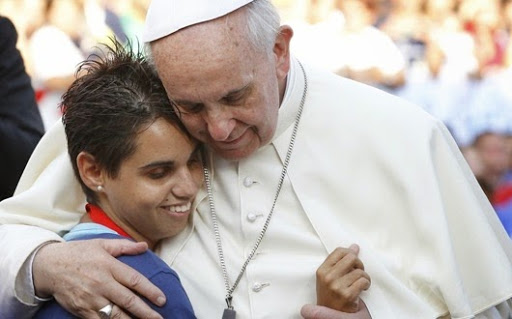
Francis hug

Today saw the first two sessions (“congregations” in Vatican-speak) of the two-week-long extraordinary bishops’ Synod on the family, and I would just like to pick out a couple what I saw as their highlights. First, however, it is worth going back to yesterday’s opening mass of the Synod, when Pope Francis had some warnings for his brother bishops, that clearly set the tone that he expects from the next two weeks’ work:

“The temptation to greed is ever present. […] Greed for money and power. And to satisfy this greed, evil pastors lay intolerable burdens on the shoulders of others, which they themselves do not lift a finger to move (cf. Mt 23:4)

We too, in the Synod of Bishops, are called to work for the Lord’s vineyard. Synod Assemblies are not meant to discuss beautiful and clever ideas, or to see who is more intelligent… They are meant to better nurture and tend the Lord’s vineyard, to help realize his dream, his loving plan for his people. In this case the Lord is asking us to care for the family, which has been from the beginning an integral part of his loving plan for humanity.

We are all sinners and can also be tempted to “take over” the vineyard, because of that greed which is always present in us human beings. God’s dream always clashes with the hypocrisy of some of his servants. We can “thwart” God’s dream if we fail to let ourselves be guided by the Holy Spirit. The Spirit gives us that wisdom which surpasses knowledge, and enables us to work generously with authentic freedom and humble creativity.”

This morning, more along good cop lines, his brief opening remarks then presented the method he would like participants to follow, which builds on clarity, openness, boldness (parrhesia) and tranquility:

“A basic general condition is this: to speak clearly. No one must say: “This can’t be said; he will think of me this way or that …” It is necessary to say everything that is felt with parrhesia. After the last Consistory (February 2014), in which there was talk of the family, a Cardinal wrote to me saying: too bad that some Cardinals didn’t have the courage to say some things out of respect for the Pope, thinking, perhaps, that the Pope thought something different. This is not good; this is not synodality, because it is necessary to say everything that in the Lord one feels should be said, with human respect, without fear. And, at the same time, one must listen with humility and receive with an open heart what the brothers say. Synodality will be exercised with these two attitudes.

Therefore, I ask you, please, for these attitudes of brothers in the Lord: to speak with parrhesia and to listen with humility.

And do so with much tranquillity and peace, because the Synod always unfolds cum Petro et sub Petro, and the Pope’s presence is the guarantee for all and protection of the faith.”

The first session then saw Cardinal Erdő present a 7.5K-word opening document – the “relatio ante disceptationem” – that is effectively the first follow-up to the “Instrumentum Laboris” in which the results of the preceding worldwide questionnaire were summarised. Erdő’s report is based on the written contributions made by the Synod Fathers ahead of the Synod’s opening and, together with the discussions that will last all this week and then in smaller groups next week, it will contribute to the final document that will be submitted to Pope Francis at the conclusion of this process.

As you’d expect, Erdő’s report broadly follows the structure of the Instrumentum Laboris, kicking off with an assessment of the challenges faced today on an individual level:

Many people today have difficulty in thinking in a logical manner and reading lengthy documents. We live in an audio-visual culture, a culture of feelings, emotional experiences and symbols. […]

Many look upon their lives not as a life-long endeavour but a series of moments in which great value is placed on feeling good and enjoying good health. From this vantage point, any firm commitment seems insurmountable and the future appears threatening, because it may happen that in the future we will feel worse. Even social relationships may appear as limitations and obstacles. Respect and “seeking the good” of another person can even call for sacrifice. Isolation is oftentimes linked, therefore, with this cult of a momentary well-being.

How this general disposition (which would not have come as a surprise to Aristippus or Epicurus some 2400 years ago) impacts the position and perception of marriage is addressed next, where there is a balance between challenges and the persistent beauty of the Church’s central teaching:

Avoiding marriage is seen as not only a sign of individualism but also a symptom of the crisis of a society already burdened by formalisms, obligations and bureaucracy. […]

The obligations arising from marriage must not be forgotten, but seen as the demands of the gift which the gift itself makes possible. […]

[The Church’s] teaching [on the family] enjoys a broad consensus among practicing Catholics. This is the case, particularly with regard to the indissolubility of marriage and its sacramental nature among those who are baptized. The teaching on the indissolubility of marriage as such is not questioned. Indeed, it is unchallenged and for the most part observed also in the pastoral practice of the Church with persons who have failed in their marriage and seek a new beginning.

Homosexuality, gender-based discrimination and gender theory get covered next, with a refreshing degree of frankness:

[T]here is a broad consensus that people with a homosexual orientation should not be discriminated against, as reiterated in The Catechism of the Catholic Church (2357-2359). Secondly, it is quite clear that the majority of the baptized — and all episcopal conferences — do not expect that these relationships be equated with marriage between a man and a woman, nor is there a consensus among a vast majority of Catholics on the ideology of gender theories. […]

[M]any want to see a change in the traditional roles in society which are culturally conditioned and in discrimination against women, which continues to be present, without denying, in the process, the differences by nature between the sexes and their reciprocity and complementarity.

The focus is then broadened to a societal level and an acute analysis of the external pressures incident on the family is presented:

We are not dealing with only problems involving individual behaviour but the structures of sin hostile to the family, in a world of inequality and social injustice, of consumerism, on the one hand, and poverty, on the other. Rapid cultural change in every sphere is distorting families, which are the basic unit of society, and putting into question the traditional family culture and oftentimes destroying it. On the other hand, the family is fast becoming the last welcoming human reality in a world determined almost exclusively by finance and technology. A new culture of the family can be the starting point for a renewed human civilization. […]

The widespread difficulty in creating a serene atmosphere of communication in some families is due to multiple factors: business and economic worries; differing views on the upbringing of children from various models of parenting; a reduction in time for dialogue and relaxation. In addition, there are disruptive factors like separation and divorce, with the consequences of a blended family, and, conversely, single parenting, where a relationship with the other parent is confused or limited, if not totally absent. Finally, this lack of communication can result from a widespread selfish mentality that closes in upon itself, with the disturbing consequence of the practice of abortion. The same selfishness can lead to the false idea of parents that children are objects or their property, who can be produced by them as they desire.

Then comes one of my favourite part, where the need for accompanying, for inclusion and for the proclamation of God’s fatherhood and the Church’s motherhood follows:

[T]hought needs to be given on how best to accompany people who find themselves in these situations [of marriage difficulty], so they do not feel excluded from the life of the Church. Finally, forms and suitable language needs to be devised to proclaim that all are and remain God’s children and are loved by God the Father and the Church as Mother. […]

Indeed, God never tires of forgiving the sinner who repents and he does not tire of giving him this possibility again and again. This mercy is not a justification to sin but rather the sinner’s justification, to the extent that he converts and aims to sin no more.

Mercy then gets the central place is requires, with a beautifully succinct paragraph:

Mercy, the central theme of the God’s revelation, is highly important as a hermeneutic for the Church’s actions (cf. Evangelii gaudium, 193 ff.). Certainly, she does not do away with truth nor relativize it, but seeks to interpret it correctly in the hierarchy of truths (cf. Unitatis redintegratio, 11; Evangelii gaudium, 36-37). Nor does she do away with the demands of justice. Consequently, mercy does not take away the commitments which arise from the demands of the marriage bond. They will continue to exist even when human love is weakened or has ceased. This means that, in the case of a (consummated) sacramental marriage, after a divorce, a second marriage recognized by the Church is impossible, while the first spouse is still alive.

Another highlight then is the following section, where the good that is there in civil marriages and even in some forms of cohabitation is called out. This is very much in the spirit of Evangelii Gaudium, where Pope Francis calls for a discernment of what there is of God in every context:

[A] new dimension of pastoral care of the family today reveals itself through considering the reality of civil marriages and, despite the differences, even cohabitation. Consequently, when these relationships are obviously stable in a publicly recognized legal bond, they are characterized by deep affection, display a parental responsibility towards their offspring and an ability to withstand trials and they can be seen as a seed to be nurtured on the path towards celebrating the Sacrament of Marriage. […] The Church cannot fail to take advantage of an opportunity, even in situations which, at first sight, are far from satisfying the criteria of the Gospel, and to draw close to people in order to bring them to a conscious, true and right decision about their relationship.

After an extensive coverage of how the challenges facing those who got divorced and civilly remarried, the report says something that I find tremendously positive and a great example of how we, Catholics, can also look to other Christian churches for inspiration:

The Instrumentum laboris relates that some responses suggest further examining the practice of some of the Orthodox Churches, which allows the possibility of a second or third marriage, marked by a penitential character (cf. 95). Examining this matter is necessary to avoid any questionable interpretations and conclusions which are not sufficiently well-founded. In this regard, studying the history of the discipline of the Churches in the East and West is important. Possible contributions might also come from considering the disciplinary, liturgical and doctrinal traditions of the Eastern Churches.

Finally, Cardinal Erdő’s report concludes with a crescendo:

If we look at the origins of Christianity, we see how it has managed — despite rejection and cultural diversity — to be accepted and welcomed for the depth and intrinsic force of its message. Indeed, Christian revelation has manifested the dignity of the person, not to mention love, sexuality and the family.

The challenge for this synod is to try to bring back to today’s world, which in some way resembles that of the early days of the Church, the attractiveness of the Christian message about marriage and the family, highlighting the joy which they give, but, at the same time, respond, in a true and charitable way (cf. Eph 4:15), to the many problems which have a special impact on the family today and emphasizing that true moral freedom does not consists in doing what one feels or living only by one’s feelings but is realized only in acquiring the true good.

In a real way, we are called upon, above all, to put ourselves alongside our sisters and our brothers in the spirit of the Good Samaritan (cf. Lk 10: 25-37): being attentive to their lives and being especially close to those who have been “wounded” by life and expect a word of hope, which we know only Christ can give us (cf. Jn 6:68).

Divorced from reality

Simulacrum

[Warning: long read, again :)]1

Starting this post is turning out to be more difficult than I anticipated, so, please, forgive my meta-cop-out for its opening line. I have now deleted four alternative openings – all failed attempts at arriving at the question that has been occupying me during the last several weeks. In fact, as framing the question (which tends to be halfway to answering it anyway) is the problem, I’ll tell you about its history for me instead.

One of my very best friends, SH, has once asked me (during the course of about a year’s worth of the most fantastic, enlightening – at least for me – and profound conversations) whether he, an agnostic, ought to want to believe in God. My immediate intuition at the time – and a view I still hold – was: “No.” I felt that it would be insincere to make oneself want to believe (if such a thing were even possible) and I was instead convinced that my friend was already living a life that was following Jesus’ example and if he were to become a believer it would not be as a result of setting out to do so. Put in other terms, I was not worried about my fiend and in fact considered him to be an example to me in orthopraxy (even with his lack of orthodoxy). This is the first marker in the landscape I would like to sketch out for you – an agnostic who lives by the Gospel.

Next, I’d like to bring in another strand that leads to my central question today. For a long time now I have felt a keen sense that the Church (i.e., me included!) must be open to all, welcoming of all, transmitting what Pope Francis refers to as the “warming of hearts” that Jesus’ presence effects. As a consequence, I have been very pleased by the Church’s openness towards atheists and agnostics (e.g., see Franics’ letter to Scalfari), by Her fresh attempts at engaging with homosexual persons (e.g. in Francis’ interview with Jesuit magazines) and by Her apparent concern for all who today are at Her periphery, including divorced and re-married persons (e.g., see Francis’ impromptu interview during the flight back from the Rio World Youth Day). All of this is a great source of joy to me and its opposites, which sadly still exist in the Church, pain me.

The third strand that leads to what I would like to talk about today is the perennial tension in the Church between safeguarding Jesus’ original, explicit teaching and listening to the Holy Spirit’s ever-new guidance in every present moment. Being a Christian is not about taking a piece of 2000-year-old text and solitarily reading it as a self-help book. Instead, it is membership in a body that has Jesus as its head and a vast throng of individuals – both alive today and already past their earthly pilgrimage – as its members. Starting from the apostles themselves, who saw, touched and lived with Jesus, through their followers and their followers’ followers down to the present day, this body – animated by the Holy Spirit – is the Church through whom Jesus walks the Earth today. What Jesus’ message is in 2013, is to be found here – in the Church. This means both that it is alive and dynamic and that it is – simultaneously – the same, one message that Jesus shared with his followers 2000 years ago: love your neighbors as yourself and God above all else (cf. Mark 12:30-31), give your life for your friends (John 15:13), feed the hungry, quench their thirst, clothe the naked, welcome strangers, visit prisoners (cf. Mathew 25:35-36), be peacemakers, merciful, meek (cf. Matthew 5:3-12), be shrewd as serpents and innocent as doves (Matthew 10:16).

The fourth strand is another tension that is part of the very fabric of the Church: Her perfection set against the flaws and failings of Her members. Here it is neither my weakness that makes aiming high futile, nor the holiness of Jesus that makes Him inaccessible. Instead I can choose to allow God’s love into my life without deluding myself into taking credit for its effects or thinking of myself as superior in any way. Dr. Sylvie Barnay put this beautifully in the opening chapter of the book “La grande meretrice” (co-authored with 6 other female historians and looking at the history of the criticisms typically leveled at the Church):2

“The Church remains […] on a journey towards sanctity, a sinner by nature, with the potential for being made perfect by grace. She is therefore neither the Church of the pure, nor a prostitute Church. She is the human Church who hopes to become divine.”

The fifth strand then is a specific confluence of the above four and gets at the specific topic that triggered this post: the challenge of how a person who got married, divorced and then (civilly) re-married participates in the life of the Church. They are not free to receive the Eucharist in the Catholic Church, since they are in a state inconsistent with the indissolubility of marriage that Jesus himself taught explicitly and categorically. As such they don’t live according to, or share with the Church in terms of, an important aspect of what it means to follow Jesus. As a consequence they cannot participate in the sacrament that is both the expression of and means to the unity of the Church. This is a very painful situation for remarried divorcees who desire union with the Church in its most profound gift – the Eucharist – as it is for the whole Church, and Pope Francis has dedicated the first synod of bishops of his pontificate to it and the topic of the pastoral care of families in general.

Francis’ attention to the suffering of remarried divorcees has already lead to a lot of discussion and even to the misinterpretation of a German diocese’s contribution to this discussion as an actual permission for remarried divorcees to receive the Eucharist (immediately followed by the Vatican calling for patience ahead of the coming synod). A couple of days later, Archbishop Müller (head of the Congregation for the Doctrine of the Faith) published an extensive treatise on the subject in L’Osservatore Romano. The gist of the argument is a categorical “no” to the idea of remarried divorcees receiving the Eucharist, and not only that, but a systematic closing-down of a number of potential counter-arguments and loop-holes. Müller essentially says: marriage is indissoluble as Jesus himself told us so directly and unambiguously. As such, those who act as if the sacrament of marriage were dissoluble are objectively at odds with the Church and can not participate in the sacrament that “effects and signifies” Her unity.

At first I was quite puzzled by Müller’s piece (while simultaneously being hugely impressed by the beauty of the argument’s exposition and the clarity of his thinking!) – not because I disagreed with it, on the contrary, everything he says is (as befits his job) highly orthodox and I am in full agreement with him, but because it – prima facie – flies in the face of Francis’ consistent message on this subject.

As is often the case with at-first-sight appearances, there is typically more beneath the surface. As I read Müller’s arguments, I started realizing what he is doing – he is crystalizing what the sacrament of marriage is, exposing its rock-solid foundations and being categorical about its value and centrality to Jesus’ teaching. Between the lines I hear him insisting: “The sacrament of marriage is indissoluble. Don’t look for answers to warming the hearts of remarried divorcees here. Look elsewhere!” To come up with an innovative solution, which the next synod will be devoted to and on which I believe both him and Francis are already at work, it is first essential to ensure that we don’t throw out the baby with the bath water, that we don’t dilute Jesus’ teaching and the immeasurable treasures it contains.

In fact, reading Müller more closely also shows that he is very much concerned for remarried divorcees and for all at the Church’s periphery:

“Clearly, the care of remarried divorcees must not be reduced to the question of receiving the Eucharist. It involves a much more wide-ranging pastoral approach, which seeks to do justice to to the different situations. It is important to realize that there are other ways, apart from sacramental communion, of being in fellowship with God. One can draw close to God by turning to him in faith, hope and charity, in repentance and prayer. God can grant his closeness and his salvation to people on different paths, even if they find themselves in a contradictory life situation.”

Far from just slamming a door shut, Müller calls for a broader view of the situation, which is also in line with another of Pope Francis’ hints on the subject. In his interview on the flight from Rio he quoted his predecessor in Buenos Aires, Cardinal Quarracino, as saying: “I consider half of today’s marriages to be invalid because people get married without realising it means forever. They do it out of social convenience, etc …” In other words, the sacrament of marriage is indissoluble, but not all that looks like sacramental marriage is – or indeed ever was – sacramental marriage. In light of this angle, Müller’s demarcation of marriage and reinforcement of its absolute indissolubility make great sense, as part to a new approach to determining whether in a given instance marriage was ever entered into or not.

I have to say I feel greatly encouraged by all of the above developments and by other statements that Pope Francis has made recently, underlining the sacramental, vocational nature and profound value of marriage. In fact, speaking to a group of young people in Assisi about a month ago, he was very explicit: “[Marriage] is a true and authentic vocation, as are the priesthood and the religious life.” I wholeheartedly agree, but I also think that this statement points to an elephant in the room: if marriage is a vocation like the priesthood and religious life, how come there is such a vast gap between how one prepares for it versus the other vocations. Entering a religious order involves years spent in preparation, passing through various forms of novitiate, being followed by a spiritual director, with the outcome not being a guaranteed admission to the order. Preparation for the priesthood is equally lengthy, with years of study, practical and spiritual preparation and discernment being exercised both by the candidate and the Church’s hierarchy. Marriage instead can be had within a matter of weeks (months at most – if we include the challenges of booking the reception venue :|) and after attending a variable number of “preparation” sessions with a total duration in single digit hours. Yet, once the sacrament is enacted, it is binding for life! No surprise that great suffering can come from such a lopsided and inadequate process.

I clearly don’t mean to say that no couple properly prepares for the sacrament of marriage, since I know many who have, but only that if it does, it is so independently of the marriage preparation provided by the Church. Maybe it would be better for fewer marriages to be entered into and for these to be the result of a couple’s response to a call from God to follow Him as a family, instead of the easy access + heavy penalties model in place today. While writing this, I hear alarm bells in my head though, reminding me that it is imperative for the Church to be open and welcoming to all and the challenge remains of how to achieve such openness while following the path Jesus has shown us.


1 Many thanks to my überbestie, PM, for the great chats we have had about this and related topics.
2 The crude translation from Italian here is all mine, as the book is, sadly, not available in English.