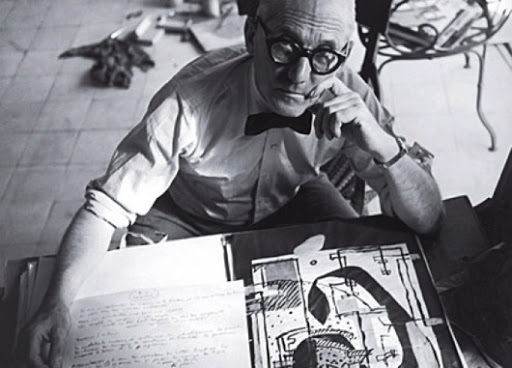
Having come across yet another profoundly misguided piece on church architecture, and not feeling like rehashing previous posts on the subject,1 I instead set out to learn more about Le Corbusier, whose name the aforementioned piece took in vain.
Le Corbusier defined architecture as “giving living form to dead material” and elaborated on its dual nature of construction and art as follows:
“You employ stone, wood and concrete, and with these materials you build houses and palaces. That is construction. Ingenuity is at work. But suddenly you touch my heart, you do me good, I am happy and I say: “This is beautiful.” That is Architecture. Art enters in.”
Even before turning to church architecture, there is a great sense of focus not only on beauty but also on the sacred in Le Corbusier’s thought:
“One preoccupation has concerned me compulsively; to introduce into the home a sense of the sacred; to make the home the temple of the family. From that moment on, everything changed. A cubic centimetre of housing was worth gold, represented possible happiness. With such an idea of dimension and purpose, today you can build a temple to meet family needs beside the very cathedrals.” (Mise Au Point
)2
How does one infuse matter with life, introduce the sacred into every cubic centimeter of a home? Again, Le Corbusier’s thoughts are illuminating:
“I am not faultless or simple, I am filled with turmoil and undercurrents. When pondering and working out a project (town planning, architecture or painting), always a long process, I bring into focus, I realise, I come to the point. I have made an immense effort without a word spoken; over the drawing boards of my office […] I do not speak; my private office (used for patient research) […] is opened to no one. There I am alone. Never in my life have I “explained” a painting. The painting will go out and will be loved or hated, understood or not. Do you think that bothers me! (How could it bother me?)” (The Chapel at Ronchamp, 1957)
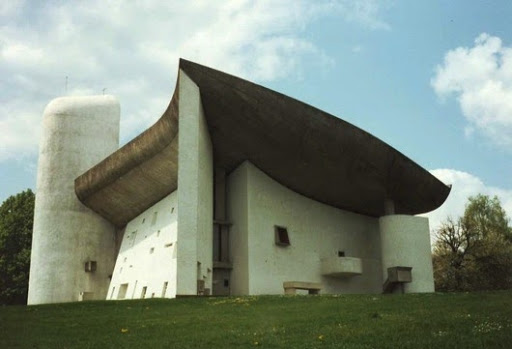
This attitude of infusing matter with purpose, with intention, and doing so in a subtle, hinting rather than overpowering way comes to the fore again when Le Corbusier inaugurates one of his greatest masterpieces – the Chapel of Our Lady of the Height in Ronchamp:
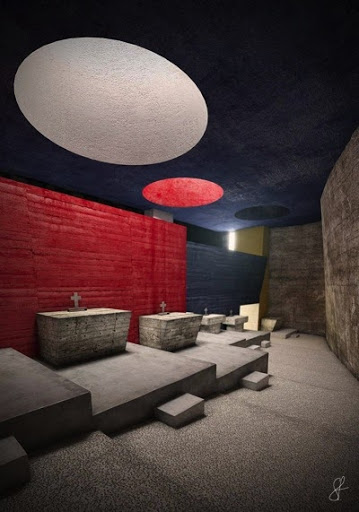
This is “a project difficult, meticulous, primitive, made strong by the resources brought into play, but sensitive and informed by all-embracing mathematics which is the creator of that space which cannot be described in words. A few scattered symbols, a few written words telling the praises of the Virgin. The cross – the true cross of suffering – is raised up in this space; the drama of Christianity has taken possession of the place from this time onwards. […] I give you this chapel of dear, faithful concrete, shaped perhaps with temerity but certainly with courage in the hope that it will seek out in you (as in those who will climb the hill) an echo of what we have drawn into it.” (Le Corbusier’s dedication speech at the chapel’s inauguration, June 25 1955)
To my mind all of the above exudes a profound love of beauty and of the sacred, and a desire to offer it to others in a way that is inviting instead of imposing. Yet, in the course of reading about Le Corbusier, I kept coming across two criticisms leveled against his work. First, that it is inferior to renaissance and antique architecture and that this inferiority stems from ignorance. It is an argument that baffled me from the start, and that I see directly countered when reading about Le Corbusier’s reaction to the Acropolis:
“In 1910 I spent six weeks at the Parthenon. At the age of 23 my consciousness had determined its future direction. “Laborious hours in the revealing light of the Acropolis. Perilous hours which brought a distressing doubt about the (real) strength of our strength, the (real) art of our art. Those who, practising the art of architecture, find themselves at a point in their career,their brain empty, and heart broken with doubt in face of the task of giving living form to dead material, will realise the despondency of soliloquies amongst the ruins. Very often I left the Acropolis, my shoulders bowed with heavy foreboding, not daring to face the fact that one day I would have to practise. The Parthenon is a drama …”” (The Chapel at Ronchamp, 1957)
The second criticism is even more ad hominem and one that I find deeply repugnant. It is an objection to Le Corbusier’s lack of faith and adherence to Catholicism, put forward as a disqualifying obstacle regarding his involvement in church architecture. Such an attitude is exemplified by the following criticism directed at the Dominican3 Fr. Marie-Alain Couturier, O.P., who commissioned Le Corbusier’s work on the Monastery of Sainte-Marie-de-La-Tourette:
“By mistaking the “spirit of the age,” or Zeitgeist, for the Holy Spirit, Couturier assisted in the production of structures by famous modernist architects at the expense of the essential features of Catholic artistic work. […] Couturier placed his trust in artists, believing that all true art revealed something of the sacred. Since true art could only be revealed by true artists, he therefore sought the services of the masters of his time, Catholic or not, to reach the sacred through the production of a supposedly “true” art.”
I couldn’t disagree more! Like Fr. Couturier, and, incidentally, Pope Paul VI,4 I too firmly believe that “all true art reveal[s] something of the sacred.”
In response to these criticisms, it is worth noting two aspects to Le Corbusier, the first of which is his directness and honesty about his beliefs:
“I am not a churchgoer myself, but one thing I do know is that every man has the religious consciousness of belonging to a greater mankind, to a greater or lesser degree, but in the end he is part of it. Into my work I bring so much effusion and intense inner life that it becomes something almost religious. […] People were at first surprised to see me participating in a sacred art. I am not a pagan. Ronchamp is a response to a desire that one occasionally has to extend beyond oneself, and to seek contact with the unknown.”
To leave a reflection on Le Corbusier’s compatibility with Christianity there would be unfair though and could leave a sense of vagueness and hand-waving. Instead, let me conclude by sharing with you the following passage from his book, “When Cathedrals Were White”:
“But those of us who live intensely in the present moment of modem times,[…] have extended our sympathy to all the world and to all times. We have rediscovered life and the axis of all human marvels and agonies. We are far from the theatrical stage which tries to place events of qualitative interest above and outside of human labors. We plunge into daily realities, are face to face with consciousness itself. […] Life bursts forth everywhere, outside the studios where art is “made,” outside of the small circles where it is talked about, outside of the writings in which the spirit of quality is isolated, localized, and disintegrated. […] Every day, every hour, the Earth sees splendors surging up which are truths and present-day beauty. Ephemeral perhaps! Tomorrow, new truths and new beauties bloom. The day after tomorrow, etc. … Thus life is replenished, full. Life is beautiful! We do not have-do we?-any intention or claim to fix the destiny of the eternal things of the future? Everything, at every hour, is only the work of the present moment. The present moment is creative, creating with an unheard-of intensity.”
If that is not Christian thought (albeit thought by a non-Christian), then I don’t know what is, and to support my claim I only need to look as far as Jesus’ own words:
“Therefore I tell you, do not worry about your life, what you will eat [or drink], or about your body, what you will wear. […] Look at the birds in the sky; they do not sow or reap, they gather nothing into barns, yet your heavenly Father feeds them. Are not you more important than they? Can any of you by worrying add a single moment to your life-span? Why are you anxious about clothes? Learn from the way the wild flowers grow. They do not work or spin. But I tell you that not even Solomon in all his splendor was clothed like one of them. If God so clothes the grass of the field, which grows today and is thrown into the oven tomorrow, will he not much more provide for you, O you of little faith? So do not worry and say, ‘What are we to eat?’ or ‘What are we to drink?’ or ‘What are we to wear?’ […] But seek first the kingdom (of God) and his righteousness, and all these things will be given you besides. Do not worry about tomorrow; tomorrow will take care of itself.” (Matthew 6:25-34)
1 The only point I’ll allow myself to make on account of refuting the ludicrous idea that church architecture has had a golden age in some past centuries is to quote from a great post on the Idle Speculations blog, which presents the killer argument that “[i]n Roman times, the early Roman basilicas were of course based on the public buildings of ancient Rome.” The tradition of church architecture is to be contemporary and not a saccharine pastiche of past forms, like the examples touted as successful by blogs like the one that triggered the present post.
2 A great source on Le Corbusier has for me been the excellent “Le Corbusier in Detail
 ” by Flora Samuel, where this quote too can be found.
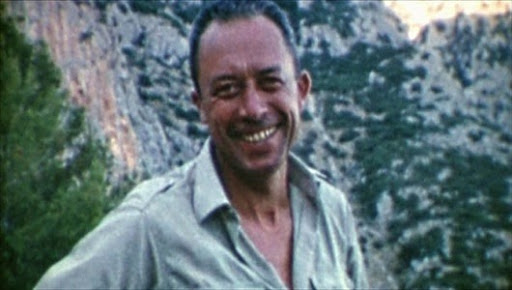
3 I am becoming quite a fan of the Dominicans, given also their links with Camus, mentioned here before.
4 “[T]he Church of the council declares to you through our voice: if you are friends of genuine art, you are our friends.” (Council Closing Messages December 8, 1965 By Pope Paul To Council Fathers)
 ” from 1937:
  eyebeleave