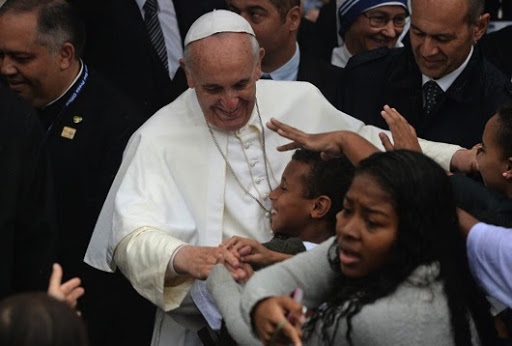
[Warning: Long read! 🙂 The following are my favorite bits from the many talks and homilies Pope Francis gave last week in Brazil. The originals span 30K words, while the following comes in at just above 3K. As you will see, it is more of a collection of gems than an attempt to comment on them, which I am sure I’ll get to in due course. For now I just wanted to give you my “best of” of Francis’ spectacular week in Brazil.]
Last week saw the 28th World Youth Day take place in Rio de Janeiro in Brazil, where as many as 3.7 million young people participated in a variety of events and during which time Pope Francis went on a pilgrimage to the Marian shrine of Aparecida, met with local bishops as well as the leadership of the Latin American Bishops’ Conference (CELAM) and visited one of Rio’s favelas. Instead of giving you a run-through of the week’s proceedings, let me instead just pick out my favorite bits.
Before digging into Francis’ 30K words spoken publicly last week, it might again be interesting to see the ones he used most frequently, with the top 50 being the following:
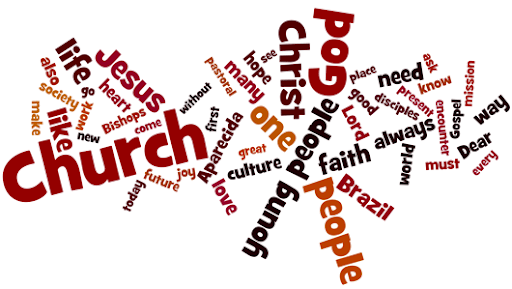
Even just from the above, it is clear both that his emphasis, as ever, is on Jesus, but it can also be seen that he had a particular concern for emphasizing our communion among ourselves and with Him – the Church. Looking at the other words, there is a high frequency of active verbs: make, work, come, love, hope, see, ask, know, encounter – and his frequent use of the word “Aparecida” also stands out. Here, the references are not so much to the place of pilgrimage as to the document written there in 2007 by the Latin American bishops, under the leadership of the then-cardinal Bergoglio. A document that Francis has referred to several times already and with even greater frequency during his visit to Brazil.
Already the day before his departure for Rio, Francis set out his expectations by saying: “All those who come to Rio want to hear Jesus’ voice, to listen to Jesus: ‘Lord, what should I do with my life? What path I should take?’” During the flight from Rome he then spoke briefly to the journalists on his plane, starting by saying that he doesn’t give interviews (a point worth remembering once we’ll come to the spectacular interview he gave during the flight back 🙂 and going on to outline his intentions for the trip, where his aim is:
“to reach out to young people, not in isolation but rather within the larger fabric of society. When we isolate them, we do them an injustice because young people already belong in several ways … they belong to a family, a country, a culture and a faith. […] It’s true, of course, that youth are the future of a people. They’re the future because they have the strength, as young people, to move forward. But those at the other extremity of life, the elderly, are also the future of a people. A people has a future if it moves forward with both these ends – young people with their strength to go forward and the elderly because they’re the ones who offer us the wisdom of life.”
Upon arrival in Rio, Francis heads to the Guanabara Palace for an official welcome, where he starts his speech by saying: “I have neither silver nor gold, but I bring with me the most precious thing given to me: Jesus Christ!,” which again underlines the constant focus on Jesus and a preference for the poor.
Two days later, Francis travels to the Marian shrine of Aparecida, where he starts off by emphasizing the role of Mary: “When the Church looks for Jesus, she always knocks at his Mother’s door and asks: “Show us Jesus”. It is from Mary that the Church learns true discipleship. That is why the Church always goes out on mission in the footsteps of Mary.” Francis then proceeds to talk about “three simple attitudes: hopefulness, openness to being surprised by God, and living in joy” and has the following to say about the last one:
“Christians are joyful, they are never gloomy. God is at our side. We have a Mother who always intercedes for the life of her children, for us […]. Jesus has shown us that the face of God is that of a loving Father. Sin and death have been defeated. Christians cannot be pessimists! They do not look like someone in constant mourning. If we are truly in love with Christ and if we sense how much he loves us, our heart will “light up” with a joy that spreads to everyone around us.”
The next morning Francis headed to the Varginha which is part of the Manguinhos Favela in Rio and said the following to the community assembled in a football field:
“From the start, my wish in planning this visit to Brazil was to be able to visit every district throughout the nation. I would have liked to knock on every door, to say “good morning”, to ask for a glass of cold water, to take a cafezinho, to speak as one would to family friends, to listen to each person pouring out his or her heart – parents, children, grandparents. […]
I am well aware that when someone needing food knocks at your door, you always find a way of sharing food; as the proverb says, one can always “add more water to the beans”! And you do so with love, demonstrating that true riches consist not in material things, but in the heart![…]
No amount of “peace-building” will be able to last, nor will harmony and happiness be attained in a society that ignores, pushes to the margins or excludes a part of itself. A society of that kind simply impoverishes itself, it loses something essential. Let us always remember this: only when we are able to share do we become truly rich; everything that is shared is multiplied! The measure of the greatness of a society is found in the way it treats those most in need, those who have nothing apart from their poverty!”
From the favela, Francis headed for an unscheduled meeting with Argentinian youth in Rio’s cathedral, where he indicated his expectations for when they return home from the World Youth Day:
“I would like us to make noise, I would like those inside the Dioceses to go out into the open; I want the Church to be in the streets; I want us to defend ourselves against all that is worldliness, comfort, being closed and turned within – Parishes, colleges and institutions must get out otherwise they risk becoming NGOs, and the Church is not a Non-Governmental Organization. […] Young people and old people in this moment of history are condemned to the same destiny: exclusion. Don’t let yourselves be excluded!”
Next, Francis headed to the St Francis of Assisi hospital, located in the run-down Tijuca district of northern Rio de Janeiro, where young Franciscan friars and sisters care for the poorest and most marginalized slum dwellers. His message was again about brotherhood and he returned to the image of the “flesh of Christ” that he spoke of on previous occasions:
“[W]hen Francis embraced a leper, this brother, suffering and an outcast, [he] was the “mediator of light … for Saint Francis of Assisi” (Lumen Fidei, 57), because in every suffering brother and sister that we embrace, we embrace the suffering Body of Christ. Today, in this place where people struggle with drug addiction, I wish to embrace each and every one of you, who are the flesh of Christ, and to ask God to renew your journey, and also mine, with purpose and steadfast hope. […] We all need to look upon one another with the loving eyes of Christ, and to learn to embrace those in need, in order to show our closeness, affection and love.”
This same Thursday, that Francis started in Aparecida, continued in the favelas, the cathedral of Rio and finally the hospital caring for drug addicts, concluded with a prayer service on Copacabana beach with the World Youth Day pilgrims, whom he addressed as follows:
“[T]oday you are all here, or better yet, we are all here together as one, in order to share the faith and the joy of an encounter with Christ, of being his disciples. […] Today Christ asks each of us again: Do you want to be my disciple? Do you want to be my friend? Do you want to be a witness to my Gospel? […] I think the answer is yes, because here today, it is good for all of us to be gathered together around Jesus! It is he who welcomes us and who is present in our midst here in Rio. […] Certainly, possessions, money and power can give a momentary thrill, the illusion of being happy, but they end up possessing us and making us always want to have more, never satisfied. “Put on Christ” in your life, place your trust in him and you will never be disappointed!”
On Saturday, Francis first met with Brazil’s political, cultural and business leaders, whom he addressed by touching on on “cultural tradition, joint responsibility for building the future, and constructive dialogue in facing the present moment”:
“Memory of the past and utopian vision of the future meet in the present. […]
[A]n integral humanism and the culture of encounter and relationship: this is the Christian way of promoting the common good, the joy of living. Here, faith and reason unite, the religious dimension and the various aspects of human culture – art, science, labour, literature… Christianity combines transcendence and incarnation; it has the capacity to bring ever new vitality to thought and life, in the face of the threat of frustration and disillusionment which can creep into hearts and spread in the streets.
No one should be denied what is necessary and everyone should be guaranteed dignity, fraternity and solidarity: this is the road that is proposed. In the days of the prophet Amos, God’s frequent warning was already being heard: “They sell the righteous for silver and the needy for a pair of sandals – they … trample down the head of the poor into the dust of the earth and push the afflicted out of the way” (Amos 2:6-7). The outcry, the call for justice, continues to be heard even today.
Between selfish indifference and violent protest there is always another possible option: that of dialogue. Dialogue between generations, dialogue within the people, because we are all that people, the capacity to give and receive, while remaining open to the truth. […] Others always have something to give me, if we know how to approach them in a spirit of openness and without prejudice. This open spirit, without prejudice, I would describe as “social humility”, which is what favours dialogue. Only in this way can understanding grow between cultures and religions, mutual esteem without needless preconceptions, in a climate that is respectful of the rights of everyone. Today,either we take the risk of dialogue, we risk the culture of encounter, or we all fall; this is the path that will bear fruit.”
From the encounter with secular society, Francis proceeds to celebrating mass with priests, religious and seminarian in Rio’s cathedral and speaks to them about the call by God, to proclaim the Gospel and to “promote the culture of encounter”:
“It is not pastoral creativity, or meetings or planning that ensure our fruitfulness, but our being faithful to Jesus, who says insistently: “Abide in me and I in you” (John 15:4). And we know well what that means: to contemplate him, to worship him, to embrace him, especially through our faithfulness to a life of prayer, and in our daily encounter with him, present in the Eucharist and in those most in need. “Being with” Christ does not isolate us from others. Rather, it is a “being with” in order to go forth and encounter others.
We cannot keep ourselves shut up in parishes, in our communities, when so many people are waiting for the Gospel! It is not enough simply to open the door in welcome, but we must go out through that door to seek and meet the people! Let us courageously look to pastoral needs, beginning on the outskirts, with those who are farthest away, with those who do not usually go to church. They are the V.I.P.s invited to the table of the Lord… go and look for them in the nooks and crannies of the streets.”
After lunch with the Brazilian bishops and cardinals, Francis addresses the following words to them:
“[H]umility is one of God’s essential features, part of God’s DNA.
Let us read once again […] the story of Emmaus (cf. Luke 24:13-15). The two disciples have left Jerusalem. They are leaving behind the “nakedness” of God. They are scandalized by the failure of the Messiah in whom they had hoped and who now appeared utterly vanquished, humiliated, even after the third day (vv. 17-21). Here we have to face the difficult mystery of those people who leave the Church, who, under the illusion of alternative ideas, now think that the Church – their Jerusalem – can no longer offer them anything meaningful and important. […] Perhaps the Church appeared too weak, perhaps too distant from their needs, perhaps too poor to respond to their concerns, perhaps too cold, perhaps too caught up with itself, perhaps a prisoner of its own rigid formulas, perhaps the world seems to have made the Church a relic of the past, unfit for new questions; perhaps the Church could speak to people in their infancy but not to those come of age. It is a fact that nowadays there are many people like the two disciples of Emmaus; not only those looking for answers in the new religious groups that are sprouting up, but also those who already seem godless, both in theory and in practice.
Faced with this situation, what are we to do?
We need a Church unafraid of going forth into their night. We need a Church capable of meeting them on their way. We need a Church capable of entering into their conversation. We need a Church able to dialogue with those disciples who, having left Jerusalem behind, are wandering aimlessly, alone, with their own disappointment, disillusioned by a Christianity now considered barren, fruitless soil, incapable of generating meaning.”
In the evening Francis was back with the young people on Copacabana beach, talking to them about being a disciple and a missionary, by analogy with three different uses of a field: as a place for sowing, as a training ground and as a construction site:
“Jesus offers us something bigger than the World Cup! He offers us the possibility of a fulfilled and fruitful life; he also offers us a future with him, an endless future, eternal life. But he asks us to train, “to get in shape”, so that we can face every situation in life undaunted, bearing witness to our faith. How do we get in shape? By talking with him: by prayer, which is our daily conversation with God, who always listens to us. By the sacraments, which make his life grow within us and conform us to Christ. By loving one another, learning to listen, to understand, to forgive, to be accepting and to help others, everybody, with no one excluded or ostracized.”
On Sunday Francis returned to say mass on Copacabana beach, to a crowd of 3 million, and continued with the theme of mission:
“Jesus did not say: “go, if you would like to, if you have the time”, but he said: “Go and make disciples of all nations.” Sharing the experience of faith, bearing witness to the faith, proclaiming the Gospel: this is a command that the Lord entrusts to the whole Church, and that includes you; but it is a command that is born not from a desire for domination, from the desire for power, but from the force of love, from the fact that Jesus first came into our midst and did not give us just a part of himself, but he gave us the whole of himself, he gave his life in order to save us and to show us the love and mercy of God. Jesus does not treat us as slaves, but as people who are free, as friends, as brothers and sisters; and he not only sends us, he accompanies us, he is always beside us in our mission of love.
Where does Jesus send us? There are no borders, no limits: he sends us to everyone. The Gospel is for everyone, not just for some. It is not only for those who seem closer to us, more receptive, more welcoming. It is for everyone. Do not be afraid to go and to bring Christ into every area of life, to the fringes of society, even to those who seem farthest away, most indifferent. The Lord seeks all, he wants everyone to feel the warmth of his mercy and his love.”
After lunch, Francis addressed the leadership of the Council of Bishops’ Conferences of Latin America and the Caribbean, CELAM, with a rich speech, from which I’d just like to pick out a couple of points:
“Christ’s followers are not individuals caught up in a privatized spirituality, but persons in community, devoting themselves to others.
Is pastoral discernment a habitual criterion, through the use of Diocesan Councils? Do such Councils and Parish Councils, whether pastoral or financial, provide real opportunities for lay people to participate in pastoral consultation, organization and planning? The good functioning of these Councils is critical. I believe that on this score, we are far behind. […] As pastors, bishops and priests, are we conscious and convinced of the mission of the lay faithful and do we give them the freedom to continue discerning, in a way befitting their growth as disciples, the mission which the Lord has entrusted to them? Do we support them and accompany them, overcoming the temptation to manipulate them or infantilize them?
Responding to the existential issues of people today, especially the young, listening to the language they speak, can lead to a fruitful change, which must take place with the help of the Gospel, the magisterium, and the Church’s social doctrine. The scenarios and the areopagi involved are quite varied. For example, a single city can contain various collective imaginations which create “different cities”. If we remain within the parameters of our “traditional culture”, which was essentially rural, we will end up nullifying the power of the Holy Spirit. God is everywhere: we have to know how to find him in order to be able to proclaim him in the language of each and every culture; every reality, every language, has its own rhythm.
Every utopian (future-oriented) or restorationist (past-oriented) impulse is spiritually unhealthy. God is real and he shows himself in the “today”. With regard to the past, his presence is given to us as “memory” of his saving work, both in his people and in each of us as individuals; with regard to the future, he gives himself to us as “promise” and hope. In the past God was present and left his mark: memory helps us to encounter him; in the future is promise alone… […] The “today” is closest to eternity; even more: the “today” is a flash of eternity. In the “today”, eternal life is in play.”
Before embarking on the journey back to Rome, Francis met with the volunteers who had helped out with the World Youth Day and addressed the following words to them on the subject of vocations:
“God calls you to make definitive choices, and he has a plan for each of you […]. God calls each of us to be holy, to live his life, but he has a particular path for each one of us. Some are called to holiness through family life in the sacrament of Marriage. Today, there are those who say that marriage is out of fashion; in a culture of relativism and the ephemeral, many preach the importance of “enjoying” the moment. They say that it is not worth making a life- long commitment, making a definitive decision, “for ever”, because we do not know what tomorrow will bring. I ask you, instead, to be revolutionaries, to swim against the tide; yes, I am asking you to rebel against this culture that sees everything as temporary and that ultimately believes that you are incapable of responsibility, that you are incapable of true love. I have confidence in you and I pray for you. Have the courage “to swim against the tide”. Have the courage to be happy.”
Finally, the return flight itself was one of the highlights of this trip, as Francis spent an hour and twenty minutes answering unvetted questions from the journalist on board his plane. I wonder what brought about this change of attitude in Francis, who on the outbound flight declared that he doesn’t do interviews, but I am glad he changed his mind :). Of the many interesting, and masterfully answered questions, let me just pick out the following few:1
“[In response to a question asking Francis why he didn’t address the topics of abortion and same sex marriage:]
Francis: The Church has already expressed itself clearly about this. There was no need to return to it, like there was no need to talk about fraud, or lying, or other topics about which the Church has a clear doctrine.
Patricia Zorzan: But this is a question that interests young people …
Francis: Yes, but there was no need to speak about this, but rather about positive things that open the way ahead for kids. Isn’t that true? Furthermore, young people know perfectly well what the position of the Church is!
Patricia Zorzan: What is the position of Your Holiness, could you tell us?
Francis: That of the Church. I am a son of the Church!
[Asked about the role of women in the Church, Francis responded:]
A Church without women is like the college of apostles without Mary. The role of the woman in the Church is not only maternity, being the mum of a family, it is stronger: she is the icon of the Virgin, of the Madonna; her who helps to grow the Church! Think that the Madonna is more important than the Apostles! She is more important! The Church is female: she is Church, she is a spouse, she is a mother. But the role of the woman in the Church mustn’t end up being just that of a mum, a worker, limited … No! It is something else! […] It is impossible to think of a Church without women, but women who are active in the Church. […] In the Church one has to think of a woman from this perspective: making risky choices, but as women. This has to be explained better. I believe that we haven’t done a deep theology of the woman in the Church yet. She can only do this or that, now she is an altar server, now she reads a reading, she is the president of Caritas … But, there is more! There is a need for a profound theology of the woman. This is what I think.
[In response to another journalist’s question Francis returns to this topic:]
I would like to explain a bit what I have said about the participation of women in the Church: it mustn’t be limited to them being an altar server, president of the Caritas, a catechist … No! It has to be more, but profoundly more, also mystically more, with regard to what I have said about the theology of the woman. And, as far as the ordination of women, the Church has spoken and says: “No.” John Paul II said it with a definitive formulation. That one is closed, that door, but I would like to tell you one thing about it. I have already said it, but I’ll repeat it. The Madonna, Mary, was more important than the Apostles, than bishops, that deacons and than priests. The woman, in the Church, is more important than bishops and than priests; how, is what we need to try and explain better, because I believe that we are missing a theological explanation of this. Thank you.
[Finally, the answer that most stirred the media (for, I believe, good reasons), was in response to a two-part question, whose second part was about the “gay lobby”]
[…] You mention the gay lobby. Uff! [Mah! in Italian :)] A lot is being written about the gay lobby. So far I have not met anyone who’d give me their Vatican ID card with “gay” on it. They say that there are some of them. I believe that when one meets a person like that, it is necessary to distinguish between the fact of it being a gay person and the fact of lobbying, because lobbying is never good. That is bad. If a person is gay and they seek the Lord and have good will, who am I to judge them? The Catechism of the Catholic Church explains this in a very beautiful way. It says: “these persons mustn’t be marginalized for this, they need to be integrated in society.” The problem is not having this tendency, no, we must be brothers, because this is one, but there are others and others. The problem is lobbying: a lobby of misers, a lobby of politicians, a lobby of masons, many lobbies. This is the most serious problem for me. I thank you very much for having asked me this question. Thank you very much!”
In spite of this being a long post, the passages I picked here are just a skimming of the surface of Francis’ spectacular week in Brazil and there will be a lot to think about and internalize in the coming weeks and months. From everything I have read, and from the videos I have seen of Francis speak, by far the most consistent message that I have heard is the emphasis on us all – Christians or not – being brothers and sisters and the need for dialogue, encounter and love. Every person must be loved first, before anything else can be said or done. It is this profound conviction that, I believe, drives Francis to reaching out to all who are in any way marginalized: the poor, the young and elderly, women, gays. It is not some politicking, demagoguery or a giving–in to external pressures that are at play, but a consistent and universal reading of brotherhood and sisterhood.
A final comment I’d like to make regards the frequent insistence over the last days that Francis is not changing Church teaching and that he couldn’t even if he wanted to. While it remains to be seen what changes to Church teaching will result from his unquestionable change of tone and emphasis, I believe that the signs are very strong already: the admission that the theology of the woman is lacking, the outreach to gays (and even the use of the word “gay”!), and his response to a question about the divorced and re-married (that I didn’t quote above) are all pointers that have an unmistakeable direction. To claim that Francis, the head and supreme legislator of the Catholic Church, successor of Peter to whom Jesus said: “I will give you the keys to the kingdom of heaven. Whatever you bind on earth shall be bound in heaven; and whatever you loose on earth shall be loosed in heaven.” (Matthew 16:19), cannot change Church teaching is astonishingly naïve and historically uninformed. Francis insists that he is a “son of the Church,” but let’s not be blind to the fact that it is a Church where, as Francis said, “[t]he “today” is closest to eternity.”
1 For the full, official Italian transcript see here, and for notes from one of the journalists in English, go here. The English in this post is my own, crude, strepidotious, but close, translation from the Italian (and where available, Spanish).

 eyebeleave