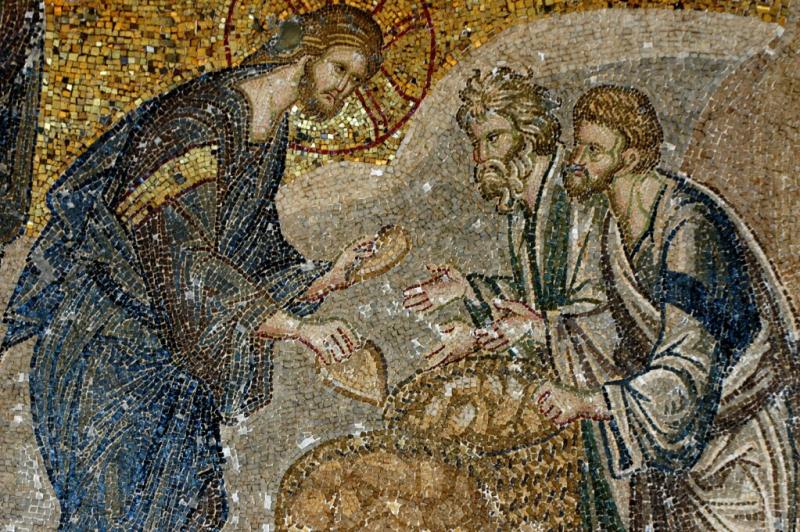
After Sunday’s Gospel reading at mass, I was struck by a seemingly throw-away point made during the homily, where the priest said that Jesus asked his disciples to go and buy some food for the people who assembled to listen to him and were in danger of running hungry:
When Jesus raised his eyes and saw that a large crowd was coming to him, he said to Philip, “Where can we buy enough food for them to eat?” He said this to test him, because he himself knew what he was going to do. Philip answered him, “Two hundred days?’ wages worth of food would not be enough for each of them to have a little.'” One of his disciples, Andrew, the brother of Simon Peter, said to him, “There is a boy here who has five barley loaves and two fish; but what good are these for so many?” Jesus said, “Have the people recline.” Now there was a great deal of grass in that place. So the men reclined, about five thousand in number. Then Jesus took the loaves, gave thanks, and distributed them to those who were reclining, and also as much of the fish as they wanted. When they had had their fill, he said to his disciples, “Gather the fragments left over, so that nothing will be wasted.” So they collected them, and filled twelve wicker baskets with fragments from the five barley loaves that had been more than they could eat.
John 6:5-13
The suggestion that Jesus wanted them to use regular means for feeding the masses made me listen up and reflect on the nature of miracles. The conclusion I am coming to is that the miracles Jesus performed were mostly accidental – not premeditated, planned (maybe with the exception of Lazarus’ raising from the dead where Jesus’ actions took place sometime after he was informed of his friend’s death). In this case, Jesus is spreading the good news of his Father’s love for all and it becomes apparent that the crowd following his words is going to get hungry and disperse to seek food in the nearest towns. Instead of following his disciples’ suggestion to call it a day and send his listeners on their separate ways, Jesus instead challenges their faith and asks them to provide for the crowd. Essentially he’s saying to them: nip down to the shops and fetch some dinner.
In spite of the effect that Jesus has already had on his disciples, Philip comes out with a bit of accountancy, ballparking the order at 200 days’ wages (a touch over £9700 in the UK today, which would give a budget per person/family of just under £2 – not exactly a lavish affair) and attempting to bring Jesus’ desire not to interrupt his mission stumbling down on logistical grounds. What comes next is a really great, but super-hesitant, move by Andrew, who says “There is a boy here who has five barley loaves and two fish; but what good are these for so many?” In other words, I hear Andrew as sticking his neck out and positioning himself next to Jesus by taking a leap of faith and bringing up the slightest of possibilities that could address the present challenge. To my mind the miracle is as much a reward for Andrew as it is a lesson for Philip and for the crowd assembled at Jesus’ feet.
Personally I read it as a call to trust in God and not to self–impose constraints where God’s providence is ready to provide against the odds. I have often experienced generosity by others or the discovery of solutions that only came to light because I placed my trust in God’s providence. Shortly before my older son was to be born, the house we were renting was put on the market and we were given a month’s notice to move. When we were informed about it, I was filled with panic and started rushing around, looking at vacancies but failing to find anything whatsoever as it was two weeks before Christmas and most places were shutting down for the holidays. One evening, and I remember this distinctly, I realized that I was leaving God out of this process (and doing so during Advent of all times!) and decided to skip the frantic search and instead spend the evening in prayer. This certainly calmed me down and when I woke in the morning. the thought came to me to look in the neighboring city instead of the one were we were living at the time. That same day I found us a new house to rent and the following months have shown how good the change of location was for us in ways we could not have anticipated.
Now, was that a miracle? No, in the sense that I don’t believe God intervened in the regular running of the universe. But, it did bring about a conversion in me that lead to greater closeness to God and a more attentive listening to his whispers.
This brings me to the final thought I have about Sunday’s Gospel: how much of what John describes (and incidentally the other three Evangelists too) was a miracle in the sense that the laws of nature were locally and temporarily altered? My impression is that not all. Let me explain … I believe that many people in the crowd that day had some food with them and that, when the gathering was dispersed, they may well have moved to a nice spot, laid it out and had a picnic. Others, who had no food would have had to trek to the nearest village and buy some, yet others would have had to go hungry as they may not have had the means to buy more food for themselves. Instead, what Jesus did by arranging the crowd into smaller groups (making the people assembled to hear him less of an anonymous mass), taking the five loaves of bread and two fish, blessing them and beginning to hand them out, was to create better conditions for sharing. I can imagine that someone who saw what Jesus did and had some food on them would add it to the food passed on to the next person, which in turn would lead to a positive, pyramidal-scheme-like avalanche and result in the many basketfuls collected at the end. Am I saying that I don’t believe a miracle (in the laws-of-nature-bending sense) took place? Certainly not – I do not see why Jesus should not have performed miracles, being God who created the universe out of nothing, but I do believe that his miraculous actions also triggered responses in their witnesses that lead to an amplification. Could Jesus have made food appear for 5000 families – sure! But, isn’t the humble (five loaf of bread + two fish) gesture much more loving, as it allows for human participation, rather than a sudden, imposing appearance of rows of fully-laden tables would have been?

 “, Augsburg, S. 139f.
 eyebeleave