The salvific atheism of Christ

Jf

[Warning: Long read.]

The title of this post is a quote from a conversation between Cardinal Gianfranco Ravasi and the journalist and atheist Eugenio Scalfari. There, Ravasi argued that Jesus’ cry on the cross: “My God, my God, why have you forsaken me?” (Matthew 27:46) can be described as a “salvific atheism.” An atheism that is juxtaposed with the Resurrection, where Jesus remains the Son even when He doesn’t feel the Father and thereby “plants the seed of the infinite in mortality.” Many shy away from attributing atheism to Jesus in this moment, where He laments His being abandoned by God, with a lot of hand-waving and “as if”s or appeals to reason along the lines of “how could Jesus, who is God, have been abandoned by God?!” Such attempts at denying Jesus’ profound experience of the absence of God may have good motives, but they have always struck me as being misguided, since they obscure the extreme nature of this most important moment of Jesus’ life.

That Jesus underwent a trial of this magnitude, where his suffering drove him to a loss of feeling united with the Father – i.e., the very heart of the Trinity, is the most powerful indication of how far God is willing to go towards us, whose faith is limited at the best of times. He is showing us that He is our brother also in darkness and during experiences of the absence of God.

The importance of this nadir in Jesus’ life (and pinnacle of His self-noughting love) was profoundly understood also by Chiara Lubich, the founder of the Focolare Movement who is now on the path of being considered for sainthood, and by the agnostic Swedish film director, Ingmar Bergman.

For Lubich, who with her first companions has spent years focused on putting the Gospel into practice, the realization of the importance of Jesus’ forsakenness on the cross came, when – in 1944 – her spiritual director asked her when Jesus suffered most and declared that he thought it was in his cry of forsakenness on the cross. Looking back to that moment some 56 years later, Lubich described it as follows:

“Right from the start we understood that fullness had another side to it, the tree had its roots. The Gospel covers you in love, but demands everything from you. “If the grain of wheat doesn’t fall to the earth and die – we read in the Gospel of John – it remains just a grain of wheat, but if it dies, it bears much fruit” (Jn 12:24). And the personification of this is Jesus Crucified, whose fruit was the redemption of humankind. […] Through a particular circumstance, we came to know that the greatest suffering of Jesus and, therefore, his greatest act of love, was when on the cross he experienced the abandonment by the Father: “My God, my God, why have you abandoned me?” This touched us to the depths. And our young age, our enthusiasm, but especially the grace of God, urged us to choose only him in his abandonment, as the means to realize our ideal of love.”

Having identified Jesus’ forsakenness as the pinnacle of his love, Lubich and her companions sought to find, love and console Him in the sufferings of all around them and in themselves:

“From that moment on, we seemed to discover his countenance everywhere. He had experienced within himself people’s separation from God and from each other, and he had felt the Father far from him. We saw him not only in all our personal sufferings, which were never lacking, but in those of our neighbor, often alone, abandoned, forgotten, in the separation between generations, between rich and poor, within the very Church at times, and, later, between churches, then between religions and between persons of different convictions.

But these wounds didn’t frighten us. On the contrary, because of our love for him in his abandonment, they attracted us. He had shown us how to face them, how to live them, how to cooperate in overcoming them when, after the abandonment, he placed his spirit in his Father’s hands: “Father, into your hands I commend my spirit” giving to humankind the possibility of being restored to itself and to God, and he showed us the way. And so he manifested himself to be the key to unity, the remedy for every disunity. He was the one who recomposed unity between us each time it cracked. In him we recognized and loved the great and tragic divisions of humankind and of the Church. He became our only Spouse.”

During Lent that same year, Lubich meditated on Jesus’ forsakenness in this way:

“He who is life itself was giving himself completely. It was the culmination of his love, love’s most beautiful expression.

All the painful aspects of life conceal his face: They are nothing other than him.

Yes, because Jesus, crying out in his abandonment, is the image of those who are mute: He no longer knows how to speak.

He is the image of one who is blind – he cannot see; of one who is deaf – he cannot hear.

He is the weary person, moaning.

He is on the brink of desperation.

He is hungry … for union with God.

He is the image of one who has been deceived, betrayed; he seems a failure.

He is fearful, timid, disoriented.

Jesus forsaken is darkness, melancholy, contrast. He is the image of all that is strange, indefinable, that has something monstrous about it. Because he is God crying out for help!

He is the lonely person, the derelict. He seems useless, an outcast, in shock.

Consequently we can recognize him in every suffering brother or sister.”

Finally, Lubich, who has made love of Jesus forsaken her life, describes the following effects of identifying and loving Him in others: “after each encounter in which we have loved Jesus forsaken, we find God in a new way, more face-to-face, with greater openness and fuller unity. Light and joy return; and with the joy, that peace which is the fruit of the spirit.”

To get another, deeply insightful, perspective on this key moment in Jesus’ life, Bergman’s “Winter Light,” that premiered in 1962, has its characters speak about it twice. First, when the pastor of a town, plagued by doubt, breaks down in front of a parishioner who comes to him for help, saying, with obvious anguish and torment throughout:

“If there is no God, would it really make any difference? Life would become understandable. What a relief!

And thus death would be a snuffing out of life. The dissolution of body and soul. Cruelty, loneliness and fear … all these things would be straightforward and transparent.

Suffering is incomprehensible, so it needs no explanation.

There is no creator. No sustainer of life. No design.

My God…

Why have you forsaken me?

I’m free, free at last.”

Before giving thought to the above, let’s look at the second reference to Jesus’ forsakenness, which comes later, when the disabled sacristan (who didn’t hear the pastor’s lament) shares the following reflection with him:

“Wouldn’t you say the focus on [Christ’s] suffering is all wrong? This emphasis on physical pain. It couldn’t have been all that bad. It may sound presumptuous of me – but in my humble way, I’ve suffered as much physical pain as Jesus.

And his torments were rather brief. Lasting some four hours, I gather? I feel that he was tormented far worse on an other level.

Maybe I’ve got it all wrong. But just think of Gethsemane, Vicar. Christ’s disciples fell asleep. They hadn’t understood the meaning of the last supper, or anything. And when the servants of the law appeared, they ran away. And Peter denied him. Christ had known his disciples for three years. They’d lived together day in and day out – but they never grasped what he meant.

They abandoned him, to the last man. And he was left alone. That must have been painful. Realizing that no one understands. To be abandoned when you need someone to rely on – that must be excruciatingly painful. But the worse was yet to come. When Jesus was nailed to the cross – and hung there in torment – he cried out: “God, my God! Why hast thou forsaken me?” He cried out as loud as he could. He thought that his heavenly father had abandoned him. He believed everything he’d ever preached was a lie. The moments before he died, Christ was seized by doubt. Surely that must have been his greatest hardship? God’s silence.”

To my mind, the above are two great attempts at an identification with the forsaken, crucified Jesus. The first, the pastor’s, is an identification from within – a re-experiencing of Jesus’ forsakenness at first hand, that leads the protagonist to a wishing away of it all, to a denial of the problem’s reality and a subsequent, forced declaration of freedom (forced and strained because of how it is portrayed in the movie). The second is an identification from the position of compassion and intuition – the disabled sacristan takes his own physical and psychological sufferings as a basis for inferring the greater magnitude of the latter, and – by extrapolation – intuiting that Jesus’ forsakenness on the cross – the experience of “God’s silence” – must have been most severe.

In many ways it is the pastor’s experience that gives the greatest sense of what it may have been like for Jesus himself, by the anguish and despair that it presents. The sacristan’s monologue, in turn, is – to my mind – already a source of hope in that it demonstrates another’s capacity to intuit my despair and therefore be lead to compassion.
Francis fights fundamentalism

20110311 gor chakhal

A new book by Pope Francis, entitled “Beauty will teach the world,” was published today in Italian and the daily La Repubblica has already released an excerpt. There Francis speaks out against fundamentalism, and while his thoughts are very much along the lines of the understanding of truth that he laid out in the letter to Scalfari, their freshness and forcefulness expand the scope and intensity of the previous sketch. Since I haven’t found an English translation yet, the following is my own, rough attempt.

In the published excerpt, Francis starts with an analysis of fundamentalism, portrayed as a flavor of insecurity and cowardice:

“What is apparent is the fact that during the course of history there has been an explosion, and there continues to be an explosion also today, of fundamentalisms. At their heart, these systems of thought and conduct are absolutely outdated, mummified, and serve as bunkers. Fundamentalism grows from the rigidity of a single thought, inside which a person protects itself from sources of instability (and from crises) in exchange for a certain existential calm. Fundamentalism does not allow for shades of meaning or second thoughts, simply because it is afraid and – specifically – it is afraid of the truth. The person who hides in fundamentalism is someone who is afraid to set out on a journey in search of truth. They already “possess” the truth, they have already acquired it and used it as a defensive means; therefore they experience each discussion as personal aggression.”

Francis then presents an alternative view of the truth – not as defense mechanism and aggression, but as a shared gift, very much reminiscent also of Dr. Slipper’s paper on “cognition by mutual reflection”:

“Our relationship to the truth isn’t static, because the Supreme Truth is infinite and can always be known better; it is always possible to immerse oneself into greater depth in it. The apostle Peter asks of Christians to be ready to “give an explanation”1 of their hope; which means that the truth, on which we base existence, must open itself to dialogue, to the difficulties that others show us or that circumstances present us with. Truth is always “reasonable,” even when I may not be, and the challenge is to remain open to the point of view of the other, without turning our convictions into an immovable whole. Dialogue does not mean relativism, but a “logos” that is shared, reason that offers itself in love, to build together a reality that is more and more liberating every time.”

Dialogue therefore fosters a sharing in truth and freedom, built on mutual openness, and Francis proceeds to project the consequences of such an attitude even further, calling it a “virtuous cycle”:

“In this virtuous cycle, dialogue uncovers the truth and the truth is nourished by dialogue. Careful listening, respectful silence, sincere empathy, an authentic making oneself available to the stranger and the other, are essential virtues that are to be fostered and transmitted in today’s world. God himself calls us to dialogue, he calls and summons us by his Word, the Word that has abandoned every nest and shelter to make itself human.”

Dialogue is presented here not only as something that is a good thing to do, but – for Christians – as a direct call from God and an example set by Him, which in turn opens new dimensions:

“As a result, three, intimately interlinked, dimensions of dialogue appear: one between the person and God – the one that we Christians call prayer, one among human beings themselves, and a third one, of dialogue with oneself. Through these three dimensions the truth grows, consolidates itself and extends over time. […] At this point we have to ask ourselves: what do we mean by the truth? Seeking the truth is different from finding formulae for possessing and manipulating it to one’s own liking.”

An aspect of the above that I particularly like is the order in which Francis presents the dimensions of dialogue: God, others, self … With this framework in place, he proceeds to emphasize the role of humility in the quest for truth:

“The search involves the totality of the person and of being. It is a journey that fundamentally involves humility. With the firm conviction that no one is sufficient for themselves and that it is dehumanizing to use others as means for being sufficient for oneself, the search for the truth embarks on this laborious journey, often artisanal, with a humble heart that refuses to quench its thirst with standing waters.

A fundamentalist “possession” of the truth lacks humility: it tries to impose itself on others by a gesture that, in and of itself, is self-defensive. The search for truth does not quench the roaring thirst. An awareness of “wise ignorance”2 lets us continually restart the journey. A “wise ignorance” that, with life’s experiences, becomes “learned.” We can affirm without fear that the truth isn’t had, is not possessed: it is encountered. For us to desire it, it must cease to be the one that can be possessed. The truth opens itself, uncovers itself to those who – in turn – open themselves to her. The word truth, precisely in its Greek sense of aletheia, suggests that which manifests itself, that which uncovers itself, that which reveals itself by means of a miraculous and gratuitous apparition. The Hebrew sense, instead, of the term emet, unites the meaning of the true with that of the certain, stable, that which does not lie or deceive. The truth, therefore, has a dual connotation: it is a manifestation of the essence of things and persons, that in their opening up of their innermost selves give us the certainty of their authenticity, the reliable proof that invites us to believe in them.”

How does such a concept of certainty mesh with the humility Francis called for earlier on?

“Such certainty is humble, because it simply “lets the other be” it its manifestation, and does not subject it to our needs or demands. This is the first justice that we owe others and ourselves: to accept the truth of what we are, to tell the truth of what we think. Our painful political history has tried many times to gag them. Very often the use of euphemisms has anesthetized us or made us fall asleep before her. But, the time has come to rejoin, to twin ourselves with the truth that needs to be announced prophetically, with justice authentically restored. Justice only springs forth when the circumstances, that we are betrayed and deceived by in our historical destiny, are called by their names. And by doing this, we accomplish one of the principal services of responsibility due to future generations.”

The above seems very clear to me: the need for dialogue and humility that Francis starts out with is motivated by the need for an honest understanding and acceptance of reality, whose denial and distortion otherwise go against the good of all. To conclude the excerpt, Francis pulls back from truth, to reveal her sisters – goodness and beauty:

“The truth is never found by herself. Together with her there are goodness and beauty. Or, better put, the Truth is good and beautiful. An Argentinian thinker used to say: “A truth that is not entirely good always hides some goodness that is not entirely true.” I insist: these three go together and it is neither possible to find nor seek one without the others. It is a reality that is very different from the simple “possession of truth” claimed by fundamentalism: they take formulae in and of themselves as valid, emptied of goodness and beauty, and they try to impose themselves on others with aggression and violence, doing evil and conspiring against life itself.”

As soon as a proper translation becomes available, I’ll point to it here, but I hope that even my broken attempts at rendering Pope Francis’ thoughts in English will give you a sense of his concerns and his positioning of the truth as part of a set with goodness and beauty and as a gift received with others in response to openness, dialogue and a journey shared.


1 “Always be ready to give an explanation to anyone who asks you for a reason for your hope.” (1 Peter 3:15)
2 I guess this is in reference to the Socratic: “I am wiser than this man; for neither of us really knows anything fine and good, but this man thinks he knows something when he does not, whereas I, as I do not know anything, do not think I do either. I seem, then, in just this little thing to be wiser than this man at any rate, that what I do not know I do not think I know either.” (Plato, Apology 21d)

Athena and/or Jesus?

Athena

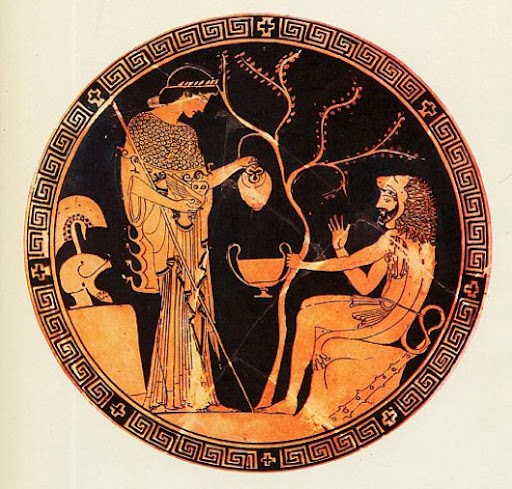
The other day I watched a greatly edifying and enjoyable video of Eugenio Scalfari and Cardinal Gianfranco Ravasi having a chat about a variety of topics in the context of the Courtyard of the Gentiles initiative launched by Pope Benedict XVI – a forum for dialogue between catholics and non-believers. What struck me in particular was a train of thought triggered by Scalfari commenting on Ravasi quoting him as having said that he was “in love” with Jesus. To this Scalfari responds:1

“Maybe it is an exaggerated phrase, but it is true. I have been following the life and preaching of Jesus ever since I was a kid, since I abandoned the faith. I grew up in a Catholic family […] but then I met Athena, together with Italo Calvino, with whom I shared a desk for three years at school …”

This follows the pattern I have seen so many times among my friends: I grew up a Catholic (or member of another church), but then I realized that belief in God was not reasonable and I became an atheist or agnostic. Scalfari tells the same story: upon encountering Athena (the Greek goddess of wisdom) his religious beliefs crumbled. Faced with a choice between faith and reason, he opted for the latter and while he still admires Jesus, he does so without any accompanying – irrational or at least arational – religious beliefs.

I particularly liked the posing of the above process with rationality personified by Athena, as it gave it a symmetry that less poetic accounts lack, and I was looking forward to Ravasi’s response, as this was a statement that he was sure to react to:

“[You tell the story of how you] made the choice of Athena, in a certain sense abandoning the choice of Christ in that moment at least. I think though that this choice, these two choices are not necessary and divisive, that they would split a person. Because I am firmly convinced, I personally, that, even though I have made the choice of Christ, I have not renounced my choice of Athena. Athena, reason, has always interested me.”

Ravasi then – very compellingly – proceeds to expand on Pope Francis’s speaking about the Truth in relational terms in his letter to Scalfari, and then shares the following, personal reflection:

“I, for myself, can’t say that I have the Truth, that I have God. I, every day, have to return – and in some moments it is likely that I drift into a territory where the heavens seem devoid of divinity … [pause] Precisely because there is this dimension of the subject [pointing at himself], that is limited and that walks in a reality that exceeds me. This is why I believe that the element of seeking, searching is fundamental.”

I believe Ravasi is absolutely spot-on here – faith is not an alternative to reason, but a position that requires reason for the sake of remaining authentic. Ravasi presents his relationship with God as a dynamic, persistent search for the infinite, transcendent-immanent by a limited and finite self contained by it. This is no rejection of reason, blind adherence to tradition or irrational ignorance of evidence that are often the objections leveled at faith, but a sincere, dynamic relationship with God, as experienced through the limited, fallible, imperfect consciousness of a human person.

Having focused on Ravasi – whose fan I admit I am, I would also like to express my admiration for Scalfari, who comes across as a highly intelligent, sincere and compassionate person and whose atheism I don’t in any way find issue with. If anything, the fact that shines through their conversation is that both are open and honest about their own understanding of reality and that both value the other’s thoughts and find inspiration in them.

To conclude, I’d like to share my motivation for this post, which was my überbestie, PM’s saying that he didn’t get why I keep talking about faith and reason as being opposed, when in fact they are not. This certainly made me stop, since I completely agree with him, and I in fact proceeded to read up on more formal treatments of rationality, reason and faith, with the desire to get to some low-level mixup that would explain the mistaken perception of this fictitious opposition. I very quickly realized though (how could I not have seen that straight-away?!) that such efforts lead me down the well-trodden, lengthy and criss-crossing paths of epistemology and ontology, for whose considerations the terms “reason” and “rational” were a lax shorthand. Not wanting to attempt a synthesis of a vast field of investigation here, I’d just like to argue again that faith and reason are not opposed – they are both means for making sense of our conscious experiences in ways which I (and the Catholic Church) believe to be complementary and fundamentally incapable of contradicting each other in their perfect instantiations.

Seeing the sincere experiences of Scalfari and many of my friends, who arrive at a different conclusion – i.e., of faith being opposed to reason – instead leads me to an examination of conscience. Why is it that the Church and I fail to present the inherent compatibility of faith and reason compellingly enough? Has too much baggage accumulated over the centuries? Have ulterior motives obscured the profound purity and rationality of Christian faith, motivated by insecurity and lack of trust in God’s love? Maybe the answer lies in personal dialogue though, instead of an attempt to address the question via some new systematic exposition. And Pope Francis’ clear, blunt and razor-sharp directness will help too, of that I am sure …


1 This is around 21:50 in the video (in Italian) and Ravasi’s reaction around 43:00.

The tyranny of absolutism

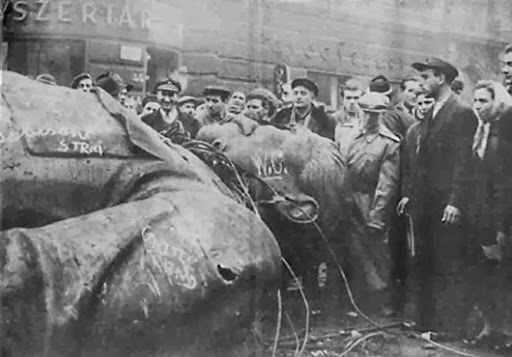
Stalin

Walking home this evening I felt like Douglas Hofstadter may have felt when coming up with the central idea of his spectacular Gödel, Escher, Bach book. Unlike his realization about a “golden braid” linking the thoughts of Kurt Gödel, M. C. Escher and Johann Sebastian Bach, which all shed light on infinity, I felt like I saw a way to connect the seemingly opposed words of Popes Benedict XVI and Francis with regard to relativism.

Benedict XVI famously attacked relativism in his sermon during the opening mass of the conclave that elected him, saying:

“To have a clear faith, according to the creed of the Church, is often labeled as fundamentalism. While relativism, that is, allowing oneself to be carried about with every wind of “doctrine,” seems to be the only attitude that is fashionable. A dictatorship of relativism is being constituted that recognizes nothing as absolute and which only leaves the “I” and its whims as the ultimate measure.”

The message here is very clear – the arbiter of truth and falsehood as well as good and evil has become the individual, with no intrinsic meaning left for these concepts beyond what each person chooses to invest them with for themselves. It is not only a relativity of meaning but also a solitude – I have my truth and you yours and that is the end of the story. In his book-length interview with Benedict XVI (“Light Of The World”), Peter Seewald, gets Benedict to elaborate on the above idea, when he says:

“It is obvious that the concept of truth has become suspect. Of course it is correct that it has been much abused. Intolerance and cruelty have occurred in the name of truth. To that extent people are afraid when someone says, “This is the truth”, or even “I have the truth.” We never have it; at best it has us. No one will dispute that one must be careful and cautious in claiming the truth. But simply to dismiss it as unattainable is really destructive.

A large proportion of contemporary philosophies, in fact, consist of saying that man is not capable of truth. But viewed in that way, man would not be capable of ethical values, either. Then he would have no standards. Then he would only have to consider how he arranged things reasonably for himself, and then at any rate the opinion of the majority would be the only criterion that counted. History, however, has sufficiently demonstrated how destructive majorities can be, for instance, in systems such as Nazism and Marxism, all of which also stood against truth in particular.

[…] That is why we must have the courage to dare to say: Yes, man must seek the truth; he is capable of truth. It goes without saying that truth requires criteria for verification and falsification. It must always be accompanied by tolerance, also. But then truth also points out to us those constant values which have made mankind great. That is why the humility to recognize the truth and to accept it as a standard has to be relearned and practiced again.”

Essentially, Benedict says that just because we cannot possess the truth, it does not mean that “the” truth does not exist. Our access to it is imperfect and tolerance and caution are called for, but denying its existence (just because of our epistemological constraints) is a dangerous path to follow. The picture from the above is very clear – relativism (making one’s “I” the ultimate arbiter of truth) is a tyranny and a reliance of one’s self is dangerous.

Fast-forward to this morning’s interview1 with Pope Francis talking to Eugenio Scalfari and take a look at what he has to say on the subject:

“Scalfari: Your Holiness, is there is a single vision of the Good? And who determines it?

Francis: Each of us has their own vision of Good and also of Evil. We have to encourage him to proceed towards that which he thinks is Good.

Scalfari: Your Holiness, you have already written it in the letter you addressed to me. Conscience is autonomous, you said, and everyone must obey their own conscience. I think that’s one of the most courageous passages spoken by a Pope.

Francis: And I repeat it here. Each one has their own idea of Good and of Evil and must choose to follow Good and fight Evil as they understand them. This would suffice to make the world a better place.”

“Each one has their own idea of Good and Evil […] as they understand them.” But, this sounds precisely like the relativism (the “I” being arbiter of truth) that Benedict denounced and declared a destructive danger. Are Francis and Benedict disagreeing here? Is Francis changing Church teaching?

I don’t think so. Instead, I believe, that their apparent opposition flows from the different perspectives from which they speak about truth and good and evil. Benedict describes what you’d see from God’s perspective: truth is absolute and denying its existence and substituting one’s whims for it, just because humans can’t access it, is a mistake. Francis, instead looks at the picture from the perspective of the individual: trust your conscience’s discernment between good and evil and choose good. Each human has a conscience by means of which they can discern (to varying degrees of faithfulness – “At present we see indistinctly, as in a mirror” as St. Paul says in 1 Corinthians 13:12) a reflection of the absolute truth. It is the same landscape, but Benedict looks down from the mountaintop while Francis looks up from the valley.

Applying this to myself, I can simultaneously believe in absolute truth and goodness, while being aware of my own inability to grasp them fully (or even with a known level of (in)accuracy). This epistemic constraint in no way undoes the meaningfulness of pursuing goodness and truth and instead makes tolerance and dialogue necessary. It also means that – as Francis said in the same interview – “Proselytism is pompous foolishness that has no sense. We must get to know each other and listen to each other and grow our understanding of the world around us.” I believe we are all accessing fragments of the one Truth,2 which makes me want to know what you have understood as much as deepening my understanding of my own faith.


1 The English translation sadly has some serious issues at the time of this post’s writing (the tile itself being seriously mistranslated), as a result of which I started from it but made adjustments based on reading the Italian original.
2 This is consonant with Francis saying, still in this same interview that “I believe in God. Not a Catholic God, there is no Catholic God, there is God.”

Benedict XVI – Odifreddi: searching for Truth, with gloves off

Boxing gloves

[Warning: long read :)]1

If you are even remotely interested in the dialogue between faith and reason, between religion and science, the last fortnight has to be among the most electrifying periods in the history of mankind. Not only did it kick-off with the beautifully sincere and profound move by Pope Francis in his letter to the atheist journalist Eugenio Scalfari, but it saw the publication of “the” interview that Pope Francis gave to Jesuit media and in which he spoke about science in terms that, to my mind, take the Church’s appreciation of science further than ever before. And if that wasn’t enough, today saw the publication of extracts from an 11-page letter that Pope Emeritus Benedict XVI wrote to the Italian atheist mathematician Prof. Piergiorgio Odifreddi, in response to his book “Caro Papa ti scrivo: Un matematico ateo a confronto con il papa teologo” (“Dear Pope, I write to you: An atheist mathematician confronting the theologian pope”).

Looking at the two letters (or, more precisely, the extracts from Benedict’s versus the full text of Francis’), Francis’ and Scalfari’s style is like a polite, yet illuminating, exchange between two gentlemen over a cup of tea, while Benedict’s and Odifreddi’s exchange is like a bare-knuckle fist-fight between a pair of prize-winning boxers who in the end sincerely shake hands and respect each other, but without giving an inch during the fight itself.

To begin with, let’s take a quick look at Odifreddi’s opening move – his 204-page book, addressed to Benedict as “between colleagues” – from a maths to a theology professor. Early on, Odifreddi identifies a point in common with Benedict’s thought, by pointing to the following passage from Benedict’s Regensburg address:

“the experience […] of the fact that despite our specializations which at times make it difficult to communicate with each other, we made up a whole, working in everything on the basis of a single rationality with its various aspects and sharing responsibility for the right use of reason”

While Odifreddi identifies this – the adherence to reason – as a common point of departure, he quickly objects to Benedict’s excessive use of it (“your almost obsessive use of the word “reason,” repeated around forty times, akin to a musical motif or continuous base”) and to the “scandalous” words from Benedict’s sermon before the conclave that elected him:

“[H]aving a clear faith based on the Creed of the Church is often labeled as fundamentalism. Whereas relativism, that is, letting oneself be “tossed here and there, carried about by every wind of doctrine”, seems the only attitude that can cope with modern times. We are building a dictatorship of relativism that does not recognize anything as definitive and whose ultimate goal consists solely of one’s own ego and desires.”

While being critical of Benedict’s words, Odifreddi argues that “both religion and science are perceived as antidemocratic and absolutist” as a result of their focus on “ultimate truths” and then proceeds to arguing against a series of passages from Benedict’s “Introduction To Christianity” and his Jesus of Nazareth trilogy.

Since it is the full, fine detail that is key to understanding the nature of what is going on between Odifreddi and Benedict, let me just pick out a single point of contention (from among many important and interesting ones that I hope to return to soon!),2 which Benedict objected to most forcefully and which the following passage from Odifreddi’s book sums up nicely:

“There is little to say about the historical Jesus, literally, because there are virtually no traces of him in the official history of the period. In total, there are only few tens of lines about him in the works of Pliny, Tacitus, Suetonius and Flavius Josephus. Some are of uncertain interpretation, like the “Chrestus” of Suetonius. Others are of dubious authenticity, like the interpolation of Flavius Josephus. […] If, therefore, Jesus truly existed, he must have been irrelevant to his contemporaries, beyond the narrow circle of his relatives, friends and followers.”

Odifreddi further accuses Benedict of side-stepping questions of fact by saying to him: “you seem uninterested in (or seem interested in not) discussing the historicity of the Gospels and the facts that they report” and attributes to him an opposition to historical-critical methods of Biblical interpretation, by quoting Benedict as saying that they “can effectively become an instrument of the Antichrist.”

Benedict’s response here is as sharp as the jab he received:

“What you say about the figure of Jesus is not worthy of your scientific status. If you put the question as if nothing were, ultimately, known about Jesus, as a historical figure, as if nothing were ascertainable, then I can only firmly invite you to become more competent from a point of view of history. To this end I particularly recommend to you the four volumes that Martin Hengel (exegete at the Protestant Faculty of Theology of Tübingen) has published with Maria Maria Schwemer: it is an excellent example of historical precision and of vast breadth of historical information. […] Further I have to forcefully reject your affirmation (pp. 126) according to which I have presented historical-critical exegesis as an instrument of the Antichrist. Discussing the account of Jesus’ temptations, I have only recalled Soloviev’s thesis, according to whom historical-critical exegesis may also be used by the Antichrist – which is an unquestionable fact. At the same time, however, I have always – and in particular in the foreword to the first volume of my book on Jesus of Nazareth – made it evidently clear that historical-critical exegesis is necessary for a faith that does not propose myths using historical images, but demands true historicity and therefore has to present historical reality in its affirmations also in a scientific way. Because of this, it is not correct either that you say that I have been interested only in meta-history: on the contrary, all my efforts have had as their objective to show that the Jesus described in the Gospels is also the real, historical Jesus; that it is a matter of history that really took place.”

Uff … I have to be honest and admit that I was at first a bit uneasy about the tone of both Odifreddi and Benedict, neither of whom are pulling punches and both of whom are blunt to say the least. Looking more closely though, and reflecting on my professional experience as a scientist, I recognize that this is the tone and strength of academic argument and doing anything less would be dishonest on the part of both the professor and the ex-professor. This is a very different context from the Francis-Scalfari one and it demands the unforgiving rigor, precision and detail of the quotes shown above. Treating Benedict like any other academic shows Odifreddi’s respect for him (which he is explicit about when saying “Having read his Introduction to Christianity, […] I realized that the faith and doctrine of Benedict XVI, unlike that of others, were sufficiently solid and fierce that they could very well face and sustain frontal attack.”) Benedict is equally complimentary about Odifreddi, when he tells him that he “considers very positively the fact that you […] have sought such an open dialogue with the faith of the Catholic Church and that, in spite of all the differences, in the central themes, there is no lack of convergence at all.”

What this, academic, dialogue is truly about is put best – and to my mind beautifully lucidly – by Odifreddi, who says that:

“[The aim], obviously, was not to try and “convert the Pope,” but instead to honestly present to him the perplexity, and at times incredulity, of a mathematician with regard to faith. Analogously, the letter from Benedict XVI does not try to “convert the atheist,” but to direct at him his own, honest, symmetrical perplexity, and at time incredulity, of a very special believer with regard to atheism. The result is a dialogue between faith and reason, which, as Benedict XVI notes, has allowed both of us to confront each other frankly, and at times also bluntly, in the spirit of the Courtyard of the Gentiles that he himself has initiated in 2009. […] Divided in almost everything, but joined by at least one objective: the search for Truth, with a capital “T”.”

Wow! I have to say I am very impressed with Odifreddi (having come to this clearly as Benedict XVI fan) and I look forward to seeing his next steps in this full-contact dialogue. In many ways, I believe, that the most important thing to take away from this first encounter is the seriousness and complete transparency, with which both parties approached the challenge of dialogue – a dialogue that is not a watering-down or a “playing nice” but a striving for Truth, regardless of how vast the abyss may appear between its opposing cliffs. It would be a mistake to get stuck on whether I happen to agree with one side or the other, as it would miss the masterclass in serious dialogue that we have just witnessed. In many ways, I read Odifreddi’s closing thoughts as a transposition – from an intra-Christian to a Christian-atheist setting – of Francis’ call to an ecumenism that starts now, while there are clear differences between the parties, when he says in “the” interview: “We must walk united with our differences: there is no other way to become one. This is the way of Jesus.”


1 Apologies, again, for the rough translation from Italian – once “official” translations are available, I’ll point you to them.
2 I can’t not mention the following zinger from Benedict, which points to the widespread use of “science fiction” in science, in response to Odifreddi’s claiming that it was religion that practiced the genre. Benedict here says, referring to Heisenberg and Schrödinger’s theories, and adding Dawkins’ “selfish gene” to the list, that “I’d call them “science fiction” too, in the good sense: they are visions and anticipations, to arrive at true knowledge, but they are, indeed, only imagination with which we try to get closer to reality.” 🙂 I agree and I’ll definitely pick this line up in a future post.

Pope Francis’ letter to non-believers

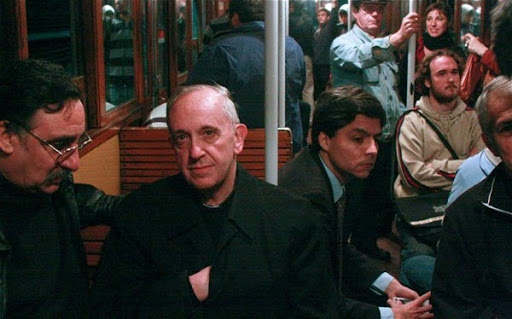
Pope 2509845b

That Pope Francis cares deeply for non-believers1 is nothing new, with his previous declaration that Jesus has redeemed atheists too having lead both to very positive responses and to a great media muddle. In today’s issue of the Italian newspaper La Repubblica, Francis continues in this dialogue with non-believers by responding to questions sent to him by the atheist journalist Eugenio Scalfari regarding Francis’ encyclical Lumen Fidei, and I would like to share my favorite parts of his letter with you here.2

Francis starts out by arguing that dialogue between the followers of Jesus and non-believers is “necessary and valuable” today for two reasons: First, the paradox that “Christian faith, whose novelty and impact on human life have since the beginning been expressed through the symbol of light, has become branded as the darkness of superstition that is opposed to the light of reason,” resulting in an absence of communication between Christian and Enlightenment-based contemporary culture. Second, for those who seek “to follow Jesus in the light of faith, […] this dialogue is not a secondary accessory[, but …] an intimate and indispensable expression of faith instead.” This, Francis argues, is expressed by §34 of Lumen Fidei, from which he proceeds to quote:

“Clearly, then, faith is not intransigent, but grows in respectful coexistence with others. One who believes may not be presumptuous; on the contrary, truth leads to humility, since believers know that, rather than ourselves possessing truth, it is truth which embraces and possesses us. Far from making us inflexible, the security of faith sets us on a journey; it enables witness and dialogue with all.”

After a beautiful exposition of how Francis himself came to believe in God and how the Christian faith has Jesus’ incarnation and resurrection at its heart, through which all of humanity is shown God’s love and connectedness to each other – to every single human being,3 he proceeds to answering the three questions Scalfari put to him.

The first of Scalfari’s questions regards whether “the God of Christians forgives those who don’t believe and don’t seek faith.” Here Francis’s response, which I particularly like, is the following:

“Given that – and this is the fundamental point – the mercy of God has no limits if one turns to Him with a sincere and contrite heart, the question for those who don’t believe in God is about obeying one’s own conscience. Sin, also for those who don’t have faith, occurs when one goes against conscience. Listening and obeying to it means, in fact, taking decisions in the face of what becomes understood as good or as bad. And it is on the basis of this decision that the goodness or evil of our actions plays out.”

Wow! While this is in some sense nothing more than what the Catechism has been saying explicitly since Vatican II, having it presented in the above universal way is great. I have often argued in exactly these terms and have faced quizzical looks from other Catholics, who wouldn’t quite believe it. It also confirms me in the answer I have given to several of my best, atheist or agnostic friends when they have asked me whether they should want to believe in God, which was “no,” with the caveat of seeking to be honest in front of their consciences.

Scalfari’s second question asks whether “thinking that there is no absolute and therefore no absolute truth either, but only a series of relative and subjective truths, is a mistake or a sin.” Great question! 🙂 To this Francis responds by saying:

“To begin with, I wouldn’t talk, not even to those who believe, about “absolute” truth, in the sense that the absolute is that which is disconnected, which is devoid of any relation. Now, the truth, according to Christian faith, is the love of God for us in Jesus Christ. Therefore, the truth is a relationship! It is also true that each one of us takes it, the truth, and expresses it by departing from oneself: from one’s history and culture, the circumstances in which one lives, etc. This does not mean though that the truth is variable and subjective. Instead, it means that it gives itself to us always and only as a journey and a life. Didn’t maybe Jesus say the same: “I am the way and the truth and the life.”?4 In other words, truth, being ultimately all one with love, requires humility and openness when sought, accepted and expressed. Therefore, it is necessary to understand each other’s terminology better, and, maybe, to avoid the constraints of an opposition that is … absolute, deepen the framing of the question. I believe that this is absolutely necessary today, so that a serene and constructive dialogue can take place.”

Another fantastic answer! Anyone who has tried to pigeonhole Francis as a populist, as opposed to the thinker that Benedict XVI undoubtedly is, can proceed to eat their own words …

The third, and final of Scalfari’s questions asks whether “the disappearance of humans from Earth would also mean a disappearance of thought that is capable of thinking God.” Here, Francis’ answer, which I won’t translate in full, revolves around arguing that, in his experience and those of many others, God is not an idea, but a “reality with a capital ‘R’.” Instead of going into more detail here, I’d instead like to translate Francis’ closing thoughts, before which he expresses his hope that his reflections would be “received as a tentative and provisional response, but one that is sincere and faithful to the invitation of walking along a stretch of road together.”:

“The Church, believe me, in spite of all the slowness, the unfaithfulness, the mistakes and sins that it may have committed and may yet commit in those who compose it, has no other meaning and end than that of living and giving testimony to Jesus: Him who has been sent by the Father “to bring glad tidings to the poor, to proclaim liberty to captives and recovery of sight to the blind, to let the oppressed go free, and to proclaim a year acceptable to the Lord” (Luke 4:18-19).”

I have to say I am delighted by these words of Pope Francis – both the emphasis on conscience that I have held dear for a long time and the insights about truth as relationship and love – and I would be keen to hear from my atheist, agnostic, humanist (and even Christian 🙂 friends what they made of them.

UPDATE (12 Sept. 2013): This morning Vatican Radio broadcast a short interview with Cardinal Gianfranco Ravasi on the topic of Pope Francis’ letter discussed above (which is now available in an official English translation here). Ravasi, who leads the Pontifical Council for Culture and in its context the “Courtyard of the Gentiles” initiative, whose aim is dialogue with non-believers, naturally welcomed Francis’ letter with great positivity, including it among the initiatives foundational documents. He then also proceeds to elaborate on the, to my mind key, point Francis made about the truth being a relationship:

“Already Plato affirmed [that the truth is a relationship] when he said that the chariot of the soul runs along the plane of truth, which means that the truth is not a cold reality like a precious stone that you can put in your pocket. Instead, it is an immense plane, a horizon – or, to use another image by a writer from the last century5 – we can say that the truth is a sea that one enters and navigates. So, in this light, I believe that the concept of truth not as absolute, but personal, interpersonal, will be very fruitful for dialogue, without losing the dimension of objectivity, of identity in itself, typical of the truth.”


1 Picking what term to use to refer to those who do not believe in God is tricky and I am going with the term Francis is using himself, not necessarily because I believe it is the most appropriate one, but because my aim here is to share his message with you today. I am mindful though of Prof. Cox’s point about the undesirability of negative labels, but since the positive alternatives (e.g., humanist) may not be self-applied by all whom the Pope intends to address here, I am sticking with his terminology. If you belong to his target audience (and to some extent everyone does – including me, a Catholic) and have a suggestion for what term to use, please, let me know.
2 Since I haven’t found an English translation of this article yet, the following quotes are my own crude translations, for which I apologize in advance.
3 I’d like to return to this great synthesis of Christianity in a future post and, if you understand Italian, I’d wholeheartedly recommend reading the full letter to you straight-away.
4 John 14:6.
5 Ravasi refers to this quote in an earlier talk, where he attributes it to Musil’s The Man Without Qualities, although I couldn’t find it there.