Synod14: A paternal home for everyone

Francis cap kid

Yesterday afternoon, the third day of the Extraordinary Synod on the Family saw contributions about difficult pastoral situations. Cardinal Raymundo Damasceno Assis, who chaired this, 6th session of the Synod, said that these are situations there is a “need to be accompanied by the Church, since the people involved in them live experiences of deep wounds to their own humanity, to their relationship with others and with God.” Here, the Church is called to learn the art of accompanying, as Pope Francis says in Evangelii Gaudium (§169) that “this accompaniment must be steady and reassuring, reflecting our closeness and our compassionate gaze which also heals, liberates and encourages growth in the Christian life.”

Cardinal Assis then proceeded to listing the various “difficult pastoral situations” that are mentioned in the Instrumentum Laboris, including cohabitation, civil unions, separation, divorce and same-sex union, and goes on to insisting that:

“Far from locking ourselves into a legalist perspective, we would like to immerse ourselves into the depths of these difficult situations, to welcome all those who are involved in them and so that the Church may be the paternal home where there is room for everyone, with their strenuous lives.”

The notes on the following discussion, shared by the Vatican’s press office, then show a reiteration of Cardinal Assis’ words, saying that:

“the Church is not a customs [checkpoint], but rather the house of the Father, and must therefore offer patient accompaniment to all people, including those who find themselves in difficult pastoral situations. The true Catholic Church encompasses healthy families and families in crisis, and therefore in her daily effort of sanctification must not show indifference in relation to weakness, as patience implies actively helping the weakest.”

Applying the above to the divorced and remarried, the Synod Fathers called for an approach rooted in mercy:

“It was strongly emphasised that an attitude of respect must be adopted in relation to divorced and remarried persons, as they often live in situations of unease or social injustice, suffer in silence and in many cases seek a gradual path to fuller participation in ecclesial life. Pastoral care must not therefore be repressive, but full of mercy.”

A discussion of the need to streamline processes of declaring the nullity of a marriage and of polygamy followed, after which the Synod Fathers shared experiences and “best practices” of care for divorced and remarried people in the form of “listening groups”:

“It was remarked that it is important to carefully avoid moral judgement or speaking of a “permanent state of sin”, seeking instead to enable understanding that not being admitted to the sacrament of the Eucharist does not entirely eliminate the possibility of grace in Christ and is due rather to the objective situation of remaining bound by a previous and indissoluble sacramental bond. In this respect, the importance of spiritual communion was emphasised repeatedly. It was also commented that there are evident limits to these proposals and that certainly there are no “easy” solutions to the problem.”

This model of “listening groups” and, more generally, of listening, was also emphasised with regard to homosexual people.

Like all the sessions of the Synod, this morning’s, 7th one also started with a testimony by a married couple. Arturo and Hermelinda As Zamberline from Brazil also spoke about the importance of a Christian understanding of sexuality and its role as an expression of love between husband and wife:

“The sexual act is rightful, loved and blessed by God, and the pleasure derived from it contributes to the joy of living and the healthy development of personality. It is the expression of love, which in the beginning may be passion, but which should gradually become more human. Couples who make love are expressing with their bodies what is in their hearts. To reach harmony, it is necessary to develop one’s desire and even a wholesome eroticism. It is necessary to stay passionate and attentive to each other.

How sexuality is lived is very important so that humans become ever more human. Father Caffarel [Founder of the Teams of Our Lady, whose members the Zamberlines are] proposes a fascinating journey: from sexuality to love. The couple is where the three functions of sexuality are expressed: its relational function, its pleasurable function and its reproductive function. The couple grows by combining these three dimensions in a balanced way.

Sexuality is lived in relation with others and with God. It’s called become a language of love, communion and life.”

The notes on the following discussions then start by reporting a re-affirmation of the doctrine on marriage, emphasising:

“the indissoluble nature of marriage, without compromise, based on the fact that the sacramental bond is an objective reality, the work of Christ in the Church. Such a value must be defended and cared for through adequate pre-matrimonial catechesis, so that engaged couples are fully aware of the sacramental character of the bond and its vocational nature.”

This was immediately followed by reiterating that “Pastoral care must not be exclusive, of an “all or nothing” type but must instead be merciful, as the mystery of the Church is a mystery of consolation.” A re-statement of the position with regard to same-sex unions then followed: “while emphasising the impossibility of recognising same sex marriage, the need for a respectful and non-discriminatory approach with regard to homosexuals was in any case underlined.”

The first part of the mooring session concluded with a return to the importance of language:

“so that the Church may involve believers, non-believers and all persons of good will to identify models of family life that promote the full development of the human person and societal wellbeing. It was suggested that the family should be spoken of using a “grammar of simplicity” that reaches the heart of the faithful.”

The theme of the second part of the morning session was openness to life, where:

“responsible parenthood was considered, emphasising that the gift of life (and the virtue of chastity) are basic values in Christian marriage, and underlining the seriousness of the crime of abortion. At the same time, mention was made of the numerous crises experienced by many families, for instance in certain Asian contexts, such as infanticide, violence towards women and human trafficking. The need to highlight the concept of justice among the fundamental virtues of the family was underlined.”

During the press conference at lunchtime, Archbishop Paul-André Durocher of of Gatineau, Quebec, made the following, very illuminating observation:

“In the Church there is a method of thinking and of reasoning that tends to start from principles and lead to conclusions […] the deductive method. And what’s happening within this Synod is we are seeing a more inductive way of reflecting. Starting from the true situations of people and trying to figure out what’s going on there. In a sense, finding that the lived experience of people is also a theological source, a place of theological reflection. Maybe a funny way of saying this is that we are learning to use the Harvard “case study” method in reflecting theologically on the lives of people. And we are only starting to learn how to do this as Church leaders. This is going to take time to learn and together to come to find, as we reflect on this, what is the way God is showing. In this sense, many voices are saying there is no kind of line that we will apply to all conditions because each person is a human person. Jesus did not meet general cases; Jesus met individuals. And he addressed individuals. And, so, for us it is to reflect on how do we do this as a Church, within the Church.”

Francis: Happiness, in ten simple steps

Francis happiness

Yesterday, Pope Francis’ interview with the Argentine Vivir (a Sunday magazine of the Clarin daily) included 10 tips for how to be happy. Their language is simple, and I believe their applicability is very broad and likely to resonate with believers and non-believers alike. While I think that they are essentially an application of his Evangelii Gaudium to the broad readership of a magazine, the way they are posed largely avoids religious terminology,1 even though they have deep roots in Jesus’ life and teaching.

Even though the 77 minute interview from which they are taken is not available yet, these 10 pieces of advice are contained in the four minute extract that Clarin have already published on their website in Spanish:2

  1. Live and let live. “Here the Romans have a saying that we can follow like a thread: “Go ahead and let others go ahead too.” Live and let live, that is the first step towards peace and joy.”
  2. Giving oneself to others. “If one stays still, they run the risk of being selfish. And still water is the first to spoil.”
  3. Moving like a peaceful oasis. “In Don Segundo Sombra there is a beautiful image of someone who reflects on their own life. He says that as a youth he was a rocky stream that moved everything in its path; as an adult he was a river that moved ahead and that in old age he felt in motion, but slowly like a peaceful oasis [“remansado” in the original]. I would use the image of the poet and writer Ricardo Güiraldes, this last adjective “remansado.” The capacity to move with kindness and humility, the peaceful oasis of life. Old people have this wisdom, they are the memory of a nation. And a nation that does not look after its old people has no future.
  4. Playing with kids. “Consumerism has lead us to an anxiety about losing a healthy culture of leisure, reading, enjoying art. These days I rarely hear confessions, but in Buenos Aires I used to do that a lot and when a young mum came to me, I asked her: “How many children do you have? Do you play with them?” And it was a question she did not expect, but I said to her that playing with kids is key, it is a healthy culture. It is difficult, parents go to work early and at times return when the kids are already sleeping, it is difficult, but it has to be done.”
  5. Spending Sundays with the family. “The other day, in Campobasso, I went to a meeting between the worlds of academia and the world of labor, and both were demanding Sundays without work. Sunday is for the family.”
  6. Helping young people find employment. “We have to be creative with their age group. If there is a lack of opportunity, they will fall prey to drugs. And the suicide index among young people without employment is very high. The other day I read, but I don’t trust it because it is not scientific data, that there are 75 million unemployed young people below the age of 25.3 It is not enough to feed them: we have to make up one-year courses for them to learn plumbing, becoming an electrician or a builder. Bringing bread home is what gives you dignity.”
  7. Looking after nature. “We have to look after creation and we are not doing it. It is one of the greatest challenges we have.”
  8. Quickly forgetting about the negative. “The need to speak ill of another indicates low self-esteem, in other words: I feel so low that instead of rising, I lower the other. Quickly forgetting what is negative is healthy.”
  9. Respecting those who think differently. “We may trouble others by our testimony, so that we may both progress in our communication, but the worst that can happen is religious proselytism, which paralyzes: “I dialogue with you to convince you.” No! Each one dialogues from their own identity. The Church grows by attraction, not by proselytism.”
  10. Actively seeking peace. “We are living in times of many wars. In Africa, wars look like tribal wars, but they are something else. War destroys. And the call for peace has to be shouted. Peace at times gives the impression of stillness, but it is never stillness, it is always an active peace.”

I particularly like Francis’ words on respect – both in general (delighting in the progress of others like in one’s own) and in dialogue (worry/unsettle – yes, set out to convince – no), on playing with kids, on a forgetfulness of the negative and on challenges (lack of peace, youth unemployment, selfishness combatted by self-giving) have to be faced actively (but an activity that is kind and humble). To suggest that the above is un-Christian (or even a-Christian) is being blinded by packaging and a subscription to dualism instead of the realization that God’s love extends to all, regardless of their beliefs.


1 Unsurprisingly, but sadly, he has already been criticized for the non-religious terms in which he has expressed his advice, e.g., here.
2 The following, crude translation is mine and follows the interview’s transcript here.
3 In fact the International Labor Organization (a UN agency) places worldwide youth unemployment at 73 million, which supports Francis’ figure. In terms of individual countries, according to government statistics there were “817,000 young people aged 16-24 […] unemployed in March to May 2014” in the UK. And in Argentina the figure is around the 2.5 million mark according to the Peace Child International NGO, while in the US there were 3.5 million unemployed 16-24 year olds in 2013, according to the ILO. Fact-check: done!

Where nothing articulate can be said

Lama sabachthani

The idea of God crying out in forsakenness, nailed to a cross like a criminal, is both deeply disturbing (hence the frequent denial of its “reality”) and a window onto Jesus’ new commandment: “I give you a new commandment: love one another. As I have loved you, so you also should love one another.” (John 13:34). It is an event that has not only occupied theologians and mystics, but has also attracted non-believers and has been written about on this blog several times. Today, I’d like to look at how Hans Urs von Balthasar, St. John Paul II, Gianfranco Ravasi and Chiara Lubich understood it and what consequences they drew from it.

Von Balthasar, like Pope Francis in Evangelii Gaudium (“Jesus’ sacrifice on the cross is nothing else than the culmination of the way he lived his entire life.” §269), argues for a deep continuity between Jesus’ life and teaching and his abandonment on the cross:

“The inarticulate cry of the cross of Jesus is no denial of his articulate proclamation to his disciples and to the people… instead it is the final end of all those articulations… which he utters with the greatest force where nothing articulate can be said any longer.” (The Whole in the Fragment)

To von Balthasar, Jesus’ forsakenness is not failure, but culmination, and this perspective can also be seen in St. John Paul II’s thought where he presents it as necessary for God’s “full solidarity” with humanity:

“[O]n Jesus’ lips the “why” addressed to God was also [… an expression of] pained bewilderment at that suffering which had no merely human explanation, but which was a mystery of which the Father alone possessed the key. Therefore, […] the question contained a theological significance in regard to the sacrifice whereby Christ, in full solidarity with sinful humanity, had to experience in himself abandonment by God.”

During that same General Audience in 1988, John Paul II also presents a synthesis of positions that argue for and against the “reality” of Jesus’ abandonment on the cross:

“If Jesus felt abandoned by the Father, he knew however that that was not really so. He himself said, “I and the Father are one” (Jn 10:30). Speaking of his future passion he said, “I am not alone, for the Father is with me” (Jn 16:32). Jesus had the clear vision of God and the certainty of his union with the Father dominant in his mind. But in the sphere bordering on the senses, and therefore more subject to the impressions, emotions and influences of the internal and external experiences of pain, Jesus’ human soul was reduced to a wasteland. He no longer felt the presence of the Father, but he underwent the tragic experience of the most complete desolation.

Here one can sketch a summary of Jesus’ psychological situation in relationship to God. The external events seemed to manifest the absence of the Father who permitted the crucifixion of his Son, though having at his disposal “legions of angels” (cf. Mt 26:53), without intervening to prevent his condemnation to death and execution. In Gethsemane Simon Peter had drawn a sword in Jesus’ defense, but was immediately blocked by Jesus himself (cf. Jn 18:10 f.). In the praetorium Pilate had repeatedly tried wily maneuvers to save him (cf. Jn 18:31, 38 f.; 19:4-6, 12-15); but the Father was silent. That silence of God weighed on the dying Jesus as the heaviest pain of all […].

In the sphere of feelings and affection this sense of the absence and abandonment by God was the most acute pain for the soul of Jesus who drew his strength and joy from union with the Father. This pain rendered all the other sufferings more intense. That lack of interior consolation was Jesus’ greatest agony.”

While the above may at first look like a variant of the naive arguments for the unreality of Jesus’ abandonment by the Father, which revolve around the claim that Jesus knew he wasn’t “really” abandoned, John Paul II’s position is more nuanced. He both affirms Jesus’ knowledge of the Father’s presence and the fullness of Jesus experiencing the Father’s absence. Unlike the naive positions that present knowledge as a mitigating factor, John Paul II does not hesitate to describe Jesus’ soul as a “wasteland” and his experience as being one of “most complete desolation.” It is essentially a third-person, “objective” view that recognizes the continuing presence of the Father while Jesus fully experiences his absence on the cross. In many ways this is akin to a Christian, who sees their atheist friends’ sincerity, recognizing that their friends live in the absence of an experience of God, while they themselves see both their own and their friends’ lives unfolding in His presence. This is not to deny the “reality” of the atheist experience (qua experience) while at the same time situating it within one’s own understanding of reality. I believe such a parallel also underlines John Paul II’s claim that Jesus’ abandonment on the cross was necessary for the sake of “full solidarity” with all of humanity – both with those who believe in God and who do not.

John Paul II’s analysis does seem to me to be the key also to understanding why many theologians wrestle with with the contradiction of Jesus’ forsakenness on the cross. Even Cardinal Ravasi, who in one context affirms the reality of Jesus’ forsakenness (even calling it “salvific atheism”), in another context speaks both about His being our “brother also in the tragedy of the absence of God” and at the same time about it not being possible to “classify that cry as a sign of despair and almost of disbelief.”

Beyond considerations about the reality of Jesus’ forsakenness and its central role in God’s closeness to humanity, what is its practical impact though? What difference does it mean to me, as a Christian, that Jesus experienced such complete desolation? Here the insights of the Servant of God Chiara Lubich are key, since she recognized in Jesus’ forsakenness the key to uniting herself both to God and to every neighbor she encountered, to the point of declaring Jesus Forsaken to be her spouse.

In a talk from 1971,1 Lubich shares her insight into Jesus’ forsakenness being the pinnacle of his self-giving:

“He had given everything.

First, a life lived beside Mary in hardship and obedience.

Then, three years of mission, revealing the Truth, giving witness to the Father, promising the Holy Spirit, and working all kinds of miracles of love.

Finally, three hours on the cross, from which he gave forgiveness to his executioners, opened paradise to the thief, gave his mother to us, and ultimately gave his body and blood, after having given them mystically in the Eucharist.

He had nothing left but his divinity.

His union with the Father, that sweet and ineffable union with the One who had made him so powerful on earth as the Son of God and so regal on the cross, that feeling of God’s presence had to disappear into the depths of his soul and no longer make itself felt, separating him somehow from the One with whom he had said to be one: “The Father and I are one” (Jn 10:30). In him love was annihilated, the light extinguished, wisdom silenced.”

Left in a state of complete self-noughting, “where nothing articulate can be said,” what choice did he have left?

“To formulate a question was the only way Jesus could then possibly express himself; that loud cry is the Word which is no longer word, which therefore, cannot be understood and explained as word. It is the indescribable reality which is so beyond what words that are uttered in the created world can express. It is the sub-word; that which is chosen by the Powers of Heaven to bear the Eternal ultra- word.”

What was the point of such complete annihilation though? Here Lubich presents a deeply logical argument:

“So he made himself nothing to make us share in the All; a worm2 of the earth, to make us children of God.

We were cut off from the Father. It was necessary that the Son, in whom all of us were represented, should experience separation from the Father. He had to experience being forsaken by God so that we might never be forsaken again.

He had taught that no one has greater love than one who lays down his life for his friends. He who was Life laid down his whole self. This was the culminating point, love’s most beautiful expression. He loved in God’s way! With a love as big as God!”

Most importantly though, Jesus Forsaken was not of academic interest to Lubich, who – with her companions and a growing number of sympathizers and followers – sought to put the Gospel into practice in everything she did, but a person with whom she developed a close relationship:

“He drew us to himself; we discovered him everywhere: in every physical moral or spiritual pain. They were shadows of his great suffering. […] Then we saw him in every neighbor who was suffering. […] Every personal suffering also appeared to us as a countenance of Jesus forsaken to be loved and wanted in order to be with him and like him, so that through the death of ourselves […], he might give life to us and to many others.”

In fact, Lubich understood that such a relationship with Jesus Forsaken, a becoming another Jesus Forsaken, is the way to profound relationships of unity:

“In his testament Jesus had said: “With me in them and you in me, may they be so perfected in unity” (Jn 17:23). If Jesus was in me, if Jesus was in the other, and if Jesus was in all, at that moment we were perfected in unity. […] Jesus forsaken is the model for those who must build unity with others. I cannot enter into another spirit if I am rich of my own. To love others I must constantly make myself so poor in spirit that I possess nothing but love. Love is empty of itself. Jesus forsaken is the perfect model of one who is poor in spirit. He is so poor that he has not even God, so to speak. He does not feel God’s presence.”

And finally, picking up on a theme so close to Pope Francis’ heart, Lubich points to the simultaneous closeness to humanity and God that Jesus’ forsakenness brings about, where He becomes the void that bridges the finite with the infinite:

“In his forsakenness Jesus seems to be nothing but a man, and so never had he been as close to us human beings as in that moment and never, therefore, had he loved so much. At the same time, never had he been so close to the Father; it is out of love for him that he dies in that way.”


1 Which was also my source for the quotes from von Balthasar’s “The Whole in the Fragment” above.
2 “But I am a worm, not a man, scorned by men, despised by the people.” (Psalms 22:7)

Differing currents of thought: fact or fiction?

Polyhedron

[Warning: Long read.]

One of my favorite passages in Evangelii Gaudium – Pope Francis’ apostolic exhortation, and de facto blueprint for the future of the Church – regards diversity of theological thought, where he says:

“Within the Church countless issues are being studied and reflected upon with great freedom. Differing currents of thought in philosophy, theology and pastoral practice, if open to being reconciled by the Spirit in respect and love, can enable the Church to grow, since all of them help to express more clearly the immense riches of God’s word.” (§40)

With the above model in mind, let me take you through the latest moves in a “cognitive reconciliation” process that has been underway for many years now and that I have commented on before: the dispute between the Congregation for the Doctrine of the Faith (CDF) and the Leadership Conference of Women Religious (LCWR). As you can see from the previous post, my take on the situation was in agreement with the CDF, especially after reading the LCWR’s “Systems Thinking Handbook” (where only the last of these three terms seemed to apply). In fact, I came away thinking that the CDF were being quite soft on the LCWR, whose Handbook could clearly be seen not to be Catholic, even by a non-theologian. As such, I felt that the CDF were doing their job both with precision and with prudence, which is no mean feat.

Last week then saw the next round of talks between the two parties, which Cardinal Müller kicked off with talk that reiterated the previous assessment’s validity and that lamented the limited cooperation of the LCWR over the last months. There, Müller, whose fan I have been for a long time, focused on criticizing the LCWR’s “focalizing of attention […] around the concept of Conscious Evolution,” as expounded by Barbara Marx Hubbard, even leading to “some religious Institutes modify[ing] their directional statements to incorporate concepts and undeveloped terms from Conscious Evolution.” Müller then spoke very directly about what the CDF (which he heads) thought of Conscious Evolution:

“Again, I apologize if this seems blunt, but what I must say is too important to dress up in flowery language. The fundamental theses of Conscious Evolution are opposed to Christian Revelation and, when taken unreflectively, lead almost necessarily to fundamental errors regarding the omnipotence of God, the Incarnation of Christ, the reality of Original Sin, the necessity of salvation and the definitive nature of the salvific action of Christ in the Paschal Mystery.”

And, again I have to say that I am 100% with Müller and that the above statement is an expression of tact and restraint that I personally would find hard to maintain. Marx Hubbard’s “Conscious Evolution” is muddled, buzzword-addled gibberish that at best aspires to pseudo-philosophy. It has nothing whatsoever to do with Christianity and in no sane context would it even be considered a “current of thought in philosophy, theology [or] pastoral practice.” To borrow another Marx’s linguistic device, I’d say that Conscious Evolution is to thought what military justice is to justice. It’s as if the LCWR took a shampoo ad (with its micro-ceramides and nanosphere complexes) as the starting point for a new theory of cosmogeny. If, after reviewing the Conscious Evolution website, you arrive at a different conclusion, please, proceed to ordering the official “EvolvePac” – the “Evolutionary Tool-Kit to-go” (and it is unlikely that I’ll ever see you here again).

So far, so good. “But,” you might ask, “what does this have to do with Evangelii Gaudium?” And you’d be right to question my train of though here, since the above is just an instance of a speck of dust being flicked off the Church’s shoulder. There is no question of a diversity of thought having to be “reconciled by the Spirit.”

Let’s therefore turn to another part of Cardinal Müller’s talk, where he criticizes the LWCR for their non-compliance with the CDF’s order that “speakers and presenters at major programs [are to] be subject to approval by the [the CDF’s] Delegate,” Archbishop Peter Sartain. Müller then proceeds to reiterate why this provision has been put into place, and to give an example:

“This provision has been portrayed as heavy-handed interference in the day-to-day activities of the Conference. For its part, the Holy See would not understand this as a “sanction,” but rather as a point of dialogue and discernment. […]

An example may help at this point. It saddens me to learn that you have decided to give the Outstanding Leadership Award during this year’s Assembly to a theologian criticized by the Bishops of the United States because of the gravity of the doctrinal errors in that theologian’s writings. This is a decision that will be seen as a rather open provocation against the Holy See and the Doctrinal Assessment. Not only that, but it further alienates the LCWR from the Bishops as well.”

What piqued my interest here is that the theologian in question is not named and furthermore that no comment is made by Müller on what it is about their writings that’s amiss (cf. the very clear and direct criticism and naming of Marx Hubbard). Also, a careful reading of his words shows that the objection here is firstly to the process having ignored a provision put in place by the CDF (who does have legal authority over the LCWR) and secondly to the lack of unity with the local Church in the USA.

I was curious though to understand what doctrinal errors the US bishops have found and who the theologian was, so, I dug a bit deeper.

It turns out that the theologian is Dr. Elizabeth Johnson – a Distinguished Professor of Theology at the Jesuit Fordham University in New York City and that the bone of contention with the USCCB is her book “Quest for the Living God.” Having read the USCCB’s assessment of her book made me even more curious, since it sounded to me like its central point was the incompleteness of Johnson’s book (i.e., a focusing only on some aspects, like the economy of the Trinity and not its immanence, or an overemphasis of others, like that of apophasis to the point of denying analogy in the context of our capacity to know anything about God) and that “the book is directed primarily to an audience of non-specialist readers and is being used as a textbook for study of the doctrine of God.”

The next step was obvious – to get a copy of Johnson’s book and see for myself. Here I have to say that I can very clearly identify the basis of the USCCB’s criticism – looking at the cited passages and reading around them provides a picture that is fairly represented in the USCCB’s assessment and, unlike Johnson in her response to the assessment, I don’t believe there has been any misunderstanding.

However, I’d like to argue that Johnson’s case is categorically different from the new-age self-help of the LCWR Handbook or the pseudo-philosophy of Marx Hubbard’s “Conscious Evolution.” Johnson is no charlatan – far from it! Reading her book gives a clear sense both of a sharp and erudite mind and of a person intent on seeking to encounter and understand God (a point also underlined by the USCCB being at pains to emphasize that theirs is “no judgment of the personal intention of the author”). Her writing is full of statements like “theology today […] seeks understanding of God at once contemporaneous with culture and resistant to its wrongs,” or that “[i]nsight develops […] from heart to head to hands,” and that:

“Signifying the Creator, Savior, and Lover of all the world, the whole cosmos as well as all human beings, the phrase “the living God” elicits a sense of ineffable divine mystery on the move in history, calling forth our own efforts in partnership while nourishing a loving relationship at the center of our being: “my heart and my flesh sing for joy to the living God” (Psalm 84:2).”

I have to say that the above could well have come from Pope Francis, Cardinal Ravasi or even Cardinal Müller. Hers is very much Christian and (part of) Catholic thought and clearly a candidate for the kind of process proposed in Evangelii Gaudium. While I agree with the USCCB’s assessment that her writing is misleading (by being incomplete and aimed at a broad audience), I do also think that it is rich in insight and that the response should have been to initiate dialogue, which, sadly has not taken place – also to Prof. Johnson’s disappointment. I believe that it would be well possible for Johnson to extend what she has written in a way that would not change her position, while making its relationship with the Church’s teaching explicit rather than ambiguous to a theologically untrained reader.

To conclude, let me just refer to Cardinal Kasper, who has been asked about this case during his visit to the US this week and who has been quoted as saying: “Sometimes the CDF views things a bit narrowly. Aquinas was condemned by his bishop. So Johnson is in good company.” I believe it is the CDF’s job to view things narrowly, but also that it is the whole Church’s job to be broad and to facilitate exactly the kind of “differing currents of thought” that Pope Francis speaks about in Evangelii Gaudium.

St. John Paul II’s encyclical of suffering

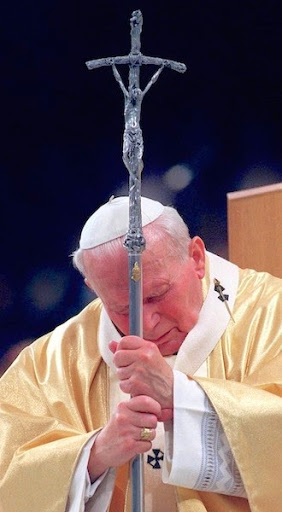
Jp2 cross s

Since writing my previous post of thanksgiving to St. John Paul II, ahead of his and St. John XXII’s canonization last Sunday, I kept coming back to thinking about another aspect of his life that has great importance for me. Beyond his words and actions, his perseverance in suffering, especially during the last 15 years of his pontificate (i.e., since the onset of Parkinson’s), has always been an inspiration and an example for me.

Cardinal Bertone put this aspect of St. John Paul II’s life best, when he said that “suffering was another one of his encyclicals.” And by considering it alongside his writings, the most obvious parallel to draw is with the encyclical Salvifici Doloris, which he wrote about suffering some six years after being elected Pope and where one of the key passages for me is the following (§23):

“Those who share in Christ’s sufferings have before their eyes the Paschal Mystery of the Cross and Resurrection, in which Christ descends, in a first phase, to the ultimate limits of human weakness and impotence: indeed, he dies nailed to the Cross. But if at the same time in this weakness there is accomplished his lifting up, confirmed by the power of the Resurrection, then this means that the weaknesses of all human sufferings are capable of being infused with the same power of God manifested in Christ’s Cross. In such a concept, to suffer means to become particularly susceptible, particularly open to the working of the salvific powers of God, offered to humanity in Christ. In him God has confirmed his desire to act especially through suffering, which is man’s weakness and emptying of self, and he wishes to make his power known precisely in this weakness and emptying of self. This also explains the exhortation in the First Letter of Peter: “Yet if one suffers as a Christian, let him not be ashamed, but under that name let him glorify God.””

The absurdity and scandal of a suffering God – and of suffering man – are not explained away or justified, but become invitations to participate in the suffering of Jesus, which demonstrates the extent of God’s love for man.

About fifteen years after writing the above words, and while visiting the sick in a hospital in Mexico City, St. John Paul II returned the the same theme and elaborated it further:

“Seen in this way, pain, disease and the dark moments of human existence acquire a profound and even hopeful dimension. One is never alone in facing the mystery of suffering: we are with Christ who gives meaning to the whole of life: moments of joy and peace, as well as those of affliction and grief. With Christ everything has meaning, even suffering and death; without him, nothing can be fully understood, not even those legitimate pleasures which God has associated to different moments of human life.”

Thinking about St. John Paul II’s health, one can wonder whether his remaining in office was good for the leadership of the Church, whether it wouldn’t have been better if he had resigned, and one can wonder whether such thoughts even entered the Pope’s head, or whether he had continued in his role out of inertia. The answer to the second part of the question is clear from the revision of his own Last Will that he made in the year 2000 and where he added:

“On May 13, 1981, the day of the attack on the Pope during the general audience in St. Peter’s Square, Divine Providence saved me in a miraculous way from death. The One Who is the Only Lord of life and death Himself prolonged my life, in a certain way He gave it to me again. From that moment it belonged to Him even more. I hope He will help me to recognize up to what point I must continue this service to which I was called on Oct. 16, 1978. I ask him to call me back when He Himself wishes. “In life and in death we belong to the Lord … we are the Lord’s.” (cf. Romans 14,8). I also hope that, as long as I am called to fulfill the Petrine service in the Church, the Mercy of God will give me the necessary strength for this service.”

To answer the first doubt, we need look no further than to the homily given by his successor, Benedict XVI, during the beatification of St. John Paul II, where he said:

“[T]he Lord gradually stripped him of everything, yet he remained ever a “rock”, as Christ desired. His profound humility, grounded in close union with Christ, enabled him to continue to lead the Church and to give to the world a message which became all the more eloquent as his physical strength declined. In this way he lived out in an extraordinary way the vocation of every priest and bishop to become completely one with Jesus, whom he daily receives and offers in the Church.”

Leadership of the Church is not about organizational shrewdness, effective policies or vigor (all of which are good, but secondary) – instead it is about an imitation of its head – Jesus. And as such, there is no doubt in my mind that St. John Paul II remained an exemplary leader until his very last moments on Earth. His public and persistent acceptance of frailty, suffering and weakness were as much evidence of his following in Jesus’ footsteps, as his rallying against the mafia, his effort to establish brotherly relationships with other religions, or his forgiving his would-be assassin. Pope Benedict XVI, addressing the Pontifical Council for pastoral healthcare professionals, explained St. John Paul II’s witness as follows:

“The mystery of suffering seems to blur the face of God, making Him almost a stranger, or even identifying him as being responsible for human suffering, but the eyes of faith are able to look deeply into this mystery. God became incarnate, He came to be close to man, even in the most difficult situations, He did not eliminate suffering, but in the Risen Crucified One, the Son of God suffered unto death, even death on a cross, He reveals that His love goes even deeper into the abyss of man to give him hope. The Crucified is risen, death has been illuminated by the morning of Easter: ‘God so loved the world that he gave his only Son, that whoever believes in him shall not perish but have eternal life’ (Jn 3.16). […] The testimony of the last years of John Paul II’s life teach us this: “An unshakable faith pervaded his physical weakness, making his illness, lived for love of God, the Church and the world, a actual participation in the journey of Christ to Calvary. The following of Christ did not spare Blessed John Paul II to take up his cross every day until the end, to be like his only Master and Lord.””

As I was thinking about what it is about St. John Paul II’s example that attracted me so much, I was visiting the Sagrada Familia in Barcelona, and I went to spend some time in front of Jesus in the Eucharist – if you convince a guard that you realize you are in an actual church, you are granted access to a small, walled-off fragment of the basilica where the tabernacle is situated. In the midst of the roar of a throng of tourists, I looked at the inscription on the tabernacle, which read: “Jo sóc la vida” (“I am the life” – cf. John 14:6) and something went “click” in my mind.1 A following of Jesus means an identification of life with Him and it is this that St. John Paul II did. His was an imitation of Jesus in all aspects of life – the joyous and the sorrowful, and a realization that the way to the joy of the resurrection that is mirrored in the joys of life passes through the sorrow of the crucifixion, which we can participate in, in its sufferings.

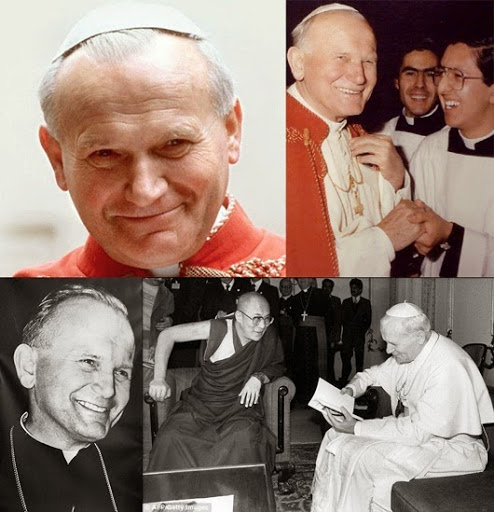
Just to dispel a potential misunderstanding that might arise from having spent 1500 words talking about suffering and that might suggest a preference for or a seeking out of suffering, let me say that this is not what Christianity is about. Instead it is all about joy, but a joy that embraces and subsumes the difficult and painful moments of life – like a profound beauty that also elevates and incorporates ugliness. In the end though it is about joy and beauty, like St. John Paul too emphasized when he insisted that “We are an Easter people” and when Pope Francis criticized “Christians whose lives seem like Lent without Easter” and who look like “sourpusses.” Let me therefore leave you with a couple of photos of St. John Paul II, from which it can be seen that he was anything but a sourpuss 🙂

Jp2 smiles


1 Not that I think the mind is mechanical :).

A joy that’s made for sharing

Francis eg

[Guest post: The following is a talk about Pope Francis’ Evangelii Gaudium, given by my bestie, Dr. Ján Morovič, at a retreat. Reproduced here with the author’s permission]

Among papal documents, apostolic exhortations serve the purpose of calling to action, and Pope Francis’ Evangelii Gaudium (The joy of the Gospel) does exactly that – it invites us to share with others the joy we have received from putting the Gospel into practice. It also shows us that sharing is a direct consequence of joy, and that such sharing is preceded by God’s presence in the life of every person.

Evangelii Gaudium is in many ways an extraordinary text. First, because of its directness, e.g., when Pope Francis says that “neither the Pope nor the Church have a monopoly on the interpretation of social realities or the proposal of solutions to contemporary problems” (§184), and when he laments the “unwelcoming atmosphere of some of our parishes and communities, or [… a] bureaucratic way of dealing with problems.” Second, because of its eclectic imagery, e.g., warning us against becoming “sourpusses” (§85) or suggesting that the Church “is not [like a] sphere […], where every point is equidistant from the centre, and [where] there are no differences between them[ … but instead that it is like a] polyhedron, which reflects the convergence of all its parts, each of which preserves its distinctiveness” (§236). And third, because of the broad variety of topics that Pope Francis covers there:

  • He emphasizes the importance of reaching out to those who live at the peripheries – both in economic and spiritual terms, (§20)
  • he desires a Church that “has been out in the streets” instead of one that is entangled in “obsessions and procedures,” (§49)
  • he speaks out against today’s “throw away culture” and the fiction of “trickle down theories of economic growth” leading to justice and inclusion (§54),
  • he warns against the worldliness of “a purely subjective faith” or of a “self-absorbed […] trust in [one’s] own powers” (§94),
  • he calls for “a more incisive female presence in the Church” (§103),
  • he provides practical tips for giving better sermons (§135),
  • he highlights the need for not only embracing the poor but also for learning from them and being evangelized by them (§198),
  • he talks about the principles of “building a people in peace, justice and fraternity,” (§221)
  • he underlines the importance of dialogue with science, other Christians, other religions and those with no religious beliefs, (§257)
  • and he reflects on the role of Mary, as the “Mother of the living Gospel” (§287).

Pope Francis’ thoughts on each of the above subjects are true gems – full of insight, derived from putting the Gospel into practice and presented with razor-sharp clarity, directness and vivid imagery. Each of them – and others besides – could be taken as a starting point for deeper reflection and be further studied, elaborated and put into practice.

While I found Francis’ words on topics like the economy, dialogue, peace and the poor very enriching, and while these stood out for me when I first read Evangelii Gaudium, I would instead like to focus now on three themes that emerged for me when I re-read the exhortation’s 52 000 words a second time. I have since also seen these popping up in his more recent talks and have also found them when reading the sermons from his time as the archbishop of Buenos Aires.

The three themes are:

  • what Christian joy means and how experiencing it compels us to share it,
  • how such sharing is directed absolutely at every single person – without exception, and
  • how the desire to share the joy of the Gospel leads to the realization that God is already present everywhere, and that it is not only a matter of us bringing his gifts to others but that he has given them gifts for us too.

It is an image of a virtuous cycle of light, radiating from the Trinity and infinitely reflected and amplified in all of creation. I believe, these themes are also the roots of the analyses and recommendations that make up the exhortation’s 100 pages and that they can therefore also serve as keys for later reflecting on them.

The joy of feeling loved

Already in it’s first paragraph, Evangelii Gaudium highlights that joy is a consequence of meeting Jesus, who has a “boundless and unfailing love” for us that “fills the hearts and lives of all who encounter” him. The result is a “joy [that] is constantly born anew” (§1) and that leads to a “personal certainty that, when everything is said and done, we are infinitely loved” (§6). This in turn leads Pope Francis to extending an invitation “at this very moment, to a renewed personal encounter with Jesus Christ, or at least an openness to letting him encounter [us]” (§3). Taking up this “most exciting invitation” then leads to the presence of “God with his people in the midst of a celebration overflowing with the joy of salvation” (§4) that Pope Francis let’s the prophet Zephaniah describe for us:

“The Lord, your God is in your midst, a warrior who gives you the victory; he will rejoice over you with gladness, he will renew you in his love; he will exult over you with loud singing, as on a day of festival” (Zephaniah 3:17)

Francis then proceeds to underline the ubiquity of such joy derived from God’s presence among us and of it being right to delight in it:

“This is the joy which we experience daily, amid the little things of life, as a response to the loving invitation of God our Father: “My child, treat yourself well, according to your means… Do not deprive yourself of the day’s enjoyment” (Sirach 14:11, 14). What tender paternal love echoes in these words!” (§4)

Not only is joy a clear theme already for the people of Israel, but it is repeatedly underlined by Jesus too during his time with the apostles:

“The Gospel, radiant with the glory of Christ’s cross, constantly invites us to rejoice. […] His message brings us joy: “I have said these things to you, so that my joy may be in you, and that your joy may be complete” (John 15:11). Our Christian joy drinks of the wellspring of his brimming heart.” (§5)

The joy of the Gospel that Francis speaks about is not a naïve escapism, or only a perk of good times. Instead, it must permeate all of a Christian’s life, like it did that of Jesus:

“I realize of course that joy is not expressed the same way at all times in life, especially at moments of great difficulty. Joy adapts and changes, but it always endures, even as a flicker of light born of our personal certainty that, when everything is said and done, we are infinitely loved. I understand the grief of people who have to endure great suffering, yet slowly but surely we all have to let the joy of faith slowly revive as a quiet yet firm trust, even amid the greatest distress.” (§6)

Francis reminds us that the promise of joy comes from Jesus himself, who said “You will be sorrowful, but your sorrow will turn into joy” (John 16:20) and that a lack of trust in it “is a defeatism which turns us into querulous and disillusioned pessimists, “sourpusses”,” (§85) it makes our “lives seem like Lent without Easter” (§6).

Personally, Francis’ words have been an examination of conscience for me and I have found his positioning of joy as a benchmark of a genuine relationship with Jesus and those around me a great help. It also reminded me of a chat I had with Hans (the responsible for men focolarini) when I was around 20 years old, who told me – in the context of discerning my vocation – “You will know that you have made the right choice, because you will be happy.” These words have stayed with me since and have proven invaluable in trying to understand God’s will at particularly important moments. In this sense, and well aligned with Francis, joy is not only a reward and an effect, but can also be an indicator.

Thinking about what Francis emphasizes about joy, I am struck not only by its clear logic, but also by its close harmony with the Ideal. Already in the first six paragraphs, which have provided all of the above insights, there is reference to life in the present moment, to the presence of Jesus in the midst, to starting again, to joy flowing from suffering and to the primacy of love.

Joy compels us to share itself with everyone

A rich and deep joy, like the one Francis describes, is something that cannot be contained, something that we can’t keep just for ourselves. It is a joy that compels us to share itself with others. As Francis puts it:

“Thanks solely to this encounter […] with God’s love, which blossoms into an enriching friendship, we are liberated from our narrowness and self-absorption. We become fully human when we become more than human, when we let God bring us beyond ourselves in order to attain the fullest truth of our being. Here we find the source and inspiration of all our efforts at evangelization. For if we have received the love which restores meaning to our lives, how can we fail to share that love with others? […] What kind of love would not feel the need to speak of the beloved, to point him out, to make him known?” (§8, 264)

Such a joy-inducing encounter with Jesus cannot be lived alone; it would make us burst if we didn’t share it and pass it on to others.

In the same breath as pointing out the necessity of inviting others to participate in the joy of the Gospel, Francis insists that it is intended for all, without exception. It is not only meant for those whom we like, for fellow Christians, or even for all men and women of good will.

“[I]t is vitally important for the Church today to go forth and preach the Gospel to all: to all places, on all occasions, without hesitation, reluctance or fear. The joy of the Gospel is for all people: no one can be excluded.” (§23)

And he adds later:

“Wherever the need for the light and the life of the Risen Christ is greatest, [the Church] will want to be there.” (§30)

As an example of such great need, Francis provides an analysis of how making everything disposable in contemporary culture leads not only to a marginalization but even to a total exclusion of some people from society:

“We have created a “throw away” culture which is now spreading. It is no longer simply about exploitation and oppression, but something new. Exclusion ultimately has to do with what it means to be a part of the society in which we live; those excluded are no longer society’s underside or its fringes or its disenfranchised – they are no longer even a part of it. The excluded are not the “exploited” but the outcast, the “leftovers”.” (§53)

Francis’ insistence on universality and on the desire of sharing the joy we have received from Jesus is also very much like how Chiara Lubich saw the consequences of unity, as she describes in a letter from 1948:

“The happiness we experience in the unity that you [Jesus] have given us through your death is something we wish to give to all those who pass next to us! We can’t keep it just for ourselves seeing that there are so many who hunger and thirst for this fullness of peace, this infinite joy that we were experiencing!”

But how do we help others develop a relationship with Jesus that then gives them access to His joy? Here, Francis makes several suggestions throughout Evangelii Gaudium. The first is to think about how it was that we grew our own relationship with Jesus and to pass that on to those we meet:

“All of us are called to offer others an explicit witness to the saving love of the Lord, who despite our imperfections offers us his closeness, his word and his strength, and gives meaning to our lives. In your heart you know that it is not the same to live without him; what you have come to realize, what has helped you to live and given you hope, is what you also need to communicate to others. Our falling short of perfection should be no excuse; on the contrary, mission is a constant stimulus not to remain mired in mediocrity but to continue growing.” (§121)

The second piece of advice is to be attentive to unexpected, informal moments that are open to our sharing of Jesus’ joy with others:

“Today, as the Church seeks to experience a profound missionary renewal, there is a kind of preaching which falls to each of us as a daily responsibility. It has to do with bringing the Gospel to the people we meet, whether they be our neighbours or complete strangers. This is the informal preaching which takes place in the middle of a conversation, something along the lines of what a missionary does when visiting a home. Being a disciple means being constantly ready to bring the love of Jesus to others, and this can happen unexpectedly and in any place: on the street, in a city square, during work, on a journey.” (§127)

The third recommendation, or better put, an invitation, is to imitate Jesus’ own method of sharing his Good News, which is that of “closeness.” Let me quote the entire paragraph in which Francis sets this method out, as I consider it to be one of the great jewels in this document:

“Jesus himself is the model of this method of evangelization which brings us to the very heart of his people. How good it is for us to contemplate the closeness which he shows to everyone! If he speaks to someone, he looks into their eyes with deep love and concern: “Jesus, looking upon him, loved him” (Mark 10:21). We see how accessible he is, as he draws near the blind man (cf. Mark 10:46-52) and eats and drinks with sinners (cf. Mark 2:16) without worrying about being thought a glutton and a drunkard himself (cf. Matthew 11:19). We see his sensitivity in allowing a sinful woman to anoint his feet (cf. Luke 7:36-50) and in receiving Nicodemus by night (cf. John 3:1-15). Jesus’ sacrifice on the cross is nothing else than the culmination of the way he lived his entire life. Moved by his example, we want to enter fully into the fabric of society, sharing the lives of all, listening to their concerns, helping them materially and spiritually in their needs, rejoicing with those who rejoice, weeping with those who weep; arm in arm with others, we are committed to building a new world. But we do so not from a sense of obligation, not as a burdensome duty, but as the result of a personal decision which brings us joy and gives meaning to our lives.” (§269)

And finally, Francis also provides a particularly lucid synthesis of the basic principles of how to share the Gospel with others:

“All […] have a right to receive the Gospel. Christians have the duty to proclaim the Gospel without excluding anyone. Instead of seeming to impose new obligations, they should appear as people who wish to share their joy, who point to a horizon of beauty and who invite others to a delicious banquet.” (§15)

And he concludes by paraphrasing Benedict XVI: “It is not by proselytizing that the Church grows, but “by attraction”.”

When I think about my own experience in terms of relationships with others and with God, I clearly recognize the closeness that Francis speaks about and that he identifies as Jesus’ method. Spending a Saturday putting up shelves with one person, driving for hours to pick up some leaflets with another, or sharing a room with someone I have never met before but whose obvious love towards me was the start of a strong friendship, are all specific events, with names and dates, that stick in my mind as moments characterized by closeness. Closeness that attracted me to the other person’s choice of God, that filled me with joy and that built a lasting bond.

Wherever we go, Jesus is already there

Leaving our excursion through Evangelii Gaudium at this point – after having looked at what Francis means by the joy of the Gospel and how he sees it as something that we want to and must share with all – would already be an enriching experience. However, I believe that there is a third strand in Francis’ thought that very much complements the first two and that gives them a new dimension, which is both humbling and empowering. This third dimension is the realization that our efforts to share the joy of the Gospel with others aren’t a matter of us being in possession of Jesus and playing the role of grandees whose generosity provides Him to others. Francis puts it very clearly already in the third paragraph of Evangelii Gaudium:

“The Lord does not disappoint those who take this risk [- the risk of being open to an encounter with Him]; whenever we take a step towards Jesus, we come to realize that he is already there, waiting for us with open arms.” (§3)

When I read these words now, they strike me as having great importance, but I have to admit that they only made me stop when I read them a second time, after hearing the talk Francis gave to missionary families from the Neocatechumenal Way, before their setting off for faraway destinations. There he expands on the idea of God always preceding us:

“[W]herever you may go, it would do you well to think that the Spirit of God always gets there ahead of us. The Lord always precedes us! … Even in the most faraway places, even in the most diverse cultures, God scatters everywhere the seeds of his Word. [… We need to learn] how to recognize the need of the Gospel, which is present everywhere, but also that action that the Holy Spirit has accomplished in the life and in the history of every people.”

These words immediately resonated with the relationships I have with friends from other religions, agnostics and atheist. It seemed to me like Francis put my own experiences in new terms, yet terms that fit them like a glove. Thinking about the close friends I have who are agnostics or atheist, and reflecting on the gifts I have received from them, I can identify features in them that do indicate actions of the Holy Spirit and seeds of the Word.

Armed with this insight from the talk to the Neocatechumenal Way, re-reading Evangelii Gaudium now looked like it was peppered with references to evangelization being a following after Jesus rather than a striking out into the unknown or a bringing of light into total darkness.

In fact, Francis takes this idea even further, by insisting that the gifts God gave others are there also for us to discover and enjoy:

“If we really believe in the abundantly free working of the Holy Spirit, we can learn so much from one another! It is not just about being better informed about others, but rather about reaping what the Spirit has sown in them, which is also meant to be a gift for us.” (§246)

He then proceeds to apply this insight also to the followers of non-Christian and non-Abrahamic religions by saying that:

“God’s working in them tends to produce signs and rites, sacred expressions which in turn bring others to a communitarian experience of journeying towards God. While these lack the meaning and efficacy of the sacraments instituted by Christ, they can be channels which the Holy Spirit raises up in order to liberate non-Christians from […] immanentism or from purely individual religious experiences. The same Spirit everywhere brings forth various forms of practical wisdom which help people to bear suffering and to live in greater peace and harmony. As Christians, we can also benefit from these treasures built up over many centuries, which can help us better to live our own beliefs.” (§254)

In other words, the Holy Spirit guides the followers of other religions too on our collective journey towards God and helps them along the way with gifts that are treasures for us too and that also enrich our own beliefs and lives.

Finally, and more surprisingly, Francis looks for the footsteps of the Holy Spirit not only in other religions, where he follows the clear example of Vatican II, but also in secularized urban environments, where he encourages us to develop a new optics:

“We need to look at our cities with a contemplative gaze, a gaze of faith which sees God dwelling in their homes, in their streets and squares. God’s presence accompanies the sincere efforts of individuals and groups to find encouragement and meaning in their lives. He dwells among them, fostering solidarity, fraternity, and the desire for goodness, truth and justice. This presence must not be contrived but found, uncovered.” (§71)

Reading the above passage made me think, e.g., of Grayson Perry’s Reith Lectures from last year, where he spoke about art and where he noted the challenges of an artist’s pursuit of their calling in a world whose default method is “detached irony.” His response was to declare that “perhaps the most shocking tactic that’s left to artists these days is sincerity.” To my mind this is very much aligned with Francis’ words.

I also see the above passage as a concrete plan for how I can better relate to my colleagues and acquaintances in whose lives I see a great deal of good, often sought under challenging family and personal circumstances, but very clearly lived both for individual good and for the good of all. Instead of only feeling a desire to share Jesus’ love with them, I can also be more attentive to recognizing God’s presence in their lives – an aspect that I was already aware of but that Francis’ words have brought out with greater clarity.

In summary, Francis places repeated emphasis on God’s preceding us wherever we go to spread the joy of the Good News. Be it far away lands with cultures very different from our own, or the cities we live in and from whose culture religion is largely absent. In all of these cases the Holy Spirit is at work though, for the good of those, whose lives he enters without their even being aware of it, but also for our own benefit. God’s presence among all who sincerely seek meaning, harmony, peace, beauty and goodness awaits us with open arms and is ready to reciprocate our sharing of the joy of the Gospel.
An ecumenism of brotherhood

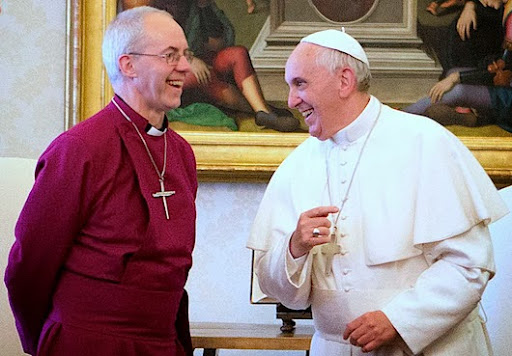
Francis abp welby

[Warning: long read.]

Already St. Paul was faced with factions and divisions among the earliest followers of Jesus – to the point of frustration, in the face of groups declaring their allegiance to one or other leader: “[I]t has been reported to me about you, my brothers, by Chloe’s people, that there are rivalries among you. I mean that each of you is saying, “I belong to Paul,” or “I belong to Apollos,” or “I belong to Cephas,” or “I belong to Christ.” Is Christ divided? Was Paul crucified for you? Or were you baptized in the name of Paul?” (1 Corinthians 1:11-13). In other words: “Pull yourselves together!”

That there are divisions among Christians is a scandal and one that both mocks Jesus’ own call for his followers to be united and for us to love each other like ourselves. It is no wonder then that ecumenism – the desire to see all Christians reunited after centuries of divisions – is one of the most prominent themes of Pope Francis’ preaching and actions. To get a sense of how he is approaching this challenge (or “opportunity,” as it would be put using a politically-correct vocabulary), it is worth taking a look at what he has said on the subject so far. The following is, therefore, my attempt to pull all of Francis’ remarks on ecumenism together in one place (in chronological order):

  1. When addressing the Archbishop of Canterbury in June ’13, Francis focuses on ecumenism as a shared journey, undertaken with Jesus in our midst:

    “The unity we so earnestly long for is a gift that comes from above and it is rooted in our communion of love with the Father, the Son and the Holy Spirit. As Christ himself promised, “where two or three are gathered in my name, there am I in the midst of them” (Mt 18:20). Let us travel the path towards unity, fraternally united in charity and with Jesus Christ as our constant point of reference.”

  2. Later that month, addressing the Ecumenical Patriarch of Constantinople, Francis draws attention to ecumenism not being about a lowest common denominator, but instead about an exchange of riches and a seeking of truth:1

    “It comforts me, knowing that Catholics and Orthodox share the same conception of dialogue that doesn’t seek a theological minimalism on which to reach a compromise, but that rather is based on the deepening of the truth that Christ has given to his Church and that we, moved by the Holy Spirit, never cease to understand better. This is why we shouldn’t be afraid of encounter and true dialogue. It doesn’t distance us from the truth but rather, through an exchange of gifts, leads us, under the guidance of the Spirit of truth, to the whole truth.”

  3. In his address to Baselios Marthoma Paulose II, Catholicos of the Malankara Orthodox Syrian Church in September ’13, Francis calls for a culture of encounter instead of clashes, emphasizing both the need of individual effort and the work of the Holy Spirit:

    “I believe that on the ecumenical path it is important to look with trust to the steps that have been completed, overcoming prejudices and closed attitudes which are part of a kind of “culture of clashes” and source of division, and giving way to a “culture of encounter”, which educates us for mutual understanding and for working towards unity. Alone however, this is impossible; our witnesses and poverty slow the progress. For this reason, it is important to intensify our prayer, because only the Holy Spirit with his grace, his light and his warmth can melt our coldness and guide our steps towards an ever greater brotherhood.”

  4. In “the” interview to Jesuit magazines later that month, Francis emphasized the mutual enrichment that is a consequence of ecumenism: “In ecumenical relations it is important not only to know each other better, but also to recognize what the Spirit has sown in the other as a gift for us.”
  5. During a general audience at the end of September ’13, Francis emphasized two points with regard to ecumenism: first that there is an abundance of riches that Christians already share:

    “There is one body, that of Christ which we receive in the Eucharist; one Spirit, the Holy Spirit that animates and constantly recreates the Church; one hope, eternal life; one faith, one Baptism, one God, Father of us all (cf. vv. 4-6). The richness of what unites us!”

    second, that the work for communion among all Christians starts with each one of us – in the family, parishes, … rather than being something removed from the lives of individuals:

    “Each one should ask himself today: do I make unity grow in the family, in the parish, in the community or am I a motive of division, of hardship? Do I have the humility to heal with patience, with sacrifice, the wounds to communion?”

    and, finally, a reminder that Christian unity is not principally a matter of political negotiation, but a gift received from God:

    “[W]ho is the motor of this unity of the Church? It is the Holy Spirit. Our unity is not primarily the fruit of our consensus, of our effort to be in agreement, but it comes from Him who makes unity in diversity, which is harmony.”

  6. When addressing the president of the Lutheran World Federation in October ’13, Francis positions unity among Christians as a consequence of each individual, community and church drawing closer to Jesus and as being in proportion to the sincerity with which it is asked for: “In the measure in which we draw closer to our Lord Jesus Christ in humility of spirit, we are certain to draw closer to one another. And, in the measure in which we ask the Lord for the gift of unity, we are sure that he will take us by the hand and be our guide.” In other words, both as a consequence of fidelity and as a gift.
  7. A week later, in a letter to the World Council of Churches, Francis effectively calls for action as one Christian community, even in the face of our existing differences:

    “In fidelity to the Gospel, and in response to the urgent needs of the present time, we are called to reach out to those who find themselves in the existential peripheries of our societies and to show particular solidarity with the most vulnerable of our brothers and sisters: the poor, the disabled, the unborn and the sick, migrants and refugees, the elderly and the young who lack employment.”

  8. In an interview for the La Stampa Italian daily in December ’13, Francis further sharpened his insistence on what Christians all have in common:

    “Today there is an ecumenism of blood. In some countries they kill Christians for wearing a cross or having a Bible and before they kill them they do not ask them whether they are Anglican, Lutheran, Catholic or Orthodox. Their blood is mixed. To those who kill we are Christians. We are united in blood, even though we have not yet managed to take necessary steps towards unity between us and perhaps the time has not yet come. Unity is a gift that we need to ask for. I knew a parish priest in Hamburg who was dealing with the beatification cause of a Catholic priest guillotined by the Nazis for teaching children the catechism. After him, in the list of condemned individuals, was a Lutheran pastor who was killed for the same reason. Their blood was mixed. The parish priest told me he had gone to the bishop and said to him: “I will continue to deal with the cause, but both of their causes, not just the Catholic priest’s.” This is what ecumenism of blood is.”

  9. At the end of the Week of Prayer for Christian Unity at the end of January ’14, Francis highlighted that Christian unity won’t be something that suddenly happens at the end of a process, but that it is instead a journey that we share already now:

    “We have all been damaged by these divisions. None of us wishes to become a cause of scandal. And so we are all journeying together, fraternally, on the road towards unity, bringing about unity even as we walk. […] Unity will not come about as a miracle at the very end. Rather, unity comes about in journeying; the Holy Spirit does this on the journey. If we do not walk together, if we do not pray for one another, if we do not collaborate in the many ways that we can in this world for the People of God, then unity will not come about! But it will happen on this journey, in each step we take. And it is not we who are doing this, but rather the Holy Spirit, who sees our goodwill.”

  10. On 18th February Pope Francis then addressed the attendees of a Evangelical Christians, via a video recorded by his friend – the Anglican Bishop Tony Palmer on his iPhone. Not only was the form of the message refreshingly friendly and informal, but its content too is significant in the completely fraternal level at which Francis places himself and the gathering he addresses. The very direct identification of past disagreements as sins on both side, the acknowledgement of God’s action among the gathering he addresses and his emphasis on the need for encounter and the recognition of each other as brothers further underline where he is coming from:2

    Dear brothers and sisters, excuse me because I speak in Italian, but I am not speaking English. But, I will speak no Italian, no English, but heartfully. It is a simpler and more authentic language and this language of the heart has a special style and and a special grammar. A simple grammar. Two rules: Love God above all else, and love the other because they are your brother and sister. With these two things we go ahead. I am here with my brother, with my brother bishop, Tony Palmer. We have been friends for years. […] It is a pleasure to greet you. A joyful and wishful greeting. Joyful, because it fills me with joy to know that you are together to give praise to Jesus Christ, the only Lord. And to pray to the Father and receive the Spirit. This gives joy, because it can be seen that the Lord works all over the world.

    And wishful because … Well, what happens with us is what also happens in some neighborhoods where there are some families who love each other and other families who don’t. Families who come together and families who separate and we are a bit – I’ll use the word – a bit separated. Separated because sins have separated us, our sins. The misunderstandings throughout history. It has been a long road of communitarian sin. But who is to blame? We all are to blame. We are all sinners. Only one is just – the Lord.

    I am wishful for this separation to end and for communion to come. I am wishful for that embrace that Holy Scripture speaks about when Joseph’s brothers, starving, went to Egypt so that they could buy food to eat. They went to buy, they had money, but they couldn’t eat the money! And there they found something more than food, they found their brother. All of us have “currency.” The currency of culture, the currency of our history, and lots of cultural riches and religious ones, of diverse traditions. But we have to come together as brothers. And we must cry together like Joseph did. This crying will unite us – the crying of love. I am talking to you as your brother. And I speak to you like this, simply. With joy and wishfulness. Let us make our wishfulness grow, because this will push us to find each other, to embrace each other and to praise Jesus Christ as the only Lord of history. […] I ask you to bless me and I bless you – from brother to brother.”

  11. That emphasis on Jesus being the center of Christian life is then taken further in Francis’ Angelus message3 last Sunday, where he insisted that :

    “Saint Paul explains that […] the community does not belong to the apostles, but it is them – the apostles – who belong to the community; but the community, in its entirety, belongs to Christ!

    From this belonging derives the fact that in Christian communities – dioceses, parishes, associations, movements – differences mustn’t contradict the fact that we all, through Baptism, have the same dignity: we are all all, in Jesus Christ, sons and daughters of God. And this is our dignity: in Jesus Christ we are sons and daughters of God! Those who have received a ministry of leadership, of preaching, of administering the Sacraments, mustn’t consider themselves to in possession of special powers, masters, but place themselves at the service of the community, helping it along the journey of holiness with joy. […]

    May the Lord give us the grace to work for the unity of the Church, of building this unity, because unity is more important than conflicts! The unity of the Church is of Christ, conflicts are problems that are not always of Christ. […]

    Pray for us [the new Cardinals, made the previous day, and the pope], that we may be good servants: good servants, not good masters! All together, bishops, priests, consecrated persons and faithful laity, we have to give witness of a Church faithful to Christ, animated by the desire to serve brothers and sisters and ready to reach out with prophetic courage towards the spiritual expectations and needs of men and women of our times.”

All of this is a lot to take in, but for me there are a couple of key points that Francis has made. First, that neither those who persecute or denigrate Christians, nor God, make distinctions between the different denominations. Second, that there are degrees of unity and that we can make it grow by working together for the good of all – including those who are not Christians, thereby contributing also to universal brotherhood (as stated also in Evangelii Gaudium §245). Third, that no one owns the Christian “brand” but Jesus himself. We are all on a level playing field, all having made mistakes, but all being recipients of God’s gifts and in a position to help, accompany and support each other. Fourth, that ecumenism is not akin to mergers and acquisitions or to a peace treaty – it is not about compromise or a lowest common denominator. The name of the game is truth, and differences, instead, are riches that will be brought together by the actions of the Holy Spirit. Fifth, ecumenism is both God’s work and ours and is part of our broader obligation – in response to Jesus’ own testament4 – to work towards unity in all contexts, which also reminds me of a great piece of advice by St. Ignatius of Loyola: “Pray as though everything depended on God. Work as though everything depended on you.”


1 Echoing one of Pope Benedict XVI’s most daring statements on the subject: “[T]he search for knowledge and understanding always has to involve drawing closer to the truth. Both sides in this piece-by-piece approach to truth are therefore on the path that leads forward and towards greater commonality, brought about by the oneness of the truth. As far as preserving identity is concerned, it would be too little for the Christian, so to speak, to assert his identity in a such a way that he effectively blocks the path to truth. Then his Christianity would appear as something arbitrary, merely propositional. He would seem not to reckon with the possibility that religion has to do with truth. On the contrary, I would say that the Christian can afford to be supremely confident, yes, fundamentally certain that he can venture freely into the open sea of the truth, without having to fear for his Christian identity.”
2 The following is my translation of the original Italian – except for the first few sentences (transcribed in italics), which Francis speaks in (broken) English – another great gesture :).
3 Since the English version of the full text is not available yet, the following is my own, crude rendition. 4 “I pray not only for them, but also for those who will believe in me through their word, so that they may all be one, as you, Father, are in me and I in you, that they also may be in us, that the world may believe that you sent me.” (John 17:20-22)

Mary is more important than the apostles

Mary queen of apostles

That the role of women in the Church is lacking, is a failing that Pope Francis has spoken about repeatedly and for which he is seeking a solution. As he stated during the impromptu interview on the flight back from the World Youth Day in Rio last summer, and again during “the” interview given to Jesuit publications, the role of women needs to be revised and they need to be part of the decision making processes in the Church. The points made during those interviews are incorporated and elaborated again in Pope Francis’ apostolic exhortation Evangelii Gaudium – a magisterial document of the Catholic Church, where he sums the situation up as follows in paragraphs 103 and 104:

“The Church acknowledges the indispensable contribution which women make to society through the sensitivity, intuition and other distinctive skill sets which they, more than men, tend to possess. I think, for example, of the special concern which women show to others, which finds a particular, even if not exclusive, expression in motherhood. I readily acknowledge that many women share pastoral responsibilities with priests, helping to guide people, families and groups and offering new contributions to theological reflection. But we need to create still broader opportunities for a more incisive female presence in the Church. Because “the feminine genius is needed in all expressions in the life of society, the presence of women must also be guaranteed in the workplace” and in the various other settings where important decisions are made, both in the Church and in social structures.

Demands that the legitimate rights of women be respected, based on the firm conviction that men and women are equal in dignity, present the Church with profound and challenging questions which cannot be lightly evaded. The reservation of the priesthood to males, as a sign of Christ the Spouse who gives himself in the Eucharist, is not a question open to discussion, but it can prove especially divisive if sacramental power is too closely identified with power in general. It must be remembered that when we speak of sacramental power “we are in the realm of function, not that of dignity or holiness”. The ministerial priesthood is one means employed by Jesus for the service of his people, yet our great dignity derives from baptism, which is accessible to all. The configuration of the priest to Christ the head – namely, as the principal source of grace – does not imply an exaltation which would set him above others. In the Church, functions “do not favour the superiority of some vis-à-vis the others”. Indeed, a woman, Mary, is more important than the bishops. Even when the function of ministerial priesthood is considered “hierarchical”, it must be remembered that “it is totally ordered to the holiness of Christ’s members”. Its key and axis is not power understood as domination, but the power to administer the sacrament of the Eucharist; this is the origin of its authority, which is always a service to God’s people. This presents a great challenge for pastors and theologians, who are in a position to recognize more fully what this entails with regard to the possible role of women in decision-making in different areas of the Church’s life.”

I’d sum the key points up as follows:

  1. Men and women are of equal dignity.
  2. Sacramental power is a function, not a source of prestige, dignity or holiness.
  3. Sacramental power being too closely tied to power in general is a source of division.
  4. Women already share some responsibilities with priests in pastoral, guidance and theological terms.
  5. Women need to be present where important decisions are made in society and in the Church.
  6. How to include women in the Church’s decision-making process and have them hold positions of responsibility and power is a great challenge.

To my mind, Pope Francis’ is a very clear and transparent account of the current status and his desire to change it is obvious from every occasion when he speaks about it.

In an attempt to get a sense of what a solution might look like, an Italian newspaper, Corriere della Sera, went to interview Maria Voce, the president of the 2.5 million member Focolare Movement – the only lay movement in the Catholic Church headed by a woman. The interview kicks off with the most obvious – and good – question about whether Voce is unhappy that she cannot become a priest1:

“Look, I know female Evangelical pastors, who are my friends and exceptional women and who do very well for their churches, but I have never thought that the possibility of becoming a priest would increase the dignity of women. It would just be an additional service. Because, the point is another: as women, what we need, it seems to me, is to see a recognition of equal dignity, of equal opportunity in the Catholic Church. Service and not servitude, as Pope Francis himself says.”

The point here is clear – the priesthood is a service to the Church, while what women need is dignity and opportunity. On a related note, Voce was also asked about the question of female cardinals, to which she responded:

“A female cardinal could be a sign for humanity, but not for me or for other women, I believe. It does not interest me. She would be an exceptional person to be made a cardinal. OK, but then? The great female figures, saints and doctors of the church, have always been valued. But it is the woman as such who doesn’t find her place. What needs to be recognized is the female genius in the everyday.”

Again, this makes great sense – the point is about an all-pervasive presence of women in the church – at all levels of responsibility and service, and not only the appreciation for exceptional individuals, who have already been well dealt with for centuries. But what would this recognition and presence look like? Here Voce has several suggestions:

“Women could lead departments of the Vatican curia […] I don’t understand why, for example, the department on the family necessarily has to be lead by a cardinal. It could very well be a couple of lay persons who live their marriage in a Christian way […] The same could apply to other departments too. It seems normal to me.

I am also thinking of the general Congregations before a conclave. The mother superiors of large orders could participate and maybe also elected representatives of dioceses. […]

[Regarding the council of eight cardinals advising the pope] I don’t envisage a group of only women that would be added. It would be more useful to have a mixed group, with women and other lay persons who together with the cardinals could provide the necessary information and perspectives. I’d be very enthusiastic about that.”

The final topic of the interview was the question of the “theology of women” that Pope Francis referred to as being absent but very much needed. Here, Voce identified Francis’ statement that “Mary is greater than the apostles” as being the Leitmotiv of such a theology. She also suggested that this direction, given by the Pope, points both to complementarity and to women also participating in the Church’s magisterium, it’s teaching and leadership role, in some way:

“Chiara [Lubich]2 thought of Mary as the blue sky that contains the sun, the moon and the stars. In this vision, if the sun is God and the stars are the saints, Mary is the sky that contains them, that contains also God: by God’s own will who has incarnated himself in her womb. The woman in the Church is this, needs to have this function, which can only exist in complementarity with the Petrine charism. It can’t be only Peter guiding the Church, there needs to be Peter with the apostles and sustained and enveloped by the embrace of this woman-mother who is Mary.”

This image of Mary enveloping the apostles is filled with profound beauty to my mind, and is such an intuitive way of putting the need for complementarity between the Petrine, apostolic aspect of the Church and the Marian aspect, which is about reciprocating God’s love for us. In fact, the Catechism of the Catholic Church – drawing on John Paul II’s apostolic letter Mulieris Dignitatem – puts this very clearly:

““[The Church’s] structure is totally ordered to the holiness of Christ’s members. And holiness is measured according to the ‘great mystery’ in which the Bride responds with the gift of love to the gift of the Bridegroom.” Mary goes before us all in the holiness that is the Church’s mystery as “the bride without spot or wrinkle.” This is why the “Marian” dimension of the Church precedes the “Petrine.””

The challenge now is to put it into practice!


1 For more on this subject, see a previous post.
2 For more about Chiara Lubich – the founder of the Focolare Movement, see previous posts and for some background on the image referred to by Voce see this particular one.

Science in Evangelii Gaudium

The apostolic exhortation published by Pope Francis yesterday has received widespread scrutiny already, with two foci being its critique of unbridled market capitalism and its equally sharp-tongued critique of the Church’s shortcomings and a call to greater mercy and closeness to all. Both of these topics are close to my heart and I hope to return to them in due course.

Instead, I’d here like to focus on the references to science that Francis made in Evangelii Gaudium – effectively as a follow-on to an analogous analysis I applied to his interview given to Jesuit publications some months ago. As I noted there, Francis placed science on par with theology, both as informing the Church from within, and I was curious to see how that – to my mind daring – positioning would hold up in this formal exposition of his vision for the Church.

The first mention of science comes up early on in the document and is well in line with the sketch from “the” interview:

“The Church […] needs to grow in her interpretation of the revealed word and in her understanding of truth. It is the task of exegetes and theologians to help “the judgment of the Church to mature”. The other sciences also help to accomplish this, each in its own way.”

Science – in fact, “the sciences” – is placed explicitly among the sources of understanding that the Church needs to take advantage of, even in the context of making sense of revelation. Francis follows this up by stating that:

“Differing currents of thought in philosophy, theology and pastoral practice, if open to being reconciled by the Spirit in respect and love, can enable the Church to grow, since all of them help to express more clearly the immense riches of God’s word. For those who long for a monolithic body of doctrine guarded by all and leaving no room for nuance, this might appear as undesirable and leading to confusion. But in fact such variety serves to bring out and develop different facets of the inexhaustible riches of the Gospel.”

The sciences and their “differing currents of thought” are shown here to lead to a nuanced, varied understanding of a multi-faceted reality. In fact, towards the end of the exhortation, Francis makes a very important point about the Gospel – and by extension reality too – being like a polyhedron:

“Here our model is not the sphere, which is no greater than its parts, where every point is equidistant from the centre, and there are no differences between them. Instead, it is the polyhedron, which reflects the convergence of all its parts, each of which preserves its distinctiveness.”

Returning to the presentation of science in Evangelii Gaudium, the strongest point is made about half-way through the document, where science is even positioned as “an instrument of the Spirit for enlightening and renewing the world,” in the context of its capacity to shed light on Jesus’ message. This is very strong stuff and, I believe, part of a much broader move by Francis to emphasize the ubiquity of God’s speaking to us. Also in the context of inter-religious dialogue, Francis proclaims that non-Christian religions too “can be channels which the Holy Spirit raises up” – again a very bold claim, like in the case of science. In effect, Francis is saying not to look for God only in the zones explicitly demarcated for it, but to realize that He can be accessed in many more ways. In fact, his words about non-believers round out this picture very clearly: “We consider [all who sincerely seek the truth, goodness and beauty] as precious allies in the commitment to defending human dignity, in building peaceful coexistence between peoples and in protecting creation.”

Next, Francis returns to the key point from “the” interview – that theology and science need to work in tandem:

“It is not enough that evangelizers be concerned to reach each person, or that the Gospel be proclaimed to the cultures as a whole. A theology […] which is in dialogue with other sciences and human experiences is most important for our discernment on how best to bring the Gospel message to different cultural contexts and groups.”

However, it is a relationship among equals that he is after – among all the sciences and rational modes of equiry and thought, which is in contrast with an absolutization of positivist science in the form of scientism:

“Dialogue between science and faith also belongs to the work of evangelization at the service of peace. Whereas positivism and scientism “refuse to admit the validity of forms of knowledge other than those of the positive sciences”, the Church proposes another path, which calls for a synthesis between the responsible use of methods proper to the empirical sciences and other areas of knowledge such as philosophy, theology, as well as faith itself, which elevates us to the mystery transcending nature and human intelligence. Faith is not fearful of reason; on the contrary, it seeks and trusts reason, since “the light of reason and the light of faith both come from God” and cannot contradict each other.”

Again, this is not a new position – drawing explicitly on John Paul II’s Fides et Ratio – but an important facet of Francis’ vision of how science is part of a Christian world-view.

Finally, Francis re-iterates the fundamental compatibility of Christianity and science, by underlining the goodness of scientific progress. At the same time he warns against an ideologisation of science too and against a jumping to conclusions or an overconfidence in emerging theories:

“The Church has no wish to hold back the marvellous progress of science. On the contrary, she rejoices and even delights in acknowledging the enormous potential that God has given to the human mind. Whenever the sciences – rigorously focused on their specific field of inquiry – arrive at a conclusion which reason cannot refute, faith does not contradict it. Neither can believers claim that a scientific opinion which is attractive but not sufficiently verified has the same weight as a dogma of faith. At times some scientists have exceeded the limits of their scientific competence by making certain statements or claims. But here the problem is not with reason itself, but with the promotion of a particular ideology which blocks the path to authentic, serene and productive dialogue.”

In summary, I find Francis’ views on science deeply positive and see them as both building on his predecessors’ emphasis on rationality and going beyond even the extent to which they saw science as a good. To declare science as an instrument of the Holy Spirit is to give it the highest possible accolade.

The Joy of the Gospel – an Anthology

Evangelium gaudii

[Very long read – but way shorter than the full Evangelii Gaudium :)]

Pope Francis has published his first extensive piece of writing as pope today – the apostolic exhortation “Evangelii Gaudium” – “The Joy of the Gospel.”1 It is a 48K+ word text, written originally in Spanish and hailed by many already as the blueprint for his papacy, and all I’d like to do for now is just share with you some of my favorite parts of this text, to which I am sure to return many more times. I will not attempt to be comprehensive and will certainly skip also important parts of this document, which I encourage you to read in full. Instead, the following will be an anthology – a collection of flowers – that most immediately spoke to me.

Whenever our interior life becomes caught up in its own interests and concerns, there is no longer room for others, no place for the poor. God’s voice is no longer heard, the quiet joy of his love is no longer felt, and the desire to do good fades. (§2)

There are Christians whose lives seem like Lent without Easter. I realize of course that joy is not expressed the same way at all times in life, especially at moments of great difficulty. Joy adapts and changes, but it always endures, even as a flicker of light born of our personal certainty that, when everything is said and done, we are infinitely loved. (§6)

Sometimes we are tempted to find excuses and complain, acting as if we could only be happy if a thousand conditions were met. (§7)

The heart of [the Gospel] message will always be the same: the God who revealed his immense love in the crucified and risen Christ. (§11)

Christians have the duty to proclaim the Gospel without excluding anyone. Instead of seeming to impose new obligations, they should appear as people who wish to share their joy, who point to a horizon of beauty and who invite others to a delicious banquet. It is not by proselytizing that the Church grows, but “by attraction”. (§14)

[I don’t] believe that the papal magisterium should be expected to offer a definitive or complete word on every question which affects the Church and the world. It is not advisable for the Pope to take the place of local Bishops in the discernment of every issue which arises in their territory. In this sense, I am conscious of the need to promote a sound “decentralization”. (§16)

Let us try a little harder to take the first step and to become involved. Jesus washed the feet of his disciples. The Lord gets involved and he involves his own, as he kneels to wash their feet. He tells his disciples: “You will be blessed if you do this” (Jn 13:17). An evangelizing community gets involved by word and deed in people’s daily lives; it bridges distances, it is willing to abase itself if necessary, and it embraces human life, touching the suffering flesh of Christ in others. (§24)

Since I am called to put into practice what I ask of others, I too must think about a conversion of the papacy. It is my duty, as the Bishop of Rome, to be open to suggestions which can help make the exercise of my ministry more faithful to the meaning which Jesus Christ wished to give it and to the present needs of evangelization. (§32)

Pastoral ministry in a missionary style is not obsessed with the disjointed transmission of a multitude of doctrines to be insistently imposed. [… To] reach everyone without exception or exclusion, the message has to concentrate on the essentials, on what is most beautiful, most grand, most appealing and at the same time most necessary. The message is simplified, while losing none of its depth and truth, and thus becomes all the more forceful and convincing. (§35)

[I]t needs to be said that in preaching the Gospel a fitting sense of proportion has to be maintained. This would be seen in the frequency with which certain themes are brought up and in the emphasis given to them in preaching. For example, if in the course of the liturgical year a parish priest speaks about temperance ten times but only mentions charity or justice two or three times, an imbalance results, and precisely those virtues which ought to be most present in preaching and catechesis are overlooked. The same thing happens when we speak more about law than about grace, more about the Church than about Christ, more about the Pope than about God’s word. (§38)

The Church is herself a missionary disciple; she needs to grow in her interpretation of the revealed word and in her understanding of truth. It is the task of exegetes and theologians to help “the judgment of the Church to mature”. The other sciences also help to accomplish this, each in its own way. (§40)

[T]oday’s vast and rapid cultural changes demand that we constantly seek ways of expressing unchanging truths in a language which brings out their abiding newness. “The deposit of the faith is one thing… the way it is expressed is another”. There are times when the faithful, in listening to completely orthodox language, take away something alien to the authentic Gospel of Jesus Christ, because that language is alien to their own way of speaking to and understanding one another. With the holy intent of communicating the truth about God and humanity, we sometimes give them a false god or a human ideal which is not really Christian. In this way, we hold fast to a formulation while failing to convey its substance. This is the greatest danger. Let us never forget that “the expression of truth can take different forms. The renewal of these forms of expression becomes necessary for the sake of transmitting to the people of today the Gospel message in its unchanging meaning”. (§41)

Often it is better simply to slow down, to put aside our eagerness in order to see and listen to others, to stop rushing from one thing to another and to remain with someone who has faltered along the way. (§46)

Everyone can share in some way in the life of the Church; everyone can be part of the community, nor should the doors of the sacraments be closed for simply any reason. This is especially true of the sacrament which is itself “the door”: baptism. The Eucharist, although it is the fullness of sacramental life, is not a prize for the perfect but a powerful medicine and nourishment for the weak. (§47)

I prefer a Church which is bruised, hurting and dirty because it has been out on the streets, rather than a Church which is unhealthy from being confined and from clinging to its own security. […] More than by fear of going astray, my hope is that we will be moved by the fear of remaining shut up within structures which give us a false sense of security, within rules which make us harsh judges, within habits which make us feel safe, while at our door people are starving and Jesus does not tire of saying to us: “Give them something to eat” (Mk 6:37). (§49)

Just as the commandment “Thou shalt not kill” sets a clear limit in order to safeguard the value of human life, today we also have to say “thou shalt not” to an economy of exclusion and inequality. Such an economy kills. How can it be that it is not a news item when an elderly homeless person dies of exposure, but it is news when the stock market loses two points? This is a case of exclusion. Can we continue to stand by when food is thrown away while people are starving? This is a case of inequality. Today everything comes under the laws of competition and the survival of the fittest, where the powerful feed upon the powerless. (§53)

True faith in the incarnate Son of God is inseparable from self-giving, from membership in the community, from service, from reconciliation with others. The Son of God, by becoming flesh, summoned us to the revolution of tenderness. (§88)

A supposed soundness of doctrine or discipline leads instead to a narcissistic and authoritarian elitism, whereby instead of evangelizing, one analyzes and classifies others, and instead of opening the door to grace, one exhausts his or her energies in inspecting and verifying. […] In some people we see an ostentatious preoccupation for the liturgy, for doctrine and for the Church’s prestige, but without any concern that the Gospel have a real impact on God’s faithful people and the concrete needs of the present time. In this way, the life of the Church turns into a museum piece or something which is the property of a select few. In others, this spiritual worldliness lurks behind a fascination with social and political gain, or pride in their ability to manage practical affairs, or an obsession with programmes of self-help and self-realization. It can also translate into a concern to be seen, into a social life full of appearances, meetings, dinners and receptions. It can also lead to a business mentality, caught up with management, statistics, plans and evaluations whose principal beneficiary is not God’s people but the Church as an institution. The mark of Christ, incarnate, crucified and risen, is not present; closed and elite groups are formed. (§94-95)

[W]e waste time talking about “what needs to be done” – in Spanish we call this the sin of “habriaqueísmo” – like spiritual masters and pastoral experts who give instructions from on high. We indulge in endless fantasies and we lose contact with the real lives and difficulties of our people. (§96)

God save us from a worldly Church with superficial spiritual and pastoral trappings! This stifling worldliness can only be healed by breathing in the pure air of the Holy Spirit who frees us from self-centredness cloaked in an outward religiosity bereft of God. Let us not allow ourselves to be robbed of the Gospel! (§97)

The Church must be a place of mercy freely given, where everyone can feel welcomed, loved, forgiven and encouraged to live the good life of the Gospel. (§114)

When properly understood, cultural diversity is not a threat to Church unity. The Holy Spirit, sent by the Father and the Son, transforms our hearts and enables us to enter into the perfect communion of the blessed Trinity, where all things find their unity. He builds up the communion and harmony of the people of God. The same Spirit is that harmony, just as he is the bond of love between the Father and the Son. It is he who brings forth a rich variety of gifts, while at the same time creating a unity which is never uniformity but a multifaceted and inviting harmony. (§117)

We cannot demand that peoples of every continent, in expressing their Christian faith, imitate modes of expression which European nations developed at a particular moment of their history, because the faith cannot be constricted to the limits of understanding and expression of any one culture. It is an indisputable fact that no single culture can exhaust the mystery of our redemption in Christ. (§118)

A theology […] which is in dialogue with other sciences and human experiences is most important for our discernment on how best to bring the Gospel message to different cultural contexts and groups. (§133)

[B]oth [the faithful] and their ordained ministers suffer because of homilies: the laity from having to listen to them and the clergy from having to preach them! (§135)

If the homily goes on too long, it will affect two characteristic elements of the liturgical celebration: its balance and its rhythm. When preaching takes place within the context of the liturgy, it is part of the offering made to the Father and a mediation of the grace which Christ pours out during the celebration. This context demands that preaching should guide the assembly, and the preacher, to a life-changing communion with Christ in the Eucharist. This means that the words of the preacher must be measured, so that the Lord, more than his minister, will be the centre of attention. (§138)

Dialogue is much more than the communication of a truth. It arises from the enjoyment of speaking and it enriches those who express their love for one another through the medium of words. This is an enrichment which does not consist in objects but in persons who share themselves in dialogue. A preaching which would be purely moralistic or doctrinaire, or one which turns into a lecture on biblical exegesis, detracts from this heart-to-heart communication which takes place in the homily and possesses a quasi-sacramental character. […] In the homily, truth goes hand in hand with beauty and goodness. Far from dealing with abstract truths or cold syllogisms, it communicates the beauty of the images used by the Lord to encourage the practise of good. (§142)

Whenever we stop and attempt to understand the message of a particular text, we are practising “reverence for the truth”. (§146)

If a text was written to console, it should not be used to correct errors; if it was written as an exhortation, it should not be employed to teach doctrine; if it was written to teach something about God, it should not be used to expound various theological opinions; if it was written as a summons to praise or missionary outreach, let us not use it to talk about the latest news. (§147)

In catechesis too, we have rediscovered the fundamental role of the first announcement or kerygma, which needs to be the centre of all evangelizing activity and all efforts at Church renewal. The kerygma is trinitarian. The fire of the Spirit is given in the form of tongues and leads us to believe in Jesus Christ who, by his death and resurrection, reveals and communicates to us the Father’s infinite mercy. On the lips of the catechist the first proclamation must ring out over and over: “Jesus Christ loves you; he gave his life to save you; and now he is living at your side every day to enlighten, strengthen and free you.” (§164)

Every form of catechesis would do well to attend to the “way of beauty” (via pulchritudinis). Proclaiming Christ means showing that to believe in and to follow him is not only something right and true, but also something beautiful, capable of filling life with new splendour and profound joy, even in the midst of difficulties. Every expression of true beauty can thus be acknowledged as a path leading to an encounter with the Lord Jesus. (§167)

To believe in a Father who loves all men and women with an infinite love means realizing that “he thereby confers upon them an infinite dignity”. To believe that the Son of God assumed our human flesh means that each human person has been taken up into the very heart of God. To believe that Jesus shed his blood for us removes any doubt about the boundless love which ennobles each human being. Our redemption has a social dimension because “God, in Christ, redeems not only the individual person, but also the social relations existing between men”. To believe that the Holy Spirit is at work in everyone means realizing that he seeks to penetrate every human situation and all social bonds: “The Holy Spirit can be said to possess an infinite creativity, proper to the divine mind, which knows how to loosen the knots of human affairs, even the most complex and inscrutable”. Evangelization is meant to cooperate with this liberating work of the Spirit. The very mystery of the Trinity reminds us that we have been created in the image of that divine communion, and so we cannot achieve fulfilment or salvation purely by our own efforts. (§178)

We know that God wants his children to be happy in this world too, even though they are called to fulfilment in eternity, for he has created all things “for our enjoyment” (1 Tim 6:17), the enjoyment of everyone. (§182)

Solidarity is a spontaneous reaction by those who recognize that the social function of property and the universal destination of goods are realities which come before private property. The private ownership of goods is justified by the need to protect and increase them, so that they can better serve the common good; for this reason, solidarity must be lived as the decision to restore to the poor what belongs to them. These convictions and habits of solidarity, when they are put into practice, open the way to other structural transformations and make them possible. Changing structures without generating new convictions and attitudes will only ensure that those same structures will become, sooner or later, corrupt, oppressive and ineffectual. (§189)

The entire history of our redemption is marked by the presence of the poor. Salvation came to us from the “yes” uttered by a lowly maiden from a small town on the fringes of a great empire. The Saviour was born in a manger, in the midst of animals, like children of poor families; he was presented at the Temple along with two turtledoves, the offering made by those who could not afford a lamb (cf. Lk 2:24; Lev 5:7); he was raised in a home of ordinary workers and worked with his own hands to earn his bread. When he began to preach the Kingdom, crowds of the dispossessed followed him, illustrating his words: “The Spirit of the Lord is upon me, because he has anointed me to preach good news to the poor” (Lk 4:18). He assured those burdened by sorrow and crushed by poverty that God has a special place for them in his heart: “Blessed are you poor, yours is the kingdom of God” (Lk 6:20); he made himself one of them: “I was hungry and you gave me food to eat”, and he taught them that mercy towards all of these is the key to heaven (cf. Mt 25:5ff.). (§197)

No one must say that they cannot be close to the poor because their own lifestyle demands more attention to other areas. This is an excuse commonly heard in academic, business or professional, and even ecclesial circles. While it is quite true that the essential vocation and mission of the lay faithful is to strive that earthly realities and all human activity may be transformed by the Gospel, none of us can think we are exempt from concern for the poor and for social justice: “Spiritual conversion, the intensity of the love of God and neighbour, zeal for justice and peace, the Gospel meaning of the poor and of poverty, are required of everyone”. (§201)

As long as the problems of the poor are not radically resolved by rejecting the absolute autonomy of markets and financial speculation and by attacking the structural causes of inequality, no solution will be found for the world’s problems or, for that matter, to any problems. Inequality is the root of social ills. (§202)

We can no longer trust in the unseen forces and the invisible hand of the market. Growth in justice requires more than economic growth, while presupposing such growth: it requires decisions, programmes, mechanisms and processes specifically geared to a better distribution of income, the creation of sources of employment and an integral promotion of the poor which goes beyond a simple welfare mentality. I am far from proposing an irresponsible populism, but the economy can no longer turn to remedies that are a new poison, such as attempting to increase profits by reducing the work force and thereby adding to the ranks of the excluded. (§204)

If anyone feels offended by my words, I would respond that I speak them with affection and with the best of intentions, quite apart from any personal interest or political ideology. My words are not those of a foe or an opponent. I am interested only in helping those who are in thrall to an individualistic, indifferent and self-centred mentality to be freed from those unworthy chains and to attain a way of living and thinking which is more humane, noble and fruitful, and which will bring dignity to their presence on this earth. (§208)

I have always been distressed at the lot of those who are victims of various kinds of human trafficking. How I wish that all of us would hear God’s cry: “Where is your brother?” (Gen 4:9). Where is your brother or sister who is enslaved? Where is the brother and sister whom you are killing each day in clandestine warehouses, in rings of prostitution, in children used for begging, in exploiting undocumented labour. Let us not look the other way. (§211)

Frequently, as a way of ridiculing the Church’s effort to defend their lives, attempts are made to present her position as ideological, obscurantist and conservative. Yet this defence of unborn life is closely linked to the defence of each and every other human right. It involves the conviction that a human being is always sacred and inviolable, in any situation and at every stage of development. Human beings are ends in themselves and never a means of resolving other problems. Once this conviction disappears, so do solid and lasting foundations for the defence of human rights, which would always be subject to the passing whims of the powers that be. Reason alone is sufficient to recognize the inviolable value of each single human life. (§213)

[T]ime is greater than space. This principle enables us to work slowly but surely, without being obsessed with immediate results. It helps us patiently to endure difficult and adverse situations, or inevitable changes in our plans. It invites us to accept the tension between fullness and limitation, and to give a priority to time. One of the faults which we occasionally observe in sociopolitical activity is that spaces and power are preferred to time and processes. Giving priority to space means madly attempting to keep everything together in the present, trying to possess all the spaces of power and of self-assertion; it is to crystallize processes and presume to hold them back. Giving priority to time means being concerned about initiating processes rather than possessing spaces. (§222-223)

The whole is greater than the part, but it is also greater than the sum of its parts. […] Here our model is not the sphere, which is no greater than its parts, where every point is equidistant from the centre, and there are no differences between them. Instead, it is the polyhedron, which reflects the convergence of all its parts, each of which preserves its distinctiveness. (§235-236)

Faith is not fearful of reason; on the contrary, it seeks and trusts reason, since “the light of reason and the light of faith both come from God” and cannot contradict each other.(§242)

As believers, we also feel close to those who do not consider themselves part of any religious tradition, yet sincerely seek the truth, goodness and beauty which we believe have their highest expression and source in God. We consider them as precious allies in the commitment to defending human dignity, in building peaceful coexistence between peoples and in protecting creation. (§257)

Often it seems that God does not exist: all around us we see persistent injustice, evil, indifference and cruelty. But it is also true that in the midst of darkness something new always springs to life and sooner or later produces fruit. On razed land life breaks through, stubbornly yet invincibly. However dark things are, goodness always re-emerges and spreads. Each day in our world beauty is born anew, it rises transformed through the storms of history. Values always tend to reappear under new guises, and human beings have arisen time after time from situations that seemed doomed. Such is the power of the resurrection. (§276)

On the cross, when Jesus endured in his own flesh the dramatic encounter of the sin of the world and God’s mercy, he could feel at his feet the consoling presence of his mother and his friend. At that crucial moment, before fully accomplishing the work which his Father had entrusted to him, Jesus said to Mary: “Woman, here is your son”. Then he said to his beloved friend: “Here is your mother” (Jn 19:26-27). These words of the dying Jesus are not chiefly the expression of his devotion and concern for his mother; rather, they are a revelatory formula which manifests the mystery of a special saving mission. Jesus left us his mother to be our mother. Only after doing so did Jesus know that “all was now finished” (Jn&nbsp 19:28). (§285)

Blessed Isaac of Stella: “Christ dwelt for nine months in the tabernacle of Mary’s womb. He dwells until the end of the ages in the tabernacle of the Church’s faith. He will dwell forever in the knowledge and love of each faithful soul”. (§285)

Whenever we look to Mary, we come to believe once again in the revolutionary nature of love and tenderness. In her we see that humility and tenderness are not virtues of the weak but of the strong who need not treat others poorly in order to feel important themselves. (§288)

There will be much to reflect on here,2 but for now, let me just say: Thank you, Pope Francis!


1 Note, that his previous encyclical – Lumen Fidei – was mostly written by Benedict XVI.
2 For now, let me just make one observation: I’d say at least 80% of what is here is either directly from Francis’ morning sermons at the Domus Sanctæ Marthæ or very much an elaboration on them. If you ever needed any more reasons to follow them, it’s this: they are previews of his future encyclicals.