Realities > ideas

803 words, 4 min read

During the last weeks I have been thinking a lot about one of the lemmas that Pope Francis presents in Evangelii Gaudium, namely that realities are greater than ideas (§231-233). There he argues that “[t]here […] exists a constant tension between ideas and realities. Realities simply are, whereas ideas are worked out. There has to be continuous dialogue between the two, lest ideas become detached from realities. […] This calls for rejecting the various means of masking reality: angelic forms of purity, dictatorships of relativism, empty rhetoric, objectives more ideal than real, brands of ahistorical fundamentalism, ethical systems bereft of kindness, intellectual discourse bereft of wisdom.” This, however, is not a one-way street of adjusting ideas to match reality, but also a call to putting our ideas and convictions into practice: “Not to put the word into practice, not to make it reality, is to build on sand, to remain in the realm of pure ideas and to end up in a lifeless and unfruitful self-centredness and gnosticism.” Leaving ideas and realities disconnected either results in our being deluded and/or disconnected from the world.

The above words of Pope Francis came to my mind recently in the context of hearing about how a friend of mine had made a mistake at work and how their attempt at presenting the situation in a way that didn’t correspond with the facts lead to a lot of tension, hurt and ultimately evil. What occurred to me then was another of Pope Francis’ recurring expressions, that the Devil is the “Father of Lies” (John 8:44). If lies then are a mismatch between reality and ideas, and the Devil personifies a turning away from God, who is good, then calling him the Father of Lies both points to that turning away being from the truth too (which also has its pinnacle and fulfilment in God) and it elevates lying to a privileged position among sins. Not necessarily from a perspective of gravity, but as the principle behind all evil.

Ultimately, it now seems to me, all evil has its roots in lies, in ideas being disconnected from reality and there being no correspondence between the two. If I hate, exploit, discriminate against or even murder another person, I have to have believed or at least implicitly assumed that they are different from me, that they are inferior to me, that their life matters less, that they are not beloved children of God. It is lies like these, mismatches between ideas and realities like these, that are the basis of and pre-requisite for evil.

Now, looking at the above, it might at first seem like an impossible situation: a mismatch between ideas and realities leads to evil, we only have direct access to ideas (challenge: try to give an example of something that is not an idea) and their mismatch with realities (that we do not have direct cognitive access to) is unknowable and seemingly inevitable. What a cruel setup!

Well, I don’t believe that this is what is actually going on. Instead of the above prison of ideas – inescapable and unsurpassable – I believe, with psychologists everywhere, that we experience reality not only in terms of ideas, but also in a variety of other conscious and unconscious ways. As a result, we may be saved from erroneous – and therefore potentially evil-oriented – ideas by our unconscious experiences. At some point we may be overcome by a feeling that our ideas just don’t add up and we may be prompted to re-examine and potentially change them, in spite of the epistemological gulf that persists between our minds and whatever gives rise to our experiences.

How can such a safety mechanism be triggered? Not primarily by being exposed to ideas (sadly, including these very ones), but by participating in realities and allowing these to interact with my conscious and unconscious processes. Having a low opinion of certain attitudes, choices or world views, the best thing to do alongside engaging with them rationally is to get to know those who have, have made or hold them. Like that, I can relate not only to their ideas, but also to their realities in a richer and fuller way and any lies I believe in may be challenged and overcome, much like the example given by the Marxist thinker Terry Eagleton, who suggests that meeting fulfilled childless women can lead one to abandon the untruthful conviction that they are all embittered.

This is both the way to stress and refine my own ideas and the mechanism by which I can have an effect on the ideas of others – not only by sharing my own ideas with them but by putting them into practice myself so that the other may experience them more fully than ideas alone would allow them to.

Judaism and Christianity: A common heritage

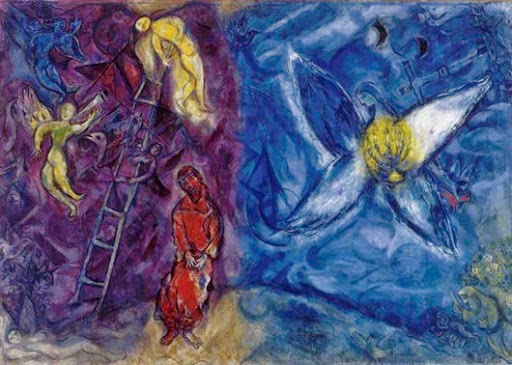
Chagall jacobs dream

A very good friend of mine (CA) lent me a great book about Judaism, entitled “What is a Jew?” and aimed at providing an introduction to a broad variety of aspects of what it means to be Jewish. The book is structured in the form of questions and answers and its tone exudes warmth and a desire to share rather than to impose or indoctrinate. Even before I started reading the book, I was looking forward to learning more about Judaism, both because of a desire to have a better understanding of the religion of several friends of mine, and because of the heightened insistence on a rediscovery of Judaism made by the Catholic Church since Vatican II.

John Paul II was famously the first pope to visit a synagogue, during which visit he spoke with clarity and warmth about the relationship between Christianity and Judaism:

“The Jewish religion is not ‘extrinsic’ to us, but in a certain way is ‘intrinsic’ to our own religion. […] With Judaism, therefore, we have a relationship which we do not have with any other religion. You are our dearly beloved brothers, and, in a certain way, it could be said that you are our elder brothers.”

Benedict XVI went on to maintain very strong relationships with Judaism, both acknowledging the Church’s past wrongs and expressing its gratitude and debt to the Jewish people:

“Abraham, father of the people of Israel, father of faith, has become the source of blessing, for in him ‘all the families of the earth shall call themselves blessed.’ The task of the Chosen People is therefore to make a gift of their God – the one true God – to every other people. In reality, as Christians we are the inheritors of their faith in the one God. Our gratitude therefore must be extended to our Jewish brothers and sisters who, despite the hardships of their own history, have held on to faith in this God right up to the present and who witness to it…”

Finally, Pope Francis has not only continued along the direction indicated by his predecessors, but has also benefitted from close personal friendships with the Jewish community. An example of this is the book – “On Heaven and Earth” that he co-authored with Rabbi Abraham Skorka, who also accompanied him on his recent visit to Israel and who has been a frequent visitor at the Vatican. Pope Francis has also reiterated, in his apostolic exhortation Evangelii Gaudium, the brotherly relationship that his predecessors have stressed:

“We hold the Jewish people in special regard because their covenant with God has never been revoked, for “the gifts and the call of God are irrevocable” (Rom 11:29). The Church, which shares with Jews an important part of the sacred Scriptures, looks upon the people of the covenant and their faith as one of the sacred roots of her own Christian identity (cf. Rom 11:16-18). As Christians, we cannot consider Judaism as a foreign religion; nor do we include the Jews among those called to turn from idols and to serve the true God (cf. 1 Thes 1:9). With them, we believe in the one God who acts in history, and with them we accept his revealed word. Dialogue and friendship with the children of Israel are part of the life of Jesus’ disciples. […] While it is true that certain Christian beliefs are unacceptable to Judaism, and that the Church cannot refrain from proclaiming Jesus as Lord and Messiah, there exists as well a rich complementarity which allows us to read the texts of the Hebrew Scriptures together and to help one another to mine the riches of God’s word. We can also share many ethical convictions and a common concern for justice and the development of peoples.” (§247-9)

Against this background I was particularly pleased to see the relationship between Christianity and Judaism described by Rabbi Morris Kertzer in “What is a Jew?” as follows:

“[The] German dramatist, Gotthold Ephraim Lessing, caught the essence of this common heritage [of Judaism and Christianity] in a play called Nathan, the Wise. One of the most memorable scenes depicts a meeting between a friar and the Jew Nathan. Moved by the beauty of Nathan’s character, the friar exclaims, “Nathan! Nathan! You are a Christian!” His friend replies, “We are of one mind, for that which makes me, in your eyes, a Christian, makes you, in my eyes, a Jew!”” (pp. 279)

I have to say that this paragraph from the last pages of the book very much rang true for me and expressed with accuracy the feeling I had as I made my way through the whole book. To give you a sense of what triggered such a recognition of what I believe to be very much mine in Rabbi Kertzer’s description of Judaism, I will share a number of excerpts from it next.

To begin with, the mystical tradition in Judaism, and its propensity to expressing itself by means of short stories reminded me immediately of the stories told about the Desert Fathers (and also about Zen kōans and the stories of the Sufi Mullah Nasrudin):

““Rabbi,” one of the disciples complained, “some of the congregants are gossiping in the midst of prayer!” “How wonderful are your people, O God,” The rabbi retorted. “Even in the midst of gossip, they devote a few moments to prayer!”

“Can you tell me, Rabbi, why the wicked are always looking for companions while the righteous are not?” “The answer is simple: The wicked walk in darkness, so are anxious for company. Good people walk in the light of God; they don’t mind walking alone.”” (pp. 21-22)

Next, I was struck by a repeated insistence on orthopraxy, which has a strong tradition in Christianity too:

“Jews are urged to put their religion into action. “Talking is not the main thing; action is,” goes a talmudic maxim, and action includes not just activity within the confines of the Jewish world, but working for the welfare of the larger society in which we live. We call this tikkun olam, meaning the “reparation of world.”” (pp. 30)

And Rabbi Kertzer goes on to recounting the same story about the building of the Tower of Babel that Pope Francis reflects on in his above-mentioned book, and then to presenting a synthesis of principles that resonate very strongly with Christianity too:

“The Rabbis used telling parables to illustrate this point. Why did the Tower of Babel crumble? Because the leaders of the project were more interested in the work than in the workers. When a brick fell to earth, they would pause to bewail its loss; when a worker fell they would urge the others to keep on building. The brick was more important than the human being. So God destroyed the imposing edifice. […]

Basic to Judaism are these fundamental principles, which are also basic to democracy: 1) God recognizes no distinction among us  on the basis of creed, color, gender, or class; all of us are equal in God’s sight. 2) We are all our brother’s and sister’s keepers; we bear responsibility for our neighbors’ failings as well as for their needs. 3) All of us, being made in God’s image, have infinite capacity for doing good; therefore the job of society is to evoke the best that is in each of us. 4) Freedom is to be prized above all things; the very first words of the Ten Commandments depict God as the Great Liberator: “I am the Eternal your God who brought you out of the land of Egypt.”” (pp. 31)

A couple of questions later, Kertzer then sets out an understanding of Scripture that could have come from the Vatican II dogmatic constitution Dei Verbum:

“[M]ost Jews look upon the accounts of miracles as inspiring literature, rather than as actual historical events. That is to say, we do not necessarily accept older interpretations of their significance, since an important lesson for the fifth century may be unimportant in the face of today’s spiritual questions; but we do use these tales as sources of inspiration ourselves, trying to draw religious lessons from the text, even the text of an event that may not be literally true. God did not create the world in precisely six days, just as the biblical text insists, but we can learn lessons for our lives from such stories as the Garden of Eden or the Tower of Babel.” (pp. 45)

On the subject of death and the Kaddish prayer, the book presents a profoundly beautiful reflection by Rabbi Steinberg:

“It is easier for me to let go of life with all its treasures, because these things are not and never have been mine. They belong to the Universe and the God who stands behind it. True, I have been privileged to enjoy them for an hour but they were always a loan to be recalled.

And I let go of them the more easily because I know that as parts of the divine economy they will not be lost. The sunset, the bird’s song, the baby’s smile, the thunder of music, the surge of great poetry, the dreams of the heart, and my own being—all these I can well trust to the God who made them. There is a poignancy and regret about giving them up, but no anxiety. When they slip from my hands they will pass to hands better, stronger, and wiser than mine.

Life is dear; let us then hold it tight while yet we may. But we must hold it loosely also! It is at once infinitely precious and yet a thing lightly to be surrendered. Because of God, we clasp the world, but with relaxed hands; we embrace it, but with open arms.” (pp. 67)

The juxtaposition of an enjoyment of the beauty of the universe and a detachment from it leads to an experiencing of everything in relationship with and gratitude to God:

“Because of its innate trust in both God and God’s world, Judaism affirms the value of life and life’s pleasures. It is therefore a religion that urges us to pay attention to the wonderful universe about us. To help us do so, it provides blessings for all of life’s bounties: seeing a rainbow; experiencing a thunderstorm; observing the first blossoms of springtime; putting on new clothes; even eating our first garden produce, as each crop ripens year after year.” (pp. 85)

That the above relationship with God is not simply an individual matter is shown clearly through the concept of minyan, which also reminded me of Jesus’ promise of his presence where “two or three” are gathered together in his name:

“Personal prayer between the individual and God may take place anywhere, any time, and with no one present but God and the individual worshiper. Public services, however, have traditionally required what is known as a minyan, that is, the presence of at least ten adult worshipers. […] Behind the idea of a minimum number is the notion that Jewish spirituality is in some sense communal. We all received the Torah together on Mount Sinai. We are all part of the people Israel.” (pp. 86)

Kertzer then goes on to presenting a simultaneous openness to diversity and faithfulness to God, that has echoes in the Church’s desire for “unity in diversity”:

“Our experience with diverse cultures has enriched our religion in many ways. Above all, perhaps, has been our hospitality to differences. Every question of Jewish law contains both an austere interpretation and a liberal one, and the Rabbis ruled that “both opinions are the word of the living God.” […] One famous rabbinic aphorism pictures God as saying, in effect, “As long as Jews do My will, they need not believe in Me.” That is an exaggeration, of course. Judaism does teach some beliefs, among them the firm conviction that God is real: a real presence in the lives of men and women, children and adults. We can know that reality as surely as we know the beauty of love, the satisfaction of faithfulness, or the buoyancy of hope.” (pp. 108)

In more specific terms, the three pillars of the Jewish faith are presented next, and unity among them is declared:

“We believe, then, in God: a personal God whose ways may be beyond our comprehension, but whose reality makes the difference between a world that has purpose and one that is meaningless.

We believe all human beings are made in God’s image; our role in the universe is thus uniquely important, and despite the failings that spring from our mortality, we are endowed with infinite potential for goodness and greatness.

We believe too that human beings actualize their potential as part of a community. The people Israel is such a community, harking back to Sinai, existing despite all odds from then until now, and still the source of satisfaction for Jews who wish to pursue a life of purpose grounded in the age-old wisdom we call Torah.

And we believe in Torah, therefore, as a continuing source of revelation.

It has been said that you can sum up Jewish belief in these three words, God, Torah, Israel. As the mystics used to say, “God, Torah, and Israel are all one.” If we lose our faith in any one of them, the others quickly perish. […]

In antiquity, it was common for scholars to distill the essence of religion in a simple formula. Thus, Hillel, the great Rabbi and scholar of the first century B.C.E., was asked to sum up Judaism while the questioner stood on one foot! Hillel replied: “Certainly! What is hateful to you, do not do to your neighbor. That is all there is in the Torah. All the rest is mere commentary. I suggest you study the commentary.”” (pp. 109)

The transcendence of God, the universal access to following Him and its being rooted in a putting into practice of His qualities brings the exposition of the Jewish faith to completion:

“Jews believe in the existence of a God who cannot be accurately conceived, described, or pictured. But God is a real presence in the universe at large; and the lives of each of us in particular. We believe also that we most genuinely show God honor when we imitate the qualities that are godly: As God is merciful, so we must be compassionate; as God is just, so we must deal justly with out neighbor; as God is slow to anger, so we must be tolerant in our judgment.” (pp. 110)

“It is the recognition of the reality of God, and the basic moral virtues, such as kindliness, justice, and integrity, that we regard as eternal verities. But we claim no monopoly on these verities, for we recognize that every great religious faith has discovered them. That is what Rabbi Meir meant some eighteen centuries ago, when he said that a non-Jew who follows the Torah is as good as our high priest.” (pp. 113)

Finally, Kertzer also speaks very powerfully about the necessity of remembering the horrors of the Shoah:

“[T]he moral reason [to remember the Shoah] may be the most important one. When the mass murderer Adolf Eichmann was on trial, the Israelis informed the world that the motive behind the judicial proceedings was not vengeance but the moral education of contemporary women and men. The striking thing about Eichmann was precisely that he was so ordinary, a living symbol of what historian Hannah Arendt called “the banality of evil.” Contemplating the events of the Nazi era, we came to see that the sin of omission on the part of the decent peoples of the world was the sin of silence, the refusal to believe that a highly enlightened people like the Germans could permit themselves to be led by a madman into acts of national depravity that culminated in the events of Auschwitz and the other death camps. We had to learn to readjust our vision and take evil seriously once again.” (pp. 161)

Not only is it essential to pursue the doing of good, but so is a taking seriously of evil and a standing up to it, since omission and silence too are grave sins – insights that are of acute relevance today and that were at the time of the Shoah also shared by Christians. The Lutheran theologian Dietrich Bonhoeffer, whose anniversary of being murdered in the Flossenbürg concentration camp in 1945 was yesterday, said:

“Silence in the face of evil is itself evil:
God will not hold us guiltless.
Not to speak is to speak.
Not to act is to act.”

Caricature Christianity

Catholic05

[Warning: long read :)]0

As I have said previously, I am a great fan of Dr. Yuval Noah Harari’s MOOC “A Brief History of Humankind,” which I have found not only entertaining and informative, but also thought-provoking and which I would wholeheartedly recommend to anyone. Dr. Harari’s style is engaging and masterful, the examples he uses are vivid (e.g., “The human race is no more than a herd of sheep that ended up with tanks and atomic bombs because of an evolutionary accident.”), his presenting alternative theories throughout the course is greatly illuminating and enriching and his use of the concept of “fiction” is a powerful didactic device that draws attention to the mental/material categories in a novel and forceful way.

Had I been writing this post before the course’s tenth lecture, it would have been 99% panegyric (with the 1% criticism reserved for the presentation of the sex/gender distinction not as fiction, given how that term is used throughout the course). Without taking away from the excellence of the first 9 lectures, I do have serious misgivings about the tenth, entitled “The Law of Religion,” where I consider Dr. Harari’s presentation of Christianity to be a caricature instead of an attempt at synthesis and summary. What makes this the more disappointing is that he is clearly a highly intelligent and learned person, very capable of speaking about religion in an informative and balanced way, as he demonstrated with the excellent exposition of Buddhism in Segment 3 of the lecture.

Even though I was not going to write about my experience of Lecture 10, I have changed my mind after being encouraged to do so by my überbestie JMGR – so you can consider this to be both a “work made for hire” and an attempt to present my grounds for calling it a caricature in more than the 140 characters of a tweet. Before delving into the details, I’d also like to say that the following will be my attempt to present what I, as a Christian, believe and that its justification by reference to established Christian doctrine will be omitted (each of the following points meriting long blog posts individually). The format I’ll use is to go through a number of claims that Dr. Harari makes about Christianity, each immediately followed by my own account. Here I will not be exhaustive (and hopefully not exhausting either), e.g., glossing over the treatment of Christian persecution by the Roman Empire, and try to focus on the most substantial claims.1

First, Dr. Harari claims that Christians believe “that you could make deals with the supreme power of the universe in order to recover from illness, to win the lottery, or to gain victory in war.” This, to my mind is a caricature of prayer, which is presented as a bargaining process: I’ll say these prayers, do some penance, go to mass, etc. and in exchange god will grant me a wish. This is nothing like what my relationship with God, or prayer are for me. I believe God loves me and has a plan for me that starts in every present moment. Prayer is the maintaining of a relationship with God, both by listening and being disposed to discerning his plan and by speaking and sharing my joys, worries and needs with him. Such sharing is not the demanding of an overriding of the Laws of Nature, but instead a silent conversation, an opening up, a turning towards. It also brings with it what Dr. Harari presented so well about Buddhism – an acceptance of both joys and sorrows, of successes and defeats, all of which are received in the context of the above prayer, which – together with a seeking of God in all around me – is the basis of my being Christian.

Second, Dr. Harari presents Christianity as incapable of coexisting with other religions:

“A religion that recognizes the legitimacy of other faiths implies either that its god is not the supreme power of the universe, or that it received from the one and only god only part of the universal truth. […] Monotheists could not live with these ideas. Monotheists usually believed that they are in possession of the entire message of the one and only god. They were compelled to discredit all other religions. If our religion is true, no other religion can also simultaneously be true.”

This, to my mind, is fundamentally a caricature of the concept of God itself and of epistemology too. It first assumes that God is wholly knowable, then that Christians believe they fully know such a fully knowable God and finally that they know that they have such full knowledge. I dispute all three assumptions. Not only is knowledge fundamentally incomplete, indirect and limited even when it comes to my self, let alone to another or a world around me, or to a God whom I believe to be both more immanent and transcendent than anything else. Every single person, their experiences, insights and beliefs are of interest to me and an opportunity to look for the traces of God’s presence. At the same time it does not mean that I believe Christianity to be incomplete, on the contrary, or that I, conversely, have to believe it to have exclusive access to the Truth and to God.

Third, Dr. Harari presents Chirstian saints as being connatural with the gods of polytheism:

“Homo sapiens tend to divide the world into we and them and sapiens want to be in contact with powerful entities that will help us against them. So the idea that there is only one supreme power in the world that cares about everybody equally this was very difficult even for Christians […] to fully adopt and understand. Consequently Christianity […] created an entire new pantheon of saints and people simply began to worship [… them] just as previously they worshipped all kinds of different gods. […] So when England and France […] go to war […] it is believed that Saint Martin helps the French and Saint George helps the English – just like the old gods.”

The irony here that it is precisely the saints who are a strong argument in support of the belief that God “cares about everybody equally.” To me the saints are my fellow Christians, who have lived lives that mirror Jesus’ own life to a particularly high degree and who are therefore examples for me to follow. Not only does the vast variety of backgrounds from which they come (social, ethnic, educational and cultural) support the claim for the universality of God’s call, but their own care and love for their neighbors does too. Since I believe that these saints are now alive in the immediate presence of God, having a relationship with them through prayer is logically consistent with the relationship I have with God himself.

Fourth, Dr. Harari presents the “problem of evil” as follows:

“The problem of evil […] asks why is there evil in the world, why is there so much suffering in the world, why do so many bad things happen even to good people. […] For monotheists the problem of evil is extremely difficult. Monotheists have to perform all kinds of amazing intellectual acrobatic tricks to explain how an all-knowing, all-powerful and perfectly good god allows so much suffering in the world. […] One answer that monotheists try to give is: “This is god’s way of allowing for human free will. If there was no evil in the world, humans could not choose between good and evil and hence there would be no free will.” This is one of these intellectual tricks that monotheists use to answer the problem of evil.”

Again, this strikes me as a caricature: there is a glaring problem with Christianity, so Christians come up with shaky stories to fool themselves. My objection here is not that the “problem of evil” is a challenge, but that presenting it as something that Christians deal with via self-delusion is a caricature. There is no satisfactory explanation for the “problem of evil” – all that I, as a Christian have are some intuitions. Of these, the argument from freedom is a strong one and I fail to see how it can be categorized as a “trick.” It still does not explain why there is evil and suffering in the world though, but only how freedom and the necessity of real choice are linked. Why could God not have done it in a different way is a valid question though! Another, strong intuition to me as a Christian is Jesus’ own life, where the acceptance of suffering – a suffering by a supremely innocent person who was scared of it – plays a pivotal role. All I can say about suffering is that it is linked to the freedom that lets me establish genuine relationships with my fellow humans and with God, that Jesus having endured it also points to its importance, but I can certainly not claim to be in a position to explain or justify it.

Fifth, to sum up his position with regard to Christianity, Dr. Harari has the following to say:

“Monotheism is a kind of mishmash, a kind of bringing together all kinds of monotheist, dualist, polytheist and animist legacies, constantly influencing and changing each other, all coexisting with each other under one big divine umbrella. The average Christian believes in the monotheistic god, but also believes in the dualist devil, in the polytheist saints, and in the animist ghosts and demons.”

Eh … no … I believe in no ghosts or demons, the saints are my brothers and sisters – not gods, and the devil is no equivalent “opposing power” to God (as would follow from Dr. Harari’s dualist definition) but simply the personification of a turning away from God while possessing full knowledge of His being God.

And breathe … 🙂

Needless to say, I am happy to provide references for how what I have said about my own beliefs above is official Catholic teaching and how it is consonant with the beliefs of Christians also from past centuries. At the same time I am not claiming that no Christian has ever held some or all of the beliefs that Dr. Harari, to my mind mistakenly, presents as being universally and fundamentally Christian – certainly they have: in the same way in which some have used microwaves to mistreat cats, without thereby rendering microwaves primarily instruments of cat torture …


0 Many thanks to my überbestie PM for his nihil obstat. 🙂
1 I am skipping the part about heaven and hell only because its exposition is factually holey (not holy :)), where to Dr. Harari’s statement: “There is no trace of [heaven and hell] in the Old Testament” I only have three words to say: Daniel 12:2 … Seriously though, there would be things to say about his claim that such beliefs are dualistic, but their refutal would take us too far off-track and I’ll leave them for another time.

Why did God make bad stuff?

Thorns

Since my sons, who are 5 and 10 years old, attend a non-Catholic school, I have been giving them Catechism lessons. The format is that I try to get them to propose topics, encourage them to share what they think themselves and then attempt to round out the picture we arrive at together. When we kicked-off these weekly catechism sessions, the first one was me pretending to be an alien and asking them to explain to me what this whole God, Jesus, Church business is all about – as you can imagine it was hilarious both for me and for them and I believe it gave catechism a place in the entertainment category :).

At the end of the most recent session, I again asked my boys for suggestions for the next topic, to which my older son replied: “Why did God make bad stuff?” I have to say I was really pleased with this question, since it shows that he is thinking carefully about his faith and also that he applies and contrasts it with his life.

What I would like to do next, therefore, is to sketch out the answer that I’ll try to get across in our Q&A-style format and thereby to attempt a response to the question of evil in language accessible to a 10-year-old, with a 5-year-old listening in. The following then are some of the questions/ideas I will try to share with them. As you’ll see, they expect certain responses from the boys that you’ll just have to intuit from my half of the conversation :):1

“What do you like best about your friends?

Great! Can you think of some examples when someone was kind/friendly/nice to you?
And you do the same to others as well, don’t you?

But do you think you can make someone be nice/friendly/kind?

That’s right, you can’t! They have to choose to be nice to you, don’t they? And sometimes even your friends aren’t nice – right? Can you think of some examples?

That’s not good, is it? But, do they stop being your friends?

Exactly, of course they don’t … What do you think you can do when they are not nice? Can you make them be nice?

Is there something else you can do though?

That’s right, you can keep being kind and loving towards them, regardless of what they do. But it’s best when they are kind and loving back to you, isn’t it?

What do you think God would like us to do?

And do you think he can make us be nice?

Sure, he could – but then it wouldn’t really be us who are loving him, would it? We would no longer choose to be kind and we’d be like robots instead. Do you think God wants us to be like robots?

So, it looks like God needs to give us the choice to be either good or bad, so that we can really choose to love him and the people around us … But, let’s think a bit more about the question we started with: “Why did God make bad stuff?” Do you think he really made bad stuff?

That’s right – he didn’t, because he is good and he always loves everyone! Good things are like light and bad things are like darkness – in the end there will be light everywhere. No matter how much darkness there is, it cannot stop the light shining from even just one candle.

So, you can see that when we are unkind to others it is not God who makes them suffer. He only lets it happen because he wants us to choose to be kind instead of forcing us. But, instead of choosing to be kind, we are sometimes mean – that’s pretty sad, isn’t it?

How do you think God feels when we are mean to each other?

Yes, he is sad too, because he loves every one of us very much and when we are mean to others we are also mean to him.

How about another, even more difficult question: Why is it that bad things happen that are not the result of someone being mean? Why do people get sick, why are there earthquakes or tsunamis, or why is it that God doesn’t stop people from being mean when what they do is very bad? What do you think?

It is tricky … And, to be honest I don’t know either! I don’t think anyone really knows. What we do know though is that when Jesus came to show us how God loves us, in the end he suffered a lot for us. As you know, he was killed in a very painful way on the cross. What do you think this tells us?

Yes, it must mean that there is a reason for suffering. We don’t know what it is, but we can trust that God is loving us even when things are difficult and painful. Just imagine that God, who can do anything he wants, chose to show us that he loves us so much that he is prepared even to suffer for us.

And do you remember what happened after Jesus was killed on the cross?

Yes, he came back to life and then went up to heaven. It is the same for us – when bad things happen we can say to Jesus: “I know you are with me now and I am with you on the cross.” You will see that you will feel Jesus close to you and he will then take you with him to heaven.”

I know the above is incomplete and far from a satisfactory treatment of the problem of evil for an adult audience (and probably even for kids). What I tried to do though is to give my sons a sense of how freedom plays a role here, how it is that we don’t have anything like a full answer and also how Jesus’ death and resurrection can help us at least intuit the value of suffering. Any thoughts on the above would be much appreciated – as always!


1 Not that I can hope for anything remotely as masterful as Camus’ The Fall, but at least the half-dialogue format of the following is inspired by it :).