The Extraordinary Synod: Family, Church, God

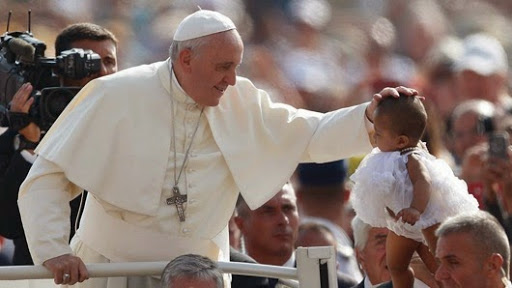
Francis w baby

[Guest post: The following is a talk about the Extraordinary Synod on the Family given at a retreat by Dr. Ján Morovič, which is reproduced here with the author’s permission.]

What I’d like to do today is to give you an overview of the Extraordinary Synod on the Family that took place from 5th to 19th October, by covering the following:

  • First, to give you an “executive summary” in Pope Francis’ own words from a week ago,
  • second, walk you through the process that is underway towards a renewal of how families are cared for by the Church and how they form part of the Church,
  • third, give you a flavor of the key topics discussed during the Synod,
  • fourth, focus on Francis’ role in the Synod,
  • and finally, argue that what is at stake here both goes far beyond the family, and doesn’t 🙂

Francis’ executive summary

The best, most concise exposition of why there is a need for the question of the family to be addressed today and, therefore, of why there was a need for the Synod that concluded a couple of weeks ago, comes from Pope Francis himself, who addressed a meeting of the Schönstatt movement last Saturday with the following words:

“The Christian family, the family, marriage, have never been attacked as much as now. Attacked directly or attacked as a matter of fact. Maybe I am mistaken, and the historians of the Church could tell us, but the family is being beaten, is being bastardized, as if it were just a loose association, as if you could call anything a family. And then, how many wounded families there are, how many broken down marriages, how much relativism there is, as far as the understanding of the sacrament of marriage is concerned. From the sociological point of view, from the point of view of human values, and from the point of the Catholic sacrament, the Christian sacrament, there is a crisis of the family. It gets beaten up from all sides. It ends up being very wounded.

So, we have no choice but to do something. So, what can we do? Yes, we can give nice talks, declare some nice principles, this we do have to do for sure to have clear ideas. Look, these things you are proposing, they are not marriage. It is an association, but it is not marriage. Sometimes it is necessary to say things very clearly. And they must be said. But, the pastoral help that is needed is body to body. Accompanying. And this means loosing time. The greatest teacher of how to lose time is Jesus. He lost time by accompanying, helping consciences mature, healing wounds, teaching. Accompanying means to share a journey.

Evidently, the sacrament of marriage has been devalued. And, unconsciously, there has been a move from the sacrament to the ritual. A reduction of sacrament to ritual. This leads to thinking about the sacrament as a social matter. Yes, with religious elements, for sure, but the strong point being the social. […] The social aspect obscures that which is most important about marriage, which is union with God.”

With the above landscape in mind, consisting of the scaramentality of marriage, its being under attack, the ubiquity of wounded families, the need for imitating Jesus’ closeness to all, and the importance of understanding marriage as union with God, let’s look at how the Church arrived at this Synod and what journey it is on, moving forward.

The process

The Extraordinary Synod on the Family, whose full title is: “Pastoral Challenges of the Family in the Context of Evangelisation,” was called by Pope Francis in October 2013. It being an extraordinary synod, as opposed an ordinary one, taking place at regular intervals, points directly to its purpose being to “deal with matters which require a speedy solution” (Code of Canon Law, canon 346 §2). And the fact that it was announced as part of a pair of Synods – the one we just had, and its follow-up that will take place from 4th to 25th October 2015 – indicates the complexity of the topic, and the need for a year’s work and discernment to be part of the process.

Within weeks of the Synod’s announcement last October, a preparatory document was published by the Synod’s secretariat, consisting both of some thoughts on the key challenges facing the family and – in an unprecedented move – a questionnaire that was sent to dioceses around the world for completion. It is a questionnaire that asked very open and direct questions about what of the Church’s teaching was understandable, and what positions were held with regard to its teaching on abortion, contraception, same-sex marriage, etc. Importantly, many dioceses opened the questionnaire up to the public (e.g., including Brentwood and Westminster), which resulted in a very large-scale response.

The Synod secretariat’s next move was to publish an extensive summary (the “instrumentum laboris”) of the responses at the end of June. This was a great move of openness and transparency, further underlined by its very frank presentation of the questionnaire’s responses. There was both a reinforcing of positives here – i.e., the continuing recognition of the value and beauty of marriage – and an identification of and admission to problems – e.g., the general lack of an understanding of the Church’s teaching, a loss of meaning of the concept of “natural law,” the damage caused by the sexual scandals in the Church, and the mounting external and internal pressures that families face today.

Next, the Synod Fathers, comprising heads of all local episcopal conferences, the heads of some religious orders and a number of members directly appointed by Pope Francis, were asked to submit written statements in response to the “instrumentum laboris.” The Synod’s secretariat then summarized these in its first working document – the “relatio ante disceptationem,” whose reading took place during the first morning of the Synod. A week of interventions followed – including “witnesses” from married couples at the beginning of each of a day’s two sessions, after which an updated working document was produced – the “relatio post disceptationem.” Note, that it was written single-handedly by Archbishop Bruno Forte, appointed to this role directly by Pope Francis. The following week saw work in groups of around 30 people each that resulted in feedback to the small team in charge of editing the working document and producing the official outcome of the Synod. Finally, this “Relatio Synodi” was voted on, paragraph by paragraph, and published as a guide for what topics to deepen during the following year.

Next year, the second Synod, still on the topic of the Family, will result in proposals to the Holy Father, who can then freely choose how to take them into account in the measures he takes with regard to the care for and role of families in the Church. When looking at the details of the content discussed at the Synod, it is worth noting the very loose relationship between the Synod on the New Evangelization that took place in 2011 and Pope Francis’ Evangelii Gaudium, that, procedurally, follows from it. In the end, the paradigm that applies here is the Jesuit concept of “You discern, we discern, I decide.”

The topics

Turning to what was discussed at the Synod, I’d like to pick out some key themes for you, without being comprehensive, as it may otherwise turn into sounding like a shopping list, and I’d like to focus on the areas that have received either the greatest support or where there was most debate. Before diving into these “hot” topics, it is worth noting that the sacramentality and indissolubility of marriage, its being a source of joy, its being between a man and a woman, and the sanctity of life that originates, runs its course and completes its earthly journey there, were unanimously reaffirmed. There was also broad agreement on the need to revise and strengthen marriage preparation and accompanying of married couples, and the pressures following from economic hardship (unemployment, separation as a result of traveling for work, the inequitable treatment of women) and the tragedy of wars were also a theme running through the Synod.

Subjects of evangelization

First, there was an emphasis on the family not only as object of evangelization (i.e., an entity to be evangelized), but also as its subject (an entity that evangelizes). In particular, movements like the Focolare and the Neocatecumenal Way (which were mentioned explicitly), were highlighted as examples of families carrying out evangelization by “patient and delicate accompanying” and by presenting “the attractive testimony of authentic Christian families.” As a consequence, it was also declared that “the Church must be more open to dialogue, and must listen more frequently (and not only in exceptional cases) to the experiences of married couples.”

A new language

Second, a very prominent topic throughout the Synod has been the call for a new language to be used when announcing the Gospel, calling for “forms and suitable language […] to be devised to proclaim that all are and remain God’s children and are loved by God the Father and the Church as Mother.” The need to listen to the world, so that it may listen to the Church was emphasized and it was noted that “dialogue may be based on important themes, such as the equal dignity of men and women and the rejection of violence.” As an example, “terms like “living in sin,” “intrinsically disordered,” and “contraceptive mentality” were singled out by the Synod Fathers as instances of “harsh language,” where there was a need for change that would demonstrate the Church’s openness and love.” Let me quote a passage from Dublin’s Archbishop Dairmuid Martin’s intervention that regards this point:

“To many the language of the Church appears to be a disincarnated language of telling people what to do, a “one way dialogue”. I am in no way saying that the Church is not called to teach. I am not saying that experience on its own determines teaching or the authentic interpretation of teaching. What I am saying is that the lived experience and struggle of spouses can help find more effective ways of expression of the fundamental elements of Church teaching. Jesus himself accompanied his preaching the good news with a process of healing the wounded and welcoming those on the margins. His teaching was never disincarnated and unmoved by the concrete human situation in which people could come to be embraced by the Good News. Jesus’ care for the sick and the troubled and those weighed down by burdens is the key which helps to understand how he truly is the Son of God.”

I also found the words of our Cardinal Vincent Nichols, the next day, to be a great example of what this new language might look like:

“I don’t doubt that most young people aspire to having their own family, having their own family within the stable relationship between husband and wife, having that family with a sense of permanence and a permanent, faithful commitment. Nobody wants a wife or a husband who is unfaithful. And so what we have to get across to people is that casual relationships before marriage is actually being casual with somebody’s future husband or wife. And its that sense of the real value that’s written in us, its in the hearts of people, that they aspire to, that has consequences for how we behave today as well.”

Seeds of the Word

Third, one of the most revolutionary ideas of the Synod is that of recognizing whatever good there is also under imperfect circumstances, which the “relatio post disceptationem” puts as follows:

“Some ask whether the sacramental fullness of marriage does not exclude the possibility of recognizing positive elements even the imperfect forms that may be found outside this nuptial situation, which are in any case ordered in relation to it. The doctrine of levels of communion, formulated by Vatican Council II, confirms the vision of a structured way of participating in the Mysterium Ecclesiae by baptized persons. […] (§18)

Realizing the need, therefore, for spiritual discernment with regard to cohabitation, civil marriages and divorced and remarried persons, it is the task of the Church to recognize those seeds of the Word that have spread beyond its visible and sacramental boundaries. Following the expansive gaze of Christ, whose light illuminates every man (cf. Jn 1,9; cf. Gaudium et Spes, 22), the Church turns respectfully to those who participate in her life in an incomplete and imperfect way, appreciating the positive values they contain rather than their limitations and shortcomings. (§20)”

The idea of “levels of communion” is with reference to how ecumenism is presented in Lumen Gentium (§15): “The Church recognizes that in many ways she is linked with those who, being baptized, are honored with the name of Christian, though they do not profess the faith in its entirety or do not preserve unity of communion with the successor of Peter.” It is also important to note that this analogy was proposed by Cardinal Christoph Schönborn of Vienna, who was the general editor of the current Catechism. Another way of looking at what these changes mean is what Antonio Spadaro SJ (the editor of Civiltà Cattolica, and Synod Father by direct papal appointment) tweeted about it: “Today […] we have seen a church that pays more attention to sowing seeds than to pulling out weeds.”

Mercy

Closely related to the above desire, to look for the traces of God’s presence under all circumstances, is the focus on mercy that has been the backbone of the Synod:

“[M]ercy is not a justification to sin but rather the sinner’s justification, to the extent that he converts and aims to sin no more. Mercy, the central theme of the God’s revelation, is highly important as a hermeneutic for the Church’s actions (cf. Evangelii gaudium, 193 ff.). Certainly, she does not do away with truth nor relativize it, but seeks to interpret it correctly in the hierarchy of truths (cf. Unitatis redintegratio, 11; Evangelii gaudium, 36-37). Nor does she do away with the demands of justice.” (Relatio ante disceptationem, 3b)

One of the Spanish-speaking Synod Fathers put this point particularly forcefully:

“Above all we must kneel before the Holy Spirit and remember that we aren’t the bosses of God’s mercy. We must remember that the mission that Jesus entrusted to his apostles, and by extension to us as their successors, is to evangelize and to heal. And this means, spreading the Good News.”

And finally, one of the English-speaking working groups feedback on the “relatio post disceptationem” has been the affirmation that mercy is needed by all of us:

“All of us need the help of the mercy of God. The mercy of God is not just a medicine, much less a consolation prize, for those who fail. None of us can be faithful without experiencing God’s mercy. No one should devalue the place of mercy in the economy of salvation.” (Relatio – Circulus Anglicus “B”)

Inclusion

A consequence of the above mercy is also the emphasis that inclusion has seen throughout the Synod, which was put particularly emphatically by the German Cardinal Reinhard Marx:

“We must be close to everyone, each with their particular circumstances. We must give them opportunities to find their place in the Church. No one is excluded! No one is redundant! No one is marginalized! Exclusion is not the language of the Church!”

It is also a point that Pope Francis underlined during the Angelus address he gave half-way through the Synod:

“The goodness of God has no boundaries and does not discriminate against anyone: this is why the feast of the Lord’s gifts is universal, for all. Everyone is given the opportunity to respond to his invitation, to his call; no one has the right to feel privileged or to an exclusive claim. All this leads us to overcome the habit of positioning ourselves comfortably in the middle, as did the chief priests and the Pharisees. This mustn’t be done; we must open ourselves to the peripheries, recognizing that even those who are on the margins, even one who is despised and rejected by society, is an object of God’s generosity. We are all called to not reducing the Kingdom of God to the confines of a “little church” – our “tiny little church” – but to widen the Church to the scale of the Kingdom of God. There is only one condition: to wear a wedding dress, which is showing love towards God and neighbor.”

The law of gradualness

Looking at the above, the mistaken impression may arise that there is a departure from a striving for perfection, or that virtue and a close adherence to the Church’s teaching and the Gospel are somehow secondary or optional. Such a reading of the Synod’s discussions would be missing an important point though:

“In the Christian life, the reception of Baptism brings the believer into the Church through the domestic church, namely, the family; thus beginning “a dynamic process [which] develops, one which advances gradually with the progressive integration of the gifts of God” (Familiaris Consortio, 9), in an ongoing conversion to a love which saves us from sin and gives us fullness of life.” (Relatio Synodi, §13)

Cardinal Marx, putting the above into his own words, declares that:

“On every human journey, including one that may be based on a mistake, there is growth and increasing maturity, there is improvement, there is something that can be lived through the spirit of the Gospel.”

The key here is that the recognition of goodness in imperfection is a stepping stone, the beginning of a journey towards fulness.

Divorced and remarried

The first case to which the above focus on inclusion, mercy and the recognition was applied, and one that has had a lot of media attention already before the synod, are the divorced and remarried, and the question of their access to the Eucharist. Here the main aspects of discernment revolved around, on the one hand, the indissolubility of marriage being recognized by all, and, on the other hand, there being differing conceptions of the Eucharist, ranging from a focus on a compliance with prerequisites by some and a focus on its being a healing gift by others. The latter is best represented by Fr. Adolfo Nicolas SJ, the Superior General of the Jesuits, saying: “A divorced person has suffered, but we withdraw medicine from him or her who needs it most. No, this cannot be!”

At the conclusion of the Synod, there was great variety in how this challenge is to be addressed, ranging from some, few, being emphatic about there being no way to provide the divorced and remarried with access to the Eucharist, to a variety of positions that called for further study and discernment both with an initial proposal for what a solution might look like, and without. Here the types of solutions ranged from individual, case-by-case discernment by the local bishop to prolonged penitential processes.

An example of the more cautious, yet not categorically opposed position here is that of Cardinal Angelo Scola:

“Personally, on a substantial level, I can not find an answer yet to the possibility that [the divorced and civilly remarried] could have access to sacramental communion without this clashing with the indissolubility of marriage. In short, indissolubility either has an impact on the reality of daily life, or remains a Platonic idea.”

The attitude to adopt already while potential solutions are considered was best expressed by Cardinal Godfried Danneels of Brussels:

“In the first place we are invited to greatly respect our brothers and sisters, the divorced and remarried. Mercy starts where we have unconditional respect for all who want to live within the Church but can’t marry again for the Church and receive Communion. […]

It is so important to speak with them, to let them speak about the beauty of marriage and the Christian family. Beauty is so powerful! This is obviously not esthetic beauty, but beauty who is the sister of truth and goodness. According to Aristotle “beauty is truth in all its glory”.”

Welcoming homosexual persons

The second case under discussion was the question of the Church’s relationship with gay people, where the “relatio post disceptationem” declared:

“Homosexuals have gifts and qualities to offer to the Christian community: are we capable of welcoming these people, guaranteeing to them a fraternal space in our communities? Often they wish to encounter a Church that offers them a welcoming home. Are our communities capable of providing that, accepting and valuing their sexual orientation, without compromising Catholic doctrine on the family and matrimony? (§50)

The question of homosexuality leads to a serious reflection on how to elaborate realistic paths of affective growth and human and evangelical maturity integrating the sexual dimension: it appears therefore as an important educative challenge. The Church furthermore affirms that unions between people of the same sex cannot be considered on the same footing as matrimony between man and woman. […] (§51)

Without denying the moral problems connected to homosexual unions it has to be noted that there are cases in which mutual aid to the point of sacrifice constitutes a precious support in the life of the partners. (§52)”

The above represents a very clear application of the desire to seek the presence of good under all circumstances and to recognize in it the potential for a journey towards perfection, not being exclusive of anyone. It was Cardinal Marx again who also put the position most bluntly here:

“[… I know] a homosexual couple who have been together for 30-35 years in a faithful relationship, which as a sexual relationship is not accepted by the Church, but they live together, one looks after the other, during the last phase of his life. Here, as Church, I cannot say that everything that these people have done during their lives is without value, because they have a homosexual relationship. […] It would be unthinkable to say that because you are homosexual, you can live nothing of the spirit of the Gospel. That’s unthinkable! At least for me.”

Archbishop Vincenzo Paglia, President of the Pontifical Council for the Family, also spoke about homosexual people with great warmth, putting the ball in our, the Church’s, court to make the first step:

“[Homosexuals] are our brothers or sisters. To be loved as children of God to the end, to be embraced, accompanied, sustained, to be close to. Another question is that of marriage. Because marriage, since the world has been the world, is between man and woman. […] Then … affection … well we can be attracted by anyone. What’s more, I wish for all of us that we would all love each other, so we aren’t like frigid sticks that don’t encounter each other! The challenge is how to be close to those who are maybe in difficulty, and here I believe that it is all of us, believers, who need to take the first step. Whoever is in difficulty is to be embraced and helped.”

Again, as in the case of the divorced and remarried, the path forward is not clear and there was a great deal of difference in opinion on this subject (including objections to the use of “welcoming” with reference to gays), but that we must – as followers of Jesus – direct a merciful, loving gaze at them too is crystal clear. Not because they are gay or divorced, but because we are all children of God, members of the one family.

Francis’ role

Having given you a taster of what the process has been and a flavor of what has been discussed and how, I would like to turn our attention to Pope Francis’ presence in the above picture, and I would just like to pick out a few of the key moments, since I think they offer a model that we can learn from also.

First, I’d like to give you a sense of the timescale and consistency of Francis’ vision. Already during the meeting of cardinals before the consistory that elected him, the then-cardinal Bergoglio said:

“Holy Week challenges us to step outside ourselves so as to attend to the needs of others: those who long for a sympathetic ear, those in need of comfort or help. We should not simply remain in our own secure world, that of the ninety-nine sheep who never strayed from the fold, but we should go out, with Christ, in search of the one lost sheep, however far it may have wandered.”

And it is on the back of this vision that he is elected, and it is a vision he re-iterates the very next day, when addressing the cardinals:

“[A]ll together, pastors and faithful, we will make an effort to respond faithfully to the eternal mission: to bring Jesus Christ to humanity, and to lead humanity to an encounter with Jesus Christ: the Way, the Truth and the Life, truly present in the Church and, at the same time, in every person.”

Note the focus on bringing Jesus to humanity and on his pointing to His presence in every person. Eight months later, he reaffirms this commitment in his apostolic exhortation – Evangelii Gaudium, a magisterial document of the Church, where he says:

“Everyone can share in some way in the life of the Church; everyone can be part of the community, nor should the doors of the sacraments be closed for simply any reason. This is especially true of the sacrament which is itself “the door”: baptism. The Eucharist, although it is the fullness of sacramental life, is not a prize for the perfect but a powerful medicine and nourishment for the weak.”

And finally, on the eve of this Synod on the Family, Francis’ homily focuses on excessive burdens and on “God’s dream”:

“[E]vil pastors lay intolerable burdens on the shoulders of others, which they themselves do not lift a finger to move (cf. Mt 23:4). We too, in the Synod of Bishops, are called to work for the Lord’s vineyard. […] We are all sinners and can also be tempted to “take over” the vineyard, because of that greed which is always present in us human beings. God’s dream always clashes with the hypocrisy of some of his servants. […] My Synod brothers, to do a good job of nurturing and tending the vineyard, our hearts and our minds must be kept in Jesus Christ by “the peace of God which passes all understanding” (Phil 4:7). In this way our thoughts and plans will correspond to God’s dream: to form a holy people who are his own and produce the fruits of the kingdom of God (cf. Mt 21:43).”

Taken with everything he has done during the year and a half between his election and the Synod, he couldn’t have been clearer about what he wants to see from his brothers, and, so – after encouraging them to speak their minds freely on the first morning of the Synod, he spends the following two weeks attending all but one of the sessions (skipping only one due to a General Audience) and doing so in silence. This, to me, is a remarkable approach and one that makes me immediately think about how Chiara saw Mary in Paradise – “as the blue of the sky contains sun and moon and stars.” In fact, Cardinal Gianfranco Ravasi pointed out that Pope Francis’s silence was fundamental for the Synod’s discussions to be possible, quoting the Latin saying “Roma locuta, causa finita.” If Francis had spoken, it would have been the end of the discussion.

What Francis did at the end of the Synod is another important lesson though. First, he had the entire final report – the “Relatio Synodi” published, instead of only the paragraphs that received 2/3rds of the Synod Fathers’ votes, as follows from the Synod’s constitution. Not only that, but he ordered for the vote counts to be published for each paragraph too. This ensured that all topics discussed during the first Synod would be deepened over the next year and discussed again at next year’s Synod – including those that did not get a 2/3rds majority, which were all of the controversial ones regarding the challenges of welcoming divorced and gay people, and ones that spoke about the need to recognize the presence of the seeds of the Word in imperfect circumstances.

To further underline his resolve and his commitment to the need for an opening and a going out to the peripheries that he has been pioneering since before his election, Francis gives an unscheduled closing speech that effectively upstages the Synod’s final report.

There, he first chastises the Synod Fathers for having succumbed to some of four types of temptation:

“- One: the temptation of hostile rigidity, that is, wanting to enclose oneself in the written (the letter) and not allowing oneself to be surprised by God, the God of surprises (the spirit); within the law, in the certainty of what we know and not of what we still need to learn and achieve. Since the time of Jesus, there has been the temptation of the zealots, the scrupulous, the cautious, the – today – so-called “traditionalists” and even the intellectuals.

– The temptation of destructive do-goodery, which in the name of a false mercy bandages wounds without first curing and medicating them; which treats symptoms and not their causes and roots. It is the temptation of the “do-gooders”, of the fearful and even the so-called “progressives and liberals.”

– The temptation to turn stone into bread so as to break a long, heavy and painful fast (cf. Lk 4:1-4), and also to turn bread into stone and throw it at sinners, the weak and the sick (cf. Jn 8.7), that is, to turn it into “unbearable burdens” (Lk 10:27).

– The temptation to come down from the cross, to please people, and not to stay, to fulfill the will of the Father; to bow to a worldly spirit instead of purifying it and bending it to the Spirit of God.

– The temptation to neglect the “deposit of faith”, not considering themselves custodians, but masters or owners, or, on the other hand, the temptation to ignore reality by using meticulous language and language so polished that saying many things result in not having said anything! Such language used to be called “byzantine”, I think, such language …”

Next, he reiterates what the Church is:

“And this is the Church, the Lord’s vineyard, the fertile Mother and caring [female] Teacher, who is not afraid to roll up her sleeves to pour oil and wine on the wounds of men (cf. Lk 10: 25-37); who does not look at humanity from a glass castle to judge or categorize people. This Church is the One, Holy, Catholic, Apostolic and composed of sinners, in need of His mercy. This is the Church, the true bride of Christ, seeking to be faithful to her spouse and to his doctrine. It is the Church who is not afraid of eating and drinking with prostitutes and tax collectors (Luke 15). The Church that has doors wide open to receive the needy, the repentant and not only the righteous or those who think they are perfect! The Church that is not ashamed of the fallen brother and does not pretend not to see him, what’s more, she feels involved and almost obliged to raise him and encourage him to continue his journey, and she accompanies him to the final encounter with her ​​Spouse, in the heavenly Jerusalem.

This is the Church, our mother! And when the Church, in the variety of its charisms, is expressed in communion, she can make no mistakes: this is the beauty and strength of the sensus fidei, of that supernatural sense of faith, which is bestowed by the Holy Spirit so that, together, we can all enter into the heart of the Gospel and to learn to follow Jesus in our lives, and this must not be seen as a source of confusion and discomfort.”

And, finally, after quoting an extensive excerpt from an address Pope Benedict XVI gave about who the pope is, he concludes by speaking to those who have been misusing the law as a veto against the renewal that the Holy Spirit has been driving in the Church since the first Pentecost, by quoting canon law to them:

“So, the Church is Christ’s – she is His bride – and all the bishops, in communion with the Successor of Peter, have the task and the duty of guarding her and serving her, not as masters but as servants. The Pope, in this context, is not the supreme lord but rather the supreme servant – the “servant of the servants of God”; the guarantor of the obedience and the conformity of the Church to the will of God, to the Gospel of Christ, and to the Tradition of the Church, putting aside every personal whim, despite being – by the will of Christ Himself – the “supreme Pastor and Teacher of all the faithful” (Can. 749) and despite enjoying “supreme, full, immediate, and universal ordinary power in the Church” (cf. Cann. 331-334).”

“You discern, we discern, I decide.” 🙂

What is at stake

To conclude this long, but still only very sketchy and incomplete run through the Extraordinary Synod on the Family, I would like to argue that it hasn’t really been about the family. Much greater things are at stake here than “just” the nature of how man and woman unite to welcome each other and be open to new life.

What is at stake here is the very nature of the Church. Is she restricted to the virtuous few, to the wholly compliant, to the pious and proper, to the i dotters and t crossers? Or is she the mother who seeks out her children wherever they may be, welcoming them with open arms and an even more open heart, healing their wounds, but also delighting in their child-like achievements, and enveloping them in a warm embrace? Francis’ position is very clear here, but so is that of many of our bishops and pastors. Archbishop Philip Tartaglia of Glasgow puts it as follows:

“[T]he Church has to find a way to speak St Paul’s words of love, which compassionately excuse and forgive, but which also heal and renew and lift up again; where forgiveness is not accommodation or indifference but genuine and sometimes hard-won reconciliation, engendering new trust, new hope, new endurance, and new faithfulness, a new page in the story of love.”

And the notes from one of the Synod’s sessions emphasize:

“[T]he Church is not a customs [checkpoint], but rather the house of the Father, and must therefore offer patient accompaniment to all people, including those who find themselves in difficult pastoral situations. The true Catholic Church encompasses healthy families and families in crisis, and therefore in her daily effort of sanctification must not show indifference in relation to weakness, as patience implies actively helping the weakest.”

In fact, what is at stake here is not only what the family is, who the Church is, but also who God is. Here, our understanding of both Church and family flow from who we believe God is, and Pope Francis again places a crystal-clear image in front of us, an image projected from the words of Jesus about his Father, brought into focus by the Holy Spirit’s presence today:

“God is good to us, freely offering us his friendship, his joy, salvation, but often it is us who do not accept his gifts, we place our material concerns, our interests in the first place and also when the Lord calls us, it often seems to bother us.” (Angelus, 12 October 2014)

“God is always new; He never denies himself, never says that what He said was wrong, never, but He always surprises us.” (Homily at Santa Marta, 13 October 2014)

“Our name is in God’s heart, is in God’s bowels, just as the baby is inside its mother. Our joy lies in our being elected. We cannot understand this with our head alone. We cannot understand this even with our heart. To understand this we must enter into the Mystery of Jesus Christ. The Mystery of His beloved Son: ‘He has poured out his blood for us in abundance, with all wisdom and intelligence, making known to us the mystery of His will’.” (Homily at Santa Marta, 17 October 2014)

Yet, in spite of having said that more than the family is at stake, it is also true to say that we have been talking about the family all along, which becomes clear through the words of St. John Paul II: “[T]he primordial model of the family is to be sought in God himself, in the Trinitarian mystery of life. […] The family itself is the great mystery of God.” (Letter to Families, 1994, §6, §19)

The family: union with God

8417364534 92a9f089c2 z

On Saturday, Pope Francis met with members of the Schönstatt Apostolic Movement in the Vatican and answered some of their questions. Since I haven’t found the full text in English anywhere, and since the topic of most of the questions was the family, I was keen to hear Francis’ words this soon after the conclusion of the Synod.

Instead of an extensive analysis, I would just like to share the following translated transcript of the introduction to his first answer, which I read as a beautiful “relatio synodi” put in Francis’ own words:

“The Christian family, the family, marriage, have never been attacked as much as now. Attacked directly or attacked as a matter of fact. Maybe I am mistaken, and the historians of the Church could tell us, but the family is being beaten, is being bastardized, as if it were just a loose association, as if you could call anything a family. And then, how many wounded families there are, how many broken down marriages, how much relativism there is, as far as the understanding of the sacrament of marriage. From the sociological point of view, from the point of view of human values, and from the point of the Catholic sacrament, the Christian sacrament, there is a crisis of the family. It gets beaten up from all sides. It ends up being very wounded.

So, we have no choice but to do something. So, what can we do. Yes, we can give nice talks, declare some nice principles, this we do have to do for sure to have clear ideas. Look, these things you are proposing, they are not marriage. It is an association, but it is not marriage. Sometimes it is necessary to say things very clearly. And they must be said. But the pastoral help that is needed is body to body. Accompanying. And this means loosing time. The greatest teacher of how to lose time is Jesus. He lost time by accompanying, to help consciences mature, to heal wounds, to teach. Accompanying means to share a journey.

Evidently the sacrament of marriage has been devalued. And, unconsciously, there has been a move from the sacrament to the ritual. A reduction of sacrament to ritual. This leads to thinking about the sacrament as a social matter. Yes, with religious elements, for sure, but the strong point being the social. […] The social aspect obscures that which is most important about marriage, which is union with God.”

And this, in turn, made me think of St. John Paul II’s profound words on the same subject:

“[T]he primordial model of the family is to be sought in God himself, in the Trinitarian mystery of life. […] The family itself is the great mystery of God.” (Letter to Families, 1994, §6, §19)

Very much is at stake here. Not only the family, but our relationship with God too. The God of mercy and vicinity, who invites us to share in the life of his being family.

Synod14: Speak clearly, don’t be afraid to offend me

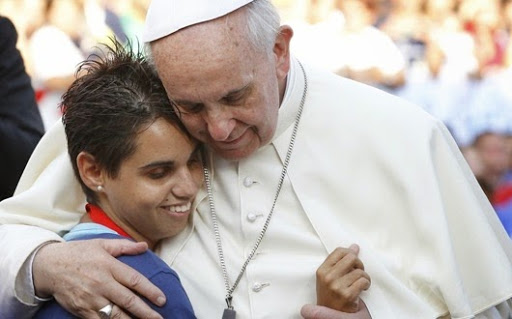
Francis hug

Today saw the first two sessions (“congregations” in Vatican-speak) of the two-week-long extraordinary bishops’ Synod on the family, and I would just like to pick out a couple what I saw as their highlights. First, however, it is worth going back to yesterday’s opening mass of the Synod, when Pope Francis had some warnings for his brother bishops, that clearly set the tone that he expects from the next two weeks’ work:

“The temptation to greed is ever present. […] Greed for money and power. And to satisfy this greed, evil pastors lay intolerable burdens on the shoulders of others, which they themselves do not lift a finger to move (cf. Mt 23:4)

We too, in the Synod of Bishops, are called to work for the Lord’s vineyard. Synod Assemblies are not meant to discuss beautiful and clever ideas, or to see who is more intelligent… They are meant to better nurture and tend the Lord’s vineyard, to help realize his dream, his loving plan for his people. In this case the Lord is asking us to care for the family, which has been from the beginning an integral part of his loving plan for humanity.

We are all sinners and can also be tempted to “take over” the vineyard, because of that greed which is always present in us human beings. God’s dream always clashes with the hypocrisy of some of his servants. We can “thwart” God’s dream if we fail to let ourselves be guided by the Holy Spirit. The Spirit gives us that wisdom which surpasses knowledge, and enables us to work generously with authentic freedom and humble creativity.”

This morning, more along good cop lines, his brief opening remarks then presented the method he would like participants to follow, which builds on clarity, openness, boldness (parrhesia) and tranquility:

“A basic general condition is this: to speak clearly. No one must say: “This can’t be said; he will think of me this way or that …” It is necessary to say everything that is felt with parrhesia. After the last Consistory (February 2014), in which there was talk of the family, a Cardinal wrote to me saying: too bad that some Cardinals didn’t have the courage to say some things out of respect for the Pope, thinking, perhaps, that the Pope thought something different. This is not good; this is not synodality, because it is necessary to say everything that in the Lord one feels should be said, with human respect, without fear. And, at the same time, one must listen with humility and receive with an open heart what the brothers say. Synodality will be exercised with these two attitudes.

Therefore, I ask you, please, for these attitudes of brothers in the Lord: to speak with parrhesia and to listen with humility.

And do so with much tranquillity and peace, because the Synod always unfolds cum Petro et sub Petro, and the Pope’s presence is the guarantee for all and protection of the faith.”

The first session then saw Cardinal Erdő present a 7.5K-word opening document – the “relatio ante disceptationem” – that is effectively the first follow-up to the “Instrumentum Laboris” in which the results of the preceding worldwide questionnaire were summarised. Erdő’s report is based on the written contributions made by the Synod Fathers ahead of the Synod’s opening and, together with the discussions that will last all this week and then in smaller groups next week, it will contribute to the final document that will be submitted to Pope Francis at the conclusion of this process.

As you’d expect, Erdő’s report broadly follows the structure of the Instrumentum Laboris, kicking off with an assessment of the challenges faced today on an individual level:

Many people today have difficulty in thinking in a logical manner and reading lengthy documents. We live in an audio-visual culture, a culture of feelings, emotional experiences and symbols. […]

Many look upon their lives not as a life-long endeavour but a series of moments in which great value is placed on feeling good and enjoying good health. From this vantage point, any firm commitment seems insurmountable and the future appears threatening, because it may happen that in the future we will feel worse. Even social relationships may appear as limitations and obstacles. Respect and “seeking the good” of another person can even call for sacrifice. Isolation is oftentimes linked, therefore, with this cult of a momentary well-being.

How this general disposition (which would not have come as a surprise to Aristippus or Epicurus some 2400 years ago) impacts the position and perception of marriage is addressed next, where there is a balance between challenges and the persistent beauty of the Church’s central teaching:

Avoiding marriage is seen as not only a sign of individualism but also a symptom of the crisis of a society already burdened by formalisms, obligations and bureaucracy. […]

The obligations arising from marriage must not be forgotten, but seen as the demands of the gift which the gift itself makes possible. […]

[The Church’s] teaching [on the family] enjoys a broad consensus among practicing Catholics. This is the case, particularly with regard to the indissolubility of marriage and its sacramental nature among those who are baptized. The teaching on the indissolubility of marriage as such is not questioned. Indeed, it is unchallenged and for the most part observed also in the pastoral practice of the Church with persons who have failed in their marriage and seek a new beginning.

Homosexuality, gender-based discrimination and gender theory get covered next, with a refreshing degree of frankness:

[T]here is a broad consensus that people with a homosexual orientation should not be discriminated against, as reiterated in The Catechism of the Catholic Church (2357-2359). Secondly, it is quite clear that the majority of the baptized — and all episcopal conferences — do not expect that these relationships be equated with marriage between a man and a woman, nor is there a consensus among a vast majority of Catholics on the ideology of gender theories. […]

[M]any want to see a change in the traditional roles in society which are culturally conditioned and in discrimination against women, which continues to be present, without denying, in the process, the differences by nature between the sexes and their reciprocity and complementarity.

The focus is then broadened to a societal level and an acute analysis of the external pressures incident on the family is presented:

We are not dealing with only problems involving individual behaviour but the structures of sin hostile to the family, in a world of inequality and social injustice, of consumerism, on the one hand, and poverty, on the other. Rapid cultural change in every sphere is distorting families, which are the basic unit of society, and putting into question the traditional family culture and oftentimes destroying it. On the other hand, the family is fast becoming the last welcoming human reality in a world determined almost exclusively by finance and technology. A new culture of the family can be the starting point for a renewed human civilization. […]

The widespread difficulty in creating a serene atmosphere of communication in some families is due to multiple factors: business and economic worries; differing views on the upbringing of children from various models of parenting; a reduction in time for dialogue and relaxation. In addition, there are disruptive factors like separation and divorce, with the consequences of a blended family, and, conversely, single parenting, where a relationship with the other parent is confused or limited, if not totally absent. Finally, this lack of communication can result from a widespread selfish mentality that closes in upon itself, with the disturbing consequence of the practice of abortion. The same selfishness can lead to the false idea of parents that children are objects or their property, who can be produced by them as they desire.

Then comes one of my favourite part, where the need for accompanying, for inclusion and for the proclamation of God’s fatherhood and the Church’s motherhood follows:

[T]hought needs to be given on how best to accompany people who find themselves in these situations [of marriage difficulty], so they do not feel excluded from the life of the Church. Finally, forms and suitable language needs to be devised to proclaim that all are and remain God’s children and are loved by God the Father and the Church as Mother. […]

Indeed, God never tires of forgiving the sinner who repents and he does not tire of giving him this possibility again and again. This mercy is not a justification to sin but rather the sinner’s justification, to the extent that he converts and aims to sin no more.

Mercy then gets the central place is requires, with a beautifully succinct paragraph:

Mercy, the central theme of the God’s revelation, is highly important as a hermeneutic for the Church’s actions (cf. Evangelii gaudium, 193 ff.). Certainly, she does not do away with truth nor relativize it, but seeks to interpret it correctly in the hierarchy of truths (cf. Unitatis redintegratio, 11; Evangelii gaudium, 36-37). Nor does she do away with the demands of justice. Consequently, mercy does not take away the commitments which arise from the demands of the marriage bond. They will continue to exist even when human love is weakened or has ceased. This means that, in the case of a (consummated) sacramental marriage, after a divorce, a second marriage recognized by the Church is impossible, while the first spouse is still alive.

Another highlight then is the following section, where the good that is there in civil marriages and even in some forms of cohabitation is called out. This is very much in the spirit of Evangelii Gaudium, where Pope Francis calls for a discernment of what there is of God in every context:

[A] new dimension of pastoral care of the family today reveals itself through considering the reality of civil marriages and, despite the differences, even cohabitation. Consequently, when these relationships are obviously stable in a publicly recognized legal bond, they are characterized by deep affection, display a parental responsibility towards their offspring and an ability to withstand trials and they can be seen as a seed to be nurtured on the path towards celebrating the Sacrament of Marriage. […] The Church cannot fail to take advantage of an opportunity, even in situations which, at first sight, are far from satisfying the criteria of the Gospel, and to draw close to people in order to bring them to a conscious, true and right decision about their relationship.

After an extensive coverage of how the challenges facing those who got divorced and civilly remarried, the report says something that I find tremendously positive and a great example of how we, Catholics, can also look to other Christian churches for inspiration:

The Instrumentum laboris relates that some responses suggest further examining the practice of some of the Orthodox Churches, which allows the possibility of a second or third marriage, marked by a penitential character (cf. 95). Examining this matter is necessary to avoid any questionable interpretations and conclusions which are not sufficiently well-founded. In this regard, studying the history of the discipline of the Churches in the East and West is important. Possible contributions might also come from considering the disciplinary, liturgical and doctrinal traditions of the Eastern Churches.

Finally, Cardinal Erdő’s report concludes with a crescendo:

If we look at the origins of Christianity, we see how it has managed — despite rejection and cultural diversity — to be accepted and welcomed for the depth and intrinsic force of its message. Indeed, Christian revelation has manifested the dignity of the person, not to mention love, sexuality and the family.

The challenge for this synod is to try to bring back to today’s world, which in some way resembles that of the early days of the Church, the attractiveness of the Christian message about marriage and the family, highlighting the joy which they give, but, at the same time, respond, in a true and charitable way (cf. Eph 4:15), to the many problems which have a special impact on the family today and emphasizing that true moral freedom does not consists in doing what one feels or living only by one’s feelings but is realized only in acquiring the true good.

In a real way, we are called upon, above all, to put ourselves alongside our sisters and our brothers in the spirit of the Good Samaritan (cf. Lk 10: 25-37): being attentive to their lives and being especially close to those who have been “wounded” by life and expect a word of hope, which we know only Christ can give us (cf. Jn 6:68).

The Gospel for families “as they are”

Modern family

The Catholic Church is in the process of preparing for two synods of its bishops – one this autumn and the other the following year – during which questions to do with the family will be reviewed. As a basis for the discussions, the Vatican has issued an initial preparatory document last November, whose most novel feature was an extensive questionnaire addressed to the bishops conferences of the world, but open to completion by anyone. The questionnaire spanned topics like whether Church teaching about the family was known, whether marriage preparation and care for families were effective, how difficult marital situations were dealt with, how same-sex unions were approached, how procreation was understood, plus an open question about any other family-related challenges.A questionnaire of this scale and openness is unprecedented, and three days ago, a summary of its results was published in the form of the “instrumentum laboris” (i.e., working instrument) that will be used during this year’s synod. The document, which weighs in at 25K words is very much worth reading in its entirety, since it – in my opinion – presents a very interesting, world-wide and above all utterly frank look at the life of the family at the beginning of the 21st century and the Church’s relationship with it. Rather than an analysis or commentary, I would first just like to share with you the passages that found most important and that effectively are my favorite 10% of the text (each passage is prefixed with the number of the paragraph it was taken from; note that – with one exception for the sake of the extracts’ logic – the following is in the same order as in the original text):

Part I: Communicating the Gospel of the Family in Today’s World

(2) [T]he divine measure of conjugal love, to which spouses are called by grace, has its source in “the beauty of the saving love of God made manifest in Jesus Christ who died and rose from the dead” (EG, 36), the very heart of the Gospel.

(4) The “true love between husband and wife” (GS, 49) implies a mutual gift of self and includes and integrates the sexual and affective aspects, according to the divine plan (cf. GS, 48-49). […] Christ the Lord “comes into the lives of married Christians through the Sacrament of Matrimony,” and remains with them. In the Incarnation, he assumes human love, purifies it and brings it to fulfillment. Through his Spirit, he enables the bride and groom to live their love and makes that love permeate every part of their lives of faith, hope and charity. In this way, the bride and groom are, so to speak, consecrated and, through his grace, they build up the Body of Christ and are a domestic Church (cf. LG, 11), so that the Church, in order to fully understand her mystery, looks to the Christian family, which manifests her in a real way.

(6) “marriage based on an exclusive and definitive love becomes the icon of the relationship between God and his people and vice versa. God’s way of loving becomes the measure of human love” (DCE, 11).

(35) “Marriage is the icon of God’s love for us. Indeed, God is communion too: the three Persons of the Father, the Son and the Holy Spirit live eternally in perfect unity. And this is precisely the mystery of Matrimony: God makes of the two spouses one single life” (General Audience, 2 April 2014).

(36) A recurring subject in almost all the responses is the importance of the Holy Family of Nazareth as the model and example for the Christian family. The mystery of the Word of God’s becoming incarnate within a family reveals how it is the privileged place for God’s revelation to humanity. In fact, the family is acknowledged to be the ordinary and everyday place to encounter Christ. The Christian people look to the Holy Family of Nazareth as a model in relationships and love, as a point of reference for every family and as a comfort in time of trial.

(39) The role of parents as primary educators in the faith is considered vital and essential. Emphasis is often placed on their witness of fidelity, particularly on the beauty of their individuality and at times, simply on the importance of their distinctive roles as father and mother. At other times, the responses stress the positive character of the spouses’ freedom, equality and reciprocity. Still other responses, especially from Europe, stress the equal importance of both parents in the upbringing of their children and domestic responsibilities.

(43) The family is essential in the maturation of those cognitive and affective processes which are crucial to personal development. In addition to being a vital environment in personal formation, the family is also the place to experience the awareness of being not only a Child of God but also called to a vocation of love.

(7) Faith is no refuge for the fainthearted, but something which enhances our lives. It makes us aware of a magnificent calling, the vocation of love. (LF, 53)

(11) The People of God’s knowledge of conciliar and post-conciliar documents on the Magisterium of the family seems to be rather wanting.

(13) Church teaching is more widely accepted, when the faithful are engaged in a real journey of faith and are not just casually curious in what might be the Church’s thinking in the matter of sexual morality.

(14) Ultimately, the responses and observations call for the need of establishing real, practical formation programmes through which the truths of the faith on the family might be presented, primarily to appreciate their profound human and existential value.

(15) the reason for much resistance to the Church’s teaching on moral issues related to the family is a want of an authentic Christian experience, namely, an encounter with Christ on a personal and communal level, for which no doctrinal presentation, no matter how accurate, can substitute. In this regard, some responses point to the insufficiency of pastoral activity which is concerned only with dispensing the sacraments without a truly engaging Christian experience.

(18) [V]arious episcopal conferences recall the importance of developing the insights of Pope St. John Paul II in his “theology of the body” series, in which he proposes a fruitful approach to the topics of family through existential and anthropological concerns and an openness to the new demands emerging in our time.

(24) Furthermore, much attention is given in the responses to the fact that what becomes established in civil law — based on an increasingly dominant legal positivism — might mistakenly become in people’s mind accepted as morally right. What is “natural” tends to be determined by the individual and society only, who have become the sole judges in ethical choices. The relativization of the concept of “nature” is also reflected in the concept of stability and the “duration” of the relationship of marriage unions. Today, love is considered “forever” only to the point that a relationship lasts.

(29) [T]his tendency accentuates the absolute right to personal freedom without any compromise: people are “formed” on the basis of their individual desires only. What is increasingly judged to be “natural” is more of a reference-to-self only, when it comes to their desires and aspirations.

(30) [M]ore emphasis [is to] be placed on the role of the Word of God as a privileged instrument in the conception of married life and the family, and […] greater reference to the Bible, its language and narratives [is recommended …] Moreover, this proposal insists on using language which is accessible to all, such as the language of symbols utilized during the liturgy. The recommendation was also made to engage young people directly in these matters.

(31) [T]he family is experiencing very difficult times, requiring the Church’s compassion and understanding in offering guidance to families “as they are” and, from this point of departure, proclaim the Gospel of the Family in response to their specific needs.

Part II: The Pastoral Program for the Family in Light of New Challenges

62. [I]n cases where the faith of family members is either weak or non-existent, both the parish and the Church in general are not seen as supportive. […] Often, when the lay faithful sense the great distance between the ideal of family living and the impossibility of achieving that goal, the couple’s crisis in marriage and the family gradually becomes a crisis in faith. Therefore, the question arises on how to act pastorally in these situations, namely, how to make sure that the Church, in her variety of pastoral activities, can demonstrate that she has the ability of caring for couples in difficulty and families.

64. [O]ne of the many critical issues facing the family is a difficulty in relationships and communication. Whether it be tensions and conflicts in a marriage due to a lack of mutual trust and intimacy or the domination of one marriage partner over the other or the inter-generational conflict between parents and children, all hinder the building of family relationships and can even make them entirely impossible. The dramatic aspect of these situations is that they lead to the gradual disappearance of the possibility of dialogue as well as the time and opportunity to work on relationships. For want of sharing and communication, each one is forced to face difficulties in isolation without an experience of being loved and, in turn, loving others. […] People who do not witness, live and accept love on a daily basis find it particularly difficult to discover the person of Christ as the Son of God and the love of God the Father.

66. The responses unanimously make reference to psychological, physical and sexual violence and abuse in families which has a particularly damaging effect on women and children, a phenomenon which, unfortunately, is neither occasional nor isolated, particularly in certain parts of the world. [… T]he responses also mention the appalling phenomenon of the killing of women, often caused by deep emotional trouble in relationships. Arising from a false culture based on possessions, this is particularly disturbing and calls for action by everyone in society and by the Church in her ministry to the family. Sexual promiscuity and incest in the family are explicitly cited in certain parts of the world (Africa, Asia and Oceania), as well as pedophilia and child abuse. The responses also refer to authoritarianism by parents, expressed in the lack of care and attention given to their children, a situation often leading to their children’s abandonment, and, on the parents’s part, a want of a sense of responsible parenthood which causes them to refuse to not only care for their children but also educate them, thereby leaving them totally to their own devices.

70. Increasing job insecurity, together with the growth of unemployment and the consequent need to travel greater distances to work, have taken their toll on family life, resulting in, among other things, a weakening of family relationships and the gradual isolation of persons, causing even greater anxiety.

71. In dialoguing with the State and the related public entities, the Church is called to offer real support for decent jobs, just wages and a fiscal policy favouring the family as well as programmes of assistance to families and children. In this regard, laws protecting the family in relation to work are frequently wanting, particularly those affecting working mothers.

75. Responses from almost every part of the world frequently refer to the sexual scandals within the Church (pedophilia, in particular) and, in general, to a negative experience with the clergy and other persons. Sex scandals significantly weaken the Church’s moral credibility, above all in North America and northern Europe. In addition, a conspicuously lavish lifestyle by some of the clergy shows an inconsistency between their teaching and their conduct. Some lay faithful live and practice their faith in a “showy manner,” failing to display the truth and humility required by the Gospel spirit. The responses lament that persons who are separated, divorced or single parents sometimes feel unwelcome in some parish communities, that some clergy are uncompromising and insensitive in their behavior; and, generally speaking, that the Church, in many ways, is perceived as exclusive, and not sufficiently present and supportive. In this sense, an open and positive pastoral approach is needed, one which can restore confidence in the institution through a credible witness by all her members.

80. “The Church is called to be the house of the Father, with doors always wide open, […] where there is a place for everyone, with all their problems” (GE, 47). […] The mercy of God does not provide a temporary cover-up of personal misdeeds, but rather radically opens lives to reconciliation which brings new trust and serenity through true inward renewal. The pastoral care of families, far from limiting itself to a legal point of view, has a mission to recall the great vocation of love to which each person is called and to help a person live up to the dignity of that calling.

89. Generally speaking, the responses from various places in the world devote attention to divorced and remarried persons or those, at least, who have formed a different union. Those living in such canonically irregular situations display various attitudes ranging from their being entirely unaware of their irregular situation to their consciously enduring the difficulties created by their irregular situation.

90. A rather great number of people give no thought to their irregular situation.

91. Before treating the suffering associated with those who are unable to receive the sacraments due to their irregular union, the responses refer to a more basic suffering which the Church must take in hand, namely, the suffering of a breakdown in marriage and the difficulty of regularizing the situation.

92. Some Church members who are cognizant that they are in an irregular situation clearly suffer from the fact that they are unable to receive the sacraments. Many feel frustrated and marginalized. Some wonder why other sins can be forgiven and not theirs. Others cannot see how religious and priests can receive a dispensation from their vows and priestly obligations so they can marry, while divorced and remarried persons are unable to receive Holy Communion.

103. Pastoral charity impels the Church to assist people who have suffered the breakdown of their marriage and are living with their situation relying on the grace of Christ. A more painful wound results when these people remarry and enter a state of life which does not allow them to receive Holy Communion. Clearly, in these cases, the Church must not assume an attitude of a judge who condemns (cf. Pope Francis, Homily, 28 February 2014), but that of a mother who always receives her children and nurses their wounds so they may heal (cf. GE, 139-141). With great mercy, the Church is called to find forms of “accompaniment” which can support her children on the path of reconciliation. With patience and understanding, she must explain to these people that their not being able to celebrate the sacraments does not mean that they are excluded from the Christian life and a relationship with God.

109. Generally speaking, pastoral care, preparation and planning of formation sessions prior to marriage are having a limited and uneven success everywhere. In almost every case, everything depends, for good or for ill, on the initiatives of each priest.

110. On unions of persons of the same sex, the responses of the bishops’ conferences refer to Church teaching. “There are absolutely no grounds for considering homosexual unions to be in any way similar or even remotely analogous to God’s plan for marriage and family. […] Nonetheless, according to the teaching of the Church, men and women with homosexual tendencies ‘must be accepted with respect, compassion and sensitivity. Every sign of unjust discrimination in their regard should be avoided’” (CDF, Considerations regarding Proposals to Give Legal Recognition to Unions between Homosexual Persons, 4).

113. Every bishops’ conference voiced opposition to “redefining” marriage between a man and a woman through the introduction of legislation permitting a union between two people of the same sex. The episcopal conferences amply demonstrate that they are trying to find a balance between the Church’s teaching on the family and a respectful, non-judgmental attitude towards people living in such unions. On the whole, the extreme reactions to these unions, whether compromising or uncompromising, do not seem to have facilitated the development of an effective pastoral programme which is consistent with the Magisterium and compassionate towards the persons concerned.

115. Episcopal conferences supply a variety of information on unions between persons of the same sex. In countries where legislation exists on civil unions, many of the faithful express themselves in favour of a respectful and non-judgmental attitude towards these people and a ministry which seeks to accept them. This does not mean, however, that the faithful give equal status to heterosexual marriage and civil unions between persons of the same sex.

Part III: An Openness to Life and Parental Responsibility in Upbringing

122. The Church is called to proclaim the fruitfulness of love in light of that faith which “helps us grasp in all its depth and richness the begetting of children, as a sign of the love of the Creator who entrusts us with the mystery of a new person” (LF, 52).

131. The responses recommend that the synod can be of assistance in rediscovering the deep anthropological meaning of the moral character of conjugal life, which beyond every type of moralism, appears as a true desire to live the beauty demanded by the Christian love between a man and a woman and given value by considering the greatest act of love which comes from laying down one’s life for a friend (cf. Jn 15:13).

132. “Parents are called, as Saint Augustine once said, not only to bring children into the world but also to bring them to God, so that through baptism they can be reborn as children of God and receive the gift of faith” (LF, 43).

137. In general, families participating in ecclesial movements are the most active in seeking to transmit the faith to newer generations.

138. [F]amilies with children who may be particularly affected by the so-called “irregular” situation of their parents deserve greater pastoral attention in Christian education. In this regard, words and expressions need to be used which create a sense of belonging and not exclusion, ones that can better convey the warmth, love and the support of the Church, so as not to generate, especially in the children and young people involved, the idea of rejection or discrimination against their parents, fully aware that “irregular” is a word applied to situations, not persons.

146. When parents, usually after an absence from the Church for some time, request from the ecclesial community the sacramental preparation of their children, the most recommended approach in all the responses is to readily accept them without making any distinctions. Receiving them with a basic attitude of respect, a friendly disposition and a willingness to listen to their human and spiritual needs creates a proper and beneficial atmosphere for communicating the Gospel message.

159. After examining the responses and observations and gathering from them not only the hopes and joys but also the griefs and anxieties, this work concludes by returning to the sources of faith, hope and charity, namely, the Blessed Trinity which is the mystery of absolute love, revealed in Christ and made accessible by the Holy Spirit. The love of God shines in a particular way in the Holy Family of Nazareth, the sure point of reference and comfort for every family. The Holy Family, the beacon of true love, is to be contemplated in every family situation so as to draw light, strength and consolation.

I have to say that this document makes me very optimistic and it does so for three reasons: first, the complete frankness of the assessment of today’s reality that doesn’t shirk either from pointing out failings of the Church or from recognizing a disconnect with regard to some aspect of her teaching (the entire document being evidence for this), second, the insistence on the importance of mercy and accompanying: “With great mercy, the Church is called to find forms of “accompaniment” which can support her children on the path of reconciliation.” (§103), and, third, that what is at stake here is not some rejigging of rules, but the very heart of men and women being called to love: “The pastoral care of families, far from limiting itself to a legal point of view, has a mission to recall the great vocation of love to which each person is called and to help a person live up to the dignity of that calling.” (§80). A consequence of these three features is, in my opinion, a chance for the upcoming Synod to bring the joy of the Gospel to families “as they are.”

Kasper’s family: the domestic church

City of churches 1918 1 jpg HalfHD

[Warning: long read]

Even though I only meant to translate from and comment on the first half of Cardinal Kasper’s talk at the extraordinary consistory of cardinals two weeks’ ago, I realized that its middle part – where Kasper focuses on the sacrament of marriage and then speaks about the family as domestic Church – has not received much coverage either (with all attention being directed at the two scenarios he sketched out that constitute a 5% of what he said …). With that in mind – and assuming you are interested in what follows, I would recommend you to take a quick look at the previous post, which covers the general framework in which Kasper then gives thought to how the family could be better welcomed by the Church.

Following the presentation of the principles of how the Gospel is to be understood, how the concept of a gift is central and how God places trust in man and woman and of the subsequent Scriptural exegesis both of the ideal and reality of the family, covered before, Kasper moves on to discuss why marriage is indissoluble:

“[T]he doctrine of the indissolubility of the marital bond […] persists also where, humanly, marriage breaks down. Many today have trouble with understanding it. This doctrine cannot be understood as a kind of metaphysical hypostasis beside or above the personal love of the spouses; on the other hand it isn’t fully accounted for by reciprocal affective love and doesn’t die with it. It is Gospel, or definitive word and permanently valid promise. As such, it takes humans and their freedom seriously. It is precisely due to human dignity that definitive decisions can be taken. These belong in a permanent way to the history of a person; they characterize it in a lasting way; it is not possible to take them back and pretend as if they had never been made. When they are broken, a deep wound results. Wounds can be healed, but the scar remains and continues to trouble; but one can and must continue to live even if that requires effort. Similarly the good news of Jesus is that, thanks to the mercy of God, those who convert can be forgiven, healed and start anew.”

Wow! I have never heard the indissolubility of marriage tied to freedom in this way, or to mercy. It is an understanding of faith like this that makes Pope Francis’ choice of Kasper very clear …

Next comes the passage where the family – based on the indissoluble bond of marriage – is likened to the Church and where Kasper introduces the “law of gradualness” that he then builds on in later parts of his talk:

“Just like the Church is on a journey of conversion and renewal, so marriage too finds itself on the way of the cross and of resurrection, under the law of gradualness of continuing to grow in ever new ways and greater depth in the mystery of Christ. This law of gradualness1 seems to me something of great importance for the life and for the pastoral care of marriage and the family. It doesn’t mean a gradualness of the law, but a gradualness, which means growth, in the understanding and putting into practice of the law of the Gospel, which is a law of freedom (James 1:25, 2:12),2 but which has today become often difficult for many of the faithful. They require time and patient accompanying along their journey.”

Next, Kasper outlines what he sees as the sources of the current crisis of the family:

“[T]he nuclear family, which developed only during the 18th century from the extended family of the past, has ended up in a structural crisis. Modern conditions of work and accommodation have resulted in a separation between accommodation, places of work and places where free time is spent and therefore have lead to a break-up of the home as the social unit. For work reasons, fathers are often away from the family for prolonged periods; women too, for work reasons, are often only partly present in the family. Due to current conditions being hostile to the family, the modern nuclear family finds itself in difficulty.”

What is the answer to these challenges? Is Kasper suggesting some sort of return to the pre-18th-century model? Not quite (and this was to be expected given his thoughts in the opening parts of the talk):

“What we need are extended families of a new kind. For nuclear families to survive, they need to be inserted into new family units that span generations and in which it is above all the grandfathers and grandmothers who take on important roles, into inter-familiar circles of close ones and friends where children can find refuge in the absence of their parents and where single old people, the divorced and single parents can find a kind of home.”

Kasper suggests that the above extended families and “circles” have hints of a “domestic Church” that he further elaborates on next:

“How to define these domestic Churches? They are a Church in miniature inside the Church. They make the local Church present in the concrete life of the people. In fact, where two or three meet in the name of Christ, he is in their midst (Matthew, 18:20). […] Through the Holy Spirit, they have the sensus fidei, the sense of faith, an intuitive sense of faith and of living according to the Gospel. They are not only object but also subject of pastoral care for families. Above all by their example, they can help the Church to enter more deeply into the word of God and to put it into practice in a way that is more full of life. Since the Holy Spirit has been given to the Church in its entirety, they mustn’t isolate themselves in a sectarian way from the broader communion of the Church. This “catholic principle” preserves the Church from disintegrating into single, autonomous, free Churches. Through such unity in multiplicity, the Church is also a sacramental sign of unity in the world.”

One thing that strikes me as important in the above is also how Kasper positions the domestic Churches – families as being important for the Church as a whole – even in core aspects like the growing understanding of the word of God. It is not like the Church in its entirety is putting itself into a position where it knows best and is the source of support for families. Instead, the relationship is very much reciprocal, which is further highlighted in the following passage, where Kasper also returns to the importance of accompanying those who suffer from the break-down of the family:

“Families need the Church and the Church needs families for the sake of being present at the center of life, where modern life takes place. Without the domestic Churches the Church is a stranger to the concrete reality of life. Only through families can it be a home where people are at home. Its being understood as domestic Church is therefore fundamental for the future of the Church and for the new evangelization. Families are the first and best messengers of the Gospel of the family. They are they way of the Church. […] Thinking about the importance of the family for the future of the Church, the rapidly growing number of broken families appears as an even greater tragedy. There is a lot of suffering. [… W]e must change the paradigm and must – like the Good Samaritan (Luke 10:29-37) – look at the situation also from the point of view of those who suffer and ask for help.”

It is only at this point that Kasper starts talking about the challenges of divorce and re-marriage and proceeds to sketch out two scenarios of how the Church could handle them differently. But, that will have to remain for another time. For now, let me just flag up one of Pope Francis’ morning sermons (from last Friday), where he again emphasizes the key in this context:

“When [… the] leaving [of] one’s father and mother, and joining oneself to a woman, and going forward … when this love fails – because many times it fails – we have to feel the pain of the failure, we must accompany those people who have had this failure in their love. Do not condemn. Walk with them – and don’t practice casuistry on their situation.”


1 As far as I can tell, this “law of gradualness” comes from John Paul II’s Familiaris Consortio (§34): “Married people too are called upon to progress unceasingly in their moral life, with the support of a sincere and active desire to gain ever better knowledge of the values enshrined in and fostered by the law of God. They must also be supported by an upright and generous willingness to embody these values in their concrete decisions. They cannot however look on the law as merely an ideal to be achieved in the future: they must consider it as a command of Christ the Lord to overcome difficulties with constancy. “And so what is known as ‘the law of gradualness’ or step-by-step advance cannot be identified with ‘gradualness of the law,’ as if there were different degrees or forms of precept in God’s law for different individuals and situations. In God’s plan, all husbands and wives are called in marriage to holiness, and this lofty vocation is fulfilled to the extent that the human person is able to respond to God’s command with serene confidence in God’s grace and in his or her own will.”” Although I also found it in the I Ching here, where it says: “[The] principle of gradual development can be applied to other situations as well; it is always applicable where it is a matter of correct relationships of co-operation, as for instance in the appointment of an official. The development must be allowed to take its proper course. Hasty action would not be wise.”
2 “But the one who peers into the perfect law of freedom and perseveres, and is not a hearer who forgets but a doer who acts, such a one shall be blessed in what he does.” and “So speak and so act as people who will be judged by the law of freedom.”

Kasper’s family: beauty in the battlefield

Comedy 1921 by Paul Klee 011

[Warning: long read – again.]

While the family is a constant and core feature of human existence that has the potential to strongly shape its members’ lives, the forms it takes today are more diverse than they have probably ever been. At the same time, the Church, at least seemingly, presents a single one of the many alternatives in practice today as the ideal and even penalizes the others. This, undoubtedly results in distance being put between the Church and those whose family lives don’t conform to its ideals, which is a serious problem for the Church, whose mission is to be close to all.

As a result, Pope Francis has put a process in motion to study the current situation of the family and explore ways of the Church being more open and welcoming, while at the same time – and here lies the true challenge – remaining faithful to Jesus’ teachings and the prompting of the Holy Spirit. The form taken by the process are two bishops’ synods – one this year and one next year – where the subject will be discussed and proposals put to the Holy Father for approval. To begin with, a questionnaire has already been circulated to dioceses around the world, in which both priests and lay faithful were asked to provide feedback on a wide variety of questions to do with the family in a broad sense. Many of these surveys have already concluded, with some bishops’ conferences even choosing to publish their result that so far consistently show a gap between Church teaching and practice by the Church’s members. An unsurprising result, but one whose openness and honest is nonetheless a positive sign.

Beyond the questionnaire, the next significant step taken by Pope Francis has been to ask Cardinal Walter Kasper to prepare an address to the extraordinary consistory of cardinals that took place in the Vatican two weeks ago. The resulting two-hour talk was greatly praised afterwards by Pope Francis, by referring to his work the next day as “doing theology on one’s knees.” The first thing to note here is that Cardinal Kasper is not in any formal way related to the family – he is neither in charge of the Pontifical Council for the Family nor the Congregation for the Doctrine of the Faith, whose heads would have been the obvious choices if the criterion had been about formal scopes or responsibilities. Instead, Francis picks one of his favorite theologians (as he said already during the first Angelus after his election) – a retired Cardinal, who had previously been in charge of working towards Christian unity and who has played important roles in improving relationships with Jews. Second, it is worth being aware of the fact that Kasper’s speech was initially not meant for publication and was instead intended only for the cardinals present at the consistory. Nonetheless, ten days after he delivered it, and following extensive media coverage of its summary and some leaked passages, the full text is now available in Italian.

Instead of attempting a detailed commentary on Kasper’s words, I would like to focus on passages from the opening parts of his speech, where he lays out the basic principles and reflects on what is immutable versus what can (and has been) changed during the Church’s long history as far as the family is concerned. Kasper then proceeds to sketch out two ideas of what could be done differently for civilly remarried divorcees – if that is what you are interested in, there has been plenty of coverage of their details, and an English translation of the relevant passages is available here.

To my mind those two proposals are the least interesting part of Kasper’s thought, since, as he states from the outset, his aim is only to provide a “kind of overture that leads towards the theme, in the hope that in the end we will receive a sym-phony, or a harmonious whole of all the voices in the Church, including those that at the moment are partly dissonant.” Kasper wants to set the scene and provide a framework in which all can come together.

The first, to my mind beautiful and lucid, insight regards an understanding of what the Gospel is and of how it relates to the Church’s teaching:

“The Gospel, believed in and lived by the Church, is the source of all truth, of salvation and of practice. This means that the teaching of the Church is not a stagnant lake, but instead a torrent that springs from the source of the Gospel, in which flows the experience of faith of the people of God of all the ages. It is a tradition that is alive and that today, as on many other occasions during the course of history, has arrived at a critical point and that, in view of the “signs of the times,” requires continuation and deepening.

What then is this Gospel? It isn’t a legal code. It is the light and strength of life that is Jesus Christ. It gives what it asks for. Only in its light and in its strength is it possible to understand and observe the commandments. […] Without the Spirit that works in our hearts, the letter of the Gospel is a law that kills (2 Corinthians 3:6).1 Therefore the Gospel of the family does not want to be a burden, but instead, as far as being a gift of faith, an uplifting news, light and strength of the life of the family.”

The second cornerstone is about the nature of the sacraments and their interdependence with faith:

“The sacraments, including that of marriage, are sacraments of faith. […] The Second Vatican Council [… says about the sacraments:] “They not only presuppose faith, but […] they also nourish, strengthen, and express it.” (SC 59) The sacrament of marriage too can become efficacious and be lived only in faith. Therefore, the essential question is: how is the faith of the future spouses? […] Many persons are baptized but not evangelized. Put in paradoxical terms, they are baptized catechumens, if not baptized pagans.”

These may sound like harsh words – and they are! – but I believe they, sadly, express a widespread reality whereby there is broad lack of understanding about faith among Catholics.

The third opening consideration brings together the dynamism of the Gospel and the indispensability of faith, and relates them to how God participates in our lives:

“God is a God of the journey: in the history of salvation he has journeyed with us. Today he has to walk the Earth again with the persons of the present. He doesn’t want to impose faith on no one. He can only present it and propose it as a way of happiness. The Gospel can convince only by means of itself and by its profound beauty.”

In summary, I see Kasper as setting a scene in which the Gospel is a source of joy, where it is through faith and with open eyes that it guides and delights the followers of Jesus. It is not to be imposed, nor is it to be read as a rule-book, and taking its consequences out of context is lethal.

Next, Kasper proceeds to lay out the basic principles of the ideal family, all by reference to the first book of Genesis:2

  1. “God created mankind in his image; in the image of God he created them; male and female he created them.” (Genesis 1:27) Here Kasper focuses on the relationship between man and woman and on it being based on the concepts of love and gift: “Man and woman are given as gifts by God one for the other. They have to complement and sustain each other, delight each other and find joy in each other. Both, man and woman, inasmuch as they are image of God, have the same dignity. There is no room for discrimination against the woman. But man and woman aren’t simply equal. Their equality in dignity is based on creation, just like their diversity. […] The equal dignity of their diversity explains the attraction between the two […] Wanting to make them equal on ideological grounds destroys erotic love. The Bible understands this love as union for the sake of becoming one flesh, which means one community of life, which included sex, eros and human friendship. In this complete sense, man and woman are created for love and are an image of God, who is love (1 John 4:8). […] When a partner deifies the other and expects that they prepare heaven on earth for them, the other necessarily feels that too much is being asked of them; they can do nothing but disappoint. Many marriages fail as a result of such excessive expectations. The community of life of man and woman, together with their children, can be happy only if they see each other as reciprocal gifts that transcend each one of them.”
  2. “God blessed them and God said to them: Be fertile and multiply” (Genesis 1:28) Kasper’s focus here is on God’s trust: “Responsible parenthood has a more profound meaning than that which is usually attributed to it. It means that God entrusts the most precious gift he can give, which means human life, to the responsibility of man and woman. The can decide responsibly the number and timing of the birth of their children. They have to do it responsibly in front of God and by respecting the dignity and the good of their partner, responsibly with regard to the good of their children, responsibly in view of the future of society and while respecting human nature. The result though isn’t a casuistic, but instead a form whose specific putting into practice is entrusted to the responsibility of man and woman. They are given the responsibility over the future. The future of humanity passes through the family.”
  3. “[F]ill the earth and subdue it” (Genesis 1:28) becomes interpreted by Kasper as a call to filling the world with a culture of love: “These words are not meant as submission or violent domination. The second creation account here speaks about cultivating and caring for (2:15). […] With this cultural mission, the relationship between man and woman transcends them again. It isn’t mere sentimentalism that revolves around oneself; it mustn’t close itself in on itself, but open itself towards a mission for the world. The family is not only a private community of persons. It is the fundamental and vital cell of society. […] It is fundamental for the birth of a culture of love and for a humanization and personalization of society, without which it would become an anonymous mass. In this sense it is possible to speak about a social and political role of the family.”

The family, as presented here by Kasper, is an exciting and grand participation, of humans as God’s partners, in the life of God, which is called to bringing love both ad intra and ad extra.

As soon as Kasper presents the ideal of the family, he is quick to point out that this ideal is “not the reality of the family [and that …] the Bible knows it.” The root cause is that “the alienation of man from God has as its consequence alienation in man and among persons,” which also projects onto the family:

“The first alienation happens between man and woman. They experience shame, one in front of the other (3:10). This shame demonstrates that the original harmony between body and spirit has been disturbed and that man and woman are alienated from one another. Affection degenerates into desire and domination of man over woman (3:16). They reproach and accuse each other (3:12). Violence, jealousy and discord creep into marriage and the family.”

Kasper also points out that the marital infidelities that the Bible recounts are even part of Jesus’ family tree, which “includes two women (Tamar and Uriah’s wife) who are considered sinners (Matthew 1:3). Jesus too had ancestors who didn’t come from a “good family,” and whom it would have been preferable not to speak about. The Bible here is very realistic, very honest.” He then goes on to warn against a distorted, idealized view:

“When we speak about the family and about the beauty of the family, we mustn’t start from an unrealistic, romantic image. We must also see the hard realities and participate in the sadness, the worries and the tears of many families. Biblical realism can in fact offer us a certain consolation. It shows us that what we lament is not something of today and that it has always been like that. We mustn’t give in to the temptation of idealizing the past and then, as happens in many cases, see the present merely as a history of decadence.”

To conclude his reflection on the family, which starts out from the ideals derived from Genesis, chapter 1, and then proceeds through the failures catalogued in both Old and New Testaments, Kasper finishes on a positive note, again derived from Scripture:

“In the end, the third chapter of Genesis kindles a light of hope. Throwing man out of paradise, God gave him hope for accompanying him on his journey. That which tradition defines as the protoevangelium (Genesis 3:15), can also be understood as the protoevangelium of the family. From its descendants a Savior will be born. The genealogies of Matthew and Luke (Matthew 1:1-7; Luke 3:23-28) witness that from the sequence of generations, even with its jolts and jerks, in the end a Savior is born. God can write straight even along crooked lines. Therefore, when we accompany people along their journeys, we mustn’t be prophets of doom, but instead bearers of hope, who offer consolation and who, even in difficult situations, encourage people to go ahead.”

The picture here is very much of hope with eyes wide open and of pursuing a great ideal even in the midst of failure and weakness. In the second half of his talk (that’s right – the above are just a couple of pieces from the first half!), Kasper then proceeds to look at how the various painful situations that families find themselves in can be approached, with a focus on how those who got divorced and the subsequently civilly re-married could be accompanied and included. Since this second half of Kasper’s talk is receiving good coverage in the media, I will limit myself to the above framework that I translated from the Italian full text and commented on above. To give you a sense of where Kasper is going in the second half of his talk, let me just quote one line from it: “The Church must be a home for all, in which all must be able to feel at home and like in a family.” Amen!

[UPDATE (4 March 2014): I have changed my mind and have continued with translating passages from and commenting on the second part of Kasper’s talk here. There he takes us through his analysis of the indissolubility of marriage, of the causes of the breakdown of the nuclear family and proposes the domestic Church as the way forward.]


1 “[W]ho has indeed qualified us as ministers of a new covenant, not of letter but of spirit; for the letter brings death, but the Spirit gives life.”
2 Here he is in good company with John Paul II’s “theology of the body” whose conclusions are also well reflected in Kasper’s thought.

Marriage and the family

Rothko3

I am married and am immensely grateful for being part of several families: the family I was born into (since, even though I am a first child, my parents were a family already before I was born or even conceived), multiple extended families, and the family my spouse and I form with our children. And that’s only as far as biological ties go. I am also a member of the Church – the family of Jesus and (some of) his followers. In many ways I also consider the relationship I have with close friends to be like that with brothers, sisters or parents and I strive to extend this circle whenever and with whomever possible.

What is it that is so special about the family? I believe it is the fact that it mimics the relationships of the persons of the Trinity, where each loves the others without limits and with complete self-noughting,1 to the extent that the three become one. In my families I have often experienced love that is selfless, self-sacrificing, generous, gratuitous and unconditional and that invokes Jesus’s promise: “For where two or three are gathered together in my name, there am I in the midst of them” (Matthew, 18:20). This love makes the family a place of peace, trust, safety, stability, openness, growth and joy and a place where I can most fully be myself. I can rely on the support and love of other family members and also on their desiring only the best for me. I don’t have to look out for myself, as it is the others who look out for me and I can instead focus on them and on others. My families have also been safe havens that have protected me from state-organized oppression, from the negative influence of others, from erroneous tendencies of my own and that have also looked after me in illness, bad moods, uncertainty and fatigue.

Is this to say that there are no challenges with living in a family? Certainly not, since even though the model is perfect, its instances are often not, even to the point of breaking. Does that make the model any less worthy of following? I don’t think so, since even when not lived to perfection, the ideal of the family provides a clear direction of what to aim for.

For me, as a Christian (and for others too), the foundation of a family – its birth, is in marriage, where the spouses each make an indissoluble gift of themselves to one another, which they do in front of God and which they aim to sustain with His help and in His presence. The day I got married was one of the sacred, lived in great simplicity (I remember polishing shoes in the morning and sending a couple of emails to close friends who couldn’t be with us and being filled with great joy and a delicious lightness of being,2 not even to mention the rest of the day that you would expect to be joyous). The years that then followed and persist into the present have been filled both with everything I said about the ideal of the family and with challenges, trials, difficulties and suffering. To me, as a Christian, these too are very much part of being married and of living in a family, just like they were very much part of Jesus’ life. They are always an opportunity to recognize Jesus’ presence and to start again to seek forgiveness, forgive and love and I am deeply grateful to God for my spouse, children, parents, siblings and all with whom I have family-like relationships.

There would be a lot more to say, but I believe I managed to give an idea of why marriage and the family matter to me. This reflection was very directly motivated by many recent pronouncements by different representatives of the Church who have spent paragraphs upon paragraphs talking about what threatens the family and how it needs to be opposed and which have always left me wondering: ‘But what is it about the family that you see worth protecting? How do you see the things you oppose as threatening? [beyond stating them as such] And what positive proposal can you make as an alternative to the ones you oppose?’ I am not saying that opposition alone isn’t worthwhile, but it is very much a level zero approach and I was certainly hoping for more. The closest I have seen to an acknowledgement of this trend is a statement made two days ago by Archbishop Diarmuid Martin:

“The Church’s social doctrine must always be animated with charity and must be accompanied by charity and will only really be understood through the lens of charity. When the Church’s organizations simply become lobbying bodies alongside other lobby organizations or social commentators alongside other social commentators then they loose their real originality and therefore their original contribution to the debate about the formation of society.”

This is exactly what I have been looking to hear from many others and I hope that Archbishop Martin will follow up this call to a focus on love and apply it to the various issues being so hotly debated these days.

Lest I be misunderstood in a way that is most repulsive to me, let me be explicit about one thing: I believe there is the potential for good in all human relationships, regardless of who their protagonists are or what their status is. What I have said about the family and about marriage was in no way meant as suggesting that the things which I value about it cannot also take place under other circumstances. In no way do I mean to suggest that the family built on marriage has a monopoly on all the good that it is capable of. Compassion, commitment, selflessness, caring, support and love are the potential of any human relationship and my seeking them in the context of my family, and the marriage it is built on, is in no way a declaration of inferiority or inadequacy with respect to other forms of life.

Finally, I do see a big challenge that the Church (i.e., me too!) faces, which is to find a way for all, who want to, to participate in its life. Cardinal Martini in his last interview gave a clear example: “A woman is abandoned by her husband and finds a new companion who is concerned for her and her three children. The second love succeeds. If this family is discriminated against, not only the woman, but her children, too, will be cut off.” Cardinal Woelki said that he tries to “acknowledge that [homosexuals] take responsibility for each other on a permanent basis, have promised each other faithfulness and want to look after each other, even though [he] cannot endorse their life choices.” And there are many others like them! What is very positive in my eyes is that there are representatives of the Church, who feel the presence of gaps that ought not be there and even though I don’t see how the gaps will be closed (without throwing the baby out with the bathwater either), I trust God will help us find a way to make everyone feel welcome in His Church.


1 Thanks to my bestie, CS, for coining this term, which I believe expresses the extent of the love the Persons of the Trinity have for one another spot on.
2 The antithesis of its unbearable variant, so beautifully described by Kundera though.